The One Way to Save Obamacare

I spent some years of my life being paid to give political advice.  My advice, like nearly everyone else’s, was accepted some times and not others; when it was accepted, it was successful some times and not others.  And when they stopped paying me, I stopped giving advice.

Today, however, as I contemplate the possible loss of the U. S. Senate to Republican control, I feel the need to give some advice.  Michael, Harry, and Barack…listen up!

You know who Barack is, of course.  I think he ought to be concerned because his legacy is at Obamacare 3stake.  He wanted his legacy to be the achievement of a new and glorious era of nonpartisan or bipartisan or post-partisan political cooperation.  We all know that didn’t happen and some of us feel it could not have happened.  Even as a hope, it was unrealistic.  Of course, electing a young and little-known black man to the presidency of the United States didn’t seem all that realistic either, at the beginning, so I think we can all be forgiven for hoping too much.

Still, when the Republicans made the decision that utter intransigence was their ticket back to power, that dream died quickly.  I don’t claim that Sen. McConnell, of Kentucky, was a large part of that Republican intransigence, but it is his expression of it that I remember best.  Sen. McConnell, the top Republican in the Senate, said that his number one legislative priority was to insure that Barack Obama was a one-term president.  That was what he wanted to do as a Senator!

President Obama persisted and with some dazzling cooperation from Speaker of the House, Nancy Pelosi, and President of the Senate, Harry Reid, the Patient Protection and Affordable Care Act was passed: Obamacare.  That is his legacy issue.  And why is control of the Senate such a fraught issue?  Because without it, President Obama is all that stands in the way of a full roll-back of the greatest contribution he has made to his country.  Nobody thinks the House of Representatives is going to pick up enough Democrats to regain majority control.  That would require that the current 207 Democratic members of the House are all re-elected and that ten more Democrats be added—all this in an off-year election when the party holding the White House ordinarily loses seats.

Obamacare 1That brings us to the U. S. Senate, which brings us to Harry Reid, the President of the Senate.  If he wants to continue to be President of the Senate, he needs to get the votes of 51 senators—one of them could be Vice President Joe Biden if the Senate divided 50/50, but no one wants that.  We are going to do some seat counting now and when you do that, you have to trust someone.  I’m putting my money on Larry Sabato.  You can find him at www.centerforpolitics.org and see his “Crystal Ball” for yourself. According to Sabato, Republicans currently “have” 49 seats, if you count as “Republican” all the states that are safely R, that are “likely R” and that “lean R.”  The Democrats currently “have” 48 seats if you count all the states that are safely D, that are “likely D,” and that “lean D.”  The remaining three are called “toss-up” states[1].  If the Democrats win all three, Harry Reid gets to continue to be President of the Senate.

And whose job is it to deliver those three seats to Democratic control?  Michael Bennett of Obamacare 4Colorado.  Sen. Bennett is Chair of the DSCC—the Democratic Senatorial Campaign Committee.  He takes over from Patty Murray of Washington, who dumbfounded observers by keeping the Senate Democratic during her year as Chair of the DSCC in 2012.  It is his job to elect Democratic Senators to those three states.  The three states are Alaska, Louisiana, and North Carolina.  They are the “toss-up” states this year.

So here’s my advice to Barack, Harry, and Michael.  This is, contrary to my history, unsolicited and uncompensated advice.  Flood those states with recipients of Obamacare.  Establish special phone lines.  Send volunteers to their doors.  Give them a ride to the offices where they may sign up in person.  Turn the justly famous “Obama ground game” loose on people who could, if the Democrats keep their eye on the ball, be enthusiastic Obamacare supporters by November 4.

Why?

There are lots of ways to turn out voters.  The urban machine bosses paid them; politically oriented churches have demanded it as “an act of faith;” districts got new construction projects to pave the way.[2]  But there is only one way to get a Democratic victory in those three states in a way that ensures Obama’s legacy and that is to make Obamacare the issue and win on that issue.  That’s Obamacare  2what I want the Obama ground game for.  I want the Republican candidates in those three states—and let’s toss in Montana, South Dakota, Arkansas, and West Virginia, who are poised to move from the Democratic column to the Republican column in November—to face voters who have just been given a priceless gift and I want the Republican candidates to campaign on taking it away from them.  The general campaign is already nasty, as you see here, but I want particular candidates to have to say this.
Here’s why I like that strategy.  Americans have never been united behind any health care plan at all.  The support for “a health care reform” is high, but for any particular one, low.  A Gallup poll on February 4, showed 51% of Americans opposed to Obamacare and 41% in favor.  Put that division on one side.  On the other side, put the conservative battle cry that the government keep their hands off my Medicare.  Hello?  “Government Medicare” is the only Medicare there is.  Once voters take a kind of government program to be part of their lives—it is now “my program,” the program I am entitled to—they resist having it taken away from them.  That’s the heart of this strategy.  Change the question from “Is Obamacare a good thing?” to “Are you going to allow the Republicans to take away your healthcare services?”

I want every Republican candidate in these seven states—the three toss-ups and the four “trending Republican—to face audiences full of people who now have healthcare benefits they never had before and I want them to have to argue, “If you elect me, I will vote to take those benefits away from you.”  Similarly, I want every Democratic candidate to have to argue that Obamacare will be safe if you elect enough Democrats.  The fact is that in some states, Arkansas and Louisiana, for instance, the Democratic candidate might be tempted to run against Obamacare on the grounds that it is not currently popular among the voters of that state.  Filling the audiences with recent recipients of Obamacare will be a useful corrective to that tendency to stray.

And finally, this legislative strategy united Barack, Harry, and Michael.  Michael and Harry might want a Democratic majority in the Senate however it might be achieved.  Anti-Obamacare Democrats in conservative states and pro-Obamacare Democrats in liberal states would be the same thing for them.  It would not be the same for President Obama.  He needs for the election to be about Obamacare and he needs a Democratic majority in the Senate that will support, clarify, and extend the measure.  So a strategy like mine united Barack, Harry, and Michael and I am arguing that is a good thing.

I’m not a big fan of Obamacare myself and if there were other options, I am sure President Obama would say the same.  There were a lot of things he wanted that didn’t make it into the law.  On the other hand, if it is accepted by more and more Americans, it can be made a better law over time.  A defeat of Obamacare—and that is what a Republican Congress, Senate and House, would mean—would be catastrophically bad.

So, guys, here’s my advice.  It is worth every penny you paid for it.


[1] In the House, of course, they are called “toss-up districts.”

[2] There are ways to shape the electorate by making it easier for some to vote and harder for others, of course.

Posted in Politics | Tagged , , , , | Leave a comment

On Having a Miserable Job

Isn’t it just amazing what we learn to be satisfied with?

We think, sometimes, that living the way we do is inevitable.[1]  Or we think that doing what we would have to do to live otherwise would be wrong or just that it would be too much work.  But however it might be explained, you know a lot of people live in situations that could be a great deal better if they would choose to make them better.

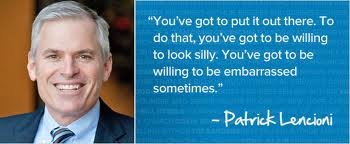
I have an example, as you probably expected.  This is from a book called Three Signs of a  miserable 3Miserable Job.[2]  My son, Dan, recommended it to me and then it turned out that I liked it even more than he did; or at least for different reasons.  The story is told by a man who has substantial skills as a manager—big time, small time; it doesn’t seem to matter—and who applies these skills to a run-down Italian restaurant in Nevada.  This guy doesn’t look all that miserable, but pictures of drive through windows aren’t all that easy to find.

“Brian” is the character representing the management perspective of author, Patrick Lencioni.  This is a very brightly told tale and I was reading along, enjoying it without paying a great deal of attention, until I came to this passage:

Brian is meeting with the staff, preparing to begin the magic overhaul.  He says, “I’m here to tell you that my job is to get you to like your jobs; to look forward to coming to work.”  Harrison, one of the employees, says, “Is there something in it for us?” 

Does that strike you as odd?  I think I would have puzzled about it for a while.  Very likely, I would have dumped it all over the Northwest Corner Caucus at Starbucks the next few mornings.  Brian was outraged!

How about not being miserable?  How about making your life a little better and having pride in your work?  Don’t you think that would be a good thing for you and your family and friends?  Or do you enjoy having the life sucked out of you every time you put on that damn Gene and Joe’s T-shirt?

That’s the passage that woke me up.  All these guys hate coming to work.  They hate working here.  Spending every day doing something they don’t like rather than doing something else or doing it in a way they would enjoy more, doesn’t seem to occur to them.   Now let’s back up a little.

Brian asked them at the first staff meeting

“How many people here get excited about coming to work?  How many of you are in a really good mood when you’re driving here?”

Patty said, “Well, I’ve got three little kids at home, so I’m just excited to get out of the house.  But I’d rather not be coming here.”

And Carl added, “I actually get kind of depressed when I wake up on Thursday mornings, because I know that I’m going to be here a lot for the rest of the week.”

The job is bad.  It is depressing.  But it is the way it is.  Nothing about it suggests that it could or should be otherwise.  And in this story, it never occurs to anyone that it could be otherwise.

Brian got to wondering how people with this attitude came to work at Gene and Joe’s, so he put the question to Joe, the owner. 

“So turnover’s a problem,” asked Brian.  Joe nodded in exasperation.

“Why do you think?”

“Heck if I know.  Most of these people aren’t exactly go-getters, if you know what I mean.”

Joe constructs the problem so that is flows naturally from the character of the employees.  To me, that puts Joe in the same category as Patty and Carl.  Here’s a really bad restaurant run by people who don’t want to be there and run by an owner who thinks it is the character of the people he hires that best explains why the place is so depression.  It is also, by the way, not making any money.

miserable 4The piece of Patrick Lencioni’s tale that so grabbed my attention is that the idea of having a meaningful job had to be sold to the restaurant workers.  Brian said, for all practical purposes, I can make your jobs meaningful and engaging and the employees replied, for all practical purposes, why would we want that?  Or maybe, we don’t believe you.  Or maybe, we don’t know how to do that anymore.  Or maybe, but all our friends have jobs like this one and they aren’t complaining.

I tell you what it did remind me of, though.  In Martin E. P. Seligman’s work on “learned helplessness,” he dealt with dogs that had learned that there was nothing to be done.  In all fairness, it is true that the dogs were exposed to electric shocks while being leashed on the shocking end of the cage.  That’s how they learned that nothing could be done.  Then Seligman and his associates took the leash off.  Nothing happened.  The dogs lay on the floor and accepted the shocks because they were knowledgeable dogs; they were experienced dogs; their experience had taught them that nothing could be done.

That puts the dogs at the same place the restaurant workers are when Brian says, “I’m here to tell you that my job is to get you to like your jobs; to look forward to coming to work.”  The good news for the dogs is that they could be retrained—it takes a long long time—so that when the light comes on indicating that the shock is near, they take off for the non-shocking end of the cage.  The good news for the employees at Gene and Joe’s Italian Food is that Brian persuades them to try the new system and it brings them to life.

My great hope is that if I ever get stuck presupposing the meaninglessness of what I am doing and assenting to it, that I will be jarred awake by remembering that it really doesn’t have to be that way.

And while I’m at it, I hope that for you, too.


[1] Words are just so much fun.  Back behind inevitable—way, way back behind it—is a verb “to evite,” which means “to shun.”  I strongly suspect that the people who took the e- from electronic and the vite- from invitation to create evite either didn’t know the earlier word or just didn’t care.  I am more likely to get an evite to a large gathering than I am to be invited by email or phone.

[2] It was written by Patrick Lencioni, who subtitled it, “A Fable for Managers (and their employees)”  Lencioni is president of The Table Group, a management consulting firm specializing in “organizational health.”  His part in the story is played by “Brian.”

Posted in Paying Attention, Political Psychology | Tagged , , , | Leave a comment

Orthopathy. Really.

On November 16, 2008, Jason Walter, a first year student at the Institute of Reformed Baptist Studies, led a discussion on Louis Berkhof’s Summary of Christian Doctrine.  I had never heard of Jason or of the Institute of Reformed Baptist Studies, but I claim him as a colleague today because he has stumbled over the want of a word and has regained his balance by inventing one.  My kind of guy.

The following note was written by “admin,” it says on the site.  It gives two looks at what the term orthopathy might mean.  Here’s admin:

Jason did not claim to have coined the term, but his use of it was especially appropriate. Curious of its origin, I checked the Oxford English Dictionary and did not find it…Maybe we need to begin to employ the term so that it will become a part of theological discourse

Sadly, it also seems to be a term used by Quacks to describe a kind of natural hygiene therapy. If you’re interested, just Google the term and look at the results. I don’t know if this use of the word would argue against a theological use–I wouldn’t want to give the idea that we support quackery!

When I googled the word,[1] having failed to find it in the OED, I found this:

Another word for Natural Hygiene is orthopathy. Dr Herbert Shelton, who wrote several books on orthopathy, says: “orthopathy comes from the Greek, Orthos, erect, regular, right, correct; and Pathos, to suffer. The word means Right or Correct Suffering, and is intended to convey the thought that when one is sick, his condition is governed by law as truly as when he is well.

I am certain that Dr. Shelton is the “quack” that admin was concerned about.  I don’t care all that much about Dr. Shelton’s alleged quackery, but I really don’t think he has the right to steer perfectly common Greek words into his own private field.  I’m really more on Jason Walter’s side of this one.

The Greek prefix ortho-, for instance, is pretty common.  It doesn’t just mean “straight,” the way an orthodontist would mean it.  It also means straight as in “going straight,” which is the way criminals used to describe their aspirations for a life after crime.  Or, as the OED says, it is used, sometimes, “in the ethical sense of ‘right, correct, proper’,” which is the use Jason and I have in mind.

Similarly the Greek pathetikos means “sensitive.”  It does derive, I don’t deny it, from pathos, orthopathy 1which means “suffering,” but etymology is just where you came from and lots of words, especially English words, have emigrated to other lands entirely.  The OED defines pathetic as “producing a stirring effect upon the emotions; exciting the passions or affectations; moving, stirring, affecting.”  And then, even better, “in modern use: affecting tender emotions; exciting a feeling of pity, sympathy, or sadness, full of pathos.”

I think a perfectly plausible and fully usable meaning of orthopathy would be, “having the right feelings,” and that is the way I want to use it.  There are two ways of defining just what feelings are “the right feelings,” but I’m going to turn that job over the Berkeley sociologist Arlie Russell Hochschild, author, most notably, of The Managed Heart.  The job left for me to do is to say how I want to use it and to reaffirm my appreciation of Jason Walter.

If orthopathy meant what Jason and I want it to mean, it would mean “having the right emotions.” orthopathy 3 I came to it by noticing the abyss between orthodoxy—having the right beliefs—and orthopraxy—taking the right actions.[2]  If you will set aside for the moment any question of just what “the right things” are, it will make sense that a person believes that certain things are true and has the emotions that his culture thinks ought to be associated with those beliefs, and that he does the things that those beliefs and those feelings impel him to do.

The ideal of personhood in the First Century C.E. was very integrated.  Persons were thinking-feeling-acting beings.  If you believed something, according to this notion, you acted in accordance with what you believed.  If you didn’t act the belief out, you probably didn’t have it.  Here’s a passage from James 2: that has always made me chuckle.

19You believe in the one God—that is creditable enough, but even the demons have the same belief, and they tremble with fear. 20Fool! Would you not like to know that faith without deeds is useless?

“Orthodoxy without orthopraxy?” says James.  Are you nuts?  The demons are perfectly orthodox and believing what they believe will do you just as much good as it does them unless you join it to the properly entailed practices.  Orthodoxy flows naturally, James thinks, into compassion, generosity, and social action.

Somewhere during and after the Enlightenment, we took those apart so we could study them separately.  It should not surprise you, for instance, to learn that there are sub-disciplines of sociology called: sociology of the emotions, cognitive sociology, and practical sociology.  But the scientific study of human beings has moved, lately, in the direction of fitting them back together.  We study and write about the effect of behaviors on emotions and cogitions; the effects of emotions on behaviors and cognitions; and the effects of cognitions on emotions and behaviors.

It’s like a family reunion.  Welcome home, everybody.

orthopathy 4Arlie Russell Hochschild is the writer I have trusted most about how emotions are socially managed.  Her  book, The Managed Heart was an in-depth study of Delta Airlines flight attendants—people who smile for a living.  Tucked into that book was a chapter on “repo men,” who take back from people goods they are using, but have not paid for.[3]  These are men who are required to scowl for a living.  The materials I am dealing with today come from “Two Ways to See Love,” Chapter 6 of Hochschild’s The Commercialization of Intimate Life: Notes from Home and Work.

She begins by postulating that for every cultural setting, there is a set of understandings that might be called “an emotional dictionary.”  Here’s what she says about it.  She cites a distressed bride whom she interviewed for The Managed Heart as saying, “This is supposed to be the happiest day of my life…”  Then she says:

The sociologist is not focusing on emotion, per se, injury or repair, but on the cultural and social context of individuals, healthy and injured alike.  Part of that context is a culture of emotion.  What did the bride expect or hope to feel before she felt what she felt?  She tells us, “I wanted to be so happy on our wedding day.  This is supposed to be the happiest day of one’s life.”

To expect or hope to feel a certain feeling, the bride had to have a prior idea about what feelings are feelable.  She had to rely on a prior notion of what feelings were “on the cultural shelf,” pre-acknowledged, pre-named, pre-articulated, culturally available to be felt.  We can say that our bride intuitively matches her feeling to a nearest feeling in a collectively shared emotional dictionary.[4]

It isn’t just a dictionary though, according to Hochschild.  It is also a kind of Bible.

“…what does the bride believe she should feel?  She is matching her experience not only to a dictionary but to a bible.  Our bride has ideals about when to feel excited, central, enhanced, and when not to.  She has ideas about whom she should love and whom not, and about how deeply and in what ways she should love…Does love loom larger for our bride than it does for her groom?  Or does she now try to make love a smaller part of her life, as men in her culture have tried to do in the past?  What are the new feeling rules about the place of love in a woman’s life?

Orthopathy, in the dictionary metaphor, is a set of “right feelings” based on the feelings that are orthopathy 2available in her culture—the ones everyone knows about; the ones she could talk about to her friends.  Orthopathy is also, in the Bible metaphor, a set of “right feelings” based on what she things she personally ought to feel, or that a woman in her situation ought to feel.  This isn’t just choosing from the buffet of possible emotions, which is what her society gives her; it is also matching how she does feel to how she thinks she ought to feel.

So I come to orthopathy not so much to spite Dr. Shelton—you remember, the quack?—as to address the logical void between orthodoxy and orthopraxy.  Jason and I hope you will find this reason compelling.


[1] Many years before admin did, I will say.

[2] Both of which actually are in the OED, in case you were wondering.

[3] Leading to one of my favorite jokes.  Question: What happens when you fall behind in your payments to the exorcist?  Answer: You get repossessed.

[4] Or, as Sheryl Sandberg, of Lean In fame, said in today’s New York Times, “you can’t be what you can’t see,”

Posted in Love and Marriage, Theology, ways of knowing, Words | Tagged , , , , , | Leave a comment

Robert Dahl, R.I.P

Robert Dahl died this week at the age of 98.  The man loomed over political theory before, during, and after my years as a political scientist.  When I began reading political science, Who Governs? Democracy and Power in an American City was the book to cope with.  When I was teaching undergraduates in the tumultuous  1970s, it was After the Revolution? Authority in a Good Society.  In 2007, long after I had retired, he wrote On Political Equality, which I will need to read now because it turns out that at the end of his life, he was writing about things I still care about.

I always liked Robert Dahl.  He approached his work the way a craftsman does.  He seemed alwaysRobert Dahl 3 to be drawing on a considerable breadth of social experience.  I never read a line until today about how many different things he had done, but now that I know about some of them, I can imagine it was those experiences that kept him from formulating narrow brittle questions, the way so many of his colleagues did.  The obituary in the New York Times (here) says that he “worked on the railroad and as a longshoreman during the summers and became a socialist and union advocate. The experience helped inspire him to study the effects of political power on average people.”

It also says that “after earning his Ph.D., he worked for the Agriculture Department and two agencies handling wartime industrial production. He then relinquished his draft deferment and joined the Army as an infantryman. He fought in Europe and earned the Bronze Star with oak cluster.  After the war ended, he was assigned to an Army unit charged with “de-Nazifying” the German banking system.”

Railroad worker, longshoreman, socialist, union advocate, bureaucrat, infantryman, international bank reformer.  Yeah, I can see why the way he formulated questions never seemed narrow and brittle.

The Political Science Department at the University of Oregon was politically radical when I was there.  Joe Allman, my dissertation adviser used to say that he used to be liberal and then the cops beat him up at the Democratic convention in Chicago in 1968 and that helped him reconsider whether liberalism was really going to do the job.  Dan Goldrich, with whom I worked closely during my time at Oregon, was so unimpressed by Dahl’s best known work—Who Governs?—that he and two colleagues spent quite a few years and burned through several cohorts of grad students writing an alternative methodology called The Rulers and the Ruled: Political Power and Impotence in American Communities.[1] Not surprisingly, it came to different conclusions as well.

Robert Dahl 1Saying nasty things about Robert Dahl was one of the major activities of graduate students during the time I was there.  I never objected to critiques of his methodology or to differences with his conclusions, but during my years at Oregon, I heard his word referred to as “political pornography.”  It was the 1970s and a lot of intemperate things were being said, but that one always seemed to me out of bounds.

After the Revolution?  For some reason it made my students at Westminster College angry too.  Actually, I think he was trying to make students angry with that one.  Dahl disposed of the revolution that was being called for during that decade—this was the “bring the mother down” revolution[2]—by beginning his book with the premise that the revolution was over and that it had succeeded in a thorough and orderly transfer of power.  “Now what?” he asked.  It turns out that “Now what?” was not a question being asked by the radicals, many of them students, who were active in “the movement.”  Dahl’s point was that all the difficulties of maintaining an open polyarchy (his term for a government of overlapping and distinct elites) would be in your in-box on the first work day after the revolution and that some thought needed to be given to how to proceed.  As I said, it made students angry, but I think he really wanted it to.

I don’t know anything Amazon doesn’t know about his recent work, except that I am going to buy it and read it.  Here’s what a reviewer says about it:

“In conclusion, Dahl assesses the contemporary political landscape in the United States. He looks at the likelihood of political inequality increasing, and poses one scenario in which Americans grow more unequal in their influence over their government. The counter scenario foresees a cultural shift in which citizens, rejecting what Dahl calls “competitive consumerism,” invest time and energy in civic action and work to reduce the inequality that now exists among Americans.”

I find it hard to believe that “competitive consumerism” is going to work, but it does sound like Dahl and it sounds attractive to me.  If you’ve been reading this blog, you know that the extremes of inequality we have reached in the United States have been troubling me.  See this link to a January post I wrote complaining about it.

I’ll miss Robert Dahl.  I haven’t kept up with what he was writing toward the end of his life, but I am quite sure that it was organized around interesting questions and that it was written in a gentle and attractive prose.  He was a huge part of my whole professional life and his death has got me thinking about it.


[1] Here is my laugh for the day.  Amazon lists this book with two titles—one containing a typo.  The mistaken title is The Rules and the Ruled, instead of The Rulers and the Ruled.  The mistaken title is actually what I studied at Oregon.  Dan was very much in the “rulers and the ruled” camp, but he set that aside to help me with the very different work I was trying to do.  I’ll send this to Dan when I finish it.  He’ll get a kick out of it.

[2] You can get a little peek at what that was like in Robert Redford’s movie, The Company You Keep.  Redford plays the part of a radical who got out of the movement and lived in genteel obscurity for decades until he was named and located by a former member of his group.  Then, “the company you keep” became his problem and the plot of the rest of the movie.

Posted in Getting Old, Political Psychology, Politics | Tagged , , , , | Leave a comment

Valentine’s Day 2014

I do love Valentine’s Day.  It has taken me awhile to get there, but I am there now.

Valentine 4I started having trouble with Valentine’s Day in elementary school.  It was our practice that everyone was to get valentines from everyone else.  Since these “valentines” came by the gross and sold for pennies per heart, that wasn’t as financially extravagant as you might think.  My problem wasn’t the financial extravagance; it was the emotional extravagance.  These valentines said the most preposterous things!  They said “Will you be mine?”  I tried to think of what that would mean to Bruce Motter or Larry Butts or John Zimman.  They would overlook it, I thought, since they had to give out valentines their mothers bought at the same store, probably from the same clerk, where my mother bought mine.  On the other hand, I also had to give valentines that said “Be my special valentine” to Jayne Dennis and Donna Humphries and Marylyn Hendricks.  Would they understand that I didn’t mean anything by it?  Would they be opposed to being my special valentines?  Or worse—would they like the idea?

It was hard.  Eventually, I rebelled.  I refused point-blank on the grounds that it offended my eight-year-old dignity and my precious but rigid autonomy.  My mother baked cookies for me.  They said nothing at all and both boys and girls liked them.

Then I remember a period of time when my kids went through the valentine machine.  I don’t remember that any of them had trouble with it.  I remember feelings of obligation about the “celebration” of Cupid’s Day that date from this period, but it’s all fuzzy.  Probably that’s a good thing.

The next era is crystal-clear in my mind, but knowing what caused what is a little dicey.  I had aValentine 2 new valentine by then (Marilyn) and a new home (Oregon) and a new relationship with my kids and stepkids (older and perfectly capable of handling Valentine’s Day on their own, thank you very much).  So for me, Valentines’s Day wasn’t all that much.  Marilyn was my very own dear valentine, but neither of us cared in the slightest for Valentine’s Day.  I think we might still have been in that anti-institutional phase where NOT celebrating Valentine’s Day was the thing to celebrate.

Valentine’s Day was always the kind of event where you are leaving a meeting you aren’t allowed to talk to the press about and someone sticks a microphone in your face and asks you to say something.  The demand that you say something is what confronts you.  It isn’t at all that you have something you want to say.

I don’t think I got more romantic, necessarily, after Marilyn’s death, but I did become less anti-institutional.  It might even be that I started looking for some way to celebrate Valentine’s Day before I had a valentine to celebrate it with.  In any case, when I finally met Bette, it was already late January and only two weeks until Valentine’s Day.  Not counting our first date—just coffee at Starbucks—we had had only two dates by then and Valentine’s Day was coming up and I didn’t  know how to use it to say to Bette the kind of thing I was beginning to think I might want to say.

Valentine 3So late on the evening of Valentine’s Day, I showed up at Bette’s condo with a present for her.  Pretty daring for an old man, but in the sixty years since I rebelled against elementary school valentines, I had acquired a sense of myself and a willingness to go down swinging if necessary.  Bette knew that I was a baker, so I assembled a little spelt flour, a little graham flour, a little white flour, and a little rye flour and put them in separate plastic bags and held the four bags in my hand the way you would hold a bouquet.  When she answered the door, I said, “I don’t know you very well yet, so I don’t know what your favorite flowers are.  But I did bring you these—they are my favorite flours.”[1]

And then three really good things happened.  That’s not bad, when you consider how many bad things could have happened.  The first is that she got the joke.  That probably meant more to me than it should have but I was already starting to think serious thoughts about us and you don’t want to live the rest of your life with someone you have to explain jokes to—especially if your jokes aren’t any better than mine.

The second good thing is that she liked it that I had thought about her in the context of Valentine’s Day.  It’s a very formal sort of flirtation, but it does move in the direction of saying “Be my Valentine” and I think Bette liked it that I took the chance when it presented itself.

The third good thing is that when I left, she thanked me “for the flowers.”  There’s a difference.  Valentine 5Trust me.  I know that flowers and flours are homophones and I know you could argue that there is no difference you can hear in the pronunciation of the two words.  It isn’t true.  When she looked up at me—looked me right in the eye—and said, “Thank you for the flowers,” I knew what she meant and I knew that she meant for me to know.  “Wow,” I said to myself as I walked back to the parking lot, “there are probably more women who would like to do that than there are women who know how and this one nailed it on the fly in one try.”

The day coming up will be our ninth Valentine’s Day—the eighth since that first one—and I come to it with a whole new appreciation for what the occasion offers to me.  This is not at all like leaving a meeting and having a microphone stuck in your face.  This is like wanting very much to say something and having the microphone handed to you.

Last year, Bette was in Germany on Valentine’s Day and I made up a packet of cards for the days before and the days after and packed them in Bette’s luggage with instructions to Bette’s daughter to take charge of the package and to give each one to Bette on the day marked on the envelope.  It was a wonderful Valentine’s Day for us.  Bette is one of the best receivers of gooey sentiments I know and if I have ever made a mistake in appreciating her on Valentine’s Day, she has found a way to turn that mistake into something good. 

And that’s why I like Valentine’s Day.  There is something I really want to say and this day gives me a stage, a special setting, that helps me say it.  And the audience is small, but very receptive.  So it’s a really good day.  I can hardly wait.


[1] I have been told that there is a current movie in which Will Farrell makes that joke.  I probably did it better and I certainly did it first.

Posted in Getting Old, Living My Life, Love and Marriage | Tagged , , , | Leave a comment

Belonging to the Narrative


As a rule, I am pretty sensitive to attributing personal traits to impersonal objects.  You can tell, I am sure, that I am going to suspend that today and you are right, but let me illustrate it first.  It is a commonplace of literary study to talk of an “interaction” between the reader and the text.  I’ve never liked that.  I am not affecting the text in the slightest.  It is “affecting” me, but it is not “acting on” me because it is not acting.  I have never liked to hear people say they have been “blessed” unless they believe that someone has blessed them—ordinarily some notion of God is the presupposition is such a statement.  If they believe that God has blessed them, I am fine with that, too.

But today, I want to talk about “belonging to a narrative.”  I am going to grant myself that latitude because I want to contrast it to “constructing a narrative.”  Everyone who has raised children knows the difference.  There is a family project and you need a story about why it is important to do this or why right now or why just this way.  You and your wife huddle up in advance—in my experience, not very much in advance—and concoct a story.  The children “accept” the story.  They may not” believe” it because it may be entirely fanciful and they know that it is the density and the coherence of the symbol system that matters, not the empirically verifiable facts.[1]  You and your wife don’t believe it at all because you made it up.

narrativeThe children belong to the narrative.  The story about how Uncle Brian sprouted wings and got to the lake before us is affected by all the other things you know that they don’t know.  Abraham Lincoln was shot by John Wilkes Booth; Hannibal crossed the Alps with elephants; William the Conqueror was known by many as William the Bastard before his military successes of 1066 CE.  Oh, and Uncle Brian can fly when he feels the need.  People who know things you don’t about Hannibal and William might know things you don’t about Uncle Brian.

These children accept the constraints of the stories you give them.  Some are true in the historical sense; some are “true”—well-constructed—in the narrative sense.  The children live within these narratives and in that sense, “belong to them.”  You and your wife do not.  You built the narrative for a certain occasion, using the conventions you and the children have settled on, and you will change any part of it that doesn’t work.  Actually, Uncle Brian can fly only on weekends.  The energy he needs to activate the wings is drained off by the demands of his job during the weekdays.  That’s why he couldn’t come today.

So there are narratives that belong to you and narratives you belong to.   Take this one, fornarrative 3 instance.  Do you think this narrative belongs to him or do you think he belongs to it?

Yesterday, I watched a really wonderful TED talk. [2] My brother, Karl, passed it along with his recommendation and we like a lot of the same kinds of things so I watched it.  It was wonderful.  Amanda Bennett’s talk is called “We need a heroic narrative for death.”  She was talking about the experience she and her husband had of planning the actions they would take during the time he was dying of cancer.

As she looks back on that time, she thinks that she and her husband chose a much more aggressive and more expensive medical strategy than they should have.  Why did they choose this strategy?  It was the strategy that fit the narrative they were living in.  They wanted to do this right; this, their last battle together.  They wanted to defeat death in a heroic struggle or to succumb in a heroic struggle.  They were committed, to say it another way, to heroism in the face of this trial and all-out war against this disease is the way the heroic narrative led them.

Being committed to the heroic narrative, they committed themselves to the decisions and actions that narrative required of them.  (You see now why I needed to introduce this by making “the narrative” capable of taking action.)  We could have done it differently, says Mrs. Bennett.  We would have done it differently if we had had another heroic narrative at our disposal.

narrative 2I think Amanda Bennett knows more than most of us about “living within the narrative.”  She and her husband lived within the narrative to which they belonged.[3]  She also wants a better narrative.  She is committed to heroic narrative, but she is open to another kind of heroism.  She is not satisfied, as she looks back on it, with “denying death.”  It was a doomed narrative, win or lose, but she doesn’t have another one.

The TED talk gets as far as her understanding that she needs another one and there are few lines of a poem that suggest a direction she and her husband might have taken and that she, herself, might take.  It isn’t a poem I know and even if it were, I wouldn’t know how to build a narrative from it.  But can you really live within a narrative you know you have created yourself?  I don’t see how.

Remember how “Uncle Brian sprouted wings and got to the lake before us?”  That really worked for the kids.  It worked because it was a whole narrative framework when they first encountered it.  They belonged to it, even if they were just believing it for fun.  Had they said, “No, not wings.  Let’s make it…a virtual rocket…and he downloads it and rides it to the lake…um…and then sends it back to the Cloud.  Yeah…back to the Cloud.”  You really have to like those kids.  I do.  But they do not belong to this new narrative.  It belongs to them.  They made it take shape.  They changed it to meet their needs.  And because they did that, there is one need it will not meet—they cannot belong to it.

I think that is what will happen to Amanda Bennett.  I think she will devise a new heroic narrative.  She will call it a better narrative and it might be better.  But the bitter paradox is that when you make ‘em the way you like ‘em, they won’t carry you anywhere you want to go.

What is better?  For society, I think it would be better if parents and teachers began assembling stories around a gentle and generous leave-taking.  If those stories, the ones the parents told and the ones the teachers read to them, were the narrative into which the children came when they first began to wonder about death, it would be the narrative they belonged to.  Maybe Amanda Bennett’s grandchildren or great-grandchildren.

I don’t think that would do it for me.  I do like the gentle leave-taking Mrs. Bennett is talking about, but that seems like a tactical response and I would feel that I was still short a strategy.  It would be, to revert to the narrative metaphor, instructions on how the narrative should be read—“tell it gently and don’t rush”—rather than what the narrative is.  I have always been drawn to St. Paul’s reflection in 2 Timothy 4: “I have finished the race; I have kept the faith.”

If you know that passage, you know that “I have fought the good fight” precedes it.  Paul relied on all kinds of athletic images.  The Greeks loved “their games” and Paul may have been a three-sport man himself.  I am not a fighter, so although I resonate to “fighting the good fight” in the life of Paul, it doesn’t mean much in the life of Dale.  I am, on the other hand, a runner and a teacher and I have known for many years that the English word curriculum comes from the verb currere, “to run.”  A curriculum is, in fact, the course that is set out for the race to take, so when I say that I have finished the race, I have a marathon course in the back of my mind.

For me “finishing the race” and “keeping the faith” are pretty much the same thing.  It’s like being sent to the store for a dozen eggs.  The goal is to get back home again AND to bring the eggs with you.  That is, after all, why you went to the store.

I didn’t choose that narrative from all the options on the buffet table.  It would belong to me if I did that.  I didn’t make it up either, because it would belong to me if I did that.  This is the one I belong to.  I have lived within it all my life and I am grateful that it has chosen me.


[1] I phrased it that way because I think those are the elements that actually matter in effective narratives, not because those are the words the children would have used to explain it to themselves.

[2] TED is “technology, entertainment, design” and can be found at TED.com.  Some of the best and most succinct explanations of new ideas I have ever heard, I have heard there.

[3] You might feel the itch to change that to “in which they belonged” (I did), but notice that the “in” phrasing takes agency away from the narrative and you can see why I wouldn’t want to do that.

Posted in Getting Old, Living My Life | Tagged , , | Leave a comment

Two Cheers for the Community of Loiterers

Here is today’s dilemma.  I don’t really know what to do about it.  That’s why it gets only two cheers.

THERE’S an old Italian saying, “A tavola non si invecchia,” which means: At the table, you don’t grow old.” All of us, of whatever age, need to socialize in public places to feel connected and alive. That sense of shared conviviality was notably absent recently when police officers removed loiterers, many of them elderly Korean-Americans, from a McDonald’s restaurant in Queens.

That’s from Stacy Torres’s column in the New York Times for January 22, which you can check out here.  Right away, you can see that “shared conviviality” and “loiterers” point in different directions.  This is not a logical problem; this is a policy problem.  That is, there is no question that Cafe Plus 1loiterers can experience and enjoy conviviality; there is only the question of whose table is being used and whether the people whose table it is can afford to have it used by loiterers.

This is one of those odd discussions—odder than we might wish—where one piece of the argument takes place in the front room and the other piece in the back room.  Here’s the back room piece.  It costs Starbucks $2.31 per table per hour to provide a table (I’m just making up the numbers).  If Starbucks can make $2.31 per table per hour, it can heat the building, employ the staff and make a profit.  There is no shortage of potential locations for Starbucks stores—although in New York City last fall, Bette and I could sometimes see three Starbucks stores from where we stood–so the question for Starbucks is whether they want to have a store here; here in this particular place.  Making less than $2.31 sends a No message to management; making more than $2.31 sends a Yes message.

In the front room, the conversation is entirely different.  Here’s a letter from a reader responding to the article.

Older patrons may test the limits of public dawdling, but this phenomenon — call it loitering or community building — is essential for the survival of many people 65 and older. According to the last census, seniors constitute 12 percent of New York City’s population. Many of them are single, sometimes far from family, and have lived in their localities for decades, their entire lives even. For the past four years, I have studied how neighborhood public places help older Manhattan residents avoid isolation and develop social ties that offer support, ranging from a sympathetic ear to a small emergency loan.

Cafe Plus 3Let’s say that the facts here are all true and that the point  they raise is important.  In the front room, we talk about how important it is for the elderly to have access to a place where crucially necessary services can be received.  In the back room, we talk about whether a Starbucks at this location should be closed down on the grounds that it is losing money.  People in the front room are showing a lot of compassion toward old people.  People in the back room are looking at profitability.  What can we do to join these two conversations?

We could ask someone to write a piece about it and stick it on a blog, I guess.

I don’t think we ought to be asking for profit companies to forego profits so they can provide much-needed social services.  That doesn’t make any sense to me.  I would be willing, from an ethical, not an economic, standpoint to ask a company to make less profit in order to provide these services.  How much less?  I don’t know: some.

Here are some lines that define the field of play for this issue.  Just as customers are free to go to Cafe Plus 4one store or another, stores are free to go to one location or another.  Just as customers are free to take action on their own behalf—sit ins, slow downs, spilling, pickets—so stores are free to take action.  They could raise the prices or change the seating or adjust the store hours.  It’s all very symmetrical.  But Starbucks could also call the police and there’s nothing symmetrical about that.  The law is on Starbucks side, so far as the rights of property and the requirements of public safety are concerned and that means, when push comes to shove, that the police are on Starbucks side as well.

The contest we need to have will take place on that field of play.  But then…don’t we have arrangements for social services that are crucially necessary but that don’t pay for themselves?  Aren’t there public parks?  Can’t you engage in “community building” in the parks?  Sure you can when the weather allows it, but what about winter time?  Heated parks?  You could call them malls, if that would help.  Some of the articles talked about Café Plus, which is being tried in some cities.  Take a look.

I honestly don’t see the merit of asking businesses that are doing what they are doing so they can make money to do things that lose them money.  That may be simpleminded, but that’s how I see it.  I would love to see a big time social democracy, along the lines of the democracies of Europe, established in the U.S.  That’s a preference, not a prediction.  That active political classes in the U.S. want no part of a safety net that actually works and that is paid for with general revenues by the national government.  On the other hand, Americans are famous for hybrid projects of various kinds.  I could see the government buying some capacity from a Starbucks or a McDonalds or a Burger King.  This is money they would get as long as they continue to serve as de facto gathering places for classes of people who would not otherwise have a place of their choosing.[1]  I have no idea how the money would work out, but the principle would be the same as buying social services from “faith-based” organizations or from public schools.[2]

It would represent an ill-defined path between two clearly rejected options.  Sound just like us, doesn’t it?


[1] Old people do not seem to congregate in age-segregated senior centers when they have a choice.

[2] A very high profile Oregon educator used to campaign for adding more social services to the public schools on the basis of a principle he called “habeas kiddus.”  You have the kids, he said, so you get the services they need.

Posted in Getting Old, Politics, sociability | Tagged , , , , , | Leave a comment

Such a Boy Scout

I was a Boy Scout in my younger years.  Scouting didn’t make much sense to me, but it was at a Boy Scout 1time in my life when nothing much made any sense, so I don’t really blame them.  But you remember the oddest things.  I remember, for instance, learning that a scout is trustworthy, loyal, helpful, friendly, courteous, kind, obedient, cheerful, thrifty, brave, clean, and reverent.  A lot of the scouts in my troop didn’t check off all 12 every day—I didn’t, certainly—but I was sitting in memorial service last week and all 12 of them came back to me, in order, as if I had been saying them every day for the intervening 60 years.

Those were unquestionably good traits, as I saw them then.  But then I grew up.  Worse yet, I went to grad school.  And then I developed an appetite for seeing the meanings of words in the context of their language of origin.[1]  So now, when I look at the list of Boy Scout aspirations, I think thoughts that would not have been possible for me then and that would make me a poor choice for scoutmaster now.[2]

I wonder, for instance, about the “traits.”  What is a trait?  This list of characteristics of a Boy Scout was adopted in 1911.  The whole collection is called “the Boy Scout Law,” which seems quite daring to me.  These are a law?  Wow!  In 1937, Gordon Allport published the study of traits, for which he was best known.  I think it would be fair to say that this way of thinking about people was presupposed in 1911, but was under serious study by 1937.  A substantial criticism of “traits” as a good way to think about what people are likely to do was offered by Walter Mischell in 1968, so I think we can no longer say that traits are presumed by the people who study them although they come in very handy in coffee shop conversations.

So, what is a trait?  Well, trustworthiness, (the first of the two desirata to come to us from Old Norse—thrifty is the other) is a trait.  It means that I can be trusted.  I am trustworthy.  But what if I am, like most people, absolutely trustworthy in this circumstance, probably trustworthy in that circumstance, and a poor bet in some other setting.  Am I trustworthy?

Or, to ask the same question another way, are “traits” a good way to think about what people will do?  Would it be better to look at the settings first?  Say I am a former smoker.  What are the odds that I will continue to refrain from smoking when I go to the old hangouts and spend time with the guys I used to smoke with?  Not good, I would think.  The chances are better if I make new (nonsmoking) friends and go to new settings to spend time with them. 

Let’s look at helpful.  Would you expect me to “help” someone who needed help?  Yes?  So I’m “helpful.”  Would you expect that I would provide: a) the help I think this person needs or, b) the help he wants,  presuming that he might want something different?  Am I helpful in both cases?  And in our time, “enablers” are thought to be bad people so I can say I am helping this person and you can say I am only enabling her to do something she will regret.  Am I helping?  Or let’s say that supporting a person in his efforts to chart his own course is “helpful,” apart from whether he makes good or bad decisions.  Do you want to say it is “unhelpful” if his decisions don’t work out?  I don’t think you do want to say that.

Helpful turns out to be complicated.  Let me tell you that friendly and reverent aren’t any better.

Further, some trait names just beg the question.  Loyal is good, I suppose.  Loyal to whom?  Are some loyalties good and others bad?  Is “loyal” good and “disloyal” bad?  If the law wants you to take one course and your family needs for you to take another course, where does “loyalty” push you?  Just asking.

Now I don’t expect any of these nasty questions to be resolved by looking at the language of origin, but I do think that we can look at these words more carefully and more usefully be seeing where they were before they came to us.  We don’t need, in other words, to accept the cultural contexts in which their meanings were clarified, but it is probably a good idea to know what they are.

I’m going to start with the Old Norse trait names first –trustworthy and thrifty.  Then I’ll move to the Old English names—helpful, friendly, kind, cheerful, and clean.  And I’ll finish up with Latin, mostly arriving here through forms adopted by the French—loyal, courteous, obedient, brave (through Italian), and reverent.  I plan to take a year doing this, so you can afford to get comfy.


[1] All English words are immigrants.  There appears to have been a sort of linguistic Ellis Island where words wanting to become part of the English language, stopped and declared the land of their origin and possibly the land from which they came just before arriving here.

[2] In the intervening years, most of my contact with the Boy Scouts as come from Boy Scouts of America v. Dale, in which the Supreme Court slapped the Boy Scouts on the wrist for claiming that the first amendment rights of free speech could be stretched to their denial of troop leadership to gay scoutmasters.

Posted in Living My Life, Words | Tagged , , , , | 2 Comments

The Growing Middle Class

I remember when the Democratic Party was the champion of “the poor.”  I always thought it was pretty gutsy to champion a set of people based on their economic status—especially the class of people that votes at lower levels than any other category of voter. After that came “the marginalized.”  I knew they meant the same people, but this word had that magic –ized ending on it which means that something has been done to these people.  They were victims.  If, after all, these people have been marginalized, then there are marginalizers—the bad guys—who can be vilified and  perhaps even defeated.

For several election cycles now, the Democrats have been the champions of “the middle class.”  I never really believed that.  I always thought that it was just a new and more respectable name for the downtrodden, the traditional Democratic icon.  I’m sure the idea of choosing “the middle class” as the favored class has something to do with the fact that the vast majority of Americans think they are part of that class.  Take a look at this chart.

middle class 1

If you combine middle class and upper middle class, you come up with 55%.  If you include the working class, and they largely do include themselves when they are asked what class they belong to, you get 86%.  That’s a lot of people who think of themselves as middle class and that’s one major reason the Democrats have made themselves the official guardians of the well-being of the middle class.

A part of the larger political message is that American economic well-being rests on having access to a middle class that can afford to make purchases.  Take a look at that sentence.  Read it twice. Remember where you saw it.  We are going to come back to it shortly.

Robert Reich, in his recent book Aftershock: The Next Economy and America’s Future, begins with the insight of Henry Ford.  Ford paid his workers outrageously well.  The Wall Street Journal called Ford’s pay scale “an economic crime.”  Ford’s idea was that if he paid his workers enough to buy Ford cars, he would sell a lot of Ford cars, and so he did.

Reich characterizes the thirty years from 1947—1975 as “The Great Prosperity.”  Everything worked.  Productivity grew, wages and salaries grew, safety net protections grew, unions were strong, increasing numbers were attending college.  Then we started doing things wrong and for the next thirty years—which included Reich’s turn as Secretary of Labor—all those advances began to retreat.  Here is his summary:

To summarize: The fundamental problem is that Americans no longer have the purchasing power to buy what the U. S. economy is capable of producing. ..What’s broken is the basic bargain linking pay to production.  The solution is to remake the bargain.

And, on the next page:

The question, then, is to move from a vicious cycle to a virtuous one—how to restore the widespread prosperity needed for growth and how to get the growth necessary for widespread prosperity.

It is true beyond question that American companies cannot thrive unless they can sell their products at a profit.  But nothing in that scheme requires that these products be sold to American consumers.  Here’s that sentence I asked you to remember.

A part of the larger political message is that American economic well-being rests on having access to a middle class that can afford to make purchases. 

Did you notice that nothing in that sentence has anything to do with access to an AMERICAN middle class? I didn’t notice it myself until I wrote it and then read it several times.  In other words, all Reich’s solution requires is that there be a middle class somewhere that is big enough—has the aggregate purchasing capacity—to keep American businesses strong.  Henry Ford’s solution—paying his workers enough to buy a car—worked just fine for Ford, but now we can sell Fords anywhere in the world that people have enough money to buy them.  Ford doesn’t really need to pay its workers “enough” anymore.

What Ford really needs is “a global middle class.”  And is there such a thing?  Sure.  Here are a couple of things I ran across.  We have the 27th largest middle class in the world if you measure median wealth per adult.  I got that from Les Leopold in the Business Section of HuffPost.  Median wealth is just  “the amount of wealth accumulated by the person precisely in the middle of the wealth distribution — fifty percent of the adult population has more wealth, while fifty percent has less.”  And, as Leopold observes, you can’t get much more middle than that.

Here’s a chart based on the findings of an International Labor Organization’s study

global middle class 2


It’s hard to see the number values in this chart, but you should be able to see that the United States is the last one on the list.  Questions can be asked about the size of each of these middle classes and about whether “median wealth per adult” is the best measure of potential aggregate demand.

Here’s what can’t be asked any more.  Where will American businesses find buyers for their products after the American middle class has wrung itself dry?  The answer is, “Everywhere else.”  There is no advantage to an American manufacturer or service provider to sell to American customers.  People who have money to spend are “customers.”

The American middle class really doesn’t have money to spend.  Wages have gone down, measured by purchasing power, since 1972.  Continuously down.  Converting families with one bread-winner into families with two bread-winners helped for a while, but falling wages wiped that out as an economic solution.  Vastly increasing credit card debt helped for a while, but eventually those have to be paid off.  Borrowing on the value of the house helped until the housing market tanked and millions of people were left with nothing.  The American middle class really doesn’t have enough money to sustain the consumer spending part of the economy and that’s a crucially necessary part of that economy.

So the Ford solution, which Reich is counting on, doesn’t really help us anymore.  American business can be prosperous so long as they have prosperous customers and there is no reason why those customers need to be Americans.  The American middle class can continue to shrivel—the protectorship of the Democratic Party notwithstanding—and American businesses can continue to prosper.

It’s hard to imagine a stable democratic country where the two large classes are the wage-poor and the profit-rich.  We’ve always thought of ourselves as essentially a middle class country.  Thomas Jefferson said that is all that would save democracy in the United States over the long run.

We’ve always thought that was good news, but maybe it isn’t.

Posted in Politics | Tagged , , , , | 1 Comment

Let Even the Old Rejoice


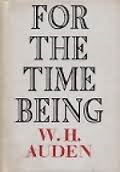
Every year, as close to Epiphany as we can get it and still have it fall on a weekend, Bette and I invite friends over to read W. H. Auden’s poem, “For the Time Being” together.[1]  It takes about three hours, start to finish, if you count the time we take for the comments between sections, the frequent trips back to the table and the bar, and all the side conversations that happen when you collect a bunch of interesting people in one room.  It was a superb group again this year—some church people, some book group people, some Starbucks people.  “All three of our churches,” as Bette might put it.

“For The Time Being” is a huge sprawling poem with intricate rhymes in some parts and flat-out bawdy commentary in other parts. Every stanza of “The Voices of the Desert,” when the Holy Family is fleeing to Egypt, ends with a limerick.  That tells you something.

It’s not a hard poem to read.  We have good readers and not so good readers every year and the old 4everyone does just fine.  It is hard, however, to understand.  The whole poem is a single argument.  It begins with the world in sad shape and proceeds through the Incarnation, with Joseph and Mary and the Wise Men and the Shepherds and all those capitalized roles that everyone knows so well.  It ends with a vision of a redeemed world—two visions really; one theologically grand and the other about how to straighten the house up after all the holiday parties.  That much tells you that the argument moves from a condition through and event to an altered condition.  It is a narrative.  It is an argument.

On the other hand, the language is so rich that it is hard to pay attention to the argument.  Here is a particularly rich excerpt.  The stone is content/With a formal anger and falls and falls; the plants are indignant /With one dimension only and can only doubt/Whether light or darkness lies in the worse direction.

I love language like that.  The continual falling of a stone as “a formal anger,” for instance, moves my mind toward wordplay and serious thought at the same time and there are lots of small passages like that.

Then, when you pull back just a little and see the argument—which was always there—it is a little bit like catching a glimpse of the muscle beneath the skin.  “Why do I keep forgetting it is there?” you ask yourself.

Today, in celebration of this year’s reading of the Auden poem, I am going to look at that sequence of skin, then muscle; at language, then narrative.

I will start with a stanza about old people.  This one catches my eye every year partly because I am old, myself, and partly because the prospect of the death they describe is half exuberance and half hilarity.  The old people’s stanza comes in a series like this: a) let number and weight rejoice, b) let even the great rejoice, c) let even the small rejoice, d) let even the young rejoice, and finally, e) let even the old rejoice.  That’s a lot of rejoicing and you would think that anyone with half a mind would ask, “Hey.  What’s all the rejoicing about?”  But until this year, I didn’t ask that.

Here’s what I did instead.

Let even the old rejoice

The Bleak and the Dim, abandoned

By impulse and regret,

Are startled out of their lives;

For to footsteps long expected

(There’s a Way. There’s a Voice.)

Their ruins echo, yet

The Demolisher arrives

Singing and dancing

the old 1I noticed that the old are described as “The Bleak and the Dim.”  I liked that.  It captures different dimensions of what “being old” is like for a lot of people.[2]  For the same reason, I liked “abandoned by impulse and regret.”  When I think of impulses, I think of those sudden, powerful decisions to do something or the experience of being overcome by desire for something.   They are, in either case, something that happens to you.  Regrets are sometimes produced by acting on the impulses, but other times, the regret is a part of not acting on the impulses.  Reflecting back on a life from the position of great age makes both of those real.  But they are not current.  They are not what your life is like then.  These great impulses and regrets have abandoned these old people and now they must do without them.

Then death approaches—The Demolisher—as they knew it would.  These are “footsteps long expected” and their ruined bodies echo the footsteps they hear.  That is what they have always expected, but that is not what happens.  The Demolisher arrives, in fact, singing and dancing and inviting them all to sing and dance with him.  Now that’s the way to die.[3]

I was so taken by this characterization of the old and The Demolisher that I forgot that the singing and dancing of the old is just a part of the singing and dancing.  The young are singing and dancing too, and the great and the small.  So, having noticed that this year for the first time, I find I am back to the question I said anyone with half a mind would be asking, which is: What’s all the singing and dancing about?

These stanzas are part of a section called  “The Annunciation,” but which I, given my own choice, would call by a broader name.  I would call it “The Incarnation.”  I would call it Emmanuel, “God With us.” That is what has happened.  That’s why all the singing and dancing.

And this brings us to what we grew up calling “the Christmas story.”  Mary and Joseph and the Wise Men and the Shepherds and all that—all of whom, as well as the Star of the Nativity, are characters in the poem.  But Auden takes us to the heart of that whole process.  He goes to the visit of the angel Gabriel to the young woman, Mary.  Joseph’s fiancée, you remember.  Gabriel appears to Mary and says, “Will you do this very difficult thing because God needs it done?”  And Mary says, “Yes.  I will.”  As a transaction, it is as simple as that.[4]

To Auden, it isn’t just a transaction.  Auden provides a setting for this event.  To use the same metaphor he gives to Mary, her saying yes would be like a diamond lying on a table.  But her saying yes in the context of what God wants for us all is like a diamond mounted in an exquisite setting.

Here’s what Mary says.

My flesh in terror and fire

Rejoices that the Word

Who utters the world out of nothing,

As a pledge of His word to love her

Against her will, and to turn

Her desperate longing to love,

Should ask to wear me,

From now to their wedding day,

For an engagement ring.

 Remember that this speech, beautiful as it is on its own, is part of a narrative.  The terror and fire that Mary experiences are part of the same story that the Bleak and the Dim old people experience, but it is because of what Mary says that “the Demolisher arrives, Singing and Dancing.”  That, to refer one more time to my question, is “what all the singing and dancing is about.”

What does Mary say?  If you crushed it and forces it into prose, what would it mean?  Here’s what I think it means.  The Word  (God)who uttered the world out of nothing has pledged to love her (the world, or, more briefly, us) no matter what.  This love will have its final and necessary and appropriate conclusion in “the Great Wedding;” the final reconciliation of God and humankind which He has been arranging for a very long time.  The Great Wedding, in other words, has been preceded by “the Great Courtship,” which is what is going on now.

Why has it taken so long?  It turns out that we were not sure God could be trusted as a suitor.  He has had to love us against our will.  He has had to turn our desperate longing into love.  And for it to happen at all, we would need to continue to believe that it could happen.  That is why there must be “an engagement ring” for us to see and it is why Mary consented to be that engagement ring.

That is what she says.  “My flesh in terror and fire rejoices that the Word should ask to wear me as a sign of His trustworthiness until the very day of the Great Wedding.”  You have to throw away a lot of very beautiful words to find that sentence.  You have to know who “the Word” is and who “the world” is and what “their wedding day” is, but when you know those things, you can make this sentence.  You can read “My flesh in terror and fire rejoices…” and know, at last, that that is what all the Singing and Dancing is about.

Amen.


[1] Epiphany as a special day offers difficulties for us.  We celebrate Advent according to Matthew’s story on one year and according to Luke’s story the next year.  Since Epiphany is connected to the visit of the Magi, which occurs only in Matthew’s account, we have nothing to celebrate in Luke’s year.  This was Matthew’s year, so there was no tension to feel.

[2] In fact, it a very good representation of the final stage of life which, according to Erik Erikson, is characterized by “integrity”  by those who embrace it, and by “despair” by those who do not.

[3] It reminds me of the last scene of The Milagro Beanfield War where Amarante Cordova, the sick old man who has saved the town and the Coyote Angel (Death, personified as in the Auden poem) set off for the party they can hear from just over the hill.  “It seems like such a long way,” says the Coyote Angel.  “I know a short cut.”  And they move off together, laughing and telling stories and are not seen again.

[4] It is as simple as Jesus’s response to God on the night before his crucifixion.  Jesus prays, “Is this really the only way?”  God responds, “I’m afraid so.  No one else can do this and now is the time.”  Jesus says, “Then bring it on.”  In all honesty, this paraphrase leans on Luke’s version more than on Matthew’s and Mark’s.

Posted in Getting Old, Living My Life | Tagged , , , , , , , | Leave a comment