Robert Dahl, R.I.P

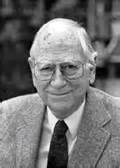
Robert Dahl died this week at the age of 98.  The man loomed over political theory before, during, and after my years as a political scientist.  When I began reading political science, Who Governs? Democracy and Power in an American City was the book to cope with.  When I was teaching undergraduates in the tumultuous  1970s, it was After the Revolution? Authority in a Good Society.  In 2007, long after I had retired, he wrote On Political Equality, which I will need to read now because it turns out that at the end of his life, he was writing about things I still care about.

I always liked Robert Dahl.  He approached his work the way a craftsman does.  He seemed alwaysRobert Dahl 3 to be drawing on a considerable breadth of social experience.  I never read a line until today about how many different things he had done, but now that I know about some of them, I can imagine it was those experiences that kept him from formulating narrow brittle questions, the way so many of his colleagues did.  The obituary in the New York Times (here) says that he “worked on the railroad and as a longshoreman during the summers and became a socialist and union advocate. The experience helped inspire him to study the effects of political power on average people.”
It also says that “after earning his Ph.D., he worked for the Agriculture Department and two agencies handling wartime industrial production. He then relinquished his draft deferment and joined the Army as an infantryman. He fought in Europe and earned the Bronze Star with oak cluster.  After the war ended, he was assigned to an Army unit charged with “de-Nazifying” the German banking system.”

Railroad worker, longshoreman, socialist, union advocate, bureaucrat, infantryman, international bank reformer.  Yeah, I can see why the way he formulated questions never seemed narrow and brittle.

The Political Science Department at the University of Oregon was politically radical when I was there.  Joe Allman, my dissertation adviser used to say that he used to be liberal and then the cops beat him up at the Democratic convention in Chicago in 1968 and that helped him reconsider whether liberalism was really going to do the job.  Dan Goldrich, with whom I worked closely during my time at Oregon, was so unimpressed by Dahl’s best known work—Who Governs?—that he and two colleagues spent quite a few years and burned through several cohorts of grad students writing an alternative methodology called The Rulers and the Ruled: Political Power and Impotence in American Communities.[1] Not surprisingly, it came to different conclusions as well.

Robert Dahl 1Saying nasty things about Robert Dahl was one of the major activities of graduate students during the time I was there.  I never objected to critiques of his methodology or to differences with his conclusions, but during my years at Oregon, I heard his word referred to as “political pornography.”  It was the 1970s and a lot of intemperate things were being said, but that one always seemed to me out of bounds.

After the Revolution?  For some reason it made my students at Westminster College angry too.  Actually, I think he was trying to make students angry with that one.  Dahl disposed of the revolution that was being called for during that decade—this was the “bring the mother down” revolution[2]—by beginning his book with the premise that the revolution was over and that it had succeeded in a thorough and orderly transfer of power.  “Now what?” he asked.  It turns out that “Now what?” was not a question being asked by the radicals, many of them students, who were active in “the movement.”  Dahl’s point was that all the difficulties of maintaining an open polyarchy (his term for a government of overlapping and distinct elites) would be in your in-box on the first work day after the revolution and that some thought needed to be given to how to proceed.  As I said, it made students angry, but I think he really wanted it to.

I don’t know anything Amazon doesn’t know about his recent work, except that I am going to buy it and read it.  Here’s what a reviewer says about it:

“In conclusion, Dahl assesses the contemporary political landscape in the United States. He looks at the likelihood of political inequality increasing, and poses one scenario in which Americans grow more unequal in their influence over their government. The counter scenario foresees a cultural shift in which citizens, rejecting what Dahl calls “competitive consumerism,” invest time and energy in civic action and work to reduce the inequality that now exists among Americans.”

I find it hard to believe that “competitive consumerism” is going to work, but it does sound like Dahl and it sounds attractive to me.  If you’ve been reading this blog, you know that the extremes of inequality we have reached in the United States have been troubling me.  See this link to a January post I wrote complaining about it.

I’ll miss Robert Dahl.  I haven’t kept up with what he was writing toward the end of his life, but I am quite sure that it was organized around interesting questions and that it was written in a gentle and attractive prose.  He was a huge part of my whole professional life and his death has got me thinking about it.


[1] Here is my laugh for the day.  Amazon lists this book with two titles—one containing a typo.  The mistaken title is The Rules and the Ruled, instead of The Rulers and the Ruled.  The mistaken title is actually what I studied at Oregon.  Dan was very much in the “rulers and the ruled” camp, but he set that aside to help me with the very different work I was trying to do.  I’ll send this to Dan when I finish it.  He’ll get a kick out of it.

[2] You can get a little peek at what that was like in Robert Redford’s movie, The Company You Keep.  Redford plays the part of a radical who got out of the movement and lived in genteel obscurity for decades until he was named and located by a former member of his group.  Then, “the company you keep” became his problem and the plot of the rest of the movie.

Posted in Getting Old, Political Psychology, Politics | Tagged , , , , | Leave a comment

Valentine’s Day 2014

I do love Valentine’s Day.  It has taken me awhile to get there, but I am there now.

Valentine 4I started having trouble with Valentine’s Day in elementary school.  It was our practice that everyone was to get valentines from everyone else.  Since these “valentines” came by the gross and sold for pennies per heart, that wasn’t as financially extravagant as you might think.  My problem wasn’t the financial extravagance; it was the emotional extravagance.  These valentines said the most preposterous things!  They said “Will you be mine?”  I tried to think of what that would mean to Bruce Motter or Larry Butts or John Zimman.  They would overlook it, I thought, since they had to give out valentines their mothers bought at the same store, probably from the same clerk, where my mother bought mine.  On the other hand, I also had to give valentines that said “Be my special valentine” to Jayne Dennis and Donna Humphries and Marylyn Hendricks.  Would they understand that I didn’t mean anything by it?  Would they be opposed to being my special valentines?  Or worse—would they like the idea?

It was hard.  Eventually, I rebelled.  I refused point-blank on the grounds that it offended my eight-year-old dignity and my precious but rigid autonomy.  My mother baked cookies for me.  They said nothing at all and both boys and girls liked them.

Then I remember a period of time when my kids went through the valentine machine.  I don’t remember that any of them had trouble with it.  I remember feelings of obligation about the “celebration” of Cupid’s Day that date from this period, but it’s all fuzzy.  Probably that’s a good thing.

The next era is crystal-clear in my mind, but knowing what caused what is a little dicey.  I had aValentine 2 new valentine by then (Marilyn) and a new home (Oregon) and a new relationship with my kids and stepkids (older and perfectly capable of handling Valentine’s Day on their own, thank you very much).  So for me, Valentines’s Day wasn’t all that much.  Marilyn was my very own dear valentine, but neither of us cared in the slightest for Valentine’s Day.  I think we might still have been in that anti-institutional phase where NOT celebrating Valentine’s Day was the thing to celebrate.

Valentine’s Day was always the kind of event where you are leaving a meeting you aren’t allowed to talk to the press about and someone sticks a microphone in your face and asks you to say something.  The demand that you say something is what confronts you.  It isn’t at all that you have something you want to say.

I don’t think I got more romantic, necessarily, after Marilyn’s death, but I did become less anti-institutional.  It might even be that I started looking for some way to celebrate Valentine’s Day before I had a valentine to celebrate it with.  In any case, when I finally met Bette, it was already late January and only two weeks until Valentine’s Day.  Not counting our first date—just coffee at Starbucks—we had had only two dates by then and Valentine’s Day was coming up and I didn’t  know how to use it to say to Bette the kind of thing I was beginning to think I might want to say.

Valentine 3So late on the evening of Valentine’s Day, I showed up at Bette’s condo with a present for her.  Pretty daring for an old man, but in the sixty years since I rebelled against elementary school valentines, I had acquired a sense of myself and a willingness to go down swinging if necessary.  Bette knew that I was a baker, so I assembled a little spelt flour, a little graham flour, a little white flour, and a little rye flour and put them in separate plastic bags and held the four bags in my hand the way you would hold a bouquet.  When she answered the door, I said, “I don’t know you very well yet, so I don’t know what your favorite flowers are.  But I did bring you these—they are my favorite flours.”[1]

And then three really good things happened.  That’s not bad, when you consider how many bad things could have happened.  The first is that she got the joke.  That probably meant more to me than it should have but I was already starting to think serious thoughts about us and you don’t want to live the rest of your life with someone you have to explain jokes to—especially if your jokes aren’t any better than mine.

The second good thing is that she liked it that I had thought about her in the context of Valentine’s Day.  It’s a very formal sort of flirtation, but it does move in the direction of saying “Be my Valentine” and I think Bette liked it that I took the chance when it presented itself.

The third good thing is that when I left, she thanked me “for the flowers.”  There’s a difference.  Valentine 5Trust me.  I know that flowers and flours are homophones and I know you could argue that there is no difference you can hear in the pronunciation of the two words.  It isn’t true.  When she looked up at me—looked me right in the eye—and said, “Thank you for the flowers,” I knew what she meant and I knew that she meant for me to know.  “Wow,” I said to myself as I walked back to the parking lot, “there are probably more women who would like to do that than there are women who know how and this one nailed it on the fly in one try.”

The day coming up will be our ninth Valentine’s Day—the eighth since that first one—and I come to it with a whole new appreciation for what the occasion offers to me.  This is not at all like leaving a meeting and having a microphone stuck in your face.  This is like wanting very much to say something and having the microphone handed to you.

Last year, Bette was in Germany on Valentine’s Day and I made up a packet of cards for the days before and the days after and packed them in Bette’s luggage with instructions to Bette’s daughter to take charge of the package and to give each one to Bette on the day marked on the envelope.  It was a wonderful Valentine’s Day for us.  Bette is one of the best receivers of gooey sentiments I know and if I have ever made a mistake in appreciating her on Valentine’s Day, she has found a way to turn that mistake into something good. 

And that’s why I like Valentine’s Day.  There is something I really want to say and this day gives me a stage, a special setting, that helps me say it.  And the audience is small, but very receptive.  So it’s a really good day.  I can hardly wait.


[1] I have been told that there is a current movie in which Will Farrell makes that joke.  I probably did it better and I certainly did it first.

Posted in Getting Old, Living My Life, Love and Marriage | Tagged , , , | Leave a comment

Belonging to the Narrative


As a rule, I am pretty sensitive to attributing personal traits to impersonal objects.  You can tell, I am sure, that I am going to suspend that today and you are right, but let me illustrate it first.  It is a commonplace of literary study to talk of an “interaction” between the reader and the text.  I’ve never liked that.  I am not affecting the text in the slightest.  It is “affecting” me, but it is not “acting on” me because it is not acting.  I have never liked to hear people say they have been “blessed” unless they believe that someone has blessed them—ordinarily some notion of God is the presupposition is such a statement.  If they believe that God has blessed them, I am fine with that, too.

But today, I want to talk about “belonging to a narrative.”  I am going to grant myself that latitude because I want to contrast it to “constructing a narrative.”  Everyone who has raised children knows the difference.  There is a family project and you need a story about why it is important to do this or why right now or why just this way.  You and your wife huddle up in advance—in my experience, not very much in advance—and concoct a story.  The children “accept” the story.  They may not” believe” it because it may be entirely fanciful and they know that it is the density and the coherence of the symbol system that matters, not the empirically verifiable facts.[1]  You and your wife don’t believe it at all because you made it up.

narrativeThe children belong to the narrative.  The story about how Uncle Brian sprouted wings and got to the lake before us is affected by all the other things you know that they don’t know.  Abraham Lincoln was shot by John Wilkes Booth; Hannibal crossed the Alps with elephants; William the Conqueror was known by many as William the Bastard before his military successes of 1066 CE.  Oh, and Uncle Brian can fly when he feels the need.  People who know things you don’t about Hannibal and William might know things you don’t about Uncle Brian.

These children accept the constraints of the stories you give them.  Some are true in the historical sense; some are “true”—well-constructed—in the narrative sense.  The children live within these narratives and in that sense, “belong to them.”  You and your wife do not.  You built the narrative for a certain occasion, using the conventions you and the children have settled on, and you will change any part of it that doesn’t work.  Actually, Uncle Brian can fly only on weekends.  The energy he needs to activate the wings is drained off by the demands of his job during the weekdays.  That’s why he couldn’t come today.

So there are narratives that belong to you and narratives you belong to.   Take this one, fornarrative 3 instance.  Do you think this narrative belongs to him or do you think he belongs to it?

Yesterday, I watched a really wonderful TED talk. [2] My brother, Karl, passed it along with his recommendation and we like a lot of the same kinds of things so I watched it.  It was wonderful.  Amanda Bennett’s talk is called “We need a heroic narrative for death.”  She was talking about the experience she and her husband had of planning the actions they would take during the time he was dying of cancer.

As she looks back on that time, she thinks that she and her husband chose a much more aggressive and more expensive medical strategy than they should have.  Why did they choose this strategy?  It was the strategy that fit the narrative they were living in.  They wanted to do this right; this, their last battle together.  They wanted to defeat death in a heroic struggle or to succumb in a heroic struggle.  They were committed, to say it another way, to heroism in the face of this trial and all-out war against this disease is the way the heroic narrative led them.

Being committed to the heroic narrative, they committed themselves to the decisions and actions that narrative required of them.  (You see now why I needed to introduce this by making “the narrative” capable of taking action.)  We could have done it differently, says Mrs. Bennett.  We would have done it differently if we had had another heroic narrative at our disposal.

narrative 2I think Amanda Bennett knows more than most of us about “living within the narrative.”  She and her husband lived within the narrative to which they belonged.[3]  She also wants a better narrative.  She is committed to heroic narrative, but she is open to another kind of heroism.  She is not satisfied, as she looks back on it, with “denying death.”  It was a doomed narrative, win or lose, but she doesn’t have another one.

The TED talk gets as far as her understanding that she needs another one and there are few lines of a poem that suggest a direction she and her husband might have taken and that she, herself, might take.  It isn’t a poem I know and even if it were, I wouldn’t know how to build a narrative from it.  But can you really live within a narrative you know you have created yourself?  I don’t see how.

Remember how “Uncle Brian sprouted wings and got to the lake before us?”  That really worked for the kids.  It worked because it was a whole narrative framework when they first encountered it.  They belonged to it, even if they were just believing it for fun.  Had they said, “No, not wings.  Let’s make it…a virtual rocket…and he downloads it and rides it to the lake…um…and then sends it back to the Cloud.  Yeah…back to the Cloud.”  You really have to like those kids.  I do.  But they do not belong to this new narrative.  It belongs to them.  They made it take shape.  They changed it to meet their needs.  And because they did that, there is one need it will not meet—they cannot belong to it.

I think that is what will happen to Amanda Bennett.  I think she will devise a new heroic narrative.  She will call it a better narrative and it might be better.  But the bitter paradox is that when you make ‘em the way you like ‘em, they won’t carry you anywhere you want to go.

What is better?  For society, I think it would be better if parents and teachers began assembling stories around a gentle and generous leave-taking.  If those stories, the ones the parents told and the ones the teachers read to them, were the narrative into which the children came when they first began to wonder about death, it would be the narrative they belonged to.  Maybe Amanda Bennett’s grandchildren or great-grandchildren.

I don’t think that would do it for me.  I do like the gentle leave-taking Mrs. Bennett is talking about, but that seems like a tactical response and I would feel that I was still short a strategy.  It would be, to revert to the narrative metaphor, instructions on how the narrative should be read—“tell it gently and don’t rush”—rather than what the narrative is.  I have always been drawn to St. Paul’s reflection in 2 Timothy 4: “I have finished the race; I have kept the faith.”

If you know that passage, you know that “I have fought the good fight” precedes it.  Paul relied on all kinds of athletic images.  The Greeks loved “their games” and Paul may have been a three-sport man himself.  I am not a fighter, so although I resonate to “fighting the good fight” in the life of Paul, it doesn’t mean much in the life of Dale.  I am, on the other hand, a runner and a teacher and I have known for many years that the English word curriculum comes from the verb currere, “to run.”  A curriculum is, in fact, the course that is set out for the race to take, so when I say that I have finished the race, I have a marathon course in the back of my mind.

For me “finishing the race” and “keeping the faith” are pretty much the same thing.  It’s like being sent to the store for a dozen eggs.  The goal is to get back home again AND to bring the eggs with you.  That is, after all, why you went to the store.

I didn’t choose that narrative from all the options on the buffet table.  It would belong to me if I did that.  I didn’t make it up either, because it would belong to me if I did that.  This is the one I belong to.  I have lived within it all my life and I am grateful that it has chosen me.


[1] I phrased it that way because I think those are the elements that actually matter in effective narratives, not because those are the words the children would have used to explain it to themselves.

[2] TED is “technology, entertainment, design” and can be found at TED.com.  Some of the best and most succinct explanations of new ideas I have ever heard, I have heard there.

[3] You might feel the itch to change that to “in which they belonged” (I did), but notice that the “in” phrasing takes agency away from the narrative and you can see why I wouldn’t want to do that.

Posted in Getting Old, Living My Life | Tagged , , | Leave a comment

Two Cheers for the Community of Loiterers

Here is today’s dilemma.  I don’t really know what to do about it.  That’s why it gets only two cheers.

THERE’S an old Italian saying, “A tavola non si invecchia,” which means: At the table, you don’t grow old.” All of us, of whatever age, need to socialize in public places to feel connected and alive. That sense of shared conviviality was notably absent recently when police officers removed loiterers, many of them elderly Korean-Americans, from a McDonald’s restaurant in Queens.

That’s from Stacy Torres’s column in the New York Times for January 22, which you can check out here.  Right away, you can see that “shared conviviality” and “loiterers” point in different directions.  This is not a logical problem; this is a policy problem.  That is, there is no question that Cafe Plus 1loiterers can experience and enjoy conviviality; there is only the question of whose table is being used and whether the people whose table it is can afford to have it used by loiterers.

This is one of those odd discussions—odder than we might wish—where one piece of the argument takes place in the front room and the other piece in the back room.  Here’s the back room piece.  It costs Starbucks $2.31 per table per hour to provide a table (I’m just making up the numbers).  If Starbucks can make $2.31 per table per hour, it can heat the building, employ the staff and make a profit.  There is no shortage of potential locations for Starbucks stores—although in New York City last fall, Bette and I could sometimes see three Starbucks stores from where we stood–so the question for Starbucks is whether they want to have a store here; here in this particular place.  Making less than $2.31 sends a No message to management; making more than $2.31 sends a Yes message.

In the front room, the conversation is entirely different.  Here’s a letter from a reader responding to the article.

Older patrons may test the limits of public dawdling, but this phenomenon — call it loitering or community building — is essential for the survival of many people 65 and older. According to the last census, seniors constitute 12 percent of New York City’s population. Many of them are single, sometimes far from family, and have lived in their localities for decades, their entire lives even. For the past four years, I have studied how neighborhood public places help older Manhattan residents avoid isolation and develop social ties that offer support, ranging from a sympathetic ear to a small emergency loan.

Cafe Plus 3Let’s say that the facts here are all true and that the point  they raise is important.  In the front room, we talk about how important it is for the elderly to have access to a place where crucially necessary services can be received.  In the back room, we talk about whether a Starbucks at this location should be closed down on the grounds that it is losing money.  People in the front room are showing a lot of compassion toward old people.  People in the back room are looking at profitability.  What can we do to join these two conversations?

We could ask someone to write a piece about it and stick it on a blog, I guess.

I don’t think we ought to be asking for profit companies to forego profits so they can provide much-needed social services.  That doesn’t make any sense to me.  I would be willing, from an ethical, not an economic, standpoint to ask a company to make less profit in order to provide these services.  How much less?  I don’t know: some.

Here are some lines that define the field of play for this issue.  Just as customers are free to go to Cafe Plus 4one store or another, stores are free to go to one location or another.  Just as customers are free to take action on their own behalf—sit ins, slow downs, spilling, pickets—so stores are free to take action.  They could raise the prices or change the seating or adjust the store hours.  It’s all very symmetrical.  But Starbucks could also call the police and there’s nothing symmetrical about that.  The law is on Starbucks side, so far as the rights of property and the requirements of public safety are concerned and that means, when push comes to shove, that the police are on Starbucks side as well.

The contest we need to have will take place on that field of play.  But then…don’t we have arrangements for social services that are crucially necessary but that don’t pay for themselves?  Aren’t there public parks?  Can’t you engage in “community building” in the parks?  Sure you can when the weather allows it, but what about winter time?  Heated parks?  You could call them malls, if that would help.  Some of the articles talked about Café Plus, which is being tried in some cities.  Take a look.

I honestly don’t see the merit of asking businesses that are doing what they are doing so they can make money to do things that lose them money.  That may be simpleminded, but that’s how I see it.  I would love to see a big time social democracy, along the lines of the democracies of Europe, established in the U.S.  That’s a preference, not a prediction.  That active political classes in the U.S. want no part of a safety net that actually works and that is paid for with general revenues by the national government.  On the other hand, Americans are famous for hybrid projects of various kinds.  I could see the government buying some capacity from a Starbucks or a McDonalds or a Burger King.  This is money they would get as long as they continue to serve as de facto gathering places for classes of people who would not otherwise have a place of their choosing.[1]  I have no idea how the money would work out, but the principle would be the same as buying social services from “faith-based” organizations or from public schools.[2]

It would represent an ill-defined path between two clearly rejected options.  Sound just like us, doesn’t it?


[1] Old people do not seem to congregate in age-segregated senior centers when they have a choice.

[2] A very high profile Oregon educator used to campaign for adding more social services to the public schools on the basis of a principle he called “habeas kiddus.”  You have the kids, he said, so you get the services they need.

Posted in Getting Old, Politics, sociability | Tagged , , , , , | Leave a comment

Such a Boy Scout

I was a Boy Scout in my younger years.  Scouting didn’t make much sense to me, but it was at a Boy Scout 1time in my life when nothing much made any sense, so I don’t really blame them.  But you remember the oddest things.  I remember, for instance, learning that a scout is trustworthy, loyal, helpful, friendly, courteous, kind, obedient, cheerful, thrifty, brave, clean, and reverent.  A lot of the scouts in my troop didn’t check off all 12 every day—I didn’t, certainly—but I was sitting in memorial service last week and all 12 of them came back to me, in order, as if I had been saying them every day for the intervening 60 years.

Those were unquestionably good traits, as I saw them then.  But then I grew up.  Worse yet, I went to grad school.  And then I developed an appetite for seeing the meanings of words in the context of their language of origin.[1]  So now, when I look at the list of Boy Scout aspirations, I think thoughts that would not have been possible for me then and that would make me a poor choice for scoutmaster now.[2]

I wonder, for instance, about the “traits.”  What is a trait?  This list of characteristics of a Boy Scout was adopted in 1911.  The whole collection is called “the Boy Scout Law,” which seems quite daring to me.  These are a law?  Wow!  In 1937, Gordon Allport published the study of traits, for which he was best known.  I think it would be fair to say that this way of thinking about people was presupposed in 1911, but was under serious study by 1937.  A substantial criticism of “traits” as a good way to think about what people are likely to do was offered by Walter Mischell in 1968, so I think we can no longer say that traits are presumed by the people who study them although they come in very handy in coffee shop conversations.

So, what is a trait?  Well, trustworthiness, (the first of the two desirata to come to us from Old Norse—thrifty is the other) is a trait.  It means that I can be trusted.  I am trustworthy.  But what if I am, like most people, absolutely trustworthy in this circumstance, probably trustworthy in that circumstance, and a poor bet in some other setting.  Am I trustworthy?

Or, to ask the same question another way, are “traits” a good way to think about what people will do?  Would it be better to look at the settings first?  Say I am a former smoker.  What are the odds that I will continue to refrain from smoking when I go to the old hangouts and spend time with the guys I used to smoke with?  Not good, I would think.  The chances are better if I make new (nonsmoking) friends and go to new settings to spend time with them. 

Let’s look at helpful.  Would you expect me to “help” someone who needed help?  Yes?  So I’m “helpful.”  Would you expect that I would provide: a) the help I think this person needs or, b) the help he wants,  presuming that he might want something different?  Am I helpful in both cases?  And in our time, “enablers” are thought to be bad people so I can say I am helping this person and you can say I am only enabling her to do something she will regret.  Am I helping?  Or let’s say that supporting a person in his efforts to chart his own course is “helpful,” apart from whether he makes good or bad decisions.  Do you want to say it is “unhelpful” if his decisions don’t work out?  I don’t think you do want to say that.

Helpful turns out to be complicated.  Let me tell you that friendly and reverent aren’t any better.

Further, some trait names just beg the question.  Loyal is good, I suppose.  Loyal to whom?  Are some loyalties good and others bad?  Is “loyal” good and “disloyal” bad?  If the law wants you to take one course and your family needs for you to take another course, where does “loyalty” push you?  Just asking.

Now I don’t expect any of these nasty questions to be resolved by looking at the language of origin, but I do think that we can look at these words more carefully and more usefully be seeing where they were before they came to us.  We don’t need, in other words, to accept the cultural contexts in which their meanings were clarified, but it is probably a good idea to know what they are.

I’m going to start with the Old Norse trait names first –trustworthy and thrifty.  Then I’ll move to the Old English names—helpful, friendly, kind, cheerful, and clean.  And I’ll finish up with Latin, mostly arriving here through forms adopted by the French—loyal, courteous, obedient, brave (through Italian), and reverent.  I plan to take a year doing this, so you can afford to get comfy.


[1] All English words are immigrants.  There appears to have been a sort of linguistic Ellis Island where words wanting to become part of the English language, stopped and declared the land of their origin and possibly the land from which they came just before arriving here.

[2] In the intervening years, most of my contact with the Boy Scouts as come from Boy Scouts of America v. Dale, in which the Supreme Court slapped the Boy Scouts on the wrist for claiming that the first amendment rights of free speech could be stretched to their denial of troop leadership to gay scoutmasters.

Posted in Living My Life, Words | Tagged , , , , | 2 Comments

The Growing Middle Class

I remember when the Democratic Party was the champion of “the poor.”  I always thought it was pretty gutsy to champion a set of people based on their economic status—especially the class of people that votes at lower levels than any other category of voter. After that came “the marginalized.”  I knew they meant the same people, but this word had that magic –ized ending on it which means that something has been done to these people.  They were victims.  If, after all, these people have been marginalized, then there are marginalizers—the bad guys—who can be vilified and  perhaps even defeated.

For several election cycles now, the Democrats have been the champions of “the middle class.”  I never really believed that.  I always thought that it was just a new and more respectable name for the downtrodden, the traditional Democratic icon.  I’m sure the idea of choosing “the middle class” as the favored class has something to do with the fact that the vast majority of Americans think they are part of that class.  Take a look at this chart.

middle class 1

If you combine middle class and upper middle class, you come up with 55%.  If you include the working class, and they largely do include themselves when they are asked what class they belong to, you get 86%.  That’s a lot of people who think of themselves as middle class and that’s one major reason the Democrats have made themselves the official guardians of the well-being of the middle class.

A part of the larger political message is that American economic well-being rests on having access to a middle class that can afford to make purchases.  Take a look at that sentence.  Read it twice. Remember where you saw it.  We are going to come back to it shortly.

Robert Reich, in his recent book Aftershock: The Next Economy and America’s Future, begins with the insight of Henry Ford.  Ford paid his workers outrageously well.  The Wall Street Journal called Ford’s pay scale “an economic crime.”  Ford’s idea was that if he paid his workers enough to buy Ford cars, he would sell a lot of Ford cars, and so he did.

Reich characterizes the thirty years from 1947—1975 as “The Great Prosperity.”  Everything worked.  Productivity grew, wages and salaries grew, safety net protections grew, unions were strong, increasing numbers were attending college.  Then we started doing things wrong and for the next thirty years—which included Reich’s turn as Secretary of Labor—all those advances began to retreat.  Here is his summary:

To summarize: The fundamental problem is that Americans no longer have the purchasing power to buy what the U. S. economy is capable of producing. ..What’s broken is the basic bargain linking pay to production.  The solution is to remake the bargain.

And, on the next page:

The question, then, is to move from a vicious cycle to a virtuous one—how to restore the widespread prosperity needed for growth and how to get the growth necessary for widespread prosperity.

It is true beyond question that American companies cannot thrive unless they can sell their products at a profit.  But nothing in that scheme requires that these products be sold to American consumers.  Here’s that sentence I asked you to remember.

A part of the larger political message is that American economic well-being rests on having access to a middle class that can afford to make purchases. 

Did you notice that nothing in that sentence has anything to do with access to an AMERICAN middle class? I didn’t notice it myself until I wrote it and then read it several times.  In other words, all Reich’s solution requires is that there be a middle class somewhere that is big enough—has the aggregate purchasing capacity—to keep American businesses strong.  Henry Ford’s solution—paying his workers enough to buy a car—worked just fine for Ford, but now we can sell Fords anywhere in the world that people have enough money to buy them.  Ford doesn’t really need to pay its workers “enough” anymore.

What Ford really needs is “a global middle class.”  And is there such a thing?  Sure.  Here are a couple of things I ran across.  We have the 27th largest middle class in the world if you measure median wealth per adult.  I got that from Les Leopold in the Business Section of HuffPost.  Median wealth is just  “the amount of wealth accumulated by the person precisely in the middle of the wealth distribution — fifty percent of the adult population has more wealth, while fifty percent has less.”  And, as Leopold observes, you can’t get much more middle than that.

Here’s a chart based on the findings of an International Labor Organization’s study

global middle class 2


It’s hard to see the number values in this chart, but you should be able to see that the United States is the last one on the list.  Questions can be asked about the size of each of these middle classes and about whether “median wealth per adult” is the best measure of potential aggregate demand.

Here’s what can’t be asked any more.  Where will American businesses find buyers for their products after the American middle class has wrung itself dry?  The answer is, “Everywhere else.”  There is no advantage to an American manufacturer or service provider to sell to American customers.  People who have money to spend are “customers.”

The American middle class really doesn’t have money to spend.  Wages have gone down, measured by purchasing power, since 1972.  Continuously down.  Converting families with one bread-winner into families with two bread-winners helped for a while, but falling wages wiped that out as an economic solution.  Vastly increasing credit card debt helped for a while, but eventually those have to be paid off.  Borrowing on the value of the house helped until the housing market tanked and millions of people were left with nothing.  The American middle class really doesn’t have enough money to sustain the consumer spending part of the economy and that’s a crucially necessary part of that economy.

So the Ford solution, which Reich is counting on, doesn’t really help us anymore.  American business can be prosperous so long as they have prosperous customers and there is no reason why those customers need to be Americans.  The American middle class can continue to shrivel—the protectorship of the Democratic Party notwithstanding—and American businesses can continue to prosper.

It’s hard to imagine a stable democratic country where the two large classes are the wage-poor and the profit-rich.  We’ve always thought of ourselves as essentially a middle class country.  Thomas Jefferson said that is all that would save democracy in the United States over the long run.

We’ve always thought that was good news, but maybe it isn’t.

Posted in Politics | Tagged , , , , | 1 Comment

Let Even the Old Rejoice


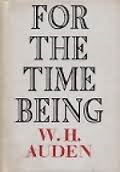
Every year, as close to Epiphany as we can get it and still have it fall on a weekend, Bette and I invite friends over to read W. H. Auden’s poem, “For the Time Being” together.[1]  It takes about three hours, start to finish, if you count the time we take for the comments between sections, the frequent trips back to the table and the bar, and all the side conversations that happen when you collect a bunch of interesting people in one room.  It was a superb group again this year—some church people, some book group people, some Starbucks people.  “All three of our churches,” as Bette might put it.

“For The Time Being” is a huge sprawling poem with intricate rhymes in some parts and flat-out bawdy commentary in other parts. Every stanza of “The Voices of the Desert,” when the Holy Family is fleeing to Egypt, ends with a limerick.  That tells you something.

It’s not a hard poem to read.  We have good readers and not so good readers every year and the old 4everyone does just fine.  It is hard, however, to understand.  The whole poem is a single argument.  It begins with the world in sad shape and proceeds through the Incarnation, with Joseph and Mary and the Wise Men and the Shepherds and all those capitalized roles that everyone knows so well.  It ends with a vision of a redeemed world—two visions really; one theologically grand and the other about how to straighten the house up after all the holiday parties.  That much tells you that the argument moves from a condition through and event to an altered condition.  It is a narrative.  It is an argument.

On the other hand, the language is so rich that it is hard to pay attention to the argument.  Here is a particularly rich excerpt.  The stone is content/With a formal anger and falls and falls; the plants are indignant /With one dimension only and can only doubt/Whether light or darkness lies in the worse direction.

I love language like that.  The continual falling of a stone as “a formal anger,” for instance, moves my mind toward wordplay and serious thought at the same time and there are lots of small passages like that.

Then, when you pull back just a little and see the argument—which was always there—it is a little bit like catching a glimpse of the muscle beneath the skin.  “Why do I keep forgetting it is there?” you ask yourself.

Today, in celebration of this year’s reading of the Auden poem, I am going to look at that sequence of skin, then muscle; at language, then narrative.

I will start with a stanza about old people.  This one catches my eye every year partly because I am old, myself, and partly because the prospect of the death they describe is half exuberance and half hilarity.  The old people’s stanza comes in a series like this: a) let number and weight rejoice, b) let even the great rejoice, c) let even the small rejoice, d) let even the young rejoice, and finally, e) let even the old rejoice.  That’s a lot of rejoicing and you would think that anyone with half a mind would ask, “Hey.  What’s all the rejoicing about?”  But until this year, I didn’t ask that.

Here’s what I did instead.

Let even the old rejoice

The Bleak and the Dim, abandoned

By impulse and regret,

Are startled out of their lives;

For to footsteps long expected

(There’s a Way. There’s a Voice.)

Their ruins echo, yet

The Demolisher arrives

Singing and dancing

the old 1I noticed that the old are described as “The Bleak and the Dim.”  I liked that.  It captures different dimensions of what “being old” is like for a lot of people.[2]  For the same reason, I liked “abandoned by impulse and regret.”  When I think of impulses, I think of those sudden, powerful decisions to do something or the experience of being overcome by desire for something.   They are, in either case, something that happens to you.  Regrets are sometimes produced by acting on the impulses, but other times, the regret is a part of not acting on the impulses.  Reflecting back on a life from the position of great age makes both of those real.  But they are not current.  They are not what your life is like then.  These great impulses and regrets have abandoned these old people and now they must do without them.

Then death approaches—The Demolisher—as they knew it would.  These are “footsteps long expected” and their ruined bodies echo the footsteps they hear.  That is what they have always expected, but that is not what happens.  The Demolisher arrives, in fact, singing and dancing and inviting them all to sing and dance with him.  Now that’s the way to die.[3]

I was so taken by this characterization of the old and The Demolisher that I forgot that the singing and dancing of the old is just a part of the singing and dancing.  The young are singing and dancing too, and the great and the small.  So, having noticed that this year for the first time, I find I am back to the question I said anyone with half a mind would be asking, which is: What’s all the singing and dancing about?

These stanzas are part of a section called  “The Annunciation,” but which I, given my own choice, would call by a broader name.  I would call it “The Incarnation.”  I would call it Emmanuel, “God With us.” That is what has happened.  That’s why all the singing and dancing.

And this brings us to what we grew up calling “the Christmas story.”  Mary and Joseph and the Wise Men and the Shepherds and all that—all of whom, as well as the Star of the Nativity, are characters in the poem.  But Auden takes us to the heart of that whole process.  He goes to the visit of the angel Gabriel to the young woman, Mary.  Joseph’s fiancée, you remember.  Gabriel appears to Mary and says, “Will you do this very difficult thing because God needs it done?”  And Mary says, “Yes.  I will.”  As a transaction, it is as simple as that.[4]

To Auden, it isn’t just a transaction.  Auden provides a setting for this event.  To use the same metaphor he gives to Mary, her saying yes would be like a diamond lying on a table.  But her saying yes in the context of what God wants for us all is like a diamond mounted in an exquisite setting.

Here’s what Mary says.

My flesh in terror and fire

Rejoices that the Word

Who utters the world out of nothing,

As a pledge of His word to love her

Against her will, and to turn

Her desperate longing to love,

Should ask to wear me,

From now to their wedding day,

For an engagement ring.

 Remember that this speech, beautiful as it is on its own, is part of a narrative.  The terror and fire that Mary experiences are part of the same story that the Bleak and the Dim old people experience, but it is because of what Mary says that “the Demolisher arrives, Singing and Dancing.”  That, to refer one more time to my question, is “what all the singing and dancing is about.”

What does Mary say?  If you crushed it and forces it into prose, what would it mean?  Here’s what I think it means.  The Word  (God)who uttered the world out of nothing has pledged to love her (the world, or, more briefly, us) no matter what.  This love will have its final and necessary and appropriate conclusion in “the Great Wedding;” the final reconciliation of God and humankind which He has been arranging for a very long time.  The Great Wedding, in other words, has been preceded by “the Great Courtship,” which is what is going on now.

Why has it taken so long?  It turns out that we were not sure God could be trusted as a suitor.  He has had to love us against our will.  He has had to turn our desperate longing into love.  And for it to happen at all, we would need to continue to believe that it could happen.  That is why there must be “an engagement ring” for us to see and it is why Mary consented to be that engagement ring.

That is what she says.  “My flesh in terror and fire rejoices that the Word should ask to wear me as a sign of His trustworthiness until the very day of the Great Wedding.”  You have to throw away a lot of very beautiful words to find that sentence.  You have to know who “the Word” is and who “the world” is and what “their wedding day” is, but when you know those things, you can make this sentence.  You can read “My flesh in terror and fire rejoices…” and know, at last, that that is what all the Singing and Dancing is about.

Amen.


[1] Epiphany as a special day offers difficulties for us.  We celebrate Advent according to Matthew’s story on one year and according to Luke’s story the next year.  Since Epiphany is connected to the visit of the Magi, which occurs only in Matthew’s account, we have nothing to celebrate in Luke’s year.  This was Matthew’s year, so there was no tension to feel.

[2] In fact, it a very good representation of the final stage of life which, according to Erik Erikson, is characterized by “integrity”  by those who embrace it, and by “despair” by those who do not.

[3] It reminds me of the last scene of The Milagro Beanfield War where Amarante Cordova, the sick old man who has saved the town and the Coyote Angel (Death, personified as in the Auden poem) set off for the party they can hear from just over the hill.  “It seems like such a long way,” says the Coyote Angel.  “I know a short cut.”  And they move off together, laughing and telling stories and are not seen again.

[4] It is as simple as Jesus’s response to God on the night before his crucifixion.  Jesus prays, “Is this really the only way?”  God responds, “I’m afraid so.  No one else can do this and now is the time.”  Jesus says, “Then bring it on.”  In all honesty, this paraphrase leans on Luke’s version more than on Matthew’s and Mark’s.

Posted in Getting Old, Living My Life | Tagged , , , , , , , | Leave a comment

Microaggression! Really?

I was watching an episode of The Mentalist this week and particularly enjoyed this one line.  I’ll let you know when the line shows up.  This next part is just background

So there are these two guys in a bar.  What is with these guys?  They are clumsy.  They don’t present themselves very well.  On the other hand, they are in the bar because women they might be interested in are there and it is their job, apparently, not the women’s job, to take the initiative.  They do it badly.

The women are there to check up on Patrick Jane, the main character of the show, who is having a date somewhere in the restaurant.  The men give their names.  After a brief pause, the women give their names.  The first woman’s name is Kim. The second woman’s name is Theresa.  “Theresa,” says the Second Oaf, “that’s a pretty name.”

OK, here’s the line.  She looks up at him and says, “Thank you.”  When, in the next  conversational pass, the women reveal that they are FBI agents and the men back cautiously away, the whole scene is over, but I thought that Theresa’s thanking the Second Oaf for doing as well as he could, was a nice touch.  I’ve had that job myself, recently, and I didn’t always do it very well. I understood that to be treated with generosity by a woman who was simultaneously signaling that she didn’t want to have anything further to do with me was a gift from her to me and I accepted it thankfully.

If you go to this site on Buzzfeed, you will see a lot of what someone  thinks ought to be called microaggression.  I look at it as training in victimhood for the featured young people.  I’ll show some pictures from this site later.

http://www.buzzfeed.com/hnigatu/racial-microagressions-you-hear-on-a-daily-basis

Now let’s talk about microaggression.  It doesn’t have to be racial or ethnic as the examples on this site are.  It could have to do with gender, with age, with social presentability e.g. fat or ugly, with being a member of the wrong class, with being—as with the two guys at the bar—confronted with a task that was beyond their ability.

“Micro” aggressions are, of course, just “little aggressions,” but it makes me wonder why it is a good idea to invent a scale that groups a lot of different behaviors together and calls them all “aggressions,” distinguishing them only by whether they are large or small.  Why is that a good idea?  So lynching a black civil rights worker in Mississippi is a macroaggression, right, and not being able to tell the nationality of an Asian schoolgirl is a microaggression.  Is a scale that does that really a good idea?

It seems to me it would be a good deal more satisfying, and not so…you know…microaggressive, to build two scales.  In my teaching days, I called them axes and called the ends of the axis, poles.  On the one axis, you put people who intend to do harm to others.  You could calibrate it from large harmful acts at one pole to small harmful acts at the other, but there would be nothing inadvertent on the axis at all.  The other axis would measure social competence—a kind of a klutz or doofus scale—micro 1and goes from high (reliably incompetent or insensitive) to low (socially skillful).

If you don’t do it that way, you are going to be calling “aggressive,” a lot of people who are trying to do social tasks that are beyond their ability.

So here’s one.  I’m guessing that the point is that she is thought not to be “American” because she is not Caucasian.  If she looked Russian, in other words, she would not be thought to be an immigrant.  If she were Russian, her family  actually could have come from the region of the Caucasus Mountains and she would be Caucasian in a way Germans and Swedes and Italians could only envy.  I wonder if she knows that rolling her eyes like that can only be an act of microaggression.

micro 5Or try this one. In my classes at Portland State, I had a lot students from Japan, Korea, China, and Vietnam and a few each term from other Asian countries.  If there is a way to distinguish students from each of these countries flawlessly just by looking at them, it was not covered in the faculty manual.[1]   If you are teaching political science, questions of relations between the government of the U. S. and these four countries will arise.  I’m trying to think why I shouldn’t ask this question of an Asian student who looks like this.

Or how about this one?  Would you really look at a person who is as far away from you as this camera shot suggests and screw up your mouth like that?  Would you really?  So the question of the monumental preference of black voters for Democratic candidates comes up and the likelihood that the one black student in the class will have no views on the question that are worth hearing is accepted as common knowledge?  What would he know about it?  What experience does he have of black voters that would not be shared equally by the other students in the class?

Of the many grievances I harbor about this piece—What!  You couldn’t tell?—let me select two. micro 3 People who perform a delicate or even a routine piece of social interaction badly are not necessarily “aggressive.”  They might be daunted, shy, anxious, or just incompetent.  That’s my first grievance.

Second, the microaggression is a notion that can have some useful applications in an experimental setting.  Used generally to disparage people who said things you didn’t like is not a good idea.  It exacerbates any tensions there may be.  It leads the doofus who asked the stupid question to move in the direction of further alienation from “different looking people.”  There are no pictures in this piece of the people who asked these questions, of course, because this is a session dedicated to training people how to feel like victims, but it is worth asking what the effect on these people will be. 

Does the routine labeling of social ineptitude as “racism” really help bring the several races into productive dialogue?  It does?  Really”


[1] The names help a good deal more.  One term, I had four Vietnamese students named Nguyen.

Posted in Political Psychology | Tagged , , , , | Leave a comment

Do You Understand What You Are Reading?

I take the title from the question Philip asks the government official in Acts 8:30.  The official is reading Isaiah and Philip runs up to the chariot to ask if the official is reading with understanding.  The two passages I have in mind for today come from Matthew and Luke, but the question I am asking is the same question Philip asked.

In the family and the community and the culture in which I was raised, knowing what the Bible Zechariahsaid was thought to be a good thing.  You could learn a lot just by reading it by yourself, of course.  Who was Tamar’s father-in-law?  Um…Judah.  But there were also groups who “studied” the Bible together and if you are going to pursue an activity in a group, there must be a common notion of what we are doing.  You can’t do it together if you don’t have some common notion of what you are doing.  Here is Gabriel, by the way.  Look at the pointing finger.

What were we doing in these groups was looking at the passage under consideration and trying to decide what it meant.  That seemed so unremarkable at the time.  We might take a passage like Matthew 25, here in the King James Version of my youth.

34 Then shall the King say unto them on his right hand, Come, ye blessed of my Father, inherit the kingdom prepared for you from the foundation of the world: 35 For I was an hungred, and ye gave me meat: I was thirsty, and ye gave me drink: I was a stranger, and ye took me in: 36 Naked, and ye clothed me: I was sick, and ye visited me: I was in prison, and ye came unto me.37 Then shall the righteous answer him, saying, Lord, when saw we thee an hungred, and fed thee? or thirsty, and gave thee drink? 38 When saw we thee a stranger, and took thee in? or naked, and clothed thee? 39 Or when saw we thee sick, or in prison, and came unto thee? 40 And the King shall answer and say unto them, Verily I say unto you, Inasmuch as ye have done it unto one of the least of these my brethren, ye have done it unto me.

ZechariahWe could have talked about the justice of God.  We could have let our imaginations run about just who “the least of these” were.  We certainly wouldn’t have paused to add “or my sisters” after “these my brethren,” although that is a perfectly respectable way to translate it if the question had come up.  We might even have raised the question of whether it is really “the least of these” who is highlighted or is it “even the least of my brothers.”  It is the brothers (and sisters) we are talking about and the least among these are being given particular focus.  Is the passage about the disciples of Jesus, in other words?

I have nothing against conversations of that kind.  There are passages in the Bible where that kind of discussion is as good as any other kind.  Furthermore, it is a very democratic and forgiving group process.  If “the meaning of the text” is right there on the page, in English, presupposing our own cultural values rather than those of the time when it occurred, and I understand it one way and you another, the discussion goes on.  I value your contribution and you value my contribution and we have punch and cookies afterward.

Then there are passages where that kind of understanding is simply not adequate.  Let’s consider one so we can explore just what would be required to understand such a passage.   Here’s one from Luke 1, shifting now to the New Jerusalem Bible, my current favorite.

18 Zechariah said to the angel, ‘How can I know this? * I am an old man and my wife is getting on in years.’ 19 The angel replied, ‘I am Gabriel, who stand in God’s presence, and I have been sent to speak to you and bring you this good news. 20 Look! Since you did not believe my words, which will come true at their appointed time, you will be silenced and have no power of speech until this has happened.’

 How will the group I have been describing and which I have often been a part of, understand this text?  I have always understood that Gabriel is chastising Zechariah for his unbelief.  That never seemed quite fair to me.  An angel appears to me in the middle of a work day and says my wife, who has never been able to get pregnant—we tried everything!—is going to have a baby.  Now, when even menopause is a distant memory.  I say, “How in the world is that going to happen?”  And he punishes me.  I thought it was a pretty good question.

It gets worse if anyone in the group happens to know that Abraham asked the same question exactly—word for word—without getting hammered for it and Mary asked the same question as well, of this same angel, and got a very informative answer to her question.  Puzzling, of course, but an answer.  There are a lot of ways the discussion in my group can go after that; all of them bad, so far as understanding the passage is concerned.

Here’s another approach to that passage.  It has a lot of drawbacks.  For one thing, it is scholarly.  We are never going to have a church full of biblical scholars or a church open to consulting biblical scholars.  Why?  Remember what I said about how bracing this kind of discussion was—democratic and forgiving, I called it?  The scholarly approach isn’t like that.  It features the authority of scholarship.  If there is more than one scholar, I probably includes academic competition as well.

But it has advantages, too.  For one thing, if provides an answer to the question of why Gabriel was so snotty to that dazzled old man.  Here’s what Raymond Brown says, “He is struck dumb.  That seems harsh, but this is not told for sentiment.”

Matthew is trying, Brown says, to remind his hearers[1] of Gabriel’s appearance to the prophet Daniel, which was Gabriel’s only previous appearance in the Bible.  Here’s how that encounter went, as Daniel himself describes it in Daniel, Chapter 9:

 14 “Now I have come to explain the vision to you. I will tell you what will happen to your people. The vision shows what will take place in days to come.” 15 While he was telling me those things, I bowed with my face toward the ground. I wasn’t able to speak.

Gabriel gave to Daniel a vision of the last times and Daniel was struck dumb by the vision.  He wasn’t being punished.  He was being overwhelmed.  And Brown says that Luke introduces this little plot twist into the annunciation story to remind the readers of the power, the gravity, the significance of the pronouncement.  The alternative way of approaching it, the way I described as my group’s approach, is dismissed by the line, “…this is not told for sentiment.”  This one line, in fact, dismisses all the kinds of understandings available to the group.  We presupposed that this story was being told for “sentiment,” although that is not what we would have called it.

Let’s just say that Brown is right about Luke’s editorial intent.  Where does that leave us?  As you would expect, there are some good effects and some bad effects.  The most immediate good effect, the one I experienced most directly when I heard Brown’s line—“…this is not told for sentiment”—is the relief of letting go of Gabriel’s snappishness.  Why Gabriel said what he said now makes sense and it has nothing to do with Zechariah.

The second implication is that a group consideration of passages like this are doomed to failure if “understanding the passage” is what the group is about.  No one in the group is going to know about Gabriel’s previous appearance.  No one will think of Luke’s artistry in evoking Daniel’s vision of the last times as he prepares us for understanding the decisive invasion of human history that begins (again) with the annunciation of the birth of John the Baptist.  No one will be thinking about Luke at all because it will not occur to anyone that the best understanding of this passage comes from the use the writer is making of it.

very old 5That means that the easy collegiality that was made possible in the Bible study group (by the presupposition that the meaning of the text was right there in the text) goes away.  That’s a big loss for me.  I really liked being part of a group working together on that tast.  People who look back at their participation in such groups with anger think of pictures like this one.  I don’t. Those old meetings are replaced by having a textual expert handy and by relying on the authority of the expert rather than our own back-of-the-envelope calculations.

Those are the gains and the losses that come to my mind first.  For myself, I don’t think I have any choice any more.  When I read about Luke’s intention to evoke Daniel, something snaps in place and all of a sudden I feel that I am seeing the passage clearly—very often, clearly for the first time.  And there is an emotional excitement about it.  I don’t want to give that up either.  I don’t think there is any going back for me.

That means that no Bible study group I have ever been part of is going to work for me anymore.  Maybe there’s a group somewhere.  I could teach a group like that myself, if the group would allow “teaching” to be relaying to them the understandings I found in my studies among Brown and his fellow scholars.  That doesn’t sound very likely to me, especially when there are so many scholars who might be chosen.

So I choose to read my books and to listen to my CDs and to have the conversations I can have based on what I have learned.  I have some friends who will be glad to be a part of this enterprise, although none of them lives in Portland, Oregon.  I have a blog, which serves to begin conversations with this far-flung set of friends.  That’s pretty good.

But however good or bad it is, I’m sure I can’t go back to the group approach I once knew.  Always, there are two questions.  The second one, “What does this passage mean for the way I understand my own life and the challenges of my own discipleship?” is going to be the same in either setting.  The first one, “What does this passage mean to me?” has been decisively replaced by “What is Luke trying to say by crafting this text as he does?”


[1] Father Raymond E. Brown tries, especially in his lectures, to remind us that most of the people who came in contact with Matthew’s text in the first several centuries were hearing it read, rather than reading it themselves.  There weren’t many copies of these texts and most people couldn’t read anyway.  This consideration of Luke’s use of the vision appears in his book, The Birth of the Messiah and in a set of lectures with the same title.

Posted in Biblical Studies | Tagged , , , , , , | Leave a comment

The Best Practice for Dying Well is Living Well

“Death” is the end of life.  “Dying,” on the other hand, is life’s last task.  I have heard it is a difficult task; difficult, at least, to do well.  On the supposition that we are likely to die as we lived, the best preparation for dying well would seem to be living well.

Here is the quote that started me thinking along this line: “The most critical task among the very old is to retain a sense of identity when confronting physical decline and the loss of loved ones…”[1] Today, I’d like to unpack that quote a little.  What is meant by “the very old?”  What is a “sense of identity?” Why are “physical decline” and “the loss of loved ones” chosen as the important categories?

very old 1I’m somewhere between “the days of a man are three score and ten” (70) and “by reason of strength, four score” (80), so I don’t think I am what Professor McCarthy meant by “very old.”[2] On the other hand, if dying is a task you can practice and, over time, get good at, I want to get started.  I’ve never been a quick learner and being “very old” would not make me any quicker.

So, what is “a sense of identity;” the sense I have of who I am which it is important to retain.  There are two important things to say about identities.  The first is that they are largely fictions.  The second is that they are extremely important. 

I might have gone a little too far in saying that they are fictions.  The fact is that they are constructs.  An identity, in other words, is not something you find; it is something you make.  On the other hand, you don’t always have the material to make the self you would really like to make.  We all have to build with the materials we can find, earn, or scavenge. A child who wants to think of himself as lovable would do well to surround himself with people who love him, for example.

So, clearly, “a self,” an “identity” is not something that is true or false.  It is true and false.  The best two questions about a self are: a) is it useful and b) is it plausible?  Those two questions are my version of the criteria employed by Snell and Gail Putney: an accurate and acceptable self image.[3]  I have turned “accurate” to “plausible,” as you see.  I think that is really the best we can do.  And I have turned “acceptable” to “useful.”  My sense of who I am, in this formulation, needs to help me do what I am trying to do.  In this post, “dying well” is what I am trying to do—or “living well,” if you want to contrast the rehearsal with the performance.

We try to “retain,” says the quote, a sense of identity.  We had it once, in other words, and we want to keep it.  We want, at the very least, not to squander it.  On the other hand, a substantial part of the materials we used to build this identity consisted of things we were good at and those materials tend to slip away from the very old.  You can’t retain the identity you have built without the materials you need.  Even identities get soiled and frayed and eroded and substantial pieces of an very old 4identity will need to be replaced, like so many shingles. So you can keep on being the person you have the materials to repair and expressions like “physical decline” suggest that the repairs you once made without thinking much about it, may no longer be possible.

What to do?

You can be the self who does remarkable and innovative work with the materials available.  That’s my goal.  Every morning, usually in the shower, I consider what I need to do or would like to do that day.  Above is the team meeting I would like to have; below, the team meeting is more often have.  I huddle with my team’s members and call a play.  Some of my team’s members are not happy.  The feet say they are fine if they can do it in stages; the legs say they could manage if I wear my compression socks; the eyes say somebody else is going to have to read the fine print on the warranty, and so on.  Most often, I have to modify the play I first called so that it calls on the present abilities of my teammates. 

Over the years, I’ve gotten really good at that.  I have a better and better grasp of what they are very old 5capable of.  I invent new offenses and new defenses to take advantage of their abilities.  In this way of thinking of it, “I” have “retained a sense of identity” while confronting “physical decline”—an expression that now refers to the team members.  I can’t run faster than anyone else any more or throw harder than anyone else.  I can’t even outwork everyone else, which was my default strategy as a younger man.  But I know my team better than ever.  I trust them to do what they can and I am smart enough not to ask them to do things they really can’t do.

The second element—the loss of loved ones—is harder in some ways.  The loved ones I have had have served—this is Putney and Putney again—as “mirrors, models, and receivers of my action.”  As mirrors, they have reflected back to me who I am.  As models, they show me what I could be or, sometimes, what I am going to be if I don’t shape up.  As receivers of my initiatives, they accept, reject, modify, accept with conditions, and any number of other kinds of responses.  To pick the simplest example, I love my wife dearly.  That means she has to be willing to be loved dearly.  She also has to teach me what loving her dearly, her in particular, means to her, but that is a topic for another post.

very old 6You lose the people who knew who you were.  The loss of those loved ones is an irreparable loss.  The saying that best captures this reality for me is “You can’t make new old friends.”

On the other hand, you will always be surrounded by people who know—or could know—who you are.  To take advantage of that resource, you will have to be willing to be who you are, not who you used to be.  If you fall into the trap of thinking that “the person I once was” is the person I “really am,” the resource of the people you have will not be adequate.  They, who know you as you are and who are looking for a chance to like you as you are, never knew you as you were.  Telling them who you used to be won’t get the job done for very long.

But if you think back, you will remember that the best friends you ever had were not discovered by telling them who you used to be.  You got those friends by telling them who you were at that time and by living the life that made that identity make sense to them.  That is what you did and I hope you got good at it because that is what you need to do now as a “very old person,” whatever Professor McCarthy means by that.  You need to look, as a good teacher does, at just who is actually there, rather than who you wish were there.

In any case, focusing on the task at hand is going to be a good idea.  This dialogue if from the movie Lion in Winter, but it isn’t the way the script has it.  It is the way Toby Zeigler and President Bartlet of The West Wing remember it.

TOBY:  Hey, your favorite movie was on TV last night.

BARTLET: “By God, I’m 50, alive, and the King all at the same time.”

TOBY:  I turned it on just as they got to the scene when Richard, Geoffrey and John were locked in the dungeon and Henry was coming down to execute them. Richard tells his brothers not to cower but to take it like men. And Geoffrey says, “You fool! “As if it matters how a man falls down.” And Richard says…

BOTH: “When the fall is all that’s left…

BARTLET: …it matters a great deal.”

And so it does.  But if you understand that dying well is only the last part of living well, you can practice.


[1] It is cited by David Matzko McCarthy in his article, “Generational Conflict: Continuity and Change.”  He found it elsewhere, but I suspect that in the elsewhere he found it, it was a quote attributed to yet another where.

[2] The age markers come from Psalm 90.  I’ve fiddled with the wording to improve the meter in English and I have completely ignored the point of this passage, which is that as long as it lasts, it is going to be hard.

[3] The Adjusted American: Normal Neuroses in the Individual and Society.

Posted in Getting Old | Tagged , , , | Leave a comment