Permanent Love

I grew up hearing my mother tell a causal attribution joke.  That isn’t what she called it, but that’s what it is and that’s why I telling you about it.  As she was growing up, both “bums” and “limburger cheese” were more common than they are now.[1]  According to this joke, some boys found a bum asleep in a boxcar and rubbed some limburger cheese in his beard as a prank.  The bum woke up and changed locations immediately because the boxcar where he had been sleeping, smelled so bad.  Kind of a rotten sour smell.  So hPermanent Love 1e went to the nearest bar for a drink and no sooner had he sat down, but he noticed that the bar smelled really bad.  Kind of rotten sour smell.  This goes on in setting after setting—it can be a really long joke—until he finally gets on the road into the teeth of a stiff breeze and walks away from town.

Pretty simple idea.  So a young married couple is out buying a few things for the house.  The clerk at the hardware store apologizes profusely because, apparently, something is wrong with the computer; it doesn’t want to approve the credit card.  The same thing happens at the convenience store, except that the clerk isn’t so accommodating.  “Is there something wrong with your card?” he says.  They shift over to the debit card and hit the local ATM.  The message says: “Sorry.  Insufficient funds.” “I hate this part of town,” says the young man.  “Let’s move across the river and up the hill.”

Permanent Love 2Same joke, right?  So I have a suggestion for this couple.  Put some money in your account!  If you are going to be drawing on it, you will need to keep putting money in the account.  That’s a really easy idea to grasp because dollars are fungible—one dollar isn’t any different from another.  You could substitute dollar #12 for dollar #8 and no one would care. 

So Joe and Sue come in to see lead author Steven Ford for a little counseling.[2]  What seems to be the problem?

Waiting for “something to go wrong” in a marriage is an understanding bereft entirely of the fact that there are things you say and do that put resources into your common account and things you say and do that draw resources out of the account.  There is nothing wrong with drawing funds out of the account.  That is why funds are there.  It isn’t too bright to keep running the balance down to zero, but it is amazingly naïve to believe you can keep taking funds out without putting funds in.

So a couple that counselor Edward Ford has designated “Frances and Charles” comes to see him.  Ford asks why they are there.  Well, says Frances, “Lately we’ve started bickering with each other when we’re alone. I don’t know. . . things aren’t what they were, that’s all.”

When I hear that, a lot of questions come to my mind right away; all of them bad questions.  I would want to know just what it is they are bickering about; whether this is a result of a lot of stress at work or maybe at home; is it a morning kind of problem or an evening problem; who starts it?  I hear “bickering a lot” and those are the questions that come to my mind.  But Ford has heard this question a lot over the years, so the question he asks what they do together.  Here are the two answers.

Now: “Well, Charles watches television a lot. We go to the movies fairly often. We turn on [to pot] quite frequently and listen to music. We have a great new stereo system. My mother hasn’t been feeling good lately, so I’ve started  spending a lot of time with her. Charles sees his friends on the weekends, and we seem to go to a lot of parties with them.”

Then (when they first met): “They enjoyed their shared activities—horseback riding, swimming, taking the same adult education classes, and doing the same household tasks. The first year of their relationship saw them frequently engaged in these relatively strenuous and demanding pursuits.

That is the set of answers that matters to Edward Ford was looking for.  It isn’t the bickering.  ThePermanent Love 3 bickering is the “insufficient funds” notice; it is the frown on the face of the cashier who is trying to run your credit card.  They aren’t the source of the difficulty and treating it won’t help.  The source of the difficulty is that Frances and Charles stopped doing all the things that put resources into their relationship.  If they want to get past the current manifestation—the bickering—what they need to do is start putting funds into their joint account again.

This is all pretty simple, right?  Yes, it is simple if we are talking about the balance in the checking account or whether there is gas in the tank.  If you are engaged in the bickering, you aren’t thinking about the balance in the account.  You are wondering why he is so crabby today.  You are wondering why she takes offense at every little thing.  It seems that the most obvious thing to do is to ask the partner to stop doing those irritating things–as in the illustration above.

And, actually, sometimes it is a good thing.  Sometimes, you get, “Oh, I’m sorry.  I know I’m being crabby.  I had a really hard day at school and now I’m taking it out on you.”  But that’s not what’s going on when “we seem to be bickering a lot.”

And that’s why I came to like my mother’s causal attribution joke.  Everyone understands how sensible it seems for the bum to complain about how bad it smells.  Everyone understands, at the same time, how pointless the complaint is.  But that leaves us with two very sensible questions.  The first is, “Is there any way you can fit your relationship with a gas gauge or a thermostat or something that calls your attention to the deficit? There is a certain amount of gas in the car, just as there is a certain number of dollars in the bank.  The trick is to know that the slowing the sputtering of the car is not really the issue  that has to be addressed and you have to know that at the time you are really upset that the car is sputtering.  Or that your wife or husband is irritable.  Whichever.

Permanent Love 4The second question is what to do about it.  You know now that your relationship—your joint account—has insufficient funds.  Now what?  Ford and Englund’s answer is that you need to do, together, whatever will have the effect of putting resources back in your joint account.  That’s a good answer.  But you need to know what will do that.  Frances and Charles, it was “horseback riding, swimming, taking the same adult education classes, and doing the same household tasks.”  That wouldn’t do it for Bette and me and it is our job to know just what would work and to get busy at doing it.  I’ve always liked the idea of running together.  I think it would work well, for one thing, and it gives me a chance to use one of my favorite lines: “The couple that sweats together, sticks together.”

That’s my pitch for today, but let me touch on one personal matter before I hit the blue “publish” button on my WordPress home page.  For many years, I have divided friendship, including married friendships, into two parts.  I call them intimacy and collegiality, meaning by the first term to refer to the face to face parts of the friendship and by the second to refer to the side by side parts.  Nearly everything I have said about collegiality, over the last thirty years, came straight out of Permanent Love, only I just recently discovered that.  I read it and took it into my heart, from which it went to my brain, then to my tongue and I have been preaching it as my very own gospel for a long time.  My first response, on rediscovering this book, was embarrassment.  “Wow!  So this is where I got all that!”

I have been preaching for many years that that “being in love” is something you do and when people like Charles say “I guess we just fell out of love with each other (see p. 33),” my ears prick up and questions about how to restore the positive balance in their account come to mind. 

You don’t “fall out of love” any more than you “fall out of shape.”



[1] And if “bums” are not exactly less common, they are now called more kinds of names, so it is harder to tell whether they are common.

[2] Edward Ford and Steven Englund, Permanent Love: Practical Steps to a Lasting Relationship: Minneapolis: Winston Press, Inc. 1979.

Posted in Living My Life, Love and Marriage, ways of knowing | Tagged | Leave a comment

The King’s Speech

The King’s Speech won the Oscar for best picture in 2013.  I’m not surprised anymore.  Several weeks ago, I got a DVD with a full commentary track and I have been living inside this story ever since then.  The intricate internal structure of the film makes it seem to more like a poem than like a simple narrative. I’d like to write about that some day, but not today.  For today, I want to start with the line that brought everything together for me.  It was, “That ought to ring a few bells with you, Bertie.”

Speech therapist Lionel Logue (Geoffrey Rush) started learning about speech defects under very trying circumstances.  Here’s the way Logue, an Australian, describes it to his patient, King George VI (Colin Firth).

When the Great War came, a lot of our soldiers were returning from the front, a lot of them shell-shocked, unable to speak…I did muscle therapy, exercises, relaxation, but I knew I had to go deeper.  Those poor young bastards had cried out in fear and no one was listening to them.  My job was to give them faith in their own voice and let them know that a friend was listening.

And then he says, “That ought to ring a few bells with you, Bertie.”

When this man first came to see Logue, he was not King George; he was the Duke of York.[1]  He was a member of the royal family and he wanted to be “a royal” more than he wanted anything.  He wanted it more than he wanted to be able to speak without a stammer.

But then things happened.

King's Speech 3His father, King George V died.  His older brother became King Edward VIII, then abdicated so he could marry Wallis Simpson.  Mrs. Simpson had been divorced twice and Edward, being the king was head of the Church of England, so he could not marry her and continue as king.  The crown then passed to his brother Albert, whom the family called “Bertie.”  Now he was a king and he absolutely had to speak.  At that point, the tug of war between being a member of the royal family, on the one hand, and allowing Logue real access to the person he was, began.  And that is what the movie is about.

The transition to what might be called “radical therapy” was simple enough for the shell-shocked troops.[2]  Getting the future king to agree to it was another matter.  “As far as I see it, the Duchess (Helena Bonham Carter) informs Logue, “my husband has mechanical difficulties with his speech.  Maybe just deal with that.”

Logue knows from his postwar experience that isn’t going to work. “I did muscle therapy, exercises, relaxation,…”  That didn’t help the soldiers.  Logue concluded, “…I knew I had to go deeper.”   But, of course, you can’t go deeper if your patient is not willing to go deeper and as the Duke of York, he was not willing.  “Strictly business,” says the Duke.  “None of that personal nonsense.”

But “that personal nonsense” is just where the problem lay.  Logue’s patients from the Great War “had cried out in fear and no one was listening to them.”  The Duke, “Bertie” eventually, had never cried out.  He did, however, begin to stammer.  Slowly, over the course of the relationship, we learn some important things about Bertie.  He was naturally left handed.  He was punished for it and now he is right handed—and, of course, a stammerer.  He was also knock-kneed and wore corrective braces night and day.  “Must have been painful,” says Logue.  “Bloody agony,” replies Bertie.  And his nanny abused him, both by making him cry at what Bertie refers to as “the daily viewing,” (the time of day he and his brother were presented to parents) and then withholding food from him.  Stomach problems ensued over the next three years.  His brother, David, ridiculed him for his stammering.  Their father approved of the ridicule and told Bertie to get over it.  And he did get over the ridicule, to a certain extent, but he stammered.

Logue does for Bertie what he did for the returning soldiers: muscle therapy, exercises, relaxation.  It doesn’t work.  Bertie is discouraged that it didn’t work, but it’s still tolerable because his brother David is now king and it looks to Bertie like he has dodged the bullet.  Then his brother forfeits the crown and all the dodging Bertie can do will no longer avoid that bullet.  He is now the king.

He returns to Logue.  He is desperate now.  “Being a member of the royal family” isn’t that much of a consolation if you actually are the king and you have to give a speech.  Logue has been very strict with Bertie. “My castle, my rules.”

To the Duchess, he said, “I can cure your husband, but for my method to work, I need trKing's Speech 1ust and total equality, here in the safety of my consultation room.  No exceptions.”  And he stayed with that.  The hauteur of the royal family didn’t daunt him in the least.

And later, he and Bertie have this exchange.

Lionel:              What will I call you? 

Bertie:             “Your Royal Highness”…then, it’s “Sir” after that.

Lionel:              A little stuffy for in here.  I prefer names.  How about “Bertie?”

Bertie:             (deeply offended) Only my family calls me that.[3]

Lionel:             Perfect.  In here, it’s better if we were equals.

Now, at last,  all that drawing of clear boundaries pays off.  When the king comes back, finally ready to work with Lionel, the relationship is there for him to return to.  They seal the deal with a glass or so of whiskey.  The first glass goes down pretty fast and Lionel offers to top off Bertie’s drink.  Bertie thanks him without thinking about what he is saying.  Lionel responds, also without thinking what he is saying, but the words he chooses so casually hang in the air.  Instead of “You’re welcome,” which is what he meant, he said, “What are friends for?”  Bertie’s response is heartbreaking.  He says, “I wouldn’t know.”

Of course he wouldn’t know.  He’s never had a friend; how could he know?  But it turns out that if he doesn’t have a friend, he can’t give a speech and Hitler has invaded Poland and Great Britain has declared that a state of war exists between Germany and Great Britain and the king now has to give a speech.   And it has to be a speech that clarifies the stakes for his nation and that rallies them to support the Parliament’s action.  It has to be the best speech he has ever given in his life.

King's Speech 2Finally, it is just the three of them: just the king, the therapist, and, between them, the microphone.  Logue looks through the microphone grill and says, “Forget everything else and just say it to me…as a friend.”  And he does.  It is, in fact, the best speech he has ever given in his life.

It’s an amazing story.  We think, when we first hear Logue say it, that he is asking for too much: Logue says, “I can cure your husband, but for my method to work, I need trust and total equality, here in the safety of my consultation room.  No exceptions.”  By the end, we see that nothing less than that would have worked.  You don’t say, “Say it to me as a friend,” if you are not a friend.  And you would not have become a friend if you had not demanded “trust and total equality” and if you had not violated the Duke’s demand that there be, “None of that personal nonsense.”

That personal nonsense saved George’s kingship and he and Logue were friends as long as they lived.


[1]The personal designations for members of the royal family are just a little intricate.  “The King’s” name is “Albert Frederick Arthur George” of the house of Windsor.  The “Albert” is the reason the family called him Bertie.  He is also the Duke of York.  His older brother’s personal name was Edward Albert Christian George Andrew Patrick David, of the house of Windsor.  David was Duke of Kent before his accession to the throne.  As king, he was Edward VIII.

[2] The etymological relationship between superficial and radical has delighted me for years.  You can see the Latin form of “face” there, so superficial could be read “on its face.”  Radical comes from the Latin word for “root,” (both radical and radish derive from the Latin radix, “root.”  So when Logue says he is being asked to deal only with the surface of the problem and that he knows he will “have to go deeper”  (to the root of the problem),he is laying the meaning of superficial and the meaning of radical on the table together.

[3] They come back to that line as they are setting up for the coronation.  Bertie asks that Logue be seated in the royal box.  The Archbishop protests that the royal box is for family only and Bertie responds, “That’s why it’s appropriate.”

Posted in Movies | Tagged , , , , , , | 2 Comments

Sex, Coffee, and the Law

I’m not kidding about the Law, but it isn’t the law you were thinking of.

 “In a short, sheer, baby-doll negligee and coordinated pink panties, Candice Law is dressed tocoffee 3 work at a drive-through espresso stand in Tukwila, and she is working it.”  That’s the first line of a 2007 article in the Seattle Times, which you can see here, if you like.  And here is Candace Law.

When I reach into my grab bag of tricks to help me understand what Americans are doing, collectively, I often divide us into a polity, an economy, and a society, as the chart below shows.  The polity is where the legal authority rests, the economy is about who sells what to whom for how much, and the society is the home of the small groups, with their habits and values, that make communities what they are. 

This story is about the eroticization of drive-through coffee shops in the Seattle, Washington area.  From the standpoint of this story, the job of the government is to define the playing field and make sure that whatever competition there is stays on the field.  It turns out that state law requires “that employees cover their breasts and buttocks.”  I try and fail to imagine the legislative debate over that bill.  Was there a minority report?Three Ring Circus

I did use an excerpt of a longer sentence about state law, however, and the whole sentence leads to the next topic.  “Bowden [Laurie Bowden, owner of a string of the Cowgirls Espresso Stands, seven of them in 2007)  said law requires that employees cover their breasts and buttocks, so there will be no ‘Thong Thursday,’ as some customers have requested.”

So here is a business (the economy) which is prevented from meeting the demands of its customers (the society) by rules laid down by the legislature (the polity).

If you are going to run a business on the basis of consumer demand,  you need to ask just what the consumers are going to demand—it raises, that is, the question of the values that the members of the community hold and express.  If you were thinking of cutting back on this enthusiastic lasciviousness, you need to know that the best you could hope to do is cut back on the values the community expresses.  How the values are expressed. Modifying the values the community actually holds is another matter entirely.

There are, apparently, enough customers who like to get steamed at the same time their lattes arecoffee getting steamed to make these “sexpresso stands,” as they are called, profitable.  Here are some things to consider.

“One recent morning, she [Candace Law] served 400 customers between about 6 a.m. and noon.  So, 400 customers in 360 minutes is about 1.11 minutes per customer and if they are selling drinks at $4.00 a piece, that’s a lot of money.

Also: “If I’m going to pay $4 for a cup of coffee” said one male customer, “I’m not going to get served by a guy.”

And further: When Ryan Reed pulled up to Best Friend Espresso for his usual, a 24-ounce iced vanilla latte, on a recent weekday afternoon, he knew what to expect. “The owner [Wayne Hembree] always hires super-hot girls,” Reed said. “That’s basically his philosophy.”

In other words, if the advent of “sexpresso stands” is undesirable, there are three ways you can go.  You can tighten up the law.  Make it read “fully covered at all times” or something like that.  You can change the values of the customers, who at the moment, like to see women as sex and service objects and are willing to pay for the privilege.  Or you can prevent the owners of these stands from requiring their employees to market their bodies as a way of attracting customers.

You can, to say it another way, intervene in the polity, the economy, or the society.

coffee 5So let’s take a look at Wayne Hembree, who, according to satisfied customer Ryan Reed, “always hires super-hot girls.”[1]  Well, Wayne Hembree does not, in fact, “hire super-hot girls.”  What he does is this.  First, he “requires his girls to “dress classy;” dresses, skirts and a nice top.  Like this barista, for instance. That sounds like most of the sales people I saw on my last trip through Nordstroms.  Second, he also “requires staff members to wear makeup and do their hair.”  That still sounds like Nordstroms to me.

You know what doesn’t sound like Nordstroms?  Hembree adds “What I think most of them have found is that their tips are better if they wear short skirts.”  Now short skirts is a long way from “bikini-clad baristas,” not to mention “Thong Thursday,” but it is the mechanism Hembree uses that caught my attention here.

The customers will train the girls.  Sex as advertising is written about and talked about, so it requires a little bit of effort to imagine the step I am about to describe.  Try.  This would work perfectly even if the baristas didn’t know what they were being rewarded for by the customers.  You really don’t need to know what you are doing that “works” in order to find yourself doing it more often.  As has been shown over and over in social science labs, students can master nearly any game you can devise for them so long as the payoff matrix is stable.  They can learn to win huge amounts of “laboratory money,” whereas the new people fail miserably.  So why don’t the veterans tell the rookies how to master the games?  Because they don’t know.  They know how to do it, but they don’t know just what they are doing that works.  It would work exactly the same way if the baristas worked with a stable payoff matrix—which, apparently, they do.

On the other hand, they probably do know what they are doing that causes the tips to go up and choosing to do it because they like the response (“Your customers freakin’ adore you,” says Candace Law) or because they like the money (Law said she makes more in tips than she ever did as a waitress) or, of course, both.

This very close, mutually defining, relationship between the customers and the baristas indicates how hard it would be to change the values that are expressed in this exchange.  Feminists say, correctly in my view, that “women as a category” are the losers when some women define the gender by exchanging sex for money.  But the women who are directly involved in this trade don’t look at it that way and asking them to forego the income so as to change “the image of women” generally, is asking a lot.  Similarly, asking the customers to refrain from choosing an activity that they like and that the baristas apparently like and that is entirely legal, is also asking a lot.

So probably, it isn’t going to happen.  Coffee anyone?


[1] “It’s his philosophy,” says Reed.  Philosophy is a term that has really taken a beating lately, but this use stretches even that.


[1] “It’s his philosophy,” says Reed.  Philosophy is a term that has really taken a beating lately, but this use stretches even that.

Posted in Economy, Political Psychology, Politics, Society, ways of knowing | Tagged , , | Leave a comment

Playing Cards: The Death of Dialogue

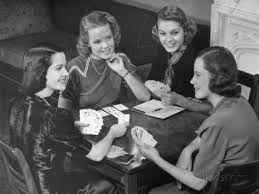
“Playing cards” was not an activity in the little town where I grew up.  It was an object.  “Playing cards” referred to what you used when you played poker and other devious games.  “Playing cards” is an activity for people who know how to play poker or even suspension.[1]

I’m not thinking about either of those today.  I’m thinking about “playing the ___ card.”  It means to activate a status you hold so as to gain an advantage in the discussion.  And that’s how it can become the death of dialogue.  Here’s an instructive exchange from the movie, Glory.

10th Connecticut Corporal: [Scoffing as he notices Rawlins’ rank] Stripes on a nigger. That’s like tits on a bull!

Sgt. Maj. John Rawlins: You’re lookin’ at a higher rank, Corporal. You’ll obey and like it.

cards 4The first speaker is white, of course.  The second speaker is black and the holder of a higher rank.  The white man is “playing the race card.”  The black man is “playing the rank card.”  That’s what I mean by “playing cards.”

Playing a card is a dicey move.  It is a way of establishing your right to be part of the conversation or your right to right to dominate the conversation or to end the conversation. Because it is an action that calls attention to the speaker rather than to the issue, it is not something the speaker does casually.

“I’ve lived on the streets so I know what real life is like.  You haven’t, so shut up.”  A claim to dominate.

“Has anybody thought about this from the standpoint of the child care worker?”  A claim to participate.

“But I am, in fact, the employer and I say that your services are no longer required.”  A claim to end the conversation.

You can see from these examples that playing the ___ card is a claim to rhetorical advantage.  That doesn’t mean claiming an unfair advantage.  Most often, when a speaker is accused of “playing the ___ card,” on the other hand, the implication is always that he shouldn’t have.

I think there was a time in our history where “playing the race card” meant that a white person was attempting to gain an advantage over a non-white person.  Today, it is nearly always the other way around.  There was certainly a time in our history when “playing the gender card” meant that a man was attempting to gain an advantage over a woman.  Today, it is nearly always the other way around.  Looking at this situation formally, we would expect to see a rise in racism among blacks and a rise in sexism among women.  I think that’s just what we find in the media and also among some groups of blacks and women.

I referred in an earlier post to my friend Bob, who has a truly amazing collection of “cards” at his disposal and simply refuses to play them.  That makes Bob a hero in my eyes, but it is heroic partly because it is so rare.  My experience of nearly everyone except myself[2] is that we play the cards we have.

Let’s take the case of women, for instance.[3]  Women live in a society that presupposes values cards 3that are more common among men or more natural to men than to women.  For all the years that they accepted those social practices and values, it was a disadvantage to them.  Now that the legitimacy of those practices and values has been turned into a question, it is a great advantage for them.   Men are not nearly as conscious of their gender status and attributes as women are.  So long as the social practices favored men, there was no reason to be all that aware.  Now that the social practices are a source of contention, men don’t know what to do about it.

When “you think like a woman” was a charge that could lower your pay or deny you a job or a promotion, women decided to do something about it.  Good for them.  Now that “you think like a man” is a charge that puts a man on the wrong side of nearly any issue you want to name, men have no idea what to do.  What kind of a man are you anyway?  You are not very sensitive.  Your mind goes right away to defending your turf, when it really should go to building your network.  Your thinking is so…linear.  Ugh.  You need to let your thinking get in touch with your feelings.  You need to be a little more…you know…human.  Sex?  You know, you’d be a much better person if your interest in sex was more like the kind of interest women have.  You think you could maybe work on that a little?[4]

cards 2Staying at the formal historical level, it seems to me that there are two things men can do[5] and by “men,” I mean men in the aggregate.  Actual men who are comfortable with themselves and comfortable with their wives or significant others who, in turn, like them the way they are—I’m not talking to you.  I’m talking about “men in general” in the same way I was talking about “women in general.” 

The first is to decide just what it is about being a man that is worthwhile and push it.[6]  This would require that men recognize that we are in the minority, not just demographically, but culturally as well.  We could develop the kind of self-awareness that religious or ethnic minorities routinely develop instead of relying on the historically exhausted masculine assumptions that were once presupposed.  That would make “being male” a card to be played, not a character defect to be apologized for.

Very likely, that wouldn’t work.  Or at least, it wouldn’t work in the sense of benefitting men, for a long time.  What it would do, almost immediately, is to create a rhetorical game in which there are two players, each of whom has cards and knows how to play them.  This means that women are no longer the background against which we can see the real show, which is what men do with power and authority.  It means that men are no longer the background against which we can see how women organize themselves to get things done and, at the same time, affirm the personal contribution of each member.  It means that the background is rhetorical; that everyone has cards to play; and that who plays which cards when is what we get to watch.

This is, I say again, a game that is to be played on the aggregate level.  This is not something individual men and women need to do.  It is something that sports shows and game shows and talk shows and sitcoms and crime dramas and articles on “the gender crisis” need to do.

Playing cards is something people do when they are in the foreground.  It is not a game when one player is on the stage and the other “player” is holding up the scenery.  It doesn’t work that way.

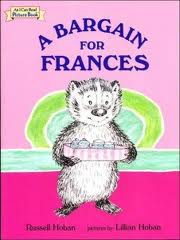
And finally, here’s a story that illustrates the kind of transformation I am hoping for.  One of mycards 1 favorite stories in the world is A Bargain for Frances.  As you can see, Frances is a badger.  Frances has a “friend” named Thelma.  Every time Frances plays with Thelma, something bad happens to Frances.  Thelma always seems to come through unscathed.  One day, Thelma goes too far; she cheats Frances out of a tea set.  This allows Frances to see the whole relationship in a new light and, as a response, she cheats Thelma out of the tea set, restoring the status quo ante.

Thelma is disturbed.  “I can see that when I play with you, I am going to have to be careful,” says Thelma.  Frances’s response is inspired: “Do you want to be careful…or do you want to be friends?”

Friendship is a possibility now.  It never was before.  Thelma was the predator and Frances the prey.  This was never anything Thelma saw fit to criticize.  It had a lot of advantages.  On the other hand, Thelma didn’t have Frances as a friend and nothing she could do would supply that to her.  It needed to be something Frances could do.  Now both Thelma and Frances have cards to play and they can play them or not as they choose.


[1] You might not have heard of that.  Suspension is a kind of bridge.

[2] I am not saying, of course, that I don’t do it myself.  What I said was that if I do it—probably, I do—I don’t catch myself at it.

[3] Not all women, of course.  I know women who are so unassertive they discard trump cards rather than play them.  I know women who are heroic in the mode of my friend Bob who have cards and know what to do with them and then don’t do it.  But “the women” of TV, movies, books, magazines, blogs and quite a few women I see in conversations that include men, routinely reach for the gender card and play it to their advantage.  And why wouldn’t they?

[4] I started to think about this some years ago when I spent some time looking over the “men’s studies” sections of some very good bookstores.  What to do about “the man problem” was divided about 75% into Position A—it’s a disease, but here are some possible cures—and Position B: it’s not a glitch, it’s a feature.  Position B gets men out in the woods, painted blue and howling at the moon.

[5] The second way is to organize in social and political ways to push for gender advantages.  I can see I’m not to get there in this piece.  It would involve developing schools, for instance, that are as supportive of boys as they are of girls.

[6] It is an etymological curiosity and no more than that, but the truth is that the vir- in virtue means “man” as in a male human beings.  There are, of course, many virtues that women have more prominently than men do, but etymologically, these virtues are all kinds of “manliness.”

Posted in Political Psychology, Politics, ways of knowing | Tagged , , , | Leave a comment

First, Apologize

I just finished spending some time with the latest New York Times/CBS poll and I have to tell you, I’m discouraged.  It is not that there is not information in the poll to gladden the heart of any liberal Democrat—that’s me; I’m the liberal Democrat from central casting.  It is that, in my judgment, none of that encouraging information is going to matter come November.

Here’s why I think that.  I am a fan of John Gray, the author of all the Mars and Venus books.  I am not a fan because I think he is right about what men and women are like.  I don’t think he is right any oftener than I am, although he would make money even being wrong and I would not ,even being right.  So that’s not it.  I am a fan because when I do what he says to do, things work out better.  I would take advice from a Ouija board if it produced the results John Gray has produced for me.

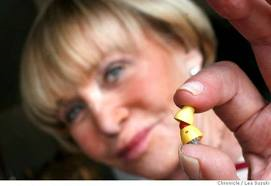
apologize 3Here is today’s example.  If you are in a relationship with a woman and you do something wrong, apologize.  Do it right away.  Why?  Because, according to Gray, she is not going to hear anything you say until you apologize.  To make this dilemma a little more graphic, let’s imagine that your lady is hearing impaired.  She has hearing aids and her hearing is pretty good when she is wearing them, but she turned them off when you did this “wrong thing,” whatever it was, and she’s not going to turn them on until you apologize.[1]  Stop and think about this for a minute.  Nothing you say is going to be heard until she turns on the hearing aid and she is not going to turn on the hearing aid until you apologize.

Let me pause momentarily to assure you that I am still talking about President Obama and the troubles he has, as they showed up in the Times poll.

It will be useful here to introduce the word exculpatory.  The culp- root is “blame” in Latin, so you can see that being “out of,” that’s the ex-,  blame, would be what the offending man would want.  There were circumstances that any fair-minded person would treat as fully exculpatory; that deserve a full and complete forgiveness.  “I’m sorry I was late picking you up for the party, but I had to stop to give CPR to an accident victim on the way home.  The medics said I saved the kid’s life.”

Like that one?  Here’s one I am borrowing from Last Chance Harvey.[2]  “I’m sorry I didn’t meet you in the marketplace at noon as I promised I would.  I had a heart malfunction and the doctors at the hospital wouldn’t release me until they had ruled out any need for immediate treatment.  I was a prisoner in the hospital.”

Obviously, examples of this sort could be multiplied.  Will these “excuses” work?  No.  Why?  Because they will not be heard.  They will not be heard, evaluated, and dismissed as inadequate.  They will not be heard at all.  Why?  Because you have not yet apologized, so she has not yet put in her hearing aids and nothing…Nothing…you say will matter until you have done that.

Here’s what I learned from the New York Times poll.  The American people, Democrat, Republican, and Independent, care about the economy first.  They are willing to hear any kind of pitch from the ruling party after the economy is taken care of.  They will put in their hearing aids after the economy is taken care of.  Before that, nothing you say will matter all that much.[3]

Fixing the economy is President Obama’s apology.  It is what he has to do first.  If he doesn’t do that—and he can’t—nothing else he says is going to be heard.  Federal regulations for same sex couples?  Sure, after you fix the economy.  Immigration reform?  Sure, after you fix the economy.  Deficit reduction?  Sure, after you fix the economy.  More humane medical care for the most vulnerable Americans—that doesn’t mean just poor ones, by the way—is a great idea.  Right after you fix the economy.

Do the American people like these ideas?  Yes.  According to the poll, they do.  Do they agree withapologize 4 the Democratic ideas about policy directions at the federal level more than they agree with Republican ideas?  Yes.  They do.  Does it matter?  No.  It doesn’t.  Why?  Because President Obama has not yet apologized and American has not yet put in her hearing aids.  This picture?  This is what you are looking for.  It is not going to happen.

This is a fundamental critique.  The standard liberal metaphor for argument in an open and democratic society is “the marketplace of ideas.”  If everyone is free to choose, the best ideas will be chosen in the market.[4]  This presumes that the ideas will be heard.  The situation I am describing is a situation in which the only ideas that can be heard are the ones that blame me for being late (these are inculpatory arguments) or that blame President Obama for not fixing the economy.  

apologize 5So here’s a thought.  The economy cannot be fixed.  Imagine that you once had a 40 inch waist and to keep your pants up, you put the prong in the third hole.  Then you screw up and are put on a turnip and water diet.  When you get out, you have a 38 inch waist, so you put the prong in the fifth hole.  Then you screw up again and the prong has to be put in the seventh hole to keep your pants up.  A Red Cross worker discovers your plight and asks what you want him to do for you and you say that you want the prong put back in the third hole, like it was in the good old days.

That’s what Americans are asking for.  It is what the party out of power tells them to ask for.  It is the Republicans now, but it would be the Democrats if George Romney had won in 2012.  They don’t want the punitive regime to be repealed.  They don’t want to stop screwing up.  They don’t want the turnips to be genetically modified so they have more protein.  They want the prong put back where it was.  President Obama cannot put the prong back where it was.

My view is that the economy we have now is the kind of economy we are going to have for the foreseeable future.  We used to have to pay our middle class workers a living wage because if they didn’t spend all that money, we wouldn’t have a living economy.  We don’t have to do that anymore.  We now have a global middle class who can provide “us”—the export-centered  industries at least—with a lively economy.  We used to have to hire actual local humans to do things that can now be done cheaper by foreign workers and even cheaper by domestic robots and that includes a lot of jobs that used to be called “skilled jobs.”  We now have “skilled robots.”  Every time there is an economic downturn, no matter what the cause of it is, the American businesses adjust by retaining or re-hiring fewer workers—this is “the new normal,” they say—and recalculating the pension obligations and reducing the power of the unions.

The prong goes in the fifth hole; then into the seventh.  You put that prong there yourself because that is how you manage to keep your pants on.  And if your vision of the future is a world where you could put the prong back in the third hole—you aren’t regaining your old weight, you are just changing where you put the prong—then you are doomed.  You need to want something else.  What you really want, of course, if for “things to be the way they used to be,” and that’s perfectly understandable but you used to BE a size 40 and you are not a size 40 anymore and if my economic reasoning is any good, you will never be a size 40 again.  Ever.

So think about this.  You’re President Obama and you want to talk about some important things. apologize 2 You might want to talk about raising the minimum wage, so people can afford to buy things again.  You might want to talk about penalties for companies that outsource their labor force—“shipping American jobs overseas,” is the way President Obama puts it.  You might want to talk about the cost to ordinary workers of the obscene levels of executive compensation CEOs are granted.  You might want to talk about the strength of labor unions as the only way to guarantee that contractual obligations will be met by employers.

Or you might want to talk about something else.  You might want to talk about the deplorable state of our transportation infrastructure or the unenforced environmental regulations that result in polluted air sheds and watersheds.  You might want to talk about sustainable levels of energy use and securing those levels from non-polluting sources.

And let’s say the American people agree with your positions on everything that is named in the last two paragraphs.  It doesn’t matter!  Why?  Because the American voters have not yet put in their hearing aids.  They will hear no reasons—other than your own culpability, which is assumed—why the economy is what it is and why it will continue to be that way.  They will engage in no other conversations, no matter how urgent those conversations might be because they can’t hear what you are saying.

They want you to apologize first and that means fixing the economy.  It means putting the prong back in hole three.  We can argue about who to blame for your pants falling down later. [5]  But as I am arguing the case, President Obama cannot “fix” the economy.  I don’t think he could fix it if he had control of both houses of Congress although more actions would be taken.  That means that the broad agreement between Americans and the Democratic positions does not matter.  It means that the reasons the economy is as it is, and why it will continue to be that way, do not matter either.  Nothing matters until President Obama apologizes and he is unable to do that.

That’s what I learned from the New York Times—not just the poll, but the news stories over the last several years.  Is it time to reconsider cochlear implants?  No?  What then?


[1] Single pedants will wonder how you can apologize to a woman who can’t hear your apology.  Married men, however pedantic they might be, will understand that there are lots of ways to convey that particular message

[2] A marvelous movie.  The perfect vehicle for Emma Thompson and Dustin Hoffman.

[3] American politics, because it relies on competition within and between parties, is a little different from the relationship I have pictured here.  In politics, you can sometimes get her to put in her hearing aids anyway if she thinks the results of refusing to put them in will be even worse.  The other party, in this setting, is so disastrously bad that she might as well listen to you even if you haven’t apologized.

[4] We owe the idea to John Stuart Mill and the phrasing to Justices Oliver Wendell Holmes and then to William O. Douglas.

[5] Maybe 2016 or 2018.  It will all be the Republicans’ fault by 2020 anyway.

Posted in Political Psychology, Politics | Tagged , , , , , | Leave a comment

Why the NCC Works

Bob 1One of the groups I belong to calls itself, modestly, the Northwest Corner Caucus (NCC).  We meet at “our Starbucks” most mornings.  We solve problems; we cause problems—it’s your ordinary group of guys (mostly) sitting around with too much caffeine.  I thought for a while that we might get T-shirts made, but it seemed a comedown when we already have…you know…a starship.  I had to sort through a lot of pictures to get one where the NCC, the Northwest Corner Caucus, was that clear.[1]  Of course, we don’t meet here, but I am sure there is a Starbucks on board somewhere.  I would guess…near the transporter room.

While there isn’t anything like a “membership,” there are people who make the kind of contribution to the group that is so substantial that there wouldn’t really be a group without that person.  The person who fits that description is named Bob.

Bob made a comment some months ago that made a lot of things clear to me.  He said, “You know why I like these discussions?  It’s because there is no ego involved.”  It isn’t exactly true in the most general sense, but the comment had a context and in that context, I knew exactly what he meant and I knew he was right.  He meant that we, those of us who gather in that corner, argue like colleagues, like fellow craftsmen.  He meant that the quality of the argument was our joint project and that when we did our work well, we both took pride in it.  When we didn’t, we were disappointed in our work.  He meant that no one ever “won.”

That particular comment came after we had spent half an hour, maybe 45 minutes, working on the question of whether God, who put limits on His power for the purpose of covenanting with human beings, should still be called “omnipotent.”[2]  Bob’s view of God doesn’t incline him to either view or, quite frankly, to care.  My view of God makes the question more interesting, but I don’t actually care one way or the other about the answer.  We both grew up in very conservative religious settings—it was one of the first common backgrounds we discovered about ourselves—and we knew this was the kind of question that split churches and divided families.  Not us.

Sometime in the minute after Bob said our discussions were not ego-driven, he said the same thing in another way.  “There isn’t any counting coup,” he said.  And again, he was right.  Particularly with religious questions, people with our upbringing are taught that taking a piece out of your opponent—showing that you could demolish his argument, and then not doing it—was the right way to do it.  It was a blow for Truth, if not for Freedom.

The arguments do get heated sometimes in our little corner, the membership in the group changes morning by morning[3] and Bob and I remember that “counting coup” is not part of what we are doing here and together, we steer the discussion in some other direction.

Bob was on the streets, finding a way to take care of himself, by the time he was 12.  It is entirely improbable that since then, he has directed plays and represented unions and has run the conciliation service of the State of Oregon.  It isn’t very likely, but it has the merit of being true.  Here is what seems more remarkable than that.  Here he is in a comfortable suburban Starbucks trading stories, jokes, and observations with people who had a lot of social advantages he didn’t have and never once, in my hearing, playing the “poor kid” card.[4]  The pressure must be nearly intolerable.  Bob’s way of arguing is to point to better available arguments or unacceptable consequences of pursuing the current argument or by telling a story about a friend of his—probably, he himself was “the friend”—who had an experience very much like that.  Nothing remotely like, “if you had grown up on the streets like I did, you would know how much better my argument is than yours.”  I say the man’s a hero.

There’s a rhythm that goes with talking with Bob.  I’ve liked this style of conversation for a long time and just within the last few months, I heard a name for it.  It’s called “back-channel communication.”  Back-channel communication refers to all the small sounds or remarks or facial expressions that indicate agreement with the speaker or that offer recognition, at least, that it is this speaker’s turn to speak.  When I’m holding forth, Bob can say something as long as “I saw a movie that made that exact point last week,” without ever giving me the impression that he is pushing me to finish my turn so he can have one.  Here’s how that works.

Because I know he isn’t trying to shorten my turn, I hear what he says without being anxious about it.  If I take a breath while he’s saying that, it’s a short breath because I know I am still “on.”  I recognize his contribution and continue my turn—very likely I continue that same sentence.  Having made his comment, Bob relaxes and continues to invest himself in what I am saying.  And because both of us treat “back-channel communication” from either of us in the same way, there is a notable and satisfying rhythm to our exchanges.

If that sounds unfamiliar, let me contrast it with something that will sound more familiar.  You start to agree with a speaker or note the value of what he is saying, and he raises his voice to cover up what you are saying.  He leans forward.  The shoulders go up a little.  The speed of delivery increases.  This guy has reacted like you tried to board his ship and he is engaged in repelling the attack.  That means I don’t relax.  It means I don’t reinvest in his turn.  It means our rhythm is shot to hell and the heat of the discussion has just risen with no corresponding increase in light.  It’s sad, really, but it isn’t uncommon.

But it doesn’t happen all that much in our corner.

Bob has probably had more different kinds of experiences than anyone else at the table.  He might very well have read more books than anyone else at the table and seen more movies and managed more different kinds of construction projects.  But that diversity shows up in the range of people and of conversations he is interested in.  It doesn’t show up by his playing a trump on top of anyone else’s four of spades.

This particular corner of this particular Starbucks brightens the mornings of a lot of people.  Some of these people—I am one—don’t always have good nights and the time when the Starbucks opens and the Caucus convenes, is a time to look forward to.  I’ve seen other groups that were more or less like this.  They don’t last all that long, as a rule.  Somebody moves; somebody dies; an interpersonal grievance is sustained and not redeemed.  Something.  And since it might not last, I’m going to enjoy every moment of it.


[1] I have begun to build a back-story for us.  According to his version, we met first on January 7, of 2001.  The Star Trek people were so jazzed about the beginning of the group that they put our first meeting date on the Enterprise as 1701, but which, in a clearer numbering system, would be 1/7/01.  This is in the long tradition of the Pogo comics where Walt Kelly, who drew and wrote the strip, would put the name of friends and acquaintances on the side of the barge.

[2] I know that seems abstruse, but it is a common kind of argument.  Does a worker who can hardly see at all without his glasses, but who sees well enough to do the job when he is wearing glasses, have a “handicap?”  You can see both arguments at a glance.  The difference between one and the other is millions of dollars.

[3] You don’t have to do anything to be a “member” except just sit there and listen to the discussion.

[4] Try to imagine that.  It’s like being the only black guy in the group and not claiming moral superiority because you are an oppressed minority.  It’s like being the only woman in the group and not claiming superiority because you see things in a more human way.  It’s like being the only Asian in the group and not gaining a step on an adversary by accusing him of “Western-style linear thinking.” 

Posted in Living My Life, sociability | Tagged , , , , | Leave a comment

“Should Obesity be a ‘Disease’?”

“Should Obesity be a ‘Disease’?”

That’s the headline on a piece in the New York Times by Crystal Hoyt and Jeni Burnett, both of the University of Richmond.  It irked me a little and I had to stop and remember that you can write as cogent a piece as you want and the headline writers will still do their work on it before it sees the light of day.  You can see the piece hereObesity 1.  Crystal and Jeni, (left and right, Obesity 2respectively) I apologize for my hasty and blaming thoughts.

Or, maybe I don’t apologize.  I do have, after all, a personality disorder[1] and that’s probably why I responded with anger.  It isn’t my fault, really.  And why should I change if it isn’t my fault to begin with.

And there you have it.

The headline is silly.  Either it is a disease or it isn’t.  That’s why they put “disease” in quotation marks.  With the quotes, it reads, “Should obesity be called a disease or should it not?”  That isn’t silly.  It does force us into some difficult decisions, however and that’s why I prefer the language of “making” problems to “identifying” problems or even “formulating” problems.  There seems to be a lingering sense that if I “made” the problem, I could have made it differently and that lingering sense is the payoff.  It’s what you get for being careful about saying that a problem “really is there” or not.

What problem shall we make about the name we shall give to a “multi-metabolic and hormonal disease state?”[2]  That is, in fact, what the American Medical Association proposes that we call it.  The AMA wants to call the natural effects of persistent overeating, a “disease.”[3]  Here is the way that problem would go using my own format for public problems.  Point 1: Obesity should be called a disease, but Point 2, it is not (currently) called that, because, Point 3, people prefer to call it a moral lapse so they can condemn those who have lapsed.

But, the thing about problems is that if you make ‘em, you can make ‘em any way you want.  How about this one?  Point 1: Obesity should be called a disease, but Point 2: it is not (currently) called that, because, Point 3: consumers are fed up with the AMA inventing diseases and making money from them.

These two formulations suggest topics for our conversation.  We could talk about the natural predisposition of people to criticize others.  As Lord Finkle-McGraw says, in one of my favorite books, “people are naturally censorious,” and they will find things to disapprove of, no matter what.[4]  We could talk about that.  Or we could talk about the persistent medicalization of persons, personalities, and social traits—every one of which turns something into a “disorder” that you can pay someone to treat.  You get your choice of conversations, but your choice is based on what you want to talk about, not about “what the problem is.”  And there is no way to talk about what the problem “really is” once you understand that you are free to make them yourself.

Authors Crystal Hoyt and Jeni Burnett did an interesting study about the effects of considering obesity as a disease.  They found three clear effects.  First, reading about the AMA’s decision to rename obesity “increased body satisfaction among obese individuals.”  Second, it undermined the importance these individuals placed on health-focused dieting.  Third, it led these obese individuals to make higher calorie food choices.

If you want to have a conversation about the effects of using MMHDS, you put the shaming response on the one side and the three behaviors listed above on the other side.  Then you say, “Is this a good idea?”  You could have that same conversation about cigarette smoking if you wanted.  You could call persistent smoking a Nicotine Affiliation Syndrome.  NAS, I suppose. I am quite sure that you would discover that it reduced feelings of self-blame among smokers; that it undermined the importance of quitting smoking, and that it led them to smoke more.  That brings us back to “Is this a good idea?”

It is easy to say nasty things about people who say nasty things about people who are overweight.  If you would like to bathe in this solution, I recommend the International Size Acceptance Association.  You can find them at www.size-acceptance.org, but you will not find there any interest in reducing the public and private expenditures associated with obesity.

It is easy to say nasty things about people who are overweight on the grounds that they are costing themselves and their families and their insurance companies (and therefore, us) and the government (and therefore, again, us).  What you really need to ask is whether saying official nasty things (hiring criteria that come perilously close to job discrimination) or unofficial nasty things (Who has to sit with the wubba in the cafeteria, today?) about obese people is going to help.

Here’s what would help.

1.         Recognize that there is no single cause of obesity.  If you are going to deal with the obesity of five people whose obesity is caused by five different things, you are going to have to come up with five different solutions.

2.         Some of those causes will require that the person suffering from MMHDS take responsibility for his or her actions and begin taking action to remedy them.  These people will not be aided in this project by being routinely disparaged by others.

3.         Most of the causes are going to require infrastructure change.  It’s going to be immediately expensive.  The argument that it will save money in the long run is ordinarily resisted by people who run for office in the short run.  I therefore recommend that the task be given to a faceless bureaucracy with a lot of money and ready access to jackbooted thugs.[5]

4.         Healthful, nourishing food needs to be cheap and plentiful and the places where you can buy this food need to be accessible to poor people.  Stores that provide this food will not make a profit for pretty much the same reasons that the U. S. Postal Service doesn’t make a profit, and will need regular government support.  Any questions about this predisposition to help the poor should be addressed by this graph.Obesity 3

5.         Safe places to exercise, including safe places to commute to work on foot or by bicycle, will need to be provided.  It will cost a lot of money, not only to provide the facilities, but to make them safe to use.  Exercise programs need to be built into schools and the information that says how bodies work and why this is important needs to be a part of the program.

6.         A fundamental distinction needs to be made between whether your body is fit and healthy and whether it is attractive.  People on my side of this issue often make nasty remarks here about looking like models.  Models come in weight classes, like wrestlers.  I don’t see why we need to disparage what they do in order to make the point that obesity is a public health problem and not having the currently fashionable dimensions—which, by the way, I have never had in all my life as an athlete—is not a public health problem and is, in fact, none of anyone’s business.

Those are six really spendy solutions.  You tell me which of them we can do without and I’ll eliminate it.  Just one thing.  Be sure that getting me to accept your suggestion is not going to raise your insurance rates and your taxes.  Just a thought.


[1] We’re going to be considering the effects of naming, today, and I want to pause long enough to ask what an “ordered personality” would look like.  That’s short for “properly ordered,” I’m sure, but even that requires a standard that defies consensus.  We appear to be able to agree on “disordered” if it is unusual and we don’t like it.

[2] In time, that will surely become MMHDS and if they adapt it for TV commercials, they could have it pronounced “MEDS.”

[3] The metabolic processes underlying this effect were once a significant evolutionary advantage for our species.  In our rush to condemn its effect in modern life, we ought to remember that.

[4] The Diamond Age.  Equity Lord Chung-sik Finkle-McGraw in one of author Neal Stephenson’s lasting achievements.

[5] The thugs are not for the people who need to lose weight.  They are for the governments, the insurance companies, and the food wholesalers who are reluctant to do what they have been given federal funds to do.

Posted in Political Psychology, Politics, Sustainability | Tagged , , , , , | 4 Comments

The One Way to Save Obamacare

I spent some years of my life being paid to give political advice.  My advice, like nearly everyone else’s, was accepted some times and not others; when it was accepted, it was successful some times and not others.  And when they stopped paying me, I stopped giving advice.

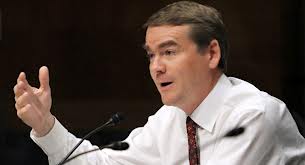
Today, however, as I contemplate the possible loss of the U. S. Senate to Republican control, I feel the need to give some advice.  Michael, Harry, and Barack…listen up!

You know who Barack is, of course.  I think he ought to be concerned because his legacy is at Obamacare 3stake.  He wanted his legacy to be the achievement of a new and glorious era of nonpartisan or bipartisan or post-partisan political cooperation.  We all know that didn’t happen and some of us feel it could not have happened.  Even as a hope, it was unrealistic.  Of course, electing a young and little-known black man to the presidency of the United States didn’t seem all that realistic either, at the beginning, so I think we can all be forgiven for hoping too much.

Still, when the Republicans made the decision that utter intransigence was their ticket back to power, that dream died quickly.  I don’t claim that Sen. McConnell, of Kentucky, was a large part of that Republican intransigence, but it is his expression of it that I remember best.  Sen. McConnell, the top Republican in the Senate, said that his number one legislative priority was to insure that Barack Obama was a one-term president.  That was what he wanted to do as a Senator!

President Obama persisted and with some dazzling cooperation from Speaker of the House, Nancy Pelosi, and President of the Senate, Harry Reid, the Patient Protection and Affordable Care Act was passed: Obamacare.  That is his legacy issue.  And why is control of the Senate such a fraught issue?  Because without it, President Obama is all that stands in the way of a full roll-back of the greatest contribution he has made to his country.  Nobody thinks the House of Representatives is going to pick up enough Democrats to regain majority control.  That would require that the current 207 Democratic members of the House are all re-elected and that ten more Democrats be added—all this in an off-year election when the party holding the White House ordinarily loses seats.

Obamacare 1That brings us to the U. S. Senate, which brings us to Harry Reid, the President of the Senate.  If he wants to continue to be President of the Senate, he needs to get the votes of 51 senators—one of them could be Vice President Joe Biden if the Senate divided 50/50, but no one wants that.  We are going to do some seat counting now and when you do that, you have to trust someone.  I’m putting my money on Larry Sabato.  You can find him at www.centerforpolitics.org and see his “Crystal Ball” for yourself. According to Sabato, Republicans currently “have” 49 seats, if you count as “Republican” all the states that are safely R, that are “likely R” and that “lean R.”  The Democrats currently “have” 48 seats if you count all the states that are safely D, that are “likely D,” and that “lean D.”  The remaining three are called “toss-up” states[1].  If the Democrats win all three, Harry Reid gets to continue to be President of the Senate.

And whose job is it to deliver those three seats to Democratic control?  Michael Bennett of Obamacare 4Colorado.  Sen. Bennett is Chair of the DSCC—the Democratic Senatorial Campaign Committee.  He takes over from Patty Murray of Washington, who dumbfounded observers by keeping the Senate Democratic during her year as Chair of the DSCC in 2012.  It is his job to elect Democratic Senators to those three states.  The three states are Alaska, Louisiana, and North Carolina.  They are the “toss-up” states this year.

So here’s my advice to Barack, Harry, and Michael.  This is, contrary to my history, unsolicited and uncompensated advice.  Flood those states with recipients of Obamacare.  Establish special phone lines.  Send volunteers to their doors.  Give them a ride to the offices where they may sign up in person.  Turn the justly famous “Obama ground game” loose on people who could, if the Democrats keep their eye on the ball, be enthusiastic Obamacare supporters by November 4.

Why?

There are lots of ways to turn out voters.  The urban machine bosses paid them; politically oriented churches have demanded it as “an act of faith;” districts got new construction projects to pave the way.[2]  But there is only one way to get a Democratic victory in those three states in a way that ensures Obama’s legacy and that is to make Obamacare the issue and win on that issue.  That’s Obamacare  2what I want the Obama ground game for.  I want the Republican candidates in those three states—and let’s toss in Montana, South Dakota, Arkansas, and West Virginia, who are poised to move from the Democratic column to the Republican column in November—to face voters who have just been given a priceless gift and I want the Republican candidates to campaign on taking it away from them.  The general campaign is already nasty, as you see here, but I want particular candidates to have to say this.

Here’s why I like that strategy.  Americans have never been united behind any health care plan at all.  The support for “a health care reform” is high, but for any particular one, low.  A Gallup poll on February 4, showed 51% of Americans opposed to Obamacare and 41% in favor.  Put that division on one side.  On the other side, put the conservative battle cry that the government keep their hands off my Medicare.  Hello?  “Government Medicare” is the only Medicare there is.  Once voters take a kind of government program to be part of their lives—it is now “my program,” the program I am entitled to—they resist having it taken away from them.  That’s the heart of this strategy.  Change the question from “Is Obamacare a good thing?” to “Are you going to allow the Republicans to take away your healthcare services?”

I want every Republican candidate in these seven states—the three toss-ups and the four “trending Republican—to face audiences full of people who now have healthcare benefits they never had before and I want them to have to argue, “If you elect me, I will vote to take those benefits away from you.”  Similarly, I want every Democratic candidate to have to argue that Obamacare will be safe if you elect enough Democrats.  The fact is that in some states, Arkansas and Louisiana, for instance, the Democratic candidate might be tempted to run against Obamacare on the grounds that it is not currently popular among the voters of that state.  Filling the audiences with recent recipients of Obamacare will be a useful corrective to that tendency to stray.

And finally, this legislative strategy united Barack, Harry, and Michael.  Michael and Harry might want a Democratic majority in the Senate however it might be achieved.  Anti-Obamacare Democrats in conservative states and pro-Obamacare Democrats in liberal states would be the same thing for them.  It would not be the same for President Obama.  He needs for the election to be about Obamacare and he needs a Democratic majority in the Senate that will support, clarify, and extend the measure.  So a strategy like mine united Barack, Harry, and Michael and I am arguing that is a good thing.

I’m not a big fan of Obamacare myself and if there were other options, I am sure President Obama would say the same.  There were a lot of things he wanted that didn’t make it into the law.  On the other hand, if it is accepted by more and more Americans, it can be made a better law over time.  A defeat of Obamacare—and that is what a Republican Congress, Senate and House, would mean—would be catastrophically bad.

So, guys, here’s my advice.  It is worth every penny you paid for it.


[1] In the House, of course, they are called “toss-up districts.”

[2] There are ways to shape the electorate by making it easier for some to vote and harder for others, of course.

Posted in Politics | Tagged , , , , | Leave a comment

On Having a Miserable Job

Isn’t it just amazing what we learn to be satisfied with?

We think, sometimes, that living the way we do is inevitable.[1]  Or we think that doing what we would have to do to live otherwise would be wrong or just that it would be too much work.  But however it might be explained, you know a lot of people live in situations that could be a great deal better if they would choose to make them better.

I have an example, as you probably expected.  This is from a book called Three Signs of a  miserable 3Miserable Job.[2]  My son, Dan, recommended it to me and then it turned out that I liked it even more than he did; or at least for different reasons.  The story is told by a man who has substantial skills as a manager—big time, small time; it doesn’t seem to matter—and who applies these skills to a run-down Italian restaurant in Nevada.  This guy doesn’t look all that miserable, but pictures of drive through windows aren’t all that easy to find.

“Brian” is the character representing the management perspective of author, Patrick Lencioni.  This is a very brightly told tale and I was reading along, enjoying it without paying a great deal of attention, until I came to this passage:

Brian is meeting with the staff, preparing to begin the magic overhaul.  He says, “I’m here to tell you that my job is to get you to like your jobs; to look forward to coming to work.”  Harrison, one of the employees, says, “Is there something in it for us?” 

Does that strike you as odd?  I think I would have puzzled about it for a while.  Very likely, I would have dumped it all over the Northwest Corner Caucus at Starbucks the next few mornings.  Brian was outraged!

How about not being miserable?  How about making your life a little better and having pride in your work?  Don’t you think that would be a good thing for you and your family and friends?  Or do you enjoy having the life sucked out of you every time you put on that damn Gene and Joe’s T-shirt?

That’s the passage that woke me up.  All these guys hate coming to work.  They hate working here.  Spending every day doing something they don’t like rather than doing something else or doing it in a way they would enjoy more, doesn’t seem to occur to them.   Now let’s back up a little.

Brian asked them at the first staff meeting

“How many people here get excited about coming to work?  How many of you are in a really good mood when you’re driving here?”

Patty said, “Well, I’ve got three little kids at home, so I’m just excited to get out of the house.  But I’d rather not be coming here.”

And Carl added, “I actually get kind of depressed when I wake up on Thursday mornings, because I know that I’m going to be here a lot for the rest of the week.”

The job is bad.  It is depressing.  But it is the way it is.  Nothing about it suggests that it could or should be otherwise.  And in this story, it never occurs to anyone that it could be otherwise.

Brian got to wondering how people with this attitude came to work at Gene and Joe’s, so he put the question to Joe, the owner. 

“So turnover’s a problem,” asked Brian.  Joe nodded in exasperation.

“Why do you think?”

“Heck if I know.  Most of these people aren’t exactly go-getters, if you know what I mean.”

Joe constructs the problem so that is flows naturally from the character of the employees.  To me, that puts Joe in the same category as Patty and Carl.  Here’s a really bad restaurant run by people who don’t want to be there and run by an owner who thinks it is the character of the people he hires that best explains why the place is so depression.  It is also, by the way, not making any money.

miserable 4The piece of Patrick Lencioni’s tale that so grabbed my attention is that the idea of having a meaningful job had to be sold to the restaurant workers.  Brian said, for all practical purposes, I can make your jobs meaningful and engaging and the employees replied, for all practical purposes, why would we want that?  Or maybe, we don’t believe you.  Or maybe, we don’t know how to do that anymore.  Or maybe, but all our friends have jobs like this one and they aren’t complaining.

I tell you what it did remind me of, though.  In Martin E. P. Seligman’s work on “learned helplessness,” he dealt with dogs that had learned that there was nothing to be done.  In all fairness, it is true that the dogs were exposed to electric shocks while being leashed on the shocking end of the cage.  That’s how they learned that nothing could be done.  Then Seligman and his associates took the leash off.  Nothing happened.  The dogs lay on the floor and accepted the shocks because they were knowledgeable dogs; they were experienced dogs; their experience had taught them that nothing could be done.

That puts the dogs at the same place the restaurant workers are when Brian says, “I’m here to tell you that my job is to get you to like your jobs; to look forward to coming to work.”  The good news for the dogs is that they could be retrained—it takes a long long time—so that when the light comes on indicating that the shock is near, they take off for the non-shocking end of the cage.  The good news for the employees at Gene and Joe’s Italian Food is that Brian persuades them to try the new system and it brings them to life.

My great hope is that if I ever get stuck presupposing the meaninglessness of what I am doing and assenting to it, that I will be jarred awake by remembering that it really doesn’t have to be that way.

And while I’m at it, I hope that for you, too.


[1] Words are just so much fun.  Back behind inevitable—way, way back behind it—is a verb “to evite,” which means “to shun.”  I strongly suspect that the people who took the e- from electronic and the vite- from invitation to create evite either didn’t know the earlier word or just didn’t care.  I am more likely to get an evite to a large gathering than I am to be invited by email or phone.

[2] It was written by Patrick Lencioni, who subtitled it, “A Fable for Managers (and their employees)”  Lencioni is president of The Table Group, a management consulting firm specializing in “organizational health.”  His part in the story is played by “Brian.”

Posted in Paying Attention, Political Psychology | Tagged , , , | Leave a comment

Orthopathy. Really.

On November 16, 2008, Jason Walter, a first year student at the Institute of Reformed Baptist Studies, led a discussion on Louis Berkhof’s Summary of Christian Doctrine.  I had never heard of Jason or of the Institute of Reformed Baptist Studies, but I claim him as a colleague today because he has stumbled over the want of a word and has regained his balance by inventing one.  My kind of guy.

The following note was written by “admin,” it says on the site.  It gives two looks at what the term orthopathy might mean.  Here’s admin:

Jason did not claim to have coined the term, but his use of it was especially appropriate. Curious of its origin, I checked the Oxford English Dictionary and did not find it…Maybe we need to begin to employ the term so that it will become a part of theological discourse

Sadly, it also seems to be a term used by Quacks to describe a kind of natural hygiene therapy. If you’re interested, just Google the term and look at the results. I don’t know if this use of the word would argue against a theological use–I wouldn’t want to give the idea that we support quackery!

When I googled the word,[1] having failed to find it in the OED, I found this:

Another word for Natural Hygiene is orthopathy. Dr Herbert Shelton, who wrote several books on orthopathy, says: “orthopathy comes from the Greek, Orthos, erect, regular, right, correct; and Pathos, to suffer. The word means Right or Correct Suffering, and is intended to convey the thought that when one is sick, his condition is governed by law as truly as when he is well.

I am certain that Dr. Shelton is the “quack” that admin was concerned about.  I don’t care all that much about Dr. Shelton’s alleged quackery, but I really don’t think he has the right to steer perfectly common Greek words into his own private field.  I’m really more on Jason Walter’s side of this one.

The Greek prefix ortho-, for instance, is pretty common.  It doesn’t just mean “straight,” the way an orthodontist would mean it.  It also means straight as in “going straight,” which is the way criminals used to describe their aspirations for a life after crime.  Or, as the OED says, it is used, sometimes, “in the ethical sense of ‘right, correct, proper’,” which is the use Jason and I have in mind.

Similarly the Greek pathetikos means “sensitive.”  It does derive, I don’t deny it, from pathos, orthopathy 1which means “suffering,” but etymology is just where you came from and lots of words, especially English words, have emigrated to other lands entirely.  The OED defines pathetic as “producing a stirring effect upon the emotions; exciting the passions or affectations; moving, stirring, affecting.”  And then, even better, “in modern use: affecting tender emotions; exciting a feeling of pity, sympathy, or sadness, full of pathos.”

I think a perfectly plausible and fully usable meaning of orthopathy would be, “having the right feelings,” and that is the way I want to use it.  There are two ways of defining just what feelings are “the right feelings,” but I’m going to turn that job over the Berkeley sociologist Arlie Russell Hochschild, author, most notably, of The Managed Heart.  The job left for me to do is to say how I want to use it and to reaffirm my appreciation of Jason Walter.

If orthopathy meant what Jason and I want it to mean, it would mean “having the right emotions.” orthopathy 3 I came to it by noticing the abyss between orthodoxy—having the right beliefs—and orthopraxy—taking the right actions.[2]  If you will set aside for the moment any question of just what “the right things” are, it will make sense that a person believes that certain things are true and has the emotions that his culture thinks ought to be associated with those beliefs, and that he does the things that those beliefs and those feelings impel him to do.

The ideal of personhood in the First Century C.E. was very integrated.  Persons were thinking-feeling-acting beings.  If you believed something, according to this notion, you acted in accordance with what you believed.  If you didn’t act the belief out, you probably didn’t have it.  Here’s a passage from James 2: that has always made me chuckle.

19You believe in the one God—that is creditable enough, but even the demons have the same belief, and they tremble with fear. 20Fool! Would you not like to know that faith without deeds is useless?

“Orthodoxy without orthopraxy?” says James.  Are you nuts?  The demons are perfectly orthodox and believing what they believe will do you just as much good as it does them unless you join it to the properly entailed practices.  Orthodoxy flows naturally, James thinks, into compassion, generosity, and social action.

Somewhere during and after the Enlightenment, we took those apart so we could study them separately.  It should not surprise you, for instance, to learn that there are sub-disciplines of sociology called: sociology of the emotions, cognitive sociology, and practical sociology.  But the scientific study of human beings has moved, lately, in the direction of fitting them back together.  We study and write about the effect of behaviors on emotions and cogitions; the effects of emotions on behaviors and cognitions; and the effects of cognitions on emotions and behaviors.

It’s like a family reunion.  Welcome home, everybody.

orthopathy 4Arlie Russell Hochschild is the writer I have trusted most about how emotions are socially managed.  Her  book, The Managed Heart was an in-depth study of Delta Airlines flight attendants—people who smile for a living.  Tucked into that book was a chapter on “repo men,” who take back from people goods they are using, but have not paid for.[3]  These are men who are required to scowl for a living.  The materials I am dealing with today come from “Two Ways to See Love,” Chapter 6 of Hochschild’s The Commercialization of Intimate Life: Notes from Home and Work.

She begins by postulating that for every cultural setting, there is a set of understandings that might be called “an emotional dictionary.”  Here’s what she says about it.  She cites a distressed bride whom she interviewed for The Managed Heart as saying, “This is supposed to be the happiest day of my life…”  Then she says:

The sociologist is not focusing on emotion, per se, injury or repair, but on the cultural and social context of individuals, healthy and injured alike.  Part of that context is a culture of emotion.  What did the bride expect or hope to feel before she felt what she felt?  She tells us, “I wanted to be so happy on our wedding day.  This is supposed to be the happiest day of one’s life.”

To expect or hope to feel a certain feeling, the bride had to have a prior idea about what feelings are feelable.  She had to rely on a prior notion of what feelings were “on the cultural shelf,” pre-acknowledged, pre-named, pre-articulated, culturally available to be felt.  We can say that our bride intuitively matches her feeling to a nearest feeling in a collectively shared emotional dictionary.[4]

It isn’t just a dictionary though, according to Hochschild.  It is also a kind of Bible.

“…what does the bride believe she should feel?  She is matching her experience not only to a dictionary but to a bible.  Our bride has ideals about when to feel excited, central, enhanced, and when not to.  She has ideas about whom she should love and whom not, and about how deeply and in what ways she should love…Does love loom larger for our bride than it does for her groom?  Or does she now try to make love a smaller part of her life, as men in her culture have tried to do in the past?  What are the new feeling rules about the place of love in a woman’s life?

Orthopathy, in the dictionary metaphor, is a set of “right feelings” based on the feelings that are orthopathy 2available in her culture—the ones everyone knows about; the ones she could talk about to her friends.  Orthopathy is also, in the Bible metaphor, a set of “right feelings” based on what she things she personally ought to feel, or that a woman in her situation ought to feel.  This isn’t just choosing from the buffet of possible emotions, which is what her society gives her; it is also matching how she does feel to how she thinks she ought to feel.

So I come to orthopathy not so much to spite Dr. Shelton—you remember, the quack?—as to address the logical void between orthodoxy and orthopraxy.  Jason and I hope you will find this reason compelling.


[1] Many years before admin did, I will say.

[2] Both of which actually are in the OED, in case you were wondering.

[3] Leading to one of my favorite jokes.  Question: What happens when you fall behind in your payments to the exorcist?  Answer: You get repossessed.

[4] Or, as Sheryl Sandberg, of Lean In fame, said in today’s New York Times, “you can’t be what you can’t see,”

Posted in Love and Marriage, Theology, ways of knowing, Words | Tagged , , , , , | Leave a comment