
What does it cost to use a U. S. citizen in the U. S armed forces?
That’s the question I want to ask. I know it cannot be answered in the form I have first asked it, but I have never heard it asked at all and that doesn’t seem good. To begin to ask it, I want to divide the costs into three periods of time: the cost of preparing him [1] for service; the cost of equipping and sustaining him during his service; and the cost of supporting him in civilian life after his period of service is ended. So: before, during, and after. I am aware that “after” might be a very long time.

The U. S. government has the legal right to pass “draft legislation” and thereafter, to commandeer anyone who is physically able to fight or to support in some organizational way [2] those who are fighting. So for those eligible to be drafted, “serving your country” is something that can be done to you. It is also, of course, something you may choose.
I don’t know more about basic training than what they show in the movies and what people say who reflect on their experience of it, but I do know that the goal of the process is to get people to do without reflection things they might decide not to do at all if they were left to their own devices. That involves stripping off a lot of the individual traits that have enabled these men to know who they are. I think that is the official view. But it may also, depending on the person, involve stripping OUT of the person, some crucial part—something that needs to be there for the person to be functional.
If you picture this as “taking off civilian clothes” and “putting on a uniform” is seems like no more than a change of clothing. But there is more to being a soldier that wearing a soldier’s [3] uniform. If it were no more than that, it would be easy to think that you put a soldier’s gear on him and use him as a fighter and then bring him home and take off the soldier’s gear and put on civilian clothes and it’s all back the way it was.
Then there is the cost of sustaining these soldiers in theaters of combat. The costs of supply and of advanced weaponry and of medical care are very high. The costs to the families are high as well.
Since we are thinking only about costs—and deliberately ignoring the other parts of the dilemma—let’s ask how much it would cost to put a former soldier “back”—to restore him to the life he had before his active duty. And let’s just consider the commonly accepted notion that 10% of the men in the military see actual combat. [4] Restoring that 10% to who they were before may be simply impossible. But even just restoring each man to “adequate functioning” after he comes home could cost quite a bit.
 Let’s consider some of the costs. If marriages that were perfectly adequate before the term of service are no longer viable after a soldier’s wartime experiences, then the costs borne by all parties, particularly the children, need to be considered. I have no idea how to calculate those, but remember that it is only the monetary costs we are considering.
If there are disabling wounds, they will need to be treated. But here we run into the same “change of clothing” phenomenon we saw before. Some of these wounds aren’t like a scraped knee that is “all healed” when the bandage comes off. Some require artificial limbs; some wheel chairs; some dialysis; some tracheotomies. What might it cost to “restore” soldiers on whom we dropped Agent Orange?
When I say “restore,” it is really a rhetorical question, but if we back the question away as far as “compensate for” or “provide a generous safety net for,” the questions get non-rhetorical quickly and the costs are mind-boggling even if we consider only physical damages.
But not all the damages are physical. There are the psychological costs. Everyone has read about PTSD, but you can’t see PTSD. PTSD is an explanation for a lot of asocial and anti-social behaviors that everyone can see. It is an explanation for some criminal behaviors that would ordinarily be handled by civilian courts. If they are PTSD-related, should they be handled by military courts? Should the military provide legal counsel for whatever civil court has to handle the case? Does “military service” become a “get out of jail free” card for all veterans? For some veterans? Which ones?
If a veteran comes back to a civilian life unable to cope with its complexity, should the military—just a shorthand expression for “taxpayers”—help them cope and, if “coping” is beyond their capacity, should the military provide some safe place for them to live. And by “safe,” I think we should mean that they are safe from us and we are safe from them.
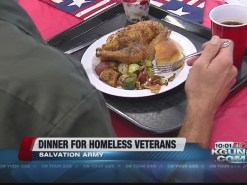 I began to think of the costs of military service when I noticed the proliferation of charitable projects to support “homeless vets.” And I began to wonder how it is that soldiers can be put against their will into situations that will damage them for life and then, when they come home, be treated as the objects of charity drives? I had a brief and angry vision of myself wheeling a friend, now a vet in a wheelchair, up to an army recruiting office and saying, “Here. You broke him. Now fix him.”
It’s a really bad vision in a lot of ways. I admit that. But the alternative, if I really want to find a place to use that line, would be to take him to a Veterans Administration (V.A.) hospital and they are desperately underfunded. We have not given them the money even to do the things we require them to do, much less the money to cover the expanded notion of services I am considering here. Besides, they are not the ones who broke him.
It seems so “private sector.” The recruiting office is the marketing department. No underfunding there. But the company doesn’t maintain a department to fix the customers that their product damages They have a legal office to manage their legal liability for damaged customers, but no Rehabilitation Division. That’s the V.A. hospital. The armed forces do have a “rehabilitation division” but we fund it as if it were a government charity and then we call on private citizens to supplement that budget with private charities.

How would we calculate “the costs of military action” if we said that every soldier we send into combat (not the other 90%) is guaranteed compensatory services for the rest of his life. Those have to do with education, employment, financial support, medical services, including psychological and legal services—for the rest of his life. And if any of these 10% suffer a loss of family support for whatever reason (that includes “reasons” which cannot be traced directly to the term of military service) the family receives the needed support as well.
I started off with an intentionally provocative question. I asked about the cost of “using” a citizen. “Using” is not a word we normally allow, but for some servicemen, the difference between being “used” and being “abused” [5] is really too thin for everyday conversations.
Not abusing these men would be everyone’s first choice, I am sure, but the business of killing people in a setting where the enemies and the civilians look just alike is daunting. So some of our soldiers are going to be ab-used. The next best choice is for the costs of rehabilitation—physical, psychological, social, vocational—be borne by the authority that sent them into battle. [6]
 It is not right, according to this argument, to recruit men to serve a public purpose and then dump the responsibility for them onto society as if they were to be a subject of private charity. I am not opposed to private charities, but they should not be run for the purpose of compensating for the deliberate underfunding of public programs. Let us take care, as citizens and taxpayers, of the men we have sent into combat. Let us take care, as private persons whose compassion reaches out to others, of anyone whose need reaches us.
Someone will surely say that defining “public purpose” as broadly as I have will substantially increase the cost of waging war—or, as we say these days, “defending the national interest”—and that is true in a sense. It might be that no more dollars would be spent, but it is very likely that the proportion of those dollars provided by the public through their taxes would increase. What might feel to many taxpayers like an increase would only, in that case, be an honest accounting for what it actually costs.
Someone else will say, I am sure, that the picture I am painting is not patriotic. I believe in being patriotic [7] but all the banner waving seems to be a part of the recruitment phase at the front end and of the public announcements of gratitude at the back end of the process. I would like it to be seriously considered as part of the funding decisions by which these men are cared for.
It is a well-known Marine maxim that you don’t leave a Marine behind on the field of battle. What I am proposing here extends the “field of battle” to the long post-service civilian life. These are our warriors and they may not be left behind.
[1] According to the latest figures I saw, 85% of the armed forces were men, so I will use the generic “he” in good conscience. I will imagine that the costs would not differ for women.
[2] I know that is clunky, but I am trying simultaneously to recognize what the serviceman’s family does to sustain a soldier but still to exclude them from the financial calculations.
[3] Even I know that “soldier” is not an acceptable substitute for all the services. Marines like to be called “Marines,” although they are a corps of the Navy. You can call members of the Navy “sailors,” and members of the Air Force, “airmen.” There is apparently no agreement on what to call a member of the U. S. Coast Guard.
[4] I don’t know if that calculation holds in a time when anywhere you walk or drive might bring you into contact with an IED. I would call that vulnerability “combat” myself, because I am considering the cost to the serviceman.
[5] We don’t often notice it, but the prefix ab-, as in, say, ab-normal, means “in the wrong way.” So there is, in the infrastructure of this word, a “proper use” and an improper (or ab-) use. This does not quite ease our discomfort at the notion of “using people,” but it might be the best we can do.
[6] We ordinarily say “into harm’s way,” as if our soldiers could be harmed by what happens to them rather than also by what they are forced to do.
[7] I don’t always define the love of my “father-land” (the patris in patriot comes from the Greek word meaning father) the way everyone else does, but I would be happy to justify that love to anyone who asks.
 I gave birth to the blog. It’s a question of perspective, I guess. And after six years of this, I’d have to say that I am surprised at how much it has changed me. As is often the case, I have three things in mind.
 In writing a blog, I find that many of the ideas I run across in the course of a day’s conversations are neurologically linked, like a microphone planted somewhere in my mental landscape. They catch and transmit the remarks of passersby; they remind me of stories I haven’t thought of for fifty years; they make connections between phenomena I have never seen as related before. Briefly, it changes how my mind works.
 My first blog was called “Blog 1” and it was 257 words long. Then I sat down and wrote 502 more essays. This one is #503. That works out to somewhere in the mid-70s per year. [3]


 the ingroup bias, “sticking with your friends.” I would call the ethnocentrism, “American exceptionalism.” I would call the emphasis on social norms “being a team player.” I would call a reliance on friendly sources of information, trusting people “whose hearts are in the right place.” And of course, I would provide pejorative names that they could use to describe the nonauthoritarians. Traitor and coward come readily to mind.
 I presented these contradictory responses as a “policy conflict,” but actually only the second response engages policy at all. The students who wanted to get the best of what there was to get did not have a policy orientation in mind at all. They took the system for granted and wanted to know how to work it. “What if we came to class an hour early?” they wondered. “Or maybe if we were among the first 27 students to register for the class. Or maybe we could get the professor to give upperclassmen first shot at those seats and seat underclassmen only if there were still room. Or maybe we could send one of “us” early and have him reserve the 27 seats for the rest of us.”
 At this point, I would like to introduce Marc Heatherington and Jonathan Weiler as they are represented in their book Authoritarianism and Polarization in American Politics (2009). I’m going to be relying on their recent work for most of the rest of this essay. They use several tests which look very good to academics. The tests are “valid,” i.e., they test what they are supposed to test and they are “reliable,” i.e. they come up with the same findings when a population is retested. So, in general terms, these are really good measures.
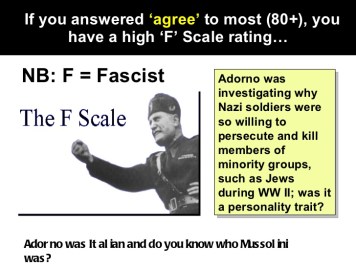 That’s what I like. “Authoritarian” is a description; it is not a condemnation. On the other hand, there are times when the policies that authoritarians disproportionately support cost all of us dearly. I can be against those policies without raising—without even considering—the question of just why they chose those policies. And that is what the authoritarianism scholarship, beginning with Theodor Adorno, has mostly done up to now. It is not what Heatherington and Weiler do, which is why I am passing their work along to you.
 seriously challenge social norms; nonauthoritarians are more likely to think that it is a good thing even when it does. Nonauthoritarians, to say it another way, are willing to put up with a good deal of disorder to protect the autonomy of persons. They don’t feel the same consideration for the “autonomy” of powerful social systems.
 My own personal views really don’t fall at either extreme. Like most people I have some of these traits and some of those. Or I honor these values in one situation and those values in another. In other words, I do not fit the “ideal type” that the tests identify. I fit somewhere further toward the middle of the scale.
 As you can almost tell, even with the way I cropped the picture, this is a front yard display. It is in my neighborhood in the sense that I drive by it on 35th Avenue every morning on my way to Starbucks. And one morning at Starbucks, my friend Paul McKay said, “Hey, you know that house on 35th that has that pig in the front yard? You know what that is? It’s ‘pearls before swine,’ like in Matthew.”

 nomination—there has been a lot of talk about “authoritarianism.” On behalf of the political scientists of the world, let me invite you to the discussion. We talk about authoritarianism pretty much all the time. It’s just that this year, some of our stuff is landing on editorial pages and is being read by a broader audience.
 In her book, Eichmann in Jerusalem: A Report on the Banality of Evil [1], Hannah Arendt raises the question of whether Adolf Eichmann was, himself, anti-Semitic. As I read her, the answer is either “No, he was not,” or “He might have been but it didn’t matter to his work.” [2] Arendt came very close to saying that Eichmann really wasn’t bright enough to be a thoroughgoing anti-Semite. She does say, clearly and repeatedly, that Eichmann’s operation of the Nazi death camps would not have been altered by so much as a single Jew if he actually had been an anti-Semite.
 history in which a bold “take no prisoners” kind of leader is required. Imagine for a moment that you are the superintendent of a school district and that one of your school is a chaotic mess filled with incorrigible students. You may have the most fanciful liberal arts dreams in mind for this school, but first you are going to have to establish law and order. So you choose a law and order principal. He is flamboyant. He drives a fire engine red sports car which has a driver’s side door fitted with a scabbard for his Winchester. He encourages his teachers to carry guns in class. The parents who are desperate for order are enthusiastic and reduce his offenses to mere peccadilloes. The others are horrified that some blowhard clown is in charge of their kids’ high school.
 Wendy Lustbader has written more sensibly about aging than anyone I have read for a long time and in a recent issue of Generations (2014) she wrote a piece called “It All Depends on What You Mean by Home.” Isn’t it the truth!
 But among people who have known you for a long time, there is a broader kind of acceptance and it is based on a broader kind of knowledge. People who have known you for a long time know “who you really are,” not just how you seem in the afternoon after your nap. “How he is after his nap” is part of what friends know about you. “He’ll be fine,” they will say, “Just give him a little time.”

 There are two things worth noting here. The first is the way Johnson sets the hook in the reader. “Did you ever have an experience like this?” he says. Nearly every Christian I know has had experiences like that. If you mix with the general public, it is pretty likely that you are going to be in a conversation where the idiocy, the arrogance, and the utter hypocrisy of religious belief are going to be taken for granted. Your own consequent idiocy, arrogance and hypocrisy are obvious applications of this view. That isn’t fun at all.
 has nothing to do with religion and b) I am part of the group of friends.
 So the lesson embedded in this setting of the story is: Let it pass and see what happens.
 group. But a person who feels unable to do either of those might still feel that something should be done and that person might think of saying, “Remember when you were talking and laughing about how stupid religious people are? That really hurt my feelings and I wish you would be more careful and not do that any more.”
 on that is going to choose Donald Trump as the nominee of “the Republican party.” Notice the quotation marks. Ryan is the highest ranking Republican. He is behind only Joe Biden as “our next President.” [1] He is as close to Mr. Republican as anyone can be. He looks pensive, don’t you think?
 I think of “agenda” and “Trump” in the way I think of the agenda of the Earp brothers at the OK Corral. If there is an agenda there, it is “get them before they have a chance to get you.” Grand Old Party? Really?
 [1] And if you can’t imagine what it would be like for a conservative Republican Speaker of the House to move seamlessly into the Oval Office and start “presidenting,” then you owe it to yourself to see John Goodman do it as Glen Alan Walken in Season 4 of The West Wing. I found it disconcerting.

 In this picture, we see the result of Haber’s suggestion that the world not be divided into warring groups by the color of their skin. George dreamed that everyone was gray and when he woke up, they all were—including Dr. Haber. I’m sure that seemed a good solution to a dreaming mind, however far from Haber’s mind it was. When George was instructed to bring “peace on earth,” he invented aliens and had them invade Earth. Problem solved.

