
Milton Mayer used to make fun of people who use Latin where they could just as well have used English. He managed to do that inoffensively by making that error repeatedly and then making fun of himself for doing it. I thought I would mention it because I am about to do it myself.
“Finem respice” he would say, “Principiis obsta.” Mayer died in 1984 but I can feel his gaze on my keyboard as I write this. “En vision the end” the saying goes, “resist the beginnings.”
I am working now with a marvelous book that Kendy Hess, my philosopher niece, brought to my attention and this morning, it occurred to me that the mechanism that C. S. Lewis uses in The Great Divorce is identical. What I am calling “the mechanism” is the trick of looking at the present from a hypothetical future time when all the events of our “present” have already occurred and we know what worked and what didn’t. Of all the claims we dealt with in our own time, we now know, from this hypothetical future, which were true and which misleading. This essay is about the advantages of knowing how everything is going to turn out.
A Broken World
Kendy passed along to me Tim Mulgan’s Ethics for a Broken World: Imagining Philosophy After Catastrophe. Mulgan has a person from our time—he calls it “the age of affluence”—visit the time from which he is writing. Since Mulgan is a savvy writer, he doesn’t say exactly when “the future” is, but he does locate it generally by saying that the age of affluence ended “only a handful of generations ago.” Let’s just artificially specify a handful as six and a generation as twenty years. So, for the purposes of this essay, he is writing from about 2140 C.E. [1]
As a way of making an argument, foreseeing the future with certainty—finem respice, remember—is a great advantage. Consider this passage from Chapter 1:
Our affluent visitor might initially refuse to believe that our plight represents the future of his affluent world. Drawing on the affluent faith in technology, he might be sure that human ingenuity must always outweigh the negative impact of climatic variation and uncertainty. We can only reply that, while this might have happened in a different possible world, it did not actually happen.
In our time—the affluent age—we still have a robust “faith in technology.” Smart 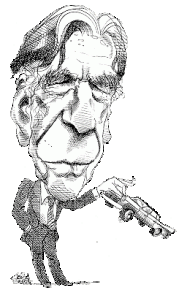 people argue that this or that can be done. Mulgan has the advantage of saying “while this might have happened…it did not actually happen.” Mulgan knows what happened—“is happening,” we would say—and so he knows that the faith in technology was misplaced. And here we have John Kenneth Galbraith, whose book, The Affluent Society focused attention on the early phases of a lot of the issues that are completely out of hand by 2140.
When you actually know what happened, you gain a real clarity about what is—from our present perspective—still going on.
We might say of a friend that although he hoped that his speculative financial losses would be offset by his gains, that did not happen. He went completely broke by the time he was 37. We might say that it looked for a while as if a marriage doomed both participants to frustration and despair, but in fact, they came out of that bad time and lived happily together for another fifty years. Writers have an enormous advantage in knowing what actually happened especially when they are giving advice. We can “resist the beginnings” (principiis obsta) if we know the beginnings (finem respice).
Heaven and Hell
 C. S. Lewis’s setting is entirely different, but the mechanism is the same. The “divorce” of the title is the separation between Hell and Heaven. Every day, the people in Hell (the Ghosts) have the chance to get on a bus and go to Heaven to commune with the people there (the Spirits), and to stay forever if they want to. Nearly everyone doesn’t want to. They get back on the bus in the afternoon and go back to Hell where, apparently, they feel more “at home.”
But while they are in Heaven, they are met by a Spirit who knew they in what we call “life.” In heaven, everything is known so the denials and evasions used by the Ghosts are transparently false, just as the “faith in technology” in Mulgan’s book is transparently false. Here are some examples.
.
The character I call “the Episcopal Ghost” is defending himself against the Spirit who has come to help him.
“Dick,” says the Ghost, “This is unworthy of you. What are you suggesting?
“Friend,” the Spirit answers, “I am not suggesting at all. You see, I know now.”
An artist wants to stay in Heaven so he can paint it. The Spirit who came to meet him, a fellow artist during their life, tries to explain what was really going on back on earth.
“When you painted on earth—at least in your earlier days—it was because you caught glimpses of Heaven in the earthly landscape. … But here you are having the thing itself. It is from here that the messages came. There is no good telling us about this country, for we see it already. In act we see it better than you do.”
A third Ghost is one I call the Rightsmonger. All he wants is what is his due
“I’m a decent man and if I had my rights, I’d have been here (Heaven) long ago and you can tell them I said so.”
“It isn’t true, you know,” says his friend, the Spirit.
“What isn’t true?” asked the Ghost sulkily.
“You weren’t a decent man and you didn’t do your best. We none of us did. Lord bless you, it doesn’t matter [any more].
So from a narrative standpoint, there is a great deal to be said for knowing all of the truth. In Mulgan’s work, you hear a lot of arguments that are being made today and that sound very plausible today. But when you know that they didn’t work—and in 2140, we do know that–the plausibility blows away like dandelion seeds. In Lewis’s fantasy, all kinds of self-justifications which any of us might use here in the present of our lives and/or might discount when we heard them used here, simply melt into incredibility before our eyes.
So, if you are thinking of writing a fantasy, I recommend that you or a narrative creature of your devising know what has happened. It makes everything else easier.
[1] I have recently read a book that is called 2312, by Kim Stanley Robinson, because that is the year in which the narrative takes place. In that book, our time is called “the age of muddling.”
 suggested in the first part can be logically extended to the second part. All that passage is nonsense, of course, but I would like for you to stop and consider just why it is nonsense. It is not the words. They work fine. It is not the ideas. They can be made to work. It is the sources. What I am going to call the genres.
 Messiah and king and son of God all had triumphant overtones. Jesus just can’t be, according to the Jewish understanding at the time (and today) the triumphant messiah and the suffering servant. One or the other; not both.
 I experienced one of the few failures of conversation I have ever had in our Starbucks group last week. I had a position I wanted to sell. It is position the group almost certainly accepts in general, but they didn’t want to accept it this time. And it is the failure of the conversation I want to point to, not my own failure. Although… (see below)
 When I referred, above, to the position the group accepts as a general matter, this is the position I had in mind. People should be granted the right to feel what they feel. This means only that we understand that every decision is made on the basis of a welter of considerations, many of them contradictory. I would really like to have my son and his family nearby, but the best job offer is in a distant city and I know the family will be better off there. The Caucus would, as a rule, say that they “understand” my feeling of personal loss and that they “approve” my giving greater weight to the more important consideration. On the other hand, if I said that I am opposed to my son and his family moving to a distant city even though I know it would be the best thing for them and that my opposition is based on my own regret that they will no longer live near me, they would not approve. They might very well characterize my consideration as “selfish.”
 The white working class of the post-bellum south has every right to mourn the loss of the one social advantage they had, but they should set that aside in favor of the much greater importance of racial equity and social justice.
 trade-off at issue really was. It doesn’t really matter for this essay. Let’s say that it was the satisfaction that Trump voters feel is seeing “their guy” stand up to the enforcers of “sensitivity.” They, it seems to them, are forever being corrected by the Nazis of Political Correctness and they have to adopt new terms because the common old ones are now “offensive” and adopt tortured syntax to work their way around a word that can’t be used any more. They have to stammer and apologize and kowtow to criticisms. But Trump doesn’t. He just doesn’t. He faces the same forces that require us to submit and punish us if we don’t and he refuses to kowtow. How satisfying to see someone stand up to them!
 This argument represents an authentic feeling. As the guy assigned to argue the Trump voter out of his madness, the intensity of this feeling is my problem. I can argue that the objection in that form is the sheerest nonsense; that “status quo” doesn’t mean anything at all if we are talking about the effects of all policies at the same time. That doesn’t help me. The anger against “the status quo” will not be mollified by more abstract considerations. Revoking Medicare and Social Security, for instance, would be a dramatic rejection of “the status quo,” but it turns out that is not what they were thinking of.
 what is truly—that ordinarily means “economically”—in their interest, but I find that they are not interested in arguments and are prepared to deny the truth value of anything that has ever been studied. They don’t believe the reporting of journalists if it is inconvenient because of “the liberal media.” They don’t believe the overwhelming consensus of experts about the causes of global warming because it is not unanimous.
 The problem I am confronting in dealing with these Trump voters is that I need a solution to the grievances they have that will feel good for them to hold. I can’t think of one.
 Vance’s second point is that as “faith” as been de-institutionalized, it has been re-politicized. But politicization, even among white working class voters, means more than Vance considers in this column. Further, the black Protestant churches are almost surely the most politicized churches in the U. S. The “values voters” that Vance laments are only a pale reflection of the “black Christian voters” that the black churches turn out year after year. [4]
 Vance sees that as the difference between a religious stance with and one without an actual community. Evangelicals who worship in community have, as Vance puts it, “camaraderie, community, and a sense of purpose.” Evangelicals who are alienated from actual communities have only a vacuum there and “into that vacuum has stepped Donald J. Trump.”
 How does that work, exactly? “Frail” is an evaluative term that requires an outside perspective. If you were to see an old man shuffling along warily, concentrating full force on not falling over, you might easily call that old man “frail.” But you would apply that term to yourself only if you imagine others would see you in that light. You imagine the way you may be viewed and apply that label to yourself.
 ondition of your bones and muscles and joints, we are talking about the conditions that will cause you to apply a word to yourself. The word is “frail.” And if you have decided that “being a frail old man” doesn’t serve you well, what can you do about it?
 ey. So I change how I act, which categorizes that kind of action as my internalized “other” will do it, which changes the meaning of what I have just done as it is applied to me. There is not an internal or “self-talk” piece in this routine anywhere. The action is external. The “meaning” is external. The application is automatic.
 The online dating setting is the same problem in a way. There are things you are expected to say. If you say only those things, they (potential dates) don’t hear you at all. But the issue in dating is not really that you want them to “hear” you. It is that you want them to “see” you; you want them to see who you are. So I learned that if you want them to see you—or, indeed, to see anything—you need to surprise them a little. Everyone on an online dating site wants to have “adventures,” for instance. So if you say you don’t like to “have adventures,” you have created an opportunity for yourself. And even if you follow that up with “…instead, I like to CHOOSE adventures,” you are likely to have revealed something about yourself. [3]
 That doesn’t happen because Ben makes common cause with her immediately and he also causes Jules to see him. In the movie, we see her do that. She says what she wants to say and then looks back down at her laptop. Then she hears what he actually said and looks back up again. Can you see that her face and her eyes are not oriented in the same way? That’s why.
 Ben jumps right on that one. “So I gather,” he says, “but I can get along with anyone.” As viewers, we remember the response of the other interns to the news. That’s how Ben knows Jules is hard to work for. He recognizes that directly and she reacts like someone just ripped a bandage off her arm. It isn’t pleasant, but when it is done, it is done and it’s all better. Besides, Ben says, “I’m here to learn about your world.”
 It can be looked at in several ways. We will examine two of them. From my side of the table, it is about “subverting the discipline of the market.” I mean that ironically, as you might infer from the quotation marks, but I do mean it. Markets actually work and they don’t work by presupposing that all the participants will have good character. They work by presupposing that everyone is trying to make money.
 expression just this once—about any conversation that comes up. “You think that’s something,” he might be expected to say, “but I did this or that or the other thing, which is a lot better or more painful or more mind altering or something.” He could. But one of the things I like best about Bob is that he doesn’t do that. Ever.
 So the proprietor seems to owe Bob $100, for which he would be reimbursed by the factory. Except that the proprietor doesn’t seem eager to do that and Bob believes that pushing too hard on the factory—on which you rely for day to day business—is probably not a good idea for the proprietor.
 that becomes one of several kinds of difficulty which causes him to switch cleaners. That’s the way it ought to happen. If you don’t do good work, the people who run businesses will find someone who does.
 The truth is, about an issue like this, that the actual decision depends on which values you put in first place, which in second place, and which in third. No one in the Starbucks salon [3] argued that any of the values under discussion was wrong. All the discussion had to do with whether the personal relationship (long time customer) was so important that the proprietor shouldn’t pay for his own mistakes. Or would we all be better off just if we just waived such considerations as we are able and treat service providers mostly just as people?
 students routinely registered for the class and only 27 desks. It’s an interesting example because some students are interested only in getting one of those 27 seats for themselves; others are much more interested in making sure that there is a seat for everyone. [3]
 Let’s consider some of the costs. If marriages that were perfectly adequate before the term of service are no longer viable after a soldier’s wartime experiences, then the costs borne by all parties, particularly the children, need to be considered. I have no idea how to calculate those, but remember that it is only the monetary costs we are considering.
 I began to think of the costs of military service when I noticed the proliferation of charitable projects to support “homeless vets.” And I began to wonder how it is that soldiers can be put against their will into situations that will damage them for life and then, when they come home, be treated as the objects of charity drives? I had a brief and angry vision of myself wheeling a friend, now a vet in a wheelchair, up to an army recruiting office and saying, “Here. You broke him. Now fix him.”
 It is not right, according to this argument, to recruit men to serve a public purpose and then dump the responsibility for them onto society as if they were to be a subject of private charity. I am not opposed to private charities, but they should not be run for the purpose of compensating for the deliberate underfunding of public programs. Let us take care, as citizens and taxpayers, of the men we have sent into combat. Let us take care, as private persons whose compassion reaches out to others, of anyone whose need reaches us.
