
Much to my surprise, I discover that I am not quite finished with the movie, The Intern. In my earlier post [“The Intern as a Theological Prop,” on March 11] I considered the whole plot and let my theological sensitivities guide me. I thought that would be enough, but it turns out that some other things mattered to me too. Much smaller things.
I debated for a little while over whether to use “heard” or “seen” as the master metaphor. I reflected on my own experiences, of which two kinds are relevant, and decided that my legislative experience favors “heard,” whereas my recent dating experience favors “seen.” So I used them both.
The two modes are alike in the sense that the person or the group to whom you are directing a communication is entirely unlikely to pay attention at all. You will be a part of the white noise in the legislative setting and part of the parade of possibilities in the dating setting. Neither of those was what I wanted, so I devised techniques to get around them.
Difficulties 1 and 2
There are two difficulties in these settings. The first is that there are things you are expected to say. When I was giving testimony before legislative committees, I represented a state agency and I had a position to describe and they already knew what it was. [1] They had no reason at all to pay attention to what I actually said.
Furthermore, you have a chance to say something that will help you make your case, something not in the written testimony, IF you can get their attention. Something needs to bring them out of routine listening and into active listening. That means you have to say something they didn’t expect you to say.
Then, while they were coming slowly back to focus, as a result of the discrepancy they had heard, I would say the one thing I wanted them to hear. Ordinarily, you can’t make them vote the way you want, but if you are careful, you can get them to hear what you want them to hear. [2]
 The online dating setting is the same problem in a way. There are things you are expected to say. If you say only those things, they (potential dates) don’t hear you at all. But the issue in dating is not really that you want them to “hear” you. It is that you want them to “see” you; you want them to see who you are. So I learned that if you want them to see you—or, indeed, to see anything—you need to surprise them a little. Everyone on an online dating site wants to have “adventures,” for instance. So if you say you don’t like to “have adventures,” you have created an opportunity for yourself. And even if you follow that up with “…instead, I like to CHOOSE adventures,” you are likely to have revealed something about yourself. [3]
The second difficulty is that you need to establish that you and they (in the committee testimony setting) and you and she (in the online dating setting) are really trying to do the same thing. You are not opponents; we are colleagues, at least for the moment. People like that. “My interest v. your interests” is inherently divisive. “Let’s see if we can get this done together” is inherently collaborative.
OK, so that’s what I know about being seen and heard.
Now let’s look at the way these issues show up in The Intern. Jules Ostin,(Anne Hathaway) the founder and CEO of a very young startup company in Brooklyn has been assigned a “senior intern.” She doesn’t want the program, but apparently she agreed to it, so she is stuck with it. She doesn’t want to have one of these interns assigned to her in particular because “she doesn’t get along with old people.” Ben Whittaker (Robert DeNiro) is 70, so she is expecting to interview him and dismiss him.
 That doesn’t happen because Ben makes common cause with her immediately and he also causes Jules to see him. In the movie, we see her do that. She says what she wants to say and then looks back down at her laptop. Then she hears what he actually said and looks back up again. Can you see that her face and her eyes are not oriented in the same way? That’s why.
That doesn’t happen because Whittaker is really good at being seen and being heard. There are four moments in this very brief interview. Two of them deal with what I called Difficulty 2: you have to establish a useful commonality. In the other two, (Difficulty 1), he says something that pierces her routine disregard of him and causes her to look up and actually see him.
I wish I could sit down with you and play this scene half a dozen times. That’s what did it for me. But…hey…this is a blog. We’ll have to make do.
Colleagueship
Ben knocks at Jules’ office door to begin an interview he knows cannot take more than four minutes. “I’m Ben,” he says, “your new intern” and he says it with an ironic smile. Jules reads the smile. “I’m glad that you also see the humor in the situation,” says Jules. “It would be hard not to,” says Ben.
Since it is just barely possible that you will see this exchange differently, let me say what I see. Ben matches Jules’ irony. “Both of us,” Ben is saying, “see this situation from the outside; we both see the unusual character it has; we both see the potential for humor.”
The second one comes at the end of the interview. Jules says the last thing she has to say and then looks down at her laptop and continues typing. Ben says, “Well, I think we managed that in less than two minutes.” There is no notice—and I mean not even so much as a lingering glance— that an “interview” with a new intern that could not possibly last more than four minutes, is a little odd. Then there is the “we” in “we managed.” Not so much as a nod to “Thanks for giving me two minutes of your valuable time;” nothing like apologizing for intruding. We succeeded. Good for us.
Anomaly
As I said in reviewing my legislative and dating experiences, you have to give them something they aren’t expecting if you hope to be seen at all.
“Could I just be honest?” Jules says, “I’m not going to have a lot for you to do. If you ask me, it would make more sense for you to be in creative or marketing. It’s a little slower and it’s not so technical and if you want a transfer, we can make that happen. And if you want to know the truth, I’m not so easy to work for.”
Jules has offered Ben an easy out. “I’m old and this is technical and I’m afraid I won’t be able to keep up.” He doesn’t take the easy out. And Jules offers Ben a handhold by giving him an additional reason to transfer: “I’m not so easy to work for.
 Ben jumps right on that one. “So I gather,” he says, “but I can get along with anyone.” As viewers, we remember the response of the other interns to the news. That’s how Ben knows Jules is hard to work for. He recognizes that directly and she reacts like someone just ripped a bandage off her arm. It isn’t pleasant, but when it is done, it is done and it’s all better. Besides, Ben says, “I’m here to learn about your world.”
When Ben leaves, he asks, “Do you want the door open or closed?” She doesn’t know until Ben starts to close the door and then she says, “Open…actually.” And then, dismissing him, “You’ll get used to me.” And then she looks back down at her computer. But she doesn’t yet know who she is dealing with.
Ben answers, “I’m looking forward to it.” That’s a lot more than Jules had in mind in her remark. She has already returned her gaze to the laptop, but when she hears that, she looks up again. The very beginnings of “Who IS this guy?” are beginning to form in her mind.
I don’t know what this very small, very tightly choreographed scene will mean to you but I can hardly get enough of it. Ben Whittaker is very nearly perfect in this scene. He makes something out of less than nothing. And since I have had to try that myself, I know a master when I see one.
Way to go, Ben.
[1] Plus, in the legislative setting, they also have your written testimony before them and they don’t want you to read it. They want you to summarize it. Concisely.
[2] Please note that “saying it in their presence” is not at all the same as their hearing it.
[3] It is true that you might only have revealed that you like to play with words and manage expectations, but a woman who was intrigued by that might be just the woman you were wanting to meet.
[4] It is supposed to take less than two minutes in the movie. It actually takes about three and a half.
 It can be looked at in several ways. We will examine two of them. From my side of the table, it is about “subverting the discipline of the market.” I mean that ironically, as you might infer from the quotation marks, but I do mean it. Markets actually work and they don’t work by presupposing that all the participants will have good character. They work by presupposing that everyone is trying to make money.
 expression just this once—about any conversation that comes up. “You think that’s something,” he might be expected to say, “but I did this or that or the other thing, which is a lot better or more painful or more mind altering or something.” He could. But one of the things I like best about Bob is that he doesn’t do that. Ever.
 So the proprietor seems to owe Bob $100, for which he would be reimbursed by the factory. Except that the proprietor doesn’t seem eager to do that and Bob believes that pushing too hard on the factory—on which you rely for day to day business—is probably not a good idea for the proprietor.
 that becomes one of several kinds of difficulty which causes him to switch cleaners. That’s the way it ought to happen. If you don’t do good work, the people who run businesses will find someone who does.
 The truth is, about an issue like this, that the actual decision depends on which values you put in first place, which in second place, and which in third. No one in the Starbucks salon [3] argued that any of the values under discussion was wrong. All the discussion had to do with whether the personal relationship (long time customer) was so important that the proprietor shouldn’t pay for his own mistakes. Or would we all be better off just if we just waived such considerations as we are able and treat service providers mostly just as people?
 students routinely registered for the class and only 27 desks. It’s an interesting example because some students are interested only in getting one of those 27 seats for themselves; others are much more interested in making sure that there is a seat for everyone. [3]
 Let’s consider some of the costs. If marriages that were perfectly adequate before the term of service are no longer viable after a soldier’s wartime experiences, then the costs borne by all parties, particularly the children, need to be considered. I have no idea how to calculate those, but remember that it is only the monetary costs we are considering.
 I began to think of the costs of military service when I noticed the proliferation of charitable projects to support “homeless vets.” And I began to wonder how it is that soldiers can be put against their will into situations that will damage them for life and then, when they come home, be treated as the objects of charity drives? I had a brief and angry vision of myself wheeling a friend, now a vet in a wheelchair, up to an army recruiting office and saying, “Here. You broke him. Now fix him.”
 It is not right, according to this argument, to recruit men to serve a public purpose and then dump the responsibility for them onto society as if they were to be a subject of private charity. I am not opposed to private charities, but they should not be run for the purpose of compensating for the deliberate underfunding of public programs. Let us take care, as citizens and taxpayers, of the men we have sent into combat. Let us take care, as private persons whose compassion reaches out to others, of anyone whose need reaches us.
 I gave birth to the blog. It’s a question of perspective, I guess. And after six years of this, I’d have to say that I am surprised at how much it has changed me. As is often the case, I have three things in mind.
 In writing a blog, I find that many of the ideas I run across in the course of a day’s conversations are neurologically linked, like a microphone planted somewhere in my mental landscape. They catch and transmit the remarks of passersby; they remind me of stories I haven’t thought of for fifty years; they make connections between phenomena I have never seen as related before. Briefly, it changes how my mind works.
 My first blog was called “Blog 1” and it was 257 words long. Then I sat down and wrote 502 more essays. This one is #503. That works out to somewhere in the mid-70s per year. [3]

 the ingroup bias, “sticking with your friends.” I would call the ethnocentrism, “American exceptionalism.” I would call the emphasis on social norms “being a team player.” I would call a reliance on friendly sources of information, trusting people “whose hearts are in the right place.” And of course, I would provide pejorative names that they could use to describe the nonauthoritarians. Traitor and coward come readily to mind.
 I presented these contradictory responses as a “policy conflict,” but actually only the second response engages policy at all. The students who wanted to get the best of what there was to get did not have a policy orientation in mind at all. They took the system for granted and wanted to know how to work it. “What if we came to class an hour early?” they wondered. “Or maybe if we were among the first 27 students to register for the class. Or maybe we could get the professor to give upperclassmen first shot at those seats and seat underclassmen only if there were still room. Or maybe we could send one of “us” early and have him reserve the 27 seats for the rest of us.”
 At this point, I would like to introduce Marc Heatherington and Jonathan Weiler as they are represented in their book Authoritarianism and Polarization in American Politics (2009). I’m going to be relying on their recent work for most of the rest of this essay. They use several tests which look very good to academics. The tests are “valid,” i.e., they test what they are supposed to test and they are “reliable,” i.e. they come up with the same findings when a population is retested. So, in general terms, these are really good measures.
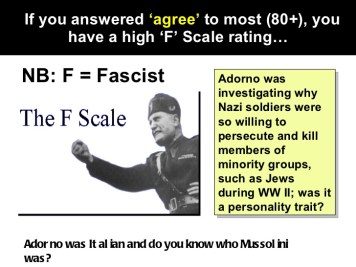 That’s what I like. “Authoritarian” is a description; it is not a condemnation. On the other hand, there are times when the policies that authoritarians disproportionately support cost all of us dearly. I can be against those policies without raising—without even considering—the question of just why they chose those policies. And that is what the authoritarianism scholarship, beginning with Theodor Adorno, has mostly done up to now. It is not what Heatherington and Weiler do, which is why I am passing their work along to you.
 seriously challenge social norms; nonauthoritarians are more likely to think that it is a good thing even when it does. Nonauthoritarians, to say it another way, are willing to put up with a good deal of disorder to protect the autonomy of persons. They don’t feel the same consideration for the “autonomy” of powerful social systems.
 My own personal views really don’t fall at either extreme. Like most people I have some of these traits and some of those. Or I honor these values in one situation and those values in another. In other words, I do not fit the “ideal type” that the tests identify. I fit somewhere further toward the middle of the scale.
 As you can almost tell, even with the way I cropped the picture, this is a front yard display. It is in my neighborhood in the sense that I drive by it on 35th Avenue every morning on my way to Starbucks. And one morning at Starbucks, my friend Paul McKay said, “Hey, you know that house on 35th that has that pig in the front yard? You know what that is? It’s ‘pearls before swine,’ like in Matthew.”
 nomination—there has been a lot of talk about “authoritarianism.” On behalf of the political scientists of the world, let me invite you to the discussion. We talk about authoritarianism pretty much all the time. It’s just that this year, some of our stuff is landing on editorial pages and is being read by a broader audience.
 In her book, Eichmann in Jerusalem: A Report on the Banality of Evil [1], Hannah Arendt raises the question of whether Adolf Eichmann was, himself, anti-Semitic. As I read her, the answer is either “No, he was not,” or “He might have been but it didn’t matter to his work.” [2] Arendt came very close to saying that Eichmann really wasn’t bright enough to be a thoroughgoing anti-Semite. She does say, clearly and repeatedly, that Eichmann’s operation of the Nazi death camps would not have been altered by so much as a single Jew if he actually had been an anti-Semite.
 history in which a bold “take no prisoners” kind of leader is required. Imagine for a moment that you are the superintendent of a school district and that one of your school is a chaotic mess filled with incorrigible students. You may have the most fanciful liberal arts dreams in mind for this school, but first you are going to have to establish law and order. So you choose a law and order principal. He is flamboyant. He drives a fire engine red sports car which has a driver’s side door fitted with a scabbard for his Winchester. He encourages his teachers to carry guns in class. The parents who are desperate for order are enthusiastic and reduce his offenses to mere peccadilloes. The others are horrified that some blowhard clown is in charge of their kids’ high school.
 Wendy Lustbader has written more sensibly about aging than anyone I have read for a long time and in a recent issue of Generations (2014) she wrote a piece called “It All Depends on What You Mean by Home.” Isn’t it the truth!
 But among people who have known you for a long time, there is a broader kind of acceptance and it is based on a broader kind of knowledge. People who have known you for a long time know “who you really are,” not just how you seem in the afternoon after your nap. “How he is after his nap” is part of what friends know about you. “He’ll be fine,” they will say, “Just give him a little time.”
 The Dilettante's Dilemma