“Estate” is a noun. Sigh.

No one “estates” anything to anyone. The language won’t allow it even if the tax codes would. The defining feature of an estate, in the modern sense of the word, is that it belongs to you. On the other hand, blood glucose belongs to you, too, and the two notions are treated very differently.

estate-4Everyone who knows what blood glucose is would wonder what you were planning on using it for. That is not the question that comes first to mind to people who know what an estate is. But today, I find myself wondering why that is. I think that is a really good question to ask about estates: “What are you going to use it for?”

Bette and I have found ourselves a part of quite a few conversations recently in which the basic logic of our choice of a Continuing Care Retirement Community (CCRC) has been called into question. The logic isn’t different than it was when we had those conversations over the last ten years, but we have actually done it now–we begin our third week at Holladay Park Plaza today– and the conversations seem to have taken on a little more edge.

There seems to have been a shift from “why would you…” to “why did you…” You can see where that extra edge came from.

The objection is that when you buy in to a CCRC the money is gone. If that money represented your estate—money you were thinking of giving to the kids or the grandkids—it is easy to think that in spending it on yourselves, you are depriving the children of something they had every right to expect. “We are spending this money on ourselves,” this couple might say, “and we hoped we would be able to give it to the kids.”  And in some scenarios, we can imagine the kids saying the same thing.

I don’t have any trouble understanding the sentiment, but I see it from a differentestate-2 stream of stories. I see “children” in their fifties and sixties (and older) seriously encumbered by the process of caring for an aged parent. [1] This parent could have invested in his or her (“”her,” usually) own care by moving to a CCRC, but she did not. She relies, instead, on the daily services of her children to enable her to keep living the kind of life she is used to.

“I want to keep my independence,” she says. “I understand,” says the caregiver, “I would love to have some independence.

If we consider this as an economic transaction—which it is, although it is more than that as well—then the “child,” the caregiver, is trading many years of exhausting toil against the hope of eventually receiving some money. No one would say it that way, of course. Both the giver and the receiver of these services think of them, on a good day, in terms of love and duty and affiliation. [2] These are personal transactions, as they see them, not financial transactions.

But what if the caregiver would gladly give away the hope of receiving “an estate” in order to see that the parent’s needs were thoughtfully and competently taken care of. If she felt that way, and it is a very common way for caregivers to feel, she would yearn for the parent to choose to live in a CCRC and to forego entirely the dream of “passing the estate” to the child. She is not taking care of her mother in the hope of financial gain. Besides, it would be nice to have some of her own life back.  And in cases where the burden of caregiving has imperiled the marriage, it would be nice to have the marriage back as well.

This is not a wish for less contact with the parent. It is a wish that more of the the contact be with the person herself. It is crucially important that the parent be supplied with the services her or she requires: being driven to appointments, being reminder of medications, help with meals, and so on. It is not crucially important that the principal caregiver herself do all those things. It is entirely possible to go to visit the parent and just sit and chat or go out to lunch. To do together, in short, the things the two of you like to do, rather than always the things that have to get done.

estate-3Buying time like that is what you would get, in this scenario, for using the estate rather than saving it for the kids. But there needs to be a way to say that in less than a page and a half. If it were possible to say, “I would like to estate to you the freedom to use our time together as we choose,” that would do the job. No one will say that.

The notion of usufruct is not a matter of common speech. [3] If it were, the notion of the “use” of one’s retirement and the “enjoyment” of one’s retirement could guide us toward the distinction I am making. The estate is the income itself so “using it” would use it up. Still, I think the distinction is worth making since the parent’s use of the estate would make possible the enjoyment of the relationship.

We could say, “I am using the estate as a way to free you from being perpetually my caregiver and not mostly my friend.” But even there, “estate” is a solid and impenetrable noun and you have to establish a novel verb of some sort to mean anything but “give over after my death.” I like novel verbs, but it takes a lot of work to make them practical in use.

I could look my own children, all now in their 50s, in the eye and say, “I am not leaving you an inheritance; I am spending it on our relationship in these days we are now living.” And they would understand what I meant and appreciate it because of the relationship we have achieved as adults.. But a formula that requires that much background is not fit for use as a general formula.

And I end this essay by saying that I cannot think of an easy way to say this simple thing.

[1[ I know it is common to say “aging” parent, as if it were the process of getting older (I have an aging nine-year-old grandson) that needs to be highlighted, rather than just where on the aging spectrum you are. “Aged” is a place on the spectrum.
[2] On a bad day, maybe just the obligation.
[3]The gains granted by usufruct can be clearly seen in the Latin phrase from which the word developed, usus et fructus, which means “use and enjoyment.” Thank you Merrian-Webster.

Posted in Getting Old | Tagged , , , , | 2 Comments

Jesus supports my political program

Today, I feel like Yaskov, the Russian spy in Howard Neame’s 1980 movie, Hopscotch. service-4He says of his opposite number, the American spy, “I do like him, you know. One can’t help it.” The opposite number in Hopscotch is Miles Kendrick, played by Walter Matthau.  Like Yaskov, I just don’t seem to be able to help liking Nicholas Kristof. He writes a lot of things I find fault with (like his September 4 column) but it never occurs to me not to like him. And I liked his father a great deal. [1]

In Sunday’s column, “What religion would Jesus belong to?,” he has a point to make and he makes it well. In the process, he leaves a trail of dearth and destruction. Let’s look at the point and then follow the trail.

The Point

The general point is made in the first line: “One puzzle of the world is that religions often don’t resemble their founders.” He goes on to refer to Mohammed and the Buddha and even adds a rabbi (Rick Jacobs, the president of the Union for Reform Judaism) to cover what Moses might have done. But mostly, Kristof wants to talk about how far short Christianity has fallen from what he thinks Jesus’s original intentions were.

Jesus never mentioned gays or abortion but focused on the sick and the poor, yet some Christian leaders have prospered by demonizing gays.

To describe Jesus’s intentions more fully, Kristof turns to Brian McLaren’s book, The Great Spiritual Migration. So I’m going to let McLaren be the voice of Kristof for a few paragraphs.

“Our religions often stand for the very opposite of what their founders stood for,”

“…Jesus was a radical who challenged the establishment…’

Founders are typically bold and charismatic visionaries who inspire with their moral imagination, while their teachings sometimes evolve into ingrown, risk-averse bureaucracies obsessed with money and power.

“In the way Jesus is presented by some of his followers] he often comes across as anti-poor, anti-environment, anti-gay, anti-intellectual, anti-immigrant and anti-science. That’s not the Jesus we met in the Gospels!”

I have some reservations

The point, when it is eventually made, is going to be that Jesus was a certain kind of person and that his ministry had certain characteristics. Then Kristof and McLaren go on to say that we should be the kind of person Jesus was and that our lives (our ministry)—both personal and institutional—should be characterized by the same emphases as his.

Really?

McLaren/Kristof are offering a very strange Jesus. You would never know from this account, for example, that Jesus prayed. Or that he challenged the religious institutions of his day to be more accommodating and less censorious. Or that he anticipated that the world would end very soon and that his own ministry was a part of that gathering of events. Or that he had no social program in mind to help the poor—none at all. [2] Or that he felt himself to be in a uniquely intimate relationship with the God of his fathers.

Where did all that go?

service-2There really isn’t any way to categorize Jesus simply unless the purpose of the categorization is to turn him into a tool of some sort. The bad guys in this column “weaponize” Jesus as part of their social program: opposed to women, opposed to the poor, wholly without compassion. The good guys in this column “instrumentalize” (I know “weaponize” would keep the parallel, but I just can’t manage it.) Jesus as part of their social program: attentive to the needs of the poor, responsive to the feminism of our time, global in its compassion for those who are suffering. I like the second set of programs much better than the first, but from a Christian standpoint, they are both idolatry

Let me ask the horrifying question at this point: what should Jesus be used for? For which of our contemporary social goals should he be used as a hammer or a saw or a screwdriver? I am hoping, in asking the question that way, to get Christians to wonder whether Jesus should be “used” for anything. [3]

Complicity

One of the great rhetorical devices might be called “control of the alternatives.” It is used prominently in this column. Here’s an example: do you want to send a check to my organization today, or do you want to be complicit in the genocide of millions? The goal of such a formulation is two-fold. First it says that there are two and only two options (that’s what the “or” is for). Second, it glorifies the one option and demonizes the other. That’s how you present what look like “alternatives” and deny any choice on the question.

McLaren, for instance, offers us this set, which is much more generous than the horrific example I used to introduce this line of thought.

“What would it mean for Christians to rediscover their faith not as a problematic system of beliefs but as a just and generous way of life, rooted in contemplation and expressed in compassion?”

And then, just in case we missed it, he repeats it in a briefer and more memorable form.

“Could Christians migrate from defining their faith as a system of beliefs to expressing it as a loving way of life?”

Let’s begin by looking at the alternative McLaren offers. You can a) hold to a faith as a problematic system of beliefs or b) hold to a faith as a just and generous way of life…[and other good things]. So the reader gets to choose between “a system of beliefs” and “a way of life.”

Now wait. Don’t rush me. I want to take some time with this. Do I want to believe things or to adopt a way of life? Shoot! Why does he have to start with the hard questions?

Again, the “or” functions to instruct us that we must have one or the other. The notion, quite common in both the Old Testament and the New, that beliefs have their natural outcome in actions is entirely missing here. James (2:18) is not “anti-belief” when he says “you show me your faith apart from your deeds and I will show you my faith by my deeds.

service-3McLaren continues with a series of examples of beliefs as distractions—actually, he considers only that they will be distractions. He touches on whether biblical miracles are true as a distraction and, of course they can be. They can also be an invitation to modern Christians to place themselves in the 1st Century as receivers of the good news about Jesus. He contrasts questioning whether Jesus actually healed a leper (that’s the miracle) with focusing on Jesus’s “outreach to the most stigmatized of outcasts.”

There is no question in my mind that this social category—the most stigmatized of outcasts—is the category of most interest to Kristof and McLaren. I have serious doubts, scholarly doubts, about whether that is the way the gospel writers understood it and they did not present Jesus as understanding it that way. Again, the options are a) being distracted by doctrinal matters or b) doing something to help poor people. Think about it. Are those the options?

In all honesty, I have to admit that they can be. People can take hold of a faith that is intended to root the believer in God’s purposes and to produce the behaviors of neighborliness (see Luke 10 of the “Good” Samaritan.) and hold to one or the other. Kristof is protesting those who hang onto faith in a way that precludes action and he is praising those kinds of action that have nothing at all to do with faith.

You could argue—Kristof does argue—that if you have to have one, right actions (orthopraxy) is the one to have, not right beliefs (orthodoxy). What Kristof, both speaking for himself and in his citations of McLaren, seems unwilling to consider is that you don’t have to have one or the other. It is the business of all churches and the actual practice of many churches to teach that belief overflows into action.

I think that might be as close as we can get to the religion founded on the life and ministry of Jesus. It isn’t really the religion he would belong to; it is the religion that belongs to him.

[1] I think I started liking Nicholas when his father, Ladis, and I shared an office for adjunct professors at Portland State. Nicholas would send his father a pre-publication copy of a column. Ladis would hand it over to me, pretending to be casual about it and say, “Nicholas—Ladis was an east European, he would say Knee-ko-lahs, three very distinct syllables—wants to know what I think of his column.” That’s when I started liking Nicholas Kristof.
[2] That doesn’t mean he was opposed to social legislation. It means that he approved, as a general matter, of the social legislation in the Torah. One should, for instance, leave the corners of the fields unmowed so the poor could glean there or that one is absolutely forbidden to charge a fellow Israelite interest on a loan.
[3] General Semanticist (and U. S. Senator) Samuel I. Hayakawa used to say that there was a Chinese proverb that went like this: “The mind is a clumsy forceps and when it grasps the truth, it crushes it a little.” I don’t know whether there is such a proverb, but I know that Hayakawa used to say that there was. You can’t be too careful about Chinese proverbs.


Posted in Biblical Studies, Political Psychology | Tagged , , , , , | Leave a comment

The Return of the Austin-Boston Axis

It’s time to start thinking about the Hillary Clinton administration. The Republicans are. Here is an amazing paragraph from Thomas Friedman’s New York Times column this morning, August 31.

Politico last week reported that while some G.O.P. officials may vote for Hillary, they are already sketching plans “to stymie a President Hillary Clinton agenda.”

It sounds to me as if Friedman thinks that’s a truly awful thing. That’s not the way it looks to me. “G.O.P officials”—I assume those are the people who are being called “the party elders” these days—have lost control of “their” party. It has become the party of a wealthy enfant terrible, Donald Trump. They are embarrassed that Republican voters have chosen him and they are prepared to see him lose in a big way.

Then what?

That’s where I think Friedman loses his bearings. Let’s talk about “the Republican Agenda,” meaning Speaker Paul Ryan’s agenda, which is the only Republican agenda I know anything about. To what extent is pursuing this agenda planning “to stymie a President Hillary Clinton agenda.” Are they the same thing? “Pursuing the Republican (Ryan) agenda” is the same thing as “obstructing the Democratic agenda?” It didn’t used to be that way.  Obstructing the Democratic agenda is more like Senate Minority Leader Mitch McConnell’s pledge that his “top legislative priority was to make Barack Obama a one-term President.”  Does that sound like a legislative priority to you?

There is some sense in thinking of “agendas” as opposed, but it makes a great deal more sense to me to say that policy makers are opposed. And why should they not be opposed? Isn’t that the value of two-party competition?

S dem 2So let’s think back a little. Historically, the Democratic party integrated these two agendas within the party. There was a liberal northern wing, which ran the executive branch, and a conservative southern wing which ran (controlled) the legislative branch. Then there was a Republican legislative party that aligned itself with the liberals sometimes, mostly on supporting business and with the conservatives sometimes, especially on social issues.  That blue band across the south, normally including Tennessee, was the natural home of the “Austin” branch of the Democratic party.  Notice that everything else has changed a great deal.

You want clashing agendas? Here are three. And because of the seniority rules in the House of Representatives, all the crucial committees had conservative Democrats as chairmen. So the northern plus southern wings worked just fine for electing presidents—the famed Austin-Boston Axis—but not so well for progressive social legislation. It was slow, but it was not frozen—except for civil rights.

Now let’s imagine that Donald Trump loses as badly as the pundits are saying he will. How is that different? A lot of conservatives can go back to the Democratic party which, until the ideological realignment of the 1960s was their natural home. The Republicans can just give up on the presidency, except for the odd election here and there, and go back to policy participation in the Congress and in the Executive Branch. And, for the purposes of passing legislation, we’ll be back to the old three party system: Northern D’s (liberals), Southern D’s (conservatives) and R’s (aggressive on business issues, conservative on social issues).

How is that different?

S dem 3Well, it is different in one way. Sen. Dirksen was famous for “delivering” the Republican vote in the Senate on the 1964 Civil Rights Act. That wasn’t what he wanted to do at the beginning of the process, but he stayed with it and kept talking to his R colleagues and at the end, delivered the votes.

Friedman characterizes the current stance of policy makers as very similar to the “politics of the Middle East” which just alternates between the two “modes of zero-sum, rule-or-die thinking.” That’s not quite what we have in Washington. We have “I will keep you from ruling, at whatever cost to the vital concerns of the country.”

Friedman’s proposed solution, which I like very much, is that the Republican elders give up on their project of a breakaway, ideologically consistent conservative party and become, again, a part of the government with a different set of policy priorities. It requires that Hillary move to the right, just as Bill Clinton did, and recognize some Republican demands.

Jim Hightower, a Texas progressive, used to say that “the middle of the road” was not a fit destination for a political party. “There ain’t nothin’ in the middle of the road, but yellow stripes and dead armadillos.” [1] I don’t like the middle of the road any better than Hightower does, but I do like having several lanes to accommodate policies moving at different speeds.

In 1960, John F. Kennedy campaigned on the slogan, “Let’s get this country moving again.” He meant to contrast his promise of vigorous action (except on civil rights) with the oddly quiet Eisenhower years. But the Eisenhower years were a blur of action compared to the present deadlock and Hillary could do worse than to promise to “get the country moving again.”

We know now that “there are no red states, there are no blue states” is a strategy that was too ambitious for us. It would have been nice, but it required a new way of thinking. That’s too much. But “getting the country moving again” would be nice and if there are any Republican party elders left, leaders who have not been Trumped, let them speak now or forever hold their peace. Hillary, the ball is in your court and if you do this right, you may get to nominate as many as three associate justices.

[1] That’s the way he used to say it, as I remember. It was part of his “good ol’ boy” schtick. For his book title, he cleaned it up just a little. There’s Nothing in the Middle of the Road but Yellow Stripes and Dead Armadillos, and then he gave it a subtitle: A Work of Political Subversion.


Posted in Politics | Tagged , , , , | Leave a comment

Civil Discourse is our “Commons”

Did you ever have that terrific feeling when you pick up an article that makes brilliantly, the case you have been making poorly for years? I just had that feeling. How I missed “The Coddling of the American Mind” by Greg Lukianoff and Jonathan Haidt (in The Atlantic, September 2015) I have no idea.

But I did. And as a result I have been struggling, mostly unsuccessfully, to make the case that our “sensitivity jihad”—I’m trying not to overuse “crusade”—is costing us more than we know.

I see now that I have been picking the issue up by the wrong handle. I have been focusing on intentional abuses of the process. We start having a conversation and it isn’t going well for you for some reason, so you choose a word I have used as “offensive.” It’s an easy claim to make. I have no way of knowing whether you are offended. It seems a simple calculation that if you are offended, then the word I used must have been “offensive.” But now the subject has been changed and I am now engaged in protecting my own character instead of talking about the issue.

Then I ran across the article by Lukianoff and Haidt. Besides offering a real buffet of horrific examples (microaggressions, trigger warnings) they pay some attention to what this new fetish is costing us. Of course, the cost is general; that means it is costing the abusers of the system just as it is costing the rest of us.
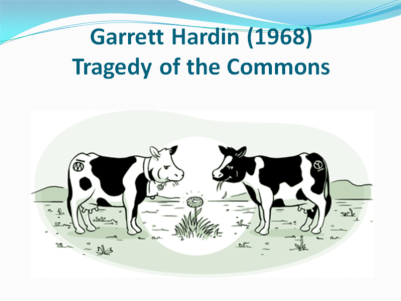
commons 1And once I got that far, I saw that it was the old familiar Tragedy of the Commons and the rest of this essay is an attempt to play our the metaphor. As first formulated, it is about cows. There is a common grazing area which is big enough to sustain grazing by so many cows; not more. But the arithmetic underlying this arrangement is seductive. If Farmer A adds just one more cow to the commons, he uses only a small fraction of the grazing area and he keeps all the profit that extra cow brings for himself. Pretty good deal.

It presupposes, however, that Farmer A is the only cheater, which is not a likely prospect for the long term, especially since Farmer A has set such an enticing example. So other farmers begin to slip an extra cow onto the commons. They overgraze the commons until the grass is gone—it is gone for the cows of the cheaters and also for the cows of the righteous farmers who are grazing only their allotted number of cows—and everyone goes through a period of very hard times.

Once I saw that “civil discourse” was our commons and the encouragement of “microaggressions” was the extra grazing, I experienced a moment of clarity. I might have said, “Woohoo!” in the manner of Walter Matthau playing Albert Einstein in Fred Schepisi’s movie, I. Q.

So what does that analogy help us to see more clearly? If the free and frank exchange of views is what is valuable in the commons, then the more constraints there are on that exchange, the less free and the less frank it will be. “Sensitivity challenges” are a tax on every exchange. They not only make exchanges more onerous, but also keep people away from topics that really need to be addressed. This is, without question, the case for the “conversation about race” that President Obama keeps saying we ought to have.

It is easy, I think, for anyone with a sensitivity or a favorite grievance to claim to be offended. [1] “It’s just this one issue,” she thinks, “They can handle it.”  It’s just racism or sexism or ageism or size-ism. Just that one thing. But that is what every farmer thinks who grazes an extra cow on the commons and says, “Hey, it’s only one cow.”

And the amount of additional grazing really is just one cow. But that one cow is a challenge to the agreement among all the farmers not to add just one cow. It might be worth extending the metaphor so that it is the common trust that is being grazed on and when it is overgrazed too badly, it is destroyed. When the trust is destroyed, it is only a matter of time until the grass is destroyed as well. Maybe “grazing on (abusing) the trust” and “grazing on the grass” is one too many kinds of grazing.

commons 5This point tends to be lost on an oversensitive member of the discussion because he thinks that racism is a really important issue. Crossing the line in talking about race is a serious offense. And this guy probably thinks that when someone else shows the sensitivity about sexism that he himself shows about racism, that he is being “oversensitive” or maybe even pretending to be offended to regain the initiative. I know that makes this “oversensitive to race issues” guy look stupid, but he isn’t using all his intelligence if he thinks that only one issue makes people angry.

What is lost on this guy is that as explosive as racist words are to him, they are not so explosive to everyone else. To someone else, sexist words may be the source of personal outrage. That is certainly the way you will feel if you think that “racism” is a real issue and “sexism” is a secondary and artificial issue. Let alone “ageism.” But the truth is, hard as it is to remember when you are in a discussion, that the words that I find offensive are different from the words that you find offensive. If we could get far enough away from it, we could all see the truth, which is that a cow is a cow. If it eats grass, it’s “a cow.”

So the argument that my extra cow is justified, but yours is not, meets a swift and justified end.

commons 2Furthermore, what I find very hard to remember when I am the one being insulted or demeaned is that we are all beneficiaries of the commons. If the commons represent a style of discussion, not a topic to be discussed, then every kind of discussion is taxed by oversensitivity. We don’t talk about supporting and sustaining families the way we might if the commons had not been so shrunk from overuse. We don’t talk about poverty and homelessness the way we might. We don’t talk about American imperialism the way we might, or the frightening over-expansion of executive power under President Obama.

And when we lose that commons, everyone loses. The people who would like only their particular sensitivities honored lose. The people who think that everyone’s sensitivities should be honored, lose. And, of course, we lose as well.

The War of the Roses

Here’s an example. Suppose we are having a discussion about movies and someone refers to The War of the Roses as “a black comedy.” The two black members of the discussion look at each other and try to decide whether to treat that term as racial taunt and the user of the term as a racist. I’d like to ask them not to. Here are several reasons.

1. The War of the Roses, Danny DeVito’s movie from 1989, is a daring and difficult movie. It needs to be discussed for any number of reasons. [2] But when the topic is changed to whether I am colluding in racism by referring to the movie as “a black comedy,” none of those things is going to be debated. It’s just me and my racism.

2. The discussion of this movie could very well lead to the discussion of other movies or of domestic discord or of the fragility of marriage. When the topic is changed to me and my racism, none of those things is going to happen.

3. I’m pretty sure that, as the conversation continues, I am going to find “insensitivities” in some area that means a lot to me. I look across the group to see whether another friend and I are going to choose to be frightfully offended about the dominance of straight actors in parts where gay actors would be every bit as good.

In short, I see the extra cow (the racism charge) you tried to graze on the commons and I can’t think why I shouldn’t add my cow (sexual preference). And do you have any idea how many extra cows there are available, should the other farmers see us grazing our extra cows on the commons?

Redemption

How do we get the commons back? Well, remembering that trust is what sustains our common dialogue, we need a chance for the trust to be reestablished. On the original commons, all you have to do is stop grazing it for awhile and the grass grows back; that doesn’t work for trust. Regaining enough trust to sustain public discussion is more like climbing a ladder, rung by laborious rung, than it is like just letting the discussion lie fallow for a season.

commons 4My solution is taking one for the team. [3] We’re having our discussion about The War of the Roses and someone makes a remark that bears on the race, religion, national origin, or sexual preference of someone else. The potential victim notes it (no problem there) decides it is not the opening gun of a bombardment, and lets it pass without comment.

At the second reference, the potential victim says something like, “but laying aside the question of race, this scene is really about anger” In saying only that much, he has said that he noticed the possibility of race as a new topic and is choosing not to pursue it; he is offering a new, nonracial, interpretation.

This is a very good thing to do because it does not accuse anyone of anything. We need to stay away from that because “who are you calling a racist?!” is just as much a diversion as the original racist (possibly racist) remark. Both preclude continuing the discussion. It is also good because it serves notice to the other members who are waiting for an opportunity to pursue their own favorite grievances—an opportunity to graze their cows on the commons as well—that you did not take the opportunity when it was offered to you. So maybe they ought to hold back as well.

At the third reference—or the fifth or whatever [4]—the potential victim says something like, “We keep drifting into a racial (not racist) interpretation of this scene and all the assessments seem to be negative. I’m sure no one intends to turn the discussion in a racist direction, so let’s go back to the question of what this scene is for.” [5] Now it is true that the language “I’m sure no one intends….” is more honorary than descriptive. It usually means, “I am going to pretend that no one intends…” Still, it gives everyone the chance to back away slowly with their hands in plain sight and no charges have been made and the topic is still on track.

How does this re-grow the grass? People with other grievances either a) experience no break in the discussion and benefit from that or b) notice that the potential victim has handled his own grievance with restraint. He has taken one for the team and it may make them feel that they can afford to take one for the team as well when their turn comes.

Here’s what Lukianoff and Haidt say.

“Teaching students to avoid giving unintentional offense is a worthy goal, especially when the students come from many different cultural backgrounds. But students should also be taught how to live in a world full of potential offenses.”

What I’ve called “redemption” is about “how to live in a world full of potential offenses.”

Before I end this, however, I think I should say that sometimes there are statements made that are so destructive that they are worth challenging, no matter what the cost to the commons. What I have been calling “the reestablishment of trust” is crucially important, but that doesn’t mean that the most vicious racism (or sexism, etc.) needs to be tolerated. That doesn’t regrow trust. It just segregates the group as people leave rather than submit to the assault.

Sometimes, you just have to say NO. It’s a kind of perimeter defense. It doesn’t regrow the grass. It doesn’t move you up the ladder by so much as a single rung. But it does stop new damage and that is worth doing.

[1] I’m not implying that they are not really offended, nor even that they should not be offended. I am saying only that when the bar of “offending others” or for being “insensitive” is set so low that many statements meet it, the space for free and frank discussions will have shrunk nearly to disappearing.
[2] One of them is Kathleen Turner’s destruction of Michael Douglas’s car with her monster truck. Is it reasonable to call that act “rape?”
[3] That’s my solution for a lot of things, actually, but being part of a team has to matter a lot to you for that to work and teams that good are in short supply.
[4] Some groups have a specific procedure for noting a possible impediment to the discussion and setting it aside for the moment, with the promise that they will return to it later should the participants still wish to. For a group like that, the explicit naming of the racial issue could be done in almost any round.
[5] red, orange, yellow, blue, and green according to Secretary of Homeland Security Janet Napolitano. And what’s more important to the security of our homeland than maintaining a commons for public discourse?


Posted in Communication, Politics, Sustainability, Words | Tagged , , , , | 4 Comments

Reading Strategies for the Next Generation

Is there a right way to read a story? The first—the very first—discussion of a topic of general interest between the Hesses and the Jaenisches concerned that question. The Hesses are Bette and me. The Jaenisches are Bette’s daughter Melisa, her son-in-law Thomas, and all three of their children: Konrad, age 9, and the twins Liliana and Lara, age 8.

Every one of us agreed that the answer was Yes. From there we took different paths. This essay is about the different paths taken at the time and also about a few later reconsiderations.

We were all surprised that the teams, if it is fair to use the word “team” to refer to several continually changing coalitions, divided along gender lines. Who would have thought it?

“They”—IMG_1167.jpgBette, her daughter Melisa, and her granddaughters Liliana and Lara [it’s Lara in the picture]—took the view, initially, that the best way to go about reading a novel was to start at the beginning and move through to the end. They granted that sometimes a book starts slowly and you have to exercise some discipline to keep reading until it starts getting interesting, but you will be rewarded for your efforts. Besides, it’s the right thing to do.

I know I’m speaking as a member of the other team, but I think that position is essentially a moral view. It honors the intentions and the craftsmanship of the author. Books, especailly novels, are written to be read in a certain way and it is therefore quite likely that the reader will have the best experience by reading it that way.

The idea that reading it “the right way” is more satisfying does an interesting thing as I see it. It turns a momentous corner and begins to move away from a formula “right way” and toward an “experienced outcome.”  The experience of the reader, the individual reader, is the whole point of my team’s view, so I will turn to that next.

“We”—Melisa’s husband Thomas, their son Konrad and I—took the view that there were many “right ways” to read a book. Finding the right way called for some knowledge of yourself as a reader. A reader might read in a way that maximized the suspense, for instance, or that minimized it, depending on the book IMG_1165.jpgand the time of day.

I grant that the author has a plan. It may involve selling the highest number of books or getting the most favorable reviews. It may even be a work of art that emanates from his or her own inner sanctum and that is “art” in the purest way.

I don’t care.

I have a plan too. I want to live in an artfully constructed fictional world, for instance. Or, in another book, I might want to bathe myself in the beauty and urgency of the author’s prose. [1] I want to follow in fictional terms an argument that actually matters a lot to me in the real world. I want to laugh out loud and tell my Starbucks caucus the next morning what was so funny.

These are the purposes I care the most about and the “plan” of the author really doesn’t weigh very heavily against them. More so for the other team, I think, but not so much for our team. I want to read a novel in a way that gives me the best chance to experience one or more of these rewards of reading. I call it “reading strategically,” because there is plan attached to a goal.

Both Konrad and I have had the experience of reading a novel in which the plot gets tighter and tighter as if some emotional rubber band is being wound up. It makes us anxious or afraid or uncomfortable. Reading the end of the book or the end of that episode—whatever is appropriate—has the effect of relaxing that rubber band and letting us calm down so we can go back and really enjoy reading about the developments that no longer bother us.

Let me give a concrete example. A lot of people love to read mysteries for the final revelation of culpability. That’s why they call them whodunits. That’s not what I like. I like knowing what kind of story it is. Very often that amounts to who gets murdered and under what circumstances.

Then I like seeing the various plot element slide into place. These are the clues that point one way and then another. When I know what a character is going to do, I can see and appreciation the way he is first introduced into the plot. Obviously, if I didn’t know what he is going to do, I wouldn’t know how to appreciate the way he was introduced.

Of course, in order to reading 1see these characters and developments slide “into place,” I have to know where they are going. That means I have to know what happens and to do that, I have to read the ending. People who like the mystery suddenly resolved should read a murder mystery A and then B and then C, just as it is written. People, like me, who want to enjoy seeing the plot assembled should read it A and then C and then B. And that is the way I most often—not always—read a murder mystery.  Jodi Picoult’s hopes to the contrary  notwithstanding.

The very heart of our approach—Thomas and Konrad and I—as I understand it, is that every reader is free to read a novel in the way that produces the most enjoyable experience. [2] Also, I think it is a gift to teach young readers the value of “strategic reading,” in which the interests and experiences of the reader are put in first place; if we do that,  we will have made a substantial contribution to the younger generation. I would wish nothing for them but that they have a full lifetime of great reading, just as I have.

On the other hand, every kind of reading takes a certain amount of discipline and that virtue is appropriately emphasized by the other side—by Bette, Melisa, Liliana, and Lara.

Afterwards

There was some shifting around of positions in the two days following the discussion. Initially, I wondered why that would be. I settled on two explanations. The first is that it is not at all uncommon for people to reconsider their views after a thoughtful exchange. I don’t want quite to say that is the point of the exchange, but it is certainly not an uncommon effect.

The second is that Bette et. al, had held their views in a general way and were surprised to be in a discussion where labels were put on those views. If there is truly One Best Way, then a proponent of that way has to be willing to look a friend in the eye and say something like, “I don’t care if you would enjoy the book more the other way, you still should read it in the One Best Way.” That is not an easy thing to say, although it follows directly from the views as they were first expressed.  And it isn’t the kind of thing that either Bette or Melisa would permit themselves to say.  They aren’t that kind of person.

So I think that having the views set out formally so that the implications as well as the principles could be seen, may have aided in the shifting around.

Whatever.

This topic produced the first All Hands on Deck discussion by the families Jaenisch and Hess and I am very grateful for it.
[1] I remember vividly the summer I was trying to read The English Patient. I discovered that over and over, my mind drifted away from the plot (which I found myself unable to engage) toward the writing itself, which was luminous. So I did the obvious thing: I read the last page, then the next to last page, then the one before that, and so on until I had come to page 1. It was very satisfying.
[2] I am currently reading The Summer Before the War, a novel in four parts. The first part, which I read from beginning to end, is a pre-war (World War I) novel of social manners. I didn’t like it at all, but I didn’t give up. The last part is a very gritty look at war in the trenches and I got some idea of where this plot must have been in order to get all the way from A to D. Encouraged, I turned back to begin B, the second of the four sections.

Posted in Books, sociability | Tagged , , , , , | Leave a comment

An inadequate joke

I have a joke in mind. My mind produced it one night recently when I was sleeping. So far, no one has liked it, which makes it a really unfunny joke, and the experience has turned me to thinking about humor generally.

A great deal has been written about theories of humor. None of it is funny, of course. That’s not what it is for. But my favorite book about why things are funny is actually funny itself. It is Max Eastman’s, The Enjoyment of Laughter—a book I would recommend to anyone who either a) enjoys a good laugh or b) wants to know more about just what makes it funny.

funny 1Eastman says that two things are necessary for something to be funny. There must be a discrepancy of some kind and there must be a setting which encourages or allows you to take it lightly. Jokes that turn on ethnic or gender or professional stereotypes are a good example. You can describe a situation that could be understood either of two ways, the classic discrepancy. But in an audience that disapproves of…oh…Polish jokes, let’s say…the permission to regard it as funny is missing. So it isn’t funny. Or at least you try not to laugh at the time.

That is a bit of a trial for people of my advanced years. I learned a lot of jokes when I was young and I was taught that they were funny and that they were acceptable. I still think they are funny, but they are mostly not acceptable any more. So I don’t tell them. And when I can manage it, I don’t laugh at them either.

funny 2It’s sad, really. The old agreement was that I tell jokes that make fun of your ethnicity and you respond by telling jokes that make fun of mine. The rule was that “equally offensive” was about the same as “inoffensive.” Under current conditions, the fact that someone was offended by it is the defining trait and we can see nearly anything as offensive.

The other part of humor is that the two perceptions that make up the discrepancy need to be j-u-u-u-st the right distance apart. I always thought about it like a spark gap. If you make the spark—the discrepancy— too big, the spark can’t jump it and the joke loses its power. If they are too close together, there is no snap in resolving it.

Here’s an example of “too far apart.” Eastman tells of a funny obituary published in the London Times. It read, “Died, John Longbottom, age six and a half months. Vita brevis est…” When I got the joke years later, I thought it was really funny but that is a long time to wait.

funny 4Why did it take me so long? It wasn’t the Latin quotation. I didn’t know it, but it was easy to look up. The whole quotation is “Vita brevis est, ars longa.” My previous contact with ars with on the Metro-Goldyn-Mayer logo, which says “Ars gratia artis.” That’s how I knew it meant “art”—the motto means “Art for art’s sake.” And, in the same way, I knew that it was pronounced “arz.

I did know, in some other part of my brain, that there was an informal British usage, arse, meaning ass. If those two parts of my brain had been communicating better, I would have heard “arse longa” instead of “arz longa,” which is what I did hear.

Then it would have taken me the one final step of seeing Longbottom, John’s last name, as suggested in the English “arse longa.” So of the Latin maxim, “Vita brevis est…” , the part the printed, means “Life is short.” The infant died at six and a half months, so I see that part. The other part, the part they counted on me to know would be said “arse longa” and would not means “art endures,” as it should. It would mean…well…long bottom.”

I needed the English slang pronunciation and the Latin maxim and I needed to get over what I knew from the MGM logo and all of those added up to too much distance for the spark to jump.  A few years later, I thought it was really funny.

The joke I thought of was like that, I regret to say. It wasn’t like that for me, of course. Even in my sleep I thought it was funny and when I woke up, I still thought it was funny. Here’s the background. On August 25, Bette and I are going to take the final step toward our residency at Holladay Park Plaza, which is the retirement center we have chosen. The final step is to actually purchase our apartment unit, so we are going to sit down and write a check for a staggering amount of money.  It’s not too much for what we are getting for it; it’s just a big amount.

Somewhere in there, the expression au revoir came to my mind. I don’t know why, really, but I suspect that the Latin origins of our word carnival pushed me in this direction. “Carnival” is supposed to be the day just before Lent, a time when many Christians forego eating meat as a way of preparing for the celebration of Easter.  The carn- part of carnival is “meat” as we know from words like carnivor. The other part, vale, means goodbye, so the source of our word carnival is “goodbye to meat.”

funny 3I think I was floating in that current when I hit au revoir because something divided the expression into “Goodbye to what?” and having gotten that far, I noticed that Au is the symbol for the element, gold. That means that one way of sensing the discrepancy is that Au revoir (notice the capital A) is a way of saying “goodbye to gold,” which is a pretty good way of categorizing the meeting where we write the check for our apartment.

So that’s the inside story. But to be a good joke, it needs to match a lot of people’s outside story and when I look at what that would require, I can see why it wouldn’t work very often. I tend to think of jokes for very small collections of people anyway. [1] But this one would require that people: a) know what au revoir means, b) notice the odd capital A in Au and make the connection to the symbol for gold, c) combine those two meanings into a “goodbye to gold” saying, and d) relate that saying to the situation in which Bette and I are writing a large check to the retirement center.

It’s asking a lot. It is, in fact, asking too much and the very spotty nature of the response is just what I deserved.

[1]  I once developed, over several years, a joke that required as the punchline the four principal parts of a common irregular Latin verb.  Great joke.  No audience.


Posted in Living My Life | Tagged , , , , | Leave a comment

“Having” a Problem

It is well-known that I am partial to redheads. Bette, for instance, is not confused about how much I enjoy being married to a redhead. [1] On the other hand, I formulated the instrumental significance of the notion of “problem” in grad school and it would not be very much too much to say that the University of Oregon granted me a doctoral degree in recognition of the work I had done with that particular word.

IMG_0309.jpg

So when I saw this picture in the Sports Illustrated for July 23—August 1, I paused to admire the redhead. And then I read the text, which refers prominently to “having” a problem. She wants to have a big problem.

I wish I could be her teacher in my political psychology course. I would try to teach her what I have—successfully in some cases—taught several decades of students, namely: what you really want is not necessarily a big problem; you want a problem that is just the right size.

I hope that seems oversimple to you.

I would try to teach her that a problem is not something you “have;” it is something you make. “Problems” as I work with them are not conditions in the real world, but constructions in the rhetorical world. Let me illustrate.

At Portland State, where I taught this course most recently, I would begin by saying what I meant by “problem.” A problem is a set of related propositions, one of which asserts a normative standard, the second a factual observation that violates the standard, and the third and explanation of why that violation has occurred. [2] These propositions, together, ARE the problem.

Then I would ask whether, using this understanding of the word, the existence of widespread starvation in the world was “a problem.” They agreed that it was not. I told them that day that on the first test just a few weeks away, I would ask them this question and they would miss it. Three weeks later, I would ask this question and about half the class would say that widespread starvation was “a problem” as the term is used in this class.

It is hard to internalize the notion that “a problem” is something you construct, not something you “find” or “have.” It is worth it, though, because if a problem is something you make, you can make it whatever size you need for it to be. Some people, for instance, are strongly motivated by big problems. Knock yourselves out; make it as big as you like. Others are intimidated by big problems and turn to denial and distortion. Fine; make it a small problem. Whatever gets you started to working on it.

“Good problems” in my way of thinking about them are not big or small or medium-sized. [3] They are the size you need for them to be. They are also—to touch on an issue I dare not pursue here—“where” you need for them to be. They are inside you or in your immediate environment or in the larger environment

Finally, “outside the box” is not always a good place to look for answers. It is always a place to be able to look for answers. This “nine dot” problem relies on our understanding the solution as connecting the nine dots without extending the line beyond the imaginary “box.” That’s what we took for granted, and this exercise is supposed to help us NOT take it for granted. That assumption is “the box.”

problem 1

Being able to think outside the box is a wonderful thing. Thinking that the best answers are “outside the box” is just another box. Most of the time, the best answers are inside the box. It is only a certain kind of answer—the kind of answer Thomas Kuhn had in mind when he wrote about inter-paradigmatic conflict—that requires a new and larger box. Most “normal science” and most “normal life” is inside the box and simple competence will suffice.

I would love to be in or teach in a school like the one described in this ad. My concern is limited to their describing as an unqualified good, what I would describe as an ability that is worth having. If you “have” the ability, that’s a good thing. “Having” a problem is not a good thing.

[1] Every now and then, she likes to have other virtues noted. Perfectly understandable. Fortunately, she has other virtues and I do note them. Still like her red hair.
[2] NS, FO, and CA in the in-class jargon. Normative Standard, Factual Observation, and Causal Attribution.
[3] As Whoopi Goldberg was in the movie Ghost.

Posted in Uncategorized | Leave a comment

Pacific Retirement Services

For a lot of people, the word pacific is always capitalized (Pacific) and refers to a body of water just west of California. Nothing wrong with that as far as it goes, but it doesn’t really go very far. It is not always capitalized and it does not always refer to a body of water. And “Atlantic” is not its natural opposite.

At some point, I should probably say that this essay is about words more than it is really about retirement. That is fully within my mandate as a dilettante, but this is not an essay you will enjoy if you are trying to learn something useful about retirement. About words…maybe.

PRS 1Ferdinand Magellan sailed out of the very nasty seas around Cape Horn and found a relatively quiet body of water. He was thankful for how peaceful it was for the same reason that the Pilgrims were thankful for food after having lost half their number the previous winter. We could say that the seas Magellan found were “relatively” calm. So in the general sense, “pacific” means “peaceful.” Everyone who has ever given a baby a pacifier ought to understand that. [1]

But the thing about the English language is that we rely on the neighborhood of words to give them their meaning. So a title like Pacific Retirement Services could make “pacific” the adjective and “ retirement services” the noun (phrase). On the other hand, it could make pacific the adjective and retirement the noun. We are now talking about a pacific retirement, which sounds really good to me, especially given the alternatives (antonyms). [2]

I put the full set in the footnote, but I especially like these five.

Some of those are really funny in the context of retirement. Here are my favorites.
annoying retirement services
quarrelsome retirement services
nettlesome retirement services
provocative retirement services, and
unsympathetic retirement services

It is expressions like “nettlesome retirement services” that clarify my preference for pacific ones. A pacific retirement is a great goal to have and whatever services it requires are of immediate interest to me.

Of course, the people who chose that name had nothing of the kind in mind. There are hundreds of businesses and associations in California, Oregon, and Washington that are called “Pacific” simply because they are in states that border on the Pacific Ocean.

PRS 2But I don’t have any direct interest in Pacific Retirement Services where “Pacific” refers to the ocean. Bette and I are going to be living at Holladay Park Plaza—in a few weeks—and HPP is one of the retirement centers belonging to (affiliated with) Pacific Retirement Services. [3] So right away, as I begin to wonder whether PRS is good for HPP, my mind drifts over to a pacific retirement, the kind I want very much. And that raises the questions of what “services” will help me achieve that. [4]

Not that there are not other values to be sought and sustained in a retirement center. Of course there are. Old people, like young people and middle-aged people, need to be engaged as active agents in their own lives. They need to live lives of meaning and, at our age, of service as well. But I don’t worry about those things for myself. I actively pursue those things. “Peaceful” is not always a part of the bargain in my life—my own fault, mostly—and it is the peaceful part of the retirement phase that attracts me.

[1] The root is pax, pacis, of course (Pax Romana?) but you will note that there is more to Pacific than that. The -ific comes from the Latin facere, “to make.” Actually, all the English words that end in -ify or -ification contain this contribution from facere. So the body of water Magellan faced was not just “peaceful,” but had been “made peaceful.” It had been “pacified.”
[2] abrasive, aggravating, annoying, chafing, exasperating, frustrating, galling, inflammatory, irksome, irritating, maddening, nagging, nettlesome, nettling, offensive, provocative, provoking, rankling, riling, vexing; engaging, incensing, infuriating, maddening; antagonistic, antipathetic, hostile, inhospitable, inimical, unfriendly, unsympathetic; aggressive, agonistic, argumentative, assertive, bellicose, belligerent, combative, confrontational, contentious, pugnacious, quarrelsome, scrappy, truculent; martial, militant, militaristic, military, warlike
[3] “The PRS family of affiliates is made up of 9 Continuing Care Retirement Communities (CCRCs) and 25 affordable senior housing communities. We are located in five states: Oregon, Washington, California, Texas, and Wisconsin.” That’s from the Pacific Retirement Services website, where I learned for the first time that Texas and Wisconsin also border on the Pacific Ocean, probably in some honorary sense.
[4] Nothing is a “service” just because it is called a service. My mind goes immediately to Steven Spielberg’s movie, The Terminal, in which the evil director of the airport is trying to get Viktor Navorsky (Tom Hanks) to walk out of the terminal so he can be arrested and become somebody else’s problem. Making him hungry ought to work and Viktor has no money for food—until he discovers that when you return a baggage cart you get a quarter. So he collects a lot of carts and gets a lot of quarters until a new “service” is invented just for him. One morning, he has collected…let’s say 20 carts (worth $5.00 to him)…and as he is about to return them, he is stopped by a man with very large arms. “Thanks,” he says, “I’ll take it from here.” Thanks, that is, for collecting all the carts, now I will take all the money they represent. And then he gives his title, a title invented just for this particular job. He says he is the Transportation Liaison for Passenger Assistance. None of those words points to what he is actually doing. What he is actually doing is providing a “service” that is not a service.

Posted in Getting Old, Words | Tagged , , | Leave a comment

“He can’t help retaliating”

I heard that line on a Slate Political Gabfest. The question had to do with Donald Trump’s response to things he thinks of as insults. He hits back hard. [1] Hitting back hard” takes the place of “running a disciplined campaign” according Ruth Marcus, a writer for the Washington Post.  There’s no telling what it would look like in the White House.

I think it was the line “hitting back hard” that lodged in my mind and my thoughts kept revolving around it until I remembered what I was trying to remember. Very early in his presidency, Jed Bartlet wanted to hit back hard and had to be talked out of it. When I say “early in his presidency,” I am talking about The West Wing, Season 1, Episode 3. Really early. Here is President Bartlet’s starting position.

https://www.youtube.com/watch?v=rtrX9rZl-4

Note the general who proposes the unthinkable. “Sir, are you suggesting that we carpet bomb Damascus?” Eventually—it takes nearly the whole show to get there—Bartlet says not to do that and he settles on what Admiral Fitzwallace calls “a proportional response.”

My concern is that the Trump response—hit back hard—couldn’t be impeded even by all that assembled brass. And if President Trump had answered, “Yes, carpet bombing Damascus is what we ought to do. It’ll teach them a lesson,” then it would be done. That’s what worries me.

It wasn’t all that easy to talk President Bartlet down from that particular tree. Admiral Fitzwallace has put together a “response scenario,” as President Bartlet asked. Here it is.

Yes, sir. Mr. President we put together a scenario by which we attack Hassan airport. Its three main terminals and two runways. In addition to the civilian causalities, which could register in the thousands, the strike would temporally cripple the region’s ability to receive medical supplies and bottled water.

That is a very specific look at what would happen to a lot of Syrians. [2] The goal of Fitzwallace’s use of details, I think, is to get the President to realize what he is doing. He is not “docking someone’d damn allowance;” he is killing thousands of civilians.

But I think Fitzwallace’s second argument is even better. Here it is.

I think Mr. Cashmen and Secretary Hutchinson would each tell you what I’m sure you already know sir. That this strike would be seen at home and abroad as a staggering overreaction by a first time Commander in Chief. That without the support of our allies, without a Western Coalition, without Great Britain and Japan and without Congress, you’ll have doled out a five thousand dollar punishment for a fifty buck crime sir.

Fitzwallace wants President Bartlet to look at himself the way everyone else is going to look at him. He is, for all practical purposes, a rookie. Fitzwallace is not a rookie and he wants to keep the Commander in Chief from making a rookie mistake. I think that is superb staff work.

According to the recollections of people who were in the room when President Obama had to make the decision about the Osama bin Laden mission, he had that kind of support around the table. The Vice President, the Secretary of State, and the Secretary of Defense all leaned on him and helped him see what he would be doing if he said “Go.” He said it anyway.

If there is anyone in Donald Trump’s entourage who has that kind of effect on him, I haven’t read about it. He needs that, even as a candidate. As the Commander in Chief in the War Room, he would need it much more.

In Bartlet’s case, Fitzwallace was enough to get the President to make the prudent decision, but he wasn’t enough to get him to see the matter differently. That took Leo McGarry, his chief of staff and one of his oldest friends. Here’s what that looked like.

BARTLET I’m talking about two hundred and eight-six American marines in Beirut, I’m talking about Somalia, I’m talking about Nairobi.

LEO And you think ratcheting up the body count’s gonna act as a deterrent?

BARTLET You’re damn right.

LEO Then you are just as dumb as these guys who think that capital punishment is going to be a deterrent for drug kingpins. As if drug kingpins didn’t live their day to day lives under the possibility of execution. And their executions are a lot less dainty than ours and tend to take place without the bother and expense of due process. So my friend, if you want to start using American military strength as the arm of the Lord, you can do that, we’re the only superpower left. You can conquer the world, like Charlemagne, but you better be prepared to kill everyone and you better start with me cause I will raise up an army against you and I will beat you!

BARTLET And this is good?

LEO Of course it’s not good, there is no good. It’s what there is. It’s how you behave if you’re the most powerful nation in the world. It’s proportional, it’s reasonable, it’s responsible, it’s merciful. It’s not nothing, four high rated military targets.

BARTLET Which they’ll rebuild again in six months.

LEO So we’ll blow ‘em up again in six months! We’re getting really good at it. [beat] It’s what our fathers taught us.

BARTLET Why didn’t you say so? [beat] Oh man Leo. When I think of all the work you put in to get me to run. [both sit] Wen I think of all the work you did to get me elected. I could pommel your ass with a baseball bat.

[They laugh.]

It’s the laugh that lets us know that Bartlet gets it. He “did the right thing” under Fitzwallace in the War Room. He heard the argument his Chief of Staff makes in his office. But finally…”It’s what our fathers taught us,” gets to him and it makes that shared laughter possible.

But we ought not to let that laughter make us feel that those three thousand Syrian civilians didn’t just have a very close call. They did. And it took a team of professionals who were willing to risk their positions to get that to happen. I don’t see that with Donald Trump and it worries me.

If he is elected, I am going to watch all seven seasons of The West Wing several times. And stop drinking caffein.

[1] “Back” requires, of course, that something was actually said or done that offended him. A person who had done nothing to offend him and who became the subject of Trump’s attacks would not think that he had been hit “back;” only that he had been hit.
[2] This is Aaron Sorkin’s second shot at this particular scenario. He wrote it somewhat differently in The American President. Still, the similarities are stark.

Posted in Politics, Uncategorized | Tagged , , , , , | Leave a comment

The Muppet Musicians of Bremen

In 1972, when The Muppet Musicians of Bremen was broadcast, my children were 12, 10, and 8, so I am pretty sure we watched it together. But somehow, the family got a CD of the show, and my kids were raised on the voices. Thats why the line “I remember it all like it was yesterday,” for example, will be followed without hesitation with “It was yesterday, you old faker.”

But now, being old myself and thinking about how many other old people I am going to find when we move to a retirement center later this month, I have been giving the old show some new thought. That’s what this essay is about.  Bette and I are headed  for Bremen.

I’m going to skimp on the plot. I discovered that it can be fairly described as Type 130 in the Aarne-Thompson classification of folk tales and the theme is summarized as follows: “outcast animals find a new home.” [1] Well, maybe just a touch more than that.

The Plot

Not counting Kermit, who plays a very important role in the story, we have four animals to consider. Leroy the Donkey, T.R. the rooster, Rover Joe the hound, and Ms. Catgut, a 13 year old blues-singing cat. I’m going to skip over Leroy and T.R. with not much more than a mention. Leroy’s master was about to “retire him: with a shotgun; T. R.’s master had chicken stew in mind for his old rooster. That’s why they ran away.

Bremen72RecordBut before we get to Rover Joe, let’s go back and pick up Kermit. Leroy’s bumbling master, Mordecai Sledge, managed to throw a Sousaphone up in a tree and it came down around Leroy’s neck. Leroy takes off, hauling a whole wagon of musical instruments  behind him. He doesn’t know what this thing around his neck is and, having escaped “from”—with no thought yet given to the “to” part—he doesn’t really know who he is either. Kermit solves both of those problems.

Kermit tells Leroy that the funny twisty thing around his neck is a Sousaphone (he says tuba, but why quibble?) and that it is a musical instrument. Just blow in the small end. The first sounds are not all that promising, but pretty soon (less than a minute) his embouchure rounds into shape and the way he works those three valves can only be envied by other animals with…um…cloven hooves.

Once Leroy has become the Master of the Sousaphone, Kermit tells him that he is “a traveling musician” and that people will be delighted to hear him play. By the time Leroy picks up T.R., he announces that he is a traveling musician on his way to Bremen [2]. T.R., it turns out, is an accomplished banjo player, standing firmly on his own two feet while also picking with one foot and fingering with the other. [3]

Let me remind you that the second part of my interest in this wonderful story comes from the imminence of our move to a retirement center. I have begun to wonder whether I am going to meet people who are just waiting to die or who have a story they need to tell or something to belong to.  I may very well wind up in one of those places myself, but until I do, maybe there is something I can do to help.  In any case, that possibility made me think that maybe I should take another look or two at the story.  Maybe it can be more than just a collection of straightlines for my kids.

Of course, it is not fair to compare Rover Joe reluctance to join the band with T. R.’s eagerness, because T. R. was looking down the blade of an axe and Rover Joe was just despondent. Still, it is true that it took Leroy one invitation to bring T. R. on board and a substantial conversation was required for Rover Joe.  I’d guess that is the more common case.

Here’s Rover Joe’s one answer. “‘Cause I’m old. I’m beat up. I’m wored away. And I’m muppetbremen6throwed out.” That can be usefully abbreviated as OBUWATO. It is why, in response to the first question, he is sad. It is why, in response to the second question, the reason that his master, Mean Floyd, threw him out the window. They invite him to join them as a travelling musician. Rover Joe declines. What to know what the reason was? OBUWATO. He says it so often that T.R. begins beak-synching with him.

But, it turns out that he can play a trombone superbly, so they are on their way. The next stop is a cemetery, where they find a cat lying on her back on one of the grave stones, four feet straight up in the air.

She’s waiting to die, she says, and asks them to leave her alone. That’s what she asks, but, of course, that is not what she wants. When they begin to leave, she takes off on a very bluesy song that begins, “Well now everybody left me, and I’ll soon be dead and gone…”

The three musicians come back, only to be informed that “a cat kind of likes to die inCatgut private if you know what I mean.” That seems clear enough. T. R. hears her with respect. “Come on Rover Joe, the lady’s got her rights.” But again, that is not what she wants and the second verse of the song begins “Well now no one care about this story…”

All three musicians say they want to hear the story, so Catgut tells it. She made friends with the rats in the pantry after chasing them for 13 years and her master threw her out.  That is when Rover Joe objects, “But you can’t just sit here and wait to die!”

Catgut’s response is direct for once. “What else is there for me to do?” We know “what else” there is because she is talking to traveling musicians and just as Leroy asked T.R. to join and they both asked Rover Joe to join, now the three ask Catgut to join. It turns out that Catgut is a top of the line trumpet player so they proceed down the road with some very good music from a Sousaphone, a banjo, a trombone, and a trumpet.

And that’s all the story I care about. You can deal with the Happily Ever After part yourselves. There are three more small matters I would like to address before I wrap this up.

Who are you?

TRIn the first scene after Leroy escapes, he is just a donkey running away. But he runs into Kermit, who says, in effect, “You are not a runaway donkey, you are a traveling musician!” I have never seen, in real life, the instantaneous transformation Leroy goes through because Kermit gave him an identity, but I have very often seen a new name given and I have seen a person grow into that name.  I have been that person.

Kermit gave Leroy a name that carried some very important things with it. Hope, for instance. And intention. The animals never get to Bremen, but “being on the road to Bremen” is a great help to them and crucially important to the plot. What’s in a name?

What’s your story?

Leroy and T. R. were faced with imminent disaster so they didn’t need a story. We get the story because we see it happen, but neither of these characters actually tells the story. Rover Joe and Catgut do tell their stories and nothing is going to happen for them until the story is told. For these two characters, having a chance to tell the story seems to free them to do something else.

It may be worth saying that that isn’t always what happens. Sometimes telling the story (over and over) is chosen as the alternative to doing something else. I have seen people fight off a present opportunity because if they accepted the opportunity, they would have to give up the old narrative in which someone had wronged them. [4] If it is a choice between the story or the action, I would prefer the action. But in this movie, the story is the prelude to the action and we get to see how powerful it an be to have a chance to tell your story.

What else can I do?

No action looks all that bad when nothing else can be done. It is the invitation to join in that turns lives around. They ask Rover Joe to join them before they know whether he can play any kind of instrument. He is not promising. He doesn’t know the difference between a trombone and a ham bone. [5] But when he joins the group, it unleashes something in him and he is instantly proficient.  It’s a movie; what can I tell you.

I think it is this availability of an alternative that makes everything work. A few muppetbremen2moments ago, you were lying here in solitary misery. Catgut was waiting to die and Rover Joe had been OBUWATO. But someone said, “Why don’t you join us?” The choice is really clear. Yes awful things have happened to you. Yes you are lying here because you had no alternative. But now you do. We are asking you to join us.

I really appreciate the power of that.  You pick up a task and with it, you get colleagues. And together, you head down the road to Bremen. You don’t actually need to get there. You just need to start.

[1] I didn’t know any of this. This is all from Wikipedia.
[2] Bremen is Bremen, Louisiana for the Muppets. The original version, “The Town Musicians of Bremen (Die Bremer Stadtmusikanten) has Bremen, Germany in mind because it has a reputation for being favorable to freedom.
[3] He would have been a four drumstick rooster, which accounts partly for why Farmer Lardpork was so eager to stew him.
[4] In Joel Hopkins marvelous movie Last Chance Harvey, Kate Walker (Emma Thompson) says she doesn’t want to hear Harvey Shine’s (Dustin Hoffman’s) excuse for missing their rendezvous because she is afraid it will be a really good excuse and she has become comfortable with her life as a disappointment.  I’ve seen that.
[5] And I have known some trombonists who actually were hambones, to it is an understandable confusion.

Posted in Getting Old, Living My Life, Uncategorized | Tagged , , , , | 2 Comments