
That really ought to be the same as “new year’s resolution,” shouldn’t it? But the meaning of “new year’s resolution” turns out to be every bit as puzzling as why we make them and why we, mostly, fail to keep them.
It occurred to me this year that I could come at the whole process from the other side. 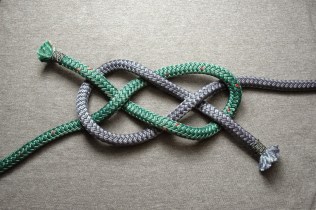 Let’s look at what the word itself—as opposed to our use of it—would like to be or what it would like to do. It’s a little like agreeing to recognize gravity or inertia. I wouldn’t want to go so far as to say that the word’s intentions have been frustrating our intentions. There are quite a few things wrong with that formulation. [1] But I do want to start with the word.
Note: I am going to put words in bold when I mean to refer to the word itself, rather than to the meaning of the word, and in italics if it is a precursor of an English word. I know that “precursor” sounds ethnocentric, but all my readers will read this in English.
I want to start with the Greek verb, luein, “to loosen.” I’m going to step away slowly, with my hands always in plain sight. No need to panic. The Latin version of luein is luere, also “to loose.” [2] We see it in soluere, “to detach, set loose, or free” and we get there very easily by adding se- to the root. That is what they call a privative, meaning that it is a prefix that marks the absence of something or the distortion of something. [3] This gets us as far as the Middle Latin solvere, which is as close to solve as we need to get in order to appreciate resolve.
Resolve, as we all know, does not mean “to solve again.” The function of the prefix re- is “again” sometimes (repeat) but it is often an intensive, where it means “really, really,” and that is what it means here.
Obviously, when we have gotten as far as resolve, the verb, we are at the threshold of resolution, the noun, which is the form we use for a “new year’s resolution.”
Resolution is the noun form of the verb resolve. When I “resolve” something, I have “made a resolution.” One of the meanings the Oxford English Dictionary (OED) gives is:
IV. To determine or fix upon a course of action.
26.
a. trans. To determine or decide upon (a course of action, something to be achieved or brought about, etc.); to make (something) one’s firm intention.
An early example of this meaning can be seen in Shakespeare’s Titus Andronicus.
1594 Shakespeare Titus Andronicus ii. i. 106 So must you resolue, That..You must perforce accomplish as you may.
A later, and more familiar, example comes from Abraham Lincoln:
That we here highly resolve that these dead shall not have died in vain.
So a resolution is a “resolving-ness” of a sort. An earlier English would have offered us “a new year’s resolve” and even today, people would likely understand what you meant by that expression. But we now know—this is the main argument of the essay down to this point—that the word wants to mean “a loosening of something.”
We may be able to see “solve a problem” as a sort of bridge usage. The meaning of “solve” in the problem usage and of “solve” in the untying of something are close enough that we can see that they could both mean the same thing. You could “untie” a problem in the sense of “loosening” a knot.
I call that usage a bridge because it connects the early “to release something from its bonds” meaning and the later meaning. This is the OED again:
to solve (a problem) (1564; 1690 with specific reference to a mathematical problem, 1765 with specific reference to an equation),
January 1, 2017
So it’s a bright Sunday morning and I want to “make some resolutions.” This year, because I have given some thought to what the word “resolution” really wants to be, I am led to think about things that I should untie, things I should “undo” in the way I undo the knot in my shoelaces.
 These are not things I am going to decide to do, as if they were foreign countries I had not yet invaded or competitors I had not yet eliminated. These are not decisions that I have been struggling with—a di-lemma is a common kind of struggle [4]—what with the two lemmas to deal with.
- Imagine a woman who is trying to decide whether to continue to be married to her husband or whether to deal with “the bonds of marriage” by loosening them.
- Imagine a man who has gotten himself involved in overlapping and incompatible committee assignments and who has decided to “un-tie” that knot by a resolution of it.
- Imagine a caregiver who has both a child who needs special care [5] and whose elderly mother also needs special care. She has been unwilling or unable to engage other members of the family in providing the needed care and also unwilling or unable to share the duties with trained professionals. This knot is tied so tight that sometimes it feels to her as if it is tied around her neck. I say the new year is a great time for un-tying.
The word resolution, based as it is—fundamentally, but distantly, on the Greek verb luein, “to loosen”—has a natural tendency to suggest meanings of untying; of un-doing, rather than more doing. We should treat this word like a horse that knows where the barn is, even if we do not, and just give it it’s head. That will require a little loosening of the reins, of course, but what could be more appropriate?
[1] You always roll the dice a little when you attribute agency to something that cannot  intend anything and then act on that intention. On the other hand, sometimes it is the easiest way to say something and if you stay vigilant, it doesn’t do any harm. Take Dawkins’ The Selfish Gene, for instance. Dawkins does not think that genes “intend;” his contention is that imagining that they do helps us make sense of the pattern of their actions.
[2] If you were thinking of a Toulouse-Lautrec joke, this would be the place for it. It’s not a joke I would want to make, myself.
[3] I think my favorite example is the se- in seduce. The -duce part just means “to lead.” The privative se- here means, “away” or, commonly “astray.”
[4] A lemma is a proposition proved or just assumed to be true. Having two irreconcilable lemmas is a dilemma.
[5] What child doesn’t need special care? Still, you know what I mean.
 ampion. So far as it is possible, they are going to deny that he really did what all the papers say he did. Failing that, they are going to say that it was an understandable mistake by a new president or that it was well-intentioned by the president but mishandled by his supporters. They are going to say that huge errors are mere foibles.


 Ominous, isn’t it? But it is the reason I changed Kevin Quinn’s sign-off line from “my story” to “our story.” If there is an “our story” and if joining with others in the community to support it is the way people can tell whether you are “one of us,” then joining in is crucially important. Being right about the changes in butterfly migration and the reasons for it, is not crucially important.
 and professionally to the same conclusion. But I found that same conclusion, much more graphically expressed in Kingsolver’s Flight Behavior. Had Hochschild and Cramer studied Dellarobia Turnbow, they would have come to exactly the same conclusion each reached about the groups they studied.
 Two further things. There is a resentment of Al Gore the person in this remark. Gore is invited to “toast his buns” on the frost. Not a very dignified reference, surely, to a man who lost the presidency by one vote. Even “toast his toes” is not so demeaning. And all such expressions are beside the point anyway, unless the point is to derogate Gore.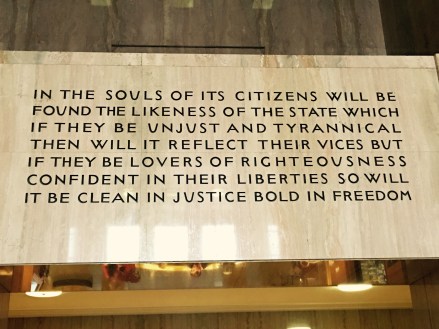
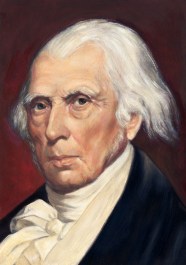 So the Framers put their hopes elsewhere. They put their hopes in the architecture of the system. I have said it this way sometimes [3]. “The Framers no more believed in the goodness of citizens than Newton believed in the goodness of planets. Newton’s idea was that if the planets were of a certain size and density and velocity and a certain distance from each other, they would just keep doing what they are doing and no “intervention” would be necessary. That’s what the Framers thought about federalism, the separation of powers, and checks and balances.”
 could produce a good state. They despaired also of forcing people to act as if they were good citizens, as if their own interests did not matter more to them than the welfare of the state. They settled on a system that would allow them to be as bad as they actually were, hoping that the long and torturous maze that confronted them would tire them out before they took over the government.
 And I want to start with three comments. First, I am grateful to Nicholas Kristof for asking the question, Timothy Keller for providing some answers, and to the New York Times for publishing it on the front page—
 that you have to have them. The other is that some doctrines that seem fully dispensable to me, seem crucially important to him.
 Then there is the question of what doctrines are really crucial. The virgin birth? Really? Keller bases his argument on the idea that if there really is a God, we have no idea at all what He is capable of. [1] Keller is right about that. We cannot know. On the other hand, we don’t need to know.
 happened or, indeed, of what “resurrection” means. You can say that Jesus acquired “a spiritual body,” but no one knows what that means. You can say he went to “heaven,” if you want to hang onto the geocentric picture of the universe which was common coinage in the time the gospels were written. You can wear yourself out on what the resurrection “was.” I wish you well. My interest is in what the resurrection “means.” It means—the witness of all New Testament writers supports this—that the life of Jesus, which was understood at the time to have ended in defeat, actually ended in triumph. God raised up this Jesus whom you crucified. (See Acts 2:36 for a concise formulation). That is what it “means.” (Skepticism is still, as you see in this picture, an aspect of a relationship, just as faith is.)
 the best response will have to be based on what it is responding to.
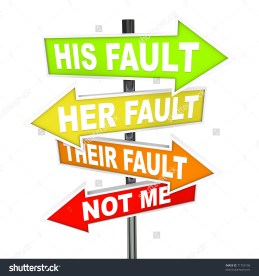 clearly identified and that it is “them.” The power of this leader does not come from any solution to the problem, but only with a way to fix the blame for it. This is very satisfying in several ways. First, if it is “their fault,” it is not my fault. Second, making them “pay” in some way for what they are doing to us is a perfectly satisfactory substitute for actually dealing with the issues. I may still be dying from the diseases my work reliably causes and still desperately poor and alcoholic, the the new problem—the gift of the leader to people like me—is that “they” don’t respect us.
 Let me describe how that would work and then you can tell me that it doesn’t solve the problem as I framed it and then I will tell you why it will work anyway. [5] I propose that we sit down with conservatives who are willing to have a civil conversation based on the different values each of us seems to have. Our job, the job he and I are working on, is having this conversation in a way that is honest and sustainable. If we succeed, it will be because of our teamwork. If we fail, “we,” not one of us, will have failed.
 But, you say, that doesn’t end the tantrum. No. It doesn’t. You are quite right. But it may well do two things that are worth doing. The first is that it may change the relationship between the policy-oriented leaders of the “Less Government” school of thought and their angry and self-destructive supporters. The second is that it may change the relationship between the “More Government” people (myself included) and the “Less Government” people.
 I wasn’t the father. She said she that had had a vision and that this was all God’s work somehow and that there was no shame in it. She also said that God said we had to name him Jesus. There haven’t been any Jesuses in my family as far back as I know. Even in this picture, all you see is my back. Luke must have taken the picture.
 I had to get everybody back home to Nazareth. When Jesus was right on the edge of the teen years, we wanted to go to Jerusalem to celebrate Passover. So I loaded everybody up again and made the trek down south and then up the hills to Jerusalem—which is a thousand feet higher than Nazareth. It’s a climb, let me tell you. And then he got himself lost and Mary and I had to go back for him. That kid! He looked me in the eye and said that we should have known he would be in “my father’s house,” he said. Pretty mouthy, I think, but the scribes at the temple seemed to think he was something special. I should have just left him with them, but that’s not my part. I am a transportation service. So I took them all back home again.”
 A Christmas Visitor. I have seen several of the main actors in other, more demanding parts, and I know they can act. It is not their fault that this movie doesn’t require them to do any. There is “the dad” (William Devaney); and “the mom” (Meredith Baxter); and a son and a daughter—and a “visitor.” That’s pretty much it.
 more visible healing. Jean has been rejecting, or at least has not been enjoying, memories of old times with her brother, John. The two kids are shown in a flashback, decorating the tree and and a direct result of their playing round, breaking one of the five points of the star. John, still in his character as “Matthew,” heals the star and in that way restores the memory to Jean. [3]
 “It is time for healing” is what George said back at the beginning. And John knows that. We don’t know how he knows. And because he knows that, John comes to them as Matthew. John is credible as Matthew, but just barely. He knows too much and even after he explains everything away, the Boyajian family is not quite convinced.
 The Dilettante's Dilemma