
Bette seems never to have cared about Valentine’s Day one way or the other. I always did: I hated it. As an elementary school child, I ran into the “valentines for everyone in the class” rule. Hated it! Why would I send a valentine to Bumpy Gray [1] and if I did, what would it say?
I don’t remember the Valentine scuffles in my first marriage. I suspect there were some because I learned with great relief that my second wife didn’t care about Valentine’s Day one way or the other. I took that as an opportunity to put the practice behind me and very likely railed against “Hallmark Holidays” invented for the sole purpose of selling cards.
I met Bette late in January, twelve Januaries ago. [2] And Valentines Day was upon me before I could devise a strategy for it.
 This was a whole new thing for me. I was completely smitten and was rooting around for occasions that would allow me to say something that I very much wanted to say. This wasn’t being fastened upon me, as in grade school, or a matter of mutual disinterest, as with my second wife. No, this was me looking for an occasion and seizing on Valentine’s Day as an excuse. That changed my attitude toward it entirely. {The picture is from the right era, at least. In it, we are celebrating Bette’s alma mater, (North Dakota State) which is represented by the same colors as my alma mater (the University of Oregon.)
Besides that, I got from Bette that Valentine’s Day a much-treasured confirmation that this lady was something special. I showed up at the door of her condo prepared for courtship. I had arranged four kinds of flour—I did quite a bit of baking back in those days—in plastic bags and I gave them to her as we stood there at the door. I said that I didn’t know her well enough to know what her favorite flowers were (implying that I would have bought them if I had known), so instead, I brought these (handing them to her) because they are my favorite flours.
She was very gracious about receiving the flours from me. We chatted for a little while in the kitchen until I thought I had been there long enough. But when I started to leave, she said, “Thank you for the flours” in the tone and with the look of a woman who has just been given a dozen perfect roses, which happened to be her favorite flower. That look. That tone. It was wonderful!
I really liked that and Bette and I have celebrated Valentine’s Day in a big way ever since. I have decided that her willingness to marry me ought not to mean that I stop courting her. She is willing to continue to be courted, particularly during what I have come to think of as “the Valentine’s Day season.” So it works out really well.
This year, Starbucks is featuring a shortbread cookie as a valentine. It has the stereotypical “heart” shape and a truly cryptic message on it. It says XO OX, as you can plainly see. I’ve worked a little on cracking the code this year and I want to tell you what I have discovered.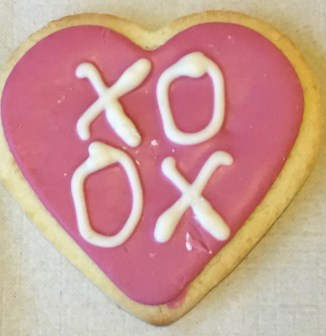
As I see it, it means “bovine barbecue.” I’m not entirely sure why that is specially appropriate for Valentine’s Day, particularly because you don’t get to be an ox without parting with a precious part of your anatomy. You can be Presbyterian without that, I am glad to say, an allusion that will be explored in just a moment.
Looking first at XO. The only language I have found in which this is actually a word is Chinese. Xo is a spicy seafood sauce originating in Hong Kong. Why you would want to put that on the flesh of an ox is puzzling, of course, but then naming a celebration of courtly love after a priest [3] isn’t all that straightforward either. And if you call beef with barbecue sauce on it “barbecued beef,” then Xo Ox is perfectly understandable.
You may have thought that the reference to Presbyterians was casual, but it was not. Etymology comes once again to the rescue. Presbyterianism is a form of church governance characterized by rule by “elders.” The Greek presbyteros is not very far away; it means “elder.” But why does it mean “elder?” The prefix pre- meaning “before” is not a puzzle. That leaves us only -buteros, from the root bous, meaning “ox.” There was, according to one of the accounts I read, a favored position saved for an old man, leading the ox to the place where the ox would be sacrificed. [4] So it is the combination “the old man in the front with the ox” that gives us presbyteros and prestyteros that gives us Presbyterianism, the rule of the church by such elders.
So much for meaning. There remains the question of just why XO has come to mean “hugs and kisses.” First, it ought to mean “kisses and hugs” because the X is the symbol that is supposed to refer to osculation. Still, we make do with the language as we find it.
As to just why the X symbol means what it is supposed to mean and the O what it is supposed to mean, I recommend a bouquet of speculations collected and arranged by Deborah Honeycutt at Today I Found Out. Some of the explanations have to do with Tic-Tac-Toe; some with X as a lingering symbol for Christ; some with the purported practice of Jewish immigrants “signing” with an O because they didn’t want to sign with “a Christian symbol.” [5]
So this “Valentine’s Day season,” there is a great deal to think about. I have, I am delighted to say, a wife who still likes to be courted. There is the whole season of Valentine’s Day which provides a context that otherwise I would have to invent. And there are cards which say little fragments (each) of the things I would like to say to Bette in the Valentine’s Day season. Some are a little goofy; some are sweet; some are sexy. Some are borrowed from other occasions; if I like the picture enough, I just change the message.
So much to do. So little time.
[1] I actually did have a classmate named Bumpy Gray. I didn’t find out his name was Paul until a substitute teacher called the roll one time. We all said, “Who?”
[2] We just celebrated the 12th anniversary of our first date. At Starbucks. I had learned in six months of dating that “coffee” is a god amount of time for a first date because you never know how it is going to turn out.
[3] One of the plausible actual Valentines who might have been associated with sainthood was a Roman Catholic priest, who presumably would have been celibate. I understand that there were exceptions, but the combination of a non-participating priest and a castrated bovine in the celebration of romantic love is just too much to pass up.
[4] Partridge in his Origins: A Short Etymological Dictionary of Modern English says originally meant “(an ox) leading the way.” Barnhart, in The Barnhard Dictionary of Etymology thinks it might refer to an old man (presbyteros is the comparative form of presbys, meaning “old”) who leads a herd of cattle.
[5] In the middle of this explanation, I learned that kike, a derogatory term referring to Jews, comes from kikel, the Yiddish word meaning “circle.” And if it is true that Jewish immigrants signed with a circle while other immigrants signed with an X, that would actually make sense.
 Kobo Abe’s 1964 novel The Woman in the Dunes is the first treatment of this theme I know about. The protagonist , Niki Junpei, is an entomologist who is trapped in a sand pit because the locals won’t let him leave. All day every day he must shovel back the ever-advancing sand dunes. A young woman lives in the cave as well and they both work at this task. Eventually, working at this endless task along with the young woman comes to seem an appropriate way to spend his life.
 begins with the same weather forecast and the same music and the same pointless jokes on the radio—and turning it into a ritual of good deeds. He changes the flat tire on a car, peforms the Heimlich maneuver on a man choking to death in a local restaurant, catches a kid falling out of a tree, rescues a homeless man from starving and freezing to death. And…he honestly courts a woman he loves, knowing that she will continue to reject him and that he will continue to deserve rejection.
 narcissism.” But the case I presented is not like that. This guy—the father, employer, mayor—IS a narcissist. It is what he is like ; he overestimates his abilities and has an excessive need for admiration and affirmation. [3] And that means that he will be a narcissistic father, a narcissistic employer, and a narcissistic mayor. He brings his condition, in other words, to the statuses he occupies and as he plays out the roles those statuses demand, characteristic traits of NPD show up at home and at the workplace and at city hall.
 That brings me to Donald Trump. And for those of you who are wondering why it took me so long, the answer is that I am trying to distinguish between the effects of narcissistic behavior, on the one hand, and the causes or the signs of it on the other
 with narcissism? It seems to me that we can find three there at least.
 I need to find a way to get off this horse before I disappear over the far horizon and I have an idea. There is hardly a more innocuous movie that The Wedding Date, starring Debra Messing and Dermot Mulroney. Messing takes Mulroney to the wedding of her sister, pretending that he is her fiancé when in fact he is a professional escort. Messing is concerned that the proceedings will go well, but they start going badly as soon as she and her “wedding date “ arrive.
 And Stephen Colbert blusters, “If our Founding Fathers wanted us to care about the rest of the world, they wouldn’t have declared their independence from it.” Season 3, Episode 2
 articles called “analysis.” These are “news stories.” In a long life of reading the New York Times, I have never seen anything like it.
 often enough, there is simply no way for the media to deal with them while staying within the boundaries of “professional journalism” as previously defined. I think they have decided that the pallid responses to which they have limited themselves have made them tools of some of the worst elements of American politics and they have decided that if that is what “professional” means, it is time to give it up. (This is Sean Spicer, by the way, President Trump’s Press Secretary. For fans of The West Wing, he is standing where C. J. Craig used to stand.)
 communicate the truth in plain language. “He knows it isn’t true and he keeps on saying it is true. If that isn’t lying, what is?” And these bald confrontational questions wind up in the headlines, not buried in the text. And not countered by someone representing “the other side.
 and Pharisees accuse Jesus of blasphemy, interpreting his statement as something he, himself, was doing. It would have been easy for Jesus to have said that God had obviously forgiven this man, so it was not something Jesus was doing, but only something Jesus recognized. Then they could argue about whether God had done that or not, citing various interpretations against each other.
 requires that you forego association with violators of the law. Jesus did not dispute that the other people at the party were sinners and he did not dispute that he would become ceremonially impure by association with them. He said, as I hear it, “They may be impure, but they are also spiritually sick. It is my mission to heal as many as I can. Why would God send me to people—like you—who are not sick and who, therefore, have no need of my special gift?”
 Let’s begin with Jesus as a chooser of what issues are going to be salient. Etymologically, and issue is “salient” when it jumps out at you. [5] Each of the events I have chosen as examples brings some new aspect of Judaism front and center. In the case of the paralytic, the question of God’s forgiveness is raised. At the party, the question of holiness as separation from the needy is raised. In the “cornfield,” the question of the applicability of the Law to Jesus and his mission is raised.
 Jesus picked this fight, it seems to me, in order to establish that he dare not subordinate his mission to the ordinary constraints of Judaism. That’s why he didn’t stop with the rabbinic justification of his disciples’ actions, but went on to make a claim about himself.
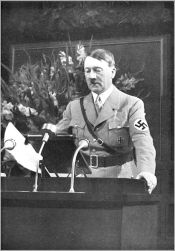 I have taught in public schools and universities nearly all my life, so I can tell you that comparing anyone to Adolf Hitler is taken as a serious insult. If you say to a politician who is five feet and nine inches tall that he is as tall as Hitler, he will take it as a mortal insult. He will say, incredulously, “Are you comparing me to Hitler?” If I say that Hitler was a marvelously gifted tactician, deploying a largely unwilling bureaucracy with great skill, I will be accused of “justifying Hitler.”
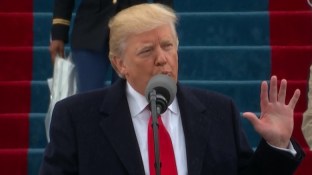 Noting these similarities is not a charge against Trump. You can go down the two speeches and just substitute a German expression for an English one and just doing that is scary.[2] It is true, however, that Trump sees many more similarities than I do between the time of his assuming power and the time of Hitler’s assuming power. And because Trump sees these similarities, he chooses words that highlight them. Any good speaker would do that. Abraham Lincoln did the same thing; he was a superb speaker as a result.
 achievement to the appropriate agencies, funding them adequately, and then holding them accountable for their work. That’s not how you build a movement. A movement needs a leader. The leader needs to focus the movement on himself and to give indications that he, personally, is bound to the success of the movement.
 United States of our time (by contrast with the Germany of Hitler’s time) there are many social and political institutions, including a robust federal system, in place. They can’t simply be set aside. They will have to be bargained with.
 OK, how are we going to have such ceremonies if people say that the ceremony is about the person who is being honored? We will not have them. If the ceremony is about the person rather than the office, then the ceremonies that are supposed to celebrate our unity as Americans and the peaceful transfer of power from one party to another, will have no power at all. Everything is politics—the pursuit of power. Nothing is government—things like providing for a common defense and protecting domestic tranquility.
 Trump will be the 45th President of the United States. But winning an election does not mean a man can show contempt for millions of Americans and then expect those very people to celebrate him.
 It takes her a little longer to get to the “but;” still, when she gets there, she wiggles the same way Rep. Castro did. I respect the office. Good. I respect the peaceful transfer of power. Good. But the man who will take the office is a jerk and the man to whom power is transferred is offensive…and therefore we cannot participate in this celebration of peaceful democracy in America.
 I think that President Trump’s actions, proposed and executed, should be opposed by everything we have. He is going to want to cozy up to Russia with predictable consequences for Germany and France. Make him pay. He is going to want to gut the health protections President Obama put in place and that the Supreme Court declared to be constitutional. Make him pay. He is going to continue to engage in business practices that are wholly out of line with the office of the President. Make him pay. He is responsible for his actions and when he does wrong, he should pay the consequences.
 Let’s look at what the word itself—as opposed to our use of it—would like to be or what it would like to do. It’s a little like agreeing to recognize gravity or inertia. I wouldn’t want to go so far as to say that the word’s intentions have been frustrating our intentions. There are quite a few things wrong with that formulation. [1] But I do want to start with the word.
 These are not things I am going to decide to do, as if they were foreign countries I had not yet invaded or competitors I had not yet eliminated. These are not decisions that I have been struggling with—a di-lemma is a common kind of struggle [4]—what with the two lemmas to deal with.
 intend anything and then act on that intention. On the other hand, sometimes it is the easiest way to say something and if you stay vigilant, it doesn’t do any harm. Take Dawkins’ The Selfish Gene, for instance. Dawkins does not think that genes “intend;” his contention is that imagining that they do helps us make sense of the pattern of their actions.
 ampion. So far as it is possible, they are going to deny that he really did what all the papers say he did. Failing that, they are going to say that it was an understandable mistake by a new president or that it was well-intentioned by the president but mishandled by his supporters. They are going to say that huge errors are mere foibles.

 The Dilettante's Dilemma