The Risk-averse servant

This story, recorded by both Matthew and Luke, has been given a lot of different interpretations. I’ve been working/playing with it recently and I have three observations I would like to make.

Before I get into the observation-making business, let me pause for a confession. I have written this essay completely and it wasn’t until I was done that I discovered that the observations I had made could be organized as three main points. I began with a simple grammatical discrepancy—as I will explain below—and followed my several curiosities as the argument flowed from one topic to another. It wasn’t until I was finished writing the essay that I noticed that I had “three observations I would like to make.” I am amazed at how organized it seems to me now, knowing, as I do, that when I first approached the topic, I charged around like a bloodhound with a meaningful scent in his nostrils.

That is the end of my confession, Now on with the observation-making business.

Here’s the story, often called “The Parable of the Talents” but which might be better called “The Risk-averse Servant,” or possibly, “The Servant Who Feared the Wrong Thing.”

Parable of the Talents

To shorten the essay up a little, I am going to presume that you know the general plot. If not, a quick look at Matthew 25 or Luke 19 will fix that. Briefly, a noblemen went away and trusted three servants with some of his funds to make money for him while he was gone. Two of them did. This is about the third one. Here is the clip that dealt with him.

Matthew 25: 24 Last came forward the man who had the single talent. “Sir,” said he, “I had heard you were a hard man, reaping where you had not sown and gathering where you had not scattered; 25 so I was afraid, and I went off and hid your talent in the ground. Here it is; it was yours, you have it back.” 26 But his master answered him, “You wicked and lazy servant! So you knew that I reap where I have not sown and gather where I have not scattered? 27 Well then, you should have deposited my money with the bankers, and on my return I would have got my money back with interest. 28 So now, take the talent from him and give it to the man who has the ten talents.

What did the servant know and when did he know it? [1]

risk averse 3I first began to be interested in this passage when I noticed that the New Jerusalem Bible (my favorite) has a translation of “knew” that was new to me. Like everyone other Protestant my age, I grew up with the King James Version, which has: “Lord, I knew thee that thou art an hard man…” [2] The Revised Standard Version has a modern version of the same sentiment: “Master, I knew you to be a hard man.” This is something the servant knows to be true and it attaches to the character of the master and is evidenced by the master’s repeated actions that support it.

But I noticed that the New Jerusalem Bible has “I had heard that you were are hard man.” “Had heard” is not at all the same thing as knowing, so I checked to see what verb is used in the Greek text. It is egnōn, “to know,” a verb widely used in the New Testament to refer to knowledge. But knowing is different than “having heard” so I was puzzled. The New Jerusalem Bible is not given to flights of fancy; it is the work of careful scholars.

But it turns out that egnōn is in a tense we don’t have in English and this is the first of my three observations. It is the aorist tense. (Please don’t give up here; this is the only really technical point in the entire essay.) An aorist verb describes an action that is taken only once although the effects of that action may go on for a long time. [3] So what would it mean to say, “There was a time when I knew a particular thing, but I have not continued to know it?” That formulation represents “past knowledge,” or, in other words, information that came the servants way in the past and which he is still using. If that is what Matthew has in mind, then the translation “I had heard” instead of “I know” is perfectly appropriate. And not only appropriate, but provocative. What does it imply about the servant I am calling “risk-averse?”

Now the servant characterizes himself as risk-averse. “I had heard that you were a difficult master so I decided to minimize the risk of doing anything to make you angry.” But does it seem odd to you to say that a man who makes a crucial decision on the basis of hearsay is really averse to risk? I don’t think so. And this brings us to the second of the three points: what would a risk-averse servant have done?

Risk-aversion and Good Information

So the servant knows the mater to be demanding and he, himself, is fearful of doing something wrong and being punished. It is not his view of “doing something wrong” that matters, of course. It is the master’s view. In order to get current and accurate information about how to stay out of trouble, the servant needs to “seek (information) and keep on seeking it” to use the language Matthew attributes to Jesus eighteen chapters earlier (Matthew 7:7)

Risk Averse 2It would be asking a lot to ask that the servant put his master’s interests ahead of his own and I am not asking that. I am saying only that if “avoiding punishment” is the servant’s own top priority, then information about what kinds of activity the master will punish is very important. Instead of that, the servant relies on “I had heard.” That doesn’t sound like risk aversion to me.

There is one other possibility, though. It may be that asking the question about the master is the risk that most terrifies the servant. The text doesn’t tell us that, but it does tell us that the servant didn’t take the trouble to find out. If wondering what the master will want of him simply terrifies the servant, then gathering information about what the master is like is the scariest possible course of action. So the servant commits himself to denial [4]in the same way and for the same reasons that someone who has a suspicious lump in his neck refuses to go to a doctor and find out what it is.

I think I would be willing to call that behavior risk-averse, even though it is not the behavior the story is intended to refer to.  Which brings us to the third of the three observations. Just what was the story supposed to be about?

Some have said it is a story about the nature of God. I don’t think that’s very helpful as an interpretation and it is really hard to see why Matthew would have chosen to represent God that way. Some have said it is a story about “lending at interest” (forbidden to Jews except to non-Jews) and therefore about capitalism. I don’t think that’s where Matthew’s interest is at all; not the Matthew who recalls that Jesus said it was impossibly hard for a rich man to enter the kingdom of heaven. (Matthew 19:24).

Being in the Game

So what is the story about. It seems to me that it is about recognizing that you are in the game and that it is useless to pretend that you are not. I’ve slipped into a modern metaphor here—“in the game”—but it’s only to highlight how contemporary the notion is. If you are a Jew living by the Torah you are “in the game.” You have a lot of obligations that pay no attention at all to what you would prefer. You are obligated to help an enemy unload his pack animal, for instance, and to redeem a kinsman from slavery and to produce offspring from your brother’s widow who will be counted as his offspring, not yours.

A Jew could say about any of those, “I wish I weren’t even in this game,” but he or she is anyway. I learned during my time in Ireland last week that the word “lynch” comes to us from Judge Lynch who was obligated to hang his own son because the son had violated a law that required death. I am sure he said, as he saw he has obligated to give the sentence the law required, that he wished he was not even in this game. But he was anyway and pretending he was not would not help him.  I’d be willing to bet that this Utah player had to stop and consider just what “being in the game meant for him.”

risk averse 6The servant is the recipient of his master’s money and the name of the game is investment and profit. I can see that Matthew would have a good deal of interest in that. Matthew would have been troubled by people who “wanted a little piece of Rabbi Jesus’s kingdom” but who wanted to pretend that no obligations went with that “little piece.”

And that, finally, is what I think this story is about. Being a part of the Jesus ministry is a kind of “being in the game.” It may require that you do things that make you uncomfortable or require that you condemn, in yourself, behavior that otherwise you might call justifiable.  Like hating your enemies, for instance. But if you have been given a gift, you are responsible to use it as the master intended it be used.

risk averse 7You could, of course, wish that you had not been given the gift and all the obligations it carries with it. I think about Frodo, who, when he discovered what “Bilbo’s ring” really was and the burden it was going to be to him, said, “I wish it need not have happened in my time.”

I get that. I have felt that way myself. But Frodo said that to Gandalf [5] and this is the reply he got. “So do I,” replied Galdalf, “and so do all who live to see such times. But that is not for them to decide. All we have to decide is what to do with the time that is given us.

And I think that’s why Matthew want to tell us this story.

[1] I wrote that line well before the recent firing of FBI Director Comey put the minds of everyone old enough to remember back to the Watergate years. All the coverup questions were set as answers to the question, “What did the President (Nixon) know and when did he know it.” These questions were asked in vain during the Iran/Contra allegations of the Reagan years, but they seem to be making a comeback.
[2] We can leave out the archaisms “I knew thee that…” and “an hard man” and still get the sense of the servant’s confession
[3]It is used this way in other text, as well. When Paul says, “Christ died for us according to the scriptures…” (1 Corinthians 15:4) he uses the aorist tense. He means that Christ died once and the effects continue. On the other hand, when Jesus says “seek and you will find,” he uses the present tense. That verse fragment means “seek and keep on seeking” and you will find (Matthew 7:7). So the implications of the aorist and the present tenses are crucial in some contexts. I think this is one of them.
[4] If you have a “denial” joke, like “it’s not just a river in Egypt,” for instance, feel free to insert it here.
[5] In Tolkein’s world, a “wizard” is a kind of being and there is no question that Gandalf is one of that kind. But in English, the -ard suffix is uniformly pejorative and in the word “wizard,” the -ard ending is attached to “wise.” Looked at in that way, Gandalf really was wise; he was not just a wizard.

Posted in Biblical Studies, Paying Attention, Theology, Uncategorized | Tagged , , , , | Leave a comment

Reflections on Ireland, 2017

As I write this, it is just after noon in Dublin, where I had breakfast yesterday.  It is just after 4:00 a.m. in Portland, Oregon where, when Starbucks opens, I will have breakfast today.  My mind is still full of Ireland, where I have spent the last two weeks.  It is still way too early for me to understand what I saw, but some small anecdotes and a few images come back to me and I would like to think about them this morning.

Let’s start with the symbol(s) of Ireland.  Although the popular color of IrelandArms_of_Ireland_(Historical).svg.png is green, as all Notre Dame fans know, the official color of Ireland is blue.  I didn’t know that.  The official symbol of Ireland is the harp and I was just playing around when I added the (s) to “symbol of Ireland” because Guinness has great popularity in Ireland and all they had to do is to reverse the direction of the harp. Note the direction of the harp in these two images.

While I saw people drinking Guinness stout all over Ireland, most of the Guinness stories I heard, I heard in Dublin.  If there is a better picture than this one, with the Irish shamrock displayed (see below) in the head of a draft Guinness, I have not seen it.  I didn’t even know they could do that.

images.jpgThe harp has been a traditional Irish instrument for a very long time, but I think it has a special status because the English domination of Ireland included a determination to obliterate Irish culture and playing the Irish harp was declared to be a capital crime.  When I saw the intensity of Ireland’s love of its harp and of traditional Irish music generally, I realized I was seeing more than just a tradition-loving people.  I was seeing an indomitable people.

Ireland is in a very good place right now.  They have levels of wealth they wereIMG_0180.jpg not prepared to have–not, everybody assured me, “like the Celtic Tiger years of the 90’s–and a stable socialist democracy that is not dependent on England.  It is dependent, however, on the European Union (EU), which funded the Celtic Tiger 90s, and Irish news pays a great deal of attention to the EU.  I heard speculation of what the EU flag would look like –the ring of stars on a field of blue–when the U. K. withdraws.  There may have been just a little glee mixed in with the speculation.

IMG_0137.jpgWhen I travel, I am often taken by signs that catch my interest.  I had never heard, for instance of the earliest written Irish script, called Ogham (and pronounced ōm).  It is just a series of lines representing letters of an alphabet.  But that makes this sign in Dingle–Chinese take-out, no less–a four-language sign.  Even in Ireland, where two languages per sign are common, this was  worth a good laugh. [1]

IMG_0227.jpgThere is nothing at all subtle about this statue of Molly Malone in Dublin.  It was hard to get a picture of just her–people wanted to have their pictures taken with her as background and who could blame them.  On the other hand, if you know the traditional Irish song “The Rose of Tralee,” this picture might catch your fancy.  This (see footnote 2) is a rose IN Tralee.  We stopped there for dinner on our way back to Adare and I couldn’t resist it.

IMG_0048.jpgI saw more redheads in Ireland than I have ever seen at one place.  There was an attempt in Portland to break the Guinness (!) Book of Records for the most redheads in one place and one time and I contributed my redhead to that cause, but I didn’t actually see the gathering itself.  It will not surprise you that there are a lot of redheads in Ireland, but this one, in Ennis, is named Éowyn and I sincerely hope there is a Faramir somewhere in her future.

Nearly everyone notes how incredibly green Ireland is.  That didn’t impressIMG_0133.jpg me all that much because I am, after all, from Oregon and we do green as well as they do. [3]  But nothing in Oregon suggests the division of all that green into very small plots of land marked by rock walls or, as here, by hedges, and you see that all over the parts of Ireland (south and west) we saw.

I don’t know yet how to think carefully about the role of foreign (English) domination in Ireland.  Maybe that will come to me in time.  Many of the stories we heard had the “and this is what they did to us” theme.  The other theme was “but that didn’t stop us from demanding the right to be Irish.”  And a lot of the excesses that are part of the caricature of Irish life–the hot tempers and the drunkenness and the violence–can be placed within this cultural narrative and maybe that is the way the Irish see it. [4]

This very brief two-week glimpse of Ireland is all I have to go on.  I might have to go back or maybe, you know, read something.

[1]  The Ogham marks are at the far left.  The red part of the sign contains Chinese characters, and information in both Gaelic and English.

[2]  In the U. S., we absorb “our culture” from quite a number of differentIMG_0149.jpg sources.  “Culture” is just things everyone knows and the elements of it don’t come with labels attached.  I got a quick lesson in Ireland about how very much of “my culture” is Irish.

[3]  I am also a University of Oregon alumnus, so green has a special meaning for me as well.

[4]  When I was in grad school, there was a faux Latin motto, Illegitimi non carborundum, which was translated, “Don’t let the bastards wear you down.”  That would serve the Irish very well if “them” meant the English.

Posted in Living My Life, Travel | Tagged , , , , | 2 Comments

A Victory for Biblical Scholarship

When I think of “going out at the top of our game, I’m not thinking of Kevin Costner’s performance as Billy Chapel, the aging Detroit Tigers pitcher who pitches a perfect game on his last trip to the mound in For the Love of the Game. That’s good, but my friend Fran Page and I recently finished an eight month Bible study that ended with a session that felt pretty much like a “perfect game” to me and may have been a more significant victory. [1]

We began last September a course that laid out Genesis/Exodus in the Old Testament and Luke/Acts in the New Testament as the course of study. That’s a lot of opportunity to teach how to approach scripture with the goal of understanding it. We hit all the emphases everyone hits about knowing the context and the writer and the situation and so on. We invited our students to try to see the situation as the writer might have, to use the stories available as a way of responding to that situation.

tamar 1Here’s an example from Genesis 38, the story of Tamar, who is one of my favorite biblical characters. The story of Tamar and Judah, her father in law, is not the easiest story to grasp because it requires an understanding of levirate marriage. [2] Our students were perfectly ready to approve of God’s commands that we should not steal, lie, or kill. God’s commands that the younger brother should mate with the widow of an elder brother was not as easy to approve. It is, however, the basis of the story of Tamar and Judah.

Tamar’s husband Er dies, leaving Tamar childless, and the younger brothers do not do their duty as God commanded. [3] And Judah, their father, even sent Tamar back to live with her own family. He is obviously not going to intervene. So Tamar took things into her own hands, producing problem number two for our students. Tamar disguised herself as a prostitute and enticed Judah, the patriarch of the family, to impregnate her—the task he should have assigned his sons to do.

From the biblical standpoint, it all ends well. Tamar’s sons (twins) will carry on Er’s name and heritage as God commanded. Judah is publicly humiliated for his part in this charade and Tamar is completely vindicated. For the writer, this is a story of a heroic and proactive woman who takes God’s commandments much more seriously than the men of the family

That’s from the biblical standpoint. That is not where our students started. They were clearly repelled by the dutiful coupling of bother with sister-in-law (the levirate marriage commandment) and inclined to disapprove of Tamar’s seduction of Judah. The writer skips over those as incidental to fulfilling God’s commandment—which didn’t matter much to the students—or treating it as comic. Our goal as teachers was to get the students to begin where the writer began, to understand and appreciate his values as they are played out in the text, and to avoid modern sensibilities that would distort the story.

tamar 2Let’s pause for a moment to appreciate how difficult and unappetizing this is. We are asking them to grasp a truly foreign concept—levirate marriage—and understand it as part of God’s covenant with Israel. It is, in other words, binding. And having grasped this concept, to care about it; to see why it would have mattered so much to the writer. On the other hand, there is nothing at all foreign about a woman seducing someone else’s husband, as Tamar did—and her father in law, no less. But to stay with the writer and his values, you have to set aside your own condemnation of Tamar’s behavior and see her as going to great lengths to achieve the goal God had in mind. [4]

So Tamar was tough, but it was just practice. We wound up at 1 Timothy 2: 9—15, a notoriously anti-feminist text. [5] All the way through Genesis and Exodus, we worked with the stories, practicing seeing them from the author’s viewpoint, practicing seeing the story as response to a situation contemporary with the author. [6] We continued to work those same skills in Luke and Acts and the class continued to work with us, practicing these new and difficult skills together.

We reached 1 Timothy as an example of the split Luke describes in Acts between the kindtamar 6 of church organization that followed from the Hellenized Jews who first followed Jesus, rather than the kind of church organization that followed from the Hebrews who first followed Jesus. From the split that Luke describes, two entirely different approaches developed and if you are inclined to doubt that, I recommend that you read the book of James, then the book of Galatians.  I am reminded here that in our little church in Englewood, Ohio, we used to sing a hymn called “The Church in the Wildwood.”  Possibly this woman in on her way to that church.

But all the work the class put in meant that when they got to 1 Timothy, they were ready to ask the necessary (though difficult) questions: who is the author? what are his principal concerns? What was going on in this church (these churches) that evoked the language he uses? Into what cultural and historical setting shall we set these demands so that we can see clearly what outcome he hopes for? And then finally, after all that work is done, how shall we understand these texts as applicable to our situation today?

Here is the text I am talking about, using the New Jerusalem Bible translation. 1 Timothy 2: 9—15.  I am putting the “suitable clothes” illustration above and the “ought to be quiet” illustration below.

Similarly, women are to wear suitable clothes and to be dressed quietly and modestly, without braided hair or gold and jewellery or expensive clothes;10 their adornment is to do the good works that are proper for women who claim to be religious. 11 During instruction, a woman should be quiet and respectful. 12 I give no permission for a woman to teach or to have authority over a man. A woman ought to be quiet, 13 because Adam was formed first and Eve afterwards, 14 and it was not Adam who was led astray but the woman who was led astray and fell into sin. 15 Nevertheless, she will be saved by child—bearing, provided she lives a sensible life and is constant in faith and love and holiness.

The fact that our class did not simply refuse to study such a passage is a triumph itself, but they did much better than that. They began by understanding that the author of this letter faced a difficulty in the life of this young church that concerned him. It was the health of the congregation that was upmost is his mind, just as the continuation of the deceased brother’s inheritance was upmost in the mind of the teller of the Tamar story. It’s hard to be against the continued health of the congregation. On the other hand, it is hard to start there, when the subtext of our era is “You go, girl.”

tamar 4If you start with how it must feel to have someone tell you that you should not dress the way you want and have your hair the way you want, much less that you should defer to the authority of “a man” just because he is a man—you arrive at a completely modern and understandable and unscholarly anger. But you can choose not to start there. (You probably cannot choose to ignore your feelings altogether, particularly when you begin to apply it to our own times.) But you can choose not to start there. You can choose to start with the situation the writer faced.

And, to conclude this already too long story, they did that. They put their modern feelings aside for the purpose of working together to understand this awful passage in its context. And to all appearances, they felt good about themselves for being able to do that. And when they got to the “what does this mean for us today?” question—a crucially important question despite the need to hold it off until last—they simply dismissed it as applicable today in those same terms.

But even so, I will give them this. They dismissed it as advice that was not needed in our church and that would not even be applicable in our church. They didn’t dismiss it because it was offensive—which, obviously, it is—but because the situation being addressed there and then was substantially different than our situation here and now. [7]

We had carefully set the stage for that kind of deliberation with the notion that some scripture passages are like good, nourishing everyone; others are more like medicine, helpful to some, but possibly harmful to others. And harmful to everyone when the doses are too high. We worked that distinction through Genesis, Exodus, Luke, and Acts. And when we really needed it in 1 Timothy, it was there are ready to use.

This is medicine, they said, and possibly just the thing for that church at that time. It is not food for us. But there is food for us in 1 Timothy and we will not be distracted by the medicine from nourishing ourselves with the food.

I don’t remember ever being prouder of a class of beginning Bible scholars. They were wonderful. They did the hard work without complaining and they will take with them tools they can use for the rest of their lives.

[1] Full credit to Fran and to her husband, Gordon Lindbloom, who helped us plan the course. Still, I am going to be talking about how this felt to me, so I am going to shift over to first person pronouns when I am talking about how it felt.
[2] There is nothing romantic about levirate marriage, which requires the males in the family to mate with the wife of a deceased brother. The offspring of that coupling will be reckoned as the children of the deceased brother, so that his name will not disappear and his property not be dispersed. “Producing an heir” is the name of the game and “his children,” the ones you created by mating with your brother’s wife, will be competitors with your children within the clan. It is not “romantic” in the slightest, but it is commanded by God (Deuteronomy 25: 4—10)
[3] A very similar situation is treated as an aspect of friendship between women in The Big Chill, in which a woman loans her husband to a good friend to impregnate her. It is treated more tragically in The Postman.
[4] We may have lost a student over this story. She knew what was right and wrong and this story was praising bad behavior.
[5] New Testament scholar Luke Timothy Johnson, who wrote the Yale Anchor Bible Commentary on 1 Timothy, calls it a “text of terror” and that is certainly the way our class (12 of the 15 students were women) would have treated it at the beginning of the class.
[6] And that isn’t easy either. The gospels read like biographies, as if the evangelists were recording events as they happened. To see the evangelists as choosing one story or another or one emphasis or another because of the situation their addressees faced requires an orientation in thinking. It isn’t easy, but scholarly study requires that you understand what the event meant to the writer before—not instead of—you understand what it means to you in modern times.
[7] There was even the beginnings of a consideration of “inappropriate dress” in our church as a concept that was worth addressing. Some version, in other words, of what the author saw as a crucial problem, is worth considering today even when it is only a minor annoyance. We ran out of time, I regret to say. I would have love to see where those deliberations would have gone.


Posted in Biblical Studies | Tagged , , , , | 2 Comments

Trashing the West Wing

Luke Savage doesn’t much like the West Wing (TWW). Or so I gather from his article in Current Affairs. I’m fine with that.

But to criticize a body of work, particularly a very complex work that stretches out over seven years, a critic really needs to find a place to stand. Savage doesn’t do that in this piece, but since he needs it so urgently, I think I can help him there.

Once we find a place for him to stand, we will be able to understand his criticismwingnut 3 more more clearly and to evaluate it more thoughtfully. In a way, I am not the ideal person to do this. I am, I need to say, a fan of TWW—the kind of person who was referred to in the chatrooms as a “wing nut.”  I participated in the chatrooms. I taught a university course about the West Wing. I own the DVDs of all seven seasons and I do, in fact, refer back to the issues that are raised more urgently and ominously in the Trump administration. [1]

On the other hand, I am a good choice for this task in other ways. I do understand the relationship between a critic’s home ground and the plausibility of the criticisms. Whenever you say that something should have been done, for example, you are implying that it could have been done. Whenever you say that one thing was a bad thing to do, you are suggesting that something else would have been better. Critics like Savage don’t ordinarily take the time to justify the tacitly proposed course of action. Just condemning the action taken is usually enough and that is what we find in this piece.

So…who is Luke Savage and what is he using as a baseline in his evaluation of TWW? Savage writes for a new magazine called Jacobin. Here is what they say about themselves on their website.

Jacobin is a leading voice of the American left, offering socialist perspectives on politics, economics, and culture.

Here is what Chris Hayes, the MSNBC political host says about the publication.

I really like Jacobin — it’s very explicitly on the radical left, and sort of hostile to liberal accommodationism. [2] There’s a lot in there that I don’t necessarily agree with, but it’s bracingly rigorous and polemical in a really thought-provoking way. It’s a really well-done publication, almost preternaturally good.
— Chris Hayes, host of All In w/ Chris Hayes

From Hayes’s brief comment, I found a few clues that were helpful. Specifically, I found “rigorous and polemical” and “sort of hostile to liberal accommodationism”

Polemical: So I picture Luke Savage and his Jacobin colleagues watching TWW and looking for signs of hope. TWW is also “rigorous and polemical” but the thing about polemics is that if they don’t match your own polemics, they don’t sound reasonable. So that doesn’t necessarily help. In fact, as we will see below, it is the basis for explicit criticism sometimes.

Accommodationism. This is going to be a loser from the very beginning. The Bartlet administration had a government to run, after all, and a Republican Congress to entice into some minimum forms of cooperation.  If you don’t like cooperation, changing it to “accommodationism” is an easy step to take.

So let’s take some of Savage’s criticism’s from his Current Affairs article and see whether my placement of him on the ideological and programmatic left helps us make sense of his criticisms.

The West Wing is an elaborate fantasia founded upon the shibboleths that sustain Beltway liberalism and the milieu that produced them.

Wingnut 2I’d say there is no blood in that one at all. But it does launch some criticisms. “Fantasia” is not entirely clear, but the relationship with “fantasy” not at all obscured. And the fantasy is founded on “shibboleths” [3]—inside code words that establish membership. These same shibboleths sustain “Beltway liberalism.” By the way, “Beltway” is the adjective of death. Nothing good is modified by the adjective “Beltway.”

So there is a tight grouping of smears here, but no actual charges. Let’s go on.

In fact, after two terms in the White House, Bartlet’s gang of hyper-educated, hyper-competent politicos do not seem to have any transformational policy achievements whatsoever. Even in their most unconstrained and idealized political fantasies, liberals manage to accomplish nothing.

Now this one does have some blood in it. After two terms, Savage says, Bartlet’s gang of politicos does not seem to have any policy achievements at all.” He may be right about that one. During their time in office they passed budgets that protected some programs liberals like to protect. They left behind a Supreme Court with an appetite for constitutional issues. They prevented a lot of bad things from happening. But in the last episode, as the Bartlets are looking over the inauguration site, Abbey Bartlet says to her husband, “You did a lot of good, Jed. A lot of good.” From Savage’s perspective, that’s not much to say.

It’s a smugness born of the view that politics is less a terrain of clashing values and interests than a perpetual pitting of the clever against the ignorant and obtuse. The clever wield facts and reason, while the foolish cling to effortlessly-exposed fictions and the braying prejudices of provincial rubes.

“Smug” is one of the cheapest of slurs. In a whole article of slurs, it is probably the lowest. Note that the alternative presented is “clashing values and interests.” Savage has collected a great many of the opponents of the Bartlet administration into a category defined by ignorance and prejudice, rather than by any political position. This makes them victims of the attitudes of the Bartlets and their minions rather than people who fought for their own principles and lost. Savage can get away with that by oversampling the episodes that dealt with campaigning and paying much less attention to the episodes about governing the country.

Maybe just one more.

But if your values are procedural, based more on the manner in which people conduct themselves rather than the consequences they actually bring about, it’s easy to chuckle along with a hard-right conservative, so long as they are personally charming (Ziegler: “I hate him, but he’s brilliant. And the two of them together are fighting like cats and dogs … but it works.”)

The good position here—Savage’s position—is that political judgments should be based on “the consequences [that politics] actually brings about” rather than being merely procedural. The example he chose comes from “The Supremes,” (Season 5, Episode 17). The tension in that episode was the value of having a Supreme Court made of moderates, who simply kick the juridical can down the road a little, or one made up of constitutional architects who build the structures that lesser and later courts redecorate.

wingnut 4

This is an odd choice for Savage. It was the giants of the Court who extended the guarantees of the Bill of Rights to apply to actions taken by state legislatures; prominent jurists who stopped rewarding local police for evidence gathered illegally; daring justices who wrote the epitaph for “separate but equal.” It is decisions like these that the new Bartlet court, with its programmatic conservative anchor and its programmatic liberal anchor, will consider. You’d think even Savage would like that. And to dislike it, he is forced to call Judge Mulready (William Fichtner) “personally charming,” where the writers of the episode go out of their way to make him an irascible nerd. [4]

OK, enough carping. Savage ends his piece with this line:

But, in 2017, [the West Wing] is foremost a series of glittering illusions to be abandoned.

I can see why he feels that way, but I start from a different place, critically, and I think that only by electing White House ensembles like the Bartlet administration and backing them up with Congresses willing to take the hard votes, are we going to get anywhere at all. As I see it, it is Savage’s hankering for a hard programmatic turn to the left that is the illusion.

[1] I also, by way of a chatroom meeting, became a member of the doctoral committee for Melissa Crawley’s dissertation, which was subsequently published as Mr. Sorkin Goes to Washington: Shaping the President on TV’s The West Wing. Dr. Crawley’s degree was authorized by a Department of Communications, but it is the best overall assessment of popular response to “politics as presented by the media” I have ever read.
[2] Accommodationism is not a familiar word in this context. The Wikipedia article, for instance, describes two settings where it has been used in American politics, neither of them anywhere near this usage. Still, it is not hard to see what Hayes means. The parties of the center are always condemned for accommodating themselves to injustice and economic misdeeds. As a rule, that is what you do when you are running a government split between liberal and conservative strongholds.
[3] One of the West Wing episodes was called “Shibboleth. “In it President Bartlet quotes the biblical passage that grounds it historically and declares that the Chinese Christian refugee in his office has just used “the shibboleth.” Season 2, Episode 8.
[4] With the sole exception of his hallway argument with Charlie Young (Dulé Hill) in which he gives Charlie a much better argument in favor of affirmative action than Charlie has ever heard before.

Posted in Political Psychology, Politics | Tagged , , , , , | Leave a comment

Now bring on the victory laps

When I first began to formulate the metaphor of victory laps in 1977 (much more later), my wife, Donnie, and our children—then 16, 14, and 12—were living in New Wilmington, Pennsylvania on a little circle of houses kept for new faculty at Westminster College.

The Original Victory Laps

The first approach to the notion of a “victory lap” was no more than self-talk. Part of my life at this period was running 34 (and change) miles a week every week for a year. [1] That wouldn’t really have been so bad, but things happen. I took a couple weeks off for a backpacking trip in the Rockies—and none of those miles counted—and then I got sick a time or two. By the spring of 1977, I was several hundred miles behind and looking for any way at all to pad my total.

It turned out that New Faculty Circle was half a mile around, if you start and end at victory lap 5our house, so after every run, I would add that extra half mile. I called them “victory laps” after all the victory laps I had seen superb runners like Steve Prefontaine take at Hayward Field in Eugene. [2] And that’s all there was to it at first.

But running distances is an intensively mental activity and after a while I noticed that my body didn’t feel the same when I was running that “extra” half mile as it felt during the “real” miles. There was a 19 mile run I used to do, for instance and I remember coming down the hill to my house in real distress; cramps or blisters or a side stitch or a headache or something. But when I started the extra half mile, those feelings went away. That helped substantiate the notion of “victory lap.” It was a celebration lap. A “victory” not over any competitor, but over my pain barrier and my tiredness.

That was a very carefully phrased sentence, I hope you noticed. I didn’t say that in that half mile the blisters healed themselves. I said the feelings went away. Did I just stop paying attention to them? Was there something about the gentle grades of that last half that didn’t aggravate them? Running pains of various kinds seems to have a wave character and the come and go, even as the condition that produces them stays the same. I have no idea what the truth was. What I cared about was that the extra half mile was ordinarily pain-free and took on a celebratory cast.

The Victory Lap Metaphor

I was about 20 when I met Donnie and we were together for 20 years, roughly, and I began to move toward imagining that if I lived to be 80, I would have “run” four 20 year “laps.” Life as mile race, where every lap was 20 years long. The proverb that runs, “The days of a man are fourscore and ten/or by reason of strength, fourscore” has been familiar to me nearly all my life. I think that accounts, in part, for my early attraction to 80.

The timing has gotten a little ragged since age 40, but Marilyn and I were together for] nearly 24 years and by the time I reach 80, Bette and I will have been together for 12 years. [3] It’s not a perfect division, but it’s good enough for me and it raises the question, “What is a “victory lap” after you have run all four of the two-decade laps and have turned 80.

Getting Serious About Application

I honestly don’t know. I have memories that that was the time the pain went away or at least that it stopped bothering me. I have the notion of a little extra running to celebrate that the “real” running is done for the day. I have the sense that during many of those victory laps, I let my mind range back over the run, celebrating the best parts, reconsidering the pace I had chosen for the hills, building a new strategy for the next run.

And then, just a few days ago, something really heart-warming happened. I got a letter from Donnie, who really understands the “victory lap” metaphor because she was there at the time. [4] She ended her note to me with this:

“However, in my heart and my mind, I will always…want you to know I care enormously about your “victory laps.”

victory lap 3This is Britain Lake, by the way.  The faculty circle loop is just to the right.

I loved that warm thought and it made me think that maybe it’s time I get to work deciding what the victory laps will mean to me in their new metaphorical clothes. The original “victory lap” was a time of physical relief. It’s hard to be against that. It was a time of critical assessment of “the run.” [5] That seems worth doing in both the immediate sense of the run just concluded and also in the more general sense of strategy for that course. It was a time of celebration. However that particular day went, I had completed the run that day and I picked up a certain number of miles against my accumulated deficit. I think I like that one too.

Those three, at least, ought to make up my present day about-to-turn-80 victory laps. If I called them Celebration, Physical relief, and Assessment, I could say I am working on my CPA. Probably I wouldn’t want to say it very often.

Celebration of completing the eighth decade certainly ought not to be a problem. At the very least, I could celebrate not having died yet and on beyond that, I have, in fact, had moments that I can recall with real pleasure and I could celebrate those. I could celebrate them as many old people do by telling stories about them.

Physical relief is going to be the hardest one to apply metaphorically. There are two reasons for that. The first is that over a long life, I have associated strenuous exercise with virtue and avoiding it with vice. If I have no more to guide me than “If it doesn’t feel good, don’t do it,” that is going to require an adjustment. What happens to all that virtue foregone; all that vice avoided?

The second is that if things like a good soak in a hot tub feel good, I have the time victory lap 1and right downstairs by the pool is the hot tub. I do have one new trick about physical relief. My body has felt bad in a lot of different ways over the years and I am familiar with those ways. I am capable, now, of getting up in the morning and actually experience the “not hurting” of a joint or a muscle. That is something I never experienced at all at the time I was running the 1776 project.

Assessment will be the easiest one. I do that anyway. What has worked on this course? Where have I too often failed to pick up a challenge that would have benefitted me later? When have I overestimated my energy and spent too much too early? Those are all very physical question in the original scenario but they are provocative prompts in the new one. Good answers to those questions could shape my life going forward.

But what is a lap?

That leaves the question of what a “lap” is—not what it is for (we’ve just established that) but how long it is.I’m inclined, at the moment, to make the lap a season. That would give me four of them a year, rather than four of them in eighty years. It would orient me outward toward the natural world, rather than inward as “quarterly” would. And the notion of “season” as a metaphor for part of a life is already well established. [6]  New Wilmington is surrounded by Amish farms, so sights like this one (this stretch looks very familiar, so I think it was part of this run) were common.

victory lap 2And I think I will start with winter. Winter will begin five days after my birthday. That doesn’t seem too long to wait. And my brother John, who has greatly enriched my appreciation of seasons, begins his survey [7] with winter on the grounds that it is the simplest. Productivity has shut down and “life” is resting—unless it is trying to find a way to live through the winter—and the whole cycle is getting ready to begin again.

Also, the church year begins in the winter with Advent. There is no historical reason for placing the birth of Jesus in winter, but the church has done it for a very long time now and I began accepting it long before I had any idea how arbitrary it was. Besides, now that I think about it, Advent is the time when Christians reflect on the many scriptures that, in retrospect, point definitively to Jesus’s birth. These scriptures are very much like my reflection, at the end of the run where, looking back, everything seems clearer.

Now if you will excuse me, I need to finish this lap so I can get the celebration started.

[1] I know it sounds odd, but I had signed up for a National Joggers Association project which called on members to run 1776 miles between the 4th of July 1976 and the 4th of July 1977. It was to be a celebration of the bicentennial.
[2] Of course, Prefontaine’s victory laps marked the races where he came in first. Mine marked training runs where I managed to come it at all
[3] I will be 80 on December 16 this year and Bette and I will have been married for 12 years on the 28th, less than two weeks later.
[4] Although I have to say that my kids were there at the time too, and they just hate the victory lap metaphor. Nothing I have ever said to them has moved them off the notion that “finishing the race” is just a metaphor for death. It is heartwarming that they don’t want me to die, of course, but it would be nice if they would take the metaphor in the way I mean it. I am a teacher, after all, as well as a father.
[5] The quotation marks there indicate a small complexity. “The run” includes the most recent run over a particular course, but it also includes “my strategy on that particular course” generally. I might conclude that I take that long uphill toward the cheese plant too fast and pay for it for the next several miles. In that way it is a more general reflection of “the best way to manage that course,” not just how I did on that course today.
[6] I am thinking, certainly, of Daniel Levinson’s The Seasons of a Man’s Life and probably also Archibald McLeish’s summary, in which he refers to autumn as “the human season.”
[7] See John Hess, A Perfectly Ordinary Paradise (the working title), forthcoming.

Posted in Getting Old, Living My Life | Tagged , , , , | Leave a comment

A Hollywood opening

Saturday, April 22, was my first visit to the Hollywood branch [1] of our library system. [2] It was a spectacularly good experience. Already I feel a reluctance to go back to try to experience it all over again because it is really hard to experience something the same way twice.  On the other hand, I will never forget the experience. Ever. And I know why. And if you’ll stay with me, I’ll tell you.

This morning, that branch of the library opened at 10:00. I was there at 9:53 and so were a few mothers with young children. By 9:59 there were lots of mothers with young children and quite a few older people too, all men. We were all waiting for the doors to open.

At 10:00 exactly, two librarians showed up to open the two large glass doors and people started in. Just inside those two doors, you have to turn to the left where you encounter two more large glass doors. Those doors were being held open—wide open—by two more librarians.

Everyone who entered received a greeting from these four young women. It was not a personal greeting, like “Oh, Mrs. Jones, how good to see you again. How is little Robert?” Nothing like that. The words spoken were more like “Good morning” and “Welcome to the library” and “Isn’t it a lovely day?” But it wasn’t the words, it was the manner.

All four of the librarians were interacting with us as we went in. They made eye contact; they smiled; they held the doors as open as the doors would go. They spoke to each adult who came in and to some of the children. If they had been curtsying, the effect could hardly have been more dramatic or more unexpected. It was a performance, certainly, but it was a performance with a meaning that everyone understood and some of us, at least, cherished.

You have to stop a minute and remember that these are not customers. They are not there to buy anything. The library would not make a nickel more by managing this entering ceremony badly than they would by managing it well.

I am sure that the people they chose to do the ceremony were people who were naturally IMG_0034.jpggood at it or who had gotten good at it. But good people or no, the ceremony itself is aimed at making people feel welcome because it is a library. They conveyed the attitude that a library is a special place. That’s where the illusion of the curtsying came from. Welcome to this special place. We do knowledge here. We are so glad you have come to spend some time sharing this pursuit with us.

It was hard for me to believe that I had seen what I thought I had seen. And then, by great good fortune, I had trouble finding the book I was there to check out. It wasn’t on the shelf “were it belonged” because it was on a special shelf called “Staff Picks.” What a good place for it to be! The librarian who helped me find it knew all about the charade I had witnessed at the doors. “For some of our people,” she said, “That is the best part of the day.”

So they knew what they were doing. I may have been unusually sensitive to it, but I wasn’t making it up. It’s hard not to love a place like Portland where things like this just keep happening.

[1] The first prominent feature in this neighborhood was the Hollywood theater and the name of the neighborhood was changed from Hollyrood to match the theater. “Hollyrood is, itself, an adaptation of Holyrood, an area in Edinburgh, Scotland.
[2] “For the 11th year in a row, Multnomah County Library patrons have checked out and renewed more items than patrons of any other U.S. library serving fewer than one million residents — an average of about 33.4 items checked out or renewed for every man, woman and child in Multnomah County,” according to the Public Library Data Service Statistical Report

Posted in Living My Life | Tagged , , , , | Leave a comment

Hey wait. There IS another way

I love those moments when the familiar options suddenly turn themselves inside out and everything looks instantly different. Daniel J. Levitin gave an amazing example in the New York Times of March 25 (here) and I have been looking for a chance to celebrate what he did. Here is the line that sold the article to me.

The voice of reason, the voices of my dear parents, filled my head: If there is no other way, I should shoot him. The phrase echoed for me: there is no other way. Then it hit me. There is another way.

This is going to be a piece about guns to a certain extent. That is the narrowest and least important focus. The next larger focus is going to be about being aware of your alternatives. That’s the difficult one. And finally, the last and most general focus is understanding how your sense of the alternatives is shaped and constrained without your awareness and certainly without your consent.

gun 1We’ll look first at the situation as Levitin describes it; then at the alternatives as they seemed to him at first. Then, finally, how he escaped that trap and how those familiar and bad options turned themselves inside out and gave him some new choices.

 

The situation

Here is the way Levitin sets the scene.

I was working at my desk the other day, overlooking my front yard, when I saw a man walk by the window and around the corner toward the back of the house. He was in his late 20s, wearing a rumpled gray sweatshirt; I’d never seen him before.

I waited, expecting him to come back around, since there is no other way out. When, after a few minutes, he didn’t reappear, it dawned on me he could be a burglar. There had been postings on Nextdoor.com about break-ins. I looked out the back window and saw him, systematically peering into windows.

Then Levitin got his gun and loaded it and called the police.

At that point, he begins to wrestle with his options in a way that brings us to the line that caught my interest. Here is that line again, this time with context.

Then it hit me. There is another way: I could simply get myself out of the house. Then there’d be no confrontation.

I sneaked downstairs, left through the garage door and waited on the corner of the street. Standing there, I realized: There is nothing in my home worth a man’s life. They are just material possessions. I can defend my life if called upon, or the lives of my family, but I don’t need to defend my stuff by shooting someone. That’s just crazy.

The Decision

In this story, Levitin rushed down the path where his fears led him. What would I do, if it came down to it, in the nightmare scenario? The intruder and I are face to face and we both have guns? If you take that scenario for granted, the next question is, “Am I willing to kill the intruder to prevent him from killing me?”

Of these two bad options—and if you take the scenario for granted, they are the only options—which will I take? Then maybe you move on to whether you would be willing; would you have the courage?” Now it’s not a question of strategy anymore; now it is a question of character. Do I have the character to do what needs to be done. Am I “man enough?”

Why not another decision?

Just what decision is before us always seems clear at the time. That is because, as I gun 2indicated above, the decision situation derives directly from things you aren’t aware of at the time. “The situation” is concocted of stories you have heard, movies you have seen, arguments you have had, your own attitude toward yourself, your self-confidence or the lack of it. So the set of options—should I shoot or not if it comes down to that—seems very present. It seems clear. And it should seem clear. These are all things you are experiencing.

But, of course, our experiences are based on our perceptions, and if our perceptions are systematically distorted, then our experience will be systematically distorted, which means that the options we think we have are also systematically distorted. It is nonsense to say that you are not experiencing what you are experiencing. On the other hand, we need to know that we don’t have to trust what we are experiencing. We can know it to be an experience and also know it not to be true.

As that bears on this intruder scenario, Levitin can experience his fear and he can clearly anticipate the alternative he things he will be facing. But if the basis of his is experience is distorted, then the alternatives he thinks he has will be distorted as well. There is every reason to push beyond those apparent alternatives. Every reason to. But not much motivation to. Not when you are afraid. That is what makes Levitin’s experience so remarkable.

Some Examples

But what you see and hear is affected greatly by other things. I walked home from the bank recently with $5000 in $100 bills in my wallet. I was just transferring it from one account to another, but the familiar walk from the bank to our apartment simply bristled with danger. People stood closer to me than usual. People took longer to pass me on the sidewalk than usual. People looked at me with an unsettling interest—not something I had experienced before on that familiar street.

What’s going on? You know, of course. I was imagining all those things because of something I knew (I had all that money in my wallet) that no one else knew. Of course. I agree. But I assure you that I experienced what I experienced. My sense of “what is going on here” was substantially distorted by the money I was carrying.

The same thing would have happened had I been carrying a gun. [1] My awareness that I was carrying a gun would distort all my perceptions into “gun-relevant” channels. I wouldn’t feel that I was being more aggressive. I would just be scanning the environment for threats. I am prompted to be unusually aware of threats because I am carrying with me a response to those threats.

So carrying a lot of cash around makes you more alert to the possibility that you are going to be robbed; carrying a gun around alerts you to the possibility that you are going to be attacked.

Making another decision

gun 3I like this story because Levitin escaped from the trap that his gun laid for him. Suddenly another question became available to him Am I prepared to kill another human being just to protect all this stuff? Of course not. In that form, he rejected it instantly.
But to get to that new question you have to break the hold of “If only there were another way!”—a formulation that assures you that there is not. And, having broken the hold, you have to be open to the realization that there actually is another way. And you have to be open to that while you are standing there with your loaded gun.

I think that is simply amazing. This is a story that needs to be told and retold. It isn’t that there are no conditions in which using a gun would be acceptable. It is always better to choose the lesser evil when both the choices are evil. But when you say “both choices” and “lesser evil” you are thinking of only two choices. How did you get restricted to two choices?

What is it that is keeping you from realizing that there may be other choices, entirely different choices? Whatever it is, you need to be willing to realize that there are other options while you are still in the situation. “Then it hit me,” says Levitin, “There IS another way.”

[1]  Here is some unsurprising but well described research on the effect of guns from Jessica Witt and James Brockmole at Purdue.


Posted in Political Psychology, Society, ways of knowing | Tagged , , , , | 4 Comments

A Bunny Welcome for Jesus

This year, Walmart featured a very upbeat TV ad with the caption, “Easter like you mean it.” It’s about kids running around in a well cared for neighborhood, chasing each other and finding easter eggs while inside the house, the elders are preparing a sumptuous feast. [1] And in spite of all the action, the first thing to catch my attention was that they had turned Easter into a verb. [2]

When I got past that, “Eastering like you mean it” began to seem like a good idea. The Resurrection of Jesus of Nazareth in one thing, of course, and the annual celebration of an event called “Easter” is quite another. Bede, the medieval English writer, says that Anglo-Saxon Christians adopted that name in honor of Eastre, the goddess of fertility and spring, but it may originally have meant “sunrise.” [3]

So the notion of “Eastering like you mean it” doesn’t actually run afoul of any hallowed Christian words. “Christmas like you mean it” does run afoul of Christian words, but the offense against the language is the same. It is clear in the TV ad that “Eastering” requires buying a lot of stuff, which is why it interested Walmart, I am sure, but it is hard to get any clarity on what the alternatives are. “Don’t Easter at all!” doesn’t sound like a winner. “Easter unenthusiastically!” isn’t much better.

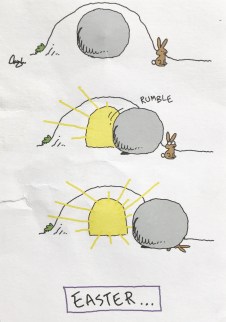
Today I want to tIMG_0028.jpgry to understand why an Easter card has meant so much to me over the years. It first meant something to me because it was sent to me by my niece, Lisa Hess, in the confident expectation that she and I found the same kinds of things to be funny. Boy was she right about that!
So here’s the first part. You have to understand that the hill represents the tomb where Jesus’s body was placed after the crucifixion and the circle in the middle of it is a stone, intended to seal the mouth of the cave. The world’s most confident rabbit sits beside the cave and the rock rolls over him. We see the word “Easter…” with its little ellipsis and inside the card comes what is supposed to be the punch line: “It not about a bunny.”

OK, that’s a little bit funny. It’s better than “Keep Christ in Christmas,” but it’s not as good as “Easter like you mean it.”

Inside the card, at the bottom right corner, it gets a lot better. It’s funnier, for one thing; something Lisa and I both enjoyed. But there is something else, too, and that something else, whatever it is, has moved me for years. There is something serious under the funny. I get the card out of the drawer where I keep it even when it isn’t Easter. I don’t even give it up for Lent.

Here’s the second part.

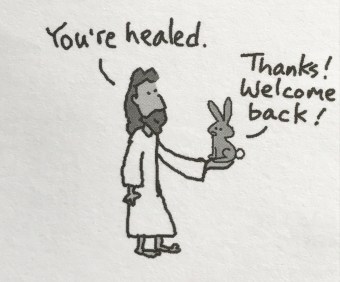
Here is Jesus, obviously, and the formerly crushed bunny. Jesus and the bunny are looking very alive. Jesus declares, “You’re healed.” The bunny responds, “ThanksIMG_0027.jpg. Welcome back.” For me, this is where the funny starts.

For one thing, of the thirty some individual healings recorded in the New Testament accounts, no one ever responded verbally to Jesus. That’s to the best of my memory and since we are here exploring why this might have struck me as enduringly funny, my memory is the record that really matters. So this bunny is the first to do that. And he is surprisingly casual about it. There’s no “Blessings on thee, thou Son of David” or anything like that. “Thanks.”

But then he goes on. “Welcome back.” Well…the time doesn’t work, for one thing. The bunny was dead long before Jesus left the tomb. No one has ever suggested that Jesus rolled the stone away himself. “Back” implies a continuity of experience that makes no sense at all. I think that is why I like it.

But I think the pop in this whole card—for me, this is a private meaning—is “Welcome.” It never made any sense to me that the bunny would be welcoming Jesus “back” representing only himself. (“Back” really is a theological problem, but it isn’t funny [4]) He must represent some larger entity on behalf of whom he is welcoming Jesus. The bunny is not a host, in other words; he is a spokesman.

As I have thought about this over the years, I have become convinced that this discrepancy—the bunny as a spokesman—is the discrepancy that has generated years of funny and now, finally, a small attempt to understand what is so funny. It is very like the discrepancy between “Thanks” and “Blessings on thee, thou Son of David.” And discrepancies are the nub of humor. A discrepancy that you take playfully is funny by definition.

So who does the bunny represent? We are all guessing here. I am sure theEaster 2 artist didn’t have a candidate in mind. For myself, I think maybe “the natural order.” The relationship of God’s followers to the natural order has been contentious to say the least. Those drawing from Genesis get to choose between God’s command that we “dominate” and “subdue” nature or that we “care for it” as a steward cares for his master’s property. Quite a difference.

But the larger difference comes in visions of the natural order and the Eschaton—the end of time—when God’s rule on earth is fully realized. Isaiah’s vision in Chapter 11 is well-known. [5]

6 The wolf will live with the lamb, the panther lie down with the kid, calf, lion and fat-stock beast together, with a little boy to lead them. 7 The cow and the bear will graze, their young will lie down together. The lion will eat hay like the ox. 8 The infant will play over the den of the adder; the baby will put his hand into the viper’s lair. 9 No hurt, no harm will be done on all my holy mountain, for the country will be full of knowledge of Yahweh as the waters cover the sea.

The Apostle Paul’s vision is even more extensive. In Romans 8, he says:

18 In my estimation, all that we suffer in the present time is nothing in comparison with the glory which is destined to be disclosed for us, 19 for the whole creation is waiting with eagerness for the children of God to be revealed. 20 It was not for its own purposes that creation had frustration imposed on it, but for the purposes of him who imposed it— 21 with the intention that the whole creation itself might be freed from its slavery to corruption and brought into the same glorious freedom as the children of God.

Creation itself is broken, Paul says. It has had “frustration imposed on it.” Whatever specific meaning that points to, I think the later expression—“it’s slavery to corruption”—is intended to echo it. In this vision, it is not only that deadly conflict is removed (as in Isaiah), but also the tendency of matter toward corruption and decay. When he says that nature is to be healed, he cites as a problem to be solved, a condition that moderns, like me, don’t think of as a problem at all. We think of it as what the world is truly like.

Anyway, that’s my best guess. I have been looking for what the bunny’s casual welcome means—what larger reality it represents. I assert that the welcome represents some larger reality on no grounds other than the persistent sense I have had that there is more to the card than a first reading gives us. And to back up the notion that there is something more to the card, I have nothing but the abiding sense of discrepancy. It is like asking everyone to listen to an echo that, it turns out, only you can hear.

I was looking for some larger entity on whose behalf the bunny could welcome Jesus’s return. Isaiah’s vision and Paul’s as well, offer “nature itself” as a candidate. It is on behalf of the natural world, now broken but ultimately to be redeemed, that the bunny welcome Jesus’s return.

I don’t really know. What I know is that I have liked this card for many years and have liked it much more than I “should” if there is no more to it than just what is on the card.  The dialog on the inner card is funny, but it isn’t that funny. The cartoon drawings are funny, but they aren’t that funny. I have gone looking for an explanation by poking and prodding at the discrepancies that are only hinted at in the card itself.

And that, finally, is what I think. I think that some part of me has sensed that the dramatic scene presented on the card is a huge cosmic drama told by Amos ’n Andy. The presentation and the meaning, by this understanding, are wildly out of line.

And that is just the kind of thing that makes me laugh.

[1] It didn’t occur to me while I was being dazzled by the ad, but scarcely anyone making Wallmart-level wages could afford the life that is pictured here. I guess that is only a minor irony.
[2] This may be in retaliation for all the verbs that have become nouns in business-speak. “We have not yet got to the ask,” illustrates the problem I am contemplating.
[3] In which case the Christian justification for having hijacked yet another pagan festival would be that the Son did, in fact, rise at daybreak. I know that goes beyond the textual evidence, but we are exploring levels of meaning here in which substantiation really doesn’t matter very much.
[4] The doctrine of the Resurrection has nothing at all to do with “coming back” to life. The “life” to which Resurrection points is on beyond death. Jesus did not rebound into a continuingly mortal life like Lazarus did. He didn’t come “back.” He went “on.”  And that makes the bunny’s  greeting a sort of theological puzzle. See “The Re- of Resurrection” https://thedilettantesdilemma.com/2017/02/26/the-re-of-resurrection/ for a recent treatment.

[5] This vision treats the predatory cycle as a problem that will be solved. No more predators and no more prey. I don’t know of any biologists who think of existence of predators is a problem to be solved.A

Posted in A life of faith, Biblical Studies, Living My Life | Tagged , , , , | Leave a comment

Remembering Dad at Easter

My father has been dead for more than thirty years, but every Easter, I remember him as vividly as if we talked just last week. I am going to show you two really ordinary pictures today. They are pictures of socks. They aren’t very good socks. The elastic is getting pretty relaxed and there are some little holes up on the ankle. But they were Dad’s socks and I wear them to the Easter services at our church every year.

I want to begin by saying that these socks “represent” something. I put the word in quotes this time because I want to use it literally; the socks “make present again”—they re- + present—a certain part of my relationship with Dad and that I why I wear them at Easter.

Dad had a lot of trouble with the Resurrection. I do too. But he thought it was important so he never quit IMG_0029.jpg wrestling with it. I haven’t either. Dad was in a great deal more contact with “resurrection” than any casually orthodox Christian would have been. I think Dad knew the Resurrection about as well as Jacob knew the angel he wrestled with and for most of the same reasons.

I wear his socks at Easter to honor all that wrestling Dad did and to help me remember to fight the good fight myself. More about “the good fight” in a little while.

I sometimes thought of Dad as a diver who was a long way below the surface and who was brought up to the surface too quickly. He got DCS (decompression sickness), commonly called “bends.” As his son, I never got to the depths he reached and I took a lot longer coming to the surface, so I didn’t have to confront the bends myself. Very much. Here’s how I saw that in Dad.

Dad came to maturity in a very conservative religious culture. You didn’t have to understand what the Resurrection was, but you did have to believe that it was true. That was hard for Dad because that same culture taught him to be very careful about his own integrity; not to say something was true if it was false or that it was unimportant if it was crucial. Some of the religious practices that produced seemed to me more humorous than tragic. In a church service where we were saying “what we believe,” Dad refused to submerge his own beliefs in any kind of “we” at all. He said that if the Apostles Creed began “We believe in God the Father Almighty,” and so on, he would have no trouble with it. “We” do, in fact, believe in God the Father Almighty.

But it doesn’t say that. It says “I believe in God the Father Almighty” and so on. Dad didn’t IMG_0030.jpghave any trouble with that particular clause, but there were clauses that troubled him a good deal and he didn’t say those clauses. The effect was like a radio with a loose connection and some clauses would be easily audible, then some silence, then another audible phrase.

My father was a serious man and he had long ago learned the meaning of the teaching Matthew passes along on “swearing.” Let your yes mean yes and your no mean no” the Matthean Jesus says. “Everything more than that comes from the Evil One.”

As an adult, Dad got a little breathing space from some very modern Christian teachers. Of these, I think Harry Emerson Fosdick was the best known. Fosdick was “a modernist” at a time when “the modernist/fundamentalist controversy” was in full swing. There were a lot of things about Fosdick’s ministry that meant a lot to Dad, but I think it was Fosdick’s panache that really sold him. He said new things and he said them coherently and on occasion wittily. He represents the surface that Dad, following the DCS (bends) metaphor, came up to too quickly.

Here is a story that might illustrate the difference. In the community where Dad grew up, no one would have said “I don’t believe in God” but if anyone had, he or she would have become the focus of a great deal of emotional energy—some of it generous and redemptive, another part of it angry and threatening. But no one would have said what Fosdick said when a young and aggressive parishioner said he didn’t believe in God. “Tell me about this God you don’t believe in,” said Fosdick in the story I heard Dad tell dozens of times. The angry young atheist started down the catalogue of things God has done and things His followers have done that are horrible to contemplate. “Oh…that God,” said Fosdick. “I don’t believe in that God either. Let me tell you about the God I believe in.”

In making Crossroads Brethren in Christ church of Mount Joy, Pennsylvania one pole of Dad’s experience and Harry Emerson Fosdick the other pole, I am not being fair to either, but I am trying to suggest the very great distance Dad had to cover to get from one to the other. And he was forced to do it too quickly. That is how he got the bends.

Somewhere in the transition, Dad acquired the “modernist” belief that theology ought to make sense. In the world where Dad grew up, a world of German pietism, “making sense” was not a high order achievement compared, say, with accepting the mystery of grace on faith. In the world where Dad lived when I knew him, “making sense” was crucially important, but it wasn’t hard to achieve if you began with the right questions. Of course, “beginning with the right questions” isn’t all that hard if the community of Christians you live in takes it for granted that the questions can be reformulated so as to be open to modern rational answers. That didn’t work for Dad. He continued to ask the old kinds of questions and to try to answer them with the new kinds of answers. The effect of that, to finish off the bends metaphor, is that Dad was never quite at home on the surface. He didn’t become “a modernist.” He did reject the belief patterns of his youth. He touched the surface now and then; he aspired to the surface—the place where Fosdick lived—but he couldn’t live there.

And that’s why his voice turned off and on when he “recited” the Apostles Creed and that’s why he continued to struggle with the real event of the crucifixion and resurrection of Jesus of Nazareth. And I do too.

And that is why I wear Dad’s socks to our Easter services every year. But I don’t have the bends, the way Dad did, and I have him to thank for that. For one thing, I was not raised in the depths, as he was. I was raised kind of half way up. Not to do more with this simple metaphor that it will really allow, we “visited” the depths where Dad had lived. And we visited the surface where Fosdick’s successors lived. But we didn’t “live” at either place—at least I didn’t.

I also have Dad to thank for being willing to talk about these things with me. I never heard a story in which some older trusted person was willing to sit and listen to Dad’s doubts and to help him find an authentic way to a mature faith. I can’t think who in his life could have done that. I had Dad.

And in the late 1960’s I came to live at the surface. I never had to traverse the distances Dad did and at the distances I did have to travel, I had him as a guide. Dad was not a guide because he had arrived at the place I wanted to be. He was my guide because he never gave up on the questions that shaped his religious awareness from the time he was small and because he never gave up on trying to make sense out of the answers that were available to him as an adult.

So, from my late 20s onward—the way I have told the story I was 28 at the time and thatmaxresdefault.jpg is probably about right—I tried to understand the essential “truths” of the Christian faith in a way that made sense. I was free, as Dad was not, to mess around with the questions and that is how I was able to come up with “answers” that fit the questions better. Like Captain Kirk, subverting the Kobayashi Maru exercise, I have felt free to reprogram the computer and manage not to die.

But for me, too, there is the matter of the resurrection of Jesus of Nazareth. I don’t understand what it was. I don’t understand it as a template of what is in store for everyone. I don’t reject it because I don’t have an ultimate allegiance to “things I can understand,” but I do continue to wrestle with it, like Dad did, and I honor that struggle in myself as I honored it in him. Which is why I wear his socks to the Easter services and have done so every year since he died. I have worn them 32 times.

Some years before he died, Dad became more and more constrained by Alzheimer’s Disease. My guess is that the loss of cognitive function didn’t affect his life of faith at all. He still trusted Whom he trusted. Alzheimers didn’t do good things to his theology, however. He continued to wrestle with the old questions for awhile, it seemed to me, but without the reservoir of strength he had once had. And then, after a while, it seemed to me that he stopped wrestling, as if he had passed that job on to a successor.

Dad’s last years were spent in an Alzheimer’s unit at a retirement center where he was given very good care. But it was a public place, not a private place, and that is why he needed to have his name taped onto everything he was going to wIMG_0031.jpgear. Of the socks I show you here, one of the tapes is still clear, as Dad had been. And one is blank, the identity has come off, as Dad became. And I think about that when I put on the one sock; then the other.

But I really don’t struggle with the bends, to go back to that metaphor, the way Dad did. I
didn’t dive as deep, the surface therefore wasn’t as far away, and I had someone to talk to. I say the whole Apostles Creed, which Dad would not do, because I know why they put some of those clauses in there—“and under the earth,” for example—and I think there were good reasons for them to do that. I participate in the process because I honor it; I don’t withdraw from the process because I can’t understand the meaning of the words. And I can afford to do that because I don’t have the bends.

Something happened to cause the disciples to change their view of what had happened in the life and death of their friend, Jesus. The various gospel writers give us little scenes that were intended to show why the disciples were persuaded that it was a real event and that Jesus was still, in the present post-Easter time, a real person. The scenes the gospel writers offer us don’t do the job of clarifying for me just what the nature of the post-Resurrection Jesus was. And it may not have answered that question for the disciples either. But without question, they did have the sense that Jesus was “back” and that the whole story of his life and death now meant something they had not understood at the time.

Whatever it was that happened—as illustrated by these scenes from the scriptures—is what I call “the Resurrection.” I believe that “it” happened in the sense that I believe that something which had the recorded effects happened. I don’t say “it” didn’t happen just because I don’t know what to call it.

You would think that would be enough, wouldn’t you? And it is, most of the time. But at Easter, it doesn’t seem to be quite enough and I wrestle again with what else it could mean. And while I wrestle, I honor my father.

I am sure I have walked a mile in his socks by now and I think I understand how he felt. Thanks, Dad.

Posted in A life of faith, Getting Old, Living My Life | Tagged , , , , | Leave a comment

Gifted, the story of “The Continent Uncle”

giften 1Let’s get the invidious comparisons out of the way right here at the beginning. McKenna Grace is much cuter than Matt Damon has ever been. OK, having said that, Good Will Hunting is a much richer movie than Gifted. Both explore the dilemma faced by a brilliant kid who wants to life a normal life. Matt Damon plays a punk from South Boston; McKenna Grace plays Mary, a little girl with no social skills whatsoever (no friends either) being raised by her uncle in Florida.

Thematically, they explore the same ground.

Which brings us to the multiplex. “Multiplex” [1] is the metaphor I have been using lately to convey the idea that when you walk in to see a movie, there is a virtually unlimited number of movies you can see, sitting right there in your chair.

When Bette and I went to see Gifted yesterday, I already knew what “the plot” was.[2] I gifted 6had read the synopsis and seen a preview. But I also knew that sitting there in my chair in the theater, I could see any number of other movies. It occurred to me when we went in that I might be about to see a movie about a “gifted” uncle, who is raising a little mathematically precocious girl in pretty casual circumstances in Florida. I was ready to see that movie and it would have been a really good movie. I might see that movie when I go back to see Gifted again. I could call it The Gifted Uncle.

But the movie I did see is not one I was prepared for at all. I saw The Continent Uncle. Who would have thought it? If you can see the “contain” in continent, you will understand that this particular uncle (Frank Adler, played by Chris Evans) has something he would like to do—a very hurtful thing, it turns out—and all through the movie, he is able to contain himself. And even at the narrative climax, when he does this hurtful thing, it is the least hurtful thing that will redeem the situation, and therefore the most gracious action available to him.  Frank is a really good guy.

Frank Adler has a document in his possession. He is the only one who knows he has it. It will be devastating to his mother (Evelyn Adler, played by Lindsay Duncan) and he has, all along, refused to hurt her in that way. Audiences are not told about this document and we have no idea there is one or what it could mean, but in fact, Frank Adler’s refusal to let out even the tiniest hint of what he has in his possession, is the most powerful theme of the movie, The Continent Uncle. (It is not the major these of the movie, Gifted, or the movie, The Gifted Uncle, which is the one I thought I was going to see.)

It is awkward, I grant you, to say that the most meaningful part of the movie is watching the main character not doing somethinmultiplex 7g. But if the climax of the movie is Frank’s slamming the document down on the desk in front of his unbelieving mother, then his doing nothing about that document all through the movie is enormously meaningful. You just don’t realize it at the time.

Now it may be, I confess, that I am a sucker for this kind of theme. I saw the same thing in The Intern where Ben Whitaker (Robert DeNiro) withholds from us, the audience, and from every character he runs across in the movie, a vital fact about his life. And when you find out what that fact is, what you want to do is to go back through the movie paying particular attention to the times when he could have revealed this fact and did not. We don’t see him strain under the effort of “not saying,” just as we don’t see Frank Adler straining under the effort of “not revealing” the document.

But when you think about it, all those moments of “not doing” become very significant, so far as understanding that plot is concerned, and very powerful emotionally. At least, they did for me.

My way of exploiting the multiplex (see Welcome to the Multiplex, April 6, 2017) is as follows:

  • to get some clarity on the story I saw; then
  • to pick the climax, the defining moment of that narrative; then
  • to reflect on the events necessary to that theme, whether I was aware of them at the time or not; and finally
  • to follow that narrative from the climax to the end.

It was when Frank Adler tossed the document on the desk and we got to see the title that I understood that this movie is not the one I was prepared to see and not the one, either, that the previews had hinted at. From that climax, I worked backward to see what was meaningful in that light of the narrative defined by that climax, and forward to see the conclusion of the story defined by that climax.

gifted 3I have no way of knowing, of course, what movie you will see when you go to see Gifted. You may want to go back and see Good Will Hunting again. I did.  You may attach the principal meaning to the mother and the relationships she has had with her husband, her son (Frank) and her daughter, Mary’s mother. This particular movie is about her relationship with her granddaughter, but Evelyn is a “one interest at at time” sort of person. “Very English,” says her continent son Frank, and there is no reason you can’t just give yourself permission to see the story that stars her and her aspirations, if that is the one you want to see.

Or, if you prefer, you can see the story with the next door neighbor, Roberta Taylor (played by Octavia Spencer). She is a wonderful friend to Frank and a truly exceptional teacher for Mary and she never has, so far as the movie shows us, a single concern for herself. She is entirely invested in the lives of others and that would make a pretty good movie too, if that is the one you would like to see.

Do see Gifted, though. And while you are there, any of those other movies that takes your fancy or that takes over your whole experience.

[1] It just means “many-fold,” (not manifold). It ought properly to be an adjective in most cases.
[2] And virtually none of the plot is going to be revealed in this essay, so you can read it with a clear conscience if you are a “spoiler alert” sort of person. I am not.

Posted in Movies | Tagged , , , , , | Leave a comment