
The New York Times did us all a service in its June 23 article, “As Critics Assail Trump, His Supporters Dig in Deeper.” I confess that I liked it partly because it wasn’t news to me, but I also liked it because my own angle on political psychology looks most closely at the reasons people give for the things they do and the things they say. That is really what this article is about.
Jeremy W. Peters, who wrote the article, has spent a good deal of time talking to Trump voters. I think what he really wanted to ask them was how they can still support Trump after all he has done. But that’s not really what happened in these interviews.
I counted seven of them all together and what I am going to do in this essay is reflect on just what some of the seven Trump voters wanted to talk about. In most cases, it isn’t Trump, but the connection between Trump and and the polarized environment is best illustrated by Ms. Anders, who has the first and also the last word in this piece.
Ms. Anders
Even if Mr. Trump wasn’t at the center of the national conversation, Ms. Anders, the Loudoun County business executive, said she thinks that the country would still be polarized. But as long as he is, she said, people on the right and the left will probably continue to dig in based on what Mr. Trump does and how his opponents respond.
“It all coalesces around Trump,” she said. “It’s either, ‘Trump wants to put people in cages, in concentration camps.’ Or, on the other side, ‘Oh the left just wants everybody to come into the country illegally so they can get voters.’”
She concluded: “We can’t have a conversation.”
 She notes that the country was polarized before Trump arrived—she didn’t say that Trump didn’t make it worse. The difference is that it is very difficult, now, to talk about the polarization. The topic defaults to Trump instead. “He wants to put children in cages” say the people who “just want to leg everybody come into the country illegally so they can get voters.” [It is not my fault that the apostrophe is where it is.]
Neither of those is Ms. Anders’ view. She would like to have a conversation rich enough to sustain the nuance and complexity—her words—that the issue deserves.
But then she comes down at the commonest of all Trump landing places: she is angry at Trump’s critics and “it makes me angry at them” and it makes me “want to defend him to them more.”
The words I would like to highlight are “to them.” She wants to defend Trump “to them.” There is the fraught relationship. That is what is drawing Ms. Anders’ attention. The reaction of Trump’s critics are “overblown” and it makes her angry. Trump disappears from the battlefield at this point and the war between Ms. Anders as the Trump critics continues unabated. If Trump were to disappear tomorrow, the critics would still have done what they have done, would still have committed their crime and Ms. Anders would still be justifiably angry at them and would still want to blame them for what they had done. They destroyed nuance and complexity and they have to be made to pay for what they have done.
I agree with nearly everything Ms. Anders says. She doesn’t apply her criticism to herself, which something a compassionate liberal might be able to help her with, but what she ways about the President’s critics is exactly right. My disagreement with Ms. Anders is about salience. There are two issues to deal with here. Trump is doing terrible things (that’s one) and his critics are immoderate in their criticism (that’s the other one).
Ms. Anders is so deeply offended by the critics that she is willing to downgrade the Trump policies to second place. What the policies are and why they are being pursued and what the effects are and what alternatives are being foregone—all those are secondary. The most highly salient issue to her is the quality of the critics.
It is at that point that I have to leave her.
Schrantz and Arnold
They are interviewees #2 and #4 in my list. They, too, are not addressing President Trump and if, as I suspect, the question Peters really wants to ask them is, “How can you keep on supporting this guy!?” he is going to continue to be frustrated. That is not what the Trump supporters talk about (with the single exception to be dealt with at the end).
Here is Schrantz
“He’s not a perfect guy; he does some stupid stuff,” said Tony Schrantz, 50, of Lino Lakes, Minn., the owner of a water systems leak detection business. “But when they’re hounding him all the time it just gets old. Give the guy a little.”
“They”—could refer to the media, could refer to Trump critics—are hounding him all the time. That is a fact. Mr. Schrantz is correct. There are two things wrong with what they are doing. The first is that they are not being “fair-minded” (my word) in that they are not giving him any leeway. I think that is what the reference to “a little” is. Trump is a public figure and they—the media or the critics—ought not to be so quick to judge him.
The second thing that is wrong is that this persistent criticism has lost its entertainment value for Mr. Schrantz. “It just gets old” is not a comment on the truth or even the importance of a criticism of the President. It’s just that having heard it so much has worn off the novelty.
Arnold agrees.
“It’s kind of like when you experience a sensation over and over and over again,” said Daniel Arnold, 32, a warehouse manager from Leesburg, Va., about an hour outside Washington. “A sensation is no longer a sensation. It’s just, ‘Oh, here we are again.’”
Arnold is looking for anomalies. The criticism of the President by the media is not anomalous, so it is not worth paying attention to.
Julie Knight
“It bothers me that he doesn’t tell the truth, but I guess I kind of expect that, and I expect that from the media, too — not to always tell the truth or to slant it one way,” said Julie Knight, 63, a retired personal injury case manager from Algona, Wash.
Ms. Knight comes at it from a different side. She has been following the news and she knows that the President doesn’t always tell the truth (A common New York Times headline is “Trump lies about ______”) But she doesn’t think the media always tells the truth either. So we have a source we don’t trust saying that an officeholder we like is lying.
A more serious criticism, although it doesn’t seem as major in her comments, is that what she means by “telling the truth” is not slanting the news one way or the other. This is completely useless way to assess “slant.”
When the media choose one story rather than another, they are slanting “the news.” When they shape the narrative one way or the other, they are slanting the news. There is no way to tell the news without “slanting “ it. And if that is Ms. Knight’s criterion, there are no news reports at all that she can trust.
This is the reason for the success of Trump’s argument that “the media” are the other
party. There is his administration and then there is “the media.” This means that the President is running in a one-horse race, which means we know who is going to win it. The notion that the opponents are the Democrats and that the media’s job is to call the fouls and enforce the penalties, is a notion long abandoned. Ms. Knight is a prime example.
On the other hand, some Trump supporters really do address the policy context and the way they do it speaks volumes about how Trump has regained their loyalty.
Here is John Westling.
“Let’s see,” said John Westling, 70, of Princeton, Minn., reciting a list of the president’s accomplishments that he said no one in the media wants to talk about. “Economy booming, check. Unemployment down, check. Border security being addressed, check. Possible end to the Korean War that started when I was 3 years old, 68 years ago, check.”
This list has the advantage of actually being about policy outcomes, at least superficially. But this kind of support is very thin. Westling says that the booming economy and the low unemployment numbers” are “achievements” by the President. But that’s not really the way the economy works. Presidents who are in office when the economy is bad are blamed and those who are in office when it is good are praised. The causal links are completely obscure. And does anyone think that when the economy tanks and unemployment goes back up, that Westlake is going to blame the President for it? Of course not
Border security is “being addressed” says Westlake. Emotionally, that is the kind of claim any President’s supporters make. “At least he is trying,” they will say. But Mr. Westlake seems to think it is an achievement. He certainly thinks the recent meeting with Kim Jong Un is an achievement although nothing has yet come from it and most experts seem to think nothing will. “Possible end,” says Mr. Westlake.
And there are others. Lynn Dittbenner admits that it is terrible about kids getting separated from their parents at the border, but “the parents shouldn’t have been there.” Gary Winthorpe is wary of the President, but feels that he is doing his best and that people ought to recognize him for that. The list of devices goes on and on.
Balls and Strikes
Of the people featured in the article, only John Westlake looks at the policy outcomes—or in some cases, the intentions—and says they are praiseworthy. I have given the reasons why I think those “outcomes” are spurious, but Westlake is using the right metric.
The other Trump supporters have turned instead to attacking the media. THEY are not being fair to HIM. I think it is surprising that the Democrats don’t show up in this set of justifications. For these people, I think there are no other proposals for governing the nation. There is only President Trump and whether he is being treated fairly or not by his critics.
This is the kind of perspective you hear from fans of the home team who believe that the umpire is not calling the balls and strikes fairly. They see the pitch from where they are seated. They hear the call from the umpire immediately behind the plate. They say that he is mistaken or corrupt because that’s not what the pitches looked like from where they are sitting.
These Trump supporters are, in other words, fans. This is not a citizenship perspective. These are not voters who would choose between two policy directions the one that is best for the country or even the one that is best for them. They love the pitcher and the umpire is cheating.
End of story. It’s not a pretty story, it seems to me, but this way of understanding how they justify their political preferences helps me grasp, finally, why for this part of the electorate, nothing will work.
 concert last week.
 intergenerational kumbaya moment.
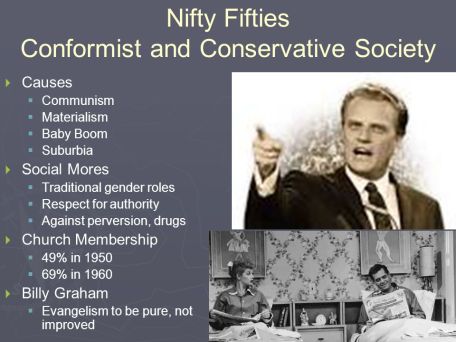 were in the 50s before all these self-appointed radicals took over.
 David Hoover, for instance, says, “We just have to keep standing up.”
 worshipers who think politics has little place in church.”
 And then there is the question of who is leading and who is following.
 Here is a small example.

 These come closer to re-experiencing a remembered event. Professor Boyer describes how neuroimaging evidence indicates that, when certain events are recalled — presumably after being triggered by familiar sights, smells or sounds — emotional brain areas are activated as well as visceral responses. You relive the feelings you experienced in the past. These recollections can be thought of as full body and brain memories.
 But it wasn’t losing Ted that did all that to Bobby.
 again free and in his freedom, Ted had sent this to Bobby.
 And that is my portal.
 You can go a long way with no more of a head start than that, trust me.
 there in the first place.
 I foresee difficulties, of course, but they are not mine to solve.
 deflecting attention and I would like to look at the recent troubles of the former (but only recently) governor of Missouri, Eric Greitens.
 learn what it was from any of the statements he is making.

 And at the same time, you trumpet the governor’s virtues.
 But in the U. S., we live in a time of tribes and there is a squeezing together of people who were once “peers” into a virtually featureless mob of adherents to a common cause. “We” now all hate the same people and love the same people. This is a real problem for someone whose instincts run in the direction of making up his own mind and the role of umpire beckons.
 The other, the one that comes down on my house, is that admitting that there is more than one starting place is a bad idea because it weakens the tribal bond. And they are right. It does weaken the tribal bond. A person who often says that you can plausibly start at either place really has the burden of justifying this practice to his colleagues. [2] This person is an umpire—a non-peer.
 by my friends and neighbors. That is a cost to the issues they hold most dear. If I am going to continue in their company—not to be a member of their tribe because umpires don’t belong to tribes [5]—I need to make at least one other point. Here it is.
 people who by accepting God’s invitation, have chosen to live in Heaven) who have come down to the bus stop to meet them and if possible to assist them in any way. With a single exception, every character in the book who comes in the morning chooses to go back “home” in the evening.
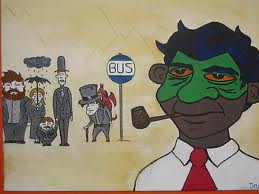 That is a very good way to write a character. You push him out to the very margins of what anyone would tolerate. Then you define “the alternative” as certain (the Spirit actually knows the truth) and as conservative as you like. The reader is put into the difficult position of inventing an alternative where there is no space for one. The positions taken by EG and the Spirit take up all the theological space there is. You would need a crowbar and an immensely long lever to create any space at all between them. And yet, I do believe that I fall between them. I am not the muddled theological liberal EG is. On the other hand, I am not aggressive and knowledgeable conservative the Spirit is. Where I live, think really don’t have the clarity he draws on. And Lewis, is, after all a master of the either/or. For instance.
 want to separate it from the reason he is in Hell in the first place, which is, according to the Spirit, who has to inform him of the reason, that he is apostate. [3] He was once “a slave of Christ” (Ephesians 6:6, Colossians 3;24, 1 Peter 2:16), but he has “run away,” as the etymology implies.
 This way of looking at it is as far as can be imagined from EG’s “When the Resurrection ceases to recommend itself to [my] critical facilities, I openly rejected it.” [4] The validity of the Resurrection is “maintained,” as the Spirit now sees it, by praying, by resisting the drift toward unbelief, by refusing to accept the pull of our desires. “Belief in the Resurrection” as the Spirit now sees it, is based on basic spiritual disciplines. These require active intentional living. Prayer requires that. Resisting the drift away from the faith requires that—in fact even being willing to notice the fact of drifting is harder than you might think if you have never tried to do it. Refusing to give in to the pull of illicit desires [5] requires that.
 Lewis is not holding back here and I think his case is better for that. Outside “the home” is “the world” where the forces of evil hold sway. And at college, there is the social whirl, which is a really good way to keep yourself from being alone and thinking seriously if you know where the choices you are making are leading you. Nothing in your academic training encourages you to wonder whether “the Supernatural” might not be True—with a capital T—especially since everyone laughs at the idea and would laugh at you, too, if you began to consider it.
 I am amazed, as I look back at this simple process, to think that I imagined that just getting it on my foot would be the end of it. But now that it is there, I find my mind wandering about and finding one context after another. Here are some of the contexts. Let the eye-rolling begin.
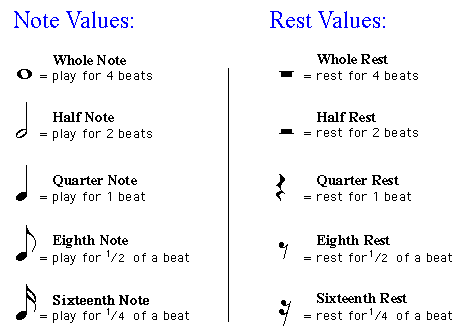 Adam’s next service would be to remove the solid inner core of the note and signal that I had slowed down from one beat to two. This would make my tattoo a half note. And after that, he would take off the stem and the tattoo would be a whole note, lasting the entire four beats of the measure.
 is immediately obvious that I could begin in the same direction by interspersing notes and rests as any composer, not just composers of puns, does. I could, for instance, have shown some measures that had only notes in them and then begin to introduce very short rests. I would probably call them naps because that is what I have called short rests all my life. [2]
 That same opposition of “profitable labor” to “sound sleep” shows up in the laments of Henry V (Act 4, scene 1) where he wishes he could have both of those, as “the wretched slave” has, knowing that being the king, he can have neither. But I, not have earned them, but having accepted them, can have both.
 And then at Pentecost, something happens—the accounts in Acts are not consistent—the result of which is that everyone can understand what the Galileans are saying. God, in this story has devised a way to speak to men so that each can understand God’s message in his own language. The Eleven, each with a tiny flame of fire on his head, is speaking Aramaic, which is, so far as we know, the only language they knew, but everyone is hearing what they are saying in their own language.
 , “There’s been a big mistake.” The aide attaches a button to Alex’s collar and the officer says, “Welcome to Starfighter command.” You speak English?” asks the dumbfounded Alex. No,” replies the aide, “You hear English, thanks to your translator device.” Here is Alex with his pilot and navigator.
 In the middle of all this cacophony, Gus Grissom (Fred Ward) changes the agenda. “You’ve got it all wrong,” he says, “The issue here isn’t pussy. The issue is monkey.” Grissom is not presented in this film as a scintillating intellect, but what he says changes the group entirely. John Glenn (Ed Harris) has been saying that the astronauts are all public figures and should lead exemplary lives. In this situation, that means not accepting the sexual advances of the flocks of young women who are trying to make the rounds of all the astronauts. The astronauts are not of one mind about Glenn’s proposal. They have not been, to this point, of one mind about anything. And that is why they have had no voice.

