
To tell you the truth, the “Nazi” metaphor was always too much for me. It treated lightly something I wasn’t ready to treat lightly. I am a veteran of a good deal of post-WW II anti-Nazi propaganda. I remember Nazi propaganda from a time when the Nazis were still winning. And, of course, I have seen many anti-Nazi movies. So treating it only metaphorically still doesn’t feel quite right, and there are several reasons for that.
 First, you may not have noticed, but real honest-to-goodness Nazis are coming back. These are the classic Nazis with the racial paranoia and the lust for authority and the attraction to violence. The guy who edits a Nazi newsletter is a grammar Nazi and it isn’t even a joke. The idea of Rudolf Hess (no relation) as a grammar Nazi actually is a joke and I had not heard it until today.
So even if it was funny back in the Cold War days, it isn’t funny anymore and may not even be safe anymore.
Language Nazis
Second, the emphasis on grammar obscures a much more pervasive problem with language generally. Consider this example from Michelle Obama.
“I remember there were kids around my [Chicago] neighborhood who would say, ‘Ooh, you talk funny. You talk like a white girl.’ I heard that growing up my whole life. I was like, ‘I don’t even know what that means but I am still getting my A.’”
The problem here is racial identity. The “kids around her neighborhood” had a model of language use in mind that specifies how “one” should talk if she is to be considered “one of us.” The threat is that if you don’t make the same mistakes we make, we will reject you and may well persecute you.
But it is class identity, too. In South Chicago, the two are intertwined, but in the Middletown, Ohio of J. D. Vance’s Hillbilly Elegy, they are not. The demand that you “talk like us” [1] has, in Vance’s book, to do with class norms, not race norms. If you use speech that sounds like the kind the kids of the professional classes are taught to use, you will get the same kind of threats Michelle Obama got.
The essential part of the “Nazi” metaphor is the enforcement. It is not any part of the joke that Nazis have better grammar than “normal people.” It is the intrusiveness of the enforcement that suggests Nazism. And in the Obama example, the intrusiveness belongs to the users of incorrect grammar. The demand is, “You will use the grammar we use or you will pay the price.”
Does that sound Nazi-ish to you? It does to me.
My father used to tell a story that had to do with language and character. I am going to tell you the story and then reconsider it from the Language Nazi standpoint. Dad used to say that a boy [2] who says “My old man ain’t got no right to bitch like he’s doin” and one who says, “My father has no right to complain the way he is” are saying the same thing about the father. They are saying different things about themselves.
The story itself implies that it is the character (read “social class”) of the boy that controls the form of the speech. In Dad’s use of it, it also implied that the first boy’s expression (=character) was inferior to the second boy’s. Dad could easily have become a Language Nazi by cruising the neighborhood and correcting the errant expressions of neighbor boys. He didn’t do that.
But the neighborhood boys could also establish the “my old man…” formula as morally superior and punish deviant uses. “Deviant” in this case would point particularly to the “My father has no right…” formulation. And if they enforced that usage, excluding and punishing the people who said it “the wrong way,” they would be Language Nazis in the same way, but in the reverse direction.
The two seem remarkably similar to me.
 You might respond that there is an objectionable “snottiness” about the traditional Grammar Nazi kind correction, a common instance of which is the confusion of “your” and “you’re.” (As the example shows.) But I would argue that there is also a remarkably pervasive snottiness about language that is “too white” or “too middle class” for the present group of hearers.
Political Correctness
“Political correctness” is a good contemporary example. The term itself is a protest by conservatives who are tired of being “corrected.” “Correct” is a notoriously weak norm. [4] If, for instance, the indigenous peoples of North America [3] find being called “redskins” or “Indians” to be offensive and if we have no reason to want to offend them there is no reason we couldn’t call them what they want to be called. But the criterion that marks such a choice is that it is collegial or civil or even generous. Justifying it on the grounds that it is “correct” is more like a criticism than like a justification. And, in fact, that is how it is used.
But if calling these people Indigenous Peoples is going to bring you ridicule and exclusion from one group and calling them “redskins” is going to bring you ridicule and exclusion from the other group, which are the Nazis? Does it make any sense anymore to label one of the groups that patrols expressions and punishes non-conformers “Nazis” and not the other group?
And that brings us back to the Grammar Nazis with whom we began. So long as the upper classes use a grammar of a certain sort, there is going to be a temptation to call it “standard” and to use it to measure the speech of others, who are presumed to aspire to upper class status. If the speech of these people is no longer widely admired–and that is one of the likely effects of the recent failure of upward mobility, then “correct” will have a specific social location, say a street gang, or a specific context, say a job interview. [5]
The people who punish you for using formulations they don’t like will have earned the Nazi label without any help from you.
[1] Pause for one delicious moment to substitute “Talk as we do” and then close that part of your mind and move on.
[2] My father had four boys to raise, so the stories were always pitched in the direction of male illustrations.
[3] “Indigenous” would have to mean the people who were living there when we became aware of them. It could not mean the people who were there before and whom the people we call “indigenous peoples” displaced. “Indigenous” is a slippery sort of notion when you look at it.
[4] It is, in that way, like the “conventional” in John Kenneth Galbraith’s widely used, “conventional wisdom.” It is as if the assembled agreement of all scholars made a point too dull to be really worth making.
[5] Bergen Evans, co-author, with Cornelia Evans, of one of my favorite dictionaries A Dictionary of Contemporary American Usage, used to say that he didn’t correct the speech of anyone who didn’t pay him to correct his speech. Evans is the ultimate non-Nazi.
 say”what is it about?,” you are choosing one strand as the principal one and relegating the others to a supporting role. Not all movies are so complex or so morally salient that they force this choice on a reviewer, but I think this one is.
 The time when the deal is made is quite clear in the film. [1] It comes when young Joan says to young Joe, “Do you want me to fix it?” Joe is a college professor and a writer. He is very good at conceiving a story and laying out the crucial events. But he has no gift at all for developing characters or for effective dialogue. Those are the gifts that she has. The manuscript in question is on the way to the printer so the question, “Do you want me to fix it?” has some urgency to it.
 are not taken seriously. That would mean that she could not—really would not be permitted to—play all the parts the successful author would have to play. She is denied all the public parts by a prejudice against women authors. That gives a social criticism dimension to what would otherwise just be a deal between a husband and a wife.
 to do. The son wants to be “a writer like my dad,” except that his dad really isn’t a writer. Maybe not much of a dad either, at least not for David. And with the Nobel, comes the kind of scrutiny a biographer brings to the job. Obviously, a good biographer will trip over all these carefully maintained fictions.
 I got this from a Vox.com piece by Umair Irfan. You can see it (and a hyperlink to the whole report) by going to Vox.com and searching for [global warming].

 You can think of the reference to “ages” as meaning a long period of time. Or you can think of it as a higher plane of life. “The life of the ages,” in this way of construing it, is true life. It is not the succession of meaningless ephemera that pass for “life” for those who know only what they see. It is the higher plane where what is True in always being enacted and always in danger. And Jesus represents that “higher plane.”
 body has spent its entire life so far and is flushed down into the sewer. The people in his apparent life have known him as Mr. Anderson, but he has taken Neo as his nom de guerre. When his body hits the water in the sewer system, a cable with a grappling claw is lowered by a hovercraft canned Nebuchadnezzar IV. It clamps onto this body and reels it up into the plane. That is where “there” is. It is where Trinity went when she escaped the phone booth and she is there waiting for him.
 So Neo, after his body is reeled up into the Nebuchadnezzar IV, begins to experience “the life that means something,” arguably, the zōen aiōnion. It is awkward at first. Lying there on the table, too weak to get up, he asks Neo, “Why do my eyes hurt?” Morpheus replies, “Because you have never used them before.” And immediately, we understand how that is true. All the optical stimulus Neo has ever received has not come from his optic nerve, but from the brain probe that simulated “seeing something.” He has never before seen what was actually there because nothing was actually there in the “life” he seemed to be living.
 than other members of our church.
 Last year, I discovered Joan Williams’ ideas on the cultural underpinnings of class in our era and she draws the line between the working class (even at fairly high levels of income) and the professional/managerial class. [6]

 There are three common kinds of responses to this kind of undeserved benefit.
 assess the charge.
 Of course, there are reasons to treat this disproportion as some kind of unfairness or as significant in some way.
 completely appropriate to me.
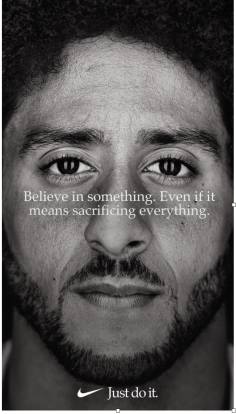
 I will say that I like this picture of Denver Bronco’s offensive tackle Garrett Boles, who is celebrating his country with one hand and his teammate with the other.
 And I think that is why we swing back and forth from criticizing too much and criticizing too little. In this essay, I am going to come out boldly in favor of criticizing just the right amount. I don’t think anyone is going to have trouble with that idea. Goldilocks didn’t. And then I am going to try to justify that standard using an argument I had never heard before today and even today, I didn’t hear it until I heard myself making it.
 The alternatives, as I have seen them and read about them, are distraction and reinforcement of positive behaviors, both of which are good tools. They make the need for explicit criticism less urgent. They make the difference, to return to the pain metaphor, between episodic criticism, which contains valuable information, and endemic criticism, which is just the pain background of your life.
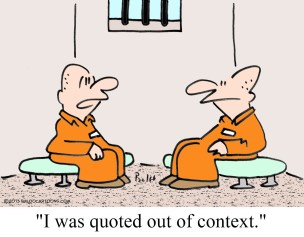 including myself as a young boy, resisted the rules by picking them apart. A fully verbalized and internalized norm would be applied reasonably to the situation. So “Don’t forget to wash your hands” would reasonably apply to anything else that was dirty, especially dirt that would be visible to other family members. The “jailhouse lawyer” kind of kid would happily come to the table with a big smear of dirt on his face and argue, when confronted with his misdeed, that he was asked only to wash his hands.
 As I implied in the last paragraph, the Sweep is the last in line. That is why he or she is called the Sweep. Because it is the Sweep’s job to be last, and there are implications to that to which I will return at the end. I have been a Sweep with IBT any number of times and have even
 is only one God and that all the other “so-called gods” are mere illusions. That means that meat that has been offered as a sacrifice to one of these illusions is not contaminated for anyone who understands what an idol is. The fast riders are those who understand this. And before we look at the slow riders, let’s stop to note that if Paul were a rider on this trip and not the Sweep, he would be a fast rider. Notice the “we” in verse 4. “We (fast riders) are well aware…” Now we will look at the slow riders.
 I think Paul the Sweep would advise that pastor to open the church fully to its women members. Pastors, Session, deacons, lectors…everything. These are the fast riders, remember, so Paul the Sweep might very well prevail on them to be gentle with the slow riders. We would say, using a modern idiom, not to rub their noses in it. He would be as opposed to a flamboyant feminism that demeans all men and drives them out of the church as he would be to a submissive role for women that hoped to keep the men by offering them an illusory (and unchristian) dominance.
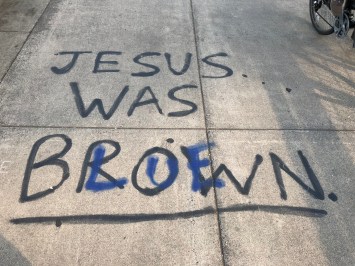 Brown like me
 But when we get away from how good it feels, we need to consider what he actually looked like. If you are a brown person living in a predominantly white society where all the white Christians are expressing their emotional affiliation to a Jesus who looks like them, I’d think it would get wearing after a while. All the emotional affiliations would add up to a factual claim and the claim would be this: Jesus was white. [1] This is the face referred to in the quotation below.
 What Jesus looked like is completely immaterial from a theological standpoint, but people who have strong beliefs about Jesus and strong feelings about Jesus might be expected to want to specify what he looked like. That accounts for the sample “ethnic Jesuses”in this essay. When you get far enough away from the issue, it comes to seem odd that we call these other images of Jesus “ethnic” but do not call the one that looks like us “ethnic.” But our own ethnos is the one we take for granted; it is the standpoint from which we look at the others.
 another motive made his mark. “Jesus was blue,” he says. [3] My first reaction was negative because I had been enjoying the “Jesus was brown” sign. To the extent that the first tagger’s real meaning was “Jesus was not white,” the comment that he is really “blue” does the same work. [4]
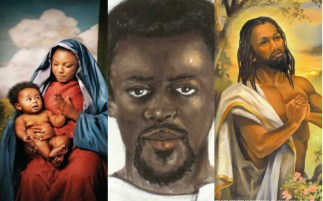 For myself, I like the idea that everyone should feel free to invent an image of Jesus that would be at home in their own ethnic group. It is a claim of affiliation and if the Incarnation means anything at all, it means that. On the other hand, I don’t think anyone but the experts should feel free to make up factual claim about what Jesus did look like. And, considering only the facts of the case, what Jesus looked like really doesn’t matter. When we picture him as tall and handsome and masculine, we are only projecting the values of our culture onto the story of Jesus. No one really thinks that God has definitively manifested Himself to be a Middle Easterner.

