
It is true that moral fervor can make you inattentive to other aspects of the problem. That is true of any kind of fervor. [1] There are so many examples that I see immediately that this consideration of ignorance, blindness, and inconsiderateness—that’s what other people say about you while you are focuses on your good intentions—can’t really be about examples.
So let me try to say in the beginning what I’m thinking about. After a couple of examples,  you can contribute your own favorites. There is a certain clarity of vision that comes with fervor. The focus is narrow, the need to act is intense, all the parts of the picture you construct reinforce each other and dammit, your duty is clear. A lot of good things can be done that way and frankly, there are some good things that probably cannot be done any other way.
But the costs are high for everyone, especially for the fervid actor who, in his [2] fervor, ignores or rationalizes away all the contrary signals that he otherwise, would have attended to. And, as this poster illustrates, the likelihood of misunderstanding is high.
- Imagine a wife who wants her husband to convert to her religious faith or, a problem just as severe, to convert to the emotional intensity of her religious faith. His persistent retreat from her catches her entirely by surprise.
- Imagine a father who wants his children to become fully autonomous [3] and “disciplines” them firmly so that they will acquire this skill. Their hatred of him for his cruelty catches him entirely by surprise.
- Imagine a solid German family living in hillbilly country [4] who wants the children to have a lot of hillbilly friends, but to be carefully unlike them in nearly every way. The loneliness and isolation of the children will come as a complete surprise to the parents, who only what their children to be “better.”
Enough examples?
I called this essay “the blindness” of good intentions because knowing what my intentions are, I pay particular attention to everything that bears on those intentions. Am I clear enough in describing the goals? Have I taken the range of objections into account? Have I provided each participant with the resources necessary to accomplish the outcomes? Is everybody adequately motivated? That’s a lot to pay attention to and that’s just the top layer.
Nowhere in here are the legitimate objections that might be raised to my intentions, or to the cost the participants might pay in cooperating with them. And when we are done with all of those, we have yet to consider what other projects will have to be foregone just so that I can do this one.
And ignoring all those things is not malice or ignorance. It is just blindness. And every time you choose what to pay attention to—intense, focused, persistent attention—you choose to be blind to other things. That’s just how it works. And if you focus on how good your intentions are—not just on knowing what they are but also on knowing that they are admirable—it is even worse.
Blind Love
I was recently part of a conversation where “the blindness of good intentions” was given a very specific focus. The conversation began with a poster that said, “Women are not rehabilitation centers for badly raised men. It is NOT your job to fix him, change him, raise him, or parent him. You want a partner, not a project.”
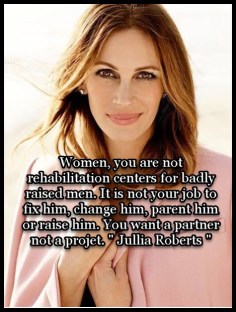 If you begin categorizing exhortations into those that are like food (nourishing for everyone) and those that are like medicine (good for some people, but harmful to others), this is definitely a medicine kind of remark. If it were phrased as a teaching, rather than a bumper sticker, it would say, “Women who feel they are obligated by virtue of their gender alone to fix men should reconsider.”
In a string of interesting comments, there was one by Denise Haley Hall that I thought shed a helpful light on this problem. I am using one of the middle paragraphs of her comment here and I will add my observations to each part. I think you will see why I appreciated her perspective so much. [6]
Here is the first.
Some women believe they can love a man enough to make him not be the bad boy, to make him grow up, to make him not be abusive.
Here we have the outcome specified. The man is to “grow up,”[5] to stop being a bad boy and to stop being abusive. And we have a means. If the woman “loves the man enough” all those good things will happen. If they don’t happen, it must be because the woman “has not loved him enough.” She has failed. My heart goes out to those women, but I have had the good fortune never to have married one, so my compassion is still abstract.
Here is the second.
They need to recognize that they never will “fix” him and stop letting themselves settle for less than a true partner in a relationship.
Here the whole project of “fixing him” is abandoned, as it should be. Further, the goal of a partnership marriage is affirmed. But how do we get from the shortfalls that raised the question of “fixing” to the true partner status. Just abandoning the effort isn’t going to be enough. How do we establish the grounds for mutual respect that would ground a partnership?
Here is the third.
I feel like some women continue to pick such men because they need to feel needed.
Here there is a turn in the argument. Here a woman is imagined who makes the same kind of choice over and over; one “project man” after another. And if, for each of these projects, she believes that just loving them enough is going to get the job done, she will fail time after time.
But here, also, an answer is offered. These women do what they do because they need to feel needed and taking on a man as a project meets that need. It truly does. It meets that need and moves all the other needs out of the picture. That is the effect of “the blindness of good intentions.”
And here is the last.
They thrive on caretaking so much that they need people to rely on them and therefore they take over so much responsibility.
I have seen the same things Denise has seen, but I process them is a slightly different way. These women don’t actually “thrive” on caretaking. They choose it and they refuse to give it up, but they don’t thrive on their caretaking obsession any more than an addict thrives on his drug of choice. That choice could be destroying him, but try to take it away.
The second way of processing this last observation differently is to focus on power, rather than on responsibility. Being the only one in the relationship who actually knows what is going on or who cares a rip about success is this woman. As she works on her project—this isn’t all that much fun for the project either—she earns the admiration and sometimes the compassion of her friends and she takes more and more power in the relationship.
This is the blindness again “I’m only doing this for your own good” is, among adults, a justification for exercising power, but the focus is entirely on the outcome. The “I’m doing this” part is a claim of power. It is what being the responsible person drives you to. The “your own good” part is the outcome the actor hopes for. Producing the outcomes that would justify such a use of power will, eventually require the cooperation of the “project” and projects are notoriously slow to cooperate.
What would work?
It is way too late in this essay to hope for a thoughtful answer to such a question, but there  is a bumper sticker version that can start us in the right direction. Men and women don’t come together like puzzle pieces, each cut out to fit the other. [7] An adjustment of each to the other is going to be required. These can be done over a long lifetime by small changes offered with generosity and grace. Nobody is a “project;” we learn as we go. And when we change, we learn other things. That’s not a project. It is not two projects. It is a partnership.
[1] The Latin root is fervere, “to boil.” The English “fervid” is the adjective form.
[2] The context of the discussion that raised this interest was whether this question should be “genderized” Would it be good for the discussion for us to imagine that this is something women do to men or men to women? My answer is No to the genderization move, so I am going to use the once-innocent neuter singular pronoun (I know, it does look like the masculine singular pronoun) to refer to everyone of all sexes and of both sexes.
[3] Not, by the way, like the family car. We are beginning to say that cars that drive themselves are “autonomous”—that means to rule themselves—rather than self-driving. The Latin verb meaning “to drive” is agere (ago, agere, egi, actus, if you want the whole declination) so a combination of auto = self and actus = to drive would be much more accurate and less scary.
[4] Playing, here, off of Colin Woodard’s American Nations, in which he identifies my part of Ohio as a place where Midlanders and Greater Appalachians both live, but who value very different things.
[5] “Grow up” is somewhat problematic in that “maturity,” which is where you get to after you have grown up, looks like different things in different men and women. If “grow up” means only not being a bad boy and not abusing others, it is too narrow. If it means “maturity,” it is not adequately specified
[6] I should take the time here to say that Denise said I could use her words and could attribute them to her by name (thank you, Denise) but I am projecting the argument further in each instance. I hope Denise enjoys them, but I have no idea whether she will agree with them.
[7] OK, I see that I am trapped. Every puzzle picture I use will have one piece fitting in the concavity of another piece. Dr. Freud has me in a corner on this one.
 that several hundred thousand uses of the phrase “reached first base” and the lack on any other common conclusion of the phrase beginning with “reached” has brought us to the place where “reached” may be taken to mean “reached first base.” Or possibly any base. That could be represented in written English as “reached…”
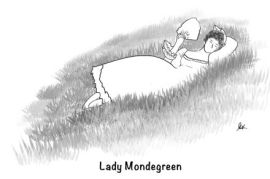 The fact is that the language we use every day—unless the setting of your life is one where the accuracy or the beauty of language is, itself, something to be valued [3]—works as long as it is good enough. “Good enough” is a very forgiving standard. People know clearly, or can infer quickly, what you probably mean and that is good enough. You can even point to an oil filter and say “carburetor” and the person you are with can say, “You mean carburetor.” and you can say, “Of course. What did I say?”
 Mondegreen” is the construction of an idea based only on the hearing of it. American writer Sylvia Wright coined the term in 1954, writing about how as a girl she had misheard the lyric “…and laid him on the green” in a Scottish ballad as “…and Lady Mondegreen.” I, myself, had trouble as a boy in church hearing the expression “gladly the cross I’d bear” as anything other than Gladly (you know) the Cross-eyed Bear.” I have since seen tee shirts featuring images of Gladly.
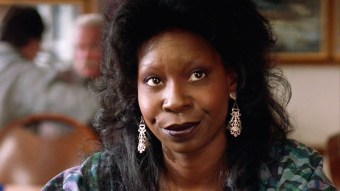 Here, for instance, is Oda Mae Brown (Whoopi Goldberg) in the movie, Ghost. Sam Wheat (Patrick Swayze) has been killed in a holdup gone bad. He knows who killed him, but he cannot communicate it to Molly Jensen (Demi Moore), his fiancé. For that, he needs someone who is “open to the spirit world.” Notice “open.” She is not empty, or “hollow,” however. She is a con artist who has pretended to be a “spiritual advisor” for many years. Pretending to have this gift is her con; she has no idea she really has it.
 to be an expert on things spiritual. “Why is he still here?” Molly wonders, having been persuaded by Oda Mae that she can hear Sam. “I don’t know,” says Sam. It is a line only Oda Mae and the viewers can hear. “He’s stuck, that’s what it is,” says Oda Mae. “He’s in between worlds. You know it happens sometimes that spirit gets yanked out so quick that the essence still feels it has work to [on] here.”
 incarcerations. That’s reality for the police. There are still discrepancies in Molly’s account to be accounted for. No one like the person the police know Oda Mae to be could possibly have known the things Molly describes. On a better day, that might have stopped the cops and made them wonder. This cop was compassionate, unlike his fellow officer at the next desk, but Oda Mae has a record and the actual killer, Willy Lopez, does not. End of story.
 name is just Shoplifters. I like the Japanese title better because this superb movie is actually about an ensemble performance. The one line description they give for this movie is pretty good: “A family of small-time crooks take in a child they find outside in the cold.”
 I mention that detail only to show how attractive it is. The grocer is either oblivious or too stuffy to care. He is seen only in the background. In the foreground are a father and son team, also a master and apprentice team, who are out rustling up dinner for the family.
 he has deferred to Osamu, as the apprentice defers to the judgment of the master. “I guess he knows something I don’t know,” Shota must be saying, “because this doesn’t really make any sense to me. You can almost see Shota’s esteem for Osamu shrink right in the scene and it is not long before Shota steals something so clumsily that he gets caught and you wonder, as you watch, whether these two events are related.
 I can tell without looking at it when the light turns yellow because there is often a sound of acceleration. You can hear it in the engines and in the sound the tires make on the street. If the drivers are slowing down in response to the yellow light, I either don’t hear it or don’t pay attention to it, but if they are accelerating suddenly, I do hear it and I don’t like it.
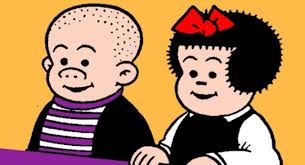 restrained question, given that people game every specific standard we know of. I remember an old Nancy and Sluggo comic strip where “the mother” told the two kids to wash their hands to get ready for dinner. They complained that actually, only one hand (each) was dirty and we are to imagine that the mother said to them, “Well, just wash that one then.” In the final frame, we see the two kids at a bathroom basin, cooperatively washing only one hand (each) and Nancy’s comment was, “I’ll bet she thought we couldn’t do it.”
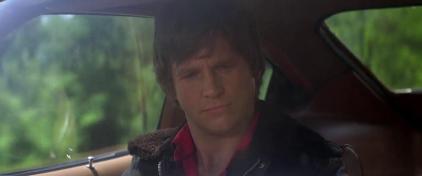 I am reminded in this context, of a forgettable scene from a forgettable movie called Starman. [5] In it, a visitor from another planet (Jeff Bridges, shown here preparing to utter this line), offers to drive for awhile while his host (Karen Allen) takes a little nap. She sees him blowing through a yellow light and thinks he doesn’t understand terrestrial traffic signals. She starts to explain them to him. “Oh no,” he says. “I remember everything I see.” (Meaning that he has internalized as rules what he has seen her actually do as a driver.) “Green means go. Red means stop. Yellow means go very fast.”
 Today I saw a new effort. It wished a recently deceased member of our community “bon voyage.” This is clearly part of the “pass on” line of thought and extends the metaphor as a voyage. This gives us the chance to wish the person we now know only as “departed” that the voyage he or she is undertaking will be a good one. This is entirely different than wishing the recently deceased person a good destination, which might be intended kindly, but which I am sure would be considered bad form
 yourself valued, provided he knows them. It runs the risk of saying that he was one of the best caterpillars I ever knew, without mentioning that he never quite became a butterfly.
 But that brings me to my enthusiasm for Vox Sentences. Every day, I get a notice in my inbox that the Vox Sentences for that day is available. The stories in the one I am going to use as my illustration were written by Starvos Agorakis, about whom I know nothing except that he is often listed as the writer of a day’s collection of the news.
 the story as Luke tells it. I began to fall in love with these stories when I began to honor how different they are. “The Christmas Story” as a mashup of the two real stories never meant very much to me. [Here is an example of the mashup. We have Joseph and Mary following the star to the town where they have to go to pay their taxes. Right.] When I learned that there were two versions, I learned to love both of them. Matthew’s story, taken all by itself, has a very stark structure; there is nothing cute about Matthew’s story. Luke’s story is glorious and cuddly and warm, which is why four out of five Advent songs are taken from Luke, rather than Matthew.
 same star they had seen those years ago—appeared again and it led them not only the remaining five miles to Bethlehem, but stopped moving and stood still in the sky right over the house where Joseph and Mary were living. As you see in the picture, the star hovered in the sky right over the house with the Christmas lights, over there at the left edge of the picture. [I share with you here the picture my son, Doug, created for me and that I use on every Matthew year.]
 what the scribes and the Pharisees did not do. And, to return to Luke’s story, they did what the residents of the inn did not do. The people who already had a place in the inn—I mean, of course, the inn that refused to accommodate Joseph and Mary— had gotten there early. I don’t think they had reservations. They had had a meal and maybe something to drink. Maybe a lot to drink. The psalmist praises God (Ps. 104:15) for “wine that gladdens people’s hearts.” In any case, they were inside and outside it may have been cold or it may have been raining and if an angel had told them that the King of Kings was just being born in the barn [1] behind the inn, it would have been hard to leave the fire and go out and find out. So they didn’t. Or, if they did, Luke doesn’t know about it.

 the director of the community at St. Anne’s, has been to Mars and Venus, he has learned to speak the Old Solar language, and he is in contact with the eldila [2] who represent “the Masters” in their plans to save the planet Earth from domination by evil forces.
 The evil forces have arisen and are on the move.
 extent.
