The Erikson Tournament: Stage 7 Explored

This is going to be a busy sort of post.  I recommend it to people who are thinking of retiring, to fans of Erik Erikson’s epigenetic stages, and to anyone who has been following these posts and who thinks I have painted myself into a corner.  There are three pieces here, after a beginning event and a review of the tournament metaphor.  The first is an attempt—long deferred already—to look at the inner workings of any of the Erikson stages.  It’s more complicated than I thought when I started.  The second is an attempt to apply the main value of Stage 7 to the life I am not living.  What, in other words, does “generativity” look like in my life right now?  In the third point, I apply these traits to a new setting—a retirement center—and try to think whether they will work there.

As I say, it’s complicated.  So let’s get to it.

Some sort of process began in my mind when I started offloading my books.  Right now—this feeling is roughly a month old at the moment—it seems like a long term change.  It feels the way a change feels when it is going to turn out to be permanent.  Here’s what “permanent” means.  Bette and I plan to be ready to move from our house to a retirement center in 2017.[1]  So I have roughly six years to work this out in principle.

So what does this mean for questions weightier than how many books I have?  Let’s look at Stage 7, which is where am supposed to be at this time of my life.  If I continue to look at Erikson’s epigenetic stages as matches in a tennis tournament, I got to Stage 7 by defeating my opponents in stages 1—6.  I have “defeated,” that is, mistrust, shame and doubt, guilt, inferiority, role confusion, and isolation and my current opponent is some form of self-absorption.   Erikson calls it “stagnation.”  “Self-absorbed” seems like a cruel thing to say to a man who writes a blog, but there it is.  Presuming that I win this one, my next opponent will be despair.[2]

So what is the current match like?  At this point, I am going to shift over to a book called Vital Involvement in Old Age.  I’m going to return, at the end, to what defeating “stagnation” looks like between now and 2017, but let’s look right now at the mechanics within a stage.  In the expanded view offered by Vital Involvement, there are five elements to account for in every stage.  I’m going to look at Stage 6 for my example because I am going to be concentrating on Stage 7 in these posts and here, the notion of the tennis tournament is again useful.  If I don’t “win my match” (meaning to be specified below), I don’t get to Stage 7

You are going to have to give me a little wiggle room in order to keep the tournament idea, but I think it’s worth it.  In a real tournament, you lose and you go home.  In the Erikson “tournament” you win big and move on more capable and confident than before; or you win but incur liabilities[3] or you are so mired in Stage 6 that you never really move on. 

So what are the elements of any stage?  The middle two columns represent the struggle most people have.  They want to find some balance between the achievement and the opposing value.  The first and fourth columns are clearly losses although just how bad and just what kind will vary from one stage to another.  The bottom row represents what the achievement, balanced by the struggle with the opposition, will result in.  It is the true goal of that stage.

Unconstrained Achievement

Achievement on Balance

The presence of the opposing value

The domination of the opposing value

Maladaptive

Syntonic Value

Dystonic Value

Malignant

Generalized “Master Value” of that Stage


Note that the achievement of the master value is not the triumph of the syntonic value over the dystonic value, as earlier work with Erikson suggested.  It is the achievement of the syntonic value constrained by the experience of the dystonic value.  A child is supposed to learn to trust, for instance, but he is not supposed to be completely gullible.  It is his experience with mistrust that enables him, in the famous phrase of Ronald Reagan, to “trust, but verify.”

In Stage 6, that looks like this. 

Unconstrained achievement: the syntonic value unconstrained

The key achievement

The key opposing force

The domination of the opposing force: the dystonic value triumphant.

Maladaptive

Syntonic Value

Dystonic Value

Malignant

Promiscuity

Intimacy

Isolation

Exclusivity

Love


In considering the transition to Stage 7, it is clear that I take with me the victories in Stage 6.  I take the defeats too, of course, but Stage 6 was a really good stage for me.  The same chart, considering  the goals and liabilities of Stage 7, looks like this.  Note that the forms are all the same, but new values are now being pursued—the previous ones now presupposed—and new liabilities are being considered and so on.

Unconstrained Achievement: the syntonic value unconstrained The key achievement The key opposing force The domination of the opposing force: the dystonic value triumphant.
Maladaptive Syntonic Value Dystonic Value Malignant
Overextension Generativity Stagnation Rejectivity

Care


Again we see that “too much,” the unimpeded triumph of the syntonic value, is not good.  It results in the maladaptation that, in this stage, is called “overextension.”  The extension of the dystonic value again produces a malignant form, this time called “rejectivity.”[4] In any case, when my interest in generativity is appropriately modified by enough quiet self-oriented experience it is not driven over the cliff into “overextension.”  It retains the characteristics that are the reason we called it a good trait in the first place.  And what are those?  What, in other words, is “generativity?”

Generativity is a concern for making life a good home for others, just as I have (Stages 1—6) made it a good home for myself.  The term the authors use is not “others,” as I have, but “following generations.”  That is who a generative older person is to make this life a home for.  For reasons that are complex beyond the needs of this post, I don’t have much of an orientation toward the following generations.  The flavor of my generativity has more to do with “making things better.”  If I assume for the moment that generativity characterizes the life I am now living, I arrive finally at the question with which I began.  How shall I imagine the life I will be living at the retirement center in terms of generativity?

If I could keep on doing the things that now seem to me to be worthwhile in the “making the world a better place” sort of way, that would minimize the transition from one setting to another.  The setting would be different, but the kinds of things I am doing would be the same.  Here are three things I do that might transition well. 

1.         I provide contexts for discussions about things.

Anything that can be said to have a generalized focus works pretty well for me.  Not, with a few exceptions, what your vacation was like, but “vacations” works for me.  Bermuda works for me.  “Knowing when it’s time to go home” works for me.  You get the idea.  If it’s not just trading experiences—again, with a few exceptions—it’s “general;”  it’s an “it,” and I can find a context that enables me to talk about nearly any “it.”

That may seem a pale skill, but in fact, it works for topics more demanding that vacations.  It works for relationships; it works for politics; it works for religion; it works for sex.[5]

2.  I organize people around shared interests.

Seeing a number of people doing one at a time something I think we would all enjoy doing together is a kind of itch for me.  I am only guessing that there are always more people who would enjoy doing something together than there are people who can see that common thing and pursue it.  If that’s really true, there will be no reason for me to stop scratching that particular itch when Bette and I move to the senior center.

3.  I really enjoy teaching and learning.  In place of  “schools, Illich favored self-organizing groups of people who were taken with an interest in learning something.  As I remember it, he used the example of people who wanted to learn about Dickens.  I am one of those people who would really like to know more about Dickens and I am one of the people who would be likely to notice that there was a general interest in Dickens.  I am not, alas, someone who could teach a class on Dickens, but there are other subjects I really could teach and would like to.

Doing things like that is probably most of what generativity means to me now.  I imagine it is those same kinds of things that will matter to me when we retire from maintaining the homestead.  Doing those things well—maintaining my commitment to making things better—and not sliding over to relentless activism is what “winning” in Stage 7 looks like to me.  But, to return to the tennis metaphor one more time, if I really have an opponent, he is going to change tactics because every point I win, he loses.  He has already learned I can win points from the baseline, let’s say; now he needs to know if I can volley a good passing shot and protect against a lob.  In short, even within Stage 7, things change.  I’m happy I’ve been able to win so many points from the baseline, but I’m not always going to be able to play on the baseline and thinking ahead to some other way I could win some points seem like a good idea.


[1] I just this moment realized that I imagined it occurring in the fall of 2017 and right after that, I understood that I had been seeing it as a fall event because…you know…school is starting then.  We’ll be moving on “the academic calendar,” I guess.

[2] I distinguished earlier between the two tournaments, calling one “the physical tournament” and the other, after some hemming and hawing, “the spiritual tournament.”  We do lose the physical tournament, i.e., we die.  You heard it here first.  The relation of the second tournament to the first is captured by the slogan, “rising above decline.”  That’s what “winning” the spiritual tournament means to me.

[3] Not to get too tennisy,  but this might by a physical liability, like the hamstring injury, or a flaw in your game.  If you won in Stage 6, but also demonstrated that you have no facility at all to handle a ball lobbed to your backhand, you move on to Stage 7 with that weakness exposed.  Your opponent in Stage 7 got there by exploiting the weaknesses of his previous opponents.  He’s not inattentive and you have shown himself something you will wish you had not shown.

[4] To my ear, the really weak word in this set is “stagnation.”  What the Eriksons (and Kivnick) really want, it is clear, is something that will modify the normal and balanced drive to share the wealth of one’s life with others, something that will prevent it from being driven too far.  I’d want a word like “moderation” or “quiet reflection” or “self-oriented experience” or something.  Stagnation?  It just doesn’t sound good.

[5] I’m not sure just how widely it works for sex, but I didn’t want to leave politics and religion hanging out there by themselves.


Posted in Getting Old | Leave a comment

My Opponent is Really Really Stupid

President Obama doesn’t really need to be Superman to win a second term, says Timothy Egan, in a New York Times op ed pieceHe does have “Republican craziness” to run against.  One of the examples of this craziness Egan cites is the doubt Gov. Rick Perry is trying to cast on the adequacy of evolutionary theory.  Here is the relevant clip from Egan’s column.

In the same week that scientists announced the discovery of fossils 3.4 billion years old, evidence of explosive growth of early life through evolution, Rick Perry showed he will take his science from the Bible. He called evolution “a theory that’s out there.” If he thinks it is just a theory, he should get last year’s flu shot.

This post isn’t about evolution.  It’s about a civic virtue for which I have not yet accepted a name.  I want to go little further than “decency” but not as far as “generosity.”  I do believe that the quality of public discourse suffers when the general level of political argument takes on the characteristics that were once associated only with the party’s flamethrowers.  Everyone knew that James Carville (he wasn’t called “the Ragin’ Cajun” entirely as a joke) was going to make extreme and very colorful statements about Republicans.  At the time, he could do that and there could exist, back in mainstream political discourse, the mutual courtesy that each combatant and his or her backers extended to the others.

We are now facing a time when the normal course of public debate is more like the James Carville kind.  I can understand that it feels good to do it that way.  Your opponents have done something outrageous and it doesn’t seem out of line to nail that action with an outrageous accusation.  The real difficulty is, I rely here on evolutionary theory, outrageous political expressions compete very successfully with more moderate expressions and drive them to the few niches in the political world where they can survive.[1]  The real world, the world outside the theme parks, would be dominated by the most extreme, the most caustic, views, the slowest to be constrained by actual facts.  Has Fed Chairman Ben Bernanke committed treason in making more money available during the economic recession?  Treason?

The question that lies at the heart of Egan’s column is this: Just how stupid is Gov. Perry?  Is he so stupid—has he taken his opposition to evolutionary theory so far—that he believes flu viruses don’t adapt to flu vaccines?  No.  He isn’t.  What Eagan has done is to create a huge category called EVOLUTION and to put into that category not only the large and politically volatile question of whether humans evolved from apes but also the undisputed question of whether viruses adapt to anti-viruses.  Once the huge category is created, every question represents the whole category.[2]  The most contentious questions about human origins are now “the same as” the least contentious questions about developments in pharmacology.  That is the device that Eagan relies on to ridicule Gov. Perry, implying that Perry doesn’t understand the need for an annually modified vaccine.

I almost passed by Egan’s sniping because making fun of Gov. Perry feels so good, but that good feeling collided with a bad feeling I have been having more and more lately.  Reasonable policy arguments are harder to find.  There are still reasonable wonkish discussions in think tanks, certainly, but anyone who wants to apply the conclusions reached in those discussions to political debate is going to have to find some way to make them into a slur on his opponents.  Back in the good old days, the biggest challenge in using think tank discussions was making them understandable to the general public.  Now you have to make them vicious or they don’t really help you.  I really don’t think they can be both.

I know that I am risking sounding like the social worker in West Side Story who didn’t know anything about the Jets or the Sharks, but wanted them to mix together at the dance and make nice with each other.  And I know that if one of the major parties turned off the flamethrowers, the first effect would be that all its officeholders would be fried by the other party’s flamethrowers.

Still, here are two simple truths. 

The partisan flamethrowers are sustained by people who like it and think it is justified.  Those are the people who are going to have to change their views.  It may be pleasant and it may be justified, but it leads to pointless policy debate and ineffective government.

We can have this kind of public debate and continue to “make policy” by rejecting Extreme Proposals 1—10.  Every potentially ineffective idea can be skewered in public and its proponents called traitors to the republic.  I know we can do that because we actually are doing that.  What we can’t do it establish a policy goal and work toward achieving it. 

It seems to me that a democracy that can’t do that is going to go the way of last year’s flu virus.


[1] Each party could establish and maintain a “moderate discourse” theme park.  They could charge tourists a nifty little price to come in and listen to R’s and D’s disagreeing respectfully with each other.

[2] That particular device is called synecdoche for those of you who are keeping a box score.

Posted in Politics | Tagged , , , | 1 Comment

Is It Just Will Power?

So how do you feel about “will power?”  Old fashioned? Crucially necessary?  Both? 

John Tierney wrote a really wonderful piece about will power in the New York Times recently.  You can see the full article here.  I’m going to reflect here on a few elements of the scientific study of the question; then a little bit on some practical implications.

First, “decision fatigue.”  It’s not just an apt metaphor, it turns out.  Making decisions is work and work takes energy and as you run out of energy, you feel fatigued.  There it is.  There has always been a difficulty to this simple formulation among scientists who study it.  The difficulty is that no one knew how glucose could affect the brain discriminantly rather than generally.  Either your brain has enough glucose to function effectively or it does not.  But, it turns out that decision fatigue causes activity to rise in some parts of the brain and to decline in others.  There is “more activity in the nucleus accumbens, the brain’s reward center, and a corresponding decrease in the amygdala, which ordinarily helps control impulses.”

So more demands from the reward center and less resistance from the control center.  That doesn’t sound good.

Second, the more decisions you make, the more you suffer from decision fatigue.  It isn’t like a set of conversations you can imagine having.  You feel energized after this one and depleted after that one.  All the decisions cost and the more options you are considering, the more they cost; the higher the value of making a good decision, the more they cost. 

I think about that first criterion when I go to Starbucks and hear a new person go through the decisions that are necessary to get a cup of coffee.  When I go in my Starbucks, they start making my coffee when they see me coming in.  So I have much less excuse for buying the doughnut than the new guy does.  The idea that the cost of the decision varies with the cost of doing it wrong can be illustrated by the idea that it costs a poor person more to go shopping than a well off person because the trade-offs are more numerous for the poor person as is the cost of a bad decision.

Third, these studies all emphasize that there is more difference among settings for choice than there is among choosers.  I have some reservations about that myself, but let’s go with it for a little while.  Someone who “has a lot of will power” is someone who arranges his decisions properly.[1]  He builds good habits, for example, so he will choose the good options—the ones he has decided are right for him—without having to choose them every time.    She saves some will power, some “decision energy” for decisions that would otherwise catch her short.  She doesn’t run her brain near the empty line, in other words.  She anticipates routinely bad settings for decisions, like back-to-back meetings or end of the work day times.  She controls her schedule and her diet so that if she makes wrong decisions, it won’t be because her brain has run out of fuel.

Fourth, since it is the accumulated depletion of the decisions that gets to you, you might want to make fewer at a time if that is feasible or in a commercial transaction, like buying a car, put all the high cost decisions up front where you will make them better.  Here is a catchy example of sequence.

The car buyers — and these were real customers spending their own money — had to choose, for instance, among 4 styles of gearshift knobs, 13 kinds of wheel rims, 25 configurations of the engine and gearbox and a palette of 56 colors for the interior. As they started picking features, customers would carefully weigh the choices, but as decision fatigue set in, they would start settling for whatever the default option was. And the more tough choices they encountered early in the process — like going through those 56 colors to choose the precise shade of gray or brown — the quicker people became fatigued and settled for the path of least resistance by taking the default option. By manipulating the order of the car buyers’ choices, the researchers found that the customers would end up settling for different kinds of options, and the average difference totaled more than 1,500 euros per car (about $2,000 at the time). Whether the customers paid a little extra for fancy wheel rims or a lot extra for a more powerful engine depended on when the choice was offered and how much willpower was left in the customer.

The car buyers eventually just run out of gas.

And finally, it seems to me that a lot of the implications of these decisions have been anticipated for a long time by “good practices.”  People who remind you not to make important decisions when you are tired or to eat something before you go grocery shopping have had no idea at all of the mechanics underlying these prudent reminders.  I, myself, am really drawn to the mechanics, but the fact is that eating something before going on a food-buying excursion was a good idea before we found what processes support it and it remains a good idea now.

The great conundrum considered by the article is all the will power required to stay on a weight loss diet.  As you say no to one sugary snack after another, your energy is depleted and so you can sustain these decisions, you long for a quick sugar hit.  For any other kind of decision, that might be just the right thing.  For weight loss, not so much.


[1] I don’t fuss with personal pronouns much, but here I am going to use “he” sometimes and “she” sometimes.  It seems likely to me that people will think men are better at will power than women or vice versa and that really isn’t a good thing to think.  So I’m going to make sure pronouns of both flavors are present.

Posted in Political Psychology | Tagged , | 83 Comments

John and Bonnie Gray, Just Doin’ Their Jobs

I want to poke just a little today at the way John and Bonnie Gray illustrate what communication between a husband and a wife ought to look like.  John Gray is the founder of the now vast Mars/Venus industries: books, seminars, websites, and so on.  Bonnie is John’s wife and in his books, she needs to act in ways that allow him to model how husbands should respond when their wives seem petulant and unreasonable.  So whatever Bonnie Gray is actually like, in the books, she needs to seem petulant and unreasonable.  It’s a nasty job, but somebody’s got to do it.  Here they are in much earlier days, before all the ducking and dodging and pausing and preparing.

Just a note here to clarify my position on the Mars & Venus books.  I disagree with nearly everything in them, with one exception.  It’s a very important exception.  When I do what John Gray says to do, everything works out really well.  I think his characterizations of male and female roles are stereotyped and rigid.  I think his historical grounding for those roles is preposterous.  Early man had to learn to “duck and dodge” his enemies in battle, for instance, so it should come naturally for a husband to “duck and dodge” his wife’s unreasonable tongue-lashing.  Oh, please!

On the other hand, it is not a small service he provides if, as has been my experience, doing what he says to do makes everything better.  And even if I value him only for that, I value him very greatly.

In this post, I want to look at what John Gray is supposed to do—what his job is—and at what Bonnie Gray is supposed to do.  If John does what he is supposed to do, nearly anything Bonnie does will work out.  If Bonnie does what she is supposed to do, it will make it much easier for John to respond to her.  In that sense, there is symmetry to their roles.  But only in that sense.

It can’t be all that much fun to be Bonnie Gray, the wife of John Gray, the founding genius of the Mars/Venus industry. John Gray uses his interactions with Bonnie mostly to provide instructions to men about how to deal with wives who seem petulant and unreasonable.  For that reason, Bonnie Gray, as she appears in the Mars/Venus books, comes off as petulant and unreasonable.

Here is a little clip from Mars and Venus Together Forever: Relationship Skills for Lasting Love.[1]  This was written to illustrate how John did what needed to be done—and so should we all, guys—and so resolved the crisis.  John tells her he was going to buy a new computer.  I’m adding his comments here, although they tend to excuse his choices, because he is trying to illustrate what “doing it right” looks like and he is being the example for us all.

Bonnie:           Why do you need to buy a new computer (she demanded)?  You already have one.

John:               Well, for lots of reasons. (He says he didn’t like being questioned, but by saying as little as this, he was able to prevent clashing with her)

Bonnie:           What’s wrong with the computer you already have? (She persisted).

John:               You seem upset.  (He “observes” this, after a pause.)

Bonnie:           Have you researched the market?  How much is this computer going to cost?  (She persisted, not answering my question.)

The next four exchanges are presented as a block.  He says he is ducking and dodging, continuing to hold back and not retaliate, but he is aware that he can take only so much more.  I will just present Bonnie’s four responses because she is the one who gets my sympathy today.

One.  Well I AM upset.  Whenever you want something, you just go out and get it.  I don’t know why you have to get another computer.  Yours works fine.  If we are going to spend money, there are other things we could spend it on.

Two.  It’s not like I have all this thought out (He asked what she thought they should spend the money on).  It’s just a feeling.  I feel like you get what you want and I get seconds.  Maybe I am mad that you want so much more than me.  When I want something, it doesn’t seem so important.

Three.  I don’t know.  (He asked her what she wanted to buy.)  But it feels like everything we do is for you and not me.  We always do what you want to do and you always get your way.  I’m afraid I will not get what I want.

Four.  We have been waiting six months to redo our floor.  Our couch needs to be recovered.  I still need a kitchen cupboard.  There are so many things we need to spend money on in the house and you are buying a computer.  It just feels like you don’t care about me.  You are going to buy what you want and that’s it.  What I have to say doesn’t matter at all.”

Here is the resolution of the computer argument above.

John:               I really want to understand your feelings and it really is hard for me.  It’s starting to sound like you’re saying I’m this selfish person.  Don’t I do anything nice?

Bonnie:           Of course you do.  I don’t mean to upset you.  I just have a lot of feelings coming up.  I really appreciate you trying to listen.  Just the fact that I could talk about my feelings without you getting upset with me makes me feel so loved.

So that’s how this round ends with a woman like Bonnie.  The problem is that she has feelings that prevent her from having a fact-based conversation about the computer and other household needs.  The solution is that John ducks and dodges long enough (he was getting close to the edge there at the end) that Bonnie gets the feelings out; she appreciates his listening to her; the emotional relationship is restored; and, eventually, the household purchases will be decided upon.

Now let’s look at what Bonnie Gray’s responsibilities are.  Since John’s responsibility is to “duck and dodge,” you will not be surprised to learn that Bonnie’s are to “pause and prepare.”  Women come naturally to this role because while the caveman husband was off fighting enemies—that’s where the ducking and dodging came from, remember—the cavewoman is home preparing.  Gray runs through things women prepare for: meals, children, their appearance, relationship, and so on

Women need to pause when they feel themselves cranking up the grievance machine.  So Bonnie need not respond by saying “You’re not listening” or “You just don’t understand.”  She can say, “Let me try saying that in a different way.”  That is pausing.  It gives John a chance to remember that he’s supposed to be listening to her feelings, not solving her problems.

“Preparing” comes next.  Bonnie says, “I have a lot of feelings coming up, and I would like to talk about them.  I just want you to know in advance that it sounds worse than it is.  I just need to talk for a while and feel that you care.”  In saying that, Bonnie not only prepares John for the ducking and dodging he is going to have to do, but also apologizes in advance for whatever she may say that is offensive or mean-spirited.  This approach asks his patience as a favor to her and promises that the barrage will be as brief as can be, still allowing time for the feelings to be expressed.

That’s what she should have done in the “buying the computer” scenario.  Asking for his patience (her job) and listening receptively to whatever feelings she has (his job) are both collegial acts. It could look adversarial to a bystander, but it really isn’t.  Bonnie needs to say how she feels and it isn’t going to be pretty.  She engages her husband as a helper and a hearer and promises her gratitude for his work when she is done.  John ducks and dodges while she unloads her feelings, then initiates reconciliation when the time is right.

“It could look adversarial to a bystander,” I said.  I was the bystander I had in mind and I really would not like to see that transaction, much less to be on the receiving end of Bonnie’s anger.  As a bystander, I ask the kinds of questions I am going to look at in the next post in this series.  I ask questions like, “Is it really fair that I have to put up with this kind of abuse over and over?”  I ask, “Is this really the best she can do?”  I ask, “Is it always going to be like this.”

In the next post, I am going to show you what happens when I actually act on those sentiments, rather than just asking them abstractly.  I have actually done that.  I did it for years.  It was ugly and I am glad I don’t do it anymore.  And so is Bette, although if I did let it slip and act like that, she would say, “That’s not like you at all.”  Little does she know.


[1] I MUCH prefer the earlier title of this book: What Your Mother Couldn’t Tell You and Your Father Didn’t Know.  His point in this book is that we don’t know what we need to know because our parents didn’t tell us and they didn’t tell us because we are living a life that would have mystified them entirely.

Posted in Love and Marriage | Tagged , , | 5 Comments

Highballs and the High Road

Imagine that this is one of the notorious “Washington Cocktail Parties.”  Maybe it is.  I don’t know.  My son, Doug, found it for me after I had spent a week looking for one.  I wanted one that played up the lavish drinks and luxurious women, but this one is close enough.  I mean, just look at those chandeliers!

What’s going on here?  There are two views.  We could call them the elite view and the populist view.  We could call them the incumbent view and the challenger view.  Or we could just call them “then” and “now.

It was a piece by Sheryl Gay Stolberg in Sunday’s New York Times that got me thinking about this.  Here’s the passage I had in mind.  Here is the whole article.

And the genteel Washington of yore — where lawmakers and spouses socialized across party lines, sharing cocktails and swapping ideas — has disappeared, replaced by a culture in which families stay in the district and members jet home each weekend.

Want to establish contacts across party and ideological lines?  Cocktail parties.  Want to beat the “bowling alone” problem?[1]  Cocktail parties.  Want to build the long-term relationships between committee chairs, the ordinary source of major compromises?  Cocktail parties.  The extraordinary intransigence that was apparent in Congress’s struggle to raise the debt ceiling is a result of too few cocktail parties.

And why are there now so few?  Of all the reasons that could be given—the Stolberg articles surveys them—I pick populism.  If you are the incumbent Congressman or Senator and you attend this party, that means one set of things in Washington: rag the committee’s ranking minority member about the double bogey on the 12th hole; compliment Mrs. Ranking Minority Member on her gorgeous gown (I pick the off-the-shoulder black gown of the woman standing at the left of the picture) and ask about how her kids have been doing in school since last you heard; pass along to a lobbyist who is close to a sometimes hostile committee chair a report one of your staff handed you and that might help the lobbyist press your case with the chair.

If you are a potential challenger in the district or anyone of the other party in the district or any group that hopes to stoke the anger of poor people by suggesting that their representative is living it up in Washington with their tax dollars, it means something else entirely.  Here’s the campaign. 

What is Congressman Smathers doing is Washington?  Just look at the picture.  Here in the district, there are hard-working families who are struggling to pay the mortgage, to afford their medicines, to put food on the table.  Clearly Congressman Smathers has lost touch with real folks here is Dubuque.

That would have worked in a few cases back in the old days.  There have always been campaigns like that.  But it wouldn’t always have worked in the old days.  Only if Congressman Smathers had made himself particularly vulnerable on that kind of issue: had voted against funds for the low income families of his district; was known for lavish vacations; didn’t come back to the district at all to meet with the voters, and so on.  Now, Stolberg suggests, you don’t have to do anything to be vulnerable to the populist smear.  You just have to go to the parties where a great deal of the mollification of angry opponents used to take place.

If that work still went on at cocktail parties, you couldn’t afford not to go.  In the “Washington of yore” Stolberg refers to, you couldn’t afford NOT to go.  So now, you go because your job demands it and open yourself to people who make their living riling up angry voters or you don’t go, to support your re-election bid, and you allow Congress to continue sliding in the direction of Civil War.  It’s a nasty choice.


[1] Robert Putnam put this issue on the front burner by observing that there has been no decline in the number of people who bowl, but there has been a substantial reduction in the number of bowling leagues.  The bowling league was a social institution that brought people who weren’t friends together year after year.  Familiarity, not charity or toleration or anything that big, is Putnam’s notion of increasing our social capital.

Posted in Politics | Tagged , , , | Leave a comment

The Touch of a Really Good Author

Some part of the genius of Ursula Le Guin is that she hides the crucial evidence in plain sight. In her Tales From EarthSea, Le Guin gives us a little girl named Dragonfly. She first appears in a subordinate clause of the second paragraph of the story: “By the time the girl called Dragonfly was born…” In Earthsea, one has a “use name”—which everyone uses—and a “true name” which is very carefully guarded. At the end of the story, this little girl, now a young woman becomes a dragon and flies away.

I was completely dumbfounded. A dragon? How did she do that?

This post has two emphases. Le Guin is only one. I am the other—specifically, my much-maligned notion of reading strategically and repeatedly. So I read “Dragonfly” the way you are supposed to, from front to back. It is a story about a woman named Irian—that’s her true name—and I forgot immediately that she had been called Dragonfly, her use name, as a girl. I presume I was supposed to forget that. And I am taken completely by surprise when Le Guin unveils Irian’s draconic character at the end.

By the time I read this story for the second and third times, I am no longer surprised that Irian has more than one “true name” and so, more than one true character. Now I get to look at, to luxuriate in, the way Le Guin prepares us for the great revelation. That’s what I get by reading it over and over. I bear no grudge against anyone who got all this the first time through, but the fact is, I don’t get it the first time through.

How does she do that? Well, you know she isn’t going to drop a footnote that says, “Oh by the way, Irian is really a dragon.” What she is going to do is to play with the range of symbols and suggestions that are attached to “dragon.” Here’s how that works. If you are looking for something—say Kestrels, for instance—your eye is attracted to anything that might be a Kestrel. A Kestrel is a small falcon, so you might notice any bird with pointed wings. You might notice any solid object at all on the phone lines or fence posts. You might notice anything moving quickly through the air at 50 feet or less above the ground. You might notice anything that hovers or seems to hover. You might notice anything that has even a touch of that slate blue color that appears on the Kestrel’s head.

You don’t declare any of these to be Kestrels. You look at them carefully and determine each and every one of them not to be a Kestrel. But you had to look at each and every one because you are looking for Kestrels and the appearance of any aspect of a Kestrel is part of the “range of symbols and suggestions” I referred to above.

Azver, the Patterner of Roke, reassures Irian that the bad guy of the story can’t come out to the magical grove and harm her. “He cannot harm you here,” says the Patterner. “He cannot harm me anywhere,” says Irian, “fire running through her veins” the text notes. “If he tries to, I’ll destroy him.” Well…she’s angry. She’s venting. Surely she doesn’t think she can destroy the Archmage presumptive of EarthSea. And if you keep thinking about that, you will not notice that “fire” is just a little too hot a word here. It’s not inappropriate. It’s just…oh…a little much.

There was a young prince she really should have had an affair with, but didn’t. Why not, she wonders in a period of deep introspection. “Am I a sterile thing, not whole, not a woman? She asked herself, looking at her strong bare arms, the soft swell of her breasts in the shadow under the throat of her shirt.”

The Patterner comes out of the Grove while she is thinking that. “She felt herself blush, her face and throat burning, dizzy, her ears ringing.” That comes out of a coming-of-age romance novel. She’s just an ordinary teenager after all.

Then Le Guin gives us “What do I want? She asked herself, and the answer came not in words but throughout her whole body and soul: the fire, a greater fire than that, the flight, the flight burning. She came back into herself, into the still air under the trees.”

Irian herself does not know why she came to Roke Island. Azver is sure it was not by chance. The Summoner knows that too.”

“Maybe I came to destroy him,” says Irian. Azver looked at her and said nothing.

“Maybe I came to destroy Roke,” says Irian. Azver’s pale eyes blazed then. “Try,” he said.

“A long shudder went through her as she stood facing him. She felt herself larger than he was, larger than she was, enormously larger. She could reach out one finger and destroy him. He stood there in his small, brave, brief humanity, his mortality, defenseless. She drew a long, long breath. She stepped back from him. The sense of huge strength was draining out of her. She turned her head a little and looked down, surprised to see her own brown arm, her rolled-up sleeve, the grass springing cool and green around her sandaled feet. She looked back at the Patterner and he still seemed a fragile being. She pitied and honored him. She wanted to warn him of the peril he was in, but no words came to her at all. She turned round and went back to the stream bank by the little falls. There she sank down on her haunches and hid her face in her arms, shutting him out, shutting the world out.”

We’ve had the fire already. Here we have the enormous size. We have the failure of words, as often before, since Irian came to Roke. Then we have her sinking down on her haunches. Haunches! But look back. We have the size, but it is larger than she is. What? And then she feels the strength draining out of her. She sinks down on her haunches, but then she hides her face in her arms. Le Guin giveth and Le Guin taketh away.

If you were to go through, in your own mind, the little exercise I did on Kestrels above, you would find things like huge, animal, fiery, fearsome, and silent. “Dragon” makes you sensitive to every appearance of all those. As those peripheral touches add up, you begin to say that Irian “reminds you of something” but then you follow Le Guin away from it again. From “the haunches” to “hiding her face in her arms.”

Le Guin touches on—hell, she pounds on—every aspect of dragons but never says “dragon.” Good readers probably saw it coming. I was taken completely by surprise. But only the first time. I began to get it the second time—not the revelation, but the way of preparing the revelation—and the third time, I exulted in it. “I should have seen it,” I say to myself, but without any sense that I have read poorly. “How wonderful!” I think. Then I think, “Maybe I should go back and read it again.”

Posted in Books | Tagged , , , | Leave a comment

The VIP Treatment

I’m going to take a look today at practicing being old.  You can laugh, but it isn’t as simple an idea as it appears.  I have placed it in my set of categories as “Getting Old, but being old isn’t the same thing.  And “being old” and “practicing being old” aren’t the same thing either.  Here’s one of the ways to picture it.

This post amounts to a detour—a brief one, I think—on my road to Erickson’s consideration of generativity.  Let me tell you how I got here.  I’ve been working on.  Helen Q. Kivnick was listed at the third author of Vital Involvement in Old Age.  She was third behind Erik and Joan Erikson and I’d never heard of her so I didn’t pay much attention.  But it turns out she has written a great deal about the kinds of ways old people can invest themselves in their lives, even though the circumstances vary a good deal from one time to another.  The circumstances vary before and after a stroke, for instance; or before and after they take away your driver’s license; or before and after the operation that puts an end to your eating solid food. 

Those are dramatic changes of the circumstances of your life, I think you will agree, but none of them prevent your continuing to involve yourself in the vitality of your old age.  The way you will invest will change.  And learning how to invest yourself in those new circumstances will require practice—if you want to get good at it.  I really do want to get good at it so I am beginning to practice as early as I can.  Like…now.  This would be a good place to put an alternative image, I think.

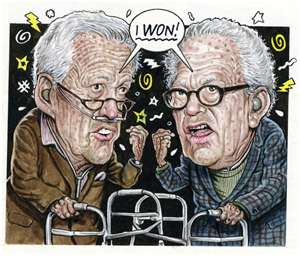
Kivnick’s interest stretches from the Erikson’s epigenetic stages on the abstract side to occupational therapy on the applied side.  That’s quite a stretch.  I’m in the seventh of Erikson’s eight stages.  Self-absorption is the opponent I am playing[1] in this stage.  There is a good deal more to be said about that, but this is my detour and I am going to look at Kivnick’s application of the Eriksons’ work.  On the occupation side, we are looking at things like this.

Occupational science focuses on the study of the form, function and meaning of human activity, and it seeks to understand people as occupational beings (Yerxa, 1988).[2] Occupations may be described as individual patterns of meaningful activity that are influenced by culture and personality.[3]

The three scenarios I sketched above—the stroke, the driver’s license, and the gastrectomy—could all benefit, it seems to me from considerations of “the form, function, and meaning of human activity.”  And Kivnick’s framework for doing that is called Vital Involvement Practice, hereafter VIP.  That will mean “very important practice” to me; I have long since given up becoming a Very Important Person.  Here’s a short sketch of what she has in mind.

Vital involvement has been described as a person’s meaningful engagement with the world outside the self (Kivnick, 1999), a process of “being in relation” to elements of the environment (e.g., people, materials, animals, ideas, values, institutions, sounds). Vital involvement maybe expressed in overt behaviors that link a person’s internal (psychological) processes to entities in the external (social; physical) world.[4]

So the practicing I am thinking about is going to be about a “meaningful engagement with the world outside the self (inside, too) and of “being in relation to aspects of the environment.”  From the list, I will pick out ideas, values, institutions, and sounds.[5]  And not only am I going to be doing that; I am going to be doing it on the basis of my current strengths.  The heart of Kivnick’s emphasis is that sound practice requires that we begin with what old people are good at—I remind you that I am the old person in question—and build a pattern of engagements on those.  If I don’t do that, I am going to get myself involved in a system aimed at identifying and categorizing behavioral deficits and providing “solutions” for those deficits.  Engaging actively in some new setting, an engagement based on my strengths, sounds better to me than that.  And maybe if I get out ahead of the diagnosticians and push the pace a little, they won’t be able to catch up to me.

So what does “practicing” involve, given all that?  It seems to me that the simplest approach is to pay attention to what I’m good at—what I’ve already had success at—and start thinking about how I can vitally engage a setting in which many other options are more limited.  And if I have trouble remembering what they are, I can consult the members of my book group, which will mark its 30th anniversary in the fall of 2013.  And they’ve been watching me as long as I’ve been watching them.  They’ll know what I’m good at.


[1] This is “playing” in the sense that one plays an opponent in tennis.  I continue to think of progressing through Erikson’s stages as analogous in many respects to winning your match in a tournament, as a result of which, you get to face your next opponent.  In my previous match, my opponent was isolation—the inability to invest wholeheartedly in an intimate relationship.  I won that one, mostly, and have moved on to playing against “self-absorption.”

[2] Yerxa, E. (1998). Health and the human spirit for occupation. American Journal of Occupational Therapy, 52, 412-418.

[3]: Helen Q. Kivnick PhD & Sharon A. Stoffel MA, OTR, FAOTA (2005):  Vital Involvement Practice: Strengths as More Than Tools for Solving Problems Journal of Gerontological Social Work, 46:2, 85-116

[4] Kivnick and Stoffel, op. cit.

[5] Engagement with people, one of the values I skipped over, is crucial to everything else for me, but I think of that transaction as involving collegiality and intimacy.  They are relationships.  The ones I chose are just transactions.

Posted in Getting Old | Leave a comment

Grounds for Hope

Joe Nocera, the New York Times columnist shared with us today that Starbucks has an idea that might help us all.  Here’s the short version.

In effect, Schultz thinks the country should go on strike against its politicians. “The fundamental problem,” he said, “is that the lens through which Congress approaches issues is re-election. The lifeblood of their re-election campaigns is political contributions.” Schultz wants his countrymen — big donors and small; corporations and unions — to stop making political contributions in presidential and Congressional campaigns. Simple as that.

I have to say that a part of me likes that.  The most important thing to a congressman is continuing to be a congressman and the way to do that is to attract more political contributions than any potential opponent.

Now what is this going to accomplish?  Here’s the way Nocera puts it.  “… an idea had begun forming in his [Schultz’s]  mind about how to force the country’s dysfunctional politicians to stop putting party over country and act like the leaders they are supposed to be.

Excuse me?  He is going to force all politicians to stop putting party over country?  How?  Or is he going to force only the dysfunctional ones to stop putting party over country.  English is the kind of language where you can’t really tell which he means.

Even if Schultz’s idea worked perfectly, which it won’t, how is threatening the corporate/union source of campaign funding going to put country over party?  Does anyone think that congressmen aren’t going to bump down to the next most available source of funds?  Putting country over party, in the context of a fiercely ideological two party system in which the primaries are controlled by the most ideological members of the parties—that’s what we have now—is the surest way not to be back to the job.  So the congressmen most attracted to Schultz’s scheme will be the most likely not to return to Congress.

That doesn’t sound promising.

Further, not everyone is going to agree to practice the interdiction of campaign funds that Schultz prescribes.  And even if left wing funders and right wing funders participate in equal numbers, we will see that funding is a highly stratified business and largest sources of funding will do whatever is in their interest, no matter what the smaller sources do.

So it isn’t going to work.  There is an alternative though.  John Kenneth Galbraith provided it many years ago in his lovely little tract, A Tenured Professor.  A member of the brain trust that worked this out suggested that they be called Political Rectitude and Integrity Committees.  Probably no one will notice that they are called PRICs, right.

Here’s the idea.

If a legislator took money from a Political Action Committee, his or her opponent in the next election would get the same amount, maybe even a little more, from a committee supported by Marvin’s financial enterprises.[1]  Taking PAC money, a member of Congress would thus subsidize his or her own opposition; in a sense, corporate PAC money would pay for an opposing stand.  Maybe then the congressman or senator would have second thoughts about PACs, and that would lead to a cut in the matching cost.


[1] Marvin is the “tenured professor” of the title.  This passage and a little context can be found on page 146.

Posted in Saturday Evening Post | Tagged , , | Leave a comment

TMI

I want to think out loud about TMI today—“too much information.”[1]  I think we do give too much information sometimes, but I suspect that most of the time that particular way of saying “Shut up!” really means something else.  This post will speculate about what else it might mean.

I had a conversation with a friend recently in which TMI came up.  I’m going to place attribute his comments to Steve, an entirely fictional creation.  Steve is married to Martha, also fictional.  I just give them the traits I want to talk about on any given day.  It provides me with a source of good examples and they don’t seem to mind.

So Steve was thinking that he had gotten painted into a corner.  He tends to speak abstractly so a lot of the time illustrations are needed.  Martha asks for illustrations because she doesn’t understand, or isn’t sure she understands, what he is saying.  Steve sets about providing the examples Martha asks for.  At which point, she clubs him with “TMI.”

Steve speaks abstractly to me too, but I really haven’t had this difficulty with him.  I ask for examples and he gives examples.  After each one, I check to see if I have a concrete enough grasp of what he is saying.  If I do, we go on; if I don’t he gives more examples.

That doesn’t seem to work with Martha, but then this question of how much information is “enough” is harder when a conflict has already begun.  The presence of conflict made me wonder if it isn’t a lack of specificity that is bothering Martha.  Martha has a concern.  Let’s say that the concern is about whether a trip they are considering is really safe.  Steve’s answers—each and every one of them—have to do with how exciting the trip will be.  He has friends who took this trip and really loved it.  He names the friends; he names the various destinations; he tells the stories they told when they got back.  He goes on and on until finally Martha stops him—and the conversation—with the TMI club.

What is happening here—or rather, the part of what is happening here that I want to look at today—is that Steve is providing lots of information but none of it bears on Martha’s concern.  Martha may have tried and failed to get Steve to address the concerns she actually has.  It is her frustration speaking when she says TMI.

My experience says that if you don’t know what they really care about, you can waste a lot of words and give yourself a frustration headache.  When you do know what they really care about—sometimes I have taken the time to find out and sometimes not—it doesn’t take many words at all.  Not many examples; not much “clarification;” not much “explanation.”  I don’t know why it is hard, sometimes, to find this out, but I have come to the conclusion that time spend finding it out is better spent than is time piling up examples that you think are going to be relevant but aren’t.

I know that some people are just better at this than others are.  I know that I am not very good at it, that I am better at it than I used to be, and that I can do it pretty well if I remember how important it is.  In any case, it is something I value a good deal in others.

Which brings me to a first date story.  Bette and I met first for coffee at Starbucks.  I’m not calling that our first date.  That was a meeting so we could decide if each of us wanted a first date.  Our actual first date was a movie.  After the movie, we wandered around the mall and I asked Bette if I could take some pictures of her.  She said, “Sure.”[2]

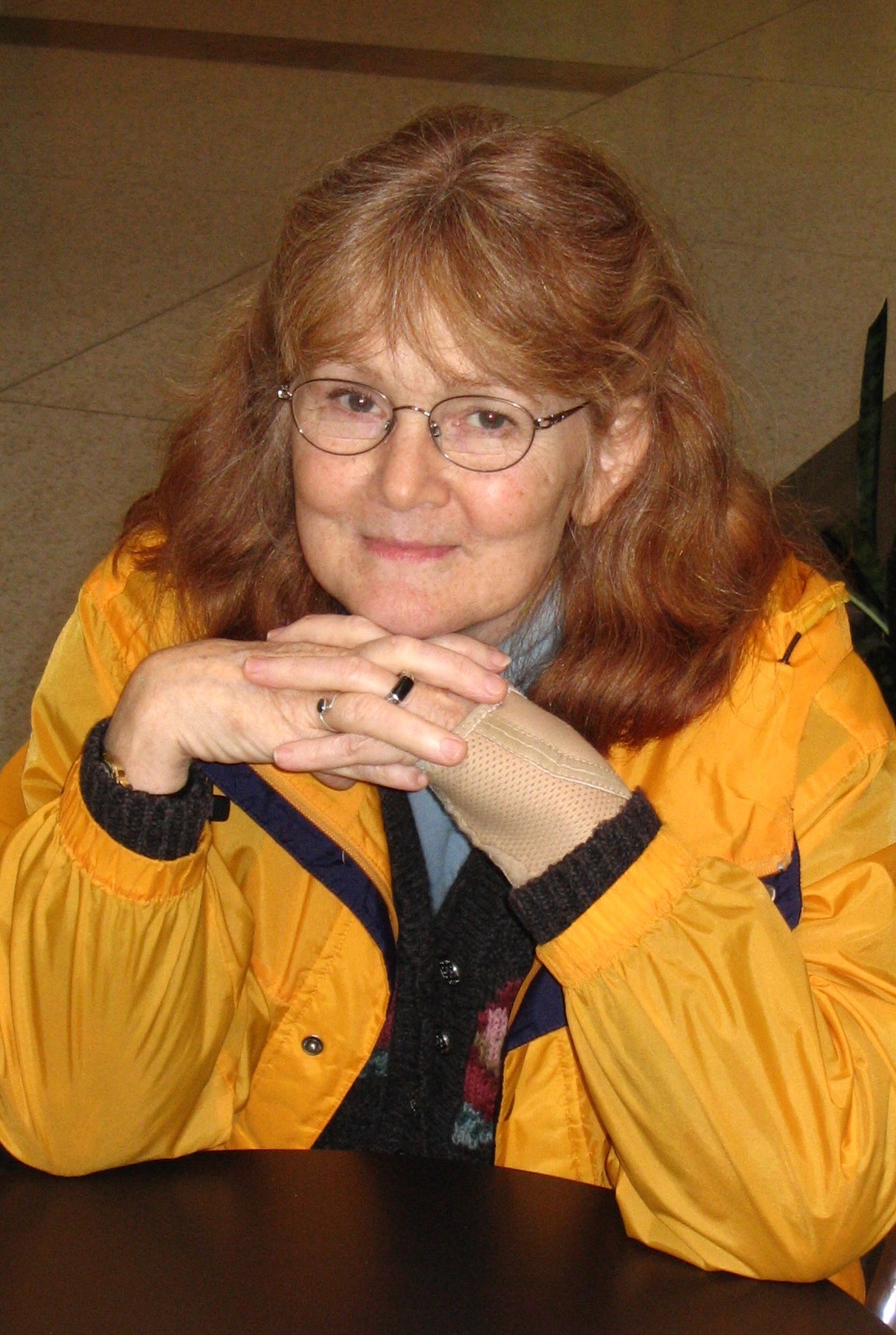
So I took a few.  Nothing seemed problematic.  Then I thought of a picture of her I thought I would like to have.  This is the picture.  But getting here wasn’t easy.  The table was too high for her to sit like this.  I couldn’t figure out just how her arms should be so that her hands could be the way they are in the picture—and her chin on her hands like this was really the only part of the picture that had been clear to me.

Then a really really nice thing happened.  Bette said, “Oh.  I think I see what you’re getting at.”  And they she arranged herself exactly into the picture I had imagined and I took it and went home a very happy guy.  Bette had been able to put herself in my place and to see herself the way I was seeing her.  Based on that, she made a reasonable guess about what I was really looking for.  It was a very good guess, it turned out, but what really flipped my switch was that she tried.

I’m passing this story along partly because I like it, but I also think it is at the heart of the TMI problem.  I really think that if Steve took the time to put himself in Martha’s place, he would see what was needed.  It might be information, but it might not.  It might be reassurance.  It might be freely granted time to consider the idea.  Note: “grudgingly granted” time doesn’t work as well.  It might be conveying an understanding that Martha’s concerns are entirely reasonable.

Steve and Martha are just going to have to work it out, but when I think of their difficulty, it reminds me of this date and the great pleasure I took in Bette’s willingness to put herself in my place and help me figure out what I was asking.


[1] If you are my age, it is easy to see it as Three Mile Island, which was more destructive, sure, but this feels worse if you are involved in it yourself.

[2] Bette was my last date.  I haven’t dated anyone since I started dating her.  And no one, either, since I married her.  But my first date—the first of the series that ended with Bette—was six months before that.  Also a movie date.  I asked if I could take a picture and my date looked at me suspiciously and said, “Why would you want to do that?”  She went on at some length to describe what she feared: her picture was going to wind up on a wall along with the pictures of a lot of other women I had dated and she would feel so demeaned to have her picture in such a collection.

Posted in Love and Marriage | Tagged , , | Leave a comment

“Attractive Older Women”

Somehow, I have gotten a reputation for being narrow-minded.  Even some of my friends think that.  Of course, I don’t think so.  I do have some liabilities—well, THOSE, sure, but I was thinking of something relevant to today’s topic—and it has to do with rationales.  I’m not all that picky about positions on issues or personal opinions or “social wisdom.”  It’s the rationales that are more likely to bother me.  I have also learned that most people are more accustomed to being upset about positions taken than about rationales abused.  So when I say it is the rationale that bothers me, I get eye-rolling and incredulity.

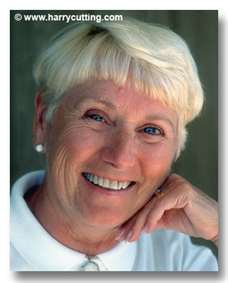
It is experiences like that that helped me decide to write this column. Here’s the article.  The rationale that caught my attention is this one.  And here’s an example of what I would call “an attractive older woman.”

Ms. Kolstad asked herself much the same question.[1]

 “In my day, no one ever thought about breast enhancement or anything,” she said. “But nowadays women go out and they would never get a second look if they show their age. I find that you have to keep up your appearance physically, even if you just want a companion or someone to ask you to dinner.

“That’s not going to happen if you don’t have a figure that these geezers are looking for.”

So here is Ms. Kolstad’s position, as I understand it.  She wants to get that “second look.”  This is that “Say, she looks really good!” look that she attributes to older men and whatever comments among the men that would follow such a look.  Without the kind of appearance that would cause men to look at her that way, you don’t have “a companion or someone to ask you to dinner.”  She is more specific too.  She wants the “figure that these geezers are looking for.”

To get this geezer-friendly figure, “Ms. Kolstad, a widow who lives in Orange County, Calif., underwent a three-hour breast lift with implants, which costs about $8,000.”  So I’m guessing that Ms. Kolstad is a good example of the sexy old women of my title.

Let me clarify  a couple of points, I am not arguing that Ms. Kolstad is not entitled to do with her $8000 whatever she wants to do.  I’m not very happy about the amount of money our healthcare system spends on the appearance of the wealthy when basic medical care is unavailable to so many of the poor, but everyone knows that that distribution of healthcare is not going to be affected in the slightest by Ms. Kolstad’s preferences about the precise latitude of her breasts.

I’m not arguing that women who want to be sexually attractive to men—Kolstad’s notion is that “sexually attractive” is the gateway condition to all kinds of less volatile associations with men, like companionship and dinner dates—ought not do what they can to look the way “men” find sexually attractive.  If that’s what she wants and she understands what kind of a transaction it is and has the raw materials, why shouldn’t she?

I did wonder a couple of things, though.  Whatever happened to the category “attractive older woman?”  Did it just disappear?  Is it really true now that to be an attractive older woman you have to look like an attractive younger woman?  Do a lot of older men and woman feel that way or it is just the geezers Ms. Kolstad is thinking of?

As I said, I don’t care all that much how Ms. Kolstad wants to live her life, but if you read the article, you will see that there is an explosion in the number of older patients who want cosmetic surgery.  If this is being driven by considerations like Ms. Kolstad’s, then a lot of the traits that were once thought to characterize a life well led have been downgraded.[2]  Living a long time in Earth’s gravity has a certain predictable effect on what a mature body looks like.  So does extended exposure to ultraviolet rays.  So does the decline of hormones that were once crucially necessary.  And so on.  Do we really want to think that a predictable stage in being an attractive older woman is having a boob job?

I guess one of the things that bothers me about that is that Mr. Kolstad’s rationale lumps me with the geezers who, you know, only want one thing.  Well, maybe two.

Another part of this is the effect on all the other categories of women.  The other categories don’t just hold still.  If a good-looking 83-year-old woman needs breast surgery to be invited to dinner, what will be said about the women who don’t have that surgery?  Will we say that “they are just letting themselves go?”  Will we say that “they used to take real pride in their appearance?”  Will we think that the biggest reason not to have the surgery is a lack of self-esteem?

Here’s what we know.  When a new category is valued, the other related categories are devalued so as to enhance the discrepancy.  This is normal social attribution.  It doesn’t take the spending the cosmetic surgery industry has put into it to make it happen.

I have no quarrel with “attractiveness” in women.  I have no quarrel with “older women.”  I have no quarrel with the kinds of changes that living many years under Earth conditions cause.  I just don’t like to have her values generalized among the older women of my acquaintance and I don’t want to be consigned to the geezers.


[1] The same question Nancy Etcoff has asked in the previous paragraph.“If an older woman wants to regain eyelids or wants a breast that she doesn’t have to tuck into a waistband, then why not?”   Etcoff is the author of The Survival of the Prettiest, which is the only book my book group ever chose on my recommendation and then refused to read because of their moral distaste for the topic.  It is a superb book, by the way.  The range of reported research is really amazing.

[2] Nothing against attractive older women, by the way.  I married one of those a few years ago myself.

Posted in Political Psychology | Leave a comment