American Catholics and African Catholics

 Yesterday, the New York Times released a poll they conducted with CBS.  The goal was to ascertain the views of Roman Catholics in the United States.  I want to go further in this post, but here are some results that might interest you.

Who is in touch with “the needs of Catholics today?”  Considered as a general matter, 53% are out of touch.  Bishops, 49% are out of touch.  Parish priests—this is where the break occurs—63% are in touch.  And for your priest in particular, 72% are in touch.  Nuns are 51% in touch.

I’m familiar with this phenomenon in the well-known finding that Congress is bad, but my congressman is good.  The schools are bad, but my child’s school is good.

What would U. S. Catholics like to see in the new pope?  He should be younger (66%) and more liberal (54%).  He should favor letting priests marry (69%) and letting women become priests (69%) and for “artificial methods of birth control.” (71%).  On the other hand, he should not favor legalized abortion (56% opposed)  or the death penalty (56%).

Finally, we come to three questions that bring us a little closer to my own interest.  The question is, “Do you believe the pope is infallible when he teaches on matters of morality and faith or not?”  The highest number say he is not (46%), but the number who say he is infallible is not far behind at 40%.

“On difficult moral questions, which are you more likely to follow—the teachings of the Pope, or your conscience?”  Not, “the teachings of the church,” I notice.  Conscience wins in a landslide, 78% to 13%.  Another 7% say they don’t know, but I’d guess those are “conscience people” whose consciences tell them it is not wise to speak their opinion candidly to a pollster.

“Do you think it is possible to disagree with the pope on issues like birth control, abortion, or divorce and still be a good Catholic?”  Yes, it is possible, 83%.  No, it is not, 13%.

This brings us to Geri Toni, a 57 year-old woman who was one of the respondents to the poll.  “I can understand how the Catholic Church stands against it (abortion).  We are not supposed to kill.  That is one of our Ten Commandments.  But as a woman, I have to make sense of it, and I believe choice comes down to the individual.”

That seems to me a striking statement for an American Catholic to make.  I am readier to hear that sentiment from a Baptist, for whom the congregational tradition is so strong and the hierarchical obligation so weak.  “I know what my church says,” says Ms. Toni, “but I’m a woman and I don’t believe it if I don’t understand it and I think that whatever my church says, it is my own sense of right and wrong that matters most.”

Did I miss anything there?  Is that what she said?


Position on Catholic Doctrines


Liberal

Conservative

Norms Governing Social Organization Individualism  

Winner in the U. S.


Loser in the U. S.

Corporatism  

Loser everywhere else


Winner everywhere else


Let’s take another step.  One of the men who is being considered as a possibility for the papacy is Cardinal Peter Turkson of Ghana.[1]  I know almost nothing about him, but let’s consider him as a strong contender on the grounds that as the Roman Catholic church is shrinking in the northern hemisphere, it is growing rapidly in the southern hemisphere.  As the majority of Catholics shifts to the south, it would make sense to choose a pope from the south and Ghana fits that directional shift.

Cardinal TurksonBut that points to some difficulties.  As the American Catholics are shifting to the left socially and theologically and as they are claiming unheard of freedom from the dogmatic guidance of their church, the Catholic church of the south is a good deal more conservative.  If they are more loyal to the institution—for lack of anything else to call that loyalty, I called it “corporatism” in the table—as well as more conservative, I think they will take over the governance of the church fairly quickly.  Organizations made up of individualists are going to lose out, more often than not, to organizations made up of corporatists, or, if you will, “team players.”

So now what?  American Catholics split off and become Episcopalians?  A distinct, non-papal American Catholic Church is devised?  Catholicism splits into a church of the Catholics of the North and the Catholics of the South? 

I have no idea.  The thing I am pretty sure of is that the Catholics can’t become markedly more liberal, so as to keep the American allegiance, and markedly more conservative, so as to accommodate the South, at the same time.


[1] I’m just meeting Cardinal Turkson today.  I know his nickname is Peter the Roman.  I know his full name is Peter Kodwo Appiah Turkson, and I know that his father was a carpenter.

Posted in Political Psychology | Tagged , , , | Leave a comment

It’s So Hard to Get Good Help These Days

It is a truism among environmentalists that it is not possible to do just one thing.  I think it is true everywhere, but environmentalists have demonstrated it so clearly and so many times that I think they deserve to be recognized for it.

Public policy, on the other hand, very often tries to do one thing.  Only.  Scarcely a bill or a regulation exists that does not have a single or a very small number of “goals,” and we are left to wonder what other effects these measures will cause and when the effects will be visited on us.

We will be working today with a notion that the authors of a recent article call “AE.”  Academic Entitlement.  Who would have thought it?

Imagine for instance, that a university wanted to become aware whenever a professor’s conduct of a course fell so far below the university’s standards that even the students noticed it.  If, for instance, the professor frequently failed to come to class or if he graded examinations unfairly or if he fell asleep during his own lectures.  I have seen that done and I am not entirely certain I have not done it myself.  The solution to this difficulty is easy to discover.  Require the professors to distribute and ask the students to complete a Course Evaluation Form.  When a number of such forms indicated that the professor missed classes and misgraded exams and snoozed during the lectures, the department or the college would have some occasion to deal with the difficulty.        

What could be simpler?

Except, of course, that it is not possible to do just one thing.  When one remedy is enacted, others are enabled.  If, for instance, you begin by asking whether the lecturer dozes as he lectures, will the next level of question to be enabled be whether he is “interesting?”  Next, whether he is “knowledgeable?”

Both of those questions are troubling to me as a political psychologist because the power in the question is in the status it grants to the one who is asked to give the answer.  Both are troubling to me as a professor as well.  Let me mention a few things about “interesting” that you and I both know.  Some lecturers are more interesting than others.  Students who have invested themselves in the material before class are much more likely to be interested than students who have not.  So, as we all know, “interesting” is a word that attaches to the lecturer, but it is, in fact, a transaction between the lecturer and the student.

The second question (the professor is knowledgeable) is even more vexing.  It requires both that the student know how much the professor knows and also how much he should know.  Is that a good question to ask the people who are supposed to learning a discipline?  Would they know enough to answer such a question?

Immediately following are other issues that are opened up.  If we imagine that a student knows whether a lecturer is “interesting” (apart, of course, from his own preparation for class) and whether the lecturer is “knowledgeable,” there is the question of whether students by and large will answer these questions based on their own sober judgment, or whether they will use them to unfairly reward some professors and unfairly punish others.  If a student asks for additional time, for instance, to complete an assignment for which the deadline was last month and is denied that request and is angry about being denied and then is given a Course Evaluation form, will he offer his own sober judgment about the professor’s work or vent his anger about the favor denied?

he is hotAny questions you might have about where this leads may be addressed at www.ratemyprofessors.com.  Professors are rated there as to whether they are “good” and whether they are “hot.”  Here are two pictures I found pursuing the question of what “hot” might mean.  No one I have ever had as a colleague in my sixty yshe is hotears of teaching looks like either of these spectacular specimens.[1]

It does get worse, though, and I come now to the deeper meaning of the axiom about “doing one thing.”  When you ask a student to complete an anonymous evaluation, you have in mind collecting information about the professor and you do.  You also bestow the status of “consumer” on the student.  No one seemed to notice at the time. but treating them as customers has had, eventually, the effect of students coming to think of themselves as customers as of courses as “products” which they are competent to judge.  They come to feel “academically entitled.”   I didn’t like her class in medieval philosophy becomes a statement like I don’t like the new flavor of yoghurt.  “It,” says the student of both the course and the yoghurt, “failed to please me.”

I got to thinking about this when I ran across an article, “Self-Entitled College Students: Contributions of Personality, Parenting, and Motivational Factors.”[2]  Their concern is with “academically entitled” (AE) students.

The authors have devised a scale to help them quantify “academic entitlement.”[3]  They gave to a sample of students statements that seemed to capture the notion of entitlement.  The percent agreement you see is the combined numbers for the three favorable columns—“strongly agree, agree, slightly agree.”  I found it interesting just to see the concept specified.  I’ll put an asterisk on the ones I have faced myself.  The percent agreeing (all three levels of agreement combined) is in parentheses at the end.

1.  If I have explained to my professor that I am trying hard, I think he/she should give me some consideration with respect to my course grade.*  (66.2%)

2.  I feel I have been poorly treated if a professor cancels an appointment with me on the same day as we were supposed to meet. (41.1%)

3.  If I have completed most of the reading for a class, I deserve at least a grade of B.* (40.7%)

4.  Teachers often give me lower grades than I deserve on paper assignments.* (31.5%)

5.   Professors who won’t let me take an exam at a different time because of my personal plans (e.g. a vacation or other trip that is important to me) are too strict.* (29.9%)

6.  Teachers often give me lower grades than I deserve on my exams.* ((25.4%)

7.  A professor should be willing to lend me his/her course notes if I ask for them. ((24.8%)

8.  I would think poorly of a professor who didn’t respond the same day to an email I sent.* (23.5%)

9.  If I am not happy with my grade from last quarter, the professor should allow me to do an additional assignment.* (17.7%)

Finally, this one got only 11.2% agreement, but I think it captures AE so very well; “ professor should be willing to meet with me at a  time that works best for me, even if inconvenient for the professor.”***

rate profsBefore I close this reflection—and well before it becomes a diatribe—let me point out that nearly all the students in whom I have encountered these attitudes are students with good manners and normal temperaments.  Reading the items above, it is easy to picture mincing vixens and snarling brutes.  That hasn’t been my experience.  They are learning what the implications of the status “student” are, and the status, “professor.”  They are trying out new roles, very often coached by upperclassmen who have found that one technique or another has “worked.”  They come to me as they would come to a sales clerk who had just charged them $39.99 for a bracelet marked $19.99.  “You’ll make this right, won’t you?  It’s only fair.” they ask.

I don’t have a solution for AE.  I think it is part of the presumed self-worth of our times.  Grade inflation—at all kinds and styles of institutions have experienced this, by the way—seems to have made students feel that they are really smart.  Email has put professors in a position that only butlers were once in, receiving negative evaluations for responding too slowly to employers’ demands.  Anonymous evaluations of professors—do you think your professor is really up on the latest literature?—have caused prudent professors to court the favor of their students.[4]

It is also true that at my university, Portland State, many students are driven to requests like this who would not otherwise make them.  I teach single moms who have three kids, take a full academic load and work 40 hours a week.  One of the students in my 8:00 a.m. American government class came to class on his way home from work.  We worked together to deal with his tendency to go to sleep in class and sometimes we were successful.  It teaches students who are paying their own way through the university with the tips they get as barmaids and the night before the exam was very often a late night.

I have both respect and compassion for these students, but they are not in my class to get what I am there to give them and among them, the snarky ones feel that in the universities, it is so hard to get good servants these days.


[1] Although Daniel Hamermesch in his book Beauty Pays says that “hot” professors make about 6% more than “not” professors.

[2] Nearly any online library collection will get you to the Journal of Youth and Adolescence.  This article, by Ellen Greenberger, Jared Lessard, Chuansheng Chen, and Susan P. Farrugia,  is in Volume 37, no. 10 (2008) pp. 1193—1204.

[3] The thought being, “if you quantify it now, you won’t have to qualify it later.”  I just invented that one and I am still enjoying it.

[4] Tabachnick et. al. report that 22% of academic psychologists states that they sometimes give “easy courses or tests to ensure popularity with students.”  The work is cited in Greenberger et. al. if this catches your interest.

Posted in Education, Getting Old, Political Psychology | Tagged , , , | Leave a comment

Smart and Poor

This post is going to be about the working poor.  I say that first because it is going to take me a little bit to get there.

In my line of work, which is political psychology, we make a good bit of use of a catewhygory called salience.  “My line of work,” will not change, by the way, when I retire for Portland State University.  I’ve been mulling over political psychology ever since there was a subdiscipline called that and I’m going to continue being a political psychologist long after they have stopped paying me for it.

Salience is one of those words, like data, that seem to be “out there,” but which are, in fact, “in here.”  They are something we do, not something “it” does.  Data is a word that comes to us from the empiricist tradition.  It comes to English from the Latin and I am going to give all four principal parts because it is a funny-looking verb for English speakers.  The parts are do, dare, dedi, datus.  You can see the beginnings of data in datus.  It means “to give” and data are “given to us” by the environment.  We now know that nothing is “given to us.”  Conception shapes perception.  It if comes into our minds, it comes in tainted.  That is why rats in mazes observed by English scientists behave differently that rats in mazes observed by German scientists.

Salience comes, Latin again, from salire, which means “to jump.”  We say something is salient if it “jumps out;” it “calls itself to our attention,” we sometimes say.  A fact “jumps out at us” in the same sense that the sun “rises” in the morning.[1]  It is a perfectly natural way to describe the feeling of the occasion, but when you start paying serious attention to it the earth and the sun, you need to understand the process differently.

I am going to show you two tables and give you a little back-of-the-envelope calculation.  It isn’t anything in the tables that I want to talk about.  The tables present data that are salient.  In each, there are comparisons that lead our minds along one path or another.  What I want to talk about is the choice of paths.

Being Poor in OregonHere’s the first table.  It shows who was making how much money in wages in Oregon in 2010.

Here is a little razzmatazz that I put together for a course on public policy.  It doesn’t say anything important.  It simply says what is in the table

1.         One of the ways of calculating a “family wage job” is called the “average covered wage.”  That is the sum of payroll from establishments covered by unemployment insurance law divided by the total number employed at those establishments.  In 2010, the average covered wage was $41,700.  By an eyeball calculation, that fits at about the center of the $35,000–$49,999 bar, the fifth from the left.  If that bar is read at 15%, we can borrow half of it (7.5%) and add it to all the bars to the right and come up with a percent of “family wage jobs.”  It is 54.5%.

2.         That means that 45.5% have “less than family wage jobs.”  You can calculate it, or add up the value of all the remaining bars.

3.         The poverty level for a family of three in 2010 was $17,400.  It would take more bar-splicing to get that exactly, but the total of the two left hand bars is just over 13% and that is close enough for this exercise.  The number is $11,000 for a single individual, so only about 7% of the “households” are poor if they are one person households.

4.         If  the botton 13% of the nonfamily wage earners are below the poverty line (for a family of three), then  32.5% are left in that fuzzy category that is better than poor, but not as good as family wage.  “Family wage” is defined as covering the “basic expenses,” like food, housing, and utilities for the earner, a spouse, and/or two children.

We learn from this chart that in Oregon in 2010, somewhere around 13% of the workforce are going to be living in poverty.  We don’t know who that will be, but if I had money to put on it, I would put the money on children who had been reared in poverty and, as adults, are still poor.

We learn that 32.5% are going to be “better than poor” but not as comfortable as “meeting the basic expenses like food, housing, and utilities for a family of three.  Again, we don’t know who they will be, but we know how many of them there will be.

Here is the second table.  It doesn’t anything much either.  It shows how much schooling was received by the categories “low-wage workers” and “high-wage workers.”[2]  A glance at the table tells you everything you want to know.

Educational Attainment Low – wage workers Higher-wage workers[3]
Less than high school

23.8

6.1

High School/GED

36.3

29.3

Some college

30.0

32.1

College or more

9.9

32.5


Now we get to my part.  What is the presupposition of the first table so far as jobs and poverty is concerned?  It is that there are only so many jobs that are “family wage jobs.”  When those are filled, we are done.  Everyone else who is in the workforce will have a “less than family wage” job.  That seems obvious, doesn’t it?  If there are 100 students in a classroom with 20 seats, we know that 80 students will be standing or making some other arrangement.  We don’t know which 20 will be seated, but we know how many.  If you want to know how many students will be standing, you look at the first chart.  If you want to know how to get one of the seats for yourself, you look at the second chart.


What is the presupposition of the second table so far as jobs and poverty are concerned?  It is that the more education you have, the more likely you are to have a “higher-wage” job.  If nearly a third of those good jobs are held by people who have college degrees “or more,” and if I want one of those jobs, I had better get me some college “or more.” [4]

And that is true, of course, up to the point where we run out of higher wage jobs.  When we have more “college or more” workers than we have “higher wage jobs,” then we will start gathering a crowd of people who have college or more and putting them into “less than family wage jobs” because those are the only jobs left.

And this returns us to salience.  By this reading, the most important aspect of the table on the distribution of wages is the presupposition that there are so many higher wage jobs and not more.  A table could be constructed that dealt with the processes by which a larger number of jobs is produced, but it would not be an “educated workforce” table.  The whole presupposition of this table is systemic—there are so many such jobs and no more, exactly as in the classroom, there are 20 chairs and no more.

Conversely, the presupposition of the table on education and wages is that the more education you have, the higher your wages will be.  It is individualistic rather than systemic.  It tells me what I must do to improve the likelihood that I will get one the jobs in those top few bars the the distribution.  It has nothing at all to do with how many such jobs there are, only what I must do to get one.

So the most important aspect of these two tables, by this reading, is not what they say but on what they presuppose.  The salience, what jumps out at me, is that you can look at either the individual goals table or the systemic capacity table—provided that you know that there are two and what the limitations of each one are.

Otherwise not.  And that’s why it is sometimes handy to have a political psychologist around.


[1] Incidentally, my grammar checker harrumphed at me for that sentence.  It said it was a fragment.  What do you think?  Does that look like a fragment to you?

[2] Notice that we are permitted to know that something is low—absolutely low—but we are not permitted to know that anything is high, except in relation to other members of the category.  It’s just a euphemism used by economists.

[3] Just a language note.  Look how statisticians wiggle to avoid saying “high wage.”  The pattern here should be either high wage and low wage OR higher wage and lower wage.  Neither of those sets is chosen, so although we have “low-wage workers,” we do not have “high wage workers.”  Does that strike you as odd?

[4] I’m going to make this pitch on February 26 to a bunch of senior political science majors, most of whom will not blink at the idea that their education will put them in line for a job that pays “higher” wages.

Posted in Political Psychology | Tagged , | 2 Comments

Property and Privacy

I’ve been thinking about civil liberties.  Civil liberties are the things the government(s) aren’t allowed to do to us.  Being Americans, our minds go right away to freedom of speech and assembly; of guarantees against cruel and unusual punishment and retroactive definitions of crimes.

Then I listened to the opening lectures of John E. Finn of Wesleyan University.  He has recorded a course called “Civil Liberties and the Bill of Rights” for The Teaching Company.  In Lecture 2, he popped an idea that so stimulated me that I want to write about it even before I hear how he wants to develop it.  I already know how I want to develop it.

John Adams “The moment the idea is admitted into society that property is not as sacred as the laws of God … anarchy and tyranny commence. PROPERTY MUST BE SECURED OR LIBERTY CANNOT EXIST”
James Madison “Government is instituted to protect property of every sort …. This being the end of government, that is NOT a just government,… nor is property secure under it, where the property which a man has … is violated by arbitrary seizures of one class of citizens for the service of the rest.”

right to propertyHere’s Finn’s idea.  The Framers looked to private property as a “hedge against tyranny,” as illustrated by the two quotations. I had never thought of the right to property as a civil liberty, but I get the idea.  It’s a place the government cannot come and your property has features the government cannot appropriate.  Then, says Finn, he is going to move directly to the right to privacy.  The logic of that transition is that privacy is important to us now for the same reasons that property was important to the Framers.  Privacy, to say it another way, is “the new Property.”

Here’s what that might mean.  It seems to me that Adams and Madison had a notion of property based on Europe’s reaction to the end of the feudal era.  Feudalism was about protection.  The lord with his castle walls and moat could protect the serfs from invasion.  In between, he could use the serfs pretty much any way he chose.  The serf’s didn’t have property, so they didn’t have property rights.  The existence of a putative legal right—the famous droit du seigneur— allowing the lord of a medieval estate to take the virginity of his serfs’ maiden daughters indicates that they didn’t have privacy rights either, but that’s another matter.

A merchant class developed, which had money and eventually property.  It was their control of their property that distinguished this era from the previous one.  My argument is that it was this notion of property as something the lord—or the king—cannot do that Adams and Madison had in mind.

Finn wants to argue, he says, that privacy is like that to us.  We are a deeply interconnected society.  We treasure our right to be private the way the Athenians treasured their right to be public.  As the government of the 18th Century was denied access to our property, so modern governments must be denied access to our identity and that is what “privacy” is all about.  It is about who I am allowed to be.

And who I am allowed to be brings us to the question of “private behavior.”  Am I private when I am parking my car in a shopping mall parking lot?  Possibly.  There may well be surveillance cameras around.  If there are, you are private unless you do something against the law.  If the people watching the surveillance tapes see you breaking the law—you may have been spanking a child, for instance—they may be required to report what they saw.  It could very well be a crime for them not to report what they saw.

Are there private conversations anymore?  Not on Portland’s highly regarded MAX light rail system.  The new cars for the rail line come equipped with audio and video monitors.  “These are standard,” says Tri-Met, the parent agency.  That means that Tri-Met has no particular interest in seeing what you do and in hearing what you say, but they are going to anyway because the cars they bought come with those capacities.  The case will be made that they are for protection, as the feudal system was, but I say they are about privacy.

And your private conversations probably shouldn’t be conducted by email or any of theRight to Privacy 2 social online media either.  There’s a record of every email stroke you make and these records can, under certain circumstances, be subpoenaed.  The courts are now deciding whether employees have the right to “personal” social media, like Facebook or whether part of the job is turning your passwords over to the employer.  If this right exists—we’re still working on it—it would mean that the employer cannot come into your “cyberspace home” and see what you’ve been doing there.

Your “private” online searches aren’t private either if Google can be forced to hand their records—that’s their records of what you do—over to the government and they aren’t private if Google or Bing are free to sell them to a third party either.  And this doesn’t ever raise the question of the warrantless wiretapping that has come to us courtesy of the PATRIOT Act and that the Obama administration has so far shown no interest in disconnecting.

Will the defense of civil liberties provide a hedge against government intrusions on privacy?  Probably not.  But I don’t think we’ve hit the worst of it yet.  What if we could be enticed into giving up our privacy freely for some commercial consideration or another?  That would be worse, wouldn’t it?  Worse to give it away than to have it taken away?

I’ve been thinking about Disneyland in a new way since Bertram Gross wrote, in his book Friendly Fascism, that when—my recollection is that he said “when,” not “if”—fascism comes to the U. S., it isn’t going to be jackbooted thugs.  It’s going to look like Disneyland.  It struck me that our current vigilance in protecting our property would be like our vigilance against jackbooted thugs and our failure to be vigilant about our privacy would be like our failure to be vigilant and selling our personal information to Disneyland.  Here’s what that would look like.

right to privacy 3The Disneyland model seems to me to cross a new and very American line.  The Disney plan is called MyMagic+.  It eliminates waiting in line if you are wearing the bracelet (and if you have paid for it, of course).  It means your kids can be greeted by name by the Disney characters in the park.  So Cinderella comes up to your daughter and says, “Oh, Caitlin, it’s so good to meet you.  And on your birthday, too.  Happy birthday, Caitlin.”

How does that sound?  I’ll bet it sounds pretty good to Caitlin.  To me, it sounds like the old TV ads for sugared cereals, where the kids were instructed to tell their parents that the kids wanted Sugarpuffies and nothing else.  Kids deserve Sugarpuffies.  And only parents who didn’t know the worth of their children would deny them such a treat for breakfast every morning.  This approach led to awful rows in the cereal isles of supermarkets and most of the ones I heard ended with the parent agreeing to buy the Sugarpuffies, although not on the first—and sometimes not on the third—pass.

So Disney now markets to Caitlin.  If it isn’t this year, it will be next year.  They portray the scene.  How wonderful that Cinderella knows who you are!  Who would deny a daughter an experience like that?  And all you need to do is buy a bracelet, give a lot of personal information, including your credit card number, to the folks who run the park and wear a GPS chip everywhere in the park you go.

I don’t expect Professor Finn to follow this line as far as the Disneyland example.  I think he will want to talk about phone and video and possibly cybersurveillance.  Things the government might want to do.  He might even get into the government commandeering emails and records of searches.  But if we can be nagged into selling our privacy, cybersuveillance will be the least of our worries.


Posted in Uncategorized | Leave a comment

It’s Providential. And That’s the Bad News.

“What luck!” says the woman with the secular vocabulary.  “No,” says the man whose mouth is full of theology, “It’s providential.”  Does that exchange make any sense at all?

Yes and No, I would say, if asked.  (On a blog, you don’t have to wait to be asked; it’s one of the best things about blogs.) It is true that “lucky” and “providential” are alternative explanations of an event, along with “fate” and “karma.”  The bulk of my academic work has been spent dealing with what we call “causal attributions.”  We “explain things” to ourselves by attributing causes.  This happened because I was too dull.  That happened because his explanation was obscure.  Two causal attributions and, as it happens, one internal (I was too dull) and one external (he was too obscure).  That pattern of internal and external is pretty common and if you pay attention, you will discover that your friends tend to specialize in one or the other.  If you pay even more attention, you will discover that you, too, specialize in one or the other.

Both of these attributions, it turns out, are external, but it is the positive flavor of both explanations that caught my eye this time around.  We say, sometimes, that people have “good luck” or “bad luck,” but when we just say “luck,”—as in “he was lucky”—it is always good luck we are referring to.  Similarly, when those who use the word “providential” say that some event was “providential,” they mean that it was a good thing.  No one says, “Oh well.  It is sad, but it was providential.”

Providence 3Why don’t we say that?  This argument is going to turn theological in just a little bit and when it does, I will use “Providential” with the characteristic capital P to refer to the Providence of God.  The word used this way refers to the intentional ordering of things by God.  I say the quip once that “Providence” is the word Christians use instead of “history.”  That isn’t precisely true, of course, but it does give you a sense of the scale of the word.  Does this picture illustrate Providence?

We get the word from provide.  If you pronounced it “pro-VIDE-ence,” you would see that right away.  So Providence is what God provides.  But God, the argument goes, “provides” based on what He foresees.  That’s how the etymology works, anyway.  The root is the familiar videre, “to see.”  God sees pro- (a version of pre-) ahead of time, so He knows what to make available to us.  You could argue, as some do, that what is—what we see around us—is what God has “provided.”  Or you could argue, as others do, that what we see around us is the result of what we have done with the opportunities and resources with which God has provided us.  The theologies are different, of course, but the word works the same way.[1]

From the standpoint of faith in God’s work, we can say that Providence is good.  Weprovidence 2 can say that about events we believe to be entailed in God’s management of things whether we like the particular things or not.  Contrary to the way we use the word, Providential means only that it is a part of God’s plan; it is something He has provided.  So the magical availability of a parking place could be said to be “Providential,” as could the maddening hour-long search for a parking place.  The fact that we appreciate the parking place and deplore the hour-long search says nothing at all about whether both or neither are entailed in God’s management of things.  God’s Providence is, in other words, an inference, not an observation.  And it isn’t a very useful inference either, from a cognitive standpoint, because you can’t say by looking that some things are Providential and some are not.  Some things actually are Providence, however.  Here is a picture.

Providence 4Here’s how I came to this dilemma most recently.  The last scene of Oh God, with John Denver as Jerry Landers and George Burns as God, illustrates the dilemma.  Jerry has done all the things God asked him to do and his doing of them has had certain consequences.  He has been fired from his job as the manager of a supermarket.  He has become a public laughingstock.  Probably, he as lost his wife and kids, too.  The movie doesn’t say, but they are a big part of the plot and then they disappear.  So, is this Providential?  Yes.  It is.  I have George Burns’ word for it.

The scene goes like this.  Jerry is driving out of town when a phone rings in a phone booth he has just passed.  He back up, goes to the phone, and discovers God in the next booth, talking to him.

Jerry:   We failed, didn’t we?

God:    What are you talking?  We did terrific.  I gave you a message of encouragement.  You     passed it along.  Now we’ll see.  You did good.  We both did good.  We’re covered.

Jerry:   Do you think anybody got the message?

God:    Do you think we have enough apples in the world?

Jerry:   Apples?

God:    We’ve got all the apples we need.  You’re Johnny Appleseed.  You drop a few seeds and      you move on.  If the seeds are good, they’ll take root.[2]  I gave you great seeds.  The best.

Jerry:   I lost my job, you know.

God:    There are other cities.  Other supermarkets.

Jerry:   Everybody things I’m a nut.

God:    Galileo, Pasteur.  Einstein.  Columbus.  You’re in good company.  Hold on.

So there you are.  God cares a great deal about the seeds, about whether they will grow.  It is God’s judgment that the cost to Jerry of this exercise is well worth while.  The movie doesn’t show us just how Jerry takes that argument.  I think I would find it hard, myself.  Then I would remind myself of two things I know to be true.

The first is that you can’t tell by looking.  I experience the costs, certainly, and in Jerry’s case, the satisfaction of doing the right thing, just as God told him to do it.  In order to appreciate whether the benefits—the Providential ordering that could not have happened if I had not done what I was asked to do—match up with the costs, I would have to know what the benefits are.  Not the benefits to me.  That would be hard enough.  THE benefits—the good that will come of a certain proportion of these seeds taking root and growing to full maturity.

So here I am, yearning for a nice clear cost/benefit justification and I find that I can’t measure the benefits.  Only the costs.

The second is that you can do without the reassurance of cost/benefit analysis if youProvidence 1 trust that things are Providential and that it is God who is asking you to do your part, however difficult that part might be.  Paying the costs is hard for Jerry, but knowing what God wants him to do is not.  God tells him exactly what he wants him to do and dazzles him with miracles.  Jerry still remembers the miracles, I am sure, but now he is trying to live down the reputation he got from doing what God asked him to do and he is looking for a job and, as I see it, trying also to stay in touch with his estranged wife and his kids.  He is remembering the miracles and he is living the life that his behavioral choices—God’s choices for Jerry’s behavior—brought him.

So what shall we say to Jerry?  “Don’t worry.  It’s Providential?”  That would be hard.  I wouldn’t want to be the one to have to say that.  Of course, I have my own causal attributions to make and my own behavioral choices as well and I don’t have Jerry’s certainty.   And I really don’t want to lose my job and my reputation and my marriage and my kids.

But if somebody has to, on what grounds, exactly, would I say that it shouldn’t be me?


[1] From here, some go off to theodicy, a “justifying” of God’s management of the world  and His management of us part-timers who live here for a little while and who are supposed to keep the place in order.  That’s not the direction I am going here.

[2] Jesus used the same metaphor to make a different point.  Three different points, actually: one in Mark 4, another in Matthew 13, and yet another in Luke 8.  All of them imagine that the seeds themselves are, as George Burns says, “the best.”

Posted in Theology, ways of knowing, Words | Tagged , , , | Leave a comment

The Most Conservative Electable Candidate

Has anyone noticed what Karl Rove is up to these days?  He may not be able to call Ohio for Obama in a prompt and professional manner, but I think he has opened a whole new front in the partisan wars in Congress.

In my line of work, there are many opportunities to describe “the responsible party model” of politics and to lament our failure to approximate its severe logic.  In fact, the U. S. has never had a responsible party system and cannot have one now without a lot of new legislation, but the model does serve a purpose now and then.  This is one of those times.

In the Responsible Party Model (RPM) the party is dominant: it chooses the candidates, it gives them the complete list of talking points (which used to be called a party platform), and it funds the campaign.  The candidates aren’t really “persons” as much as they are little atoms of party-ness.

Here’s the intriguing part.  If all the candidates are hewing to the party line and if the party wins a majority, then there is a majority to actually enact these “talking points.”  The Democratic party campaigns on ending torture.  All Democrats are in favor, by definition.  They win a majority and pass a law eliminating the use of torture.  At the next election—here’s where the “responsible” part comes in—the party returns to the public with a record of accomplishment of the items on party platform and this question: “Do you want us to keep doing this?”

The theory is that “the people” aren’t all that good as evaluating theories and promises, but they are really good at evaluating policy effects.  You campaign on redistributing income through taxation and at the next election, I watch to see whether it has happened and if it has, whether I like it the way I thought I would.

Now you might be wondering what brought that to mind.  Here’s the article that started me thinking about it.  If you look at the RPM, you can see that Karl Rove’s new push really doesn’t recruit Republican candidates.  Rove wants to “vet them” and the criterion he admits to is “as conservative a candidate as can be elected.”  Rove doesn’t want to establish uniform “talking points.”  Rove doesn’t want to fund the candidates in the sense that Crossroads America is the only source of funds.  In fact, you could argue that all he really has in mind is to neutralize the political contributions of people like the Koch brothers.[1]

Rove’s initiative is as close to the RPM plan as we have seen on the political right.  It chooses the candidates (vets them) and it funds them (by counter-funding the primary election opponents).  And really, you have to wonder what else he could do.

There has been a powerful and recent alliance between angry conservative voters (Tea Party) and strategic conservative donors.  The combination has elected a “Tea Party Caucus” in the House of Representatives.  Speaker of the House John Boehner doesn’t have a Republican majority without them.  And, since they have resisted his calls for Republican unity, he doesn’t have a majority with them either.  That means that the power of the Republican party in Congress has waned considerably.  Further, the success of Tea Party Republicans in winning primary elections, then losing to Democrats in the general elections has led to the worst of all possible worlds—Democrats have been winning seats that should have been won by Republicans.

So Rove has swung into action.  Maybe he remember the RPM lecture an otherwise undistinguished professor gave at the University of Utah.  Maybe he would rather see moderate Republicans elected than conservative (Blue Dog) Democrats.  Maybe he is sick and tired of seeing very wealthy conservative donors skewing the ideology of his party and screwing the Republican leaders in the Congress.

We really don’t know.  What we know is that Rove has the RPM somewhere in his mind and he is doing what he can to keep the Republican party from committing suicide.


[1] Rove believes that things really don’t go better with Koch.

Posted in Politics | Tagged , , , | Leave a comment

The Fret of Care

Today, I am working with a title from one world and an event in another. The title comes from a hymn we sang in my church when I was a little boy.  The whole line, adapted to today’s question is, “O Master…help me bear the strain of toil, the fret[1] of care.”  The event is the current movie, Amour, which has been nominated for five academy awards.  If you have seen it, you know why the expression, “the fret of care” came to my mind.

Spoiler Alert: I’m going to talk about what happens in the movie.  Some people would rather find out at the movie what happens.  I am not one of those.  I am more likely to go to a movie to see what I know is going to happen.

Georges (Jean-Louis Trintignant) and Anne (Emanuelle Riva) are in their 80s, creaky but happy.  They appear to have had a full Fret of Careand satisfying life and that life goes on.  One morning at the breakfast table, Anne has a stroke and their life becomes more stressful.  Then she has another, with which they cope as best they can.  Then another, a more serious one, and they simply run out of coping resources.

Now what?

Georges agreed to honor her urgent request that she not be placed in a care center of any kind, but she said that and he agreed to it after the first stroke.  Now there is no chance to renegotiate the agreement, so Georges sticks with it.  He gives himself full time to caring for Anne, which she appreciates in the beginning, but as she sees him start to slide, she urges him to live a life of his own.  Get out, see friends, go to concerts.  He won’t do that.

Amour after the strokeThe guilt Anne feels as the proximate cause of Georges’s dutiful despondency weighs on her, but there is nothing she can do about it.  She seems to feel a despair about her own life, but I think it may be more the grinding sense of guilt about what she is doing to her dear husband.  He has trapped her in her guilt and it is more than she can bear.  That’s how I saw the story.

The movie meant a lot to me because I had done a lot of thinking about it before.  It took my wife, Marilyn, about two years to die after her cancer was diagnosed.  During a fair amount of that time, there wasn’t much her body could do, but her mind was a sharp as ever.  I wrote some essays during that time and we read them together.  She liked them.  She wanted to be the woman in those essays, she said.  She was, actually.  I modeled the woman after her.  And she was grateful that I was trying to be the man in those essays.

Here are a few of the things she liked.  They were written in the winter of 2003, the year she died in August.

The principal responsibility of the partner as caregiver is to see to it that care is provided.  Some things can be done only by the partner.  Others can be done by family and friends, but it is the partner’s job, always, to see to it that they are done.  Not that they are done “his way,” but that they are done to the satisfaction of the recipient.

The caregiver’s principal job is not to provide all the services his partner needs.  He can’t possibly do that, for one thing.  But also, he should not because it will cost him more resources than he has, or than he has access to.

And also:

Committing to the work when the caregiver does not have adequate resources is more likely to produce denial than adaptation.  I can always say I have more resources than I have, meaning that I surely must have more than I know about.  I can always say that the cost to me is acceptable, when everyone who knows me can see how my life is distorted by the burden I am, at the same time, bearing and denying.  And by slow and steady steps, I become, under those pressures, a husband less and less familiar to his wife, a man less sought after by his friends; a man who would rather live an impossibly shrunken life than claim a life of his own and find the resources to live it.

And finally:

In any case, however the caregiver justifies his choices, his job is to do gladly, as he is able, the services he does for her.  And to do generously what he cannot do gladly.  And to block, in any case, any appearance of unwillingness to do what needs to be done.  Unwillingness hurts.  Joyless duty hurts.  And if he feels that way about the tasks that have fallen to his lot, he should find a way to keep it to himself.

For every point about the caregiver, there was a point about the receiver of those services.  Marilyn said she “aspired” to them, but in fact, I formulated them by writing down what I saw her doing.  Maybe I’ll write about that side of the relationship some time.

You can see, in any case, why I found the movie so attractive.  It is a beautifully written and sparely filmed story.  It’s beautiful and it’s worth thinking about.


[1] The OED says there is a meaning that has a transferred sense of  “slow and gradual destructive action, as of frost, rust, disease, chemical corrosives, friction, the waves, etc.”  That’s the kind of “fret of care” I was thinking of.

Posted in Getting Old, Love and Marriage | Tagged , , | 3 Comments

What is God like?

This is one of those “Why is the grass green?” kinds of questions.  I do want to try to answer it in the third of the pieces that make up this blog, but I have two prior questions.

The first is this: Don’t we already know what God is like?  We have an entire library full of stories about Him.[1]  I am thinking here of the sixty-six volume library (Bible) that we use in the Protestant tradition.  This library contains, among other things, both stories and propositions and I am thinking here more of the stories more than the propositions. This being the case, the question becomes, “What do these stories teach us about God?”

The stories reflect the history of the Hebrew people and their continuing reflections persistent widowabout the stories of their origins and their covenant with Yahweh.  That means you could say, in one sense, that the God we know about is the Hebrew God.  But the Jews and Christians (and Muslims) are monotheists and believe that there is only one God, so the expression “Hebrew God” is not really  a good one.  It imagines that each people has its own God, so we could talk about the Hebrew God and the Babylonian God (interesting question of capitalization there) and so on.  Or we could mean “God as the Hebrews imagine Him to be, based on their long history of interaction with Him.”
I think that’s a pretty good answer, but I have to tell you that I am a modern German (by ancestry and to an unusual extent, by culture as well) and I come to this treasure house of Hebrew experiences as an outsider in every way.  I read these Hebrew stories and I note what conclusions the writers (and rewriters) drew from them and I wonder they are the right conclusions.  The God of the Hebrews is just so….Hebrew.

When I was a boy and I learned “what God is like” by spending a lot of unsupervised time in the Holy Library—everyone in my family had a Bible of his own—I learned that the conclusions the Hebrews drew were all true.  Actually, I didn’t learn that.  I took the truth of the accounts for granted, which is not exactly the same thing.  And now that I am not taking them for granted anymore, I find myself, a well-read Christian of scholarly habits, asking really naïve “Why is the grass green?” kinds of questions.  Why me, God?  Why now?

This brings us to the second point.  The implication of the foregoing line of thought is a commonplace, indeed it is a beginning place, for religious ethnographers.  Every people ever studied has devised a god (or some gods) of some sort that can serve as the repository of the highest and best traits of that people.  Where generosity is prized, God is supremely generous.  Where justice is prized, God’s justice is praised.  We decide on our best traits, project them onto a deity, and multiply for 1000.  And so on.  This would lead, in another essay, to the question of whether anyone is actually right about the nature and character of the One True God, but it will not happen in this essay.  This leads, in this essay, to a much easier question, which is, “What is a good parent like?”

Not so hard, you say.  A good parent raises children who think and feel and act as children should.  Or, from an ethnographic point of view, we say, “…as they should in that culture.”  There are cultural norms that apply to the behavior of children and children who conform to those norms—that would include the norm of adolescent rebelliousness in our culture, by the way—are “good children.”  Good children had a good parent.

But when we begin with the idea that the characteristics of successful parenthood vary from one culture to another, we can come back to our original question and ask just how God is a good parent.  Let me simplify all the possibilities by imagining that there is a Hebrew style of good parenting and a German style.  I don’t want to stereotype modern Germans, so I will use the well-known and ancient norms of the Stoics to represent “Germans.”

Imagine that a child has a desire and makes this desire known to a good Hebrew-styleask and you shall receive parent.  Let’s say that the function of an expressed desire, in this system, is to affirm and clarify the relationship between parent and child.  The child says “Please…” and parent says, “No.”  The child says, “…just this once?”  No.  The child says, “…if you really loved me…”  No.  The child says, “I’ll be good all week if you say yes.”  The parent says “Yes.”

Is this good parenting?  In this mode, which I have invented and aligned to a hypothetical Hebrew model, the answer is yes.  The request was in play for a long time.  The child and parent are kept in relationship for a long time.  The solution to the dilemma was both rewarding and instructive.  What’s not to like?  Unless, of course, this was happening at the table next to yours at the coffee shop.

Now imagine that the child has a desire and makes this desire known to a good German-style (Stoic) parent.  Let’s say the function of an expressed desire, in this system, is (primarily) to make a decision about the desire and to (secondarily) affirm the relationship between parent and child.  The parent in this system is imagined to be thoughtful and fair-minded, committed to the well-being of the child, and concerned that, over the long run, desires like this and the best response to them, will be internalized and become part of the child’s character.  The child says, “Please…” and the parent says, “No.”  The child goes off and considers what has been said.  The child returns and says [please substitute the child-like pleading language of your choice here] “I know you said No when I asked you earlier, and I will, of course, respect your wishes and your wisdom, but I wonder if you had considered X in your answer.”  The parent says, “Yes, I did consider that.”  “Ah,” says the child, “Thank you.”  And he goes off, satisfied.  Eventually.

The solution to the dilemma was both rewarding and instructive.  What’s not to like?

Two “good parents.”  Two “good children.”  Two irreconcilably different styles.  One of these represents “What God is like” as I learned His character from the Bible as I read it as I was growing up and the other represents the culture in which I was raised (to a certain extent) and my own cultural preferences.  Is God really like “that other style?”  Really?

Let’s consider some texts.    I have three stories in mind.  Each of these can be interpreted in the Hebrew mode or in the German mode or they were written down to be compatible with the Hebrew mode.  If you don’t know that there are many styles of interpretation, you read every example as if it were a window to the Truth.  If you know that there are many styles, each window has a truth of its own, and you have to choose.  You can’t, after all, stand at all the windows.

One of the best-known Jews of the first third of the First Century used this logic once.  “If you, being evil, know how to give good gifts to your children, how much more will your Heavenly Father give good gifts to those who keep on asking Him?”[2]  You noticed the “keep on asking” did you? The verb is in the present tense in the Greek, a tense that presupposes continuing action.  You need to ask and ask and ask; you need to keep on asking.

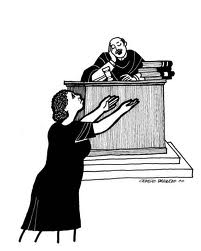
Or this one.  God is said to be like a judge.  A widow brings a legal case to this judge, demanding that justice be done.[3]  The judge, for reasons we are not told about, is not particularly interested in justice in this case.  But the woman won’t leave him alone.  She pounds on the door.  She scratches on the window.  She leaves notes in the mailbox.  She hacks his computer.  Finally, the judge—the judge is the God-figure in this story even if He is not the main character—gives up and makes the judgment on behalf of the widow just so he can have a little peace and quiet.  The story is told so as to approve the persistence of the woman.  Asking, even when it reaches a level that looks very much like harassment, is not too much.

The final story has to do with bargaining behavior, but I will indulge myself in a personal story on the way.  When I was young, I learned the expression “to jew down” to mean to bargain aggressively to bring down the price of an item.  I knew “to jew down” long before I knew what “Jew” meant or that the expression “to jew down” was pejorative.  You know how this goes.  When you learn that it is offensive, you stop using it, but you never actually forget it.

Abraham bargainsSo God is about to destroy Sodom and Abraham, the good guy, doesn’t want him to.[4]  “Will you spare the city for the sake of 50 righteous people,” Abraham offers.  “Well OK,” says God, “but you have to find the 50 people.”  Abraham looks and comes up short.  “So, what about 45 righteous people?” he says.  “Would 45 be enough?”  If I were reading this, I would play it for comedy.  Abraham offers, after God accepts, 45: 40, 30, 20, and 10.  Here’s Abraham, the Prototype Jew bargaining with God—please remember my introduction to this notion, when I was young—to bring the price down.[5]  It just tickles me.

In this story, we have not only the continual bargaining, but a divine tantrum as well.  God is angry and wants to destroy everything, but He can be sweet-talked out of it if you know how and if you stay at it long enough.

These three stories align perfectly with God as the Hebrew parent.  Here’s a way you could characterize it.

The request [to save the city] was in play for a long time.  The child [Patriarch] and parent [God] are kept in relationship for a long time.  The solution to the dilemma was both rewarding [for the community of faith, in whose repertoire this story is kept and treasured] and instructive.

None of this makes any sense in the Germanic model.  God would have had a really good reason for saying No in the first story and perpetual nagging [asking and asking and asking] is not going to change that good reason.  “No, you may not tidy up your little brother’s hair with those scissors so he will look nice at the photographer’s studio.  No.”  God’s having a good reason for what He said casts a new light on the behavior of the “good child.”  In this model, God is not a fearsome tyrant.  You get to ask why, if you do it respectfully and only once, but when the answer has been reaffirmed, you accept the wisdom of it and arrange your own plans accordingly.

God the Judge, in the second story, is a good deal more oriented to justice than any of the participants is likely to be and much more acute about what justice actually entails.[6]  That means that the widow is not only entirely out of control, but also mistaken.  She doesn’t see the whole picture; she is fatally self-interested; she has no proper respect for the magistrate.[7]  She’s not putting the team first.

God the Vigilante in the third story has a really good reason for destroying the city and if it would take 50 righteous men to save it (and if Abraham can find them), then 45 righteous men aren’t really going to do the job and agreeing to the lower number would be either foolish or stupid.  God is not foolish or stupid.

So what is God like?  Here’s where we (Christians, Jews, and Muslims) are.  We have the stories.[8]  We understood what they are meant to teach in the cultural settings of their origins.[9]  If the God of those stories conforms to what “good parent” means to us, then our job is done.  If not, we are faced with the choice of changing what we mean by “good parent” or changing what lessons about God should be drawn from the stories. 

So here’s the third piece.  I know it’s been a little bit of a hike.  If you need a nap or a breather or something, now would be the time.

If you come from what I have been calling “the Germanic model,” you can look at how very Hebrew the stories are and call those characteristics of God “artifacts” of the story.  They aren’t really, that is to say, what God is like; they are just  the costume the storytellers have dressed God in so that He can be understood and revered in a culture like theirs.  Since we of the Germanic mode know that God isn’t “really” like that and since we still have those same stories to work with, we reinterpret them.  We are now free to reinterpret them.  In fact, in this way of understanding it, we have the obligation to reinterpret them.

This returns us to the original question: Don’t we already know what God is like?  The answer now is, “Not really.”  We know what clothes God has been given to wear in the stories the Hebrews told about their God.  We can see how completely aligned the Hebrew character—we have considered only the parent/child roles—is with “God’s character.”  We have stopped trying to model our own behavior after this very Hebrew-like God and have begun to wonder whether God could not be understood differently if the stories could be understood differently.  This would give us the possibility of a Germanic or Stoic God whose character is an extrapolation from the values we hold most dear, rather than from the values they held most dear.  This God is a thoughtful, a caring , and a decisive God.  Wheedling doesn’t really work.  Pouting really doesn’t work.

Here’s an example.  The awful wrestling Jesus enduring in Gethsemane before his crucifixion can serve as an example of the two styles.  In the Synoptic gospels—Matthew, Mark, and Luke—Jesus arrives at a place that makes as much sense to the Hebrew culture as to the German.  “If this cup cannot pass away unless I drink it, it is not what I want, but what You want that matters most.”  His mother said the same thing to the angel Gabriel.  “Let it be done with me as you have said.”  The process Jesus went through to get to that acceptance is gut-wrenching.   It is fully in accord with the Hebrew notions of what “doing it right” looks like.  It is not in accord with Stoic conventions and the depth of Jesus’ distress had to be justified somehow to Gentile hearers.

The values of the Hebrew people, in other words, are no longer taken as determinative of the character of the One True God. Their stories are earlier, but they are not better.  They reveal a Truth to us and distort that truth at the same time.  This leads directly to the project of re-envisioning God according to our own values.  We would have a God, let’s say, who is not so vulnerable to tantrums; a God who actually has a good reason for doing what He is doing.

Anthropologists and theologians speak knowingly of “creating a god in our own image.”[10]  You have to admit it is witty.[11]  On the other hand, if what these faith traditions give us is a costume for God not a culture-neutral insight into God’s true character, then every community creates the costumes that represent “what God is like” for them. This ought to work as long as you remember that you are talking about the clothes, not the Person. 

And consider the alternative.  We would continue to construe God as a person of traits we disdain in every other context of our own lives.  That’s hard.  And eventually, you learn not to care.  That’s worse.  Then you learn not to notice and the game is over.  And you lost.


[1] This might be a good time to reiterate my solution to the “gender of God” dilemma.  I think it is ridiculous to imagine that God has a gender.  The solution I was taught in elementary school was that for circumstances where a gender designation is unavailable or inappropriate, one uses the neuter from of the pronoun.  The neuter form mirrors the form of the masculine pronoun, but is not the masculine pronoun.  I know now everyone is happy with that solution, but it keeps me away from three alternate “solutions” that I find nauseous.  One is to refer to God in the pronoun form as he/she/they.  Another is to invent the pronoun “Godself” to refer to Him/Her/Them.  The third is to foreswear pronouns entirely and repeat “God” where the pronominal form would ordinarily be.

[2] That’s Matthew 7. I’ve skipped around a little in verses 7—11.  The language is in the archaic King James Version, which is the form imbedded in my memory.

[3] Wonderful story.  See Luke 18.

[4] This one’s in Genesis 18.

[5] I had the discipline to refrain from calling Abram the Ur-Jew in the text, but here in the footnotes, my normally steely self-discipline has given out.

[6] In our faith, we say that God is a God of both justice and mercy.  I admit that is more complicated, but it is a complication for another day.

[7] Since this is a mostly religious post, I’ll pause to note that the magus in magistrate means “large, great” while the minus in minister, means “small, humble.” 

[8] There is additional literature in all three cases.

[9] Just don’t get really fussy about “origins.”  The Hebrew people picked up a lot of well-used local stories from their neighbors and Hebraized them so that they taught the right lessons to their own people.

[10] The literal meaning of “idolatry,” by the way.  The Greek for “image” is eidolon; for “worship” is latreiuo.

[11] See Genesis 1for the original version of this line.

Posted in Biblical Studies, Uncategorized, ways of knowing, Words | Tagged , , , | Leave a comment

Doing What You Can

Back in the old days, before doctors were able to cure many illnesses, a big part of “medical care” was being with the patient.  Just being there says things that can’t be said otherwise, principal among them is, “You matter so much to me that I am spending time with you, comforting you as I am able.”

It seems to me that as medicine has gotten better, the gift of human comfort has gotten poorer.  We still do it—we still spend time with the people who are ill—but we think more about recovery than we used to and less, it seems to me, about comfort.  Nothing about the medical regime that will return me to health says. “You matter this much to me.”

I got to thinking of this as I watched the bittersweet ending of a very good French movie called All Together.  I want to tell you enough about the movie that you mAll Togetheright understand what I want to tell you about the end.

Five long-time friends decide to move in together.  At first it looks like a simple efficiency.  They spend all their time visiting each other anyway.  Each of these five people, the three men more than the two women, is having trouble letting go of who he has been in the past.  Albert’s memory is going and he flickers in and out of the present.  Jean, the political activist, is an old man now and can’t even get himself arrested at a public protest.  Sex means everything to Claude, but his heart attack complicates that as well, even with readily available prostitutes.  Even so, each of the five is present for the others in a meaningful way.

It is Jeanne, Albert’s wife, who introduces the dilemma I want to point to.  She knows that he is so forgetful that he cannot manage on his own.  She also knows she is dying of cancer and that when she is gone, the remaining friends will not be able to care for him anymore.  She dies and has just the funeral she wants, complete with the bright pink coffin she is shopping for when we first meet her.  Albert comes to the service with the other friends.  But later in the day, he can’t find her.  He has no recollection of the funeral.  In his present confusion, he no longer knows she is dead and he goes out looking for her.

The remaining three friends look at each other, weighing the task of telling him, yet again, that Jeanne has died.  They decide not to. Albert is quite agitated.  He decides to go out looking for her.  The other three, worried about letting him wander around on his own, go with him.  He begins to call her name.  Where could she be?

At that point, an emotionally powerful moment occurs.  The friends understand that Albert can no longer join in their life.  They decide to join his instead.  Each of them begins to call “Jeanne,” just as Albert does.  They walk along together.  Albert is calling Jeanne’s  name and looking for her.  The friends are walking with him and calling her name as well.

There isn’t a satisfying end to the story.  There can’t be.  Albert’s daughter will come and get him and put him in a place where he can be cared for and watched over.  Jean and Annie and Claude will go back to their house and live as best they can.

So it isn’t really the ending that got me and that I offer to you today.  It is the choice the friends made and that I admire.  They do what they can.  They walk with him for a long time, honoring a lifetime of friendship by calling out his wife’s name.

This is a situation our medical advances have not caught up to.  No one can heal Albert.  The best we can do is walk with him for a little while and help him search for his wife.  It is an honest choice and a hard one.


Posted in Getting Old | Tagged , , | 2 Comments

How are the prospects for President Obama’s second term in office?  Pretty good, I’d say, all things beinpoll 2g considered.  The President is duly aware of what he calls “locusts”—unforeseen events that swarm the political landscape and destroy the prospects for anything good to grow there.  He knows that a lot of otherwise promising presidential second terms have faltered and failed and he knows that his second term might be like that.  Or so says today’s New York Times.

On the other hand, the New York Times released yesterday the poll that they conducted, with CBS, on January 11—15 and it looks pretty good. (I just love it when they publish polls.)   Here are five things I like about his prospects.

1.         People are not at all excited about the new healthcare prospects of the Patient Protection and Affordable Care Act (hereafter P-PAC, in honor of apollingll the peas I harvested for Del Monte in the summer of 1958).  A third of the New York Times/CBS sample would like to see the entire law repealed.  That is 1% less than the number who identify themselves as “conservative on most political matters.”  Some (19%) would like to see the requirement that individuals purchase health insurance (the individual mandate) repealed.  Some (18%) would like to keep the law as it is.  A few more (24%) would like to see it expanded.  I think that’s not too bad for a law that has been trashed without much subtlety and the benefits of which have yet to kick in.  It is reasonable to expect that people will be more favorable about P-PAC when they have experiences with it and not only warnings about it.

2.  Also, the economy is thought to be improving, and not just by economists.  When the economy improves, the President is thought to be smarter, more decisive, nicer to his children, and more likely to be a Christian (rather than a Muslim) and to have been born in the United States.  A substantial minority (40%) of those surveyed are not concerned at all that they or someone else in their household might be out of work in the next 12 months.  Except for the number a month ago, you have to go all the way back to the summer of 2011 to get more than 40% on that question.  And an additional 33% say they are only “somewhat concerned.”  An additional 27% say they are “very concerned,” but that number hasn’t been lower than 30% since the summer of 2009 and I think it will continue to decline unless there are “locusts.”

The more general numbers about the economy are not as rosy as that.  Those who disapprove of “the way Barack Obama is handling the economy” outnumber those who approve by 49% to 46%.  On the other hand, there aren’t that many people, it seems to me, who can distinguish between Obama’s handling of the economy and the condition of the economy.  And, in answer to the “condition of the economy” question, 32% say “good” or “fairly good,” while 66% say “bad” or “fairly bad.”

3.  The political side of these economic questions always asks who you would rather have making the decisions and what approach to the decisions you have more confidence in.  President Obama has been fortunate in his enemies.  Some support for my contention that President Obama’s situation is pretty good can be found by looking at the people’s alternatives.  Speaker of the House John Boehner is not thought to be handling his job very well—49% disapprove; only 29% approve.  Majority leader Harry Reid, over in the Senate, is in pretty much the same boat—45% disapprove and only 29% approve.  So people would rather have the executive branch in charge of framing and answering the questions than the legislative branch.  Note that this is not a Republicans v. Democrats question.  It is an executive branch v. legislative branch question.

4.  One of the framing questions is who is responsible for the economic slump we are still experiencing.  After four years of trying to cope with this question, Obama is still seen as least responsible for causing it.  In the blame index, he gets 13%.  Everyone else gets more: the Bush administration 27%, Wall Street financial institutions 19%, and Congress 14%.

And it gets worse.  Who do you trust more to make the right decisions about the nation’s economy?  Obama 50%, “Republicans in Congress,” 35%.  The right decisions about the budget deficit?  Obama 50%, Republicans in Congress 37%.  The right decisions about taxes?  Obama 52%, Republicans in Congress, 36%.

And how should these agreements be arrived at?  Should they be produced by compromise as both Speaker Boehner (intermittently) and President Obama (persistently) have said or by “sticking to the original positions,” which characterizes a portion of Boehner’s majority in the House so large that he couldn’t get Republicans to pass a bill he wanted them to pass?  Most Americans favor compromise (84%) over “stick to the positions,” 11%.  The Republicans in Congress are particularly at risk here because 80% of those surveyed said they should compromise and only 14% said they should stick to their positions.[1]  People feel that the best way to reduce the federal budget deficit is a combination of raising taxes and cutting spending—Obama calls it “a balanced approach.”  The combination gets 61% of Americans, where just raising taxes gets 3% and just cutting spending gets 33%.

5.  Of course, not all the questions Americans have are about the economy.  We seem to like what the President is doing on foreign policy (49% approve to the 3obama redux6% who disapprove).  People are optimistic about the next four years of an Obama administration (59% optimistic v. 38% pessimistic).  People are confident in Obama’s ability to make the right decisions about Afghanistan: “very confident” and “somewhat confident” total to 62%;  “not too confident” and “not at all confident” total to 36%.  The same groupings show confidence in Obama’s ability to make the right decisions in protecting the country from a terrorist attack (69% to 30%) and the right decisions about immigration (55% to 44%)

People don’t trust President Obama overwhelmingly, of course, but they trust him on a lot of things.  And they trust “the Republicans in Congress” or Speaker John Boehner even less.  They would rather see the crucial decisions made in the executive branch than the legislative branch.  They favor the approach to handling the deficit that the President (and occasionally the Speaker) favors, but not the approach the conservatives in the House favor.  They are optimistic about the future.

If I held a federal office—God forbid—I would much rather be in the President’s shoes than in anyone else’s.


[1] That doesn’t reflect the majorities in the districts that sent these Congressmen to Washington, of course, which is another problem the Speaker faces.

Posted on by hessd | Leave a comment