Still Mine

I am not honestly sure whether this is a really good time for movies about old people or whether I have just started to get interested in movies about old people.  I think it’s just a good time.  When Ron Howard gave us Cocoon, nearly 30 years ago, I was ready to invest myself in it.

In any case, Bette and I saw Still Mine this week and I’ve been thinking about it.  You probably shouldn’t seStill Mine 1e it if you happen to be a building inspector.  To the extent there are any bad guys at all (death and senile dementia are not bad guys), it is the building inspectors.  On the other hand, if you are a libertarian, an old woman who is married, an old man who is married, the son or daughter of either of the above, a builder, or a neighbor, you are going to find something here to like.

I won’t bother you with the plot.  Here it is: http://www.imdb.com/title/tt2073086/

The first thing to like is the work of James Cromwell and Geneviève Bujold as Craig and Irene Morrison.  They have been married for sixty years or so.  He is watching his life start to flatline because nothing moves him to demand more of himself.  She is losing touch with reality—little things, mostly, but they can’t continue to live in the big old house he built for them and their sevenStill Mine 2 children.[1]

She needs to love him and trust him and she does, as she is able.  He needs to love her and treasure her and he does, with a couple of exceptions.  I like the exceptions.  I don’t approve of them, but the fact that he is not endlessly patient and constructive helps me believe that he is actually a person and not just a moral mirage.  Cromwell and Bujold need to be very very good because there isn’t much plot.  The movie is about who they are, particularly who they are for each other.

I wanted more to be made of the way Craig and Irene had friends.  They were particular friends with Chester and Margaret Jones.  Chester and Craig mostly just rag on each other; it took me a little while to be sure that it was just their way of being friends.  Margaret brings a casserole over after Irene falls and is taken to the hospital.  Craig refuses until Margaret says, “If the roles were reversed, this is what Irene would have done.  You know that.”[2]  Craig does know that and accepts the casserole.

I wanted to see more of the way their relationship was lodged in their community because I suspect they could not have been who they were for each other had they not been those people to others in their town.  We hear about things they have done for others, but we don’t get to see it so it doesn’t serve as the vivid context as it should.

I also wanted to see more because right in the middle of everything, Chester dies.  We don’t know Chester well, but Craig does and Chester’s death reminds him of all the deaths to come—some not all that far off.

Just go see it if you fit into any of the categories I named.  Bette and I came away thoughtful, but also hopeful.


[1] One of the tug of the heart scenes is Craig leaving the big family house for the last time and stopping to put his hand on the door frame they used to measure the height of their children as they grew.  He could always pry it off and take it with him, but he knows it would be better if he left it.

[2] That’s almost right.  I’ve only heard it once so far.

Posted in Movies | Tagged , , | Leave a comment

What Pope Francis said

How shall we understand the new pope, Pope Francis?

“If someone is gay and he searches for the Lord and has good will, who am I to judge?” Francis told reporters, speaking in Italian but using the English word “gay.”

That’s a clip from today’s New York Times, in a story written by Rachel Danadio.  She is careful to point out that the Pope’s remarks came during a very long trans-Atlantic flight.  Pope Francis was returning from a triumphant tour of Brazil and had every reason to feel good about what he had accomplished.  So he wandered back to the press room on his plane and had a very long talk with reporters, of which this one comment has been, so far, the most prominent.

“Who am I to judge?” is an interesting question coming from the CEO of the Roman Pope FrancisCatholic Church.  To Protestants, it is apt to sound like the head of the Personnel Department asking whether he should have a view on whether hiring decisions are distorted by racial bias.  “Yes, they might be,” he would be saying, in this example, “but who am I to judge?”  In the personnel case, a good answer would be, “You are the one who is breaking the law if there is a racial bias in hiring decisions.  Who are you?  You are the one who is going to jail.”

That isn’t the most interesting part of what the pope said, but it is the easiest part of peel away, so I thought it was worth starting there.  The Pope is also, according to Catholic dogma, “the vicar of Christ.”  What is a “vicar?”

Well…Joe Biden is a vicar.  The White House accepts a lot more meetings than the President can attend himself, so he sends the Vice President in his stead; as a substitute.  “In his stead” and “substitute” point to the most common meanings of the Latin vice, which is why the office is called “Vice” President.[1]

It would be odd, everyone would think, if Vice President Biden announced at a gathering, “Well, I don’t know how the President feels about this, but I, myself, don’t feel competent to make a judgment.”  It would be odd because Biden is the “vicar” of the President.  Following the logic, what the Pope really needs to do is to pass along Christ’s judgment, not to make one of his own.  And what is “Christ’s judgment?”

This is one of the many places where the argument turns nasty.  Homosexuality is not a topic Jesus ever addressed in any text we know.  He did talk about caring for the poor and inviting the outcast.  In Luke’s version particularly, he said really awful things about rich people.  He taught that compassion was the heart and the source of neighborliness.  He didn’t say anything about homosexuality.[2]

This means, to revert briefly to the Joe Biden example, that the Vice President has no judgment to pass along.  He is no one’s agent.  He speaks only for himself and is perfectly free to say, “Who am I to judge?”

No one believes that the Pope is free to speak for himself on a matter that threatens to seriously divide his church.  In the news coverage I saw, the reporters were very happy with Pope Francis’s “tone.”  He seemed humble.  No one imagined he was substituting his own personal judgment for the teachings of the church.  He wasn’t and, frankly, he shouldn’t.

The church over which the Pope presides teaches that a homosexual orientation is “unnatural” and reflects a “distorted” personality.[3]  Both of these are difficult charges.  There is no shortage of same-sex behavior among animals generally, so if “occurring in nature” is what “natural” means, then homosexual behavior is natural—not unnatural.  The argument that it is a distortion requires a judgment about what it is a distortion of.  Following this line of thought, the Catholic Church would be on the hook to show what God’s preferred personality was and that homosexuality is not an acceptable “version” of this personality, but a distortion.  Those are very hard things to show.[4]

The church over which the Pope presides is also divided between a more liberal northern hemisphere—particularly the United States—and a more conservative southern hemisphere.  Making changes in Catholic dogma is going to make people unhappy.  Seeming to be open to changes is going to make people unhappy.  Changing the style of his pronouncements and leaving the substance alone is going to make people unhappy.

Those are the issues as I see them in the large context.  What Pope Francis actually said man mean more in a small context.  He may have said that homosexual behavior is entirely unacceptable in priests, but a homosexual orientation is not unacceptable.  He would be saying, in other words, the same thing he says about heterosexual priests.  And what look like conditions in his remark—provided that “he searches for the Lord and has good will”—are not conditions that would not apply to heterosexual priests as well.  What priest should not search for the Lord and have good will?  And if all priests are resolutely celibate, what difference does it make?

In other words, Pope Francis may have said nothing at all.  On the other hand, seeming to have said something may have lit a fuse that is not as long as he thinks it is.


[1] “Vice” in the sense of “bad habit” derives separately from the Latin vitium, “fault.”  Richard Nixon’s Vice President Spiro Agnew managed to be a Vice President in both senses at the same time and he wasn’t the first one.

[2] He did say, in the Sermon on the Mount, that condemning other people is a very dicey thing to do and cited the principle that what goes around comes around.  The word Matthew chose for that saying means “to condemn;” it does not mean “to make a judgment.”

[3] This might be the time to confess that I am no scholar of Catholic dogmatic theology.  I got those two words—“unnatural” and “distorted”—from a site called “What Catholics Believe.”

[4] And following the biblical principle that teachings should be based on biblical texts that are about the same subject as the teaching—teachings about homosexuality, that is, should be based on biblical texts about homosexuality—runs into the difficulty that there are no New Testament texts about homosexuality—not even from the Apostle Paul, who is the go-to guy for Catholic interpretation.

Posted in Biblical Studies, Politics, Theology | Tagged , , , | Leave a comment

Salmon Fishing in the Yemen

I have heard it said that every story has an inner core of meaning—a structure of meaning.  I might have said it myself.  Yesterday.

In fact, every story has as many narrative structures as there are people who know the story.  When I have seen a movie I like half a dozen times or so, I find that my mind has been turning the story this way and that, trying to find “the” structure of the story, meaning, I suppose, some inner coherence in the narrative that attracts and holds my attention.  I have seen and enjoyed Lasse Hallström’s Salmon Fishing in the Yemen for several months now and just today I realized[1] what it is really[2] about.

Here’s the plot.  Dr. Frederick Jones (Ewen McGregor) is forced by office politics to hear a ridiculous scheme pitched by Harriet Chetwode-Talbot (Emily Blunt).  Harriet represents a Sheik (Amr Waked) who would like to introduce the sport of salmon fishing into his country.  Fred fights as hard as he can to stay away from the project, but he is drawn in; then he gets interested in it; finally committed to it.  The three of them—Fred, Harriet, and the Sheik—become a team with a common interest that transcends everything they would otherwise have thought to be more important.

Yemen 2Dr. Jones fights involvement the way some of the movie salmon fight being reeled in.  When you know him better—and after watching the move half a dozen times, you do know him better—you wonder why.  He has a really awful job.  It doesn’t challenge him; it scarcely engages him.  The project he is most ardent about at the beginning of the film is presented as so narrow that only a fishing geek could be interested in it at all.  He has a really awful marriage.  Dr. Jones and his wife have not shared anything important to them for a long time.  Even the little we learn about their sex life is more than we want to know.  Fred’s wife makes a major career change and forgets to mention it to him.  There’s really nothing there.

Here are the two lines of dialogue that, in this understanding of the story, form the turning point from alienation to commitment.

Harriet:           I mean, you know, it’s fishing.  Who the hell cares?

Fred:               Well…strangely enough, I do.

How and why did Dr. Frederick Jones arrive at that point?  In one way, you would think Dr. Jones Yemen 1would welcome a daring new project.  What does he have to lose?  But he fights it in every way he can.  The reasons he gives for judging the project to be impossible as well as a huge waste of money sound rational.  They are factually wrong, because he has not taken the trouble to find out anything about the Yemen, but they sound good.  For each of his objections, Ms. Chetwode-Talbot has a satisfactory answer.  She is also unfazed by his manifest contempt for the project.

It’s when you understand that Dr. Jones’s life is a wasteland, that you begin to see the desperation in his rejection of the project.  He is completely bored in his job.  He has narrowed his focus further and further until choosing the right graphic for a very narrow article he is publishing is really the most important thing in his life.  He has no more life outside his job than inside.  He and his wife, Mary, exist in the same space, but have no warmth to share.

It is clear then, that Dr. Jones is not rejecting the project so he will be able to get back to a life that he finds challenging and nurturing.  He is rejecting it so he will not be forced to notice that he is living a life in which nothing matters.  Ms. Chetwode-Talbot moves him in the direction of noticing that.  That is why she is such a threat.  She is attractive, knowledgeable, competent.  She meets every objection he can come up with: the infrastructure has already been completed, the Sheik’s commitment is strong, the money has already been allocated.

Yemen 4This is a project that ought to make a salmon fisherman’s soul leap with joy.  Dr. Jones is an avid salmon fisherman, or used to be—back when his life allowed for joy.  But experiencing his heart leaping for joy would be very frightening to Dr. Jones.  It would call his attention to how long it had been since anything really mattered to him.  He wants very much not to have to notice that; and then, to admit it; and then, to know it to be true.

That’s what is going on inside—in the movie I have learned to see after all these re-watchings—when all we see on the outside is injured pride and the verbal abuse it produces.  For example:

Dr. Jones:        Water, Ms. Chetwode-Talbot.  H2O.  Fish require water.  You are familiar with the concept?

Ms. Chetwode-Talbot:  Yes.  I am. Yes.

For reasons that have largely to do with British politics, Dr. Jones is forced to pretend to take the project seriously.  Simple boorishness will no longer suffice.  He demands a meeting with the engineering team from the Three Gorges Dam; a meeting with a British oxygen company; and two huge Russian cargo planes—one, he explains, to transport the fish and one to carry all the money they are wasting.  He prices the project so high that he is sure it will be out of reach.  Harriet simply notes the price and wants to know if the figure is in dollars or pounds.

At the end of that session, we learn that Dr. Jones will be continuingly involved with the project whether he likes it or not.  Here are the lines that mark that transition.

Dr. Jones:  I mean, this is a sort of joke.

Ms. Chetwode-Talbot:  Well, I’m sure you wouldn’t want to joke about a 50-million-pound project, Dr. Jones.  Not when you’re in charge of it.

Being in charge of the project finally begins to wear on Dr. Jones.  The problems he now faces are practical problems—his kind of problem—and they are huge.  His wife leaves for a job in Switzerland.  He is forced to continue to deal with Harriet who, as I have already pointed out, is attractive and remarkably sweet-spirited.  Then the word comes that Harriet’s new boyfriend, who was sent to Afghanistan, has been sent on a patrol from which, according to official reports, there were no survivors.

Harriet is distraught.  It is she, now, who wishes there were no project to introduce salmon into the Yemen.  She doesn’t care about the Yemen or anything else.  But by now, Dr. Jones does care about the project.  He has the beginnings of care for Harriet as well.  He wasn’t sure how to relate to the competent confident administrator she was when he met her, but she is now a woman brought quite low by grief, and Dr. Jones knows quite a bit about grief.  We have seen that he knows only how to deny it in his own life, but we learn, to our surprise, that in someone else’s life, he knows what to do about it.

That brings us back to the two lines with which we began.

Harriet:           It’s just fishing.  Who the hell cares?

Fred:               Well…strangely enough, I do.

The story goes on.  They build the project, but it is sabotaged.  Harriet’s boyfriend returns from Afghanistan, but Harriet chooses the colleagueship of the project over romance with the boyfriend.  The three of them—Fred, Harriet, and the sheik—recommit to the success of the project and we have reached the end of the story.

But the story that mattered to me was over when Fred said, “…I do.”[3]  Isn’t it odd, I have thought since thinking about this movie, how very hard we will fight when the alternative is to notice that the life we are now living is not really worth it.  Continuing not to realize that justifies alienation, anger, resentment, pride, contempt, and simple nastiness.


[1] I hope you notice the irony there.

[2] More irony

[3] Just playing.  Fred and Harriet do wind up together—not only as colleagues but as intimate friends.  Probably, well after the time of this movie’s story, husband and wife.  But he did say, “I do,” earlier, I want you to notice.

Posted in Movies | Tagged , , , | Leave a comment

“That includes me:” Obama talks about race

On January 20, 2009, Barack Hussein Obama was inaugurated as our first black president.  A lot of the early betting went against him as a candidate.  No one seemed quite sure if Democrats were ready for a black nominee of their party; they were certainly ready for a woman nominee.  But then, an odd thing happened.  Over the course of the campaign, Obama didn’t seem all that black.  “Black,” sure.  His father, after all,  was from Kenya.[1]  But “black” didn’t seem to be any of the top four or five things about him.

That is what the gaffe-prone Senator Joe Biden was really trying to say when he said this: “I mean, you got the first mainstream African-American who is articulate and bright and clean and a nice-looking guy. I mean, that’s a storybook, man.”[2]  He got hammered for including “clean” as one of the descriptors, but I thought when he said it that he meant “clean” as in “a clean record.”  Biden Black Man 3meant that candidate Obama didn’t look like this.  Very often.  Also, Biden was campaigning against Obama at the time because Biden wanted to be the Democratic nominee and remarks like these are NOT how you campaign against someone.  I’m sure Vice President Biden knows that now.

So “not all that black” Barack Obama was inaugurated in January and his Attorney-General, Eric Holder gave a speech at the Department of Justice on February 18, less than a month later.  It quickly became known as his “nation of cowards” speech.  If you follow this link, you will find that expression in seconds 18—20 of the speech.  He didn’t waste any time getting to it.

http://www.youtube.com/watch?v=2Fy2DnMFwZw

We are “cowards” he said because we do not talk with each other about race.

That was shocking for a lot of reasons.  One is that Eric Holder looks more or less like Barack Obama.  He is not a scary looking black man.  Another is that President Obama was elected by moving discussions about race into the background.  Every time the Republicans pointed out that the Democratic nominee was a black man, the Democrats changed the topic to something else; the rainbow nation, a post-partisan nation, the terrible economy.  I wouldn’t be surprised to learn from the historians of that election that Obama lost more votes because of the myth that he was a Muslim than because of the fact that he was a black man.  And finally, most of the people I had heard talking about race were using it as a way to talk about social justice.  For these folks, it was inequality, not race, that needed to be focused on.

Black Man 2For whatever reason, we didn’t have the conversation about race that Eric Holder wanted us to have.  And then George Zimmerman killed Trayvon Martin.  The jury who found George Zimmerman not guilty heard almost nothing about race during the trial and did not, according to the most vocal juror, take it into account in their deliberations.  Since the trial, it seems that we have heard about very little else.

On July 19, President Obama walked, unscheduled, into the press briefing room because he had a few things he wanted to say.  You can see the text here.  There weren’t any teleprompters.  Just the President talking about being a black man in America.  He said some of the things Attorney General Holder said in 2009.  I think he said them better, but they weren’t really different things.  And then he said this:

There are very few African American men in this country who haven’t had the experience of being followed when they were shopping in a department store.  That includes me.  There are very few African American men who haven’t had the experience of walking across the street and hearing the locks click on the doors of cars.  That happens to me — at least before I was a senator.  There are very few African Americans who haven’t had the experience of getting on an elevator and a woman clutching her purse nervously and holding her breath until she had a chance to get off.  That happens often.

And I don’t want to exaggerate this, but those sets of experiences inform how the African American community interprets what happened one night in Florida.  And it’s inescapable for people to bring those experiences to bear. 

It wasn’t a speech.  It wasn’t a conversation with friends over a beer.  I don’t think I’ve seen anything like it.  He called it “expanding on my remarks.”  I thought it was the most candid and personally revealing appearances I have seen a politician make.[3]

You should see this.  Printed words just don’t do it.  If you watch this video from the 3:12 second mark to the 4:19 second mark, you will see what I mean. Here’s the link.

 http://www.whitehouse.gov/photos-and-video/video/2013/07/19/president-obama-speaks-trayvon-martin

Maybe this will change the conversation some. Maybe watching the President say, “That includes me,” when talking about the department store setting and the street setting and the elevator setting he used as instances.

It will be a long time before I forget seeing the President say that.  “That includes me,” he said.  I hope it is a very long time.


[1] I have never quite understood why President Obama is not called Barack Hussein Obama, Jr.  His father’s name was Barack Hussein Obama, Sr.  That ought to do it, shouldn’t it.  Does anyone doubt that there was a Martin Luther King Sr.?

[2] Jesse Jackson said that although Biden’s remarks were “highly suggestive,” they were not “off-color.”  Isn’t that just sweet?

[3] Ever.  Unless you saw and believed Richard M. Nixon’s “Checkers Speech” in 1952.

Posted in Politics | Tagged , , | Leave a comment

Jesus and Rich People

So how did Jesus feel about rich people?  That doesn’t sound too hard to answer.  I’ve got some proof texts right here.  I hope they are the same as your proof texts.

We don’t have Jesus’s words to consider, of course.  We have his teachings as they have been preserved in several traditions.  We have, in other words, four different notions of how Jesus answered that question.  Jesus has the most bitingly negative view of wealth in Luke’s gospel, so let’s look at that one as an example.

I’ve been listening to Raymond E. Brown’s lectures on the Gospel According to Luke.  I’d have to say that I’m a fan.[1]  Some day, I may come to disagree with how Brown goes about understanding the gospels, but for the moment, he is my standard for both accuracy and relevance.  When I hear another view, the first thing I do is to check to see whether it is compatible with what Brown says.

I know that’s cheap.  It’s a little like an intellectual infatuation—I am aware that the Latin fatuus, on which the word is based, means “foolish.”—but I have high hopes for it anyway.  My hope is that as I continue to read other scholars, I will come to see that Brown is really good on this question, but not so good on that one.  I have followed this same process in each new field of academic study and it has worked the same way each time.  The person I choose first winds up as scaffolding and he finds a place for everyone, even his worst critics.

Here is what Brown says about Jesus and rich people.  He points out that the Jesus of Luke’s gospelrich fool 1 is really hard on rich people; much harder than the other gospel writers are.   In this post, I would like to just pick one instance and play around with it a little.

Here is a parable Luke records (Chapter 12), but which does not appear in the other gospels. 

16 And he told them this parable: “The ground of a certain rich man yielded an abundant harvest. 17 He thought to himself, ‘What shall I do? I have no place to store my crops.’

18 “Then he said, ‘This is what I’ll do. I will tear down my barns and build bigger ones, and there I will store my surplus grain. 19 And I’ll say to myself, “You have plenty of grain laid up for many years. Take life easy; eat, drink and be merry.”’

20 “But God said to him, ‘You fool! This very night your life will be demanded from you. Then who will get what you have prepared for yourself?’

21 “This is how it will be with whoever stores up things for themselves but is not rich toward God.”

So here are two really good questions.  What did this parable mean to Jesus?  What does it mean to us? 

To answer these questions, some notion of what an economy is must be filled in.  Jesus and all of his contemporaries understood that there was a fixed amount of wealth.  The world of economic transactions is, in other words, a zero sum proposition.  What I have, I have because I took it from you; what I get, you lose.

Rather than picturing this narrative as a harvest, which can be stored and used over long periods of time, it might help us to picture it as a the body of a freshly killed animal.  Because there is no refrigeration, whatever is not consumed immediately is going to rot.  The rich man can have as large an appetite as he wants; he is not going to be able to eat the whole animal.  His options are sharing it or wasting it.  In this parable, he chooses to waste it.

That new setting provides a way for us to better appreciate Jesus’s scorn.  Using the hunter imagery, it is easier to see that the man should have shared the kill with his neighbors.  It also suggests that being “rich toward God” (v. 21) is one outcome and “sharing with your neighbors” is the other.  God is a God of sharing with your neighbors.  When you keep it all for yourself, therefore, you are not only denying your neighbors, but God as well.[2]

So what does this mean to us?  We don’t share Jesus’s presuppositions about the economy.  Capitalism has a way of making the market larger, under some circurich fool 3mstances, so it is possible for my wealth and your wealth to increase at the same time.  As a result of the actions I take, I get richer and so do you.  The metaphor of the economic “pie” is often used.  If you can make the pie bigger—or “higher,” as George W. Bush used to say—then both of us can have more pie.

Imagine, for instance, that the point of the story about building a new barn was that this farmer employed a lot of workers in construction of the barn, that the delayed sale of the wheat brought increased revenues, and that the taxes on those revenues supported three new centers for transitional youth.  This is a ferocious adulteration of a simple metaphor.  Let me be the second to admit that (second only because you probably made that observation while I was finishing the sentence).  On the other hand, my story, like Jesus’s story, has a point.  It is that “sharing with the neighbors” can look very different in a society in which economic activity can benefit everyone (although not equally) and in which there is a government which has at least some redistributive functions.

So.  Would the Jesus who condemned the greedy farmer condemn the keen-sighted entrepreneur?  He might.  I’m really not sure.  But if he did, it would be on grounds other than those presumed in his story.  And what about the farmer’s reception in the next world, where God relies on the judgments made by the poor to make up His mind about the rich?  Certainly we can say it is more complex. 

This is not the case of the hunter who, having killed more than he can eat, would rather see the excess rot than share it with his hungry neighbors.  This farmer did what he did because of greed—it is the only motive capitalist theory recognizes—but by that greed, he benefitted many of his neighbors, who otherwise would have received very little benefit. Rather than giving out a dole of grain, he employed workers, made profits, and paid taxes.  Presumably, those who benefitted would, when the farmer died that night, recommend to God that he be shown mercy.

On the other hand, one thing you can be sure about, if we are talking about capitalism, is that some rich fool 2will benefit and some will lose.  Capitalism is a truly awful distribution mechanism and it would not be too much to say that it eats (some of) its children.  Capitalism guarantees that many will be worse off.  That is how the price of labor is set.  What will those, the marginalized, say to God when the farmer dies and faces the judgment?  And what will God do, faced with benevolence from some of the poor (the winners) and malevolence from others (the losers).[3]

Let’s go back to Luke.  The set of questions with which I finished the paragraph above are really bad questions.  They are bad because they impose some modern ways of understanding economic activity that are foreign to the world Jesus was talking about.  They also impose the categories of economic actors—like proletariat and bourgeoisie— that would have been entirely foreign to the First Century.  That means that “building a new barn” is not necessarily a good thing or a bad thing.  It is not like eating all the kill you can hold and allowing the rest to rot, which is always a bad thing.

Anyone who wants to be a learner from Jesus—and that is what “disciple” means—is going to have to figure out what Jesus would say to you on Facebook when he heard about the new barn.  That’s actually what a learner would want to know.


[1] I got my introduction to Brown’s way of approaching scripture maybe twenty years ago.  I got his book The Birth of the Messiah.  There are two accounts of Jesus’ birth: Matthew and Luke.  I opened up Brown’s book and saw that the whole book was divided into two parts.  The first half was about Matthew; the second half about Luke.   It was love at first sight.

[2] Luke tells some other stories which, according to Brown’s understanding, have the same point.  The poor are going to be in heaven.  When you get there, they will testify in your favor or against you and God will listen to what they have to say.  The parable of the rich man and the beggar at his door makes this point.  So, in its own odd way, does the parable of the sleazy steward.  Both are in Luke 16.

[3] If you are following Mitt Romney’s dichotomy of “makers” and “takers,” the farmer represents the 53% who actually make the economy work and both kinds of workers are the 47% who are “takers.”  Just so you know.

Posted in Biblical Studies | Tagged , , , , | Leave a comment

Too Pretty to Work Here

It is hard to write seriously about the Iowa dental assistant who was fired.  I am sure it is a serious matter for Melissa Nelson, the dental assistant.  It is probably about to become serious for James and Jeanne Knight because they have set themselves up to be objects of ridicule.[1]   Nevertheless, I will try.  I will be serious.  I will.

According to the news reports, Nelson was fired because the dentist found her too attractive.  According to the opinion of the Supreme Court of Iowa, Nelson was fired because the dentist’s wife, Jeanne Knight, was concerned about the relationship between her husband and Nelson.  Here is the case.  See what you think.

http://www.iowacourts.gov/supreme_court/recent_opinions/20130712/

The question as the court construes it is this: “Can a male employer terminate a female employee because the employer’s wife…is concerned about the nature of the relationship between the employer and the employee?”  Answer: Yes, he may.

The question as I have seen it treated—ordinarily, I would say “discussed,” but this case does not seem to lend itself to “discussion”—is whether the law offers Melissa Nelson any recourse, after having been fired by her employer.  The answer is: No, it does not.  Not, at least, in Iowa.

Melissa Nelson, IowaSo here is Melissa Nelson.  If  I were going to take a picture of her as an innocent victim, I would put her in a loose-fitting gray sweater with a scarf around her neck and use a shelf or so of law books as the background.  That’s what they have done here and I applaud their judgment.  If you would like to see extravagantly worse judgment, you may google “Melissa Nelson, dental assistant” and see what has been done with the issue.

I would like to use this very small public forum of mine to look at this issue in three other  ways.  I want to consider the realistic options available to Mrs. Knight; then what a healing intervention by their pastor might have done; and finally, the very difficult legal argument the court was required to use in its decision.  There will be a huge celebration of “the issue” in the online news sites, in the press, and on TV.  It will be ridiculed by everyone.  I think my approach is better.

  My first reaction, when I read in the court’s decision, that James Knight acted at his wife’s urging, was to regard her as a bit player in a drama that was not about her.  But if she values her marriage, maybe it is about her; there is, at least, a way of looking at the issue that takes her interests into account.

Jeanne Knight sees her marriage going away because she has failed to act to save it.  The first question you run into, if you are willing to start there, is: Is my marriage in danger of dissolution?  If you think it is, the next question would likely be: Is there anything I can do to help save it?  I you think there is, you look at the elements of the problem.  My husband, James Knight is more erotically attracted to his dental assistant than he wants to be.  His employee, Melissa Nelson, is much more attractive to him than is compatible with my continuing to have a happy marriage.

Now picture these options.

Scenario 1:      Jeanne has a sit-down talk with her husband and asks him to be less erotically attracted to Melissa than he is.

Scenario 2:      Jeanne admits that there is no way for James to be less attracted to Melissa than he is, but urges him to be very careful about seeming, in any way, to act on his feelings.

Scenario 3:      Jeanne tells her husband that there is room for one erotic attraction in his life, but not for two.  It is time for him to make a choice.

I have to admit that Scenario 3 is the only one in which Jeanne, herself, can act on her behalf or on behalf of the marriage.  By contrast, picture her asking James to feel differently than he does feel or to be continually aware that he needs to refrain from acting on his feelings.  If you are reluctant to dismiss Scenario 2, I ask you to imagine yourself in the position of a patient undergoing root canal at the hands of a dentist whose mind is largely elsewhere.

So much for Jeanne Knight.  Another way to look at this is from the standpoint of the church.  Frank Hearn, a communitarian author and a favorite of mine, has a vocabulary that can help us here.  Most important transactions, Hearn writes, really should be taking place in a community where people know and care for each other.  Some issues that can be handled well only by a community are highjacked and sent off to be dealt with by the courts.  He calls this process juridification.  This question of sexual attraction in the workplace can best be handled by the people who actually know what is going on.  It is a good deal too subtle for the courts to handle competently.

So let’s start with the religious community.  Let’s imagine—I have nothing but the neighborhood church to go on and I am choosing it instead of inventing a church—that all four people are members of the same church.  It would be the Faith Baptist Church of Fort Dodge, Iowa, which looks to be a block or so east of the Knight home.  So Steve and Melissa Nelson would be members of this church and so would James and Jeanne Knight.

It would not be hard for the pastor of the church to recall St. Paul’s words about “taking a brother to court.”  Paul’s advice is, “Don’t do it.”  Here’s the text from 1 Corinthians 6.

Is one of you with a complaint against another so brazen as to seek judgment from sinners and not from God’s holy people?  …when you have matters of this life to be judged, you bring them before those who are of no account in the Church![2]  I say this to make you ashamed of yourselves.  Can it really be that it is impossible to find in the community one sensible person capable of deciding questions between brothers, and that this is why brother goes to law against brother, and that before unbelievers?

Of course, Fort Dodge, Iowa and ancient Corinth are not similar places and we don’t categorize “the church” and “the world” that way anymore.  Still, it is not hard to imagine a pastor who cares about saving relationships as well as people to think of the situation more broadly.  Here is something he might have said.

“I’m glad the four of you were willing to sit down with me to talk about this.  The media will have a field day with us all if this gets into the court system.  All of you are going to be damaged if that happens and we don’t need to do that.  Here’s what needs to happen.  Melissa needs an apology.  James and Jeanne, that’s your job.  She is going to lose a job she likes and is going to become a figure to be ridiculed.  If she is going to have to take another job, she needs a sincere apology, a letter of recommendation that sounds like it came from God, a guarantee of a new job without any loss of income.

Melissa, you and Steve and going to have to find some charity in your hearts for James and Jeanne.  Jeanne is not crazy to be concerned about whether her marriage is going to be destroyed.  Marriages get destroyed by workplace flirtations all the time.  James has crossed the line that is supposed to separate employer conduct from sexual flirtation.  That was wrong.  On the other hand, he tried not to cross that line for a long time and under the circumstances, I think you can find it in your hearts to forgive him when he was not successful.”

Let me stop and remind you that most of that is made up.  It isn’t implausible, however, and it does defeat the threat of juridification.  Actual persons apologize and forgive.  Actual persons have their financial well-being taken into account.  I think it is a pretty good outcome.  It does require that the pastor take a very broad look at the issue and a pretty aggressive approach to the two couples, but I have seen pastors do that.

And finally, what happens if the matter is not handled within the community.  It goes to court.  And Nelson’s attorney employs the “but-for” strategy.  Nelson would not have been fired “but for” being a woman.  Not so, says Dr. Knight’s attorney.  It was the nature of the relationship and the threat to the marriage that are the issue.  Absolutely, says Nelson’s attorney, and you are telling us that there would have been this threat to the marriage if Nelson were not a woman?  That’s what you are telling us.

The Iowa Supreme Court wound up contrasting a “condition”—unjust treatment of an employee—with a “motive:” this was done to save the Knight’s marriage.  That just seems like bad law to me.  It doesn’t seem stable.  And the only court in the land to which this case could be appealed is the U. S. Supreme Court and I would have no hope at all that the legal issues would be sorted out there.


[1] Ordinarily, I would have said “objects of ridicule by the liberal press,” but I saw a broadcast about the issue on ABC in which both Mr. and Mrs. Knight and the Iowa State Supreme Court were trashed.  ABC is not any part of “the liberal media.”

[2] “Those who are of no account in the church”—which is not a pejorative expression in the context of the letter—would include the Supreme Court of Iowa and the 8th and 11th (federal) Circuit Courts of Appeals.


Posted in Uncategorized | Leave a comment

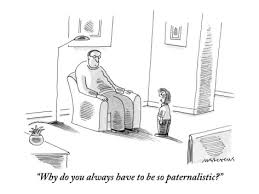
A Modest Proposal about Paternalism

Today is a rescue operation.  I am going to try to rescue the term “paternalism.”  Very likely, I won’t succeed, but I have learned a phrase from my wife that I now use a good deal: “How bad could it be?”

Once you know that paternalism is bad, you really don’t need to know what it means.  In this, it parallels “racism” and “sexism.”  To the best of my recollection, racism was once a wPaternalism 2ay of ordering the several races in a hierarchy.  It meant that “my race”—all of the members of my race, without regard to personal traits—is better than “your race,” with the same wall to wall erasing of personal distinctions.  In that form, it is false.  You can have any kind of grading system you like, provided that it grades individuals, and “racism” in that form can be shown to be empirically false.

Over time, the term came to mean the recognition of any racial differences at all.  I think the operating theory must have been that if a fact is established, people of ill will can use it to the disadvantage of the targeted race.  And since there is no way to prevent people of ill will from using facts in this manner, it is up to you to deny the existence of those facts.  Or, if you are not willing to deny them, just ignore them.  That will work just as well unless you are put on the spot.[1]

Sexism works the same way.  One sex is better than another.  That has meant that men are better than women.  But it doesn’t work the way race does.  You simply can’t say that every man is better at everything than any woman.  You can get most of the heavy lifting done, however, if you denigrate the value of the things women are better at.  I trust you will notice the pun.[2]  So men are better “at the things that really matter” than women are.  This runs into the factual problem, of course, just as racism did, and the options for people who know what the facts are are the same: deny the facts or shut up about them.

This brings us to paternalism.  That ought to mean that fathers—not “men,” but “fathers”—are better at everything than mothers—not “women,” but “mothers”—are.  No one thinks that.  The fallback position would be that fathers are better at all the most important parts of parenting than the mothers are.  Hardly anyone thinks that either, although there remains the question of just what “the most important” parts are.

This brings us to the text for today.

But paternalism, modestly construed as an expectation of achievement cushioned by a responsible willingness to provide guidance and support, has both a firm basis in male tradition and a present utility.[3]  As with many of the important criteria of manhood, it expresses tension between judgment of performance and a loving association with the performer: one measures one’s son and tries to help him through the measurements.[4] (p. 194)

Paternalism 1This from Peter N. Stearns, a social historian and long-time observer of the pattern of gender roles.  In that whole description, I see only one weasel word, which I think is truly admirable.  The word I see is the “modestly,” after “paternalism.”  He gets to say what a “modestly construed paternalism” is and the men’s liberationists and feminists who have attacked him for this view (the book was first published in 1979) “just don’t understand” the kind of paternalism he has in mind.

I do, though.  I had a mentor.  My brother, Karl, was a pediatrician for most of his adult life.  He saw a lot of family settings and a lot of whole and balanced kids and a lot of seriously messed up kids.  He looked for two elements in the family setting.  He said that if these two elements were there, nearly every kid, however varied the personalities, had a good foundation for all the later choices.  The two elements were: love and firm rules.

That’s the way I remember it from all those years of conversation, but I called him last week to be sure I remembered it correctly and I discovered that he has clarified “love” a little.  He said he counted that a little boy was “loved” if there was someone in the home who was willing to listen to him.  Karl is a pediatrician, remember, not a child psychologist.  What he needs is a rough and ready criterion for “home setting,” something that will help him judge whether a child’s health is supported or abraded by the conditions at home.

I’ve remembered those two criteria over the decades since I first heard him say it, and they were in my mind when I read Stearns’ account.  In “loving association with the performer,” I see Karl’s insistence that the child is cared about and listened to.  In “judgment of performance,” I see the firm and clear rules that Karl thought were so important.

I see two kinds of dilemmas that will need to be addressed if this “modestly construed paternalism” is to be developed.  One has to do with the children; the other with the wife.

Stearns says that the decline of “traditional fathering” since the beginning of the industrial era has left men with a confusing situation. 

“Now that men cannot train their sons for work, and work with them during an overlap of careers, it has been difficult to find an alternate style with will produce guidance and authority…  Leisure activities, to which men now resort for so many of the satisfactions of manhood, have been the best surrogate, for they combine friendly association with training in skills and, where the father keeps up his own abilities, with the possibility of ongoing contact.” (pp. 192—193).

Being “buddies” with your children is often not what the child wants.  Furthermore, if one chooses to be a buddy rather than a father, it is not likely to be what the child needs, either.  The “judgment of performance” part of the father’s role is not really compatible with “being a buddy.”  If you have been to highly organized sports for children, you have seen fathers trying some way to play both roles at the same time.[5]

Before the industrial revolution changed family life so drastically, the father was the master of a setPaternalism 3 of skills he could teach to his sons.  This loaded the scale in favor of the judgment of performance criterion and against the “loving association with the performer” criterion.  Or, in Karl’s terms, the scale was loaded in favor of the rules part and against the “loving and listening to” part.  The Little League father is looking at a scale loaded the other way, even for the relatively minor part of essential family life that is played out in sports.  There are difficulties both ways.

Then there are the difficulties the wife presents.  Women have long borne the brunt of caring for the family.  The idea that the husband is going to be at home more now and therefore available to help bear the burden of family life has been an idea long welcomed.  On the other hand, when the women did all the work, they defined the job the way they wanted it and had no notion at all that it involved an exercise of power.  When the men enter the family to a new extent, being freed from the workplace to an increasing extent, they see “caring for the family” in their own way.  They don’t see themselves as apprentice mothers; they see themselves as fathers.

The family is, or should be, a field of male action in which men insist on defining a clear role for themselves, including a style of parenting.  Women complain that despite important strides to mutuality, men actually remain dominant in more cases than not.  This is doubtless true in many aspects of husband-wife relations.  But it is less likely true in areas of family activity, including child rearing, over which women have long maintained a virtual monopoly.

Men who want to be fathers, in this sense, are going to have to find a way to make it OK with their wives.  If the wives can’t find a way to assimilate a new adult at home, the children will be denied the “modest paternalism” that Stearns argues is the gift men have to give at home, or engage in protracted conflict about how to raise the children, particularly the boys.

I have no idea how these stresses are going to work themselves out.  I am quite sure it will not happen in my lifetime.  Stearn’s view is that the industrial revolution distorted gender patterns for several hundred years.  It would be odd to imagine that men and women—fathers and mothers—would devise some new balance on the fly and apply it collegially to the new challenges.  That is asking too much and I am not asking it.

What I am asking is that “paternalism” be removed from the listing of social pathologies it shares with sexism and racism.  Some way needs to be found for men to be men and fathers and husbands at the same time under confusing post-industrial circumstances.  I think this word can help us.


[1] In Ursula LeGuin’s marvelous novel, The Lathe of Heaven, her protagonist, George Orr, “solves” the race problem in a dream that changes the reality of the world.  In this new world, everyone is gray.

[2] I don’t, of course.  If I trusted that you would notice the pun based in denigrate, I wouldn’t have written this footnote.

[3] If you are like me and read a quotation beginning with “but…” you will want to know why it is there.  The previous sentence is, “Not a patriarchal style: quite apart from the effective disappearance of the propertied weapons of the patriarch, there is no way to justify a return to this formal dominion.”

[4] Peter N. Stearns, Be a Man! Males in Modern Society.  New York: Holmes and Meier Publishers, Inc. 1979.  I will give the page references along with the specific quotations.

[5] Not to go all nostalgic or anything, but the vast majority of my athletic experience took place in a vacant lot in our neighborhood, which was just fine with my parents who knew where we were and that we were safe, and cared nothing at all about whether we were learning to be wide receivers, shortstops, or power forwards.

Posted in Uncategorized | Leave a comment

Fully and Visibly Engaged

It has to be one of the hardest jobs in the world.  You are on camera frequently and you have to be visibly responding to what someone else is doing.  Yawning is out; napping is out; checking your watch is out.  It’s just hard to do well.

I have thought for some time now that Vice President Joe Biden’s performances in appearing to respond to President Obama’s State of the Union speeches were Oscar-worthy.  He’s not just happy and approving.  He is amused, wry, anxious, hopeful.  The emotional palette he uses is extraordinary.Andy Murray 9

“I have,” as Tom Lehrer says in introducing his satire, ‘The Vatican Rag,’ “a modest example here.”

This one looks like: “Whenever you start talking about presidential succession, I focus intensely.  I think I am beginning to get that headache again.”

Andy Murray 8

Here’s the Vice President again.  I propose: Ve-e-e-r-y E-e-e-nerestink.  This imagines that the  Vice President knows Artie Johnson as well as other members of our generation do.

And finally, how about this one?  I’m thinking: “It isn’t just anyone who can tAndy Murray 7ell that joke, but you nailed it.”  I am encouraged in that interpretation by the droll expression of the face of Speaker of the House, John Boehner.  He would not have gotten the joke, I suppose, or would not have thought it was funny.   Also, you will notice that Boehner and Biden are leaning away from each other.  It’s just a visual artifact, really.  Biden, on the left, is leaning to his right and Boehner, on the right, is leaning to his left.  Both are trying to find a way to meet in the center.  Or not.

One the other hand, Andy Murray’s girlfriend, Kim Sears, is a gifted responder as well.    The best I have seen since Joe Biden.  Andy Murray did some amazing work in putting Novak Djokovic away in straight sets in the Wimbledon finals, but every time Murray did something amazing, the camera panned over to Kim to see how she was reacting.  She, too, needs to be fully and visibly engaged in the event.  No yawning, napping, or watch-checking.

Here are some guesses about what she was thinking.  I’ll make the pictures bigger because she is a good deal cuter than Joe is.  Here are the three pictures I liked best along with my proposals for what might have been going on in her head.

Andy Murray 5“A drop shot?  From behind the baseline?  We’ve talked about that several times, you will recall.”

Andy Murray 6

And for the second picture, how about: “Oh.  I can wear the blue gown to the victory dinner.  That will work.  When I wear white, people mistake me for Kate Middleton.   Or they did before she got pregnant.”

And for the third one, how about this?  “This must be so hard for Novak’s Djokovic’s girlfriend.”

Andy Murray 3

This is the kind of game anyone can play, as you see, so if you have any ideas about what captions to supply to these pictures, don’t let timidity or good taste hold you back.


Posted in Living My Life | Tagged , , , , | Leave a comment

Borrowing Bette

Every metaphor you can think of is deficient in some respect and, regrettably,  that includes the metaphor I am going to use today.  I am going to treat the opportunity I have of living my life with Bette by the analogy that she is a book I have checked out of the library.  This is what she looked like when I met her.  Why would I not have wantedBette Pensive to check her out?

There.  That’s the worst of it.  Now you are in for a little exculpatory throat-clearing, after which I will work with the metaphor a little.  One: there really isn’t any Library in this metaphor, out of which I could have checked Bette.[1]  Also no Librarian, no cosmic Yenta who makes matches and therefore also makes mistakes.  Bette is a person, not an object.  She is not like a “book,” that can be owned, borrowed, and returned; and if she were, she would be the kind of book the librarian consulted with before loaning her to anyone.[2]

Here’s why I’m using this metaphor anyway.  It distinguishes sharply between “reading a book” and “having a book.”  That’s worth doing.[3]  Besides, Bette was a librarian when I met her, so I am benefitting from both ends of whatever humor there is in this metaphor.[4]

Bette had a headache earlier this week.  Bette doesn’t get headaches.  So this was a potentially disturbing event.  What did this headache mean?  The question had a little more pop for me than it would have had for a guy who has not already lost a wife to a disease that first presented itself as a series of inconsequential medical anomalies.  Being that guy, I press a little harder on just what “inconsequential” might mean, even if it is just an unexpected headache.

So I had a bad night that night and the next day the headache went away and Bette is back to normal.  But during that bad night, it occurred to me that living intimately with someone is like reading a really good book from the library.  Even if you have to let go of it—you can get it renewed sometimes, but eventually you have to give it back—you still got to read the story.  Bette’s story–in this metaphor, the story that is Bette–is a rich and complicated story; it has subplots and sub-subplots; it has heroes and villains; it has engaging sidekicks and comic relief.  It means something wonderful.

And you always get to keep the story, even if you have to return the book.  That’s how far I got during that bad night.  It’s a metaphor with some problems, as noted above, but it brings a wonderful clarity to the central meaning of the metaphor, which is that no matter what happens, you always get to keep the story.

I have books, and I’ll bet you do too, that I have not really given myself to.  I’ve enjoyed them.  I know there is more in them than I have yet found, but I also know that I have them, there on my shelf, and that I can always go back and read them again.  If I knew that I could not go back and read them again, I imagine that I would invest myself more intensively, getting everything the book had to give me.  What this metaphor does is to remind me that the partner you married really is not like the book you have.  She is more like the story you need to give yourself to so that you will always have it when you have to give the book back.

So to conclude, I have offered a metaphor that has recently meant a lot to me.  It is truly terrible theology and I don’t mean it as theology.  They say sometimes that youth is “wasted” on the young because they don’t know how wonderful it is.  They might also say that marriage is wasted on the married, because they don’t know how wonderful it is.  But I really do know how wonderful it is and I don’t want it to be wasted on me and so far it has not been.


[1] This is not to say that I did not check her out when we first met, back in January of 2005.

[2] That was, in fact, the experience of the mutual friend who undertook the task of persuading Bette to loan herself to me for a brief coffee date.  He pleaded; she resisted.  “It’s a fourteen day loan,” he said, “and he is really good about returning the people he borrows.”  Bette said, “That’s not good enough, I’m afraid.  I have things I want to do in the next fourteen days and none of them involves getting back into the Slough of Dating.”  The above story is true, more or less, in principle.  The dialogue is entirely invented.

[3] People who know my life will understand that I have also lost a book.  You have to pay a fee for that.  It is a quite substantial fee.  I did return my next book when it was due, and I understand that I may be called on to return Bette as well.  I hope not.  It is about my turn to be returned.

[4] I went so far as to say, at our wedding, that I was proud to have taken her out of circulation, a joke only her librarian friends really appreciated.

Posted in Getting Old, Living My Life, Love and Marriage | Tagged , , , , | Leave a comment

Hannah Arendt

Please go see this movie.  It will be good for you.  You will want to talk about it with your friends.

Critics have not been very kind to the movie, Hannah Arendt, because it is a talky movie.  I don’t see what else it could be.  Hannah Arendt, played in Hannah Arendt 1the movie by Barbara Sukowa, was a prominent political philosopher before the New Yorker asked her to cover the trial of Adolf Eichmann in Jerusalem.  On the left, here, is Arendt as herself.  On the right, Sukowa as Arendt.

I know Arendt from her Origins of Totalitarianism and The Human Condition.  This movie is about Eichmann in Jerusalem: A Report on the Banality of Evil.  Most particularly, it is about Arendt’s insistence that the most horrible thing about Eichmann was his mediocrity.  Eichmann was not a monHannah Arendt 2ster, according to Arendt.  He was only a paper shuffler.  He was not even an anti-Semite.  He was a nothing.  That is what made the Holocaust so horrible.

Have you ever had the experience of trying to point out the “real cause” on an event and being defeated because your explanation didn’t have any villains in it?  Or not villains who were quite evil enough?  I have had that experience many times.

Here’s what happens.  Imagine that villainy can be calibrated on a scale of ten.  The prevailing sentiment among your audience is that the Villain at Issue—it is Eichmann in this case—should be an 8.  Your own view is that, given the circumstances, he is no more villainous than 5.  What will you be charged with, do you suppose?  Defending the villain!  The case you make that he is a 5 is an affront to decent people everywhere and especially to the victims of villainy.  You are “defending” the villain by arguing that 5 is a better measure of his villainy than 8!

This response is what the movie, Hannah Arendt, is about.[1]  We see Arendt in Jerusalem listening to the testimony.  Eichmann is in a class case.  They say it is to protect him, and maybe it really was, but he looks in that case, like an exception to the human race.  There is everyone else and then there is EichmHannah Arendt 4ann.  Arendt is struck by how horrible the death machine is.  Nothing can be said about the Nazi intentions and actions that is too awful to say.  On the other hand, once the machine is built, it doesn’t take any particular malice to run it.  It just takes bureaucrats who have their orders and who comply with them to the very best of their ability.

It is evil, surely.  But it is also banal.  The OED gives these meanings to banal: commonplace, common, trite, trivial, petty.[2]  The operation Eichmann ran was so thoroughly evil it was hard to comprehend.  Eichmann’s part in it, Arendt argued, was trivial.  It was petty.  It was trite.

It has always seemed to me that it is more valuable for all of us to understand that social systems can be built that do not require evil men to operate them.  Trivial bureaucrats will be enough.  This is scarcely saying more than Edmund Burke said: “All that is necessary for the triumph of evil is that good men do nothing.” Arendt, however, pointed to the system.  That is what we need to understand.  Her opponents wanted to revile Eichmann, himself.  In doing this, said Arendt, we cheat ourselves and deny to ourselves a knowledge of what is now possible that we will urgently need in the future.

Arendt’s major professor, Martin Heidegger, joined the Nazi party in the hopes of reforming the university system.  He was tried, in the denazification hearings following World War II.  The French military finally classified him in 1949 as a “Mitläufer or Nazi follower (Mitläufer : person who gives into peer pressure without participation nor resistance nor inner conviction, unlike a fellow traveler, literally “with-runner” similar to “lemming-like”).”[3]  I think Arendt’s position was that Eichmann was a Mitläuffer.

I’m in no position to say whether Arendt or her critics is nearer to the truth.  The better question, it seems to me, is whether we need to understand Arendt’s view of Evil—that’s a capital E—or her critic’s view.  Which is more crucially important for us?  I’m with Arendt on this one.


[1] Mostly.  It is also, to a certain extent, about her judgment that the local German rabbis made the Nazi’s work easier by organizing the local Jews for them.  Arendt is charged, in this instance, with “blaming the victim” rather than “defending the villain,” but the dynamics work out along the same lines.


[2] There is an earlier meaning of banal which has no real historical association with the modern use of the word, but the meaning seems almost an eerie forerunner in Eichmann’s case: “of belonging to compulsory feudal service.”.

Here is a use of that meaning from 1753: “ a kind of feudal service, whereby the tenants of a certain district are obliged to carry their corn to be ground at a certain mill, and to be baked at a certain oven for the benefit of the lord.”

[3] Thanks to the Wikipedia article “Heidegger and Nazism” for that quote.

Posted in Movies, Politics, Uncategorized | Tagged , , , , | 4 Comments