“Tangerines” is beautiful

Ida, the Polish movie that won the Oscar for the best foreign film in 2014, is a more complicated movie, certainly. But Tangerines, nominated in the same year, is every bit as powerful.  Just to give you a sense of the part of the world where this takes place, you see Akkhasia at the tip of Georgia, which is sandwiched between Russia and Turkey.

I’d like to start my account at one of the two high points of this marvelous film. I will endtangerines 4 with the second.

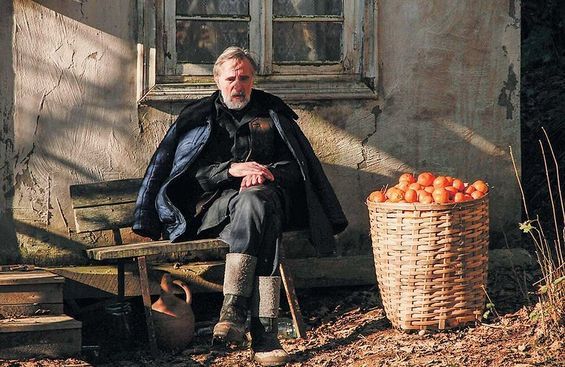
Ivo’s house is a quiet place when the Georgians and the Abkhasians or their mercenary soldiers are not killing each other in the road in front of the house. In this scene, Ivo and his Georgian friend are sitting quietly at the table talking. Ivo has just learned that before Nika, the Georgian, enlisted in the army, he had been an actor. Ivo promises that when the fighting is over, he will come to Tblisi and see Nika act. “And,” he says, “Ahmed will come with me.” And he begins, slowly, to clap his hands together. Nika gets it and laughs with delight.

It’s a high point because Ivo and Nika came a very long way to get to that moment. Ivo and his neighbor, Margus, are among the last of the Estonians left in Abkhasia. Georgia is a former Soviet state about the size of South Carolina. Margus, at the right in the picture below, is the one who grows the tangerines.

Almost everyone has gone back to Estonia, but Margus (Elmo Nugannen) go because he is harvestingtangerines 3 tangerines and Ivo (Lembit Ulfsak) can’t go because he is making the crates for Margus’s tangerines. [1] It’s a long way to Estonia, about 1500 miles, but, beginning in the 1850’s Tsar Alexander I began colonizing George with farmers from Estonia. Before the war that came with Abkhasia’s attempt to secede, there were a lot of Estonians in the region. Now there are Ivo and Margus.

And Ivo has house guests. Ahmed, a Chechen mercenary the Russians are paying to fight for Abkhasia, and Nika, a Georgian fighting to prevent that secession. Both men were near death when Ivo and Margus found them on the battlefield but each has recovered somewhat and now each is duty bound to kill the other.

That is how the movie begins. I am hoping that nothing I have said yet, explains why Ahmed and Ivo would come to Tblisi after the war to applaud Nika’s acting.

tangerines 2Ivo locks the two wounded men—one a Muslim and one a Christian, one a mercenary, one a patriot—in separate bedrooms. When they get well enough to pose a threat to each other, Ivo lays down the law. “No one can kill anyone in my house unless I want it to happen.” [1]

That brings about a completely impossible situation except that it makes this story possible. Ahmed, the mercenary Chechen and Nika, the patriotic Georgian, sit at opposite ends of the table drinking tea and eating bread and cheese. They don’t know each other as persons; only as individual members of a class called “enemies.” Each has killed some of the other’s friends, so hostility is natural, but it is also hard to hold on to in the quiet little house with the bread and tea.

The drive toward recognizing the humanity of the other is very strong in that setting and the integrity of the setting is guaranteed by Ivo’s authority as well as by the fact that both men recognize that they owe their lives to his intervention. “Our common status as human beings” seems the only relevant status. Acting on the status of “enemy” is forbidden, so they slide, they “backslide,” as their commanding officers would have put it, into “fraternizing with the enemy.” Except that in Ivo’s house, no one really seems like an enemy.

Only minutes after the high point I described, some soldiers show up. Nika gets the guns from under the bed where Ivo has hidden them and risks his life to save Ahmed from the soldiers. Nika is killed in the exchange of fire, as is Ivo’s neighbor Margus, and if falls to Ahmed and Ivo to bury them.

That brings us to the second high point. They bury Nika in a little plot overlooking the Black Sea, right next to Ivo’s son. Ahmed pushes Ivo about it. Who killed your son? It was, it turns out, Georgians who killed him; the people Ahmed was fighting against. But when Ivo responds, “Does it really matter?” Ahmed understands.

And as they stand there, they produce the second high point of the movie. When Ivo asks, “Would it really matter?” a thought occurs to Ahmed. “If I had died instead of Nika,” he asks, “Would you have buried me here?”

Ivo doesn’t answer immediately. The pause lengthens. “Yes,” he says finally, “but a little further away.” Ahmed smiles in return. It is a beautiful smile. It is a smile that sees the necessity of the answer and that savors the generosity it carries with it—and that finds the mix funny. The smile is the recognition of their comradeship. They are the two men left standing and they have done a good thing.

[1] A. O. Scott, who reviewed Tangerines for the New York Times said he was so impressed by Ulfsak’s performance that he looked up all his other films.  That would have taken a while.  Ulfsak is Estonia’s most famous actor.

[2] Ivo radiates authority. In the first scene, armed men came into his house demanding food. One of them takes the picture of Ivo’s beautiful granddaughter off the shelf and hands it to the other. Ivo intervenes.“Don’t comment. Don’t dare.” To soldiers ransacking his house for food! And they don’t. They put the picture back, take the food and a bottle of vodka, and leave.

Posted in Getting Old, Movies, Politics | Tagged , , , , , | Leave a comment

God’s Holy Library

The Bible is a book made up up books. It is, to say the same thing another way, a compilation. “Bible” points to the unity; compilation to the diversity. I think both notions are valuable and I’d like to think about then a little.

When I was young, the reader of the biblical text for the day would preface the reading by saying, “Listen to the word of God.” I didn’t have any trouble understanding that. The Bible is the word of God. He is going to read from the Bible and wants us to listen. Everything makes sense.

Then they changed it. They began to say, “Listen FOR the word of God.” I was very conservative as a child and that change bothered me. It implied that what you were reading is not really the word of God, but it it “contains,: or might possibly contain, the word of God.  I like the “for the word of God” formulation better now, but then I am no longer either young or conservative.

If the Bible has a unity, and for Christian believers it does, the unity is in the God who reveals Himself by means of all these kinds of books. “So it is,” records the prophet Isaiah, “with the word that goes forth from [God’s] mouth: it will not return to me unfulfilled or before having …achieved what it was sent to do.”[1] I said there was a unity and a diversity. There is the unity. It is God who speaks.

library 2But because the Bible is a book made up of books, it is also a kind of library. [2] That is why I flinch from conservatives who say, “The Bible says…” and then cite something the Bible says, about which the Bible also says something else. The double accounts of creation and the double accounts of David’s kingship and the double accounts of Jesus’s cleansing the temple are all famous, but there are many many more.

Then too, a lot of the Bible is offered in literary forms that are not meant to be taken in any propositional way. Did it really take three days to walk across Nineveh? Wasn’t the teller of that tall tale looking for guffaws when he ended the story with God saying, “So why should I not be concerned for Nineveh, the great city, in which there are more than a hundred and twenty thousand people who cannot tell their right hand from their left, to say nothing of all the animals?”

“…to say nothing of the animals?” Really? The notes that introduce the book of Jonah in my New Jerusalem Bible call it “A light satire, with no pretensions to being historical.” On the other hand, it has a point. And about the point, God may very well say that it [the story of Jonah] will not return without achieving what it was sent to do.

OK. That was the serious part. The Bible, being a library of books, does God’s will in all thelibrary 4 ways it must be done, including telling really great preposterous stories. So I got to thinking about the Bible as a library and then I got to thinking how you would classify various books if you gave them Dewey Decimal numbers. [2] That’s when the fun really started for me.

Here are some I liked especially.

Old Testament: Genesis I put in the 398s. Mythology. Designating something as “mythology” doesn’t mean it isn’t true. It means it isn’t true in the way an empirical study is true. It’s a broad brush account of our origins as a species and of the introduction of evil into a good world. There is a very good parallel in the movie, The Matrix. It shows you what questions need to be answered. When you go back to Genesis, you say, “Hey, that’s pretty good.”

Exodus would be in the 910s,  Travel. Also Isaiah. If there are sub-designations that specify travel in Egypt or travel in Babylonia, I didn’t look hard enough to find them. Egypt and Babylon are the two prominent foreign destinations of the Israelites. For Israel, a “foreign destination” is just “a place to return from.”

Jonah, as Fiction, goes in FIC, as most small libraries designate it.

I would put Leviticus and Numbers in the 340s, in the section for Law.

Song of Solomon would go in a section for Erotica if there were a single section for erotica. Here is the advice of Gwen B on Yahoo eight years ago: “The Sexuality section, usually around 306 and 612 in the Dewey Decimal system.”

Proverbs goes exactly in 398.9. That one is for Proverbs. Also there are lots of self-help designations that would work. I found Dealing with People You Can’t Stand at 302.3, so I might start at that shelf. Better to be poor and walk in integrity
than to be crooked in one’s ways even though rich. (Proverbs 28:6)

Psalms are Poetry, of course, so 809.1 would be a good place.

As a special treat, I will pass along that I found an odd designation at 256. It says “256, not assigned or no longer used.” I can think of a lot of biblical passages that meet those criteria. Different ones for biblical liberals and biblical conservatives, of course.

New Testament: There aren’t as many different kinds of books in the New Testament, but all the same rules apply.

library 1Matthew, Mark, Luke, and John. “The gospels,” as we say. They aren’t biographies. The “life of Jesus” is not taught as if the writer wanted to tell us about what Jesus’s life was like. It’s more like a series of important things to know about Jesus, each of which is given a narrative form. [4] If it had to be located in the Dewey system, I think “Historical Fiction” would be the right place, but if they had a category for fictionalized history, that would be better. Best of all is the film designation “based on actual events.” I like that one because it is true and because it recognizes that the stories have been…oh…enhanced.

The Acts of the Apostles is clearly a story of Organizational Development. Again we find a lot of sources, so I chose Good to Great: Why Some Companies Make the Leap…and Others Don’t. I found that one in 658.

The Pauline letters could all be placed in Pastoral Counseling. There is a Christian Life and Practice designation at 248.4. Maybe there.

A library wouldn’t be better if it contained only books that are important in the same way. A really good library has fiction and non-fiction, prose and poetry, histories and letters, and so on. And each kind needs to be read with an understanding of the kind of literature it is so that we are prepared to receive as much as we can hold of the gift each has to give us. And if each kind were designated separately by a Dewey Decimal number, it might help us remember that.

[1] That’s Isaiah 55 as the New Jerusalem Bible translates it.
[2] Some readers will know that I am married to a librarian. For the record, Bette loaned me a book called Subject Headings in the Library Catalog by Dorothy G. Lewis and one called Cataloging and Classification by Susan E. Snyder, but she isn’t responsible for any of my categorizations.
[3] Melvil Dewey, I learned for the purposes of this post, was a librarian at Amherst College . He worked out the various designations using their collection as his guinea pig(s) in the 1870s.
[4] You could try this yourself if you have the discipline to do it. Pick a trait, e.g., Jesus has the authority to cast out demons, and then find a story that illustrates the general maxim. You can write nearly every event in every gospel that way. The stories Jesus told were probably collected in a different way, but then Jesus used them to illustrate points he wanted to make, so you get the same anchoring device.

Posted in Biblical Studies | Tagged , , , , | 1 Comment

ISIS and the Republican Party: Brothers in Arms

The first scholar of political language I ever ran across was Murray Edelman. From his book, The Symbolic Uses of Politics, I learned that one way to assess the meaning of a political expression is to see how it lines up with who else is using it.

Edelman pointed out, for instance, that in the volatile racial climate of the 1960s and middle east 3 copy1970s, the people pushing hardest for armed confrontation were the cops on the street and the armed and militant black groups. They saw the situation in remarkably similar terms. The Us v. Them language was prominent as was the scorn heaped on people who were trying to make things better. “There’s only one language they understand” was a sentiment as common among the armed and radical left as it was among the armed and reactionary right. The only real difference in this exchange of slogans as who :they” referred to. To the blacks, it certainly meant the cops and sometimes meant “the white power structure.” To the cops, it certainly meant the black militants and sometimes meant the entire black community.

The moderate black leadership and the moderate white leadership were sure there was a “problem” that could be “solved” by “men of good will.” The issues that divided them were really superficial and could be addressed by some new programs, some budgetary tweaking, and persistent efforts to communicate across the racial barrier. “What we have here is a failure to communicate” was a sentiment as likely to be heard on the moderate black side of the conflict as on the moderate white side. [1]

The moderates won. There was not a race war—not, at least, a war of the kind the extremists were calling for. The new programs were tried, the budgets were tweaked and what happened is what we have now. It is not what the moderates promised, but it was not a racial holocaust either.

Ever since then, I have tried to notice, when a political slogan is unfurled, who else is unfurling the same slogan. What I learned from Murray Edelman is that the sides in a conflict may be distinguished by the ends they would like to see achieved or by the tactics they think are appropriate. In a very practical and immediate sense, the people who are calling for the same tactics are “brothers in arms.”

This brings us to ISIS and the Republican party. [1] The Republicans campaign like a home security company. They create bogeywomen [2] to arouse otherwise unconcerned consumers. They define the bad guys in terms of a permanent inner proclivity. They specify the means by which the bad guys should be dealt with. They deprecate all other proposals for dealing with them as well as all other ways of defining them.  We can say that the response of the burglars has the normal range of responses, including seminars on how to disable alarm systems [3] As you see in the somewhat whimsical table below, the moderates are in a very difficult position. “Gee, Officer Krupke, what are we to do?” is the question asked in the three quotes below, including one by the Chair of the Senate Armed Services committee who actually knows “what we are to do.” He want to call the radicals “Islam” to send American troops (back) to fight them.

That table didn’t really do what I wanted.  The red cell on the left and on the right is supposed to read “radical militants;” the blue bars in the center, to read “moderate diplomats” and “moderate Muslims.”

middle east 8

If you can remember seeing West Side Story, you can remember what a hapless figure Officer Krupke was. The really cool guys were the Sharks and the Jets and they saw the situation in exactly the same way. “They” are a threat to “us” and need to be destroyed. That is the Shark/Jet position. It is, with some changes of language due to the international venue, the ISIS/Republican position as well.

ISIS desperately needs a religious war. ISIS recruiters fall asleep at night with visions of religious war dancing in their heads. A global conflict between Christianity and Islam is the “sugarplum” they see dancing. A war to establish a radical Islamic homeland doesn’t do the job. It isn’t urgent enough. Taking oil resources from its Western-supported neighbors doesn’t do the job. Too geopolitical. Getting the U. S. to withdraw military bases from Saudi Arabia, where they sit side by side, with Islamic holy sites doesn’t do the job. Too passive. “Holy War” against the “infidels,” (that’s us) of the “decadent West” (still us), and especially “the Great Satan” (us again) is what will do the job that ISIS has in mind.

What would that do?

It would bring recruits in unprecedented numbers from all over the globe. Nations with no real interest in seeing ISIS prevail against the Kurds or the Turks or the Iraqis or the Syrians would line up to support “a holy war against Christianity.” An Islamic banking system would flourish; arms and materiel would flow to the points of greatest need. The Caliphate would again become a thinkable thought and put fire in the blood of millions of young Muslims.

It’s a long shot, but ISIS is not really without hope because they have the support of theirmiddle east 5 partners, the Republican Party of the United States. “How can you say that?!” you say, having passed by all the paragraphs preceding, which I was counting on to prevent that response, “No one is more anti-ISIS than the Republicans.” That is true. And no one was more anti-cop than the black militants.  That is why I called them “brothers in arms.”

But look at the table. It is the radicals that feed off each other. If ISIS says “This is a war against Christianity” and the United States says, “No it isn’t. This about armed thugs beating up on their neighbors,” everything will be local and contained. If the United States says that the thugs are Islamic and their scriptures support their efforts and what these guys need is to see “a little Christian steel,” then conditions are set for the religious war ISIS needs so badly.

Who in the U. S. will volunteer to partner with ISIS. President Obama could. Since a sizable proportion the conservative electorate still thinks Obama is Muslim, it would be a very satisfying thing—a very un-Muslim thing— for him to do. But he can’t do that; he has a job to do and that would make everything worse. Obama has also been criticized for a “soft” or even a “cowardly” approach to foreign policy. Condemning ISIS in a way that highlighted their religious background would be a very satisfying way to shut up the critics and send his approval rating back north of 50%. But he can’t do that; he has a job to do.

You would think that the Republicans could do that if they really wanted to. They could look at the taunts of ISIS—all put in a religious mode—and refuse to take the bait. That’s not what they have done. They have been bitterly critical of Obama’s refusal to label ISIS as “Islamic militants.” The Republican case is that these guys are Islamic and they are militant, so they are Islamic militants. President Obama’s case is that they are a dozen other things, in addition to those two, and including a religious designation is only helping them achieve their war aims.

Here are a few quotes that I will attribute to right wing Islamophobes, not to the Republican party generally but they will help to identify the ground we are on.

1.  “Christians [should] prepare to wage holy war in an effort to utterly destroy all 1.6 billion of the world’s Muslims because Christians simply have to “face the harsh truth that Islam has no place in civilized society.”

That could not have been phrased better by anyone in ISIS. ISIS is the principal beneficiary. It is fully in accord with their war aims. They didn’t say it, however. This quote comes from Gary Cass, founder of the Christian Anti-defamation Commission.

How about this one?

2. Islamization, she has said, is not something that will happen overnight. “It’s a drip, drip, drip, drip…The mosque-ing of the workplace where you’re imposing prayer times on union contracts, non-Muslim workers have to lengthen their day. … These demands are a way of imposing Islam on a secular society.”

middle east 3More ISIS propaganda, trying to draw the U. S. into defining the conflict as religious, rather than military and political? Nope. This is Pam Geller, founder of the American Freedom Defense Initiative.

“This is a religious war!” is the only hope ISIS has of becoming a self-sustaining movement. “No it isn’t, it’s a regional mugging” is the best hope the U. S. has of isolating ISIS from Islamic nations worldwide. The President knows that. It is likely that the Republicans know it as well.

3.“Look at the world in 2009, and look at the world today. My friends, it is dramatically shifted in favor of the forces of radical Islam, forces of terror, and they are now direct threats to the United States of America.”

Obviously, this is not ISIS. The point of view is strongly opposed to ISIS, but it is strongly in favor of U. S. intervention with ground troops and it labels the bad guys by using religious terminology. They are “radical Islam.” So it still helps ISIS achieve their goal, which is to turn their neighborhood scuffle into an occasion for religious war.

middle east 4This one is by Sen John McCain who, at the time he said this (in an interview on Fox News) was on the verge of becoming the Chair of the Senate Armed Services Committee. He is now the Chair and has a very different view of the matter than the Commander in Chief of the Armed Forces.

Everybody who understands the ISIS challenge knows that their only real hope of success is to call their cause “a religious war” and to taunt the United States into agreeing with them. When we say, as Cass, Geller, and McCain do, above, that they are right; that it IS a religious war, ISIS wins that round and is a step closer to the Caliphate.

[1] Thanks to Cool Hand Luke, that is an expression that has become useful in an amazing variety of circumstances.
[2] Trying really hard to get past gender stereotypes here.
[3] These seminars have been held for many years now in federal and state penitentiaries, where the masters of these crafts can be brought together with novices and a great deal of hard-earned knowledge shared.

Posted in Political Psychology, Politics | Tagged , , , , , | Leave a comment

The Bible in (less than) 300 Words

The bulk of this post is going to be the work of others. My part in it will be limited to telling you who those “others” were and saying why I am so excited about what they did that I wanted to share it here.  Here is the First Presbyterian Church of Portland, Oregon, where we met for so long and learned so much.

disciple 1Two notes here, just as a background. First, the piece I am going to paste into the middle of this document is a narrative of staggering scope. It is an answer to the question, “What is the story the Bible tells?” So it is a document that is historical and doctrinal. It was crafted in the same way the great councils of the church crafted the confessions—think of the council of Nicea in 325 A.D. or the council of Chalcedon in 425 A.D. It was crafted, that is, with part of our attention on what we wanted to say, part of it on being consistent with other parts of the document, yet other parts on meeting the needs of the readers. [1] And finally—the best part for me—on the need to make this a compelling narrative. It is a kind of interest I call “rhetorical,” for what seem to me good reasons, but that cause others to shake their heads sorrowfully.

The second note is that the piece itself is richly theological. If you have theological appetites, you can satisfy them here. This post, however, is not theological; it is, if any one field can be charged with it, more pedagogical.

Here’s the piece. Nine of us, not including me, put this together under a spartan word limit. This is what they did.

The Bible in (less than) 300 Words

In the beginning, God created the heavens,the earth, and mankind. Adam and Eve disobeyed God, resulting in a broken relationship with Him. Not giving up on mankind, God established covenants, including those with Abraham and Moses.

In the Promised Land, God provided for judges and kings, yet over the long stretch of their history the Israelites remained discontented. Unfaithfulness finally led to alliances that resulted in the exile to Babylon, during which the prophet Jeremiah told of God’s passion for reconciliation: a new covenant, through the coming of a Messiah.

An angel announced to the Virgin Mary that she would be with child, the foretold Messiah of David’s lineage.  John, the Baptist, prepared the way for the Messiah and baptized Jesus.  Jesus claimed to be the son of God, preaching God’s love and forgiveness through faith, not laws: fulfilling and supplanting the Mosaic covenant. His teaching, especially his parables, included messages of salvation and love.  He also performed many miracles.

Jesus’ ministry threatened the Pharisees’ status as well as Roman control.  He was crucified.  After his resurrection, Jesus came to his apostles and told them to preach his words to all mankind.  Jesus’ death and resurrection became the source of eternal salvation.

When the disciples were empowered by the Holy Spirit at Pentecost, they began to share with everyone the good news of God’s redemptive work in Jesus. The new church struggled to understand how Jews and gentiles could be united as followers of Jesus. In this united church, God made a way for all people who follow Jesus to be brought back to the relationship God desired. God had been seeking to restore this relationship ever since it was first broken.

If you are not inclined toward theology AND you read all the way down to here, this piece might have struck you as a piece of nonsense. It isn’t, really. It is an adroit summary and an interpretation of a very large story. And it is entirely orthodox, given the leeway of a shading of meaning here and there. And it does manage to tell a story. It has a beginning and a middle and and end. It has a motive and obstacles to its achievement and a successful conclusion.

If you are inclined toward theology, you will notice right away that although the old familiar ground is covered, it is covered in some unusual ways. “Sin,” for instance, is not so much as mentioned. What sin did, however, is the driving theme of the essay from beginning to end. And, to pick another prominent example,specific people are left out almost entirely. In addition to Jesus and Adam and Eve, four people (4!) are named. Abraham, Moses, Mary, and John the Baptist. And yet, in that survey, so very poor on names, they covered the covenantal history of Israel, the Incarnation, the official beginning of Jesus’s ministry, and the crucifixion and resurrection. Amazing!

How did that happen? [2] Let’s begin with just how preposterous it is. Depending a little on how you count them, there are 783,137 words in the Bible. We committed to 300. On the other hand, we had Max Eastman to go on.

A book… should begin by telling in a few sentences the author’s conception of the significant form of that history as a whole, [3]

So began with the idea that no matter how huge the story is, it bare outline of it can be told briefly. Afterwards, additions can be made to restore some of the lost detail, but those additions are made TO the narrative structure, not INSTEAD OF IT. Big difference.

Second, I picked 300 words as the limit because I guessed that would produce enough friction to motivate a meaningful triage, but not enough to blow the whole project sky high. It was a guess, but I’ve done this before (beginning in 1961) so it wasn’t an ignorant guess.

And it worked. In the first rounds, we specified a lot of people and indicated our commitment to a lot of doctrines. But as the space shrank, choices had to be made and at the heart of the choices were these two wonderful questions: a) Is A more important than B and b) Why?

These questions enable discussions about WHY a doctrine is important. What does it do? [4] It is that question that enabled us to deal with “sin” in lines one and two without using the word. We talked about what sin DID, not about what it was. They are both important, but if you are telling a story, the latter is more important than the former and we were telling a story.

Third, and finally, when we got down to the very end, we had to make decisions about “what is True” (notice the capital T) and what the story needs. When you are down to 300 words, what the story needs in order to work gets to be a really compelling matter. Valuable doctrines were left out—doctrines that meet the standard implied by the big T in True—so that the sequence of events could be clear and so that the motive would be seen as adequate to the needs of the story and so that it would end in the way the beginning promised it would end.

All those are concerns that no one—trust me on this—had in mind when we began. In fact I was surprised, myself, at how powerful it got as we threw one doctrine after another, one hero of the faith after another, over the side so we could keep the flow of the narrative intact.

So you might wonder, as Butch Cassidy did, “Who are those guys?” Those “guys” are nine members of a group at First Presbyterian Church in Portland, Oregon. They will have spent, by May 12, thirty-four weeks, working through the Disciple 1 program, offered by Abingdon Press. There is not a trained theologian among them. The amount of biblical literacy varied a great deal among them as did notions of what it means to call a text “sacred.”

They are, in all their wonderful and distinctive complexity, a group of ordinary people. And they did THIS. Wow! Amen.

[1] I did not appreciate this point sufficiently when we began the process of writing this. But there came a time when the members of the class pointed out to me that there was no way to decide finally on one emphasis or another, or on one phrasing or another, until they knew who was going to read it
[2] I am going to give you the short answer. A longer and more adequate answer would have to say that everyone worked really hard at it and some of the hardest work was letting go of treasured doctrines or persons. “You’re not going to tell this story without X are you?” Without “sin,” without David the King, without the ethical teachings of Jesus, without the richness of the Torah? Even the most treasured emphases were laid aside so that the work as a whole could be competed. That’s the longer answer to how it happened.
[3] Eastman had a history of the U. S. in mind, as his example shows (The Enjoyment of Laughter, page xv), but it works on anything you can shape as a narrative
[4]A crucially important question I learned from George Lindbeck of “the Yale School of Theology,” which is not so much an institution as an approach.

Posted in Biblical Studies, Living My Life, Theology | Tagged , , , | 2 Comments

Mothers as “Designated Worriers”

It’s Mother’s Day today. Or Mothers’ Day. An addition to a chalked sign I saw today said, “…and to all nurturers.” Mother’s Day is so hard these days.

There are ways I think it is hard and needs to be. We just need to get some things worked out among ourselves. And then there are some ways it needn’t be hard…but is, anyway.

I think everyone agrees that a man and a woman who want to have amother 1 child should not be forbidden. But when it comes to celebrating people who have had children—parous women—from those who have not (nulliparous women), it gets harder. [1] Who should be forbidden is a pretty easy question. Who should be celebrated is much more difficult. I am a veteran of the 1970s when there was a brave but short-lived attempt to celebrate Non-mother’s Day (on the same day), validating the choice women had made to refuse to bring yet more offspring into an already overpopulated world.


mother 2And then too, no one really thinks that it is the fact of motherhood for which women should be celebrated. We think of GOOD motherhood. All the selfless and nurturing acts women commit for benefit of their children. But we all know really awful mothers. These are women who are distorting their children’s  lives so badly that they will spend the rest of their lives trying to recover from it. So we celebrate a tacitly constrained “motherhood”—some, but not others—under the guise of celebrating parity generally. And how else could it be, really?

Everything is worse for Father’s Day (Fathers’ Day) and I don’t even want to get into that.

My wife—the mother of our children—and I once tried a dodge of our own back in the 1970s. We thought we could get away with it because we were going to apply it only in our own family. Why is it, we said, that women are treated as if they are the sole source of nurture in the family and men as if they were the sole source of guidance or direction? How silly, we said. What we all know is that the husband and the wife—the father and the mother—both offer nurture and that both offer guidance and direction. Each in our own way, of course.

mother 4So the obvious solution was to celebrate Nurturer’s Day on which the nurturing each of us did would be noted and celebrated and then, several weeks later, Leadership Day, in which the direction each of us provided to the children would be celebrated. The kids were mortified. I wonder whether they will even remember the event. They ridiculed the whole idea to us and God only knows what they said to their friends. We refused, that first year, to say that we knew when we were beaten and we resolved to do it again next year, but we never did it again. And so promising, too.

So those two things continue to bedevil us. First is the separation into meritorious and non-meritorious camps of women who have or who have not given birth to children. Second is the implicit celebration of “motherhood as such,” when what we are really trying to celebrate is successful motherhood—Hallmark card-style motherhood. So we will have those problems no matter what.

Other problems are self-inflicted. I got to thinking along these lines when I scanned through an article in today’s New York Times (see it here) called “Mom: The Designated Worrier.” Scattered throughout the column in the paper copy (not the electronic copy) were little hints about what the article said. [2]

Here’s one: “So long as women talk about men ‘helping out,’ we have not attained equality. Helping isn’t sharing.”

Here’s another: “Moms don’t necessarily do everything, but they make sure that everything gets done.”

I’d like to come at that from another side. I’d like to look first at how and by whom the tasks to be done were organized. Then I’d like to look at the emotional style to be celebrated. Those seem pretty straightforward on Mother’s Day, but I think what seems straightforward has been bent backward.

Often, it’s a help to start with the truly ridiculous and work back. [3] Imagine a bachelor whose passion for tidiness has caused him to hire a maid service to clean his apartment for him. The maid starts doing a sloppy job of what should be a simple task. Dust the National League posters on the first and third weeks of the month and the American League posters on the second and fourth weeks. She dusts Cleveland and Cincinnati on the same week. “Oh no,” he says, “you aren’t helping when you do that.” After several repetitions, she replies, “You know, this is the stupidest organization of a simple job I have ever seen!” And she huffs out because she is, after all, the maid. What if the guy were a husband instead of a bachelor and the woman was his wife instead of a maid for hire?  Who decided on that National/American split?

Let’s just drive that peg in the ground and walk away a short distance.

If the work is planned together (when, how often, how clean, determined by what method, etc.) the man and woman are equally responsible for the accomplishment of the work. They are partners. Very often, they don’t have equal amounts of “off of work time,” but that would be taken into account in the planning. If “the work” is the private property of the woman of the house, then “equality” can never be achieved because there is only one planner. The husband is just hired help even if he does more of the execution than she does.  If there is no parity in the planning (just kidding about the “parity”), then everything following it is…um…below par.

No one would call this standard “helping out.” “We have planned the work to meet our standards (even if that required some compromise) and now we will be responsible to do what we decided. Who’s helping out?

mother 5Besides, it isn’t factory work. When you are having a hard week—an accountant near the end of the tax year, for instance—I pitch in and do work that under normal circumstances, you would have done. And I do it to the standards you have established.  It wouldn’t be any help otherwise.  And I do it with a friendly spirit because I remember with gratitude how you filled in for me during finals week. The meaning of “partners” isn’t some rigid definition of work to be done, no matter how collegially it was first planned. “Partners” includes the adjustments we make as life happens.

Everything is harder if we are talking about helping the kids grow up and not something relatively more simple like keeping the house clean. Kids, for instance, know which parent to appeal to for what immediate goal. They work the parents in ways that household tasks don’t. [4]

Let’s come back and look briefly at the “designated worrier” role. That’s how it appears in the title. But down in the article, it is called “making sure everything gets done.” Does that sound like the same thing to you?

Worrying is a style of management. [5] It is currently the fashionable style, but it is only one among many. The value of worrying in this system is that it keeps everything active—while you are worrying about it, you are thinking about it—and makes it less likely that you will forget things that are related to the task. On the other hand, attention span being variable but still finite, it makes it more likely that you will forget things unrelated to the task. The worrier’s spouse, for example.

And as the standards for child-rearing continue to escalate, the anxiety about meeting those standards increases. That doesn’t make worrying a more effective strategy, of course, but worrying is the cheap form of concerned engagement, just as guilt feelings are the cheap form of behavior change. Everything is more complicated than it really needs to be, don’t you agree?

So long as worry is prized for its own sake, there is really no solution to the designated worrier problem. If that is the problem. More often, I think, it is the “default worrier” that needs to be dealt with. If, for instance, the moral requirement is that one of us needs to be worrying and you are not worrying, then it falls to me to do it. I have not been “designated.” That would be a much better arrangement. I have volunteered.

The solution lies in the same direction as the “share the planning, share the work” standard. Let’s agree on what has to be done and then let’s keep at it until WE are finished. Now there is no real need for worry. If you want to worry as a recreational matter or if the worrying reflex is left over from a previous administration, then we can safely let it be. Maybe a counselor could help, but it isn’t an issue between the partners any more.

Again, the standards will need to be negotiated. If they are not, the parent who wants more to be done and who cannot convince her or his partner of the value of it, will very likely take on the worrying at whatever cost to them both. If, on the other hand, the person with the higher standard is not willing to compromise with the partner with the lower (more…um…flexible) standard, then we need to ask why compromise is so hard to reach. Maybe reflexive maternal worrying isn’t really the problem here. Maybe it’s worse.

Mother’s Day thoughts. I’ve been a father since 1960 and a stepfather since 1979. I don’t approach these issues as if I don’t know they are hard to deal with. I just think we could, maybe, be a little gentler with them.

[1] Some dictionaries give parous as a word, meaning “having given birth,” while others consider it only a suffix. There is no question about the legitimacy of nulliparous, so it is possible that parous is a back-formation. The form of the word as a noun is much clearer, so far as language goes, but much less clear as a social attribution. It should be possible to say of women who have successfully given birth that they have “achieved parity.” But that would require some notion of the Latin verb parere = “to bear,” rather than the Latin paritas = equal. The fact that both words, spelled the same as nouns, are part of our language makes it possible to look at headlines like “Women have achieved parity in the workplace” and to turn silently aside to watch sports or something
[2] I haven’t actually read it and I won’t until I’ve finished this post.
[3] Celebrating, as always, Maxwell Smart’s offer (from the TV show Get Smart), “What would you believe, chief? Let’s start there and work our way back.”
[4] Not that household tasks can’t be used the same way. On the week when I take over tasks you would normally do, I could do then to my standard rather than the one we agreed to and then I could show it to you and say, “There. Now that look better (than when you do it)?” Everything is more complicated than it would have to be.
[5] English has the expression “a dog worrying a bone.” In that expression, the dog is doing the worrying, so to speak, but it is a transitive verb, so it is the bone that is being worried. And if it is “being worried,” then in “is” worried. A lot of worrying could be left for the bones to do, while the dogs go off to happier pursuits.


Posted in Uncategorized | Tagged , , , , | Leave a comment

NCIS

At the end of the show—the first episode of the first season of NCIS—Gibbs gets into a convertible driven by a redhead and is whisked away. Why?

The best response I can imagine is, “Who cares?” And the best rejoinder I can manage comes from Salmon Fishing in the Yemen’s Dr. Frederick Jones, who says, “Well…strangely enough…I do.”

Also, there is my identity as a dilettante to consider. If you look at the title of my page, above, you will see that the tagline is: “delight is the heart of the dilettante.” [1] As an operating principle, that means that I wind up writing about whatever snags and holds on to my interest for a time. My interest, it turns out, is easily snagged.

Which brings us back to NCIS, the most popular television show in America. The show is about Special Agent Leroy Jethro Gibbs. That’s my own judgment. You could say it is about the Marines. [2] You could say it is about the team of agents Gibbs leads. You could say it is about “justice,” on the grounds that “the bad guy(s)” get killed or jailed at the end of (nearly) every episode.

I say it is about Gibbs. Let’s go back to the redhead who picks him up in the car at the end gibbs 3of Episode 1. They never say who she is. They never say what relationship she has to Gibbs, if any. [3] She just shows up, acquires Gibbs, and heads off. Why the redhead? Because they want to say something about Gibbs. The show is “about” Gibbs.

The redhead is not a hooker. That’s not what they want to say about Gibbs. She is not notably younger than Gibbs—maybe a little. She has short hair. I think Belisario decided that a woman with long red hair would fit nicely into viewer speculations about who she was, so she has short hair. She drives a silver Mercedes convertible. Gibbs gets into the car without greeting her and they drive away. It’s not about the redhead. It’s about Gibbs.

Gibbs has had three wives by the time the show debuts. He needs to be “single,” a word meaning that the affairs he keeps having can’t evolve in the direction of marriage, so that he can be solitary at all times. [4] He is alone when he is at work. People come to him, cases come to him, whoever the director of the agency is at the time summons him. He goes “home” and goes straight to the basement, where he is perpetually working on a boat with hand tools. [5]

Gibbs 1So, since he can’t be married and since he has to be perpetually attractive to women and since being attractive to women who are regulars on the show creates problems for the writers, what we really need is a completely unexplained attractive age-appropriate redhead. That says what needs to be said about Gibbs’s sex appeal and it doesn’t complicate the plot.

Gibbs really needs some kind of understandable appeal because he is “god-like” in all the worst senses of the word, in other respects. It would be tempting to say that he is “unaffected” by people,” but that isn’t really true. He is unaffected by people who are trying to affect him. He relates freely and warmly to people—children, damsels in distress—who need him. “I will have mercy on whom I will have mercy” (Exodus 33) is the short version. [6]

He knows things he really couldn’t know and the show has no interest in explaining why that is. The team eventually just takes it for granted that Gibbs is going to know about “it,” whatever it is, and he always does. That isn’t divine omniscience in any thoroughgoing sense, but it is close enough for network television.

He is not really confined by space the way the rest of us are. He just “shows up.” He doesn’t “come into the room.” He just “is” in the room and he is standing right behind whoever is doing something he or she shouldn’t be doing. It’s not omnipresence, really, but since you can’t ever be sure when it will happen, it winds up being close enough for network television.

Gibbs isn’t funny. That gives everyone around him a chance to be funny and we get toGibbs 2 enjoy all that repartee, but it doesn’t affect Gibbs. Gibbs has access to irony on occasion, but he doesn’t laugh when everybody else laughs. Why?

Well…it’s like the mysterious redhead. [7] The show is about Gibbs. Gibbs is whoever he needs to be to set up the show. If you are going to have all that godlikeness, you really need a mysterious redhead in a Mercedes.

Do you watch NCIS? Bette and I do. It’s about Gibbs.

[1] It is, actually. The English word dilettante derives from the Latin delectare, “to delight.”
[2] Donald Bellisario, the creator of the series, was a marine himself and is relentlessly positive about the corp’s virtues.
[3 NCIS is a show that relishes inside jokes. Although no one knows who “the redhead” is on the show, everyone knows who she is in real life. She is Vivienne Belarisario, the fourth wife of the show’s creator and she is Sean Murray’s mother. Murray plays Agent Timothy McGee on the show.
[4] That’s Gibbs. Mark Harmon, on the other hand, has been married for a long time to Pam Dawber, whom you will remember, if you are old enough, as “Mindy,” who starred with Robin Williams on Mork and Mindy.
[5] Mark Harmon, who plays Gibbs, does, in fact, make furniture using hand tools. That explains why Agent Gibbs seems to know what he is doing
[6] He also has a firm-but-fair collegial relationship with other male members of the team. More “coach-like” than godlike.
[7] In, I should say, a show stocked with redheads. Some of the redheads have been his boss. Some have been flings. One I can think of has been both.

Posted in Living My Life | Tagged , , , , , | Leave a comment

A Listening Silence

I want to think today about how we listen to each other.

This is not going to be a lament that we don’t listen to each other any more, but back in the old days, whenever you were a child, people really did listen. I think that’s probably true, by the way; there were so few things to “listen to” back then that listening to people was a much more common activity than it is now.

This is going to be about therapeutic listening.

Not listening by therapists or to therapists. There is a healing that comes just from being listen 4heard and one step on the road to being heard is being listened to. There is another step, but I want to share a couple lines of text before I go on to talk about that one—a couple of lines and the story that goes with it.

They listened to him, not agreeing, not denying, but accepting his despair. His words went into their listening silence, and rested there for days, and came back to him changed. [1]

To grasp this text more fully we will need to know a few more things, like “they” and “him” and “his words” and we will get to all that. For now, I want you to notice that it is the words that change. You could argue that words don’t actually change. That is my own very solid empiricist tradition, in fact, but this text is from Ursula LeGuin to whom I have given my heart many years ago and it takes place in her Earthsea, which is not really as rich as Middle Earth, but which is a place I am at home. And LeGuin does this. It is a pattern in her fiction. She has “it” act while we watch. [2]

So notice, first, that “the words came back to him.” And when they came back, they were changed. In a little bit, we will need to know what those words were, but for now, let’s look where they went because that is what I really want to talk about.

The words went into “their listening silence.” The words came out of Medra [3] and they went somewhere. They went into a listening silence.” Now a listening silence isn’t like a black hole or an acoustical dead zone. A listening silence is created and maintained as an act of caring. It is a place where words can be changed, words can take other forms, and return to be newly heard by the speaker.

So Medra, who spoke the words, could mean by them only what he meant. The words he chose expressed perfectly how he really felt, but after he had said them, they went away and were changed and came back to him meaning something else. The words now meant something he had been unable to say and unable to mean before. Here’s what he said.

“Trust;’ the young man said, “Yes. But against— against them?— Gelluk’s [an evil wizard] gone. Maybe Losen [an evil king] will fall now. Will it make any difference? Will the slaves go free? Will beggars eat? Will justice be done? [5] I think there’s an evil in us, in humankind, Trust denies it. Leaps across it. Leaps the chasm. But it’s there, And everything we do finally serves evil, because that’s what we are, Greed and cruelty. I look at the world, at the forests and the mountain here, the sky, and it’s all right, as it should be, But we aren’t, People aren’t, We’re wrong. We do wrong. No animal does wrong. How could they? But we can, and we do. And we never stop.”

OK, that’s a rant. It might have been hard to hear and both the women who heard this knew it was true. But they knew something else; they knew it didn’t lead anywhere. And that is what happened to Medra’s words during their time in “the listening silence.” They were changed into something that actually did lead somewhere.  Roke Island, the home of all magic is the purple dot right in the center of the map, south of Havnor

listen 6Let me take a small professional break from the story. I am a political psychologist by training and, if I were still being paid for it, by trade as well. I look at how people explain things to themselves and at what value the particular explanations they choose have for them. These explanations are called “causal attributions” in the end of the pool where I swim and Medra’s causal attributions go nowhere. If Medra is right about how things are and must be, then his despair is fully justified and he might just as well lie down and die. What I teach is how to make causal attributions that help you get up and do something. It’s a really good causal attribution—it meets one of the two criteria—if it does that.[5]

The women did that for Medra. What women?

Anieb died while he [Medra] held her, her ruined face against his arm. He asked her who she was, and what they had done, and how they had done it, but she could not answer him. Her mother Ayo and her mother’s sister Mead were wise women. They healed [Medra] as best they could with warm oils and massage, herbs and chants, They talked to him and listened when he talked.

That is part of who these women were. They were “wise women.” Medra did everything he could to save the life of Ayo’s daughter Anieb and failed. He was broken in body and spirit by what he and Anieb had been through together and Ayo and Mead nursed his body back to health. That’s what the warm oils and the massage and the herbs and chants did. But they also talked to him and listened to him and that enabled him to deliver the rant we heard him give.

listen 3We have seen that the women were healers and they were wise. We see now that they were also political subversives. They were part of a loosely strung web called “the women of the Hand.” Women, and a few men, who had no power but who trusted each other and who wanted, to borrow a few phrases from Medra’s rant “the slaves to go free and the beggars to eat and justice to be done.” They were known to each other by a sign.

She [Mead, Ayo’s sister] held- up her first finger; raised the other fingers, and clenched them together into a fist; then slowly turned her wrist and opened her hand palm out, as if in offering. He had seen Anieb make that gesture. It was not a spell, he thought, watching intently, but a sign.

It was, in fact, a sign. It said, “I am of the women of the Hand” and by telling you this, I am putting my life in your hands. So it wasn’t just the listening that Ayo and Mead gave to Medra. Making the place—it wasn’t just the “listening silence,” into which Medra’s angry words could go and could return to him changed—required that they be who they were. They were wise women and dangerous women. They wanted freedom and justice and they were part of a subversive group who refused to want something less.

Here’s what Medra said when the words returned to him out of the listening silence that Ayo and Mead held in place for him.

We can’t do anything without each other;’ he said. “But it’s the greedy ones, the cruel ones who hold together and strengthen each other, And those who won’t join them stand each alone.

Medra began at “Everything we do finally serves evil, because that’s who we are.” In his anger and despair, Medra talks about the nature of human beings and the nature of society. He talks about things that cannot be changed. Those words went into the listening silence held in place by the strength and the compassion of the wise women and when they came back to Medra, they were no longer about who we are and must be; they were about what we can do together.

What they could do and did do is what the rest of the novella is about, but the story would have gone nowhere without the wise women. Medra would have let his pain and guilt destroy him. Or he would have let his anger take him into self-destructive acts of resistance. But because his words came back to him changed, he became one of the men who served with “the women of the hand” and long afterward, he discovered the Book of Naming in the house of a poor woman on the island of Pody, where the mage Ath had hidden it many years before.

How did he find it? First, he went looking for it. But…he also had help. This is what that looked like.

I won’t be so bold as to ask for a kiss, said Medra [posing as a peddler of trinkets], but an open hand, maybe?” He made the sign; she looked at him for a moment. “That’s easy, she said softly, and made the sign in return, “but not always safe among strangers.”

And she took him to the house of the poor woman where the priceless Book of Names had been hidden and took it to Roke Island, where it became to basis of all resistance to tyranny.

I look around at the place where I live and at the people with whom I live and at myself as well and I wonder what could happen if we could hold in place a “listening silence”—a place from which words could return, changed, to the speakers. The words would return changed and they would change the speakers, perhaps as Medra was changed, from hopelessness or anger—we don’t know which way he would have gone—to trust and subversion.

[1] This is Ursula LeGuin at her best. It is what I like best, at any rate, about her. These few lines, and the story that gives them their meaning, are in her Tales of Earthsea, this one from a story called “The Finder.”
[2] In The Dispossessed, the protagonist, Shevek, watches his greatest theoretical breakthrough running away, laughing, and he knows he will always remember what it is.
[3] In Earthsea, everyone has a “true name” and a “use name.” Because he lives the kind of life he does, Medra has two use names, Tern and Otter, but we will stay with his one name, his true name.
[4] Anyone else hear Amos ranting there against the evils of Israel or James against the rich of his congregations. See chapter 5 of each of those books, Amos in the Old Testament, James in the New, for and account that sounds amazingly like Medra.
[5] The other is authenticity—effectiveness alone doesn’t cut it—but that will have to wait for another blog.

Posted in Books, Political Psychology, ways of knowing | Tagged , , , , , , | Leave a comment

Foul-mouthed and Free

bad language 5I heard a story yesterday that was unlike any I remember having heard before. Today, I’m going to tell it to you, cutting back a little on the narrative and expanding a little on the theoretical implications. It is…sigh…what I do.

The story comes from Marv Mitchell, who runs Julia West House, where a number of valuable services are provided by the First Presbyterian Church of Portland, Oregon (hereafter, “my church.”) The service Marv was talking about yesterday involved providing food, coffee, and a place to get out of the rain for a group of Portland’s homeless, mostly men. [1’] These are the people Marv calls “our guests.”

This story could be started at a lot of places, but I want to start it at the staff meeting where Marv said that the language being used at Julia West was coarse, foul, and abusive and it had to stop. There were two kinds of objections to his proposal, both of which made a great deal of sense to me.

bad language 4The first was that foul language was the language these people had chosen. It was authentic; it was their chosen mode of communication. Someone may have hinted, Marv didn’t say this, that he was being just a little bit paternalistic. That kind of language wasn’t his choice, of course, but it was their choice and Julia West House should honor the dignity of their guests by allowing them to “be who they are.”

The second was that nothing Julia West staff did was going to work anyway. These people made a lifestyle out of being intractable and resisting any attempts by authorities to constrain them. That’s why a lot of them were on the street in the first place. You start to put the hand on them and they will just go somewhere else.

Actually, that’s not what happened. Marv continued to believe that change in a good direction was possible and in the face of the advice he got, he started going around among the guests, saying, “We don’t allow that kind of language here,” or whatever he said. Whatever it was, it wound up eventually on the Julia West homepage (www.juliawest.org) like this:

We have expectations of mutual respect and appropriate behavior. We do not tolerate language or behavior that is racist, sexist, misogynistic, abusive or violent. [2]

Nothing in this story so far was surprising. I have seen people making Marv’s point derided and defeated many times over the years and have, on occasion, played that role myself. That isn’t what happened this time.

bad language 3The first thing that happened is that Marv successfully talked down one angry man after another. He didn’t say how. Marv isn’t big and menacing. The second thing that happened is that people started to shush one another: “Hey, you better knock off that language or Marv is going to come over here.” That response is the first sign of a change in culture, which I like to represent as “We don’t do that here.”

And that’s really the end of the story Marv told. Currently, at Julia West, the guests really don’t talk to each other like that. But then a couple of things happened after the story and they are what made me think the story was worth telling.

One thing that happened is that everybody at Julia West on a given day began to get some warning that something bad was starting to happen. The reduced prominence of bad language and the reduced din of angry language provided a space where you could tell that something was starting to go the wrong way. You can hear the first angry voice at a meeting and maybe even deal with it. When everyone is already yelling and shaking fists, the early signs of serious trouble are going to be really hard to spot. When things were quieter, people got a chance to catch trouble that was just starting.

Another thing that happened is that “good manners started by break out.” That’s Marv’s phrasing. Being the social scientist, I began to wonder why that would be. My first guess—that’s really as far as I have gotten so far—is that polite words and polite behavior are a unit. They are one thing; something like a “mode” or a “gear.” They have always “belonged together” and when one is enforced, it cues the other.

I’m prepared to believe that, in any case, because I am a veteran of public elementary schools and high schools at a time when the administrations thought it would be good to have a “casual Friday.” Casual Friday was awful. “Casual” got to be “edgy” and then “provocative” or combative and a lot of behavior we spent time trying to prevent came right along with it. We had more talking during class; more fights on the playground bad language 1(elementary) or in the parking lot (high school). We had more smoking in the restrooms and more enforced trips to the principal’s office. Why? As I was looking at it, I concluded that the clothes cued the language, which cued the behavior. That’s what I thought of first when Marv said that “good manners broke out.” Of course they did, I thought.
Finally, and most surprising of all to me, guests of Julia West House began to come up to Marv and thank him for making and enforcing the rule. Here’s what they said. “This is the one place where we don’t have to talk like that.”

Did you catch that? We don’t have to. We are not compelled, here, to represent ourselves as foul-mouthed angry men and women. We are free, here,[3] to choose to represent ourselves otherwise. “We are free to,” is language that suggests to me that the person who said that had been wanting to present himself otherwise—as soft-spoken, perhaps, or gentle. Possibly even as a nurturing person. But he knew he didn’t dare show that part of himself because it would be taken badly. It could have been taken as a criticism of the others. “Oh…listen to Chauncey! I think we’ve hurt his feelings!” It could be taken as volunteering to be the butt of the jokes and later, outside, as the one who had volunteered to be abused.

He wanted to present himself that way and knew he didn’t dare. That’s the way I read “This is the one place where we don’t have to talk like that.” That was the most surprising new way of thinking about street people. It was the most surprising part of Marv’s story to me.

I don’t know what you will make of it. I’m not sure yet, what I will make of it. But I’ve heard it now, so I’m going to have to think about it.
[1] We don’t provide food anymore. It turns that there are lots of places in Portland where people living on the streets can get food. Since the time when this story is set, Julia West has concentrated on other things, such as the skills and the clothes necessary to get jobs.
[2]Whenever I see language like this, I wonder why misogyny is forbidden but misandry is not. One of the burdens someone carries who has an eye for symmetry and has read a lot of words over the course of his life.
[3] This is where the title “Foul-mouthed and Free” comes from. I didn’t think I dared to title it “Foul-mouthed OR Free.

Posted in Living My Life, sociability, Uncategorized, Words | Tagged , , , | Leave a comment

Accountability and Trust

I am going to say a few words in favor of accountability here.  Nearly everyone I know who is a fan of “accountability” will be disappointed by what I have to say and some will feel betrayed.  I don’t think they should.  Stay with me and let’s see.

It will not surprise you that accountability once meant, and sometimes still means, “able to give a [satisfactory] account.”  A lot of social structure goes into that simple statement.  I may ask anyone who is accountable to me to give me an account of her[1] behavior.  I may also ask, if I wish, that people who are not accountable to me give me such an account.  The rejections on the quiet side include, “Why would I do that?”  On the more boisterous side, “Who the hell do you think you are?”

So even from the beginning, accountability means “accountable—owing an account—to someone in particular”.[2]  Imagine that I am a manager’s boss and I stop by her desk and ask why productivity is down.  I’m her boss; she owes me an account.  She is accountable to me.  She says, “There are new people in shipping and it’s taking them some time to get up to speed.  We’ll be back to normal by next week.”

Being able to give a satisfactory account to the people to whom you owe it is a good thing.  On the other hand, I asked a pretty good question.  What sort of question do you think President Truman had in mind when he said, “The buck stops here.”[3]  Haccountability 1ad he been asked why he dropped a second atomic bomb only three days after the first, he could have given an answer.  It was a question he answered often, in fact, and he answered it by giving the reasons he thought it was a good idea.  I raise that particular question in order to wonder who President Truman was accountable to in that instance.  The Congress?  Any reporter with a microphone?  The American people?  General MacArthur?


And it is questions like that that make me wonder.  Would we say that a committee handling sensitive information was “accountable” to anyone who wanted access to that information?  Let’s say it was personnel information, which is often highly protected.  I ask for the information to be given to me and when I am refused, I say that the personnel committee (agency, bureau, office) is “unaccountable.”

That is the way I would say it because it sounds most credible that way.  I would not say “unaccountable to me” because someone might ask if I had the right to demand an account.  I would not say that they were accountable to the government that protected personnel information and which declared that leaking it is a crime.  It is their accountability to me that I want to highlight and not the fact that very often a manager is accountable to different people for different reasons all at the same time.  “Accountability has now become “able to give an account, to whom, about what, by when.”

It gets worse.

Demanding that an account be given is like a tax.  It costs to give an account when it is accountability 2asked for.  I might want my employee to use her resources to do the job rather than to give an account of how well she is doing the job.  If there is reason to question how well she’s doing, then I should ask and she should give me her account.  If there is no reason to ask, I am just taking resources that would be better used elsewhere and diverting them to deal with my own curiosity.

And it gets worse.

The more I supervise, the less able I think my subordinates are.  Here’s a study by Lloyd H. Strickland, which, if I may be candid this far into the essay, is what started me thinking about accountability.[4]  Strickland ran an experiment in which supervisors did or did not have information about one particular aspect of their subordinates.  Since Strickland controlled all the information, he was able to have highly interventionist bosses and clearly laissez faire bosses.  Some bosses, in other words, hovered over their workers and cajoled and corrected and exhorted them.  Other bosses, who were also responsible for the output of their workers, were denied any information about how things were going.

What Strickland was actually studying was the traits the bosses attributed to the workers and to do that, he had to be sure that exactly the same amount of work got done in each setting.  You see immediately that one kind of boss could not argue that his style of management produced “superior results,” because the results were all alike.  All you could do was to account for the work done on the basis of the character of the workers.

Here’s what Strickland found.  The bossy bosses concluded that their workers were lazy louts who needed constant harassment or they would not work.  The laissez faire bosses—bosses who were denied any access at all to their workers—concluded that their workers were honest, hardworking types who did good work on their own.

It is  all artificial, of course.  This is all happening in a social psychology lab at the University of North Carolina.  But notice that each set of bosses chose the explanation that satisfied their own needs as bosses.  If I can’t affect my workers, the least stressful thing for me to do is assume that they will work just fine on their own.  If I can affect my workers, the least stressful  thing for me to do is to assume that what I am doing– all the surveillance and all the exhortation– must be having some effect.  They would not, in other words, have done that work had I not been in their faces all the time.  Would these kids have gotten on the bus safely?  Just asking.

Let’s stop just briefly to remind ourselves that these “differences” are completely illusory. accountability 3There were no differences at all—the experiment required that—between the workers who labored under surveillance and criticism and those who were protected from surveillance and criticism.  But the differences in the supervisors were substantial.

Let us now move to the “complete surveillance society,” which is where we are headed.  Following the implications of Strickland’s work, we would expect the trust that supervisors have in their subordinates will go down.  If police are required to wear cameras that record their every move, we would expect the trust the chief of police has in them would go down.  If a child is under  surveillance by a parent, we would expect the trust the parent has in the child to go down.

We have moved a long way, notice, from “accountability” as the ability to give an account should one be required.  In these examples, “accountability” and “surveillance” are very nearly synonyms.  And the trust which was once thought to lubricate social relations and “make society possible,” as sociologists like to say, has been replaced by knowledge—knowledge in principle, of course.[5]

When I say, “I don’t need to trust you.  I can know for sure what your work is like,” we pass over the changes in me that are produced by my access to your work.  My role in making your work grows ever larger and your role grows ever smaller.  I am trustworthy by definition because I am relying on myself, but you are less trustworthy because I am no longer relying on who you are, but only on what I can verify.  The manager is affected, in other words, by the surveillance.  Your view is distorted.

accountability 4Stop a minute and think.  Does anyone really think that if I strapped a “fidelity cam” on my wife that I would become more and more convinced that she is worthy of my trust?  Really?

So here is where the accountability X total surveillance movement has brought us.  Everyone is under scrutiny.  A record is being kept of every keystroke I make as I type this sentence.  The more “information” there is—information is what all the surveillance produces—the less need there is for trust.  Also, the more surveillance there is, the more you can expand and affirm your role in my productivity by making sure you know what I am doing and by offering “helpful hints.”  The more you do that, the better you feel about yourself and the worse you feel about me.

You see the cyclical nature, right?  What is going to get us off this merry-go-round?

[1] There are so many prominent women CEOs these days.  Let’s just stay with feminine pronouns.

[2] Simpler and more communal societies have an  accountability to broad groups.  I have heard it called “echelon authority.”  In such societies, “an adult,” any adult, might ask a school age child, “Why aren’t you in school?” and expect to receive an answer.  We don’t do it that way.
[3] According to the Truman Library, the saying “the buck stops here” derives from the slang expression “pass the buck” which means passing the responsibility on to someone else. The latter expression is said to have originated with the game of poker, in which a marker or counter, frequently in frontier days a knife with a buckhorn handle, was used to indicate the person whose turn it was to deal. If the player did not wish to deal he could pass the responsibility by passing the “buck,” as the counter came to be called, to the next player.
[4] L. Strickland, “Surveillance and Trust, ,”Journal of Personality, 1958, Vol 26, no. 2, pp. 200—215.
[5] Even if everyone is under unrelenting surveillance, someone is going to have to look at the visual record and establish the meaning of what was recorded.  We tend, carelessly, to call the visual record “data,” but “data” is the end product of a Latin verb meaning “to give.”  Data are, in the old empiricist tradition, “what is given.”  But everyone knows that meaning is not “given.”  Meaning is constructed.  Who is going to do all that?  At what cost?  Will the records be kept forever?  Will they be hacked?  Will they be meaningful?

Posted in Politics, sociability, Society, Sustainability | Tagged , , , , | Leave a comment

My Victory Lap

Long before I began to think of my life as a mile (= four laps) run, I knew the popular version of a saying from Psalm 90: “the days of a man are three score and ten or by reason of strength, four score.”

There was a good deal wrong with my memory, apparently. The King James Version, which I was pretty sure was being quoted, actually says, “”The days of our years are threescore years and ten; and if by reason of strength they be fourscore years, yet is their strength labour and sorrow; for it is soon cut off, and we fly away.” Psalm 90:10

So the point of the verse is that it is soon over and we “fly away.” [1] I never got beyond three score and ten. Also, I never really liked the way the translation scanned in English; too many syllables. “Or by REA-son of STRENGTH four SCORE,” places an emphasis on every other syllable and I like it better that way. And it isn’t “of a man,” as I recalled, but “the days of our years.” Oh well.

I started running seriously in 1968, the year I first visited the University of Oregon. The people I saw running there took my breath away long before I started running myself and discovered that that takes your breath away, too.

Then I noticed that I was twenty years old or so when I first married and forty years or so A very young professor at Westminster Collegewhen that marriage ended and sixty years or so when my second wife died and I got to wondering what was going to happen when I was eighty years or so old. Partly for that reason—it wasn’t just the symmetry of the design—I decided to propose that Bette (third wife) and I move to a senior center in 2017, when I would be eighty years old. This picture is from that same era and I did remember to take a victory lap around the track at the University of Oregon when they granted me a Ph. D. The kids all ran with me.

That’s the timing part. Now comes the part where I have to apologize to my children, all of whom are in their 50s by now so they are more likely to forgive me this flight than when they were in their teens. In 1976, I began a project to “celebrate” the bicentennial of our country. The project was simplicity itself. We were to run one thousand, seven hundred, seventy-six miles between the fourth of July 1976 and the fourth of July 1977. That’s less than six miles a day for each of six days a week for a year. No problem. I was still in my 30s, with relatively fresh knees and something to prove. But…things happen in a year’s time and I showed up in March of 1977 about 280 miles behind the pace. So that’s roughly 36 miles a week built into the schedule PLUS somehow those extra 280 miles.

Last Mile.At that point I began to resort to mind games of one kind or another. One of them is the “victory lap,” which is the subject of today’s reflection. We lived on what was called “new faculty circle” in New Wilmington, Pennsylvania, where I taught at Westminster College. The “circle” was half a mile and I made it a practice to run that little extra loop every time I came in from a run. What the heck; it’s another half mile added to the total. I was desperate. I did it, though. Here is 39 year-old Dale running the last of the 1776 miles.

But then something really interesting happened. I noticed that running that extra half mile didn’t feel at all like running the ten or fifteen or twenty before it. If I had been having blister problems, for instance, they stopped bothering me on the “victory lap.” The strong task orientation I felt, especially on longer runs that really tested my body, seemed to go away on the victory lap. I was reflective and peaceful on the victory lap. I looked back on what I had done with a willingness to celebrate.

At that point, I began to think of the victory lap as a metaphor and I thought about those sets of double decades as the laps of a race and I thought how really terrific it would be if, when I finished the race, after my fourth lap, I could run a little longer with that reflective and celebrative cast of mind. It all sounded good to me.

It did not sound good to my kids, who were 16, 14, and 12 at the time. The “end of the race” didn’t mean beginning of a post-run celebration; it meant dying. They didn’t want me to die and they didn’t want me to think about dying. And if I did think about it, they wanted me not to talk about it. And I have mostly not talked about it, at least not to them.

But now it appeals to me more and more strongly. I’m not sure I can do it, to tell the truth. It appears to require skills I have not yet mastered and have only, in fact, caught sight of every now and then. I thought I might treat my retirement from the Oregon Higher Education System like that, but I didn’t. I signed up to teach in a doctoral program at Portland State and I worked at it like a sonofobitch!

As I think about it, there really was no way to do a bad job of the victory lap. All that still confronted me was a hot soak for my feet and a cold beer for the rest of me and then taking on the rest of the day. But there are a thousand ways of teaching badly and I hate each and every one of them.

After leaving Portland State, I took on a year-long Bible study class at First Presbyterian church, here in Portland. For an odd mix of reasons, I worked the course pretty hard. We were supposed to become “a community,” in the process of reading the entire Bible in 34 weeks. That takes some emailing and some phoning and some coffee drinking and some visiting and, in our case, some praying as well. Also, I had been thinking I knew a fair amount about the Bible because I keep reading the parts of it I like best. You don’t do that with a class, so I read a lot of things I hadn’t read in years and that I had never understood at all. I worked it pretty hard, but not like the doctoral studies. I’m prepared to call that an improvement.

Leaving our house in the West Hills of Portland is easier—so far. It’s still a year or two out, but already I am experiencing some of the victory lap feelings. [2] I remember when we planted the Austrian Pine that has gotten so big now. I remember years of “bagel parties,” each different; each a pleasure. [3] I remember the pleasures—sometimes the sorrows, but mostly the pleasures—of living here with my second wife and doing the little things that helped her die more comfortably and brimming with family. I remember with pleasure the mess I made of rototilling the back yard.

All that is victory lap stuff. It isn’t how long the lap is. It is what the lap is for. It is tacking on an extra half mile, all the while remembering the run with pleasure and not feeling the discomfort, discomfort that was undeniably apparent ten minutes ago, but has gone somewhere during the victory lap.

My idea of ending a phase of my life is like closing a long-running and highly successful Broadway play. There are no tears of sadness; there is no lamenting. Everyone celebrates what a glorious run the play had, how many people saw and enjoyed it, how many careers got their start on that cast, and so on.  No one complains that its “run” on Broadway is over.

In December of 2017, I will turn 80 unless something unforeseen intervenes. By then, I hope to have thought through and named and practiced the crucial victory lap skills. I want to be good at them because I really don’t want to have to work very hard at them and I really don’t like doing it wrong.

[1] The actual meaning of the verse was, in other words, entirely opposed to the reason I remembered it. In a long life of biblical scholarship—reading it, not producing it—I have found that to be distressingly common.

[2] “Victory lap skills” would be a great deal better than “victory lap feelings” but be begin where we are able and progress as means, motive, and opportunity enable us.

[3] We really do make and eat bagels at a “bagel party,” but I put the term in quotation marks because of the way we do it. We divide the group into teams of four and each takes a turn shaping the bagels and leaving them to rise. They group one returns to “their bagels”—the ones they claim to remember having made or, failing that, the best-shaped bagels on the table—to boil them and bake them. The boiling is carried out with completely unnecessary precision; there is an official timer; there is a bagel-flipper, etc. Then each remaining group does the same until Group 1’s bagels come out of the oven and the “eating phase” begins. THAT’S a bagel party.

Posted in Getting Old, Living My Life | Tagged , , , , | Leave a comment