Mr Bennet’s Folly

It is really hard to dislike Mr. _____ Bennet. [1] In the early scenes, he stands unmoved Bennet's Folly 2amid the hurricane force moods of his wife. The wife is so obnoxious that I felt an immediate admiration for Mr. Bennet just for being unmoved. In one of the early scenes, for instance, Mrs. Bennet is lamenting at the very top of her emotional range.
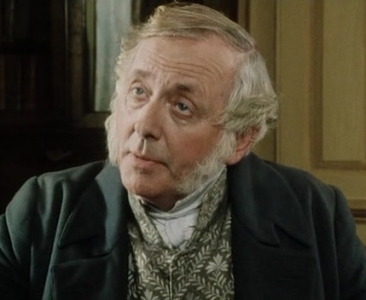
Mr. Bennet, how can you abuse your own children [in his previous remark, he characterized his daughters by saying “they are all silly and ignorant like other girls”] in such a way. You have no compassion on my poor nerves.

To which he responds:

You mistake me, my dear. I have a high respect for your nerves. They are my old friends. I have heard you mention them with consideration these last twenty years at least.

And because Mr. Bennet is so cool under these effusions from his wife, I have always tended to like him. I’m going to try to get over that in this post. Jane Austen gives us every reason to judge him harshly. She does not give us much motive, pairing him with his silly wife, but she does give us grounds. I never really noticed that until recently.

The story of Elizabeth Bennet starts to go the wrong direction when Mr. Bennet chooses his wife.

Her father, captivated by youth and beauty, and that appearance of good humour, which youth and beauty. generally give, had married a woman whose weak understanding and illiberal mind…

Mr. Bennet was “captivated” by the youth and beauty of the young woman he chose. He Bennet's Folly 3inferred, incorrectly, it turns out, that she was a woman “of good humor.” She was not. Further, she had “a weak understanding” and “an illiberal mind.” [2]. So, a bad choice.

But it gets worse. The weak understanding and the illiberal mind:

…had very early in their marriage put an end to all real affection for her. Respect, esteem, and confidence, had vanished for ever; and all his views of domestic happiness were overthrown.

This doesn’t seem quite fair. These traits of Mrs. Bennet “put an end to” Mr. Bennet’s affection. Does Mr. Bennet have no voice in the matter? No agency? Are his wife’s traits something that is done to him, to which he can respond only by retreating into irony? In any case, Mr. Bennet no longer has affection for her, nor respect for her, nor esteem for her, nor confidence in her. And that is the relationship between them that we see in the first scene of the book.

On the other hand, we don’t really care all that much in the first scene of the book. But later on (page 180 in my copy [3]), it matters a great deal. By this time we know that Mr. Darcy (who is Proud) has fallen in love with Elizabeth (who is Prejudiced) and she, almost, with him. Then word comes that Lydia, the irresponsible youngest daughter, has eloped with a dastard. Elizabeth understands immediately that Lydia’s disgraceful behavior is the end for her own relationship with Darcy.

[Darcy] seemed scarcely to hear her, and was walking up and down the room in earnest meditation, his brow contracted, his air gloomy. Elizabeth soon observed, and instantly understood it. Her own power was sinking; every thing must sink under such a proof of family weakness, such an assurance of the deepest disgrace.

By the time this happens to Elizabeth, we care very much about her disreputable family, and that leads us back to Mr. Bennet, whom we can, in this context, consider less kindly. He has taught his five daughters very bad lessons about family life.

Had Elizabeth’s opinion been all drawn from her own family, she could not have formed a very pleasing picture of conjugal felicity or domestic comfort. (p. 154)

By means that Austen doesn’t disclose, Elizabeth has escaped the picture of dysfunction Bennet's Folly 1that her father has drawn. Elizabeth still knows what a family would look like if it were done right. She also knows that her father has not done that and she tells him so plainly.

Our importance [the Bennet family], our respectability in the world, must be affected by the wild volatility, the assurance and disdain of all restraint which mark Lydia’s character. Excuse me—for I must speak plainly. If you, my dear father, will not take the trouble of checking her exuberant spirits, and of teaching her that her present pursuits are not to be the business of her life, she will soon be beyond the reach of amendment.

These are the harshest words Elizabeth has for her father. He will not “take the trouble.” Elizabeth thinks he should have and she knows that for her prospects with Mr. Darcy it is too late, but she still thinks Mr. Bennet should step in and do something about Lydia. We know that is not going to happen because Mr. Bennet has made his life tolerable by retreating into an unheeding distance.

To his wife he was very little otherwise indebted, than as her ignorance and folly had contributed to his amusement. This is not the sort of happiness which a man would in general wish to owe to his wife; but where other powers of entertainment are wanting, the true philosopher will derive benefit from such as are given.

Austen calls this emotional distance “philosophy.” “The true philosopher,” Austen says. I think she means only “resignation” or perhaps “wry amusement.” She certainly has no higher hopes for him.

In order to “take the trouble,” Mr. Bennet would have to take his family seriously, which means that he would have to take his wife seriously, which he is not willing to do. So the family of otherwise marriagable girls suffers, which means that Elizabeth suffers and that last disaster really hurts readers who admire Elizabeth. Like me, for instance.

And further,  if Mr. Bennet were to have thought about the marriage chances of his daughters, he would have been well-advised to endow them with enough money to attract—or at least, not to repel—suitors. He didn’t do that either.

Mr. Bennet had very often wished, before this period of his life, that instead of spending his whole income, he had laid by an annual sum, for the better provision of his children, and of his wife, if she survived him. He now wished it more than ever.

He ended by settling five thousand pounds on Mrs. Bennet and the children. Having refused, year after year, to set aside enough money to help support the girls’ marriage hopes, he ends by being disappointed in himself, and even, for a brief time, ashamed.

So…I have come a long way from my early enjoyment of Mr. Bennet. His reliance on ironic detachment works if I place it against the background of his undisciplined and garrulous wife. If I place his behavior against the background of his responsibility to provide for the girls a family life that would support and instruct them and a financial backing that help them find husbands, if find him not all that enjoyable.

[1] According to my heavily annotated edition, no first name is ever given for Mr. Bennet. And, if memory serves, he ends his letters with the closing, Yours &ct. where others, Darcy, for instance, end with their names. Hm.
[2] I am no Austen scholar, but I do think it is important that we give these crucial charges the meaning and the weight she intended to give them. My best guess is that “weak understanding” refers to the lack of subtlety she displays. People are good or bad; her daughters are better than anyone else’s daughters; grasping at recognition from one’s social superiors can only produce good results. I think the old meaning of “liberal” as “free from constraints” is what Austen has in mind when she describes Mrs. Bennet as “illiberal.” Her mind is bound to the small setting of her village and the everyday beliefs of her neighbors. She doesn’t read or think, so she is trapped.
[3] I am very partial to the Norton Critical Editions of the Austen novels. There are notes on corrections Jane Austen or her sister made from one edition of the book to another, explanations of the meaning of a given word at the time it was written, and a lot of critical reflection, about 150 pages of it, at the end.

Posted in Books | Tagged , , , | Leave a comment

Screwtape and Salience Games

From the time I first read The Screwtape Letters (TSL), I have been intrigued by the way Screwtape plays with salience. And that was before I spent four very concentrated years at the University of Oregon studying salience. In this essay, I would like to follow that notion a little and see where it leads me.

The gimmick of TSL is that it consists of letters from a very senior and important devil to aScrewtape 3 much younger and less experienced devil. Screwtape is the head [1] of a large department, in a sense, and Wormwood is just one of the many devils who work in that department under Screwtape’s mentorship. Wormwood has only one person, a “patient” in Screwtape’s vocabulary, to focus on and his job is to damn the man’s soul or, again in Screwtape’s language, to bring the patient “safe into the House of our Father Below,” i.e., in Hell. The point of all the letters of advice from Screwtape is to help Wormwood with this single task.

I called this perspective a gimmick, meaning no disrespect, because it provides a different perspective on spiritual issues and it attracts and holds our attention. Still, it is worth pointing out that Lewis, a well-known medievalist and philologist, does not really know how Screwtape looks at things. Lewis’s notion is not derived from biblical texts, which show only the mildest and most occasional interest in angelology, but from Milton, who cares quite a bit about angels. That means, to say the same thing another way, what we are told about Screwtape is true to Milton—Lewis, the scholar, passes it along faithfully—but not to scripture.

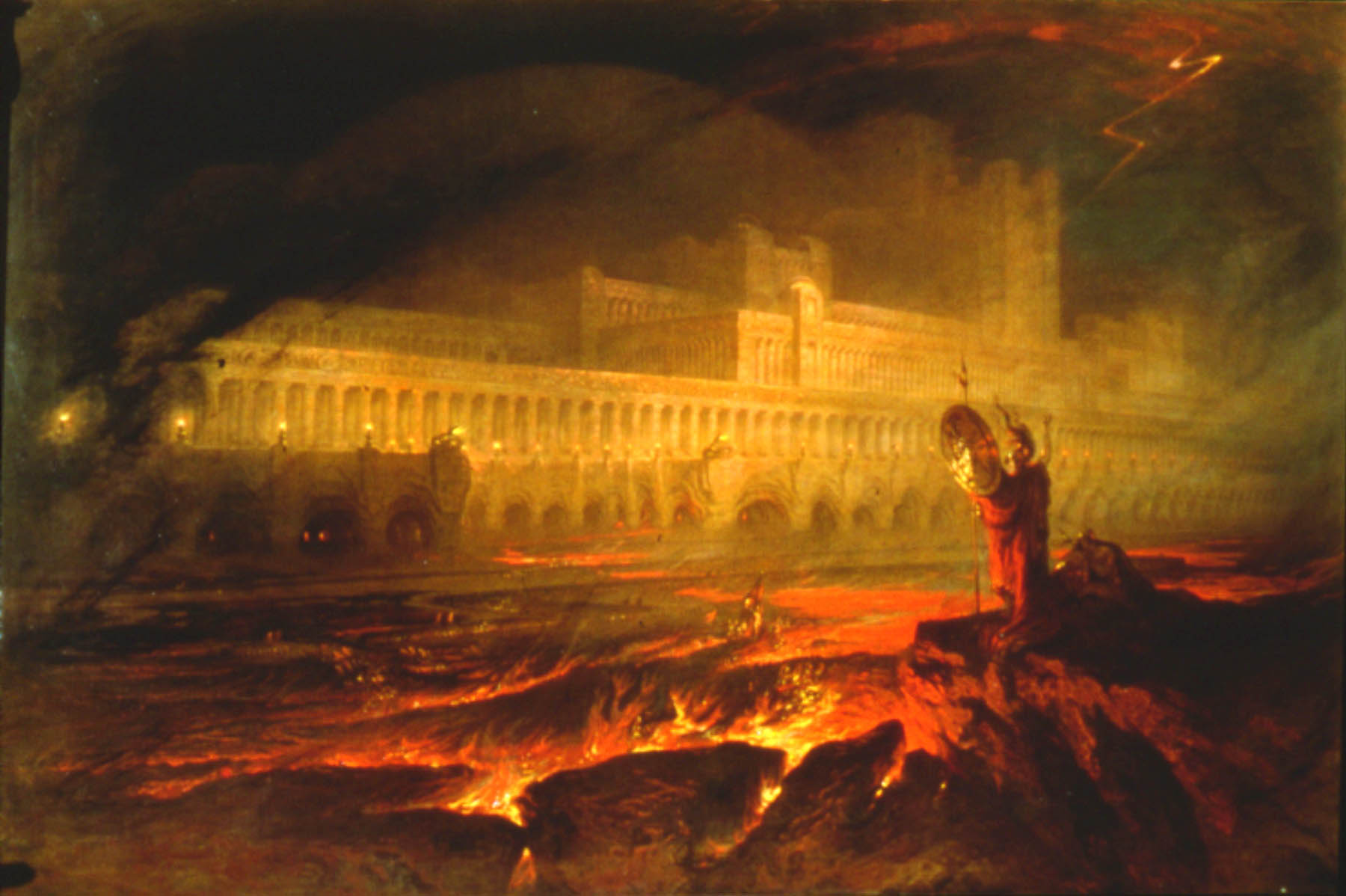
Screwtape 1Now there is a sense in which Screwtape knows what God knows. The Devil, Screwtape’s boss, is a “spiritual being,” and Screwtape sees things as they really are. [2] But “knowing” is not the whole thing for the Bad Guys. They recognize the holiness of God and the grace of God and they hate it passionately. They deny it when they remember to, but often Screwtape says what is going on in terms that any Christian would recognize and then says how completely nauseous it is. So Screwtape’s information is first class, but his value system is abysmal. [3]  The abyss is in the foreground here.  In the background is “Pandemonium,” literally “the place of all demons.”

So the reader knows, although Screwtape uses language like “safe in the House of our Father Below,” that it is the eternal destruction of this person’s soul that is his object. And Screwtape’s object is the direct and sole responsibility of the apprentice devil, Wormwood. That means that when Screwtape says to Wormwood, “You need to be careful to do this…” .or “Try to keep him from realizing that,” we know that if we are interested in the salvation of the man’s soul, in terms that Christians would recognize, we need to be against what Wormwood is for. [4]

So if we could imagine ourselves as the Christian mentor to Wormwood’s “patient,” we would quickly see that all the advice is bad. It is bad so far as its moral direction goes—evil is praised and good is denied—and it is bad so far as salience goes.

“Salience” is not a word that is used as much as I would like. It derives from the Latin verb, salire, meaning “to jump.” We would say that the “salient” part of a statute or an argument or a property deed “jumps out” at us; that it calls itself to our attention. [5] Screwtape says things like, “Under these circumstances, be sure the patient is paying attention to A, but under other circumstances, our cause will be better served by focusing his attention on B.”
The first example comes in the first letter.

I once had a patient, a sound atheist, who used to read in the British Museum. One day, as he sat reading, I saw a train of thought in his mind beginning to go the wrong way. The Enemy, of course, was at his elbow in a moment. Before I knew where I was I saw my twenty years’ work beginning to totter.

The patient’s mind is “beginning to go the wrong way.” His thoughts are on a trail that leads to a serious consideration of God and what claim God might have on his life, in particular. For the patient to pay attention to those ideas, for him to claim them as salient, would be a disaster for Screwtape—20 years of his work with the patient, he says, is at risk. What to do?

Once he was in the street the battle was won. I showed him a newsboy shouting the midday paper, and a No. 3 bus going past, and before he reached the bottom of the steps I had got into him an unalterable conviction that, whatever odd ideas might come into a man’s head when he was shut up alone with his books, a healthy dose of ‘real life’ (by which he meant the bus and the newsboy) was enough to show him that all ‘that sort of thing’ just couldn’t be true.

What to do? Change what is salient. The patient could sit there and focus on these new thoughts, but Screwtape suggests that it is time for lunch. On his way out to lunch, he sees the No. 3 bus and hears a newsboy and the salience of what he categorizes as “real things” takes over. The ideas God was proposing become “that sort of thing” and the bus and the newsboy become “a healthy dose of real life.”

So not only does what is salient, what draws and holds the patient’s attention, change from A to B, but also from the standpoint of B, A is redefined. When his mind began to move in the direction of God, it was kind of interesting. Scary, maybe, but intriguing. Once the patient chooses B as his focus, he looks back at A and redefines it as uninteresting and probably false.

Lewis gives us a special treat by having Screwtape recall this event with satisfaction. By this time we know that the man’s soul is damned, he is, as Screwtape says, “safe in our Father’s house,” i.e. in Hell. And knowing that, Screwtape gives us the very language that the patient used later in his life, recalling his “narrow escape” at the British Museum: he was fond of talking about “that inarticulate sense for actuality which is our ultimate safeguard against the aberration of mere logic.” [6]

Salience is everything.

Let’s try one more example. Here is Screwtape’s formulation. Remember that in these exchanges of letters, Screwtape is the tutor. He is the master of the craft which Wormwood, the junior devil,  is supposed to be learning.

One can therefore formulate the general rule; in all activities of mind which favour our cause, encourage the patient to be unself-conscious and to concentrate on the object, but in all activities favourable to the Enemy bend his mind back on itself.

That’s the rule. The rest of that paragraph is an example.

Let an insult or a woman’s body so fix his attention outward that he does not reflect ‘I am now entering into the state called Anger—or the state called Lust.’ Contrariwise let the reflection ‘My feelings are now growing more devout, or more charitable’ so fix his attention inward that he no longer looks beyond himself to see our Enemy or his own neighbours.

These are salience games, as you can clearly see. Direct the patient’s attention outward in screwtape 4all cases where the external focus will help us damn him. The salient matter is the bad behavior of the guy at the bar—sorry, the “pub”—or his bad character. Focus on those. Inundate yourself in how despicable he is. Do NOT allow the patient to see that he is getting angry or being unreasonably judgmental or losing his self-control. If those, the state of his mind at the moment, become the salient matters, he will reject them. He will not choose anger. But if he is thinking about the moron at the pub, the question of anger will never come up; it will never become the salient question.

The other side of this, indicated by Screwtape’s use of “contrariwise,” is in all cases where the patient’s inward attention will help us damn him, then focus his attention on those. If he is taking a turn toward thoughtful and sympathetic treatment of a difficult friend or relative, we don’t want him thinking about the friend or relative, not about the effects of his behavior on them, not about what additional services they might require. If those are highly salient to the patient, then our cause—Screwtape’s cause—is not looking good. What Screwtape wants is for the patient to be focusing on how kind and sympathetic he is; how noble, how generous.

The more he thinks about what a nice person he is, the thinner and more vulnerable his choice of good actions will be. The salience is directed inward in such a case, not outward.

So we can look now, at Screwtape’s rule—favoring us, focus out; favoring them, focus in—works in practice. All the power of his analysis flows from a very simple truth: what you are paying attention to, matters. It matters particularly as it affects what you are not paying attention to.

[1] The author, C. S. Lewis, has a lot of fun with spatial terms in this book. Because “Our Father in Heaven” is a standard Jewish and Christian way of referring to God, Screwtape refers to his own boss as “our Father Below.” Lewis gives Screwtape the nonsense word “Lowerarchy,” as if it could be set off as the opposite of hierarchy. It can’t: hierarchy derives from hieros a Greek word meaning “sacred” or “holy.” Screwtape’s word would have to be Higherarchy, but Lewis is a linguist and he is having fun. Is it really appropriate, in terms of this inversion, to say that Screwtape is the “head” of a department? Would he be the tail or the foot or the butt or something? Similarly, can we say with confidence that a junior devil works “under” his boss? If the boss is very low in the Lowerarchy, do not his “subordinates” work “above him?” There is really no way to be consistent about it, but as I say, Lewis is just having fun.
[2] He is forced, sometimes, for reasons of office politics, to deny that he knows what he knows, but he slips up—Lewis makes sure Screwtape slips up—frequently enough that we know what he really sees. Screwtape and Wormwood are on the wrong side of that quip in the New Testament Letter of James in which James sarcastically congratulates his addressees on “mere orthodoxy.” “What you believe,” says James, “is orthodox. Good for you. The devils believe the same thing and it scares them silly. You don’t even have the wit to be frightened.” Screwtape, for instance, describes the actual presence of God in terms that sound very much like the description of “the glory of God” in Exodus except that the “clouds of glory” are horrible asphyxiating vapors to Screwtape.
[3] Lewis uses that word too. It once meant “of or pertaining to the Abyss,” i.e. to Hell. It has come to be a term of general derogation—your grades this term have been abysmal—but Lewis knows what it once meant and puns on it mercilessly.
[4] That didn’t always work out in practice. The Screwtape Letters were printed, one at a time in the newspaper, and one reader wrote the paper to say that the “advice” that Screwtape was giving was very bad advice; that it was ultimately “diabolical.” That’s the word he chose. It must have made Lewis’ day to see the perspective he formulated for the Devil to be called “diabolical” by a reader.
[5] The means by which this “jumping out” occurs has been studied by cognitive psychologists for many years and is now being studied by neurologists. All I really need from the word is “something you are likely to pay attention to” and that is what Screwtape has in mind, without using the word, as well.
[6] I really like that kind of language. It sounds so smart, so appealing. And Lewis wants us to be drawn by it while at the same time we know that it is by words like this that the patient chooses Hell.

Posted in Books, Living My Life, Theology, ways of knowing | Tagged , , , , , | Leave a comment

The Moral Minority

Molly Worthen writes in The New York Times (see the column here) that Donald Trump’s candidacy has exacerbated a split among evangelicals. She describes it like this.

What is most striking is that Mr. Trump’s campaign has exposed a rift within evangelicalism — a split between those calling for culture war as usual and those who say Christians must adjust to life as a minority in American Babylon.

I confess that I was taken aback by the phrase “culture war as usual.” The American phrasemoral 2 was borrowed from the German Kulturkampf, where a better understanding is “struggle.” No one would deny that we are having a “struggle” about the most appropriate cultural commitments in the U. S., but it may not really be a translation problem. It may just be that what is a “struggle” anywhere else in the world starts getting called a “war” as soon as it hits the U. S.  Lexical inflation?  It’s always worse when it happens to me?

The culture war should continue according to this evangelical faction. And what is the war about? Well, let’s just run down the list that James Davison Hunter provided in 1991 in his very useful book Culture Wars: The Struggle to Define America. He surveyed abortion, federal and state gun laws, global warming, immigration, separation of church and state, privacy, recreational drug use, homosexuality, and censorship. Looks familiar, doesn’t it?

That’s a lot we could choose to fight about, you will agree. but not everyone thinks differences should be fought about. My mind goes immediately to H. Richard Niebuhr’s influential book Christ and Culture. In that book, he laid out five modes of dealing with the conflict between what churches feel they are being called to do and what the more pervasive culture is doing.

Niebuhr proposes that Christians have disagreed among themselves about whether to “withdraw from, compromise with, or selectively affirm and reject, or transform society.” [1] I was raised in a “withdraw from” culture, the one Niebuhr calls “Christ against Culture.” Politics is a dirty business, the general culture is corrupt and if we are to be holy as God requires—the principal thrust of holy is “separate from”—then we need to withdraw. The Amish are a good example of that choice.

moral 7All that changed for the conservative wing of Protestantism around 1980. For one thing, Paul Michael Weyrich, a conservative political activist coined the term “moral majority.” It’s a really good phrase for a nation that prides itself on majority rule and that keeps electing thoroughgoing secularists to office. They are “only the political majority,” Weyrich’s term says, while we are “the moral majority.”

The moral majority took on electoral significance through the work of Kevin Phillips, who argued, in The New Republican Majority,  that the Republican party could get a lot more votes out of the white south if they stopped trying for racial justice. He called it “the Southern Strategy.” Here’s a quote of his from the New York Times from May 1970.

From now on, the Republicans are never going to get more than 10 to 20 percent of the Negro vote and they don’t need any more than that…but Republicans would be shortsighted if they weakened enforcement of the Voting Rights Act. The more Negroes [that was the publicly acceptable term for American blacks in 1970, by the way; it is not a racial slur] who register as Democrats in the South, the sooner the Negrophobe whites will quit the Democrats and become Republicans. That’s where the votes are. Without that prodding from the blacks, the whites will backslide into their old comfortable arrangement with the local Democrats.

You’ll have to admit that worked pretty well. Unless you are old, like me, or have read a lot of political history, you wouldn’t know that the expression “Solid South” once referred to the political monopoly of the Democratic party in the South. As a result of Phillips’ analysis and the Republican party’s pursuit of his logic, it is now solidly Republican.

So the culture wars that James Davison Hunter wrote about and the moral majority that Paul Michael Weyrich named, now have a solid sectional and electoral foundation. With that as a background, the expression “culture war as usual” actually makes sense.

But I began by observing that Molly Worthen says that there was a split among evangelicals and so far I haven’t called the other side anything. I think maybe “Moral Minority” would be appropriate. On second thought, I’ll write that without the capital letters: moral minority. What would that mean?

moral 3First, it would mean that these evangelicals do not imagine themselves as representing a majority view in the U. S. Jerry Fallwell and Pat Robertson, two of the best-known of the Moral Majority, argued that there existed a majority in the U. S. supporting of their views and their job was to mobilize it. Representatives of the moral minority don’t think that is true now and deny that it was ever true or that it ever will be true. They deny “a Christian America, either of the made-up past or the hoped-for future.” That language belongs to Russell Moore, the president of the Ethics and Religious Liberty Commission of the Southern Baptist Convention.  Moore was one of Worthen’s major sources for the column.

Just what that means politically isn’t really clear to me. If these evangelicals were political leftists, they could scan down the list of culture war items Hunter provides and take the progressive side (that would be the “sinful” side in Moral Majority terms). So, to pick just a few, they would be in favor of a woman’s right to choose abortion (not the same as being pro-abortion), they would want tighter federal and state gun laws, they would be environmental activists, strictly police the wall that is supposed to and sometimes does separate church and state and so on. That’s not what they do, according to Ms. Worthen.

These evangelicals are not more liberal than the Moral Majority; they are just responding to the issues in a different way. They might be convinced anti-abortion activists, for example, but what they would do is witness to their faith in declaring abortion to be wrong. They would not try to pass laws against it or control access to hospitals where it is offered. They might picket a clinic that offers abortions—that would be part of their “witness”—but if they did, they would be nice about it.

Again, Moore provides the language: “Change doesn’t come from a position of power, but a position of witness.” Rejecting “a position of power” is rejecting the Moral Majority approach. The moral minority position is a clear witness to their faith in God and in the social practices God demands from His followers. God does not, in this image, demand such behavior from non-followers.

So, for instance, we could imagine a moral minority member refusing to open his or her business on a Sunday. That is a witness to God’s having declared “a Sabbath” to be holy. They would not, as a part of their witness, demand that everyone else close their businesses on the Christian sabbath.

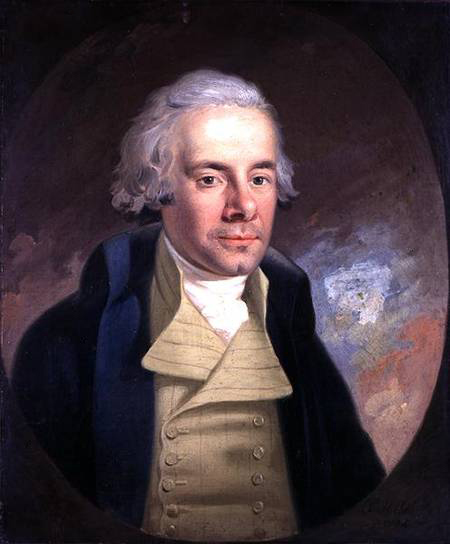
Dr. David Platt, a megachurch pastor, points out the role of William Wilberforce, the

WHM146809 Portrait of William Wilberforce (1759-1833), 1794 (oil on canvas) by Hickel, Anton (1745-98) oil on canvas © Wilberforce House, Hull City Museums and Art Galleries, UK German, out of copyright

WHM146809 Portrait of William Wilberforce (1759-1833), 1794 (oil on canvas) by Hickel, Anton (1745-98)
oil on canvas
© Wilberforce House, Hull City Museums and Art Galleries, UK
German, out of copyright

evangelical politician who helped end slavery in the British Empire, as a helpful example, and Gabe Lyons, who runs a conference and media organization called Q, says, “We want to be a counterculture for the common good,” he said. “A counterculture can be antagonistic, lobbing grenades, but that’s not how Christians should be engaging.” In these two comments, Platt indicates how broadly cooperative he would like to see the work of evangelicals and Lyons describes a little of the style (not throwing grenades) that would support such a breadth.

But the moral minority is not pushing for doing nothing. They want to be sweetly reasonable but they want to be effective as well. The moral minority want to reject the immorality of the society that surrounds them. Dr. Platt points out that one of the Apostle Paul’s most vital churches, was set in “the fleshpots of First Century Corinth” and Paul’s council to the Christians in his charge was not to participate in such practices.  Paul did not go on to urge them to take over Corinth and set everybody straight.

Then there is the question, also, of distinct Christian practices affirmed by the moral minority approach. Dr. Platt urges evangelicals to “reject Christian nationalism, ‘cap’ their materialistic lifestyles and give more to charity.” These are ways they can witness to their faith. If they are going to be active in politics, Platt would like to see crusades against human trafficking where a coalition as broad as Wilberforce’s might be sustained, rather than against abortion, which is a deeply divisive and solidly partisan issue.

So as Molly Worthen sees it, the evangelicals in their response to Donald Trump are dividing into two groups. The first is the old style Moral Majority, taking pubic power and brandishing “the sword of the Lord.” The second is the newer, smaller moral minority that emphasized witness more than power and persistent persuasion over the sectarian bullhorn.

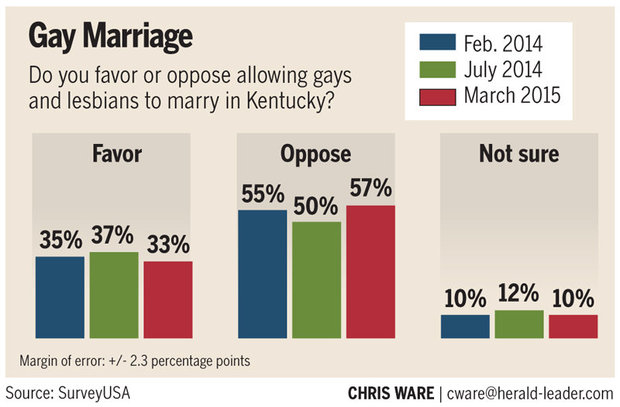
There is no question in my mind that the culture generally is moving in a direction opposed to both groups. Surveys reflecting attitudes toward homosexuality, for instance, show a decade by decade decrease in condemnation until it gets down to people who simply cannot grasp why you are asking the question at all. For many years now, surveys on abortion show majorities who say it is a bad idea and majorities who are opposed to depriving women of the right to choose abortions. Even in the South and even in the current Supreme Court, the logic of a secular government presiding over a richly religious—of many religions—people seems to continue to hold sway.

It is in their response to these cultural developments, as I see them, at least, that the two groups of evangelicals have divided.

[1] I took this list of options from a book whose authors are deeply critical of Niebuhr’s work: Authentic Transformation: A New Vision of Christ and Culture. You can tell from the title that these authors think Niebuhr chose “transformation—the church transforming the world” as his favorite. You can also tell that they don’t think much of his choice. These authors’ choice was “authentic transformation,” not the kind they say Niebuhr wants.

Posted in Politics, Sustainability, Theology | Tagged , , , , , | Leave a comment

Where did Cain’s Wife Come From?

One of the enduring questions about reading the Bible, is how to read it with the same interests and worldview as the author of the story. [1] I know that way of saying it makes it sound easy. I apologize for that because I am sure you know it is not easy.

It is going to take us a little while to get to why this point causes friction because we are going to have to start in very early childhood.

If we started at the very beginning, we would have to go back to that stage of early childhood where the child first discovers that different minds have different contents. “I know this is true, but she thinks that is true.” It is only an extension of that early awareness to note that the author of a biblical text pictures the world differently that I do, has different values to account for and keeps those values in a different priority order than mine, imagines that there is such a thing as “the natural world” or not and if there is one, what the rules of its operation are and under what circumstances they can be broken.

Now I can know that to be true—the author thinks this way and I think that way—and still Cain 2have no inclination at all to prefer the author’s understanding to mine. When Tamar—one of my favorite people in the Bible, not just one of my favorite women in the Bible—seduces her father-in-law, Judah, and gets pregnant, we want to say that she shouldn’t have. Naughty, naughty. But to the author, is it the supreme act of obedience to God and compassionate service to the father-in-law. [2] To understand Tamar, see Genesis 38, you have to care about what the author cares about and the author is engaged in caring about what The Author cares about, which is, in this case the regular transmission of property from one generation to another. There is a lot of sexual activity in Tamar’s story and we, in our very sexualized age, are drawn to it in a way the author is not. And that’s just Tamar. There are a lot of stories where the challenge of caring about what the author cares about is much more severe.

We are now almost to the step where we started. We know now that we need to find a way to get inside the author’s intention or we will not understand the text. One way to do that is to recognize the kind of text it is. Is is a history? If so, is it guided by modern or ancient notions how how to do a history? Is is poetry? If so, are the arts that make their poetry work the same as ours? Is it biography? Where did the information come from to describe the crucial events of that life? Is it myth and folklore? What events is this folklore about and/or what lessons does it try to teach?

OK. NOW we are back to where we started. This is the why of reading the stories in this way. Now we get to the “how” question. How do we do all those things? [3] Well…this has been pretty abstract. Let’s take a particular question. How about one of the all-time favorites, “Where did Cain’s wife come from?”

Cain 4If you have been reading along in Genesis, you have noticed the prototypical human couple, Adam and Eve. They had two children, Cain and Abel. That is the pool of people to draw from. Now, suddenly, Cain gets married. Huh? Who? The only named woman so far is his mother, Eve! Uck! We don’t want to go there. So…where?

Using the understanding that there are multiple stories going on, all at once, and that characters may drift from one story to another, gives us a new way to understand Cain and a new way to answer the question. A lot of stuff was going on in the neighborhood while we were focused on Cain and Abel. The woman Cain married came from one of those other stories.

So how do we understand the stories if there are a lot of them going on at the same time, representing several genres of literature and drama? This is going to sound simpleminded, I know, but I recommend starting with the question, “What is this story about?” Every narrative is there for a reason. Every narrative requires a time and a space for its logic to play out. Every narrative requires a cast of characters adequate to the time, the space, and the meaning.

So…questions like what, for instance. How about these?
why is there evil in the world?
why do we die?
what is the intended relationship of men and women (two answers are provided)?
what is the fundamental relationship between God and humankind?
why does childbirth hurt?
why is it so hard to make a living?
where is matter come from OR (alternatively) why is matter ordered rather than chaotic?
why do we all speak different languages?

And so on.

Every one of those is addressed in a story that does not preclude other stories which account for the same interest. Here are some examples.

Example 1: Adam and Eve

Cain 3For there to be a relation between humankind and God, there needs to be one entity called human. Not many entities: one. Genesis manages that by having God create the progenitors of the one race, the human race, and proposing a relationship of a certain kind with them. The oneness is crucial. It’s how we understand human nature, how we understand the Fall and sin; how we understand being a race of people alienated from God (alienated from the relationship for which we were created) and in need of reconciliation.

Example 2: Cain and Abel

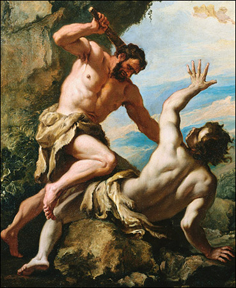
Italian Baroque Painting of the Killing of Abel and the Banishment of Cain --- Image by © Geoffrey Clements/CORBIS ORG XMIT: 12873731

Italian Baroque Painting of the Killing of Abel and the Banishment of Cain — Image by © Geoffrey Clements/CORBIS ORG XMIT: 12873731

But when you move to kinds of economies and of cultures, you don’t need oneness, you need multiplicity. Actually, two-ness will be enough. You make Cain, a farmer, and Abel, a rancher/shepherd. It’s very much “Oh, the ranchers and the cowhands should be friends” from Oklahoma! That’s who Cain and Abel are: they are the farmers and the cowhands.

Now the story comes from a people who are nomadic herders, so it shouldn’t come as a surprise that it was the farmer’s sacrifice that was not acceptable. When Israel occupies a land and grows its own crops, the crops can be “sacrificed” (the first fruits) as well, but Cain and Abel are a lot earlier than that. Israel is going to be a nation with animal sacrifice an essential part of its religious practice, so God needs to prefer the sacrifice of an animal—Abel’s sacrifice—as the right kind.

Again, as the question becomes “this way of life or that one” the oneness emphasis of the humankind in paradise gives way to the multiplicity of economies. It requires another stage setting because it is another question. A new question gets a new cast of characters and a new set of scenery and a new narrative focus and so on.

Example 3: The Tower of Babel

One more. Humankind living together in an urban setting. Huge numbers of them, all speaking the same language and proud of their technological powers. “God is up there,” they reason, “and we know how to build a tower that gets us up there. Let’s build it and overthrow God.” You see what question is being asked, so you see what kind of setting will have to be constructed so that the answer can be played out. God notices the work and decides to “confuse”—I think today we might have said “diversify”—their languages so that can’t cooperate with each other. Another story based on a question and with a new cast of characters.

So what is a good answer to a child who is thinking these matters through for the first time and stumbles on Cain getting a wife from…well, from nowhere? I have sketched, above, the answer I think is a good answer, but you may have noticed—those of you who are parents will certainly have noticed—that it is not an answer to the question the child asked.

It is not a good practice to tell a child he or she should not have asked that question. It is especially bad if you want the child to continue to formulate and ask interesting questions. I think what I would do is to point out how many stories are going on at the same time. Genesis 1—11 gives an amazing buffet of stories. If they are all taken as historical, one precludes another. But if they are taken as answers to questions, there is a story that goes with every question and you can focus as much as you want or even as much as the child wants on the relationship between the narrative and the point.

The child will continue to be interested in reading these stories in the wrong way because that is the way he or she has been taught to read stories. But coming back over and over to the relationship between the story and why it matters (the point) ought to function, eventually as a kind of narrative rope-a-dope and the child’s curiosity about these stories as history ought to wane, while the freshness and the significance of the stories as narrative that say something important ought to remain.

To tell you the truth, I don’t remember whether it worked with my kids. It has worked really for me and I continue to learn things about these stories that amaze me.

[1] In the context of my own upbringing, the question was always of the Author (God, obviously) and not the author, say Nehemiah. After all these years, I find I am entirely happy with the Author/author division but I have made the work of the Author the presupposition and the work of the author the focus of my study.
[2] No, not that kind of service. By my calculation, Tamar saves Judah’s life by running the particular con she managed so well.
[3] With great difficulty, I would say, and only by persistent study—particularly if you were trained, as I was, that all that was not necessary. I’ve been working on this for nearly 70 years and I still have bad habits to catch and refuse.

Posted in Biblical Studies, Getting Old | Tagged , , , , | Leave a comment

Being the Sweep

On every bike tour IBT (International Bicycle Tours) does, there is a Sweep. [1] On nearly Sweep 4every bike tour I have taken with IBT—the Danube (twice), Denmark, the Netherlands and Belgium, the Rhine and the Mosel Rivers, and most recently the Loing River valley in France—I have had a chance to be the Sweep for one day.

We were working our way up toward Paris on September 17 when I was chosen as Sweep most recently. The Sweep’s job is to be dead last. IBT prides itself on never losing anyone on a bike trip and the key to all that is the Sweep. [2] Here’s how serious they are about it.

  • If your bike breaks down, the Sweep waits with you until it can be fixed or replaced
  • If you have to find a bush that will accommodate taking a discrete leak, the Sweep will wait for you
  • If there is a picture you really need to take and which will take you away from the bike path, you tell the Sweep and go wherever you need to go and when you get back, the Sweep is waiting for you.
  • Being the Sweep is one of the very few things you can do that will allow people to address you by your status (Sweep) rather than your name, as in “Thank you Sweep.”

So I always thought it was a big deal to be chosen Sweep for that day. That makes sense to me. The leader thinks I can be counted on to exercise the discipline of being last and to make the unpredictable decisions that crop up from time to time. Here’s what didn’t make sense to me. I took positive pleasure in my Sweep day. And when I did, I remembered that Sweep 3I had enjoyed it on those earlier days as well. I enjoyed interactions between the other riders that I would not have paid any attention to before and, even better, I was simply not irked at the normal run of stupid things that someone will do on any given day.  Here is the Village of Mammés, at the confluence of the Loing and the Seine, by the way.  I wouldn’t swear that we saw this exact scene, but we saw quite a few like it.

So…more responsibility and less irritation and more pleasure. Not really a common combination, is it? How does it work?

My guess is that it works because when I am the Sweep, my own wishes are not the top item on my mental agenda. Ordinarily, I have a pretty acute sense of what I want to happen and sometimes I allow that to morph over to “what should happen.” But when I have a job—being Sweep is a job—the top item is whether the things I am responsible for are happening. Am I really the last rider? Is the group getting too strung out?  The riders below are not us.  There were twice as many of “us” but you get the idea.

So what happens if someone wants to stop and take pictures of each other—not “look how Sweep 5beautiful France is” pictures, but “here I am in front of some garden gate” pictures? If I were not the Sweep, I would just pass them and rejoin the group. No harm; no foul. As the Sweep, I have to wait until they are done unless waiting too long would separate us too much from the rest of the riders. It seems to me, taking my own personality into account, that waiting for people to do things that don’t have any value anyway (no value I recognize) would be extraordinarily irksome. But it was not.

Why? Well, if the top item on the agenda is “Am I doing my job well?” then the second item, “Am I being inconvenienced by the lack of discipline of my fellow riders?” just does not get asked. If it did get asked, the answer would be Yes! and I am quite sure I would either be angry or engaged in some sort of anger management strategy. But nothing they are doing is preventing me from being the very last rider, which is my job, so only the first question is asked and by that standard, everything is just fine.

Sweep 2It doesn’t make sense right away. When I am freed to do what I want—I am one rider in a line of riders—I get irked by the gimmicks other riders use. Some of those things are selfish. Some are just insensitive. Some are dangerous. I disapprove of them in principle and several times, had a fall from my bike because of them, a sad fact to which I refer later.[3] But in every case where I am just one rider among many, the top question in my mind is “Am I being inconvenienced by the lack of discipline of my fellow riders?” And, as I noted earlier, when the question gets asked, the answer is certain and my own emotional struggles follow directly.  This actually is the Loing, just upstream from the Seine. Isn’t it gorgeous?

One solution—the Sweep solution—is to put some other question first. That way the “personal grievance” question doesn’t get asked and so never gets answered. I confess that it is tempting in principle. I wouldn’t have personal wants like the other riders. I would have only the obligations and satisfactions that go with my status.

In addition to that, there is a lot of language that is used in the church I attend and in the religious materials I study that gives support to this kind of notion. It probably wouldn’t do any harm to start with the funny ones. Jesus says in Matthew 20:16 that the last shall be first and my job as Sweep is to be last so it’s really a path to advancement. In addition, a formulation of the church’s ministry to “the least, the lost, and the last,” would surely include Sweeps who are, as the saying goes, “last, but not least.”

OK, I’ve had my fun. Here are some problems with my formulations so far. I’ll deal with the religious ones first and then with the psychological ones. If you are using as your illustration, a society where there are masters and slaves [4], everyone knows what the slave’s duties are. But “serving” a bicycling group could mean riding up close to the leader; it could mean falling into line with some of the slower riders; it could mean walking your bike up a hill because you don’t want there to be only one walker; [5] it might mean being a very active corner and helping the other bikers navigate a tricky intersection safely. In a master/slave setting, you can tell who is “serving.” On an IBT tour, you can’t. Doing “what needs to be done” in an attitude of serving is a pretty good approximation and, as a further advantage, only you will know when you are doing it. And when you have failed to do it.

Sweep 1It is entirely possible that you can serve your fellow bikers best by engaging yourself as completely in the countryside as safety will allow and just enjoying the ride. You don’t have to pay any attention to the others at all, but if seeing you enjoying the valley helps them remember to enjoy the valley, that’s probably a good thing, although you are not likely to find out about it.  Neither of these guys is me either, but I did fall off my bike four times in four days of riding and I wanted to remind myself.

From a psychological standpoint, I am pretty sure that the first thing I am responsible for is being who I am. Knowing who I am and being who I am is the foundation of everything else I might do. [6] Being who I am makes me a knowable entity, someone the others can be confident of; someone they know how to relate to. Being who I am allows me to place myself confidently in the various sets of social relationships that will be available.

I need to be sure that the fuel I need to run on is available. I know that’s a very general notion, but the kind of fuel I run on is sure to be different than the kind you run on and I don’t want to make too narrow a point. When I run low on fuel, I start to make bad decisions, often thoughtless and selfish decisions, about what to do. I put “enough of the right kind of fuel” up there with good food and enough sleep.

In short, to pick two very broad aspects of self-maintenance, I need to be who I am and I need to make sure that I have access to enough of the fuel that enables me to be that person. In the light of that, I see the Sweep solution as a really good solution for a day. It is kind of a vacation from myself. But that is also why it is a short range solution: I want to be myself. I just don’t want to have to be myself all the time.

[1] I don’t think we are supposed to capitalize the word, but I want to draw attention to the status itself. Every day, someone plays the role of Sweep and whoever it is gets treated differently that day.
[2] And the corners, but I don’t think this particular reflection will take me as far as the corners.
[3] In addition, that is, to being generally clumsy and having a deteriorating sense of balance.
[4] The same word, doulos, is rendered either “servant” or “slave” depending on the context.
[5] The Sweep WILL walk. It’s not a choice for the Sweep. There isn’t any other way to be last.
[6] Again, the elegant phrasing of Snell and Gail Putney, “an accurate and acceptable self-image”

Posted in Living My Life | Tagged , , , , | Leave a comment

Went There. Did That.

If there is some sort of annual contest for the worst blog title of the year, I might consider entering this one. [1] But I still like the title I wrote before Bette and I left for France. That title was Being. In France. By that title, I wanted to convey my hope that I would be able to avoid “doing France” and would be able, instead, to be who I am with France as the relevant setting. [2] I’m back now—it is dinnertime in Paris as I write this, so I am only mostly back in Portland—and I am really pleased by how my effort to “be” rather than to “do” worked out.

I thought a lot about this the day I was the Sweep (about which, more later) and I A Mode 1formulated it as two models of what being in Paris might be like. I am going to call them Mode A and Mode B. This will not fool anyone and I don’t intend it to. I am a partisan of Mode B, for myself at least. This will lead my descriptions of Mode A in the direction of caricature. [3]

Mode A takes “what Paris has to offer” as its starting point. It has French cuisine and the Eiffel Tower and the Louvre and Notre Dame and the famous Left Bank and inescapable cigarette smoke and so on. These are things I can see or do there that I cannot do here. It is that distinction that brings them to prominence. So I want to do them when I can, which is when I am there.  That’s Mode A.  It runs the danger of becoming a checklist and having a checklist puts you in danger of seeing the boxes on the list and not the city at all.  It’s a danger.  Some people can apparently have a checklist and be genuinely charmed by the city.  I am not one of those people.

Mode B takes “what my most genuine interests are like” as the starting point. If I haveA Mode 2 shown no interest in the works of art available in Portland (I haven’t), why should I focus my time on the works of art available in Paris? Just because they aren’t available in Portland? That seems thin to me. Wouldn’t it be better to focus on the things I already like here in Portland and see what they are like in Paris? I love language, for instance. I pay a lot of attention to it here in Portland and I will  to pay a lot of attention to it in Paris. Bookstores, as well. Restaurants. Beautiful parks. Birds. That kind of thing.

So I “went there,” as the title has it. And I “did that;” I focused on my own settled interests in a new setting. Bette wanted to see some of the displays at the Louvre (above, the most famous one, which she did get to see) so I walked over there with her so she could see the inside. I saw the famous glass pyramid from the outside, for which I did not have to arm-wrestle busloads of tourists, and went on to other things.  I saw a small figure sitting on the extreme western tip of the Île de la Cité.  So I went down there and found a young woman sitting peacefully under a prominent weeping willow, reading a paperback book.  There is a point very much like it is Portland and it reminded me that I really want to go there more than I do. [4]

I went to a bookstore—the book department of Le BHV/Marais, a really major department store—and spent some time seeing how they set up their books.  The whole store is spare and classic, like this department.  What kinds of demand did theyA Mode 6 expect? I couldn’t read anything, of course, except in the very small English language section, but I watched people pick up books and look through them. Then I went to Shakespeare and Company, an English language book store founded by American ex-pat Sylvia Beach in the 1920s. [6]

On our way up to the northern suburbs, we watched through the bus window as the buildings got lighter colored (not as dirty as along the river, I suppose) and the people got darker colored and there began to be signs in Arabic on the store fronts.  We wound up at Place Pigalle [7] in the middle of a downpour and took refuge in a little restaurant where I had the most lavish French Onion Soup I have even had.  It had more cheese on the top than a pizza I once had in Milan, but that’s another story.

I watched a lot of conversations going on at the same time at Le Buci. I would have done A Mode 5that anyway, at some point or another, but I did it this time at 4:15 a.m. because they were still making so much noise that Bette and I couldn’t sleep in our hotel room across the street. [5] That hour of the morning is not my favorite time for anything but sleeping, but watching conversations form and break up and reform is something I really like to do. By the way, the balcony you see just to the right of the black Le Buci sign was our room.  That’s how far the conversations carried.

We saw some really beautiful Tits along the Seine one morning. This is the justly famous Cyanistes caeruleus, several of which we saw along the banks of the Seine one morning.

OLYMPUS DIGITAL CAMERA

All in all, I had the kind of time I was looking and hoping for in Paris. I didn’t ignore the differences in context.  In fact, I celebrated them.  But I didn’t let the differences, alone, set the agenda.  You would imagine that as a Mode B person, I would like to do that for myself and you would be right.

[1] I was thinking of something like the annual Darwin Awards, where acts that demonstrate that you are not really worthy of passing on your genes as described in loving detail. See http://www.darwinawards.com
[2] I am going to be thinking about my experiences in Paris, rather than in France generally, because the non-Paris part of our French trip was a bike and barge trip in Burgundy and “doing” was really most of the agenda on biking days.
[3] For which I apologize to my Mode A friends. I think I would be fairer to their way of looking at it if I spent more time describing it, but I don’t really want to have to put that kind of effort into it.
[4] The Portland spot is Kelly Point Park in Portland, where the Columbia and Willamette rivers run together and make a little point very like this one.
[5] And we couldn’t close the windows because the room was only recently a No Smoking room, or only intermittently a No Smoking room—and when we closed the windows, the smell of old tobacco was nauseating.
[6] The Book Group goes to the Sylvia Beach Hotel in Newport, Oregon most years in the spring. It is located at Nye Beach and is named for Sylvia Beach. This Sylvia Beach.

[7]  The guidebook says that American Soldiers in Paris during World War I called it “pig alley,” which I am sure was intended to be a slur on the red light district, but it also doesn’t say much for their command of French.

Posted in Living My Life, Travel | Tagged , , , , | Leave a comment

Being. In Paris.

I understand there is a lot to see in Paris. I’m going to be there for a few days in the next week or so. I’ve looked at some guidebooks and listened to the enthusiasm of friends who have visited, some of them many times. No one talks about what I want most to do. I was to be in Paris.

paris 1Possibly a brief philosophical excursion will help. I make a distinction between “being” and “doing.” This isn’t the kind of distinction the philosophers who have written on this have in mind, I am sure, but it means a good deal to me and I use it carefully. In the “being” mode, I imagine that what I do proceeds from who I am. Being is first and doing proceeds from it. In the “doing” mode, the doing is really epiphenomenal. It provides the material from which my being is formed, over time, like so many layers of sediment. That’s what I mean by it, in any case.  I’m a doing kind of person, normally. I employ what is sometimes called “the instrumental mode.”

But not in Paris. In the length of time we are going to be there—less than a week—the great temptation is going to be to “do” as much as we can. I want to do a little of that. But I really just want to “be” in Paris.

I want to look through the bookstores although I don’t read a lick of French. [1] I want to paris 4order dinner from a very tolerant Parisian waiter. [2] I want to go to the Left Bank where the American expatriates hung out. Maybe I can find the bookstore Sylvia Beach used to run in the 1920s. I want to walk in different kinds of neighborhoods, only the safe ones, but not only the rich ones. I want to go to a Starbucks coffee shop, just once, while I am there. The rest of the time, I want to try to get used to the way the French drink coffee.

I want to see the Louvre and, if possible, to go inside. I want to hear people speaking French without working hard at it. I want to see what kinds of things they laugh at. I want to ride the Metro trains and take taxis and not be hit by bicyclists. I hear les flics direct traffic in some intersections. Time magazine offers this little blurb:

To foreign tourists, the Paris cop seems a model of quiet courtesy. He directs them to American Express and Thomas Cook with a debonair salute; he guides gladiatorial traffic with a calm nonchalance. Frenchmen look on le flic quite differently.

paris 2I would like to see Frenchmen looking on them differently, but I would also like to see their “calm nonchalance” since I will be a tourist. I’d like to look around in a department store. Most of all, I want to spend some time sitting at a sidewalk café with Bette watching Parisians. I want Bette to be there because I am one of those, “Ooooh, did you see that?” kind of people-watchers. If I don’t have a chance to share it with someone—Bette would be my first choice—I hardly feel that I have seen it myself.

I want to find other English speakers and ask them how Paris seems to them. I want to hear people say arrondissment. I want to see Notre Dame—I mean actually see the inside of it. They say Paris is a friendly city for walking. I like that. I am friendly to walking too, especially if I get to sit down and rest every now and then. I know they sell the International Herald-Tribune in English in Paris.

I can’t imagine that I will be blogging in Paris, but you never know. Some posts, like this one, just happen and I watch them, paternal and bemused. We’ll be back on September 23 and by then, Bette will have successfully completed another year. Bon anniversaire, Bette.

[1] You never know where your help is going to come from. I was in Copenhagen during one of the EU referenda. It seemed that every wall I could see was hung with posters urging a No vote, but I couldn’t really read then because I couldn’t read Danish. So I stopped a young couple on the street, hoping for help. “Do you speak English,” I asked in English. “Of course,” they said. “Oh good,” I said, pointing to a very graphic poster, “What does that say?” They burst out laughing, but in a good natured way. “We don’t speak Danish,” they said in very good English. “We’re German.”
[2] I once ordered pizza from a little mon and pop shop in Milan. All the menu items were in Italian; no one there spoke any English. So I worked my way down, like Bill Cosby in his fernet branca skit, which you can see here if you like: http://www.youtube.com/watch?v=n2LntsPxUEU, until I found a word I recognized: pepperoni. “I’ll have that,” I said, pointing at the menu. Very shortly, my pizza came out: sliced grilled bell peppers. You know. Pepper-oni!

Posted in Living My Life | Tagged , , , | 2 Comments

Gay and Married in Kentucky

I don’t want to be troublesome. Really I don’t. But this matter of the county clerk in Kentucky is just really interesting.

I’d like to look at several other instances of defiance of the law, just so we have a chance to get clear about what is at stake here. Kim Davis is, or was at the time this story appeared in the New York Times, the County Clerk of Rowan County, Kentucky. She is a member of a very conservative Christian church in a very conservative state. She believes that sinners go to Hell and that she is being asked, in her capacity as County Clerk, to commit a sin.

I am a liberal person, myself. More politically and economically liberal than culturally KY 3liberal. And most of my friends [1] are liberal as well and Mrs. Davis has been roundly condemned because of the subject matter that her action deals with. It deals with homosexuality.

But if you block out the subject matter—not for very long, just for a little bit—you get to see some other things. In America, “the law” is never given the highest allegiance by the citizens. There are lots of reasons for that, but it might just be good to note that Jefferson’s argument in the Declaration of Independence made his ultimate appeal to “the laws of nature and of nature’s God.” King George and his Parliament have control of “the law,” but there is no reason to obey the law unless it reiterates “the law of ….nature’s God.”

God comes first, with Jefferson, at least rhetorically and the civil law made by underlings—that would be the King and the Parliament for Jefferson, the Constitution for Mrs. Davis—comes second.

Then there is the question of what “the law” is. Is it “what the U. S. Supreme Court just decided the Constitution means?” Really? So the Constitution forbids sexual relations between gay men in Georgia from 1986 (see Bowers v. Hardwick) but the Constitution stops forbidding it in Texas in 2003 (see Lawrence v. Texas). So the U. S. Constitution said this particular thing for seventeen years. That’s “the law.”

Abraham Lincoln didn’t feel that way about the Supreme Court’s decisions. He was particularly offended by the Court’s decision in Dred Scott v. Sanford (1858) and to people who said that he should be bound to respect it, he said that it would be prudent to wait and see if the Court affirms that decision. If a series of cases considers the question and comes up with the same decision time after time, we probably ought to call it LAW. This Dred Scott thing might just be a blip; it might not mean anything by itself.

KY 2The Supreme Court decided Obergefell v. Hodges on June 26, 2015. By a 5-4 vote. [2] Two months later, a gay couple shows up at Mrs. Davis’s counter asking that “the Law” be honored. Mrs. Davis might have cited fellow Kentuckian Abraham Lincoln to the effect that we should all wait to see if this is a one-off like Bowers v. Hardwick or a genuine decision. But she didn’t.

Instead, she chose to “do the right thing.” Like, for instance, destroying draft board records in Catonsville, Maryland, an act for which the one or both of the Berrigans, Daniel and Phillip, served three and a half years in prison. The law said that selective service was the right thing to do and the Berrigans, priests, both of them, said it was not and refused to obey.

KY 5Edward Snowden violated the law and has not yet served three and a half days and may never serve any time at all. He said that the law was a bad law—in addition to being insidiously circumvented by people who claimed they were following it—and that the right thing to do was to refuse its claim on his loyalty.

In going on like this, I am not justifying what Mrs. Davis did. I am trying to look more closely at the “other things,” I called them, that I get to see when you suspend homophobe-phobia. [3] One thing I get to see is that America has from our birth—literally from our birth—appealed to a higher law than mundane (Constitutional) law. It’s easier to see it when the good guys are doing it, which is why it is worth while to add Mrs. Davis to the list that includes Mr. Jefferson, Mr. Lincoln, the Fathers Berrigan, and Mr. Snowden.

It is also worth noticing that Mrs. Davis is showing a very lively fear of going to Hell. It doesn’t seem very likely to me—liberal Protestant that I am—that there is a Hell of the sort the Solid Rock Apostolic Church teaches about and I am just a little uneasy when I see how cavalier my attitude is toward her worst nightmare. This is not just a life and death of the body matter to her; it is a life or death matter for her soul. I wonder if I would look at this whole matter differently if I had the nightmares she has [4]. It comes right up to the edge of saying out loud that I don’t mind all that much if Mrs. Davis goes to Hell, so long as it isn’t me. That is a sentiment so shorn of human feeling that I don’t even want to say it to myself, let alone to publish it in a blog.

KY 6Then there is the mockery of Mrs. Davis as a hypocrite. Why is she a hypocrite? Well, she is a hypocrite because she herself has married several times in direct contradiction of God’s word—as Mrs. Davis understands it—that we should marry only once.

To deal with this charge, I think we need to get back to understanding just what a hypocrite is. A hypocrite is someone who is acting a part that he or she doesn’t really affirm. I pretend to be more religious than I am because everyone respects people who are religious. That is hypocrisy. Or I pretend to be more patriotic than I really am or more world-weary or more dismissive of approval than I really am. All those are part-playing so all are hypocritical.

I don’t think Mrs. Davis is acting. I think her actions come directly from her commitments. She is not very consistent, I notice. She says this is right and does that instead. She fails to live up to what she thinks of as God’s standards, so she is a sinner. But I have read not one word of criticism of her as a sinner. I have read a good deal more about her violating God’s notion of what marriage is and then refusing to let these two Kentuckians also violate (her idea of )God’s notion of what marriage is.

On the other hand, I think she made a really bad decision. She is trying to use her public KY 1office to enforce her private notions of godliness on her neighbors. She really shouldn’t do that. If she can’t do what the office requires—and has required for nearly two months now—then she should turn the office over to someone who will and then she should go on a speaking tour as a Christian martyr and make millions of dollars from conservatives looking for an exemplar and then retire in genteel splendor in western Montana. None of that is against the law and it only costs conservatives money so I’m fine with it.

Mrs. Davis would not take advice from me, I am sure, and by refusing, she shows that she still has some sense. But if I were going to give advice, I would start with knowing just what God’s word—God’s breath, God’s teaching, God’s wisdom—are about this matter. She is confident that she knows that based on a few verses of scripture, whose siblings she rejects without consideration. If she were to cite the Bible, I would say that the Bible is a library and it offers all kinds of positions on all kinds of issues. And for every one of those issues, you must take the time and the situation and the kind of literature into account. It gets complicated. But if you are going to say what God says, “complicated” should not be too high a price to pay.

My second piece of advice is to witness to her faith in every way she can without depriving her neighbors of services to which they are entitled. There is no reason to think that Mrs. Davis hates gays, but gay or straight, they are entitled to equal treatment under the law and I would call her refusal to serve them as they deserve, theft. She has stolen from them a status to which they are—since June 26—entitled. The God who condemns multiple marriages also condemns theft. Or as James puts it in Chapter 2

10 For whoever keeps the whole Law but fails in one point is guilty of breaking all of it. 11 For the one who said, “Never commit adultery,”[f] also said, “Never murder.”[g] Now if you do not commit adultery, but you murder, you become a violator of the Law.

So here’s what I would like. I would like for the Court’s judgment about the essential equality of gay marriage upheld and enforced throughout the land. It’s the right thing to do. I would like to see people who believe that their own notions of what God wills are superior to everyone else’s notions, be refuted both in public and in private. I would like to see those who are unwilling to do what the law requires to get out of the way and let someone do it who is willing. [5]

And I would like to see a little compassion for the tiny minority of people who are deeply conflicted about public v. private and sacred v. secular values. I don’t want any compassion for their position; I want to see the position condemned for the reasons I have given above.

But the actual person—maybe a little compassion wouldn’t cost us more than we could afford.

[1] Not all my friends. I still have a few conservative friends and I am very proud of having them.
[2] The same vote by which they elected George W. Bush as President of the United States, may I remind you.
[3] Certainly not a word, but if you hate homophobes, there needs to be a word for what you are doing.
[4] That’s a metaphor. I don’t actually know anything about Mrs. Davis’s nightmares. My own idea of a nightmare would be attending the Solid Rock Apostolic Church.
[5] That is, after all the way President Nixon got the Independent Special Prosecutor fired in what is now called “the Saturday Night Massacre.” He just kept firing people until he got down to someone who was willing to do what he was told.

Posted in Biblical Studies, Politics, ways of knowing | Tagged , , , , , | Leave a comment

A Poor Use of Good Hyssop

There is a very helpful biblical resource called a “harmony of the gospels.” The idea is that the accounts given by the different gospels can be “harmonized.” It is clear, in fact, that the gospel accounts are not always harmonious. That has caused a great deal of ingenuity to be expended showing how well they can be made to fit together. The idea I pursue in this essay is that all that ingenuity would be put to better use by attending to the symbols each writer of a gospel uses to make his own account richer and more powerful even though they are not the same symbols another writer uses.
But I have another problem to address today. It is a much softer, kinder problem: what if the various accounts could be harmonized without doing violence to them? Would we be better off if we did that?

I’m going to argue that we would not be better off. I have an example in mind that will help us explore the question. Here are the accounts of the four gospels on whether Jesus was offered wine during his crucifixion and if so, how.

  • Mark: So someone ran and soaked a sponge in some sour wine. Then he put it on a stick and offered Jesus[ab] a drink, saying, “Wait! Let’s see if Elijah comes to take him down!”
  •  Matthew: When some of the people standing there heard this, they said, “He’s calling for Elijah.”[ai] 48 So one of the men ran off at once, took a sponge, and soaked it in some sour wine. Then he put it on a stick and offered Jesus[aj] a drink.
  • Luke: The soldiers also made fun of Jesus[t] by coming up and offering him sour wine, 37 saying, “If you are the king of the Jews, save yourself!”
  • John: A jar of sour wine was standing there, so they put a sponge full of the wine on a branch of hyssop and held it to his mouth.

So Mark and Matthew say there was a stick handy. They put a sponge on the stick and hyssop 1lifted it up to where Jesus could reach it. John says they put the sponge on “a branch of hyssop.”  Hyssop doesn’t actually lend itself to a job like that: it is a fern-like plant, as you see.

What to do? One thing to do is to approach this the way a journalist might. You might note that neither Mark nor Matthew says what kind of stick it was, so there is no reason it couldn’t have been a stick made from a “branch” of a hyssop plant.
That’s not outrageous from a journalistic point of view. I’ve never seen a picture of a hyssop plant that looked like the branches were long enough to be of use in that way, but there certainly could be one. And then, you would either have to cut the fronds off the end so you could attach a sponge to it or you could try to hold it by the end with the fronds and use the thicker base of the branch to hold the sponge.

I think that if my principal concern were to harmonize the various accounts, that is what I would do. I might make a study of where in Jerusalem hyssop plants grew. I might ask for measurements of their length and their circumference at the base of each stem. I might check to be sure that there would be some growing in the area around the time of Passover.

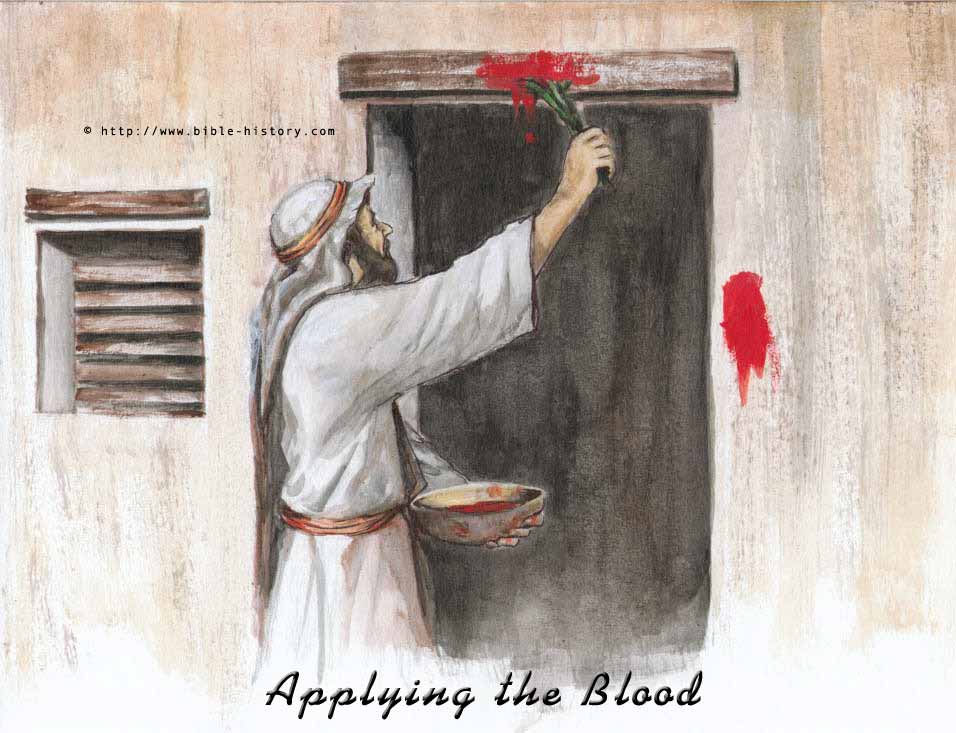
hyssop 2I don’t think I would want to do that. What I would want to know is why John introduces the reference to hyssop at all. At this point, I might stop and remember that this is not the first reference to hyssop I have heard. I might remember that the blood of the slain lamb was to be applied to the lintel and the doorposts so that the Angel of Death would spare the homes of Hebrews whose houses were marked that way. The bushy fronds of hyssop would make a really good brush for applying the blood. (Exodus 12:22).

Hyssop is used to sprinkle blood on a person who has had a skin disease to show that he is now well (Leviticus 14:4). It is used to sprinkle water on a tent and its contents if a person has died in the tent. (Numbers 19: 17—19). The palmist prays, “Purge me with (I think “with” means “by using”) hyssop and I will be clean.” (Psalm 51:7)

It is not hard to see the hyssop + blood + purity elements in these passages. And John hashyssop 3made that connection before. In Chapter 1, verse 29, John the Baptist calls attention to Jesus by saying, “Behold the lamb of God who takes away the sins of the world.” That brings us to the question of whether it is that perspective, those associations, that made John decide to specify hyssop as the means by which wine was offered to Jesus. Does John want us to say, as I am saying, “Hyssop. Now that sounds familiar. Why hyssop?”

And if I find, in looking at the plant that hyssop is not really a natural choice for the job (not, as I noted above, an impossible choice), then my mind moves toward what John wants to tell us about the death of Jesus—not about how it happened, but about what it means. I think John would like that. The resonance of the Passover in Egypt and the rituals of purification make the imagery of the “Lamb of God” much more vivid.

Or, if you want to attribute some aggressiveness to John, we could have him saying, “That (the Passover) is not really a lamb; it is Jesus who is the lamb.” It would be entirely like John to do that. He did is about the water that was poured over the alter by having Jesus say, “You call that water? I am the living water.” And about the bread, “Your ancestors ate bread in the wilderness and they died. I am the true bread and whoever eats this bread will never die.” And about the lights at the festival, “You call those lights? I am the Light of the World.” So if we want to consider that John wants to exalt Jesus as THE Lamb, the association with hyssop is a very good symbolism.

Now we come to the best question of all. Is that really why John introduced the hyssop? Honestly, I don’t know. It seems plausible to me but “plausible” takes you only so far. What I am really sure of is that if the time that is spent harmonizing the gospel traditions is time taken away from the thought you would otherwise have given to the hyssop and the Blood of the Lamb, then it is time wasted.

John doesn’t care. Matthew, Mark, and Luke don’t care. Each of them spends time building up a context of imagery within which to place the meaning of the lif and death of Jesus of Nazareth. That’s what they care about.

And I think that’s what we should care about as well.

Posted in Biblical Studies | Tagged , , , , , | Leave a comment

Deathbed Confessions

I want to think about “deathbed confessions” today. I am going to imagine for today’s purposes that they are fraudulent. The reasons for starting there will become clearer as we go.

deathbed 1In order to use that frame of reference with a clear conscience, I am going to try to imagine what a genuine deathbed confession might be like. There is nothing about the word that requires its most common current meaning. Confession simply means “to acknowledge” or “truly avow. [1] One may “truly avow” one’s deepest convictions, which is what “confession” means in the phrase “confession of faith,” or in the “confession of sins,” both of which are regular parts of the liturgy of my church.

The real power of the notion of “deathbed confession” comes from the idea that you are confessing them to someone who is able to forgive them, to absolve you from the guilt that belongs to you because you committed them. So let’s say that you have been terminally ill for awhile and you have been thinking long and hard about how guilty you are because of your misdeeds. Someone you believe can absolve you from that guilt, a Catholic priest, let’s say, comes to visit you on Fridays and on one Friday, not your last one, your remorse overflows and you confess sins you have been longing to confess for years. You confess them sincerely and the priest, who has the authority to remove the guilt of them (but not their consequences) does so and before the next Friday, you die—guiltless.

I think that is the best I can do. [2] I have nothing bad to say about such a scenario, however emotionally remote it may seem to me.

Beyond the scenario I just sketched, I’d have to say that I am not a fan of “deathbed confessions,” and particularly I am not a fan of postponing “confessions” until the last possible moment. Here’s why. Let’s imagine that I am thinking of my sins as the great pleasures of my life. They are wrong, of course, but hey, cheating on my wife, “borrowing” money from the pension fund, holding a grudge against my brother…what’s life about anyway? Those are just “human” things to do. [Editor’s note: They are indeed “just human.” The whole theology of grace takes that for granted.]

And I’d really like to keep doing them until right up to the moment of my death. This isdeathbed 5 like falsifying the books right up to the moment of the audit, I guess. God is the Great Auditor and you have milked the system for everything you can get out of it and now you are dying so now is the time to admit that you cheated a lot of people out of money that was rightfully theirs and you pay no price for it, being, you know, dead. Doesn’t sound quite right, does it?

Or, since you might not have a deeply personal relationship with the accountant, let’s go back to the “cheating on your wife” part of the scenario. You know that your sexual misadventures are painful to your wife. The dilute the relationship. [3] They are violations of promises you both have made and which she has kept. Your wife is deeply in love with you—the neighbors all wonder why—and would forgive you anything. But…what would it mean to “confess” your infidelities of the previous week if you were still hoping to continue them next week. This brings us to how much more weight “confess” carries than a lighter word like “admit.”

deathbed 8Would such a man say to his wife, “I have every intention of making a deathbed confession of my many infidelities, but I don’t want to confess them before that because I still enjoy them and want to continue them.” That doesn’t sound quite right either. If “confess” carries the notion of “renounce” and of “desist,” then grieving his wife with a painful but meaningless confession every week is just brutal. On the other hand, how would the wife understand his assurance that her husband intended to fully renounce such behavior and to display sorrow for all those hurtful episodes…but only when there is no further opportunity of continuing to do them? A more grievous violation of relationship can scarcely be imagined.

Ordinarily, a deathbed confession is understood as a confession to God—mediated by a religious official in some traditions, not so mediated in others—and a plea for mercy. The plea for mercy doesn’t fit all that well with the intention to continue sinning as long as the opportunities continue to present themselves. We’re going to get to God momentarily, but let’s pause briefly to examine the differences between squaring things with the Auditor, who has your errors and eventually jail time in his armory and the Wife, with whom this man has had a relationship characterized by generosity and patience, and, on her side, complete trustworthiness.

This man has every reason to fear the sanctions the Auditor wields, but no other reason todeathbed 3 take the impending audit into account. He has every reason to trust and honor his wife and to build on that foundation a relationship that will sustain them both for their whole lives. Postponing any change in his financial practices until he is forced to confess them to the Auditor might not be all that smart, but it is fully in keeping with the kind of relationship he has with the Auditor, which takes into account only the punishments the Auditor can inflict. Postponing any change in his life of recurrent infidelity in not in keeping with the kind of relationship he could have with his wife and which his wife deserves. [4]

The relationship with the person who is to be feared only because of the hell he can bring into your life is structural and narrowly defined. It is structural rather than personal; he doesn’t care who you are, only what your status is (responsible for finances) and whether he needs to report you. It is narrowly defined because it is only the condition of your books that concerns him

The relationship with your most intimate friend is another kind of thing. It is the most personal relationship you have. It is precisely “knowing who you are,” rather than anything about your status that gives the relationship meaning. It is not the hammer, divorce, let’s say, that she holds that makes the relationship one to be cherished, but the whole range of shared experiences and commitments. It is a relationship always to be cherished, always to be nourished, never to be abandoned.

Which brings us back to God and to the deathbed confession. If you understand your deathbed 9relationship with God by close analogy to your relationship to the Auditor, then continuing to “borrow” money from the pension fund until the last possible minute is a thinkable thought. People who think of God in terms of Hell and Heaven—God is the Ultimate Carrot as well as the Ultimate Stick—are thinking in the Auditor mode. “Doing it” until you get caught is a practice with a long history; moralists note it and shrug.  This is not really a shrug.  This is Michelangelo’s picture of a guy who is just getting it.

If you understand your relationship with God by close analogy to the relationship with the Wife—by the most common analogy, we are the wife and God the husband, but I’m not writing this from God’s point of view—continuing to violate the relationship as long as possible, hoping for a last minute reprieve, makes no sense at all. If the relationship is always to be cherished, the regular and casual violation of it, cannot be seen as part of that cherishing. You can imagine a God as forgiving as you like, nothing will square your casual violation of the relationship with an intimacy that makes sense and that makes sense of everything else.

No one who imagines his relationship with God as a relationship to be achieved by a final accounting coup is thinking of the relationship at all except in the crudest and most instrumental sense. And that is why the deathbed confession, conceived of as a strategy for avoiding punishment has always seems to me the profoundest sacrilege.

[1] The Latin prefix con- is often used to intensify the meaning of the verb. The prefix is attached here to fatari, part of the very large family of fari, which means only “to speak.” More serious notions like “truly avow” come from the effect of the prefix.
[2] Which, I have to say, is considerably better than Danny Devito does in David Mamet’s 2001 movie Heist. Joe Moore (Gene Hackman) has just shot Mickey Bergman (Danny DeVito) in an extended gun battle and goes over to finish him off with one last shot. Mickey says, “Don’t you want to hear my last words?” Joe responds, “I’ve just heard them.” and pulls the trigger.
[3] That is what the word “adultery” means. You can adulterate whiskey, too.
[4] Andrew Greeley mourns, in his wonderful book, Sexual Intimacy, that “sexual fidelity” is an expression saved for what people don’t do. That seems an unnecessarily pale use of the word to Father Greeley. He would mean by it, “failing to do everything within your power to give your marriage a powerful and gracious erotic relationship.” Failing to do what the relationship requires is what Greely thinks ought to be called “infidelity.” Good advice from a priest; from anybody, actually.

Posted in Society, Theology | Tagged , , , , | Leave a comment