And don’t forget to wash your hands

According to John’s account, Jesus turned water into wine, really good wine, at a wedding in Cana. I have enjoyed that story for years and now, as an old man, I am beginning to get the beginnings of an idea of what it is about.

I grew up in a culture and in a family where drinking anything alcoholic was frowned Cana 1upon, the example of Jesus to the contrary notwithstanding. That meant that Jesus’s “making” the wine and how much he seems to have made, were sources of mildly rebellious humor. A hundred and fifty gallons of wine?  Really?  That’s a lot of wine for just one wedding.  And then there is the odd interaction between Jesus and his mother. She says, “They have run out of wine. This is a disaster.” He says, “Not really. You want to see a disaster, you see what happens if I launch this ministry before the launch window is fully open.”

As I say, it’s all good fun. But none of that fun leads to the question, “What is this story about?” So the two questions for today are going to be, “Why is the significance of the story not clearer to us?” and “Well…what is it? You think you’ve got some idea of what the significance is, let’s have it.”

You would think that John would be more help than he is. He is the most reflective of the evangelists, but he doesn’t say why he is telling us this story. He does say, “This was the first of Jesus’ signs: it was in Cana in Galilee. He revealed his glory and his disciples believed in him.” [1]

That seems straightforward, but it isn’t, really. You have to know what a “sign” is. John has no interest at all in miracles; signs are important because of what they signify. [2] You also have to know that John has organized this part of Jesus’ ministry around the theme of “replacement.” Those practices of “the Jews,” as John will call them, using a fully alienated way of describing them, are not important to us (believers in Jesus) anymore, but instead, we get this!”

Cana 2As I see it, if Cana is a sign then the sign points to the replacement. [3] Let’s spend a little time with that. According to Brown’s understanding, John has no interest in miracles at all. He doesn’t deny them. He just thinks of them as elementary. It is the semiotic value—the value as a sign—that interests John. So all the attention paid to the “how did he do that?” part of the story is just wasted. This action of Jesus is a sign of something; what does it mean? [5]

If it is a sign of replacement, what is being replaced? This question is the entry to the whole maze to me. My attention has always been drawn to the wine. Wow! Look at that! There’s a lot of wine now and it’s really good wine! But when you get as far as saying that the wine replaced the water, you have to ask why there was so much water there and what it was used for.

All that water was there for washing. The washing was a part of “the tradition of the elders,” according to Mark (see below) and therefore a functioning part of the Mosaic Law.

2  And when they saw that some of his disciples were eating loaves of bread with impure, that is unwashed, hands— for the Pharisees, and all the Jews, unless they first wash their hands with the hand shaped into a fist refuse to eat, since they hold fast to the tradition of the elders; nor, when they come from the marketplace, do they eat unless they immerse; and there are many other customs which they have received to preserve, immersions of cups and of pitchers and of copper utensils and of beds— and the Pharisees and the scribes asked him, “Why don’t your disciples walk according to the tradition of the elders? —but they eat bread with impure hands. [5]

The washing symbolized, as Mark makes plain, the adherence to the Mosaic Law. Jesus makes adherence to that Law impossible for the partygoers. When you look at the wine, you think, “How wonderful! Wine for all!” When you look at the fact that there is now no water at all—no water for the ritual purifications that the Law requires, you say, “Uh oh.” This understanding calls to mind Luke’s use of sēmeion when the old man Simeon says to Mary in Luke 2: “Look, this child is marked for the fall and the rise of many in Israel, to be a [sēmeion] that will be rejected…”

Let me pause for a personal Gee Whiz moment. It never ever occurred to me to wonder Cana 4what the guests would do now that there was no water available. I knew the water was there for use in the rituals of purification. I knew the formerly water, now wine could not be used for that purpose any longer. But my mind still followed the wine and the happy partygoers. Only now—finally—does it occur to me to wonder what they are going to do without water.

You can play it for comedy and I confess that was my first reaction. The partygoers washing their hands in the wine [6] and going to the tables with sticky hands. The hands stick to everything they touch, including each other, and very likely stain whatever they touch as well. You can see the slapstick possibilities. As kids, we did the same thing with the amount. Six stone jars, we mused, with 15—25 gallons per jar, so 90—150 gallons of wine. Whoa! Now that must have been a party to remember! In addition to which, I collected these fantasies from my daughter, Dawne, yesterday. If you washed your hands in the “water,” would they be sticky? Would they leave little purple handprints on the tablecloths? And what it look like if the servants used that “water” to wash the feet of the guests?  How far up would the servants wash? Would those sandals EVER come off again? OK, that was the personal moment and I confess it was fun.

B22-623180 - © - Jean-Marc CharlesSo…what does it mean to say that this event—a sign—was “about” the lack of a continuing need for the water? It means that the Law’s demand for ritual, not for hygienic, purification had been displaced. In its place, a marvelous beverage, fitting the celebration of the coming of the Messiah. Jesus is saying to John’s hearers, “You don’t have to do that anymore.” [7]

Bearing in mind that Jesus’s enemies reviled him as “a winebibber and a glutton” (Luke 7, I am using the King James because I love the phrasing here), it may be that his generosity at this wedding followed him as a story. I picture the story featuring Jesus saying to the guests, “Well, there isn’t any more water, but I have an idea. Let’s all have a drink.”

[1] One of the most charming remarks I have read about how John manages to seem so obvious and so puzzling at the same time was offered by Dr. Merrill C. Tenney: “One of the peculiarities of the Fourth Gospel is the fact that its author chose to hang its key by the back door.”
[2] Ordinary English has let us down yet again, I’m afraid. When we started to use significant as a synonym for important, we lost the obvious question, “Significant. Really? What does it signify?”
[3] This is as good a place as any to indicate my debt to Catholic scholar Raymond E. Brown, this time to his commentary of the Gospel of John. Brown says that this is the first of many “replacements” to follow. Jesus shows up at all the major feasts, for instance, denigrating the central symbolism of the feast and replacing that symbol with himself. The meaning for the followers in the Johannine community was “You don’t have access to these feasts anymore, but if you have Jesus, you haven’t lost a thing.” Replacement.
[4] The Greek word is sēmeion, “sign,” a word from which semiotics, the study of the nature and relationships of signs in language” is derived. John uses sēmeion seventeen times in his gospel.  That’s a lot of times.
[5] The translation is by Joel Markus, in his commentary of the Gospel of Mark, part of the Anchor Yale Bible Commentary series.
[6] John never actually says it “became” wine. He says that the party manager tasted it and said it tasted like wine. That’s what we know and that’s all we know.
[7] To his followers at the party, he is saying “There is no way you could to do it anymore even if you wanted to.”
Posted in Biblical Studies | Tagged , , , , , , | 2 Comments

Wheaton College: Conduct Unbecoming an Evangelical

Wheaton College has recently disciplined a political science professor for saying something that embarrassed them. Since the handiest charge is that she has violated her doctrinal commitments, that is the charge they used, but that is not what she has done.

Here’s what the College says she has done:

“Contrary to some media reports, social media activity and subsequent public perception, Dr. Hawkins’ administrative leave resulted from theological statements that seemed inconsistent with Wheaton College’s doctrinal convictions…”

Now THAT is correct. You just have to read it carefully. This might be the place to identify myself as a Wheaton College alumnus (Class of 1959) [1] and I did learn to read carefully at Wheaton.

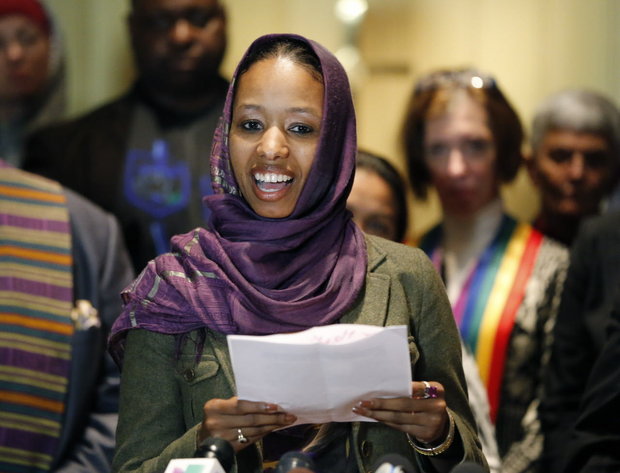
Political science professor Larycia Hawkins said she had planned to wear the hijab until hijab 6Christmas “…in solidarity with my neighbor, who is Muslim. That’s what this is about.” Professor Hawkins also said that she believes that Muslims and Christians worship the same God. That was when the College put her on administrative leave.

I’ve thought a lot about this little spot of friction at Wheaton. I have written three previous versions of this essay, all of which are on their way to electronic oblivion. But finally, I worked out what I wanted to say. Professor Hawkins is guilty of “conduct unbecoming.” [2] Professor Hawkins’ actions and her remarks lack decorum.

Let’s leave that there and start at another place. How about the National Football League? The NFL doesn’t have any doctrinal requirements at all, but they do have a sense that the players ought not to be allowed to embarrass the League. Here’s how they attend to that business.

Discipline may be imposed in any of the following circumstances: Conduct that undermines or puts at risk the integrity and reputation of the NFL, NFL clubs, or NFL players. [3]

hijab 8
This is my proposed solution for Wheaton College. Notice that in the case of the NFL, you don’t have to do anything wrong or say anything wrong. The question is whether what you did or said causes other people to think less of the organization. So let’s ask this: Did anything that Professor Hawkins said or did “undermine…the reputation…of the College?”

Yes. She did. We could ask whether this particular aspect of the College’s reputation needed to be undermined. We might supply a word more favorable to our case; we might ask whether the College really needed to be freed from the burden of some particular aspect of their reputation. We shouldn’t expect the College to look at it that way, of course.

Now if Wheaton had a “conduct unbecoming” policy, like the NFL’s, they could simply say that Professor Hawkins is guilty of “that” and fine her…oh…$50,000 and it would all be over. But Wheaton doesn’t have a policy like that. Wheaton needs to say that Larycia Hawkins is guilty of a doctrinal offense, which at Wheaton, is a contractual violation as well. The College smacked Professor Hawkins with the weapon they had available and they did not have “conduct unbecoming” available. Only heterodoxy. [4]

And it turns out not to be a good weapon. Here is Miroslav Volf, writing in the Washington Post on December 17:

Appealing in part to arguments in my book “Allah: A Christian Response,” Hawkins asserted that Muslims and Christians worship the same God. She did not insist that Christians and Muslims believe the same things about that one God. She did not state that Islam and Christianity are the same religion under a different name, or even that Islam is equally as true as Christianity. She did not deny that God was incarnate in Christ. Neither did she contest that the one God is the Holy Trinity. In fact, by having signed Wheaton’s Statement of Faith, she affirmed her belief in God as the Trinity and Jesus Christ as God and man, fundamental Christian convictions which, among other things, distinguish Christian faith from Islam.

In this paragraph, Volf, Director of the Yale Center for Faith and Culture,  takes the trouble to list a lot of positions that actually would violate Hawkins commitment to uphold Wheaton’s Statement of Faith and to note that Hawkins did not take any of those positions.

hijab 10That brings us to the dilemma Wheaton is facing. Here’s the way I see it. Professor Hawkins has committed an offense related to the image, the “brand” of the college. Serious people who love Wheaton are offended by what she did and said. These serious people have communicated their unhappiness to the President of the College, who has taken a halfway measure of some sort, hoping that will work, at least in the short run. [5] That’s the one horn of the dilemma.

The other horn is that Professor Hawkins is an attractive black women and a professor who has signed the Statement of Faith and has not violated it and is taking a stand that will be approved of by religious organizations from the middle to the left end of the spectrum and by most secular media. She simply can’t be ignored. And given the way she is handling this, I imagine that she will be a very hot commodity, sought after by religious organizations of all sorts.  Notre Dame has recently been providing a happy home for people like her, for instance.

Here’s my favorite resolution of that dilemma. I’m not making any predictions about what will actually happen. All the knowledge I have about this issue I have gained from public media and from my very old memories of having been there in a more conservative time—more conservative for me as well as for the College. But this is what I would like.

President Ryken meets with the Board and with the V. P. for Finance. [6] He apologizes to the Board and to the donors—they will hear about that through the V.P.—for allowing a situation so embarrassing to the College to occur during his presidency. But then he will take a bold step. He will say that the reason Wheaton has a Statement of Faith and the reason the College takes it so seriously is that it is what binds us all together.

“Some of us,” he would say, “are political and cultural moderates and some political and cultural conservatives.” He might even say “liberals and conservatives” just to get a chuckle. We encourage all kinds of diversity because we know it makes the College stronger—all kinds EXCEPT doctrinal diversity. We have made our Statement of Faith the touchstone of our common work together and our common community together. Now is a time for us to reaffirm our unity and—especially in this difficult matter of Professor Hawkins—to affirm our appetite for diversity as well.”

Ladies and gentlemen,” he continues, “there is nothing about our common faith  that hijab 11precludes one of our own from standing up for our neighbors who are being actively persecuted or who are under special scrutiny. Wearing a hijab as a way to dramatize that is…well…a little unusual, but the prophets we revere did unusual things too and did it for the purpose of calling attention to God’s word for their time. What Professor Hawkins did pushes the boundary of our comfort, which is fine, but it does not cross the line of her faith commitment, the same commitment we hold as our common treasure.”

“So I say it is time to ‘man up,’ [7] all of the men and women in this room, and to affirm the unity of our faith and also the flexibility we grant to our faculty in expressing it. If that doesn’t sound good to you, see me afterwards. We are adjourned.”

That’s my fantasy. I’m not a fan of Wheaton’s Statement of Faith, but I still have some affection for the school: it was a very good school for me when I was there. And I still wish her well and I will express that wish with these words from the Alma Mater.

We’ll keep they old traditions, pledge love and honor too,
For Wheaton and her colors The Orange and the Blue

[1] Fifty-nine…”in all things we really shine” in the words of the class song. I am not supposing anyone would doubt my being a part of that class at Wheaton, but if anyone did, my knowing the second line of the class song should put all fears to rest.
[2] We all know uses of becoming that are temporal. It is nearly dawn and the sky is becoming lighter. We have been meeting only in class but now we are becoming friends. This isn’t that. In this use, becoming is just a synonym for “that which is befitting and proper; decorum.” So says the Oxford English Dictionary, giving this as an example: 1598   Shakespeare Love’s Labour’s Lost ii. i. 67   Within the limit of becomming mirth.
3] This is only one of six bulleted items, but it is the one I need for this piece.
[4] Everyone knows orthodoxy. This is what a position is if it is not orthdox.
[5] Not to cast any unnecessary aspersions on President Ryken, but I am currently studying the narrative of Jesus’s trial and sentence and because of that I am reminded that in John’s account, Jesus was publically flogged as Pilate’s way to find a “halfway measure of some sort…that would work in the short run.” He was, in John’s account, trying to find a way to get Jesus off. But, of course, Pilate had Trustees, too, and you need to know what they want.
[6] I am assuming here that the major donors to the College and the members of the Board are angry for the same reasons and that they differ mostly in the tools they have available to express their displeasure. So I won’t speculate about which group might be angry about which part of the charge.
[7] I don’t know the President’s academic background, but if in includes classics, he might slip in a reference to all the “virtue” words in English derive from vir-, the Latin root meaning “man.”

Posted in Advent, Education, Political Psychology, Theology | Tagged , , , , , | Leave a comment

Unitasking. Really.

Studies of efficiency by multitaskers have been nearly unanimous and almost entirely dismal. The more tasks being attempted at once, the lower the efficiency of each task performance. But what if we did it the other way around?

unitask 6Work is organized—predominantly, not entirely—around the idea that productivity is a good thing and, to a lesser extent, that efficiency is good as well. Given that, it is easy to say that whatever impedes those values is a bad thing and, as a rule, we give bad names to bad things. We call the depth of attention of a multitasker, “shallow” and complain that span of attention is choppy. Each episode of attention is “short.” [1]

In a conversation one morning this week—Starbucks, where else?—we were talking about the proportion of people whose ability to attend and to relate to persons who are physically there and to feel empathy for them are all eroding as online time increases. We imagined, in the conversation, that 30% of the workforce [2] was suffering this deficit. Then we speculated about what would happen when that 30% became 80%.

Where to take this Starbucks Caucus-inspired reflection? I’d like to try to look at it in two ways in this essay. The first is the standard succession of cultures based on generations. Every generation deplores the shortcomings of the next generation, etc. The second is a little harder. It asks us to speculate about whether a given cultures really works for its members. What if living life in a certain way is just bad for people? Will they notice the bad effects and go back to what worked?

OK. Let’s see how this goes.

If four out of every five workers has this “condition,” then it is, by definition, “normal” and is therefore not a “condition” as we normally use that word. It is just how people are. How are people? Well, they maintain task focus for…oh…ten minutes at a time. They have many more contacts than people used to have and are, in that sense, more “social.” They can handle somewhere between four and six tasks simultaneously, without any unacceptable loss of efficiency. That’s what people are like in the new normal.

I assure you that a paragraph like that one would not be written by anyone of myunitask 2 generation, and, although I did write it, I found it difficult and I had to go back and scrub out all the “naturally occurring” pejorative words. What a person of my generation would have said would have sounded like a lament. “Kids today!” we would have said. “They don’t have real relationships because they don’t know how. They have markedly reduced levels of empathy. They have virtually no attention span at all. They persist in doing “too many” things at once, thereby depriving themselves of any really clear experience and insuring that their task performance will be poor.”

This is the classic dilemma: we said/they said. The statistically normal traits become the values—the norms—of every generation. We value these things; they value those things. We are statistically normal—we are the norm, in both senses of the word—and they are “deviant,” in the very limited sense that they deviate from the norm. When the generational change occurs, they will be statistically normal and we will be “deviant”—which is not so bad, really, because we will also be old—and they will come up with pejorative names for the traits we valued. For example, I might say that you, the Millennial [3] I am talking to, “can’t keep your attention on the subject at hand.” You might prize your ability to move smoothly and efficiently among the many tasks you are simultaneously tracking.

This is a pretty familiar argument so far. It is exacerbated in our time because the pace of change is so fast and the power of peers is so much stronger than the power of parents. The result is that one generation is more different from the preceding generation than was once the case. But there is another argument embedded in this one and to get at that second argument, we are going to have to take a short hike and start at another conceptual trailhead.

What if it doesn’t work? Then what?

unitask 3What if the society has adopted patterns of behavior that insure that nearly everyone will acquire a disease that, to an outsider, could be easily prevented. [5] Doing things “the way we do them here,” a rough and ready definition of culture, will get you all the deficiencies and all the diseases that those decisions lead to. If beri beri is one of the natural consequences and you are an observant member of the culture, you will get beri beri.

Members of the group who do not have beri beri comprise the datum to be explained. Why don’t they have beri beri? No one asks, in this society, why everyone else does have it. Here, at last, we move away from the conflict of generations, by which Generation A accuses Generation B of failing to meet “the standards,” by which they mean Generation A’s standards. In time, Generation B says the same thing to Generation C, and so on.

If the shallow distracted mode of “attending,” it is almost a courtesy to call it attending at all, is like the beri beri in the example above, then it is the natural result of “how we do things around here.” It is, simply, “culture.”

unitask 4Some of us, I’m guessing it will be mostly older people, are “unculturated.” [6] We tend to severely limit our attention, imagining that paying full attention to the one person you are listening to is somehow a good thing. Naturally, this comes with the loss of the other five things a “normal person” would have been—and really should have been—attending to at the same time. It’s sad, really, but it is how they are.

And we perseverate. Not only do we limit ourselves to one interaction at a time, but we extend this interaction over many minutes. A Millennial might say of his parents, “I have seen them engage in this focused “one to one” thing for as much as an hour, completely oblivious of all the other things that are going on, on Facebook for instance, during that time.”

I’m finished with the snide language now. I allowed myself a few paragraphs of it to try to represent the wonderment, the utter incomprehension, of members of the dominant culture in this future time. These are the people, remember, who, back in our day—back in the time when our cultural assumptions were dominant and the Millennials were deviant—needed help because them had shallow relationships and scattered attention and no inner resources at all. Now I am trying to represent their sense of who we are, under the cultural assumptions that they represent and which are now the dominant assumptions, i.e. the assumptions that undergird “how we do things around here.”

unitask 5The question I was asking—the beri beri question from Putney and Putney—was this: “What will they do when they discover that the new cultural practices don’t work?” Following out the Millennial prescription would, in this view, produce people who are damaged. They have no stable selfhood because they don’t take the time it requires. They have no intimate relationships because they don’t take the time such relationships require. They don’t take the time because more than 27 seconds off-line feels like a month in solitary confinement and whatever you have to do to prevent that dreadful feeling…well, that’s what you ought to do.

What will they do, upon discovering all these serious deficits? They will redefine “personhood” and “relationship” and “alone time” so that these notions fit with the cultural assumptions they have made and which they prefer.  These preferences will become so strong that not following them will look like “deviance” and, of course, they will be deviant by that time. They will be a certain specifiable distance from the new norm.

My guess is that that’s where we are going. The alternative scenario is that people will notice how inadequate the new culture is and there will be a successful backlash against it. Millennials, or, more likely, their children, will reject the norms of their parents and will yearn for an older and a more satisfying time. They will want to talk to people like us who remember things like “conversation,” people who know how to “unitask.”

I say that is possible. I don’t think it is the most likely scenario. The most likely scenario is much darker than that.

[1] Ordinarily, we remember not to say that it is “too short,” because if we said that, we would have to say “too short for what?” and that leads us down a path we are not prepared to travel.
[2] There isn’t a playforce, is there?
[3] “The millennial generation” is used casually as if everyone knew what everyone else meant. Even researchers use a very broad band of birth years to identify this group; birth years from 1980 to 2000. I think it is partly chronological and partly stylistic.
[4] I’m going back to Snell and Gail Putney’s The Adjusted American: Normal Neuroses in the Individual and Society. Many books postulating the notion of a “sick society” were written during this era, but this is one of the easiest to approach.
[5] Notice how important the process is in this word. We would not be called “uncultured,” a state of not being in harmony with the culture. We would be called “unculturated,” meaning that we have not gone through the process of being brought into alignment with the culture. That is what the -ate part of “unculturated” does. It means that we are not hopeless, but we may need…oh…incentives or perhaps just extra time.


Posted in Living My Life, Paying Attention, Society | Tagged , , , , , | Leave a comment

The Matthew Tree

At our house, we are really serious about telling Matthew’s story one year and Luke’s the other year. This year, it is Matthew so we are decorating the tree the way Matthew would have wanted it.

Every now and then, I imagine that I will try to palm off all this playing with the tree as a way to engage my kids in Advent/Christmas, but my kids are all in their 50s. I have some grandchildren in town who are young enough to enjoy this kind of playing around and their parents are amazingly tolerant. But the truth is that I decorate the tree this way because I like it.

Every year something new gets added. This year it is the star. This came to me about a month ago in the middle of what I recall as a sound sleep. I remember liking the idea right away, but very shortly after IMG_0572that I remember thinking that if it doesn’t work, I can say that an angel revealed it to me in a dream. [1]

Everyone knows that the Wise Men—we would call them astrologers today—saw “a star at its rising.” Just by looking
at it, they could tell that it foretold a new king of the Jews. “So,” I said to myself in my sleep-befuddled state, “Just what kind of star would give them that idea?” [2]

Because it is a Matthew year, we celebrate Matthew’s interest in the genealogy of Jesus. Matthew’s genealogy is much better known than the one Luke provides and we celebrate that by featuring the forebears of Jesus on the tree. It took some doing to get four that are exactly alike, but I managed. I have written recently about the amazing women who help to drive Matthew’s genealogy forward. Here, I celebrate all of them at once, including both Jacobs and their sons, both Josephs. It all fits together, as you see. One of the requirements of the tree we choose is that it will have a place for the bears.

As you would imagine, we have different ornaments for the different years—not all the ornaments are different, just enough to establish which year it is. The fact that the Wise Men knew what the star “meant” establishes that they were astrologers, wIMG_0576hich we represent with the signs of the zodiac, four of them in this picture.  The fact that they headed off for Jerusalem, the capital of Judah, establishes that they were political geographers. The fact that they followed the star all the way from Jerusalem to Bethlehem and then didn’t tell Herod what they had found means that they were faithful to their calling.


And, finally, there is the question of where the Wise Men went in Bethlehem. They went to
the house over which the star stopped; the house of Joseph and Mary and their little boy, probably about two years old at the time, Jesus. [3] I mentioned that part of this whole charade was to establish in the minds of the grandchildren (and their parents) that by Matthew’s account, Joseph and Mary lived in Bethlehem. They never got as far north as Nazareth, way up in the Galilee district, until the end of the story Matthew tells.

So for a dwelling, we wanted something that looked as little like a stable as possible. Fisher-Price accommodated us by producing this monstrosity. It has little household “appliances” inside—a computer, a microwave, a toilet, and a phone, all of which make approximations of the appropriate sounds. If you wanted to say that by Matthew’s account, JESUS LIVED IN A HOUSE, you could hardly find anything better adapted to the purpose. [4]

IMG_0580There is a front door that is big enough for the Wise Men, imagining that they parked their camels in the yard. [5] The colors stand out, possibly to make the house easier to find. At a certain point in the process, I back carefully away from exegesis, keeping both hands in plain sight, and let my whimsy take over.

This all works, by the way. The grandchildren know that the story Matthew tells is different from the story Luke tells. Their parents know as well. They know that Grammy and “Dale”—there really isn’t a good title for stepfathers, a plight, but one I share with Joseph—are very picky about how they decorate the tree.[6]

So it’s all good. It gives a theme to each Advent season. I am checking with El Al to see if we can, in two more years, represent the Flight to Egypt is some engaging way.

[1] Among the good reasons not to try this is that it doesn’t fit Matthew’s story. There are lots of dreams in Matthew’s account, but angels don’t give messages to gentiles in dreams. The Wise Men, for instance, were “warned in a dream;” no angel. I am unquestionably a gentile, so I would need to skip any reference to an angel in his year.
[2] The same kind that Balaam saw (Numbers 24:) I imagine. I think Matthew was counting on his story recalling the old familiar story.
[3] That’s the way Herod calculated it, in any case. Presuming that Jesus was born when the star appeared, two years elapsed between the time they first saw the star and the time they conferred with Herod.
[4] The plan, of course, was not to use this monstrosity in the Luke year, when we needed a stable with a feed trough and some animals and some shepherds. The kids really liked the HOUSE, however, so in the Luke year, we brought it back as the INN that unaccountably could not find room for the Holy Family.
[5] This imagines that there were three Wise Men, when in fact no one has any idea how many were in the party. We know that there were three gifts, but that is the only number we have to work with. Since they were academics, it is possible that they had to share the cost of such spendy gifts.
[6] There are lots of non-picky ornaments on the tree as well, including a lot of the most popular secular ones and in Luke’s year Santa’s reindeer need to be kept from fraternizing with the oxen and the asses.

Posted in Advent, Living My Life | Tagged , , , , | Leave a comment

Being “happy”

What do people mean when they say they are happy? Is it a state? A direction? A blissful moment? You are the one who most needs to know.

I finished sending out our Christmas letters before my birthday (today) this year. My practice is to write an email to my friends and family and attach an account of the year with some reference to which Advent season it is this year. [1] Somewhere in the note I give a one-line characterization of the year Bette and I have had. This year, that characterization often included the phrase “healthy and happy.” The reason I put the quotes on “happy” and the reason I am writing this essay are pretty much the same thing.

Every time I wrote it, I experienced a little twinge happy 2because I know a great deal about happiness. I may or may not know that much about being happy myself—that’s really what this essay is about—but I know a lot about “happiness.” I know how it is most often defined by scholars with different research interests. I know that it is thought to be inherited to a considerable degree and otherwise to be achieved. During the last ten or so years that I taught a course in political psychology at Portland State, I used a book by Robert Lane called The Decline in Happiness in Market Democracies. By the time I finished, I had not only read the text of the book many times, but had followed out most of the footnote citations as well. That’s why I know so much about happiness.

Also, I’m a pretty happy guy. To me, saying that doesn’t mean that I’m happy all the time. I categorically reject the notion that happiness is a “state” like, say, marriage, where it would be reasonable to say that either you are or you aren’t. [2]

So, if it isn’t a state, what is a good way to characterize it? I don’t think there is any way to say that “a happy person” doesn’t have moments when he is happy and knows he is happy. You could define it that way without doing a lot of damage: a happy person is a person who has a lot of happy moments. [3]

I would say about myself that I have a lot of happy moments. It is true that I lead a privileged life, but I think my happiness has more to do with being open to appreciation. You can walk out of the house and confront a heartbreakingly blue sky. Or a subtly blue sky. Or a tiny blue patch surrounded by cumulus clouds. You don’t have to be privileged to enjoy that; you just have to be willing.

happy 4I have a lot of happy moments with Bette. I take real pleasure in the jokes that are consummated with a meeting of eyes across the room or the things I count on her to see in a movie that she knows I am going to miss. You can’t manufacture good moments, even in a really good marriage, but you can purposefully arrange situations where good moments just might happen and then you can purposefully celebrate them when they do.

So I like “moments” as a way of looking at “being happy.”

I also like an orientation to happiness as a way of “being happy.” Most of what I mean by the expression “orientation to happiness” is covered by words like resilience or buoyancy [4] but I also want a notion that is broader than that and that has a positive component.

happy 8If that is what you are like—and there are lots of studies of people who have had really awful things happen to them and who, afterward, feel pretty much as satisfied with their lives as they were before—then you feel a lift toward happiness whenever it is not being prevented. There are events that tie a couple of concrete blocks around your ankles and you discover that under the circumstances, you are no longer buoyant. But there are people who are no more buoyant when the concrete blocks are removed than they were before. They are not buoyant. They have learned how to be submerged permanently. Other people start moving toward the surface as soon as the blocks are removed. I am one of those.  Being a Duck (U of O) myself–I am the one at the far left, just swimming out of the picture–I prize buoyancy more than some others.

If there is not something wrong with me I am up around the surface somewhere. And when something was wrong with me and it isn’t there any more—or isn’t wrong any more—I start moving up. It isn’t a decision I make any more than a ship made out of iron and air “decides” to float. And if I am up around the surface, I am inclined to notice the events that make me momentarily happy.

That doesn’t always happen. I had an episode of depression in 2006—still unexplained—where it didn’t happen. For reasons I still don’t understand [5]

happy 7I went into some kind of a sinkhole. I had no energy. I was not interested in anything. I couldn’t sleep at night and couldn’t stay awake in the daytime. It was so unlike the person I had always been, that when I got over it, three or six months down the road (depending on who is counting), I really noticed for the first time “what I am normally like.” Having been so very unlike that while I was depressed turned my normal taken for granted buoyancy into an actual datum. “Oh,” I said, “Look at that! Hm.”

I’ve done three things so far. I have discarded the idea that happiness is meaningfully described as a state, even though I used the word that way in my Christmas letters. I have explored two other kinds of meanings. The first is the “moments of happiness” notion. You are happy, according to this notion, if you have moments of happiness and take the time to notice and appreciate them. The second is the “orientation to happiness” (broader than simply buoyancy) by which standard you move toward happiness whenever there is no reason why you should not. I like both of those.

happy 6There is one further idea I would like to add before the special license I granted to myself for my birthday expires. That is that when I do the work of creating and sustaining the situations in which happiness just might discover me, I am proud of myself. I am more likely to be happy when I approve of what I am doing and how I am living. It isn’t that I feel that I have, in some way, “earned” happiness. It is only that I know I have done the work that has, in the past, established the conditions for my most prized moments of happiness. Doing the work puts me in a mind to receive all the happiness that is available to me on that occasion. [6]

And for me, it’s just a good way to live.

[1] We celebrate Advent using Matthew’s account in odd-numbered years and Luke’s account in even numbered ones.
[2] Or, one I like to use for women, “parity.” Parity is the noun form of an adjective, “parous,” which means “having had children.” Women who have not had children are “nulliparous.”
[3] Unfortunately, that activates the urge to specify just how many happy moments meet the criterion for the state called happiness.
4] That’s really just a choice of metaphors. Do you “bounce back” or do you “float up to the surface?”
[5] My friends will understand how really hard it is for me to have no idea what is going on.
[6] If the adjective “occasional” had not already been kidnapped and made to mean “rare,” I would be able to characterize the happiness I feel on these occasions as “occasional happiness.” I know that doesn’t work any more.

Posted in Living My Life | Tagged , , , , , | 1 Comment

God’s DNA

We’re going to have to talk just a little about the Virgin Mary today. My strategy in entering this field is to begin on the outrageous end of the row and pick my way back to where I parked the car. I thought “God’s DNA” was outrageous enough to do that.

On the other hand, this is a serious-minded essay. I know all the Virgin Mary jokes—have told half of them myself. This essay isn’t about that. It is about changing the metaphor entirely. I will want to work my way around to the proposition that Jesus was not begotten in a reproductive act of any sort, but in a creative act of God.

Where to start? Let’s start with John 3, where the Johannine Jesus, so dramatically different from the Synoptic Jesus, attacks the proposition that “Jewishnss” is a high priority matter. [1]

Virgin 1Jesus’s answer to Nicodemus, so familiar that it is hard to hear at all, goes like this. “In all truth, I tell you, no one can see the kingdom of God without being begotten from above.” [2] So it is the begetting—God’s work—that matters, not the physical birth—the work of humans. That’s all in John 3:3.

Down in John 3:5, Jesus concluded that being “begotten/born” through water and the Spirit is crucially important. Having a Jewish mother, not so much. There is more that really needs to be said about that, but let’s pop back to the Virgin Mary just for a moment. The question we are asking about the Immaculate [3] Conception of Jesus is a Nicodemus-style question, not a Jesus-style question. That alone ought to make us stop and think about what question to ask.

In the Prologue of the Gospel of John, we find that God gave to those who believed in the divine Word—later in the chapter, the divine Word is identified with Jesus— the power to become children of God. These children of God were begotten/born “not from human stock or human desire or human will, but from God himself.” Here is an excerpt: these children of God were not born…from human stock.”

What does that mean?  It does mean something.  It does not deserve to be thrown out or paved over by years of casual attention.  But what does it mean here?

I think it depends radically on the context of the question. In these passages from John, the question is, “Is it enough to have a Jewish mother? Does that establish you as one of God’s people?” To this question, the answer John gives is, “No. That is not enough. No considerations of human parentage will establish that you have been born “from God” (John 1:13)” by water and the spirit” (John 3:5).” So that’s what it means in that context.

What does it mean in the context of the Virgin Birth? There, I think we have to follow an entirely new path.  There, I think “born of the Spirit” requires us to find a way to think of the birth of Jesus in either the conception and birth metaphor or the “new creation” metaphor.

To approach the “new creation” metaphor, I propose that we look at the old creation virgin 2metaphor. [3] Here is Genesis 1: “In the beginning God created heaven and earth “When God began creating heaven and earth, the earth being then a formless void with darkness over the deep and a divine wind sweeping over the waters, God said, “Let there be light.” [4] We see here that the wind (spirit, breath) of God is sweeping over the waters.

The situation here is evil and chaotic. Professor Rendsburg, in making this judgment, points out that every word, with the exception of “wind” is “symbolic of chaos and evil: unformed, void, darkness, deep. God’s role, he says, is “to bring order and goodness into this chaotic and evil world.

We are working with the “creation” metaphor. That was Genesis. Here is Matthew. The angel says to Joseph, who is right on the edge of calling everything off between himself and Mary, “…do not be afraid to take Mary home as your wife because she has conceived what is in her by the Holy Spirit.” Luke says the same thing, although the angel is talking to Mary this time, “The Holy Spirit will come upon you, and the power of the Most High will cover you with its shadow. And so your child will be holy and will be called Son of God.”

According the Raymond E. Brown (The Birth of the Messiah), both Matthew and Luke, by virgin 3referring to “by the Holy Spirit” (Matthew) or “the Holy Spirit will come upon you” (Luke) mean to point the minds of the first hearers back to the first creation. The “creation of Jesus” through the power of the Holy Spirit is analogous to the “creation of the world” through the power of the Holy Spirit. So when I speak of the “creation metaphor,” that’s what I’m talking about.

So these two gospel writers ask us to use a metaphor that is at home with “creation” rather than reproduction. And you will recall that that is what John asked of his hearers as well: “not by the will of the flesh, but by the will of God.” That means that there is nothing more sexual about the creation of Jesus that there was about the creation of the seas and the dry land. And if you want to extend the metaphor off into the area of deep scandal, you would have to ask whether the zebra (or some zebra-like progenitor) also carries God’s DNA.

virgin 5The zebra picture was supposed to be silly; that’s probably why zebra was the animal that came into my mind. If God does not share His DNA with his first creation, then why would we think it appropriate that he shared His DNA with his “second creation?” DNA is not a relevant notion either for the “divine wind sweeping over the waters” or for “the shadow of the power of the Most High.” It’s not a hard question. It’s just a bad question. We should ask DNA questions about situations where DNA is relevant.

But the church was born in contention. Accusations were made; defenses were constructed. “This guy you call the Messiah is actually a bastard from the hills of Nazareth.” [5] And the church says, “He is not a bastard. Joseph and Mary didn’t have sex until after the first child was born.” You see how weak that is as a rebuttal. You have to get some distance away from a situation everyone is going to define as essentially sexual in order to make the distinction I am making today, which is that the gospel accounts emphasize “creation” and not “reproduction.” That distinction is just not going to hold up under controversy.

But, as I said, it seems a lot to ask of people in the middle of a controversy in which sexual charges are being made, to say that such charges are entirely irrelevant. So the church invented a “reproductive process” in which Mary participated but no other human did. Therefore, presumably, Mary’s DNA is a part of Jesus’s genetic makeup. And the other half of Jesus’s DNA is…the Holy Spirit’s? God’s? Joseph’s? Some itinerant Roman soldier’s?

Once you start down the DNA route, which is where the sexual reproduction metaphor takes you, it takes you right to this corner and you have to invent more and more outlandish explanations. It’s a paradox. It’s a mystery. God’s ways are not our ways.

That’s not a good route to take.

I propose, instead, that we go back to the biblical account and say that in the beginning, God’s creative spirit brought good and order out of darkness and chaos and “in the fulness of time” God’s creative spirit came over Mary and produced a son, who was the light of the world. [6] Theologically, we can say that the first act was “creative” and the second “redemptive,” but in the gospels, it is unquestionably a new creation, comparable in scale only to the first creation.

So I conclude that the question of “God’s DNA” is a silly question, as I said at the beginning. But by now, I have said why I think it is silly.

[1] The ironies this argument provides are so thick and overlapping that it is hard to leave them alone. Jesus, the Jew, is arguing with “the Jews” that “being Jewish” is a very low priority matter compared to being “begotten by God.” You are a Jew if you are born of a Jewish mother. You are a part of God’s family if you have been “begotten” by God. So “begotten” is used by one side of the argument and “born” by the other side and in the Greek of John’s time, the word for born and for begotten was the same word. As I say, ironies abound.
[2] There are lots of good reasons for the variability of translations here. I am pushing all the “begetting” (the male part of the process) onto one side and the “bearing” (the female part of the process) onto the other side. So in this passage, Jesus says “begotten from above” and Nicodemus says, “What” Born again? Surely not.”
[3] I want to pause here to acknowledge the work of Gary Rendsburg of Rutgers University. He offers a really good set of lectures, part of the Great Courses series, on “the Book of Genesis.” Lectures 2 and 3 are on the first creation story and the second creation story respectively. It is from his lecture that I learned that “creation ex nihilo” is no part of Genesis 1.
[4] That’s the way Rendsburg translates it. It is given in the New Jerusalem Bible as a “grammatically possible translation” but not the one they chose. I am not competent to choose between them, but Rendsburg’s translation highlights what I want to highlight, so I am going with him this time.  The cartoon I chose to illustrate this moment has, oddly enough, that same translation.
[5] For some years now, I have taken quiet delight in the fact that the English word bastard comes with an etymology that means “born in a barn.” So using this terms fits beautifully with Luke’s account and not at all with Matthew’s.
[6] All the powerful light and darkness poetry of John helps to carry the Genesis account of creation into the New Testament.

Posted in Biblical Studies, Theology | Tagged , , , , , | Leave a comment

How Matthew prepares us to receive Mary

I really think Matthew puts as much effort into preparing his readers to understand Mary as Luke does. Luke is famously Mary-centered. In Luke, Joseph is part of the ensemble, back there with the oxen and the asses. He doesn’t speak a single line. But in Matthew, Joseph is in David’s line of descent and that is why his son is “a child of David.”

Although Matthew does not feature Mary—Mary does not have a spoken line in Matthew’s the women 6account—Matthew needs to prepare his readers to understand who she is and what she has done for us. Of all the ways he does that, I want to think today about the genealogy he presents. This is a royal genealogy. The king’s son is king after him; the grandson is king after the son; the great-grandson king after the grandson. We don’t really need to know who the mother is if the father is the king.

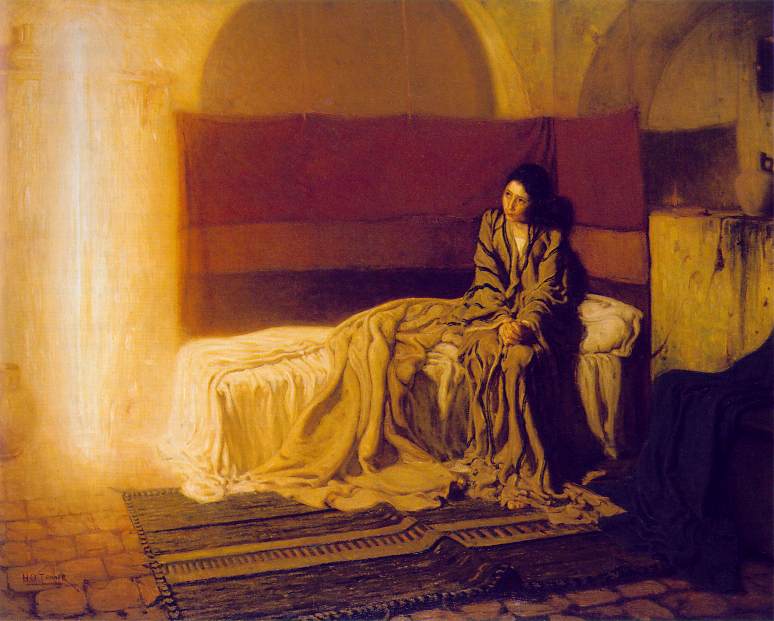
And mostly, Matthew does not tell us who the mother is. Matthew’s genealogy is arranged in sets of fourteen, so to make this point, we can look at the the first fourteen, beginning with Abraham and ending with David the King. “Abraham fathered Isaac, Isaac fathered Jacob, Jacob fathered Judah and his brothers.” That’s the way it goes (Matthew 1:2) and that is the way we expect it to go. But if it continued that way, how would Matthew be preparing us for a pregnant virgin?  (The picture comes from Luke.  Sorry.  It was the only way to have a picture.)

So we begin to see breaks in the pattern. He ended with “Judah and his brothers,” the sons of Jacob. But now Matthew says, (verse 3) “Judah fathered Perez and Zerah, whose mother was Tamar.”

The mother was Tamar? Why? Matthew didn’t bother to tell us that Isaac’s mother was Sarah,[1] nor that Jacob’s mother was Rebecca, nor that Judah’s mother was Leah. Why break the pattern to tell us about Tamar? Hold that thought.

A few generations later, we find another break. Verse 5 tells us that Salmon fathered Boaz, whose mother was Rahab; and right after that, Boaz fathered Obed, whose mother was Ruth. Then, in the second part of verse 6, that “David fathered Solomon, whose mother had been Uriah’s wife.”

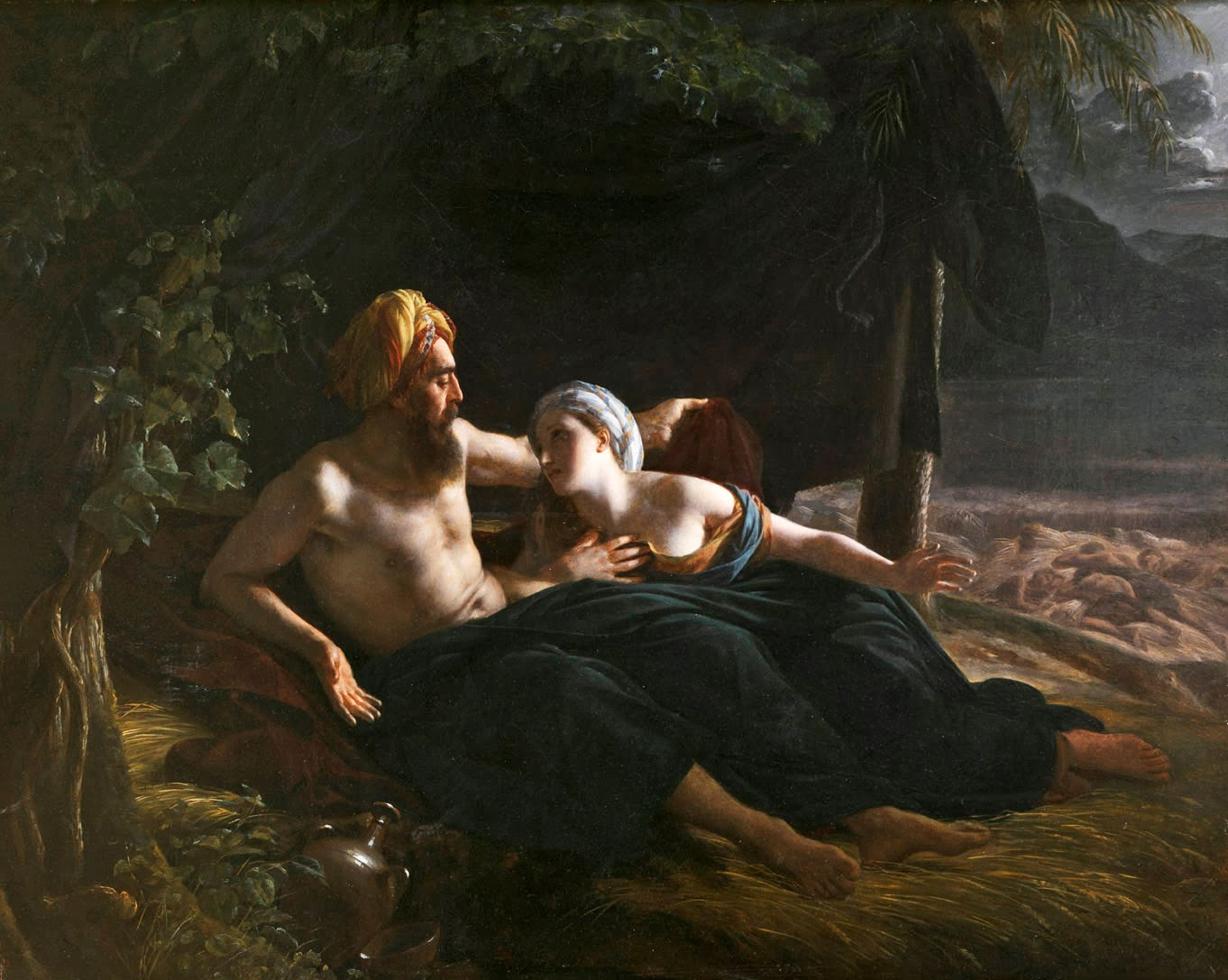
the women 5So we have a clear pattern. We have not yet addressed how these breaks help Matthew prepare us for the role Mary plays. Matthew drops in the mother in addition to the father four times. And then we get to Mary. “Jacob fathered Joseph, the husband of Mary, of her  was born Jesus who is called the Christ.”  (verse 16) [2] In the case of Mary, a new pattern is substituted because Matthew does not want to say that Joseph fathered Jesus. That phrasing sounds like sperm and egg stuff and that’s not what Matthew wants to say. [3]  The picture shows Tamar seducing Judah.

So these four breaks in the pattern—Tamar, Rahab, Ruth, and Bathsheba—are introduced to help prepare us for Mary in some way. How do they do that? We could stop and note that they were foreigners; all but Bathsheba, who is not called by her name, but “the wife of Uriah the Hittite.” That might be part of it.

The role each woman plays is morally ambiguous. Matthew is going to record some accusations against Jesus in 11:19. “Look,” his accusers say, “a glutton and a drunkard, a friend of tax collectors and sinners.” Matthew doesn’t allow any of Jesus’s accusers to point a finger at Mary and shrug and say, “Like mother, like son.” I do think that Mary’s morally ambiguous situation has been prepared for by the women who preceded her—the women Matthew had to break his pattern to introduce. Let’s look at the cases Matthew gives us.

Tamar, after all, had extramarital sex with her father-in-law, Judah. Rahab was a traitor to the women 2her people, the Canaanites, by harboring Israelite spies. Ruth put herself in a very compromising on the threshing room floor with Boaz. Bathsheba was taken, probably against her will, by the king, who then killed her husband, Uriah the Hittite. These women lead us to Mary…how exactly?

I can think of two ways. [4] I don’t know whether these are the ways Matthew had in mind. The first is that these women aligned themselves with the story God was telling through them. Tamar, for instance, was fixed on the notion that descendants were to be raised up in the name of her dead husband, Er. That’s what God said should be done and she couldn’t find anyone else who was interested in doing what God said should be done. She counted on an array of men to do the job (including her brother-in-law, Onan, Onan’s younger brother Shelah, and Judah, the patriarch, which is where the buck stopped. When they would not, she did it herself. She disguised herself as a prostitute and got herself pregnant by Judah, her father-in-law. And the children were reckoned to be the children of her husband, Er. [5]

God says, in other words, that children shall be raised up to carry on the line of the dead husband. That’s what God says. Everyone said no except Tamar. She “aligned herself with the story God was telling” by getting pregnant out of wedlock.

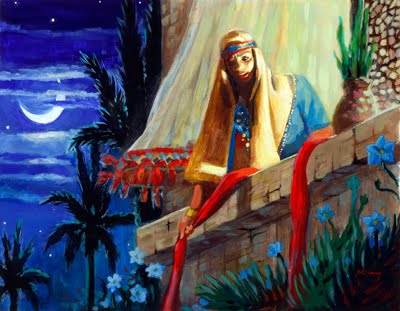
Rahab, the traitor, threw her lot in with the invading Israelites and against her people, the the women 3Canaanites. Since the only account we have of that comes from the Israelites, Rahab is revered. And without Rahab, there would have been no inhabitation of the Promised Land by God’s people—at least not in the way it actually happened. And without the Promised Land, of what nation would David have been king? It is all very well to say, as Matthew does, that Ruth’s husband Boaz fathered Obed, who was the father of Jesse, who was the father of David, but if there is no kingdom, there is no king and it was Rahab the traitor who aligned herself with God’s story in helping establish a kingdom.  The picture shows Ruth on the threshing room floor with Boaz; actually, it shows more of her than scripture really requires.

That brings us, skipping over the fascinating story of Ruth, to Mary herself. You know, the “pregnant out of wedlock” Mary? The initiative-taking Mary? The aligning herself with God’s story Mary?

By the time we get to Mary, the Mary for which Matthew has prepared us, we know that the women 1“racial purity” is not going to be any part of Jesus’s claim to be Messiah. Paul can call himself “a Pharisee of the Pharisees,” but he does not call Jesus that. Jesus was born on the other side of the track in socially embarrassing circumstances and he was born to a woman who aligned herself with God’s story—like her predecessors, Tamar, Rahab, Ruth, and Bathsheba.

[1] Nor that he had fathered another son, Ishmael, before Isaac.
[2] Joseph, by taking and naming the child, declares himself to be the child’s father according to Jewish law. Joseph was his father “fully and legally,” to use and expression biblical scholar Raymond E. Brown uses. And Mary calls Joseph the father of Jesus as well (Luke 2:48). The question in these cases is not genetic, but legal.
[3] Actually, Matthew wants to talk about “a new creation,” but that will have to wait for another essay.
[4] At some point in this essay, I need to acknowledge my very substantial reliance of the work of Raymond Brown. The chapter in his The Birth of the Messiah that begins to treat all this is called, “Why the women?”
[5] This is, obviously, a matter of law, not of genetics. Perez and Zerah were “the children of Er,” who had been long dead by that point.

Posted in Biblical Studies | Tagged , , , , , , , | Leave a comment

Four Years Early?

George Orwell wrote 1984 in 1948. It wasn’t a prediction, really; more of a convenience reich 8just to flip the numbers around. Robert Reich wrote Aftershock: The New Economy & America’s Future in 2011 and in it, he imagined a boiling over of populist fervor in 2020. He might be right. He often is. On the other hand, as I look at Speaker Paul Ryan’s call to arms, I wonder if Reich might not be four years late.

Here is Reich’s scenario.

November 3, 2020. The newly formed Independence Party pulls enough votes away from both the Republican and Democratic candidates to give its own candidate, Margaret Jones, a plurality of votes, an electoral college victory, and the presidency. A significant number of Independence Party members have also taken seats away from Democrats and Republicans in Congress. [1]

On the night of November 3, President-elect Jones gives a victory speech. Her tone is defiant.

My fellow Americans: You have voted to reclaim America. Voted to take it back from big government, big business, and big finance. To take it back from the politicians who would rob us of our freedoms, from foreigners who rob us of our jobs, from the rich who have no loyalty to this nation, and from immigrants who live off our hard work. (Wild applause.) We are reclaiming America from the elites who have rigged the system to their benefit, from the money manipulators on Wall Street and the greed masters in corporate executive suites, from the influence peddlers and pork peddlers in Washington—from all the privileged and the powerful who have conspired against us. (Wild applause and cheers.) They will no longer sell Americans out to global money and pad their nests by taking away our jobs and livelihoods! (Wild applause, cheers.) This is our nation, now! (Wild applause and cheers that continue to build.) A nation of good jobs and good wages for anyone willing to work hard! Our nation! America for Americans! (Thunderous applause.)

reich 3There are eight sentences here, nearly all of them dripping with paranoia.  Richard J. Hofstadter wrote “The Paranoid Style in American Politics” first as an article in Harpers’s Magazine, then as a collection of essays with that title. Hofstadter justified the use of “paranoid” by specifying “the sense of heated exaggeration, suspiciousness, and conspiratorial fantasy” which characterizes some political movements. [2]. You can argue that there are public policy goals valued by the right and not the left, in American politics, and vice versa, but “paranoid” is not about policy goals. It is about ways of thinking, prominent among which are “us” versus “them.”

Reich identifies a few trends that sound just as clear today as they did when he wrote them five years ago. These conditions, taken together, are, he says, “toxic.”

“Americans might be able to accept a high rate of unemployment coupled with lower wages,” he says (Chapter 3). [3]

“We are likely,” he continues, “ to accommodate absolute as well as relative losses in our standard of living for a long stretch of time. (Chapter 4).

“We might abide even wider inequality.” (Chapter 5)

And he concluded, “But when all of these are added to a perception that the economic game is rigged—that no matter how hard we try we cannot get ahead because those with great wealth and power will block our way— the combination may very well be toxic.” That’s the first paragraph of Chapter 6. The title of Chapter 7 is “The Politics of Anger.”

The conditions Reich identifies are undeniably there, with the exception of the last one. It reich 2is not widely agreed that the game is rigged. [4] And if it were, there would be very little agreement on how it is rigged, on whose behalf it is rigged, and what might be done about it.

In a way, that’s even worse. Terms like those that President-elect Jones uses, “us” and “them,” really don’t require agreement on who is being referred to. Those who are furious about immigrants and “pork peddlars” can vote happily beside those who are furious about “money manipulators” and “greed masters.” All are THEM. A government elected by such incompatible angers could not govern, of course, but such a government could continue to be elected so long as the angers are generalized and potent.

This brings us to Speaker Paul Ryan. Ryan is conservative. He is not paranoid. On the other hand, how close to the us v. them worldview does he dare to go before a spiraling radicalization takes over?

The New York Times’ David Herszenhorn reported on December 4 that Speaker Ryan said, “Our No. 1 goal for the next year is to put together a complete alternative to the left’s agenda.” Ryan imagines a “them” which is not the government and not the Democratic party, but “the left.” He believes that “the left” has an agenda and he would like to see a point for point alternative from…well…from “the right,” I guess. [5] Ryan puts “the government” on one side and “the people” on the other.

Not that the Speaker doesn’t have policy goals. He wants to overhaul the tax code.reich 7 Everybody likes that as a general proposition; it is the specific provisions that hurt. He wants to support American manufacturers; to strengthen the military, especially against the threat of the Islamic State; and to repeal Obamacare.

So here’s where we are. The combination of economic forces has been abrasive to middle class hopes for more than 40 years now. Things are getting worse and they are going to go on getting worse. Economic inequality in the U. S. has reached levels we saw last in 1929, just as the Great Depression broke. The political fight of today could be—eventually—about what to do about it. [6]. But what to do about it seems, in the present paranoid climate, a little abstract; a little brain driven. Before we get there, and possibly instead of getting there at all, there is the question of who is to blame. US v. THEM is the lineup we need for the politics of blame.

This would be like the little NFL dramas that occur when offensive and defensive lines collide before the ball is snapped. The O line points to the D line; the D line points to the O line. It’s predictable; it’s theater; it’s funny. But in the NFL, there are referees who will decide who is at fault and will assess the proper penalty. There is no chance that the fans can be so offended by the refs’ decisions that they will vote them out at put in “our own guys.” The NFL doesn’t work that way because they need to keep their fan base and that requires at least the presumption of fairness. The U. S. needs to keep its fan base too and a Left v. Right battle of Armageddon in 2016 is not going to do that job.

And if it doesn’t get done in 2016, Margaret Jones awaits in 2020.

[1] Not that Reich is opposed to having fun with the scenario. The Republican candidate that year is George P. Bush. The Democratic candidate is Chelsea Clinton.
[2] See a very interesting current look at the same phenomenon by Neil H. Buchanan posted on justia.com on May 21 of this year.
[3] Reich numbers the chapters separately in Part I, Part II, which begins on page 77 of the Vintage paperback, and Part III. All the chapter numbers I cite here are in Part II.
[4] According to Gallup, Americans asked in 1998 whether there was “plenty of opportunity to get ahead in America today” said that there is. 81% thought so. By 2011, that percentage was down to 57%. The most recent poll on that question (2103) only 52% said yes.
[5] Ryan is no more “the right” than Obama is “the left,” but this is the side-choosing season and the Speaker would like to see competing lineups.
[6] All of Reich’s Part III is about his proposals for what we should do about it. Secretary Reich is a wonk.

Posted in Political Psychology, Politics | Tagged , , , , | Leave a comment

Tidings of Delicious

There is a bright red banner across the glass front of the pastry case at our Starbucks in Multnomah Village. It says, “Tidings of Delicious.”

Every time I see it, I think of Matthew’s strategy for placing the birth of Jesus in a richdelicious 1 context of Old Testament events that he doesn’t have time to name specifically. There is no reason, after all, for Starbucks to write out, “Fear not: for, behold, I bring you good tidings of great joy, which shall be to all people.” [1] On the other hand, I can’t think of any other common use of “tidings,” so “Tidings of Delicious” might just as well have a scriptural tag on it (see Luke 2: 10).

It’s a word that tunes the ear to a previous setting: a story or a joke or a controversy. It tilts the table of your memory in the direction of “that other thing” without ever mentioning it. [2]

Matthew does it a lot. Some of the instances are plain, right on the surface. Others are hidden to the eyes of ordinary people in our time, but were water cooler conversation in the time when Matthew was written, probably in the mid-80s A.D. Today, I want to play with one of the rich ones.

The door to this reference is almost clear. The problem Jesus had as a little boy is that Herod wanted to kill him. Magi showed up, who knew that a new king of the Jews had been born—Herod’s successor: I’m sure he noted that part—and were led to Joseph’s house in Bethlehem. Joseph escapes to Egypt and comes back when he gets the angelic “All Clear.”

delicious 1So picture Matthew’s infancy narrative being read aloud to a congregation of Jews and Gentiles, all of whom believe that Jesus of Nazareth was the promised Messiah That belief is why they would be a part of the church for which Matthew adapted his gospel. The Jews who believe in Jesus would hear the words, “For those who sought the life of the child are dead,” (Matthew 2:20) Matthew and they would say, “Those? What do you mean, ‘those?’ It’s just Herod isn’t it?” And then they would catch themselves and say, “Besides…that sounds really familiar. Doesn’t that sound familiar?”

And it does, of course. “Reminds me of something” is the reason Starbucks uses “Tidings of Delicious” and it is the reason Matthew uses this plural—“those” who sought your life are dead” (Exodus 4:19). It reminds people who are hearing the story of Jesus for the first time, of the story of Moses, which they have heard many times. Hm…they say. That happened to Jesus too. Jesus and Moses. Hmmm. [2]

It’s a little bit tougher to see the paralleling of the Magi in the story of Moses to the Magi in the story of Jesus, but that is because we don’t have the texts for Moses. But Flavius Josephus did. In his Jewish Antiquities, Chapter 10, he has this passage: [4]

“One of the sacred scribes [Magi] who are very wise in foretelling future events truly, told the king, that about this time there would a child be born to the Israelites, who, if he were reared, would bring the Egyptian dominion low, and would raise the Israelites…Which thing was so feared by the king that, according to this man’s opinion, he commanded that they should cast every male child which was born to the Israelites into the river and destroy it.” [5]

delicious 2Now it is true that the Magi did not cooperate with Herod. They were warned, in a dream, not to report back as Herod had asked. But Matthew also records that the Magi had told Herod when they had seen the rising of the star—Herod treats this star, remember as The Star of the One Who Is Going To Replace ME—about two years prior. So “the baby Jesus” is at least two years old by this time. [6] That is why Herod orders only male children and only two years old or less to be slaughtered. The information provided my his Magi is the reason the Pharoah decided that all the Israelite babies should be killed at birth so that the birth of the future leader of Israel could be prevented.

Please remember that I am not arguing the historicity of either event. We may find, eventually, some way to verify that they occurred or, less likely, to show that they could not have occurred. I am showing you the background Matthew presumed among his hearers which allowed him to say something to them that escapes us entirely. Jesus and Moses. Moses and Jesus. Anything sound familiar? Tidings of Delicious.

delicious 4And finally, why Egypt? An angel appears to Joseph—who seems, like his namesake to have been a major league dreamer—and says “Take the child and go to Egypt immediately.” Joseph goes and wakes up his wife and his little boy and takes off immediately.

The case that Matthew wants to make is not only that Jesus is Moses, but also that Jesus is the nation Israel. So Matthew is working toward Hosea 11:1, with says “I called my son out of Egypt,” which he cites in Matthew 2:15b. Matthew has taken a lot of trouble to assure that Jesus is “a son of David” through Joseph and he will he will be quite explicit about Jesus’s identity as Son of God (Matthew 3:17), but adding that Jesus is a “son” in the sense that Israel is a “son” is a little like winning the trifecta for Matthew.

He says “Egypt” so you will start thinking, “Hm…that sounds familiar.” And he says “magi” and Pharoah so he can say Magi and Herod. And he said “a special child will be born” of Moses [6] so he can have the Wise Men say it of Jesus. Matthew knows how this works.

And so does Starbucks, of course, which is why we have “Tidings of Delicious.” [7]

[1] “Which shall be to the whole people,” i.e. all of Israel. The King James Version is being prematurely ecumenical here.
[2] One of my favorites is Roosevelt’s castigation of his wealthy opponents as “malefactors delicious 6of great wealth” at a time when the most common use of “malefactors,” possibly the only one anyone had ever heard, was to refer to the criminals who were crucified on each side of Jesus. Roosevelt could have said “those of the wealthy who do evil” and no one would have stirred. My wealthy opponents are like those who were crucified with Jesus—it doesn’t have to be said out loud, you know—is much better, i.e., it is much worse.
[3] Matthew is the gospel writer who begins the story of Jesus’s ministry by having him go up a MOUNTAIN and address his followers about THE MOSAIC COVENANT. It is Matthew who shapes his gospel into five functional units like the five books of Moses—not all scholars agree that that is the best way to account for the structure of Matthew, and, not being a scholar myself, I follow those who make the point I like best.
[4] “And, indeed, Josephus seems to have had much completer [sic] copies of the Pentateuch or other authentic records no lost, about the birth and actions of Moses, than either our Hebrew, Samaritan, or Greek Bibles afford us…”
[5] The Pharoah and his Magi are the “those” in God’s word to Moses, “Those who sought your life are dead.” Not that they were the only ones seeking Moses’s life; he was a fugitive from justice after all. And this accounts for the “those” in Matthew which refers only to Herod. Follow me here. This “those” needs to line up with that “those” in order to get the “Hm…that sounds familiar” hit.
[6] So all those picture of the Wise Men and “the infant Jesus” really ought to be revised. Fat chance.
[6] Remembering that the story of “the special child, Moses” was either in the Penteteuch of the day or was a popular story known in that day. For Matthew’s purpose, it doesn’t really matter which, provided that it begins to turn your mind in the right direction.
[7] And since it is Starbucks, I will forgive them for using an adjective where they really should have used a noun. But if they ever put up a poster where the angelic host proclaims “Tidings of joyful,” I will have to find some other place to get my coffee.

Posted in Advent | Tagged , , , , , , | Leave a comment

Happy New Year

Happy new year to all.

As you know, there are as many different calendars as there are reasons to establish a cycle of days. We think first of the annual calendar. [1] It starts in January, to honor Janus, the two-faced god, and ends in December, which was, apparently once the tenth month. Some of us think of the federal budget calendar, which begins in October and runs to September.Some might think of the Christian church calendar, which begins very plausibly with the celebration of Advent—the birth of Jesus—and which is marked on the four Sundays before Christmas. [2]

And that is more or less where I begin my Blogging Year. Like the federal budget, I date the “year” by when it ends, so the 2016 BY, the one that just started, begins on the first of December 2015 and goes until the 30th of November, 2016.

So Happy New Year.

I was sitting with a new friend recently who had just been told about my blog. “Oh,” she said, “What’s it called?” I said, “The dilettante’s dilemma.” And she said what a lot of people say who are accustomed to noticing their own reactions to events [3] “Why do you call it that?”

There are two parts to the answer. This essay will begin to veer in the direction of seriousdilettante 1 thought as I begin to treat the second one: dilemma. I call myself a dilettante for several reasons. The first is that it is a negatively connoted term. [4] This is an easy way to preempt criticism. I use and thereby affirm the charge you were just getting ready to make. The the second, and the original, reason was that I got such a bump out of learning that the root of dilettante is the Latin delectare = “to charm.” “See delight,” says my dictionary. [5] And that is why it says, “Delight is the heart of the dilettante” just below the title. I aspire to write about the things that delight me.

But, as simple as that might sound to anyone who has never tried it, writing about the things that delight you and not about other things, is difficult to do. People say sometimes, “You really ought to write about that.” Do you write about it? You write an essay that gets Version 2an amazingly popular response. People write in from all over the world and say what a terrific post that was. And right away, you want to write more posts like that one, whether these later posts interest you in the way the first one did or not. I notice sometimes that the topics in my posts are leaning heavily in the direction of politics or biblical studies or something and I have the urge to “balance” the blog by the addition of other topics. What if those other topics don’t delight me at the time?

So, as I was saying, it is hard to maintain the inner silence that will allow me to hear the voice of a curiosity or a grievance or a celebration that is just beginning to take form. [5]
And that is the dilemma. A “dilemma” is being confronted by two (and only two, contrary to the illustration here) lemmas. “Lemma” is an English word. Look it up. It means “proposition.” But when we say “the horns of a dilemma,” we are thinking of two lemmas, either of which might pierce us and cause damage (to our person or to our pride), and in which over-attention to one of them makes you more vulnerable to the other one. The bull, tdilettante 5he bearer of the horns which represent the lemmas, will see to that.

So the dilemma is that I need to orient myself outwardly, so as to have enough follower to sustain a conversation [6], and to orient myself inwardly so I can hear the first rustlings of an idea that would like to make my acquaintance. It’s not a bad dilemma, as dilemmas go, but too much attention to the one weakens the equally necessary attention that must be paid to the other.

It is, briefly, a dilemma. This delight? Or that one? Or both if some way can be found that makes them allies for even brief period, rather than antagonists. [7]

[1] Just a note of appreciation for the a- in annual. We get it from the Latin annus = year. dilemma 6The a- saves it from being annul (Latin again: ad + nullus) = “to bring to nothing.” I have had years like that so I am well placed to appreciate the difference.
[2] That always seemed so reasonable to me. You begin the Christian calendar with the birth of “the Christ.” Sorry for the quotes, but I wanted the parallel of Christ and Christian and I wanted to avoid the whole briar patch about when Jesus of Nazareth “became” the Christ.
[3] A smaller group than you might think. Knee-jerk reactions do not require any consultation of what your own reaction actually was.
[4] You can verify this very easily by googling “dilettante” and looking at the collection of images.  The back story of delectare has a dark side to it. It can apparently mean “to charm” in the sense of “to befuddle” as one “charms” a snake. I don’t do that myself and I think the people who claim to be able to are fakirs. Behind “charm” is de- plus lacere = to entice, literally “to ensnare.”
[5] Not to make this a bigger deal than it ought to be, but the experience of Elijah in the wilderness comes back to my ear sometimes. (See 1 Kings 19 for his version of the story.) I grew up with the translation, “still, small voice.” After all the natural phenomena (hurricane, earthquake, fire) have done their thing, Elijah hears “a still small voice.” Quite a number of modern translations say that he heard “the sound of silence.” That would have struck me as deeply philosophical or even paradoxical had not Simon and Garfunkel taken out a patent on the phrasing.
[6] Very often, the conversations following the posting of an essay are the best part of the whole experience, particularly with friends who follow the blog regularly and who see how one thing has led to another or how one emphasis weakens another.
[7] Who, according to the Greek derivation, “wrestle each other.”


Posted in Advent, Living My Life, Words | Tagged , , , , | 1 Comment