Being “happy”

What do people mean when they say they are happy? Is it a state? A direction? A blissful moment? You are the one who most needs to know.

I finished sending out our Christmas letters before my birthday (today) this year. My practice is to write an email to my friends and family and attach an account of the year with some reference to which Advent season it is this year. [1] Somewhere in the note I give a one-line characterization of the year Bette and I have had. This year, that characterization often included the phrase “healthy and happy.” The reason I put the quotes on “happy” and the reason I am writing this essay are pretty much the same thing.

Every time I wrote it, I experienced a little twinge happy 2because I know a great deal about happiness. I may or may not know that much about being happy myself—that’s really what this essay is about—but I know a lot about “happiness.” I know how it is most often defined by scholars with different research interests. I know that it is thought to be inherited to a considerable degree and otherwise to be achieved. During the last ten or so years that I taught a course in political psychology at Portland State, I used a book by Robert Lane called The Decline in Happiness in Market Democracies. By the time I finished, I had not only read the text of the book many times, but had followed out most of the footnote citations as well. That’s why I know so much about happiness.

Also, I’m a pretty happy guy. To me, saying that doesn’t mean that I’m happy all the time. I categorically reject the notion that happiness is a “state” like, say, marriage, where it would be reasonable to say that either you are or you aren’t. [2]

So, if it isn’t a state, what is a good way to characterize it? I don’t think there is any way to say that “a happy person” doesn’t have moments when he is happy and knows he is happy. You could define it that way without doing a lot of damage: a happy person is a person who has a lot of happy moments. [3]

I would say about myself that I have a lot of happy moments. It is true that I lead a privileged life, but I think my happiness has more to do with being open to appreciation. You can walk out of the house and confront a heartbreakingly blue sky. Or a subtly blue sky. Or a tiny blue patch surrounded by cumulus clouds. You don’t have to be privileged to enjoy that; you just have to be willing.

happy 4I have a lot of happy moments with Bette. I take real pleasure in the jokes that are consummated with a meeting of eyes across the room or the things I count on her to see in a movie that she knows I am going to miss. You can’t manufacture good moments, even in a really good marriage, but you can purposefully arrange situations where good moments just might happen and then you can purposefully celebrate them when they do.

So I like “moments” as a way of looking at “being happy.”

I also like an orientation to happiness as a way of “being happy.” Most of what I mean by the expression “orientation to happiness” is covered by words like resilience or buoyancy [4] but I also want a notion that is broader than that and that has a positive component.

happy 8If that is what you are like—and there are lots of studies of people who have had really awful things happen to them and who, afterward, feel pretty much as satisfied with their lives as they were before—then you feel a lift toward happiness whenever it is not being prevented. There are events that tie a couple of concrete blocks around your ankles and you discover that under the circumstances, you are no longer buoyant. But there are people who are no more buoyant when the concrete blocks are removed than they were before. They are not buoyant. They have learned how to be submerged permanently. Other people start moving toward the surface as soon as the blocks are removed. I am one of those.  Being a Duck (U of O) myself–I am the one at the far left, just swimming out of the picture–I prize buoyancy more than some others.

If there is not something wrong with me I am up around the surface somewhere. And when something was wrong with me and it isn’t there any more—or isn’t wrong any more—I start moving up. It isn’t a decision I make any more than a ship made out of iron and air “decides” to float. And if I am up around the surface, I am inclined to notice the events that make me momentarily happy.

That doesn’t always happen. I had an episode of depression in 2006—still unexplained—where it didn’t happen. For reasons I still don’t understand [5]

happy 7I went into some kind of a sinkhole. I had no energy. I was not interested in anything. I couldn’t sleep at night and couldn’t stay awake in the daytime. It was so unlike the person I had always been, that when I got over it, three or six months down the road (depending on who is counting), I really noticed for the first time “what I am normally like.” Having been so very unlike that while I was depressed turned my normal taken for granted buoyancy into an actual datum. “Oh,” I said, “Look at that! Hm.”

I’ve done three things so far. I have discarded the idea that happiness is meaningfully described as a state, even though I used the word that way in my Christmas letters. I have explored two other kinds of meanings. The first is the “moments of happiness” notion. You are happy, according to this notion, if you have moments of happiness and take the time to notice and appreciate them. The second is the “orientation to happiness” (broader than simply buoyancy) by which standard you move toward happiness whenever there is no reason why you should not. I like both of those.
happy 6There is one further idea I would like to add before the special license I granted to myself for my birthday expires. That is that when I do the work of creating and sustaining the situations in which happiness just might discover me, I am proud of myself. I am more likely to be happy when I approve of what I am doing and how I am living. It isn’t that I feel that I have, in some way, “earned” happiness. It is only that I know I have done the work that has, in the past, established the conditions for my most prized moments of happiness. Doing the work puts me in a mind to receive all the happiness that is available to me on that occasion. [6]

And for me, it’s just a good way to live.

[1] We celebrate Advent using Matthew’s account in odd-numbered years and Luke’s account in even numbered ones.
[2] Or, one I like to use for women, “parity.” Parity is the noun form of an adjective, “parous,” which means “having had children.” Women who have not had children are “nulliparous.”
[3] Unfortunately, that activates the urge to specify just how many happy moments meet the criterion for the state called happiness.
4] That’s really just a choice of metaphors. Do you “bounce back” or do you “float up to the surface?”
[5] My friends will understand how really hard it is for me to have no idea what is going on.
[6] If the adjective “occasional” had not already been kidnapped and made to mean “rare,” I would be able to characterize the happiness I feel on these occasions as “occasional happiness.” I know that doesn’t work any more.

Posted in Living My Life | Tagged , , , , , | 1 Comment

God’s DNA

We’re going to have to talk just a little about the Virgin Mary today. My strategy in entering this field is to begin on the outrageous end of the row and pick my way back to where I parked the car. I thought “God’s DNA” was outrageous enough to do that.

On the other hand, this is a serious-minded essay. I know all the Virgin Mary jokes—have told half of them myself. This essay isn’t about that. It is about changing the metaphor entirely. I will want to work my way around to the proposition that Jesus was not begotten in a reproductive act of any sort, but in a creative act of God.

Where to start? Let’s start with John 3, where the Johannine Jesus, so dramatically different from the Synoptic Jesus, attacks the proposition that “Jewishnss” is a high priority matter. [1]

Virgin 1Jesus’s answer to Nicodemus, so familiar that it is hard to hear at all, goes like this. “In all truth, I tell you, no one can see the kingdom of God without being begotten from above.” [2] So it is the begetting—God’s work—that matters, not the physical birth—the work of humans. That’s all in John 3:3.

Down in John 3:5, Jesus concluded that being “begotten/born” through water and the Spirit is crucially important. Having a Jewish mother, not so much. There is more that really needs to be said about that, but let’s pop back to the Virgin Mary just for a moment. The question we are asking about the Immaculate [3] Conception of Jesus is a Nicodemus-style question, not a Jesus-style question. That alone ought to make us stop and think about what question to ask.

In the Prologue of the Gospel of John, we find that God gave to those who believed in the divine Word—later in the chapter, the divine Word is identified with Jesus— the power to become children of God. These children of God were begotten/born “not from human stock or human desire or human will, but from God himself.” Here is an excerpt: these children of God were not born…from human stock.”

What does that mean?  It does mean something.  It does not deserve to be thrown out or paved over by years of casual attention.  But what does it mean here?

I think it depends radically on the context of the question. In these passages from John, the question is, “Is it enough to have a Jewish mother? Does that establish you as one of God’s people?” To this question, the answer John gives is, “No. That is not enough. No considerations of human parentage will establish that you have been born “from God” (John 1:13)” by water and the spirit” (John 3:5).” So that’s what it means in that context.

What does it mean in the context of the Virgin Birth? There, I think we have to follow an entirely new path.  There, I think “born of the Spirit” requires us to find a way to think of the birth of Jesus in either the conception and birth metaphor or the “new creation” metaphor.

To approach the “new creation” metaphor, I propose that we look at the old creation virgin 2metaphor. [3] Here is Genesis 1: “In the beginning God created heaven and earth “When God began creating heaven and earth, the earth being then a formless void with darkness over the deep and a divine wind sweeping over the waters, God said, “Let there be light.” [4] We see here that the wind (spirit, breath) of God is sweeping over the waters.

The situation here is evil and chaotic. Professor Rendsburg, in making this judgment, points out that every word, with the exception of “wind” is “symbolic of chaos and evil: unformed, void, darkness, deep. God’s role, he says, is “to bring order and goodness into this chaotic and evil world.

We are working with the “creation” metaphor. That was Genesis. Here is Matthew. The angel says to Joseph, who is right on the edge of calling everything off between himself and Mary, “…do not be afraid to take Mary home as your wife because she has conceived what is in her by the Holy Spirit.” Luke says the same thing, although the angel is talking to Mary this time, “The Holy Spirit will come upon you, and the power of the Most High will cover you with its shadow. And so your child will be holy and will be called Son of God.”

According the Raymond E. Brown (The Birth of the Messiah), both Matthew and Luke, by virgin 3referring to “by the Holy Spirit” (Matthew) or “the Holy Spirit will come upon you” (Luke) mean to point the minds of the first hearers back to the first creation. The “creation of Jesus” through the power of the Holy Spirit is analogous to the “creation of the world” through the power of the Holy Spirit. So when I speak of the “creation metaphor,” that’s what I’m talking about.

So these two gospel writers ask us to use a metaphor that is at home with “creation” rather than reproduction. And you will recall that that is what John asked of his hearers as well: “not by the will of the flesh, but by the will of God.” That means that there is nothing more sexual about the creation of Jesus that there was about the creation of the seas and the dry land. And if you want to extend the metaphor off into the area of deep scandal, you would have to ask whether the zebra (or some zebra-like progenitor) also carries God’s DNA.

virgin 5The zebra picture was supposed to be silly; that’s probably why zebra was the animal that came into my mind. If God does not share His DNA with his first creation, then why would we think it appropriate that he shared His DNA with his “second creation?” DNA is not a relevant notion either for the “divine wind sweeping over the waters” or for “the shadow of the power of the Most High.” It’s not a hard question. It’s just a bad question. We should ask DNA questions about situations where DNA is relevant.

But the church was born in contention. Accusations were made; defenses were constructed. “This guy you call the Messiah is actually a bastard from the hills of Nazareth.” [5] And the church says, “He is not a bastard. Joseph and Mary didn’t have sex until after the first child was born.” You see how weak that is as a rebuttal. You have to get some distance away from a situation everyone is going to define as essentially sexual in order to make the distinction I am making today, which is that the gospel accounts emphasize “creation” and not “reproduction.” That distinction is just not going to hold up under controversy.

But, as I said, it seems a lot to ask of people in the middle of a controversy in which sexual charges are being made, to say that such charges are entirely irrelevant. So the church invented a “reproductive process” in which Mary participated but no other human did. Therefore, presumably, Mary’s DNA is a part of Jesus’s genetic makeup. And the other half of Jesus’s DNA is…the Holy Spirit’s? God’s? Joseph’s? Some itinerant Roman soldier’s?

Once you start down the DNA route, which is where the sexual reproduction metaphor takes you, it takes you right to this corner and you have to invent more and more outlandish explanations. It’s a paradox. It’s a mystery. God’s ways are not our ways.

That’s not a good route to take.

I propose, instead, that we go back to the biblical account and say that in the beginning, God’s creative spirit brought good and order out of darkness and chaos and “in the fulness of time” God’s creative spirit came over Mary and produced a son, who was the light of the world. [6] Theologically, we can say that the first act was “creative” and the second “redemptive,” but in the gospels, it is unquestionably a new creation, comparable in scale only to the first creation.

So I conclude that the question of “God’s DNA” is a silly question, as I said at the beginning. But by now, I have said why I think it is silly.

[1] The ironies this argument provides are so thick and overlapping that it is hard to leave them alone. Jesus, the Jew, is arguing with “the Jews” that “being Jewish” is a very low priority matter compared to being “begotten by God.” You are a Jew if you are born of a Jewish mother. You are a part of God’s family if you have been “begotten” by God. So “begotten” is used by one side of the argument and “born” by the other side and in the Greek of John’s time, the word for born and for begotten was the same word. As I say, ironies abound.
[2] There are lots of good reasons for the variability of translations here. I am pushing all the “begetting” (the male part of the process) onto one side and the “bearing” (the female part of the process) onto the other side. So in this passage, Jesus says “begotten from above” and Nicodemus says, “What” Born again? Surely not.”
[3] I want to pause here to acknowledge the work of Gary Rendsburg of Rutgers University. He offers a really good set of lectures, part of the Great Courses series, on “the Book of Genesis.” Lectures 2 and 3 are on the first creation story and the second creation story respectively. It is from his lecture that I learned that “creation ex nihilo” is no part of Genesis 1.
[4] That’s the way Rendsburg translates it. It is given in the New Jerusalem Bible as a “grammatically possible translation” but not the one they chose. I am not competent to choose between them, but Rendsburg’s translation highlights what I want to highlight, so I am going with him this time.  The cartoon I chose to illustrate this moment has, oddly enough, that same translation.
[5] For some years now, I have taken quiet delight in the fact that the English word bastard comes with an etymology that means “born in a barn.” So using this terms fits beautifully with Luke’s account and not at all with Matthew’s.
[6] All the powerful light and darkness poetry of John helps to carry the Genesis account of creation into the New Testament.

Posted in Biblical Studies, Theology | Tagged , , , , , | Leave a comment

How Matthew prepares us to receive Mary

I really think Matthew puts as much effort into preparing his readers to understand Mary as Luke does. Luke is famously Mary-centered. In Luke, Joseph is part of the ensemble, back there with the oxen and the asses. He doesn’t speak a single line. But in Matthew, Joseph is in David’s line of descent and that is why his son is “a child of David.”

Although Matthew does not feature Mary—Mary does not have a spoken line in Matthew’s the women 6account—Matthew needs to prepare his readers to understand who she is and what she has done for us. Of all the ways he does that, I want to think today about the genealogy he presents. This is a royal genealogy. The king’s son is king after him; the grandson is king after the son; the great-grandson king after the grandson. We don’t really need to know who the mother is if the father is the king.

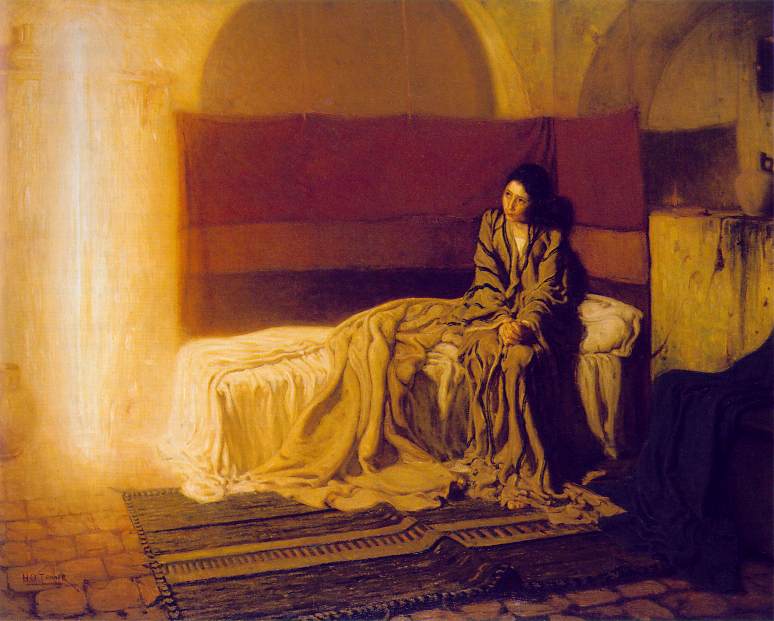
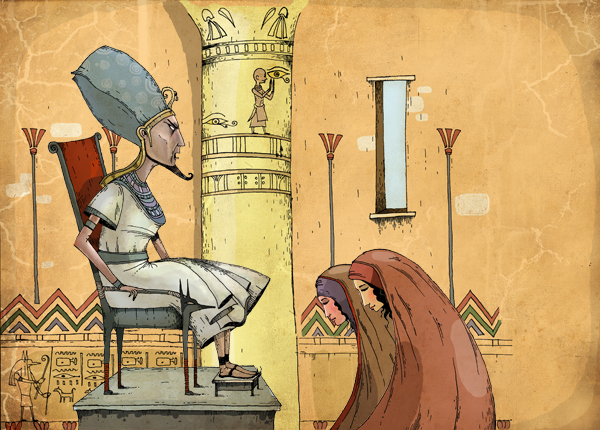
And mostly, Matthew does not tell us who the mother is. Matthew’s genealogy is arranged in sets of fourteen, so to make this point, we can look at the the first fourteen, beginning with Abraham and ending with David the King. “Abraham fathered Isaac, Isaac fathered Jacob, Jacob fathered Judah and his brothers.” That’s the way it goes (Matthew 1:2) and that is the way we expect it to go. But if it continued that way, how would Matthew be preparing us for a pregnant virgin?  (The picture comes from Luke.  Sorry.  It was the only way to have a picture.)

So we begin to see breaks in the pattern. He ended with “Judah and his brothers,” the sons of Jacob. But now Matthew says, (verse 3) “Judah fathered Perez and Zerah, whose mother was Tamar.”

The mother was Tamar? Why? Matthew didn’t bother to tell us that Isaac’s mother was Sarah,[1] nor that Jacob’s mother was Rebecca, nor that Judah’s mother was Leah. Why break the pattern to tell us about Tamar? Hold that thought.

A few generations later, we find another break. Verse 5 tells us that Salmon fathered Boaz, whose mother was Rahab; and right after that, Boaz fathered Obed, whose mother was Ruth. Then, in the second part of verse 6, that “David fathered Solomon, whose mother had been Uriah’s wife.”

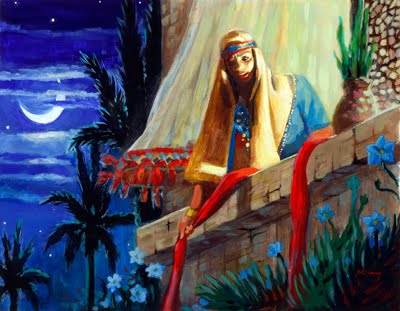
the women 5So we have a clear pattern. We have not yet addressed how these breaks help Matthew prepare us for the role Mary plays. Matthew drops in the mother in addition to the father four times. And then we get to Mary. “Jacob fathered Joseph, the husband of Mary, of her  was born Jesus who is called the Christ.”  (verse 16) [2] In the case of Mary, a new pattern is substituted because Matthew does not want to say that Joseph fathered Jesus. That phrasing sounds like sperm and egg stuff and that’s not what Matthew wants to say. [3]  The picture shows Tamar seducing Judah.

So these four breaks in the pattern—Tamar, Rahab, Ruth, and Bathsheba—are introduced to help prepare us for Mary in some way. How do they do that? We could stop and note that they were foreigners; all but Bathsheba, who is not called by her name, but “the wife of Uriah the Hittite.” That might be part of it.

The role each woman plays is morally ambiguous. Matthew is going to record some accusations against Jesus in 11:19. “Look,” his accusers say, “a glutton and a drunkard, a friend of tax collectors and sinners.” Matthew doesn’t allow any of Jesus’s accusers to point a finger at Mary and shrug and say, “Like mother, like son.” I do think that Mary’s morally ambiguous situation has been prepared for by the women who preceded her—the women Matthew had to break his pattern to introduce. Let’s look at the cases Matthew gives us.

Tamar, after all, had extramarital sex with her father-in-law, Judah. Rahab was a traitor to the women 2her people, the Canaanites, by harboring Israelite spies. Ruth put herself in a very compromising on the threshing room floor with Boaz. Bathsheba was taken, probably against her will, by the king, who then killed her husband, Uriah the Hittite. These women lead us to Mary…how exactly?

I can think of two ways. [4] I don’t know whether these are the ways Matthew had in mind. The first is that these women aligned themselves with the story God was telling through them. Tamar, for instance, was fixed on the notion that descendants were to be raised up in the name of her dead husband, Er. That’s what God said should be done and she couldn’t find anyone else who was interested in doing what God said should be done. She counted on an array of men to do the job (including her brother-in-law, Onan, Onan’s younger brother Shelah, and Judah, the patriarch, which is where the buck stopped. When they would not, she did it herself. She disguised herself as a prostitute and got herself pregnant by Judah, her father-in-law. And the children were reckoned to be the children of her husband, Er. [5]

God says, in other words, that children shall be raised up to carry on the line of the dead husband. That’s what God says. Everyone said no except Tamar. She “aligned herself with the story God was telling” by getting pregnant out of wedlock.

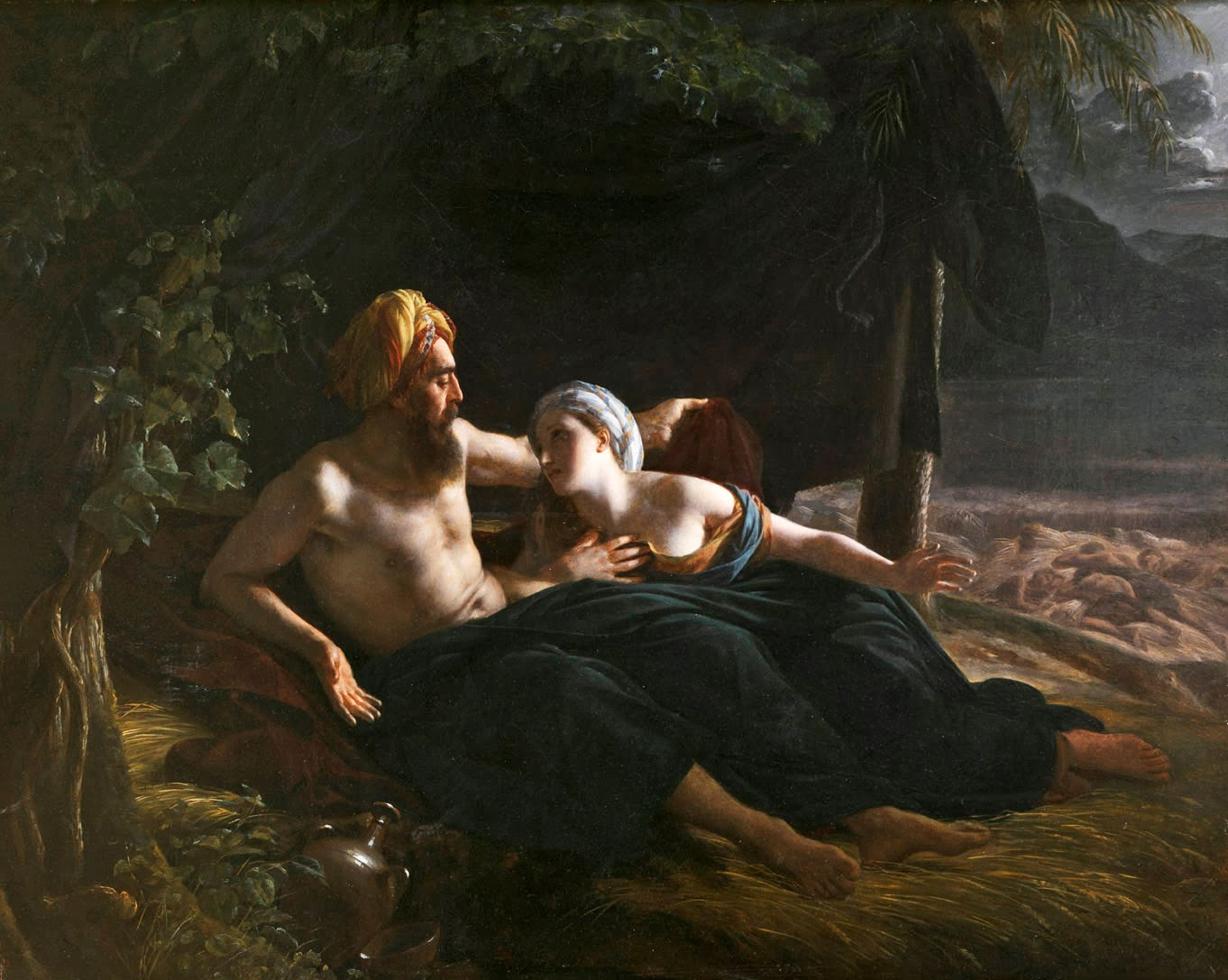
Rahab, the traitor, threw her lot in with the invading Israelites and against her people, the the women 3Canaanites. Since the only account we have of that comes from the Israelites, Rahab is revered. And without Rahab, there would have been no inhabitation of the Promised Land by God’s people—at least not in the way it actually happened. And without the Promised Land, of what nation would David have been king? It is all very well to say, as Matthew does, that Ruth’s husband Boaz fathered Obed, who was the father of Jesse, who was the father of David, but if there is no kingdom, there is no king and it was Rahab the traitor who aligned herself with God’s story in helping establish a kingdom.  The picture shows Ruth on the threshing room floor with Boaz; actually, it shows more of her than scripture really requires.

That brings us, skipping over the fascinating story of Ruth, to Mary herself. You know, the “pregnant out of wedlock” Mary? The initiative-taking Mary? The aligning herself with God’s story Mary?

By the time we get to Mary, the Mary for which Matthew has prepared us, we know that the women 1“racial purity” is not going to be any part of Jesus’s claim to be Messiah. Paul can call himself “a Pharisee of the Pharisees,” but he does not call Jesus that. Jesus was born on the other side of the track in socially embarrassing circumstances and he was born to a woman who aligned herself with God’s story—like her predecessors, Tamar, Rahab, Ruth, and Bathsheba.

[1] Nor that he had fathered another son, Ishmael, before Isaac.
[2] Joseph, by taking and naming the child, declares himself to be the child’s father according to Jewish law. Joseph was his father “fully and legally,” to use and expression biblical scholar Raymond E. Brown uses. And Mary calls Joseph the father of Jesus as well (Luke 2:48). The question in these cases is not genetic, but legal.
[3] Actually, Matthew wants to talk about “a new creation,” but that will have to wait for another essay.
[4] At some point in this essay, I need to acknowledge my very substantial reliance of the work of Raymond Brown. The chapter in his The Birth of the Messiah that begins to treat all this is called, “Why the women?”
[5] This is, obviously, a matter of law, not of genetics. Perez and Zerah were “the children of Er,” who had been long dead by that point.

Posted in Biblical Studies | Tagged , , , , , , , | Leave a comment

Four Years Early?

George Orwell wrote 1984 in 1948. It wasn’t a prediction, really; more of a convenience reich 8just to flip the numbers around. Robert Reich wrote Aftershock: The New Economy & America’s Future in 2011 and in it, he imagined a boiling over of populist fervor in 2020. He might be right. He often is. On the other hand, as I look at Speaker Paul Ryan’s call to arms, I wonder if Reich might not be four years late.

Here is Reich’s scenario.

November 3, 2020. The newly formed Independence Party pulls enough votes away from both the Republican and Democratic candidates to give its own candidate, Margaret Jones, a plurality of votes, an electoral college victory, and the presidency. A significant number of Independence Party members have also taken seats away from Democrats and Republicans in Congress. [1]

On the night of November 3, President-elect Jones gives a victory speech. Her tone is defiant.

My fellow Americans: You have voted to reclaim America. Voted to take it back from big government, big business, and big finance. To take it back from the politicians who would rob us of our freedoms, from foreigners who rob us of our jobs, from the rich who have no loyalty to this nation, and from immigrants who live off our hard work. (Wild applause.) We are reclaiming America from the elites who have rigged the system to their benefit, from the money manipulators on Wall Street and the greed masters in corporate executive suites, from the influence peddlers and pork peddlers in Washington—from all the privileged and the powerful who have conspired against us. (Wild applause and cheers.) They will no longer sell Americans out to global money and pad their nests by taking away our jobs and livelihoods! (Wild applause, cheers.) This is our nation, now! (Wild applause and cheers that continue to build.) A nation of good jobs and good wages for anyone willing to work hard! Our nation! America for Americans! (Thunderous applause.)

reich 3There are eight sentences here, nearly all of them dripping with paranoia.  Richard J. Hofstadter wrote “The Paranoid Style in American Politics” first as an article in Harpers’s Magazine, then as a collection of essays with that title. Hofstadter justified the use of “paranoid” by specifying “the sense of heated exaggeration, suspiciousness, and conspiratorial fantasy” which characterizes some political movements. [2]. You can argue that there are public policy goals valued by the right and not the left, in American politics, and vice versa, but “paranoid” is not about policy goals. It is about ways of thinking, prominent among which are “us” versus “them.”

Reich identifies a few trends that sound just as clear today as they did when he wrote them five years ago. These conditions, taken together, are, he says, “toxic.”

“Americans might be able to accept a high rate of unemployment coupled with lower wages,” he says (Chapter 3). [3]

“We are likely,” he continues, “ to accommodate absolute as well as relative losses in our standard of living for a long stretch of time. (Chapter 4).

“We might abide even wider inequality.” (Chapter 5)

And he concluded, “But when all of these are added to a perception that the economic game is rigged—that no matter how hard we try we cannot get ahead because those with great wealth and power will block our way— the combination may very well be toxic.” That’s the first paragraph of Chapter 6. The title of Chapter 7 is “The Politics of Anger.”

The conditions Reich identifies are undeniably there, with the exception of the last one. It reich 2is not widely agreed that the game is rigged. [4] And if it were, there would be very little agreement on how it is rigged, on whose behalf it is rigged, and what might be done about it.

In a way, that’s even worse. Terms like those that President-elect Jones uses, “us” and “them,” really don’t require agreement on who is being referred to. Those who are furious about immigrants and “pork peddlars” can vote happily beside those who are furious about “money manipulators” and “greed masters.” All are THEM. A government elected by such incompatible angers could not govern, of course, but such a government could continue to be elected so long as the angers are generalized and potent.

This brings us to Speaker Paul Ryan. Ryan is conservative. He is not paranoid. On the other hand, how close to the us v. them worldview does he dare to go before a spiraling radicalization takes over?

The New York Times’ David Herszenhorn reported on December 4 that Speaker Ryan said, “Our No. 1 goal for the next year is to put together a complete alternative to the left’s agenda.” Ryan imagines a “them” which is not the government and not the Democratic party, but “the left.” He believes that “the left” has an agenda and he would like to see a point for point alternative from…well…from “the right,” I guess. [5] Ryan puts “the government” on one side and “the people” on the other.

Not that the Speaker doesn’t have policy goals. He wants to overhaul the tax code.reich 7 Everybody likes that as a general proposition; it is the specific provisions that hurt. He wants to support American manufacturers; to strengthen the military, especially against the threat of the Islamic State; and to repeal Obamacare.

So here’s where we are. The combination of economic forces has been abrasive to middle class hopes for more than 40 years now. Things are getting worse and they are going to go on getting worse. Economic inequality in the U. S. has reached levels we saw last in 1929, just as the Great Depression broke. The political fight of today could be—eventually—about what to do about it. [6]. But what to do about it seems, in the present paranoid climate, a little abstract; a little brain driven. Before we get there, and possibly instead of getting there at all, there is the question of who is to blame. US v. THEM is the lineup we need for the politics of blame.

This would be like the little NFL dramas that occur when offensive and defensive lines collide before the ball is snapped. The O line points to the D line; the D line points to the O line. It’s predictable; it’s theater; it’s funny. But in the NFL, there are referees who will decide who is at fault and will assess the proper penalty. There is no chance that the fans can be so offended by the refs’ decisions that they will vote them out at put in “our own guys.” The NFL doesn’t work that way because they need to keep their fan base and that requires at least the presumption of fairness. The U. S. needs to keep its fan base too and a Left v. Right battle of Armageddon in 2016 is not going to do that job.

And if it doesn’t get done in 2016, Margaret Jones awaits in 2020.

[1] Not that Reich is opposed to having fun with the scenario. The Republican candidate that year is George P. Bush. The Democratic candidate is Chelsea Clinton.
[2] See a very interesting current look at the same phenomenon by Neil H. Buchanan posted on justia.com on May 21 of this year.
[3] Reich numbers the chapters separately in Part I, Part II, which begins on page 77 of the Vintage paperback, and Part III. All the chapter numbers I cite here are in Part II.
[4] According to Gallup, Americans asked in 1998 whether there was “plenty of opportunity to get ahead in America today” said that there is. 81% thought so. By 2011, that percentage was down to 57%. The most recent poll on that question (2103) only 52% said yes.
[5] Ryan is no more “the right” than Obama is “the left,” but this is the side-choosing season and the Speaker would like to see competing lineups.
[6] All of Reich’s Part III is about his proposals for what we should do about it. Secretary Reich is a wonk.

Posted in Political Psychology, Politics | Tagged , , , , | Leave a comment

Tidings of Delicious

There is a bright red banner across the glass front of the pastry case at our Starbucks in Multnomah Village. It says, “Tidings of Delicious.”

Every time I see it, I think of Matthew’s strategy for placing the birth of Jesus in a richdelicious 1 context of Old Testament events that he doesn’t have time to name specifically. There is no reason, after all, for Starbucks to write out, “Fear not: for, behold, I bring you good tidings of great joy, which shall be to all people.” [1] On the other hand, I can’t think of any other common use of “tidings,” so “Tidings of Delicious” might just as well have a scriptural tag on it (see Luke 2: 10).

It’s a word that tunes the ear to a previous setting: a story or a joke or a controversy. It tilts the table of your memory in the direction of “that other thing” without ever mentioning it. [2]

Matthew does it a lot. Some of the instances are plain, right on the surface. Others are hidden to the eyes of ordinary people in our time, but were water cooler conversation in the time when Matthew was written, probably in the mid-80s A.D. Today, I want to play with one of the rich ones.

The door to this reference is almost clear. The problem Jesus had as a little boy is that Herod wanted to kill him. Magi showed up, who knew that a new king of the Jews had been born—Herod’s successor: I’m sure he noted that part—and were led to Joseph’s house in Bethlehem. Joseph escapes to Egypt and comes back when he gets the angelic “All Clear.”

delicious 1So picture Matthew’s infancy narrative being read aloud to a congregation of Jews and Gentiles, all of whom believe that Jesus of Nazareth was the promised Messiah That belief is why they would be a part of the church for which Matthew adapted his gospel. The Jews who believe in Jesus would hear the words, “For those who sought the life of the child are dead,” (Matthew 2:20) Matthew and they would say, “Those? What do you mean, ‘those?’ It’s just Herod isn’t it?” And then they would catch themselves and say, “Besides…that sounds really familiar. Doesn’t that sound familiar?”

And it does, of course. “Reminds me of something” is the reason Starbucks uses “Tidings of Delicious” and it is the reason Matthew uses this plural—“those” who sought your life are dead” (Exodus 4:19). It reminds people who are hearing the story of Jesus for the first time, of the story of Moses, which they have heard many times. Hm…they say. That happened to Jesus too. Jesus and Moses. Hmmm. [2]

It’s a little bit tougher to see the paralleling of the Magi in the story of Moses to the Magi in the story of Jesus, but that is because we don’t have the texts for Moses. But Flavius Josephus did. In his Jewish Antiquities, Chapter 10, he has this passage: [4]

“One of the sacred scribes [Magi] who are very wise in foretelling future events truly, told the king, that about this time there would a child be born to the Israelites, who, if he were reared, would bring the Egyptian dominion low, and would raise the Israelites…Which thing was so feared by the king that, according to this man’s opinion, he commanded that they should cast every male child which was born to the Israelites into the river and destroy it.” [5]

delicious 2Now it is true that the Magi did not cooperate with Herod. They were warned, in a dream, not to report back as Herod had asked. But Matthew also records that the Magi had told Herod when they had seen the rising of the star—Herod treats this star, remember as The Star of the One Who Is Going To Replace ME—about two years prior. So “the baby Jesus” is at least two years old by this time. [6] That is why Herod orders only male children and only two years old or less to be slaughtered. The information provided my his Magi is the reason the Pharoah decided that all the Israelite babies should be killed at birth so that the birth of the future leader of Israel could be prevented.

Please remember that I am not arguing the historicity of either event. We may find, eventually, some way to verify that they occurred or, less likely, to show that they could not have occurred. I am showing you the background Matthew presumed among his hearers which allowed him to say something to them that escapes us entirely. Jesus and Moses. Moses and Jesus. Anything sound familiar? Tidings of Delicious.

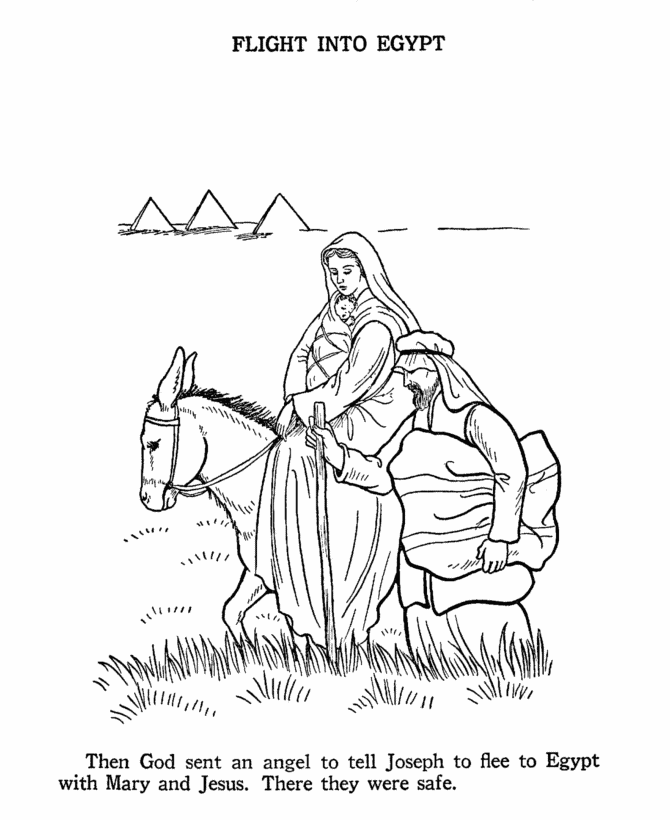
delicious 4And finally, why Egypt? An angel appears to Joseph—who seems, like his namesake to have been a major league dreamer—and says “Take the child and go to Egypt immediately.” Joseph goes and wakes up his wife and his little boy and takes off immediately.

The case that Matthew wants to make is not only that Jesus is Moses, but also that Jesus is the nation Israel. So Matthew is working toward Hosea 11:1, with says “I called my son out of Egypt,” which he cites in Matthew 2:15b. Matthew has taken a lot of trouble to assure that Jesus is “a son of David” through Joseph and he will he will be quite explicit about Jesus’s identity as Son of God (Matthew 3:17), but adding that Jesus is a “son” in the sense that Israel is a “son” is a little like winning the trifecta for Matthew.

He says “Egypt” so you will start thinking, “Hm…that sounds familiar.” And he says “magi” and Pharoah so he can say Magi and Herod. And he said “a special child will be born” of Moses [6] so he can have the Wise Men say it of Jesus. Matthew knows how this works.

And so does Starbucks, of course, which is why we have “Tidings of Delicious.” [7]

[1] “Which shall be to the whole people,” i.e. all of Israel. The King James Version is being prematurely ecumenical here.
[2] One of my favorites is Roosevelt’s castigation of his wealthy opponents as “malefactors delicious 6of great wealth” at a time when the most common use of “malefactors,” possibly the only one anyone had ever heard, was to refer to the criminals who were crucified on each side of Jesus. Roosevelt could have said “those of the wealthy who do evil” and no one would have stirred. My wealthy opponents are like those who were crucified with Jesus—it doesn’t have to be said out loud, you know—is much better, i.e., it is much worse.
[3] Matthew is the gospel writer who begins the story of Jesus’s ministry by having him go up a MOUNTAIN and address his followers about THE MOSAIC COVENANT. It is Matthew who shapes his gospel into five functional units like the five books of Moses—not all scholars agree that that is the best way to account for the structure of Matthew, and, not being a scholar myself, I follow those who make the point I like best.
[4] “And, indeed, Josephus seems to have had much completer [sic] copies of the Pentateuch or other authentic records no lost, about the birth and actions of Moses, than either our Hebrew, Samaritan, or Greek Bibles afford us…”
[5] The Pharoah and his Magi are the “those” in God’s word to Moses, “Those who sought your life are dead.” Not that they were the only ones seeking Moses’s life; he was a fugitive from justice after all. And this accounts for the “those” in Matthew which refers only to Herod. Follow me here. This “those” needs to line up with that “those” in order to get the “Hm…that sounds familiar” hit.
[6] So all those picture of the Wise Men and “the infant Jesus” really ought to be revised. Fat chance.
[6] Remembering that the story of “the special child, Moses” was either in the Penteteuch of the day or was a popular story known in that day. For Matthew’s purpose, it doesn’t really matter which, provided that it begins to turn your mind in the right direction.
[7] And since it is Starbucks, I will forgive them for using an adjective where they really should have used a noun. But if they ever put up a poster where the angelic host proclaims “Tidings of joyful,” I will have to find some other place to get my coffee.

Posted in Advent | Tagged , , , , , , | Leave a comment

Happy New Year

Happy new year to all.

As you know, there are as many different calendars as there are reasons to establish a cycle of days. We think first of the annual calendar. [1] It starts in January, to honor Janus, the two-faced god, and ends in December, which was, apparently once the tenth month. Some of us think of the federal budget calendar, which begins in October and runs to September.Some might think of the Christian church calendar, which begins very plausibly with the celebration of Advent—the birth of Jesus—and which is marked on the four Sundays before Christmas. [2]

And that is more or less where I begin my Blogging Year. Like the federal budget, I date the “year” by when it ends, so the 2016 BY, the one that just started, begins on the first of December 2015 and goes until the 30th of November, 2016.

So Happy New Year.

I was sitting with a new friend recently who had just been told about my blog. “Oh,” she said, “What’s it called?” I said, “The dilettante’s dilemma.” And she said what a lot of people say who are accustomed to noticing their own reactions to events [3] “Why do you call it that?”

There are two parts to the answer. This essay will begin to veer in the direction of seriousdilettante 1 thought as I begin to treat the second one: dilemma. I call myself a dilettante for several reasons. The first is that it is a negatively connoted term. [4] This is an easy way to preempt criticism. I use and thereby affirm the charge you were just getting ready to make. The the second, and the original, reason was that I got such a bump out of learning that the root of dilettante is the Latin delectare = “to charm.” “See delight,” says my dictionary. [5] And that is why it says, “Delight is the heart of the dilettante” just below the title. I aspire to write about the things that delight me.

But, as simple as that might sound to anyone who has never tried it, writing about the things that delight you and not about other things, is difficult to do. People say sometimes, “You really ought to write about that.” Do you write about it? You write an essay that gets Version 2an amazingly popular response. People write in from all over the world and say what a terrific post that was. And right away, you want to write more posts like that one, whether these later posts interest you in the way the first one did or not. I notice sometimes that the topics in my posts are leaning heavily in the direction of politics or biblical studies or something and I have the urge to “balance” the blog by the addition of other topics. What if those other topics don’t delight me at the time?

So, as I was saying, it is hard to maintain the inner silence that will allow me to hear the voice of a curiosity or a grievance or a celebration that is just beginning to take form. [5]
And that is the dilemma. A “dilemma” is being confronted by two (and only two, contrary to the illustration here) lemmas. “Lemma” is an English word. Look it up. It means “proposition.” But when we say “the horns of a dilemma,” we are thinking of two lemmas, either of which might pierce us and cause damage (to our person or to our pride), and in which over-attention to one of them makes you more vulnerable to the other one. The bull, tdilettante 5he bearer of the horns which represent the lemmas, will see to that.

So the dilemma is that I need to orient myself outwardly, so as to have enough follower to sustain a conversation [6], and to orient myself inwardly so I can hear the first rustlings of an idea that would like to make my acquaintance. It’s not a bad dilemma, as dilemmas go, but too much attention to the one weakens the equally necessary attention that must be paid to the other.

It is, briefly, a dilemma. This delight? Or that one? Or both if some way can be found that makes them allies for even brief period, rather than antagonists. [7]

[1] Just a note of appreciation for the a- in annual. We get it from the Latin annus = year. dilemma 6The a- saves it from being annul (Latin again: ad + nullus) = “to bring to nothing.” I have had years like that so I am well placed to appreciate the difference.
[2] That always seemed so reasonable to me. You begin the Christian calendar with the birth of “the Christ.” Sorry for the quotes, but I wanted the parallel of Christ and Christian and I wanted to avoid the whole briar patch about when Jesus of Nazareth “became” the Christ.
[3] A smaller group than you might think. Knee-jerk reactions do not require any consultation of what your own reaction actually was.
[4] You can verify this very easily by googling “dilettante” and looking at the collection of images.  The back story of delectare has a dark side to it. It can apparently mean “to charm” in the sense of “to befuddle” as one “charms” a snake. I don’t do that myself and I think the people who claim to be able to are fakirs. Behind “charm” is de- plus lacere = to entice, literally “to ensnare.”
[5] Not to make this a bigger deal than it ought to be, but the experience of Elijah in the wilderness comes back to my ear sometimes. (See 1 Kings 19 for his version of the story.) I grew up with the translation, “still, small voice.” After all the natural phenomena (hurricane, earthquake, fire) have done their thing, Elijah hears “a still small voice.” Quite a number of modern translations say that he heard “the sound of silence.” That would have struck me as deeply philosophical or even paradoxical had not Simon and Garfunkel taken out a patent on the phrasing.
[6] Very often, the conversations following the posting of an essay are the best part of the whole experience, particularly with friends who follow the blog regularly and who see how one thing has led to another or how one emphasis weakens another.
[7] Who, according to the Greek derivation, “wrestle each other.”


Posted in Advent, Living My Life, Words | Tagged , , , , | 1 Comment

Terrified of Muslims: A Liberal Rant

My son Dan posted a piece by Andy McClure on Facebook. I think it originally appeared on http://www.dailykos.com, but it got so popular so fast that I’m not really sure. Like a lot of ideological rants, it is really funny if it is based on your own ideology. And it is, actually, based on my ideology, but it didn’t strike me as funny.

For one thing, it was too edgy, too angry, to seem funny to me. For another, the artistry of it was so prominent—it is a small masterpiece of the genre—that I was moved more to admiration…well…envy…than to laughter.

immigrant 7If you’d like to see the whole piece, you can google “Andy McClure, muslim” and find it, but I’d like to start at the top and just turn it over in my mind a little. Before I start, let me include a mostly unfunny joke.  When I write a piece like this, it always makes me feel a little referee-ish.

Question: Why are there so many referees at a football game?
Answer: So each of them will have someone who is willing to talk to him after the game.

Here’s the way it starts.

A: I’m terrified of Muslims. I don’t want sharia law in America.

B: OK, Let’s avoid that by separating church and state.

A: Nope. I believe in Jesus and want this country to be more Christian.

That’s the first unit. There are six more in McClure’s piece: refugees, veterans, homeless
kids, Planned Parenthood, access to healthcare, and freedom of religion. In each of them B proposes a public policy that I support, only to see it rejected by A for reasons I deplore. That said, this is still a rant and my hopes lie in the direction of civil debate. [1] If you want to pop over to http://www.civilpolitics.org, a site run by psychologist Jonathan Haidt, you can browse the approach to politics that I find most attractive. I found this note in the second line of a statement of what his site is about.

to help liberals understand (and be civil to) conservatives: Videos [to come]

So let’s look at this first unit. The conservative caricature, A, is terrified. Language has a tendency to get inflated by use, so maybe he’s only anxious, but let’s say he really is terrified.

mcclure 1He is the expert on whether he is “terrified” but when it gets to what it is that terrifies him, he needs to say things that make sense. Is it possible to be terrified of “Muslims.” Well…in a sense, it is. It is possible to be scared of the boogyman. But I would like to say to A what I would say to a child who is scared of the boogyman: “Don’t be afraid. There isn’t any boogeyman.”

There are Muslims, of course, and they can be described demographically as a group and can be known personally one or so at a time and some of them are scary and some are not. Being afraid of “Muslims,” in the aggregate is silly and A ought to try to get over it.

On the other hand, he isn’t scared of Muslims. He is scared of one or more subsets of Muslims. These prominently include, no doubt, the terrorists he sees on TV and perhaps the fundamentalists who want to see the requirements of their version of Islam fastened on all Muslims and perhaps on all persons. [2] If those are the pictures that the word “Muslim” calls up, then I agree they are scary pictures. Now we need to unhook his fears from the word “Muslim,” then we need to talk about how likely these fantasies are.

So A, our conservative caricature, has seen terrorists who claim the authority of Islam formcclure 4 their acts and fundamentalist vigilantes who claim that Allah [3] is the source of their interpretation of the Quran. It is perfectly sensible for any American to oppose those practices.

His illustration, Sharia law, suggests that he is particularly concerned about the possibility that American non-Muslims might have to obey Sharia or be punished. There are several settings in which that might be a very relevant fear for a Christian. In some countries, Egypt, for instance, the bulk of civil law is strongly influenced by considerations of Sharia. The United Kingdom makes Sharia courts available to English citizens who are Muslim, but there is no such provision in the United States.

I am sympathetic to our conservative caricature. I would not like to live in a country where I could be tried in the civil courts for blasphemy. [4] On the other hand, my sympathy is tethered by his interest in seeing “this country…being more Christian.” Does that just mean “In God we trust” on our coins or does it include courts where people could be tried for violating some fundamentalist interpretations of religious duty? Would anyone be interested, for example, in implementing Deut 21:18—21 which calls for the public stoning of a son who is disobedient, stubborn, and rebellious?

mcclure 2I mention that particular crime and that particular punishment because, although they are “biblical,” they are not practiced. Also because there are similar passages in the Quran which, in A’s fantasy of Sharia law, might be visited on him or his family. The conservative knows that such scriptures are not put into practice in the U. S. He does not know whether similar Muslim scriptures are or are not put into practice in countries where Sharia is “the law” for everyone.

The conservative could be criticized, of course, for saying he wants his religion to be dominant in his country and wants other religious to be banned. But if he believes that “his religion” is what God wants and that “other religions” are an abomination to God, then he is really not free to partake of the genial secularism of the U. S. where expressions like “faith communities” are used so readily.

If this guy really wants a Christian theocracy, he should say so. My guess is that he wouldn’t say that; he would say that he wants the country to be “more like Jesus,” i.e., “more Christian.” Of course, he wants a lot of other things too, including low taxes, so quite a number of Jesus’s sayings about caring for the neighbor would have to be re-examined in the context of a modern consumer capitalist economy.

The other six interactions are all like this one, at least in principle. The liberal interviewer is positive and policy oriented. The conservative is negative about every public policy approach to solving the problems that he agrees we have. I think some careful vocabulary agreements could bring him into a public discussion of what realistic options are open to people with his values, but the process of clarifying the choices and providing an acceptable vocabulary would be exhausting and frustrating work.

And, of course, it doesn’t pay well. At least in the short run.
[1] Not to say that rants aren’t a valid part of democracy. The nation needs them and I think we are all better off is someone is writing and posting them. It just seems to me that ridicule is a tool that will take you only so far, then you need to decide what to do next.
[2] In the novel, Prayers for the Assassin, Muslims have conquered the United States. Here is the beginning of the clip that appears on the Amazon account of the story:
“SEATTLE, 2040. The Space Needle lies crumpled. Veiled women hurry through the streets. Alcohol is outlawed, replaced by Jihad Cola, and mosques dot the skyline.”
[3] “Allah” is not the name of “the Muslim God,” by the way. It is the Arabic word referring to the God of Christians and Jews. Thinking that Muslims worship a deity called Allah is like thinking the French worship a deity called Dieu and the Germans a deity called Gott. A has a point, however, because the common practice of the media is to translate the French and German words into the English “God” and to leave the Arabic word untranslated so that it could reasonably be construed as the name of another deity.
[4] I was once asked to take my membership and leave a Presbyterians church and also once asked to teach the Sunday School class I was teaching across the street at a restaurant that was closed on Sunday mornings (so I wouldn’t actually be teaching IN the church), so I am not as far away from A’s fears as one might think.

Posted in Communication, Politics | Tagged , , , , | Leave a comment

Is the U. S. “anti-immigrant?”

Not exactly. But “anti-immigrant” is just a political spitball. It is not intended to and it does not, in fact, help anyone understand what is at stake here. Let me start with the passage that helped me start thinking about this. Here is Timothy Egan in a recent New York Times.

{France has] nearly five million Muslims, many living in slums that breed hatred and isolation. But [President] Hollande said Wednesday that France would honor its commitment to those fleeing the barbarians of the Islamic State, allowing up to 30,000 refugees to settle in France, with proper vetting, over the next two years.

I think it was the juxtaposition of “slums that breed hatred and isolations” with “admitting refugees who are in great need” that started me thinking. I would like to run a simple analogy here. The analogy asks whether it is worth our while to align the values in Scenario 1 with the values in Scenario 2. It does not assert. It asks.

immigrant 2Scenario 1 is about entrance into the world the way the fetus experiences it—or, actually, the way we imagine a fetus might experience it. The fetus is in the womb, then passes through the birth canal, then is “accepted into” the larger reality that the rest of us call “the world,” ignoring, by calling it that, how very different it is from anything the new member has ever experienced before.

Scenario 2 is about entrance into the country the way a new immigrant experiences it. We do actually know something about how they experience it [1] because we have asked and they have said. I am going to shift over, at this point, to talking about “refugees.” We call people refugees who immigrate to the U. S. seeking refuge. They have been forced out of their homes by religious persecution or gang violence or civil war. [2] This makes them “fugitives.” [2] There are many places where immigrants—those who call themselves refugees and those who do not—are admitted to the U. S., but for the sake of the analogy, I am going to choose the best known such place: Ellis Island.

immigrant 4So the argument is going to be that we can learn a lot by imagining that these two processes are parallel. To help do that, let me introduce some ordinary terms. In Scenario 1, I will use “Pro-Birth” to refer to people who believe that extraordinary care should be exercised to get a fetus through the birth canal. At that point the birth has occurred and no further consideration would need to be given. I will use 
“Pro-Life” to refer to those who are concerned not only with the successful birth but also for the conditions of a successful life. The infant will need shelter and food and human caring at first; then a stable home life and opportunities to prepare for fulfilling and rewarding work. The Pro-Life position, as I am describing it, commits the society to all those things by the most practicable means, whether they are public (governmental) or private (families, clans, small villages, gangs) or some combination of public and private. Preparing the conditions within which this new life can thrive will be part of the designation, Pro-Life.

immigrant 8Similarly, I will use Pro-Refugee as the stance the takes it as crucially important to get a person or a family who lives in intolerable conditions in the homeland, to Ellis Island. Government policy should favor it, private charity should favor it, voluntary movements of compassion should favor it. Whatever is necessary to get the refugees to Ellis Island. I will use Pro-Immigrant to refer to the position that there is no merit in shepherding refugees through Ellis Island only to dump them into the streets of our cities without support. These new residents and potential new citizens, will require what the infant requires: shelter and food and social support at the beginning; then opportunities to establish themselves in this country, and provide for their offspring.

The analogy continues so far as recognizing that, in Scenario 1, people will come to maturity at different times in different ways. They will make their livings in different ways and raise their families in different ways. “Different strokes,” we used to say, “for different folks.” In the same way, people who are reborn in this country will choose different styles of living together. They may gather together in clans, which is not the form of organization we expect today. They will exercise their right to worship together in the faith of their choice. They will need public assistance until they are economically secure and the kinds of employment they choose may provide an oversupply of any one kind of work–at least in the short run.  Any displaced American workers may also require some short term aid.

immigrant 6Pro-Life and Pro-Immigrant positions look at these continuing needs and begin to work at ways to provide them. New humans will need these services and guarantees; new immigrant groups will need those services and guarantees. These two positions will be at odds with the Pro-Birth and the Pro-Refugee positions, which will argue that the work is done at the farther end of the birth canal or the exit doors of Ellis Island. Compassion is appropriately offered, they will say to the fetus and the refugee, but then the needs of society needs to be weighed as well.

The moral approach to these two groups can be seen, oddly, as one in which the fetus has great moral value, but loses it somehow in the trip through he birth canal. A fetus in the womb of a poor and/or unmarried woman has incalculable value, but the infant child of a poor and/or unmarried woman is burden on society and society is justified in taking measures to ensure that such young lives are not seen as an encouragement of other women to follow this course. The young child will certainly be punished in making such spartan provisions for the mother, but she should have thought of that either before she got pregnant or before she got poor.

Similarly, the moral approach to the refugees grants them great value, a valueimmigrant 7proportionate not only to their need but to our distaste for their oppressors. But as they emerge from “Ellis Island,” they lose all their moral virtue. They are now just that many additional poor people. They will take jobs away from “real Americans,” i.e., those who preceded them at Ellis Island. They will practice religious faiths unlike the most common ones practiced here and they may very well fail to understand how deeply we value non-religion here. If they are “religious” in any obvious way, those of us who are “non-religious” may feel disapproved of or even judged.


My practice in these thought experiments is, as a rule, to set up the conditions, to run the machine, and to allow whatever emerges to stand on its own. In that same way, I offer here no guidance other than the sets of affiliations that are implied in the terms I have given to the four positions.

My goal was to argue that if these two cases—birth and immigration—are set up as parallel systems, interesting commonalities emerge. I think I have done that.


[1] Not to imply that there is one immigrant experience. Obviously, there are many. But we know something about the variety of experiences because we have asked a variety of people about their experience.
[2] This is probably the place to say that people who want to live in the U. S. and who know that being a “refugee” gives them a better chance to do so, will call themselves refugees whether they are or not. “Immigrant” is a fact; “refugee” is an explanation.
[3] This whole family of words is based on the Latin fugere, “to flee.” A fugitive who is looking for a new place to live is a refugee. Same word.

Posted in Politics, Society, Sustainability, Words | Tagged , , , , , , | Leave a comment

Jonathan Haidt’s “Inner Lawyer”

Jonathan Haidt offers the third illustration in the clutch of three we are examining. All three involve two functions—actively suppressing information and not receiving the information—but it gets complicated because I am the person who plays both parts. I hide information from myself; I search actively for it but am unable to discover it. It makes no sense. It is like hiding a treasure where you will never be able to find it.

Nevertheless, we have looked at two instances of this—I am the one who is saying they areepiscopal 9
three instances of the same thing—and I am arguing that this third episode, the Jonathan Haidt episode is essentially like the others. “The others” include Queen Susan of Narnia (in Prince Caspian) who would have believed Aslan was there if she had allowed herself to believe it. “The others” also include a character I call “the Episcopal Ghost” (in The Great Divorce) who suppressed his gradual loss of faith because he wanted other things, incompatible things, more. Thus, he drifted to a place where he could be, “sincerely heretical.”

The question for today is simply this: Does Jonathan Haidt, in the episode he narrates, fall into the same category? Let’s begin with the most directly relevant quote from Haidt’s account, “I then lied so quickly and convincingly that my wife and I both believed me.” I lied so well that I believed me? Really?

Here is Haidt’s account.

On February 3, 2007, shortly before lunch, I discovered that I was a chronic liar.[1] I was at home, writing a review article on moral psychology when my wife, Jayne, walked by my desk. In passing, she asked me not to leave dirty dishes on the counter where she prepared our baby’s food. Her request was polite, but its tone added a postscript: “As I’ve asked you a hundred times before.”

My mouth started moving before hers had stopped. Words came out. Those words linked themselves up to say something about the baby having woken up at the same time that our elderly dog barked to ask for a walk and I’m sorry but I jut put my breakfast dishes down wherever I could….so I was acquitted.

Haidt continues to write the review article. Then:

I disliked being criticized, and I had felt a flash of negativity by the time Jayne had gotten to her third word (“Can you not…”). Even before I knew why she was criticizing me, I knew I disagreed with her… The instant I knew the content of the criticism (…leave the dirty dishes on the…”) my inner lawyer went to work searching for an excuse… It’s true that I had eaten breakfast, given Max his first bottle, and let Andy out for his first walk, but these events had all happened at separate times. Only when my wife criticized me did I merge them into a composite image of a harried father with too few hands, and I created this fabrication by the time she had completed her one-sentence criticism (…counter where I make baby food?). I then lied so quickly and convincingly that my wife and I both believed me.

'I didn't hear you calling. I can't listen to everybody who yells at me.'

‘I didn’t hear you calling. I can’t listen to everybody who yells at me.’

As I indicated in the introduction, it is that last sentence that matters most to me. He lied to his wife in this instance. He does that a lot, apparently, because he calls himself “a chronic liar.” And he didn’t do it because he chose to. He did it because his “inner lawyer,” who, apparently acts on his behalf without being asked to, produced this excuse. And the excuse was so good that not only did his wife believe it at the time, but he, himself, believed it at the time as well.

Excursus: I need to find a place to say that Haidt did, eventually, realize what “he” (his inner lawyer) had done. And when he realized it, he accepted it. He didn’t ignore it, he didn’t deny it, he didn’t repress it. He realized what his inner lawyer had done to him and presumably—this is not part of his account—he went to his wife and told her what had happened.What he would be forced to say is that “it”—my inner lawyer—lied to you this morning, and as soon as I discovered it, I came to you to correct the account which he, deceitfully, sold to both of us. Notice the “it” and the “I.”

The Length of the Process

Reincursus: (End of excursus, I’m just playing) So now we have all three instances before us. Let’s rank they first by how long the process took. Haidt’s lying is obviously the fastest. He—his inner lawyer—starting putting together an untrue account of his actions three words into his wife’s accusation. That’s fast. Susan admits on Day 2 that she “really believed” on Day 1, but also says that she did not really believe on Day 1 because she did not allow herself to. The inner reality she constructs a day later—“would have believed had I allowed myself to”—shows an awareness of something. Did she sense the inner lawyer at work and chose not to go over the the desk to see what the lawyer was doing?

The Episcopal Ghost is the slowest by far and we have only his friend Dick’s understanding to go on. Now it is true that Dick says the same thing was happening to him at that time, so he does have an inner perspective. Then too, Dick is a Spirit—in other circumstances, we might say “an angel”—and he is in Heaven, that place of ultimate reality, so presumably he knows what is true and says what is true.

Direct Agency

So that is a ranking that takes the speed of the process into account. Let’s look now at direct agency. Who acts most clearly as an agent making choices? This time I think we have to put Haidt last. His account of what happened—his “inner lawyer”—is the gold standard for failure of agency and I am going to try to use it to look at the other two cases.

Haidt, to say the same thing another way, does not act at all. The “inner lawyer” acts and Haidt is, for a little while, deceived. So we score Haidt, in this first round, at least, with no agency at all.

I would put Queen Susan next. On the second day, she admits that she “really believed…Haidt 6
deep down inside” that Aslan was there or “I could have if I had let myself.” So even when she was saying she could not see Aslan, some part of her knew that she did see him. We can say this another way. Susan’s “inner lawyer” was not as good as Haidt’s “inner lawyer.” Susan felt, or could have felt, that the “inner lawyer” was doing something and could have made it her business to find out what it was. At the time Haidt—or someone—lied to his wife, there was nothing to attract his attention, to make him wonder.

I would put the Episcopal Ghost last. This line is the crucial line for the Episcopal Ghost. It would be better for my argument if he said it himself, but he cannot, so it is said instead by a completely trustworthy witness who shared the Ghost’s vulnerability at the time. We accepted, says the angel, “every half-conscious solicitation from our desires.” Now…not get all arithmetical, but “half-conscious” means that only half of the subversion of his faith was “unconscious.”

If the question is one of agency, who could have acted on his own behalf and did not, they the Ghost wins. There were times, according to the angel, when you were conscious of being pressed by your desires, being seduced [2] by your desires. At that point you could have done something, but you chose not to. You could have “gone over to the desk” and looked at “what your inner lawyer was writing” on your behalf and you could have torn it up. There was that much opportunity for agency on your own behalf, but you did not take it.

One of the things I like best about blogging is that you get to propose a topic, to make the argument, and then to decide that the argument was solid. You do all that yourself. Well…really you just decide that the argument is “solid enough.” Or you just decide it isn’t going to get any better and you just abandon it. So I am going to declare that my attempt to show that Haidt and the Ghost and Queen Susan were involved in the same process—the same close family of processes—and can be understood in the same way.

What to do?

Of the remaining questions, let me chose one. “Can we do anything about this?” I think the best answer is Yes, but you notice that the agency question reappears. When we say “we,” we are back to agency. At the moment, Susan could not want less desperately to be out of the woods, the Ghost could not want less passionately to be accepted by the smart and modern world, and Jonathan Haidt could not want so urgently to remember what had happened that his “inner lawyer” just shut up.

But if we start the story further back for each of these characters, things look better. It is possible, in principle, for Susan to know that when she gets stresses, she is vulnerable to selling out higher values for lesser ones. It would have been possible for the Ghost to clarify his highest commitments—the angel says that “resisting” and praying would have been a great help—and so have been less vulnerable to the daily solicitations of other needs. I don’t really see any help for Jonathan Haidt, and, in all fairness, he told that story to illustrate that there is no help available, but something in him began to separate the strands of his lie almost as soon as he was done telling it. That’s pretty good.

I put my money on identifying categories. I want to be able to say, “In it is situations like THESE, that I am in most risk of selling out.” OK, so how do you form the categories? You pay careful and systematic attention to how you explain things to yourself and you notice the situations that keep recurring. Then you give those situations a name of some sort, e.g., dealing fairly by people who are hostile to my cause. That is a category name. And if you have done the work [3], the categories you build make you more sensitive to “what happens in situations like these.”

That would have been a great help for the Ghost, at the time in his life when he was selling his birthright for a mess of favorable reviews. It would have made Susan aware that these are situations where she really doesn’t want to see Aslan and if she is to see him, she needs to set her fears aside and know what “she really knows, down deep.”

Professor Haidt, you’re going to have to handle this one on your own.

[1] I needed to stop here anyway to give you the citation, but while I am stopped, let me just celebrate that sentence. That is the first sentence in Chapter 3 (page 52). Who would not want to keep reading? Jonathan Haidt, The Righteous Mind: Why Good People Are Divided by Politics and Religion. New York: Pantheon Books, 2012.
[2] “Seduced” is one of those wonderful words that packs so much imagery it is hard to mistake its meaning. The word come into English from Latin, where the prefix se- means “apart, away, aside” and the root is the verb duco, “to lead.” So “to lead astray.” But “astray,” the part of the word contributed by the prefix, presumes that there is a right way to go. “Astray” cannot mean anything if there is not a right way to go. So the word means “You could have gone here, but you were led off and went there.” Also “to lead” means that these are not choices you made yourself; someone led you.
[3] I am a big fan of a recording device I call a “causal attribution journal” (CAJ); it has been my principal academic focus since 1974.

Posted in Political Psychology, Theology, ways of knowing | Tagged , , , , | Leave a comment

Sincerely Heretical

This is “When I lie to myself, I don’t believe me, Part 2”  It is the second of a series of three essays which, I maintain, are about the same issue. Maybe they are and maybe they aren’t, but the series is based on the idea that they are. That’s my story and I’m stickin’ to it.

episcopal 3Here is the question. How is it possible for me to prevent myself from knowing something. In such a case, who is it who prevents? Who is prevented? How does it work?

In our first look at this question, we examined Queen Susan of Narnia at one of the least respectable moments of her reign. In C. S. Lewis’s Prince Caspian, Susan opposes her sister Lucy’s story that Lucy has seen Aslan, but later she says:

And I really believed it was him tonight, when you woke us up. I mean, deep down inside. Or I could have, if I’d let myself. But I just wanted to get out of the woods…”

So “deep down inside” there is a belief, or the beginnings of a belief. “She,” Susan, “has” this belief…somewhere. But she didn’t accept it; didn’t allow herself access to it; didn’t claim it in whatever part of her is not “deep down inside.” But in some way, she did not allow herself to “know” that she believed it was really Aslan.

You see the problem. Who is doing what to whom, and how?

The second case is harder for a number of reasons, so I am going to dip briefly into the toolkit I assembled over fifty years of teaching. I am going to change the crucial quote from The Great Divorce so that the categories parallel Queen Susan’s confession more closely.

I really believed in God during those crucial years, I mean deep down inside. Or I could have if I had resisted the half-conscious solicitation from my desires, had I continued to pray for guidance. But I just wanted the success and approval that came being a daring renegade priest.

I wrote it that way to highlight the similarities between the second case and the first. Now it is time to admit what I have done and to try, still, to have you accept the similarities.

The person who, in my paraphrase, said these things in one of the characters in C. S. Lewis’s fantasy, The Great Divorce. He is one of seven major characters in the book and since they don’t have names, I will refer to him as “the Episcopal Ghost”—or EG when I get tired of typing the whole title.

In Lewis’s story, there is a bus that leaves Hell every day and goes to Heaven. Anyone may episcopal 2get on the bus in Hell and anyone who wants to may stay in Heaven. But none do. EG walks away from his friend, Dick, humming softly to himself, ‘City of God, how broad and fair.’

All the major characters are met at the bus by an angel, a person who had known them in life. The angel who meets them is a Spirit (not a Ghost) and, being in Heaven, knows the truth about everything, Heaven being the place where Reality is recognized. The body of the Spirit is real substance, as is Heaven. The body of the Ghost is insubstantial, as is Hell. That means, among other things, that when the insubstantial foot of EG steps on the substantial grass of Heaven, the grass pierces the foot. If the Ghost is going to go anywhere, he will need help.

In this particular case, we have a clergyman who has become a heretic and who simply cannot be reached any longer. [1] The Spirit, whose name is Dick, tries every way he can think of and the Ghost simply cannot be reached. But it is the Ghost’s justification of himself that has won him a place in my blog. The question for him, too, is “Who is doing what to whom?”

The Ghost’s self-justification (not, you would think, the kind of justification that would episcopal 5work well in Heaven) comes in two parts. It is from these two parts that I crafted his “statement” above. In the first, you will note that the speaker is not the Ghost himself, but his friend Dick. We both did the wrong thing, says Dick, who now, in Heaven, knows that to be true.

Having allowed oneself to drift, unresisting, un-praying, accepting every half-conscious solicitation from our desires, we reached a point where we no longer believed the Faith.
And what resulted from this drifting?  …What was at all likely to come of it except what actually came—popularity, sales for your books, invitations, and finally a bishopric?’

Now let’s put the two statements we are examining—Queen Susan’s and the Episcopal Ghost’s—back into their common format.

Queen Susan says she “just wanted to get out of the woods;” the Episcopal Ghost says—through Dick, the Anger—that he accepted the lure of his desires and later we find out what those desires were. They were popularity, book sales, prestigious invitations, and a high church office. Those are the things each wanted so much that they were willing to defy some other part of themselves, a better part, to get it.

Susan says she could have let herself believe that Aslan was truly there, but she did not The Ghost says—Dick says for him—that he wanted success so much that he stopped praying, he stopped resisting, and he chose his own desires instead, desires he was only partially aware of.

In those two ways, I am saying, their cases are the same. On behalf of X, a strongly felt desire, each of them suppressed any awareness of Y, when each would have admitted that Y was the right thing to do.

By this means, the Ghost had allowed himself to drift to a place where “sincere” andepiscopal 4 “worshipful” could not be said of the same views. Once he was there, he could be as sincere as he likes. When his doubts are blocked off, “sincere” is only an assessment of the motives he is willing to recognize. There is no good resolution once this has occurred.

That’s really the end of my argument. You will be convinced or not or, just as likely, wonder why I have spent so much time “knocking on an open door,” as one of my Oregon professors used to say. But I did come across one more similarity between the two characters; one I did not expect.

I have been making the point that Susan began to see on her own as she followed Lucy, who saw Aslan. This was an act of faithfulness on Susan’s part, even though it had nothing to do with Aslan. During that trip, during those step by step acts of fidelity, she herself came to see Aslan.

Dick, when he sees that nothing he is going to say is going to move his friend the Ghost, takes another tack.

‘Will you come with me to the mountains? It will hurt at first, until your feet are hardened. Reality is harsh to the feet of shadows. But will you come?’

This is the “real grass” versus the “insubstantial feet” problem I referred to earlier.  The Ghost, according to this offer, does not have to believe anything at all, just as Susan did not have to believe that Aslan was really there. All the Ghost has to do—much more painful physically, but much less painful spiritually—is to walk, holding his friend’s arm—toward the mountains. [4] Like Susan, the Ghost will not really have to believe anything; only to walk and keep on walking. Eventually, he will begin to see where he is and what that means.

In the next (and last) of this series, I will consider the case of political psychologist, Jonathan Haidt, who calls himself “a chronic liar,” for reasons we will explore.

episcopal 7[1] I found myself originally sympathetic to this Ghost, but eventually the persistence of the Spirit and the utterly impenetrable denial of every kind of truth and every kind of fact wore me out. I was relieved when he got back on the bus to Hell.
[2] I grant that this is more likely to be implied as a premise and to be illustrated by speakers who have had the experience themselves. They will call “leaving their faith behind” something much more attractive, I am sure. “Fearless modernity,” possibly or “Unmasking the myths of religion.”
[3] A very plausible list of such refutations is launched against Dick during their conversation in Heaven, but Dick, who confessed his faith in life, now Knows the Truth—in Heaven—so he is not wounded by his friend’s barbs.
[4] “Going to the mountains” is the higher worship of the Spirits. It is what they are supposed to be doing. Dick came back to the bus stop to meet his friend and with him or without him, he will return to his trip to the mountains.

Posted in Political Psychology, Theology, ways of knowing | Tagged , , , , | Leave a comment