
In 1888, Edward Bellamy wrote a very influential book called Looking Backward. That’s Bellamy in the next paragraph. He placed the action well into the future—the beginning of the 21st Century—so that his readers could get some distance on the society they were living in at the time. Some things in his imagined future look odd to us, the technical things particularly, but every future is an imaginative projection of our present and very often, we are so immersed in that present that we cannot see it clearly.
 In 2011, roughly the time when Looking Backward is set, Kim Stanley Robinson wrote 2312: A Novel. His goal is different from Bellamy’s in many ways. Robinson, who also wrote the breathtakingly technical Red Mars, Blue Mars, Green Mars series, is a practitioner of “hard SF.” [2] He’s not a reformer, really. On the other hand, the protagonist, Swan Er Hong, lives on Mercury and when she is forced to visit Earth, she is scandalized by what has become of it. It is what we all know but projected to a catastrophic future.
In this essay, I would like to point to two very small excerpts from Robinson’s latest work. The first is a new “periodizing system” by the fictional historian Charlotte Shortback. We use historical periods as common currency in the West and give them very little thought: the Middle Ages, the Renaissance, the Romantic Period, the Early Industrial Period. They use historical periods in the East too, of course, but they use different ones. Those all collect sets of years in agreed upon chunks.
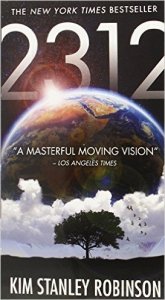 Shortback’s periodization takes off from our present and moves to the present in which the novel is set. I’ll name them all and then I will pay closer attention to three of them. First, The Dithering: 2005 to 2060; then The Crisis: 2060 to 2130.; then The Turnaround: 2130 to 2160; then The Accelerando: 2160 to 2220; then The Ritard: 2220 to 2270; then The Balkanization: 2270 to 2320.
All those are, of course, unfamiliar, because only the first part of the first period has yet occurred. Still for a story set in 2312 that will feature a ruined and barely habitable earth, it is hard to think of a better title for our own era that the one Shortback provides. We live in “the Dithering.” Here is Shortback’s description.
The Dithering: 2005 to 2060. From the end of the postmodern (Charlotte’s date derived from the UN announcement of climate change) to the fall into crisis. These were wasted years.
That is followed immediately by:
The Crisis: 2060 to 2130. Disappearance of Arctic summer ice, irreversible permafrost melt and methane release, and unavoidable commitment to major sea rise, In these years all the bad trends converged in “perfect storm” fashion, leading to a rise in average global temperature of five K, and sea level rise of five meters — and as a result, in the 2120s, food shortages, mass riots, catastrophic death on all continents, and an immense spike in the extinction rate of other species. Early lunar bases, scientific stations on Mars.
Shortback points out that “all the bad trends” converged during this time. The convergence belongs to her time period, 2060—2130, but the trends are all perfectly understandable in our own time. Note the “disappearance of Arctic summer ice (happening now), the irreversible permafrost melt (happening now) and the methane release which results from the permafrost melt (happening now) and the unavoidable…sea rise (happening now).
Then a bunch of things happen. A good deal of the plot of 2312: A Novel comes from these intervening periods. But I thought it might be worth your while to look at the final period of Shortback’s set.
The Balkanization: 2270 to 2320. On earth the major events of The Balkanization are these: “volatile shortages pinching harder, causing hoarding, then tribalism; tragedy of the commons redux; splintering into widespread “self-sufficient” enclave city-states.”
We have met the enemy, it seems.
So Shortback’s historical periods serve as the first clip from the novel. The second excerpt has to do with restoring the Earth and its people with space-based technologies. It doesn’t work very well and in this second excerpt, I would like to explore why.
The “splintering into widespread enclave city states” is known, even in our time (the first few years of The Dithering), but they become prominent in parts of the world that live under life and death tensions for decades at a time. People living under those conditions become less and less able to help themselves and also less and less able to accept help from outside. The local rulers demonize “Outside” as a way of keeping control.
Here’s a recent example. Do you remember the Clinton Administration’s brief foray into humanitarian politics in Somalia? There were starving people in Somalia and there were TV cameras. It was the combination that made it hard for U.S., specifically the Clinton Administration, to bear. The Somalis needed food and we had food.
Here’s an account of what happened by General John S. Brown, Army Chief of Military History. The picture shows “the cheering Somali mobs” Brown describes.
The United States Army has a long tradition of humanitarian relief. No such operation has proven as costly or shocking , however, as that undertaken in Somalia from August 1992 to March 1994. Greeted initially by Somalis happy to be saved from starvation, U.S. troops were slowly drawn into inter-clan power struggles and ill-defined “nation-building” missions.
That sense of “mission accomplished” made the events of 3-4 October 1993 more startling, as Americans reacted to the spectacle of dead U. S. soldiers being dragged through the streets by cheering Somali mobs, the very people Americans thought they had rescued from starvation.
For our purposes, it is the “starving Somalis” and the “inter-clan power struggles” that matter most. The worse things get for the people, the more powerful the clans are. The more powerful they are, the more there will be conflict between them. The more conflict there is, the more their attention will be focused on their power relative to other clans and the less it will be focused on the needs of the people.
Robinson deals with this same process on a much larger canvas. The need on Earth is so great that Swan and some other spacers [3] decide to “terraform” Earth. [4]
They planned to start by reconstructing the part of Harare called Domboshawa, transforming its northernmost ring of shantytowns into garden city versions of themselves. This “refurbishing of the built infrastructure” was not a complete solution but the selfreps [not really sure what those are] did build wells, health centers, schools, clothing factories, and housing in several styles already used in Domboshawa, including aspects of the traditional local rondavels.
That sounds spectacularly good to me. It sounds like American marines storming the beach in order to provide food for starving Somalis.
But on Earth, it wasn’t working out. The transformations involved were too great; there grew furious objections, often from elsewhere that the areas being renovated.
It was happening all over Earth…; their restoration projects were getting tangled in dense networks of law and practice and landscape, and the occasional sabotage or accident didn’t help. One couldn’t change anything on Earth without several different kinds of mess resulting, some of them paralyzing. Every square meter of the Earth’s land was owned in several different ways.
Are we surprised? I was surprised only by the scale.
There were of course very powerful forces on Earth adamantly opposed to tinkering from above in general and to creating full employment in particular. Full employment, if enacted, would remove “wage pressure”—which phrase had always meant fear struck into the hearts of the poor [bold font in the original] also into the hearts of anyone who feared becoming poor, which meant almost everyone on earth.
I’m nearly finished with the book. I don’t expect the “terraforming of Earth” to be any part of a successful conclusion of the plot, although they did bring Florida back above sea level. The technology, even now, is enough to relieve a great deal of the present misery, but our efforts founder on what General Brown calls “inter-clan power struggles.”
In setting after setting, we meet the enemy and, as Pogo has it, “he is us.”
[1] One of my favorite quotes of all time, but variously attributed. The original dates from 1813, when Oliver Hazard Perry reported on his success against the British fleet on Lake Erie, “We have met the enemy and they are ours.” Walt Kelly, in the Pogo comic strips I read when I was growing up, revised it to, “We have met the enemy and he is us.” Pretty existential for a swamp possum. Lately, I have heart it attributed to Charlie Brown of the Peanuts comic strip.
[2] I learned that phrase a few weeks ago, just before I started reading Robinson. It means science fiction (SF) that focuses on the scientific and technical aspects (Hard) of the story, rather than the social or psychological aspects.
[3] “Spacers” are people who were born “elsewhere,” i.e. not on Earth and/or who identify with their place of birth. Swan was born on Mercury. Neal Stephenson has the same naming problem in SevenEves where a “people” who have lived in space for generations come back to Earth to confront two separate populations, one of which survived below the land and the other below the sea.
[4] Our planet is often referred to as Terra so “terraforming” would mean making life “there,” like life here. Constructing an atmosphere containing oxygen and adequate heat and adequate gravity and so on. By 2270 they have terraformed quite a few planets and asteroids. The question now is, would those same techniques work on what is left of Earth. The technical answer is that they would. The political answer might be entirely different, as it was in Somalia in the 1990s.
 She told him that she knew she had not been a good wife. She was disappointed in herself. Would he give her six more months, she wondered, and in that time she would be the wife she could be. If she did her best to be the kind of wife she approved of—her standards for her performance—and at the end of six months, he still wanted a divorce, she would raise no obstacles to his dissolving the marriage.
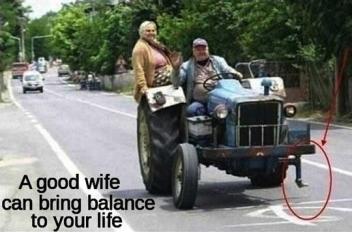 She said that she was ashamed that she had not met her own standards as a wife. Perhaps you can see, by now, how breathtakingly simple this is; how many self-justifications she walked past in order to get to this statement: I have not met
  This woman and the husband who asked her for a divorce had been happily married for many years before the morning she told me this story. They are married still, and happy still, and their children have grown up and there are grandchildren. So, to use a formula more common among hobbits than among humans, “They lived happily until the end of their days.”
 Early in the second season, an angry mother releases a genetically modified plague bacterium and Tony is the only one who comes down with it. The scientist who designed this bacterium says that Tony has about one chance in fifteen of surviving it. So if you set aside your certain knowledge that Tony appears in the next episode, it seems that he doesn’t have much of a chance.
 The experimenters I read about were studying how to treat athletes at the point of exhaustion. That sounds brutal to me, but there are athletes who really want to know how much they can take. These particular athletes were cycling—on stationary bikes, I suppose. They ride until they are exhausted and then are treated by one or another intervention. In this case the two interventions were: a) drinking sugar water or b) rinsing their mouths with sugar water and then spitting it out.
 So then I got to thinking, “What if there were a “reserve of healing” that functioned by precise analogy with the “reserve of energy?” I don’t know that there is such a thing, but I would guess that there is. What would you call someone who has access to that reserve, someone who can cause the healing response to be produced? I don’t want to be stuffy, but I don’t think it would be out of line to call such a person a healer. If he “causes a healing response,” I’d be willing to call him or her a healer. If this response CAN NOT be called forth—the reserve cannot be released—unless you believe that this particular person can do it, then I would say that person is a “faith healer,” This person is someone who is able to “heal you” (call out the healing reserve) if you believe he or she can do it (if you have faith). Faith healer?
 The counter-instance is made, too. Jesus, having established a reputation as a healer, returns to his home town, Nazareth, and runs into a wall of disbelief. Maybe “dismissal” would be a better word. The villagers said, “Where did this guy get all the religious stuff. He grew up here. We know his family and so he can’t be who he says he is.” And Matthew (13:58) tells us that Jesus “did not work many miracles there because of their lack of faith. Mark says (6:5) that he could not work miracles there because of their lack of faith.
 I’ll make two brief points here. The first is that these questions [Do you approve of the way Barack Obama is handling his job as President?] may seem simple-minded, but a good deal can be learned from the fact that they ask
 responsible for the poor showing of the economy. The economy is still going to be bad in 2020, according to my argument, and President Hillary is going to be swept away by the popular anger UNLESS she provides, by 2020, when she would be up for re-election, someone else for people to be angry at.
 There is not that same circus atmosphere on the Democratic side, but the difficulties of a Democratic candidate are already plain—people don’t know Bernie and they don’t trust Hillary. The favorable opinion about Hillary—Is your opinion of Hillary Clinton favorable—peaked in 2008 and 2009 during and just after her run for the Democratic nomination. She was above 50% approval for five polls in a row: that’s from September of 2008 until February of 2013. Something happened—the Benghazi controversy, probably—which resulted in here approval rating plummeting from 57% to 26% in just a little over a month. She has been, with a single exception, in the 20s and 30’s ever since. She was at 31% in this most recent poll. “Not favorable” is now over 50%. [4]
 I think that is why we say “He is risen.” But that’s not the way I say it when I have a chance to say it by myself. I say “He is risen” along with everyone else, but I mean, “He was raised.”
 I think C. S. Lewis comes at this question best when he comes at it indirectly. In The Lion, the Witch, and the Wardrobe, he includes a scenesin which Aslan, the lion, who is the Christ-figure, is humiliated, tortured, and killed on a stone Table. And then one in which he is alive again. The witch figured she had Aslan dead to rights because he gave up his life to save the life of a traitor. But, Aslan says, the next morning, “There was a deeper magic that the witch did not know. She did not know that when a willing victim was killed in a traitor’s stead, the Table would crack and Death itself would start working backwards.”
 eturn to life of the story they had thought, up until the death of Jesus, they were part of. When he died, they thought they must have been mistaken. Then when they experienced him again, they said first, “So it was all true!.” Then they said, “Look, these scriptures—as we now understand them—show that this was the plan all along.” Then they said, “OK then. Let’s get to work.”
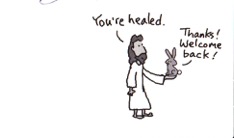 pretty simple, as you can see. “You’re healed,” Jesus says. “Thanks!” replies the bunny, “Welcome back!” This bunny knows from the beginning what the church struggled even to begin to grasp. It’s so easy for the bunny. It isn’t easy because he was healed although I think we could say that not being dead is an advantage. It is easy because it is easy. It is easy in the way it was easy for the girls in The Lion, the Witch, and the Wardrobe.
 Here’s how I get there. If you treat “orthodoxy” as “believing the right things,” then you have to be able to believe something in order to be orthodox. Not to get rigorously etymological or anything, but the -doxy part of orthodox comes from the Greek verb (dokein) meaning “to think” and the ortho- part from the Greek adjective (orthos) meaning “straight.” So “thinking the right things” is a pretty good indicator of orthodoxy, especially if we allow “straight” to be defined by the local community.
 I think a much better measure of being Christian, of being, as Christians understand it, a part of God’s family, is saying Yes to God with every available resource. Here’s a handy checklist. (See Deuteronomy 6 and Mark 12) To know what the authors of Deuteronomy meant, you would have to have a better grasp than I do of the crucial terms. What did they mean by “heart” or by “soul,” for instance? When I run a checklist of that kind for myself, I use these four categories: what I think, what I intend, how I feel, and what I do. That is a series that is meaningful to me. [4]
 The only question that verse asks of the person living in that house is, “Are you going to open the door?” It doesn’t ask if you know who is knocking. It doesn’t ask if you had intended to have a visitor. It doesn’t ask if you are anxious about who is knocking. It asks whether you are going to open the door.
 “Where to Invade Next.” That’s not a headline. We don’t look good in any of the Michael Moore movies. It’s just a statement about what I want to think about today.
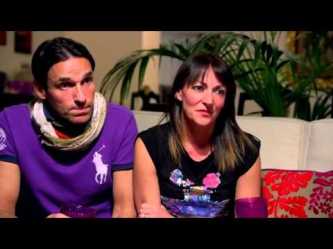 The Italian couple pictured here who are accustomed to eight weeks of vacation every year are astounded to learn that American workers get none at all—by law. Moore does admit that vacation hours are negotiated in contracts. She is in a mid-level business; he’s a cop. They both look very good in the vacation pictures that someone takes of them nearly everywhere in the world it is sunny and warm.
 meal we see at the elementary school is charming. It is served by kitchen staff. On china. A four-course meal. For less per child than we spend. And they get an hour to eat it.
 is as good a thing as she thinks it is.
 Another difficulty that the notion of “uselessness” hands us is, “What do we mean when we say ‘useful’?” Society is a rough and ready kind of enterprise so far as meanings go. Society is possible because “close enough” is the standard for giving and receiving meaning. But every now that then, “good enough” really isn’t good enough and I think this is one. What if, for instance, our common definitions of “useful” are merely conventional? What is these common definitions are not “useful?” What if another notion of “useful,” on being presented, would be welcomed and would benefit us all?
 member of the group who is willing to ask the “Why is grass green?” kind of question. No one knows the answer, but we all think we should so all of us pass the opportunity by and none of us asks it. But this one guy does. He would be very much surprised, I think, to learn that his contribution is “useful” to the group; it is, in fact, much more than useful. It is vital.
 One night, all the residents (except the one holdout) are magically transformed into themselves as children. They run and play and laugh. But before the night is over, they have begun to remember also the wonderful relationships and events of which they were a part and which they will not have any access to unless they go back to their old selves. And Mr. Bloom gives them that. You can go back, he says, to “your old comfortable bodies,” but with “fresh young minds.” The next morning these old people nearly erupt from the senior center, bursting with things to do and places to go that were there all along, but which they had not been willing to contemplate.
 Amending the soil, so that the kinds of plants you want in your yard really would help. If the moisture retention of clay is my problem, then amending it with organic matter to improve drainage is the solution.
 Montana in August 1991. A professor from the University of Montana had just given a talk opposing President George H. W. Bush’s “Operation Desert Shield.” It was a pro-Bush crowd so there was a lot of conversation afterwards. During the conversation, an old German man came up to me and said, in broken English, something that chilled my blood at the time and that I have never forgotten. He said, “I haff heard all ziss before,” and he went away shaking his head sadly. It chilled my blood because I knew who he had heard it from. He had heard if from Hermann Goering.
 Germany. For me, Mauthausen is the name of the camp, a place where Jews and other “enemies of the state” were to be sent to die. [5] The camp is now a tourist attraction, of course, complete with a very good bookstore. That was where I found The Logic of Evil: the Social Origins of the Nazi Party, by William Brustein of the University of Minnesota. These are “the stairs of death” at Mauthausen when the camp was in full operation. I walked these steps on a beautiful sunny day and could scarcely believe they were the same steps.
 But as the fear and anger are jacked up, what was once the vital middle of the spectrum comes to seem “politics as usual,” or, even worse, as “the status quo.” You hear people ay they are “against the status quo” as if it were one thing and as if whatever broke it would be better. Clearly politics as usual is not giving us back the America that was stolen from us under the leadership of the moderates. (Ronald Reagan, by the way, was one of those “moderates.”) Politics as usual is not protecting us from the threat of—in the U. S. today, that means “the existence of”—extremist groups who will count no cost too high if they can inflict even a minor wound on the U. S. It’s time to elect a “strong man.” This is a real Trump rally picture. Let’s hope it isn’t really representative.
 Then the question of what “empties himself” means, both in the case of Jesus and in the case of Ben Whittaker. Then, second, there is the question of what is actually emptied. I don’t know what that means for Jesus, but what it means for Ben is what the movie is about. Finally, there is the question of what is not–can not be?–emptied.
 My problem is not with understanding it. I can’t. My problem is with not caring about it. I’m not really critical of myself for failing to care, but I think all Christians are poorer if they fail to care about this fundamentally important mystery. I think we need to live with it and care about it. I would really like to understand it; that’s the kind of person I am. But even failing to understand it, I am not prepared to stop caring. How to do that?
 Sir Robin’s problem is the tiniest fragment of the dilemma Jesus faced in “giving up the form of God,” but since I have no idea what “the form of God” means, I don’t really feel anything about it. I really get the little frog’s problem. I can feel that one.
 The second interviewer picks up at college and asks about work history. This is the first time we, as viewers, hear that Ben was V.P. for Sales and Advertising and later was in charge of the production of the physical phone book. For New York. The second interviewer wants to know why people don’t just google phone numbers. Ben is unflappable. “Well yes, but back then people needed phone books.”
 He doesn’t “empty” those things. They were part of his old self and they are part of his current self. And they save him. They save the company, too. And Jules Ostin, the company’s founder, whose intern he is. It is not hard to track those traits in the story. [4] Ben goes into a conference room to perform a very simple task that Becky, Jules’ secretary, has summoned him to do. While there, he hears crisis discussed—a crisis for the company and also for the founder. When he reports back to the secretary, she says, “So…what were they talking about in there.” Ben replies, “I really couldn’t say.” Becky prompts, “You were in there a long time…” Ben comes back with, “I couldn’t hear a thing.” Not true, of course, because he did hear; but also not a lie because Becky knows exactly what he means.
 The Dilettante's Dilemma