
I want to tell you right up front that the topic I want to get to is the teaching in Jesus’s story of the Good Samaritan. I mention that because it is going to take me a little while to get there. I’m going to begin with a few fragments.
Fragment 1: Bette and I will be moving soon into a retirement center. We are really excited about it. Everything seems wonderful. I am still in the infatuation period—and I am remembering when I use that word that we get it from the Latin fatuus, “foolish.”
 I’ve been there a lot in the last few weeks on one errand or another and I have used the restroom on the first floor just north of the lobby. There is good hot water there and a soap dispenser and a tray of rolled up cloth towels. Very classy. Because people wash their hands at the sink, there accumulates on the counter little pools of water and soap suds. So after I have wiped my hands on the towel, I mop up all the water and soap and throw the towel into the basket under the sink.
Why do I do that? Well, as I said, I’m feeling foolish about the place and it just feels good to me to help make it look really good and all the materials are there. But why that action particularly? I wouldn’t feel any need to clean up a mess anyone had left on the floor or to wipe down the mirror. Why that cleaning of the counter in particular?
Let me spend a sentence reminding you that I am still working on the Good Samaritan story. Really I am.
Fragment 2: The story I am about to tell you has bounced around in my mind for quite a few decades now. I’m not sure anymore what the original version of the story was, so I’m just going to tell it the way I remember it. It’s true; I’m just not sure it is accurate.
A faculty colleague of mine at Westminster College in Pennsylvania used to take the paper towels he had left over from drying his hands and dry the faux marble top of the counter in the locker room where the sinks were. I remember seeing him do it and I remember thinking that it seemed a really good thing to do. I thought more highly of him because he chose to do that and I began to do it myself for no better reason than simple imitation. It was “what he did” so it became “what I do.”
The Good Samaritan
A lot of lessons have been drawn from this story. [1] I’m going to assume you know the story. If by any chance you don’t, you can check it out at Luke 10: 25ff. It ends like this.
36 Which of these three, do you think, was a neighbor to the man who fell into the hands of the robbers?” 37 He said, “The one who showed him mercy.” Jesus said to him, “Go and do likewise.”
Now “likewise” means “like he did.” Do what the Samaritan did. That sounds like a law or a principle to me. I have always heard it cast as a principle and therefore also as an obligation. But as I consider it, I am not sure that is the best way to think of it and I am not sure, either, that that is the way Jesus intended it.
If “likewise” means, “Do what he did,” then it might pay us to look at what the man from Samaria did. That’s a few lines up the page.
33 But a Samaritan while traveling came near him; and when he saw him, he was moved with pity. 34 He went to him and bandaged his wounds, having poured oil and wine on them. Then he put him on his own animal, brought him to an inn, and took care of him.
I am looking now at the sequence. He saw him. He was moved with pity. He took care of him. One, two, three. What if he hadn’t been moved with pity? What if you take the moving—using the same root, we all them motives today—out of the sequence. Nothing connects one and three. Nothing happens.
Moved with compassion
When I finish this essay, I am going to go down to the office at Portland State that I share with a number of other adjuncts. Portland State is an urban university; it is very “downtown.” When I walk to the office, I am going to walk past any number of people whom I will see sitting on the pavement with their signs and toward whom I will not feel compassion and whom I will not offer to help.
Should I? Does the “lesson” of the story instruct me to help these people? Is that what “do likewise” means? I have always thought so and I have always been taught so, but how I am beginning to wonder. And I didn’t do it anyway.
 That way of understanding the story has not helped me. It has brought a consistent and principled demand down on my behavior. It has not caused me to intervene when otherwise I would not have. I don’t think I have ever seen anyone intervene because of the “do likewise” instruction. That formulation is really good for blaming yourself, of course, and it is even better for blaming other people, but without compassion, it doesn’t actually work and I think we know that.
I had some fun with this a few years ago. I developed two alternative tracks to this narrative, neither of which required a compassionate enemy. In the first, a businessman with a lot of contacts in Jerusalem and Jericho developed a stretcher service that ran on a regular schedule. The compassionate Samaritan is systematized so that no actual compassion is required and many more people are helped. No one liked it.
In my second track, I developed a large scale economic intervention that began with a man with contacts in Rome. He got a planning grant from the emperor, using “law and order” arguments. He discovered that there were valuable minerals in the wilderness through which the road passed. He developed a mining operation that provided stable employment with good wages to people who used to be only highway bandits. No one got hurt. No one liked that one either.
There was no compassion in them. It was the compassion that made Jesus’s story appealing. The the command “Go and do likewise,” doesn’t have any compassion in it either unless it begins with verse 33c. The story might be understood as a demand that we should be neighborly in some general way. Maybe you believe that commanding people to feel compassion causes them to feel compassionate. That has not been my experience.
Beginning with the experience of compassion
What if “go and do likewise”(verse 37) were understood as beginning with compassion. “When something really moves you,” this version of Jesus’s story would hold, “follow that compassion with action.” This way of understanding opens up a whole new approach. It is addressed to people who are in situations like that and who feel compassion. It says that compassion is a good instigation and should be trusted. It doesn’t say anything to people who don’t begin with the experience of compassion. But what if other kinds of things move you to compassion? The man who is hired to play the part of Jesus in a passion play in Montreal [1] takes compassion on the actors who are auditioning for a beer commercial and smashes all the video equipment and chases the advertisers out of the building with a whip made of cords. “Contempt,” he says, “really upsets me.”
This way of looking at it not only changes the way the “lesson” takes shape, but changes the role Jesus plays as well. He is not The New Lawgiver in this way of looking at things. If the punchline of the story is “Go and Be Neighborly,” then Jesus is, in fact, the New Lawgiver. Instead, Jesus is someone who tells a story about a really appealing person—the kind of person you feel drawn to. The kind of person whose actions—not his feelings—you might want to emulate. Jesus, in this way of looking at him, is the kind of guy who says, “Let me tell you a story about my Uncle Abram. He was on the road one day….”
I want to end with that approach because it is appealing. I am going to skip over all the objections people are going to offer to this new way of looking at it. I think I’ve heard them all. I may have used them all myself. But I wouldn’t mind hearing them again.
Bullying
Instead, I would like to look at bullying. Every school I have ever attended has had bullies. Every school has had people who somehow evoked bullying behavior. Predators, in other words, and prey.
There has been a lot of attention recently to cutting down on bullying. It begins by identifying people who are standing around watching the harassment as it starts. It asks them to intervene and it gives them some language that might work; it gives them some training in using that language.
 I think that’s a really good idea. The bully’s aggression works by isolating some vulnerable person. If the bystanders refuse to fall away, to expose this boy or girl to abuse, then he or she is not isolated and the bully will have to reconsider. He may very well reconsider by going after you, but that is one of the things you might have to risk. You might be willing to risk it because you feel compassion for the bully-bait, especially if you have seen it before. You feel compassion and you are impelled to follow those feeling with actions.
But what if you can tell, walking into a new school, who is going to get bullied. You can tell just by looking around. The person is doing everything but holding up a sign saying, “You can bully me with no risk. I have no idea what to do.”
What are you going to do when you walk into a new place and see that person? What if you can see the bullying coming and you would like to intervene before it all gets started? What if you look at this kid and feel compassion? What actions would flow from that compassion?
Would they be getting to know this kid? No one else seems to have bothered. Would it be teaching him that presenting himself this way is not a good idea and here is why? Would it be teaching him that this is not a good place for him to be at this time of day and here is why? Could it be that your compassion might flow out of you not when you see the bully looming over him, but when you see him inadvertently inviting the bully to loom over him?
Would that work?
I don’t know whether it would or not. It does begin with compassion and eventuate in action. It does seem silly to continue to use the setting of Jesus’s story—beaten up by the side of the road—as the only kind of event that might evoke compassion. Why not the school setting? What if that evokes my compassion?
Finally, I want to go back to my friend who cleaned up the counters before he left. I don’t bring him back to help me close this essay on the grounds that his action proceeds from compassion. Compassion for puddles of soapy water? I bring him back because seeing him do what he did and admiring it as I did has helped me to remember to do it myself. When I find myself in that situation—and I just did at the retirement center—I want to act in that way. I want to “do likewise.”
My friend at Westminster is Jesus’s Uncle Abram. He’s a character in a story and when you see who he is and what he does, you feel sometimes that you would like to be that kind of person yourself.
And maybe that’s a good way to teach. And maybe that’s why Jesus used it.
[1] Jesus of Montreal. A superb “play within a play” treatment of the life and death and resurrection of Jesus of Nazareth.
 Cute.
Cute.
 I know there will be other sortings as well; I’m just not sure what they will be. Will there be a group—a real group, not just a category—of “people who used to be teachers?” Will there be “people who used to run businesses?” Will there be a group who used to be important and miss it dreadfully? Will there be a group of movers and shakers who serve on retirement center or on neighborhood committees and who want to tell you what is going on? I have no idea.
 I know this happens all the time in new settings. I know I am going to walk into the dining room and look around. I am going to see some people dressed as “we used to be teachers” or “we used to run businesses” or “we were stay-at-home moms.” And they are going to look at us, at “the new guys,” and make the same kinds of early decisions. Where is the Sorting Hat when you really need it?
 As I tried to find a way to say what it was about the two conventions that bothered me, I made my way back to 1895 again. That’s when H. G. Wells’ well-known science fiction work, The Time Machine was published. As nearly everyone knows—I’m sure there is a Classic Comic version of this famous story—the Time Traveler goes far into our future, to a time when there are only two species: the Eloi and the Morlocks. Here’s a piece about their relationship from the Wikipedia article on Morlocks, but you can see it all in the picture.
 The production and distribution of goods and services are being globalized. American manufacturers want to find customers for their products and as a global middle class continues to develop and grow, they are finding them. Not the American middle class, but still, a customer is a customer. A global labor market is also taking shape. This pool of “laborers” includes blue color and white collar; it includes jobs in production, sales, and services—including some very demanding services, like architecture and engineering. The need for workers—reduced as it is by robotics—is still quite large, but there is no need for these to be American workers.
 What would help? OK, I’m not going to call it socialism. I’m not going to call it anything at all. But here’s what needs to happen. If American businesses are going to go to the least expensive labor markets and if they are going to sell their products to a rapidly emerging global middle class, then we might as well admit that the cost to our own middle class—the late great American middle class—is going to be catastrophic. [5] The pain these policies cause makes they angry. The pain needs to be mitigated. That is something governments actually can do and they should. They can’t fix the problem, but they can make it hurt less.
 Since Bette and I decided to leave our Hayhurst Neighborhood and move to a good retirement center somewhere, we have been thinking about the going part. How can it be done thoughtfully and gently, honoring all the neighborhood has been for us? And now that we have bought an apartment at Holladay Park Plaza, our choice of retirement centers, it is time to think about the coming part—coming to a new home. [1] HPP is actually in the Sullivan’s Gulch Neighborhood, as Portland counts neighborhoods [2], but I think it would be better for Bette and me to think of HPP itself as our neighborhood.
 standard are very likely to be rejected at the outset, even though there are other values that also need to be considered. If it isn’t thoughtful and gentle, I don’t want to consider it. I was shopping for a metaphor that would help me think through the process and in the middle of my search, I stumbled on the metaphor I used last January for leaving the neighborhood: it is “the abscission layer.” As soon as I saw that, I knew that I wanted to go around to the other end of the process, which is grafting. Bette and I want to be grafted in to our new neighborhood.
 ced by sunlight and magic and sent to wherever in the tree it is needed. I don’t understand photosynthesis, really, but I know it involves an interaction at a part of the tree whose principal responsibility is to make nutrients and put them into a transportation system that will bring them to the right place.
 Not everyone would call the action of hormones like auxins, cytokinins, and gibberellins “politics,” but I would. The production and inhibition of growth and the distribution of resources to one place rather than another sound like the ordinary work of the legislature to me. We’ll see.
 vision the end” the saying goes, “resist the beginnings.”
 people argue that this or that can be done. Mulgan has the advantage of saying “while this might have happened…it did not actually happen.” Mulgan knows what happened—“is happening,” we would say—and so he knows that the faith in technology was misplaced. And here we have John Kenneth Galbraith, whose book, The Affluent Society focused attention on the early phases of a lot of the issues that are completely out of hand by 2140.
 C. S. Lewis’s setting is entirely different, but the mechanism is the same. The “divorce” of the title is the separation between Hell and Heaven. Every day, the people in Hell (the Ghosts) have the chance to get on a bus and go to Heaven to commune with the people there (the Spirits), and to stay forever if they want to. Nearly everyone doesn’t want to. They get back on the bus in the afternoon and go back to Hell where, apparently, they feel more “at home.”
 suggested in the first part can be logically extended to the second part. All that passage is nonsense, of course, but I would like for you to stop and consider just why it is nonsense. It is not the words. They work fine. It is not the ideas. They can be made to work. It is the sources. What I am going to call the genres.
 Messiah and king and son of God all had triumphant overtones. Jesus just can’t be, according to the Jewish understanding at the time (and today) the triumphant messiah and the suffering servant. One or the other; not both.
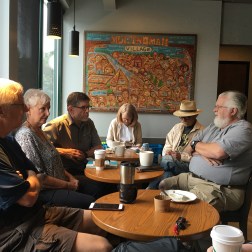 I experienced one of the few failures of conversation I have ever had in our Starbucks group last week. I had a position I wanted to sell. It is position the group almost certainly accepts in general, but they didn’t want to accept it this time. And it is the failure of the conversation I want to point to, not my own failure. Although… (see below)
 When I referred, above, to the position the group accepts as a general matter, this is the position I had in mind. People should be granted the right to feel what they feel. This means only that we understand that every decision is made on the basis of a welter of considerations, many of them contradictory. I would really like to have my son and his family nearby, but the best job offer is in a distant city and I know the family will be better off there. The Caucus would, as a rule, say that they “understand” my feeling of personal loss and that they “approve” my giving greater weight to the more important consideration. On the other hand, if I said that I am opposed to my son and his family moving to a distant city even though I know it would be the best thing for them and that my opposition is based on my own regret that they will no longer live near me, they would not approve. They might very well characterize my consideration as “selfish.”
 The white working class of the post-bellum south has every right to mourn the loss of the one social advantage they had, but they should set that aside in favor of the much greater importance of racial equity and social justice.
 trade-off at issue really was. It doesn’t really matter for this essay. Let’s say that it was the satisfaction that Trump voters feel is seeing “their guy” stand up to the enforcers of “sensitivity.” They, it seems to them, are forever being corrected by the Nazis of Political Correctness and they have to adopt new terms because the common old ones are now “offensive” and adopt tortured syntax to work their way around a word that can’t be used any more. They have to stammer and apologize and kowtow to criticisms. But Trump doesn’t. He just doesn’t. He faces the same forces that require us to submit and punish us if we don’t and he refuses to kowtow. How satisfying to see someone stand up to them!
 This argument represents an authentic feeling. As the guy assigned to argue the Trump voter out of his madness, the intensity of this feeling is my problem. I can argue that the objection in that form is the sheerest nonsense; that “status quo” doesn’t mean anything at all if we are talking about the effects of all policies at the same time. That doesn’t help me. The anger against “the status quo” will not be mollified by more abstract considerations. Revoking Medicare and Social Security, for instance, would be a dramatic rejection of “the status quo,” but it turns out that is not what they were thinking of.
 what is truly—that ordinarily means “economically”—in their interest, but I find that they are not interested in arguments and are prepared to deny the truth value of anything that has ever been studied. They don’t believe the reporting of journalists if it is inconvenient because of “the liberal media.” They don’t believe the overwhelming consensus of experts about the causes of global warming because it is not unanimous.
 The problem I am confronting in dealing with these Trump voters is that I need a solution to the grievances they have that will feel good for them to hold. I can’t think of one.
 Vance’s second point is that as “faith” as been de-institutionalized, it has been re-politicized. But politicization, even among white working class voters, means more than Vance considers in this column. Further, the black Protestant churches are almost surely the most politicized churches in the U. S. The “values voters” that Vance laments are only a pale reflection of the “black Christian voters” that the black churches turn out year after year. [4]
 Vance sees that as the difference between a religious stance with and one without an actual community. Evangelicals who worship in community have, as Vance puts it, “camaraderie, community, and a sense of purpose.” Evangelicals who are alienated from actual communities have only a vacuum there and “into that vacuum has stepped Donald J. Trump.”
 How does that work, exactly? “Frail” is an evaluative term that requires an outside perspective. If you were to see an old man shuffling along warily, concentrating full force on not falling over, you might easily call that old man “frail.” But you would apply that term to yourself only if you imagine others would see you in that light. You imagine the way you may be viewed and apply that label to yourself.
 ondition of your bones and muscles and joints, we are talking about the conditions that will cause you to apply a word to yourself. The word is “frail.” And if you have decided that “being a frail old man” doesn’t serve you well, what can you do about it?
 ey. So I change how I act, which categorizes that kind of action as my internalized “other” will do it, which changes the meaning of what I have just done as it is applied to me. There is not an internal or “self-talk” piece in this routine anywhere. The action is external. The “meaning” is external. The application is automatic.
 The Dilettante's Dilemma