
The time it takes me to go from “having an experience” to “having “a kind of experience” has gotten perilously short. I don’t think I have put anyone in danger yet, but the transition from the one to the other is getting quick and I want to tell you about it.
“Kind” in “kind of experience,” is a word that presupposes categories, each of which contains [1] objects or events. When your seventh son brings home a girl he is interested in, you do not say, “Wow! What’s going on?” You say “I think these are getting easier,” which places this event into the category “all such events,” meaning what it was like when the six older brothers brought their girl friends home. I don’t have seven sons, myself, but I can speak for these parents. It is extremely difficult to take this seventh iteration on its own terms! Your mind goes to the category and to this event, the seventh girl friend, as an instance of the category. It isn’t fair to the son or to the girlfriend, but first sons have special difficulties too and I think it all evens out.
I want you to imagine “the first time you have an experience.” Hard, isn’t it. It’s like “the First Annual Something,” where “annual” expresses nothing more than the organizer’s hopes. At about the third time, if it is a highly scripted social event, like getting fired from your job, or dissed by your teenage daughter, you see the similarities and you start talking about “events like this one.” If it isn’t so scripted, it might take a few more, but eventually even the dullest will notice that these experiences are a lot like those and begin to invent a name for the category.
So here’s the stinger. “Social norms”–what ought to happen– don’t belong to experiences; they belong to kinds or categories of experiences. So the notion that you are doing something right or that someone else is doing something right depends on the category to which you assign the experience. So there is this constant and largely unconscious interplay between the actual experience and the whole context to which that experience belongs.
OK, enough from the nosebleed level of social theory. Let me tell you a story my father used to tell. There was a man in a little town who was so ugly that kids with nothing better to do would taunt him when he passed and call him names. It’s hard to see this clearly at this part of the story, but the kids are doing “what kids do” in a situation of this kind. Or that, at least, is what they would tell themselves if they bothered to think about it.
Well he really was ugly, but he wasn’t stupid. He stopped to talk to the kids and he said that it was really inconvenient to be called names out in public like that, but if they would come over to his house to call him names, he would give them a dollar each every time they did it. Free money just for being a jerk! WhooHoo!
 So they did it for a few days and then the man said that times were a little tough economically and although they were doing everything they promised, he would be able to pay them only 75 cents each from now on. It’s still free money. Later, he reduced it further. When he got down to a dime for each kid, there was a rebellion. “What! You expect us to come clear over here to insult you for a measly dime? We’re done with this deal. Goodbye!” The old ugly man waved goodbye as cheerfully as he had done everything else and smiled quietly to himself.
How did that work? The ugly man took one category of events, the kids harassing him because they could, and turned it into another category of events—wage labor. With the notion of wage labor goes the idea that you are doing what you are doing because you are getting paid for it. A whole new motivation: entirely implicit; completely effective. Here is that interaction between the experience itself and the background expectations that make the experience understandable.
 At the crucial moment in such transitions—I am just about to tell you one of mine—the question, “What is happening here?” or sometimes “Why am I doing this?” gets asked. When it gets a different answer than the one you were expecting, you get the feeling Wiley Coyote gets when he runs off a cliff and doesn’t start falling until he notices that he isn’t standing on anything anymore. Here was my Wiley Coyote moment last week and here’s the way I described it when it happened.
I’ve been using the same torn towel for days now. It isn’t torn very much; there is a little notch on one of the long edges. I am quite sure that if I toweled off with that edge taking most of the tension, the towel would rip further. After that, it wouldn’t take very long for it to become a pile of rags.
“Not much of an event,” you say? Probably not worth writing about?
You might be right, but let’s consider first what categories this event might fall into. Is this a defective towel? Have I been too hard on it in some way—brought it into contact with a sharp edge, perhaps? Maybe after a long and useful life in the service of desiccation, it has reached the age of retirement.
All those are possible. None all that interesting.
As I was mulling my towel with the notch, it occurred to me that this is not my towel. This is a towel provided by Holladay Park Plaza, the retirement center I where I have lived for nine days now. [2]At the moment that thought came to me, I felt my perceptual field shifting.
- “They gave me a bad towel!” was one of the voices I heard.
- “What kind of place is this?” came from another.
- And one, much further away, may have said, “Do you even know what the process is for filing a grievance?”
All that in the twinkling of an eye; all that about something as inconsequential as a damaged towel—a towel, by the way, that I have been using successfully for several days now. I have moved from an environment wholly of my devising and largely my responsibility [3] to an environment of someone else’s devising—and for which they are responsible!
And I had no notion of that change—not a change of experiences, please note, but a change of the categories that give meaning to the experiences—until I realized that the torn towel was not my problem. I didn’t cause it. Probably. I don’t need to fix it. THEY need to fix it and they will be happy to if I just mention it to them.
I am convinced that “life,” i.e. the aggregate of meanings we assemble, is controlled by moments like this. People who solve a problem by changing the environment (alloplasts) and people who solve it by changing their own behavior (autoplasts) are distinguished entirely by what category the experience gets placed in.
It intrigues me that changes that are so crucially important to the kind of life each of us lives happen so fast that we can’t even say just when they happened–that intrigues me and I hope that you will catch sight of it, maybe out of the corner of your eye, from time to time, too.
[1] Or “is made up of.” It’s a linguistic argument I am competent to recognize, but not to participate in.
[2] Actually a month and a day on the day I am posting this.
[3] Just to make things easier, I am going to skip over Bette’s part in making the environment what it is.
 eally has surprised me. There is no relationship I can see between how constraining a disability is and how the person responds to it. I write on our “front porch,” just outside the door of our apartment. The front edge of this picture is a hallway and I sit at one of the tables. And most of the time I am writing, people are walking by–some with the aid of walkers or canes.
 Everyone who knows what blood glucose is would wonder what you were planning on using it for. That is not the question that comes first to mind to people who know what an estate is. But today, I find myself wondering why that is. I think that is a really good question to ask about estates: “What are you going to use it for?”
 stream of stories. I see “children” in their fifties and sixties (and older) seriously encumbered by the process of caring for an aged parent. [1] This parent could have invested in his or her (“”her,” usually) own care by moving to a CCRC, but she did not. She relies, instead, on the daily services of her children to enable her to keep living the kind of life she is used to.
 Buying time like that is what you would get, in this scenario, for using the estate rather than saving it for the kids. But there needs to be a way to say that in less than a page and a half. If it were possible to say, “I would like to estate to you the freedom to use our time together as we choose,” that would do the job. No one will say that.
 He says of his opposite number, the American spy, “I do like him, you know. One can’t help it.” The opposite number in Hopscotch is Miles Kendrick, played by Walter Matthau. Like Yaskov, I just don’t seem to be able to help liking Nicholas Kristof. He writes a lot of things I find fault with (like his September 4 column) but it never occurs to me not to like him. And I liked his father a great deal. [1]
 There really isn’t any way to categorize Jesus simply unless the purpose of the categorization is to turn him into a tool of some sort. The bad guys in this column “weaponize” Jesus as part of their social program: opposed to women, opposed to the poor, wholly without compassion. The good guys in this column “instrumentalize” (I know “weaponize” would keep the parallel, but I just can’t manage it.) Jesus as part of their social program: attentive to the needs of the poor, responsive to the feminism of our time, global in its compassion for those who are suffering. I like the second set of programs much better than the first, but from a Christian standpoint, they are both idolatry
 McLaren continues with a series of examples of beliefs as distractions—actually, he considers only that they will be distractions. He touches on whether biblical miracles are true as a distraction and, of course they can be. They can also be an invitation to modern Christians to place themselves in the 1st Century as receivers of the good news about Jesus. He contrasts questioning whether Jesus actually healed a leper (that’s the miracle) with focusing on Jesus’s “outreach to the most stigmatized of outcasts.”
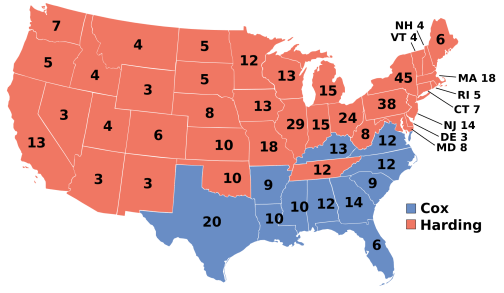 So let’s think back a little. Historically, the Democratic party integrated these two agendas within the party. There was a liberal northern wing, which ran the executive branch, and a conservative southern wing which ran (controlled) the legislative branch. Then there was a Republican legislative party that aligned itself with the liberals sometimes, mostly on supporting business and with the conservatives sometimes, especially on social issues. That blue band across the south, normally including Tennessee, was the natural home of the “Austin” branch of the Democratic party. Notice that everything else has changed a great deal.
 Well, it is different in one way. Sen. Dirksen was famous for “delivering” the Republican vote in the Senate on the 1964 Civil Rights Act. That wasn’t what he wanted to do at the beginning of the process, but he stayed with it and kept talking to his R colleagues and at the end, delivered the votes.
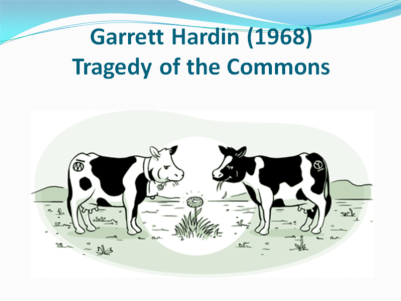 And once I got that far, I saw that it was the old familiar Tragedy of the Commons and the rest of this essay is an attempt to play our the metaphor. As first formulated, it is about cows. There is a common grazing area which is big enough to sustain grazing by so many cows; not more. But the arithmetic underlying this arrangement is seductive. If Farmer A adds just one more cow to the commons, he uses only a small fraction of the grazing area and he keeps all the profit that extra cow brings for himself. Pretty good deal.
 This point tends to be lost on an oversensitive member of the discussion because he thinks that racism is a really important issue. Crossing the line in talking about race is a serious offense. And this guy probably thinks that when someone else shows the sensitivity about sexism that he himself shows about racism, that he is being “oversensitive” or maybe even pretending to be offended to regain the initiative. I know that makes this “oversensitive to race issues” guy look stupid, but he isn’t using all his intelligence if he thinks that only one issue makes people angry.
 Furthermore, what I find very hard to remember when I am the one being insulted or demeaned is that we are all beneficiaries of the commons. If the commons represent a style of discussion, not a topic to be discussed, then every kind of discussion is taxed by oversensitivity. We don’t talk about supporting and sustaining families the way we might if the commons had not been so shrunk from overuse. We don’t talk about poverty and homelessness the way we might. We don’t talk about American imperialism the way we might, or the frightening over-expansion of executive power under President Obama.
 My solution is taking one for the team. [3] We’re having our discussion about The War of the Roses and someone makes a remark that bears on the race, religion, national origin, or sexual preference of someone else. The potential victim notes it (no problem there) decides it is not the opening gun of a bombardment, and lets it pass without comment.
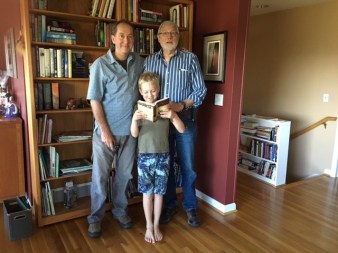
 Bette, her daughter Melisa, and her granddaughters Liliana and Lara [it’s Lara in the picture]—took the view, initially, that the best way to go about reading a novel was to start at the beginning and move through to the end. They granted that sometimes a book starts slowly and you have to exercise some discipline to keep reading until it starts getting interesting, but you will be rewarded for your efforts. Besides, it’s the right thing to do.
 and the time of day.
 see these characters and developments slide “into place,” I have to know where they are going. That means I have to know what happens and to do that, I have to read the ending. People who like the mystery suddenly resolved should read a murder mystery A and then B and then C, just as it is written. People, like me, who want to enjoy seeing the plot assembled should read it A and then C and then B. And that is the way I most often—not always—read a murder mystery. Jodi Picoult’s hopes to the contrary notwithstanding.
 Eastman says that two things are necessary for something to be funny. There must be a discrepancy of some kind and there must be a setting which encourages or allows you to take it lightly. Jokes that turn on ethnic or gender or professional stereotypes are a good example. You can describe a situation that could be understood either of two ways, the classic discrepancy. But in an audience that disapproves of…oh…Polish jokes, let’s say…the permission to regard it as funny is missing. So it isn’t funny. Or at least you try not to laugh at the time.
 It’s sad, really. The old agreement was that I tell jokes that make fun of your ethnicity and you respond by telling jokes that make fun of mine. The rule was that “equally offensive” was about the same as “inoffensive.” Under current conditions, the fact that someone was offended by it is the defining trait and we can see nearly anything as offensive.
 Why did it take me so long? It wasn’t the Latin quotation. I didn’t know it, but it was easy to look up. The whole quotation is “Vita brevis est, ars longa.” My previous contact with ars with on the Metro-Goldyn-Mayer logo, which says “Ars gratia artis.” That’s how I knew it meant “art”—the motto means “Art for art’s sake.” And, in the same way, I knew that it was pronounced “arz.”
 I think I was floating in that current when I hit au revoir because something divided the expression into “Goodbye to what?” and having gotten that far, I noticed that Au is the symbol for the element, gold. That means that one way of sensing the discrepancy is that Au revoir (notice the capital A) is a way of saying “goodbye to gold,” which is a pretty good way of categorizing the meeting where we write the check for our apartment.

 Ferdinand Magellan sailed out of the very nasty seas around Cape Horn and found a relatively quiet body of water. He was thankful for how peaceful it was for the same reason that the Pilgrims were thankful for food after having lost half their number the previous winter. We could say that the seas Magellan found were “relatively” calm. So in the general sense, “pacific” means “peaceful.” Everyone who has ever given a baby a pacifier ought to understand that. [1]
 But I don’t have any direct interest in Pacific Retirement Services where “Pacific” refers to the ocean. Bette and I are going to be living at Holladay Park Plaza—in a few weeks—and HPP is one of the retirement centers belonging to (affiliated with) Pacific Retirement Services. [3] So right away, as I begin to wonder whether PRS is good for HPP, my mind drifts over to a pacific retirement, the kind I want very much. And that raises the questions of what “services” will help me achieve that. [4]
 The Dilettante's Dilemma