Even the faintest breeze

I want to share, today, some of the amazing people I see here at Holladay Park Plaza—the retirement center where Bette and I have wound up. But I don’t want to start there. I want to start with some dogs who have learned things that cramp their style.

breeze-2One of the great pleasures of teaching my Political Psychology class [1] over the years was introducing my students to Martin E. P. Seligman’s marvelous book, Helplessness. The focus of the book was on a particular cognition—something you had learned. And what you had learned is “there is nothing I can do.”

There are, of course, fatalistic religions and philosophies which teach that there is, in fact, nothing you can do and acquiescence or acceptance or even just submission is the relevant virtue. But Seligman studied dogs [2] where these religions and philosophies are not considered seriously as far as we know.  There are two conditions about these dogs that I would like to use as the introduction to the amazing people I mentioned at the beginning.

The experimental apparatus doesn’t need to be described at any length here, but it might help to know that some of the dogs were exposed to an electric shock in one end of a two-compartment box and they had to jump over a low partition into the other end to stop getting shocked. No dog was ever unable to learn that. The light comes on; that means that the shock will start in X seconds; no need to hurry, says the experienced dog.  At X-1 seconds, the dog lopes over to the barrier and jumps over it. [3]

On the other hand, some dogs were leashed to the shock end of the box and there really was nothing they could do about it and some, after a while, showed every sign of acquiescence, acceptance, or submission. That’s a lot to say about a dog, but I wanted to re-use that really nifty sequence one more time. These dogs  had learned that they were helpless and coped with it the best they could.

Then the leash was removed. Did the dogs leap over the barrier at the first opportunity? Nope. Because these were “educated dogs.” [4] They had degrees in the School of Hard Shocks. They had learned that there was nothing they could do and now that there actually was something they could do, they didn’t notice.

Imagine a dog from the first condition having a conversation with a dog in the second condition. “Hey. Look! There’s no leash on you anymore. You’re free! All you have to do is jump over this little barrier.”

breeze-5The educated dog lies there. The light comes on. Eventually, the shock starts. The educated dog lies on the floor looking philosophical.  The first dog says, “Hey. Like this. See? The light comes on, I jump over the barrier. Neither of us is wearing a leash. Come on! It’s not hard. Just Do It.” The second dog doesn’t respond because he knows it is no use and he continues to “know” that even when safety is a few easy feet away. This dog in exhibiting “learned helplessness,” which is the subject of Seligman’s early work.

With that much to go on, let’s consider what a Truly Amazing Dog (TAD) would do. A TAD would continue to check the conditions of his confinement to see if they still apply. They always have. So far. [5] A TAD understands all too well what the verb “pay” means in the expression “pay attention” and he is willing to continue to pay that price although paying it has never bought him anything. Light, check the leash, shock, keep checking the leash; choose resignation, but don’t stop watching for any change in the sequence that might hint at changes.

Then, one day, he is not leashed. What happens? Well, for a regular dog, nothing happens. He stands or sits or lies there and gets shocked. For a Truly Amazing Dog, he leaps over the barrier and finds safety. And if, on the next day, the leash is back, he goes back to the sequence: light, check leash, shock, keep checking, etc.

Just about done with the dogs. Stay with me.

If all we cared about, in looking at this situation, was how to manage the greatest number of escapes on those days when escape was possible, this “amazing” dog would not be amazing. Smart, diligent, successful…but not amazing. But I want to look at this in a different way. I want to look at what it costs the dog to be aware, always aware, of the possibility of “success.”

“Success” in the case of this particular dog means “escape.” But now I want to turn to the breeze-7old people. I had seen a lot of Truly Amazing Elders (TAE) before I came to Holladay Park Plaza, but I had never seen such a concentration of old people before. There is nothing like living in a retirement center to see a lot of old people, after all.

And in these old people (myself included, of course) I see the same kinds of responses Seligman found in his dogs. [6] And the ones I am calling Truly Amazing Elders are those who are “leashed” most of the time, but are always alert to any moment when they are not. “Leashed,” obviously, is a metaphor. We don’t put anyone on a leash here at HPP. But some people carry their oxygen around with them. Some must take a walker everywhere they go. Some carry their grief for the loss of a much-loved spouse everywhere they go. Some carry the burden of “I used to be important and now I am not” everywhere they go. Once we know we are talking about metaphors, just what constitutes a “leash” can be quite varied.

But now that we know we are talking about metaphorical constraints, it is time to go back to what it costs to be ready to take advantage of anytime the leash is not there. If you have a persistent pain in your shoulder, you do not, as a rule, say, “I wonder if today will be a good day for a swim.” Why? Because holding onto a world in which you always might be free to swim—a world in which you did not have that incapacitating pain in your shoulder—takes a lot of effort. It is a lot easier to ignore the possibility than to consider, over and over again, whether you might be free to do it this time.

At the risk of sounding pathetic, I admit that I have had that choice presented to me on occasion. I remember that I was in some kind of funk for several days [7] and was surprised to notice, one afternoon, that I wasn’t “in it” anymore. And I wondered how long I had been free of it (no leash) and just hadn’t noticed because what I knew about myself was that I was in a funk and they last a long time.

I remember discovering that a lingering feeling of grievance (it had been anger, originally) had blown away. It was gone when I noticed it. I wondered whether, if I had been paying attention, I would have seen it go away. If I had, I might have been able to think back on anything I might have done that had helped it move on. I didn’t get to ask that question—you will agree, I hope, that it is a question with a good deal of promise—because I wasn’t paying attention.

breeze-8If I had really wanted a restoration of that relationship, wanted it urgently, I think I would have noticed when the grievance left. So what I called “a failure of attention” at the time (I just didn’t notice when the grievance stopped) may actually have been a failure of will (I just didn’t want it badly enough). So to translate this everyday catastrophe back into the world of Seligman’s dogs, I didn’t want to be free of the leash badly enough to notice when I actually got free.

I think of it sometimes as a sailor becalmed. You really want to go somewhere—back to the dock, for instance, and then home and then to dinner—but a sail is what you have and there is no wind. [8] That sailor will notice every faint breeze. He might notice anything that “might possibly be a breeze” or might become a breeze. If there is a feeling in the air that precedes a breeze and that indicates that a breeze is coming, I am sure he would notice that as well. He wants that breeze urgently and he is willing to pay (the cost of) the kind of attention that assures instant awareness.

I said that I see a lot of people here at HPP who are “leashed” to something. I had to say that first so that I could say this second. I see a lot of people here who seem to be alert to the faintest breeze; who are alert to any occasion when taking a deep breath seems suddenly easy or when dinner suddenly smells really good or when the walker I am using to keep my balance suddenly seems almost to be moving on its own and I am walking along with it.

You will not—trust me on this—celebrate those events if you don’t notice them and you will not notice them if you take for granted that they are always there and always will be there. If you know, in short, that you are permanently leashed, then you will not inflict on yourself the pain of always checking to see if the leash might not be there today.

And every day, I see people around me who are willing to notice any small decrease in discomfort or any sudden increase in hope or even in appetite. I celebrate those people. I admire their courage. They are Truly Amazing Elders and I want to get to know them well enough to learn how they do it.

[1] For my Westminster College friends who took this same material under the heading Political Behavior, I haven’t forgotten what we called it back then, but I last taught this material under that name in 1980—36 years ago—and at Portland State, it was always Political Psychology.
[2] Mostly. The findings turned out to apply to mice and rabbits and squirrels, etc. as well.
[3] I saw film of this same experiment on goldfish. The experienced goldfish loiters near the line and at the last minute, flips its tail and gets to safety. The lecturer, noting the tendency to wait until the last minute, called this a “grad school goldfish.”
[4] I don’t mean to be all snarky about “educated dogs.” The dogs that learned that they could always jump the barrier and escape the shock were “educated dogs” too. But their education had been designed to lead them to a different conclusion.
[5] “The triumph,” as Samuel Johnson says of second marriages, “of hope over experience.”
[6] The full set has four conditions: a) always free to escape, b) free at first, then leashed, c) leashed at first, and then free, and d) always leashed. I want to write sometime about b) because there is a great story there, but today, I am thinking about c).
[7} I say “depressed” when I am talking to myself, but that word has become a diagnosis with some boundaries of meaning to it and I don’t have the credentials to use it except in my own inner dialog.
[8] I am no sailor, so I may get some of the mechanics wrong, but I do know about wanting to be home and safe.

Posted in Getting Old, Paying Attention | Tagged , , , , | 2 Comments

Vote NO on virtue

It is my great privilege to pass along to you one of the best political recommendations I have ever had the pleasure to read.  Below, you will see a picture of the last argument offered on this measure in Oregon’s Voter’s Pamphlet for November 8, 2016.

The arguments on ballot measures are divided into two sections: ARGUMENT IN FAVOR and ARGUMENT IN OPPOSITION.  All very sensible.  This is Oregon, after all.  If you have a Voter’s Pamphlet handy, you can turn to pages M-28 to M-36 to see the whole set of arguments.

vote-noThe title of this ballot measure is as follows: Limits contributions, expenditures, requires disclosure in Multnomah County candidate elections.  The measure in the form of a question (Should the charter require…?) follows, then a Summary, then an Explanatory Statement.  Then there are 18 “arguments” in support of the idea.  All of the people you expect to weigh in against the perversion of elections by the dominance of big spenders are represented here.  All these arguments make good sense to me.

There is one argument in opposition.  It says ARGUMENT IN OPPOSITION.  There isn’t a smiley face or anything.  You have to read it.  And if you can scarcely believe what you read first–that’s how I felt about it–you really want to keep on reading.

And if you follow the site to best-words.com, you wind up at a site called honest-elections.com, headed by a banner that says YES on Measure 26-184 and where you are given a chance to place lawn signs and campaign in a number of very traditional ways for the passage of the measure.  This is the group that you got to by following the message ARGUMENT IN OPPOSITION.

In my judgment, this election has been WAY too serious.  I don’t see anything wrong with mixing a little levity with all the necessary gravity.   I was on their side of the issue from the time I read the text of the ballot measure, so they didn’t really change my vote.  They just gave me a whole morning of happiness.

Thanks, guys.

The rest of this post is a picture of their Voter’s Pamphlet ad.

Vote No.jpg

Posted in Politics | Tagged , , , | 1 Comment

A Man Called Ove

The maxim that it is more blessed to give than to receive is well known and I would apply it without a second thought to director Hannes Holm’s 2015 movie A Man Called Ove. I think the movie fits the maxim and vice versa. On the other hand, I think the maxim doesn’t really capture the two points I would like to explore in this essay and I would like to extend the implications just a bit.

The first point ove-1is that it calls for a comparison of “amounts” or “degrees” of being blessed. It is the word “more” in the maxim that has us comparing one amount of blessedness with another and saying that one amount is larger. That is what “more” means and what it needs to mean. [It says right here than you aren’t allowed to do that.]
But what strikes me in this movie isn’t anything like an amount at all. It is more like a flavor or an overtone or a tint. It is another kind or another source or another delivery system for the “blessedness.” I find that really thought-provoking.

And that leads me to the second point, which has to do with what I called a “delivery system.” But what, really, is the means by which these blessings are conferred? There is no scene where single shaft of light from heaven illuminates the old man’s features. He doesn’t pronounce a blessing on the children and then they pronounce it on him. How does this work exactly?

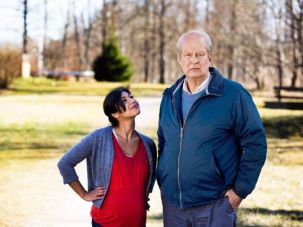
Ove (Rolf Lassgård) is a grumpy old widower and retiree. [1] His life is stable, but bleak. Then some neighbors move in—people who are very hard to ignore—and Ove is forced to do an amazing variety of things he has not done for a long time. Some, he has probably never done. Let’s look at an example or two.

ove-5The wife, Parveneh, (Bahar Pars) of Ove’s new neighbor is Persian. That’s a short way of saying that she doesn’t know how to be Swedish. It turns out that she has no intention of becoming culturally Swedish, but that’s another story. [2] Parveneh has to make a quick trip to the hospital and leaves Ove in the waiting room with her two children. [This one picture nails the two characters exactly.]
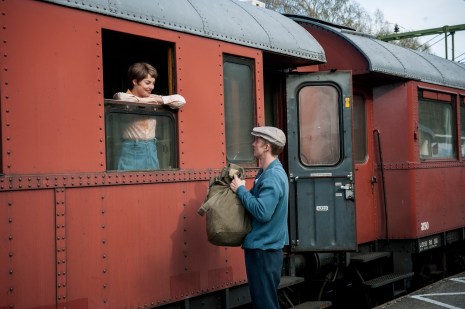
She gives Ove a book that could, in a pinch, be used to entertain the children. The children prevail on him to read to them. They have no idea how far outside Ove’s comfort zone that is. He has never been a father. He doesn’t know all the “reading to the kids” tricks that fathers pick up so quickly. So Ove starts reading to them about a bear. The children don’t like the way he is reading. They think the lines the bear says should sound like a bear.

I don’t think “outside his comfort zone” really captures this request. Ove has very likely never done this or anything like this before. If he ran across a man reading in growly sounds to little children in a public place, I am sure he would have disapproved of it. But he tries. And he does really well. And the kids really like it and, at that moment, they really like him.

How does it work?

So let’s stop, after just this one example, and look at what he gave the children and what the experience of succeeding in pleasing the children with his creative artistry “gave” to him. [3] Ove gave the children a distraction while their mother was busy in the hospital. The children gave Ove the first evidence he had ever had that he might be one of those adults who knows how to please children. The children gave him reason to believe that his growly conversation was delightfully bear-like (ursine, we say in the trade) and he knows he invented those sounds himself.

And, getting away from the “giving” metaphor, we can say directly that Ove is given the opportunity to be a kind of person he never had been before (probably) and that he certainly had not been since his wife’s death.  He takes that opportunity and is forced, as a result, to re-evaluate the kind of person he is.

In another scene—another crisis, of course—he is called into the neighbor’s house. The children need to be looked after. He also winds up in the middle of an argument about what to do with a dishwasher that doesn’t work and is therefore, no more than a piece of junk. And Bette remembers (she’s usually right about things like this) that the kitchen where the junky dishwasher sat was full of dirty dishes.

Ove survives bedtime for the children. We don’t see that. Then he fixes the dishwasher. We don’t see that either. And when the parents return, they discover that the counters are all clear because the dirty dishes are either in the dishwasher or because they have been washed and put away in the cupboards.

That’s a very nice favor for Ove to have done and it is a real help to the parents. But a prominent part of the beginning of the story is the parade of neighbors who ask Ove to “look at” (fix) things and he always says No. He says No to the request and also a broader and more hurtful No to the person. Ove is a cranky old man and none of these neighbors means anything to him. But then he is “forced” into the neighbor’s house. There must have been a time for the kids to be in bed. He did that. And he stands in the kitchen looking at a dishwasher he knows he could fix. And he does that. And then he looks (Bette’s version) at the counter full of dirty dishes and then at the empty dishwasher and he shrugs, I suppose, and starts loading the dishes into the dishwasher.

He came to help with the kids because the parents had an urgent need for him. But then what? They didn’t have an urgent need for him to fix the dishwasher. It must have just seemed fitting to Ove. A guy who would come over at night and figure out a way to get the two little girls to bed just must be the kind of guy who would fix a cranky piece of machinery if he could. And the guy who voluntarily fixed the dishwasher is probably the kind of guy who go on and wash the dishes.

I’m making is sound like logic. I know it isn’t logic, but I chose that phrasing deliberatelyove-4 because I think that there is an affinity of some kind between one act of kindness and another. [4] Something like the current of a stream is set up and Ove “drifts downstream” following the implications of the kindnesses he has done, just as he had been following the logic of his refusal to help any of his neighbors.  Actually, “who he is to the neighbors” is very much like “who he was to his wife,” who was a marvelous person and the first person ever to really believe in him.

So when we think about “the blessedness of receiving,” I think we need to be alert to currents like these. Ove benefitted much more than anyone else did from his kindnesses to his new neighbors. And it isn’t just that they appreciated his efforts. It is not just that. It is also that Ove was forced to think some very positive things about himself. He was forced to admit that he had done some generous things and possibly even to speculate about whether he was a generous person. Thinking those things was perfectly reasonable, giving the things he had actually done.

That isn’t why he did them. But that is, in fact, how he was blessed.

[1] Ben Whittaker (Robert De Niro) says in the opening lines of The Intern, that Freud thought life was focused on work and love. Well, Ben says, my wife died and I am now retired. What is there to focus on.
[2] In this little town, “doing it the Swedish way” and “doing it the right way” are completely synonymous. Just having someone like Parveneh around makes that clear.
[3] Right away, when you start putting words like “gave” in quotes, you know you are into new territory. The point here is that Ove did this thing and experienced himself in a new way (daring, creative storyteller) and found himself rewarded for it. All those are internal experiences. So “gave to Ove” really doesn’t capture either the source of the reward or the nature of it. “Caused to grow in Ove” would point to the experience better, but we don’t say that.
[4] Or one act of cruelty to another. The tie is so tight that it is a commonplace among sports commentators that a player who makes a superb defensive play at one end of the basketball floor is quite likely to return to the other end and make a superb offensive play. In some odd way, making the basket is “implied” in the prior blocking of the shot. In sports, sometimes, we call it “momentum.”

Posted in Movies | Tagged , , , , | Leave a comment

“Oh, the farmers and the cowhands should be friends”

IMG_0336.jpg

One of the nice things about moving to a new neighborhood is that you see new signs. This one is just south of the Starbucks closest to our house. The first time I saw it, I laughed out loud. I had said “decaf” as often as everybody else and had never heard the “calf” in “decaf.” [1]

I didn’t think the main slogan was all that funny by itself, but I was still laughing about “de-calf,” so I gave it a pass. Then I got down to PeTA, the sponsoring organization. I don’t think the folks at the People for the Ethical Treatment of Animals (PeTA) are funny at all. Then I noticed that in that new PeTA context, even “de-calf” didn’t make me laugh any more. Ah well. Other things still do.

not-your-milk-2As I continued thinking about the sign (I do walk by it every day), I began thinking about the premise. That’s just the way my mind works. Negatively, the premise can be put this way: the milk does not belong to you unless you are a calf. Positively, we could say that the milk is the rightful property of the cow’s progeny, not the cow’s owner.

I got to talking about the sign with some friends and said that the sign had an implicit premise. I didn’t think that was a controversial thing to say. The premise is that the use of the cow’s milk is appropriate to the calf and not to others. But one of the premises that emerged in the discussion was that the person who said this—for our purposes, let’s imagine that a person said it, not that it is the product of an expensive ad campaign—and that the person might have meant something else.

That surprised me, I have to say. I have always thought that the premise belonged to the formulation. “This way of saying it,” I would say, “requires that premise, however the author might have intended it.” And then the conversation went on, leaving both premises lying on the table without further attention.

not-your-milk-1Another unfunny way to think about the sign is to think about the alternatives the sign offers. Nothing against coconut milk, of course, or soy milk. It isn’t that I have some fantasy that little coconuts or little soy beans are being deprived of milk that would otherwise have been theirs.

It may be that the reason for placing a calf in the picture was to imply that when we take the milk, the calf is being deprived of it. But that is as much a fantasy as the little coconuts and soy beans. The way we produce and distribute milk has nothing at all to do with whether the calf’s needs are being met.

Then things got completely out of control and it occurred to me that so far as this particular PeTA sign is concerned, it would be perfectly permissible for one’s own mother to pump and store her breast milk so that in later years, you could put it in your coffee. Naturally, I am not suggesting that they would favor that. Some of the folks at PeTA are surely mothers and would see the humor in it. I am saying only that that solution fits comfortably within the standards they laid out in their sign.

not-your-milk-4I don’t think the sign would have gotten under my skin the way it has if I had not enjoyed it so much the first few times I saw it. I saw it as a clever pun (de-calf your coffee) rather than as a moral admonition. And when I saw the sign for what it was, I had the feeling that I had been ambushed—as if someone had whacked me on the knuckles while I was still laughing.

OK guys. I’m not laughing anymore. You can change the sign any time you like.

[1] The Lagunitas Brewery supports Oregon Public Broadcasting, which is a fine thing for them to do. But I didn’t pay much attention to it until they began to claim that Lagunitas puts the “pub” in “public radio.” Then I bought Lagunitas beer for a while just as a thank you.

Posted in Living My Life, Words | Tagged , , , | Leave a comment

Dumbo’s Dilemma

OK, let’s talk about Dumbo. Remember? The little elephant with the big ears?

A helpful circus mouse (Disney, remember?) points out that if he opened up his giant ears he could fly and thus become a big star. Dumbo, being no dummy, disagrees, until the mouse says he’s got a magic feather. If Dumbo would just hold the magic feather in his trunk, open up his wings and jump off the high-dive platform, he would fly.

Weeks, months go by. Convinced that the magic feather is what keeps him afloat, Dumbo continues to fly. One fine day, flying along at cruising altitude, a strong wind whisks the feather out of his trunk. Horrified, Dumbo drops like a stone. The mouse, hitching a ride in his hat, screams at Dumbo that the feather was a trick, a ruse, a lie! He could fly without the feather!

Thanks to Wikipedia for refreshing my memory about Dumbo.  I needed that because I’m going to lean on the little guy pretty hard today.

What first caught my attention was this line, from a column by Michael Lind: “Politicians should tell working Americans what they need to hear, not what they want to hear.”[1] As a former campaign manager, I can tell you that is not the way it looks to the candidate in the middle of a race.

Michael Lind or, more likely, the headline writers at the New York Times, asks in his column (see it here): “Can you have a good life if you don’t have a good job?”

good-jobs-4The answer is Yes. First, he needs to do a little defining of terms. Second, he wants to answer the question positively: Yes, you can have a good life even if you don’t have a good job. I’m right with him so far.
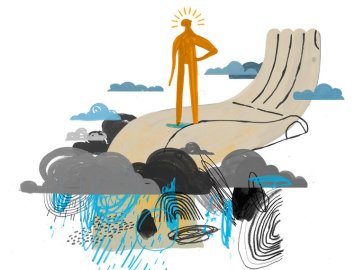
But then, third, he begins to talk about who needs to do what to resolve this dilemma in our contemporary world of politics. To my mind, that is where the wheels come off of Lind’s argument. He wants candidates to tell voters what they need to hear. You don’t win elections that way.  You forfeit elections that way.

Good jobs and the good life

Let’s get a little clarity on the key terms. By “good jobs,” Lind means “jobs with solid wages, regular hours, and, perhaps, generous employer-provided benefits.” If you wanted to talk a little more expansively about what “good job” ought to mean—and ordinarily, I do—you would want a lot more than that. But Lind is right that in the current climate, when people use the expression “good jobs,” they mean something like wages, hours, and benefits.

“Good life,” is, as you would expect, a little trickier, but here is what Lind means: “access to the basic goods and services that define a decent life in a modern society.” [2]

Now the point of Lind’s article is perilously like the crucial moment in the story of Dumbo, the elephant who can fly if he thinks he can fly. If he thinks it is the feather that enables him to fly, he has to have that feather. Let me explain. I’m going to be pushing Lind on who is going to deliver the mouse’s line, but I really like his description of the situation.

The “how to fly” team

To begin with, there is a “how to fly” team. Lind describes a consensus among “bipartisan experts” as one component of that team. The other, as you will see in the quote below, is legislators. (Not candidates, please note.) By “legislators,” Lind means to point to the people who are actually defining and funding programs.

Bipartisan experts tend to agree that the decline in employer-provided benefits and the rise of unconventional work arrangements are trends that should be accommodated, by reforms including new portable benefits and expanded income maintenance programs, like tax credits for low-income workers.

For several decades, this consensus has been reflected in what legislators have actually been doing. Slowly, incrementally, Americans have been moving away from a system in which a good job with a generous employer was the key to having a good life to a new system in which even people with low-wage jobs can have access to the basic goods and services that define a decent life in a modern society.

So this sounds pretty good, right? The old sources of “good jobs” are decaying, but slowly, legislators are moving to “a new system in which even people with low-wage jobs” can have good lives. So what does that actually look like? What programs are we talking about.

Here are four.

One piece of the new system includes the earned-income tax credit, a means-tested wage subsidy that has enjoyed bipartisan support since its creation in 1975.

And then there are new kinds of jobs.

Another example is provided by jobs in the health care and social assistance sector. These jobs are projected to grow much more rapidly than the average for all occupations, increasing by 38 percent between 2012 and 2024 and accounting for 3.8 of the 9.3 million new service sector jobs.

And besides that.

The Patient Protection and Affordable Care Act — Obamacare — enacted into law in 2010 sought to ensure that all Americans without employer-provided health insurance had access to affordable health insurance, through either Medicaid, state-regulated exchanges or a federal exchange.

And furthermore.

Here again, many Democrats and Republicans agree that the answer [to the reduction in families who save for retirement] is to detach retirement security from particular employers, though it should still depend on how much you work. A number of states have considered creating state-sponsored retirement savings plans for private sector workers without employer-provided retirement savings plans. California, Illinois, Oregon and Massachusetts have already established such programs.

If we just relied on that, Lind says, we could fly. Look ma. No feather!

Problem One: No feather

There are two problems we have to deal with for this Dumbo scenario to work. The first is that voters are stuck on the magic feather. Here’s what they mean, according to Lind.

The kind of jobs voters want exist in:

“a world in which one or a few lifetime jobs in a paternalistic company that provided benefits during your working life and a pension after your retirement.”

good-job-1That’s the feather. That’s how you know you are flying. And I think a “magic feather” is a really good symbol for this effect because this kind of a world is not something that individual workers can do or groups of workers can do. It is not something a candidate supported by the workers can do. It’s “magic” and the symbol of the magic is the feather.

 

What voters see when they look at the future is this:

“…individuals struggle to survive by piecing together “gigs” and “tasks” with a bewildering variety of federal, state and local social programs may strike many workers as a dystopian nightmare. The price of increased flexibility may be increased stress.”

In short, they don’t see anything like a feather. So the voters decide that they can’t fly after all and they fall. We fall.

Problem Two: No mouse

So now we go back to the story, the part where the mouse confesses that the whole “magic feather thing” was a fraud and that Dumbo doesn’t need it. He can fly in a new way. [3] What Lind wants if for someone—“politicians,” he says, to step up and play the part of the mouse. He wants them to tell voters during the campaign that all that stuff about “good jobs” was just a fraudulent feather; that they really can fly without it. I don’t see that happening.

So we actually can fly and everyone is allowed to say that except candidates for office.

Donald Trump “proposes to protect American workers from competition with illegal immigrants, the offshoring of jobs by United States-based corporations and harmful practices by trading partners like China.”

Hillary Clinton “promises ‘the biggest investment in good-paying jobs since World War II’ by means of a mixture of tough trade negotiations, investment in domestic manufacturing, infrastructure investment, research and development, regulatory relief for small business, debt-free higher education and a tax credit to subsidize apprenticeships.”

It is clear that Lind is counting on the mouse. “Politicians should tell working Americans what they need to hear, not what they want to hear.” It is also clear that neither of the two major candidates is going to say, in the middle of a campaign, that we don’t need that old magic feather.

Rousing conclusion

So here we are. We are Dumbo. We think it was the feather that enabled us to fly. That’s the good life/good jobs illusion. But a team of policy wonks and legislators—bipartisan groups, both of them—have devised a way for us to fly without the feather. We can live the good life now with “bad jobs,” or what we used to think of as bad jobs.

good-job-5All we need now is the mouse. But politicians, people who are actually running for office and who tell voters “what they need to hear,” lose . And not only do they lose, but they also take a lot of other candidates down with them, candidates much further down the ballot.

So this isn’t really cowardice, which is what Lind seems to think. It is responsible leadership. They have good reasons for not telling voters the bad news and the good news. The bad news is that the whole “feather thing” is gone and isn’t coming back. The good news is that we don’t need it any more.

But we do need that mouse.

[1]New America is a think tank and civic enterprise committed to renewing American politics, prosperity, and purpose in the Digital Age. We generate big ideas, bridge the gap between technology and policy, and curate broad public conversation.
[2] I I think that I, personally, would prefer to talk of “a good life” as a life that combines personal wholeness, meaningful social interaction, and life in a polity characterized by justice, at least, and by trust and solidarity at most.
[3] The “new way” for Dumbo is, from an aerodynamic standpoint, exactly the same as the old way. He has these enormous ears and he can use them to fly. But aerodynamics isn’t everything. Dumbo can fly because he thinks he can fly and the feather is the outward symbol of that ability. So the “new way” is flying without believing it is the feather that is doing it.

Posted in Political Psychology, Politics | Tagged , , , , | Leave a comment

Look like what you mean

The great thing about fighting a war with intercontinental ballistic missiles is that you don’t have to know a lot about your enemies. You load up a barrel full of destruction and heave it off to “do bad things” toslutty-2 the bad people over there. Of course, there are other things that are incredibly bad—like when an ICBM lands on you, sent by people following the same script. Still, firing them off is a pretty tidy action.
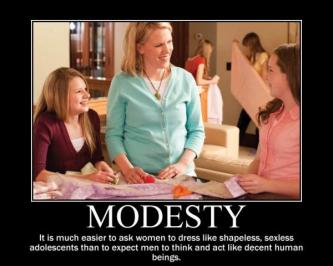
The nuclear exchange model

I discovered just last week that there is a “SlutWalk” in Portland which is supposed to serve as a retaliation for remarks made in Toronto in 2011. Seeing Portland’s response as retaliation is what brought an exchange of ICBMs to mind. In Willamette Week, a local paper, Marty Smith wrote an article about it. He provides this much background.

In 2011, a police officer named Michael Sanguinetti told a campus crowd in Toronto that female students “should avoid dressing like sluts in order not to be victimized.”

First, without going into the merits of his argument, I want to recognize Sanguinetti as a Man of Courage. He went onto a college campus and said either a) that women are sexually abused because they dress provocatively or b) that they would not be abused if they did not dress provocatively. If he said either of those things, then he came very close to saying that “women who dress like that get what they deserve” or that the men who abuse them are free from any blame because they could not help responding.

I don’t know if that is what Sanguinetti had in mind, but if he did, I think that was the initial ICBM strike. Portland’s response was predictably bellicose. Marty Smith puts it this way.

SlutWalk was founded in response to these remarks: The “slutty” attire worn by marchers proudly asserts a woman’s right to wear (or not wear) whatever she chooses without being shamed for it.

looks like an ICBM counterstrike to me. Women have the right to wear anything they want without “being shamed” for it. The interesting thing to me is the sudden shift into the passive voice. The women are “being shamed” by someone. That means at the very least that someone is telling these women that they shouldn’t be wearing such an outfit. It may mean more than that. The great thing about the sudden introduction of the passive voice is that it enables us to single these “shamers” out for…special shame, I suppose.

So the nuclear exchange could be summarize like this. Strike 1: Women who dress like sluts and are abused as a result are getting what they deserve. [1] Strike 2: Women have the right to wear whatever they want without fearing adverse consequences.

The communication model

So I have an idea. Maybe nuclear exchanges aren’t the best way to approach this issue. I think conversation might be a better metaphor. “The way I present myself,” or just “what I wear” for today’s essay, is something I choose to say about who I am and what my intentions are. What I say is not gobbledegook; it relies on broadly accepted meanings. [2]

Here’s a very helpful example from a piece by Peggy Orenstein in the New York Times, which you can see here.

An economics major taking a gender studies class is getting dressed in her college dorm room for a night out, cheerfully discussing sexual stereotyping in advertising with Orenstein — while at the same time grabbing a miniskirt and a bottle of vodka, the better to achieve her evening goal: to “get really drunk and make out with someone.” “You look hot,” her friend tells her — and the student, apparently registering the oddness of the scene, turns to Orenstein. “In my gender class I’m all, ‘That damned patriarchy,’ ” she says. “But . . . what’s the point of a night if you aren’t getting attention from guys?” Her ambition, she explains, “is to be just slutty enough, where you’re not a prude but you’re not a whore. . . . Finding that balance is every college girl’s dream, you know what I mean?”

Please note that what she calls “every college girl’s dream” is not getting laid or not getting laid. It is navigating between two “looks,” each of which will be meaningful to others and both of which she rejects. She wants to say something about herself—“just slutty enough,” is what she is after. She knows the look (or thinks she does) that will convey “whore” and she is trying to avoid it; she knows the look that will convey “prude” and she is trying to avoid that as well.

This girl is a terrific example of the system I would like to see in place—the conversation system— as opposed to the nuclear exchange scenario I described and rejected first. And here’s another one. This one comes from a site called Aggie Catholics and the message I want to share here has been devised by Kristine Cranley for a very conservative setting. The reason for what Cranley calls “modesty” is this:

First of all, I want to assert that the reason we dress modestly is NOT [the caps are in the original] because our feminine bodies are bad or ugly or intrinsically ‘occasions of sin’. Simultaneously, it is NOT because all men think about is sex, or that they are incapable of looking at us without lust. Rather modesty involves speaking the truth with our bodies. …Whether we intend to or not, revealing too much of our bodies sends a message that we are sexually available to them.

The quotation is accurate.  I put the bold font in myself.

I like that approach in the sense that it is a communicative, rather than nuclear, approach. Don’t send a message you don’t want to send. Furthermore, as Cranley says later, “modesty involves speaking the truth with our bodies,” and I think she is right for the audience she is addressing.

lust-6The woman who is trying to look “just slutty enough” is an example of the communications paradigm. The women who are dressing modestly so that they will send the message they want to send are, likewise, examples of the communications paradigm. And when Cranley complains: “Too loose. Too tight. Too low. Too high. Who teaches us about these things anymore?,” she is complaining about a lack of the vocabulary that will enable women to say what they mean.

Sooner or later, some reader is going to point out that men have a vocabulary as well. I am inclined on theoretical grounds to say that is very likely true, but i have no idea what it is. My sense of the courtship exchange is—with a notable exception I am going to describe before I give this up—is that women dress in a way that says what they want and men respond by going up and saying, “So…let’s follow up on your suggestion.” I know that is crude, but my understanding of the interaction is crude. [3]

Doing it Right

On the other hand, no man is required to follow the lead a woman provides. I have an example in mind. A student of mine at the University of Oregon was set up on a blind date by some friends of his and her. In preparation for the meeting, her friends—through ignorance or a desire for entertainment—talked the woman into dressing very seductively.

As Kristine Cranley laments, no one teaches anymore about “too loose, too tight, too low, and too high.” And if that was the case here, the woman was being forced to say something about herself by friends with no knowledge of either the vocabulary or the syntax of the situation. She went downstairs to meet this student of mine “dressed slutty” but without any slutty intentions.

The man kept his head and said something that his buddies would have mocked him for if they had ever learned about it. He said, “My friends and your friends said we would like to get to know each other. I don’t think I can get to know you while you’re wearing that. Would you mind changing into something that would give us a better chance to get to know each other?”

I don’t think a date had ever said anything that pleased her as much as that did and she said as much when she told me about it. She presented herself (unwillingly) to him as an “it.” He responded by asking if she would be willing to be addressed as “you.” She happily changed into something that did not detract so forcibly from the project of getting to know each other and they went out together. [4]

This is the best story I know about sexual interaction considered as communication. In the nuclear exchange model, she would have demanded to dress like a slut but not to be treated like a slut. He would have claimed the right to treat her like a slut because that is what she was asking for.

I am not pitching, in this essay, sluttiness or modesty. I am pitching communication. I think it is better than blowing each other up.

[1] With charity toward Mr. Sanguinetti, I think it is only fair to imagine that he might not have said that. He very likely said something that could be caricatured in that manner, and when you speak in public on matters about which other feel strongly, that happens.
[2] Even within the conversation metaphor, we take it for granted that words have common meanings. In the present instance, “slut” means the same thing to both ICBM communities. They want to do different things, but they rely on the word to mean the same thing.
[3] In my defense, I will say that this unsubtle narrative in which the woman signals her readiness for interaction and I respond by opening a conversation is all I know from my own knowledge. Of course, I have read books and seen movies where other, more aggressive, styles of interaction are pursued. Also, I have the stories told by friends and it is always possible that some of those stories are true.
[4] And, several years later, married each other.

Posted in Communication, Uncategorized | Tagged , , , , , | 2 Comments

Biases, folded in and folded out

Where on earth did we get the idea that we ought to be unbiased? Or that we could possibly be unbiased? I have never understood that. [1]

There was a time, not all that long ago, when everyone in the village was expected to hold the same views, particularly about “us” and “them.” Now we are beginning to formulate a standard that holds the each of us should have perceptions and lines of reasoning and conclusions of fact and value that are based on extensive study. That is, in fact, what being “unbiased” would require.

How on earth did we come to such a place?

bias-2Emily Badger has a really interesting column in the New York Times for October 6 in which she refers to the term “implicit bias” as “one of the newest chew toys in the presidential campaign.” At the level of actual discourse—Ms. Badger was referring specifically to the Vice Presidential debate between Mike Pense and Tim Kaine—here is what all the chewing comes down to. Kaine represents black voters who have everything to gain by pointing out the extent of the bias against them. Pense represents white voters who are sick and tired of being accused of having biases they don’t even know about.

I find both of those views entirely understandable, but then, I can afford to. I am not seeking the allegiance of any voters at all. I would really like to see a long-running and profitable public discourse on the status of ethnic and racial minorities or of sexual minorities (of the two most common gender statuses, that would be men) or of old people or fat people.

Shall we start the conversation by determining just who is biased? Here’s a comment from Emily Badger’s column.

The science of how this submerged bias affects your actions is still a work in progress; studies have found a link between the biases and specific actions in some situations but not others. But because this bias is a function of universal human psychology, researchers say, we all experience it — and you can’t exactly get “rid” of it.

So I’m biased and you’re biased. How shall we begin the conversation? Could we, possibly, begin with the biases that have effects on the kind of conversation we could have? Let’s see. I think you are African-American and therefore stupid and lazy. You think I am a white person and therefore a racist and a bigot. Does either of those sound to you like a good place to begin a conversation. I would say a conversation that starts there is doomed before it even begins.

We could, I suppose, compare how harmful our biases/prejudices are. “Your biases are more harmful than mine! No, how can you say that? You know that yours are more harmful than mine!”

I wrote that exchange to sound silly and I think you will have to agree with me—it bias-1does sound silly. On the other hand, it is a step forward—a step toward an enduring public conversation—better, that is, than debating whether we have any biases or not. This silly exchange focuses on what the effects of the biases are, which is a conversation worth having, rather than whether there are biases.

Interpersonal Conversation

So here’s an idea that would work really well in interpersonal conversation. I am going to attempt to ignore all the biases you hold, including some that you treasure, if they do not impede the path of the conversation. You will do the same. There is now a subset of all our biases that will need to be recognized and dealt with—likely a very small subset.

Maybe an example would help. You and I want to have a conversation on how to counteract every influence on academic performance at our local grade school except interest and ability, Kids who like learning (in any of the modes it is offered at our local school) will do better than those who do not. Fine. Kids who are really smart will do better than those who are not. Fine.

But gender, race, class, and family status should not be allowed to constrain the natural expression of any child’s ability and interest. So we work together on how those can be accomplished. And in our conversation, my food preferences (and your attitude toward my food preferences) and your taste in clothes (and my attitude toward your taste in clothes) and my authoritarian attitude toward raising my own children (and your attitude toward my parental style) will all be set aside.

Needless to say, the fact that you are a right-leaning Trump supporter and I am a left-leaning Sanders supporter, now sagging back onto the Clinton team, will also be set aside.

That’s my program for interpersonal conversations where there is a common goal. In the setting I just described, there are two common goals: one of ends and one of means. The substantive goal is that we change the educational climate of the local grade school which your children and my children attend. The procedural goal is to have the kind of conversation that enables us to settle on a program of action and purbias-4sue it over time.

Conversation in Groups

Conversations in groups can follow this same sensible protocol PROVIDED that there is agreement on the ends and the means AND there is someone in the group who will call attention to the inevitable violations of the norms the group agreed to honor.

That would be an astounding achievement in the current political and social climate, but you may think I have lobbed a softball up toward the place just so I could hit it out of the park. So let me rephrase. You are asking the participants in this group to collaborate with evil people—under ordinary circumstances, “the enemy”— and to be complicit in conversations full of lies and slurs and half-truths and massive ignorance of the facts.

Yes, that is what I am asking. And further, I am asking that this be done over and over, at conversation after conversation, until the job we share is done. That means that just “enduring” these conversations is not going to be enough. If participating in one such conversation uses up 10% of your reserve, how many of those do you think you can take before you bail out. [Hint: the correct answer is considerably less that 10: you don’t bail out when you have used up your resources but when you see that you are going to.]

Debates between Parties

Only one step to go. Let’s go back to Mike Pense and Tim Kaine. Let’s imagine that neither of them is a bigot or a nanny—neither one who believes in vile racial stereotypes or one who takes it on himself to punish lapses in political correctness. They could still say exactly what they said in the debate because they are trying to mobilize indentifiable sets of voters. It’s their job.?

But what if it were not their job? What if they refused? What if they made a show of their amiable collegiality before and after the show? What is the principals—Trump and Clinton—did not require their vice presidential candidates to serve as rabble rousers? What if the Democratic National Committee and the Republican National Committee refused to condone that kind of behavior by their candidates?

I’m not proposing any of those. I’m just trying to illustrate how far we would have to go to affect the partisan morality plays that fill up our campaigns.

Or what if the rabble-rousing we left to marginal parties. Let me offer a homely example. Car dealerships in Oregon are now advertising that their sales force are salaried. What does that mean? It means that they are not required to strong-arm customers in order to make a living. They can afford to be courteous and knowledgeable because they are going to receive their salaries whether they sell you any cars or not. [2] This is an opportunity to demean the dealerships when a customer walking onto the sales floor is treated like a piece of raw meat.

Following that same logic—you can call it snobishness if you like—the major parties, currently the Democrats and the Republicans, will identify themselves as the “salaries sales force” kind of organization. We argue for the superiority of our candidates and our platforms, but we don’t treat our opponents like enemies and we don’t appeal to the base instincts of the rabble. They do—those “fringe parties”—but we don’t.

bias-6Or imagine that the standard of behavior of major league baseball players was very high and those of minor leaguers notably lower. When the minor league player is called up to the majors, he does not want to flaunt his ignorance and naiveté. He wants to behave “the way we do it at this level.” He wants to look like the guys he knows belong in the big leagues.

So the fringe parties—whether Marxist or environmental or nutritional or xenophobic—are free to bash and slash, thereby identifying themselves and their programs as bush league. [3] But if they were to aspire to serious social standing, if they wanted a place at the table, they would have to act like the grownups.

Please note that is proposing these changes, I am not asking for anyone to be better than they are. I am not asking for a raising of moral standards or a return to the public probity we associate with a bygone era. I am asking only that people continue to do what works. I am proposing a social setting in which “what works” is less noxious to the participants and less toxic to the republic.

So…I’ll tell you what. Indulge in all the implicit biases you have and all the finger-pointing you like so much—provided that it does not impede the job you and your colleagues are trying to do. If there isn’t anything you are trying to do, you might want to ask why that is.

[1]  The Latin verb plicare is the source of all this.  It means “to fold,” so implicit biases are “folded in” and explicit biases are “folded out” where everyone can see them.

[2]  I am not describing here how sales people who don’t sell cars are treated by their employers.  I am describing the appeal of that way of pitching the company.

[3]  No offense is intended toward either of the Presidents Bush or to the recent Republican candidate for his party’s nomination.

Posted in Politics, Sustainability, Words | Tagged , , , , , , | Leave a comment

Yesterday when it is past

Today I would like to tell you about some surprises I have encountered in moving from one kind of life to another. That sounds more momentous that it would really need to but I am going to start with a passage from the Psalms and I thought that sentence could afford a little extra gravity. Here’s the passage (in the King James, which I nearly always like best for psalms).

Psalm 90:4 For a thousand years in thy sight are but as yesterday when it is past,and as a watch in the night.

That verse kept coming back to me as I was writing the first draft of this essay and now I think I know why. Look at the expression “yesterday when it is past.” As I am considering it in the light of today’s reflection, I note that “yesterday while it is still happening” is going to look and feel very different.

So from my standpoint, “today,” I look back and reflect on yesterday and I know that the reflection is distorted. “Yesterday when it is past” seems like a blip. While it was happening, it felt like a parade. There is no value at all in asking which it “really was.” This is a distinction that bears entirely on how it seemed. “Yesterday when it is past” is a beautiful and engaging way of saying “brief.”
I turn now to the new life/old life distinction. Briefly, after living in the same house on the west side of Portland for a very long time, Bette and I moved to a retirement center on the east side of Portland. [1] Part of the newness is living in a very attractive and welcoming retirement center rather than in an attractive and welcoming neighborhood. But another part is that all the things that are really familiar to us are now “over there” and we have to go to them.

We had a really good life on the west side and have begun a really good life here on the east side, so the natural question is how to go about keeping the best of the old and adding to it the best of the new. I’ve been turning this over in my mind for the last several years—what Bette calls “hyperprocessing” and I call “being intentional”—and I had the general outlines of a strategy in mind.

If it is true, however, that there is a distortion of “how things seem” depending on where in time you are standing—“yesterday when it is past”—then all that planning is going to produce more surprises that accurate predictions. And it has.

Let me use my beloved Multnomah Village Starbucks as the example that representsneighborhood-1the whole “old life” construct. My practice used to be to hit Starbucks twice each morning. I would drive over around 5:30 or 6:00. I’d get coffee for Bette and me and come home to write things like this. Then I would walk over (about a mile) intending to get there about 7:30 for the meeting of “the Northwest Corner Caucus.” [2] And then the other caucus participants and I would do whatever happened that morning.

It was a really good experience and I had no intention of giving it up just because I had moved across the river and Bette and I were down to one car. There are perfectly good public transit alternatives and I practiced them just to be sure. So I announced that my plan was to be there at the regular time on Tuesdays, Thursdays, and Saturdays. I was counting on being there predictably as an adequate substitute for being there all the time.

It isn’t.

The caucus still meets and I still get there at 7:30 on the appointed days and I still like everyone just as I did before and they still like me just as they did before. But I am a guest now. My many years at that Starbucks—and the Hillsdale Starbucks, a mile to the east, before that—are like “yesterday when it is past.” The distortion that distinguishes “today while I am experiencing it” from “tomorrow as I am imagining it” fooled me. When you get to tomorrow, you discover that yesterday looks different than it did when you were living it.

Then I started thinking about the mechanism by which that shift occurs. That second thought—how does that happen?—follows almost immediately after “what just happened?” for me. [3] And then, following a feeling more than a memory, I went back to the breakup with my very first girlfriend.  This is not that girlfriend, but that girlfriend was, in fact, a redhead as is my current…um…girlfriend.

neighborhood-3I was a senior in high school. She was kind of a “practice girl friend” for me and I was a practice boy friend for her. It was a new and exciting kind of relationship but as the school year was winding down, we both looked at the relationship and realized it wasn’t going anywhere. It was a generous and thoughtful and collegial decision and we were both satisfied with it.

There was one small problem. This was a very small school—an academy in rural Pennsylvania— and “who was going with whom” and particularly “who was breaking up with whom” were really big topics. My girl friend and I agreed that we would save ourselves a lot of grief if we would just pretend to continue being boyfriend and girlfriend for the remaining two weeks of school. What would be so hard about that?

In that experience, I learned something I would never have suspected. The excitement in a romance comes from where you think it is going. You “borrow” a lot of the emotion from things you think are going to happen or that might happen in your common future. Events are not merely pleasant, but also significant. They “foretell the future” in a hamhanded sort of way. And when you know there is not going to be a common future, the air just leaks out of the balloon.

neighborhood-10Now, I do not have any girlfriends west of the river. I brought the only girlfriend I have with me to the east side. But I have a lot of friends over there and being with them has reminded me of my first girlfriend and the fading of a relationship with no future. If it is really true, as I learned in high school, that what we call “the experience of a relationship” is in fact part experience and part expectation, then I should have imagined that when you remove the expectation part, the experience part would start to lose its color and snap. [4]

Is it something like an aura of engagement that stays bright when you know you are going to keep on seeing someone and keep on valuing them; and then that starts to dim when you don’t see them as often? Is it something like investing in a fund and drawing from it what you need and then, later, just drawing from it. The opportunities for investment are only occasional and continuing to draw from the fund now shrinks it? Is it like that?

On the other hand, some such mechanism works in the other direction here. Every new part of the life here I try out—I went swimming at 4:00 a.m. a week or so ago—could be the beginning of “a practice.” Every new acquaintance could be the beginning of a friendship. Each new setting that seems to invite one sort of behavior but that also undercuts it, it a delicious new dilemma to consider.

Over here is not “yesterday when it has passed;” it is “tomorrow as I prepare for it.” Is that a distortion? Yup. No one anticipates or remembers without distortion. No one. But I think this distortion is going to be working in my favor. That’s how I feel about it today and, more important, that what I think really ought to happen.

It’s the way the machinery works.

[1] Long before I ever lived in Portland, I learned about the east side/west side neighborhood-7distinction from a Portland guide book. It opened with a completely straight-faced joke about a man who came to Portland and got a job and worked hard and saved his money and eventually was able to move to the west side. He married and started a family and then began again to save money so he “could bring his mother across.” First I said, they didn’t really mean that and I read it again. I decided that was exactly what they meant. Then I said, “Ooooh. I want to live in a city that thinks that is as funny as I do.”


[2] Imagine “the caucus” as a pool of people, some of whom will show up on a given morning with the expectation that we will talk about whatever is on our minds—some collection of personal tidbits and public issues—and practice “civil discourse.” Just how we arrived at the practices of what we call “civil discourse” is another story.
[3] Some say it is a character flaw; I say it is my graduate training.
[4] Of course, over here the machinery works just the other way around. A conversation I just had here on my front porch was pleasant enough, but it also laid down markers for other things that might be important in the future. This conversation carried significance. Significance of what, exactly, I don’t know yet, but I am hot on the trail.


Posted in Getting Old, Living My Life, ways of knowing, Words | Tagged , , , , | Leave a comment

Both Sides Now

There are 127 apartment units at Holladay Park Plaza. [1] I Three of them have both an east view and a west view. Bette and I live in one of those. We can see “both sides now.”

IMG_0389.jpg

The sunset picture is completely genuine. I took it from my front porch—the public area just outside our apartment door where I am, in fact, writing this. I took it because when our friends Frank and Joan McNamara were visiting us, Frank looked out the window at the collection of buildings that is prominent in this picture and said, “There’s your new notch.”

I saw it as soon as he said it, although I don’t know how long it would have taken me to come to it myself. The “old notch” was Grindstone Ridge, a prominent dip in the Coast Range that was visible from our Dakota Street house. All the Bookies—members of the book group we started in 1983— including Frank and Joan, had, for many years, sat on our deck in September to celebrate the sun’s setting in that notch. We invented a gruesome Spanglish name for the event: we called in Buenos Notches Dias. [2] And to celebrate it, we invited friends in for…nachos.

When we moved over here, we were prepared to say goodbye to the notch and to Buenos Notches Dias. Even, perhaps, to the nachos. Sad, I thought, but not one of the great catastrophes of our time. And when Frank said what he said, I began to be alert for just when the sun would set in our new “notch,” which is formed by the Lloyd Center Tower on the right and the Lloyd 700 Building and Kaiser Permanente tower on the left. One of the days it sets nicely into the new notch is September 28.

IMG_0384.jpg

The sunrise picture is completely genuine. It was taken facing east from Holladay Park Plaza and features Mount Hood, as it should. On the other hand, the east view from our apartment, which in on the fourth floor, [3] is entirely innocent of Mount Hood. This picture was taken from the penthouse level (16th floor) and this is what it looked like yesterday. The sunrise picture and the sunset picture were taken on the same day.

It is not accidental, it turns out, that people like me can go up to the highest floor and walk out onto the roof patio and take pictures like this. At Holladay Park Plaza, as everywhere else, the higher floors are justly prized for the view they offer. It’s hard to get an apartment on one of the upper floors because they are very much in demand.

But the Penthouse belongs to everyone on the same grounds that Oregon’s magnificent beaches belong to everyone. The highest and best floor is “reserved” for everyone. It is a common area although, as you see, the view of what Portlanders call “the mountain” is anything but ordinary. You have to wait a long time to get this prospect from the 15th floor, but it is there for anyone anytime on the 16th floor.

There is no law that protects access for all the residents to the Penthouse level. There is, of course, a law that protects access for all Oregonians to Oregon’s beaches. So the two are different in that way. But I think the instinct that leads us to “save the best for all of us” is what shows up in both cases. And I like that.

[1] What number you want to use depends a little on what you have in mind. For today’s use, I am including all the independent living apartments and excluding both of the floors of the South Tower that are there for residents needing special treatment of some kind. So this number counts the Holladay North (a separate building) the north tower (north of us) and the south tower (south of us) and the bridge between them, which is where we live.
[2] The choice of names was not entirely innocent. We had a Spaniard living with us at the time we named it, and the “Spanish” in the name was so truly bad that, although he tried to be playful about it as the rest of us were, caused him real distress.
[3] The top floor of the bridge (between the north and south towers) is only four floors high. We live on the top floor of the bridge.

Posted in Living My Life | Tagged , , , , | 1 Comment

Official Sexism

As you can tell from the title, I have a grievance in mind for today. After such a long struggle for gender equality, it grieves me that we have given it up so easily.[1] Ah well.

sexism-4This morning, I had a truly wonderful experience at the Multnomah County Courthouse. I was summoned to be part of the pool of potential jurors and I gave them from 8:00 a.m until 11:30 a.m. so I was available to be chosen. I was not chosen, so I will be back at the courthouse at 8:00 tomorrow morning to give them a second chance.
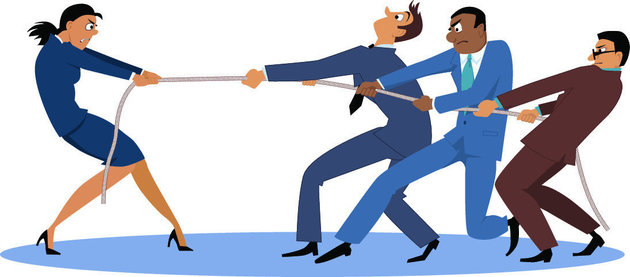
Today’s reflection is almost entirely positive. You wouldn’t know it from the title of this essay, but then, there wouldn’t be an essay about this experience had it been all positive. The juror’s orientation included a remarkably good speech by Judge Kenneth Walker. I liked it that they asked a judge to give the orientation; I thought it showed that they were serious about it. The speech itself was very good. It was funny without being frivolous; it allayed the fears of potential jurors without making the choices we might be asked to make seem inconsequential. The continuing management of the roomful of jurors by Mayami and Julie was done competently and in good humor.

Judge Walker did say something I objected to, but we’ll get to that later.

They also showed us a video made by the Oregon Department of Justice and I thought it was every bit as good as Judge Walker’s speech. It took us through the whole process in a realistic way. The actors represented nearly the whole spectrum of Oregon residents, including not only various ethnic affiliations and gender statuses, but even some strikingly large people. What they often call “size-ism,” to make it seem like “sexism,” was nowhere to be found there.

Judge Walker told us that Multnomah County has 38 judges, 20 of whom are women and 18 of whom are men. He called that “parity,” although it is not, but I didn’t care because I think of parity in a general way. Equality, plus or minus 5% is fine by me, or equality across the span of time. The word means 50/50, but I think that’s asking a lot and I don’t ask it.

Then, in summing up he said that we could go home and tell our daughters that they had a better chance of being judges in Multnomah County than our sons do. There were appreciative chuckles. I think Judge Walker imagined that he was simply specifying the consequences of what he had earlier called “gender parity.”

sexism-2But this is different. “Women have a better chance…” and this is a good thing. Really? Let’s see: “Men have less of a chance…” and that is a good thing?  Really?  The first statement is a commonplace. [1] I have never heard the second said out loud although the meaning is exactly the same. This rooting for the comparative success of women is a new thing, it seems to me. Maybe the sports metaphor comes easily to mind because of the Olympic games, but I hear people rooting for the success of women in the same spirit that they root for the success of American athletes generally.
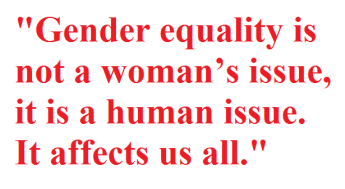
Someone could say that a win for America is good for us all because we are all Americans. I know that is stretching the sentiment a little, but it is not an incomprehensible sentiment. No one could say that a win for “women” (remember that this is a comparative question now: a winners and losers question) is good for us all because we are all women.

Picture one of my fellow jurors from this morning going home to his children, a boy and a girl, and saying, “Good news for us all, kids. Sally here has a better chance of becoming a judge in Multnomah county that you do, Robert.” Just sit with that a little. It’s ugly and uncomfortable and it’s sexist, but let’s just sit with it a little.

You cannot be a partisan of women and a partisan of equality both. You have to choose. You could say, of a a prestigious vocation, that even though men and women are equally attracted to it, there are twice as many men as women members. You could express the hope and you could take actions leading to increasing the percent of women in that vocation and you could do all that in the name of gender equality. But as you watch the percentage of women in that profession move up from 35% to 45% and then to 55% and express the hope that the trend continues, you have left equality concerns behind. You are now a partisan, not of equality, but of women. Your partisanship necessarily includes, since these are comparative measures, hoping for and working for a loss of the number of men in this vocation. We have, apparently, “too many men.” Why is that?

Some will say that the mistake Judge Walker made today is an easy mistake to make.sexism-3 Granted. Some will say it is easy to mistake hoping for advances for women for hoping for the disproportionate success of women—and, of course, the failure of men. I know it is an easy mistake to make and I don’t hold bad feelings against Judge Walker for making it. At the same time, the standard itself is sexist and reprehensible and I think it deserves to be vilified. Judge Walker does not, but the position that he, perhaps inadvertently, advanced, does deserve it.

OK, let’s all take a breath and remember that it’s easy to make a mistake. My concern is for the standard we are being asked to value and support. If I thought we all agreed about that (I don’t think that), I wouldn’t even have written this piece.

[1] “Equity,” meaning “fairness” is another matter entirely. It is not at all difficult to be in favor of fairness, unless and until you need to be specific about how it is to be measured. If it is not 50%, you will need to explain why. If it is 50% it is the same as equality, so it doesn’t really add anything.
[2] Meredith Viera celebrated how many women were on the U. S. Olympic team this last summer by saying how high the percent of women athletes was. I think she said 54%. And expressed the hop that it would get even higher. I didn’t get a chance to ask her why that would be good.

Posted in Living My Life, Society, Words | Tagged , , , , , | Leave a comment