
So many kinds of things go on in a Protestant worship service. [1] Calling it “a worship service” is almost a courtesy, but I like the term because it expresses our highest hopes about what we are doing there. Or maybe only the best hopes we remember having.
So “worship service” might almost be called a term of aspiration, rather than of description. It is not so much what we do as what we aspire to. What we actually do might be better described as a variety show. There are “acts” of all kinds to suit all sorts of tastes. There are the high holy moments and the low holy moments. The attention of the congregation comes together in a sharp focus, then drifts away. [2]

I’d like to explore this notion by considering three moments in the recent worship services in my church, the First Presbyterian Church of Portland, Oregon. I don’t mean by choosing these three to imply that other important things were not happening. There may have been a challenging sermon on that morning, or the reading of a thought-provoking scripture, or a children’s sermon that engaged the children and that had an additional track of meaning laid down for the listening adults.
I am choosing these three things because they are like the beds in Goldilocks and the Three Bears. One is too hard and one is too soft and one is just right. [3] I want to look at the Prayer of Confession, at the Affirmation of Faith, and at our common recitation of the Lord’s Prayer. And so you won’t need to maintain the suspense, the affirmation of faith is too hard, the prayer of confession is too soft, and the Lord’s Prayer is just right.
The Affirmation of Faith
We use quite a few different texts in our service, but recently, we have been using the Confession of 1967. The Confession of ’67 was not intended to be read in unison. It is not well-adapted to that use and we do it very badly. In addition to that, it is used as an auxiliary sermon—not to give us a chance to say what we believe, but to tell us what we ought to believe.
Here’s part of the section we read last Sunday.
The institutions of the people of God
change and vary as their mission requires in different times and different places
The unity of the church is compatible with a wide variety of forms,
but it is hidden and distorted when variant forms are allowed
to harden into sectarians divisions,
exclusive denominations, and rival factions.
Compare that, just to get the flavor of the two, with the first and last lines of the Nicene creed:
I believe in one God, the Father Almighty, Maker of heaven and earth, and of all things visible and invisible….and I believe one holy catholic and apostolic Church.. I acknowledge one baptism for the remission of sins; and I look for the resurrection of the dead, and the life of the world to come.
Although the Confession of ’67 is set into verse form, presumably to make it easier to read, it is not easier to read. Nothing you can do with the last three lines of the Confession of ’67, beginning with “but it is hidden…” will align the sense and the sound of the lines. By contrast, everything in the Nicene creed falls naturally into spoken patterns.
The Confession of Sin
On the other hand, the our church—that includes the people who write the prayers by which we confess our sins together—have not been able to find a form for that confession. The old style (a very attractive example follows) was bold and without any amelioration at all. “We have sinned in thought, word and deed.” Not much wiggle room there. “We have done that which we ought not to have done and we have left undone those things that we ought to have done.” So again, nowhere to hide.
Here is one from a recent week. It seems so beautiful to me that it is hard for me to say it aloud.
Gracious God, our sins are too heavy to carry, too deep to undo.
Forgive what our hearts can no longer bear.
Set us free from a past that we cannot change;
open us to a future in which we can be changed;
and grant us grace to grow more and more into your likeness;
through Jesus Christ, the light of the world.
It is meant to be read together and you see how congregations are invited to do that by parallels like “too heavy to carry” and “too deep to undo.” The admissions are bold, but then, so are the remedies. “Set us free…” and “open us to a future” and “grant us grace” are sweeping. The theology is orthodox. The appeal of the words themselves is enticing.
Despite my radically individualistic upbringing, I find I like that uncompromising tone. It bookends nicely, for one thing, with the Affirmation of Faith, in which we “confess” those things we aspire to believe whether we actually do at the moment or not. In the Confession of Sin, we “confess” to sins as we imagine a just and holy God sees them. We ourselves, might have seen them as “failures to communicate” [4] but in the phrasing of the confession, we are prepared to see that God sees them as more fundamental and more destructive.
But that use of the confession makes the little qualifications we often put in seem unworthy. We say, “We have sometimes failed….” and “We have not always trusted…” and some Sunday soon I expect that we will be asked to pray “We have not lived up fully to Your expectations.”
People have apparently felt that the traditional form of the confession is not empirically valid. Either it is not true that that we have sinned in thought, word, and deed, or that description does not recognize that there were instances when we did not fail in thought, word, and deed. And that would have us confess an “untruth,” which surely God does not demand of us. [5] Right. But it seems to me that confessions of principle, of sin as such, are only made to look ridiculous by being qualified with date stamps.
The Lord’s Prayer
But we do say the Lord’s Prayer. We don’t understand it, but we do say it and the experience of being a part of a congregation united in the saying—that means a great deal to me. For me, that is the third Goldilocks bed: it is not too hard or too soft. In fact, the hardness or softness of it doesn’t really bear on my appreciation of it at all. It isn’t always the meaning of the Lord’s Prayer that moves me in the Sunday service; it is the experience of all of us saying the same thing in the same way at the same time.
It isn’t a visual experience. If it were visual, I would have to choose between seeing the  unity—as if I were watching the Rockettes in New York and marveling that they kick exactly the same kick at the same time—and being a part of the unity. If it’s visual, you have to do one or the other. The saying/hearing the Lord’s Prayer is aural. Not only can you say it and hear it—hear yourself as one of many—at the same time, but you can try to approximate the way you say it to match the way you are hearing it. [6]
Our congregation stumbles a little at the beginning because our various leaders in worship lead into the Lord’s Prayer differently. Some say, “the prayer that Jesus taught us to pray”—pause (maybe a fifth of a second)—“Our Father….” Some use different introductions. Some don’t pause at all. As a result, we, the congregation, don’t normally catch the common rhythm at the beginning but by the end of the second phrase “who art in heaven,” we are together.
And we continue together. We break between phrases whose meaning requires a break. We break between phrases whose meaning requires continuing the thought. But we break at the end of each phrase and we break for the same length of time and we sound (to me) like one voice. [7] It’s hard to say just how long the breaks are. I would guess they are between one tenth and one fifth of a second, but whatever they are, they are the same each time.
And we sound like one voice.
We are an extraordinarily diverse church. This is really the only thing we do in unison. It feels healing to me in part because I know that an hour ago people differed sharply from each other on what the words “my brethren” means in the phrase, “the least of these my brethren.” They still disagree about that and will for years to come, but here they are in the worship service, pausing between “Thy Kingdom come” and “Thy will be done” in perfect unity.
[1] I am limiting the topic drastically, but I haven’t experienced very much outside Protestantism.
[2] That’s not a complaint. Allowing your attention to drift, while you are in a competently run worship service in a beautiful building with familiar and well-performed music is not at all a bad thing. It isn’t everything.
[3] I’ve never been happy with the way Goldilocks’ own preference for mattress firmness was ignored. The story is told as if it were all about the beds, when in fact, Goldilocks’ experience is the product of her preferences and the condition of the beds. Or, as my grad school mentor, Jim Davies, used to put it: B = f[P,E].
[4] Thanks to Cool Hand Luke for that enduring and widely shared expression.
[5] It has been some time, I imagine, since the people making this objection have looked over James, Chapter 2, which contains this gem: “10You see, anyone who keeps the whole of the Law but trips up on a single point, is still guilty of breaking it all. 11 He who said, ‘You must not commit adultery’ said also, ‘You must not kill.’ “
[6] That’s what I try to do. I have passed through two other phases. In the one, I tried to say it as a personally meaningful phrasing, saying it so that it sounded like me. In the other, I tried to say it in a way that “brought out the meaning,” whether anyone else was saying it that way or not. I now reject both of those, except when something in the service has seriously pissed me off.
[7] Every now and then, we get a worship leader who conceives of his or her job as teaching the congregation how it ought to be said. The most common crisis is between the phrase “And forgive us our sins” and “as we forgive our debtors.” Some worship leaders think that the contingent relationship, as they imagine it, between the two phrases ought to be stressed, so instead of breaking between the phrases, the just retard a little and continue the thought. The cost to the unity of the congregation’s voice is high, of course, and the value in significance gained in minuscule—particularly since, as Matthew has it, the “forgiveness” is a one time action.
 About his execution, More is reported to have said, “I die the King’s good servant, and God’s first.” It is More’s claim to the ultimate sovereignty of God and the valid, but subordinate, claim King Henry has on his loyalty. More took his stand and paid the price as many honorable men and women have done through the ages. But what he said to the king, cannot be said to a “a truth.” Nor can it be said to be a fact. It is a witness. [2]
 temperatures have been increasing at rates unprecedented in the modern era. The elites have nothing but contempt for “people like us” and will say whatever they want with no concern at all for our welfare. One of those is not “truer,” as we like to say, than another. Each “truth” determines the subsequent actions of one community or another—the scientists by the first truth, the “climate deniers” by the second.
 What we have here is a clash of narratives each supported by experimental data. The narrative supported by Brady’s findings is about the stress of decision making. The monkeys bore the burden of choosing and paid the price. The narrative supported by Weiss’s findings is about the stress brought on by powerlessness. The animals (rats in Weiss’s case) received shocks with no opportunity at all to avoid them and that is what produced the stress and the ulcers.
 not a preacher of sermons, but Matthew is really struck by the insight that Jesus is the new Moses. In order to make the parallel clear, Jesus needs to be a lawgiver and that requires that he give sermons, not just that he drop memorable anecdotes. So Matthew collects the Jesus material he has [1] into longer bodies of text; into sermons. And because these sermons are composites built from the Jesus material, we can’t tell the setting of any one part of the sermon.
 All of these are “don’t get discouraged” (DGD) stories. DGD, sometimes the soil is bad. It’s not your fault. Just keep sowing. DGD, some of the fish are unusable. Just throw the bad ones away and keep on fishing. DGD, it takes only a little yeast to raise a big lump of dough and only a little seed to make a tree so big birds can nest in it. DGD, no matter what this is costing you, the value of the reward is so great that it will be worth it. DGD.
 Matthew understands the message, is concerned about conflict among the preachers of the Way. If we think of the “weeds” as other interpretations of Jesus’s teachings, it may be that Matthew was counting on the continuing context of the Torah to keep the church together. It is only Matthew (13:52) who imagines both the old treasures and the new being brought out of the storehouse.
 I recently heard a sermon in which the preacher identified the “weeds” with “the shadow side” of the self, as Carl Jung calls it. Jung’s use of “the vast part of the self that the ego does not know about or will not accept” is broadly attractive in a lot of ways. It is hard to get a handle on, as you might expect, just as the Freudian unconscious is hard to get a handle on. But it would be deeply unorthodox (heretical) to identify the shadow in psychoanalytic theory with the weeds in Matthew’s story. The shadow side is an inevitable part of us and although it is “dark,” it is not evil.
 I’ve been a fan of Federer’s for a long time now. It’s not just that he is a superb tennis player. I like the way he sees the game. I like the way he sees his life, with the game as part of it, rather than all of it. I like the way he admires and supports the other players, even while he is doing his best to defeat them.
 e front desk at the time and I was checking out Holladay Park Plaza to see if maybe Bette and I wanted to move there. I remember thinking that the lobby looked like the lobby of a really good hotel and I remember thinking that the woman behind the desk looked like she belonged in a really good hotel. I had been touring senior centers at the time and I had never visited one that caused that thought to come to mind. I liked it.
 personally, but educationally as well,” she is talking about the experience she has had. She is talking about the “journey” part of the competition, about the friendships with the other contestants, about all she learned about presenting herself, about, about taking a leadership role in making the contest what it was. These are things that she gets to keep no matter who wins. And when she won the Miss Portland crown, she crowned the journey with the destination.
 All this is coming to a head now because Ms. DeVos (shown here) is bringing this balance up for reconsideration. The New York Times writers refer to the ongoing conflict as “a maelstrom.” [3] She wants to meet with groups who will be willing to represent the men, the disproportionately accused parties. Predictably, the women are not happy with the men who are being included, some of whom they call misogynists. I think it would be reasonable to assume that the men’s groups are going to call the women’s groups misandrists. English makes that pairing available and given the level of intensity this conflict has reached, it would seem almost odd if both were not used.
 been accused have gone through an absolutely horrendous experience, They have had their entire world turned upside down.” He doesn’t say that he is promoting a Twitter campaign called #DearBarack, but if the Civil Rights Division is flooded with letters from women and men who have had their lives ruined by sexual encounters in college, that will be what I mean by an Astroturf campaign.
 On the other hand, if you were the tongue in this picture, you could just as accurately say that you “were” depressed, but you would be referring to the effect that the little popsicle stick is having on you. “It is depressing me,” the tongue would say, “therefore. I am being depressed” Notice that “depressed” is clearly a verb now. The parallel sentence would be, “I am being strangled,” in which “”depressed” and “strangled” each describe an ongoing action being aimed at you.
 This is the way my inner organizer arranges my experiences for me. It is very much as if I had asked for a book called Captain Klutz and was referred to a list of books with that theme. Except these “books” are all about things I have done. These may be things I have never before considered to be related to each other, but somebody—whoever is organizing and presenting these other experiences to me—thinks they are related.
 Some one in the Gorithm family (Al, probably) is monitoring my use of the computer and notices that I was searching for images of attractive older women and concluded that I was in the market not just for the pictures, but for the women. I search for images every time I put an essay up on my blog site. I’d hate to think that each of these searches is taken as an indication of an “interest” that can be commercially exploited. But that is what I do think.
 I were not being held down. On the other hand, I know what to do about it. It isn’t instantaneous, which would be nice, but it is reliably effective. There are things I can do that are kind of like “pushing back” or at least “getting out from under the thumb.”
 This is the “Profiles in Courage” rebuttal. The Mayor has said that he couldn’t “do the right thing” because it would cost him his office. The reporter comes back hard, “Maybe you should have made your fight and taken your licking,”
 The Mayor is the exemplar of “democratic accountability” as Banfield sees it. There is no way for voters to choose a party (and the party’s nominee) unless the party makes good on its promises. There is no way for the party to make good on its promises unless its officeholders “do the right thing.” Being so committed to the revitalization of downtown that you cause a race riot is not the right thing. Alienating the working class voters in the inner suburbs and turning the Mayor’s office over to the other party is also “not the right thing.”
 his career, became famous for such books as The Unheavenly City, The Unheavenly City Revisited, The Moral Basis of a Backward Society, Here the People Rule, Political Influence, Civility and Citizenship, and City Politics .Here,very early in his career, I think he was just trying to make a buck. This was written in 1959, which accounts for some of the ethnic stereotypes and some old words (“Negro”), but the political principles work just the same way now that they did then. Here is Banfield as a very young academic.
 represented as performing a series of actions that pointed beyond their plain meaning. For that reason, they are not called miracles; they are called “signs.” [1] That means that they point to some meaning beyond themselves. What they have in common is that they look at some major element of Jewish practice—we are going to be looking at the wedding at Cana for our example—and then declare it to be surpassed by the present ministry of Jesus. So each of the signs “means something” in the same way; they point beyond. The meanings themselves differ as the occasions differ.
 I am calling those tangential. I am not arguing that they are mistaken; only that they don’t help John establish the point he is making. John has a use for this story and for this use, the central symbol is the six jars of water. All this water is necessary because “the Jews” [2] needed to ritually purify themselves. John’s point is that because of Jesus, all that water is superfluous. You can do something else with it, since you don’t need it for ritual ablutions. So why not turn it into some really superior wine?
 It is not only the right of these peoples to throw off the yoke of tyranny, but it is their duty to do so. [4] This is true of all peoples—all collections of politically self-conscious people—so it is the general case. Someone arguing against Jefferson would have to argue that although it is true of mankind generally, it is not true of the British colonies in North America; or he would have to argue that Locke’s notions of contract were not valid even in their general sense.
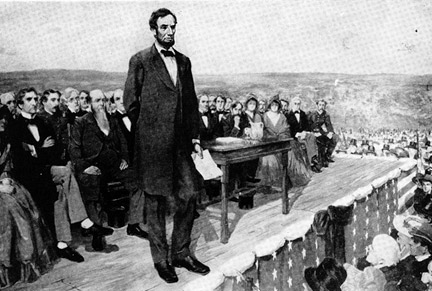 Lincoln has no use at all for the hypothetical equality of peoples, equally freed from their allegiance to a tyrant. What he needs is an understanding that puts white people and black people in the same scale—Lincoln had signed the Emancipation Proclamation in January of that year—and finds them to be equal in worth. It would be a violation of “Nature and Nature’s God,” to use Jefferson’s phrase, for one man to own another.
 issue of The Christian Century. That’s where I am going next, but I want to make one final point about arriving at 2 (after having experienced 5). When you know you can’t keep it, there are several things you could do as a response. You could devalue it. “Because it won’t last, it isn’t really that important.” You could strain to hold onto it. “I want to feel this way for as long as I can.” Or you could just enjoy every second of it, knowing that won’t last.
 The second point is that I don’t have any experience at all of putting my wife in God’s hands. I don’t have that experience with Bette; I did not have it with Marilyn. I want to go back now to the advice to Mike, which I liked so much, and to pick up the part I left out. Here is the whole quotation with the deletion in bold.
 Susan Carpenter (Naomi Watts) is trying to raise two small boys: Henry (Jaeden Lieberher) and Peter (Jacob Tremblay). Peter is a perfectly normal little kid, which means he has to come somehow with the fact that Henry is a genius and a competent manager of events and a superb caregiver and an action-oriented empath. Something is fundamentally wrong with Susan. We never find out what it is, but it keeps her in the dead end job she has as a waitress, it keeps her from writing and illustrating the children’s books, for which she has a real gift. It does not keep her from playing war-themed video games.
 s worked. So when he dies suddenly—sorry to just drop it in like that—he leaves behind the red notebook you see him with in the picture. This is the Book of Henry. In it, he argues very powerfully that his mother’s job now is to murder the stepfather, having already fraudulently produced a document that says in the event of his death, he would like Susan Carpenter to have custody of the stepdaughter.
 In fact, the best Susan Line is not “No, you are only a child.” Her best line is just afterward, when she leaves the shelter from which Henry’s ambush should have happened and tells the stepfather that she knows everything about what he has been doing and that she will see to it that he pays the price. The evil stepfather is also the local chief of police, so the likely consequences of saying this are ugly. He waves her off and starts to leave. She orders him to stop and turn around and face her and when he does she gives her best line—the best Susan Line: “I just wanted you to see who you’re up against.” Amazing!
 I think that to appreciate the power of Susan’s renunciation of Henry’s thinking—not just of the conclusion Henry reached but the simplicity of the route he took in getting to that conclusion—you have to appreciate how attractive intervention is made to seem. The stepfather next door is a brute and the girl who lives with him is completely helpless. The husband at the grocery is a jerk and “deserves what he gets.” That’s the way the narrative is set up. There is no anxious wrestling with the consequences of other possible choices.
 The Dilettante's Dilemma