Weeding tares is way above your pay grade

The story Jesus told to his disciples about the wheat and the “tares” (a plant now called Bearded Darnel, as I understand it) is one of the least satisfying stories of Jesus’s ministry. (This story and all the others I will be using as references are in Matthew 13. ) I’ll tell you how bad it is. I once had a friend who was wearing a plaster cast and she developed an insistent and annoying itch inside the cast. “What shall I do about the itch,” she asked the nurse. “Do what we do,” replied the nurse. “Don’t scratch it.”

That’s how unsatisfying this story is.

Today’s question is straightforward: how shall we understand this story? There is an interpretive key I would like to recommend and one I would like to excoriate. You won’t have any trouble telling which is which.

Who’s asking?

There are three kinds of answers here. I am interested in two of them. The three are: a) who asked Jesus this question, b) who asked Matthew this question, and c) who in the story asks the question.

The answer to the first question is that we really don’t know and there is no real basis for informed speculation. That’s not to say that no one asked Jesus this question or that Jesus did not answer it this way. He almost certainly did, but the time, the place, and the asker are lost to us.

Furthermore, Matthew presents Jesus as a preacher of sermons. Very likely, Jesus wastares 7 not a preacher of sermons, but Matthew is really struck by the insight that Jesus is the new Moses. In order to make the parallel clear, Jesus needs to be a lawgiver and that requires that he give sermons, not just that he drop memorable anecdotes. So Matthew collects the Jesus material he has [1] into longer bodies of text; into sermons. And because these sermons are composites built from the Jesus material, we can’t tell the setting of any one part of the sermon.
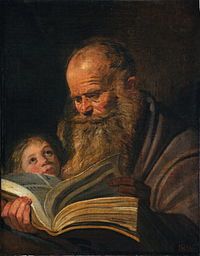
But someone asked Matthew. This is a story Matthew draws out of the Jesus tradition to deal with a question that someone is asking. Matthew recalled this story because he thought it was a good answer to a question he was being asked or possibly a good response to the needs of the congregation he was addressing, whether they had thought to ask the question or not.

That brings us to who in the story is asking the question. We transition now from the uncertainties of history to the very direct evidence of the story. We know it was the field hands—servants, slaves, laborers [2]—who came to the master and asked the question because Matthew tells us that.

The tares as a kind of question

Matthew has grouped a lot of the teachings Jesus gave into blocks of similar material, so it might help us a little to see what other stories appear in this chapter and what questions they represent.

There are five other parables in Chapter 13 [3] There are: a) the sower and the seed, b) the catch of fish, c) the buried treasure, d) the yeast in the dough, and e) the mustard seed. The catch of fish (47—50) has a final division into good fish and bad fish, just like the wheat and the darnel. The buried treasure stories (44—46) say how great is the value of the Kingdom of God [4] and how worthwhile it is, therefore, to use all your resources to acquire it.

The other three can be seen as small encouragements to disciples who might be getting discouraged. Don’t give up, they say. It takes only a little yeast (verse 33) to make a big difference and a tiny mustard seed (verses 31,32) grows into a huge plant. And the seeds that are sowed don’t always produce very much (verses 3—9) because sometimes the soil is bad.
tares 8All of these are “don’t get discouraged” (DGD) stories. DGD, sometimes the soil is bad. It’s not your fault. Just keep sowing. DGD, some of the fish are unusable. Just throw the bad ones away and keep on fishing. DGD, it takes only a little yeast to raise a big lump of dough and only a little seed to make a tree so big birds can nest in it. DGD, no matter what this is costing you, the value of the reward is so great that it will be worth it. DGD.

So what questions are being asked?

All of Chapter 13 is given over to DGD, so I think it will serve us as a good interpretive background for the wheat and the tares.

Question 1 Why are there weeds in your field, master? Did you use inferior seed?

Answer: No, the seed was good. The weeds can be accounted for by the hostile actions of an enemy. This is not carelessness, as some of you have apparently been thinking. This is sabotage.

That seems pretty clear.

Question 2 So what shall we do about it?

Answer: Nothing. Tare discernment is way above our pay grade.

And this is why I said the story is so unsatisfying. Yeah, it’s the master’s field and all that, but it is where I work. And I have the master’s interests at heart. And as much as I value the wheat (low level long term appreciation) I am really angry about the tares (short term highly motivating emotion) and I want to do something about it NOW. “Do what we do,” said the nurse, “Don’t scratch it.”

At the level of the story, this is clear instruction at least. Agriculturally speaking, there is no question what is a “weed” because the farmer intends some particular crop. Other plants in that field are therefore “weeds.” But when we come to the theology behind the story—which is the reason Jesus told it and the reason Matthew remembered it— it’s not so easy. Let’s imagine that the disciples of Jesus, the field hands of the story, in announcing the coming of the Kingdom of God come across people who are preaching a different message or just a different form of the message. That would be a “wrong message” from the standpoint of the disciples.  It would  be a weed.

Why are those other people here? Some explanation needs to be arrived at which does not put the blame on Jesus. [5] This story gets that job done. It recognizes that there are weeds and accounts for their presence by saying that the Devil has done it. This is sabotage. You just keep on preaching.

The next question is what to do about the weeds, and particularly why doing that is a good thing to do. The servants in the story—the disciples in the Jesus movement—offer to undo the evil that they see being done. Jesus tells them not to.   Thinking of Matthew’s use of the story as a practical application, we are brought to asking why Jesus would not want his disciples to be opposing these other messages.

I don’t think there is any sound basis for speculation, but it may be that Jesus, as tares 2Matthew understands the message, is concerned about conflict among the preachers of the Way. If we think of the “weeds” as other interpretations of Jesus’s teachings, it may be that Matthew was counting on the continuing context of the Torah to keep the church together. It is only Matthew (13:52) who imagines both the old treasures and the new being brought out of the storehouse.

Or, if we imagine that the weeds are actual opponents, Matthew may have felt that it was too early for Jesus’s disciples to be opposing them. You just keep preaching what Jesus told you to preach. A later time will be better for dealing with preachers of “untruth.” That means “at the final judgment” in the story, but any later time might be good enough for Matthew.

But why wait?

It is the rationale for waiting that I find most intriguing. I summarized it in the title of this piece as “Way above your pay grade” and I did that because Jesus said it would be up to the angels to make the decision. “And,” he might have said, “I know that you are not angels.”

It is clear that the master does not want his laborers mucking about in the fields. Why? It might be because the two kinds of plants are so interconnected in their roots that uprooting one will damage the other. That would work for this story, but not for the fish (13:37—40).

It might be because you really can’t tell which is which until the head of grain appears. At that point, even the servants can say this one is wheat and that one is darnel. That fits really well with crops of grain, but the story is supposed to point to controlling the message Jesus is bringing about the Kingdom of Heaven. Jesus points out in the Sermon on the Mount (Matthew 7:16) that you can tell what kind of plant it is by the kind of product it produces. Wheat plants produce wheat, barley plants produce barley. But it isn’t true about people unless who a person is going to turn out to be is a direct outcome of the person he is now and if that were true, there would be no need to go around preaching about the Kingdom of God.

What is equally true of wheat plants and people is that there will be a time when the natural outcome of that life will be judged. It isn’t now because it isn’t the harvest yet. And it won’t be you, for reasons the story doesn’t specify. In Jesus’s commentary on the parable, he says it will be the angels doing the harvesting, but in every version, the workers are told to leave things alone now.

Psychologizing the parable

So there are puzzles in applying this parable to what we imagine to be the present life of the church that Matthew is instructing. Still, the elements are clear: a) there is an immediate problem, b) this problem comes from an outside and evil force, not from God’s lack of foresight or provision, c) is it a problem that cannot be successfully dealt with now, d) at harvest time, the end time for a plant, when the plant has produced its fruit, is the time to deal with this, and e) the weeds will be utterly destroyed while the good wheat will be collected and stored.

Any application that meets those criteria could be said to be “applying” the parable. It would be hard, however, for an exegete, let alone a preacher, to say that all action can be safely deferred to the end time when it will be turned over to God’s agents. What is a preacher to do?

One kind of answer is to “psychologize” the story. That doesn’t mean just that we are going to talk about people rather than plants. It also means we are going to talk about motivations rather than actions.

tares 4I recently heard a sermon in which the preacher identified the “weeds” with “the shadow side” of the self, as Carl Jung calls it. Jung’s use of “the vast part of the self that the ego does not know about or will not accept” is broadly attractive in a lot of ways. It is hard to get a handle on, as you might expect, just as the Freudian unconscious is hard to get a handle on. But it would be deeply unorthodox (heretical) to identify the shadow in psychoanalytic theory with the weeds in Matthew’s story. The shadow side is an inevitable part of us and although it is “dark,” it is not evil.

The wheat doesn’t have a shadow side. The field has been infiltrated by weeds.The weeds are not part of “us” in the sense that they are part of each plant. And there is no “salvation” for weeds. There is only identification and then destruction.

A further difficulty is that once we have mixed the fields, with their good and bad plants, together with the persons, with their lit and shadowed sides, we can no longer predict what God will do. In other passages—none that I am aware of in Matthew, but it is common in the writings of Paul—there is the idea that the evil in us will be purged and we will be reckoned holy by the grace of God. God does not have, in any theology I have read, any constructive use for the evil in us. [6]

So psychologizing this particular parable brings us to a difficult pass. Taking the story in its context provides an analysis of the situation, but no real ideas about what to do. “Cool it” is not a proposal for action. Similarly, the time when this is all going to get sorted out—the end time, the harvest—when the angels will deal with the matter, also does not help.

On the other hand, if by psychologizing the parable, we can refer to those dark parts of ourselves—it’s hard to say in a sermon just what those might be—and to say that God has a use for them might feel very freeing. We are a mixture of good and evil, this line of thinking goes, and God has a place in His Kingdom for both the good and the evil. You see how that brings us some difficulty about God and evil.

For myself, I think I’d rather stay with Matthew’s use of the story and align all applications to those Matthew would like. But then, like Jesus, I am not a pastor and the effect on my congregation isn’t something I have to worry about.

[1] Scholars believe that Matthew had access to previously written sources as he composed his gospel. He certainly had a copy of Mark before him. He seems to be drawing on a “sayings source” known as Q (short for the German Quelle, meaning, “source.” And he seems also to have had access to another body of material, which Mark and Luke did not have. It is usually called M. Out of these materials, Matthew forms the “sermons” that Jesus preaches in his gospel.
[2] The Greek douloi is used for all those roles and for this story, it really doesn’t matter.
[3] A chapter doesn’t always define a “block” of material, of course, but it does here.
[4] The Kingdom of Heaven in Matthew’s account.
[5] Jesus says that God is the sower of the seed, but the disciples know where they heard it and their opponents are not casting their opposition to the message as opposition to God.
[6] There may well be parts of us we dislike or of which others disapprove, but if they are not evil, God may find a use for them that will surprise us. We need to look here at things God disapproves of, not things we disapprove of. If we persist in disapproving, we may be told to wait until the harvest and see what fruit is borne of them.


Posted in Biblical Studies | Tagged , , , , , | Leave a comment

Alyx Amber, Miss Portland 2017

I want to reflect a little today on Alyx Amber, [1] who is currently Facility Services Coordinator at Holladay Park Plaza, where Bette and I live. She is also Miss Portland 2017. I put her name in the first sentence because I want to start with Roger Federer, for reasons that will become clearer as this essay takes shape.

I was happy for Alyx when she won the Miss Portland competition and headed off to Seaside, Oregon to compete for the Miss Oregon title. But it never occurred to me that I wanted to write anything about it; to share Alyx’s journey with you. That happened when I was listening to an interview with Roger Federer, who at age 35, has just won the men’s singles title at Wimbledon.

Alyx 4I’ve been a fan of Federer’s for a long time now. It’s not just that he is a superb tennis player. I like the way he sees the game. I like the way he sees his life, with the game as part of it, rather than all of it. I like the way he admires and supports the other players, even while he is doing his best to defeat them.

That is going to sound a lot like Alyx Amber before I am finished here, but let me give you a little Roger Federer first.

How does this sound, for instance?

Sometimes you’re just happy playing. [Sometimes] you have to go back and think, “Why have I started playing tennis? Because I just like it. It’s actually sort of a dream hobby that became somewhat of a job.”

Or this?

When I was at a crossroads in 2004 and became world No. 1 for the first time, I thought, “Ok, do I want to stay there, or just enjoy the ride and see how long it lasts before it fizzles out?” I decided I would love to squeeze more of these moments and play the right way with the right mindset and the right flair, but also with fair play and also to represent the game well, which is very important to me.

Or this, from his post-finals interview at Wimbledon?

“…my heroes walked the grounds here…and because of them, I became a better player.”

Alyx doesn’t play tennis at all, as far as I know, but she understands the relationship between competition and life, between the journey and the destination, in a way that sounds like Federer. Alyx has great respect for the other people who are competing for the prize that is just as important to them as it is to her.

That’s not how she became Miss Portland 2017, but it may be how she was able to enter the competition with such a positive attitude. Does this attitude sound familiar at all? Below Alyx meets at the Seaside competition with friends from Holladay Park Plaza; from left to right, Auzhanae Upton, Latricia Jones, Xasha Upton, and Debra Jones. [3]

“On June 26, I will depart for Seaside, Oregon where I will compete for the Miss Oregon title one last time. I will compete with 19 other incredible young women whom I admire and am proud to call sisters. I have gained so much from this program not only personally, but educationally as well.

alyx 3

Alyx wrote that for the Plaza Review, our in-house newspaper at Holladay Park Plaza. That means not only that she approached the competition with a very positive attitude, but also that she wanted to share the experience with a lot of people at a senior center, all of whom probably think that if there had been any justice, she would have been chosen Miss Oregon.

That’s how we felt about it—some of us, at least. But that’s not how Alyx felt about it.

Tonight was incredible and this first picture truly captures the evening. I am so proud to be the 2nd runner up to Miss Oregon 2017, Harley Emery. I have walked away from this week with thousands of dollars in scholarships, the love and support of my family and friends and some of the best memories of my lifetime. Thank you to everyone who made this journey possible.

I met Alyx on February 23, 2016. [2] She was working at thIMG_0041.jpge front desk at the time and I was checking out Holladay Park Plaza to see if maybe Bette and I wanted to move there. I remember thinking that the lobby looked like the lobby of a really good hotel and I remember thinking that the woman behind the desk looked like she belonged in a really good hotel. I had been touring senior centers at the time and I had never visited one that caused that thought to come to mind. I liked it.

And as I was getting ready to take this shot, I asked Alyx if she would wave to me. I thought it would give some human perspective to the shot and would serve as a focal point. Alyx didn’t have any reason to do what I asked. I didn’t know her and she didn’t know me. But she gave me this wave and the smile that went with it. I was not surprised to see, last week when I first saw this picture, that she has that same smile. Here, it’s under a crown, and I think that adds a little something to it, but it’s the same smile. It is not, in other words, a “beauty queen smile;” it’s just Alyx.

Colluding with your competition

“I will compete with 19 other incredible young women whom I admire and am proud to call sisters.” That’s the way Alyx sees it. Note, for instance” “compete with.” I think I want to call that an attitudinal preposition. Mostly, you hear “compete against,” and although there’s nothing wrong with that, it points to a different attitude toward competition. “Compete with” means something different.

It is true in the Miss Oregon competition, as in the Wimbledon competition, that one will win the prize and all others will not. But Alyx told me that the women who had to change costumes quickly as part of the contest were helped out by the women who had the time to help them. The others—the “competitors”—laid out the clothes and helped the women on tight schedules get into them. “Compete with” allows that; “compete against” does not.

I was surprised to hear that there was so much cooperation among the contestants, but this wasn’t just a few unusually helpful women. Alyx said this is the way the whole competition was organized. The Miss Oregon pageant is under the leadership of two people, Stephanie West and Teri Leeper, who have an idea what a collegial and fulfilling competition would be like. It wasn’t like that in the past, when the women competed more aggressively against each other. So there was guidance from the top. Furthermore, Alyx was one of a group of women who had been in these contests for several years and were able to provide some leadership to the women who were there for the first time. “O.K., girls, “they would say. “Here’s how we do it in Oregon,” and go on to describe the elements of “competing with.”

It could be argued, I suppose that the goal of being Miss Oregon is so valuable that it would justify even an abrasive and bitter competition to win it. But if you can organize the competition so that both the journey and the destination are things to celebrate, why wouldn’t you?

And when Alyx says “ I have gained so much from this program not onlyIMG_4482.jpg personally, but educationally as well,” she is talking about the experience she has had. She is talking about the “journey” part of the competition, about the friendships with the other contestants, about all she learned about presenting herself, about, about taking a leadership role in making the contest what it was. These are things that she gets to keep no matter who wins. And when she won the Miss Portland crown, she crowned the journey with the destination.

Why I care about this topic

I would care just because I like Alyx and wish her well. That would be enough. But it is also important to me because I live here at Holladay Park Plaza where Alyx works and it will not surprise you to learn that there is a good deal of this same generosity and helpfulness here. I see a direct relationship between the kind of magic that transformed “compete against” into “compete with” in the way the staff relate to the residents here.

Here where Bette and I live, someone sits down with the staff and says something like, “Now remember, this is the way we do things at HPP. To make this the kind of place we promised to the residents, we have to keep it clear in our own minds.” Here’s an example. Alyx and her friend Debré Jones (far right in the picture of Alyx and friends at the contest) were explaining the relationship of staff to residents one evening last March. See the context of that discussion here.)

“You live here,”[Alyx] said, meaning me in my resident status, not me personally. “We just work here. It’s your home and we need to make it a good place for everyone. We do that, by putting the interests of the residents at the center of our concern. We want you to have the kind of life you had in mind when you chose Holladay Park. That’s our job.”

When I think about what that means to me, I almost think it gives me some insight into what it might feel like to be one of a group of “competitors” all of whom are helping each other be their best selves and do their best work. I do see the differences, of course. Because I am not a fellow competitor with Alyx, I don’t have the opportunity of returning the favor. It will never work out, the way it did in the contest, that she helps me when my time in tight and I help her when her time is tight. It isn’t like that.

On the other hand, it can be like that, apparently, among the staff here. Consider this:

Since the moment I began working at the front desk I have realized that here at Holladay Park Plaza, we are family. The love and support that all of you have shown me in my journey to Miss Oregon has been overwhelming and sharing this experience with all of you is so special to me

That’s from an article Alyx wrote for the paper that all the residents read. If it is really possible for the staff to work toward making our home—the residents’ home—the place they promised, it would require a staff that feels like family. From a family like that, you could get the support and the presence of mind to do your job. To do your job, as Roger Federer says, “in the right way.”

That’s how Alyx does her job. It was a pleasure to watch her do it long before she became Miss Portland.

[1] Properly speaking, Alexandra Amber, but it says Alyx on the name plate on her desk.

[2] I had no idea that was going to be a significant date and I made no effort to remember it, but there it is on the calendar in the picture.

[3]  I saw Alyx going to a meeting here is a really terrific looking black dress.  “Oh,” she said, “it’s Debré’s.  We’re the same size and the front desk people are pretty close.”


Posted in Getting Old, Living My Life, sociability | Tagged , , , , | Leave a comment

He said, She said, and Russian Roulette

Rape is always a bad idea. Let’s start with that. On the other hand, doing “whatever is necessary” to prevent rapes–stop for a moment to consider what actions that standard justifies– is also a bad idea. Where do we go from there?

I would like to take a non-empirical look at policies bearing on sexual activity on university campuses. By “non-empirical,” I mean that this essay would not be affected in the slightest if it turns out that there is one false accusation of rape out of a million truthful accusations of rape or if it turns out that there are even numbers of true and false accusations. [1]  That is not what this piece is about at all.

This article in the New York Times says that Secretary of Education Betsy DeVos is starting to reconsider some of the Obama-era regulations. Some new balance is going to be attempted, apparently, so this is a good time to look at what “balance” means in this context.

  • Let’s look at the organized side of balance first.

“…advocates for victims and women …have spent the last six years waging a concerted campaign to educate college administrators, and the public, on students’ rights under the law, and how to combat what some have called “rape culture” on campus.”

It’s hard to think of anything good to say about a “rape culture,” which is, presumably, a culture that encourages or at least excuses the abuse of women by men. [2]

On the other hand, it is entirely possible that we now have an “accusations culture” which would also not be good.

“Rather, the accusations — 90 percent of them — fall into the category of ‘we were both drunk,’ ‘we broke up, and six months later I found myself under a Title IX investigation because she just decided that our last sleeping together was not quite right,’” Ms. Jackson said.

  • Then there is the rhetorical side.

DeVos 1All this is coming to a head now because Ms. DeVos (shown here) is bringing this balance up for reconsideration. The New York Times writers refer to the ongoing conflict as “a maelstrom.” [3] She wants to meet with groups who will be willing to represent the men, the disproportionately accused parties. Predictably, the women are not happy with the men who are being included, some of whom they call misogynists. I think it would be reasonable to assume that the men’s groups are going to call the women’s groups misandrists. English makes that pairing available and given the level of intensity this conflict has reached, it would seem almost odd if both were not used.

There is still the question of whether calling your opponents bad names is an effective political strategy.

  • And then there is the balance between the powers of the the Presidency and the powers of the Congress.

President Obama was fairly aggressive in using the powers of his office—not in changing the Congress’s approach to Title IX of the Civil Rights Act—to put the campuses on notice that they would accept the new federal programs aimed at reducing sexual assaults on campus or they would be rejecting the federal monies that would otherwise flow to the universities.

It would seem odd, I think, if President Trump did not make use of those same powers to try: a) to undo the gains of the Obama presidency or b) to restore at least the rudiments of balance between the accused and the accusers. Obviously, you can say it either way. The difficulty in both cases is that the law stays the same as it was and the Civil Rights Division of the Department of Justice, acting in the President’s name, makes whatever changes in interpretation their constituents require.

That is, as my father used to say, no way to run a railroad.

  • And finally, there is the Astroturf side.

In politics, they call it Astroturf if what is supposed to be a “grass roots movement” is entirely artificial. Women’s groups have been asking people to post their personal stories about sexual assault on Twitter, using the hashtag #Dear Betsy.

In the meantime, C. D. Mock, (pictured at the right) whose son was accused, says, “The young men who have DeVos 2been accused have gone through an absolutely horrendous experience,  They have had their entire world turned upside down.” He doesn’t say that he is promoting a Twitter campaign called #DearBarack, but if the Civil Rights Division is flooded with letters from women and men who have had their lives ruined by sexual encounters in college, that will be what I mean by an Astroturf campaign.

I tell my stories. You tell your stories. I ask for the electronic in-boxes of federal policy makers to be flooded by pathetic stories that illustrate my point. You ask for the pathetic stories to illustrate your point. At some point, the inboxes are all full and neither campaign has addressed the other.

If you learn that a friend of yours is spending his out of class hours in college playing Russian Roulette, you will have to decide when to tell him he is making a mistake. He does not begin to make a mistake when he pulls the trigger when there is a bullet in the chamber. That approach produces only stacks of tweets from people who didn’t die while playing the game and other tweets from the parents of students who did die. All the inboxes are full and no one has addressed whether playing Russian Roulette is a good idea.

[1] Ms. Jackson says, “Hundreds of cases are still pending, some for years, she said, because investigators were “specifically told to keep looking until you find the violation” on college campuses even after they found none — a charge her critics strongly deny.” Catherine E. Lhamon, who led the Education Department’s civil rights office from August 2013 through December 2016, called Ms. Jackson’s claims that investigators were told to fish for violations “patently, demonstrably untrue.” What I mean by “non-empirical” is that I am not going to inquire whether it was true or not. This piece is about something else entirely.
[2] The context of this whole discussion presupposes heterosexual relationships. There are difficulties of other kinds in other kinds of relationships, of course, but this article does not deal with them.
[3] No references have yet been made to a “femaelstrom” but the controversy has not yet climaxed so there is still time.

Posted in Political Psychology, Politics, Society | Tagged , , , | 2 Comments

Am I (being) depressed?

Today, I want to look at the kind of guidance our language gives us on depression, especially whether it can best be conceived of as active or passive. But before I do that, I have a very small admission to make. I have never heard anyone describe the experience of “being depressed” in the way I experience it. For me, most often, it is a conclusion I draw when I notice how my inner editor—a hypothetical agent over which I have no control at all—has organized my perceptions and my memories. “Oh, look at that,” I say to myself, “I am (being) depressed.” [1]

So my experience of (being) depressed may be unusual, but I think the processes I use to get out of it are pretty ordinary. Also, they have worked pretty well so far.

What the metaphor looks like

In the sentence, “I am depressed.” what part of speech is “depressed? I’m not all that good at this sort of thing, but I would say that it functions as a predicate adjective, as “orange” would in the sentence, “I am orange.”

depressed 5On the other hand, if you were the tongue in this picture, you could just as accurately say that you “were” depressed, but you would be referring to the effect that the little popsicle stick is having on you. “It is depressing me,” the tongue would say, “therefore. I am being depressed” Notice that “depressed” is clearly a verb now. The parallel sentence would be, “I am being strangled,” in which “”depressed” and “strangled” each describe an ongoing action being aimed at you.

So…I kind of like the verb version better. The adjective version describes you: remember that depressed = orange so far as the grammar goes. The verb version describes an action that is being taken and in which you are the object; remember that depressed =strangled.

And one of the reasons I like it is that it raises the question of the origin of that action. Who or what is depressing you?” The other version doesn’t ask that question.  And it leads fairly directly to the next question which is, “What can you do to get him/her/it to stop?”

I think that is a better question, but even that better form of the question is not quite as simple as I have made it sound so far. Imagine that I was going to an event that required wearing a tie and the dress code of this event required that the tie be really tight around the neck. Presuming that I am the person who tightened the tie around my own neck, the direct answer to the question “Who is doing this to you?” is “I am doing it to myself.” On the other hand, there is a distal force [2] that is not me and that requires that the ties I wear be really tight. So another useful answer to the question, “Who is doing this to you?” is “They are.”

I do feel pressed down (de + pressed) from time to time and this last time the experience struck me as having some interesting online parallels. I have three principal ones in mind. Let’s see how the similarities hold up.

Other Readers

If you order a book from Amazon, they will tell you that other people who ordered this book also ordered, or also looked at, these other books. A friend recently asked me to read The Wonder by Emma Donoghue. When I looked it up on Amazon, I was informed that customers who bought this item also bought Do Not Become Alarmed: A Novel, by Maile Melde and A Visit from the Goon Squad, by Jennifer Egan, and Give a Girl a Knife: A Memoir, by Amy Thielen. These books are “brought into my view” together as a result of my looking up The Wonder.

You have to stop a minute to think how strange all this if you take it seriously. It isn’t mind reading or palm reading. Amazon’s computer is guessing that an interest in one book indicates a probable interest in certain other books.

Here is the analogy that struck me. I have lived a long time and have many experiences. I have organized these experiences into categories, although I didn’t do it intentionally and I don’t know what the names of the categories are. Here’s what I know: when I take an action or receive an action or have a vivid memory, a whole batch of “similar” memories and tastes and associations come to mind. If I do something really dumb, like asking a friend how his father is getting along only to find out that the father died over a month ago, I’m embarrassed. I get through the occasion, but after that—sometimes for days after that— I am bombarded by “similar screw-ups.”

depressed 6This is the way my inner organizer arranges my experiences for me. It is very much as if I had asked for a book called Captain Klutz and was referred to a list of books with that theme. Except these “books” are all about things I have done. These may be things I have never before considered to be related to each other, but somebody—whoever is organizing and presenting these other experiences to me—thinks they are related.

Coins

Imagine further that all one’s experiences can be represented as if they were coins with a heads (positive) side and a tails (negative) side. Clearly, one side of the coin is not more true than another. Let’s say I got tired of a job and decided to leave it for another one. But part of the same experience is that someone in the hierarchy had a grievance against me or thought I wasn’t doing my job well. “I got tired of it so I quit and went on to another job” is the heads side of that coin. “I screwed up and got fired” is the tails side.

When I do something like ask about my friend’s father who, as everyone else in the group knows, died last month, it is a faux pas. I am embarrassed. I apologize. But as I am walking home afterward, I see that all the coins have been turned so that they are all tails. These are completely unrelated events. There is the time I dumped tomato soup on my clean white shirt and the time I lost my cool and insulted an obnoxious guest and the time I went to a friend’s birthday party on the wrong night. Here I am, present in hand, and I am the only “guest.”

There is not, to my mind, any topical similarity at all. They are just things that this inner organizer gathers together and puts in a category of some sort and presents to me—like so many books at Amazon—one after another after another.

Peripheral Advertising.

A lot of web sites are paid for by advertising. They are able to customize the advertising to you because they know what you have been doing on your computer. Here’s an example that still makes me smile. I wrote an essay called “Attractive Older Women” and I searched around in Google images to find a good example I could put in the essay. Shortly afterward, advertising started showing up on the websites I used. These were ads “about” (not “from”) attractive older women in the Portland area who are looking for men who aren’t afraid of commitment. This went on for months.

depression 8Some one in the Gorithm family (Al, probably) is monitoring my use of the computer and notices that I was searching for images of attractive older women and concluded that I was in the market not just for the pictures, but for the women. I search for images every time I put an essay up on my blog site. I’d hate to think that each of these searches is taken as an indication of an “interest” that can be commercially exploited. But that is what I do think.

I think that if I wrote an essay about new cars—maybe I’m just studying what kinds of words are used to sell cars these days and comparing it to the words that were used when I was younger—pictures of cars on the lots of local dealers would start showing up in the advertising space. I think that’s how it works.

And that’s why I think the process might be a good indication of how that inner processor of mine works. The part of that process I’m thinking about in this essay is concerned about fears or anxieties or guilt of shame (now new cars or old women), but I think the process is analogous. I think there is something like an algorithm that monitors my experiences and serves up “related products.” I think that if I saw a situation on a local train and thought I ought to intervene, but then didn’t, I would leave the train feeling ashamed.

Words like “coward” and “culpable” and “complicit” and the pictures that belong to my life’s experience of those words, would start to show up in my mental “ad space.” I would think of times when I showed good judgment by not getting involved in someone else’s fight, definitely “heads” memories. And I would find that all those coins had been flipped over by this inner advertiser and now all those coins are tails. I remembered it as careful judgment, but when I look back, I see that it was cowardice.

I hate that.

On the other hand, looking at these coins and at these “suggested books” and at the peripheral advertising is the way I find out that I am depressed. Some people look “inside themselves” as if there were a tag or a sign. Or they just feel depressed. What’s the matter, Alex?” “Oh, I don’t know. I’m just depressed.” These people FEEL depressed. I notice it when I see that all the coins are tails up and the books are all about being a klutz. At that point I realize that however well I thought I did in responding to my friend, I realize when I see what “books” are being presented to me, that I must be depressed and it’s going to take a while to get “un-depressed.”

What I do when I notice

Sometimes it is true that I am being “depressed”—”held down.” It is also true that I wishdepressed 4 I were not being held down. On the other hand, I know what to do about it. It isn’t instantaneous, which would be nice, but it is reliably effective. There are things I can do that are kind of like “pushing back” or at least “getting out from under the thumb.”

They aren’t magic. I do things (actions) I am proud of. Sometimes I have to do quite a few of those. And I hang out with people (associations) who like and respect me. And I don’t talk about how I am feeling. I just let the natural effect of these actions and associations do what they always do.

And then I’m OK until I screw up again.

[1] I got to thinking about this kind of possibility when I read Daryl Bem, a social psychologist who said that what we call “insight” or “introspection” is really using the same kinds of clues about ourselves that our friends use. The example exchange I remember best goes like this. Q. Do you like rye bread? A. I guess I do. When I have a choice of breads, I always choose it.

[2] In my line of work, “proximal” is a word used to describe the immediate cause (the tie) and “distal” is used to describe the mediated cause (the requirement).


Posted in Living My Life | Tagged , , , , | Leave a comment

Mayor Murphy and half-a-loaf politics

This might be the time to take another look at Mayor Murphy. We have all the True Believers and hyperpatriots we really need right now. We have a Congress full of people who have signed pledges of ideological purity and have promised not to compromise with the enemy—ordinarily, that’s the other party but sometimes another faction in your own party—no matter how bad the outcome looks to be. So maybe it’s time to reconsider Mayor Murphy.

I have three goals in mind for this essay. First, obviously, I am going to have to tell you about Mayor Murphy. Second, I am going to pose the question of democratic accountability as Edward C. Banfield has illustrated it. [1] Third, I am going to argue for the crucial necessity, in our time, of the kind of leadership Murphy illustrates.

mayor 1

The character himself is taken from Banfield’s pamphlet. In that little story, he is called “the Mayor,” but, in the words of the fictional journalist who interviewed him, the Mayor was “a little roly-poly fellow, very jolly and red-faced, and a real pro.” That, and the legendary success of Irish politicians in city politics, was enough for me to decide that I might as well name him Murphy.  I think this is actually Jack Germond, but his face fits the type perfectly.

The newspaper reporter in this case study is Banfield’s tool for collecting information about all the relevant players in an urban development drama. There are four principal positions [2] and the reporter’s job, as Banfield deploys him, is to show that each of them is inadequate. As a practical matter, however, we, in the Trump era, have only two choices as they bear on these positions. We could choose to adopt one of these four perspectives and go to war with the others. Or we could admit that we need them all and try to find some way of balancing their strengths and weaknesses.

The Problem the Mayor Faces.

Here is the nub of it.

“Well, we might as well talk frankly,” the Mayor said. “The reason I didn’t do it the way it ought to be done was that I just couldn’t. The people wouldn’t stand for it. I would have been out on my ear if I had tried to tear down that slum. I would have been right square in the middle of the worst row you ever saw.

The Mayor had the chance to tear down a slum, bring back the suburbanites who had left, increase the urban tax base, and redevelop the core of the city. Instead, he put the federally funded redevelopment project in an old warehouse district, and tastefully “refurbished” a small fraction of the old slum.

And he did that because “the people” wouldn’t stand for it. When I hear a phrase like that, I wonder the same thing you do. “What people are we talking about?” [3] Murphy has two kinds of people in mind:

  • those who are making profits from slum properties—“[that includes] some churches too” the Mayor adds,
  • the working class whites who just moved to the suburbs and don’t want public housing built next door to them—the classic NIMBY position.
  • Besides that, the Mayor is concerned about the racial unrest these public housing projects might cause and is not eager to put his town through that.

That’s what he means by “the people wouldn’t stand for it.”

The Reporter Pushes Back

mayor 5This is the “Profiles in Courage” rebuttal. The Mayor has said that he couldn’t “do the right thing” because it would cost him his office. The reporter comes back hard, “Maybe you should have made your fight and taken your licking,”

The Mayor comes back at the reporter just as hard and this rationale is the main reason I wanted to spend some time with him.

“Personally, I don’t look at it that way,” he said. “I don’t have any respect for a politician with such high principles that he can’t get re-elected. In this game you got to do what it takes to win. Either that or let somebody else play in your place. If you’ve got such a sensitive conscience that you can never make any compromises, you’re too good for politics. You owe it to your party to step aside for someone else. After all, the party wants to win, not just make your conscience feel good”.

I don’t know anyone who talks like that, even off the record, and I’m not sure I know anyone who would accept the Mayor’s case as he makes it. The people who populate my circle are more apt to say what the reporter said, viz. do the right thing and whatever happens happens.

I think there are four separate kinds of justification in the Mayor’s response, counting the snarky phrasing as one of the points. The first point, the most general one, is that getting re-elected is his job. Things that get in the way of his doing his job—“high principles” is the example he gives—need to be put aside in the present instance.

The second is that from the standpoint of the party, he is taking up space. The party wants whoever is in the Mayor’s office to do what is necessary to keep the party in control of the office. [3] If he can’t do it, he needs to get out of the way so someone else can. The Mayor owes the party something as well as owing the people something.

The third is that what he has done is “make compromises.” That’s what politics is about. It is not a place for True Believers (remember Eric Hoffer’s book?)—but a place for politicians who can get the best deal available for their supporters. And “the best deal” includes keeping potential disasters at an arm’s length.

The fourth “point”—the snarky one—comprises the language the Mayor chooses to demean the alternatives. “Such high principles” does that; so does “such a sensitive conscience;” and so does “too good for politics.” These are all disqualifications from the Mayor’s perspective. They might be virtues in private life, but they are vices in public life.

I think the Mayor makes a very strong case, but it is all phrased as a response to the reporter. Let me take a shot at phrasing it more generally.

mayor 2The Mayor is the exemplar of “democratic accountability” as Banfield sees it. There is no way for voters to choose a party (and the party’s nominee) unless the party makes good on its promises. There is no way for the party to make good on its promises unless its officeholders “do the right thing.” Being so committed to the revitalization of downtown that you cause a race riot is not the right thing. Alienating the working class voters in the inner suburbs and turning the Mayor’s office over to the other party is also “not the right thing.”

So the point is that if you believe in “the sovereignty of the people” in any practical way, you need to believe that there is a way for the people to choose a government that will do what needs to be done. Not a party strangled by its own “high principles,” but a party willing to cut the deals that serve its own base. The old notion was that “half a loaf is better than no bread at all,” but, of course, those alternatives require a particular kind of context.  That is how voters can affect policy, which is the heart of democratic accountability, which is the mechanism by which the sovereignty of the people means anything at all. It all links together and none of it allows a free-lancing Mayor.

Conclusion

My pitch, above, was that we might need to take all four of the positions and try to balance them. Today’s job was just to present the Mayor’s case as one that ought not be thrown out. Somebody needs to exercise the discipline that keeps the worst from happening and maintains the stability that will allow further steps to be taken later on. I am sure that is what Mayor Murphy thinks he is doing and he may be right.

[1]This was taken from pamphlet called “The Case of the Blighted City.” Banfield, later in mayor 4his career, became famous for such books as The Unheavenly City, The Unheavenly City Revisited, The Moral Basis of a Backward Society, Here the People Rule, Political Influence, Civility and Citizenship, and City Politics  .Here,very early in his career,  I think he was just trying to make a buck. This was written in 1959, which accounts for some of the ethnic stereotypes and some old words (“Negro”), but the political principles work just the same way now that they did then.  Here is Banfield as a very young academic.

[2] There is an economist, who represents the “free market” perspective, the city engineer, who represents the efficiency standard, and the citizen activist who represents the goals of a well-informed and highly motivated citizen. The mayor is the foil to all three of these.
[3] At some point, I need to say that the relationship between the party and the incumbent presupposed throughout this little study is that the party is dominant and the Mayor is their current representative. The party guarantees the Mayor a majority of the votes in “the organization precincts” of the city by exchanging job for votes. Given this relationship, it is not implausible that the Mayor would defer to the party’s interests.


Posted in Politics | Tagged , , , | Leave a comment

A Wedding, a “Declaration” and an “Address”

Written July 4, 2017.  Happy Independence Day!

I’d like to look today at Thomas Jefferson’s well-known statement that “all men are created equal.” Some critics have said that this is the height of hypocrisy, coming as it does from a man who owned slaves, but I don’t think so. I think Jefferson was talking about something else entirely.

In this essay, I’d like to say what I think Jefferson was talking about and why I think that. I want to approach this text the way a biblical text might be approached by a careful scholar. We will have to start by keeping in mind who wrote it and to whom and for what purpose. We will give more weight to ways of construing the text that seem in line with Jefferson’s rhetorical needs and less to those that seem tangential.

The Wedding at Cana

Let’s take a simple example to illustrate this technique. In the Gospel of John, Jesus is declaration 3represented as performing a series of actions that pointed beyond their plain meaning. For that reason, they are not called miracles; they are called “signs.” [1] That means that they point to some meaning beyond themselves. What they have in common is that they look at some major element of Jewish practice—we are going to be looking at the wedding at Cana for our example—and then declare it to be surpassed by the present ministry of Jesus. So each of the signs “means something” in the same way; they point beyond. The meanings themselves differ as the occasions differ.
John tells the story of the first of the signs in Chapter 2: Jesus goes with his family and his disciples to a wedding celebration in the nearby town of Cana. They run out of wine and Jesus provides more. The sommelier is ecstatic about the quality of the new wine, not knowing that a few moments ago it was just water.

It is a story that is much abused because it is easy to care more about what we want to have in the story than in what John needs to have in it. For John’s purposes, the crucial verse is 6, which reads:

There were six stone water jars standing there, meant for the ablutions that are customary among the Jews: each could hold twenty or thirty gallons.

I am going to be arguing, shortly, against several interpretations of Jefferson’s language in the Declaration on the grounds that they are “tangential” as opposed to “central.” They lead away, in other words, from the purpose of the argument. Let me introduce that notion by looking at some of the tangential interpretations of John 2.

  • It was a miracle. This shows that Jesus was “divine” because he changed water into wine.
  • It showed his break from family life. He rejects his mother’s request and requests absolutely the rationale she provides for it.
  • It established a basis for the disciples’ belief in him because he “revealed his glory and his disciples believed in him.” (verse 11b)

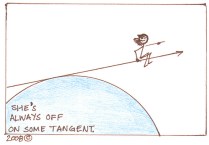
declaration 1I am calling those tangential. I am not arguing that they are mistaken; only that they don’t help John establish the point he is making. John has a use for this story and for this use, the central symbol is the six jars of water. All this water is necessary because “the Jews” [2] needed to ritually purify themselves. John’s point is that because of Jesus, all that water is superfluous. You can do something else with it, since you don’t need it for ritual ablutions. So why not turn it into some really superior wine?

The other interpretations “fly off on a tangent” rather than saying what the sign was and why it was important. That doesn’t make them wrong; it makes them superficial. We can be brought back into line by asking what John was trying to say.

The Declaration of Independence

The passage we are looking at today—the one that has the “all men are created equal” language—is part of a larger argument. I am asking you to give additional weight to interpretations of this much-debated phrase that support the main argument; that are not, in other words, tangential. Like John, Jefferson has a point he is trying to make and we would expect that the language he chooses would help him.

Here is the well known text.

We hold these truths to be self-evident, that all men are created equal, [3]that they are endowed by their Creator with certain unalienable Rights, that among these are Life, Liberty and the pursuit of Happiness.

Just before that, Jefferson says;

“…a decent respect to the opinions of mankind requires that they should declare the causes which impel them to the separation.”

The argument Jefferson is about to make, in other words, is one that will be taken as cogent according to the “opinions of mankind,”—of Great Britain, France and Spain in particular. And he follows this up by building on John Locke’s theories about the social contract, so that he can say that the New World colonies are no longer bound by that contract.

So…what understanding of “all men are created equal” will help him make this point?

Jefferson wants to make the case that all mankind are bound by a “natural” contract to a legitimate authority. That is the condition of mankind in general and Jefferson will make no exceptional claim for the North American colonies. If the sovereign violates his side of the contract—which, according to Jefferson’s extensive accusations, King George III has done—then the colonies are freed from their part of the contract. Any people bound to a legitimate sovereign would be freed from the contract when the king shows himself to be a tyrant, and therefore not a legitimate ruler..

A phrasing that would have established this would have been that any “people” whose sovereign has violated the terms of the contract, is no longer bound by it. This is true of all peoples—it is true of the Dutch and the French and the Spanish, etc.—and it is just as true of the “Americans.”

declaration 4It is not only the right of these peoples to throw off the yoke of tyranny, but it is their duty to do so. [4] This is true of all peoples—all collections of politically self-conscious people—so it is the general case. Someone arguing against Jefferson would have to argue that although it is true of mankind generally, it is not true of the British colonies in North America; or he would have to argue that Locke’s notions of contract were not valid even in their general sense.
This shows us that understanding Jefferson’s phrase “all men” to refer to “all peoples” moves his argument forward in a direct way. It is central, not tangential, to the argument. By contrast, thinking of “all men” as a comparison of individuals helps Jefferson not at all. There is no good reason, in fact, to think that Jefferson meant that.

The Gettysburg Address

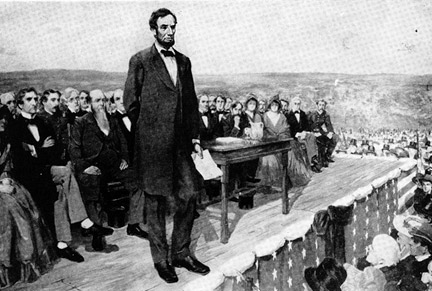
There is every reason, on the other hand, to think that Lincoln meant exactly that. Lincoln made reference to Jefferson’s language in a way that Garry Wills (in an article in The Atlantic) calls “chicanery.” That might seem bold because Wills is a scholar as well as a journalist, but this is what the Chicago Times said at the time.

“The cheek of every American must tingle with shame as he reads the silly flat and dishwattery [sic] remarks of the man who has to be pointed out as the President of the United States. … Is Mr. Lincoln less refined than a savage? … It was a perversion of history so flagrant that the most extended charity cannot view it as otherwise than willful.”

The “perversion of history” the Chicago Times had in mind was Lincoln’s claim that “our fathers brought forth… a new nation… dedicated to the proposition that all men are created equal.” The Times is complaining, in other words, that Lincoln has willfully misunderstood Jeffersons words—that is the burden of this essay—and has set this misunderstanding out as the fundamental interpretive framework of the Civil War.

Using the textual analysis we have used in the Gospel of John and in the Declaration of Independence, we can ask how this way of construing Jefferson’s claim would have benefitted Lincoln. In Lincoln’s case, it is almost an answer just to ask the question.

declaration 5Lincoln has no use at all for the hypothetical equality of peoples, equally freed from their allegiance to a tyrant. What he needs is an understanding that puts white people and black people in the same scale—Lincoln had signed the Emancipation Proclamation in January of that year—and finds them to be equal in worth. It would be a violation of “Nature and Nature’s God,” to use Jefferson’s phrase, for one man to own another.

Lincoln could just have said that, of course, but what he really needed was an argument that America has always been about that. That was what our fathers meant when, “four score and seven years ago,” they brought forth a new nation—a nation dedicated to the proposition of equality. Not the equality of peoples, which is what Jefferson needed and what he meant, but the equality of persons, which is what Lincoln is saying the battle at Gettysburg was about.

Editorialists all over the country screamed, if not in the blunt prose of the Chicago Tribune, but people are not scholars. The idea that Jefferson meant something else seemed pale, when what Lincoln meant was so vitally present and so crucially important. What Lincoln said helped people make sense out of their world and the war was going to go on for another two years. What Jefferson meant, “back then,” is something for scholars to fight about after the Confederacy is defeated.

So it helps us, I think, to make the needs of the author central to debates about what he might have meant.  For Jefferson, this principle aims “all men” in one direction; for Lincoln, it aims “all men” in another direction.  Each of them knew what he was doing and I think we ought to grant them that.

[1] And the first part of John’s gospel, chapters 1:19—12:50, are often called “The Book of Signs.”
[2] John was written at a time of considerable conflict between the followers of Jesus in the Johannine tradition and the Jews of the post-Jerusalem period. As a result, John is at pains to emphasize every difference he can between Jesus and the religious setting in which he was raised. John’s use almost makes it sound as if Jesus was not a Jew, which he was.
[3] A good illustration of “tangential” would be an argument that paused here to say that Lincoln was asserting that man was “created.” It would be even worse to say that Lincoln stressed “created” to deal with Darwin, whose major theoretical work had been published only four years earlier.
[4] Here, Jefferson takes an entirely new step. The rights are specified by Locke’s social contract theory, but when we get to “duties,” we are entering a new territory. To whom would the duty be owed? “The laws of nature and of nature’s God” is pretty thin and that is the only plausible recipient of such a “duty.”

Posted in Biblical Studies, Communication, Political Psychology, ways of knowing, Words | Tagged , , , , , , | Leave a comment

There is more to this story

Does this illustration remind you of anything? It reminded me of that whirlwind survey of the relationship of Carl and Ellie Fredericksen, with which the movie, Up, begins. They are little children, they are lovers, they are spouses, then he is a widower. That’s where the narrative of Up actually begins; Carl is a dispirited old man, the one in panel 5, still grieving for the loss of his wife.departed 4.jpg

If this picture doesn’t more you in the direction of thinking about life and death, I can’t imagine what would. Take just a moment to notice the trees. [1] And then the people—tallest in panel 3, you notice. The sizes grow toward 3 and recede from it. And look at the relationships. Playing with balloons, then holding hands, then embracing ecstatically, then standing companionably.

And then consider the direction, thinking of this sequence as a narrative.  You pass this way but once, the picture says. You go from left to right and then you are done. As much as I love this picture, I am going to have to offer an amendment. It is true that you can’t go from 5 to 1, but you can go from 5 to 2. [2] There are parts of this sequence, in other words, you can do more than once.  Everyone who has happily remarried knows that.

In fact, I think I would go so far as to say that “getting to do it again,” i.e. leaving 5 behind and going back to 2 gives you a whole new appreciation for 2. You know, for instance, that it is going to go away and you need to celebrate it while you have it. Or, as it feels at the time, while it has you.

This brings me right up to the lip of a column M. Craig Barnes wrote in the June 21 6 panels 4issue of The Christian Century. That’s where I am going next, but I want to make one final point about arriving at 2 (after having experienced 5).  When you know you can’t keep it, there are several things you could do as a response. You could devalue it. “Because it won’t last, it isn’t really that important.” You could strain to hold onto it. “I want to feel this way for as long as I can.” Or you could just enjoy every second of it, knowing that won’t last.

New friendships, after all, don’t last. Either they go away or they become old friendships. In neither case do they stay what they were and if you are going to enjoy them fully, you need to know that your pleasure in them doesn’t need to be diminished in any way by your knowledge that it won’t last.

Craig Barnes’ column is called “The temporary gift of marriage.” His way into this question is different from mine. He has entered it as a pastor, engaging many couples in counseling before their marriage. I entered it as an unwilling participant when my wife died in 2003. [3] I think those two ways of coming to the question account for our somewhat different understandings of it.

Even so, I agree wholeheartedly with the main inference he draws from the “temporariness” of marriage, which is that it needs to be celebrated and appreciated in every moment. I remember when that occurred to me with some force in 2013 when I wrote “Borrowing Bette.” [4]

So Barnes’ advice to Mike is sage and wonderful advice:

I say give her [Sue, his fiancé] up today. …That way, every morning when you find her next to you, you can rejoice in the temporary gift you can still enjoy.”

Whatever helps Mike rejoice every morning that Sue is next to him in bed is a good thing. Denying that it is important on the grounds that it is not permanent is not helpful. Any marriage, even a very good marriage, is temporary. See Panels 5 and 6. Failing to appreciate it because you are riven with anxiety about losing it is also not helpful. Whatever occasions the rejoicing that she is still there…that is what is helpful.

So I enjoyed the column thoroughly. On the other hand, as I said, I have come at it differently than Barnes did and I think that shows in the two remaining points I want to make.

With reference to the first, Barnes says:

Young people often assume that the funerals for old lovers are not so difficult, as if the weeping person in the first pew is thinking, “Well, we had a good run.” To the contrary, the better the marriage the harder it is at the end.

But that is exactly what Marilyn and I said to each other during our last two years together. We reflected on our time together in a way you really don’t take the time to do when you imagine there will be a lot more time. We looked back on it as a bounded and finite time, like a spectacularly successful Broadway play, and we said that we had had a wonderful “run.” [5]

6 panelsThe second point is that I don’t have any experience at all of putting my wife in God’s hands. I don’t have that experience with Bette; I did not have it with Marilyn. I want to go back now to the advice to Mike, which I liked so much, and to pick up the part I left out. Here is the whole quotation with the deletion in bold.

“So why do you want to go through all of that?” I asked. “I say give her up today. Give her back to the Creator who made her, sustains her, and to whom she will always belong. Get the grieving over with before it becomes unbearable. Let God hold her. That way, every morning when you find her next to you, you can rejoice in the temporary gift you can still enjoy.”  The distinction the poster makes between belonging “to” and belonging “with” is crucial.

I am fine with the theology of the sentiment in the Christian Century column, but I have no experience with it at all. I had the clear sense that Marilyn did not “belong to” me and, as I said in “Borrowing Bette,” I have that sense of Bette now. Maybe the experience—not the doctrine, but the experience—of the loved one “belonging to God” requires more mysticism than I have. Or maybe it is a religious phrasing of an experience to which I have given secular names.

I don’t know which of those it is or whether it is something else entirely; something that has not even occurred to me. But here is what Craig and I both know. You can’t hang onto it and you shouldn’t try. And, rather than trying to prolong it, it is better to invest yourself fully in the appreciation of it today. If Mike and Sue heard that, their time with their pastor was time well spent.

[1] I don’t know why the left side of each is sheared off. They looked like trees that have adapted to a consistent wind from the west to me. It was Bette who noticed that the left edge is as straight as a ruler.
[2] I did that. Panel 2 is a generalized representation of my first date with Bette. We sometimes remember to celebrate our wedding anniversaries, but we always remember to celebrate the anniversary of that first date. And although the relationship did become a 3 and is becoming a 4, it began as a 2. I was at 5 when Marilyn died, but after a year or so, 2 happened to me.
[3] I am not eager for Dr. Barnes to come to the topic the way I did because he is married to my daughter.
[4] I liked the title because those of our friends who read it would roll their eyes, knowing that Bette is a librarian and enjoying the pun; and those who didn’t know that about us would read on innocently.
[5] Marilyn and I were both in our 60s when we reflected on our several decades together. Mike and Sue, the couple in the Christian Century column, were probably in their 20s and this was a first marriage for each of them. Those differences probably help account for my different perspective.

Posted in A life of faith, Getting Old, Words | Tagged , , , , | 2 Comments

The Book of Henry

I’d like to invite you to see one of the most thought-provoking movies I have seen in a long time. It is The Book of Henry, directed by Colin Trevarrow. If you are going to see it, you might want to do it before you read any of the reviews. But since you won’t do that, allow me to present some of the more poignant passages from the first four reviews listed in http://www.mrqe.com [1]

Manohia Dargis of the New York Times

A weepie, a thriller, a tragedy, a sub-Spielbergian pastiche, “The Book of Henry” is mostly a tedious mess.

John DeFore for The Hollywood Reporter

The preposterousness of Gregg Hurwitz’s screenplay isn’t enough to throw star Naomi Watts off her game, and the actor’s sincere performance may suffice to keep a segment of the family-film demographic on board, barely.

Susan Wloszczyna for the RogerEbert.com

For much of the film, I focused on the young actors (even Ziegler shows signs of having performing chops beyond her dance skills) and savored the few moments of dry humor—such as when Henry describes his own diagnosis in great detail and in complex medical terms to his shocked brain surgeon. But every book needs an editor, and there really is no upside in threatening to turn Watts into a mommy assassin. That doesn’t just make Henry look stupid, but his movie, too.

James Berardinelli for ReelViews

If you look hard enough, it’s possible to find worthwhile elements in The Book of Henry, an overwrought, tonally inconsistent drama about cancer, death, and child abuse.

OK, that’s what they say. Here’s what I say. I have never seen a movie with the guts to portray social action based on a child’s empathy in the way The Book of Henry does. And they give you no clue at all that they are going to have the chops to do that. At least, I didn’t pick up any clues. So when they drop the bomb—the stunning and satisfying reversal of everything we have come to expect–I ran into it like a glass door. [2]

So of all the themes I could choose from this movie—which I am sure is not going to be in the theaters very long because the critics were very nearly unanimous in their dismissal of it—I am going to choose the strengths and weaknesses of Henry and his mother. You don’t ever see these at the same time, by the way. When Henry is being strong, his mother is being weak.

Plot

I’m going to tell you everything that mattered to me about this movie, so some of you are going to check out now. Tell you what. Go see the movie and come back and read this.

Henry 4Susan Carpenter (Naomi Watts) is trying to raise two small boys: Henry (Jaeden Lieberher) and Peter (Jacob Tremblay). Peter is a perfectly normal little kid, which means he has to come somehow with the fact that Henry is a genius and a competent manager of events and a superb caregiver and an action-oriented empath. Something is fundamentally wrong with Susan. We never find out what it is, but it keeps her in the dead end job she has as a waitress, it keeps her from writing and illustrating the children’s books, for which she has a real gift. It does not keep her from playing war-themed video games.

She puts her two boys to bed every night in a very loving way, but that’s about the limit of her parenting skills. In terms of managing an adult life, she has no skills at all.

Next door is a beautiful girl, who is in Henry’s class at school, and who lives with her stepfather, who is a beast. He has taken, now, to physical abuse. Maybe sexual abuse too. The bruises and the trips to the emergency room and the suddenly listless attendance at school that are all to familiar to social workers are all part of her life.

Henry has tried everything he can to get the authorities to intervene. Nothing haHenry 1s worked. So when he dies suddenly—sorry to just drop it in like that—he leaves behind the red notebook you see him with in the picture. This is the Book of Henry. In it, he argues very powerfully that his mother’s job now is to murder the stepfather, having already fraudulently produced a document that says in the event of his death, he would like Susan Carpenter to have custody of the stepdaughter.

Henry has left nothing to chance. He has figured out where his mother can buy the rifle with the scope and silencer, how she can get rid of the evidence, how she can establish a cast iron alibi. From a technical standpoint, Henry’s performance is even more impressive than anything he achieved during his life.

How to be the mother of a superhero

They don’t tell you that this is what the movie is about, but this is what is was about to me. Susan can’t support the family financially, but Henry can and does. He plays the stock market brilliantly. She can’t commit herself to her own artistic talent. She can’t use her time in any meaningful way. She can’t keep the insurance current or pay the bills. She defers to Henry about all those things and Henry comes up a winner in everything. Henry is, in fact, the adult in the family.

And then he dies. And in the Book, he leaves his mother a lot of really difficult things to do. She gets the evil stepfather to sign a document (any document) from which his signature can be forged. She faces down a corrupt arms salesman with a toughness we did not expect from her. Henry wrote all the lines for her, but she delivers them convincingly. She lays out the ambush and establishes the alibi and then, with the villain in her sights, she says No. In fact, she says in her internal dialogue with Henry, “No. You are just a child.” [3]

She’s right. From here on, I want to pursue three things. Two of them are about Susan Carpenter. The other is about the movie itself—which probably means it is about director, Colin Trevarrow.

Susan 1

It is by following Henry’s posthumous instructions that Susan becomes a fully functioning adult. I know that sounds odd. She lived by Henry’s gifts from the beginning of the film. What we see is Susan as a parasite on Henry’s competence. But in setting out to make his mother a murderer, Henry knows he first has to make her competent. It is by accepting his arguments and following his instructions that Susan acquires a sense of herself.  The picture below puts the point to Henry’s instructions: “Never leave things undone.”  It also shows (far left) the abused little girl next door.

Henry 2In fact, the best Susan Line is not “No, you are only a child.” Her best line is just afterward, when she leaves the shelter from which Henry’s ambush should have happened and tells the stepfather that she knows everything about what he has been doing and that she will see to it that he pays the price. The evil stepfather is also the local chief of police, so the likely consequences of saying this are ugly. He waves her off and starts to leave. She orders him to stop and turn around and face her and when he does she gives her best line—the best Susan Line: “I just wanted you to see who you’re up against.” Amazing!

Being up against the person she was before Henry’s death would have been a piece of cake for the Chief. But who is this, speaking his doom with power and certainty?

Susan 2

The movie leads us to believe that Susan is uncaring or weak-willed. We see Henry and Susan and Peter in a grocery store, watching an ill-mannered bully humiliate his wife in public. [4] Henry starts to go over to the couple to “do something.” Susan calls him back. Henry says that what they are seeing is wrong and that “something should be done.” Henry is good at “something.” Susan tells him “It is none of our business.” Which is probably true. It is not true about the abuses going on next door, but no one knows this couple and no overtly violent actions are taken. It could be just the way they fight as husband and wife; something Susan knows a good deal more about than Henry does.

Henry rebukes her, “What if everyone said that?” [5] She has no answer. There is no good answer. A good answer would require context. It would require a consideration of side-effects. It would consider what other tools were available. It would consider the systemic implications on a basis beyond that of individual actors. None of those are what this movie is about. This scene is here to show that Henry is a Moral Superhero as well as a genius and that his mother’s failure to intervene is only another aspect of the hapless life she lives.

Director Trevarrow

I am going to assume that this movie—the one I saw—is built around the point I am about to make. Here’s what it is. I don’t remember ever before seeing a character take Henry’s position, only to see it and him rejected. I have seen “failures to intervene” shown to be cowardly or, at the very least, as failures in empathy. I have seen good-hearted, but ill-considered actions, produce really awful consequences for which the agent can only say, “I’m sorry. I didn’t know it would turn out like that.”  Those two lessons sum up my moviegoing experience on this point.

I have never seen an adult like Susan reject the actions urged upon her on the grounds that they are childish. “Extreme empathy,” like nearly everything else called “extreme,” is a good thing. How can it be wrong if it proceeds from the awareness you have of the suffering of another? That’s the film lesson. How can it be right to refuse to intervene when you see someone behaving badly in public? That’s the film lesson.

Until this film.

Susan follows Henry’s wisdom about the checking account and the insurance policies and Henry seems to have the upper hand on the social situations they confront—both the ongoing tragedy next door and the scuffle in the grocery. So we are completely unprepared—even Bette didn’t see it coming—for Susan’s rejection of murder as what she should do AND for her condemning the his urging as childish. “You see things as a child sees them,” she says to Henry in effect, “but I am an adult and I will follow my own wisdom.

Henry 3I think that to appreciate the power of Susan’s renunciation of Henry’s thinking—not just of the conclusion Henry reached but the simplicity of the route he took in getting to that conclusion—you have to appreciate how attractive intervention is made to seem. The stepfather next door is a brute and the girl who lives with him is completely helpless. The husband at the grocery is a jerk and “deserves what he gets.” That’s the way the narrative is set up. There is no anxious wrestling with the consequences of other possible choices.
None of that. Everything is set up to follow Henry’s plan until his mother says “No.” And grounds that “No” with, “You are just a child.” That’s where the power comes from. The moviegoer is urged to retrospectively reject Henry’s approach, which seemed so appealing at the time, and which we are now asked to see as “Childish.”

I hope that is what Colin Trevarrow had in mind. I really think that is the bone the reviewers are picking at, whatever the particulars are in their reviews. Trevarrow said No to the engaging empathy of an appealing child and he put that rejection in the mouth of a person whose record had not been that attractive up to that point.

[1] The Movie Review Query Engine, which I highly recommend as a source of movie reviews. There were 50+ reviews of this movie on the site.
[2] Pay It Forward, which was a much better movie in most ways, was not able to climb this particular hill. Trevor, the principal character, was deeply empathetic, like Henry, and also a tyrant, like Henry. But Pay It Forward doesn’t say that.
[3] That may seem an odd way to say it, but Henry’s instructions, now that we are down to the actually killing, are no longer represented as pages in a book, as the earlier ones were, but are delivered in Henry’s own voice.
[4] That’s how I read it. I might have gotten some of the details wrong, but I got the scene right.
[5] In Western philosophy, with which Henry might have been thoroughly familiar, we trace that test back to Kant: “act only in accordance with that maxim through which you can at the same time will that it become a universal law,” or “act as if the maxim of your action were to become by your will a universal law of nature.”

Posted in Movies, Society | Tagged , , , , | Leave a comment

Inclusio

I have, in mind for today a tactic to help me watch movies. I ran into it in biblical studies, where it is called “inclusio.” [1] I’m going to spend a little time on what this technique is, but let’s look at a movie first. The movie I have in mind is Their Finest, which either a dispiriting tragedy about a woman who leaves her husband, finds a true love, only to see him killed right before her eyes or a bracing tale of a talented woman who persists at her job until her real worth is recognized.

inclusio 3Both plots are there, but the movie can’t be “about” both of them. What to do? There are two early scenes that offer beginnings to this story. In the first, a [2] loutish husband sends his wife off to make enough money to pay the rent. In the second, a group of British moviegoers watches a truly terrible propaganda movie in a theater. If the last scene matches one or the other of those in the way a second parenthesis “matches” the first, then I would say that inclusio is in play and decide in favor of that theme.

Well it turns out that in the last scene, the writer attends a showing of her movie—the movie the making of which this story has been about—and finds people genuinely moved by it. Ending the movie there tells me something about where the director wanted the movie to begin. That last scene demands that the early propaganda movie, not the husband shipping his wife out to make the rent money, be understood as the first scene.

And that is the use I have in mind for inclusio. So what is inclusio? Most of what I know about it, I know from having biblical scholars use it. They identify instances of it and a plausible reason for it, but they don’t talk about what it is exactly and I will need to do that to use it for my movie watching.

In Matthew 5, there are the famous beatitudes. Two of them—the first one and the last one—end with “for theirs is the kingdom of heaven.” The goal of this device, according to the commentators is to identify the material between those references as a single body of material. It is identified as “a unit” by being bracketed with those identical clauses.

Matthew also use the device to bracket the whole Sermon on the Mount and the collection of actions that are grouped into a narrative following the Sermon. That is why, some scholars argue, Matthew 4:23 and 9:35 are nearly identical. Matthew 4:23 reads (in the New Jerusalem Bible):

He went round the whole of Galilee teaching in their synagogues, proclaiming the good news of the kingdom and curing all kinds of disease and illness among the people

And Matthew 9:35:

Jesus made a tour through all the towns and villages, teaching in their synagogues, proclaiming the good news of the kingdom and curing all kinds of disease and all kinds of illness.

Nearly identical. They function like the first and second parentheses or the first and second quotation marks. I have been sensitized to that because I spend some time every week scanning documents and very often one of the parentheses makes it into the text, while the other does not. So when I find a left-facing parenthesis, I go back looking for the right-facing one, knowing that all the material between them is one kind of thing. When I identify that material by locating the boundary markers, then I go back and see if I can say what “it” is about.

Here’s a little pitch I found in Wikipedia and which I think is adequate for todays needs (the bold font is in the original).

In biblical studies, inclusio is a literary device based on a concentric principle, also known as bracketing or an envelope structure, which consists of creating a frame by placing similar material at the beginning and end of a section, although whether this material should consist of a word or a phrase, or whether greater amounts of text also qualify, and of what length the frames section should be, are matters of some debate.

I have described how I made some sense out of Their Finest Hour by treating the last scene as if it were the second parenthesis and therefore a clue to the “real” theme of the movie. I was very happy with that experience. On the other hand, it isn’t always a clear as that.

Let’s look at The Lovers with this same technique in mind. [3] Again, all the warnings about spoilers apply. I need to start with the whole film to try to explore how the first relates to the last. In the last scene, Michael (Tracy Letts) and Mary (Debra Winger) are arranging a sexual rendezvous by phone. They manage to seem excited and furtive at the same time, which seems odd to me and will seem odd to you, too, when I give you the background of the relationship. The first scene—which by the inclusio technique ought to me the mirror image— shows Michael trying to comfort a disconsolate woman: “Don’t cry, Lucy” he says. We don’t know who the woman is when we see this scene.

inclusio 5So let me tell you what the last scene means. Michael and Mary are lovers, which is just a little odd, since they just recently divorced and married other people. The people they married Robert (Aiden Gillen) for Mary and Lucy (Melora Walters) for Michael, were their lovers when they were married to each other.
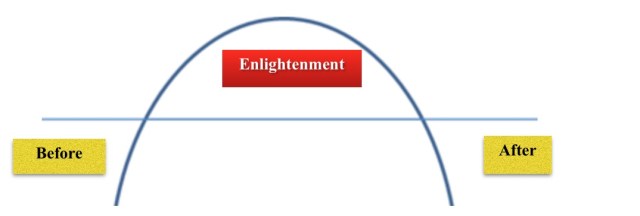

This is not a movie about loving. This is a movie about cheating. In the middle of their boring and loveless marriage—and two boring and loveless affairs—Michael and Mary suddenly get turned on by each other. This urgent powerful sexual attraction is the only one the movie gives us. Neither of the affairs has anything like the power of this unexpected episode in the lives of Michael and Mary. Michael and Lucy are not like that; Mary and Robert are not like that.

So Michael and Mary divorce, their hot sexual attraction to each other notwithstanding, and marry their “lovers” as they had promised them they would. At which point, they carry on with their own torrid sexual relationship which is now an adultery. To do this, Michael needs to cheat on Lucy in exactly the same way he has been cheating on Mary; Mary needs to cheat on Robert in exactly the same way

So I think I would pick for the “first scene”—the one that serves as the key to understanding the narrative as a whole—the first scene where Michael and Mary are together. They are “together” in the sense that they are both in the screen at the same time, but they are not together in any other way. They are not as close as you would be to someone who lives in your neighborhood and whom you met unexpectedly at a shopping mall. The chance encounter would be warmer, more personal. The Michael and Mary scene shows only the most grudging of recognitions that there is another person in the room.

So that’s my choice for “first scene.” It is the left-facing parenthesis. I like what it says about the last scene, which, however illicit it might be, is also engaged and personal. And if those are the first and last scenes, then I get to say–using or misusing the technique of inclusio– that the movie is “about” the interpersonal relationship of these two people (Michael and Mary) who once had a nerve-dead relationship (though married) and who now have a rich and sexually engaging relationship (though adulterous).

The good news is that this technique offers a way of questioning a thematically complex movie to see what it was “about.” The bad news is that if the movie really won’t tolerate that treatment, people like me might use it anyway, just tucking in the corners as necessary.

[1] I have recently seen it called “inclusion,” but if it is a specific technique—and it is—I would rather give it a distinctive name.
[2] Their Finest is “comedy, drama, romance” according to IMDB. I guess you get to take your pick. The book was called Their Finest Hour and a Half—which I really like as a title—and was directed by Lone Sherfig.
[3] A “comedy” according to IMDB. It was written and directed by Azazel Jacobs.


Posted in Biblical Studies, Movies, Uncategorized | Tagged , , , , | Leave a comment

The End of the Enlightenment?

What’s the matter with Kansas? wondered Thomas Frank [1]. They don’t seem to vote in favor of the programs and candidates that would benefit them most. I like the way Frank framed the question, but I’d like to take it back a little. How is it that we think we would decide to do the things that are in our best interest? Isn’t that an excessively rational kind of expectation?

Enlightenment 3

Here’s what I’ve been thinking about recently.

In this simple little figure, I want to represent the part of the Western experience of rationality for which we use the name Enlightenment. Societies based on the Enlightenment in one way or another—I have several possibilities in mind—are above the line. The two parts of the arc that are below the line represent our past (to the left) and our future (to the right). They represent, in other words, where we have been and where we are going.

Dismal, isn’t it?

A generous dating of the beginnings of the Enlightenment starts it around 1620 C.E. [2] The Enlightenment is often characterized as the establishment of Reason as the basis for society. But “reason” rather than what?  Here, pondering an answer is Thomas Aquinas, who thought “just price” would do it.

Enliightenment 4Historically, Reason was contrasted with Authority, particularly the authority of the Catholic Church, as an alternative basis for society. I don’t think that is the best set of alternatives for today, but even that set is suggestive. Consider, for instance, that “God says everyone shall be paid enough to live on.” We might even throw in “Thou shalt not muzzle the ox that treads the grain. Deuteronomy 25:4 and several New Testament citations). We would say that this is ordering society on the basis of “revelation,” as the Church understands what God is commanding. That is not rational in any narrow sense of the term. [3] On the other hand, the market system isn’t rational either. “People will be paid whatever employers are forced to pay them to insure for themselves a skilled and stable supply of labor” is not rational. Even in an un-distorted market it would not be rational and no one thinks that the current market for labor is “un-distorted.”

Between those irrationalities—the pre-Enlightenment and the post-Enlightenment, there is a rational path. I am not recommending it because it didn’t work well, but it does have the virtue of rationality. It is the “just price” doctrine, which was once devised and enforced by the church. The Communist Parties of the Soviet Union and China tried the same thing, using social rationality as their argument, and discovered what the Church discovered—nobody knows enough to decide what is “just.”

So in this little parenthetical example, I have placed the inaccessible sources—God on one side and the Market on the other—as bearing the same relation to rational choice. I have put the Church and the Communist Party in the center as examples of rational means of establishing prices. I do not count their failure against them; they did proceed rationally.

There is a way for democracies to proceed that follows this same course. In it, too, there is a brief moment of bright sunlight between a promising dawn (Enlightenment) and a disheartening dusk. Let me describe this period of sunlight briefly.

In order to do it briefly, I will have to caricature the various players. I think it is the only way to proceed, so, with apologies to all, I will grotesquely simplify the last several hundred years of experience.

Making social decisions has nearly always been thought of as a team sport, of which there are two versions. In one, you are a powerful person—a clan chieftain, let’s say—or you are a member of the clan who trusts your chieftain to make the best judgment. This is rational, or could be, on the part of the chieftain, but it is not rational in that same way on your part. Trust in your leader is the virtue on your part. You are part of the social group which operates in the backwash of the leader’s decision and your membership in the social group so affected defines you. If there is a rationale to it, it is that you need to be a member of the team in order to function effectively and being a member of the team means supporting the chieftain’s decisions.

good enough 2This meets the broader standard of “rationality” you will notice—the one that was met by saying that doing what the Church said God wanted you to do is “rational”—although it does not meet the narrower standard.

Now comes democracy with its “enfranchisement” of “the people.” [4] The notion of “the people” gradually opened out to include everyone over 18 years of age and was further insividualized by the secret ballot. So I go into the polling booth all by myself and I decide all by myself which rulers will serve us all best. Or I decide which rulers would serve me best and the system of democratic equality adds all the personal preferences together and comes up with an approximation.

This is an exercise in “rationality” in the narrow sense. Candidates run for office and make the promises they think they have to make, knowing that they will have to fulfill at least some of them. Voters choose the candidates who make the most plausible promises, knowing that not all of them will be fulfilled. That meets the notion of “rationality” in the narrow sense, as I am arguing the case. [5]

I am considering the election of Donald Trump as a signal that the “day” of Enlightenment is just about over. We are returning—have returned?—to the clan members who support the decisions of the chieftain because that is how we know we are clan members.

I was thinking about this development in May of 2014 when I wrote about Barbara Kingsolver’s book, Flight Behavior. You can see the long version of that post here. The short version appears below. Ovid represents “rationality;” Dellarobia is speaking for the clan members.

Ovid says, “You think…it’s a territory divide? We have sorted ourselves as the calm, educated science believers and the scrappy, hotheaded climate deniers?”
Dellarobia replies, “I’d say the teams get picked, and then the beliefs get handed around.”
“Team camo,” she says, referring to Cub’s team. “We get the right to bear arms and John Deere and the canning jars and tough love and taking care of our own. T
“The other side,” she doesn’t even know what to call the other team but contemporary conservatives call them Limousine Liberals, “wears I don’t know what, something expensive. They get recycling and population control and lattés and as many second chances as anybody wants.”

If what Dellarobia says is a fair characterization of how President Trump was elected, then I think we need to consider the possibility that decision making in large societies simply puts more stress on our rational capacity than it will bear. “Being a member of the team”—Team Camo in Dellarobia’s description—has been important for a long time. Individual rationality has been the mechanism for making social choices for a relatively short time and was not even considered as a possibility before the Enlightenment.

I take the election of President Trump as an indicator of how bad things have gotten. IEnlightenment 4 am thinking of it as analogous to the death of the canary in the coal mine, which is a major event for the canary, but for the miners, it is only an indication that things are not safe. But we have decided, apparently, to vote with our hearts, not our heads. And we have decided not to elect someone who will do what the office requires, but instead to take actions that make us feel good. And we have decided that words and acts—anything, really—that shows how angry we are is all we will require of the person we choose to organize the domestic economy and to deploy the military. That is how the majority that chose Donald Trump was assembled.

Democratic voters who voted for Barack Obama in 2008 because he was black and for Hillary Clinton in 2016 because she was female, fit this same logic perfectly. Not that Obama = black and Clinton = female is the same argument as Trump = angry. The policy consequences, of course, are different, but the way of casting a vote is the same. None of those logics is aimed at an outcome, which is supposed to be the virtue of democratic voting systems.

We have arrived back, in this way of looking at it, at a way of making decisions as clan members. We call them “lifestyle votes” but voting that way is the way you broadcast that you are a member in good standing of this group. And speaking of broadcasting, the little matter of what you call “news” and where you get yours is crucial to group membership. [6]That does not meet the standard of rationality—even as forgiving as I have been about the narrow use of that term.

That is social solidarity voting and it means, so far as decision making in complex societies is concerned, that the sun is setting on the Enlightenment. And after such a promising dawn.

[1] In his book of the same name, published in 2004. The subtitle is “How Conservatives Won the Heart of America.
[2] The Enlightenment is such a complex movement that imagining that “it” started at any particular time is just a useful fiction. Still the ideals that began to be prominent were distinctly different from those before it and, I will argue, with those after it.
[3] It’s probably not a good idea to say that obeying God’s word is not rational, so I pause to distinguish the narrow meaning—following the rules of evidence and of logic—from the broader one.
[4] The quotation marks are richly deserved, of course. “The franchise,” i.e. the right to vote, was limited to white male property owners. No manufacturers, no women, no blacks. But still, the white male property owners are being considered as individual decision makers.
[5] Political scientists have long been enamored of a party-centered model called the “strong party system” in which the party, not the candidate, does the promising. Even political scientists have mostly given up on that, but we did it after the voters refused to be interested in it. We thought it would simplify rational choice for the voters. The voters didn’t like to have their personal preferences rationalized.
[6] I was surprised to see that Fox News was on all the TVs at Dallas/Fort Worth airport. And then I was surprised that I was surprised. The clan in Dallas is defined to include travelers. You could call that Southern Hospitality if you really wanted to.

Posted in Political Psychology, Politics, Society, ways of knowing | Tagged , , , , | Leave a comment