
If you were here, I would dearly love to turn to you, as I did to Bette, and say, “What just happened?” Here is what I think happened. In the first season of The Good Doctor, they have developed a racism subplot and a sexism subplot to supplement the handicapped theme—the “good doctor” is autistic—which is the main driver of the show.
In Season I, Episodes 10, 11, and 12, one of these two plot developments absolutely floored me and the other followed a very familiar pattern. It is the racism subplot that has turned strange; the sexism subplot is thoroughly predictable.
The Sexism Subplot
We are going to have to do some plot now. I’m going to be using a lot of pictures because most of the characters are non-white and that matters in this account.
Step 1 Dr. Coyle (Eric Winter) inappropriately propositions Dr. Browne (Antonia Thomas) in one of the operating rooms  of St. Bonaventure Hospital in San Jose. Here are Dr. Coyle
  and Dr. Browne. She reproves him as she should and reports him as she should. But Dr. Kalu, her boyfriend, (that’s a gross characterization, but it’s good enough for this small turn of the plot) is angry and physically assaults Dr. Coyle. And then he gets fired for having done that.
Step 2 Dr. Kalu wants his job back, so he hires a lawyer to make the case that his punishment is much greater than the punishment of several white doctors who were reproved for having done the same thing Dr. Coyle did. [1] The severity of Dr. Kalu’s punishment is said either to be racism or to be something that will look like racism when Dr. Kalu’s lawyer takes the case to court when he sues the hospital.
 This requires a confrontation between Allegra Aoki (Tamlyn Tomita), who is Chair of the
 St. Bonaventure Foundation—that means she presides over the sources of the money that fund the hospital—and Jessica Preston, (Beau Garrett) who is Vice Chair of Risk Management. You see them here.
Step 3 Ms. Aoki agrees the settle the case rather than to allow it to go to court, the result of which is the Dr. Kalu gets his job back. That means he returns to his position as surgical resident under Dr. Andrews, who is furious with him for doing what he had to do to get his job back. Here are Dr. Andrews and Dr. Kalu. Keep this picture in your mind when you see the line, “It sets us (us!) back two steps.”
Step 4 Dr. Coyle has been “punished” by being transferred to a different hospital at a higher salary, but that is not enough for Dr. Browne. She complains to Ms. Aoki that the punishment is not severe enough. Ms. Aoki agrees, but says that all Dr. Browne has, from a legal standpoint, is a case of he said/she said, which is not a strong case. So Dr. Browne heads out to round up other women who may have been abused by Dr. Coyle (#me too!) and in the last scene of these three episodes, finds one.
A familiar problem with a familiar solution
Let’s take the harassment problem first. Dr. Coyle is a creep. He is not a racist, but he is a creep. Dr. Browne complained about his behavior and he was punished, but not severely enough to satisfy Dr. Browne, who is pretty sure that Dr. Coyle is going to continue to operate [2] in the way he did at St. Bonaventure. So Dr. Browne goes out looking for other women who may have experiences inappropriate advances from Dr. Coyle.
This is the #me too moment. We are led to believe that if this subplot is continued, Dr. Browne will find a bunch of women—fellow victims—and that Dr. Coyle will finally get what is coming to him.
This is the most common of the current plots. The man is evil and the women are victims, but when they join together, the evil man can be punished appropriately. I’m not making a judgment either about the real world events or the TV drama events that follow this path. I am saying it is the most common current path of the shows I watch or hear discussed. In fact, I might go so far as to say that as a plot device—not as a real life event, but as a dramatic convention—it is trite.
A familiar problem with a twist
The race question goes a different way, although it doesn’t appear, at first, that it is going to. Up in Step 2, I said that there was a clash of sorts between Ms. Aoki and Ms. Preston. Here’s what that looked like.
Preston: The chief oncologist—this is before I came here in December of ’14—Dr. Marshall shoved a scrub nurse during a post-op discussion of some sort. So you remember that?
Aoki: I do.
Preston: Your response was to settle with the nurse while Dr. Marshall was let off with a warning. There’s another almost identical instance later that year. In both cased, the doctors in question were white. They were censured. Dr. Kalu was fired.
Aoki: Do you think this was a racial matter. Do you think I’m racist? That I favor white people?
Preston: Then why the leniency then and not now?
Aoki: They’re stars that happened to be white. Doctors like Dr. Marshall allow St. Bonaventure to compete with other West Coast institutions.
Preston: So that’s our defense. We’re not racist. We just allow our doctors to assault people as long as they bring in enough donors.
Aoki: They were reprimanded and there were no further incidents.
Preston: And how do you think all of this is going to play out in court?
Aoki [pushes the file across the desk to Preston] Settle.
Preston: OK
Neither Ms. Aoki or Ms. Preston thinks that the way Dr. Kalu was disciplined had anything to do with his race. [3] Both look at the damage that can be done to the hospital if Kalu’s case goes to court and Ms. Aoki makes the prudent choice. Settle this out of court.
I think that is not quite standard. The charge is standard. You treat white offenders different than “dark” (Caribbean, maybe?) offenders. But neither of the women in this discussion thinks that issue really is race. They agree that it will look like racism if it goes to court.
The Racism Subplot
But then something blatantly non-standard happens. Not only was I unprepared for it; I found myself nearly speechless when I saw it. I went back and watched that part again to be sure it really happened the way I thought it happened. It did. Here it is.
Dr. Andrews, Chief of Surgery, (Hill Harper) is just leaving for the day when Dr. Kalu (Chuku Mood) catches up to him and tries to engage him in a conversation about what happened in surgery that day at the hospital. Dr. Andrews isn’t having any.
Dr. Kalu Dt. Andrews. Good evening. I…uh…checked out the twins’ file…it’s an amazing case.
Dr. Andrews: To be clear, Jared, I don’t want you here.
Kalu: What we presented to Miss Preston was the truth.
Andrews: I understand that. And those problem doctors and the ways we police ourselves will be dealt with, should have been dealt with a long time ago. But you stepped over a line.
Kalu: I fought for my job.
Andrews: You compromised your integrity. The incident with that jerk Coyle had nothing to do with black or white, but that’s what you and your lawyer sold for leverage. And when you misrepresent racism for something it’s not…it sets us two steps back.
So how is the racism question being dealt with here? Very differently that the sexual harassment question certainly! I said that development of the harassment theme was trite as a dramatic narrative. This one is pathbreaking.
 Dr. Andrews, the black Chief of Surgery, (on the right) reproves Dr. Kalu, the dark
  surgical intern, (on the left) for playing the race card inappropriately. Kalu defends himself by arguing that the case he made—white doctors in that situation have been treated differently than he was—is true. Andrews says that isn’t a good enough excuse. “You stepped over a line,” he says. He doesn’t say what “the line” was, but he is about to.
Kalu defends himself again. He was just doing what was necessary to get his job back. He is right about that. Nothing less that threatening an embarrassing and unsuccessful appearance in court would have caused the hospital to settle. But that isn’t the line Dr. Andrews is talking about. He says that Kalu compromised his integrity. That is not something you ordinarily hear a victim of racism accused of, and very probably no one who is not black and not his superior at the hospital could have said it.
What did Kalu do wrong, according to Andrews? Kalu knew that the discipline he received had nothing at all to do with race, but he and his lawyer used race anyway, just as leverage. Then come two really important final steps. The first is this: “When you misrepresent racism for something it’s not….” Your punishment had nothing to do with racism and you knew that, but you said it did and you said that for your own advantage.
The second is this: “…it sets us back two steps.” Us. The differences between Dr. Andrews and Dr. Kalu, so far, have been that Andrews is Kalu’s immediate superior. Andrews is Chief Surgeon. Kalu is a resident in surgery. Kalu is a hothead and romantically involved with another resident. Andrews is not a hothead, and in his position, he couldn’t afford to be. And he knows the risks he runs by having a hot-tempered resident on his staff. We know about those differences. They have been clearly shown to us in previous episodes.
“Us” has not been clearly shown. “You and I,” Andrews is saying, “are people who have been and who will continue to be, subjected to racism. We have been making progress; slow and painful, step by step progress. And you have just set ‘us’ back two steps.”
Andrews here addresses Kalu as a fellow black man. That’s what “us” means. It is hard enough to make any progress in undoing the knot of racism without some of the victims playing fast and loose with the truth. “The truth” here is given a very high place. “Making a dent in racism” is given a lesser place. If one is to be sacrificed to the other, is the the crusade against racism that is the give way and the truth of the matter to be preserved and it is especially the work of the black victims of racism to demand it.
Sexism and Racism
So…I don’t know. I’ve never seen these two liberal subplots running along side by side and then watch one change direction drastically while the other keeps on going. I suspect the marketing department at ABC knows something I don’t know. Do they have a liberal fan base and a conservative fan base and decided to give one subplot to each? Do they have one tribal fan base—racism, anti-racism, sexism, and anti-sexism are all tribal affiliations—and one judicious, let the facts speak for themselves fan base?
Surely not. If I were in marketing for ABC, I would certainly argue that the network is going to make more money pandering to the tribal affiliations–either one, let alone one for each– than to the judicious, above-it-all group.
Any ideas?
[1] This is a plot problem of sorts. No one is accused of having done what Dr. Kalu did, which was to physically assault another member of the hospital staff.
[2] The notion of “a smooth operator” in a hospital-based show is really asking for trouble, but there it is. The language will stand only so much twisting and bending.
[3] There is a nice moment, though, when Aoki, who is Japanese, asks Preston, who is white, if she really thinks Aoki is racist. Really?
 is like. [1] In The Great Divorce, Lewis gives a very interesting account of the Spirits who are in Heaven and who belong there. In Lewis’s version, the Ghosts come up from Hell as visitors—there is a bus every day for that purpose— and are met at the bus stop by the Spirits who are there to help them.
 It is also true, in this fantasy, that the Ghosts are completely insubstantial. Picture a column of smoke in the shape of a person. The Spirits are substantial—“real” Lewis says—because Heaven is “real” (substantial) and that difference in the two places mimics the spiritual condition of the two kinds of beings.
 physical tasks. The Rights-monger cannot simply wander around Heaven on his insubstantial feet, much less begin a journey to the mountains. He will need quite a bit of help and Len is offering it to him. It means spiritual tasks as well, as in asking for forgiveness for the evils Len had done on earth.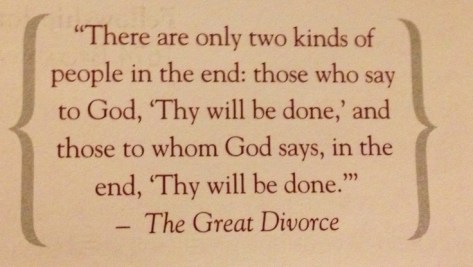

 There are people here, for instance, who manage to stay in touch with their biological family—that ordinarily means siblings and children and grandchildren—and also to build stable friendships with the other residents. I wasn’t all that impressed at the beginning of my time here, but now that I have given it a try, I know how hard it is and I want to learn how they do that. I don’t want to copy them—the differences also need to be taken into account—but I want to learn how they see the field of play and how the decide what to do.
 chipper; the husband was quiet, but he could say things that made sense on their own and that contributed to the conversation. Sometimes. And sometimes not. When “sometimes not” happens, the wife has a decision to make.
 incontestable outline of things. And after that, and without losing any awareness of it, you can attend to a good deal of complexity without losing your sense of the vision as a whole.
 And it isn’t just history. In preparing for a Bible study course that begins in September, I have been studying the Old Testament prophets. And all of a sudden, it occurred to me that there were three major categories of those prophets. Only three. There were the pre-Exilic, whose message was that God is going to punish (“discipline” in some of the prophets) you for your godless ways. And then there were the Exilic prophets, who said to Israel, “Your sentence is almost up. God is going to restore you to your homeland.” And there were the post-Exilic prophets who, with the exception of Jonah, said, “The holiness of the temple and the city and the worship of Yahweh have all been compromised while you were gone. Put things back to the way they should be.” [3] This is someone’s notion of what the prophet Amos looked like. He was one of the pre-Exilic prophets.
 When I hit my first communitarian sociologist, Frank Hearn, I was fascinated by his allocation of all kinds of “social problems” to one of three places. His own preference as a sociologist is that most problems be considered as “social problems,” by which he means problems rightly referred to communities using their own local institutions. But that means that he has to have a nasty name for the practice of referring those social problems to other places, where they really shouldn’t be. [4] Problems that are rightfully social, but that are referred to the polity instead, have been “politicized.” Problems that are rightfully social, but have been referred to the economy instead, have been “commodified.” Three places to put problems: no more. Horizon.
 complexities of today’s policy proposals. DACA or not? Amnesty or not? Enhanced legal immigration or not? But all of these questions take the present political system—the old classic post-medieval Liberal system—for granted. And Deneen says that system is running out of fuel and can’t be saved. I’m sure this picture is an ad for a business of some kind, but note the similarity to Deneen’s communalist picture of liberty.
 movies. [1] The picture I am relying on here is the patient lying on the couch free-associating in the presence of a fully present therapist. The “free” of free associating means, in part, that the little boxes in which we keep the thoughts and feelings that contradict each other are all opened at the same time in free association. And they associate with each other, not in the dark safety of the mind but in the public space between the therapist and the patient. Both hear the patient say things neither has ever heard before. [2]
 year, red states want to do red state things and blue states want to do blue state things. And every year, each color has to put up with federal regulations that requires them to be much more similar than they would really like to be. This tension between the national administration of national systems and the state preferences which express the political culture of their own states, is the heart of the federal bargain.
 know that because they aren’t working. Further, they are not working because they choose not to work and in that choice, they forfeit their claim to society’s help.
 states are finally being allowed to do what they have wanted to do for so long. It is this “permission,” that called to mind the image of Dr. Trump as the therapist and “the red states” as the patient. Dr. Obama kept telling them how they should feel—compassion, for instance, toward those not able to find work—and made them feel ashamed of how they did, in fact, feel. Dr. Trump is allowing those states to say out loud what they have felt for so long and is giving them permission to build systems tying work to medical service.
 has not yet abated. Some of that animosity appears to be no more than personal grudges projected onto public issues. What could have been a perfectly normal division within the Democratic party between the ideological left and the pragmatic center, got blown out of proportion by the personal attachments of the campaign supporters. Hillary’s people need to get over blaming Bernie’s people for “denying her the election.” Bernie’s people need to get over their resentment of Hillary’s persistent tacking to take advantage of the winds of the campaign season
 This argument agrees that the Republicans may be very weak in 2020 as a result of the expected Trump implosion but they make the case that winning seats is more important than the success of the programs so dear to the left wing of the party. And you don’t have to say out loud that you don’t share those goals if you can just make the case that it would be risky to pursue them.
 are not the same kind of thing at all. The dominant voice of the Republican party is now a movement-oriented voice, something like jihad. The Democratic style is collecting groups of voters who are willing to sign on for the campaign, like a state militia. The Democratic party works like the United Nations, not like Al Qaeda. [4]
 Of course, the fact that I am not “working” anymore doesn’t mean that there aren’t things I want to do. In fact, there are things I commit myself to accomplish and they highlight that task-focused center and they push my focus on myself to the blurry periphery. It’s a very familiar feeling and most of the time, I like it.
 to be done—sometimes there is a deadline—and you need to do to yourself whatever you need to do to get it done. Solitude, alcohol, stimulants, brainstorming…whatever. So starting from the other end, “What job best fits what I have to give right now?” is a whole new thing. Sometimes I am frazzled and can’t focus on anything. That is the basic fact. But there is a collection of errands or chores to do that require virtually no focused thought. I can do them just as well when I am scattered as I can when I am cogent. So I choose those.
 tranquility by showing you this picture. The case for: wouldn’t it be great to be able to be like this some part of every day? The case against: wouldn’t it be awful to be like this all day every day?
 For reasons I can no longer recall, a big distinction was made, where I grew up, between “a reason for something” and an “excuse.” By usage, I learned that a reason you gave for something was one or the other. I never heard anyone say that a reason was so inadequate that it could not serve as an excuse or that a reason was so compelling that it did serve as an excuse. The old usage is still in place, I notice.
 For one thing, the IOYK excuse functions as a kind of euphemism. It is a socially acceptable reason where “the real reason” might not be so acceptable. If there are parties you don’t want to go to or projects that aren’t really worth doing or jobs you would rather leave for someone else, saying those things in those ways will get you into trouble. Or reasons for not texting an “old person.” Using IOYK will not. People accept it more or less at face value and don’t take it personally.
 And not only that, but the people to whom this reason is presented and who accept it as legitimate—they accept it, that is, as an excuse—will also learn the broader premise we are using. “He thinks of himself as old” our friends will learn to say, “…and so he would probably not like to be invited to the party or told about the project.” And, of course, our friends talk to each other too, so this assessment of what we might respond to spreads across our friendship network, with the result that many invitations may simply be not offered. “He always says No,” our friends will say as they consult each other, “and he will say he is too old.”
 the basis of the show—Dr. Shaun Murphy is better than everyone else at the hospital in diagnosis and treatment and worse than everyone else in interpersonal relations—is hard for me to manage. I also thought that they would settle on a format and just crank each week’s episode through that format and be done with it.
 This one is called “Point Three Percent,” [2] and in it we meet an amazing boy. Evan Gallico (Dylan Kingwell, who also plays Steve Murphy, Shaun’s brother, when they both are young). [3] Evan is committed to protecting his parents. That is the common element of the several strategies he adopts. He is bright and caring and perceptive. He is not the kind of kid you want to see die of cancer.
 things God can no longer do once He has committed Himself to free choice in his creatures. That is what intervenes between “if I believe in Heaven, I’ll have to believe in God” on the one hand, and “then I’ve got to believe that God made me sick,” on the other. Evan believes that whatever happens must be the will of God because God can do anything. But it seems to me that God limited the playing field a great deal by creating people capable of saying Yes or No to Him.
 been lost on scholars, for instance, that in Matthew, Jesus’s first sustained teaching was on a mountain. Moses went up the the mountain (Sinai) the get “the Law” from God. Jesus went up a mountain to give a series of contrasts to that Law, each of which began, “You have heard how it was said to our ancestors…” and then continues, “But I say this to you…” [1]
 This device of Matthew’s is, as I say, widely recognized in his gospel, but it is not widely recognized in his narrative about the birth of Jesus and it is noticeable there as well. You would think that a writer who thinks of himself as a teacher has a point to make, he would work it into every part of his writing, even the birth stories. And he does. Here are some examples.
 fulfill what the Lord had spoken through the prophet: I called my son out of Egypt.” (Matt 2:13) So…what prophet is Matthew talking about? It is Hosea (11:1) where Hosea, in using the expression, “my son,” means Israel. And Matthew knows that Hosea meant Israel. So how does he manage to appropriate it so that it refers to Jesus? I can argue all I want that in Matthew, Jesus would have been a little boy, but I can’t find any pictures in which he is not an infant.
 about Jesus sounded familiar.” Placing Joseph’s family in Egypt allows Matthew to re-appropriate the scripture, “From Egypt, I have called my son.” For Matthew and/or for his readers, this is a sign of the providential working of God to bring us the Messiah just as he had promised.
 This is the first line on the paper. Remember the “slaughter of the innocents by the Pharoah in Egypt?” And then the parallel line. Well, there was a slaughter of Israelites at the time of Jesus as well, this one engineered by Herod the Great. [5] And we say, “Oh, right. I knew that sounded familiar. This story of Jesus is so very much like the story of Moses.”[6]
 The Dilettante's Dilemma