I am glad I am not THERE anymore

If you have lived a long time, you have held views you no longer hold. Your choice, from the place you are now, is how to regard those views you once held. [1]

I want to emphasize that this is all about narrative-building. You do not, in fact, know why you held the views you once held. Nor is is “true,” exactly, that those views were a stumbling block that you finally surmounted or a scaffolding that enabled you to build the (much superior) views you hold today. Or a sequence of views you held as you served your apprenticeship to your parents, or to your commanding officer, or to your professor, or to your employer.  You can buy this hoodie, apparently.  It means “Control my own narrative.”

All those things are necessary parts of your self-narrative. You can’t really get rid of live there 4them, so you have to assert some functional role for each. We hear this all the time, “Back when I was young and naive….” someone will say, implying that his present views have somehow escaped that naiveté. “My Sunday School teacher always said…” is the beginning of a rejection of that position—or, more likely, a caricature of that position—and a celebration that it has been discarded. [2] Sometimes you hear a narrative placement like, “Our parents always insisted that we…” and this is particularly true if the speaker is trying to assert the continuity of those early practices with his current practices.

I’ve told those stories a lot of times myself. Mostly, they are “love ‘em and leave ‘em” narratives. I say that I grew up with a certain set of views (or a certain way of establishing my views) [3] and they were good for me at the time but eventually, I grew out of them. Or I was forced out. Or I became much more attracted to some other view and found I could not hold both.

I’ve been thinking about a political version of my narrative recently. The most recent turning point is how I used to be a liberal. But I am much more familiar with the religious narrative so I think I’ll start with that one and then move over to the political one when I have built up enough speed. If any of you have been on both of those journeys, you may have comments of your own to make.

Religious Narrative

I was raised in a religiously conservative home. My father and my mother held different, but compatible, ideas of what a good Christian life would look like. Naturally, I absorbed some of each. The conservatism I learned in college [4] was much more systematic and much more Calvinist than anything I had learned at home. Biblical scholarship at Wheaton was recruited to hold its conservative views in place and to give them a solid intellectual backing. It didn’t work that way for me. The more I embraced the scholarship, the less I embraced the conservatism.

live there 3So I became a liberal. Kind of. [5] And like a lot of liberals who had once been conservatives, I belittled the conservative views. This was my first experience with “I’m glad I am not there anymore” (IGIANTA). The liberalism I graduated to had a great deal of anti-conservatism in it and I enjoyed both the breadth of scholarship to which my new liberal appetites directed me and also the regular belittling of the views I once held. [6] I told “fundy” (fundamentalist) jokes the way we used to tell “dumb blonde” jokes.

But I got tired of it, eventually. The views I held then were made up of equal parts rejection of conservatism and attraction to liberal scholarship. [7] Initially, perhaps, even more rejection than attraction. Then I moved on to a commitment to liberal scholarship without having to bash my former colleagues in passing. That is my position now.

So those people who occupy the place where I lived until that last ten years or so, are now “where I used to live” and I have the same rejection of their views that I once had of conservatism. The relentless banging on conservatives—they are stupid, they are racist, they are hypocrites, etc.—-seems so unnecessary. I wish “they”—the people who are still doing what I myself was doing until recently—would just knock it off. There are such wonderful positive engaging things to be learned in scripture and to be celebrated; why waste all that venom on conservatives.

I am well aware that there were people who felt exactly that way about me in my conservative-rejecting liberal phase. I am sure they had every right to. But now I feel that way myself, so it seems so much more reasonable now. I call this the “love ‘em and leave ‘em” mode. I liked being where I was, but now I am somewhere else.

Political Narrative

I was raised conservative politically, too. I didn’t know it until I moved away from home and was able to look back and see my political upbringing as a particular kind, one that fit into a particular category. Colin Woodard in his book American Nations would say that I grew up in Greater Appalachia. When I discovered this, I became a liberal. Of sorts. [8]

And having become a liberal, I disparaged conservatives, particularly conservatives of the kind I was. I had escaped. I was now a butterfly. I exercised my contempt for colleagues who were still caterpillars. I think I did manage to grow out of that phase so far as the damning of conservatives is concerned. “Damning” just isn’t as much fun as it used to be.

But my real problem with liberalism is its break to the left. Continuing to hold the views I held as a “liberal” now make me almost conservative. This is like one of those jokes where everyone else in line takes a step backward and you discover that you have just volunteered for something.

I don’t want to be the one who breaks the news, but partisan politics in our time has live there 6become a blood sport. This isn’t something Donald Trump did. This is the social change that gave us Donald Trump. Years of economic stagnation have left their mark. The effectiveness of ridicule and disparagement of one’s political colleagues pioneered at the national level by Newt Gingrich and widely adopted by Republicans has also left its mark. The moral condemnation of many traditional voters as “haters” of one kind or another has become standard practice by liberals and that, too, has left its mark.

Liberalism, which used to attract me by its hopes and its more generous policies for the welfare of society, seems to have degenerated into angry accusations about the immorality and the stupidity and the racism of conservatives. Liberalism has been weaponized as a political movement and I don’t see that as a way to restore the legitimacy of democratic government.

And that’s what I want. I want to be governed by institutions and leaders that are broadly seen as legitimate. They were properly elected and have the right to govern in what they see as the interest of the public until they are replaced in office by voters. That, in case you have not noticed, is not what we are doing now and I would like to move back in that direction. So the liberalism that broadens and deepens its disparagement of conservatives is why I’m glad I am not there anymore And IGIANTA to you as well.

I haven’t tried to devise a name for my current position yet, but perhaps “post-liberal moderate” would do as a starter. I now run the risk of alienation from my friends who think of their bellicosity as “being true to the cause” and of my hankering for a post-war peace accord as being “untrue to the cause.” And they are right, in a way. If “the cause” is weaponized liberalism, I am not being true to it. It is not going to get me anywhere I want to go.

I’ve already said where I want to go. I want to have a government characterized by respected legitimate institutions and I want a politics that will allow the maintenance and use of those institutions. Maybe an example would help here. Liberals and conservatives have differed for years on tax policy. As a caricature—good enough for this one example—if the liberals, when in office, bent the IRS toward their tax preferences (and the conservatives the same), that would preserve the legitimacy of the IRS. If the elected government thinks of itself as the Mafia and uses whatever tools it has to destroy its enemies, that would not preserve the legitimacy of the IRS.

Partisan political competition has already been weaponized. When the government itself is weaponized, the era of free and fair elections and of legitimate government is over. My liberal friends don’t see it that way. They want to win the political wars, thinking, I suppose that they will govern freely and fairly when they win.

That seems short-sighted to me, for reasons I will have to explore at another time. [9] The point here is that I am having to disparage the people (liberals) whose views represent the achievement of my youth and middle age. I am genuinely attracted to the reconstruction of legitimate government. I know that means de-escalating the political wars. It does not mean unilateral disarmament, but it does mean detente.

So the liberalism of most of my life is somewhere I have had to leave. What I want to do is to continue to value my liberal friends—including those who think that weaponizing politics is the only way to be true to the cause—and to work toward practical cooperation with those conservatives who are tired of teeter-totter. About that liberalism, I have to say IGIANTA.

I’m post-partisan. I’m bipartisan. I think there is no way to have legitimate government without electing people who care more about the public good than they do about cheap partisan victories.

I have no interest in people who care more about the public good than they do about being elected. If they don’t get elected, they are of no use to me at all.

But they can take the honest and difficult path instead of the cheap and easy path.

That’s where I want to be.

[1] This is as nearly true of me as it is of you. I’m just trying to stabilize the pronouns.
[2] It is awkward if you, yourself, hold the view that the speaker attributes to his ignorant, self-righteous, and dogmatic Sunday School teacher, but sometimes that happens.
[3] Experience and authority are the two major ones, especially if you include the results of research in “experience.”
[4] Wheaton College in Wheaton, Illinois. When I was there, Wheaton was still calling itself “the West Point of evangelical Christianity” and both the religious views and the military underpinnings were prominent at Wheaton.
[5] A very friendly evangelical pastor who knew me well maintained that I was not really a liberal. He said I was “a minimalist evangelical.” It was an act of friendship.
[6] Not, as nearly as I could manage it, the people who once marched with me under the flag of conservatism.
[7] There are many “liberalisms,” of course, just as there are many “conservatisms.” I was never attracted to “God is dead” liberalism, or liberation theology or process theology.
[8] In politics, as in religion, there are many different “conservatisms” and many different “liberalisms.” I have always been fairly conservative socially. I call it traditionalism, not conservatism. I am much more progressive on political and economic issues than on social ones.
[9] The short version is that the alternation in power is like being on a teeter-totter. Whoever is down has both the incentive and the means (contact with the ground) to change positions. That means you can’t win at teeter-totter. You need to be playing some other game. And not the merry-go-round if that was your first thought.

Posted in A life of faith, Politics, ways of knowing | Tagged , , , , | Leave a comment

Neaera H. comes to life

In 1975, five years after ending the series featuring Frances the Badger, Russell Hoban wrote Turtle Diary. Turtle Diary is a book for adults—not “an adult book”—about William G and Neaera H., two losers who, in freeing some turtles from the London zoo, become winners. [1]

They are losers is quite different ways, so what they look like when they become winners is quite different. I like Neaera’s story better; I just respond to it more. Here is a reflection by Neaera as she is just beginning to adjust to being a winner.

It used to be that I stayed up till all hours and still felt time-starved, none of the day seemed to be metabolized into living. Now the minutes make me strong.

neaera 2There are some particular issues that have defined Neaera’s life [2] but the thing that intrigued me about this observation of hers is the transition from “time endured” to “life lived.” She calls this transformation “metabolism.” She goes through a whole day without this transformation of minutes into living; she experiences it as not having enough time, but when she becomes a winner and begins to reflect on her life, she knows that isn’t what it was. She felt time-starved, but she wasn’t, really. She was “life-starved.”  Here, as played by Glenda Jackson.

So how does one manage one’s life so that the minutes are metabolized into the experience of living? For Neaera, there are two things. There are the turtles, on the one hand and her feeling for them living trapped and pointless lives. And then there is the turtle keeper, George Fairbairn.

This is not a story, I am happy to say, where years of self-neglect are redeemed by a convenient romance. They were redeemed, in fact, by an act of liberation. She and William G. formulate a plan to steal the turtles—the keeper, George Fairbairn, is all for it—and take them to a small coastal city and turn them loose.

This is daring is a lot of different ways. For Nearea H., who is trapped in a sterile neaera 3passivity, it requires that she help plan the heist, that she cooperate with William G., whom she know only from the context of this proposal, that she sneak the turtles to the coast and set them free. And then, presumably, come back to her own life, which she characterized, early in the book (p. 43) as “I seem to go on doing what I do.”  Ben Kingsley here as William G. along with a woman who wants very much to be his girlfriend.

It turns out that she was not able to do that. Once she was out of the trap, she was able to look back at where she had been and see that it was a trap. On p. 184, for instance, after the success of the turtle liberation project, she observes: (p. 184)

I didn’t know how lonely I’d been until the loneliness stopped. Now…my flat…seemed to have been cleared of the invisible wires, criss-crossed in patterns of pain that had been there for years. [3]

The other thing that happens to Neaera H. is that she meets George Fairbairn, the turtle keeper. This relationship might become a romance or not (Hoban doesn’t commit himself in the book and director John Irvin doesn’t commit himself in the movie) but the effect on Neaera H. doesn’t depend on that. It depends on George’s modeling for her another way to be (p. 178)

George seemed to carry a clear space about with him that made all things plain and simple where he was.

Nothing in her life has been “plain and simple” for a long time. It might be that her early writing about the happy animals was like that when she first wrote them, but she has moved on and they have not.

Gillian Vole and Delia Swallow and all the other and all the other animals and birds I had written about and drawn They led such cosy cheerful lives, that lot.

She sees her life to have been “safe” in a stunted way, as if she has given away priceless things so that she can stay away from dangerous boundaries. You can see that in her reference to the creations of her mind as “that lot.” She made her living off of “that lot” but now she is done with them.

I was waiting for something now and the waiting was pleasant. I was waiting for the self inside me to come forward to the boundaries from which it had long ago withdrawn. Life would be less quiet and more dangerous, life is risky on the borders. Gillian Vole and Delia Swallow live in safe places.

In this passage, (p. 185) she contrasts the “safe places” where her animals live with “the boundaries” from which, for no reasons the book gives us, she has withdrawn.

Whatever it was that happened to her—it wasn’t just liberating the turtles—required her to move out of that safe space. The turtles were magnificent creatures suffering a great indignity, decade after decade. It just wasn’t right! But she was also hankering for a little danger in her life and seeing those feelings as “about the turtles” helps her. [4] William G. helped her, too, taking risks on his own. And George Fairbairn helped her by being who he was.

And having escaped from her trap, she was able to look back and see what a trap it had been and to choose never to go back there again. She is no longer the writer who cuddles up with the likes of Gillian Vole. She is, instead, the writer whose last poem in the book, goes like this.

Stiff but not formal
          A dead cat says hello
This winter morning

[1] The movie version stars Ben Kingsley and Glenda Jackson. It is a slow story, a low key delight. But the book is better.
[2] She is an author of very popular children’s stories, but the ore in that mine seems to have petered out and she begins to suspect that she has been publishing rather than living.
[3] There is nothing in her description of her life, as it is represented early in the book, that has any of the emotional power of “criss-crossed in patterns of pain.” There is no pain at all in her early descriptions. There is only despair. Looking back, she realizes that the despair was what she chose so she would not feel the pain.
[4] That doesn’t work for her partner in crime, William G. whose sad conclusion was “You can’t do it with turtles.”

Posted in Books, Living My Life, Movies | Tagged , , , , | Leave a comment

But Whitey’s goin’ to the moon

Would we be better off, do you think, if we were more sensitive to the concerns of others?  You would think so, wouldn’t you?  That notion has come very close, in the blue bubble where I live [1], to replacing all ten of the commandments that were so important to Moses.

But when you think about it, shouldn’t it matter what the “concerns”—grievances, really—are?  What if there are concerns that are not based, even loosely, on facts?  Would we want to know whether a concern had any merit other than being deeply felt?  You would think so, wouldn’t you?

Expressions of concern

For me, the classic “expression of concern” is “I’m mad as hell and I’m not going to take this any more.”  Howard Beale gave us that in the movie, Network.  People all over the viewing area did just what he urged them to do.  They opened their windows and stuck their heads out and yelled that line as loudly and as many times as they could and they took great comfort from discovering that many other people were yelling the same thing at the same time.

Should we take that “expression of concern” seriously?  Would it help to understand why they are mad as hell?  I’m thinking of the man who took his gun and went out looking for revenge on 9/11.  He found a Sikh, an Indian wearing a turban, and shot and killed him because he imagined that the man was “an A-rab” and therefore a Muslim and therefore complicit in the attack on New York and Washington.  Would it help if we took this man’s “concern” more seriously?  I don’t think so.

Some grievances need to be abandoned because there is no factual cause for them.  I remember a story of an irate parent who stormed over to the house of the teacher who told his daughter that Paris was in “Europe” when the father was holding in his hand a map that showed that it was in France.

Some grievances need to be abandoned because there is nothing that can be done aboutmoon 1 them.  In the Pacific Northwest, where I live, a major earthquake is long overdue.  When it occurs, it will be a tragedy, but the earth is, in fact, made up of tectonic plates and the Juan de Fuca plate is pressing harder and harder on the North American plate and some sort of “adjustment” is going to occur.  There is no point, it seems to me, in formulating that as a grievance. [2]

Some grievances need to be expressed because we all feel better after we have expressed them, but these are not “concerns” that we expect to be addressed and they do not attribute any particular causes of our grievance.  When we think about responding to those grievances—being “sensitive” to them—we have to ask whether anyone will be better off if they are taken seriously?  Will the aggrieved?  Will those to whom the grievance is attributed?  Will society as a whole?  

And who will be worse off?  

I saw the movie First Man this week.  It was very light on the great achievement of the moon landing and very heavy on the cost of it to the astronauts, especially Neil Armstrong, who was the subject of the film. [3]  This movie introduced me for the first time to Gil Scott-Heron’s song, “Whitey on the Moon,” which he sang in 1970, just a year after the event itself. [4]

Whitey on the moon

moon 4I want to make a comment or two about the song and then I want to return to the “sensitivity problem.”  First, it is a song of racial alienation.  That might seem too obvious to say, but it is not.  There are so many sources of alienation in our society today; the song could have been about any of them.  None of the astronauts was gay, for instance. [5]  The song could have been about “straight people” —“Straighties?—on the moon and would have expressed the same alienation.  None of the three astronauts was a woman, so…[insert your favorite derogatory terms for men here] “on the moon.” Of all the  alienations that currently afflict us, I am specifying that this was a song of racial alienation, rather than of some other kind.

Second, the song laments black poverty and contrasts it with white achievement.  This splits “Americans” into racial groups so that sentiments like “America, first in the race to the moon” lose all their meaning.  “Oh, I’m sorry.  Did you mean the white America or the black America?” [6]

These two Americas are latched together in the song in two ways.  One is principally poetic.  The other is a causal attribution.

Of the poetic ones, “Whitey’s on the moon” is introduced by “with” three times, by “but” three times, and by “and,” “while,” “for,” “of,” and “to” once each.  There is also a “Hmmm,” which is my favorite from an artistic standpoint.  Those words connect the bad things happening to black people here with the heroic achievements of the all-white space exploration, but only because they occurred at the same time.  

But there are also to causal ones.  All these bad things are happening here “cause” Whitey’s on the moon.  Here are those two.

The man just upped my rent last night.

(’cause Whitey’s on the moon)

I wonder why he’s upping me?

(’cause Whitey’s on the moon?)

“The man” could just as well have been Asian or Hispanic or black, but in the context, we might as well assume that he is white.  While I don’t know why the rent was raised,  I am entirely sure that it was not so we could send a white astronaut to the moon.

For all the lament in this song, for all the alienation it expresses, for all the black solidarity it engenders, this particular attribution is just wrong.  No one raised this black man’s rent so NASA could beat the Russians to the moon.

Even worse alienations

And as an illustration of alienation—even just racial alienation, forgetting for a moment all the other kinds—I think it points to an even worse fragmenting of the society.  Emily Hanford recently published a column in the New York Times about learning how to read.  The short answer is the phonics is crucial because it teaches students to “decode words.”  There is active resistance to this idea.  It’s the basis of the resistance that inclines me to put it in a consideration of Whitey’s on the moon.

It’s not just ignorance. There’s active resistance to the science, too. I interviewed a professor of literacy in Mississippi who told me she was “philosophically opposed” to phonics instruction. One of her colleagues told me she didn’t agree with the findings of reading scientists because “it’s their science.”

“It’s their science” is very close to the ultimate alienation.  It is as if each baseball team brought its own home plate umpires, each of whom called the balls and strikes.  The calls of “your umpire” are to be rejected, of course.  You can’t play ball that way and you can’t sustain a society that way either.  Different values will always be at the root of social grievances, but we should be able to agree on enough of the facts to propose some solutions.

“It’s their science” is very near the end of the line in alienation, but that line begins way back at “Whitey’s on the moon.”

[1]  That’s not mostly a political reference, although Oregon is a “blue state,” i.e. votes consistently for Democratic candidates.  I’m thinking of it in class and cultural terms as well.  We are mostly mainstream Protestants and genteel agnostics.  We meet each other at symphony concerts and say hello.

[2]  My favorite solution is to purchase “no fault insurance.”  If there were no fault, there would be no earthquake, after all.

[3]  I did know, before I went, that the movie was not going to be about Adam.  For one thing, “Adam” mans “earth.”

[4]  Just to introduce a different perspective on the achievement, Dennis Overbye had this to say about the mission —finally ended—of the Kepler telescope, which had had the job of looking for other habitable planets.  “Kepler’s retirement marks just the beginning of a quest to end humankind’s cosmic loneliness.”  Think about “humankind’s cosmic loneliness” a little before you return to “Whitey’s on the moon.”

[5]  I don’t know that for a fact, but since the question has never been raised at all in my hearing, despite many other gay issues being raised, I am just going to assume it for the moment.

[6]  The historical context of the race to the moon was, of course, the Cold War.  “America” was contrasted to the Soviet Union.  “We” meant all of us, not “them.”

Posted in Political Psychology, Society, Sustainability | Tagged , , , , , | Leave a comment

Madam Secretary 4.1

I want to think about trashy news and trashy people today.  The United States has enemies, of course, and they act against us in the old style and in the new. [1]  The old style is acting against us in support of some interest of theirs.  If we had planes surveying the areas where they are growing or refining drugs and they shot down one of our planes, that would be the old style.  

In the new style, the enemies are trying to weaken the United States generally.  This has nothing to do with some current conflict.  They would like to live in a world where the U. S. is internally divided and is, therefore, weak and hesitant externally.  Whatever does that, whenever it is possible to act on it, they will act on it.  These are acts of war, not of diplomacy and they are part of the fabric of our world.

Our peril lies in the combination of enemies—when have we not had enemies?—andmad sec 5 trashy people.  I am going to look at some of the trashy people and I am going to say directly that they make possible the damage our enemies do to us.

I have some trashy people in mind.  These particular trashy people are players in an episode of NBC’s Madam Secretary. [2]  I’m going to lay out the bare bones of the plot and distinguish “the bad guys” from the trashy people.  Then I want to indulge in some baldfaced moralizing.

Shrewsbury College

But before I do any of that, I want to visit Lord Peter Wimsey briefly.  This aristocrat, Dorothy Sayers’ best-known sleuth, was called in to solve a series of crimes at a women’s college in Oxford, England.  The perpetrator of these crimes is acting against Shrewsbury College in what I called, above, the new style—whatever weakens the college is good.  She commits crimes of which anyone might be suspected, and in fact, each of the dons comes to suspect most of the others.  They bend, in a sense, but they don’t break.  Here’s the way Lord Peter puts it:

Will you let me say here and now, that the one thing which frustrated the whole attack…was the remarkable solidarity and public spirit displayed by your college as a body…This kind of loyalty forms at once the psychological excuse for the attack and the only possible defense against it.”

There is, of course, no possibility of getting the kind of group loyalty Lord Peter is referring to in a nation-state.

The Obama Interview

In an interview with David Letterman, former President Obama said that in his early and enthusiastic use of the internet as a campaign tool, he did not see the formidable uses the same techniques could be put to.

So I had a very optimistic feeling about [the net-based campaign in 2008].  And I think that what we missed was the degree to which people who are in power…people…special interests…foreign governments, etc….can, in fact, manipulate that and …propagandize.

What the Russians exploited, but it was already here, [bold font is added]  is we are operating in completely different information universes.

What was it that was “already here?”

Madam Secretary, Season 4, Episode 1

The Colima Cartel, drug dealers, want a small “independent” Asian nation, so they can expand their distribution in Asia.  The President of Timor Lesté, holds them off for awhile and finally caves in.  His second in command, a personal friend, does not give in and the Cartel murders him.  He dies of the poison they gave him during his meeting with the U. S. Secretary of State (shown here, with the President).

mad sec 3Long before the body is cold, some manufacturers of “outrages made to order,” a specialty of the house in Macedonia, has begun circulating the rumor that the Secretary had, in fact, killed the Vice President.  And we haven’t even come to the trashy people yet.

These rumors—enticing enough to serve as “click bait”—are picked up by Americans who run conspiracy-oriented sites and who care nothing at all for the truth of the rumor, but only for its likely effect.  This rumor “goes viral” among these groups and finally makes the leap to the next level.

At the next level are Senator Carlos Morejon and talk show host Marty Hawk, who bring this to the attention of the mainstream public.  Hawk says it is not longer possible to ignore a rumor that is lighting up the blogs.  The allegations are trash and Hawk knows they are trash, but he is as fully addicted to “clickbait” as the conspiracy theorists are.  So, not only does he inform his viewers that these rumors are circulating, he presents them as something to be denied.

And in the process, he shows a clips (from ten minutes ago, he says) from Senator Morejon.  Morejon also takes no responsibility for bringing this item to public notice.  “I was just repeating a news item that one of my staffers read online.”  And with no more than that to go on, he links these words together: allegation, investigation, FBI, murder, Secretary of State.  And he does it with a stern “root out corruption” tone and demeanor.

Senator Morejon is not a trashy person.  He is at war.  Anything is fair.  Here is the way he puts it in his final scene.  

Here’s what I know already.  In this brave new world of scattered partisan media where unscrupulous news outlet are desperate for any juicy news story and political plot twist that they can find,  I believe I can chip away at [President] Dalton’s approval ratings quickly and efficiently.  12% of the American public thinks that you’re a murderer, Madam Secretary.  I can work with that.

Comments

In this kind of world, it really doesn’t take very many bad people to conduct a vicious war.  It takes a few bad people; a great many trashy people; a general alienation from politics as a public concern; and an internet to connect all of the above.

There is probably nothing we can do about the Colima Cartel.  We could stop using drugs, I suppose.  That would require changes in the economy, in the high-using communities, in our incarceration policies, in our institutionalized racism, and in our relations with the governments where that cartel and all the others, operate with impunity.  So…not much we can do.

There is probably nothing we can do about the “click-bait factories” operating in Macedonia and which have found a very comfortable home in conservative sites.  If you think of the founders—like well-known Macedonian media attorney, Trajche Arsov—as “click lords,” rather than “drug lords,” you will see the similarities in the two situations.

There is probably nothing we can do about the conspiracy-oriented sites.  If these people think of themselves as at war with the U. S. they are “foreign agents” in a sense, but if they just like to play in the mud, I’d put them in the trashy people category.  So long as their audiences hold up, there is no reason for them not to publish the most outrageous lies, provided that they are lies their fans click on and thus provide revenue.

We might be able to do something about the fanatics who “share” the trash with each other.  They pass it along free of any involvement because “reposting is not endorsing,” they say.  So all the “sharing” of egregious lies doesn’t even raise a moral issue with these people.

The Cable News Anchor

The principal “trashy person” in this show is Marty Hawk, the cable news anchor.  He springs the whole load on the Secretary of State on the grounds that: a) there is a “story” that is burning up a lot of websites right now, b) a snap poll shows that 22% of Americans believe you are a murderer, and c) Sen. Morejon of Arizona gave an interview ten minutes ago in which he promised an investigation.  Then he shows the ominous clip from Sen. Morejon.

What Hawk does is to lift the story up out of the right wing sewer and present it as “news.”  The fact that he can offer a legally-elected U. S. Senator who is “just repeating a news item a member of my staff read online,” really does make it news, but the real news is that Sen. Morejon has just hit a new low.  The seeming news is that nearly a quarter of the American populace thinks their Secretary of State is a murderer.

But, of course, people watch the Marty Hawk show hoping for titillating little goodies like this, which they will pass on as “news.”  Secretary McCord assesses the situation accurately, I think, when she goes right at Marty Hawk.

Morejon is using the tactics not just of dirty politics but of warfare.

Because it’s dictatorial.  It’s autocratic.  It’s un-American.

Furthermore, a mainstream media outlet ought to have a better understanding of its responsibility to the public and refuse to signal-boost these kinds of outright lies.  Really.  You ought to know better. [3]

Conclusion

I know this is a grim assessment.  The sources of this public sickness are either beyond our reach (Macedonia, Colima) or so much a part of our life that we can hardly see them, much less oppose them.  Still, I think this show—which is a TV drama, not a news report—has captured a large part of what the problem is and that is worth doing.

Thank you Madam Secretary.

[1]  As we act against them.

[2]  This is not a show I have watched much.  When it was introduced several years ago, I watched a few episodes, decided it wasn’t all that good and turned to other things.  A friend told me recently that it had gotten better over several seasons and that I should try it again.  The episode I watched, News Cycle, is the first of Season 4.  I still don’t like the show generally, but this particular episode dramatized very nicely an issue that is coming to mean a great deal to me, namely web-based attacks on the U. S.

[3]  This tirade causes the President’s Chief of Staff to go ballistic because that’s not how you treat a scandal.  You just hunker down until it’s over.  And he is right, if minimizing damage to the Secretary and the President is the game.  But it passes up the chance to call this cancer what it is and to oppose it.

Posted in Political Psychology, Politics | Tagged , , , , | Leave a comment

Starbucks Lost

Apologies to John Milton. I don’t mean at all that I think of Starbucks as Paradise, but it is true that I have seen a Starbucks that was a lot closer than any Starbucks I now know. I feel sad about it, but when I look back at what made “my Starbucks” so very wonderful, it seems unlikely that it could have lasted even as long as it did. [1]

I don’t want to make this essay about Jennifer. Not exactly. I want to make it about the e11cec8d84f8ee5a1ed0e608b320851a--coffee-gif-i-love-coffeestyle of service she offered as a barista and taught as a manager of baristas. But to do that, I will have to tell you a little about her so you don’t imagine that the kind of service she provided was disembodied and abstract. It was not. She embodied that quality of customer service herself and she made it a part of nearly all the waves (it is tempting for me to think of them as “generations”) of baristas who were fortunate enough to come under her pedagogy.

The names of these neighborhoods won’t mean anything to you if you don’t live in Portland, Oregon on the west side of the Willamette River, but the Starbucks where I met Jennifer served the Hillsdale neighborhood. She was the assistant manager and very likely much more. She had an extraordinary collection of baristas working there. [2]

Then she moved about a mile west to become the manager of the Multnomah Village Starbucks and I moved with her. She had an extraordinary collection of baristas working there. That’s when I began to get suspicious. It could just be a coincidence, I cautioned myself.

It was not.

It is not just that her own manner of greeting and welcoming and serving customers was superb; it is that it was exemplary. Literally.

Every transaction had a bonus with it. There was always some more personal or more gracious or more welcoming way to do the things that had to be done to make the place work. It’s just, after all, selling coffee. You really don’t have to do all those other things.

After a collection of us had been at the Starbucks together for awhile, we began to swap Jennifer stories and that helped us notice things we might not have noticed before or, more likely, to put the things we noticed into Jennifer-related categories. It was in the contest of those discussions that we began to talk about the “Jennifer Effect.”

Baristas came to the Multnomah Village store from a lot of different backgrounds. Some transferred from other stores, which had other cultures, particularly the drive-through stores. Some were brand new baristas. Some came from stores where there had been neglectful managers, who gave no real teaching. All of these would, in a very short period of time, begin to show the Jennifer Effect. [3]

camelot 2They would begin to add the personal touches to the transactions. One I remember is the change from “What is your name?” if a name needed to be taken for an order, to “May I have your name for the order?” Little things; classy things. They just began to creep into the language and behavior of the new people, which is why the group called it “the Jennifer Effect.”

That was some time ago, I regret to say. Jennifer is now studying for her masters degree in counseling at Lewis and Clark College, which has a very good counseling psychology program. [4]

And why am I writing this now?

Well…something ugly happened to me at that Starbucks this week. It wasn’t AWFUL, except in principle, but it was something that would not have happened when Jennifer’s customer orientation oriented the staff. The actual problem was a small one. I kept ordering my breakfast sandwich on a plate, and it kept coming in a bag. That’s not such a big deal, is it?

This week, I mentioned the problem to the the current manager, who, because she was making lattés, was the closest person to me at the time. Her response was that it wasn’t her fault.

Really?

So…I pointed out that my order was not being fulfilled—not just this time, but on several occasions in the past as well. I am a long term customer with a complaint. I would expect that the response would be something about the complaint. What I am talking about is the first item on the agenda.

“I’m so sorry that happened,” would be a good first step. “I know you like to have your sandwich on a plate,” wouldn’t be a bad followup. “Let us bring you another one” wouldn’t hurt, even if I turned it down. All those responses have the common virtue of being about the complaint. And, frankly, they all sound a good deal like a Jennifer-trained manager.

None of those happened. The response presupposed that the real question—the question that needed to be answered while I stood there at the counter—was whose fault it was. So the sandwich agenda got itself replaced by the personal responsibility agenda. It works like this: let’s not talk about the bad service you got; let’s talk about whose fault it was. Or, most particularly, whose fault it was not. It was not, said the manager, the manager’s fault.

I don’t actually care whose fault it was. Considering the kind of effect Jennifer had on her staff, I think a case could be made that the persistent mishandling of my order actually was the manager’s problem. I don’t care all that much about the sandwich. The thing that struck me most forcefully was the vast change that had taken place so quickly. Not very long ago, it was “Starbucks is the place where we count on meeting or exceeding your expectations.” And very quickly, it has come down to “It isn’t my fault.”

And, of course, now that you know whose fault it wasn’t, that ought to take care of your concerns as a customer. Right? I mean, right? Not really.

Not “Paradise,” maybe.  Maybe just Camelot.

[1] My favorite story about the Hillsdale store happened one morning when Jennifer wasn’t even there. It was at a time when Marilyn could no longer drink coffee so I would fiddle with the teabag while the barista made my coffee. I would take the bag out of the sealed envelope, put the bag in the hot water, wad up the envelope and throw it into the trash container on the other side of the counter. I nearly always hit it, but one morning I missed. The barista, on his way from one machine to another, stopped and picked it up and put it back on the counter so I could try again. He didn’t even say anything. He may not even have looked at me. It makes me happy just to remember it. I put it in on my second try.

[2] I fell in love with the place when Marilyn and I used to go there. When Marilyn died, I fell even more in love with the place because there were competent friendly people there and they opened at 5:00 a.m. I had a lot of bad nights after Marilyn died, but I almost always felt I could hang on until 5:00 and then I could get up. And then I met Bette at a Starbucks and it wasn’t entirely a joke—maybe a little bit—when I gave her Starbucks stock as a wedding present.
[3] It wasn’t gender-specific, by the way. It worked on men who came to work there as well as women. Of course, it expressed itself differently in the men than it did in the women.
[4] I got a chance to write a recommendation for her. My translation of the skills and the orientation that produced the Jennifer Effect to the skills that made her a good bet for admission to graduate study was one of the best recommendations I ever wrote.

Posted in Living My Life | Tagged , , , , | Leave a comment

“Grammar Nazis”

To tell you the truth, the “Nazi” metaphor was always too much for me. It treated lightly something I wasn’t ready to treat lightly. I am a veteran of a good deal of post-WW II anti-Nazi propaganda. I remember Nazi propaganda from a time when the Nazis were still winning. And, of course, I have seen many anti-Nazi movies. So treating it only metaphorically still doesn’t feel quite right, and there are several reasons for that.

nazi 2First, you may not have noticed, but real honest-to-goodness Nazis are coming back. These are the classic Nazis with the racial paranoia and the lust for authority and the attraction to violence. The guy who edits a Nazi newsletter is a grammar Nazi and it isn’t even a joke. The idea of Rudolf Hess (no relation) as a grammar Nazi actually is a joke and I had not heard it until today.

So even if it was funny back in the Cold War days, it isn’t funny anymore and may not even be safe anymore.

Language Nazis

Second, the emphasis on grammar obscures a much more pervasive problem with language generally. Consider this example from Michelle Obama.

“I remember there were kids around my [Chicago] neighborhood who would say, ‘Ooh, you talk funny. You talk like a white girl.’ I heard that growing up my whole life. I was like, ‘I don’t even know what that means but I am still getting my A.’”

The problem here is racial identity. The “kids around her neighborhood” had a model of language use in mind that specifies how “one” should talk if she is to be considered “one of us.” The threat is that if you don’t make the same mistakes we make, we will reject you and may well persecute you.

But it is class identity, too. In South Chicago, the two are intertwined, but in the Middletown, Ohio of J. D. Vance’s Hillbilly Elegy, they are not. The demand that you “talk like us” [1] has, in Vance’s book, to do with class norms, not race norms. If you use speech that sounds like the kind the kids of the professional classes are taught to use, you will get the same kind of threats Michelle Obama got.

The essential part of the “Nazi” metaphor is the enforcement. It is not any part of the jokenazi 1 that Nazis have better grammar than “normal people.” It is the intrusiveness of the enforcement that suggests Nazism. And in the Obama example, the intrusiveness belongs to the users of incorrect grammar. The demand is, “You will use the grammar we use or you will pay the price.”

Does that sound Nazi-ish to you? It does to me.

My father used to tell a story that had to do with language and character. I am going to tell you the story and then reconsider it from the Language Nazi standpoint. Dad used to say that a boy [2] who says “My old man ain’t got no right to bitch like he’s doin” and one who says, “My father has no right to complain the way he is” are saying the same thing about the father. They are saying different things about themselves.

The story itself implies that it is the character (read “social class”) of the boy that controls the form of the speech. In Dad’s use of it, it also implied that the first boy’s expression (=character) was inferior to the second boy’s. Dad could easily have become a Language Nazi by cruising the neighborhood and correcting the errant expressions of neighbor boys. He didn’t do that.

But the neighborhood boys could also establish the “my old man…” formula as morally superior and punish deviant uses. “Deviant” in this case would point particularly to the “My father has no right…” formulation. And if they enforced that usage, excluding and punishing the people who said it “the wrong way,” they would be Language Nazis in the same way, but in the reverse direction.

The two seem remarkably similar to me.

nazi 3You might respond that there is an objectionable “snottiness” about the traditional Grammar Nazi kind correction, a common instance of which is the confusion of “your” and “you’re.” (As the example shows.)  But I would argue that there is also a remarkably pervasive snottiness about language that is “too white” or “too middle class” for the present group of hearers.

Political Correctness

“Political correctness” is a good contemporary example. The term itself is a protest by conservatives who are tired of being “corrected.” “Correct” is a notoriously weak norm. [4] If, for instance, the indigenous peoples of North America [3] find being called “redskins” or “Indians” to be offensive and if we have no reason to want to offend them there is no reason we couldn’t call them what they want to be called. But the criterion that marks such a choice is that it is collegial or civil or even generous. Justifying it on the grounds that it is “correct” is more like a criticism than like a justification. And, in fact, that is how it is used.

But if calling these people Indigenous Peoples is going to bring you ridicule and exclusion from one group and calling them “redskins” is going to bring you ridicule and exclusion from the other group, which are the Nazis? Does it make any sense anymore to label one of the groups that patrols expressions and punishes non-conformers “Nazis” and not the other group?

And that brings us back to the Grammar Nazis with whom we began. So long as the upper classes use a grammar of a certain sort, there is going to be a temptation to call it “standard” and to use it to measure the speech of others, who are presumed to aspire to upper class status. If the speech of these people is no longer widely admired–and that is one of the likely effects of the recent failure of upward mobility, then “correct” will have a specific social location, say a street gang, or a specific context, say a job interview. [5]

The people who punish you for using formulations they don’t like will have earned the Nazi label without any help from you.

[1] Pause for one delicious moment to substitute “Talk as we do” and then close that part of your mind and move on.
[2] My father had four boys to raise, so the stories were always pitched in the direction of male illustrations.
[3] “Indigenous” would have to mean the people who were living there when we became aware of them. It could not mean the people who were there before and whom the people we call “indigenous peoples” displaced. “Indigenous” is a slippery sort of notion when you look at it.

[4]  It is, in that way, like the “conventional” in John Kenneth Galbraith’s widely used, “conventional wisdom.”  It is as if the assembled agreement of all scholars made a point too dull to be really worth making.

[5]  Bergen Evans, co-author, with Cornelia Evans, of one of my favorite dictionaries A Dictionary of Contemporary American Usage, used to say that he didn’t correct the speech of anyone who didn’t pay him to correct his speech.  Evans is the ultimate non-Nazi.

Posted in Communication, Words | Tagged , , , , | Leave a comment

The Wife

How shall we see this picture?  This is a letter from a fan, on the one hand.  Bette and I saw The Wife partly because Glen Close’s performance was getting very high praise–fully justified, I can now say.  But what is it about?

There are so many interwoven plots that it becomes unusually clear that when you wife 1say”what is it about?,” you are choosing one strand as the principal one and relegating the others to a supporting role. Not all movies are so complex or so morally salient that they force this choice on a reviewer, but I think this one is.

Imagine that it is Oscar night and the several ways of understanding the essential meaning of this film are the candidates and that some Hollywood beauty and I—they don’t require the men to be beautiful, I am glad to say—are about to reveal the winner. She says, “And the winner is….” and turns to me and I fumble with the envelope and finally pull it out and say, “A Deal with the Devil Gone Bad.”  That is the way of understanding the plot that just won.  It won my vote, at least.

The Deal

The seductive power of the deal with the Devil is that you get all the stuff you want right now and the Devil doesn’t get what he wants until the end. So it has the “buy now, pay later” rhythm that Americans seem to like so much.

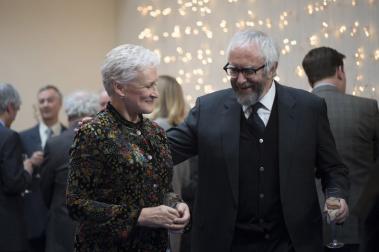
The deal is made when the Joe and Joan Castleman were young. The adult Joe and Joan, who are the real subjects of the story, are played by Jonathan Pryce and Glen Close. The young Joe and Joan are played by Harry Loyd and Annie Starke (shown here). So it is the young Joe and Joan who make the deal and the old Joe and Joan who pay the price. Or, another way to say it is that Joan has been paying the price for a long time now and that is Joe who pays the price at the end.

wife 6The time when the deal is made is quite clear in the film. [1] It comes when young Joan says to young Joe, “Do you want me to fix it?” Joe is a college professor and a writer. He is very good at conceiving a story and laying out the crucial events. But he has no gift at all for developing characters or for effective dialogue. Those are the gifts that she has. The manuscript in question is on the way to the printer so the question, “Do you want me to fix it?” has some urgency to it.
He says Yes. She fixes it. The publisher loves it. Now what?

The film is not as clear after this point, which occurs, you recall, as a flashback. It isn’t inadvertence, I am sure; it is a choice of narratives. That rubs me a little, not because I disagree with their choice, but because the meaning of the narrative they chose depends, for me, on the alternative narrative.  What are they saying this story is not?

This “alternative narrative” is not the product of my imagination. It is a narrative they made plausible by the way they introduced the story and did not rule out in the way they developed it. If they didn’t rule it out, does that mean than they are denying it or that they lost interest in it or just that they hoped the audiences wouldn’t notice. I’m really not sure.

The Narratives

In any case, here they are. As you will see, they describe two entirely plausible narratives, both of which find support in the film as distributed.

Narrative #1

That moment—the “do you want me to fix it” moment—continues through their life together. He does what he does. He get these absolutely terrific plot ideas, which he doesn’t know how to develop. She “fixes it” by giving real force to the characters and by creating lively [2] dialogue. The plot idea plus the fixes make a series of really great novels. They have commercial success and they also, as the presenter at the Nobel ceremony says, “challenge the form of the modern novel.” [3]

Not only does Joe do this part, his part, he also is the public face of the partnership. She is private; he is public. She is shy; he is gregarious. She withdraws; he schoozes.

The result of this intricately collegial partnership is years of best-selling novels and academic acclaim. And a well-funded life. And a dysfunctional family. [4]

Narrative #2

The “fix it” moment is the tripwire that dooms the rest of their life. There is no evidence in the rest of the story that Joe continues to make the contribution he first made on the plot ideas. “Fix it” becomes “I will write the books for which you will become famous.” In this story, she is the writer—she does all the parts that lead to these great novels—and he is the public face of her work.

That might be what they want. There is a brief scene that suggests the “women writers”wife 2 are not taken seriously. That would mean that she could not—really would not be permitted to—play all the parts the successful author would have to play. She is denied all the public parts by a prejudice against women authors. That gives a social criticism dimension to what would otherwise just be a deal between a husband and a wife.

And with that additional irritant, her resentment as a woman—not just as Joan Castleman—could be much sharper. She might imagine that she had the same control of her resentment as she would have as Joan Castleman, the wife, but in fact, she would not. The categorical resentment would mingle with the personal resentment to make a much more potent emotional stew.

In any case, their life requires that she retreats to the study and writes his books for eight hours a day, while he takes care of the kids and the house and pays the bills and so on. It is the kind of arrangement that would cause no one to blink if the roles were reversed, but if the roles were reversed it would be the writer who is receiving all the recognition, not the “nanno.” [5]

So this deal, which has become a life, is a lie and keeping the lie gets harder and harder© Meta Film London ltd to do. The son wants to be “a writer like my dad,” except that his dad really isn’t a writer. Maybe not much of a dad either, at least not for David. And with the Nobel, comes the kind of scrutiny a biographer brings to the job. Obviously, a good biographer will trip over all these carefully maintained fictions.

And the deal is also harder because although Joan Castleman knows she made this deal and knows her livelihood is based on it, can’t quite square her oblivion with his fame. And with his fame comes his affairs, some more discreet than others, of course. She can’t help knowing that it is her skill—in this version of the story—that produces the fame that he trades in for affairs with pretty young women. And she can’t help resenting it, although she tries.

And the winner is…

…anyone who goes to see this wonderful film.

As a moviegoer, I have to tell you that I saw both of these stories at the same time. Both are incomplete, in the sense that neither uses all the information the plot provides. I think the makers really prefer Narrative #2, but they didn’t deal with the plausibilities they offered for Narrative #1, so I had a hard time letting it go.

It is an absolutely superb movie. Jonathan Pryce and Glen Close are very good and their performances require a subtle touch. We need to see how thin the skin of his bravado is, and we do. We need to see how powerful, beneath the determined efforts to be a team player, her resentments are and we do.

I wish they made more movies like this.

[1] The Devil, as is fitting in a story like this, is not as clear.
[2] As I recall, the word she used for his dialogue was “wooden.”
[3] Not an exact quote, but it is close and the focus is on the right thing.
[4] In this narrative, the worst of the family crises is caused by the unavailability of Joan Castleman to her son, David.
[5] Just playing, really. What if “nanny” were given a masculine suffix?

Posted in Movies | Tagged , , , | Leave a comment

Policymaking in a democracy

What will happen to the great coastal cities if the atmosphere continues to warm at the rate it is warming now?

I think that is an interesting question.

Even more interesting would be pictures—these would look like photographs, but would, in fact, be visual constructions based on the predictions of scientists—of Amsterdam, Bremen, Miami, and New York under each of the scenarios pictured below.

Screen Shot 2018-10-10 at 6.40.21 AM.pngI got this from a Vox.com piece by Umair Irfan.  You can see it (and a hyperlink to the whole report) by going to Vox.com and searching for [global warming].

This chart does not move anyone to action.  The numbers ought to be alarming, but they are not.  Most people don’t know how to be alarmed by numbers.  I am thinking, though, that the picture of “my home town” flooded up to the fifth floor of the city’s largest department store, just might cause alarm.

It seems to me that we have wasted a lot of time arguing about the scientific basis of climate change.  We—environmentally aware citizens and knowledgeable scientists—have wanted our opponents to recant.  They aren’t going to recant and we aren’t going to be able to make them.  They have their own reasons for saying what they are saying.

We have proposed one policy after another to deal with the things we are doing that cause the atmosphere to heat up and the oceans to rise.  The great defect of these proposals is that they will take a long time to have an effect and the economic reasons for opposing them are urgent and immediate.  So the policies are opposed, successfully, so far.  People who live in “coal states” or “oil states” are not going to accept the radical rise in the costs of those fuels that would come if we priced them by the damage they are doing.

So trying to get consent to policies has been difficult.  

I wonder if it might not be better to try outcomes, rather than policies. climate 1 Here is your city, we would say, in each of the four proposed scenarios.  Here is a sample of New York  We are asking you to choose the picture you like best.  When you have done that, I will tell you what policies—these are worldwide policies, of course, not use U. S policies—belong with each of the pictures.

At that point, assuming that you are still willing to believe in democracy—a belief that doesn’t fare well, frankly, in difficult times—we can tell you who to vote for in order to get these policies.  These policies will require that people who are still making money by polluting the atmosphere be forced to stop, at whatever cost to themselves.

Or, failing that, you could consent to some form of dictatorship—it would be called “temporary” at first—for the purpose of imposing measures on both individual citizens and corporate citizens, some of which the Constitution expressly forbids.  That, of course, is why you would need a dictator if electing people committed to restoring a livable climate turned out to be insufficient.

After all, no one sells toothpaste anymore.  They sell smiles.  Outcomes.  Maybe the closest we can come to an “outcome” is the pictures of your home town under any of these scenarios. 

Here are your choices, we would say.  Pick one.

Posted in Political Psychology, Politics | Tagged , , , , | Leave a comment

Nicodemus lives in the Matrix


In John 3, in part of Jesus’ extended colloquy with Nicodemus, he says that believing in him—believing that Jesus is who he says he is—makes zōen aiōnion available. What does that mean?

Literally, it means “the life of the ages.” There are several ways of understanding that. matrix 6You can think of the reference to “ages” as meaning a long period of time. Or you can think of it as a higher plane of life. “The life of the ages,” in this way of construing it, is true life. It is not the succession of meaningless ephemera that pass for “life” for those who know only what they see. It is the higher plane where what is True in always being enacted and always in danger.  And Jesus represents that “higher plane.”

These two meanings offer us zōen aiōnion as an infinite extension of the life we are living now—a life that lasts forever—or, alternatively, as access to another kind of life entirely. To me, the second meaning–another kind of life entirely–makes a great deal more sense and it solidifies the case, I think, that Nicodemus can find no way to grasp that notion at all.

That’s as far as I can take the conversation by relying on how the words might be understood. I would like to offer a more visual explanation, however. It is the world presupposed in The Matrix, a 1999 movie by the Wachowski brothers. The only world we see for a long time in the film is entirely illusory. As viewers, we don’t know that, but we get a clue when the bad guys ram a truck into a telephone booth where Trinity (!) is making a call and, not finding her body there afterward, they say, “She got out.”

“Out?” Hmm. She got “out” of “here,” presumably by going “there.” Where is “there?”

We find out where “there” is when Neo (!) is unplugged from the vat of goo where his matrix 2body has spent its entire life so far and is flushed down into the sewer. The people in his apparent life have known him as Mr. Anderson, but he has taken Neo as his nom de guerre. When his body hits the water in the sewer system, a cable with a grappling claw is lowered by a hovercraft canned Nebuchadnezzar IV. It clamps onto this body and reels it up into the plane. That is where “there” is. It is where Trinity went when she escaped the phone booth and she is there waiting for him.

“Out” is where the life of the body and the life of the mind are one thing, rather than two. That is how we learn what the Matrix is. We do know what the Matrix is, in a sense, because Morpheus, the captain of the Nebuchadnezzar IV tells Neo what the Matrix is. It is, according to Morpheus, “the world that has been pulled over your eyes to blind you to the truth.” But when you are in the hovercraft, you are out of the Matrix and you are not blind anymore. [1]

Being “out of the Matrix” means, for one thing, that the sensations you have— what you feel and see and smell—are not provided by a brain probe the way they were when your body was “living” in the tub of goo. The sensations you now have are provided by your fingers and your eyes and your nose. So the life of your mind and the life of your body are intricately connected, not merely simulated.  You are living the life you think you are living.

But there is another thing it means. It means that you can be in actual, not just imagined, mortal conflict with the Matrix as a system. It means that your life can mean something. It can be the result of the choices you make. It can be “your life,” not just in the sense that you intend it, but also in the sense that you can live out the life you have chosen. [2]

Of course, the life you have chosen was not available to you before. Someone has to come from “out there” to contact you. It was Trinity in the case of Neo. She did things he knows cannot be done (she took over his computer and used it to talk to him) and then, after arranging a meeting with him (in the the Matrix, of course, the only “place” available to Neo) tells him that there is an answer to the most important question he has ever asked, the question that has dominated his life up to this point: “What is the Matrix?”  And Morpheus symbolized the choice for Neo as blatantly as Jesus did for Nicodemus.  The red pill or the blue pill?  Continued blindness or coming to grips with the truth.  Choose.

matrix 1So Neo, after his body is reeled up into the Nebuchadnezzar IV, begins to experience “the life that means something,” arguably, the zōen aiōnion. It is awkward at first. Lying there on the table, too weak to get up, he asks Neo, “Why do my eyes hurt?” Morpheus replies, “Because you have never used them before.” And immediately, we understand how that is true. All the optical stimulus Neo has ever received has not come from his optic nerve, but from the brain probe that simulated “seeing something.” He has never before seen what was actually there because nothing was actually there in the “life” he seemed to be living.

In the “life of the ages,” the zōen aiōnion, something is really there and you can see it with your own eyes. And, just as your vision is now authentic, so now your intentions can be authentic, You can life the life you choose—remembering always that it chose you before you had any possibility of choosing it—and all of your choices presuppose a war against the Matrix. The little band of people who rescued you from the Matrix is a band of soldiers at war with the Matrix and now, you too are at war with the Matrix.

The dominant characteristic of the life of the ages is that you can make real choices. The Matrix is constitutionally hostile to such a life, so you cannot choose peace with the Matrix. You can fight it, as Neo does, or you can surrender to it, as Cypher, one of the little band that rescued Neo, does. Cypher asks to be “re-inserted” into the Matrix, knowing it will be the last authentic choice he ever makes.

The film, The Matrix, and its two lesser sequels, presuppose the disjunction between what we think of as “life” and “real life”—a life that matters. I think that in John’s gospel, the disjunction between the kind of life Jesus offers Nicodemus and the kind he is “living” at the time he goes to talk to Jesus, is a choice as stark as that. The Life of the Ages is clearly not, in The Matrix, continuing to live for a very long time, the kind of life you think you are living. It has to mean living a life on a different plane entirely; [3] it has to mean a life that means something, however long it lasts.

I think that is the reality that The Matrix points to. It is the most visually persuasive representation I have ever seen of the disjunction between what Nicodemus was talking about and what Jesus was talking about.

[1] This is the most vivid representation I know of the distinction Paul makes in Romans 12 when says we are not to be “conformed” to the world, but to be “transformed.” Neo, in his imaginary life, his life within the Matrix, was a hacker and he was very anti-Matrix.” But as long as his body and therefore his mind was actually in the Matrix—imagining the life the brain probe constructed for him—there was no possibility at all of being “transformed.” That happened when he was rescued from the Matrix by the cable and the grappling claw.
[2] Neither of these “lives,” by the way, lasts forever. When your body is “in the Matrix,” you are valued for the voltage your body produces and which the Matrix uses as a power source. When you are outside the Matrix, you might be killed because you are after all, an enemy of the System. But even if you are not killed, your body will still die in the normal way. Living a real life doesn’t give your cells extra telomeres. But when you die outside the Matrix, you die having actually lived.

[3]  No pun intended, but it is hard to avoid it.

Posted in Biblical Studies, Movies | Tagged , , , | Leave a comment

A Midlands family living in Greater Appalachia

I come from a “set apart” sort of family.  I knew that when I was a little boy growing up in what is now a northern suburb of Dayton, Ohio. [1]  I was taught that it was a good thing to be “separate,” and I think it was a good thing for a long time, at least for my parents.  I don’t think my parents ever really came to grips with what it means for their four boys.

I’ve had trouble coming to grips with it myself.  The life that gets into you at that very early level never really gets expressed well in the words that you learn later.  There’s always something a little mysterious about the emotional tones out of which those carefully chosen words emerge.  The words are all the right words, but you keep feeling that there is more there than the words capture.

I am a “capturing in words” person, as, I suppose, most bloggers are.  So I find it just a little uncomfortable that my best accounts of that part of my life never quite squares with the mix of feelings that I remember.

That may be, at least in part, why the notion of “narrative” is so attractive to me.  You can lay out—and I am just about to—alternative narratives of an event, each of which is “true” in a sense, but none of which excludes the other narratives.  Each narrative is shaped within a particular frame of reference and tells as much of the truth as I know that is available within that frame.  Even while I am doing that, I know that there are other frames—other starting points, other sets of categories—that enable me to tell other, very different, also true, stories.

I’m going to try three such frames here.  They are: religion-oriented, class-oriented, and culture-oriented and that is the order in which I learned them.

Religion-oriented [3]

“Come out from among them and be ye separate” saith the Lord.

The phrasing is from 2 Corinthians 6:17.  Obviously, and nothing could be more appropriate, it is in the language of the King James Version of the Bible.  Or just “the Bible” where I grew up.  It is one of the easy-to-abuse instructions Paul wrote, but it is all through the Old Testament accounts of Israel in the Promised Land.  It is, in fact, fundamental to the notion of what “holy” meant to the Israelite people.

My family had a different notion of what “holy” was than our neighbors; different alsoset apart 7 than other members of our church.  It is nearly impossible to teach your children “not to be like” the other kids, without at the same time teaching them to see themselves as “better than” the other kids.  And, if not better in fact, then at least better in aspiration.

I remember, for instance, that my mother used to criticize behavior that did not come up to the family standard as “common.”  That made more sense to me when I learned that was what “vulgar” meant.  But Mother only meant, “what everybody else does,” and she didn’t understand either that in sacrificing what was “common,” we were sacrificing what was  “in common” with our classmates and our neighbors.

I had a very caring upbringing by a loving family and it seems, even to me, a little churlish to criticize it, but in fact, I was raised in a little bubble of self-conferred religious superiority and getting over that has been one of the major jobs of my life. [4]

Class-oriented

So I grew up and moved away and took a lot of courses in the various social sciences, including sociology.  And it began to dawn on me that however much my family might have thought about “what is right for the Hesses to do” in religious terms, it is also possible to think of it in terms of social class.  In fact, if you take enough sociology, almost everything begins to seem explicable in terms of social class.

I remember how ardently my father wanted at least one of us to play the violin. [5]  I don’t think he liked violin music particularly.  When he had the choice, he listened to choral music.  But violins are so…you know…classy.  Dad had a lot of education and aspired to more than the size of his family allowed for.  My mother was the daughter of a man who was often a mayor and  was also a major business leader.  I don’t think she pushed that, but I don’t see how she could have forgotten it either.

Neither of my parents aspired on their own behalf or on ours to be “upper class.”  But the current discrepancy between the professional/managerial class and the “working class” really does capture where the rift is.  I’m actually just kidding about the castle; it’s a much older notion of class unless these are happy tourists.

set apart 3Last year, I discovered Joan Williams’ ideas on the cultural underpinnings of class in our era and she draws the line between the working class (even at fairly high levels of income) and the professional/managerial class. [6]   Williams helped me get past the social structural notions of class—there wasn’t room in the small town I grew up in for a complicated class structure—and to consider the cultural infrastructure of the class identity we grew up with.

What does “cultural infrastructure” mean?  In part, it means “social capital.”  Here is Williams.

Cultural capital is class specific: the kinds of cultural capital required to survive and thrive in non-elite circles differ from the kinds required in professional-managerial contexts…

For example:

Professional-managerial jobs require people skills, which are essential for building and exploiting networks and for enhancing opportunities to advance as a lawyer, doctor, or “organization man.”

The cultural capital required of workers is quite different. While questioning authority and thinking for yourself might get you a promotion in an upper-middle-class job, in a lower-status job it is more likely to get you fired. 

It is “class” in that sense of the term, both the “social capital” sense and the aspirational sense, that I substituted for religion and I began to understand my upbringing as “different.”

Culture-oriented

But recently, I came across a way of thinking about the whole matter that is not principally religious and not “classist” either, in the fine-grained sociological sense.  This is more like comparative anthropology and I found this in Colin Woodard’s  American Nations.  Woodard makes a good case that a lot of the enduring regional differences can be traced back to the the various eastern settlements and the changes they took on as they extended themselves westward.   And there may be no clearer example of these cultures than Ohio,  where there are three.

set apart 1

On the map, you can see that Cleveland is part of the western extension of Yankeedom.

Here is Woodard’s characterization of the Yankee culture.

Yankeedom: Founded by Puritans, residents in Northeastern states and the industrial Midwest tend to be more comfortable with government regulation. They value education and the common good more than other regions.

But the more interesting distinction for me happens as you move south out of Yankeedom.  The whole middle section of Ohio is called “the Midlands,” and the people the Midlanders.  Culturally, it was formed in eastern Pennsylvania, where my father was raised.  It is, in fact, my family’s home culture.  

But you can see on the map that all of southern Ohio, including the part where Orville and Wilber Wright and I grew up, is a part of Greater Appalachia.  So by this way of looking at it, we were a Midlander family living in a Greater Appalachian culture and that explains a lot to me.  

For one thing, it gives the “Come out from among them…” passage a contemporary cultural setting.  It translates the fine-grained sociological analysis into a much broader regional interpretation. 

Look, for instance, at the way Woodard distinguishes the culture of my family background from the culture where I was raised.  The midlands serve as “the old country” for the Hesses.

The Midlands: Stretching from Quaker territory west through Iowa and into more populated areas of the Midwest, the Midlands are “pluralistic and organized around the middle class.” Government intrusion is unwelcome, and ethnic and ideological purity isn’t a priority.

But our family was trying to do all this in Greater Appalachia.  Greater Appalachia is a good part of what Mother meant when she said “common.”

Greater Appalachia: Extending from West Virginia through the Great Smoky Mountains and into Northwest Texas, the descendants of Irish, English and Scottish settlers value individual liberty. Residents are “intensely suspicious of lowland aristocrats and Yankee social engineers.”

It is clear to me that the discrepancies I experienced as a young boy growing up can be understood in a variety of ways.  I have surveyed three here.  As is to be expected, I find the third to be most persuasive because I just came across it and am still infatuated by it.

Every explanatory device has its own strengths and weaknesses, of course.  It is true that I was raised in “the holiness tradition,” where “holy” mean separate.  I did that. 

I was also raised with class mobility in mind and the habits of mind and go with professional and managerial jobs [7].  I did that too, although my path wasn’t quite as straightforward as my brothers’ paths. 

And I grew up, we all did, with the presuppositions Woodard describes as typically Midlander—including the part about ideological purity.  Woodard is talking about political ideology. We got all the purity we needed from religious doctrine, either from embracing it or from rejecting it.

So I did that, too.

[1]  That’s just a little north of Middletown, the site of Hillbilly Elegy, where J. D. Vance grew up.  Middletown is different in a lot of ways from Englewood, but we come from the same part of Ohio.

[3]  I know that’s awkward, but there is no hope for the title that deals with social class, so I am casting them all in the same form, just to keep the parallelism.  I’m open to other solutions.

[4]  There is, in fact, one sense in which I don’t want to get over it.  I need a way to detect and to critique my own lapses.  I know when I could have done better and just didn’t bother.

[5]  We all wound up playing brass instruments.  Sigh.

[6]  See especially Chapter 5 of her marvelous Reshaping the Work-Family Debate: Why Men and Class Matter

[7]  I was a professor for most of my “working life.”  Of my three brothers, one was also a professor, and two were physicians.  We all got where were supposed to go, by one path or another.

Posted in Living My Life | Tagged , , , , | 1 Comment