
I’m a big fan of good analytical categories. I value them in the way academics tend to, but on beyond that, I have been benefitted by them in some very personal ways. Martin and Doka, for instance [1], distinguish between “intuitive” and “instrumental” styles of grieving.
On the other hand, the experience of grieving (the instrumental and intuitive styles are responses to the condition of grieving) is a fact. Grief is true in your bones and in the pressure behind your eyes; it is true in the associations one word has with another; it is true in the way the numbers change on the clock.
My son, Doug, referred to me recently as “a grief sherpa.” I think he invented the term  on the spot, but I liked it right away. Sherpas are not defined by their nationality. There is no “Sherpistan.” They are not defined by their locality although they do live in the Himalayas. They defined by what they know and what they can do and mostly, that means what they have done before. I think that is what Doug meant by calling me a grief sherpa—grief is something I have done before. [2]
The thing about me is, though, if I have experienced it frequently or deeply or both, I have probably written something about it. Bette says I think with my fingers and although I’m not admitting anything, I do know what she means. People say to me, “What was it like for you?” and very often, they wonder if, when it happened to me, I wrote anything about it. Usually I have.
they say it much more often than they say, “How do you think I should handle this in my life?”
The notion of “sherpa-ness” took my mind right back to Leo McGarry’s description of how he could help Josh Lyman. [3]
LEO This guy’s walking down a street, when he falls in a hole. The walls are so steep. He can’t get out. A doctor passes by, and the guy shouts up “Hey you! Can you help me out?” The doctor writes him a prescription, throws it down the hole and moves on. Then a priest comes along and the guy shouts up “Father, I’m down in this hole, can you help me out?” The priest writes out a prayer, throws it down in the hole and moves on. [4]
Then a friend walks by. Hey Joe, it’s me, can you help me out?” And the friend jumps in the hole! Our guy says “Are you stupid? Now we’re both down here!” and the friend says, “Yeah, but I’ve been down here before, and I know the way out.”
This a great story for people who are grieving. For one thing, it implicitly recognizes that there is a time called “afterward.” When you are in the middle of it it feels like it is always going to be like this. Somebody who was once in the hole you are in and who got out establishes that “afterward” is possible.
And for another thing, the friend has already jumped down into the hole. He knows some important things (how to get out, for instance) and he has made himself available. He is a friend.
 This turns out to be relevant to what is going on in my life these days. Some very difficult things have happened to friends recently. These are friends who know enough of my life to know that I have been in the hole they are in right now. Climbing out of that hole if really important to them; it is important, even at first, to know that it is possible and when you start to talk about climbing, you are talking about sherpas. I called sherpas “people who know something and who know how to do something.
Here’s one that helped me. Just a little earlier than the West Wing story I cited earlier, Josh was having a wrap-up conversation with Stanley Keyworth, his therapist. Josh has just learned that his panic reaction had been brought on by the music he had heard.
JOSH So that’s gonna be my reaction every time I hear music?
STANLEY No.
JOSH Why not?
STANLEY Because we get better.
We do. We get better. I knew that in an abstract sort of way, but hearing Dr. Keyworth say it, especially the way he said it, made it seem like something I could afford to trust, maybe to risk a little, hoping that it might be true.
So my sherpa-ing amounts only to this. I have done this before. I know some things and I know how to do some things. And I am willing to help.
[1]Their book is very misleadingly titled, Men Don’t Cry…Women Do, Kenneth Doka and Terry Martin, but it is a superb book
[2] There is also an informal use he might have known about: “a civil servant or diplomat who undertakes preparatory work prior to a summit conference.” That meaning was new to me, but if it has gotten that far, it has probably also become a verb in the same way that “caddy” became something your caddy did.
[3] Season 2, The West Wing, “Noel”
[4] This is Aaron Sorkin pushing as hard as he can against the narrative of The Good Samaritan. That makes it much better when the role of the Samaritan is subverted.
 That didn’t happen in the one subplot of the one episode “The Blues” (Season 1, Episode 13) that I am going to describe here.
 making mistakes, but she tries to tough it out and denies all the indications that she is a danger to the hospital.
 Iggy asks about her childhood.
 afraid, agency is what you really need and besides it feels marvelous.
 To the extent I do anything at all, in Minnie Haskins picture of reaction to fear, is that I do go out into the darkness. [5]
 It does raise the question, however, of what you look for in friends and that is an especially piercing question when the people who might become your friends are your own children.
 clearly on nurturance.
 It is at that point that you find out how tightly wedded you are to the Wise Man role.
 The two hard things about that transformation are that you have to give up a role you were really good at and start practicing a role you are not likely to be as good at, at least at the beginning.
 of oversight and provision is gone now [5] and in its place is a friendship.
 t isn’t just that his existence is ephemeral, like a mayfly. It is not that it does not last beyond that day; it is that it has no meaning beyond that day. He starts off tomorrow, having learned a great deal from all the yesterdays that he (only) remembers. [2] He finds that terribly discouraging, eventually, but his first response is that it is a great opportunity.
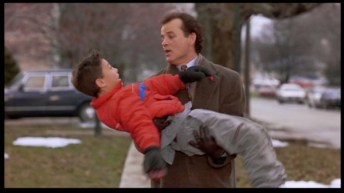 him on his “rounds.” He frightens the insurance salesman who always frightened him; he changes a flat tire for some old ladies; he catches a boy falling out of a tree; he performs the Heimlich maneuver for a man in a restaurant. Those are regular, but episodic.
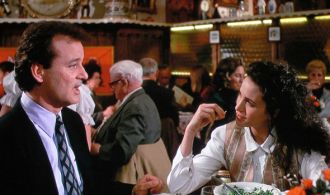 So the curse wasn’t the arrogant person he was and all the action that inconsequentiality made possible. Had that been the case, the wonderful person he became when he saw the possibilities of inconsequentiality would have been the end of the curse. That’s not how he saw it. The inconsequentiality—the repeating of the same day with the same insipid radio host banter and the same songs and the same “chance” meetings on the street—was itself the curse.
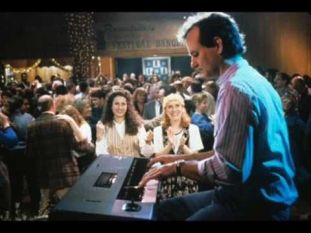 him as the kind of person he really wants to be. He tried seduction and slovenliness and irresponsible work and theft and unconcern and suicide and found them to have consequences for his own sense of himself that he did not like. Now he is trying honest courtship and hygiene and solid professional work and honesty and compassion and he likes that Phil. It doesn’t break the curse (see the argument above on what the curse really was) but it gives him the richest life a person in his situation can have and either he likes it or his heroism in the face of inconsequentiality knows no bounds at all. Jean Paul Sartre would marvel at an existential hero like this Phil Conners.


 Santos tries in several ways to use Vinick as a way to get the Vice President he wants. [2] Vinick sees that coming a mile off and refuses to play. In desperation, Santos just tells the truth. “I want you as my Secretary of State. You’re my first choice.”
 two men on foreign policy generally and on Kazakhstan in particular, which is a crisis point in the seventh season of the show. Finally, this happens.
 Take, for instance, the notion that “a re-tweet is not an endorsement.” [3] I think that is demonstrably false. Let’s consider two notions of what “endorsement” means. The first is truth-value. I “endorse” a story as true by “sharing” [4] it with friends. The second is salience. I “endorse” a story as “meaningful” or “interesting” or “satisfying” or as morbidly confirmatory.
 House of Representatives to work the media by calling their opponents ugly names and by alleging damning but unconfirmable [7] statements or actions on their enemy’s part. He brought a gun to the Congressional knife fight.
 I happened across this sign recently when I was looking for examples of the idea that when you “know” what something is about, it is hard to notice that other people might think it is about something else. I put it in that post, even though it didn’t fit as well as some others I had found, because I kept laughing at it. It still tickles me.
 usic to the man who directs our choir at church. I asked him what he saw there on the page. He told me about the suspension and after it is resolved it winds up in the key of G and all that. I said, “That doesn’t look like Gsus (I pronounced it Jesus) to you?”

