
Last night, I watched—again—one of the final episodes of The West Wing. In it, Matt Santos (Jimmy Smits) asks Arnie Vinick (Alan Alda) to be his Secretary of State. This seems odd, on the surface, because Santos has just defeated Vinick in an extremely close presidential campaign. {1]
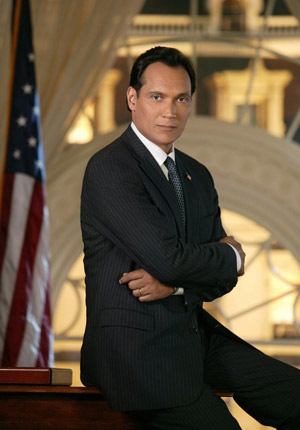 Santos tries in several ways to use Vinick as a way to get the Vice President he wants. [2] Vinick sees that coming a mile off and refuses to play. In desperation, Santos just tells the truth. “I want you as my Secretary of State. You’re my first choice.”
It takes Vinick a long time to realize that he and the President agree on foreign policy. Everybody else knows it. Vinick’s staff knows it. I want to tell you how Vinick finally got it. It is a TV example that I would like to practice in my real-life life.
The offer of Secretary of State is not a quid pro quo. [3]
Vinick: Secretary of State is not something you throw at the other party to show how bipartisan you are. The job is way more important than that. This is your representative to the world.
Santos: I agree.
Vinick fears that he would be used only as a figurehead.
Vinick: You think you can make me Secretary of State and then ignore me and run all foreign policy out of the White House?
Santos: No.
Vinick: Anybody good enough to appoint would quit the day you try to go around the State Department.
Santos: I don’t want to go around you. I want you to do the job.
They go through a batch of others. All of their considerations ignore the agreement of the 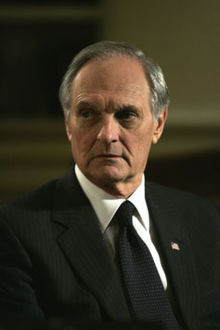 two men on foreign policy generally and on Kazakhstan in particular, which is a crisis point in the seventh season of the show. Finally, this happens.
Vinick says, “I don’t know. I don’t know. This is crazy. I don’t see how this can work.” And that is precisely correct. He does not see; he cannot “see” how it will work. And when he demonstrates to himself that it will work, it doesn’t require his “seeing” anything. Only doing something and that will force him, eventually—not during this show—to see how they agree.
That is the last assessment anyone makes from the outside. There are no further objections, there are no refusals based on some suspected political strategy or on any category, even “We agree on foreign policy.”
Santos: Here’s today’s intelligence report on Kazakhstan. There’s a interesting item in there on page two. Second paragraph.
Vinick: What, the Chinese demanding a veto on routing of the pipeline?
Santos: Yeah, they’ve never said that before.
Vinick: Don’t worry.
There is more of Vinick’s thought below, but I want you to stop for a moment and notice that the job is done right there. “Don’t worry” is not something a job applicant could say to a potential employer. It can be said by someone who has an “us” in mind and who is seeing things from the same side as his former opponent. This is the advice a Secretary of State would give the President. But there is more.
Vinick: Chinese know they haven’t a chance of getting that, but they think the Russians do. So they demand it now before the Russians, so we won’t help either one.
Santos: So how do we move them out of their positions get them to agree to a compromise?
Vinick: You can lay the groundwork for that now. You let both sides know that in the endgame the Russians will have to get a share of Kazakhstan oil production and the Chinese are gonna have to have the pipeline. You make sure they understand you’re the one setting the agenda. You don’t have to make it explicit, just hint at it.
And the show ends as the two men—the President-elect and the Secretary of State designate continue their joint planning.
Experiencing Agreement.
Santos got Vinick to do the things he would be doing as Secretary of State. We don’t get to see the moment when Vinick realizes what has happened. [4] He just buries himself, at Santos’ invitation, in the work the Secretary of State would do. He does the agreement long before he experiences it.
In that very limited sense, you could say that Santos got Vinick to be his Secretary of State without ever agreeing to. “Agreeing” would require that Vinick go back to the question of how many things he and the President-elect disagree on and it would be hard to come back to the truth everyone knows, which is “You agree on foreign policy.”
If there were a category called “doing agreement,” rather than the much more conscious “coming to agreement,” I could say that is what happens in this show. Vinick gets to “Don’t worry,” his first words as Santos’ Secretary of State without ever noticing what he has done.
Maybe that would work better for me than what I’ve been doing.
[1] “Flip 40,000 votes in Nevada and I win,” Vinick grumbled to his staff.
[2] The Vice President during the campaign was Leo McGarry, who is killed off in the show because John Spencer, who played McGarry, actually did die.
[3] I can’t write that Latin phrase without remembering Edwin Newman’s quip about a Korean boxer named Kid Pro Kwo. He didn’t win many fights, according to Newman, but he gave as good as he got.
[4] That would be fun, but the narrative doesn’t need it and I respect the writers for leaving it out. Still, it would have been fun.
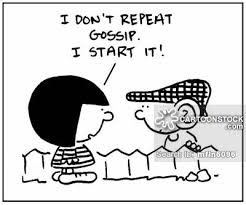 Take, for instance, the notion that “a re-tweet is not an endorsement.” [3] I think that is demonstrably false. Let’s consider two notions of what “endorsement” means. The first is truth-value. I “endorse” a story as true by “sharing” [4] it with friends. The second is salience. I “endorse” a story as “meaningful” or “interesting” or “satisfying” or as morbidly confirmatory.
 House of Representatives to work the media by calling their opponents ugly names and by alleging damning but unconfirmable [7] statements or actions on their enemy’s part. He brought a gun to the Congressional knife fight.
 I happened across this sign recently when I was looking for examples of the idea that when you “know” what something is about, it is hard to notice that other people might think it is about something else. I put it in that post, even though it didn’t fit as well as some others I had found, because I kept laughing at it. It still tickles me.
 usic to the man who directs our choir at church. I asked him what he saw there on the page. He told me about the suspension and after it is resolved it winds up in the key of G and all that. I said, “That doesn’t look like Gsus (I pronounced it Jesus) to you?”
 you can contribute your own favorites. There is a certain clarity of vision that comes with fervor. The focus is narrow, the need to act is intense, all the parts of the picture you construct reinforce each other and dammit, your duty is clear. A lot of good things can be done that way and frankly, there are some good things that probably cannot be done any other way.
 If you begin categorizing exhortations into those that are like food (nourishing for everyone) and those that are like medicine (good for some people, but harmful to others), this is definitely a medicine kind of remark. If it were phrased as a teaching, rather than a bumper sticker, it would say, “Women who feel they are obligated by virtue of their gender alone to fix men should reconsider.”
 that several hundred thousand uses of the phrase “reached first base” and the lack on any other common conclusion of the phrase beginning with “reached” has brought us to the place where “reached” may be taken to mean “reached first base.” Or possibly any base. That could be represented in written English as “reached…”
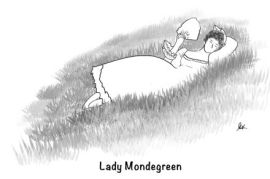 The fact is that the language we use every day—unless the setting of your life is one where the accuracy or the beauty of language is, itself, something to be valued [3]—works as long as it is good enough. “Good enough” is a very forgiving standard. People know clearly, or can infer quickly, what you probably mean and that is good enough. You can even point to an oil filter and say “carburetor” and the person you are with can say, “You mean carburetor.” and you can say, “Of course. What did I say?”
 Mondegreen” is the construction of an idea based only on the hearing of it. American writer Sylvia Wright coined the term in 1954, writing about how as a girl she had misheard the lyric “…and laid him on the green” in a Scottish ballad as “…and Lady Mondegreen.” I, myself, had trouble as a boy in church hearing the expression “gladly the cross I’d bear” as anything other than Gladly (you know) the Cross-eyed Bear.” I have since seen tee shirts featuring images of Gladly.
 Here, for instance, is Oda Mae Brown (Whoopi Goldberg) in the movie, Ghost. Sam Wheat (Patrick Swayze) has been killed in a holdup gone bad. He knows who killed him, but he cannot communicate it to Molly Jensen (Demi Moore), his fiancé. For that, he needs someone who is “open to the spirit world.” Notice “open.” She is not empty, or “hollow,” however. She is a con artist who has pretended to be a “spiritual advisor” for many years. Pretending to have this gift is her con; she has no idea she really has it.
 to be an expert on things spiritual. “Why is he still here?” Molly wonders, having been persuaded by Oda Mae that she can hear Sam. “I don’t know,” says Sam. It is a line only Oda Mae and the viewers can hear. “He’s stuck, that’s what it is,” says Oda Mae. “He’s in between worlds. You know it happens sometimes that spirit gets yanked out so quick that the essence still feels it has work to [on] here.”
 incarcerations. That’s reality for the police. There are still discrepancies in Molly’s account to be accounted for. No one like the person the police know Oda Mae to be could possibly have known the things Molly describes. On a better day, that might have stopped the cops and made them wonder. This cop was compassionate, unlike his fellow officer at the next desk, but Oda Mae has a record and the actual killer, Willy Lopez, does not. End of story.
 name is just Shoplifters. I like the Japanese title better because this superb movie is actually about an ensemble performance. The one line description they give for this movie is pretty good: “A family of small-time crooks take in a child they find outside in the cold.”
 I mention that detail only to show how attractive it is. The grocer is either oblivious or too stuffy to care. He is seen only in the background. In the foreground are a father and son team, also a master and apprentice team, who are out rustling up dinner for the family.
 he has deferred to Osamu, as the apprentice defers to the judgment of the master. “I guess he knows something I don’t know,” Shota must be saying, “because this doesn’t really make any sense to me. You can almost see Shota’s esteem for Osamu shrink right in the scene and it is not long before Shota steals something so clumsily that he gets caught and you wonder, as you watch, whether these two events are related.
 I can tell without looking at it when the light turns yellow because there is often a sound of acceleration. You can hear it in the engines and in the sound the tires make on the street. If the drivers are slowing down in response to the yellow light, I either don’t hear it or don’t pay attention to it, but if they are accelerating suddenly, I do hear it and I don’t like it.
 restrained question, given that people game every specific standard we know of. I remember an old Nancy and Sluggo comic strip where “the mother” told the two kids to wash their hands to get ready for dinner. They complained that actually, only one hand (each) was dirty and we are to imagine that the mother said to them, “Well, just wash that one then.” In the final frame, we see the two kids at a bathroom basin, cooperatively washing only one hand (each) and Nancy’s comment was, “I’ll bet she thought we couldn’t do it.”
 I am reminded in this context, of a forgettable scene from a forgettable movie called Starman. [5] In it, a visitor from another planet (Jeff Bridges, shown here preparing to utter this line), offers to drive for awhile while his host (Karen Allen) takes a little nap. She sees him blowing through a yellow light and thinks he doesn’t understand terrestrial traffic signals. She starts to explain them to him. “Oh no,” he says. “I remember everything I see.” (Meaning that he has internalized as rules what he has seen her actually do as a driver.) “Green means go. Red means stop. Yellow means go very fast.”
 Today I saw a new effort. It wished a recently deceased member of our community “bon voyage.” This is clearly part of the “pass on” line of thought and extends the metaphor as a voyage. This gives us the chance to wish the person we now know only as “departed” that the voyage he or she is undertaking will be a good one. This is entirely different than wishing the recently deceased person a good destination, which might be intended kindly, but which I am sure would be considered bad form
 yourself valued, provided he knows them. It runs the risk of saying that he was one of the best caterpillars I ever knew, without mentioning that he never quite became a butterfly.
 The Dilettante's Dilemma