Pence shilling at Liberty University

“ As bleak as Pence’s remarks at Liberty University may sound, his words could very well strike a chord with these Christians who feel isolated.”

That’s the concluding line of Catherine Kim’s report on Vice President Mike Pence’s commencement speech to the graduating class at Liberty University.  I think that “strike a chord” may be Ms. Kim’s attempt at humor or possibly at straight-faced journalism, but lines like that are often called “red meat.”  Picture throwing a steak into a kennel of hungry dogs and saying that the arrival of the steak “struck a chord” with the dogs.

pence 1You wouldn’t know it by reading the speech [1] but there is a serious policy issue embedded in the Vice President’s remarks.  It is religious liberty.  If you have liberty on the basis of your religious faith, what is it you are free to do?  Well, let’s see.  You are free to “follow the dictates of your conscience.”

Let me just illustrate where that leads.  In the immediate aftermath of 9/11, Balbir Singh Sodhi was shot and killed outside of his Mesa, Arizona, gas station by Frank Roque, who said he wanted “to kill a Muslim” because of the 9/11 attacks.  Mr. Sodhi was “a Muslim” because he was wearing a turban.  Mr. Sodhi is a Sikh.  No one thinks Mr. Roque should be allowed to do such things just because his conscience told him to.

The consciences of Jehovah’s Witness school children in the Minersville School District told them that the “salute to the flag” at school was actually idolatry and therefore forbidden by conscience. [2]  The Supreme Court said that “freedom of conscience” didn’t extend that far.

On the other hand, the Board of Regents of the State of New York composed a prayer to be recited by students as part of the opening exercises.  The Supreme Court in Engel v. Vitale (1962) said they couldn’t do that.  That doesn’t mean, as conservatives are fond of saying that “prayer in schools is illegal. [3] It means that forcing students to pray is illegal.  A line I once heard and have cherished for years is that there will be prayer in schools so long as there are tests is schools.

This business of being guided simultaneously by one’s conscience, on the one hand, and pence 2by the laws of the state on the other is a dicey business.  The law says that motels are not allowed to discriminate on the basis of race whom they will accommodate and whom they will not.  What happens if my conscience tells me that contact with black Americans is contaminating and sinful?  Gay couples?  Transgendered customers?  Jews?  What happens if your pharmacist’s conscience will not allow him to fill a prescription your doctor has written for your contraceptives?  Jerry Falwell, founder of Liberty University, here.
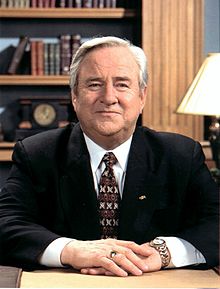
It is a dicey business as I said.  Everyone agrees that there are some actions you should be able to take on the basis of your conscience and others you should not be required to take on the basis of your conscience.  Everyone agrees that the laws of the land apply equally to those who disagree with them—I don’t personally believe in traffic lights—and those who agree.  Where is the line?

No line but a crusade

Vice President Pence is not looking for a line.  He is building a crusade.  He is “trying to strike a chord with these Christians who feel isolated.”  In doing so, he is also doing three things that bother me a great deal.

The first is that he is taking the name “Christian,” which is a very important name to me, and saying that it refers exclusively to that very small slice of Christians represented by Liberty University.  It is because of the strategy Pence is using, in line with his conservative forebears, that people look at me with disgust on learning that I use that name to refer to my own faith. [4]

The second is that he refers to all kinds of opposition to the kind of “Christianity” taught at Liberty University as “persecution.”  In saying that, he is not wholly wrong.  There are secular people to whom the language of religion sounds like an attack on them and they reply in kind.  There are people who get tired of being lectured at by religious conservatives and reply in kind.  Those things do happen and I can see why Pence would want to call them “persecution.”[5]

On the other hand, some very aggressive political actions are being taken by people who call themselves Christians and the people who oppose those actions sometimes have good public policy reasons for their opposition.  These ought to be seen as policy struggles where these people want more and those people want less.  Situations like that used to result in compromise.  But if they are “persecution,” then not only are the conservatives morally right so matter what their stand, but all opposition to them is morally wrong.  It is “persecution.”  I don’t like that either.

Finally, Vice President Pence said this:

“Throughout most of American history, it’s been pretty easy to call yourself Christian  It didn’t even occur to people that you might be shunned or ridiculed for defending the teachings of the Bible.

As someone who takes expressions like “the teachings of the Bible” seriously, I don’t like that kind of language at all.  I have to assume that he means those teachings he approves of.  There are many others I am sure he would not approve of and he doesn’t mean those.  There are many such teachings, for instance, that will not help the students at Liberty University feel like a persecuted minority as they try to use their new political power to take rights away from other Americans.

I skipped the middle part of the speech where the Vice President loyally pitched President Trump’s invaluable contributions to the welfare of America.  They don’t bear directly on this essay, but they did suggest the title, “Pence Shilling at Liberty U.”

 [1]  Available at whitehouse.gov

[2] Minersville School District v. Gobitis, 310 U.S. 586 (1940), was a decision by the Supreme Court of the United States involving the religious rights of public school students under the First Amendment to the United States Constitution. … This decision led to increased persecution of Witnesses in the United States.

[3]  Or sometimes that they are “throwing God out of the schools.”

[4]  I let go of the historical symbol of the fish representing Christianity since the 1st Century A. D. when it came to represent not Christianity, but only “creationism.”  Having it on my car’s bumper said something about me that I did not want to say and adding a footnote to a bumper sticker—even for me—didn’t help.

[5]The Washington Post said, about this speech that “it furthers the evangelical persecution complex.”

Posted in A life of faith, Politics | Tagged , , , , | Leave a comment

Warm, graceful, generous, funny

I want to share with you today some signs I have carried with me for awhile now.  I love these signs; I love the people who thought of them and the people who thought it was a good idea to have them made and displayed.

But first I want to tell you a story.  I attended a concert a year or so ago where I heard the most spectacular “Turn off your cellphones” announcement I have ever heard.  She said something like this: “The choir you are going to hear tonight is very very good.  You are going to want to tell all your friends what a wonderful concert this was tonight.  And to be sure you don’t forget to do that, please remember to turn your cellphones on as soon as you leave.”

A Hallmark store in Gresham, Oregon had these.  The could have said: “Out of stock,” or even “we are restocking our card supplies” or something like that.  This is what they said instead.  This is the last layer of the rack; this is what you see when someone buys the last card.

IMG_0454.jpeg

And today, at New Seasons, our favorite local grocery, I saw this “No dogs allowed: sign.  You know it means that, right?  We love dogs.  Also customers.  And we have a high regard for our staff as well.  And to affirm all those relationships, we have made this place where your dog can do its work (waiting) while you do your work (shopping) and everyone will be happy.

IMG_0191 2.jpeg

So I think that if the world were full of people who thought up warnings and limitations that felt like this, it would be a much nicer place.

Posted in Communication, sociability, Uncategorized | Tagged , , | Leave a comment

All I ask…

“All I ask is that you let me feel my way.”

Kaitlyn Tiffany, a writer for vox.com, is the reason I know about the new Burger King ad campaign. Take a look.    It opens with a black guy sitting on the edge of his bed making, in a gently cadenced way, a complaint that ends, “All I ask is that you let me feel my way.”

Kaitlyn Tiffany says that is a play on the long-time Burger King slogan, “Have it your way,” but I know what “have it your way” means and I know who it is addressed to.  That is not what this guy means by it.   He’s not talking about which condiments he wants on his aliment. [2]  What is he talking about?

BK 1

Well…before we rush to judgment, let’s look at the five other characters.  Next up is a high school girl who comes to her locker and finds “SKANK” written on the door.  After that, there is the business woman who just got fired and is leaving with “her box,” calling her boss a “bleep” and throwing papers up into the air.  Then there is the guy who is deeply in debt and foresees never leaving his parents’ home.  And then the young man who just got “ghosted:”[3] and imagines that he will live his life alone.  And then the very young woman [4] carrying an infant down the street and complaining that “they” say she is too young to raise a child and proceeds to tell “them” to take their opinion and “suck it.” [5]

  • The first thing that catches my eye is that all these people are victims.  They have been done to.  That is the first thing them have in common.
  • The second thing is that they are asking to be given some latitude either to recover—depressed, indebted, and ghosted—or to respond with anger or disdain. [6]
  • The third is that no constructive action is imagined by any of these characters.  It is not what they do to make something better—anything better—but how they express their unhappiness.
  • A fourth is that there is no social dimension to these at all, with the partial exception of the indebted character who gets to share a milkshake.  No one of these characters is asking for any help at all—only “room” to, as the depressed guy puts it, “feel my way.”

But I think that “feel my way…” leaves off the destination.  Feel my way back, maybe?  The first line of the ad is him looking downcast and saying, “Not everybody wakes up happy.  Sometimes you feel sad, scared, crabby.  All I ask is that you let me feel my way.” So “feel my way back” would be from sadness to…oh…equanimity maybe or happiness.  It would be from scared to something like competent or confident.  It would be from crabby to even-tempered or pleasant.  Every “feel my way” needs to be a “feel my way back to.”  Otherwise, who is he asking for “room” and how much room is he asking for?

For the guy who just isn’t happy this morning, it is plausible to imagine that he is saying that he’ll be fine; just give him time to adjust to the day.  Maybe have an Unhappy Meal or two.  He is the only one that really works for.

And especially it doesn’t work for the young woman who is planing to raise her infant daughter alone.  Statistically speaking, things are not at all likely to be “fine” for her or for her daughter.  Having a lot of “them” let her “feel her way” is not going to solve the problem, particularly if 40% of births—a widely used number— are now outside marriages.

So I get Burger King’s poking fun at the Happy Meals.  I think it’s kind of funny, at least in principle.  But the chorus of victims demanding that “they” back off really isn’t going to solve anyone’s problem.  Except, of course, Burger King’s.

[1]  She covers “consumer technology and internet culture” at Vox.  How is that for a specialty?

[2]  I owe that word to my brother Karl.  When I asked him what it meant, he said it is what you put the condiments on—an explanation I have treasured for years especially for its economy.

[3]  Dictionary.com defines ghosting as “the practice of suddenly ending all contact with a person without explanation, especially in a romantic relationship.” …

[4]  She looks about 14 to me.  Bette says maybe 17—20.  I say the makeup and the clothes are meant to suggest a younger woman.

[5]  I’m not up on the language of young people, but I’d guess that’s euphemism for “stuff it,” the site of said stuffing to be understood.

[6]  What I am calling here “disdain” is expressed in the special DGAF—which I has to look up—meals.  It stands for Don’t Give a F***, which everyone under the age of 30 already knew.  I’m staying with “disdain.”

Posted in Communication, Political Psychology, Society, Sustainability | Tagged , , , , | Leave a comment

Nicholas Kristof interview me

Not really, of course.  Why would he care how I answer his questions?  Still, he asks a lot of people these same questions, so I thought I might just take my turn.  And it is, after all, the day after Easter.

jones 2Nicholas Kristof, of Yamhill County, Oregon and the New York Times, drops in on prominent religious leaders from time to time and asks them news-worthy questions.  I don’t like the questions very much, but nearly always, I like them better than the answers.  I know that is not a fair judgment on my part.  Kristof is after news-worthy columns; the interviewees are after some public witness to their faith. [1]

I have read all Kristof’s interviews and I come away from each one feeling snarky and unsatisfied.  Today, I thought, “Hey.  I don’t have anything to lose.  Nobody’s publishing me.  Nobody’s going to fire me.  Why don’t I just have a go at these questions myself?”  If you don’t like my answers, you can check hers out at the hyperlink below or maybe you should try to formulate some of your own.

So…here are the questions with my “responses.”  They aren’t “answers” really, but they are what I would like to say if Kristof and I were to have a conversation over a beer.  Let’s pick a beer from the Allegory Brewing Company, named as one of Yamhill County’s finest.

Question 1. Do you think of Easter as a literal flesh and blood resurrection.  I have trouble with that.

My Response.  I don’t have any trouble with it; I just don’t understand it.  Something happened, certainly.  Something catalyzed the disciples and sent them out into the streets preaching.  What do you think that was?

By “resurrection,” you aren’t, by any chance, thinking of simple resuscitation?  Nobodyjones 1 argues that Jesus “came back” from death in the sense of coming back to the life he had  before.  The texts that treat the resurrection all picture Jesus not as coming back, but as going on.  There is another “kind” or “form” of life.  This is President Serene Jones.  I would want to interview her, too. 

Is “the trouble you have with that,” by any chance, a rejection of non-natural explanations?  None of the writers of our gospels believed in natural explanations at all.  You wouldn’t be looking for their accounts to be cast in modern scientific parlance, would you?  “Supernatural” is not even a category they used.

Question 2   But without a physical resurrection, isn’t there a risk that we are left with just the crucifixion?

My Response: No, I’m afraid it isn’t as easy as that.  The cross and the resurrection are the answer to a question about just how God “so loved the world that He [2] gave his only son.”  How did God do that?”  That’s the question.  Of all the answers, I think there are two principal kinds: the incarnational and the sacrificial.  The Incarnation holds that God came to live among us in the person of Jesus Christ and that event, itself, bridges the gap for anyone who accepts that it is true.  The sacrificial answers presuppose the Israelite practices of the remission of sins based on an unblemished sacrifice.  We are not committed, in understanding just how God chooses our redemption, to just the cross and the empty tomb.  It’s tempting to think so at Easter, but there are other answers worth considering.

Question 3 You alluded to child abuse. So how do we reconcile an omnipotent, omniscient God with evil and suffering?

My Response: I see that as two questions, really.  Evil is one thing; suffering is another.  Let’s look at the suffering that comes because we are mortal and live on a planet that will survive for only a finite period.  I don’t know how to deal with that kind.  God created humankind to be mortal—Adam and Eve were mortal—and created viruses and predators as well.  And God placed us on a rocky ball with a molten core and tectonic plates.  It’s not paradise.

But evil is something we choose.  When God created humans, he created free will.  Free will allows us to choose to worship idols and the persecute our fellow humans and we have done that.  God cannot prevent evil if He is to grant the gift of free will.  He does provide the means of redemption, however, as your first questions note.

Question 4 Isn’t a Christianity without a physical resurrection less powerful and awesome? When the message is about love, that’s less religion, more philosophy.

My Response: Well, you don’t find a physical resurrection powerful and awesome, do you?  Would Christianity be better if you did?  And is the alternative to resurrection, some disembodied notion that we should be nice to each other, as you seem to imagine it?  I don’t think so.

The heart of the Christian message is that we are not on our own.  God created us for fellowship, but we chose rebellion and independence instead.  But God keeps coming back, finding one way after another, to invite us back into a relationship of intimate trust.  With that trust, we give up independence, and become willing agents, going where we are told and doing what needs to be done.  That involves what looks like love sometimes, but also what looks like justice and what looks like judgment.

Questions 5—8 deal with the Virgin Birth, intercessory prayer, and some kind of specific site for our lives after we die.

My Responses: The Virgin Birth is, again, the answer to a question.  You have to ask the question first.  It is: how is it possible for Jesus, who inherits the same guilt every other human inherits, to be the “unblemished sacrifice.”  I just don’t ask the question.  That’s not how I see the crucifixion and resurrection affecting us.  It’s not about blood sacrifice for me. 

Intercessory prayer is a problem when we are telling God what to do.  You can say “pleading with God” if you don’t like “telling.”  But when we pray, as Jesus did, “Not my will but yours be done,” then we really have no basis for empirical conclusions about “what worked” and what did not.  So that question, too, is one I don’t ask.

Your third question is the “heaven and hell” question.  There are lots of different notions in our scriptures of “what happens next,” of which the most prominent is “nothing.”  About King David, for instance, they say “Then he died in a ripe old age, full of days, riches and honor.”  In the New Testament, there are several kinds of pictures—never more than snapshots—about some eternal “site” for the people who refuse God’s invitation to the party and those who accept.  I don’t put my faith in any of those snapshots.  I put my faith in God’s decision to be “with me” as long as there is any “me” at all.

Question 9 [Given that I am clearly heterodox] Dr. Hess, am I a Christian?

My Response: That depends on what you mean.  “Christianity” is a set of beliefs and your beliefs are not Christian.  So if your question is a doctrinal question, the answer is No.  But I don’t think that’s your question.  I think your question is whether God has found a way to declare you truly a member of His family.  It would be bizarre, I think, to imagine that God runs down a checklist, like Jiffy Lube, to see whether you match up.  Does that sound to you like the God who has relentlessly pursued us all these years?

So I think God knows whether you are one of His, whether you have accepted the invitation to the party or turned it down.  You may not know for sure.  I certainly don’t.  I do trust God to know, however, and if I am confident to leave the eternal destiny of my soul in God’s hands, I am confident to leave yours there as well.

[1]  I’m mot trying to be derogatory.  I am sure each person also wants more than that.  Kristof, for instance, seems to have a very personal interest in the questions he is asking and the fact that he publishes them in the New York Times doesn’t exclude that.  President Serene Jones may be coming as close to candor as her position, her training, and her faith will allow her to come.

[2]  I use what are now called “male” pronouns to refer to God.  It’s just a convenience.  I don’t attribute any gender at all to God, but our language doesn’t have a pronoun for personal non-gendered beings, so all the choices are flawed.

Posted in A life of faith, Theology | Tagged , , , , | 1 Comment

Jesus washes the feet of Judas

Each of the accounts of Holy Week gives a different account of the relationship between Jesus and his disciple, Judas Iscariot. I want to puzzle a little today, in the time between the Maundy Thursday service and the Good Friday service, about what it means that Jesus washed Judas’s feet at the last supper.

The Jesus of the gospel according to John is a sort of superhero and the Judas of that abscondita 8gospel is an arch-villain. The Jesus of John is scarcely believable as a human being. Jesus the Man is much clearer in the other gospels, so the divine powers of Jesus in John are not a theological crisis. [1] Jesus is so nearly identical with God the Father, that John has trouble representing Jesus as praying in any meaningful way. Things are not as bad as this poster portrays them, but they are bad. [2]

In John, Jesus doesn’t have a eucharistic Passover supper with the disciples, where he talks about his body as bread and his blood as wine, but he does have something the other gospels don’t have at all, which is a foot washing scene. It is easy to focus on Peter, in this well-known account, because he is so flamboyant, but I want to think today about Judas.

Jesus wraps a towel around his waist and makes the rounds of his disciples, washing the feet of each one. That means he washed Judas’s feet as well. He doesn’t wait until later, after Judas has left. He does it when they are all together. He acted as the house servant of the man who later that evening would direct the Romans to the quiet place where Jesus could be safely arrested. [3]

judas 2Jesus considered the foot washing as a prophetic act. It wasn’t an act of sanitation, as if he had passed foot sanitizer around. It was more like Jeremiah (Jeremiah 27) wearing an ox yoke around so that when his countrymen asked why he was doing that, he would say that this is what is going to happen to Judah when the Babylonians invade. It is why Ezekiel cut off his hair and burned some and threw another portion into the win (Ezekiel 5). It is an action that is meant to teach something.  Here is a view of the occasion by 14th century painter, Duccio di Buoninsegna.

And what was it supposed to teach?

I, who am your lord [4], am acting the part of a servant . And if even I do that, how much more should you do that for each other? [5]However demanding that may be—”by this shall all men know that you are my disciples, if ye have love for one another”—among the disciples, it is just that much more demanding as it applies to Judas.

Think about it this way. Jesus washes Peter’s feet and then Judas’s feet and then he tells all his disciples to love and serve each other, as the foot washing illustrates. Shall we understand that, in principle, as a call for Judas to love and serve Peter and for Peter to love and serve Judas? I am reminded of Luke’s account of the return of the prodigal, in which the father very wisely instructs the servants to dress the returned son with all the emblems of the family that make him their master. [6] Does Jesus, in washing Judas’ feet in the presence of all the other disciples, instruct them, as the father in Luke’s story instructs the servants, to treat him as one of their own? Does the footwashing of both disciples mean something like that?

Consider this while you are thinking about it. In an effort to blacken Judas’s character judasfurther, John tells us not only that Judas was in charge of the common purse, but that he was stealing from it. [7] Jesus, who presumably (in John’s account) knows about this, doesn’t say anything to him about it. Jesus doesn’t ask Peter to do anything about it. What would it mean to love and serve someone who was stealing from the common treasury. What would it mean for us, in our time, to love and serve someone who was stealing from the church?

In this act of humility and service, Jesus refused to single Judas out. Jesus adopts the role of a servant in washing Judas’s feet, just like the others, even though he knows that Judas is “not clean” (13:10) and that no foot washing is going to make him clean. In his instructions to his disciples to “love one another as I have loved you,” he makes no exception of Judas.

This may be one of the scenes in the life of Jesus that has no implied meaning for us at all, as when Jesus is anointed for his burial. If it did have some direct meaning for us, I would be tempted to try to soften it by thinking about “tough love” or about the cost all the other disciples would have to pay. I don’t think I want to do that this year.

[1] They are certainly a reflection of the conflict that was well under way by the time the Gospel of John was written. In conditions of conflict the two sides increasingly diverge and Jesus gets worse in the language of his opponents and better in the language of his supporters.
[2] See Jesus praying at the tomb of Lazarus in John 11:41, 2).
[3] Just who it was who arrested Jesus varies from one account to another, but John has Roman soldiers there.
[4] There is always a little flex in the title “lord” in the Gospels because everyone who has servants is the lord whom they serve, but there is also “the Lord,” who is God and, especially in John, there is always an interaction between “lord” and “Lord” when the disciples address Jesus. I am choosing the lower case “lord” here because Jesus is making the general case.
[5] John 13:12—16
[6] That’s what the robe and the sandals and the ring mean according to Ken Bailey’s wonderful account of the story in his Poet and Peasant.
[7] Mark, who doesn’t say anything about the treasure, has a much more ambiguous view of Judas, who, when Jesus is arrested at Gethsemane, says to the mob, “Seize him and take him away securely” (translation by Raymond E. Brown in The Death of the Messiah.

Posted in A life of faith, Biblical Studies | Tagged , , , , | Leave a comment

Being who you are

If you were once an important person, it is hard to give it up. I already knew that. I live in a Senior Center [1] where I see people struggling with it every day. For example, I see people who used to be doctors and who treat their fellow residents as patients; I see people who used to be executives and who treat their fellow residents as department managers. On the other hand, I see former doctors and former executives who seem to have escaped that trap entirely.  They are amazing.

IU2B 1And it’s not just important people either. We are all marked, one way or another, by what we did before we came here. One guy I know used to be a teacher and his perpetual liability is treating his fellow residents as if they were his students. [2]

The trick for all these people —both the ones who have already mastered it and the ones who are still puzzled by it—is to be who they are now instead of who they used to be. The trick is to be the very best version of the people we are now.

I know that can be made to sound easy, but if you think about it, you know it is not. In the first place, it requires that you understand who you now are and then you have to develop standards appropriate to that self.

I have three versions of this problem in mind. They are all, as I have constructed the model,[3] the same problem and so each has the same solution. They just look different.

I used to be important (IU2bI)

The doctors and business executives I referred to above are instances of the first version and there are a lot more examples where those came from. There are some very accomplished people here. They were important people; they took on the challenges that important people take on, the paid the price that important people pay, and they reaped the rewards important people earn. Now they are here and they aren’t important in that way any more. The challenges and the rewards here are entirely different.

They can choose, if they want, to keep the old self-image and the old standards for ' He's not taking to his retirement easily.'judging their behavior and conclude in all fairness, that they are has-beens. That is a sobering conclusion, certainly, and people react differently to it. Some respond with depression and despair; some aggressively market to their present companions how important they used to be. And then there are those people who succeed here as naturally as they succeeded there.

For those who are still coming to terms with their former importance, I have good news. There is a solution.

I used to be unimportant (IU2bU)

I also see people here who have never been thought to be important by anyone outside their families. They are people—women, mostly, but a surprising number of men—who tidied up the physical and social worlds that the Important Person (IP) in the family kept messing up. The IP did the things that had to be done, of course, but the Unimportant Person (UP) kept track of the schedules and kept on good terms with the pharmacy and cooked the meals and kept the house orderly and “balanced the checkbook.” [4]

Here where they live now, there are opportunities to make important contributions to the general welfare just by continuing to be good at what they have always been good at. But if they do those things here, they run the risk of becoming a really important person and that would feel unfamiliar.

There is a solution to that version of the problem too.

I Used to Have a Cause (IU2HAC)

Demonstration against G8 Summit in Le HavreThe third version of the problem looks different in a lot of ways, but it is essentially like the others. There are people here who at considerable cost to themselves, have served the needs of others all their adult lives. Had they been killed in the process of doing that, the media would have called them martyrs and many of their friends actually were  killed or wounded. But these people, now friends of mine, survived and now they are here. The daily challenge, which was once just to continue to live [5] is now how to contribute meaningfully. The daring and dangerous business of providing help to people who desperately need it is yesterday’s business. Today’s business has none of that spice at all and it can taste pretty bland.

There is a solution, of course, and I think you will agree that it sounds familiar.

Solution

I have said that all three of those dilemmas are versions of the same problem. The solution is to know who you are now and to value that person and to put it to work for you. [6]

So the IU2bI problem is solved by realizing that you are not “important” in the same way you were. That doesn’t mean you aren’t important. When you complete the first step of this journey, which is assessing who you are NOW, you can move on to deploying the resources you have to make a significant contribution HERE. This will require, it turns out, all the skills you used to have and some new ones as well.

It will require assessing the situation accurately, deploying your resources to achieve your new goals, measuring the results carefully, and adapting your strategy as required. That is just what you used to do and you were good at it; now you get to continue being good at it. The result here is that you will make a substantial contribution to the life of the Center where you live.

The IU2bU problem works the same way. You now live in a place where the job of tidying up relationships is crucially important—not peripheral—and your skills make you among the most accomplished and promising residents at the Center.

While the important things were being done by the Important Person—enemies kept at IU2b 8bay, security established at home, the power structure stabilized, adequate resources supplied for the family [7]—you were providing nurture to those in need of it, sociability to those who could share it, and conflict resolution for those whose resources had run out. So…guess what. It turns out that in a CCRC, the Important Person (IP) functions are pretty much taken care of by the management. The others—the traditional skills of Unimportant People (UPs)—are the ones that are most important in this new setting and the most valuable people are the people who are good at those skills.
That is all good news for us, the other residents. But if the UPs have cultivated a view of themselves as unimportant, they may not see the new opportunities at all and may be wary of stepping forward confidently to claim them. They have, after all, never done that before.

The case of the people who have given their lives to a cause is a little different, particularly if the cause was extraordinarily difficult or dangerous (D&D) [9]. These residents may not ever have reflected on themselves at all. They are much more interested in whether what they are doing is effective or ineffective. They reflect on themselves only indirectly (is it working?) and by means of their vocation  (is it what I am called to do?).

The issue they face here is that nothing here where we live is difficult and dangerous—at least not in the traditional sense. And if you have defined “real” and “important” in terms of how difficult and dangerous the work is, you will be compelled very quickly to admit that in living here, you have left “the real world”(RW) and that this world feels more like a virtual world (VR) of some kind, where your choices don’t really matter much.

If you are used to a project focus and especially if the project is difficult and dangerous, what will you do here where nothing is difficult and dangerous?[10] You can retreat into yourself, since “it doesn’t matter anyway.” That way you get to keep your definition of what is important even if it forces you to recognize that you, yourself, are not. Or you can criticize everyone else for being satisfied with this pale imitation of RW. That helps you keep your old definition in place, but that is about all it does.  And it hurts people.

Or you can find the things that need to be done here. That’s the hard choice. It means remembering that although you got hooked on “difficult and dangerous” out there, that wasn’t what made them important. It was the task itself was important, and difficulty and danger was just the price you paid. Who knew you were going to get addicted to them the way some people get addicted to cocaine or amphetamines? What makes this choice so hard, is that you need to get clean and sober first. The reliance on danger as a stimulant doesn’t work any more. Then you can notice that there are, in fact, things you may be called to do here . If those things are here and if they are your work, you are not free to reject them on the grounds that they are not D&D. That’s why it is the hard choice.

Conclusion

I called all three of these “versions” of the same problem and I stayed true to that idea by providing only one solution. The answer for the formerly IP and the formerly UP and the formerly cause-activated person is all the same. Be who you are now. Let go of the definitions of importance (high and low) and of significance that were required before. That was then; this is now. Take on wholeheartedly the tasks that are here to do and that you are uniquely prepared to do well.

It is in that way, and in no other way, that you can really be who you used to be.

[1] Full disclosure. I live in a CCRC (Continuing Care Retirement Center) in Portland, Oregon. It is a very good CCRC and it is chosen more by people who want to be here than by people who have to be here. That makes a difference in how many of which kinds of dilemmas I see.
[2] I have hope for all of them. Maybe a little less for the former teacher, who is, of course, me.
[3] Hence, “versions”
[4] I chose the old phrasing and put it is quotation marks because I want you to think of the old and typical function.
[5] To “not get dead,” as they put that achievement in the movie, Speed.
[6] That last part—to put it to work for you—isn’t a necessary part of the solution for everyone. It is for me. There are some people for whom just “being” who they are works perfectly well and “doing” the things that would confirm that person are not necessary.
[7] Not that those aren’t important, but I pulled the list from the functions performed by the male chimpanzees living in a tribe in the wild.
[8] Keeping the plural—“styles”—to remind us all that there are many ways of playing Alpha and Beta.
[9] Not an idle designation. If D&D calls Dungeons and Dragons to your mind, it will have done its job because if you know that Dungeons and Dragons is called D&D, then you know people who are addicted to D&D and that is just what I want to talk about.
[10] There is an alteration of “realities” here that is very much like the difference between virtual reality (VR) and “the real world” (RW) as Steve Piecznik describes in in Tom Clancy’s Net Force. Here is an example: “When he (Tyrone) shoved his World War I aviator goggles up on his forehead, the VR band also went up in RW and all of a sudden he was back in his room. He blinked. RW always looked so…pale compared to VR.”

Posted in Uncategorized | Leave a comment

Something happened

The bad thing about the NBC show New Amsterdam is that it isn’t very realistic.  On the other hand, it is well done and week after week, manages to surprise.  In this essay I am going to tell you about one of the best surprises.  I watched it again as soon as I could.

Setting

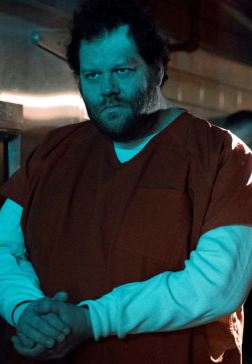
This is New Amsterdam, Season 1, Episode 17.  It is called “Sanctuary.”  The piece of it I cared about has to do with a convict named Burl (Olafur Darri Olafson)  from Rikers prison. [1].  When we meet him, he is stuck in an MRI machine because the hospital power went off.  Burl, his psychologist remembers, know how to fix stuff like that so they go dig him out of the machine and take him to the emergency generator.  It is broken too, so the hospital has lost both heat and light and the winter storm continues to rage outside.

Before and After

The contrast I want to draw for you—the basis of title for this essay, “Something happened!”—involved these two scenes.  Here is the BEFORE scene.

Burl: If you want me to, I can fix it.  I’m going to need a set of plans…and…um…a reduced sentence.  A pardon from the governor works too.

Max Look, Burl, I’m not in a position to negotiate terms.

Burl Well then I guess people are going to die.

And here’s the AFTER scene.

Max:  Hey…did you fix this?

Burl:   Welding wasn’t gonna fix that.  I couldn’t tell you that or Reyes would have dragged me off.  I just figured that if this place had an old swimming pool, it might have a fuel pump system I could switch out.  It did.

Max:   What do you want?  Anything.  I’ll make it happen.

Burl:   I wanna get better.

Some things we can see clearly.  Burl says that the hospital’s clout is a tool he can use to get a reduced sentence.  Nothing else matters to him.  Max says that his position does not allow him to “negotiate terms.”  Nothing else matters to Max either.  They are stuck.

Burl 1By the end, Burl has not only saved a lot of lives at the hospital, he has also outwitted the guard, Reyes.  He asked for a welder and warned that there might be an explosion when he started welding.  He knew a welder wasn’t going to do the job, but he had to close the door so he could “escape” to the pool area to see if there was a replacement part he could use.

By the end, Max has changed from “I’m not in a position…” to “What do you want?  Anything.”  Max wasn’t any more willing to bargain that Burl was and now, confronting the solution to the hospital’s problems that Burl has produced, he has nothing but gratitude.  It is the gratitude that produces, “What do you want?”  Burl is a scary-looking dude, right?  And in the early scenes, lit from below.  He looked like a goblin in handcuffs.

So what happened?

The short answer is that Burl has a change of heart.  My guess is that the way he has been seeing himself is just not compatible with the daring and the generosity he has shown in fixing the hospital generator and saving all those lives.  To continue to demand a reduced sentence in exchange for what he has already done simply throws away the meaning of his heroism and he is not willing to do that.

I think that is what happened.

But I also think it was helped along by Iggy, Burl’s counselor, who took something Max said to Burl and turned it into a tool Burl could use and making the transformation we see at the end. 

Max: You could be a hero tonight, Burl.  I’m trusting you to come through for everyone.

Iggy: Has anyone ever said that to you before.  Has anyone ever given you that opportunity?  Burl, you said you wanted to change, right?  This is it.  This is where it starts.

In this scene, Max offers an alternative narrative.  “You could be a hero tonight” is not an event that is possible as part of the bargaining setting.  So long as Burl is saying that he gets a reduced sentence or people will die and Max is saying that he is not in a position to propose such changes, there is no narrative space at all for a hero.  It is not possible.  Max escapes from the limitations of the bargaining narrative by offering Burl hero status.

Burl 2And Iggy, who as Burl’s counselor, knows more about what Burl wants that anyone, knows that Burl has said he wanted to change.  We learn that at that moment.  There is not a hint of it elsewhere in the episode.  But because of what Iggy knows, he can make Max’s offer a good deal more powerful.  “This is it,” he says.  That process you said you wanted to begin has to start right here.  Your hopes to change will be set back seriously if you walk away from this chance.  Iggy here, (left) with Reyes, the guard.

So…what really happened?

We don’t know.  I’ve offered two possibilities, one of them supported by some dialogue in the show itself, the other just my own construction.  But I really like mine better.  That may be because I have experienced it myself.  When you do something really good, you are reluctant to follow it up with something tacky or tawdry.  You really want to keep that sense of yourself as a hero just a little longer.   And I think Iggy helped by tying the “want to change” with the “this is where it starts.”

But whatever happened, I was taken completely by surprise when Burl, who was offered whatever he wanted, jettisoned the whole bargaining process and chose his own wholeness.  Burl and Max, in their negotiation, had talked only about what Burl could force the hospital to do.  But Burl and Iggy had talked about what Burl’s hopes for himself and in the end, Burl chose that conversation as his best choice.

[1]  Technically “the Rikers Island Prison Complex”

Posted in sociability, TV, ways of knowing | Tagged , , , , | Leave a comment

What should the 2020 election be about?

I know that, properly speaking, I should justify a time bomb work like “should.”  I’m not going to.  By the “should” in the title, I mean only that I prefer the non-referendum form myself and I think it is better for the country.  That is what I mean by “should.”

But let’s start with Thomas Edsall’s observation about President Trump.

To date, Trump has shown every intention of turning the election into a referendum on himself, and all the baggage he carries, with no regard for the political survival of fellow Republicans.

That straightforward observation will require a little unpacking and it will need to be done carefully.  There is the question, for instance, of just what baggage he carries.  And since the context is an election in a presidential year, the “fellow Republicans” we are considering are what are called “down-ticket Republicans. [1] And then there is the question of just what a referendum is.  Let’s start with that.

What is a referendum?

A referendum is an issue posed in a yes or no, up or down context.  We have been doing referenda in Oregon since 1902.  I have liked the goals and means of a few. Not many. For referenda, unlike consideration by legislative committees followed by a vote in each chamber, the thing you vote on is not open to amendment.  There is a “take it or leave it” quality to referenda that is hostile to careful thought and argumentation.

referendum 4The Death With Dignity Act is an instance, however, of why it is good to have a referendum as a possibility.  This bill was passed by both houses of the Oregon legislature.  Twice.  In both cases, it was killed in the conference committee—which is called to iron out differences between the House-passed version and the Senate-passed version—by the vigorous opposition of a religious pressure group.  Majorities in both houses favored it; the governor favored it.  And yet it did not become law until the citizens placed it on the ballot themselves and passed it. [2]  That’s why I think there should be a referendum.  It is Plan B.

I said, above, that the take it or leave it aspect of the referendum is why President Trump wants one.  Unkindly, I can say that he would like it because it is all about him.  More usefully, I can say that he thinks it is the only thing thing that will enable him to win.  It will mobilize his base.  It will prevent the presentation of alternative programs by the Democrats.  To see what this would mean, imagine an election in which the Democrats said, “Here’s our healthcare plan.  Where’s yours?” or “Here’s our environmental plan, where’s yours?”

For those two reasons, I can see why President Trump would prefer an election cycle that is all about him.

How to prevent it.

I don’t really have a strategy, but I have a sort of a schematic.  It has three parts: the press, the opposition candidates, and the people. [3]

The Press

The press is going to have to leave the daily tantrums alone.  That’s going to be difficult.  Ordinarily what the president says—or tweets—is “news” but when you strip the tweets of the arrogant language, the consistent cruelty, the racism, there is really only the policy implications left to look at.  We are going to have to learn to do without TRUMP THREATENS NATO ALLIANCE—which is, after all, about the President—and make do with “Administration proposes withdrawal from NATO, while Congress continues to value it.”

That would be a difficult choice for the press to make because writing things that get referendum 2them noticed is part of the business, but headlines like that first one also get the President noticed.  It is also likely that some news outlets are going to continue to feature the “daily outrage” and they may gain an advantage over media who do not.  Of course, just how much advantage they gain will depend on whether the readership rewards them or not and the readership is us.  If, as is customary, we deplore media oriented to sex and violence and consume those media disproportionately, the media will respond to what we do, rather than to what we say we do.  So we would have to consume, disproportionately, media that emphasize the policy dimension of the President’s remarks.

Consider this.  Trump is a monster.  Trump is a bigot.  Trump is a racist.  Trump is a predator.  Trump is childish.  All those headlines could very well have been crafted by the “Re-Elect President Trump” campaign.  They are all about him.  They make the election of 2020 a referendum on him, which, as Edsall speculates, is what he wants.

The Opposition Candidates

This will be harder.  It is one thing to build your campaign for Congress on your policy proposals.  Here’s my plan for stabilizing our immigration policy.  Here’s my plan for making healthcare available to everyone.  It is another to refuse to respond to attacks on your person.  Charges are made and people expect you to respond to them and, frankly, you do have to respond to them.  But a response will never be enough, you candidates will have to say out loud that these attacks on me will not put before you, the voters, the choices you face.  We need to get back to what kind of country you want to live in.

That’s the hard case.  The easier case is that Democrats need to run on what they oppose—gridlock, neglect, environmental disaster—and on what they propose to put in their place.  The alternative is running against Trump.  The common “I will fight for you” can so easily be turned to “I will fight against HIM,” which is, again, Trump-centered.  The essential case is this: “I am not going to campaign against the President.  I am going to campaign for policies that will benefit us all.” [4]

The People

We, as the audience in the campaign, are going to have to respond to policy-centered messages more than to person-centered messages. Here, for instance, is a person-centered message that says it is about “hate.”  This feeds the referendum strategy of the President. That doesn’t seem all that likely, given that we are wired for tribalism rather than for principle.  Maybe it would be enough is we emphasized our loyalty to our tribe.  

Screen Shot 2019-04-07 at 7.07.11 AM.pngThis could be “the tribe I belong to” as is the case for the white working class generally. [5]  It could be “the tribe I sponsor,” as is the case for many well-off Democrats who emphasize the rights of any one of a dozen marginalized groups. Tribe could be my political party.  Anything that would allow us to appear as political actors on behalf of our group (that’s the tribalism part) and the principles of our group.  I know that runs the risk of becoming unfocused, but none of those emphases play into the “referendum on Trump” focus, which, as Edsall says correctly, is the President’s best chance of re-election.

Of course, I don’t want the President to be re-elected, but on beyond that, referenda are a really terrible way to have a public debate and make an informed choice—and those matter a great deal to me.

[1]  Candidates who are not at the top of the ballot are affected a good deal by the races that are above them.  So, “down-ticket” Republicans.

[2]  Twice.  I like the symmetry of that.  Opponents brought it back in the next election cycle to get the voters to undo their earlier choice and we passed it by an even larger majority the second time.

[3]  Ordinarily, we say “the voters” at that point, but the reactions of the people take a lot of important forms beyond voting.

[4]  The way I am representing this kind of campaign makes it sound policy-centered.  I know that doesn’t work.  It must be centered on the narrative of political solidarity, inclusion, and common success.  It’s the story that works.  I just can’t afford that detour here.

[5]See Joan Williams, Reshaping the Work-Family Debate: Why Men and Class Matter.  Cambridge: Harvard University Press, 2010.


Posted in Politics | Tagged , , , , | Leave a comment

Playing the Angel Card

Let’s start with the silly question approach.  

Q: Why did Luke not write that Jesus was comforted by an angel after his testing in the wilderness after his baptism?

A: He needed an angel to comfort Jesus in Gethsemane and he only had one angel to work with.

So…imagine that each of the gospel writers has a card that represents each element of the tradition.  Everybody has a cleansing of the temple card, a healing the blind man card, an unfruitful fig tree card and so on.  And each has some cards that the others don’t have.  

angel 1You play your “cards”—cite the various elements of the tradition you know—at the place in the narrative where it will do what you want. Matthew makes a collection of the teachings of Jesus and has him deliver it on a mountain to make the parallel with Moses unmistakably clear.  Luke puts his very similar collection on a plain, surrounded by a crowd of people.  Notice the insubstantiality of the wilderness angel.  Keep it in mind when we get to a representation of the Gethsemane angel.

Each writer will play these cards at the place in the narrative where they say something important about Jesus.  There is a good deal of variability in where these cards are to be played, but you have only so many cards and once you have played a card, it is gone.  So you have to use each card thoughtfully.

The “play the angel card” metaphor has some important contributions for us.  For people who have been reading the gospels as if they were newspaper accounts, the notion that there is a strategy of presentation in each of the accounts can be really good news.  It turns the differences in the accounts from “discrepancies” into “variations”  No one imagines on hearing a “theme and variations” piece [1], that one of the variations is “correct” and that the others are not.  So the “angel card” approach begins by saying, “Remember, this is not journalism.”

Or, to say the same thing another way, the accounts we read in the gospels are not journalistic accounts. A journalist who was covering Jesus’ ministry would (could) just say where Jesus went and what he said.  He could interview the crowds or the Pharisees or the beneficiaries of the miracles and get them to say how they felt about it. [2]

But in addition to removing the misunderstanding that these are newspaper accounts, the “angel card” metaphor also prompts a more thoughtful attention to the narratives each writer develops.  Matthew, for instance, maintains the tie to Judaism more closely than the others.  Luke is very severe about wealth and poverty.  John understands Jesus as the pre-existent Logos and fully in charge of the events of his life, including his crucifixion.  Watching what cards are played and where in the narrative each is used provides a much richer sense of the ministry of Jesus.

Luke’s Angel Card

So we see that Luke did not provide an angel to comfort and restore Jesus after his wilderness tempting by the Devil.  And now we can speculate that he was “saving his angel card.” for Gethsemane, when Jesus would be in great need of it.  No angel appears in Mark and Matthew.  Jesus is prostrate on the ground and virtually paralyzed by the prospect facing him. [3]  In Luke, Jesus in kneeling (not prostrate) and is ministered to by an angel who functions as a trainer might in preparing an athlete. [4]

Luke’s angel changes everything.  Jesus’ healing ministry continues through the arrestangel 2 and the interrogations and the trials and even during the crucifixion.  In Jesus’ forgiveness of the penitent criminal on the cross, I see the effects of the strengthening angel.  Jesus’ last words in Luke are not “My God, why have you abandoned me?”, but “Father, into your hands I entrust my spirit.”  In that, I see the effects of the strengthening angel and it makes me grateful that Luke saved his angel card until then.


I started with the silly question, but clearly, the “play your card” metaphor is a different approach entirely.  The gospels are compositions.  Their shape is determined by what cards each narrator has available and where he chooses to play them.  That perspective invites us to a much richer appreciation of the narrative traditions of the ministry of Jesus.  Every variation gives another chance to appreciate the underlying theme.

[1] Of which, I must say Brahms’ Variations on a theme by Haydn (also called the Saint Anthony Variations), is my favorite.And there is fugue at the end, just for fun.

[2]  If Herod, whom Jesus once called “that fox,” (Luke 13:32) had a network of spies covering Galilee for him, it would be a Fox Network.  Very likely the first one.

[3]  And it doesn’t get better.  In Mark and Matthew, Jesus’ last words from the cross are, “My God, why have you abandoned me?”

[4]Raymond E. Brown argues, in The Death of the Messiah that the “agony” of Jesus in the garden represents the Greek agonia, which is a state of extreme readiness in preparation for an athletic event.

Posted in Biblical Studies | Tagged , , , , | Leave a comment

God, are you still there?

Not much of a question, from a theological point of view.  Yes.  God is still there.  A God who is everywhere is “there,” whatever you had in mind when you used that word.

But the question is not very often asked from a theological point of view.  It is asked from an experiential point of view and the circumstances that wring that kind of question out of a Christian can be appallingly bad. [1]  I have two circumstances in mind.

The first is the “presence,” the taken for granted presence of God in the life of a believer.abscondita 1  You have been taught, as a proposition, that God is there and nothing in your life has made you reconsider the proposition.  You have been taught that these feelings are evidence of God’s presence and you are taught what to do when those feelings aren’t there.  These little remedies are aspirin-sized remedies for what amounts to a religious headache.  For the person in this picture, it is not a headache.

That kind of “presence” doesn’t really answer the question because in that circumstance, no question has really been asked.  For instance, “Which way is up?” is kind of an entertaining question until your first serious bout with vertigo.  Then it is a lifestyle question.

The second is the “presence” of God when you can’t feel anything at all.  This can be acutely traumatic.  The gap between Jesus’ first prayer in Gethsemane (Is this really necessary?) and his second, (Your will be done.) shows how severe the loss of the sense of God’s presence can be in someone who has counted on it.

“Are you still there” can be a wrenching cry of the soul.  I know that.  I don’t want to minimize it in any way.  But I do want to understand it better.  To do that, I am going to offer a simple structural version of the problem and then tell a couple of stories that illustrate it. [2]

Here is the structural version

You can’t experience “God” directly the way you experience the wetness of water directly.  You have an experience of some sort and you attribute that experience to God.  It reveals the presence of God in your life (and affirms, logically, that there is such a God) or it means that God is acting on you to support you or to give you some job or other to do.  We learn these attributions as groups of Christians.  We teach them to each other; we fine-tune them for each other; we explain the anomalies for each other.  These social structures are what sociologist Peter Berger calls “plausibility structures.”  All communities of every kind whatsoever use such structures.

It does, however, conflate the experience with the attributed source of the experience.  I know God is there when I think these things or do these things or have those feelings, etc.  If you keep “God” and the means by which you experience God, separate, then you are staving off any possible disaster.  But people really don’t do that.  They make the experience and the way they explain the experience to themselves into one thing.  You know they aren’t, but it is very hard to keep them separate.

Hunt for Red October

abscondita 4There are lots of reasons to like McTiernan’s Hunt for Red October, including Alec Baldwin’s imitation of Sean Connery’s attempt to sound Russian, but I keep thinking of Courtney Vance as Seaman Jones, the sonar operator.  He knows that the Russian submarine, the Red October, is there because the sounds he hears through his headset and the squiggles he sees on his monitor tell him the sub is there.  He is listening to the sound of the engines.  But the whole point of Red October is that they have a new “silent drive” and when they turn it on and all the engines off, the Red October “disappears.”

If Seaman Jones had conflated the existence of the Red October with his experience of the Red October, the beeps and he squiggles, he would have every reason to believe that the Red October was no longer there.  He could have said, “It is gone” but he is too savvy for that.  What he says is, “It disappeared.”  That is precisely correct.

Apollo 13

Ron Howard’s Apollo 13 gives us a less savvy observer.  Dr. Chuck (Christian Clemenson)  has the job of monitoring the vital signs of the three astronauts. He can look at his monitors and read off the blood pressure, and pulse, and bladder pressure of all three astronauts because they are “wired up” with sensors and the information is communicated to Dr. Chuck in Houston.  For Dr. Chuck, the beeps and the squiggles ARE the astronauts.  These blips and squiggles are the actual experience Dr. Chuck has; it reveals to him the condition of the astronauts (and affirms logically that there really are astronauts) [3]  He completely conflates the existence of the astronauts with his current modality for experiencing them.

That makes him look like a fool when the astronauts, under considerable stress from the damage to their spacecraft, decide that they have had enough of the world knowing way too much about the functioning of their bodies, and they rip off the sensors.

Dr. Chuck, who, as I said, is not as savvy as Seaman Jones, exclaims “They’re gone!”  It is not a philosophical conclusion he has reached.  He is looking at his blank screen, the only evidence he has had of the existence of the astronauts, and his immediate reaction is that the astronauts are no longer there.  And if you conflate [4] what you know with your way of knowing it, that is what you open yourself to.  I recommended, above, “keeping them separate” (paragraph 8) as a way of “staving off disaster.”  Dr. Chuck doesn’t do that and has the immediate experience of disaster.

Fortunately for him, Gene Kranz (Ed Harris) is in charge of the operation and he knowsabscondita 7 what is going on.  “It’s just a little mutiny,” he tells Dr. Chuck.  And then adds, needlessly, “I’m sure they are still there.”  He is sure they are still there because he has a larger understanding of what is going on.  He knows how anxious and angry the astronauts are and he knows how the connection is maintained between the monitors they are wearing and the blips and squiggles on Dr. Chuck’s monitor.

Don’t be Dr. Chuck

I wish that I, as a Christian, were more like Gene Kranz when apparent disaster looms.  Unfortunately, the only times I can really count on being like Gene Kranz are when things are proceeding the way they should and my faith is not called into question.  When all the things that cause me to attribute to God a loving care for my life (and for all lives) disappear, I revert to Dr. Chuck mode.  Now, of course, I am theologically sophisticated, so I don’t say out loud what Dr. Chuck says.  I don’t say it.  But it is where I am and in my sickness of heart, I initiate whatever Plan B operations come to hand.

I wish I didn’t.  I know better.  Eventually, my Gene Kranz self—or more likely the community that plays the Gene Kranz part for me—comes back and I say, “No…I’m sure He’s still there.”

[1]  As always, I do not mean, by specifying Christians, to exclude the experience of people of other faiths or of no faith at all.  I am referring to the context I know best.

[2]  If you can get over my dealing with such an intimate experience by making references to movies, you should be OK with this essay.  Otherwise, please don’t read to the end and then get angry.

[3]  Quoting myself from paragraph 7.

[4]  It just now occurs to me to wonder if the unnecessary and potentially disastrous condition of conflating the means of knowing something with the thing that is to be known, should be called “conflatus.”  There is a certain satisfaction in that phrasing and just might help you let go of it.

Posted in A life of faith, Movies | Tagged , , , , , | Leave a comment