Something happened

The bad thing about the NBC show New Amsterdam is that it isn’t very realistic.  On the other hand, it is well done and week after week, manages to surprise.  In this essay I am going to tell you about one of the best surprises.  I watched it again as soon as I could.

Setting

This is New Amsterdam, Season 1, Episode 17.  It is called “Sanctuary.”  The piece of it I cared about has to do with a convict named Burl (Olafur Darri Olafson)  from Rikers prison. [1].  When we meet him, he is stuck in an MRI machine because the hospital power went off.  Burl, his psychologist remembers, know how to fix stuff like that so they go dig him out of the machine and take him to the emergency generator.  It is broken too, so the hospital has lost both heat and light and the winter storm continues to rage outside.

Before and After

The contrast I want to draw for you—the basis of title for this essay, “Something happened!”—involved these two scenes.  Here is the BEFORE scene.

Burl: If you want me to, I can fix it.  I’m going to need a set of plans…and…um…a reduced sentence.  A pardon from the governor works too.

Max Look, Burl, I’m not in a position to negotiate terms.

Burl Well then I guess people are going to die.

And here’s the AFTER scene.

Max:  Hey…did you fix this?

Burl:   Welding wasn’t gonna fix that.  I couldn’t tell you that or Reyes would have dragged me off.  I just figured that if this place had an old swimming pool, it might have a fuel pump system I could switch out.  It did.

Max:   What do you want?  Anything.  I’ll make it happen.

Burl:   I wanna get better.

Some things we can see clearly.  Burl says that the hospital’s clout is a tool he can use to get a reduced sentence.  Nothing else matters to him.  Max says that his position does not allow him to “negotiate terms.”  Nothing else matters to Max either.  They are stuck.
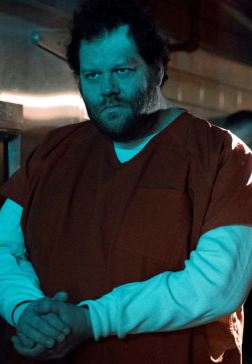
Burl 1By the end, Burl has not only saved a lot of lives at the hospital, he has also outwitted the guard, Reyes.  He asked for a welder and warned that there might be an explosion when he started welding.  He knew a welder wasn’t going to do the job, but he had to close the door so he could “escape” to the pool area to see if there was a replacement part he could use.

By the end, Max has changed from “I’m not in a position…” to “What do you want?  Anything.”  Max wasn’t any more willing to bargain that Burl was and now, confronting the solution to the hospital’s problems that Burl has produced, he has nothing but gratitude.  It is the gratitude that produces, “What do you want?”  Burl is a scary-looking dude, right?  And in the early scenes, lit from below.  He looked like a goblin in handcuffs.

So what happened?

The short answer is that Burl has a change of heart.  My guess is that the way he has been seeing himself is just not compatible with the daring and the generosity he has shown in fixing the hospital generator and saving all those lives.  To continue to demand a reduced sentence in exchange for what he has already done simply throws away the meaning of his heroism and he is not willing to do that.

I think that is what happened.

But I also think it was helped along by Iggy, Burl’s counselor, who took something Max said to Burl and turned it into a tool Burl could use and making the transformation we see at the end. 

Max: You could be a hero tonight, Burl.  I’m trusting you to come through for everyone.

Iggy: Has anyone ever said that to you before.  Has anyone ever given you that opportunity?  Burl, you said you wanted to change, right?  This is it.  This is where it starts.

In this scene, Max offers an alternative narrative.  “You could be a hero tonight” is not an event that is possible as part of the bargaining setting.  So long as Burl is saying that he gets a reduced sentence or people will die and Max is saying that he is not in a position to propose such changes, there is no narrative space at all for a hero.  It is not possible.  Max escapes from the limitations of the bargaining narrative by offering Burl hero status.
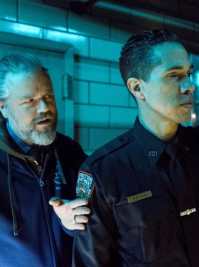
Burl 2And Iggy, who as Burl’s counselor, knows more about what Burl wants that anyone, knows that Burl has said he wanted to change.  We learn that at that moment.  There is not a hint of it elsewhere in the episode.  But because of what Iggy knows, he can make Max’s offer a good deal more powerful.  “This is it,” he says.  That process you said you wanted to begin has to start right here.  Your hopes to change will be set back seriously if you walk away from this chance.  Iggy here, (left) with Reyes, the guard.

So…what really happened?

We don’t know.  I’ve offered two possibilities, one of them supported by some dialogue in the show itself, the other just my own construction.  But I really like mine better.  That may be because I have experienced it myself.  When you do something really good, you are reluctant to follow it up with something tacky or tawdry.  You really want to keep that sense of yourself as a hero just a little longer.   And I think Iggy helped by tying the “want to change” with the “this is where it starts.”

But whatever happened, I was taken completely by surprise when Burl, who was offered whatever he wanted, jettisoned the whole bargaining process and chose his own wholeness.  Burl and Max, in their negotiation, had talked only about what Burl could force the hospital to do.  But Burl and Iggy had talked about what Burl’s hopes for himself and in the end, Burl chose that conversation as his best choice.

[1]  Technically “the Rikers Island Prison Complex”

Posted in sociability, TV, ways of knowing | Tagged , , , , | Leave a comment

What should the 2020 election be about?

I know that, properly speaking, I should justify a time bomb work like “should.”  I’m not going to.  By the “should” in the title, I mean only that I prefer the non-referendum form myself and I think it is better for the country.  That is what I mean by “should.”

But let’s start with Thomas Edsall’s observation about President Trump.

To date, Trump has shown every intention of turning the election into a referendum on himself, and all the baggage he carries, with no regard for the political survival of fellow Republicans.

That straightforward observation will require a little unpacking and it will need to be done carefully.  There is the question, for instance, of just what baggage he carries.  And since the context is an election in a presidential year, the “fellow Republicans” we are considering are what are called “down-ticket Republicans. [1] And then there is the question of just what a referendum is.  Let’s start with that.

What is a referendum?

A referendum is an issue posed in a yes or no, up or down context.  We have been doing referenda in Oregon since 1902.  I have liked the goals and means of a few. Not many. For referenda, unlike consideration by legislative committees followed by a vote in each chamber, the thing you vote on is not open to amendment.  There is a “take it or leave it” quality to referenda that is hostile to careful thought and argumentation.

referendum 4The Death With Dignity Act is an instance, however, of why it is good to have a referendum as a possibility.  This bill was passed by both houses of the Oregon legislature.  Twice.  In both cases, it was killed in the conference committee—which is called to iron out differences between the House-passed version and the Senate-passed version—by the vigorous opposition of a religious pressure group.  Majorities in both houses favored it; the governor favored it.  And yet it did not become law until the citizens placed it on the ballot themselves and passed it. [2]  That’s why I think there should be a referendum.  It is Plan B.

I said, above, that the take it or leave it aspect of the referendum is why President Trump wants one.  Unkindly, I can say that he would like it because it is all about him.  More usefully, I can say that he thinks it is the only thing thing that will enable him to win.  It will mobilize his base.  It will prevent the presentation of alternative programs by the Democrats.  To see what this would mean, imagine an election in which the Democrats said, “Here’s our healthcare plan.  Where’s yours?” or “Here’s our environmental plan, where’s yours?”

For those two reasons, I can see why President Trump would prefer an election cycle that is all about him.

How to prevent it.

I don’t really have a strategy, but I have a sort of a schematic.  It has three parts: the press, the opposition candidates, and the people. [3]

The Press

The press is going to have to leave the daily tantrums alone.  That’s going to be difficult.  Ordinarily what the president says—or tweets—is “news” but when you strip the tweets of the arrogant language, the consistent cruelty, the racism, there is really only the policy implications left to look at.  We are going to have to learn to do without TRUMP THREATENS NATO ALLIANCE—which is, after all, about the President—and make do with “Administration proposes withdrawal from NATO, while Congress continues to value it.”

That would be a difficult choice for the press to make because writing things that get referendum 2them noticed is part of the business, but headlines like that first one also get the President noticed.  It is also likely that some news outlets are going to continue to feature the “daily outrage” and they may gain an advantage over media who do not.  Of course, just how much advantage they gain will depend on whether the readership rewards them or not and the readership is us.  If, as is customary, we deplore media oriented to sex and violence and consume those media disproportionately, the media will respond to what we do, rather than to what we say we do.  So we would have to consume, disproportionately, media that emphasize the policy dimension of the President’s remarks.

Consider this.  Trump is a monster.  Trump is a bigot.  Trump is a racist.  Trump is a predator.  Trump is childish.  All those headlines could very well have been crafted by the “Re-Elect President Trump” campaign.  They are all about him.  They make the election of 2020 a referendum on him, which, as Edsall speculates, is what he wants.

The Opposition Candidates

This will be harder.  It is one thing to build your campaign for Congress on your policy proposals.  Here’s my plan for stabilizing our immigration policy.  Here’s my plan for making healthcare available to everyone.  It is another to refuse to respond to attacks on your person.  Charges are made and people expect you to respond to them and, frankly, you do have to respond to them.  But a response will never be enough, you candidates will have to say out loud that these attacks on me will not put before you, the voters, the choices you face.  We need to get back to what kind of country you want to live in.

That’s the hard case.  The easier case is that Democrats need to run on what they oppose—gridlock, neglect, environmental disaster—and on what they propose to put in their place.  The alternative is running against Trump.  The common “I will fight for you” can so easily be turned to “I will fight against HIM,” which is, again, Trump-centered.  The essential case is this: “I am not going to campaign against the President.  I am going to campaign for policies that will benefit us all.” [4]

The People

We, as the audience in the campaign, are going to have to respond to policy-centered messages more than to person-centered messages. Here, for instance, is a person-centered message that says it is about “hate.”  This feeds the referendum strategy of the President. That doesn’t seem all that likely, given that we are wired for tribalism rather than for principle.  Maybe it would be enough is we emphasized our loyalty to our tribe.  

Screen Shot 2019-04-07 at 7.07.11 AM.pngThis could be “the tribe I belong to” as is the case for the white working class generally. [5]  It could be “the tribe I sponsor,” as is the case for many well-off Democrats who emphasize the rights of any one of a dozen marginalized groups. Tribe could be my political party.  Anything that would allow us to appear as political actors on behalf of our group (that’s the tribalism part) and the principles of our group.  I know that runs the risk of becoming unfocused, but none of those emphases play into the “referendum on Trump” focus, which, as Edsall says correctly, is the President’s best chance of re-election.

Of course, I don’t want the President to be re-elected, but on beyond that, referenda are a really terrible way to have a public debate and make an informed choice—and those matter a great deal to me.

[1]  Candidates who are not at the top of the ballot are affected a good deal by the races that are above them.  So, “down-ticket” Republicans.

[2]  Twice.  I like the symmetry of that.  Opponents brought it back in the next election cycle to get the voters to undo their earlier choice and we passed it by an even larger majority the second time.

[3]  Ordinarily, we say “the voters” at that point, but the reactions of the people take a lot of important forms beyond voting.

[4]  The way I am representing this kind of campaign makes it sound policy-centered.  I know that doesn’t work.  It must be centered on the narrative of political solidarity, inclusion, and common success.  It’s the story that works.  I just can’t afford that detour here.

[5]See Joan Williams, Reshaping the Work-Family Debate: Why Men and Class Matter.  Cambridge: Harvard University Press, 2010.


Posted in Politics | Tagged , , , , | Leave a comment

Playing the Angel Card

Let’s start with the silly question approach.  

Q: Why did Luke not write that Jesus was comforted by an angel after his testing in the wilderness after his baptism?

A: He needed an angel to comfort Jesus in Gethsemane and he only had one angel to work with.

So…imagine that each of the gospel writers has a card that represents each element of the tradition.  Everybody has a cleansing of the temple card, a healing the blind man card, an unfruitful fig tree card and so on.  And each has some cards that the others don’t have.  

angel 1You play your “cards”—cite the various elements of the tradition you know—at the place in the narrative where it will do what you want. Matthew makes a collection of the teachings of Jesus and has him deliver it on a mountain to make the parallel with Moses unmistakably clear.  Luke puts his very similar collection on a plain, surrounded by a crowd of people.  Notice the insubstantiality of the wilderness angel.  Keep it in mind when we get to a representation of the Gethsemane angel.

Each writer will play these cards at the place in the narrative where they say something important about Jesus.  There is a good deal of variability in where these cards are to be played, but you have only so many cards and once you have played a card, it is gone.  So you have to use each card thoughtfully.

The “play the angel card” metaphor has some important contributions for us.  For people who have been reading the gospels as if they were newspaper accounts, the notion that there is a strategy of presentation in each of the accounts can be really good news.  It turns the differences in the accounts from “discrepancies” into “variations”  No one imagines on hearing a “theme and variations” piece [1], that one of the variations is “correct” and that the others are not.  So the “angel card” approach begins by saying, “Remember, this is not journalism.”

Or, to say the same thing another way, the accounts we read in the gospels are not journalistic accounts. A journalist who was covering Jesus’ ministry would (could) just say where Jesus went and what he said.  He could interview the crowds or the Pharisees or the beneficiaries of the miracles and get them to say how they felt about it. [2]

But in addition to removing the misunderstanding that these are newspaper accounts, the “angel card” metaphor also prompts a more thoughtful attention to the narratives each writer develops.  Matthew, for instance, maintains the tie to Judaism more closely than the others.  Luke is very severe about wealth and poverty.  John understands Jesus as the pre-existent Logos and fully in charge of the events of his life, including his crucifixion.  Watching what cards are played and where in the narrative each is used provides a much richer sense of the ministry of Jesus.

Luke’s Angel Card

So we see that Luke did not provide an angel to comfort and restore Jesus after his wilderness tempting by the Devil.  And now we can speculate that he was “saving his angel card.” for Gethsemane, when Jesus would be in great need of it.  No angel appears in Mark and Matthew.  Jesus is prostrate on the ground and virtually paralyzed by the prospect facing him. [3]  In Luke, Jesus in kneeling (not prostrate) and is ministered to by an angel who functions as a trainer might in preparing an athlete. [4]

Luke’s angel changes everything.  Jesus’ healing ministry continues through the arrestangel 2 and the interrogations and the trials and even during the crucifixion.  In Jesus’ forgiveness of the penitent criminal on the cross, I see the effects of the strengthening angel.  Jesus’ last words in Luke are not “My God, why have you abandoned me?”, but “Father, into your hands I entrust my spirit.”  In that, I see the effects of the strengthening angel and it makes me grateful that Luke saved his angel card until then.

I started with the silly question, but clearly, the “play your card” metaphor is a different approach entirely.  The gospels are compositions.  Their shape is determined by what cards each narrator has available and where he chooses to play them.  That perspective invites us to a much richer appreciation of the narrative traditions of the ministry of Jesus.  Every variation gives another chance to appreciate the underlying theme.

[1] Of which, I must say Brahms’ Variations on a theme by Haydn (also called the Saint Anthony Variations), is my favorite.And there is fugue at the end, just for fun.

[2]  If Herod, whom Jesus once called “that fox,” (Luke 13:32) had a network of spies covering Galilee for him, it would be a Fox Network.  Very likely the first one.

[3]  And it doesn’t get better.  In Mark and Matthew, Jesus’ last words from the cross are, “My God, why have you abandoned me?”

[4]Raymond E. Brown argues, in The Death of the Messiah that the “agony” of Jesus in the garden represents the Greek agonia, which is a state of extreme readiness in preparation for an athletic event.

Posted in Biblical Studies | Tagged , , , , | Leave a comment

God, are you still there?

Not much of a question, from a theological point of view.  Yes.  God is still there.  A God who is everywhere is “there,” whatever you had in mind when you used that word.

But the question is not very often asked from a theological point of view.  It is asked from an experiential point of view and the circumstances that wring that kind of question out of a Christian can be appallingly bad. [1]  I have two circumstances in mind.

The first is the “presence,” the taken for granted presence of God in the life of a believer.abscondita 1  You have been taught, as a proposition, that God is there and nothing in your life has made you reconsider the proposition.  You have been taught that these feelings are evidence of God’s presence and you are taught what to do when those feelings aren’t there.  These little remedies are aspirin-sized remedies for what amounts to a religious headache.  For the person in this picture, it is not a headache.

That kind of “presence” doesn’t really answer the question because in that circumstance, no question has really been asked.  For instance, “Which way is up?” is kind of an entertaining question until your first serious bout with vertigo.  Then it is a lifestyle question.

The second is the “presence” of God when you can’t feel anything at all.  This can be acutely traumatic.  The gap between Jesus’ first prayer in Gethsemane (Is this really necessary?) and his second, (Your will be done.) shows how severe the loss of the sense of God’s presence can be in someone who has counted on it.

“Are you still there” can be a wrenching cry of the soul.  I know that.  I don’t want to minimize it in any way.  But I do want to understand it better.  To do that, I am going to offer a simple structural version of the problem and then tell a couple of stories that illustrate it. [2]

Here is the structural version

You can’t experience “God” directly the way you experience the wetness of water directly.  You have an experience of some sort and you attribute that experience to God.  It reveals the presence of God in your life (and affirms, logically, that there is such a God) or it means that God is acting on you to support you or to give you some job or other to do.  We learn these attributions as groups of Christians.  We teach them to each other; we fine-tune them for each other; we explain the anomalies for each other.  These social structures are what sociologist Peter Berger calls “plausibility structures.”  All communities of every kind whatsoever use such structures.

It does, however, conflate the experience with the attributed source of the experience.  I know God is there when I think these things or do these things or have those feelings, etc.  If you keep “God” and the means by which you experience God, separate, then you are staving off any possible disaster.  But people really don’t do that.  They make the experience and the way they explain the experience to themselves into one thing.  You know they aren’t, but it is very hard to keep them separate.

Hunt for Red October

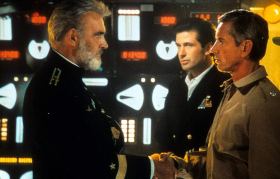
abscondita 4There are lots of reasons to like McTiernan’s Hunt for Red October, including Alec Baldwin’s imitation of Sean Connery’s attempt to sound Russian, but I keep thinking of Courtney Vance as Seaman Jones, the sonar operator.  He knows that the Russian submarine, the Red October, is there because the sounds he hears through his headset and the squiggles he sees on his monitor tell him the sub is there.  He is listening to the sound of the engines.  But the whole point of Red October is that they have a new “silent drive” and when they turn it on and all the engines off, the Red October “disappears.”
If Seaman Jones had conflated the existence of the Red October with his experience of the Red October, the beeps and he squiggles, he would have every reason to believe that the Red October was no longer there.  He could have said, “It is gone” but he is too savvy for that.  What he says is, “It disappeared.”  That is precisely correct.

Apollo 13

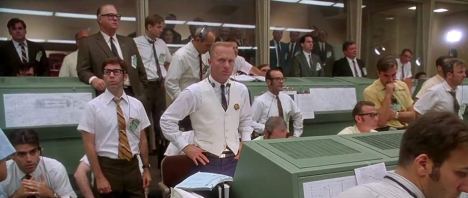
Ron Howard’s Apollo 13 gives us a less savvy observer.  Dr. Chuck (Christian Clemenson)  has the job of monitoring the vital signs of the three astronauts. He can look at his monitors and read off the blood pressure, and pulse, and bladder pressure of all three astronauts because they are “wired up” with sensors and the information is communicated to Dr. Chuck in Houston.  For Dr. Chuck, the beeps and the squiggles ARE the astronauts.  These blips and squiggles are the actual experience Dr. Chuck has; it reveals to him the condition of the astronauts (and affirms logically that there really are astronauts) [3]  He completely conflates the existence of the astronauts with his current modality for experiencing them.

That makes him look like a fool when the astronauts, under considerable stress from the damage to their spacecraft, decide that they have had enough of the world knowing way too much about the functioning of their bodies, and they rip off the sensors.

Dr. Chuck, who, as I said, is not as savvy as Seaman Jones, exclaims “They’re gone!”  It is not a philosophical conclusion he has reached.  He is looking at his blank screen, the only evidence he has had of the existence of the astronauts, and his immediate reaction is that the astronauts are no longer there.  And if you conflate [4] what you know with your way of knowing it, that is what you open yourself to.  I recommended, above, “keeping them separate” (paragraph 8) as a way of “staving off disaster.”  Dr. Chuck doesn’t do that and has the immediate experience of disaster.

Fortunately for him, Gene Kranz (Ed Harris) is in charge of the operation and he knowsabscondita 7 what is going on.  “It’s just a little mutiny,” he tells Dr. Chuck.  And then adds, needlessly, “I’m sure they are still there.”  He is sure they are still there because he has a larger understanding of what is going on.  He knows how anxious and angry the astronauts are and he knows how the connection is maintained between the monitors they are wearing and the blips and squiggles on Dr. Chuck’s monitor.

Don’t be Dr. Chuck

I wish that I, as a Christian, were more like Gene Kranz when apparent disaster looms.  Unfortunately, the only times I can really count on being like Gene Kranz are when things are proceeding the way they should and my faith is not called into question.  When all the things that cause me to attribute to God a loving care for my life (and for all lives) disappear, I revert to Dr. Chuck mode.  Now, of course, I am theologically sophisticated, so I don’t say out loud what Dr. Chuck says.  I don’t say it.  But it is where I am and in my sickness of heart, I initiate whatever Plan B operations come to hand.

I wish I didn’t.  I know better.  Eventually, my Gene Kranz self—or more likely the community that plays the Gene Kranz part for me—comes back and I say, “No…I’m sure He’s still there.”

[1]  As always, I do not mean, by specifying Christians, to exclude the experience of people of other faiths or of no faith at all.  I am referring to the context I know best.

[2]  If you can get over my dealing with such an intimate experience by making references to movies, you should be OK with this essay.  Otherwise, please don’t read to the end and then get angry.

[3]  Quoting myself from paragraph 7.

[4]  It just now occurs to me to wonder if the unnecessary and potentially disastrous condition of conflating the means of knowing something with the thing that is to be known, should be called “conflatus.”  There is a certain satisfaction in that phrasing and just might help you let go of it.

Posted in A life of faith, Movies | Tagged , , , , , | Leave a comment

Healing the Homeless on the Cheap

Very often it seems that one of America’s tribes want to see the vulnerable (undeserving) cared for (coddled) and the other wants to spend as little tax money (government resources) as possible on the nanny state (compassionate social programs). And sometimes there are issues that line up just that way. I want to spend more or social programs and you want to spend less. Period.

But there are also issues where much more compassionate programs cost a good deal frequent flyer 2less than punitive ones (or than no programs at all) and you and I ought to be on the same side of those issues, working together to achieve mutual success.

There is a lovely instance of such an issue in Season 1, Episode 11 of the NBC series, New Amsterdam. [1] Dr. Bloom, who is in charge of the emergency room, introduces Dr. Goodwin (the director of the hospital) to Andy Keener, who spends a lot of time at the New Amsterdam hospital, and is therefore “ a frequent flyer.” Dr. Goodwin (Max) responds the way he responds to every situation, “How can I help?” Here is scene 1.  Max is in the blue scrubs in this picture.  Dr. Bloom is on the right.

Dr. Lauren Bloom: You said you wanted to know the next time a frequent flyer came in.

Dr. Max Goodwin: Yeah, frequent flyers mean we’re not doing our job.

Lauren: Well then, you’re in luck. Meet the Amelia Earhart of frequent flyers: Andy Keener.

Max: (to Andy) How can I help?

Nothing complicated so far. But in the next scene, Max arrives at a dollar figure; this is what “treating” Andy Keener has cost the hospital this year. [2] Here’s that clip.

Max: Did you know that Andy Keener has been in this hospital over 100 times.

Lauren: He’s a frequent flyer

Max: If my math is correct—and I’m pretty sure that it is—Andy Keener has cost New Amsterdam $1.4 million this year. And we haven’t done a thing to help him.

frequent flyer 3Well…the “help” in “help him” is a different “help” than “How can I help?” They have helped Andy Keener in the sense that they have ruled out, each and every time he has come in, some more serious possibilities. That’s a help; sort of. And they treated the presenting problems each time. Max rattles off four on his way to a “solution.” The four are fatigue, heart arrhythmia, stress, and malnutrition, but we know there are more. So it is not true that Max and Colleagues have not helped, but they have not dealt with the fundamental problem, which is that Andy lives on the street and bad things happen to him.

So Max deals with it head-on. “ Mr. Keener, I’m prescribing you a home.’

The case so far is that effective medical treatment requires the solution Max has invented. But when we get over to social policy, conservatives are going to get really uncomfortable. The hospital is renting an apartment for a homeless person? And then when we get to spending policy—what we want to spend tax dollars on—the fiscal conservatives are going to get uncomfortable. On the other hand, the savings are dramatic, and you would think the fiscal conservatives would like that.

The role of the several kinds of conservatives is played by the “dean” of the hospital [3] In this discussion, Max gets to be the fiscal conservative. Max is a tax and spend liberal, so the Dean is momentarily confused.

Dean Fulton: So…who is Andy Keener and why are we renting an apartment for him?

Max: Andy is a…um…frequent flier. His homelessness has cost this hospital $1.4 million this year alone and many of those costs will go away if Andy just has a full-time place to stay. I mean, renting this man an apartment is actually going to save this hospital money.

Dean: So you suddenly decided to care about money?

You see the Dean’s incredulity in the bold “you.” You, of all people, have decided to spend less? Max is on good ground. If the apartment cost $1000 dollars a month, the hospital saves $1,388,000 every year. This should make the Dean happy once he gets over his surprise that Max is doing this. Max’s medical rationale, after all, is pretty good at the level of the hospital, Max’s answer is pretty good. “ Well, I care about money when it’s only going to one patient when it should be going to thousands.”

So now we turn to social conservatism.

Dean: This is socialism. This is exactly what’s wrong with our whole healthcare system.

Max will not be redirected, “You’re right Somebody really should fix it.” But, of course, “somebody ought to fix it” does not change the subject and it doesn’t take account of the political character of the Dean’s objection. So the Dean gets more specific.

Dean: So this guy abuses the system and he gets a free apartment. What about all the other guys who are working their asses off? You think this is fair to them?

Max: It’s not fair to them, but it’s smart business for us. We’re talking about saving over $1 million a year. That’s a million dollars that could be spent on those very people who are working their asses off, who do deserve more.

Max agrees with the name socialism, but he doesn’t really care. Max agrees with the unfairness to people who are badly off, but not quite as badly off as Andy, but he justifies it as a smart business decision for the hospital. On those grounds, it is really hard for the Dean to object.

That really ought to end the episode. If the writers didn’t care about any more than the policy preferences of liberals and conservatives, the story would end there. It doesn’t, though, and there is this final scene, which I have enjoyed. Max goes to the ER and finds Andy in a bed.

Andy: You going to take away my apartment?

Max: No. I don’t know what to do.

Andy: I…I guess I just like it here.

Max: …You are always welcome here…when you’re sick. And when you’re not sick we have a lot of people that we have to take care of, and that’s just the way it has to be.

Andy: I’ll…I’ll leave. No problem.

A visitor: Excuse me. Sorry, does anyone know how to get to the ICU? [4]

Andy: Oh, dude, you can’t get to the 12th floor from this building. You gotta take the elevator to the 3rd floor, then take the breezeway to Harriman. Then you take the second set of elevators to 12. Then you walk to the end of the hall.

Visitor: Thanks, man. You’re a lifesaver.

Max:  Do you[also] know how to get to the oncology ward?

Andy:  Of course. I’ve had many the nonexistent tumor examined there.

Max:  How would you like to start paying off that apartment:?

Andy: How?

Max:  By spending a little more time at New Amsterdam.

They turn him into a guide for new patients, where, we are led to believe, he functions superbly.

[1] You get “Amsterdam” by damming the Amstel river in the Netherlands, by the way, or so they told us when we visited there. Maybe it’s just a tour guide joke.
[2] I couldn’t find a way to make that dollar figure reasonable, so, rather than lose the narrative, I just translated it into “lots of money.”
[3] I have no idea why a hospital should have a dean, but you need to know that Dean is not his first name.
[4] This little intervention out of nowhere is narrative fraud. I don’t care. I like it.

Posted in Political Psychology, Society, TV, Words | Tagged , , , , | Leave a comment

The Sixth Commandment in Shetland

I’d like to share with you today a small exchange that has caused me to smile for murder 2several days now.  These four lines (below) are from a show that Bette and I have come to like a good deal.  It is a cop show set in the Shetland Islands of Scotland.  The chief cop (Detective Inspector) is Jimmy Perez.  Here is Douglas Henshall as Perez.

In this episode, called “Dead Water,” the last episode of season two, he had a conversation with a very religious man named John Henderson.  Henderson’s religious views are startling, but they are not insincere.  

Henderson’s setting for how he looks at the world is religious.  He actually has a Weltanschauung; Perez has a job.  This disjunction between how Henderson sees the world (and what things he presupposes) and the way Perez sees the world (and what things he presupposes) are what made this little exchange funny to me.

Jimmy Perez in investigating another murder and that is why he has come to talk to Henderson.Here is how that goes.

Henderson: I live Sola Scripture, detective.The Ten Commandments are my guide in life.  And “Thou shalt not kill” is…

Perez: It’s number six.

Henderson: You know the commandments then?

Perez: I know that one.

Henderson is extremely serious, as you can tell.  Even in a man who is cast as a religious stereotype “I live Sola Scriptura” sounds pompous. [1]  He follows with “the 10 Commandments” and then goes directly to “Thou shalt not kill…” because the plot of all the episodes of Shetland begin with someone finding a body.

murder 1So in Henderson’s world, the commandment about killing is just an instance of his commitment to all the commandments, including the one about stealing, which is what gets him killed in the next turn of the plot.  That’s not the way it is with Perez.  Henderson with the woman he had just married.

In a show where all the plots start with a murder, Perez is a man who has every reason to know the sixth commandment, whether he knows any others or not.  The sixth commandment is an instance of fidelity to God for Henderson.  It is a way of being good at his job for Perez.

So when Perez fills in the right number and says, in effect, that he might not know all the other commandments, but as a man who spends his life investigating homicides, he does know that one, the discrepancy in perspectives is extreme and delicious.

I got the humor in this exchange the first time I saw it.  Barely.  I saw that there was a discrepancy there but I didn’t appreciate just how stark it was.  That started to get clearer for me at the second viewing and at every viewing since.

[1]  They did capitalize “Sola Scriptura” in the captions.  That seemed odd to me.

Posted in funny, ways of knowing | Tagged , , , | Leave a comment

Turning cheeks and turning tables

bargain 1The little badger invented by Russell Hoban and brought charmingly to life in the illustrations of Lillian Hoban, has been my favorite badger for a long time. [1] I have liked all the Frances books, but I have had reason to use this particular one—A Bargain for Frances—because it is a finely drawn instance of a situation I have to deal with a lot. The situation is the conflation of strategy and tactics.

I know that sounds obscure, but it really isn’t, and I propose to use the rest of this essay to convince you that it is not.

In A Bargain for Frances, Frances’ “friend” Thelma cheats her out of a tea set and Frances, having given the matter some thought, cheats Thelma out of a tea set. Her actions, as I see them are not only moral, but, ultimately, transformative.

That is why I juxtaposed the two turnings in the title. There is a good deal of debate about what, exactly, Jesus meant  (Matthew 5) when he taught that his disciples should “turn the other cheek” when struck. The meaning of “turn the tables on” is a good deal clearer. [2] Are these opposing and contradictory actions, as some say, or potentially complementary actions?

Here is the way the story goes. One morning, Frances is getting ready to go play with Thelma and her mother warns her to be careful on the grounds that playing with Thelma has often turned out badly in the past. Mother says, “Be careful.”

Then Thelma cheats Frances out of her tea set and when Frances realizes that she hasbargain 4 been played for a sucker, she ends a little song she is singing to herself, “…Mother told me to be careful. but Thelma better be bewareful.” This is a different matter entirely. Mother’s advice is good, but it is general, and, being parental, easy to ignore. Frances’ threat “better be bewareful” is not only specific, but Frances is saying the she, herself, needs to be taken account of. She is, herself, capable of wreaking vengeance. This is a transformation of Frances’ character [3]

It is it a good transformation?

In this story, it is. “Turning the other cheek” is what Frances has been doing during her whole history with Thelma. It is why Mother told her to be careful. Thelma and Frances have a stable relationship; Thelma is the predator and Frances is the prey. [4] That is where turning the other cheek has gotten both of these little badgers.

Turning the tables is Frances’ declaration that a new kind of relationship is in the offing. It might be “former friends.” It might be “enemies.” Turning the tables establishes the end of predation, but it doesn’t specify what the new form of the relationship, if any, will be. It is, in fact, friendship

“Careful” is a word that comes back when Thelma realized that she has been deceived by a playmate who has been only a sucker previously.

“Well,” said Thelma, “from now on I will have to be careful when I play with you.”

And Thelma is not wrong. The person Frances realized she could be—the person of whom Thelma had better be bewareful—could, in fact, be the kind of playmate of whom Thelma would want to be careful. We can picture Thelma’s mother reminding her of all the recent tricks Frances has played on her, just as Frances’ mother did in the opening scene.

But that is not what Frances has in mind.

Being careful is not as much fun as being friends,” said Frances. “Do you want to be careful, or do you want to be friends?”

Having established a relationship of parity, there is the question of how to shape it. “Friends,” of whom one must be bewareful in one of the possibilities, certainly. But being friends rather than being careful is much more attractive. [5]

bargain 6This same transformation is caught in the substitution of “halfsies” for “backsies” Backsies is crucial to the con game. You make the deal and when you find out you have been defrauded, “no backsies” is a crucial part of the deal. That is why the sucker is required to accept those terms first. So Frances and Thelma take the pathetic dime that Thelma has given Frances as part of being cheated in return, and they go together to the candy store and each spends half of the dime on candy. “Halfsies” is a perfectly appropriate deal among peers who are friends and “backsies” are completely unnecessary.
I call the style of thinking that identifies “what you are supposed to do” (regardless of the outcome) the Servant style. [6] Those people would have counseled Frances to continue “being nice to” Thelma and would, thereby, have prevented the development of their friendship. I call the other style—the style oriented toward producing a good outcome— the Steward style. “Cheating Thelma back”–if it is a move in a larger game– would be fine with the Stewards, depending, of course, on what the larger game is. But Stewards would have been satisfied with a number of good outcomes that are not nearly as good as the one Frances produced—sustained mutual wariness, for instance—provided that they dealt with the predator problem.

Frances’ solution is in the Steward stream of thinking, but it is at the very high, at the “redemptive,” end.

[1] Apologies to Russell Wilson, who was an outstanding quarterback at Wisconsin before he became an outstanding quarterback for the Seattle Seahawks.
[2] According to the OED, it originated with the playing of board games in the 17th century and it means turning a disadvantage into an advantage.
[3] And unique in the whole corpus of Francescan literature. My apologies for the “Franciscan” pun; I was momentarily overcome.
[4] In another essay, it would be possible to consider whether Frances’ behavior did not induce Thelma’s, that Thelma was drawn into predation by Frances’ unwillingness to stand up for herself. This is not that essay.
[5] I am reminded that “free” and friend” are derived from a common source, which fits Frances’ turn of phrase very nicely.
[6] For good biblical reasons that don’t really bear on this essay. The same goes for the Steward style, which I see as the alternative.


Posted in A life of faith, Biblical Studies, Political Psychology | Tagged , , , , | Leave a comment

Fan base

“There’s such a thing as loyalty,” snapped the angry Jane Studdock.

There is, ma’am,” returned Andrew McPhee, “As you get older, you will learn that it is a virtue too important to be lavished on individual personalities.” [1]

I am trying to do a very hard thing. I am trying to be a fan of the team who is playing the best ball. I grew up, as you did, thinking that “fanhood” belonged to a particular team. I’m a fan of the Pittsburgh Steelers or the Cincinnati Reds or the Duke Blue Devils. I’m trying to get away from that. At my age, I probably won’t be successful, but I do admire the effort.

What would that mean?

The sports I like to watch most are professional football (I like college ball also), collegefan 1 basketball (not pro ball), and professional tennis. I’m not going to try to justify those. They are just the ones I most enjoy watching.
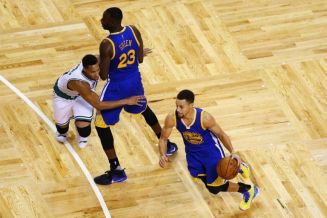
For each sport, there is a kind of game I like to watch. To some extent, it is the kind of game I understand best. Of course, I don’t like it if it doesn’t work. But if a team is playing a kind of game I don’t like, I don’t care whether it works or not.  Here, for instance, is the classic pick and roll.  Green (23) sets the pick.  If Curry gets free, he shoots.  If they adjust to him, Green will be free to “roll” and he can shoot.

What would that look like?

I like smart players (tennis) and smart teams (football and basketball). It could be argued that doing whatever it takes to win is the smart thing and that might make good sense if you are a manager. I’m just a fan [2] So if the other team’s big men are undersized and yours are not, it would be “smart” to throw the ball into your really big man under the basket and let him just outmuscle everyone and score. That’s not what I mean by smart.  It’s effective, but it doesn’t require the kind of thought I like to watch in action.

On the other hand, if they have someone who just can’t guard your center and also someone who can, they will put the better defender on your center. If you pass the ball around really well so that they have to switch and put the poorer defender on your guy, [3] and then you pass him the ball and he scores—that looks like smart to me. It’s the same two points, but I would enjoy watching it. I am a fan of that way of playing basketball and I would like my loyalty to flow to anyone who is using it.

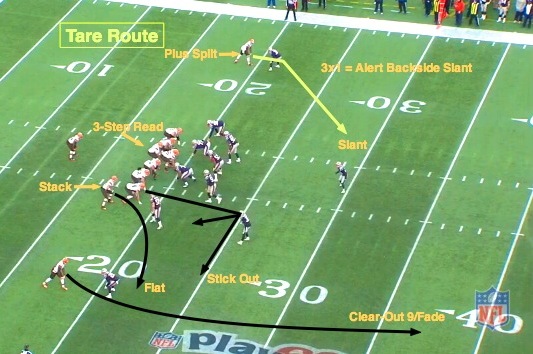
I learned from Tony Romo’s commentary during the 2019 Superbowl, that New England fan 3ran the same play three times in a row, delivering the ball to a different receiver each time. It is a considerable strain on the defense to defend “the same play” time after time, only to have it work differently time after time. So theoretically, I could have started with a leftover, “old style” preference for Los Angeles, and have been won over by the smart play of New England.
This is not that game, obviously, but just look at the “clear out route” at the bottom of the picture.  If the defensive lineman lined up opposite the wide receiver follows the wide receiver down the field, then he will not be in the flat where the tight end is going to be and the defensive back may or may not be able to get over to cover him.  Sometimes I can see that set up as I am watching.  More and more the commentators graph out some of the possibilities before the ball is snapped and refer to them in explaining the play.  You don’t have to be all that smart if all you have to do is look at what they are showing you.  On the other hand, you do have to pay attention, and you have to be willing to prefer a smart play to a dumb one.

As I am trying to build my new habits—being a fan of a style of play, rather than of a team—that would be a victory for me.

The downside of this new habit is that I need to be a more knowledgeable viewer. If I am the fan of a team, if the ball goes in the basket, it is good. If it was a bad shot—a shot the player should not have taken—it is bad whether it goes in or not. If a team is passing the ball around the perimeter because they can’t think of anything else to do with it, that it going to turn me off quickly. If, with every pass, they gain a small advantage until finally someone is free to take an easy shot, I am going to enjoy that. Similarly, if a team is passing well, but the defense is even better and no combination of passes gets an open shot—and even more if the shot clock buzzer goes off—I am going to become a fan of that defense,

If a safety misunderstands the coverage and lets a receiver get entirely open, that’s on him. If the offense pulls him to the center of the field, where he simply can’t get back to the flat to cover the receiver, that’s just a well designed play and no fault goes to the defensive back. The first instance is just bad football by the defense My loyalty starts to drift away. The second instance is just good football by everyone and my loyalty to both teams holds firm.

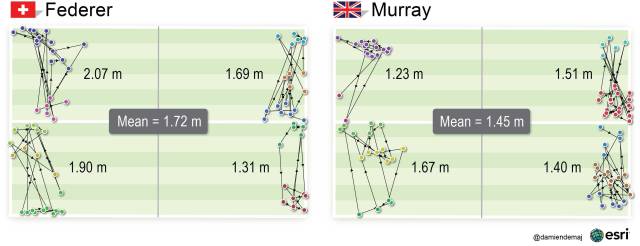
fan 2It works the same way in tennis.  If I can pull the opposing player a little wider with every cross court shot, eventually, I will get him to where he just can’t make it all the way back and if he commits to the long trek too early, I can just hit it behind him.  On the other hand, if the defensive player does more with my shot than just returning it, he can break up the whole sequence and capture the offense for himself.  I like both of those and whoever is doing it better is the one I would like to be appreciating more.

That could very well involve appreciating (being a fan of) Roger Federer in the first set, and when his tennis goes abruptly bad, which it does sometimes, being a fan of Andy Murray in the second set.  If I can do this, I will be a fan, in the fifth set, of whoever has been playing the best tennis up to then.

I have no idea if it will work, but I’d like to give it a try. Being a fan of the team that is playing the best ball or the player who is playing the smartest tennis seems like something I would like to do. I foresee getting kicked out of alumni parties, but I think I’m OK with that.

[1] Both from C. S. Lewis’s That Hideous Strength. Neither of them is talking about college basketball.
[2] I am aware, of course that “fan” is the short form of “fanatic” but I am trying to resist the idea that fanaticism must be attached to a team.
[3] Of course, I need to be able to see it and I admit that the commentary helps me learn what to look for. I also admit that the TV coverage is not a fan of that kind of watching. Still, it works often enough to engage my appreciation and, hypothetically, my loyalty.

Posted in Living My Life, Paying Attention | Tagged , , , , | Leave a comment

Asymmetrical Mutual Prohibitions

I know that’s an awful title, but I don’t get to say things like that all the time and this time I think I can justify it.  I will let you be the judge.

For one reason or another, I have been spending some time grappling with Romans 14 this year. Did you ever have the experience of listening to a song from a genre you are not familiar with? It’s an OK song, you say. Nothing special. Then you learn more about that particular kind of music and you start to evaluate it not just by “how it hits you,” but by how closely it achieves the demanding standards of that kind of music.

Wow, you say, it’s really good. That’s your brain talking. But further on down the road, you internalize those norms; they are now the norms that enable you to hear that music and appreciate it in the way that is most appropriate to the kind of music it is. It’s not “an OK song” anymore. It’s really wonderful. It moves you.

The weak and the strong

So the song metaphor is the way I am feeling about Paul’s treatment of the weak and the strong in Romans 14. I have read it all my life as having the essential meaning that the strong and the weak ought to be nice to each other. That’s not wrong—and it’s not a bad idea—but there is more there and lately I’ve been marinating my mind in just how much more there is.

There are four pieces to this tidy puzzle. What does “weak” mean? What does “strong” mean? What are their obligations to each other? How long do these obligations last?  The first three questions mean what you think they mean. That fourth one is a trap.

What does “weak” mean?

In the New Jerusalem Bible, my go-to version, the whole chapter is headed “Charityweak 3 Toward the Scrupulous.” [1] So “weak” in this context means “scrupulous,” or as we would more likely express it, “overscrupulous.” Paul is clear that what he means is things like refusing to eat meat and drink wine and and honoring special days. These very particular things are part of the faith of “the weak;” they are the style of the faith of the weak. They are completely authentic. They express their sense of what God requires. [2]

What does “strong” mean?

Similarly, “strong” means not making these distinctions. The “strong,” says Paul, making it clear that he is one of them, have “faith enough” to eat any kind of food and they honor all days equally and they feel free to drink wine. Their faith is oriented toward the view that God has provided many good things for us all and that honoring God as we enjoy them is the right way to worship.

I am sure that all sounds safely ancient and foreign, but the fact is that when we feel strongly that there is “a right way to worship” or that it is crucial to “do what God requires,” we are implying that there is a single standard. God requires/allows that we do this and not that. And since these standards are adhered to by groups in the congregation, there is also an “us and them” dynamic. When you think about it, there is every reason for any member of the Roman church to think that “we” are doing it right and that “they” are doing wrong and, should the occasion arise, to express those feelings freely.

Mutual obligations

weak 6And this is where it gets good. The obligations are symmetrical in the sense that we owe them something and they owe us something. But what we owe them is different from what they owe us. And the difference is acute when you look at it psychologically. The weak are not to “condemn” the strong. The verb is krinetō and it does not mean “judge” in the sense of “come to a decision about,” as one would judge one wine to be better than another. And the strong are not to “disdain” the weak. The verb is exethenetō and I think a good modern approximation would be “to diss.” The strong are not to diss the weak. Both verbs, by the way, are imperatives and both have the sense of a continuing action. So we would be perfectly within our (hermeneutic) rights to say, “Don’t keep on condemning/ don’t keep on dissing.” or even “Don’t keep harping on…” So obligations are mutual, but they are not even remotely symmetrical.

It is hard to be scrupulous. I have friends who, for reasons that have nothing at all to do with religious faith, cannot eat gluten or dairy or any soy product. When I think of “scrupulous,” I picture these friends examining lists of ingredients and cross-examining the cook. As always, when you engage in costly behavior, you ask yourself, “Why am I doing this?” In their case, the answer is readily available. “Because I will get sick if I don’t.”

But what if the answer is, “Because it is what God requires.”? It is extremely difficult, within a small group, to say that God requires this strenuous scrutiny and this onerous abstinence from us but not from you. And when I see you doing the things that are forbidden to me, it is extremely difficult for me not to condemn you for doing them. And that is particularly true if I would like to do them, but am not allowed to. [3] “Condemnation” is the natural response of the scrupulous to the “unscrupulous.”

It is not at all hard to be “strong.” About questions like meat and wine, one needs only to ask, “Why on earth not?” They are natural appetites, certainly, and if there is no reason not to indulge them, why not? Of course, “God has forbidden them to you” would be a good reason, but God has not done so. “We,” that is our group (not yours) have a robust faith and do not imagine God to forbid things without reason. God has made the world full of good things for us to enjoy and only the crabbed and small-minded would refuse to honor God by enjoying them.

Oops. Did is just say a discouraging word? “Crabbed and small-minded” are not weak 8condemnations, exactly. They are insults, but they are not serious insults. They are “lookings down upon;” they are trivializings. They are objections launched from the moral heights against those toiling in the lowlands. They are disdain. [4]  Archie Bunker, for instance, was supposed to be a laughingstock.  He was supposed to be the excuse for the disdain of “the strong.”  Except that America loved him.  More oops.
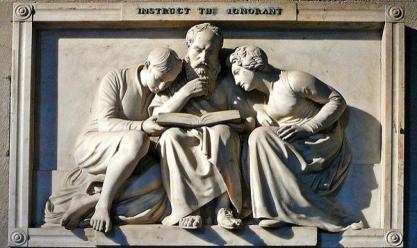
Disdain is as natural to the strong—the “underscrupulous”—as condemnation is the the weak—the overscrupulous.” There is no good single answer to how scrupulous you ought to be. [5] There is, however, a good answer to how you ought to cherish your fellow believers.

Here is where it gets dicey for the strong. First, says Paul to the strong Christians, do no harm. Don’t evaluate your behavior only on whether it is satisfying and without blame; examine it also in terms of what kind of damage it might do to the weak. You have no obligations at all to take on the rationale that the weak must use to justify their behavior, but you do have an obligation to them to refuse to do what will weaken their faith. [6]

How long, O Lord?

There is, of course, no corresponding obligation for the weak. Paul has no notion that the condemnation of the weak will damage the faith of the strong any more than the condemnation of a movie by cultural conservatives will make it less attractive to cultural liberals. The weak get to keep on doing what they are doing and the strong do not. You don’t have to be too farsighted to see that a problem will develop here.

weak 9And I think it should. Paul’s time horizon is very short. He believes that we are living in the very last days of our era, that the return of Jesus is imminent and that, therefore, there is no need to adopt long-term strategies. I have been saying to my class that Paul is a sprint coach and the marathoners don’t know what to make of him.  This is the duty of the strong as they think Paul would see it in the long run.

In the long run, the commitments of “the weak” are problematic not because they are onerous, but because their justifications are thin. If it is true, as Paul says, that there are no other gods, then meat offered to them is not contaminated and anyone with a robust faith—here, that would require a robust justification—should be free to eat it. So if there is a long run, the strong need to get about the job of enriching the understanding of the weak.

The strong believe in principles; the weak believe in practices. If there is to be a long term, let the conversations continue. Let the love of the strong for the weak encompass not only their sharing the deprivations of the weak, but also helping them see that those practices are not really required by any principle they themselves would approve of. These conversations, remember, would continue over meals that have no meat and no wine. The strong are not to put stumbling blocks in the path of the weak. But they have no obligation to leave the weak hostage to groundless superstitions either, so I say let the conversations continue.

I’ve been an educator all my life and I firmly believe that bad justifications are much more toxic that meat and wine could ever be.

[1] These little “headlines” that are being put into modern Bibles and not inspired in the same sense the original text is and sometimes they are just misleading. This is one of those.
[2] And they are, frankly, very Jewish-sounding. The notion of “holiness” as separation, as withdrawal from, as purity, is how much of the Law is defined.
[3] My parents would be angry if they found out or the other members of my group would condemn me if they found out.
[4] At the risk of politicizing this unnecessarily, let me point out that these are the characteristic flaws of the blue culture (Democrats) and the red culture (Republicans)
[5] We get the word from scrupus, a Latin noun referring to a small sharp stone. Cicero imagined the nagging of the conscience as something like having such a stone in your sandal, but if you’ve ever passed a kidney stone, you have a much finer appreciation of what scrupus feels like.
[6] Paul is not interested, contrary to what I learned as a child in a very conservative home, in what will offend others, but in what will cause others to offend—what will be a threat to their faith. This is a much better standard, because when you learn that all you have to do to control my behavior is to say that you find it offensive, I am a goner and I know whereof I speak. Paul’s standard is much better.

Posted in Biblical Studies, Political Psychology | Tagged , , , , , | Leave a comment

Prudence, resilience, and awfulizing

The idea behind pairing these ideas is that the amount of care we exercise in preventing bad outcomes can, under some circumstances, be translated into an unrealistic and ominous assessment of what those outcomes could be.

I have had a lot of opportunity, lately, to prevent bad outcomes.  [1] I get a lot of leeway just for being old.  Failures that in a younger person might be chalked up to lack of effort are passed over because I am old.  I’m not sure that is good for me, but I am sure, as W. S. Gilbert says, that “these attentions are well meant.”  

I am often in settings where I am a customer and customers are notoriously under-criticized.  As an academic, I spent a lot of time in settings where disciplinary rivalries were well established and anything said by a member of the psychology department, for instance, might be objected to, just as a matter of habit, by a member of the sociology department.  But where I live now, I am “an academic” by contrast with the other residents, who were were in business or in other professions.  In this setting, I am granted the kind of space academics are given by people who don’t really appreciate how narrow academic specialties really are.

So, all in all, I am in the very fortunate position of not being criticized very often except by people who really know me.

The downside of being that fortunate is that I have become less adept at dealing with resile 1.jpgdifficult experiences.  I have become, to say it more briefly, less resilient.  I am going to tell about a recent experience in a moment, but before I do that I want to pause to resuscitate the verb “resile,” which really ought to be more popular than it is.

It seems odd, when you stop to think about it, that the adjective resilient is so common and the noun resilience is pretty common, where the verb resile has to be put in quotation marks (as I did in its first use, above) so people will know you said it on purpose. [2]

I had an experience recently that surprised me.  I went out for a medium-sized bike ride after surveying the weather and concluding that it was going to be a day of drippy Portland weather.  I begin this route at the point furthest from home, so when I started, I didn’t have half the route to go; I had the whole route to go.  

And I had no sooner started than it began to rain really hard.  I had several backup plans in place, but as I approached the site of each one, it seemed to me to be not much better than just continuing.  And as I continued past these checkoff points, I began to get the sense that it would be kind of like the old days to just allow myself to get good and soaked (I wasn’t cold) and just finish the route as planned.

resile 6And that is what happened.  I was soaked through by the time I got home and I was feeling absolutely exultant.  I could have felt bad for failing to predict the weather accurately or for failing to use the backup plans, but I didn’t.  I felt really good about getting through it and really paying very little attention to my discomfort.  That part felt really good and it called to my mind a lot of times I had made that choice as a younger man and had felt really good about it.

There is a time, when you are young, when you are curious about just how much you can take.  The goal in that phase is not to prevent the hard knocks but to ignore them.  You just endure them and take the discomforts for granted and draw conclusions about how resilient you are.  A part of this phase is that it happens at a time when you are much less able than you will be later to think through and therefore to prevent, those outcomes, but that isn’t all of it.  Part of it seeks those discomforts as a way of testing just how strong you are, which is something you really need to know when you are young.

So…in this model, you tend to ignore (or undervalue) prudence when you are young and to appreciate (or overvalue) resilience.  When you are old, you tend to overvalue prudence [3] and, as a result, lose your sense of how resilient you can be when it is really called for.

Agency is fundamental

Why does it work that way?  It turns out that one of the most fundamental questions we ask ourselves is, “Why am I doing this?”  “Agency” in the sense I used it above, can be understood as “doing-ness.”

I remember my first look at how powerful this question is.  In a well-known psych experiment, students were given a really boring job to do, then asked to come back later in the week and do it again.  Some of the students were paid to do it the first time and others were not.  When they were asked to come back and do it again, it would be for free.  No one would get paid.  The proportion of students who were not paid the first time and who volunteered to do it the second time was larger. Why?

In the view of the experimenters, the people who were paid the first time said, “Why am I doing this?” and answered, “Because they are paying me.”  So then next time, when there would be no pay for anyone, they asked, very sensibly, “Why would I do that?” and then refused.

But the students who were not paid the first time were in a very different situation.  When they asked, as everyone does, “Why am I doing this?” there wasn’t any obvious answer.  Many of them answered the question, “I must like it.”  That was the answer to the question.  It wasn’t accurate, but it was accepted and it accounted for the larger proportion of these students who volunteered to do it again.

Ever since I read about that experiment, I have had a real appreciation for the power of the question, “Why am I doing this?”  It is a question we can’t stop asking and the answer guides our behavior whether we are aware of it or not.

resile 3I am arguing here that when I exercise excessive prudence [4] I am answering this unavoidable question in a way that affects me.  When I am “excessively careful” about being on time, I am teaching myself that it would be really awful to be late.  When I am excessively careful not to offend anyone, I am teaching myself that it would be really awful if anyone were to take offense at what I am doing.  Or, succinctly, I am “awfulizing.” [5]  I am overstating the seriousness of the consequences of my actions or the seriousness of a threat.

I don’t have the need, as an old man, to find out how tough I am the way I did as an adolescent.  And I have the means, as an old man, to avoid a lot of the difficulties I could not avoid as a young man.  I can avoid having an ill-tempered boss for instance, or having to fight through tiredness to complete my workday, or being hungry (or eating junk-food because I didn’t have time to eat.)  I don’t have to do any of those things now.  And if I think of those as occasions for practicing my resilience, I now have a dearth of those occasions.

As a young man, I treasured the occasions that demanded resilience because I wanted to know if I could resile adequately.  As an old man in very favored circumstances, I am in a good position to avoid those occasions.  And when I do, I teach myself that it would be really really awful to be tired or hungry or  or to have an unreasoning obedience demanded of me.  I take the commonplaces of my youth and I awfulize them.  And because they are so awful I exercise “excessive” levels of prudence to avoid them and in that way, I come to imagine that I have very little resilience.

I look at the strenuous efforts I make to avoid these challenges and I say, “Why am I doing that?”  That is, I argued above, an unavoidable question; everyone asks it whether he or she is aware of it or not.  A common answer to the question is, “Because it would be really awful if that happened.”

And that’s how I lose my resilience.

Resilience is a good thing because it helps you recover from the bad things that happen.  Knowing just how resilient you are is also a good thing because it keeps you from worrying about how you will manage when bad things happen.

And prudence is a good thing.  It keeps you from acting like a young man when you are, resile 2in fact, an old man.  You have less flexibility, less strength, a less effective immune system, poorer vision, and poorer hearing.  You have “positions” you have taken over the course of your life that you are reluctant to change unless there is a good reason, and hardly anyone is left in a position to require that you change them.

It would be foolish to pretend that those things are not true and to take them into account when you decide just what kind of an action will count as “daring.”  On the other hand, trying too little and staying too safe and being too prudent will deprive you of your resilience—you do, after all, have to hit something to “bounce back”—and losing your resilience is a catastrophe.  And losing your awareness that you can bounce back is disabling as well because it pushes you into unnecessarily prudent choices that whatever “muscles” resilience requires will atrophy.

So it turn out that unnecessary “prudence” is not prudent at all.  It leads to awfulizing, which leads to atrophy which leads to life in a very small place.

[1]  In everything that follows, I make an exception for physical difficulties, which are more common among my peers than they are among younger people.

[2]  And not, as all my kids said when they were little, “on accident.”

[3]Here, as is so often the case, the etymology of a word is helpful.English gets prudence from the Latin prudentia, which emphasizes sagacity or practical judgment; but prudentia is a contraction of the Latin providentia, which points us in the direction of seeing (vide-) ahead of time (pro- as a form of pre-)

[4]  There must be, in principle, some “just the right amount” of prudence; not too much and not too little.  The description “excessive prudence” means only that more prudence is exercised than this hypothetical “just the right amount.”

[5]  Awfulizing is a term coined by psychologist Albert Ellis. It refers to an irrational and dramatic thought pattern, characterized by the tendency to overestimate the potential seriousness or negative consequences of events, situations, or perceived threats.

Posted in Getting Old, Living My Life | Tagged , , , , | Leave a comment