
In Portland, Oregon, where I live, there is a section of North Portland called St. Johns. St. Johns is a pleasant bike ride from my neighborhood and my brother, Mark, and I rode up there today with the idea of stopping at Anna Banana’s Café for a sandwich and a beer.
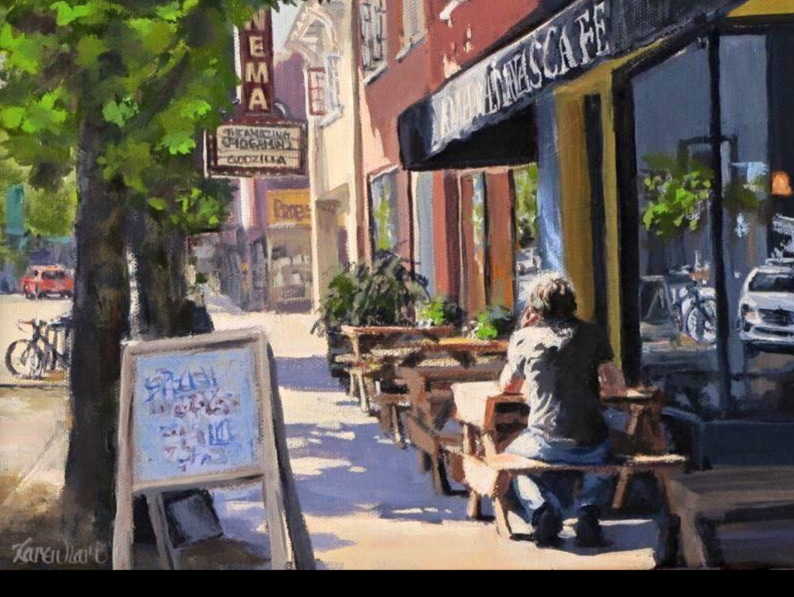 This short essay is in praise of the kind of place it is. It is not an assessment of a restaurant. I would like the kind of place Anna Banana’s is no matter what its business was. This picture is from their website.
Downtown St. Johns is a little bit on the raggedy side, so it made sense to me that the restrooms at Anna’s required keys. There were two restrooms: the slotted spoon restroom and the black spatula restroom. I discovered those names for myself when I went back looking for a restroom and puzzled a little while over the names.
I puzzled first in how the names identified the men’s and women’s restrooms. My attempts to associate “spatula” with some known attribute of men or women failed as did my attempt to associate “slotted spoon” with either, although I did experience a brief flurry of possibility. When everything failed, I noticed that each of them was, in any case, locked, so I went back up front for a key. There they were, hanging on the wall: one key tied to a black spatula and the other to a slotted spoon.
So I took one and opened the restroom and confronted two signs on the wall. It is partly the signs I have in mind when I say that Anna’s is “a kind of place.” Another part is the the people who were doing the cooking and serving seemed like the kind of people who would have wanted signs like these in the restrooms.
Here’s the first sign.
Small art pieces wanted
Instead of graffiti I propose we
collaborate on a gallery of your art or
cast off art. I want the pieces to come
from a place of love, viewable by all ages.
All art must be ok’d by the barista on
duty. Let’s make the bathrooms a more
interesting place.
I like it that in this tacky little sign in a restaurant restroom, there is a goal statement. “Let’s make the bathrooms as more interesting place.” There are lots of bad things that can be said about bathroom graffiti, of course, but “not very interesting” seems to me one of the better ones.
There is to be “a gallery of your art,” which may very well be how the graffiti artists felt about what they had been doing, but now they are invited to do something better. And they are to do so in collaboration with the management. You see that in both “collaborate” and in “Let’s.” Let us make…
The management can’t prevent it anyway. They may own the restrooms, but they can’t control what is done there. Ownership and control are just not the same things in a setting like this and an invitation to collaboration seems a good substitute.
Here’s the second sign, pinned to the wall just below the first.
Please
Do not flush
***********
Paper towels
Tissues and Wipes
Sanitary products
Kittens and Puppies
Hopes and Dreams
****************************
Thank you
This one doesn’t really work the way the first one does. The first few items are standard and there is the temptation to think you know what the rest is going to say. It is true that each line is in a different font and that might keep some part of your mind on the lookout for ambiguities.
Still, it is a big leap from “Sanitary products” to “Kittens and Puppies.” And the background of “don’t flush sanitary products” is not at all like “don’t flush kittens and puppies.” I wasn’t sure how my body had responded to that prospect. But, well before the verdict came in on how I had responded to the demise of the kittens and puppies, I came to the last line. We don’t want you to flush your hopes and dreams here.
The people who posted the sign about making the restroom a more interesting place and who solicit your art are the kind of people who would think you have hopes and dreams and who hope that you treat them kindly. Flushing them down the toilet in the black spatula restroom is not treating them kindly.
So I left Anna’s, having had my sandwich and beer at this table on the sidewalk on a beautiful day after the first half of a very good ride and as the context for an even better conversation with Mark.
I was still happy about it when I got home, so I wrote this. I wish all the people at Anna Banana’s Café well. It’s a very good kind of place and I am looking forward to going back.
 no content would be problematic.
 The similarity between the kind of appeal Egan is using—tribal, primal, vindictive—and the kind he is condemning is very clear to me.
 In this piece, Egan contributes to the degradation of dialogue about crucial public issues.
 evident. I would like to summon up parallel terms, one for offense and one for defense. I am thinking of something like the pair of fouls that occurs so often in basketball when one player runs into another. Was it charging? Was it blocking? Was it a case of really good acting?
 So it is plausible but it is only plausible if you don’t know what an encyclopedia is, which Jed does and Hiram does not. So…why does Hiram not know what an encyclopedia is? Everybody knows what an encyclopedia is.
 These discrepancies may be left over from earlier patterns of use, as where occupational names ended in –man. They may be national stereotypes: Scotsmen (Scotswomen too, I suppose) are stingy, French are sexy, Irish are drunk and rowdy. If you take those not as statements of belief or fact, but as the presuppositions necessary for the “witty remark” to follow, there is no reason to take offense. If you are microdefensive, there is every reason to take offense.
 Upton Sinclair is associated with the saying, “It is difficult to get a man to understand something, when his salary depends on his not understanding it.” That is the kind of connection I have in mind. It is really hard to recognize that you are not offended when there are such advantages to discovering that you are offended. One simply cannot reward the feeling of offense and expect it not to show up more frequently.
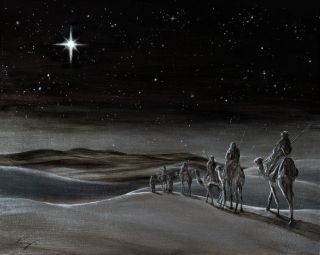 played by Herod and his team of scholars. Why does Matthew have characters like this? How does he prefigure the gospel he is about to write by the stories about Jesus’ birth? I love this picture because it shows the Wise Men following the star to Jerusalem (which they did not do) instead of from Jerusalem to Bethlehem (which they did do).
 My approach, emphasizing the point of the story Matthew is putting together, has not raised at all the question of the spot Herod was in. That’s not what Matthew’s interest was. The journalistic account my strategic friend was using—in what looks to me in retrospect like a judo move— did raise those questions and I have to say, they are really interesting. Just how is it that “the whole of Jerusalem was perturbed?” I never wondered that. How is it that Herod never meets with his own academics and the academics from the East at the same time? Does the general upset of the city affect how he has to play his own cards? This picture has been adapted by my son, Doug, to show how else the Wise Men could have found the house where Joseph and Mary lived. It was the one with the Christmas lights.
 generally used in disparagement. “It should have been a hardball (difficult) question, but instead, it was just a softball (easy) question.” As you can readily see, this gets us into much more difficult territory. In order to know whether it was a “softball question,” we need to know whether it should have been a hardball question.
 We might ask of a question, rather than asking about hardness and velocity, whether it had a useful notion of the causes of the event in question. Holladay Park Plaza is going to have to spend a substantial amount of money replacing its heating and cooling systems. If that was caused by sabotage, we need to know about that; if it was caused by the gradual deterioration of the present system over the last 50+ years, then we need to know that. It isn’t that the sabotage idea is harder and therefore more appropriate, it is that it misattributes the cause. The virtue of the explanation that the system is old and needs to be replaces is not that it is a softball question, and therefore inappropriate, but that it correctly attributes the cause of the problem and sets us up for appropriate action.
 activity?
 These people had had some early contact with Bible teaching.
 One of the people they will need to consult is the local shaman.
 worked like a slave for you,” (as the Elder Brother said) it would be Martha.
 Let’s come at the same question another way.
 fans of Freberg’s humor.
 The Dilettante's Dilemma