
The story of old Eli and young Samuel has been told a lot of times. The story I have always heard is how Samuel learned, finally, to hear God’s voice. It’s a really good story. But lately, I have been noticing what Eli hears.
 Eli can’t hear God speaking to him anymore. He did once. Now he needs help and Samuel provides the help Eli needs. He doesn’t know he is doing that. Samuel is innocent entirely of God’s plan for Eli, but he helps Eli to hear God by doing all the things he is supposed to do. It’ a sobering thought.
Let’s look at it from God’s point of view. How do you get a message to Eli when Eli has stopped listening? Answer: you call Samuel. I chose this picture because Eli looks really irked and Samuel looks clueless.
Samuel has no idea what is going on. He hears his name being called and there are only two of them there, so he knows it is Eli calling. So he runs to Eli to see what he wants. Eli has no idea yet what is going on, but he is sure that he did not call Samuel and he tells Samuel that. Samuel doesn’t know how to understand what Eli is telling him—might not believe it either—but he goes back to bed as Eli has told him to do.
Note the difference at this point between understanding what is going on and doing what you are supposed to do.
Samuel goes back to sleep and hears his name being called again. Since it can only be Eli, he goes back to see Eli and gets the same answer. Eli might be puzzling a little about why Samuel keeps hearing his name being called, but he is way past doing anything about it. Only being wakened again and again out of a sound sleep by a very obedient little boy is going to raise that question in his mind.
The discrepancy between what Samuel thinks is going on and what Eli suspects is going on has now gotten sharp. Eli now needs another explanation for why his servant keeps coming up and waking him. This is a big deal. He has lived for many years without stumbling on this discrepancy. It is the equivalent of the harassment tactic of phoning a victim’s number every hour all night. At some point, the victim will say, “Who are you and what do you want.”
Samuel knows that only he and Eli are there. That’s how he knows who is calling him. But Eli knows—now that he has been forced to consider it—that there are three there: Eli knows Yahweh is there as well. Samuel does not know that. That means that if Samuel keeps getting called and Eli knows he is not doing the calling, it is God.
It has been a long time since Eli has heard anything from God. He has learned how not to hear God. If spiritual sensitivity could be compared to wearing hearing aids, Eli has taken his hearing aids out. He is slowly dying and everything is fine, but he can’t keep Samuel from waking him up and, eventually, he can’t help noticing what is going on.
God’s project of contacting Eli is now half done. Eli is paying attention. So God tells Samuel everything Samuel needs to hear, including a bunch of really nasty stuff about Eli. The next step is for Samuel to break the bad news to Eli and he doesn’t want to.
But Eli has been awakened now, and from a much more substantial sleep that the one Samuel kept interrupting; he understands, now, that the little boy is not going to want to tell him the bad stuff. So he instructs Samuel very directly to tell him all the bad stuff and Samuel does.
17Eli asked, ‘What message did he give you? Please do not hide it from me. May God bring unnameable ills on you and worse ones, too if you hide from me anything of what he said to you.’ 18Samuel then told him everything, hiding nothing from him. Eli said, ‘He is Yahweh; let him do what he thinks good.’
As I was reading over this familiar story and seeing if from another angle, I remembered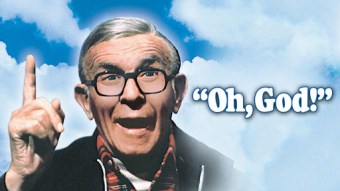 a very bad movie about God. It is Oh, God, with George Burns playing God. He wants to get a message to Jerry Landers (John Denver), who doesn’t believe in God in any way practical enough to allow God to give instructions. God gives Jerry a written note inviting him to come and see Him. Jerry wades it up and throws it away. The next day, that note is in the outer leaves of a head of lettuce. Jerry wads it up and throws it away. Then it shows up on his pillow that night.
Jerry still doesn’t believe in God, but he wants his life back with the same intensity with which Eli wants his night’s sleep back. So he goes to the place where God is and hears what God wants to tell him and is forever changed.
You can see why the story of Eli reminded me of the story of Jerry. But in Oh God, the role of Samuel is played by a piece of paper that magically reappears over and over until Jerry gets tired of throwing it away. If you don’t have a magic piece of paper, you will need someone like Samuel.
Who’s like Samuel?
Samuel is, in this story, God’s catalyst. He has no idea what is going on, but he does his job. He is, in that one sense, inert. God knows what is going on and Eli once knew what was going on, but Samuel does not. Samuel knows his duty and he does his duty and in that way, God is able to get Eli’s attention without using a magically reappearing piece of paper.
I look around, sometimes, for what I think of as “meaningful work.” By that, I mean work that means something to me. I’m not sure I have the patience to do the catalytic work Samuel was called to do.
 newly elected State Representative (House District #1 in Oregon) [1] He thought I was politically naive (which was certainly true, although not in the way he thought) so he would bring me into the office from time to time and ask me a question. I thought it felt a good bit like a catechism. The question was, “What is a good idea?” The correct answer was, “Sixteen and 31.” [2] So, roughly, if you can sell it to a majority, it’s a good idea. [3]
 People who like more “meat” [6] will wonder why they should shift from a menu they like to a menu they do not like. That seems to me a reasonable question. There is a good tight relationship between the preferences of the resident carnivores and their meal choices. They like to eat meat and so they choose meat dishes from the menu. The counterargument, that they really should have different preferences than the ones they do have, will sound faint to their ears and if it persists, it will become annoying. Doing what you like to do—provided that it is not illegal, immoral, or fattening—is your right.
 So neither rationale—neither do the right thing nor do what you want to do—is going to work here. What works, instead, is an approach toCommon Pool Resources (CPR), such as Elinor Ostrom considers in her 1990 book, Governing the Commons: The Evolution of Institutions for Collective Action. . In Törbel, Switzerland, for instance they live with the possibility of private overgrazing at public cost and they deal with it. How? First, they inculcate the attitudes that will make voluntary compliance the normal thing. [7] Second, they rely on all the members of the association to monitor and report infractions. The association also hires people to monitor infractions, but they are not expected to do all the work, only to supplement the work the residents do. Third, they punish violators with both disapproval of their neighbors and with financial penalties.
 forthrightly what she considered desirable in a future race.[1] It was easy enough to see that the children of Tekla were going to be strong, disciplined, formidable fighters. And one did not have to be a military genius to understand that fighting, for the foreseeable future—several millennia of being bottled up in space colonies—was going to be up close and personal.
 You will see the names Tekla and Aida.
 thought of as modern day products of Old Earth’s Neanderthals, both of their physiology and their culture.
 good deal more than I had ever wanted to know about clan governance. Clans cohere around the leader. Until, of course, someone kills him and takes over, at which point they cohere around the new leader. “The law of the clan” is a fiction for the same reason the “law of the mob” was fiction in Chicago when it was being run by Al Capone. These are “leader-driven” not “law-driven” societies.

 It is easy to be critical of these choices of crucial virtues and/or of the choice to attach a fragment of scripture to each of them and/or of the particular scripture that is chosen.
 This short essay is in praise of the kind of place it is.
  no content would be problematic.
 The similarity between the kind of appeal Egan is using—tribal, primal, vindictive—and the kind he is condemning is very clear to me.
 In this piece, Egan contributes to the degradation of dialogue about crucial public issues.
 evident. I would like to summon up parallel terms, one for offense and one for defense. I am thinking of something like the pair of fouls that occurs so often in basketball when one player runs into another. Was it charging? Was it blocking? Was it a case of really good acting?
 So it is plausible but it is only plausible if you don’t know what an encyclopedia is, which Jed does and Hiram does not. So…why does Hiram not know what an encyclopedia is? Everybody knows what an encyclopedia is.
 These discrepancies may be left over from earlier patterns of use, as where occupational names ended in –man. They may be national stereotypes: Scotsmen (Scotswomen too, I suppose) are stingy, French are sexy, Irish are drunk and rowdy. If you take those not as statements of belief or fact, but as the presuppositions necessary for the “witty remark” to follow, there is no reason to take offense. If you are microdefensive, there is every reason to take offense.
 Upton Sinclair is associated with the saying, “It is difficult to get a man to understand something, when his salary depends on his not understanding it.” That is the kind of connection I have in mind. It is really hard to recognize that you are not offended when there are such advantages to discovering that you are offended. One simply cannot reward the feeling of offense and expect it not to show up more frequently.
 played by Herod and his team of scholars. Why does Matthew have characters like this? How does he prefigure the gospel he is about to write by the stories about Jesus’ birth? I love this picture because it shows the Wise Men following the star to Jerusalem (which they did not do) instead of from Jerusalem to Bethlehem (which they did do).
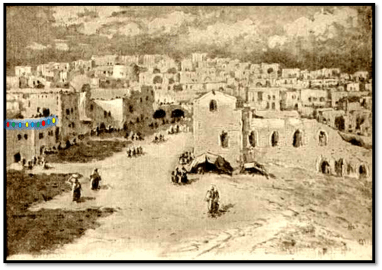 My approach, emphasizing the point of the story Matthew is putting together, has not raised at all the question of the spot Herod was in. That’s not what Matthew’s interest was. The journalistic account my strategic friend was using—in what looks to me in retrospect like a judo move— did raise those questions and I have to say, they are really interesting. Just how is it that “the whole of Jerusalem was perturbed?” I never wondered that. How is it that Herod never meets with his own academics and the academics from the East at the same time? Does the general upset of the city affect how he has to play his own cards? This picture has been adapted by my son, Doug, to show how else the Wise Men could have found the house where Joseph and Mary lived. It was the one with the Christmas lights.
