
There are some things novelist Neal Stephenson just does better than anyone else. This post is about two of them. The first is that he builds these thick amazingly dense alternative worlds—worlds with their own history and people and languages. In support of that I am going to give you a one-step-as-a-time introduction to what a “mobe” is.
I am going to give you the first line of this passage (“So I looked with fascination at those people in their mobes…”) and then just take you step by step through the other words that are required. These are not particularly important words, but they are, as you see, interlinked. Each one requires the next one.
[a wheeled passenger vehicle used extramuros] [extramuros: the world outside the walls of the Math; the Saecular world.] [Math: a relatively small community of avout] [Avout: A person sworn to the Cartasian Discipline and therefore dwelling in the Mathic, rather than the Saecular world] [Cartasian Discipline: The set of rules prescribed by Saunt Cartas] [Saunt: A title bestowed on great thinkers, thought to be a contraction of “Savant.”]
The second of the great gifts of Neal Stephenson is that no matter how far away he gets 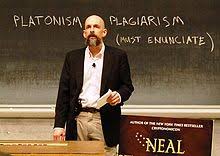 from “our time and our place” (or even our planet), what he has to say about people and the habits and agreements that bind them into societies are amazingly insightful. I won’t go on about that because the next section illustrates it. The next section is the reason I wrote this essay. I put the contrasting poles of the argument in bold font.
Thousands of years ago, the work that people did had been broken down into jobs that were the same every day, in organizations where people were interchangeable parts. All of the story had been bled out of their lives. That was how it had to be; it was how you got a productive economy. But it would be easy to see a will at work behind this: not exactly an evil will, but a selfish will. The people who’d made the system thus were jealous, not of money and not of power but of story. If their employees came home at day’s end with interesting stories to tell, it meant that something had gone wrong: a blackout, a strike, a spree killing. The Powers That Be would not suffer others to be in stories of their own unless they were fake stories that had been made up to motivate them. People who couldn’t live without story had been driven into the concents… All others had to look somewhere outside of work for a feeling that they were part of a story, which I guessed was why Saeculars were so concerned with sports, and with religion. How else could you see yourself as part of an adventure? Something with a beginning, middle, and end in which you played a significant part? We avout had it ready-made because we were a part of this project of learning new things. Even if it didn’t always move fast enough for people like Jesry, it did move. You could tell where you were and what you were doing in that story. [1]
So…what is this? This is speculation by Fraa Erasmus. He has lived in a Math—like a monk—since he was 10. He was “collected,” as they say and has received a superb education since then. But now he is on a mission and the mission has taken him back to the Saecular world and it seems strange to him.
These people are the victims of “the Powers that Be.” The “powers that be,” as Erasmus thinks of them, are “the people who had made the system.” They were jealous of story—of the power of story. “If their employees came home,” Erasmus says, “with interesting stories to tell, it meant that something has gone wrong.”
 That is a stark assessment and it might be wrong. Erasmus is 19 and has lived the life of the separated scholarly world for a long time. On the other hand, he does give this as the other side of the coin in the second passage in bold font.
We avout had it ready-made because we were a part of this project of learning new things. Even if it didn’t always move fast enough for people like Jesry, it did move. You could tell where you were and what you were doing in that story
The “it” in “had it ready made” refers to a sense of being part of an adventure. The project is “learning new things.” As part of that project, you could tell “where you were and what you were doing.” It is the very opposite of “having all the story bled out of you.”
So Erasmus is reflecting on the difference between his world and—to be candid—our world. What is “our world” like as Erasmus sees it? Here are three points. The first is the nature of the jobs we do and about them, Erasmus says pretty much what Karl Marx said. The jobs have been “rationalized,” not from the standpoint of the person doing the job, but from the standpoint of the organization. [2] There is a sense to the division of labor and the repetitive nature of work, but is not a sense made at the individual level. It is not “sensible” to people.
The worker who is living his or her life like this has no sense of being “part of a story.” The story could be told at the level of the market or at the level of the organization, but not at the level of the individual..
The second point is that people really can’t live with knowing what story they are part of and what part they play. This is taken care of, in Erasmus’s view in that stories are provided for them. There are two kinds us such stories. There are “fake stories that had been made up to motivate them” and there are the general categories of “sports and religion.” If I had been making the list, I would have put politics in there, too. Particularly the toxic current version often called “identity politics.”
In Erasmus’s view, the first kind are provided by “the powers that be.” [4] They are stories that are completely controlled and that have no genuine place in the lives of the people who are asked to invest in them. The “sports and religion” stories are allowed by the elites but are fantasies so far as locating and confirming the role played by individual people.
The third point is that these stories, as intense as they are sometimes, are small. They are not stories larger than you; stories of which you are a part. No, these are all small intense bursts of story—the Cubs finally won the Series!—that take up your time and give you stimulation without meaning.
To clarify that last point, let’s look again at Erasmus’s characterization of the meaningful life the avout live in the Mathic world.
We avout had it ready-made because we were a part of this project of learning new things. Even if it didn’t always move fast enough for people like Jesry, it did move. You could tell where you were and what you were doing in that story.
People like Erasmus were “part of the project” This project continues to move. Not as fast as you would like (Jesry is a genius friend of Erasmus) but still it moves. And the nature of your participation in this project is such that you can tell where you are and what kind of contribution you are making to it. As poor as the avout are and as separated as they are from the (Saecular) world of overconsumption and hyperactivity, still they have this. There is a huge project stretching over many centuries and they are part of this during their own lifetimes.
It is that, down at the root, that Erasmus contrasts with having no story of your own to tell. I think he is right.
[1] Anathem, page 434-435
[2] The organization, in a society responsive to the needs of the market, also plays the role it must play. Erasmus might not have known that, but Marx did.
[3] It might be worth saying that Erasmus has no notion at all of how the elites of the Saecular World actually work. Stephenson very wisely gives Erasmus an inexact and ambiguous way of speaking about then because he knows nothing. But Stephenson knows that Erasmus is about to find out a great deal about it.
[4] To “make progress,” I would say, without specifying just yow “progress” is different from “change.”





 So let’s return to Orolo’s axiom, considering frustration as an event; it is the failure to achieve something you were trying to achieve.
 are entirely taken up with the strategy and tactics of achieving a particular goal, it is hard to consider at the same time whether it is a viable goal. Persistent frustration of your efforts (failure to achieve the goal) is an excellent time to consider whether is a good goal for you to have.
 Then the headline writers took over and we got this: Debunking Three Viral Falsehoods about Kamala Harris. Note that these are “viral falsehoods.” [2] The falsehoods are viral. And I thought, as I once thought about the fun party, “Wow! That happened fast.”
 have been allegorized on the spot, especially by Mark and Matthew. You hear a suggestive phrase and it blossoms almost immediately into an allegory where each part of the story represents some identifiable part of the real world.
 Hell! Or, more properly, “Retreat? Hell…” The rest of the line in “We’re just attacking in another direction.”
 Dr. Birx was criticized by Crazy Nancy Pelosi.” Speaker Pelosi is one of the least crazy people on the American political scene. She is inconvenient at times and she is quite forceful. She would be crazy not to be.
 picture—you know he is not going to do what he was asked to do. How do you know that? Because there is nothing on the teleprompter. What’s a teleprompter? Well…do you see how Santos’ face is (nearly) framed by a window. It is extremely significant that there is nothing on the window. To understand how important that is, you need to know what is supposed to be on the window. Santos’ speech withdrawing from the race is supposed to be there.
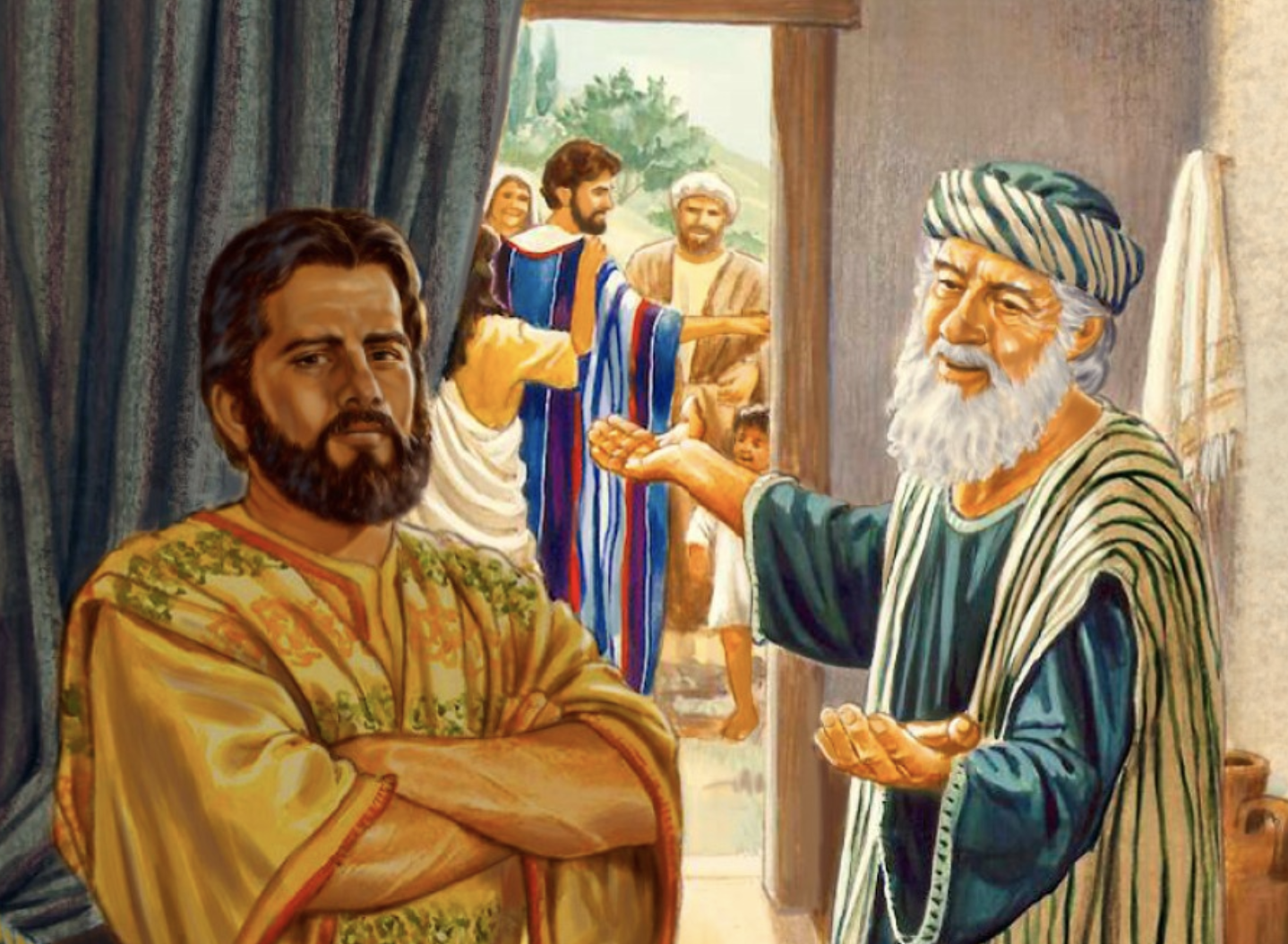 You see, Jesus adapted the parables he told based on the conventions of parable-telling. He devised these conventions by listening to parables his whole childhood and early adulthood. He liked some and didn’t like others. He saw possibilities in some that others had not seen or had not used. He didn’t start off in Mark 4 by explaining what a parable was; he began by using an established form—a popular, rather than a scholarly form—to preach to the crowds.[3]
 A says, in other words, “We need to do something about the callous treatment of black protesters.” B says, “Let’s talk about why you want place before the neighborhood the claim that you are a virtuous person.” A says, “Let’s talk about a public crisis.” B says, “No, let’s talk about a private motive.”
 I have lived in a society where other things were prized, however. Take purity in purchasing foods, for instance. You could be “righteous” for purchasing only virtuous goods. [3] You could be righteous by purchasing virtuous goods from virtuous stores. You could be righteous by investigating the conditions under which the food was produced and by buying only foods produced without the exploitation of workers. You could be righteous by buying food only from companies who use their profits in ways you approve.
 The Dilettante's Dilemma