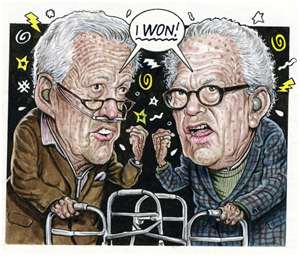
I want to poke just a little today at the way John and Bonnie Gray illustrate what communication between a husband and a wife ought to look like. John Gray is the founder of the now vast Mars/Venus industries: books, seminars, websites, and so on. Bonnie is John’s wife and in his books, she needs to act in ways that allow him to model how husbands should respond when their wives seem petulant and unreasonable. So whatever Bonnie Gray is actually like, in the books, she needs to seem petulant and unreasonable. It’s a nasty job, but somebody’s got to do it. Here they are in much earlier days, before all the ducking and dodging and pausing and preparing.

Just a note here to clarify my position on the Mars & Venus books. I disagree with nearly everything in them, with one exception. It’s a very important exception. When I do what John Gray says to do, everything works out really well. I think his characterizations of male and female roles are stereotyped and rigid. I think his historical grounding for those roles is preposterous. Early man had to learn to “duck and dodge” his enemies in battle, for instance, so it should come naturally for a husband to “duck and dodge” his wife’s unreasonable tongue-lashing. Oh, please!
On the other hand, it is not a small service he provides if, as has been my experience, doing what he says to do makes everything better. And even if I value him only for that, I value him very greatly.
In this post, I want to look at what John Gray is supposed to do—what his job is—and at what Bonnie Gray is supposed to do. If John does what he is supposed to do, nearly anything Bonnie does will work out. If Bonnie does what she is supposed to do, it will make it much easier for John to respond to her. In that sense, there is symmetry to their roles. But only in that sense.
It can’t be all that much fun to be Bonnie Gray, the wife of John Gray, the founding genius of the Mars/Venus industry. John Gray uses his interactions with Bonnie mostly to provide instructions to men about how to deal with wives who seem petulant and unreasonable. For that reason, Bonnie Gray, as she appears in the Mars/Venus books, comes off as petulant and unreasonable.
Here is a little clip from Mars and Venus Together Forever: Relationship Skills for Lasting Love.[1] This was written to illustrate how John did what needed to be done—and so should we all, guys—and so resolved the crisis. John tells her he was going to buy a new computer. I’m adding his comments here, although they tend to excuse his choices, because he is trying to illustrate what “doing it right” looks like and he is being the example for us all.
Bonnie: Why do you need to buy a new computer (she demanded)? You already have one.
John: Well, for lots of reasons. (He says he didn’t like being questioned, but by saying as little as this, he was able to prevent clashing with her)
Bonnie: What’s wrong with the computer you already have? (She persisted).
John: You seem upset. (He “observes” this, after a pause.)
Bonnie: Have you researched the market? How much is this computer going to cost? (She persisted, not answering my question.)
The next four exchanges are presented as a block. He says he is ducking and dodging, continuing to hold back and not retaliate, but he is aware that he can take only so much more. I will just present Bonnie’s four responses because she is the one who gets my sympathy today.
One. Well I AM upset. Whenever you want something, you just go out and get it. I don’t know why you have to get another computer. Yours works fine. If we are going to spend money, there are other things we could spend it on.
Two. It’s not like I have all this thought out (He asked what she thought they should spend the money on). It’s just a feeling. I feel like you get what you want and I get seconds. Maybe I am mad that you want so much more than me. When I want something, it doesn’t seem so important.
Three. I don’t know. (He asked her what she wanted to buy.) But it feels like everything we do is for you and not me. We always do what you want to do and you always get your way. I’m afraid I will not get what I want.
Four. We have been waiting six months to redo our floor. Our couch needs to be recovered. I still need a kitchen cupboard. There are so many things we need to spend money on in the house and you are buying a computer. It just feels like you don’t care about me. You are going to buy what you want and that’s it. What I have to say doesn’t matter at all.”
Here is the resolution of the computer argument above.
John: I really want to understand your feelings and it really is hard for me. It’s starting to sound like you’re saying I’m this selfish person. Don’t I do anything nice?
Bonnie: Of course you do. I don’t mean to upset you. I just have a lot of feelings coming up. I really appreciate you trying to listen. Just the fact that I could talk about my feelings without you getting upset with me makes me feel so loved.
So that’s how this round ends with a woman like Bonnie. The problem is that she has feelings that prevent her from having a fact-based conversation about the computer and other household needs. The solution is that John ducks and dodges long enough (he was getting close to the edge there at the end) that Bonnie gets the feelings out; she appreciates his listening to her; the emotional relationship is restored; and, eventually, the household purchases will be decided upon.
Now let’s look at what Bonnie Gray’s responsibilities are. Since John’s responsibility is to “duck and dodge,” you will not be surprised to learn that Bonnie’s are to “pause and prepare.” Women come naturally to this role because while the caveman husband was off fighting enemies—that’s where the ducking and dodging came from, remember—the cavewoman is home preparing. Gray runs through things women prepare for: meals, children, their appearance, relationship, and so on
Women need to pause when they feel themselves cranking up the grievance machine. So Bonnie need not respond by saying “You’re not listening” or “You just don’t understand.” She can say, “Let me try saying that in a different way.” That is pausing. It gives John a chance to remember that he’s supposed to be listening to her feelings, not solving her problems.
“Preparing” comes next. Bonnie says, “I have a lot of feelings coming up, and I would like to talk about them. I just want you to know in advance that it sounds worse than it is. I just need to talk for a while and feel that you care.” In saying that, Bonnie not only prepares John for the ducking and dodging he is going to have to do, but also apologizes in advance for whatever she may say that is offensive or mean-spirited. This approach asks his patience as a favor to her and promises that the barrage will be as brief as can be, still allowing time for the feelings to be expressed.
That’s what she should have done in the “buying the computer” scenario. Asking for his patience (her job) and listening receptively to whatever feelings she has (his job) are both collegial acts. It could look adversarial to a bystander, but it really isn’t. Bonnie needs to say how she feels and it isn’t going to be pretty. She engages her husband as a helper and a hearer and promises her gratitude for his work when she is done. John ducks and dodges while she unloads her feelings, then initiates reconciliation when the time is right.
“It could look adversarial to a bystander,” I said. I was the bystander I had in mind and I really would not like to see that transaction, much less to be on the receiving end of Bonnie’s anger. As a bystander, I ask the kinds of questions I am going to look at in the next post in this series. I ask questions like, “Is it really fair that I have to put up with this kind of abuse over and over?” I ask, “Is this really the best she can do?” I ask, “Is it always going to be like this.”
In the next post, I am going to show you what happens when I actually act on those sentiments, rather than just asking them abstractly. I have actually done that. I did it for years. It was ugly and I am glad I don’t do it anymore. And so is Bette, although if I did let it slip and act like that, she would say, “That’s not like you at all.” Little does she know.
[1] I MUCH prefer the earlier title of this book: What Your Mother Couldn’t Tell You and Your Father Didn’t Know. His point in this book is that we don’t know what we need to know because our parents didn’t tell us and they didn’t tell us because we are living a life that would have mystified them entirely.