TMI

I want to think out loud about TMI today—“too much information.”[1]  I think we do give too much information sometimes, but I suspect that most of the time that particular way of saying “Shut up!” really means something else.  This post will speculate about what else it might mean.

I had a conversation with a friend recently in which TMI came up.  I’m going to place attribute his comments to Steve, an entirely fictional creation.  Steve is married to Martha, also fictional.  I just give them the traits I want to talk about on any given day.  It provides me with a source of good examples and they don’t seem to mind.

So Steve was thinking that he had gotten painted into a corner.  He tends to speak abstractly so a lot of the time illustrations are needed.  Martha asks for illustrations because she doesn’t understand, or isn’t sure she understands, what he is saying.  Steve sets about providing the examples Martha asks for.  At which point, she clubs him with “TMI.”

Steve speaks abstractly to me too, but I really haven’t had this difficulty with him.  I ask for examples and he gives examples.  After each one, I check to see if I have a concrete enough grasp of what he is saying.  If I do, we go on; if I don’t he gives more examples.

That doesn’t seem to work with Martha, but then this question of how much information is “enough” is harder when a conflict has already begun.  The presence of conflict made me wonder if it isn’t a lack of specificity that is bothering Martha.  Martha has a concern.  Let’s say that the concern is about whether a trip they are considering is really safe.  Steve’s answers—each and every one of them—have to do with how exciting the trip will be.  He has friends who took this trip and really loved it.  He names the friends; he names the various destinations; he tells the stories they told when they got back.  He goes on and on until finally Martha stops him—and the conversation—with the TMI club.

What is happening here—or rather, the part of what is happening here that I want to look at today—is that Steve is providing lots of information but none of it bears on Martha’s concern.  Martha may have tried and failed to get Steve to address the concerns she actually has.  It is her frustration speaking when she says TMI.

My experience says that if you don’t know what they really care about, you can waste a lot of words and give yourself a frustration headache.  When you do know what they really care about—sometimes I have taken the time to find out and sometimes not—it doesn’t take many words at all.  Not many examples; not much “clarification;” not much “explanation.”  I don’t know why it is hard, sometimes, to find this out, but I have come to the conclusion that time spend finding it out is better spent than is time piling up examples that you think are going to be relevant but aren’t.

I know that some people are just better at this than others are.  I know that I am not very good at it, that I am better at it than I used to be, and that I can do it pretty well if I remember how important it is.  In any case, it is something I value a good deal in others.

Which brings me to a first date story.  Bette and I met first for coffee at Starbucks.  I’m not calling that our first date.  That was a meeting so we could decide if each of us wanted a first date.  Our actual first date was a movie.  After the movie, we wandered around the mall and I asked Bette if I could take some pictures of her.  She said, “Sure.”[2]

So I took a few.  Nothing seemed problematic.  Then I thought of a picture of her I thought I would like to have.  This is the picture.  But getting here wasn’t easy.  The table was too high for her to sit like this.  I couldn’t figure out just how her arms should be so that her hands could be the way they are in the picture—and her chin on her hands like this was really the only part of the picture that had been clear to me.

Then a really really nice thing happened.  Bette said, “Oh.  I think I see what you’re getting at.”  And they she arranged herself exactly into the picture I had imagined and I took it and went home a very happy guy.  Bette had been able to put herself in my place and to see herself the way I was seeing her.  Based on that, she made a reasonable guess about what I was really looking for.  It was a very good guess, it turned out, but what really flipped my switch was that she tried.

I’m passing this story along partly because I like it, but I also think it is at the heart of the TMI problem.  I really think that if Steve took the time to put himself in Martha’s place, he would see what was needed.  It might be information, but it might not.  It might be reassurance.  It might be freely granted time to consider the idea.  Note: “grudgingly granted” time doesn’t work as well.  It might be conveying an understanding that Martha’s concerns are entirely reasonable.

Steve and Martha are just going to have to work it out, but when I think of their difficulty, it reminds me of this date and the great pleasure I took in Bette’s willingness to put herself in my place and help me figure out what I was asking.


[1] If you are my age, it is easy to see it as Three Mile Island, which was more destructive, sure, but this feels worse if you are involved in it yourself.

[2] Bette was my last date.  I haven’t dated anyone since I started dating her.  And no one, either, since I married her.  But my first date—the first of the series that ended with Bette—was six months before that.  Also a movie date.  I asked if I could take a picture and my date looked at me suspiciously and said, “Why would you want to do that?”  She went on at some length to describe what she feared: her picture was going to wind up on a wall along with the pictures of a lot of other women I had dated and she would feel so demeaned to have her picture in such a collection.

Posted in Love and Marriage | Tagged , , | Leave a comment

“Attractive Older Women”

Somehow, I have gotten a reputation for being narrow-minded.  Even some of my friends think that.  Of course, I don’t think so.  I do have some liabilities—well, THOSE, sure, but I was thinking of something relevant to today’s topic—and it has to do with rationales.  I’m not all that picky about positions on issues or personal opinions or “social wisdom.”  It’s the rationales that are more likely to bother me.  I have also learned that most people are more accustomed to being upset about positions taken than about rationales abused.  So when I say it is the rationale that bothers me, I get eye-rolling and incredulity.

It is experiences like that that helped me decide to write this column. Here’s the article.  The rationale that caught my attention is this one.  And here’s an example of what I would call “an attractive older woman.”

Ms. Kolstad asked herself much the same question.[1]

 “In my day, no one ever thought about breast enhancement or anything,” she said. “But nowadays women go out and they would never get a second look if they show their age. I find that you have to keep up your appearance physically, even if you just want a companion or someone to ask you to dinner.

“That’s not going to happen if you don’t have a figure that these geezers are looking for.”

So here is Ms. Kolstad’s position, as I understand it.  She wants to get that “second look.”  This is that “Say, she looks really good!” look that she attributes to older men and whatever comments among the men that would follow such a look.  Without the kind of appearance that would cause men to look at her that way, you don’t have “a companion or someone to ask you to dinner.”  She is more specific too.  She wants the “figure that these geezers are looking for.”

To get this geezer-friendly figure, “Ms. Kolstad, a widow who lives in Orange County, Calif., underwent a three-hour breast lift with implants, which costs about $8,000.”  So I’m guessing that Ms. Kolstad is a good example of the sexy old women of my title.

Let me clarify  a couple of points, I am not arguing that Ms. Kolstad is not entitled to do with her $8000 whatever she wants to do.  I’m not very happy about the amount of money our healthcare system spends on the appearance of the wealthy when basic medical care is unavailable to so many of the poor, but everyone knows that that distribution of healthcare is not going to be affected in the slightest by Ms. Kolstad’s preferences about the precise latitude of her breasts.

I’m not arguing that women who want to be sexually attractive to men—Kolstad’s notion is that “sexually attractive” is the gateway condition to all kinds of less volatile associations with men, like companionship and dinner dates—ought not do what they can to look the way “men” find sexually attractive.  If that’s what she wants and she understands what kind of a transaction it is and has the raw materials, why shouldn’t she?

I did wonder a couple of things, though.  Whatever happened to the category “attractive older woman?”  Did it just disappear?  Is it really true now that to be an attractive older woman you have to look like an attractive younger woman?  Do a lot of older men and woman feel that way or it is just the geezers Ms. Kolstad is thinking of?

As I said, I don’t care all that much how Ms. Kolstad wants to live her life, but if you read the article, you will see that there is an explosion in the number of older patients who want cosmetic surgery.  If this is being driven by considerations like Ms. Kolstad’s, then a lot of the traits that were once thought to characterize a life well led have been downgraded.[2]  Living a long time in Earth’s gravity has a certain predictable effect on what a mature body looks like.  So does extended exposure to ultraviolet rays.  So does the decline of hormones that were once crucially necessary.  And so on.  Do we really want to think that a predictable stage in being an attractive older woman is having a boob job?

I guess one of the things that bothers me about that is that Mr. Kolstad’s rationale lumps me with the geezers who, you know, only want one thing.  Well, maybe two.

Another part of this is the effect on all the other categories of women.  The other categories don’t just hold still.  If a good-looking 83-year-old woman needs breast surgery to be invited to dinner, what will be said about the women who don’t have that surgery?  Will we say that “they are just letting themselves go?”  Will we say that “they used to take real pride in their appearance?”  Will we think that the biggest reason not to have the surgery is a lack of self-esteem?

Here’s what we know.  When a new category is valued, the other related categories are devalued so as to enhance the discrepancy.  This is normal social attribution.  It doesn’t take the spending the cosmetic surgery industry has put into it to make it happen.

I have no quarrel with “attractiveness” in women.  I have no quarrel with “older women.”  I have no quarrel with the kinds of changes that living many years under Earth conditions cause.  I just don’t like to have her values generalized among the older women of my acquaintance and I don’t want to be consigned to the geezers.


[1] The same question Nancy Etcoff has asked in the previous paragraph.“If an older woman wants to regain eyelids or wants a breast that she doesn’t have to tuck into a waistband, then why not?”   Etcoff is the author of The Survival of the Prettiest, which is the only book my book group ever chose on my recommendation and then refused to read because of their moral distaste for the topic.  It is a superb book, by the way.  The range of reported research is really amazing.

[2] Nothing against attractive older women, by the way.  I married one of those a few years ago myself.

Posted in Political Psychology | Leave a comment

Words with clean sharp edges

I don’t usually have any trouble telling when a particular usage is wrong.  Sometimes when I try to say just what is wrong about it, it takes longer.  But then when I try to think why is it really harmful to the language—I have a tender brotherly love of the English language—I run into difficulties.  I have a case in mind and I will get to it shortly.

I know what’s wrong with “very unique.”  Unique is an endpoint word; a polar word.  It means “unprecedented” or “one of a kind,” depending on whether you want to approach it temporally or structurally.  Imagining that unique is on a sliding scale of some kind so that it could be “more” or “less” destroys the contribution it makes to the language.

I’ve been bothered lately by the warnings at the beginning of movies or previews that parental guidance is suggested because of “mild language.”  When I was young, I was taught that mild language was a good thing in most circumstances.  I was told that “a soft answer turneth away wrath,” and I infer from the Elizabethan form of the verb, that it is a quotation from the King James Bible.  The truth is that sometimes it does and sometimes it doesn’t, but that’s pretty good for wisdom literature, I think.  I suppose that “mild language” is a truncated form of “mildly offensive language,” meaning that it will offend some but not others or that it will not offend anyone very much.

That’s a good thing to know.  I’m happy to have that little warning.  It does have the effect of transposing language into a setting where it is like a disease or a disability.  Like “a mild sprain,” for instance.  You could argue that there is no harm done because no one mistakes “mild language” for anything other than a warning, but that’s what they said about “tax relief,” and tax relief has the not at all benign effect of casting “taxes” as the kind of thing from which we ought to have relief, as it if were stomach acid.  Taxes, as Oliver Wendell Holmes said, are “the price we pay for civilization.”  They are not like stomach acid.

This morning’s New York Times rubbed that little tender spot in my neocortex where my affection for thoughtful language use is located.  Here’s the quote.  Achal Prabhala is an adviser to the Wikimedia Foundation.  He would like to see other kinds of references serve the function that only authoritative citations now serve.

“There is this desire to grow Wikipedia in parts of the world,” he said, adding that “if we don’t have a more generous and expansive citation policy, the current one will prove to be a massive roadblock that you literally can’t get past. There is a very finite amount of citable material, which means a very finite number of articles, and there will be no more.”


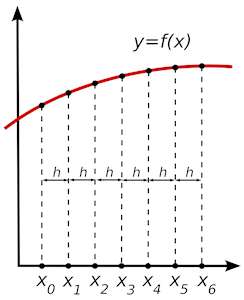
What does a statement like that mean for finite? [this image is called “finite differences;” I don’t know why.]  I have always understood that infinite is a polar term like unique.  There is that final node on the scale—the very end of it—and then there is everything else.  There is “not finite” at the very end and then the entire rest of the scale means “finite.”  You could say it isn’t a scale at all: it’s like an off/on switch.  Things are either finite or they are not but nothing is “very finite.”

What’s the harm?  It’s hard to say.  I haven’t adjusted yet to “limited income” to mean “low income.”  Limited income?  That’s a problem?  But “very finite” seems worse, somehow.  It is as if you could have a substance that is very very finite and then one that is exactly finite and then one that is just barely finite and then, finally, one that is not finite at all, i.e., “infinite.”

Does this prepare us to hear, at a public hearing on gas prices, that the prices are high because supplies of petroleum are “finite.”  What source of power isn’t finite?  Solar power is finite.  But once the water is muddied, it is hard to see anything clearly and to me, this use of finite muddies the water.

Is there some good new use for muddy water that I haven’t heard about?


Posted in Words | 1 Comment

Don’t Give Up on Electoral Politics

There has been so much hand-wringing about the debt-limit debate.  All of it justified, in my opinion.  A few posts ago, I compared it to a “game” of Russian roulette rather than the more common metaphor of a “game” of chicken.

Then I read the New York Times/CBS Poll for August 2 and 3 and it occurred to me that it is always possible that democracy might solve our problem this time.  Maybe not.  I’m not predicting anything.  But I do want to pause briefly to talk about the much-maligned “responsible party model” (RPM).

Here’s the way I talk about it in PS 102.  In Step 1, policy-oriented parties recruit candidates who will support those policies and fund their campaigns.  If you want a policy-oriented national party, you can’t have yellow dog Democrats running in liberal districts and blue dog Democrats running in conservative districts—and then voting against each other in Congress.  In Step 2, the parties run policy-oriented campaigns (rather than personality-oriented ones).  The party that wins the majority now has an elected majority capable of fulfilling the party’s promises—more like the situation we expect in parliamentary systems.  So in Step 3, the party in power enacts and approves the policies it campaigned on.  Then, in Step 4, the crucial step, they return to their constituents with a record to talk about.  Maybe even the beginnings of actual achievements based on their legislative stewardship.  At that stage, the party says, “We did what we said.  How do you like it?  If you send us back, we’ll do more of it, so consider your policy desires carefully.”

It isn’t very realistic in modern American politics, but you can see why I like it, right?  I like that last stage particularly because it is the only circumstance under which people can evaluate actual policy-generated outcomes and say whether they like them.  Evaluating promises and intentions is uncertain work; evaluating outcomes is more the kind of thing it is fair to expect voters to do.

So what about the Times/CBS poll?  Here are some results that caught my eye.  Obama’s approval rating is at 48%.  It hasn’t been above 60% since June 2009 and it hasn’t been about 50% since April 2010 except for a one poll spike in May of this year.  That was bin Laden’s execution, I suppose.

People are not happy about the way “things are going in Washington.”  Combining the two least approving columns gets you 84%.  Combining the two most approving columns gets you 15%.

Since June of last year, the percentage of people who disapprove the way Congress is “handling its job” has been above 70%, but it has moved from 70% in June to 82% in August.  Here are some relevant additional figures.  Approve of John Boehner?  Yes, 30%, No, 57%.  The way Republicans in Congress have handled the recent negotiations?  Approve 21%, Disapprove 72%  Approve Democrats in Congress (same question)?  Approve 28%, Disapprove 66%.  Do “most members” of Congress deserve to be re-elected?  No, 74%

I see anger, frustration, and pain there.  The natives are restless.

Who do you trust more to make the right decisions about the nation’s economy?  Republicans in Congress, 33%; Barack Obama 47%.  Is it better for the parties to compromise or stick to their positions?  Compromise, 85%; hold fast, 12%.  Who is mostly to blame?  Here I’ll give you the current figure and the trend since the last poll.  The Bush administration is to blame, 44%, up 3% since April; The Obama administration is to blame, 15% up 1% since April; the Congress is to blame, 15%, up 3% since April.

Who do you blame more of “the difficulties in reaching an agreement” on the debt ceiling?  Republicans in Congress, 47%, Barack Obama and the Democrats 29%.  Did the Republicans in Congress compromise too little?  Yes, 52% (15% said “too much” and 32% said “the right amount.”)  Did Barack Obama and the Democrats compromise too much?  Yes, 26% (34% said too little and 32% the right amount.)  Those percentages are roughly thirds; that’s very good for the Democrats.  Are you optimistic about the ability of this Congress to deal with future issues?  Yes, 12%, No 66%.  Should taxes be increased above the $250,000 level to help balance the budget?  Yes, 63%, No 34%.

So that’s how Americans were feeling earlier in the week.  What if the RPM kicks in for the general elections in the fall of 2012?  People who said they absolutely would not raise taxes run into an electorate two thirds of them disagrees with them and now these “candidates” are incumbents and they are presenting what they have done, not what they promised to do.  That doesn’t seem a good prospect for Republicans in Congress who campaigned on holding firm and not compromising and who signed a no tax pledge.

If I were Barack Obama, I would make the campaign about whether you want actual adults in charge of the economy or adolescent zealots.  I would NOT make the campaign about whether I had done a good job of managing the economy over my first term, but in trying to avoid that, I would be helped by the 44% who still blame the Bush administration for what is wrong with the economy.

If the voters react in 2012 by rewarding people who promise to compromise and to include more revenue in out “living within our means” issue, then democracy will have done what it is supposed to do.  It will have registered the judgments of actual voters on actual outcomes.  If the voters felt otherwise—if they felt, for instance, that the economy wasn’t all that bad in 2009 and that Obama should have fixed it by now—then democracy would work exactly the same way and the Democrats would be slaughtered by the new round of votes.

But I don’t think they will be.

Posted in Politics | 2 Comments

Where Does This Issue Belong?

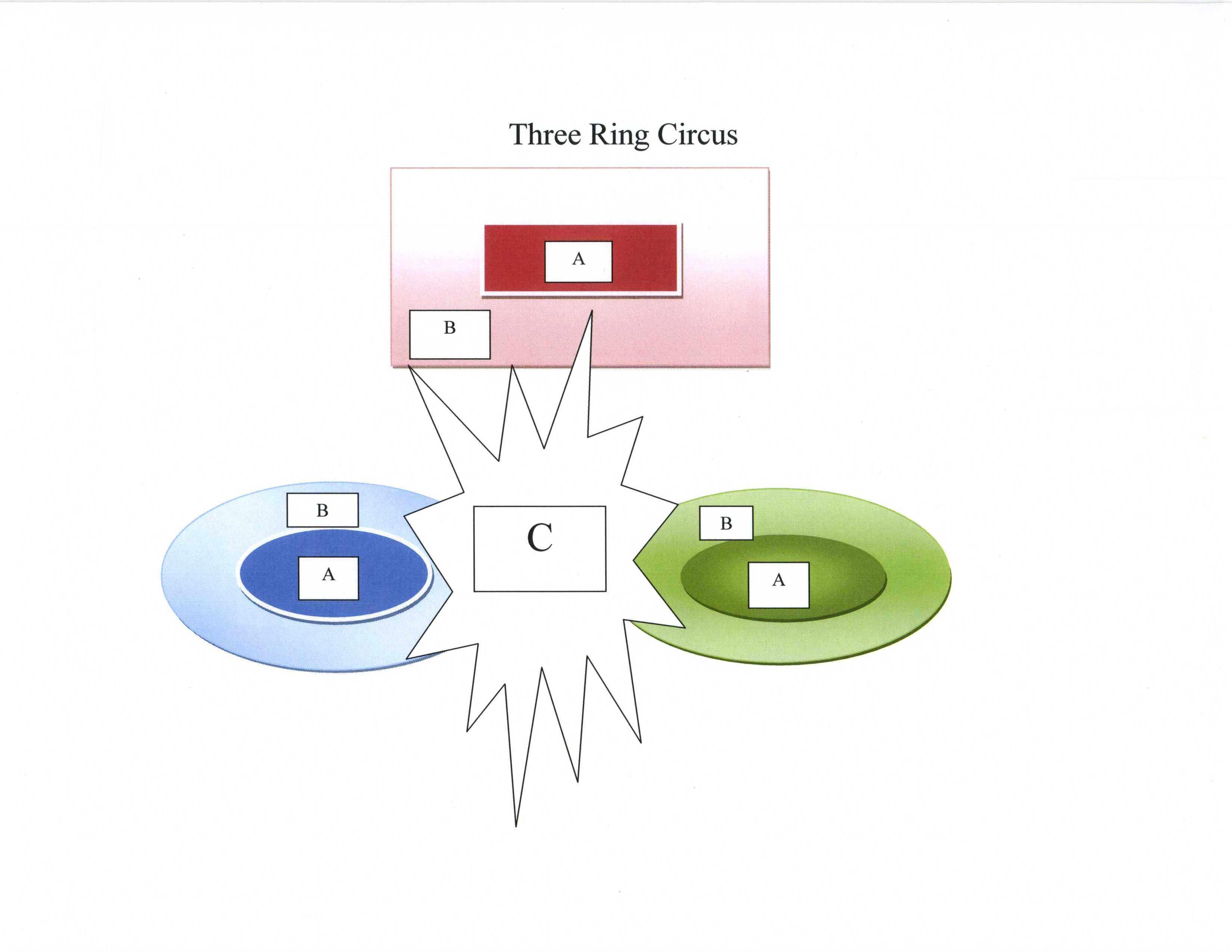
It’s an “issue,” as we say.  It concerns a lot of people.  Something ought to be done about it. Let’s imagine the easiest possible resolution.  There are three leaders in this societal constellation: one of the polity, one for the economy, and one for the society  Let’s call them tyrants—meaning nothing scurrilous by the term—so that we have three “areas” to consider and a tyrant for each.

All we have to do is to decide which tyrant gets to decide on this issue.Well, that’s not entirely true.  First we have to explain the diagram.  The three colored figures are the polity (red rectangle), the economy (blue oval) and the society (green oval).  Each figure has a core—the darker color marked A—and a periphery.  The periphery—the lighter color marked B—is a kind of antechamber.  B is where an issue is when it is on its way to being a part of the core or when it is on its way out of that figure entirely.  An issue does not, in this figure, move directly from A in the polity to A in the economy.  It would first move from A to B in the polity, then from B to A in the economy.

This possibility of issue mobility is a concern to the tyrants, of course.  In most cases an “issue” belongs to me because it is something from which additional authority and additional revenue can be extracted.  When someone says, “This is a problem for Superman!” Superman smiles.  More heroics and more fame are in the offing.  There are issues, on the other hand, which are dead losers.  Sometimes they simply can’t be solved and whoever has the issue is “it” and will take the fall.  Sometimes an issue can be dealt with, but it will cost more to solve it than you will gain in revenue.  That’s a loser.  Sometimes it can be dealt with, but the only successful ways of dealing with it will make you enduringly unpopular.  That’s a loser too.

Such issues as these really belong somewhere else.  It’s about those issues that Superman says, “You know, Batman is the right person to take this job on.”  The tyrant of the economy says that each family ought to save more.  The tyrant of the polity says that consumer spending ought to increase.  The tyrant of the society says that the welfare of each family—not the aggregate demand or the aggregate savings—is the proper goal.

That much of an explanation will show why some potentially mobile issues—the ones in the B areas—are sought after while others are nearly pushed out the door.  What remains is to consider why C is there; that oddly astrocyte-shaped blob.  I wanted it irregular because problems that have not yet been placed as issues are…well…irregular.  I wanted those odd little rays to look just a little like tentacles.  I wanted the whole shape to strike you an inchoate and faintly menacing.

In C, an issue could belong anywhere.  That’s a jump ball for all the people (and their tyrant) who want it.  It is a live grenade to all the people (and their tyrant) who don’t want it.  But if we are talking about new issues—and that’s why I developed this particular image—it isn’t an “issue” until it is a “problem” that is placed somewhere.

Problems are personal.[1]  Issues are public.  It’s when someone in authority says, or when a lot of people who have no authority say, “Say, that’s really a job for ______” that it become an issue.  It could be a job for the polity, a job for the economy, or a job for the society.[2]  It doesn’t “belong” anywhere, the way a lost wallet full of one hundred dollar bills and a credit card “belongs” to its owner.  It “belongs” somewhere in the way a job belongs to the only person in the community who has the tools and the equipment to keep the river from flooding the town.

So by the time a problem is “socialized” as we say’ by the time it has become an issue, there is still the question of where it can best be dealt with.  If I am the tyrant of the economy and I can see that my ownership of this issue will benefit me, I do everything I can to claim it for myself and to render your claims—you other two tyrants—less attractive or plausible.  If it looks to me like the kind of issue that will tar the hands of anyone who tries to manage it, they I will see it belonging properly to you.  I might say you are responsible for it.  I might say only you can deal with it.  I can say that no one else has the necessary authority or popular support or access to resources to manage it properly.  What I really mean is “Anyone But Me.”[3]

A strong smoothly functioning society will have three powerful settings and a clear process for placing the right issue in the right place.  Compared to those two things, nothing else matters much.


[1] There is more that really should be said.  As I use the word “problem,” it is not a condition at all.  It is not like hunger.  It is a formulation.  It is built by someone to represent what would be a very confusing situation without this representation.  So all problems are artificial in the sense that someone has built them for his own purposes and it is where it is because it has been placed there.  It is problems that have been constructed and placed that are likely to become issues.

[2] “Society” is decentralized in some ways: families, communities, churches, schools, sex roles.  But it is a complete system in other ways: a rigid class-based system, a broadly “spiritual” but not institutional population, a rabidly homophobic population, depleted, one-parent families and the institutions needed to keep them together.

[3] This was, very likely, the first ABM treaty.  Two tyrants agree that whatever it is, it belongs to someone else.

Posted in Political Psychology | Tagged , , | Leave a comment

Dr. Obama’s Bedside Manner Needs Work

It occurred to me recently, that back in the bad old days of medicine when there was very little you could actually do for a patient, people understood their job to be “being with” the patient and making him or her comfortable.  The illness was going to what it was going to do.  Before germ theory came along, everything was even more mysterious than it is now.  The bedside manner emphasized “I’m here for you” rather than “Take two of these and call me in the morning.”

When “take two of these” works, I’m pretty happy with it and I am delighted in the great progress medicine has made since it discovered germs.  But I didn’t have these little medical reflections for no reason at all.  There was something going on that had those same contours and it took me a little while to catch just what it was.

It’s the economy.  It’s in bad shape and it’s going to go on being in bad shape for quite a while.  Dr. Obama would really like to be a “take two of these and call me in the morning” kind of president.  It’s his style.  But Dr. Obama doesn’t have access to anything, two of which will help his patient.  The president will, of course, do a lot of Republican bashing over the next year—as he should—but he is still going to be held accountable for the bad economy and he doesn’t have any way to treat it.

Let’s consider some possibilities.  Let’s give the banks a bunch of money so they can loan it to people who will do something productive with it.  Dr. Obama can see to it that the banks get a bunch of money.  He cannot require them to actually lend it to anyone.  When the banks get the money, they will consult their own needs for reserves, for security, for high return loans and when they have considered all those, they will just sit on the money.

Let’s encourage companies to hire more workers.  This would help with the unemployment problem, one would think.  As the economy picks up, the companies really could use more workers, but they make more money by reducing workforces than they do by increasing them.  The new economic situation, in other words, allows quite a few currently unemployed workers to get their jobs back, but it doesn’t require the companies to rehire them.  The new “leaner” companies are going to be much more profitable, even as the economy continues to crawl along in low gear.  Nothing the President can say will cause these companies to make less profit so that the economy will improve.

The President could always raise taxes on businesses, of course, and use the new revenues to invest in new technologies and more employment.  But there’s this problem with the businesses.  They get the same services from the U. S. government whether they pay taxes or not and a business that has an accounting department that does NOT know how to keep the profits safe in an off-shore bank has a very uncreative accounting department.

The President could always cut taxes on the rich, of course, allowing them to create new jobs as their market savvy allows them to.  That has been prescribed many times and actually tried several times and it turns out that the rich have better things to do with their money than use it to increase production and therefore employment.  Yachts and corporate jets come readily to mind, but I am sure there are lots of less visible things to spend the money one.  The point is that they don’t spend it in ways that help the economy in any broad way.

Robert Reich argues persuasively in his book, Aftershock, that the fundamental problem of the American economy is that we don’t pay our workers enough to enable them to buy what we make.  Consumer spending is two thirds of the Gross Domestic Product, I heard yesterday on the radio.  Increasing what we pay the workers would enable them to spend more money—and they would spend it—which would increase demand, which would increase employment, etc.  This is the well-known Henry Ford solution.  It was Ford who scandalized the whole world of business by paying his assembly line workers enough money that they could buy Ford cars.  He sold a lot of Ford cars that way, but Reich passes along some of the commentary that appeared in the Wall Street Journal when he did that.  Scathing!

So that is a “treatment” that would work.  There is nothing Dr. Obama can do, unfortunately, to get that prescription filled.  Nothing.  Actually, there isn’t anything in the whole “take two of these and call me in the morning” world that the President can do.  And that’s why I think it is time for him to break out his bedside manner and get into the “I’m here for you” mode.  This guy’s got the idea, I think.

Posted in Politics | Leave a comment

America the Litigious

This note recognizes the past, present, and likely future of Dr. Loren Fishman, a psychiatrist.

The good doctor was driving along innocently one day when a taxi pulled in front of his car.  He swerved to avoid the taxi and suffered a bad tear in his left shoulder—a tear in the supraspinatus muscle, specifically.

Dr. Fishman had practiced yoga for many years and felt frustrated by his inability to continue yoga while he waited to see a surgeon.  One day he attempted a yoga headstand and after righting himself, he discovered he could raise his left arm over his head without pain, even though an M.R.I. showed that the supraspinatus muscle was still torn.

Note: This is not a serious post.  If you are seriously interested, I recommend Jane Brody’s column in this morning’s New York Times.

Everything is good so far.  And it gets better.

This headstand turned out to be a great treatment for the rotator cuff tears.  In a report published this spring in Topics in Geriatric Rehabilitation (an issue of the journal devoted to therapeutic yoga), he described results in 50 patients with partial or complete tears of the supraspinatus muscle.   All the yoga-treated patients maintained their initial relief for as long as they were studied, up to eight years, and none experienced new tears.

It’s that last line that shows clouds gathering on the horizon.  The future I see for Dr. Fishman is that he discovers the commercial potential of this exercise and markets it as “No More Tears.”  At that point, the children’s shampoo folks at Johnson and Johnson come down on him like a ton of bricks and he gets sprains in places he didn’t even know he had.

And he was so promising too, that Dr. Fishman.


Posted in Words | Leave a comment

Welcome, friends

This isn’t a dazzlingly simple puzzle like the one Gandalf faced.  He thought he was confronted by a sign that said, “Speak, friend, and enter.”  No incantation in his capacious memory opened the doors.  What it actually said was, “Speak friend and enter.”  Gandalf spoke the elvish word for friend–mellon, as I recall–and the doors opened.

This isn’t as tough as that.  My last post over at thedilettantesdilemma.blogspot.com invited you to come over here, following the bread crumbs, and here you are.

I’ve been poking and prodding at John Gray’s Mars/Venus books lately so I think that will be the subject of tomorrow’s post.  The thing that continues to puzzle me about Gray is this: a) his idea that there is an essential character to men and to women (different, but complementary) is not a respectable idea it seems to me.  Things are more complicated than that.  On the other hand, b) his advice is gold in the mine.  Forget how he understands gender relations.  When I do what he says to do, it always works better than what I would otherwise have done.

How’s that for a dilemma?

Posted in Uncategorized | 4 Comments

The House of the Venerable and Inscrutable Colonel

Really, It’s Just KFC

In general terms, this post is just a celebration of Neal Stephenson’s mastery with words and the fun he has with thunderous incongruities.  I’m going to do that in two ways—both from The Diamond Age.[1]

First, I want to place the utter centrality of Kentucky Fried Chicken in Shanghai, several decades into our future.  Judge Fang, Constable Chang, and Miss Pao are the participants in this spoof.[2]  They are trying a little boy named Harvard for assaulting a rich young engineer and stealing some of his possessions.  Up to this point the trial has been conducted in English.

At this point, the three revert to Chinese.

“The hour of noon has passed,” said Judge Fang.  “Let us go and get some Kentucky Fried Chicken.”

“As you wish, Judge Fang,” said Chang.

“As you wish, Judge Fang,” said Miss Pao.

Judge Fang switched back to English.  “Your case is very serious,” he said to the boy. “We will go and consult the ancient authorities.  You will wait here until we return.”

The House of the Venerable and Inscrutable Colonel was what they called it when they were speaking Chinese.  “Venerable” because of his goatee, white as the dogwood blossom, a badge of unimpeachable credibility in Confucian eyes.  “Inscrutable” because he had gone to his grave without divulging the Secret of the Eleven Herbs and Spices.

I think I have not passed a KFC for a decade or more without some version of the “House of the Venerable and Unscrutable Colonel” passing through my mind.

Today’s second celebration of Neal Stephenson will be made up of my notes on some of the words he introduced me to.  I’ll pick my favorite five for today.  I give Stephenson’s use first; then whatever I have come up with as the meaning.

7.         coenobitical

Page 25: There were a bunch of coenobitical phyles—religious tribes—that took people of all races, but most of they weren’t very powerful and didn’t have turf in the Leased Territories.

This isn’t as weird as it looks.  The dictionary cites cenobite, which solves the oe- problem and getting from cenobite to cenobitical is a short trip.  A cenobite is a member of a religious order living in a monastery or convent.  This distinguishes them from anchorites, who were hermits.  Cenobite is a version of the Greek koinos, “common” and bios, “life.”  There are later forms, of course, such as the Late Latin coenobium, “a cloister.”  The prefix is pronounced SEE-no, as in evil.

9.         coarcted

Page 30: All the other thetes,[3] coarcted into their tacky little claves[4] belonging to their synthetic phyles, turning up their own mediatrons to drown out the Senderos…

This is an unfamiliar word that really adds something.  It is just right.  The meaning of the adjective coarctate in biology is “compressed or constricted” or “rigidly enclosed in the last larval skin: said of certain insect pupae.”  Stephenson, with the verb coarcted gets not only the cramming together but the insect image as well.  “Crammed together as tight as the final skin on a larva” is the clout he gets out of this word.

7.         phyles

Phyle (Greek φυλή phulē, “clan, race, people”, derived from ancient Greek φύεσθαι “to descend, to originate”) is an ancient Greek term for clan or tribe. They were usually ruled by a basileus. Some of them can be classified by their geographic location: the Geleontes, the Argadeis, the Hopletes, and the Agikoreis, in Ionia ; the Hylleans, the Pamphyles, the Dymanes, in the Dorian region. [Wikipedia]

41.       decussating

Page 341:  The unmarked decussating paths would have been confusing to anyone but a native.

Decussating paths cross in the form of an X.  How that’s different from an ordinary intersection, I’m not sure.  The Latin is decis, “10.”  That’s 10 as in X, since it’s a Roman numeral.  Decussare means “to cross in the form of an X,” which is, apparently, what “decussating paths” do.

33.  glacis

Page 258:  “…who would struggle their way up the vast glacis separating wage slaves from Equity Participants.”

I am shocked to find that this word is pronounced like “glasses,” except the final s- is also sibilant.  It looks so French.  A glacis is a gradually slope.  It doesn’t have any particular temperature, although it shares the root of the Latin glacialis, “frozen.”  I think it’s the connotation he wants.  A glacis can be part of a fortress; the embankment sloping gradually up to a fortification so that anyone attacking it will be exposed to gunfire the whole way.  I think that’s the picture he wants us to have of wage slaves trying to become Equity Participants.


[1] Neal Stephenson, The Diamond Age: Or, A Young Lady’s Illustrated Primer. New York: Bantam Books, 2000.  The KFC passage is on page 91.

[2] All three are Chinese, but Judge Fang is from New York City and Miss Pao is from Austin, Texas.  They have been familiar with KFC for a long time.

[3] A thete is a person who belongs to no phyle at all.  Phyle is the next word in this list.  Until today, I thought it had no etymologically regular trail at all.

[4] enclaves, I imagine.

Posted in Saturday Evening Post | Tagged | 1 Comment

Debt Limit Chicken–And Worse

July 27, 2011.  It is now less than a week until the United States of America tells the people who have loaned money to us that we were, after all, a bad risk.  The debt limit confrontation has been pictured as a game of chicken between President Obama and Speaker John Boehner, the only presiding official in the Congress who opposes him.  Sen. McConnell will have to wait his turn.

So…a game of chicken.  We drive our cars toward each other at high speeds.  In the best outcome, you flinch and turn aside and I win.  In the second best outcome, I flinch and you win.  In the least good outcome, neither of us turns and we kill each other.  But now that I have gone that far, I realize that there is an outcome even worse.  We both flinch and turn into each other (that would be to the right for you and to the left for me—how very familiar that sounds!) and reveal ourselves not only as cowards but as incompetent cowards.  That would be worse.

I’m not sure that chicken captures all the elements of this contest, however, so I would like to try several others.  How about Russian Roulette?  You spin the cylinder, put the gun to your head, and pull the trigger.  You have five chances out of six of surviving—if you do it one time.  If you do it over and over—I’m not at all good at calculating cumulative probabilities—the odds get worse.[1] 

So let’s consider the roulette elements of the present situation.  President Obama can’t control the Democratic votes he needs to pass the compromise he prefers.  Speaker Boehner can’t control the Republican votes he needs to pass the compromise he prefers, which, until recently, was the same one the President preferred.  The two parties are highly ideological.  Votes which pitted 80% of Democrats voting one way against 80% of Republicans voting the other way were once unusual; now they are the commonest kind of vote.  The new Tea Party-backed Republican House members believe they owe intransigence to their constituents—it is their sworn duty—and that intransigence has now been turned against the leader of their own party.  This has led Eric Cantor, the Number 2 man in the House to tell them to “Grow up,” a sentiment also found on the lips of the President.  How awkward is that?

This is highly unstable.  Now we approach this brink over and over.  The probability of hitting the live chamber, by this analogy, goes up radically as you do it over and over.  Eventually, you will hit the live chamber—that would be the House in the present scenario—and you blow your brains out. Actually, that might have happened in the 2010 elections; it’s still too soon to tell.

The third scenario, one which captures yet another aspect of this impending disaster, is a champion battle.  I’m thinking of David and Goliath as an example.  I’m not really sure, now that I think of it, what was supposed to happen to the army of the defeated contestant.  Were they supposed to be massacred?  To be slaves?  To be put in internment camps?  I really don’t know.  But it doesn’t really matter, because the notion of “champion” is all I need.  Theoretically, if David wins, it is good news for the Israelites.  If Goliath wins, it is good news for the Philistines.  But fiscal default isn’t really like that.  If we default, both David and Goliath lose.  And all the people David and Goliath represent also lose.  All of us are killed or enslaved or put in camps, or whatever.  The cost to anyone of borrowing money for anything will go up, for instance.  You don’t need to be on the losing side to suffer this defeat because both sides are the losing sides—not just the champions but the armies and not just the armies but the civilian populations. Everyone—litigators, bundlers of financial instruments[2] and off-shore hiders of revenue and Chainsaw Al personnel departments—loses.

These three images together give us a fuller picture, I think, of what we’re up against.  This account sounds crude and contemporary to my ears, however.  This is how Lincoln put it.

“On the occasion corresponding to this four years ago all thoughts were anxiously directed to an impending civil war. All dreaded it, all sought to avert it. While the inaugural address was being delivered from this place, devoted altogether to saving the Union without war, insurgent agents were in the city seeking to destroy it without war—seeking to dissolve the Union and divide effects by negotiation. Both parties deprecated war, but one of them would make war rather than let the nation survive, and the other would accept war rather than let it perish, and the war came.”


[1] Your chance of living through 10 rounds of Russian Roulette is, by my naïve calculation, .161 so you’d be fine nearly 200 times out of 1000 tries.  Pretty good.

[2] This shows how far we have fallen.  Bundling was common among the Puritans of  New England and you never heard of anyone getting in trouble for it.

Posted in Politics | Leave a comment