Kimiko Says Thank You

People who formulate, legitimate, or enforce public policy for a living have a good idea what makes a policy work.  It has to be effective, i.e., meet the goals the policy establishes.  It has to be affordable, i.e., not cost more than succeeding legislatures are willing to pay for it.  And it has to be acceptable, i.e., those affected by it need to comply without too much opposition.  You can tell when there is “too much” opposition because people grumble; they invent shortcuts that are probably illegal but which make enforcement uncertain; and sometimes they violate the policy flagrantly because they have no emotional attachment to it and want to make their opposition plain to the authorities.

There are other reasons policies fail, but those three take care of most cases.  When there are difficulties with a policy, the first wave of responses considers ways to alter the goals, increase the revenues, and rev up enforcement.  I’d like to consider another approach.

I was coming home from a run on the Wildwood Trail this week when I had to stop for a school bus.  I have taught at a lot of schools so I have a kind of respect for school buses.  For me, the STOP sign attached to the arm that swings out when the bus stops and the flashing lights and the little gate that extends from the front bumper are just reminders.  On the other hand, when you are on a road with school buses, you are going to be stopping a lot.  It was an ordinary compliance situation.  I was ready to comply, but I wasn’t happy.

One little girl got off the bus.  She looked like she might be Japanese, so I called her Kimiko, just to myself.  She was wearing a pink jacket and carrying a backpack.  And she looked at me as she crossed the road and waved her thanks.  It looked like it meant something to her that I had stopped.   She wanted me to know that she appreciated it.

I played with that appreciation the rest of the way home.  It occurred to me that maybe the best way to sell a policy is to have the beneficiaries say thank you.  Kimiko wasn’t thanking me as a way to drum up support for the schools’ traffic laws.  She really didn’t gain anything by it.  But she was small and cute and looked happy and the idea of stopping for her seemed a lot more appealing than stopping for the bus ever seemed.

This isn’t a “technique,” really.  It isn’t going to make palatable policies that cost too much or that are fundamentally contested.  On the other hand, people who oppose policies spend a lot of money dramatizing how their rights are being violated or their estates compromised.  It probably would not hurt a lot if some of the beneficiaries of the policy took a minute to say thank you.  I think maybe Kimiko is onto something.

Posted in Saturday Evening Post | Tagged , , | Leave a comment

Obama’s Policy on Israel and Palestine

How shall we approach the decades-long standoff between Israel and Palestine?  In our rush to establish one position or another, we blow right by the general questions which the positions purportedly address.  Any set of comparable positions lines up on an axis of some kind.  Is I see it, there are three axes available.  The first is conquest.  Everyone has a claim on the Promised Land.  It has been notoriously over-promised.  Some combination of Middle Eastern states may very overwhelm Israel and put the land back in pre-1947 conditions, minus, of course, the British.  Israel may decisively preempt attack and decisively defeat their enemies.  They have done it before.  Yet the war goes on.

The second is international settlement.  There will have to be a deciding party and an enforcing party. The deciding party will be the United Nations.  It’s hard to envision who will take part in the enforcing.  A “New World Order” style of temporary coalition wouldn’t be stable enough.  The U. S. would have to form the core of it and we wouldn’t unless the alternative were decisively worse for Israel and that view was taken by a substantial majority of the important pro-Israel groups in the United States.  The basis would be the 1967 lines with land swaps and some arrangement for sharing Jerusalem.

The third is bilateral agreement.  Israel and the Palestinian Authority work it out.  That seems the least likely.  No conceivable Israeli government could engineer such an agreement and no conceivable government of all the Palestinians—the West Bank and Gaza—could enforce the peace such an agreement would require.  The fatal flaw in the “land for peace” deal is that Israel does not have the political will to give up the land and Palestine does not have the security forces to legitimately offer peace.

That is the set President Obama is working with.  I don’t see any winners there.  My gripe about the president’s speech to the U. N. is that he is denying any attention to what I think is the only hope.  I call it, below, a “hybrid option” and will spend the rest of this post considering it.

The only hope I see is that the United Nations grants that the current set of options is unworkable and come with a hybrid.  Palestine becomes a member of the United Nations.  The plundering of the West Bank is recognized as the invasion of the territory of a UN member.  Economic and military sanctions are threatened, as they would be if there were a similar invasion of Italy or any other member state.  The same set of sanctions turns against the Palestinians if they are unable to control their militants and end military retaliation.

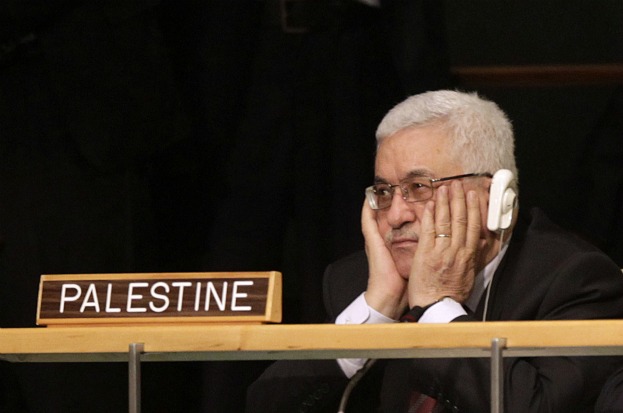
It is possible, under those circumstances, that the Israeli parties could decisively renounce their aspirations to Greater Israel and make the only deal there is to make.  And it is possible that Palestine (UN member nation Palestine) could decisively deal with the array of their allies—most notably Iran– who consent annually to the deaths of thousands of Palestinians, provided that their own war against Israel continues.  It is possible.  The look on the face of Mahmoud Abbas is not encouraging.

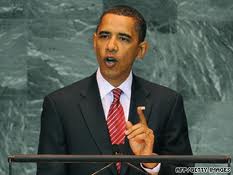
To do that—to devise this hybrid—it is necessary to abandon the line President Obama drew in his September 21 speech to the United Nations.  There is “judgment from the top” he said, and then there is “agreement by the two parties.”  There is no hybrid there, please note.  There is, instead, a resolute ignoring of the possibility of a hybrid and where necessary, the denial that it is possible.  That is awkward, presuming that nothing else will work.

The bulk of the President’s speech was devoted to clarifying that line, so that the top down—the international mandate—solution could be decisively rejected.  “This is how it is supposed to work,” said the President, “nations standing together for the sake of peace and security and individuals claiming their rights.  He cited South Sudan and Côte D’Ivoire and Tunisia and Egypt and Libya.  All those—successes or successes-in-progress all—show “the way it is supposed to be.”  We can argue about whether any of those is an example comparable to the Palestine/Israel conflict, which is the use the president wants to make of it. 

My interest here is the way each example reinforces the line of division the President wants to maintain.  “We must choose,” he says over and over, “between ineffective top-down decisions” and “letting the two parties work it out.”  Given only those two, the President is hoping that the U. N. members will deny Palestine’s bid for recognition.  But to do that, you have to say that those two are really the only options.

Since I am pushing a hybrid—enhanced negotiations resulting from U. N. membership for Palestine—I am not happy to see my option obscured.  When the President claims that there are only two options (and of the two, the one he likes looks preferable), it is important to argue that there are not just two and that we need not choose between them.

Controlling which options are seen as available is one of the first rules of power.  Whatever choice is finally made, that will have been the first step.  But to do that for the benefit of all, you have to get the options right and I don’t think President Obama did that at the U. N.

Posted in Political Psychology, Politics | Tagged , , , | Leave a comment

Djokovic Plays Erikson, Round 7

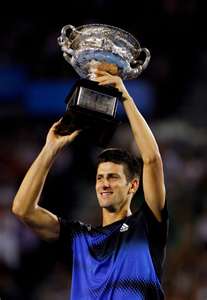
I hate to abandon Roger Federer after so long, but since he lost to Novak Djokovic in the semifinals, I will have to examine Erikson’s Stage 8 with Djokovic in mind.  He is the one who actually made it to Stage 8.  In the integration I have been pursuing—the seven rounds of the U. S. Open tournament against the eight stages of Erik Erikson’s developmental ladder—if you get to the finals, you are facing the challenges Erikson described as the eighth and final stage.

Here’s what that looks like.

Maladaptive Syntonic Dystonic Malignant
Presumption Integrity Despair Disdain

WISDOM

 Before I go into this for the last time, however, I want to remember how we started.  I began by saying that there is a physical tournament and a spiritual tournament.  We lose the physical tournament.  We are, briefly, “mortal.”  You can dodge car accidents and strokes and cancer and crazed former spouses but eventually, something does the job.  I’m fine with that.  I have no idea what it would be like not to see myself at some point on a trajectory headed toward death.

We’ve been following the “inner” or “spiritual” tournament.  You can win that one.  That means that in Stage 6, you overcome isolation and achieve an intimacy marked by the struggle.  In Stage 7, you overcome stagnation and achieve a generativity marked by the struggle.  In this stage, you overcome despair and achieve an integrity—a sense of wholeness, of rightness—marked by the struggle.  The syntonic value does not careen, unmodified, into the excesses of presumption.  The dystonic value does not plummet into the malignant excesses of disdain.[1]

At this end of the analysis, the weaknesses of the tournament metaphor are clear.  Professional tennis players—professional anything players—deal with the recently completed tournament by learning what they can and moving on.  It stretches the metaphor to imagine the winner of the final game struggling to push despair away and in the process, opening himself to WISDOM.  Maybe if it were the last match of his career.  Or maybe these questions come up as you end your career in tennis and look back at how you have spent your life since you were 14 years old.  Now you are old, in tennis terms, in your early 30s and you might wonder if your “career” in tennis actually meant anything to anyone—or even whether it meant anything to you.  You hear about athletes who are more or less whole persons so long as their pro careers sustain them and go onto the street, sometimes pausing at a series of failed business attempts, on the way to the gutter.  We can see, in those cases, that integrity has lost out to despair.

The final entanglement in thinking about Stage 8 is that as part of the process of asking whether your life meant anything, you must ask whether “life” can “mean” anything.  Considered at any level below cocktail party chatter, that one rocks you back on your heels.  You really do have to decide what it would mean to “mean something.”  And then you would have to establish “a life” as a unit that could be assessed in that way.  And then you would have to measure your own life according to whatever metric you decided had merit.

I like all those questions and I’d like to spend some time with each of them, but this brief post-tournament reflection is not the right time.  Let me just use the last few paragraphs to point in a somewhat different direction than Erikson does.  I think I would put TRUST in the final place, where Erikson puts WISDOM.  There is no reason to think that the two are opposed in any fundamental way, but trust is fundamentally personal.  It isn’t just a metaphor drawn from interpersonal relationships; it is personal.  We trust “persons.”  We don’t trust “fate” or “destiny” or “the cycle of life.”

At this very last question, I bump up against the limits of my self-imposed decision to operate at a secular level.  I do think you can successfully deal with questions like “industry”—that’s like “industriousness,” remember—and identity and intimacy and even generativity, in a secular way.  When you come to asking “did my life mean anything,” even I, with my secular intentions, run out of the available scaffolding.

So thank you Erik and Joan Erikson.  Thank you Helen Kivnick.  Thank you Novak Djokovic.  It was a superb tournament and I will do my best, as a Roger Federer fan, to assert the integrity of the tournament and to fend off my own despair.


[1] I don’t like either of those terms, but they are good enough for now.  I’ll be working a good deal more with Stage 8, since that’s where I am headed (as are you) and I’ll poke around more with them then.  Presumption, for instance, is not “too much integrity.”  Maybe “entitlement” is more what he is looking for there.  And I am not at all sure that disdain is worse than despair—I’m not sure it is not simply a form of despair.

Posted in Getting Old | Tagged , , , | 2 Comments

Love and Savvy

I haven’t actually read the book Women Who Love Too Much, but when I saw it on the shelf, I knew I didn’t want to.  The person who made up that title—I understand that it might not have been the author—has a notion of what “love” is that I want to stay away from.  How can anyone love too much?

You can, in your attraction to or your care for another person, make bad choices.  You can put his or her values at the center of your life where your values ought to be.  You can concede the point in conflicts where sustaining your own commitment is necessary to your integrity.  You can be boundlessly tolerant when only clear rules and consistent behavior will make the world clear enough to live in.  Certainly you can do all those things.  You cannot love too much.

The combination I am looking for is love and savvy[1].  Love and street smarts.  Or if you like the Greek notion, love and metis—practical craftsmanship.  It isn’t too much love that drives us to pursue our goals in ways that guarantee their failure.  Craftsmanship without love isn’t very attractive either, of course.

In a relationship like marriage, metis is what enables you to know how the other person sees things, what she cares about, what expectations he has.  If I set out to love my wife and offer her the things that mean most to me (not that mean most to her), I do not have a shortage of love.  I have failed in savvy.  If I know what would mean the most to her and don’t care enough to offer it to her, I have failed in love.  You can’t love too much and, in the service of love, you can’t know too much.

There are situations that must be managed, just as there are relationships that lay their claim to our attention.  You have to know, sometimes, “what will work.”  It might not be what you like most to do, but if it needs to come out right and if you know what it will take, that is what you need to do.

I have an illustration in mind.  It is a story Jesus told.  Mostly, we call it “The Prodigal Son.”  I call it, “The Hothead, the Tight-ass, and Their Father.”  It is the father who shows the combination of love and savvy that I find so attractive.  In a lifetime of churchgoing, I have heard this story told dozens of times and even preached on many times.  Usually, the emphasis falls on how much the father loved his itinerant son.  He didn’t wait for him; he ran to the gate of the city.  He didn’t bargain with him; he restored him to the family.  He didn’t chastise him; he rejoiced to have him back.
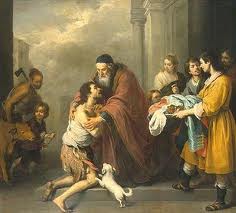
Yes, he did.  He was a loving father.  But why did this old man, the patriarch of his family, hoist his robes up around his knees and run out into public view?  Let’s start there.

Ken Bailey is the author of Poet and Peasant, one of the best books on the parables of Jesus I have ever read.  Here is a comment by John Nordin on how Bailey works.  I found it on the Amazon.com page under comments.

 Bailey’s unique contribution is that he sat down with a number of trusted Palestinian nomads and listened carefully to their take on the cultural issues behind various parables. He contends, with some justice, that this group of people have something in contact with the original culture that these parables arose in, and thus can help us understand the unstated assumptions and cultural implications of the texts. He invested many years in this and did it with care and precision. On top of that, he has explored the early translations of the New Testament into Syriac and related languages. The result is nothing short of stunning. His analysis of the puzzling parable of the unjust steward (Luke 16:1-13) is worth the price of admission alone, and even on the well-trod parable of the Good Samaritan, he has much valuable insight to share.

The whole parable is worth attending to with the tools Bailey makes available, but I want to talk about how savvy the father was.  Everyone knows he was loving and I don’t want to diminish that in any way, but if he hadn’t been street smart—or, in this case, “gate smart”—it wouldn’t have mattered much.

Why did he run to the entrance to the village?  I once wrote an extended celebration of Bailey’s account of the story.  You can read the whole thing here, if you like.  The answer to the question goes like this.  The villagers would be really hostile to this former member of their village.

The younger son comes back to town, broke and hungry. The prodigal returns, Bailey says, “to face … the slander of a whole town and certainly the gathering of a mob. As soon as the prodigal reaches the edge of the village and is identified, a crowd will begin to gather, He will be subject to taunt songs and many other types of verbal and perhaps even physical abuse.”

So one reason for hitching up his robe and dashing for the village border was to get to the son before the villagers did. Something like a gauntlet would be in the process of forming, remember, as village children alerted their elders to what was dragging itself into town. A second reason is that the father needed to make a spectacle of himself to assure a good‑sized audience for his next several actions.

So the son’s safety, first.  Second, the son’s status.  The father kisses the son because he knows what he wants to say and how to say it.  The son knows neither.  The son wouldn’t know whether to kiss his father’s hand or his feet or some…well…other place.

The father, by kissing his son on the cheek, indicates his forgiveness and his wish for reconciliation. The son would not have dared to kiss his father on the cheek, but the father preempts the son’s self‑abasement by his own quick mercy. And by doing so, he sets in motion a quite different sequence of events.

Next, he directs the servants to put his own robe on the son.  Here’s Bailey again: “the best robe”…would be the father’s robe; the feast day robe. It would be the finest robe the villagers had ever seen.  The father does not put this robe on the son.  That would not teach the servants what the father wants to teach them.  “You put it on him,” he tells them.  “He is my son, just as he was before.”

And he tells the servants to put shoes on his feet.  The shoes are a sign of being a free man in the house, not a servant. Telling the servants to put shoes on his feet was telling them that he was returning to his status of their master.

And he tells them to put a ring on his finger.  This isn’t quite as clear.  A Lucan scholar named Derrett speculates that the ring they were to put on his finger was a signet ring. It means he is to carry the authority of the master in his actions. He does not carry the economic resources, remember.  He received his share of the inheritance and spent it making whoopie.  He is, as a practical matter, a pauper and will be a pauper the rest of his life.  His brother will no doubt remind him of that fact many times a day for many years.   But there will be a limit to what the older brother can do, because both brothers wear the ring.

This old man, so often portrayed as foolish, admirable only in the exuberance of his love for his son, is seen here as quite deft.  The “restoration to status” is clear to the servants (serve him) and to the villagers (lay off him) and extends to the older brother (he wears the same ring you do; back off a little).  Whatever arrangements the father makes will have to continue to function after his death.  This is a supreme exercise in “generativity” for those of you who have been following the Erikson posts.

Are the villagers going to go along with all this?  Maybe.  The chances are not hurt at all by the huge party the father is throwing to which they will all be invited. 

Finally, the father orders the killing of the fatted calf. Bailey says this is an occasion for the whole village; that to kill a calf and not invite the village ‘would be an insult to the village. And, having already seen so many of the father’s actions as strategic, it is tempting to add this one to the list.  At the party, under the influence of a celebrative gathering, good meat, and free‑flowing drink many villagers will have an opportunity to accustom themselves to the presence of the younger son, who will be the guest of honor.

If there were a book called Fathers Who Love Too Much, this father would not be in it.  He’s too savvy for that.


[1] From Spanish, possibly: sabe (usted) = you know.  Or from the French savez (-vous) = do you know?  Many years of wasted scholarship have gone into deciding if Tonto really knew the Sabe in “Kemo Sabe” meant.  Some scholars have suggested that it meant “the one who thinks he knows.” It is, in any case, a West Indian pidgin borrowing and Fran Striker, who wrote the Lone Ranger books and invented Kemo Sabe never made it west of the Mississippi.


Posted in Biblical Studies, Love and Marriage, Political Psychology | Tagged , , , | Leave a comment

Federer Plays Erikson, Round 6

It has taken me a little while to recover from the semifinals.  Even if you don’t follow tennis, you probably know now that Novak Djokovic won the U. S. Open and since you know how tournaments work, you know that he also won his semifinal match.  I am not in mourning because Djokovic beat my man Roger Federer in the semifinals.  I am in mourning because Federer had him at match point on his own serve with two chances to end Djokovic’s run and didn’t do it.  Ah well.  You have to give it to the people who run the tournament.  The semifinal matches featured the first seed (Djokovic) against the third seed (Federer) and the second seed (Nadal) against the fourth seed (Murray).  You can’t run a tournament any better than that.

For the purpose of tracking the Erikson developmental stages, Federer’s loss serves as well as a win would have.  Round 6 of the tournament matches up to Stage 7 or Erikson’s scheme.  In that stage, each of us encounters the good tendency (syntonic) and the bad tendency (dystonic) of that stage.  As always, the best outcome is for the good tendency to prevail, but, as always, only after having to cope with the resistance put up by the bad tendency.  Here’s what that looks like for Stage 7.

Maladaptive Syntonic value Dystonic value Malignant
Overextension Generativity Stagnation Rejectivity

CARE

 So what do those mean?  We have come a long way to reach generativity.  This emphasis takes for granted a lifetime of hard work and intimate relations.  It is the achievements in those areas that need now to be cared for.  I have been a teacher and a father since I was 22 years old.  I have students and grandstudents and great-grandstudents and more.  I have children and grandchildren.  The grandchildren are great, but they are not great-grandchildren.  The work of my productive life has been accomplished.  I need now to care for it and for them.  That is the work of generativity.  Notice how outgoing it is.  Think of the watershed pictured here.

Stagnation is not outgoing.  As a modifying effect on generativity, it has the effect of keeping the schedule manageable, of keeping time to nurture the self and the marriage and the close friends.  Those are all good.  As a value of its own, it represents only withdrawal from the work of one’s life.[1]  There are other things to call it, of course.  The later phases of this stage have been called “the golden years,” meaning that at last you can indulge the level of self-absorption your working life prevented.  You can do everything you have always loved to do.  And when you are tired of it, you get to do more because that is really all there is.  That is the point where you discover that self-oriented “leisure activities” were seasonings, like salt.  They had a wonderful effect on the activities and commitments you seasoned with such activities.  This is the time you realize that a diet of salt or dill or oregano really isn’t that satisfying.[2]

The extremes are, as always, distasteful.  An unrelieved generativity slides into overextension.  We all know people who, in their retirement, volunteer at a place that leaves them distraught and exhausted.  Not enough “stagnation,” to use Erikson’s term.  Not enough attention to the quality of generativity, I would say, rather than to the raw quantity of it.  And unrelieved stagnation is not inert.  It is an active rejection of the involvements that would give meaning and structure to your life.  Hollywood has made a great deal of money over the years, telling the story of an old codger who withdrew from all meaningful work and all meaningful relationships, rejecting the attempts of even the most diehard friends to re-engage them, until finally a Q falls into their lives.  Q is a puppy or a grandchild or a long alienated son or daughter or a once-important cause that calls one back to action.  Lots of kinds of Q.  It’s all the same story.  But when Q fails, the Eriksonian rejectivity is the ruling force.

The name Erikson gives to the appropriate outcome of the necessary conflict between generativity and stagnation is CARE.  “Caring,” he means, I think.  This caring overcomes the rejection of one’s own progeny, whether biological or pedagogical.  Being a teacher, I see my “progeny” as both my children (and their children) and my students (and their students).  Or, as I say it when I have only myself to please: “my progeny, both genetic and memetic.”[3]

Beginning, in your retirement, to exercise some care for the watershed where you live is a good idea, but it isn’t generativity.  Generativity is continuing to care.  It took a long time to build the coalition—I’m not presuming you are the one who built it, only that you were involved in it—and to set in place the expectation that the watershed deserves deliberate care, and more time to engage the relevant regulatory majorities at city, county, and state levels, and even more time to establish the budget line.  NOW my care for the watershed is generative.

It took a long time to establish close trusting adult relationships with my children—or, depending on whose life is being described, my grandchildren or my stepchildren or whatever—but that is now accomplished.  Now I oversee their lives with satisfaction, but from a distance.  I answer the questions they still want to ask me as well as I can, but there is great satisfaction that those questions reaffirm the relationship.  I ask more questions than I am asked, because I am a known quantity and questions that might be jarring from someone who was not trusted are not jarring from me.  Generativity is continuing to serve as I am able, but much more to celebrate the work of others, whose lives were once under my active care.

It took a long time for my students who became teachers to confront the dilemmas I confronted with them.  But when they did confront them, some of them came to think that I might be able to help and we became colleagues.  I know that examples that have been a part of my teaching for years—how do you understand a classroom for 100 students which has only 20 chairs?—have been told and told and told as generations a students have gone to school and graduated.  That is not, as some say, “a form of immortality,” but it actually is my present care that the example be well used.  It is a part of my generativity.

The one thing that remains to be said yet is that all three of these examples—who are not me, but they are flavored by my recollections—reject stagnation.  Stagnation is refusing to care any longer.  It is daytime soaps or endless golf or fanatical sports attachments or whatever you default to when you give up caring urgently for the life that goes on outside your domain and that will keep right on going when you die.

Actually, we come to the dying next.  The last of the Erikson stages looks right down the barrel of that event and we will see, in the next post, what he sees.


[1] We will see in Stage 8 that the dystonic value is “despair.”  Of course it is.  That follows directly from the withdrawal of the meaning of one’s life that is represented by “stagnation” in Stage 7.

[2] It confuses, my brother Karl taught me to say, the aliment and the condiment.  Everyone knows what condiments are; aliments are what you put them on.

[3] Evolutionary biologist Richard Dawkins coined the word “meme” as the cultural counterpart of “gene.”  It is based on the Greek mīnēma, “something imitated.”  My students who are teaching the things I taught them or teaching in the way I modeled for them are my memetic “children,” and I owe them my generativity as well.  They are the children of my mind and my heart as my biological children are the children of my body (and my mind and my heart).

Posted in Getting Old | Tagged , , , | Leave a comment

Federer Plays Erikson, Round 5

In the musical, 1776, John Dickinson of Pennsylvania objects to the wording of Thomas Jefferson’s Declaration of Independence, which was before the Second Continental Congress for debate.  Jefferson had referred to King George as a “tyrant.”  King George, Mr. Dickinson specified, is “not a tyrant…in Pennsylvania.”  I know the feeling.  In looking forward toward the Federer v. Tsonga match, I referred to Tsonga as “a monster.”  But he was not a monster this year.  Federer took him out 6-4, 6-3, 6-3.

This brings my man Roger to the end of the matches in which he is the higher seeded player.  The two players standing between him and the 2011 U. S. Open title are #1 Novak Djokovic and #2 Rafael Nadal.  Good luck, Roger.

The point of all the attention to the U. S. Open, however, was to follow Federer through the several stages of Erik Erikson’s developmental stages.  I had to start Roger on Stage 2 (Round 1 of the tournament = Stage 2 of the developmental sequence) so his Round 5 match with Tsonga is our springboard for a consideration of Stage 6 in Erikson’s scheme and here is where my tournament metaphor comes seriously apart.  Stage 6 is about the triumph of intimacy over isolation, with LOVE considered as the effect that the struggle with isolation has on the capacity for intimacy.

Nothing in the Federer v Tsonga match bears on it, so I will go back to the fundamental rationale for the tournament metaphor and leave the intimacy questions to be worked out between Roger and his wife, Mirka.  Should he win the match with Djokovic, we will be in a good position to go on to look at generativity, because Roger and Mirka have identical twin daughters, Myla Rose and Charlene Riva.[1]

It is tempting, in the context of tennis, to move directly from Stage 5, in which you have established a central identity and have found a way to be faithful to that identity in an array of circumstances, to Stage 7, in which you achieve what that identity has prepared you to achieve.  But most of us don’t live our lives that way.  We aspire to a deep mutuality with another person and that has very little to do with the kinds of achievements we have been considering.

The treatment given this stage in Vital Involvement in Old Age focuses on the syntonic value, intimacyThe name they give to the maladaptive form is promiscuity.  I have been calling the maladaptive tendency the “too much” version of the syntonic value, but it is hard for me to see promiscuity as too much intimacy.  It almost seems to me that it is too little.  It’s not hard for me to think of a man who has sex with a lot of women because he has no interest in, or possibly no capacity for, real intimacy with any of them.  I don’t actually know anything about Tiger Woods as a person, but he is a prominent celebrity who seems to have moved away from intimacy toward promiscuity.

The dystonic value, the central antagonist to intimacy is isolation.  I don’t know if anyone reads Kahlil Gibran at wedding ceremonies anymore, but a line of his I used to hear  at weddings a lot belongs here.  The line is, “Let there be spaces in your togetherness.”  I think those spaces are the value they are pointing to with the word isolation.  If that’s what they have in mind, I agree wholeheartedly.  If you really can’t manage to be alone, it is hard to know just what you are trying to achieve in relationship.  You can, certainly, hide from yourself—that would be a Stage 5 failure—in an intimate relationship.  When you are OK with your aloneness, it is clearer what you are trying to achieve in an intimate relationship.

The word they use for the “too much” level of the dystonic tendency is exclusivityI think they must mean a stance of actively excluding others, i.e., not just withdrawing from then, as in isolation, but preventing such relationships.  I hope that’s what they mean.  When I talk about exclusivity, I think of it as the basis of intimacy.  It is the exclusion of others, in what would otherwise be promiscuous, that allows intimacy with one partner.  So…they mean something else.

The master value of this stage is LOVE.  Love, in this sense, is the mastery of intimacy in its struggle with isolation.  Isolation—the aloneness I mentioned earlier—has its proper place in an intimate relationship, but it is not the first place.

Roger has Novak Djokovic next.  That’s the semifinals—Round 6—of the U. S. Open tennis tournament and it corresponds to Stage 7 of Erikson’s scheme.  I hope he does well.  He played Djokovic straight up in the French Open this year and took him out.  On the other hand, Roger is 30 and the commentators seem to think that his best matches are behind him.  Even if that’s true, it wouldn’t allow a prediction of tomorrow’s match.  What it does do is to put that match in a good place to consider Roger in the context of generativity, the syntonic value of Stage 7.


[1] Full disclosure.  I have identical twin granddaughters, but I liked Federer’s tennis long before either of us considered what life in the doubles court would be like.

Posted in Getting Old | Tagged , , , | Leave a comment

Reading Year (RY) 2012

You can have conflicting short-term and long-term goals, right?  I want to lose weight over the longer term, but I want that milkshake RIGHT NOW!  With that in mind, the sentiment I want to begin with today might not be so bad.  I like to read books I really don’t want to read.

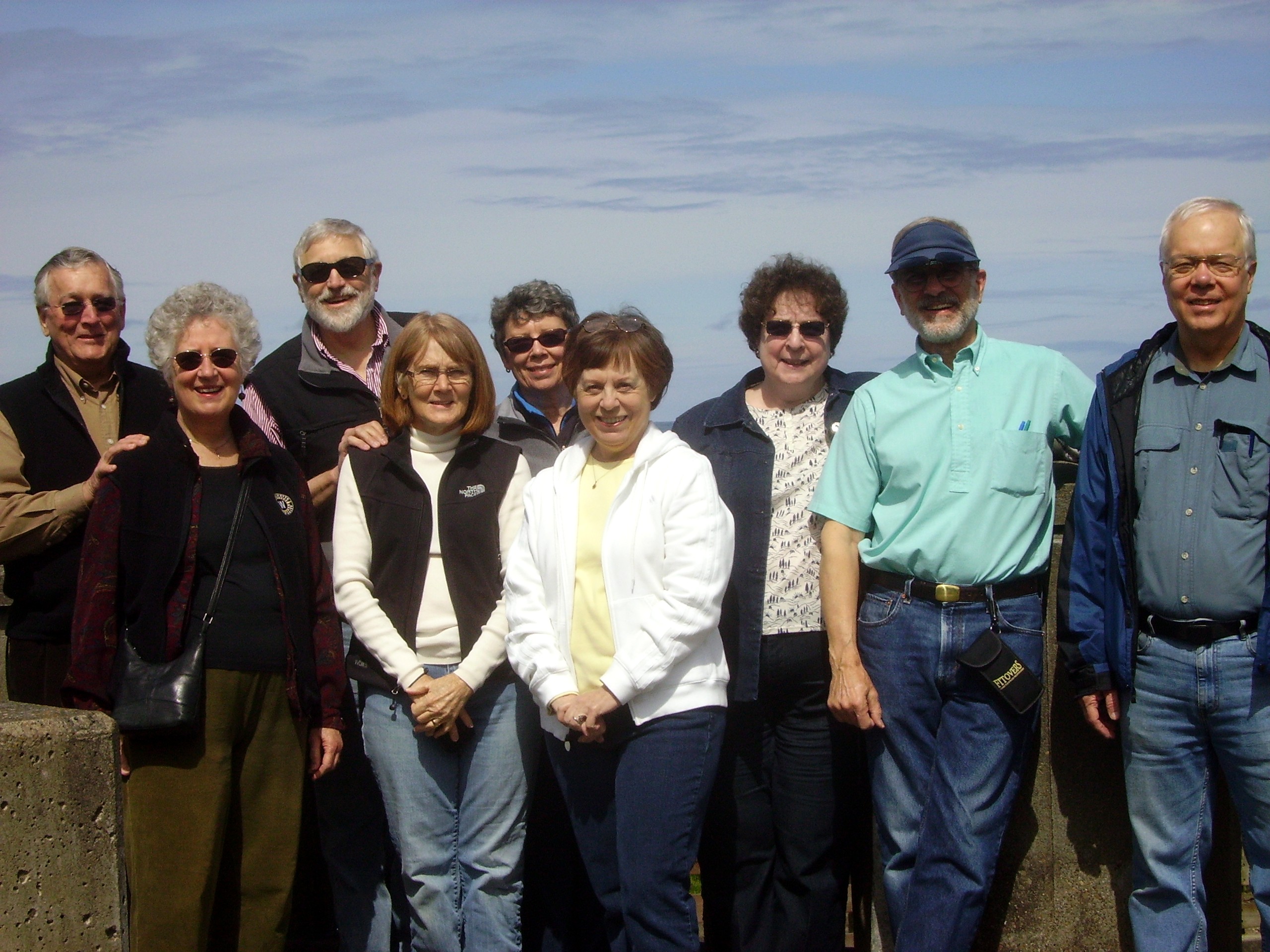
How does that work?  Well, five friends and I started meeting as a book group in 1983.  There aren’t many long-lived book groups.  Most book groups are women’s book groups.[1]  In the fall of 2013, we will begin our 30th year.  One of the friends was my employer at the time, an Oregon state legislator.  One was an education lobbyist in the 1983 legislative session.  They and their wives and I and my wife were the six people.  The next year, each couple chose to invite another person or another couple and very soon we were a group of 12, which is our current number.  Four of the original six are still members.  Here is the most recent picture of us, missing only three.  That’s the Pacific Ocean behind us.  The Sylvia Beach Hotel, famous for its author-themed rooms, is stage right.

We choose books for what I have recently been calling “the reading year.”  There are many different fiscal years; there are calendar years; there are liturgical years. Why not a reading year; an RY?  Following the practice of the federal fiscal year, I propose we date the year by the ending date, so we are just entering RY 2012.  We choose books from October to September.  That’s the RY.  At the September meeting, we will discuss the last book of RY 2011—it is Daniel Schorr’s Staying Tuned—and complete our balloting for RY 2012.[2]

Let me start with the truly shocking news.  Not everyone in the group shared my taste in books.  You heard it here first.  People nominate books I have never heard of and some of which I find really unattractive.  We have read books of poetry by poets I didn’t like.  We have agonized over the impoverished or otherwise distorted childhoods of people who grew up to write nostalgic or angry reflections on that time.  We have read children’s stories.  One month, long ago, we read supermarket tabloids.

In the process of reading books someone else thought were important and interesting, I have become interested in books I would never have read.  Further, some of the books I have read and never did become interested in have nevertheless benefitted me.  I look back on “having read them” with a pleasure entirely incommensurate with the pain of actually reading them—or with the prospect of reading another such book.  So I like reading books I didn’t want to read and nearly every year, the books that have real merit form a larger fraction of the total list.

Tell you what.  Don’t take my word for it.  Here is the list of books from which we must choose nine for RY 2012.  Pretty cool, huh?


[1] I just spent a little time trying to verify those assertions, but I can’t do it in the time I have.  The way I remember it, women’s groups are most numerous, followed by couple’s groups and, distantly, by men’s groups.

[2] I say “complete our balloting” because there will have been at least one round of electronic balloting by the time we meet on September 24.  We need nine books and if we have chosen fewer than nine in the electronic balloting, which has been the case every time so far, the remainder of the books will be chosen by old-fashioned put your paper ballot in the jar politics.  And by old-fashioned politicking as well.

Posted in Books | Tagged , , | 2 Comments

American Exceptionalism

I got a late start on the current discussion of “American Exceptionalism.”  When I was in grad school, there was some talk about it.  The idea at the time was that the U. S., unique among the Western powers, had no experience of feudalism; no deep-rooted anticlericalism; no authentic Marxist reaction to the brutalities of the early Industrial Revolution.  We were the exception.

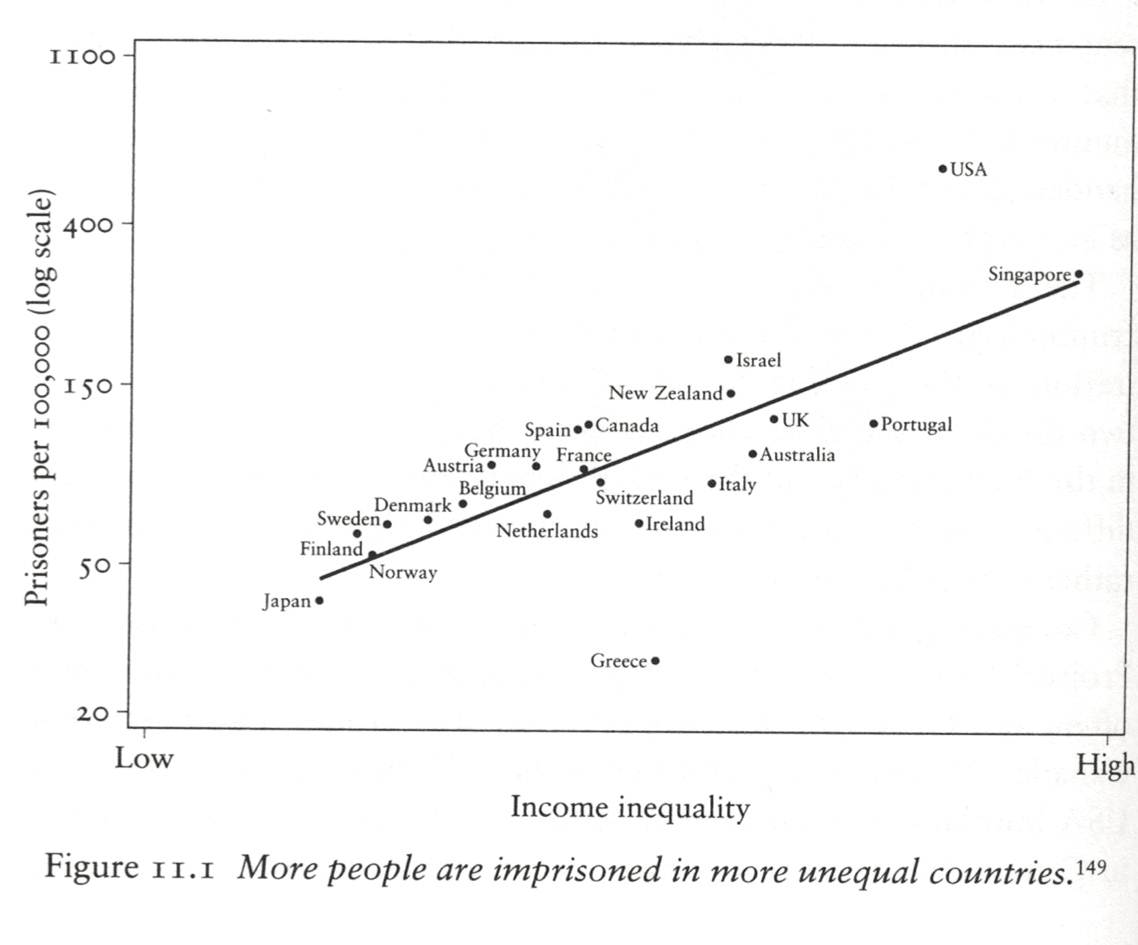
In this post, I am going to pass along some slides my brother Karl found.  Neither of us claims to have developed this information; both of us find it frightening.  Here, I will simply show you the charts and comment on each.

This chart doesn’t need a great deal of comment.  These nation-states are shown by the number of prisoners per 100,000 of population and by how unequally the income is distributed within each state.  Japan has distributed its income most equally of the nations shown here and has the fewest prisoners.  We are at the other end, almost off the chart entirely.  The very highest in income inequality and in number of prisoners.  The authors think there is a relationship between those two facts.  I am simply looking at American exceptionalism.  Here is an example.  When we sing about “the land of the free,” we aren’t talking about the percent of Americans in prison.

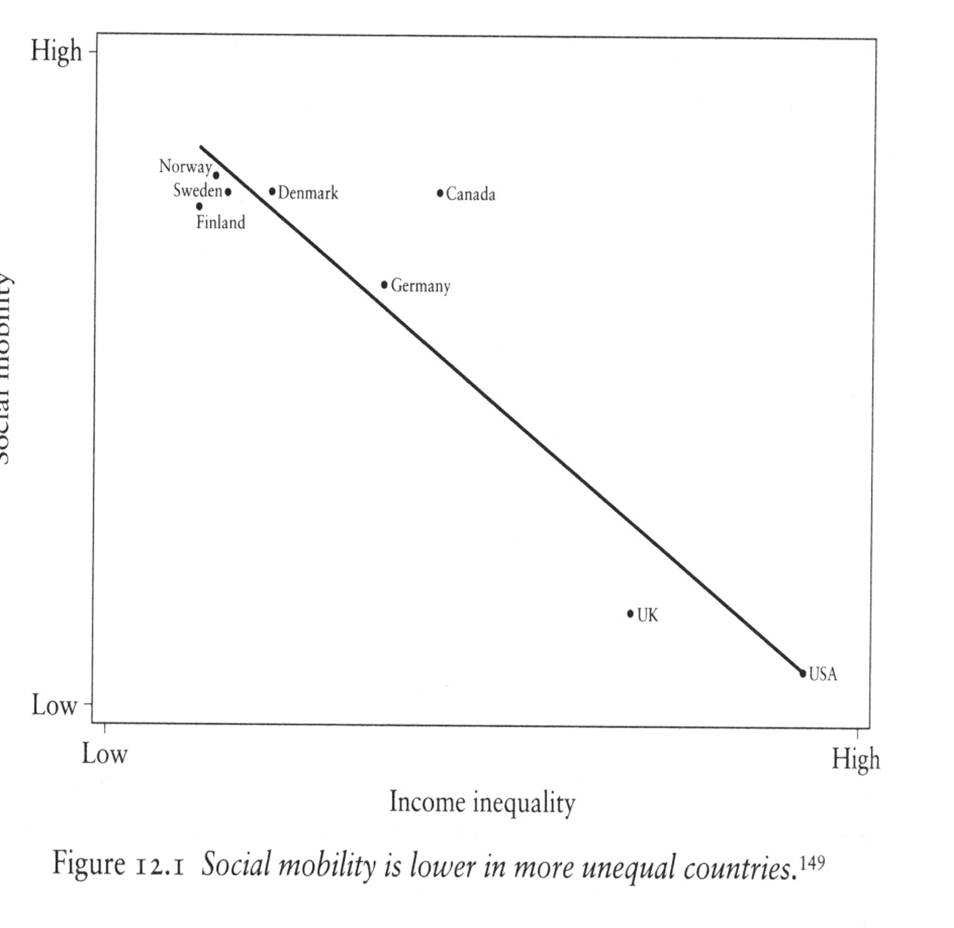
This one looks at social mobility.  In general terms, social mobility is the ability to move “up the ladder of success.”  You have to get pretty deep into the sociological literature before they start to consider moving down the ladder.  Getting up the ladder is a deeply American aspiration.  It shows up, in part, in our wanting to preserve the favorable status of the elites because, you know, we always might become elites ourselves and we would want that status to be there for us, or possibly for our children.

That being the case, it is a shame we aren’t Scandanavian.  The four nations clustered at the top of this scale are the lowest in income inequality—the highest, that is, in “income equality”—and they have the highest social mobility.  No reason at all why a little Finnish child shouldn’t hope to grow up to be Prime Minister.  Again, this chart doesn’t speculate about causes.  It just groups the nations by where they fall on these two measures.  We are exceptional, again, in how unequally our income is distributed and in how unlikely any of us is to improve his or her social standing.

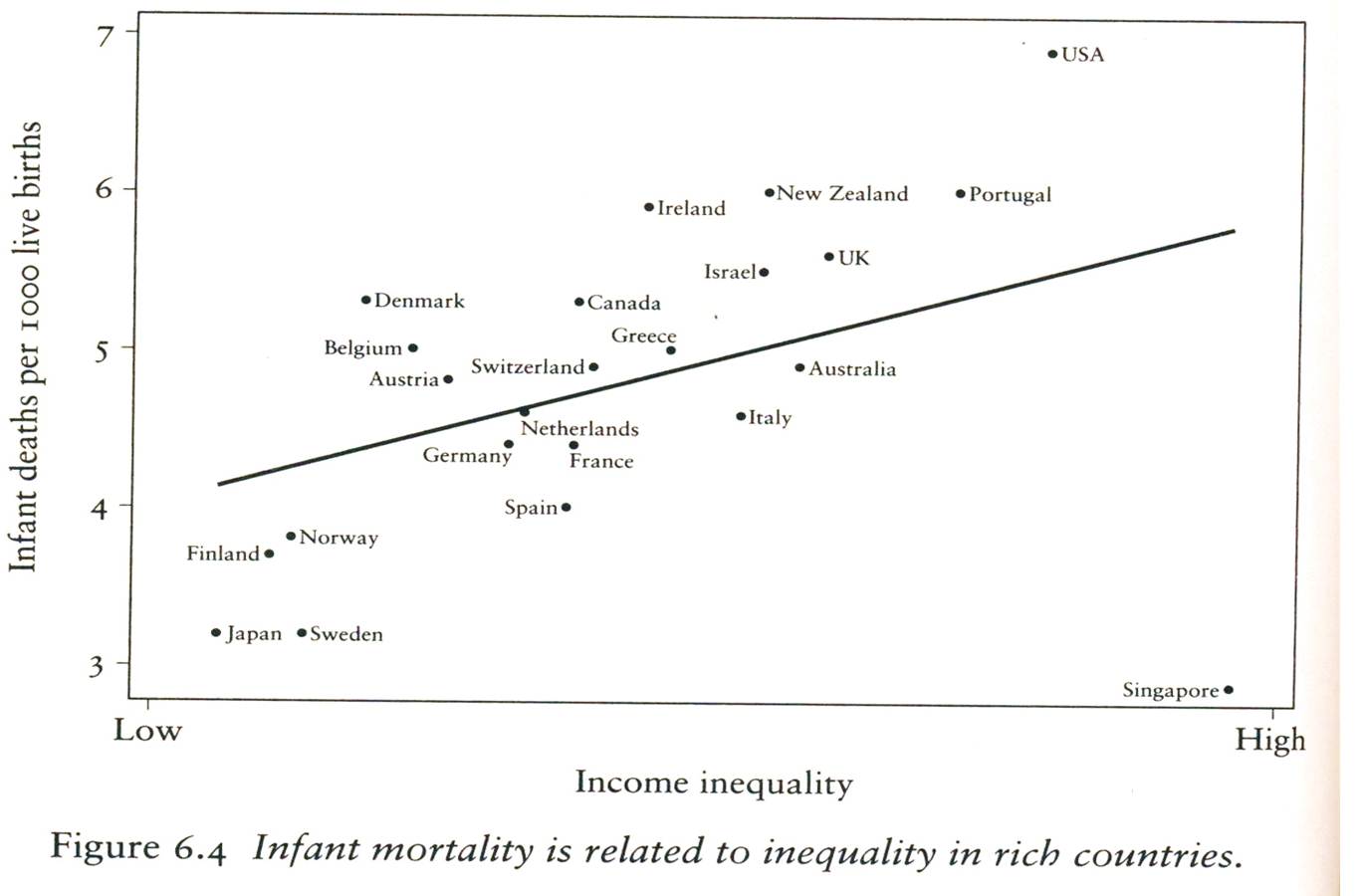
The final chart is a variation on the same theme.  This one looks at infant mortality.  Remember that the bottom line doesn’t measure the availability of income.  You could have a rich nation right next to a poor nation on this chart.  It measures how very little the poor have in that country compared to the rich in that country.  Again, we are clearly exceptional.   Not as much as Singapore, as you see.  Singapore’s wealth is even more unevenly distributed than ours, but the instances of infant mortality are very low.  Ours are very high.

None of this is at all pretty.  I know this isn’t what the current discussion of “American exceptionalism” is about, but maybe it should be.  I’ve just begun reading a very good book on this question.  It is The Spirit Level: Why Greater Equality Makes Societies Stronger by Kate Pickett and Richard Wilkinson. 

A “spirit level” is what Americans would call a carpenter’s level, the one where you try to adjust the surface so the bubble is between the lines.  America is about half a bubble out of plumb, as we used to say at the lumber yard where I grew up.

Posted in Politics | Tagged , | 3 Comments

Federer Plays Erikson, Round 4

Roger Federer had absolutely no trouble with Juan Monaco last night.  Did Monaco have a bad game?  Did it start too late?  Is Roger finally getting focused on the tournament?  He had better start to get focused, because he has Jo-Wilfed Tsonga next and Tsonga is a monster.  Monaco was not a monster.  Federer took him 6-1, 6-2, 6-0.

These are the quarterfinals now.  When this draw fills out, there will be eight players.  If Federer wins, he will get the No. 1 seed, Novak Djokovic as the prize.  That means it is time to look at the Erikson stage not only in terms of what strengths Roger has developed in previous stages, but what strengths he is going to need to beat Tsonga, then (probably) Djokovic, then (probably) Rafa Nadal.

Since the quarterfinals are the fourth round of the U. S. Open, they direct us to Stage 5 of Erikson’s stages.  What is supposed to be going on there?  Erikson places this stage roughly at adolescence and the principal question is, “Who am I?  Really.”  The opponent to be defeated is role confusion; in Erikson’s terms, the dystonic value.  The strength to be attained is identity coherence; that is the syntonic value.[1]  The unchecked, “too much” version of identity coherence is called fanaticism.  The unchecked, “too much” version of role confusion is called repudiation.

Here, from Vital Involvement in Old Age, is a summary of what’s at stake.

It is important [for a person in Stage 5] to identify himself with life goals worthy of commitment and fidelity and to do this with an appropriate knowledge of his capacities.  The sturdy strengths of hope, will, purpose, and competence, which result from the earlier balancing of these stage-specific syntonic and dystonic tensions, will not support these new vital commitments.  But this is a demanding step to be taken, and it is easy to become confused and uncertain about one’s life role and one’s firm sense of “I.”

Without turning the tennis tournament into an allegory, I’d have to say this is surprisingly apt.  When the top players play poor players, they win no matter what the style of the game is.  But when good players play good players, the most important single thing to know is, “Whose game is going to be played?”  We know beforehand that I will win the match if it is all baseline rallies and that you will win a serve and volley game.  I will be trying to get you to play a baseline game, which means I will be hitting the ball deep and trying to make you run for it.  You will be hitting sharply angled shots you can follow to the net or short shots to draw me to the net.  If I know who I am, I will know what kind of game I must play.  Note how disadvantageous “role confusion” is at this level.  Or, for that matter, “fanaticism.”

It makes such sense that the product that best emerges from the struggle of syntonic and dystonic values is FIDELITY.  This is not fidelity to a friend or a partner.  Such a relationship with such a partner is the principal goal of Stage 6.  This is fidelity to oneself and to the view of what is important in life that you have acquired through the frictions of role confusion—with its gift of openness—and identity coherence, with its gifts of closure and commitment.  It is fidelity to the person you now know you are that is crucial here.

This is not so important for the Federer/Tsonga match.  They have played before.  Each man knows what game the other would like to impose; each knows what his own best game is and what strokes and strategies will be necessary to establish it.  It is crucially important in the development of persons.  The players who win, said Jo-Wilfred Tsonga after the match, are those who are “strong in the head.”

If you tend, as I do, to see important questions asked and answered in the movies, you will probably already have been attracted to The Truman Show.  Truman Burbank has lived his entire life on a movie set, surrounded by actors pretending to be a friend or a mother or a wife.  Truman is the only person in the world who does not know who he is.  When he finds out he is, for all practical purposes, a prisoner, he escapes.  Just as he is about to go into “the real world,” Christof the creator and director of the show addresses him and tries to persuade him to stay in this world, even though he now knows it to be completely contrived.  Here’s Ed Harris as Christof.

Christof:         Truman.  You can speak.  I can hear you.

Truman:          Who are you?

Christof:         I am the Creator…of a television show that gives hope and joy and inspiration to millions.

Truman:          Then who am I?

Christof:         You are the star.

Truman:          (Catching on immediately).  Was nothing real?

Christof:         You.  You were real.  (The answer there is really No.  Everything you have ever experienced was contrived, artificial, and manipulative.)

Truman decides, however, that he does know who he is and launches himself on a real life that will be based on that idea.  No actual person is launched quite so dramatically, but it is a common experience to look back at your own life and locate the time when the general contours of the person you now are were first visible.


[1] The book I am cribbing from, Vital Involvement in Old Age, used the term “identity cohesion” here, but a lot of the words that are chosen seem about an eighth of a turn off and I am going to start substitution the form of the word that would be more normally heard.

Posted in Getting Old | Tagged , , , | Leave a comment

Federer Plays Erikson, Round 3

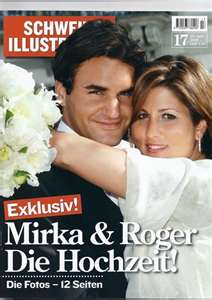
The first week of the U. S. Open tennis championship is drawing to a close and we won’t know anything more about my guy until Monday, when he will be playing Juan Monaco of Venezuela. If you have not been following my attempt to fold the U. S. Open into Erik Erkison’s developmental stages, this post is really not the place to begin but the point of the analogy is this: just as we progress in our lives along our developmental course, defeating one opponent after another, so the tennis players progress along their (mutual) developmental courses, playing one opponent after another.  There are lots of pictures of Roger Federer.  I’m choosing this one because they both look so happy.

I’m using Roger Federer’s path as my focus as long as he remains in the tournament and today, he dispatched the Croat Marin Cilic (pronounced CHIL-itch) in four sets.  Federer didn’t look at all good in the second set and I wasn’t sure how things were going to go, but something good happened—he found a new strategy or a new focus or Cilic started to wear down—and the third and fourth sets went smoothly.

So from an Eriksonian standpoint, who was Federer’s opponent in Round 3?  I’ll put the short answers here so we can play with them a little.  Federer’s opponent was inferiority.  That is the dystonic value in Stage 4.  Federer seeks in Stage 4 to achieve what they call “industriousness,” but it used to be called industry.  We call it “hard work” sometimes today.  Here, in Edmund Burke’s well-known letter to his constituents in 1754, is the use of “industry” I will mean.

Your representative owes you, not his industry only, but his judgment; and he betrays, instead of serving you, if he sacrifices it to your opinion.

Your representative owes you his hard work—his industry—and his own judgment as well.  In the expanded presentation I am following (Erikson, Erikson, and Kivnick’s Vital Involvement in Old Age), they consider the unconstrained victory of the syntonic value as a maladaptive tendency.  In this stage, it is called “narrow virtuosity.”  They consider the unconstrained victory of the dystonic value to be a malignant tendency; they call it “inertia.”  Those unhappy states are where a person runs the risk of sliding off if there is a clear victory of industry or of inferiority.

The ideal, in the Erikson system, is for the syntonic value to triumph (industry, in this case) but only after having had to struggle with the dystonic value (inferiority, in this case).  The virtue one carries forward in that case is COMPETENCE, which is what industry produces when it has learned that it needs to take the threat of inferiority seriously.[1] 

I began in the last post to see that a straight tradeoff is implied in the developmental scheme.  If there is too much of the dystonic value, the first place to look for effects is in the syntonic value.  For example, I speculated in the previous post that guilt had played too large a role in my life and wondered aloud if it had had the effect of reducing my readiness to take initiatives.  In thinking of my own life in Stage 4, I would wonder if too large a sense of inferiority had produced a deficit of hard work on my own behalf.  It’s a question worth asking and it is given a very useful shape by Erikson’s scheme.

For me, I think, the answer is that it did not.  There were quite a few times in my life—Erikson has school age children in mind here—when it might have.  I hit speed bumps several times that brought me to a place where I just stopped trying.  But then I started trying again and gained both a sense of my own competence, but also a sense of what is most apt to damage it.  It is that awareness that has kept me from swerving too far into narrow virtuosity.  I think you’ll agree that a man who has titled his blog, “the dilettante’s dilemma” has escaped “narrow virtuosity.”

The other interesting speculation, though, is how the deficit of initiative that I brought with me from Stage III affected my development in Stage IV.  I think the line there is clear.  I have often attempted to make up for the somewhat tattered initiative of Stage III with a very vigorous display of “effort” in Stage IV.  As I look at the chart, it seems to me that I have tried to make up for the lack of vision and daring with a lot of hard work, substituting the syntonic value of Stage IV for the syntonic value of Stage III.  Erikson is clear that you take both your successes and your failures with you when you face the next opponent.  I may have taken the partial failure of Stage III with me and attempted to remedy it—Erikson says you can actually do that—in Stage IV.

So, for Roger Federer, Juan Monaco of Argentina is next. This is the round of sixteen at the U. S. Open, what they would call “the Sweet Sixteen” in college basketball’s March Madness.  It will be round 4 of the tournament, so it will be Stage V of Erikson’s scheme.

Talk to you again on Monday.


[1] Last night, my Oregon Ducks were pounded on national TV by the LSU Tigers.  The general run of press comments in Oregon today matches the Erikson tradeoff exactly.  Oregon’s highly respected offense (industry) has just taken a slap of inferiority in the face.  If it handles that public humiliation properly, it will approach COMPETENCE as the season continues.

Posted in Getting Old | Tagged , , | Leave a comment