The Fret of Care

Today, I am working with a title from one world and an event in another. The title comes from a hymn we sang in my church when I was a little boy.  The whole line, adapted to today’s question is, “O Master…help me bear the strain of toil, the fret[1] of care.”  The event is the current movie, Amour, which has been nominated for five academy awards.  If you have seen it, you know why the expression, “the fret of care” came to my mind.

Spoiler Alert: I’m going to talk about what happens in the movie.  Some people would rather find out at the movie what happens.  I am not one of those.  I am more likely to go to a movie to see what I know is going to happen.

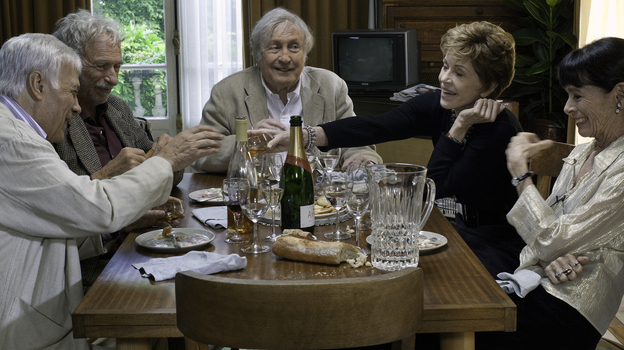
Georges (Jean-Louis Trintignant) and Anne (Emanuelle Riva) are in their 80s, creaky but happy.  They appear to have had a full Fret of Careand satisfying life and that life goes on.  One morning at the breakfast table, Anne has a stroke and their life becomes more stressful.  Then she has another, with which they cope as best they can.  Then another, a more serious one, and they simply run out of coping resources.

Now what?

Georges agreed to honor her urgent request that she not be placed in a care center of any kind, but she said that and he agreed to it after the first stroke.  Now there is no chance to renegotiate the agreement, so Georges sticks with it.  He gives himself full time to caring for Anne, which she appreciates in the beginning, but as she sees him start to slide, she urges him to live a life of his own.  Get out, see friends, go to concerts.  He won’t do that.

Amour after the strokeThe guilt Anne feels as the proximate cause of Georges’s dutiful despondency weighs on her, but there is nothing she can do about it.  She seems to feel a despair about her own life, but I think it may be more the grinding sense of guilt about what she is doing to her dear husband.  He has trapped her in her guilt and it is more than she can bear.  That’s how I saw the story.

The movie meant a lot to me because I had done a lot of thinking about it before.  It took my wife, Marilyn, about two years to die after her cancer was diagnosed.  During a fair amount of that time, there wasn’t much her body could do, but her mind was a sharp as ever.  I wrote some essays during that time and we read them together.  She liked them.  She wanted to be the woman in those essays, she said.  She was, actually.  I modeled the woman after her.  And she was grateful that I was trying to be the man in those essays.

Here are a few of the things she liked.  They were written in the winter of 2003, the year she died in August.

The principal responsibility of the partner as caregiver is to see to it that care is provided.  Some things can be done only by the partner.  Others can be done by family and friends, but it is the partner’s job, always, to see to it that they are done.  Not that they are done “his way,” but that they are done to the satisfaction of the recipient.

The caregiver’s principal job is not to provide all the services his partner needs.  He can’t possibly do that, for one thing.  But also, he should not because it will cost him more resources than he has, or than he has access to.

And also:

Committing to the work when the caregiver does not have adequate resources is more likely to produce denial than adaptation.  I can always say I have more resources than I have, meaning that I surely must have more than I know about.  I can always say that the cost to me is acceptable, when everyone who knows me can see how my life is distorted by the burden I am, at the same time, bearing and denying.  And by slow and steady steps, I become, under those pressures, a husband less and less familiar to his wife, a man less sought after by his friends; a man who would rather live an impossibly shrunken life than claim a life of his own and find the resources to live it.

And finally:

In any case, however the caregiver justifies his choices, his job is to do gladly, as he is able, the services he does for her.  And to do generously what he cannot do gladly.  And to block, in any case, any appearance of unwillingness to do what needs to be done.  Unwillingness hurts.  Joyless duty hurts.  And if he feels that way about the tasks that have fallen to his lot, he should find a way to keep it to himself.

For every point about the caregiver, there was a point about the receiver of those services.  Marilyn said she “aspired” to them, but in fact, I formulated them by writing down what I saw her doing.  Maybe I’ll write about that side of the relationship some time.

You can see, in any case, why I found the movie so attractive.  It is a beautifully written and sparely filmed story.  It’s beautiful and it’s worth thinking about.


[1] The OED says there is a meaning that has a transferred sense of  “slow and gradual destructive action, as of frost, rust, disease, chemical corrosives, friction, the waves, etc.”  That’s the kind of “fret of care” I was thinking of.

Posted in Getting Old, Love and Marriage | Tagged , , | 3 Comments

What is God like?

This is one of those “Why is the grass green?” kinds of questions.  I do want to try to answer it in the third of the pieces that make up this blog, but I have two prior questions.

The first is this: Don’t we already know what God is like?  We have an entire library full of stories about Him.[1]  I am thinking here of the sixty-six volume library (Bible) that we use in the Protestant tradition.  This library contains, among other things, both stories and propositions and I am thinking here more of the stories more than the propositions. This being the case, the question becomes, “What do these stories teach us about God?”

The stories reflect the history of the Hebrew people and their continuing reflections persistent widowabout the stories of their origins and their covenant with Yahweh.  That means you could say, in one sense, that the God we know about is the Hebrew God.  But the Jews and Christians (and Muslims) are monotheists and believe that there is only one God, so the expression “Hebrew God” is not really  a good one.  It imagines that each people has its own God, so we could talk about the Hebrew God and the Babylonian God (interesting question of capitalization there) and so on.  Or we could mean “God as the Hebrews imagine Him to be, based on their long history of interaction with Him.”

I think that’s a pretty good answer, but I have to tell you that I am a modern German (by ancestry and to an unusual extent, by culture as well) and I come to this treasure house of Hebrew experiences as an outsider in every way.  I read these Hebrew stories and I note what conclusions the writers (and rewriters) drew from them and I wonder they are the right conclusions.  The God of the Hebrews is just so….Hebrew.

When I was a boy and I learned “what God is like” by spending a lot of unsupervised time in the Holy Library—everyone in my family had a Bible of his own—I learned that the conclusions the Hebrews drew were all true.  Actually, I didn’t learn that.  I took the truth of the accounts for granted, which is not exactly the same thing.  And now that I am not taking them for granted anymore, I find myself, a well-read Christian of scholarly habits, asking really naïve “Why is the grass green?” kinds of questions.  Why me, God?  Why now?

This brings us to the second point.  The implication of the foregoing line of thought is a commonplace, indeed it is a beginning place, for religious ethnographers.  Every people ever studied has devised a god (or some gods) of some sort that can serve as the repository of the highest and best traits of that people.  Where generosity is prized, God is supremely generous.  Where justice is prized, God’s justice is praised.  We decide on our best traits, project them onto a deity, and multiply for 1000.  And so on.  This would lead, in another essay, to the question of whether anyone is actually right about the nature and character of the One True God, but it will not happen in this essay.  This leads, in this essay, to a much easier question, which is, “What is a good parent like?”

Not so hard, you say.  A good parent raises children who think and feel and act as children should.  Or, from an ethnographic point of view, we say, “…as they should in that culture.”  There are cultural norms that apply to the behavior of children and children who conform to those norms—that would include the norm of adolescent rebelliousness in our culture, by the way—are “good children.”  Good children had a good parent.

But when we begin with the idea that the characteristics of successful parenthood vary from one culture to another, we can come back to our original question and ask just how God is a good parent.  Let me simplify all the possibilities by imagining that there is a Hebrew style of good parenting and a German style.  I don’t want to stereotype modern Germans, so I will use the well-known and ancient norms of the Stoics to represent “Germans.”

Imagine that a child has a desire and makes this desire known to a good Hebrew-styleask and you shall receive parent.  Let’s say that the function of an expressed desire, in this system, is to affirm and clarify the relationship between parent and child.  The child says “Please…” and parent says, “No.”  The child says, “…just this once?”  No.  The child says, “…if you really loved me…”  No.  The child says, “I’ll be good all week if you say yes.”  The parent says “Yes.”

Is this good parenting?  In this mode, which I have invented and aligned to a hypothetical Hebrew model, the answer is yes.  The request was in play for a long time.  The child and parent are kept in relationship for a long time.  The solution to the dilemma was both rewarding and instructive.  What’s not to like?  Unless, of course, this was happening at the table next to yours at the coffee shop.

Now imagine that the child has a desire and makes this desire known to a good German-style (Stoic) parent.  Let’s say the function of an expressed desire, in this system, is (primarily) to make a decision about the desire and to (secondarily) affirm the relationship between parent and child.  The parent in this system is imagined to be thoughtful and fair-minded, committed to the well-being of the child, and concerned that, over the long run, desires like this and the best response to them, will be internalized and become part of the child’s character.  The child says, “Please…” and the parent says, “No.”  The child goes off and considers what has been said.  The child returns and says [please substitute the child-like pleading language of your choice here] “I know you said No when I asked you earlier, and I will, of course, respect your wishes and your wisdom, but I wonder if you had considered X in your answer.”  The parent says, “Yes, I did consider that.”  “Ah,” says the child, “Thank you.”  And he goes off, satisfied.  Eventually.

The solution to the dilemma was both rewarding and instructive.  What’s not to like?

Two “good parents.”  Two “good children.”  Two irreconcilably different styles.  One of these represents “What God is like” as I learned His character from the Bible as I read it as I was growing up and the other represents the culture in which I was raised (to a certain extent) and my own cultural preferences.  Is God really like “that other style?”  Really?

Let’s consider some texts.    I have three stories in mind.  Each of these can be interpreted in the Hebrew mode or in the German mode or they were written down to be compatible with the Hebrew mode.  If you don’t know that there are many styles of interpretation, you read every example as if it were a window to the Truth.  If you know that there are many styles, each window has a truth of its own, and you have to choose.  You can’t, after all, stand at all the windows.

One of the best-known Jews of the first third of the First Century used this logic once.  “If you, being evil, know how to give good gifts to your children, how much more will your Heavenly Father give good gifts to those who keep on asking Him?”[2]  You noticed the “keep on asking” did you? The verb is in the present tense in the Greek, a tense that presupposes continuing action.  You need to ask and ask and ask; you need to keep on asking.

Or this one.  God is said to be like a judge.  A widow brings a legal case to this judge, demanding that justice be done.[3]  The judge, for reasons we are not told about, is not particularly interested in justice in this case.  But the woman won’t leave him alone.  She pounds on the door.  She scratches on the window.  She leaves notes in the mailbox.  She hacks his computer.  Finally, the judge—the judge is the God-figure in this story even if He is not the main character—gives up and makes the judgment on behalf of the widow just so he can have a little peace and quiet.  The story is told so as to approve the persistence of the woman.  Asking, even when it reaches a level that looks very much like harassment, is not too much.

The final story has to do with bargaining behavior, but I will indulge myself in a personal story on the way.  When I was young, I learned the expression “to jew down” to mean to bargain aggressively to bring down the price of an item.  I knew “to jew down” long before I knew what “Jew” meant or that the expression “to jew down” was pejorative.  You know how this goes.  When you learn that it is offensive, you stop using it, but you never actually forget it.

Abraham bargainsSo God is about to destroy Sodom and Abraham, the good guy, doesn’t want him to.[4]  “Will you spare the city for the sake of 50 righteous people,” Abraham offers.  “Well OK,” says God, “but you have to find the 50 people.”  Abraham looks and comes up short.  “So, what about 45 righteous people?” he says.  “Would 45 be enough?”  If I were reading this, I would play it for comedy.  Abraham offers, after God accepts, 45: 40, 30, 20, and 10.  Here’s Abraham, the Prototype Jew bargaining with God—please remember my introduction to this notion, when I was young—to bring the price down.[5]  It just tickles me.

In this story, we have not only the continual bargaining, but a divine tantrum as well.  God is angry and wants to destroy everything, but He can be sweet-talked out of it if you know how and if you stay at it long enough.

These three stories align perfectly with God as the Hebrew parent.  Here’s a way you could characterize it.

The request [to save the city] was in play for a long time.  The child [Patriarch] and parent [God] are kept in relationship for a long time.  The solution to the dilemma was both rewarding [for the community of faith, in whose repertoire this story is kept and treasured] and instructive.

None of this makes any sense in the Germanic model.  God would have had a really good reason for saying No in the first story and perpetual nagging [asking and asking and asking] is not going to change that good reason.  “No, you may not tidy up your little brother’s hair with those scissors so he will look nice at the photographer’s studio.  No.”  God’s having a good reason for what He said casts a new light on the behavior of the “good child.”  In this model, God is not a fearsome tyrant.  You get to ask why, if you do it respectfully and only once, but when the answer has been reaffirmed, you accept the wisdom of it and arrange your own plans accordingly.

God the Judge, in the second story, is a good deal more oriented to justice than any of the participants is likely to be and much more acute about what justice actually entails.[6]  That means that the widow is not only entirely out of control, but also mistaken.  She doesn’t see the whole picture; she is fatally self-interested; she has no proper respect for the magistrate.[7]  She’s not putting the team first.

God the Vigilante in the third story has a really good reason for destroying the city and if it would take 50 righteous men to save it (and if Abraham can find them), then 45 righteous men aren’t really going to do the job and agreeing to the lower number would be either foolish or stupid.  God is not foolish or stupid.

So what is God like?  Here’s where we (Christians, Jews, and Muslims) are.  We have the stories.[8]  We understood what they are meant to teach in the cultural settings of their origins.[9]  If the God of those stories conforms to what “good parent” means to us, then our job is done.  If not, we are faced with the choice of changing what we mean by “good parent” or changing what lessons about God should be drawn from the stories. 

So here’s the third piece.  I know it’s been a little bit of a hike.  If you need a nap or a breather or something, now would be the time.

If you come from what I have been calling “the Germanic model,” you can look at how very Hebrew the stories are and call those characteristics of God “artifacts” of the story.  They aren’t really, that is to say, what God is like; they are just  the costume the storytellers have dressed God in so that He can be understood and revered in a culture like theirs.  Since we of the Germanic mode know that God isn’t “really” like that and since we still have those same stories to work with, we reinterpret them.  We are now free to reinterpret them.  In fact, in this way of understanding it, we have the obligation to reinterpret them.

This returns us to the original question: Don’t we already know what God is like?  The answer now is, “Not really.”  We know what clothes God has been given to wear in the stories the Hebrews told about their God.  We can see how completely aligned the Hebrew character—we have considered only the parent/child roles—is with “God’s character.”  We have stopped trying to model our own behavior after this very Hebrew-like God and have begun to wonder whether God could not be understood differently if the stories could be understood differently.  This would give us the possibility of a Germanic or Stoic God whose character is an extrapolation from the values we hold most dear, rather than from the values they held most dear.  This God is a thoughtful, a caring , and a decisive God.  Wheedling doesn’t really work.  Pouting really doesn’t work.

Here’s an example.  The awful wrestling Jesus enduring in Gethsemane before his crucifixion can serve as an example of the two styles.  In the Synoptic gospels—Matthew, Mark, and Luke—Jesus arrives at a place that makes as much sense to the Hebrew culture as to the German.  “If this cup cannot pass away unless I drink it, it is not what I want, but what You want that matters most.”  His mother said the same thing to the angel Gabriel.  “Let it be done with me as you have said.”  The process Jesus went through to get to that acceptance is gut-wrenching.   It is fully in accord with the Hebrew notions of what “doing it right” looks like.  It is not in accord with Stoic conventions and the depth of Jesus’ distress had to be justified somehow to Gentile hearers.

The values of the Hebrew people, in other words, are no longer taken as determinative of the character of the One True God. Their stories are earlier, but they are not better.  They reveal a Truth to us and distort that truth at the same time.  This leads directly to the project of re-envisioning God according to our own values.  We would have a God, let’s say, who is not so vulnerable to tantrums; a God who actually has a good reason for doing what He is doing.

Anthropologists and theologians speak knowingly of “creating a god in our own image.”[10]  You have to admit it is witty.[11]  On the other hand, if what these faith traditions give us is a costume for God not a culture-neutral insight into God’s true character, then every community creates the costumes that represent “what God is like” for them. This ought to work as long as you remember that you are talking about the clothes, not the Person. 

And consider the alternative.  We would continue to construe God as a person of traits we disdain in every other context of our own lives.  That’s hard.  And eventually, you learn not to care.  That’s worse.  Then you learn not to notice and the game is over.  And you lost.


[1] This might be a good time to reiterate my solution to the “gender of God” dilemma.  I think it is ridiculous to imagine that God has a gender.  The solution I was taught in elementary school was that for circumstances where a gender designation is unavailable or inappropriate, one uses the neuter from of the pronoun.  The neuter form mirrors the form of the masculine pronoun, but is not the masculine pronoun.  I know now everyone is happy with that solution, but it keeps me away from three alternate “solutions” that I find nauseous.  One is to refer to God in the pronoun form as he/she/they.  Another is to invent the pronoun “Godself” to refer to Him/Her/Them.  The third is to foreswear pronouns entirely and repeat “God” where the pronominal form would ordinarily be.

[2] That’s Matthew 7. I’ve skipped around a little in verses 7—11.  The language is in the archaic King James Version, which is the form imbedded in my memory.

[3] Wonderful story.  See Luke 18.

[4] This one’s in Genesis 18.

[5] I had the discipline to refrain from calling Abram the Ur-Jew in the text, but here in the footnotes, my normally steely self-discipline has given out.

[6] In our faith, we say that God is a God of both justice and mercy.  I admit that is more complicated, but it is a complication for another day.

[7] Since this is a mostly religious post, I’ll pause to note that the magus in magistrate means “large, great” while the minus in minister, means “small, humble.” 

[8] There is additional literature in all three cases.

[9] Just don’t get really fussy about “origins.”  The Hebrew people picked up a lot of well-used local stories from their neighbors and Hebraized them so that they taught the right lessons to their own people.

[10] The literal meaning of “idolatry,” by the way.  The Greek for “image” is eidolon; for “worship” is latreiuo.

[11] See Genesis 1for the original version of this line.

Posted in Biblical Studies, Uncategorized, ways of knowing, Words | Tagged , , , | Leave a comment

Doing What You Can

Back in the old days, before doctors were able to cure many illnesses, a big part of “medical care” was being with the patient.  Just being there says things that can’t be said otherwise, principal among them is, “You matter so much to me that I am spending time with you, comforting you as I am able.”

It seems to me that as medicine has gotten better, the gift of human comfort has gotten poorer.  We still do it—we still spend time with the people who are ill—but we think more about recovery than we used to and less, it seems to me, about comfort.  Nothing about the medical regime that will return me to health says. “You matter this much to me.”

I got to thinking of this as I watched the bittersweet ending of a very good French movie called All Together.  I want to tell you enough about the movie that you mAll Togetheright understand what I want to tell you about the end.

Five long-time friends decide to move in together.  At first it looks like a simple efficiency.  They spend all their time visiting each other anyway.  Each of these five people, the three men more than the two women, is having trouble letting go of who he has been in the past.  Albert’s memory is going and he flickers in and out of the present.  Jean, the political activist, is an old man now and can’t even get himself arrested at a public protest.  Sex means everything to Claude, but his heart attack complicates that as well, even with readily available prostitutes.  Even so, each of the five is present for the others in a meaningful way.

It is Jeanne, Albert’s wife, who introduces the dilemma I want to point to.  She knows that he is so forgetful that he cannot manage on his own.  She also knows she is dying of cancer and that when she is gone, the remaining friends will not be able to care for him anymore.  She dies and has just the funeral she wants, complete with the bright pink coffin she is shopping for when we first meet her.  Albert comes to the service with the other friends.  But later in the day, he can’t find her.  He has no recollection of the funeral.  In his present confusion, he no longer knows she is dead and he goes out looking for her.

The remaining three friends look at each other, weighing the task of telling him, yet again, that Jeanne has died.  They decide not to. Albert is quite agitated.  He decides to go out looking for her.  The other three, worried about letting him wander around on his own, go with him.  He begins to call her name.  Where could she be?

At that point, an emotionally powerful moment occurs.  The friends understand that Albert can no longer join in their life.  They decide to join his instead.  Each of them begins to call “Jeanne,” just as Albert does.  They walk along together.  Albert is calling Jeanne’s  name and looking for her.  The friends are walking with him and calling her name as well.

There isn’t a satisfying end to the story.  There can’t be.  Albert’s daughter will come and get him and put him in a place where he can be cared for and watched over.  Jean and Annie and Claude will go back to their house and live as best they can.

So it isn’t really the ending that got me and that I offer to you today.  It is the choice the friends made and that I admire.  They do what they can.  They walk with him for a long time, honoring a lifetime of friendship by calling out his wife’s name.

This is a situation our medical advances have not caught up to.  No one can heal Albert.  The best we can do is walk with him for a little while and help him search for his wife.  It is an honest choice and a hard one.


Posted in Getting Old | Tagged , , | 2 Comments

How are the prospects for President Obama’s second term in office?  Pretty good, I’d say, all things beinpoll 2g considered.  The President is duly aware of what he calls “locusts”—unforeseen events that swarm the political landscape and destroy the prospects for anything good to grow there.  He knows that a lot of otherwise promising presidential second terms have faltered and failed and he knows that his second term might be like that.  Or so says today’s New York Times.

On the other hand, the New York Times released yesterday the poll that they conducted, with CBS, on January 11—15 and it looks pretty good. (I just love it when they publish polls.)   Here are five things I like about his prospects.

1.         People are not at all excited about the new healthcare prospects of the Patient Protection and Affordable Care Act (hereafter P-PAC, in honor of apollingll the peas I harvested for Del Monte in the summer of 1958).  A third of the New York Times/CBS sample would like to see the entire law repealed.  That is 1% less than the number who identify themselves as “conservative on most political matters.”  Some (19%) would like to see the requirement that individuals purchase health insurance (the individual mandate) repealed.  Some (18%) would like to keep the law as it is.  A few more (24%) would like to see it expanded.  I think that’s not too bad for a law that has been trashed without much subtlety and the benefits of which have yet to kick in.  It is reasonable to expect that people will be more favorable about P-PAC when they have experiences with it and not only warnings about it.

2.  Also, the economy is thought to be improving, and not just by economists.  When the economy improves, the President is thought to be smarter, more decisive, nicer to his children, and more likely to be a Christian (rather than a Muslim) and to have been born in the United States.  A substantial minority (40%) of those surveyed are not concerned at all that they or someone else in their household might be out of work in the next 12 months.  Except for the number a month ago, you have to go all the way back to the summer of 2011 to get more than 40% on that question.  And an additional 33% say they are only “somewhat concerned.”  An additional 27% say they are “very concerned,” but that number hasn’t been lower than 30% since the summer of 2009 and I think it will continue to decline unless there are “locusts.”

The more general numbers about the economy are not as rosy as that.  Those who disapprove of “the way Barack Obama is handling the economy” outnumber those who approve by 49% to 46%.  On the other hand, there aren’t that many people, it seems to me, who can distinguish between Obama’s handling of the economy and the condition of the economy.  And, in answer to the “condition of the economy” question, 32% say “good” or “fairly good,” while 66% say “bad” or “fairly bad.”

3.  The political side of these economic questions always asks who you would rather have making the decisions and what approach to the decisions you have more confidence in.  President Obama has been fortunate in his enemies.  Some support for my contention that President Obama’s situation is pretty good can be found by looking at the people’s alternatives.  Speaker of the House John Boehner is not thought to be handling his job very well—49% disapprove; only 29% approve.  Majority leader Harry Reid, over in the Senate, is in pretty much the same boat—45% disapprove and only 29% approve.  So people would rather have the executive branch in charge of framing and answering the questions than the legislative branch.  Note that this is not a Republicans v. Democrats question.  It is an executive branch v. legislative branch question.

4.  One of the framing questions is who is responsible for the economic slump we are still experiencing.  After four years of trying to cope with this question, Obama is still seen as least responsible for causing it.  In the blame index, he gets 13%.  Everyone else gets more: the Bush administration 27%, Wall Street financial institutions 19%, and Congress 14%.

And it gets worse.  Who do you trust more to make the right decisions about the nation’s economy?  Obama 50%, “Republicans in Congress,” 35%.  The right decisions about the budget deficit?  Obama 50%, Republicans in Congress 37%.  The right decisions about taxes?  Obama 52%, Republicans in Congress, 36%.

And how should these agreements be arrived at?  Should they be produced by compromise as both Speaker Boehner (intermittently) and President Obama (persistently) have said or by “sticking to the original positions,” which characterizes a portion of Boehner’s majority in the House so large that he couldn’t get Republicans to pass a bill he wanted them to pass?  Most Americans favor compromise (84%) over “stick to the positions,” 11%.  The Republicans in Congress are particularly at risk here because 80% of those surveyed said they should compromise and only 14% said they should stick to their positions.[1]  People feel that the best way to reduce the federal budget deficit is a combination of raising taxes and cutting spending—Obama calls it “a balanced approach.”  The combination gets 61% of Americans, where just raising taxes gets 3% and just cutting spending gets 33%.

5.  Of course, not all the questions Americans have are about the economy.  We seem to like what the President is doing on foreign policy (49% approve to the 3obama redux6% who disapprove).  People are optimistic about the next four years of an Obama administration (59% optimistic v. 38% pessimistic).  People are confident in Obama’s ability to make the right decisions about Afghanistan: “very confident” and “somewhat confident” total to 62%;  “not too confident” and “not at all confident” total to 36%.  The same groupings show confidence in Obama’s ability to make the right decisions in protecting the country from a terrorist attack (69% to 30%) and the right decisions about immigration (55% to 44%)

People don’t trust President Obama overwhelmingly, of course, but they trust him on a lot of things.  And they trust “the Republicans in Congress” or Speaker John Boehner even less.  They would rather see the crucial decisions made in the executive branch than the legislative branch.  They favor the approach to handling the deficit that the President (and occasionally the Speaker) favors, but not the approach the conservatives in the House favor.  They are optimistic about the future.

If I held a federal office—God forbid—I would much rather be in the President’s shoes than in anyone else’s.


[1] That doesn’t reflect the majorities in the districts that sent these Congressmen to Washington, of course, which is another problem the Speaker faces.

Posted on by hessd | Leave a comment

The Value of Routines in a Marriage

I have been a husband for a long time now and I have learned something about being married.  At the very least, I have learned something about being a husband in the kind of marriage I want to have.  Just to head off some easy objections, I am not claiming that the kind of marriage I like (and that I have) is better than other kinds.  Without question, there are horrible marriages that demean and impoverish the husband or the wife or both.  Let’s grant that and move on.  There are also many kinds of marriages that are not at all like mine, but that suit the husband and wife perfectly—it is the kind they chose; the kind they have achieved; the kind they like best.  I’m happy for all such people.[1]

I am saying exactly that about the kind of marriage I now have.  Though the social scientist in me wants to be sure to say that there are many good kinds, the husband in me wants to say that this kind—the kind I am going to be writing about—is the kind I like best.[2]

And for today, I want to think about one part of this kind of marriage.  I call this part “routines.”[3]  You could call them “set pieces” or “practices”[4] or any one of a number of things.  You will know what I am talking about by my description.  I’m still looking for a good name for the category.

Routines are little habits that are put into the marriage or that just show up and one routines 4day you recognize that they have been there for a good while.  Let’s take the car door routine as the example for today.  When we are going to go somewhere in the car, I open Bette’s door and “help her” into her seat.  When we get there, I go around and “help her” out of the car.[5]  That’s the whole thing.  At least, it is the whole thing you would see if you were watching.

Of course, to us, there is more.  For one thing, the kind of marriage we have tops the cake of equality with the icing of asymmetry.  Neither of us has any interest in a “head of the household” status.  Neither of us thinks one of us is more important than the other.  We believe in equality as a matter of social theory and, because of our prior marriages, also as a matter of chastened experience. 

I called that the “cake” mostly so I could spend some time on the icing.  If the cake is our equality, the icing is a joyful appreciation of our different roles.  It isn’t, for instance, that I open her car door for her and, in turn, she opens my door for me.  There’s no asymmetry there.  For us, the exchange is that I open the door for her and she expresses her appreciation to me.  She likes having the door opened and I like doing something she appreciates.

It isn’t very complicated.  It is simply an exchange of gifts.  I give her something she likes and she responds by giving me something I like.  If we had a devicroutines 5e that opened the door remotely, she would hand me the device and I would open the door remotely and help her into her seat.  It isn’t practical at all.  It’s just a routine that reminds us of the cake and the icing and how much each of us likes icing.  You could almost call it chivalry, except that chivalry had a very practical aspect as well, protecting maidens from dragons and all that.

Of the other things I could say in praise of marriage routines, let me choose just one more.  This one is a little more complicated, but it isn’t more complicated than the average teen romance novel, so I am going to chance it.  Bette and I have cultivated a practice of “rich communication.”  We called it “rich language” at first, before we understood how many times we would use it with no words being spoken at all.  Rich communication is simply adding into a routine, some words or gestures of affirmation and appreciation.  It doesn’t change the routine at all, to look at it, but it transforms the routine entirely to the people who enrich and who are enriched by it.

Pretty simple so far.  The next step is less so.  What does “rich” mean?  It means whatever the person who is to be affirmed means by it.  The language Bette is speaking when she enriches a routine, it is my language, not hers.  Imagine a couple where the husband was comfortable only in his native German and the wife comfortable only in her native French.  When he holds the door for her, she thanks him in German.  It means more to him and that’s why she learned how to say it in German.[6]

routines 3If I am going to enrich a routine, I am going to have to do it in a way Bette will recognize as intended to convey warmth and regard and that actually does convey warmth and regard.  I don’t need to know why that particular language means so much to her.  It may seem rather odd to me.  All I need to know is what language it is and how to speak enough of it to make her glow.

OK, that was the complicated part.  Now here is what the routine does.  On a given day, I might help Bette into and out of the car, half a dozen times.  There is no need for her to do anything unusual on any of those times.  “Usual” is just fine.  But let’s say that we have been having a conversation in the car and that it meant a lot to her.  When I helped her out of the car that time, she would do something—I can think offhand of a dozen things she has done at one time or another—to sweeten the gesture; something to make it richer; emotionally warmer; more personal; more loving.

If she knows the language, and she does, she can do it any time she feels like it.  She can do it when she feels moved to.  She can do it when she thinks I need it.  The occasion is there many times a day and it will be there whenever she decides to use it.  And that is what is so great about a routine.  It doesn’t cost anything.  It doesn’t go away.  It is a frequently repeated action that could at any time be used to give a truly wonderful gift. 

Imagine, by contrast, that there is a time when Bette is feeling extraordinarily loving toroutines 1 me.  She wants to make a small speech saying how happy she is to be married to me and what a wonderful husband I am and how happy she is and so on.  If you are married, you can fill in whatever content would mean most to you in a speech like that.  If she has to look for a place to deliver such a speech or just the right occasion or just the right setting, it isn’t going to happen very often.  Those considerations make it bulky or clunky.  Or imagine that she takes her seat in the car and tells me these wonderful things before I close the door.  Imagine further that it is really cold or really raining or that the wind is blowing really hard.  I like what she is saying, but I am getting colder and wetter by the microsecond, so my feelings are ambivalent at best.

Now imagine, by contrast, that she can “say” all those things by the way she takes my hand and by the way she looks at me before I close the door.  This takes about three of the microseconds I referred to and I am happy to get colder and wetter for that long.  This is especially true when I take into account how I am going to feel afterwards.  I almost hate to say this about such a wonderful act of affirmation, but the truth is, it is efficient.

I love to see effective routines in a marriage.  Building them takes careful work by both partners.  Learning just what the other understands as “richer” takes some work.  But when those are in place, the routine just sits there.  Either of us can use it anytime we choose.  The effects dramatically outpace the cost of the actions.  And for husbands or wives who would like to be loved a lot more frequently than they now are, it’s something to think about.


[1] I’m going to be talking about marriages because it is the context where I have learned about this.  There is nothing in the nature of a routine that requires marriage at all (it works for “significant others”) or heterosexual marriage (it works the same way for gay and lesbian partners).  It’s just a human thing.

[2] I have fallen back on “kind of marriage” because I don’t really have a name for it.  I’ve experimented with a few but I haven’t found one that Bette and I like and that usefully describes what we are doing.

[3] This might be the time to confess that Bette doesn’t like the term “routines” either.  It has negative connotations.  Yes, it does, or at the very least, it is emotionally flat.  But I like the neutrality of the term.  A routine is just a vehicle for other things and it is the other things I like.

[4] Though not in Alisdair Macintyre’s sense of the term in After Virtue.  That sense of “practice” is very useful and widely used, but it is not what I am talking about here.

[5] The expression “help her” is in quotes because she actually doesn’t need the kind of help I am giving.  She is perfectly capable of getting into and out of the car herself.  On the other hand, I was once married to a woman who actually did need help getting in and out of the car and she chose to treat it as an act of chivalry on my part.  That was pretty wonderful.

[6] This might be the time to cite Gary Chapman’s The Five Love Languages.  I can be critical of the book for some purposes, but I don’t know any book that does a better job of establishing that if you want to convey your love and appreciation to your partner, it is wise to use the language that means the most to him or her.  Bette and I have substantially different “language” preferences, and when it is important that I understand what she is saying to me, she says it in the language that matters most to me.

Posted in Love and Marriage, ways of knowing | Tagged , , , | Leave a comment

What We Know About God

On Christmas, the New York Times published this op-ed piece by Maureen Dowd.  It Newtown CTis, in fact, a reflection by Father Kevin O’Neil.  Dowd asked him if he could write something that reflected his faith and his practice in the aftermath of the Newtown, Connecticut killings.  Dowd described Father O’Neil as a saint and that is certainly what he sounds like.  I would love to have a man like that among my friends.  And if he were among my friends, I would love him all the more if he would allow me to quibble with his theology, as I am about to do, and still have me as a friend.

Ten years ago, I finished a series of essays for my children, whose median age at the time was forty.  There were fifty-two such essays (two pages each) and I sent them one every Friday for a year.  The last two sections were called “Theology” and “Discipleship” and when I first imagined the series, I thought that the discipleship essays would simply be an application of the theology essays.  In fact, there was virtually no positive connection at all.  No practice of Christian discipleship derived particularly from the doctrine of the trinity or of God’s providence or the nature of sin or of salvation.  I say “positive connection” because some theological doctrines did, in fact, preclude some behaviors.  Not many.

After weeks and weeks of wrestling with these questions, each week culminating in a Friday essay, I devised these two images to help me keep track of what I was doing in theology, on the one hand, and living out the kind of life Christian faith points to, on the other hand.  Theology is like geometry.  Discipleship is like a convention of cooks.

When I look at what Father O’Neil does as a disciple, I want to get up next to him and ask how he was able to do this or that, reflecting that when I tried it, it didn’t work at all.  I want him to say things like, “No, you have to let it marinate for at least 12 hours” or “I learned when I was trying to bake at the altitude where you live, that I had to use higher temperatures and shorter cooking times.”  Or even, to bring it a little closer to living, something like, “I can understand why you felt that way.  I did too.  It was an awful experience.  But it has to be done and people like us are called to do it.”

But theology isn’t like that.  Theology is like geometry.  You start with the axioms and derive propositions that are consistent with them.  Internal consistency is what makes geometry work.  That’s how it’s like theology.  When you say that a proposition is “true,” you mean that it is consistent with the axioms.  You don’t say that the axioms are true; you just assume them and start deriving propositions.  In the same way, when you say a doctrine about God is “true,” you mean it fits with the others.  You don’t mean you have found a way to prove that there is a God or that God has this trait or that one or that God has “traits” at all.

By now, I have lost at least 47% of you, but blogs don’t survive on the basis of votes and I am happy to continue this quest with the 53% percent of you who have no idea what I am talking about or who are sure I am underselling theology or who can’t figure out why I bother making these distinctions at all, particularly during the BCS bowl season.

Here’s why.

How can we celebrate the love of a God become flesh when God doesn’t seem to do the loving thing? If we believe, as we do, that God is all-powerful and all-knowing, why doesn’t He use this knowledge and power for good in the face of the evils that touch our lives?

These questions are good questions and for them, Father O’Neil finds no theological answer.  Is that because God is beyond knowing?  Certainly God is beyond our knowing, but our theology is our own work.  We build these theologies ourselves.  If we build a house badly, it falls down.  If we build a lens badly, it distorts our vision.  If we build a theory badly, the data don’t clarify it one way or another.  But if we build a theology badly, we wind up saying, “It a mystery.”  And we shrug as if we were saying that God is a mystery (of course) rather than that the operation of the system of propositions we built to help us discipline our thinking about God has, regrettably, failed us.

Father O’Neil says that Christians believe God to be all-powerful (since it’s just us, here, talking, we can say “omnipotent”) and all-knowing (omniscient).  Then he asks why God doesn’t do the loving thing.  Well, he doesn’t say that exactly.  O’Neil is a priest and he knows to say “doesn’t seem to do the loving thing,” where the issue is in the seeming, not in the doing.  I recast his remark into the form in which I most often hear it.  We look at a dreadful event and say, “A God who would do this (or allow this) cannot be a loving God.”

boat and hedgeSo let’s look, just briefly, at the kind of system we have built.  Considered as “knowledge about God,” it has certain drawbacks.  It is negative knowledge; it works only by excluding things.  We can feel confident when we say that there is nothing God does not know.  If you begin with the axiom that God has no limits, this is just an entailed proposition.  But then we have to say that God knows everything, a positive statement, and there is no way to know what that means.  We know it’s true—in the way you know things about geometry and theology—but we don’t know what it means.  Does it mean God knows what the future will be?  We say that God is omnipotent.  Again the negative position doesn’t sound so bad, there is nothing God cannot do, but the positive position is simply incomprehensible.[1]  And about “loving acts,” this imagines that we can tell by looking at an outcome whether it was intentional or not and if we think it was, whether the intention was benign or not.  Why would we think we can tell by looking?

So Father O’Neil’s statements, if they are taken as “true” about God, run into all the difficulties I offer about theology.  And if they are taken as theological constructions, they lead us nowhere.  I think we can do better than that if we ask less from our theology.  Here are some possibilities.

We could begin by asking two questions.  The first is “What is theology for?”   The second is, “How good does it have to be to be useful?”

One answer to the first question is that theology is a system of thought that helps us talk to each other.  It is a language game.  People who agree to play by the rules of this game can understand each other in ways others cannot.  They can have actual conversations about topics like: a) what does it mean to say that God is “person-like” on the one hand and unlimited on the other, b) can we understand the character of God’s interaction with the world on the analogy of a narrative, e.g., that what we call “history” is a story God is telling, c) what is the ultimate value in this narrative of God, a value so great that it justifies great costs?  A theology doesn’t, I am arguing, settle questions like this.  It does provide some helpful definitions and some rules of engagement and it guards the boundaries of the conversation, sending back onto the field of play, discussants who were on the verge of wandering up into the stands.

What “powers” did God give up, for instance, when humans were created as free moral agents?  Did God give up omniscience so that freely chosen worship by agents who could choose otherwise was possible?  If God values our freedom of choice, does it make sense that we would be protected in the exercise of that choice?  And if God could not “create” a free moral agent in the same sense that, say, a planet could be created, would it make sense to say that God had put limits on omnipotence as well?

We don’t have to talk about Newtown to raise these questions.  We can ask whether God could have prevented Cain from killing Abel.[2]  It’s a good question and it is particularly good if we remember that it is a test of whether our theology allows us to raise and talk about those questions.  It is not a test of our knowledge of God.  It is not a test of God.  It is a test of our theology—a stress test.  If asking this question makes our structure fall apart, we need to start over and build a better one on our next try.

Those are very modest goals, it seems to me, and people who talk theology ought to be modest about what they have to offer.  This is particularly true when theologians, people who have agreed to the rules of this particular language game, are talking to people who have not agreed.

The second question is, “How good does it need to be?”  I think a theology will make a very valuable contribution if it is good enough to help us keep on telling the stories on which our community depends.  No one would ask, about a room, “Is it warm enough?”  We would want to know what was going to happen in the room and we would think about how much worse things would be if it were too cold for that activity and then we would say, “Yes, it is warm enough for that.”

If theologies can’t be true, we must count on their being useful.  That means the question, “Is it useful enough?” is a good question and it is especially good if we can say, as we did about the room, that it is useful enough for some activity in particular.  In my view, the heart of our faith is not usefully characterized by propositions, but by stories.  It’s the stories you can live in and learn from.  It’s the stories that can live in you and change the way you think about things.

So we need a community of people—Father O’Neil has followers of Jesus in mind—who can share the stories and live out the implications together.[3]  The rules we follow—our theology—rules out some stories.   They cannot be justified if we begin with the assumptions we have agreed to accept.  But the rules allow a substantial diversity of stories, including stories that would, if they were treated as journalistic accounts, contradict each other.  But they aren’t journalistic accounts.  They are narrative traditions.  And when they don’t agree, we live in the tension between them.

This way of casting the issue means a good deal to me.  It continues to engage my best efforts, even after all these years.  It keeps me out of several kinds of swamps, including the one John Bunyan called “the slough of despond.”  I don’t think this way of asking the question does anything at all for Father O’Neil.  On the other hand, I don’t think Father O’Neil needs to have anything done for him.  He seems to be a gentle and loving man and he knows how to say nothing when he has nothing to say.  May God make us all more like that.


[1] Although I have to say that I do treasure George Carlin’s rendition of God’s omnipotence, “God is all-powerful.  He can do anything He wants.  He can throw a boat right over a hedge.”

[2] I’m not treating these well-known stories as if they were history.  I’m just taking them for granted as our common property, which is something I can do under the rules of engagement.

[3] The rabbits of Watership Down are a superb illustration of living together by telling the stories.  In that book, Richard Adams arranges things so that the rabbits tell the story that they are just about to need.  I wish I knew how to do that.

Posted in Theology, ways of knowing | Tagged , , , | 2 Comments

It’s not really about Hef. It’s about you, you smug SOB

Chuck Tatham has written an absolutely dizzying op-ed piece in the New York TimesYou really ought to read it for yourself.  It rubbed me in so many sore spots that I considered, only briefly, that I was having a neurological failure of some sort.

Tatham is an executive producer of a televised comedy series, so there is always the chance that this whole piece is a spoof, but I am going to take it seriously because—spoof or not—there are some issues embedded in the piece that I care about.

Let’s start with the headline—“Cynics, Step Down. Let Hef Love.”  “Hef,” is, of course, playboy bunny iconHugh Hefner, creator of the Playboy empire and serial bridegroom of beautiful women in their twenties who have long hair, long legs, and big boobs.  Cynics, it appears have the power to prevent Hef from loving.  How they could do that, I’m not really sure. 

Also, there are a lot of people who need love, especially at this time of year.  If my memory serves, his daughter Christie now runs the Playboy empire and I’m sure she would appreciate all the love her father can spare. And maybe a little help at the office.  It isn’t hard to find people to love, certainly.

Unless, of course, the word “love” in the headline has to do with sexual intercourse—always a possibility, given the context.  I didn’t like the collapse of the language of sex into the language of love.  Sex seems to me so…well…specific and there are so very many kinds of love.  In fact, if it weren’t for the actual patterns of our current speech, there is no reason that the expression “making love” could not refer to what Alicia Nash said about her husband in the movie, “A Beautiful Mind,” when she confided to a friend,  “…but then I look at him and I force myself to see the man I married.  And he becomes that man.  He’s transformed into someone I love.”  If language were fair and just, that would be called “making love.”  And then there is the further descent from “making love” to “loving.”

Chuck Tatham isn’t responsible for the cheapening of our language about love and neither is Hugh Hefner.  But it has happened and now we can read in the headlines that cynics will prevent Hef from “loving.”  A love like that would be a little thin, I think.  Unless, Crystal Harris, the next Mrs. Hef, is the cynic Tatham has in mind.

But we don’t really need to address any of those questions, because the op-ed piece really isn’t about Hefner—it’s about us.  Let’s see, just what are we like?

Well, we are “part of a rampant trend of cynicism that must cease.”

And, apparently, we sneer.

Also, we are part of “snarky observers whose raison d’être is to mirthfully degrade anything and everything, including a warm, loving relationship.”

Of course, it also might be that we are “jealous of the passionate connection between Hef and Crystal.”

We should know better because after all, “No one mocked [our] nuptials; what gives you the right to” mock Hef’s?

And, of course, we are smug.

Besides, what did Hugh Hefner ever do to you?[1]

The reason I suspect this is a spoof is that it contains all the put-downs Tatham says he is deploring.  Here are four from the treasure chest of this column.

Hef and Crystal have already “registered for silverware, bath towels and a defibrillator.”

Or, Tatham was chosen as best man because “I’m Hef’s blood type and I know CPR.”

Or, “The guests at the wedding won’t throw rice, they’ll throw Viagra.”[2]

Or,  “The wedding will be unique for a lot of reasons, including the fact that there will be a ring bearer and a pallbearer.”

There may not be any way to hold Hefner’s newest wedding up to the scorn it probably deserves, but the substantial protection it has—this is Tatham’s approach and it is increasingly common—is that Hefner’s wedding is really inconsequential.  What is truly worth talking about is the cheap, sad, and easy criticisms that are launched at Hefner.  So no matter what he does, the issue will be whether people have responded to it with appreciation and generosity.

You know, I don’t think that is always the issue that most deserves our attention.


[1] I like that one particularly because it establishes the standard that only the things that have been done to me, personally, give me a cause for complaint.  I have no reason to complain about the 87 gun-related deaths per day, it appears, because I was not one of them.  Of course, people who actually were one of them aren’t complaining either.  This “personal cost” standard is thoroughly perverse.

[2] This particular response is called “cheap, easy, sad.”

Posted in Words | Tagged , , | 2 Comments

Luke’s story, for kids

I learned “the Christmas story” the same way you did.  Unlearning “it” has been one of the great delights of my adult life.  In unlearning “it,” I was free to learn “them,” and that has been very satisfying.

“Them” are the narratives of the birth of Jesus provided by our only two sources of information, the gospels written by Matthew and by Luke.  In this post, I’m going to say how I learned about the two birth narratives.  Then I’ll offer a sample of one place—of the two—I have wound up.

Raymond E. Brown was one of the best known and most respected biblical scholars of his era.  He died at the age of 70 in 1998.  The book that introduced me to this topic was his The Birth of the Messiah in 1977.  For a book that has two sources, it is very sensibly divided between Matthew’s account—the first half of the book—and Luke’s account.  For twenty years or so, I have been reading one of those halves each year at Advent and ignoring, as nearly as I was able, the other half.

Those twenty years or so have allowed me to get comfortable in each of the stories and to enjoy the integrity of each narrative.  Integrity is not something you will find in “the Christmas story,” which is a head-spinning combination of the two stories.  It has given me a gift that is not often found in people my age: I really like the birth narratives.  They aren’t sentimental mush to me.  They are two rich artistic reconstructions of the kind of birth Jesus must have had to be the Messiah as Matthew sees him or the Messiah as Luke sees him.

So you could do it the way I did it.  It is twenty or thirty years, but…you know…it’s just for the season of Advent.  You would still have the rest of the year.  Or, alternatively, you could read the story that makes up most of the rest of this post.

Last year, when I was reading and thinking about the narrative Matthew tells, I wrote a version of it for the only grandchildren I have who are still young enough (none are yet old enough) to appreciate it.  Try this sometime with a story that matters to you.  Try to write it so that it could be understood by a beginning reader.  One of the first things you learn is that there are a lot of questions about the story that you, yourself, have never asked.  And, of course, you don’t know the answers.

This year, I’ve been reading and thinking about Luke’s account.  Here’s what I wrote.  Then, below, I’ll tell you about three problems that I wasn’t able to solve this year.  My next chance at it will be in 2014.  Maybe I’ll get it right then.  If not, there’s always 2016.

 Luke for Kids: 2012

This is the story of how God provided Jesus with two invaluable gifts: a mother and a teacher.  The mother’s name was Mary.  She was a young woman who lived in Nazareth.  The teacher’s name was John.  As you will see, Jesus was born according to the plan God had laid out. The planning was very careful and there was only one tiny mistake.

John would be Jesus’s cousin and nearly a year older than Jesus, so let’s start with his story.  John’s father Zechariah was a priest and one day, as he was in the temple in Jerusalem, the angel Gabriel appeared to him and told him that his wife, Elizabeth, was going to have a baby.   Elizabeth had wanted a baby all her life, but she had never been able to have one and was now an old woman.  Or, as Zechariah said to Gabriel, she was “getting on in years.”

Zechariah knew how happy Elizabeth would be about this, but he had trouble understanding how it could happen for people as old as he and Elizabeth.  Gabriel said that Zechariah should have been willing to trust God’s message to him and because he doubted, he would not be able to hear or to speak until the child was born.  But the child would be born anyway, just as God had promised.

And he was.  Zechariah and Elizabeth were both so happy and all the neighbors and family came to their house to celebrate the wonderful event.  It wasn’t so hard to believe any more, now that it had happened. Everyone assumed that the little boy would be named Zechariah, after his father,[1] but Elizabeth insisted that he was to be named John.  “John?” they said.  So they signed to Zechariah, who, you remember, could still not hear or speak, and he wrote down on a pad, “His name is John.”  So years later, when Jesus met him, his name was John and he was famous and people called him John the Baptist because he baptized people in the river Jordan.

After the angel Gabriel appeared to Zechariah in Jerusalem, he came to Mary at her parents’ home in Nazareth.  He told Mary that she was going to have a little boy as a special gift from God.  Mary was to name the boy Jesus and that Jesus would do God’s work in a wonderful way when he grew up.  When Elizabeth learned from Zechariah that she was going to have a baby, she was very happy, you remember.  But Elizabeth was an old woman who had always wanted a baby.  Mary was a very young woman who was not married and who had not even begun to think about having a baby.  She loved her fiancé, Joseph, but they had never lived together the way they would after they were married.

So she asked Gabriel the same question Zechariah had asked, “How could this happen?”  Gabriel said it would be a special gift from God and that she should trust God about how and when it would happen.  Mary thought about how complicated it would be to have a baby before she and Joseph were married, but she trusted God to have a plan.

But the next step in God’s careful plan was not to happen in Nazareth, where she lived.  After Gabriel’s announcement, Augustus the ruler of the Roman Empire, which included Nazareth and Jerusalem and the rest of Israel, had an announcement of his own.  He wanted to get a count of how many people there were in the empire and all the Jewish people were supposed to go to the town where their ancestors had lived.  Joseph’s family came from Bethlehem, way down south near Jerusalem, so he and Mary went to Bethlehem to be registered in the census.

While they were there, it was time for the baby to be born and this is where a really odd thing happened.  Do you remember how the whole story of John and his parents and Jesus and his parents showed such careful planning and everything went just according to plan?  Well, when Joseph and Mary got to Bethlehem, it turned out that nobody had made a reservation for them at the inn and they had to spend the night in the stable with the animals and that is where Jesus was born.  Of course, they didn’t have a bed either, out there in the stable, but they put him in the animals’ feed trough and he looked very comfortable there.

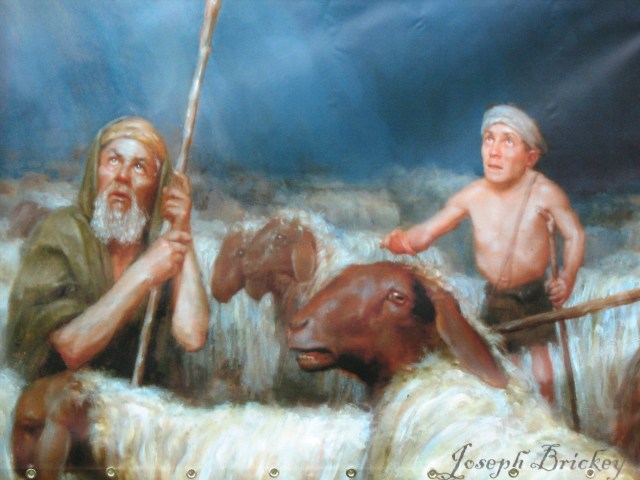
Not long afterward, some shepherds from the nearby hills showed up and asked to see shepherds at bethlehemthe baby.  Joseph and Mary were surprised to see the shepherds.  They didn’t understand how anyone else would know about the baby Jesus.  But it turned out that the shepherds had an amazing story to tell.  They were out in the fields, they said, protecting their sheep from harm when suddenly an angel was standing there with them and a bright light shone all around them.  They were scared of course, but the angel said there was nothing to be afraid of. 

He had wonderful news for them, he said.  A baby had been born down in Bethlehem and this baby would be the Messiah and would grow up to be the one to save Israel.  They could tell which baby it was, the angel said, because he would be in a stable, sound asleep in a feed trough. 

And then the whole sky filled up with angels, singing “Glory to God in heaven and peace on earth to everyone who bears God’s blessing.”  That’s when the shepherds decided they just had to go to Bethlehem and see.  And they found the baby and saw for themselves what the angel had said.  Then they left to go back to the sheep and on their way back, they told everyone who would listen about the little baby who would grow up and save Israel.

Before they went back up to Nazareth, Joseph and Mary took the baby to the temple in Jerusalem.  There, they made an old man very happy.  The old man’s name was Simeon and God had promised him that before he died, he would get to see with his own eyes the Messiah that God had promised.  Simeon had waited many years for God to fulfill the promise, but when he saw Jesus, he knew that his long wait was over.  He took the baby in his arms and prayed, “Thank you, God, for showing me the baby who will rescue Israel.  Now at last I can die happy and at peace.”

After this, Joseph and Mary went back to Nazareth where Jesus grew up.  As a young man, Jesus wanted very much to know what special work God had for him to do.  He even went to the temple once and stayed there for a while, talking with the priests and listening to them.  Then one day, he heard that his cousin John was baptizing people in the Jordan River, telling them to give up their sins and open their minds to what God wanted them to be.  People wondered if John might be the Messiah, but John knew he was not.  He thought about his cousin, Jesus, and he said to the crowds, “I am baptizing you with water, but there is one coming, very soon, who is more powerful than I am.”

Jesus baptized 2This is when Jesus, whose ministry was not clear to him yet, really needed a teacher and he chose his cousin John.  Jesus became a part of John’s ministry and listened to what he told the people.  Then one day, God chose Jesus out from the whole crowd of John’s followers and said to him, “You are my true son.  It is time for you to begin your own ministry.”  John, his teacher, watched him go and was very proud, as teachers are sometimes.

So there’s my best shot for 2012.  Here are the three concerns I still have, this being an account for children to think about.

1.         I have overdone the reliance of Jesus on John’s ministry.  I was driven to it by my designation of John as a “teacher” of Jesus and I was driven to that by Luke’s choice to commit nearly all of the first chapter to the birth of John.  I have chosen a historical solution to a problem that is really only a narrative problem.  The historical problem, however, is Luke’s and the narrative problem is mine, so I’m choosing to solve my problem.

2.         The heavenly host celebrate peace on earth of “all who bear God’s blessing.”  There are some exegetical problems with that phrasing, but I’m OK with what I’ve done with them.  As I phrase it as a story for children, I have to find a way to deal with this new translation—a blessing the kids are likely to see as quite exclusive—especially if they have heard “Peace on earth, good will to men.”  I skipped over Simeon’s observation that the baby he was holding in his arms would cause the fall of many in Israel.  I thought I could do without it.  But here is that same problem with the angels and I don’t think I can do without them.

3.         Simeon appears to have exceeded his “best deceased by” date.  He is eager for death, as I read it, although he is even more eager to see the Lord’s promised messiah.  I wonder how to put his eagerness (“….at last, I can die…”) for the kids.  I muffled it a little bit with the cliché “die happy” but the rest of it sits there.

I have two more years to think about this.  Sage advice would be appreciated.


[1] The father had been named Zechariah some years earlier.

Posted in Biblical Studies, Living My Life | Tagged , , , , | Leave a comment

Hark, the Herald Angels Sang (in traditional barbershop harmonies)

You don’t have to read much of Tanya Luhrmann to feel like a fan.  Today’s editorial in the New York Times ought to be enough.  If this tickles your appetite and you like more academic prose, which she also does well, I recommend “A Hyper-real God and Modern Belief” in the journal Current Anthropology in August of this year.

Luhrmann is an anthropologist at Stanford.  She studies evangelicals the way the first generation of anthropologists studied Polynesians.  She is not an advocate; she describes.  But she describes things that ought not be there.  That is troublesome.  And when the question arises of whether “it” is “really” there or not, she asks you to enter into the mindset of the people who claim to experience “it” and ask the question that way.

As an anthropologist, she is inclined to talk to “informants.”  One such is “a man from Horizon Christian Fellowship” in San Diego.  “The Bible is a love story,” he told her, “and it is written to me.”  Wow.  Another such is Albert Mohler, president of the Southern Baptist Theological Seminary.  “My first concern,” Mohler told her on his radio show, “is not with the God we are looking for, but the God who is.”  Luhrmann says his practical concern is that “imagination drifts quickly away” from what [what he would call] the truth.  And there it is.  The man from Horizon Christian Fellowship or the man from the Southern Baptist Theological Seminary?

That is the dilemma, she says, of Christianity in the modern West.

Which position you take depends on whether you are more worried about heresy or atheism. The pope and Albert Mohler are concerned that Christians get God right. They fear that congregants in these experientially oriented churches will imagine God in a way that inadvertently violates Scripture and leads them astray (God might become wholly loving, for example, and not at all judgmental).

Are we more in danger of heresy or atheism?  Actually, that isn’t the way I would put it.  Atheism is a commitment to the notion that God does not exist.  I think the other pole—the non-heretical pole—is that the question of God and of being a part of what God is doing in the world becomes a kind coffeehouse debate.  Everyone is “tolerant” because no one really believes that any one of them is more nearly righI like Godt than any other and, in fact, the notion of “being right” about things like that violates the spirit of the game.  It is this idle recreational treatment of God that I think is the true alternative to the God of everyday intention and sensation and emotional chumminess.  I’m sure there is a website somewhere where visitors are asked to “like” God.

 On the other hand:  “Richly described settings — Narnia, Middle-earth, Hogwarts — become places that people can imagine on their own.”  Yes they do.  And Earth Sea and Star Trek and the Game of Thrones.  There is no clear end to our ability to invest in “fictional” or “nearly fictional” realities, provided that we have made them.  Realities that have made us, on the other hand, can scarcely be trusted.

I am inclined to resist this dilemma.  As Phaedrus says in Zen and the Art of Motorcycle Maintenance, you don’t have to choose the left horn of the dilemma or the right horn.  You can try to distract the bull—the practical and immediate bearer of the “horns” of the dilemma—or you can throw dirt in his eyes and head for the exit.  I think it is really possible care deeply about the biblical texts and to refuse to ask them questions that are not a part of their authors’ worlds. 

This is deeply anthropological, so Luhrmann ought to like it.  You can ask about Luke or the Deuteronomic school or the Pauline school, “How did they see the world?  Within the meanings they could possibly have had in mind, which of them gives the best guide to what a text really means?”  And you can refuse to ask of them questions that arise in your world but that have no place in theirs.

Luhrmann wants us to adopt the anthropology of Robin Horton on what is real.

He [Horton] was saying that it was a theory and that the correct question to ask about such seemingly strange ideas as water spirits was not whether they were sensible in the abstract but how and why they were used.

Those are the questions we might as of the Deuteronomist .  When you described God as saying, “I will put my law in their minds and write it on their hearts…” what kind of law and what kinds of hearts and what kind of “writing” did you have in mind?

 Now the Pope maintains, according to Luhrmann, that Roman Catholics should not be distracted from the gospel accounts we have—neither to the right (popular myth) nor to the left (historical scholarship).  But for some modern Christians, the historical scholarship is the way we can get inside the worlds inhabited by the authors of scripture.  This gives us a chance to ask the kinds of questions Horton is asking, not, in other words, “Did Jesus really walk on the water?” but, “What is Luke trying to tell us by passing that story along?”  Luke does not want to consider the possibility that the water was particularly dense at that particular place on the lake.  It’s of no interest to him.  We should ask him the questions that belong in his world and therefore in his account.

It is in my hope for biblical scholarship that I differ from the Pope’s remarks and that’s really closer to the Pope than an Anabaptist boy should be.  And it is that third way—inhabiting the world of your informants, as Luhrmann does—that is my hope of escaping the dilemma Luhrmann offers us.


Posted in Biblical Studies, Theology | Tagged , , , | Leave a comment

I’m sorry. I didn’t mean to be unclear.

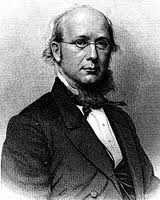
It is not quite fair to either Horace Greeley or to Abraham Lincoln to characterize them the way I am about to.  Lincoln won’t mind, I am sure.  And despite Mark Twain’s caution that one should not pick a fight with anyone who buys his ink by the barrel, I will take my chances with Greeley and his New York Tribune.

I mean no disrespect to Greeley by referring to him as a zealot, nor to Lincoln by referring to him as an agent.  Zealots have a lot of…um…zeal.  Greeley was an abolitionist, a worthy cause certainly, and that is just about all that mattered to him as a public man.  The things that moved in the direction of abolishing slavery were good and the things that did not move in that direction were bad.

English gets the word zealot from the Greek lōtēs and zeal is “intense enthusiasm, as in working for a cause.”  I know the etymology of a word is not its meaning, but I am amazed at how often it makes the understanding of a word richer.  English gets agent from the Latin agens, the participial form of the verb agere, “to act.”  An agent is one who acts.

You can see that this distinction really doesn’t separate them much.  Greeley also horace greeleyacted—he published a newspaper—and Lincoln was also enthusiastic in working for a cause.  But Lincoln was a public servant.  That’s what I want to emphasize.  Yes, he was president of the United States, but public servants at all levels need to act in the way Lincoln acted.

If, after all, only one thing is right, all we need to know about a public servant is whether he or she has the backbone to do what is right, or, as Greeley says in his editorial:

We require of you, as the first servant of the Republic, charged especially and preeminently with this duty, that you EXECUTE THE LAWS (caps in the original).

Actually, Greeley had one law in particular in mind and that’s a condition you often run into in zealots.  Lincoln was not doing all that the second Confiscation Act authorized him to do and if he had done everything the act authorized him to do, more slaves would immediately have been freed.  And Lincoln would very likely have lost the support of the border states for the forthcoming drama of the reconstruction of the union.  Lincoln was “… unduly influenced by the counsels, the representations, the menaces, of certain fossil politicians hailing from the Border Slave States,” according to Greeley.

Lincoln had in mind the successful performance of quite a few actions at the samea lincoln time.  Some could be done immediately and others would have to be done over the long haul with the cooperation of men who would need to be cajoled, courted, and/or threatened.  It is his attention to all the things that causes me to assign the label “agent” to him.

So the conflict between Greeley and Lincoln is just one of many such conflicts.  You could change the names of the men and change the nature of the conflict and the dynamics would look very very familiar.  Agents act as best they can to secure the range of outcomes the public needs.  Zealots snap at their heels while they are doing it.

Greeley’s editorial was called “The Prayer of Twenty Millions,” a reference to the size of Lincoln’s popular vote in 1860—inflated, probably, by adding those who care about slavery but did not vote for Lincoln.  The editorial was 2200 words.  It was long and complicated; it was vitriolic and finger-pointing.

Here is the entire text of Lincoln’s response.  It is 408 words long.  It has a labored clarity to it, which is understandable, given the editorial to which it is a response.  It is also a gesture of warmth to a friend, as well as to a person who buys his ink by the barrel.  I’ll just put it on the page and make a few remarks and call it good enough.

Executive Mansion, Washington, August 22, 1862.

Hon. Horace Greeley: Dear Sir.

I have just read yours of the 19th. addressed to myself through the New-York Tribune. If there be in it any statements, or assumptions of fact, which I may know to be erroneous, I do not, now and here, controvert them. If there be in it any inferences which I may believe to be falsely drawn, I do not now and here, argue against them. If there be perceptable in it an impatient and dictatorial tone, I waive it in deference to an old friend, whose heart I have always supposed to be right.

As to the policy I “seem to be pursuing” as you say, I have not meant to leave any one in doubt.

I would save the Union. I would save it the shortest way under the Constitution. The sooner the national authority can be restored; the nearer the Union will be “the Union as it was.” If there be those who would not save the Union, unless they could at the same time save slavery, I do not agree with them. If there be those who would not save the Union unless they could at the same time destroy slavery, I do not agree with them. My paramount object in this struggle is to save the Union, and is not either to save or to destroy slavery. If I could save the Union without freeing any slave I would do it, and if I could save it by freeing all the slaves I would do it; and if I could save it by freeing some and leaving others alone I would also do that. What I do about slavery, and the colored race, I do because I believe it helps to save the Union; and what I forbear, I forbear because I do not believe it would help to save the Union. I shall do less whenever I shall believe what I am doing hurts the cause, and I shall do more whenever I shall believe doing more will help the cause. I shall try to correct errors when shown to be errors; and I shall adopt new views so fast as they shall appear to be true views.

I have here stated my purpose according to my view of official duty; and I intend no modification of my oft-expressed personal wish that all men every where could be free.

Yours, A. Lincoln.

The range of ways Lincoln would save the union is staggering.  Take, for instance “…and if I could save it by freeing some and leaving others alone I would also do that.”  I doubt that that option really means anything by itself, but it does plug a hole that would have been there if he hadn’t said it.

And this line is intended especially for Greeley.  I read it as saying, “I know you are a zealot and I hope you know why I can’t afford to be.”  Here’s what he says to Greeley.    “ If there be those who would not save the Union unless they could at the same time destroy slavery, I do not agree with them.”

This letter is perhaps the clearest letter by any politician I have ever read.  It cannot be misunderstood.  Even Greeley, who printed it, certainly didn’t like it.  On the other hand, he didn’t misunderstand it.


Posted in Politics | Tagged , , , , | Leave a comment