Being “Beautiful”

So I’m this old guy with a white beard.  What would I know about being “beautiful”?

Quite a bit, actually.  I don’t know how it feels to be beautiful, having…you know…never been, but I do know how it feels to play a part that is constructed and placed on you and to know two things at the same time: 1) this is not who I am and 2) I need to pretend to be this person for the sake of the people who are expecting it.

That might seem an odd connection, but it came to me as I was watching a TED talk that my step-daughter, Melisa Jaenisch, (I am a rich in step-daughters and have never ceased to benefit from it) sent to me.[1]  This is Cameron Russell, who is, as you see, very attractive.[2]

In her lecture, she puts up a series of pictures of herself: the professional glamor queen on beautiful 1the left; the actual person on the right.  The pictures on the left are remarkably similar, no matter what she is wearing.  The pictures on the right show her on her soccer team, at a slumber party, with her grandmother.  Just a pretty little girl.  The pictures on the left were taken at the same time as the pictures on the right.  The day she shot the bikini and heels shot was the same day she played soccer with her team.

About the pictures on the left, she says, “That’s not me.  That’s a construct they have built using me as the base.”  There are, she says, hair stylists, makeup artists, photographers, pre-production (whatever that is), and post-production (whatever that is).  She knows how she can be made to appear and she has a sense of just how much of that bears on who she is.  Her livelihood depends on being made to appear that way; her life requires that she know that the image is not her.

But that’s really only a part of the truth.  She also tells of “buying” a dress and realizing at the last minute that she had forgotten her wallet.  No problem.  The store was happy to give her the dress.  No pre- and post-production; no makeup artists and hair stylists.  Just “how she looks.”  Or the time she was riding in a car with a friend, who was pulled over by a cop.  The cop looked in the window and saw Cameron Russell as the passenger and gave the driver a warning and left.  No problem. No pre- and post-production; no makeup artists and hair stylists.

beautiful 3She could have refused the gift of the dress, but refusing the favor (to her friend) from the cop is a lot tougher and the way it is tough points to a lot of other difficulties.  Men will go out of their way to do “favors” for attractive women.  These may be “favors” the women would not have chosen and do not like, but they will be offered anyway, because the men are paying homage and will not be deterred.  Women in that circumstance really can’t get away with saying that they aren’t attractive or that they are tired of being attractive or that they wish to have some other aspect of themselves recognized.  The most socially agile women I have ever seen deal with this issue, grant the premise, express appreciation, and change the subject.  If they are unable to change the subject, they leave.

The man says, in effect, “You are beautiful and I am doing this for you as a recognition of your beauty.”  The woman says, in effect, “Yes I am, thank you for noticing, how ‘bout them Steelers?”  Men who are socially agile catch that transaction on the first bounce.  Most men seem to get it after just a few bounces.  The ones who refuse to get it need to be dealt with more directly. That isn’t pretty, but it is necessary.

On the other hand, some women make a career out of being beautiful and find it more enjoyable than not.  I remember a line from a movie called The Mirror Has Two Faces in which Barbra Streisand is supposed to be the ugly sister.  The other sister, never shown in the movie, is supposed to be more attractive, but the mother is a beauty.  She is played bybeautiful 2 Lauren Bacall, who knows how to do it, and is resented by the younger (ugly) daughter.  Streisand’s character experiences a romantic catastrophe and has to move back home.  At that point, thoroughly humiliated, she summons up the nerve to ask her mother, “What is it like to be beautiful?”  Her mother hesitates, to see if her un-beautiful, anti-beautiful daughter is really asking the question, and then answers it.  “It’s wonderful,” she says; and then says just how it is wonderful.

We can place the photographed version of Cameron Russell on one side of this construct and the personal experience of Lauren Bacall on the other.  One identifies with the role and cherishes it; the other knows the role to be fraudulent, and alienates herself from it—when she can.  When her friend is driving and is arrested, she overcomes her alienation and uses the resource.

I actually know a little about this myself—not, of course, because I have ever been beautiful–but I really have played a role that needed to be played and that was “not me.”  I have lobbied, at the state legislature, on behalf of bills I did not believe in.  I have been hired as an “inspirational speaker” at weekend retreats and have been related to in the way that people thought would be appropriate if I were “inspired.”  I have pretended to be smart and knowledgeable in settings where it was either me or nobody and have graciously accepted the compliments of people who thought I pulled it off successfully.  All those are “constructs” that are “put on me” and that are “not me,” but that I felt I needed to own, at least for the time being.

But those were comparatively easy.  Easy?  Compared to what?  Compared to being the father of small children.  I realize that have just divided my reading public into two groups.  The first group have been fathers and know exactly what I am talking about and know I am right.  The members of the second group have not had that experience themselves and think I am overdoing it a little.  Or a lot.  I’m fine with both of those responses.  I know what I know.  I know what Cameron Russell knows.  There are times when you really need to be the person they think you are or the person they need you to be.

Dawne cuteAs a father of young children, you are your son’s first coach and your daughter’s first boyfriend.  You know “how things are” and sometimes “why.”  They see you as vastly experienced; you know people in a bewildering variety of styles; you are paid money to do things; you have authority, and should worst come to worst, power.

In a collective society, a new father moves into the phalanx of fathers.  He is “one of those” and acts correctly when he acts the way they do.  In an individualistic society, being a new father is all improv.  It’s not that you didn’t have a father.  It’s that your father succeeded (or not) by playing his part with the resources available to him.  Since his time, the part has changed and you are not him and the resources you have access to are different.  It’s improv.  And if you are recently married, your wife has never seen you “be a father” either and, in addition, has different memories of how it should be done.  Her father was, after all, her first boyfriend and she remembers what “doing it right” looked like.

But it turns out that playing any of the parts I’ve described, even the role of “father,” works the same way being an attractive woman works.  You can’t deny a “truth” people are committed to. Saying that you don’t feel like that about yourself only makes you “humble” and  besides, it pulls the rug out from under them.  Ordinarily, people don’t like that.  The only way I have ever seen it done well is by people who find the words and actions that amount to: “Yes, what you think I am it real.  Thank you for noticing.  How ‘bout them Steelers?”


[1] If you don’t know the short lectures available at TED.com, you have a treat coming.  You can just pick one of the ones they are featuring or search by presenter or by subject.  I have seen some I didn’t agree with, but I have never seen one I didn’t like.
[2] I actually save the word beautiful to refer to what an attractive woman does with her looks.  It isn’t the superlative form of attractive for me.  And it isn’t really a visual word for me either; it is a “generous use of a highly prized resource” word.  That’s just a personal use, but it explains why I use other words when I can and why, when I do use that one, I put it in quotes.

Posted in Living My Life, Society | Tagged , , , , | Leave a comment

Peace in All Three Iraqs

I don’t know what the Romans called the area that is now—for the next months at least—called Iraq.  Just to make it easy on me, let’s say they called it “Iraq.”  That brings us next door to one of the best known sentences in all of Latin literature: “Iraq est omnis divisa in partes tres.”  The increasing likelihood that modern Iraq is going to be divided into three parts.  According to a recent map, which Ross Douthat linked into his column today, this is what that would look like.  Tucked in there between Syria on the west and Iran on the east are : Free Kurdistan, Sunni Iraq, and an Arab Shia State.

Iraq map, three partsDouthat doesn’t have a perspective, in this column, at least, about what American policymakers ought to prefer in the Middle East.  He is content with pointing out that there are really very few options that fall within the tradition of the projection of American power.

Here is one option.

As Jerry Muller argued in Foreign Affairs in 2008, the brutal ethnic cleansing and forced migrations that accompanied and followed the two world wars ensured that “for the most part, each nation in Europe had its own state, and each state was made up almost exclusively of a single ethnic nationality,” which in turn sapped away some of the “ethnonational aspirations and aggression” that had contributed to imperialism, fascism and Hitler’s rise. But this happened after the brutal ethnic cleansing that accompanied and followed two world wars. There’s no good reason to imagine that a redrawing of Middle Eastern borders could happen much more peacefully.

We don’t want to choose that because although we might like the end product, we want no part of the means of achieving it.

Another option is to intervene directly on the side of whoever is most likely to keep the various regions together.  That’s a bad idea for a lot of reasons, one of which is that it would take a long time.  The domestic political pressure against it would be severe.  And, of course, the entry of an outside power tends to unify the local powers as much as is necessary to repel the “invader.”  The most graphic recent example is the weapons we gave to the mujahidin in Afghanistan so they could repel “outsiders.”  Then, when we invaded after 9/11, we were the outsiders and the weapons worked just as well against us as they did against the Russians.

On the other hand, it’s hard just to give it up.  Whatever lack of merit the policies may have had, the cost to American soldiers was awful and it is hard to conquer real estate as such cost and then just abandon it.  It must be done, but it is hard.

Douthat positions himself in the middle, not so much by proposing a way forward as by critiquing the views of others.  That is perfectly appropriate; he is a columnist after all.  He criticizes the Bush administration (George W, not George H. W.) for “recklessness.”  He criticizes the Obama administration for “neglect.”  But he comes to the present dilemma when he points out:

Now our leverage relative to the more immediate players is at a modern low point, and the progress of regional war has a momentum that U.S. airstrikes are unlikely to arrest.

Douthat just barely manages to avoid saying that the U. S. ought to have more leverage than the immediate players.  Just barely.  The point here is that there are people who live there and who care intensely about borders we have only recently heard about.  They will kill each other over ethnic nuances that elude us entirely.  Is there any reason they should not have more leverage than we do?

Oddly, all this reminds me of Abraham Lincoln’s re-entry into politics after his term as a Whig Congressman.  My son, Doug, and I are listening to some really good lectures by David Zarefsky, of Northwestern University.[1]  Zarefsky is really clear that Lincoln had an instinct for the center and when he couldn’t get it by defining the policy he favored, he got it the way Douthat gets it—but ridiculing his foes.  Lincoln held that slavery was fundamentally wrong, but that it was constitutionally guaranteed.  Lincoln’s fight was not to abolish slavery, but to contain it in the states of the old South.  He rejected the slavery faction on the one side and the abolitionist faction on the other side.  He may very well have argued that so far as the federal government is concerned, “our leverage relative to the more immediate players is at a modern low point.”  I hope that sounds familiar.

As he was debating with Senator Douglas, he had no idea what policy would get us where we wanted to go but he was sure he wanted to preserve his options.  It is that, I think, that helps me watch Douthat struggling with where we should go.

[1] Another good one by the Teaching Company: “Abraham Lincoln in His Own Words.”


Posted in Politics | Tagged , , , , | Leave a comment

Only St. Peter Controls the Copier Codes

According to Matthew’s account of the transaction, Jesus gave Peter the keys of the kingdom of heaven (see Chapter 16).  That’s the good news.  The bad news is that Bowdoin College has disabled the keys given to the Bowdoin Christian Fellowship.

This way into the subject (see the New York Times account here) is just for fun, but you have to wonder if it is really a fair trade.  If it means the Rev. Robert Ives, the director of religious and spiritual life at Bowdoin, gets to determine who has access to Bowdoin and St. Peter gets to determine who, at Bowdoin, gets into heaven, you really ought to think about it.  Bowdoin: Heaven.  Heaven: Bowdoin.  Sometimes it’s hard to choose.

OK, that was recess; let’s get back to our studies.

For forty years, roughly the amount of time the Hebrew people spent wandering in the Bowdoin College 3wilderness[1], evangelicals at Bowdoin College in Maine have been “part of the school community.”  Presumably that means—it is what it meant at the University of Virginia when their case came up[2]–that they receive the benefits of funding from the College and access to rooms where they can meet, just as all the other groups receive.  Now, the Bowdoin Christian Fellowship has run afoul of the College’s anti-discrimination requirements.

In a collision between religious freedom and antidiscrimination policies, the student group, and its advisers, have refused to agree to the college’s demand that any student, regardless of his or her religious beliefs, should be able to run for election as a leader of any group, including the Christian association.

I read this with a certain incredulity.  Hello?  You don’t have to be Christian to lead the Bowdoin Christian Fellowship?  Why not?  Do you have to be an evolutionist to chair the biology department?

But then I thought, “Well, that’s sensible after all.  Why should the College have any views about who the evangelicals should choose as their leader?  If they want to elect a Buddhist, why shouldn’t they be allowed to?”

That hard-won ease lasted me two paragraphs, when I learned that:

At Cal State, the nation’s largest university system with nearly 450,000 students on 23 campuses, the chancellor is preparing this summer to withdraw official recognition from evangelical groups that are refusing to pledge not to discriminate on the basis of religion in the selection of their leaders.

As I see it, this moves on beyond the question of whether they can elect a Buddhist if they want to and gets to the question of whether they can justify failing to choose a Buddhist.  Note that “I want a leader who will help this group meet its avowed objectives” is not a valid objection because it “discriminates on the basis of religion.”

I see two questions here and, as is often the case in this blog, one points this way and one points that way.

The first question has to do with the school administration’s attitude toward special interest groups.  I don’t think it would violate any important principle for the administration to say that “discrimination” is perfectly acceptable if it has to do with the fundamental reason a group exists.

Some institutions, including the University of Florida, the University of Houston, the University of Minnesota and the University of Texas, have opted to exempt religious groups from nondiscrimination policies.

Presumably, this refers to discrimination about religion.  I am quite sure it does not empower the religious groups to discriminate on the base of race or gender, for instance.  This seems like a common sense solution to me.  It grants room for freedom of religious practice to the group and it doesn’t disadvantage anyone.

The second question comes at the problem from the other side.  Are there really no catacombs under Bowdoin?  Why not meet there, as the early Christians did at Rome?

The students are saying that Bowdoin should let them practice their religion in peace, but what they mean is that they want to be free to practice AND to violate the non-discrimination policy AND keep their college-granted key access.  This is precisely like saying that a church should be able to campaign in any way it chooses AND to keep their 501(c) (3) status with the IRS.

Bowdoin College 2I would like to ask the Reid Wilson and Zachary Stur, recent members of the Christian Fellowship what they are gaining by weaning themselves from official approval and what they are losing.  Let’s leave aside the question of whether the College is being fair.  They are not.  You already know I’m on your side of that one.  So let’s move to the question of your own goals.  How can you not meet in Christian fellowship and apprentice yourselves to Jesus Christ and to study God’s Word without official approval?  What would you be free to do if you didn’t have to have official approval? What have you been refusing to consider because it would have cost you official approval?

This could be the best thing that ever happened to you?  Can you imagine, years down the road, the administration coming to you and pleading for you to accept the College’s blessing so that you would have to stop doing what you have been able to do by not caring whether you had the College’s blessing?

I think the College is wrong.  I agree with you.  But really, this may be one of the best things that ever happened to you and if Jesus had waited for official approval, he would still be waiting, and so would we.


[1] And, as you will see, that might not be the only similarity.
[2] See Rosenberger v. University of Virginia, 1994.  Another of the 5-4 decisions for which recent courts have become famous.  If you have been following this Court, you will not be surprised that Justice Anthony Kennedy wrote the opinion.

Posted in Education, Politics | Tagged , , , | Leave a comment

Wanting What You Can Have

My old friend Tony and I get together at the Cadillac Café every now and then just to keep up on what’s going on.  The last time we were together, he passed on a saying that was current in his family when he was growing up.  Here’s the way I remembered it.  “If you can’t have what you want; want what you have.”  I included that in a note I sent Tony afterwards and thought that would be the end of it.  It wasn’t.  Tony wrote me back immediately to let me know that I had not heard it properly.  It isn’t “want what you have;” it’s “want what you can have.”

That’s one small amendment to the formula; one giant change to the meaning.  And that change is what I want to write about today.

For the last week or so, I have been living inside the world Barbara Kingsolver created in her 2012 novel, Flight Behavior.  The book isn’t about relationships.  Actually, it’s about butterflies.  But there are some intriguing relationships in the book.  I want to tell you about three of them and then I want to come back to the saying I heard (finally) from Tony.

Here are the three.  Ovid Byron and his wife, Juliet Emerson.  Ovid is a scientist who studies butterflies; Juliet calls herself a folklore artist.  Then Cub Turnbow and Crystal Estep.  Cub is the husband of Dellarobia Turnbow, the book’s principal character and Crystal wishes she were not, because she thinks Cub is just w-o-o-n-derful.  Cub and Crystal are not “together,” as we say.  Crystal keeps hitting on him and Cub keeps saying no—at least some part of him keeps saying no.  I suspect that some other parts are saying yes, but Kingsolver doesn’t tell us that.  The third couple is Cub—“Burley,” actually, the same name as his father—and his actual wife, Dellarobia.

The first two couples are beautifully matched, although, in fairness, Cub and Crystal are only a potential couple.  The third couple is deeply mismatched.  I would like to look at these three couples and then poke a little at Cub and Dellarobia, using my friend Tony’s wisdom as the stick.

Ovid and Juliet

Here is what the relationship of Ovid and Juliet looks like to Dellarobia. She and Ovid and Juliet are sitting at the table.  Dellarobia’s son Preston, who is dazzled by Ovid’s “star scientist” persona, is sitting with them.

“The monarchs are coming out of, diapause,” Dellarobia thought to announce.

“We saw them having their family life,” Preston said, “In the road,

“Really,” Ovid said, with convincing enthusiasm.  But Juliet revealed that he already knew, he’d noticed it first thing when they drove in this morning. She claimed he was more excited about the butterflies than about seeing his wife.

It was so easy for her to say a thing like that, with full enthusiasm for the eccentric coordinates of her man. At some point in the evening Dellarobia had stopped being amazed that Ovid had turned into someone new, and understood he had become himself in the presence of his wife. With the sense of a great weight settling, she recognized marriage. Not the precarious risk she’d balanced for years against forbidden fruits, something easily lost in a brittle moment by flying away or jumping a train to ride off on someone else’s steam. She was not about to lose it. She’d never had it,

It catches Dellarobia that Juliet says her husband was “more excited about the butterflies than about seeing his wife.”  She doesn’t mean it as a criticism.  It’s more like an endearing idiosyncrasy.  Juliet has “full enthusiasm for the eccentric coordinates of her man.”  In Dellarobia’s mind, Cub doesn’t have any eccentric coordinates.  Cub is the redneck from central casting, just as his father, Bear, is.  And if he had endearing traits, Dellarobia would not know their coordinates—would not, in other words, know how to find them.  And if she found them, she would be unable, in all likelihood, to feel any enthusiasm for them.

Then she sees something else. “With the sense of a great weight settling, she recognized marriage.”  This, Dellarobia thinks, is what “marriage” is and she knows she cannot have one like that.  If this is what “marriage” is like, then she has not been married—not in the sense that Ovid and Juliet are–and very likely will never be.

Cub and Crystal

So Ovid and Juliet are wonderful. They are beautifully matched and they are married in a way Dellarobia has never seen a relation of husband and wife and had not imagined that there could be any such thing.  Cub and Crystal, if they were a married couple, would not be like Ovid and Juliet, but they would be wonderful, too.

Dellarobia’s mother-in-law, Hester, is telling her how she sees the kind of marriage she and Cub have.  It isn’t pretty.

“A child doesn’t have to walk on water for you.  But a husband does.”

“What’s that supposed to mean?”

“Children are born so small.  But yet you love them that way, all dumb and helpless, so you keep on.  With a husband you don’t get that chance.  Him you’ve got to look up to.”

“I’m five-foot-nothing, Hester.  I look up to everybody.”

“No, you don’t.  Not Cub.  You never did.

Dellarobia felt socked.  The vision that ambushed her was of Crystal in the dollar store that day.  How she’d looked, talking to Cub.  Craving, yes, but also admiring, cherishing.  By any measure, looking up.  How much more of a man Cub would be if he’d married some sweet, average-minded girl who thought Cub Turnbow hung the moon.  Dellarobia felt loss as wide as a river.  For what she had taken from him.

There is that beautiful match that somehow didn’t happen.  Crystal would be full of “enthusiasm for the exact coordinates of her man.”  She would know what those coordinates were and she would celebrate them.[1]  Crystal would be “craving, admiring, and cherishing.”  She would make Cub much more of a man that he could ever be with Dellarobia, but Dellarobia is the one Cub impregnated and the marriage followed swiftly after.  It is sweet of Dellarobia to think that that happiness is something she has “taken from Cub,” but it isn’t true; Cub gave it away himself.  And now, for the duration of this story anyway, Cub has Dellarobia, no matter how much he might prefer Crystal.

Cub and Dellarobia

The third couple.  The mismatched one.  In the course of the story—and I really do urge della flies 5you to read it for yourselves; it is a marvelous story, superbly told—Dellarobia has grown a great deal.  She has outgrown her habitual role as victim.  She has seen a vision that turned her life around. [2] She has made some money and been abused by the media and handled crowds.  She knows, now, that she cannot get small enough to fit back into Cub Turnbow’s life.  And Dellarobia is not a Cub fan, as is the one we see pictured.  Here’s how that goes.

Cub and Dellarobia are having the best and worst conversation of their married life.  Nothing that is currently true is being denied.  Things that might become true are being ignored.

Dellarobia could imagine the inner structure of her husband’s world, in which events confirmed themselves. Their marriage must be good, because marriages were. It had come to pass.

“I appreciate you for manning up. I do,” she said. “I had no family, and then all of a sudden I had your family. But you were there too, Cub, You know what I’m saying. We were headed in different directions. You can’t tell me we weren’t,”

Cub assimilates this and then tries another tack.

“We love each other now,” he said, “That’s what matters,”

“I know. People say that. We do. You can make yourself love a person, we’ve done a fair job of that. But there’s other stuff, Cub.”

“Like what?”

“I don’t know. Respect? You can’t manufacture that. You can’t demand it at gunpoint. Whatever. You earn it.  Like a salary or something.”

“I respect you,” he said.

“I know. And you’re sweet to me. It’s just never quite—I don’t know how to put this—” She pressed her lips together and shook her head. “It’s like I’m standing by the mailbox waiting all the time for a letter, Every day you come along and put something else in there. A socket wrench, or a milkshake, It’s not bad stuff. Just the wrong things for me,”

The “waiting for a letter” image is powerful.  Dellarobia is a customer in this image, not a wife.  She stands by the mailbox.  Cub delivers one item, then another, then another.  He delivers a wrench; we know he would have a wrench.  Then a milkshake; we know he sneaks them when he is working even though they aren’t in the family’s budget.  He doesn’t put a letter in the box because he doesn’t have a letter.  He doesn’t know any language Dellarobia understands. The customer is still displeased and eventually, walks out of the “store” a free woman.

Has she failed Tony’s test?  Has she failed to want something that she really could have had?

The book doesn’t say and I think Kingsolver has written Dellarobia so that the answer would be No.  I’m not so sure.  I tend to look at things from Cub’s point of view, as well as Dellarobia’s, and I wonder what would happen if she asked for a letter.  Dellarobia is pretty forceful.  Did it not occur to her to ask her husband to put into the mailbox something she wanted to find there?[3]  Did it occur to her to do something other than stand by the mailbox?  No man is happily married to a “customer.”  Trust me.  It doesn’t work that way.

Dellarobia could never have become Crystal.  She wouldn’t want to and she wouldn’t know how.  She does have the sense of what Cub has lost, though.  When she has that sense of loss as wide as the river for what she had taken from Cub, she is seeing what could have been.  But how much of what could have been, could still be?  How much of what Dellarobia can have, is still there for the taking?  Well…for the making…actually.  It takes four hands and you have to make it every day and it won’t be a croissant, but it could be a very satisfying loaf of whole wheat bread and for a Wonder Bread family, that is a big improvement.

She doesn’t have to believe that Cub Turnbow “hung the moon.”  Cub knows that Dellarobia knows better.  But she could help Cub become the kind of man both of them would respect.  She appreciates Cub as a father and “loves him,” she says, but he is not living a life she respects.  I think Cub could be a much better man than he has been.  Being a better man will help him be a better husband.  Being a better husband will make theirs a better marriage.  I am confident of all that.

How much better a marriage?  That’s the part I don’t know.  Kingsolver doesn’t know.  Eventually, having made the marriage all it could ever be and having enlisted her husband in the process, Dellarobia might conclude that it really isn’t good enough.

She would, by that time, have done everything she could to want what she could have and would still have found it inadequate.  That would be the time to give up.


[1] Honestly, celebrating them is part of how you find out where they are.  Then you get to celebrate them some more.
[2] In another life, I pay attention to words like “repentance” and “conversion.”  The word that is usually translated “repent” means “to change your mind.”  You can see, if you look at it, that the word “convert” has to do with turning around.  Those two things happen do Dellarobia in the first chapter and it has nothing at all to do with religion.
[3] A wonderful romance develops between Robert Duval and Jane Fonda in Stanley & Iris.  By the end of the movie, Iris is thoroughly in love with Stanley and celebrates every one of the letters he writes to her from the site of his new job.  He was illiterate when she met him and she taught him to read and write.  Now he writes his love to her.  Not, you know, to make too much of a single metaphor.

Posted in Living My Life, Love and Marriage | Tagged , , , , , | Leave a comment

Are the people of Feathertown, Tennessee, Idiotēs?

I think so.  I am going to offer some information about Feathertown from Barbara Kingsolver, who invented it and described it in her marvelous novel, Flight Behavior.  She has set a major dilemma in Feathertown: what to do about the disordered migration of the monarch butterflies.  One horn of this dilemma concerns the reactions of the local citizens to the plight of the butterfly and that is the horn of concern to us today.

That brings us to the Greek term, idiotēs.  It will be obvious to all that we get the English word idiot from this Greek word, but I am going to use the Greek version because I want to set it in the Greek setting.  Also, the people of Feathertown are not idiots, as we use the word in modern English.  They do live in a very tightly confined space of information and attention, however.  The affairs of “the public” are not their affairs and it is to that meaning of the word that idiotēs points.

Here’s a clip from Wikipedia about ancient Athens.

An idiot in Athenian democracy was someone who was characterized by self-centeredness and concerned almost exclusively with private—as opposed to public—affairs.  Idiocy was the natural state of ignorance into which all persons were born and its opposite, citizenship, was effected through formalized education.In Athenian democracy, idiots were born and citizens were made through education…

So what does it look like in Feathertown?  Here are husband and wife,  Cub and Dellarobia Turnbow.  Dellarobia has been working with the scientists who came to Tennessee to find out what has gone wrong with the migration of the monarch butterflies.  Ovid Byron is the acknowledged expert on the butterfly dilemma and is the source of everything Dellarobia knows about it.  She is not “a citizen,” as defined by the Athenians, but she is right on the brink.  Her husband, Cub, is not on the brink and wants to stay well away from it.

Take this exchange, for example.  Dellarobia starts.

“Do you know what they’re saying about the butterflies being here? Dr. Byron and them? They said it means something’s really gone wrong.”

“Wrong with what?” Cub asked.

“The whole earth, if you want to know. You wouldn’t believe some of the stuff they said, Cub. It’s like the End of Days. They need some time to figure out what it all means. Don’t you think that’s kind of important?”

“Well, if the butterflies fly off somewhere, the doctor and them can go park their camper behind somebody else’s barn.”

“What if there’s no place else for them to fly away to?” she asked.

“There’s always someplace else to go,” Cub said, in a tone that said he was signing off: Worries like that are not for people like us.

Dellarobia passes along to Cub the scientists’ ideas about how the migration of the Dellarobia 3butterflies might result from a huge change in climate.  Here are two pieces of Cub’s response.  “Well, if the butterflies fly off somewhere…” indicates his sense that the problem before them is that the butterflies wound up in Tennessee this year, rather than, say, Florida or Mexico.  For the butterflies, one place is as good as another.

The second is his quick sense of what that would mean for his family.  It would mean that “…the doctor and them can go park their camper behind somebody else’s barn.”  The scientists, Dr. Byron in particular, are living, at Cub’s invitation, in a camper by the Turnbow barn and using part of the barn as a laboratory.  In Cub’s sense of the situation, there are always other barns where they could park, just as there are always other places the butterflies can go.

Dellarobia raises the crucial question, “What if there isn’t anywhere else?”  Cub’s response is, “There’s always somewhere else.”  It is the quality of mind that produces “there is always somewhere else” that I want to point to here.  If you look at the globe and the climate and the needs of a particular species, you see right away that there is not always “somewhere else.”  But when you look at the world of Feathertown where things “go away” pretty frequently and are never heard from again, it is an entirely understandable response. It is not correct, however.

It is resolutely private, please note, and efficiently sheds the possibility of public engagement.  That is what Kingsolver means by seeing Cub’s remark as a “signing off” and it is what she means by giving his statement the meaning, “worries like that [public] are not for people like us [private].  We are very close, here, to the Athenian meaning of idiotēs.

The Greeks imagined each polis had a “team,” the people who met to debate public affairs, and “others”—private people, people who belonged to no team at all.  That’s not the way Kingsolver sees life in the Appalachian highlands.  When Cub says, “people like us,” he is thinking of their team, not of “no team.”  Clearly, this changes things.  Who, we want to know immediately, is on Cub’s team.

Let’s start with Johnny Midgeon, a local radio voice.  Midgeon is the source—or at least the local relay point—for the line about Al Gore.

“What persuaded the butterflies off their track?” Cub asked,

“Well, see, that’s what they’re wanting to figure out,” she [Dellarobia] said. “And Dr. Byron’s not the only one wondering. There’s more to it than just these butterflies, a lot of things are messed up. He says it’s due to climate change, basically.”

“What’s that?”

She hesitated, “Global warming.”

Cub snorted. He kicked up a cloud of dusty frost, “Al Gore can come toast his buns on this,” It was Johnny Midgeon’s line on the radio, every time a winter storm came through.

In this debate, had it taken place in ancient Athens, only a person who wasn’t on the team could have said this and he or she would have offered it as a personal opinion.  But in the modern Appalachia of Kingsolver’s book, Cub can say this because his team says it.

Dellarobia 5What do we see here?  Let’s start with “Al Gore.”  Al Gore’s 2000 campaign for the presidency involved a serious claim about the changing nature of the climate.  And he lost.  Since then, conservatives have thrown a dart at the Al Gore Dartboard every time it gets cold in the winter.  What Cub actually knows hangs on the fact that Gore’s environmental contentions were…well…contentious and that he lost.[1]  But Cub doesn’t know that in any well-focused way.  What he knows is that Johnny Midgeon, the local radio guy, dismisses Al Gore with this line.  It becomes something “our team” does, for Cub; not necessarily something our team believes.  This distinction between knowledge and belief is something Dellarobia knows and Ovid does not—and Dellarobia cannot find a way to convey it to him.

Next, let’s take “Al Gore can come and…”  The refutation of Gore’s “global warming” claim is local.  It is right here on our farm.  If Gore wanted to know the truth, he would come here—here, where the truth is.  And the truth is that there is snow on the ground.  A lot of the tension in this story is produced by the fact that “Al Gore” actually did come to Feathertown.  Ovid Byron is “Al Gore” to Cub and his teammates.

So “global warming” is not an explanation Cub can use and he doesn’t have another one.Dellarobia 4  Giving up your one hypothesis might be thought to be prohibitively onerous, but it is not.  Why?  Because “the weather is the Lord’s business,” according to Cub.  This is really not a religious sentiment for Cub.  He has no notion of the Providence of God by which one weather pattern is seen to be God’s gift and another God’s curse.  By “the Lord’s business,” Cub means only “not our business.”  He means the same thing he means when he refers to the scientists as “those people.”  He means they are not “our people” and therefore not “our concern.”

In that sense, it fits completely with his dismissal of Dellarobia’s concerns about the landslides that logging causes in Mexico.  “That’s Mexico,” says Cub, “This is here.”  Or the heavy rains that have caused flooding on his parents’ farm.  Cub says, “This rain won’t keep up.  They’re saying it’s a hundred-year flood. So it won’t happen again for another hundred years.”  Cub’s whole world is “here and now.”  Mexico is not here—so the basic principles that applied there will not apply to us—and the flooding is not “now.”  The weather in this valley will follow the old rules even if the climate has changed, disordering the old weather patterns.

Dellarobia understands this.  Her exposure to the facts Ovid has at his fingertips have caused her to raise new questions, but she understands—as Ovid never can—how Cub and the other members of his team, actually think.

Let me conclude our visit to Feathertown, Tennessee with the most discouraging assessment of all.  This comes in a discussion Dellarobia has with Ovid.  Dellarobia understands why Johnny Midgeon is trusted and the community of global scientists are not; she knows why a cold snap brings Al Gore jokes and why the natural laws that brings catastrophe to Mexico won’t happen here because “this is not Mexico.”  Dellarobia understands that things aren’t the way they were in Athens, where the idiotēs were solitary and private.  The Idiotēs are a team now; The Fightin’ Idiotes.  They have the same tee shirt and the same secret handshake; they are brothers.

Ovid says, “You think…it’s a territory divide? We have sorted ourselves as the calm, educated science believers and the scrappy, hotheaded climate deniers?”

Dellarobia replies, “I’d say the teams get picked, and then the beliefs get handed around.”

I think that’s powerful.  “The marketplace of ideas” was Justice Oliver Wendell Holmes’ notion of how a good argument defeats a bad argument in fair and open competition.  He would have been stunned, officially at least, by Dellarobia’s observation that the teams come first and then constrain—one set of facts to each team—the beliefs.

“Team camo,” she says, referring to Cub’s team.  “We get the right to bear arms and John Deere and the canning jars and tough love and taking care of our own. T

“The other side,” she doesn’t even know what to call the other team but contemporary conservatives call them Limousine Liberals, “wears I don’t know what, something expensive. They get recycling and population control and lattes and as many second chances as anybody wants.”  Dellarobia doesn’t have a name for the “other team,” but she knows they are rich (wear something expensive, lattes, second chances) and progressive (recycling and population control).

One team cites the preponderance of the evidence as collected by climate scientists.  The other cites Johnny Midgeon and Al Gore jokes.  That’s the state of the debate in Flight Behavior.  Things are bad for the environment.  They are amazingly good for Dellarobia herself, however, and I’ll get to her shortly.

[1] Only by 5-4: surely the closest presidential election ever.  And they say a single vote doesn’t matter!

Posted in Books, Political Psychology, Politics, Sustainability, ways of knowing, Words | Tagged , , , , , | Leave a comment

Surrogates

“Don’t go out without your surrie.”  That’s what Maggie Peters says to her husband, Tom Peters.  Doesn’t it sound just a little like “Don’t go out without your umbrella.”?

“Surrie” is what people in the movie, Surrogates, call the robots through which they live their lives.  A few years ago, it would have seemed a complicated task to represent what is real and what only appearance, but then The Matrix happened and everybody seems to get how that could be.  The deal in Surrogates is that the person who has bought the surrogate stays home lying in a “stim chair” and “experiences” the world through the eyes and ears and skin of the surrogate.

That means that what Maggie Peters said to her husband actually meant, “Never go out of your bedroom.  Sit there forever in your stim chair.”

That’s what she does herself.  When, in the emotionally climactic scene, the actual Tom Peters, to the left, confronts the surrogate of his wife, Maggie Peters, to the right, what he has to say to the surrogate is, “I want HER.  The woman sitting back there in her room.”[1]

Surrogates 6It is impossible to keep from entering that world, the world of which Surrogates is the logical culmination.  A man takes “a step in that direction” in the most literal sense when he “puts his best foot forward” in meeting a new person.  The “best foot” is not the most representative foot; it is the one he would most like to be known by.  In dating, it serves as “the self I could be in this relationship, should it become necessary.”

Then there are the guys who rent expensive cars and hire expensive escorts in order to attend their class reunions appropriately.  This is not “who they are,” of course, but it is who they can get away with seeming to be for the evening or the weekend.[2]  This is all the stuff of comedy because it’s only for the weekend and usually the guy is found out and ridiculed, but today, I would like to take it seriously.

Surrogates is about a society that is built on that principle: the human being is essentiallySurrogates 4 irrelevant; the surrogate is the real thing.  Let’s take Maggie Peters, for instance.  I can’t show you the woman she actually is—the woman in the bedroom in the stim chair—but I can show you the person she wants to appear to be.[3]  She is perfect in every way as you can see and no matter how close the close-up gets, she is still perfect in every way.  Perfect body, flawless hair, graceful movement—everything.  That’s important to her and to her friends—those are the surrogates that her surrogate hangs out with—who are just as near to perfection as she is.

Surrogates 1Here’s Bruce Willis “in” his surrogate.  (That’s the surrogate of his detective partner behind him.)  He is as nearly perfect as his wife is.  He is young; he has a great complexion; he has hair.  And with all of that, he’s a good detective.  We do see more of him (in the flesh) than we see of his wife because he has to work nights—the best crimes happen at night—and sometimes his surrie is still charging when he gets up in the morning.  When that happens, we see old bald grumpy Tom Potter in the kitchen with his spritely perfect wife—the wife’s surrogate, that is—and they look odd together.  Being married to someone who looks like he does is an embarrassment to her.  Being married to someone who will not show herself except “as” the surrogate, angers him.  That conflict is what the plot is about.  Naturally (repeat of spoiler alert) after he destroys all the surrogates in the country, he gets his real wife back.  Bluebirds sing.  The rainbow glows.  The sky is blue.  The streets are filled with pale overweight people in bathrobes. That’s the relationship heart of the story.  There is also, of course, a bad guy plot and a lot of shooting.

Now back to the dark side.  Maggie has traveled far down the road that begins with “putting your best foot forward.”  She now lives in a society where the physical proximity of surries and the remote isolation of humans are taken for granted.  She is addicted—that’s the word they use in the movie—to “appearing in public” in the form of this doll who is not her.[4]  The woman lying in the dark in the bedroom accepts and acknowledges the compliments of all the other humans who see her (through their surries, of course) and she loves that so much that she will not live in the real world. The argument of this movie is a reduction ad absurdum.  It takes where we are and the direction in which we are headed and projects how really bad it would be if we followed that direction to its logical conclusion.

Could we really be “addicted” to looking better than we really look?  Is it fair to judge the strength of such an addiction by what we would give up rather than break it?  My answers are Yes and Yes.[5]

If we start by putting our best foot forward, do we continue by passing up a concert because we don’t have “concert-worthy clothes?”  I have clothes that are good enough for the occasion, of course, but they make me look like someone who doesn’t go to a lot of concerts and I am not willing to look like that.  That illustrates a meaning of “addicted” and it gives a measure of the strength of the addiction.  Choosing not to go the concert and going out to buy the fancy clothes are just alternative answers.  They measure the power of the desire on the same scale.

Do we go up to Botox next?  In a sense, this is like the concert example, except it is aboutsurrogate 1 your own face.  If you get Botox injected—it is essentially a muscle relaxant—you get rid of those nasty frown lines.  But since you have changed the muscle itself, you also get rid of the ability to frown.  Ever.  Would a Botox user imagine that she will never encounter a “frown-worthy” situation?

Does plastic surgery come after that?  I’m not thinking, obviously, of the kind of plastic surgery that repairs a cleft palette.  I am thinking of the kind that tightens up skin that has really earned its right to relax a little.  Are there people who would be willing to participate actively in a social life with a face lift and unwilling without it?  If we are considering how to calibrate an addiction, then the value of a social life you are willing to pass up unless you have the face lift is one measure.

On beyond plastic surgery—well beyond—is the premise of Surrogate, where people “live through” their “surries” rather than meeting each other “in the flesh.”  The premise of the movie is an extreme and socially presumed commitment to the appearance of youth and beauty.  My argument in this post is that we are headed that direction and it is not too early to start looking for somewhere to get off the train.


[1] SPOILER ALERT.  In the last scene, the real Tom Peters is holding the real Maggie Peters in his arms.  In the step before that, Tom Peters destroys all the surrogates in the U.S.  A man who knows what he wants, I guess.
[2] I know you can rent cars for the weekend.  I don’t really know about escorts.  Maybe there’s a price break if the first rental day is a weekday.
[3] This actually is Rosamund Pike, the actress who plays the part.  I know that because Jonathan Mostow, the director, notes in his commentary that Pike held that position and didn’t even blink as several thousand pounds of camera equipment came down toward her face.  Mostow’s commentary is very good, by the way.
[4] She says that appearing as the surrogate is “better” and tries to make the case that it is better for both of them.
[5] Surrogates doesn’t really present the problem for men as acutely as the problem for women.  Stereotypically, a man wants to be (or appear to be) powerful and a woman wants to be (or appear to be) beautiful.  The addiction question, adjusted for gender, would be whether a man is willing to appear weak and whether a woman is willing to appear ugly.  This movie is set up to be more about the woman problem, although in a spirit of generosity, they include silly men who want to look handsome.

Posted in Movies, sociability | Tagged , , , , | Leave a comment

“Eating Right”

There are lots of other ways to say that.  One of the common ones, “eating healthy,” I reject on grammatical grounds.  It means “eating healthfully,” but no one says that anymore and saying it just changes the subject from “food” to “people with archaic and overly formal vocabularies” and you get to be the example.  No thank you.[1]  Also, I choose this expression because of the moralistic overtones.  Among the people of my age (mid-seventies) and class (middle, with an academic discount) and region (Pacific Northwest, home of fanatical foodies) “eating right” has a kind of fervor that used to be displayed in “standing up for America.”

In writing on this topic, I am, I realize, entering a minefield.  People care a lot about what is said about diets and the people who hold forth offensively[2] and the people who hold forth defensively are regularly in conflict.  The offense takes the position that “our society” or that “you in particular” ought to eat a particular diet for reasons having to do with health, ethics, and the cost of medical care.  The defense takes the position that all the prescriptions are overbroad; that most of them are made by people who will make money from them; and that there are perfectly good diets available to be eaten by people who wouldn’t know a carbohydrate from a carburetor.

Still, living in a diet-mad world as I do, I feel every now and then that I ought to say something.

In 2007, Michael Pollan published a piece in the New York Times called “Unhappy Meals.”  I read it the day it was published and have felt, since then, that Pollan and I share the same soul.  It wasn’t so much his food advice, although I like it very much, as it was his language.  Here is the first sentence of that column.

Eat food. Not too much. Mostly plants.

And here is the second sentence.

That, more or less, is the short answer to the supposedly incredibly complicated and confusing question of what we humans should eat in order to be maximally healthy.

How can you not follow the advice of a writer who can write like that?  Pollan begins by distinguishing “food” from “edible food-like substances.”  I am going to refer to these “edible food-like substances”  EFS (that’s both a singular and a plural), because it has just the pejorative sound I am looking for.

Pollan is offensive is the second sense you thought of; he is playing offense.  But he is not food 2offensive in the more common usage; he does not offend.  Let’s take vegetarianism, for example.  Once you get as far as “food + -isms,” you are down in the deep end of the pool.  Vegetarians might have taken good heart from Pollan’s “mostly plants,” but if the vegetarianism is more an ethical than a dietary position, all that good heart goes away in the next paragraph, where Pollan says, “A little meat won’t kill you, though it’s better approached as a side dish than as a main.”[3]  For Pollan, this is a matter of what is in the foreground and what is in the background, not a matter of the forces of light and the forces of darkness.   In the foreground is the notion that a little meat is a very sensible seasoning to a meal.  Into the background goes any ethical consideration of whether meat ought to be thought of as good or evil…um…incarnate.

Pollan favors food and, consonant with that position, opposes EFS.  I think that, technically, he is on the wrong side of that one.  These products he lampoons as “edible food-like substances” are, in fact, food.  And if you held a gun to Pollan’s head, he would probably be willing to say so.  But he has a really delightful ability to bend the words around so that, although you catch him at it, you really don’t mind.  About EFS, he says, “These novel products of food science often come in packages festooned with health claims.”  In that one sentence, he manages a four-count indictment: first “products of food science;” then “packages;” then “festooned;” and finally, “health claims.”

food 3One of the reasons food is better is that you already know what it is.  That might not be strictly true, of course, because you might have grown up in an urban ghetto where nothing was thought to be fit for human consumption until it had been deep-fried in a vat of saturated fat or you might have grown up in Lake Wobegon, where creamed soups, butter, and cheese were added to everything.  But I like Pollan’s claim anyway because its principal use is that we don’t need to be told by experts what food is good for us.  (I’ll be coming back to that one.)  The fact that you know what food is does not mean, certainly, that you will choose to eat it.  It means that you will know what it is.  The EFS Pollan complains about cannot make that claim.  Read the ingredients label.  Read it out loud.  I dare you.

Why are EFS not good for you?  Well…if you don’t know it’s food, you are not going to eat it unless someone tells you it is food and that you will gain some benefit from eating it.  Who will tell you?  The federal government might.  But if they tried to promulgate standards by using bureaucrats, they would run into the control of the funding for their food 4agency, which will be influenced very strongly by people who support “foods of a certain kind,” and not “foods” as opposed to EFS.  If they try to do it in public, with legislative hearings, they will run into the buzzsaw the McGovern Commission ran into.  Or you could just mouse over to http://www.beefusa.org and see if there is an alternative perspective there.  The American Cattleman’s Beef Association, just to be clear, is not in the EFS camp.  But aren’t in the “food, mostly plants” camp either.

So the government isn’t going to come out in favor of “food, mostly plants.”  Or, you could be told by the businesses that manufacture the EFS—and “festoon” it with “health-claims.”  A lot of nasty things could be said about the health claims, but I am going to content myself with a reference to Gyorgy Scrinis’s book, Nutritionism: the Science and Politics of Dietary Advice.[4]

So there is no shortage of people who will be happy to tell you what to eat.  Scrinis notes that “the primary power to shape public understanding of food quality has [been] transferred from research scientists to government agencies to the food industry.”

That doesn’t look good to me, but if you are going to abandon “food,” as Michael Pollan defines it, you are going to have to rely on someone to tell you what to eat and the current spokesman is the food industry itself.

Bon appétit.


[1] I’m not going to spend the rest of my life “writing in Europe.”  Thanks to Stan Freberg for that line from a very snarky Benjamin Franklin.  See Stan Freberg, The History of the United States: Volume I.
[2] I’m just going to sit here and let that word mean all the things it means, not choosing which meaning will lead the parade, which will follow, and which will sneak off the parade route for a hot dog and a beer.
[3] My brother, Karl, taught me that in more useful terms many years ago.  He said it is better to think of meat as a condiment than as an aliment.  I had never heart of aliments, so I asked him what they were.  He said aliments were what you put condiments on.  I found that a very satisfactory answer and once I had remembered that I had an “alimentary canal,” I felt that I had been given several words for free.
[4] Another brother, Mark this time.  My third brother, John, has provided every photograph I have ever used in the heading of my blog.  The current one is a feather from a female cardinal.

Posted in Politics, Sustainability, Uncategorized | Tagged , , , , | Leave a comment

A Bucket List for America

“America” is not an expression I use much.  It has “Fatherland” or “Mother Russia” connotations that make me uncomfortable.  When Republican presidents end their speeches, they say “God bless America;” when Democratic presidents end their speeches, they say, “God bless the United States of America.”  Ever notice that?[1]  When I say “America,” I mean the kind of thing Alexis de Tocqueville meant when he titled his reflections, Democracy in America.  He was interested in how the Americans were managing their lives here in the United States.

But today, I want to say “America,” not the USA.  I want to think of “America” as something that emanates from or that is contained in the United States.  It is an emergent property, not reducible to the pieces that make it up.  I want the word to include the promises we have attached ourselves to as well as the policies the United States has pursued and that we, the people, have embraced.  Not just the “idealized America,” but actual political entity which has served not only as the vehicle for those ideals but as one of the principal violators.  It is that complicated combination of realities that I want to refer to when I choose the word “America.”

bucket list 1Now to “bucket list.”  As everyone knows who has seen Morgan Freeman and Jack Nicholson do their magic in the movie of that name, a bucket list is a list of things you want to be sure to do before you “kick the bucket.”  This essay imagines that “America” is going to kick the bucket.  “Kick the bucket” is a way to say that a person—or, if you are so inclined, “a person’s body”—has died and begun to decay.  But nations are not persons.[2]  What would it mean to say that a nation had kicked the bucket?

The United States is declining as a world power.  I think that is beyond dispute.  We are still the predominant power in the world, all things considered, but we will not be “the leader of the free world” for much longer, even in our own image of ourselves, and we were never the “leader” of any other part of the world in the sense that the rest of the world looked to us for guidance.  That means that, properly speaking, it is the international dominance of the United States that will be kicking the bucket, not the United States itself (ourselves).  And if it is true, as I am arguing, that the United States cannot be simply reduced to “America,” it is also true that the United States is still the vehicle by which “America” has been delivered to the world.

bucket list 2I don’t want to say we’ve done a bad job.  I just want to say that looking ahead to the decline of our dominant position, we might want to put a few things on a bucket list—these would be things we would want to do before we kick the bucket; before we are no longer in a position to do those things.  It might be easier to imagine it as a cell phone that has enough battery left for just a few messages before it, the battery, kicks the bucket.  What would we want to say in those messages?

Frankly, I have just given you the idea I am confident about.  Our time is running out and there are a few things we should do before the buzzer.  But now the logic of the essay moves to the question of what those things ought to be.  What should be on the list?  And, to tell you the truth, I don’t know.  I can make up a list—I’m about to do that—but there is no reason to think it will be better than your list.  Let’s start with just a few samples.

1.         Maintain freedom of religion among a population that cares about religion.

We’ve done some good work on religion.  The old idea that the king’s religion IS the citizens’ religion never worked here.  Only a few states ever had state churches.  We have protected the right of many school children not to be subsumed in the religion of the district’s majority.  We have protected religious speech in many settings where what was being said was unpopular.  But most of the gains we have made in what we call “religious tolerance” have been made by not really caring all that much and I think we make a mistake when we call this apathy, “tolerance.”

To use an old maxim about ethnic diversity, America as a melting pot does not and was not intended to “tolerate” other cultures.  It was meant to tame them; to “socialize” them; to make them so much like the pre-existing culture that disputes lost their zest.  But a new phase of cultural identification has come about and we hear about “the rise of the unmeltable ethnics.”[3]  The picture I have is a rise of the unmeltably religious.  These are religions people care about intensely.  In the picture I am constructing, their willingness to grant the rights of citizenship to people in other religious groups would come not from their apathy about religious belief and practice, but from their passionate affirmation of the value of all this honest diversity.

When America “dies,” i.e., when our dominance has sunk to the level that deprives us of our access to the world podium, I would like to be able to point back to that achievement and say, “There.  I told you that could be done.”

2.         Find a way to distribute income that is not based solely on profit-making employment.

This is harder, I’m sure you will agree.  It is the same problem Karl Marx saw coming down the road.  It made him look away from what he already knew about how people are and to defer his hopes to how people might be willing to be.  I do sympathize.

Our current economic system and any imaginable future economic system will require thatbucket list 4 people spend money on the goods they want to buy.  There is a level of consumer demand, in other words, that is absolutely essential.  By tying income to employment, we have been kicking the can down the road and now the road is starting to peter out.  There is not enough employment to continue to distribute income that way and we are extremely wary of other ways.

There is, of course, some work that needs to be done.  Bridges need to be built and maintained, for instance, and hair needs to be cut, and gutters freed of the winter’s load of leaves and needles.  Our commitment has been to the idea that people will not do the work that needs to be done unless the consequences to them are predictable and dire.  But there is no longer enough work that requires human beings to do it, let alone human beings who live in the United States.  So that game is over and we need to find some way to replace it.

There are two kinds of “work” I am imagining.  For the first, I would like to see people do the work that needs to be done because it needs to be done.  Somebody needs to clean the roofs and count the ballots and create the statues and parse the language and maintain a credible currency.  Those are essentially “maintenance jobs” and they are predictable.[4]  For the second, I would like people to imagine what could be done and try to do it.  The whole creative edge of the society doesn’t need to be paid to do things; they just need to be supported while they dream new dreams and try to write programs for them.

This brings us to the crux.  Will people really do things like that if they don’t have to?  Yes, they will, if they are properly socialized.  People will “give back” if there is a “back” to give to.  If the basis of self-respect includes carrying your share of the load, then most people will carry their share of the load.  I am willing to state that as an axiom.

That brings us to the question of how we get from where we are to that kind of society.  I have no idea.  Probably we won’t.  But a bucket list that didn’t include it would be an inadequate bucket list and I’m just not willing to leave it off.

You may have noticed that my “list” is only two items long.  I do have half a dozen more items (or so) but time—I have to go now—and space (there is a limit to what people are willing to read) have run out.

[1] Except for President Obama, who once said, in a State of the Union address, no less, “God bless these United States.”  I have not yet found another president who has used that expression in a State of the Union address, but I’m still looking.
[2] Corporations are, according to the current Supreme Court majority, but no one has maintained that nations are.
[3] See, for instance, Michael Novak’s book by that title.
[4] Hyper-state novels like Edward Bellamy’s Looking Backward have all that work done by young people.  Hypo-state novels like Ursula LeGuin’s The Dispossessed have it done by everyone, using an “every ten day” rotation.

Posted in Politics | Tagged , , , | Leave a comment

“Flopping”

John Dickerson asked on the Slate Political Gabfest recently what should be done about all the floppers.  I had never heard that expression applied to politics, but I understood what he meant right away.

He had a political application in mind, but the picture he wanted us to see was this one.  Inflops 3 basketball, the rules specify that when the ball handler is going for the basket, the defender cannot simply get in his road.[1]  You can “be” in the road, but you have to get there first.  If you are there first and the ball handler runs into you—it has to be a significant, not just an incidental contact—the dribbler has committed a charging foul.

“Flopping” is making incidental contact look as if it were significant contact.  As I go by you, my shoulder brushes yours, just barely, but you fall backward dramatically, waving your arms, trying to get the referee to call me for charging.  That’s “flopping.”

So in politics, my opponent brushes my shoulder in passing, and I begin to scream and shout.  The idea is to persuade the voters (that’s the referee in most political conflicts) that there was a “significant” contact.  Let’s take Mitt Romney’s famous line, “I don’t care about the poor.”  What he actually said was:

“I’m in this race because I care about Americans. I’m not concerned about the very poor — we have a safety net there,” he said. “If it needs repair, I’ll fix it. I’m not concerned about the very rich — they’re doing just fine. I’m concerned about the very heart of America, the 90-95 percent of Americans who right now are struggling.”

That wasn’t an insensitive thing to say, but it was a vulnerable statement.  Romney made what any ref would call “incidental contact” with the interviewer, CNN’s Soledad O’Brien, and she went flailing backward as if he had hit her with a baseball bat.  She said:

“I think there are lots of very poor Americans who are struggling who would say, ‘That sounds odd.’”

Soledad O’Brien flopped.  And Mitt Romney was called for the foul.  Does it matter?

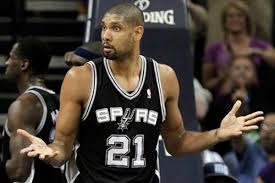
flops 4Well…yes, it does.  Let’s go back to basketball for a moment.  The game is supposed to be about one team trying to put the ball in the basket and the other team trying to prevent them.  If I am the offensive team and I dribble better and pass better and set picks better and cut for the basket better, eventually I am going to get a clear shot at the basket—with all that, probably an easy shot at the basket.  Your job as the defensive team is to impede my dribble, challenge my passes, get around my picks, and stay with the cutter, so that no matter what you do, you will not get a clear shot at the basket.  Seeing to good teams trying to do things like that is really exciting.  I call that basketball.  Here is Tim Duncan with the standard “Who me?” pose.

There is an alternative, however.  Rather than your trying to get to the basket, you can try to make the ref think the defensive player impeded you path to the basket.  This is all drama; it is all showmanship.  I play defense for the purpose of persuading the ref that you committed a charging foul.  You play offense for the purpose of persuading the ref I committed a blocking foul.  This is not basketball; it is theater.  The more the game is rigged for dramatic effect, the less it is like basketball and the more it is like a bad soap opera. [Note: not all flopping is bad.  Below is Dick Fosbury of Oregon State, who perfected flopping before it was even a bright idea in basketball.]

It works the same way in politics.  What Dickerson meant was that there is a way to play flops 2politics.  I try to show that my party is more reliable than yours; that my issue positions are more likely to work than yours; that I am a more appealing, more likeable person than you.  You say that my party is out of step with the American people, that my positions will lead to some dire outcome; that I, myself, have done or said things I should be ashamed of—Mitt Romney “not caring about the poor” is a good example of that last one.  And while you are trying to show that my issue positions are bad, I am trying to show that yours are worse.  We are playing offense and defense simultaneously.

But what Dickerson actual said is that there is a lot of flopping going on.  The whole game of politics is skewed as candidates try to pretend that something racist or sexist or ageist has been said and that the candidate who said it should a) apologize to anyone who might have been offended, b) withdraw from the race, and c) if necessary, sacrifice his or her firstborn child.  The more the political debate is rigged for dramatic effect, the less it is like civic discourse and the more it is like a bad soap opera.

President Obama wants the poor to get good medical care as they do in the social democracies of Europe.  President Obama is a socialist.  He is un-American.

Senator McCain wants to send a message to Iran: “You know that old Beach Boys song,” he quipped, “Bomb Iran? Bomb bomb bomb, bomb bomb Iran.”  Sen. McCain is a warmonger.  He would involve U. S. troops all over the globe at horrific personal and financial cost.

People who like their politics dirty ask, “What’s the harm in having a little fun?”  I say it depends on what you have to give up to have that fun.  When candidates are punished for every expression that could be misunderstood, they will resort of completely opaque “talking points.”  When candidates’ private lives are ransacked for unguarded comments to friends or neighbors, they will make sure no part of their private lives is accessible to anyone outside the clique.

Flopping is an increasingly common political strategy.  I say it’s ugly.  I don’t want to watch it. And it takes the place of issues oriented discussion without which we will continue to drift.

[1] The NBA says, “If a defensive player is not stationary, does not have both feet firmly planted on the floor, or does not have established position before the offensive player is by him, he will be charged with a blocking foul.”.

Posted in Politics | Tagged , , , , , , | Leave a comment

College Recruiting and Sexual Abuse

This is probably one of those essays I will eventually wish I had written and not posted.  I take a little courage from the experience of Hannah Arendt who wrote about the trial of Adolph Eichmann and called it “the banality of evil.”  The OED defines banality as “anything trite or trivial; a commonplace.”  Eichmann?  The guy who ran the Nazi death camps?  Trite?

That’s what Arendt was reviled for saying, but she had a point to make.  The point was the Eichmann himself was a nonentity.  He was a petty bureaucrat.  The death machine the Nazis created and put at his disposal was a horror beyond all previous imagining, but there was no way to put this horrific institution on trial; we had only Eichmann to try, and he was small fish.  Arendt’s critics were not satisfied.  They wanted Eichmann himself to be evil.  Arendt said that was missing the more important point; it was missing the point we really needed to understand, which is that evil can be routinized and turned over to “rule-followers.”  Killing all the rule-followers is not going to help us.

So…I’ve got a point to make, too.  It is that sex is a big time part of big time sports programs in the NCAA.  It is, to this point, to the advantage of the major athletic programs to arrange the sex, to deny how commonly it is used to buy athletes, or to look steadfastly in some other direction while it is occurring.

The article this post is based on appeared in the New York Times in 2002.  I am going to pick out of this article a series of events that suggest that sex is a normal part of the recruiting process.  It is a system.  Because of that, it does not exclusively represent the choices made by individual men and women, although that is also true; it represents a system that has enough goodies in it that it will continue despite periodic scandals on this campus or that.

By the way, I normally illustrate these posts with pictures that make the topic more visually compelling.  You will understand why I am not doing it for this post.

The article is based on the New York Times, but the fact is that I am a University of Oregon alum and the recent scandals about basketball players at the U of O provide an occasion.  Bear in mind my idea that these scandals are the by-products of a system and that the system benefits from continuing to have them.

Here’s what the University of Oregon believes happened.

Damyean Dotson, Dominic Artis and Brandon Austin were named in a police report alleging that they assaulted a woman at an off-campus home on March 8. None of the three players were charged with a crime.  The police couldn’t find anyone with a clear and verifiable memory of what happened.

Oregon President Michael Gottfredson said at a press conference, “that he has worked with several campus organizations to make sure that allegations of sexual assault in the campus community are dealt with swiftly and appropriately. It’s my great hope that we as a community can address the broader issue directly, openly and decisively,” he said. “We will do whatever it takes to foster a culture of respect and shared values on our campus.”  Very presidential.

Oregon Athletic Director Rob Mullens said that the alleged actions of the three players involved in the incident aren’t befitting of a University of Oregon student-athlete. “It was very clear to us that we didn’t want them representing our organization,” Mullens said.  It’s about the players, you see; not about the party.

Basketball coach Dana Altman said, “I’m very disappointed in these players.  When I read the report, I was disappointed.”  A somber, fatherly tone.

I don’t want to imply that any of these responses is insincere, but it is what the occupants of those statuses always say when another in the long series of sexual abuses becomes a news story.

Here, for instance, is James Duderstadt, who was president of the University of Michigan from 1988 to 1996.

“These parties are a major problem and I can’t say for certain, but I think they are a problem at a number of universities, mainly because these are high school kids away from home and there is a total lack of supervision and structure. I was shocked when I heard about how they were handled. They basically turn these kids loose and hope things work out.”

The parties are the problem.  The kids are not up to the challenge of behaving themselves.  “They”—that’s someone from the university—just turn these kids loose and hope things work out.

Mary Keenan, the district attorney from Boulder, Colorado, looked into recruitment parties and found them to be “an ugly football subculture.”  A 17-year old woman had told the Boulder police that she had been raped by a Colorado football recruit at a party in 1997.  “These recruiting parties are definitely concerning,” Jim Fadenrecht, director of public safety at the University of Colorado, said. “The bottom line is there are certain ingredients when you put them together that can be a problem. Those things are alcohol, young kids and a lack of supervision.”

Fadenrecht’s comment is the closest one so far to that way I am approaching things.  There are these “ingredients.”  You put them together and you are going to get trouble.  I like that because it begins to define a system that is a good deal larger and much more stable than the individual intentions of individual men and women.

Not everyone agrees with the “mix of ingredients” approach.  Tyrone Willingham, who was the football coach at Notre Dame at the time, said “Most players and recruits behave like gentlemen at these parties…I think there are [sic] only a handful of troublemakers.  Barry Switzer, former coach at Oklahoma doesn’t see it that way: “There are groupies everywhere and sex is going to happen when kids are involved.”  That’s not much of a mix of ingredients and by “groupies,” I think he means women who go to the parties to score with athletes.

Mike Freeman, who wrote the New York Times piece I am relying on for information, thinks it may be more a misunderstanding.

“Some of the accusations connected to recruiting parties seem to have their origins in confusion over their purpose. Some participants have acknowledged after an incident that they knew the women were expected to have sexual relations with visiting high school players. While the relations generally appear to have been consensual, occasionally women who attended a party said afterward that they had no idea what was expected of them.”

I find that same passive construction in a protest by several women’s groups:

“Some women understand they are expected to have sexual relations with the recruits and do so willingly, but others do not have a clue about what is expected and become unwilling participants.”

I’m looking at the passive verbs here: “were expected to have sexual relations” and “no idea what was expected of them.”  I put the emphasis on other people’s expectations of the women in Freeman’s account and the emphasis on “groupies” in Switzer’s account.

Inevitably, we get down to the question of whether the women consented to sex.  We want to talk about that because we want very much to distinguish between between “kids having fun” and “sexual abuse.”  Everyone who wants that distinction to be very clear will be unhappy about the amount of alcohol consumed at these parties.  Freeman tells of a woman who volunteered to have her apartment used for such a party.  She drank eight beers and two shots of run and went to lie down.  She woke up with people on top of her.  Did she consent?  Is that a question that means anything?

These parties are going to happen.  The universities’ athletic departments like it, the boosters like it, the recruits and players like it, the women who go to these parties for thrills like it.  The NCAA says it is up to the universities to police these matters.  The universities say they do police the official ones but there are a lot of unofficial ones.  These parties are going to happen.  “Recruiting parties can be harmless fun,” observes Mike Freeman, “but they can also cross the line.”

I have argued that there is an organized system of beneficiaries and that the sexual abuse that sometimes happens is a by-product.  One of the ways of making sure that these parties don’t “cross the line” so frequently is not to run the whole recruitment enterprise so close to the line.  That means that university officials must make it their business to know what is happening and to actively prevent it or lose their jobs.  If “I didn’t know about it” is not acceptable as an excuse and “they are boys away from home for the first time” is not an acceptable excuse, and if “you failed in your responsibility as president/athletic director/coach and so you are fired” is the consequence, then these parties will stop.

Let me return to the system emphasis.  My point here is that there is a confluence of interest so great that this kind of recruiting WILL continue, and people will continue to be victimized by it.  But these “victims” are also free agents.  The recruits and the veteran players who decide how to “show them a good time” are agents.  They can decide what to do and what not to do.  They are accountable for their choices.[1]  The women who go to these parties for the thrill of it and who drink themselves into irresponsibility are still accountable for their choices.[2]  The boosters who arrange the parties and, in some widely noted occasions, arrange the strippers, are accountable in the same way the players are.[3]  The NCAA, the university president, the Director of Athletics, and whichever relevant coach or assistant coach it is, are still accountable for their actions and should be condemned if they fail.  When they fail twice, i.e., both by ignoring the behavior and then by denying that they knew anything about it, they actually are condemned.  Many formed presidents can testify to that.

There is a lot of fun to be had, as I see it, in condemning any or all of these people; their choices, their distorted priorities, and their self-centeredness.  But now, I get to cash in the business end of the Eichmann analogy.  Hannah Arendt never denied that Eichmann was culpable for what he did.  Her point is that if we allow ourselves to be distracted by this person—his choices, his distorted priorities, his self-centeredness—we will not attend as we should to the much greater evil.  That greater evil is that a system was built that was so large and so powerful that “holding people accountable” doesn’t even slow it down.

And that is my point about sex and recruitment in big time athletic programs.  The sexual abuse that occurs is a predictable by-product of what is done all the time and that most of the time, produces no complaints.  For instance, the woman who drank eight beers and then two shots of rum and then woke up with a very large athlete on top of her—remember her?—was one of four women at that party and the other three said they got exactly what they came to the party to get.

That means that we need to shut down the machine because the low percent of regrettable by-products is too high or we need to say that keeping the machine going is so important that we can afford that percent of regrettable by-products.

I think those are our real options.  What some people think of as “a better option” does not seem like an option at all to me.  That would involve a new recruit, brought to a room of strippers in the presence of people he looks up to and whom he hopes to join as a teammate, saying, “No thanks.  This isn’t something I want to do.”  It would involve women refusing to go to “parties like that” as her friends do or going to the parties in non-seductive clothes and staying resolutely sober the whole evening, making herself conspicuous in the process.  It would involve coaches, ADs, and boosters choosing “good character” and lower athletic skills and watching their program decline relative to their traditional opponents and, of course, losing their jobs in the process.

Those don’t look like “options” to me.  I think the real options are the two I offered earlier.


[1] Of course, they are accountable for the failure of their alternative (“not showing them a good time”) strategies, too.  These recruits are going to play somewhere.
[2] Of course, the one woman in clothes unlike the other women and drinking club soda, unlike the other women, will have to find a way to answer the question, “So…why are you here?”
[3] They must explain, in other words, why they seduced the recruits (not just with the strippers) or why they allowed the program to decline or, in a more just world, both.

Posted in Education, Living My Life, Politics | Tagged , , , , , | Leave a comment