My teammates are not offended

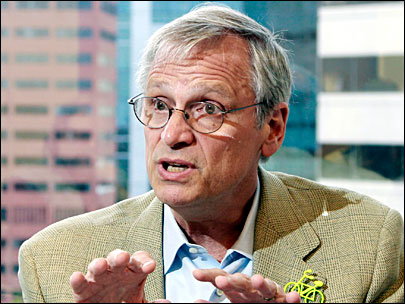
I was taken, recently, with the premise of the movie, Surrogates. I liked the premise so much that I tried really hard to like the movie. I failed, but I still like the premise so I am going to make use of it today. Surrogates is set in some unspecified future in which ordinary people spend their days in “stim chairs” and are represented in public by automatons who look just the way each of them would like to look. [footnote 1: “Including drool 1the fat and balding old man who chooses to inhabit a surrogate that looks like an incredibly sexy young woman.”]  In this picture she is appearing in her surrogate; he is not.

You can see why that appealed to me. These people weren’t prisoners…exactly. They refused to appear in public as the people they actually were—inhabiting the bodies they actually had—and chose, instead to live all day every day sitting in a chair wired to connect them to their surrogates. This isn’t like not going to the dance because you “don’t have anything to wear.” This isn’t like skipping your high school reunion because you still have a lousy job and a disreputable car. This is a lot worse.

I let my condemnation of “those people” run free as I watched the movie, in part because I don’t make those particular mistakes. But there is the question of how to think clearly about the kind of mistakes I do make—the Dale kind of mistakes. I have an answer I’d like to offer, but first I want to prepare that answer with plausible starting points.

drool 2Here is the first such. A sociology text I read long ago attempted to define what the word institution means to sociologists. The author imagined a scene in a restaurant in which all the normal customers were sitting and eating. One man was standing at the window turning slowly left and right looking, apparently, for something. A young woman new to the restaurant thinks maybe she should call the manager and get that guy out of here, but one of the regulars stops her. “It’s OK,” he says, “he always does that.” When “always does that” makes everyone relax and go on with their business, “institutional status” has been achieved.

Here is the second. Imagine that I am a guy who just can’t hold his liquor. I drink a little bit and I get “funny.” [footnote 2: ‘thinking you are funny would be one of the great consolations of being drunk if only everyone else got drunk at the same time and alto thought you were funny.  Alas, it is not always so.”] And then I drink a little more and I get sociable and I plan parties for us all to attend next week. Eyes roll. No date books are utilized. Finally I get mean and start to say really nasty things to these people who are my friends. “It’s OK,” says one of my longtime friends to a new acquaintance, “He always gets like this after the first six-pack. He doesn’t mean any of it.”

You see the similarity, of course. You feel the same way I would, I suppose, that if I can’t handle alcohol any better than that, maybe I should stay away from it. Good idea. Let’s move on.

Third starting point. Let’s say the difficulty isn’t alcohol. It’s a stroke and the effect of the stroke, for our consideration, is that I can’t feel the side of my mouth, which means I can’t feel the saliva that pools there. And I don’t know when I start to drool. This a failure of presentability.  It’s serious. It is one of the things “one simply does not do” and now I can’t help it and don’t know when I’m doing it.

There is the Surrogates strategy, of course. I am so embarrassed about being the guy in drool 3the group who drools that I just don’t become a part of the group. Understandable, certainly, but not very satisfactory. And if I have been in a group where one or more of the members drools, then I know how I felt about it and about them. Naturally, I imagine that people are feeling that way toward me. The strong side of me doesn’t want to inflict that experience on the others; the weak part of me is just self-conscious and ashamed.

Fourth starting point. I was married for a long time to a wonderful woman who died very rapidly of cancer. In the short time between the diagnosis and the death, she experienced a bunch of really nasty treatments and felt really bad a lot of the time. And, of course, all her hair fell out. Marilyn wasn’t really the self-conscious type. She imagined that everyone either liked her or was looking around for a strategy that would enable them to like her. Here’s what that did for her.

She took her physical liabilities—the analog to the drooling man, above—as difficulties her friends were trying to overcome. There is a certain wariness people have when they sit down to a good conversation with a woman who is dying of cancer. You don’t know quite how to treat her. You don’t know whether she is self-conscious or frightened or angry. You just don’t know how to be.

Marilyn saw her job as finding a way to make them comfortable with her. She taught themdrool 4 how to be with her and rewarded them for continuing to try and for getting it right. She was a warm and generous woman and when she rewarded you, you knew you had been rewarded. No one avoided her. People continued to introduce her to their friends and to be introduced to her friends, just as they always had. In the meantime, her husband (me) stood there dumbfounded. I had not only never seen a performance like that; I had never imagined that there could be one. The faint beginnings of the concept and the repeated concrete actions occurring at the same time, day after day. It was dazzling. On the other hand, it set the bar pretty high.

Having started now at four different places, let me arrive at a strategy I think even I might be able to use. I tell my friends that I am sorry to be the guy in the group who drools and doesn’t know when it is happening. I tell them that I value their friendship and would like to presume on their good will for a favor. Since they can see the early stages of drool and I can’t, they can just give me a signal—I picture any one of them putting an index finger up to the corner of his mouth—and I act to prevent the occurrence. That’s it, really.

But I see the power of this in the establishment of the institution. I’m like the guy in the restaurant about whom they say, “Don’t worry. He always does that.” This difficulty I have isn’t like remembering not to get drunk and abuse my friends; this is about having had a dool 5stoke and needing friends. If this works the way I am thinking it will, these friends are my team. They have my back. They know the many ways we care for each other and the little signal, the finger to the corner of the mouth, is just one of those ways of caring.

People who would like to be offended by it will face a wall of people who are not offended by it. They would be violating a norm that my friends learned how to honor and then to value. The new people would run very quickly into the wall of “this is how we do it here.”

We are a team. About me they say, “He is one of us.” To other people, they say, “Don’t worry about a thing. We’ve got this under control.”

Posted in Living My Life | Tagged , , , , , | Leave a comment

Obamacare and “Death Panels”

This is a question that has gotten a lot more attention than it deserves.  Let’s take a look at it.  A “death panel” would have to be a number of people (panel) that is empowered to take an action or to withhold it, the result of which would be that the person in question dies.  That brings us now to two questions: a) are there any such panels and b) is there any provision in the Patient Protection and Affordable Care Act (Obamacare) that facilitates the death of patients?

Are there death panels?

death panels 8Yes.  Of course there are.  Not like these. Let’s try to imagine what it would be like if there were not.  It would mean that there were no medical procedures  that “cost too much.”  For the very rich, of course, this is often true.  If a procedure were available that extended a rich man’s life at the cost of a million dollars a day and he wants to pay the million dollars a day, he will be treated.

If that same procedure were recommended for a poor woman, the question of cost would come up.  If the poor woman is insured, the insurance company will have to say yes or no.
If not, some payer of last resort will be looked for.  Back when there were no procedures that cost a million a day, families sometimes pitched in, but we are out of the range of family resources here.  In Oregon, I have seen tearful mothers begin media campaigns for contributions that will save the life of a child, only to see the child die before enough money was contributed.  If there were some way to make it funny, it would be a terrific TV game show.
Here’s the truth.  If there is a medical procedure to be done, someone is going to have to be paid to do it.  Any group of people who refuses to pay the cost of a procedure, is a “death panel.”
2.  What does Obamacare have to do with death panels?
Nothing.  Let’s start the question at another point.  Do you think that elderly people ought to have the right to make decisions about how their last days will be managed?  Me too.  If they don’t decide when they are able, someone will decide for them when they are no longer able.
Brief Excursus:  The word I always use for this is “agency,”  I want to be the agent—that’s death panel 6Latin for “the one who acts”—in my own life.  There is a nastier form of this consideration that uses autonomy instead.  I am a big fan of autonomy when it is my own autonomy we are considering, but I am not such a big fan of the word anymore because “autonomy” is too close to “heteronomy.”  Someone is going to “be the law” in a situation—that’s the nomos part.  It will be me (auto-) or someone else, (hetero-).  My hesitation about the word autonomy, considered in the light of its alternatives, is that it raises the question of alternatives.  I don’t want that question raised.  I want it presumed and “agency” does that for me. Incursus resumes here.
Presumably a woman and her husband will sit down with a knowledgeable person to talk about how they want their last days handled.  Making my own decisions about that is important to me and having the advice of a doctor can help a lot.  Question: who is going to pay the doctor for spending his or her time that way?  Here is a little cut from Wikipeda, every piece of which, with the exceptions of the names of the cosponsors, I know to be true.
A bill to provide for reimbursement every five years for office visit discussions with Medicare patients on advance directives, living wills, and other end of life care issues was proposed by Rep. Earl Blumenauer (D-OR) in April 2009—with Republican cosponsors Charles Boustany (R-LA), a cardiovascular surgeon, Patrick Tiberi (R-OH), and Geoff Davis (R-KY).[32][33][34] The counseling was to be voluntary and could be reimbursed more often if a grave illness occurred. The legislation had been encouraged by Gundersen Lutheran and a loose coalition of other hospitals in La Crosse, Wisconsin that had had positive experiences with the widespread use of advance directives.
death panel 7Earl Blumenauer is a very good congressman, but I take special pleasure in noting his contribution to this issue because he is the only member of Congress who could greet me by name if we met on the street.  So the answer to the question of who pays the doctor to be a part of this conversation is: Medicare. As important as these conversations are—they are the only way to guard agency and understanding at the same time—the doctors aren’t going to do them for free and they shouldn’t have to.  So the “Obama death panel” controversy, from this standpoint is, “Should the doctors be compensated for their work in helping people insure that their wishes are honored when they are no longer able to insist on them?”
You don’t have to be liberal to like the sound of that.
The argument against this provision of Obamacare is that it could be abused, that “panels of bureaucrats” (Sarah Palin’s phrasing) would coerce elderly people to “choose” to have the government kill them.  Any discussion can be perverted.  I know that.  Even teacher parent conferences can be perverted.  I have been the student, the parent, and the teacher in those conversations.  When the common purpose uniting the members of the conference falters, everyone has a “me first” substitute.  I remember that most vividly when I was the child in question.
So here are two questions.  What will happen if we do pay doctors to be a part of these discussions and what will happen if we don’t?  Remember the reference, above, to LaCrosse, Wisconsin?  Here’s why that is there.  You can see the whole piece from Forbes Magazine here.

Imagine a town of 50,000 Americans where 96% of those who die have signed an “advance directive” codifying their conscious decisions about how they would like to die. This is quite an accomplishment given we haven’t been able to move the needle at a national level beyond 30% over the past 30 years. By definition every possible polarized constituency in this town– conservative and liberal, religious and secular, Republican and Democrat, rich and poor–  agree on one of the most divisive political and social issues in America. Welcome to La Crosse, Wisconsin– a Midwestern everytown USA that has managed to transcend Sarah Palin’s death panel rhetoric not only to become the “cheapest place to die in America.”  But, more importantly, they have transformed the entire “tenor of care” for end-of-life planning.

96%!  How did they do that?  By talking about it together.  What a concept.  And the effect on medical costs of this plan, which, in LaCrosse, is called “Respecting Choices Advance Care Planning?”

Nationally, the average  cost for a patient’s last two years of life  is $26,000 (in some hospitals average costs run as high as $65,000) the average cost in La Crosse, is just $18,159.

The “death panels” charge was a low blow.  PolitiFact, which makes its living checking such charges, named it their “Lie of the Year.”  It’s bad and everyone who participated in it should be ashamed.  But the real cost, beyond the moral theater of it, is that we are not doing, nationally, what they have already achieved in LaCrosse.  Agency is respected.  Conversations are held.  Money is saved.

Which of those three outcomes does anyone want to object to?

Posted in Getting Old, Politics | Tagged , , , , | Leave a comment

Walking Gladly in the Dark

And I said to the man who stood at the gate of the year: “Give me a light that I may tread safely into the unknown.”

And he replied:“Go out into the darkness and put your hand into the Hand of God. That shall be to you better than light and safer than a known way.”
So I went forth, and finding the Hand of God, trod gladly into the night. And He led me towards the hills and the breaking of day in the lone East

King George VI—the king of The King’s Speech—read this poem to his British radio audience during his Christmas broadcast in 1939.  Great Britain had, by that time, declared war on Germany.  Germany had conquered Poland, virtually over the weekend, and Hitler was biding his time for the attack on western Europe.  It was a dark time and finding the way in that dark time was daunting.  You can see why it appealed to the king.

The poem was popularly called, ”The Gate of the Year.” Minnie Louise Haskins, of the London School of Economics, who wrote the poem in 1908 called it “God Knows.”  You can see the whole poem here.

I have loved this first part of the poem since I first heard it.  “The man who stood at the gate 4gate” engaged my imagination and asking only for a light and being told there is a better way and finally, treading “gladly into the night.”  All those appealed to me.  But something did not appeal to me and I’ve never known just what it was.  Today, I want to poke around a little and see what I can find.

When I think of it as my own problem, rather than King George’s, I start at a different place.  Here’s what I want: I what to tread safely into the unknown.  I think it will not be “unknown” if I can see it, so I ask for a light.

The man said, “You will be better off trusting God because this trusting will be better than seeing where you are going and it will be safer than knowing where to go.”  That’s how I read what the man said.

I have that sentiment myself sometimes.  “Tell me what to do so that I can be safe,” I want to say.  I formulate it in those terms, but I don’t say it out loud because I don’t approve of it.  Safety first people don’t do improv, I’m sure.  Safety first people don’t put their lives in the hands of local populations who may be friendly or not.  Safety first people don’t catch a pass on a crossing route when cornerbacks of reliably hostile disposition are waiting for them.  So safety is good, but “safety first” is not.

As I see it, there are two kinds of reassurance I might (probably would) prefer to trusting that I have put my hand into the hand of God.  First is “the known way.”  Familiar; habitual.  “I could do this with my eyes closed,” we say, but we don’t often say it in inescapable darkness.

Second is “the observable way.”  This is not a “way” we know, necessarily, but it is a way we will know how to react to if we can see far enough ahead.  We trust our reaction time, rather than our foreknowledge.

I might have a shot at either of those, if I were entirely sure that I had put my hand into the hand of God.  But it’s hard to be sure of that.  It is easy to see that I am not calling the shots anymore, but it is not easy to know who is.

gate 4The image that comes to my mind—influenced, I am sure, by a rapidly increasing technophobia—is “giving control” over to my computer to someone as at “remote source.”  If the tech at the “remote source” cares about this glitch as much as I do (unlikely) and if he or she is more competent than I am (extremely likely), then I can relax and watch the cursor jerk frantically from one menu to another and from one function to another while I watch.  Do I trust this person to manage my computer better than I could myself?  Absolutely.  Do I trust God to manage my life better than I could myself?  In principle.  Do I know that the remote source now exercising control over my life is, in fact, the God whom Jesus referred to as “Father?”  No.  I don’t know that.

And if I did know that, would I turn control over to God with the wholeness of heart with which  I submit to the tech at the remote location?  My very best trust in God comes when there is no alternative.

When I have some notion, myself, of how things should work out, I discover that other, deeper, levels of myself have preferences.  I know a little something about this “way,” I say, because I have been here before.  I am asking for only a little light, not a lot, because I do trust my ability to respond to unforeseen events.  If there are alternatives, like these two very partial ones, trusting that the Being to whom I have given remote control over my life is, in fact, God and that He will “guide my way”—then those are harder.

There is a solution to this dilemma.  It is, to borrow a phrase of C. S. Lewis’s, a “severe mercy.”  It is to trust, not that God will guide me safely along my path, but that God will direct me where He needs for me to go.  When the weak point in a military position is just about to give way, any general will send more soldiers there  That might not be where the soldiers want to go, but it is where they are needed, so it is where they are sent.  I don’t think of my life as a battlefield, really I don’t, but in the battlefield situation, the contrast between where I need to go and where I want to go is nicely illuminated.

If I trust that I will be guided where I need to be, that will be “a mercy.”  If that “place” is somewhere I will be humiliated or bored or fired or killed,  that will be “severe.”  But if I can tread gladly into the night, I will feel that it is trust well placed and I will gladly give up my known way and my attraction to safety.

Posted in Living My Life | Tagged , , , | Leave a comment

When you can’t go any further, you know where you are

I went to the University of Oregon to begin my doctoral work in 1970.  I knew that they didn’t give doctorates out for really good essays on what I did last summer vacation.  I knew it would require original scholarly work.  And I didn’t even know what I wanted to study.

I did know who I wanted to study with, however, and that worked our just as well.  James C. Davies had written Human Nature in Politics in 1963. It was a serious consideration of important political ideas from the standpoint of research in social psychology.  So I did two things in pursuit of my new doctoral field.  I applied to be a graduate teaching fellow in the department of political science.  They said No.  So I applied to be the morning janitor at the public library in Eugene.  They said Yes.

boundary 2, 2From the standpoint of the dissertation I eventually wrote—I called it Undimensional Man, having a little fun with Herbert Marcuse’s One Dimensional Man—both the No and the Yes were crucially important.  This is all hindsight, of course.  I really wanted the fellowship and, except for the money, I really didn’t want the janitorship, but you really can’t tell, at the time, what is a good outcome and what a bad outcome.

Just before I would open the library doors to the public at 7:00 a.m., I would dust the whole library floor.  As a part of that process, I dusted past the theology section—and every other section—and in the theology section, three shelves up from the floor, was one of the ugliest book jackets I have ever seen.  It looked like it was designed not to be mistaken for a deer in hunting season; it was orange (not green, like the example) and yellow and black.  I noticed that cover for a month before I ever stopped to see what it was.  It was Gordon D. Kaufman’s magnum opus, Systematic Theology: a Historicist Perspective.  “Huh,” I said, “So that’s what it is.  Ugly cover.”

A month later, I picked it up again and noticed that he said, “a Historicist Perspective” as he should, and not “an Historicist Perspective” as many do. Then I noticed that he was raised Mennonite, which is not a religious background I associate with Harvard Divinity School, where Kaufman was a professor, and which is similar in many ways to my father’s upbringing in the Brethren in Christ church.  Eventually, I took the book out; I did have a library card, after all.  I have read it maybe a dozen times by now.  The Gordon Kaufman of 1968—he has moved on from his 1968 positions but I still hold them—is my “go to” theologian.”

When I started getting sold on Gordon Kaufman, I started working my way through his other books and by 1972, I had found God the Problem, a book of his essays.  In one of the essays, “Transcendence without Mythology,” I found this passage.

Consider, for example, the situation of a man imprisoned in a cell outside of which he has never been and from which he cannot escape. If he seeks to conceive the restricting walls of his room—with their resistance to his efforts to push through them, their hardness and solidity and color—as (material) realities, he will be able to do so only in analogy with the experienceable (material) objects within the room. Thus, his conclusion that the walls are composed of some sort of thickness of material substance, however plausible, in fact presupposes an interpretation of that which is beyond what is directly experienceable by him, namely the bare surface of the walls. The conception of the ultimate limit of his movements is constructed imaginatively out of elements derived from objects within his experience that partially restrict and limit him; for the stuff or structure of the walls themselves—that “behind” their surfaces—cannot be directly known, though the restrictingness of the walls is, of course, directly experienced.

It was the picture that did it for me.  A man in a completely dark cell.  What he knows aboutboundary 2.3 where he is can be determined by not being able to go any further.  He goes until he hits a wall and then he can’t go further.  By keeping track of where he is and moving in different directions, he can determine the size and shape of his “cell.”  He can learn the height of the cell and the makeup of the floor and what the inner surface of the walls is like.

And while I held that image in mind, I read a lot of anthropology and sociology and psychology and political theory and had conversations with a lot of really interesting professors and graduate students.  I began to notice that “what stops us from going where we want to go” is like the wall of a cell.  Skin color can be a wall; gender can be a wall; poverty can be a wall; being religious or irreligious or wrong-religious (depending on where you live) can be a wall.  And how do you find out that there are walls there?  By running into them and remembering where they are.

I was still thinking about walls when I read Amitai Etzioni on “inauthenticity” and how it is different from “alienation.”  The guy in the cell in Kaufman’s example is alienated as Etzioni sees him.  But look at this distinction: “The alienated man sees before him a tall unyielding wall; the man caught in an inauthentic situation feels entailed in a cobweb.”  You can find that on page 633 of Etzioni’s The Active Society or you can find it as the quotation introducing a paper Dave Campbell and I published last year, “Turning Cobwebs into Walls.”

When I read Etzioni on inauthenticity, I realized that you don’t really need walls to trap boundary 2, 1people.  Cobwebs will do the trick if the people have given up on going anywhere or if they are confused about where to go or even if the notion of “going somewhere” has lost all meaning.

The short way to end this story is that when I saw that cobwebs could function as “walls”—and in Marcuse’s One-Dimensional Man, they do—I sat down and wrote my dissertation.  That wouldn’t be a fair account, but it wouldn’t really be false.  I needed to add some other pieces to that realization to bring me to inventing a “causal attribution journal” as a way to tell which were walls and which only cobwebs.

The work of devising the causal attribution journal has been on my mind since 1974.  I have been presented by my undergraduate classes with dozens of ways to misunderstand it which I would never have thought of.  And in all that, the image of the guy in the dark cell has continued to anchor all my speculation and all my teaching.  And I had forgotten about it until just last week.

Posted in Political Psychology | Tagged , , , , | 2 Comments

2014 in review

The WordPress.com stats helper monkeys prepared a 2014 annual report for this blog.

Here’s an excerpt:

A New York City subway train holds 1,200 people. This blog was viewed about 5,800 times in 2014. If it were a NYC subway train, it would take about 5 trips to carry that many people.

Click here to see the complete report.

Posted in Uncategorized | Leave a comment

Simeon the Stubborn

We just finished the season of Advent.  On the church calendar, it is now Christmas.  How awkward is that?  Our whole society is saying “Been there, done that,” and the churches, the liturgical churches at any rate, are saying, “Wait.  We’re just getting started.”

So it’s Christmas now.  And at our house, it is the Christmas story according to Luke this year and that brings us to the character of Simeon.  Bette once said that a mind like mine that makes connections by so many different modalities really shouldn’t be trusted with a blog that just anyone could read.  She didn’t actually say that out loud, but I know the look by now.  Today, my goal is to prove her right.

The thing that’s hard to get about Simeon is just how bad he wants it.  Here’s what Luke says about him.

25 Now there was a man in Jerusalem, whose name was Simeon, and this man was righteous and devout, looking for the consolation of Israel, and the Holy Spirit was upon him. 26 And it had been revealed to him by the Holy Spirit that he should not see death before he had seen the Lord’s Christ.

jacob 2The expression “the consolation of Israel” doesn’t have a single clear meaning, but everyone is sure it means that God will, at long last, take care of his people, Israel.  It is something a devout man might feel very intensely about.  He might want it more than he wanted anything.  He might very understandably want it more than he wanted life, but that wasn’t a trade he was going to get to make.

It is easy for people who haven’t thought about it to imagine that “should not see death [until]…as something like the invulnerability of Achilles.  And just as we think Achilles is “safe”—except for that little matter of the heel—so we might think that Simeon is “safe” until God provides the promised consolation; until, in Luke’s phrasing, he had seen “the Lord’s Christ.”

That’s not the way I’m thinking about it.  Let me add a batch of entirely fictional, but also entirely plausible, “facts” about Simeon.  He’s an old man.  Let’s say he has rheumatoid arthritis. He is in pain all the time.  He doesn’t sleep well, so he is fuzzy-minded all the time.  He doesn’t have any friends and he doesn’t get around the way he once did.  And yet, every day he goes to the office, so to speak.  He goes to the temple to pray for the one thing that he can set beside his pain and his drowsiness and his loneliness in such a way that they all would be worth enduring.  He wants to die, sure.  He is eager to die.  But he refuses until God makes good on His promise.

God looks down from heaven and pities the old man.  He says, “Simeon, this is taking longer than I thought.  It’s OK for you to let go. I know you want to die and it is a release you deserve.”  And Simeon says, “No.  Absolutely not.  You promised and I am holding you to it no matter what it costs me.  I will be here—I will be right here—until you keep your promise.”

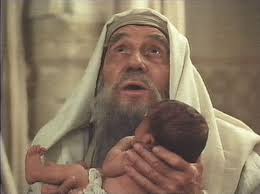
Then one day the Holy Spirit says to Simeon, “Go to the temple.  Now!”  Simeon, being that kind of person, does what he is told and there he finds Joseph and Mary and their infant child.  This is really the only way for the standoff between God and Simeon to be resolved.  They put the child into his arms and he realized instantly that the two things he wants more than anything—but wants equally—are now his.  He is holding “the consolation of Israel,” in his arms.  God has acted, finally, and “the anointed of the Lord” is here.  God has kept His word.

Now he can accept the other gift God has for him.

29 Lord, now lettest thou thy servant depart in peace…30 for mine eyes have seen thy salvation.

Some translations read, “Lord, now dismiss your servant…”  The New Jerusalem Bible has “Now, Master, you are letting your servant go in peace as you promised…”  And then, as I imagine it, Simeon dies.  He dies, I am sure, with a smile on his lips.  He can lay all that down now.  He can die in peace.  God’s honor has been preserved and Simeon’s waiting has been rewarded.

As I was thinking about Simeon this year, how badly he must have wanted it impressed himself on my mind.  If Simeon had had a wife, she would have said to him, as Job’s wife said, “Why are you hanging on like this?  Curse God and die.”  And like Job, Simeon would have said, “No.  I will wait.”

Jacob 1Then, yesterday, I thought of it another way.  This is going to take us back to Jacob, later named Israel, wrestling with “the angel.”  See Genesis 32 for the whole story.  The being Jacob was wrestling—there is some confusion about who it was, exactly—said, “Let me go for day is breaking.”  Jacob said, “I will not let you go unless you bless me.”

Jacob is not a character I have ever admired, but this year, I noticed that he was stubborn in the same way Simeon was stubborn.  Simeon had God’s promise, “I will not let you go until I bless you.”  In the fantasy I managed above, God tried to talk Simeon out of it but Simeon wasn’t having any.   In that fantasy, Simeon said to God what Jacob said: “I will not…go…until you bless me.”  Simeon knew the story and he was sticking to it.

As someone who has read the Bible all his life, I can’t tell you that I think these two passages—Genesis 32 and Luke 2—are related in any way.  But the transactions they describe suddenly seemed to me to be oddly alike.  This way of looking at it makes Simeon a lot more stubborn than he has been in the imagination of any commentator I have read, but it also makes me like him better.  He wanted to die more than he wanted any thing—except one.  And on behalf of that one thing, he came to the temple, day after day, to remind God of his promise.

Posted in Biblical Studies | Tagged , , , , , | Leave a comment

Can you really prepare for Alzheimer’s?

I think so.

Last night, I watched a really good TED talk my brother, Karl, sent to me.  The talk is about Alzheimers disease and Karl is my older brother—the only one of the four of us to have cracked 80 so far.  Alzheimers is something Karl and I care about, so when he recommended this lecture, I paid attention.

You can see it here and I hope you do.

But if you don’t—and most of you are a lot younger than I am—let me tell you what it says and let me start at another place.  Here is Dylan Thomas’s well-known prescription:

Do not go gentle into that good night,
Old age should burn and rave at close of day;
Rage, rage against the dying of the light.

He had death in mind, of course, not dementia.  But the you—the person you are—is what is lost in dementia.  Dementia shows that “who I am” is a shorthand expression referring to who I have been.  I am proud of who I have been, but as that self slips away, I do not become no one at all.  I become the person I am then.  I may be shifting, frail,  and confused.  A disordered self, but a self, still.

As I look at the poem, I am struck that submission or acceptance are seen as one pole: the bad one.  And rage is seen as the other pole: the good one.  Really?  Are those the options?  Whatever a self is, it is associated with “agency,” that is, with the ability to intend an outcome and to act so as to achieve it.  Is it worth spending the last penny of agency on rage?  Maybe that’s a good use for some people.  I don’t think it is for me.

Alanna Shaikh calls her talk “Preparing to get Alzheimers,” which is a little catchier than the title I would choose.  She pictures herself as predisposed to get Alzheimers because her father had it—as my father did—but I still think I would want to say that I was preparing for the possibility of Alzheimers.  There are three things you can do, she says, and I like all of them.

Alz 1First, learn to do some activities that are not principally cognitive.  She chose knitting.  The idea is that you want to do things you take pleasure in and if the New York Times crossword is the kind of thing you take pleasure in, you are going to lose it quickly.  You aren’t going to lose knitting quickly.  You hands will know how to knit and you will  be able to take pleasure in what they do.

That idea caught me because my favorite activities, apart from running on Portland’s famous Wildwood Trail, are cognitively demanding.  I read a lot, I write a lot, I have discussions that require and that celebrate careful thought and careful use of words.  Maybe I could make a regular routine out of shooting baskets.  I used to be a pretty good shot.  Maybe weeding garden beds is my kind of thing. Something.  Alanna’s idea is that now is the time to start getting good at it and that, at least, makes sense.

Second, she proposes that becoming physically stronger and better balanced are worth doing.  If Alzheimers offers a straight decline from whatever level of fitness you had whenAlz 2 the decline started, then the higher the level, the more of the decline is at the good end of the scale.  She wants to maintain her mobility for as long as she can, and who wouldn’t?

I have had a quibble for a long time now with the notion of “getting fit.”  “Fit for what?” I always wonder.  Here, at last, is a good answer.  Fit for moving around safely under your own power.  Fit as in not falling down and hurting yourself.  Fit as in standing up and sitting down when you want to.  Those all seem to me to be things worth doing and retaining the ability to do them longer doesn’t have, for me, any of that burring sulphur smell of “rage against the dying of the light.”

Alz 3Shaikh’s third project is “becoming a nicer person.”  I have my doubts about that one.  I think becoming a nicer person is worth doing, but my sense of what Alzheimers does to you is that it takes you way back to your most natural and least processed self.  I don’t think I am going to “regress” in my 80s to the person I started trying to become in my 50s.  If it really works like that, I’m going to move toward the person I was as a little boy.  That’s a mixed bag, I’m sure, but I was a pretty happy little boy, so maybe it will work out.

Apart from the specifics of Shaikh’s proposals, I’d have to say that I really like the idea of doing what I can now to give me more good time then.  And if “then” never comes, how bad is that?  I’m stuck with some new skills and a heightened level of fitness and some surplus niceness?  Is that bad?

And then too, I just like being plan-full.  It feels good to me.

Posted in Getting Old | Tagged , | Leave a comment

Green Chri$tma$, 1958

When Green Chri$tma$ came out in 1958, I was about twenty years old.  I thought it was the funniest broadcast parody I ever heard.  I memorized it immediately—not much of a trick at twenty, really—and performed little impromptu snatches of it with friends and family.  It was AGAINST the commercialization of Christmas.  Can you imagine?  In 1958?
Now, in 2014, you can just google Freberg, Green Christmas and hear the whole thing and green 2if you are my age or so, you can just check off the products that are being referred to, one after the other.  What is it, for instance, that is “hot” as that kind of product “ought?”
But…of course…a lot of life has intervened between 1958 and 2014.  I still love the skit and I still remember most of it, but a couple of things have come slowly to my mind since the fifties.  One is that I have become a good deal more sensitive to the -zation suffix.  “-ize” is an action suffix; something has been done to a word that has been “-ized.”  A “personalized” birthday card, for instance, was impersonal and then you “-ized” it and now, if you did it well, it is “personal.”
It is easy and accurate to say that Christmas has been -ized and if it is an egregiously commercial “holiday” it has been commercialized.  But as a personalized birthday card was impersonal before you personalized it, Christmas was something before we commercialized it.  And before it became a celebration of the birth of the Christ (Christ-mas) it was, by various names, the Festival of Sun-return.  And some very enterprising Christian missionaries sacralized it and it became Christmas.  I’m fine with that.  I still celebrate Sun-return.  Everyone who is affected by Seasonal Affective Disorder during Portland’s relentlessly gray winters also celebrates Sun-return.  I also celebrate Christmas, mostly Advent in my case, and enjoy them both.
Green Chri$tma$ scandalized a lot of people.  It was played only twice in New York [City] by one disc jockey, and the station’s sales department threatened to have him fired if he played it again.  Robert Wood, manager of KCBS-TV in Los Angeles, told Freberg it was “sacrilegious,” which it might well have been although we would need to know Wood’s religion to be sure.
Sacrilegious?  Really?  Let’s look.

SCROOGE AND CHORUS:
Christmas comes but once a year,
So you better cash in,
While the spirit lingers,
It’s slipping through your fingers,
Boy! Don’t you realize
Christmas can be such a
Monetary joy!

CRATCHET: Well, I guess you fellows will never change.

SCROOGE: Why should we? Christmas has two s’s in it, and they’re both dollar signs.

You really have to like Cratchet, played by long-time Freberg associate Dawes Butler. He is so sincere it almost makes your gums hurt.  And Freberg’s Scrooge is so really really awful.  It is immediately satisfying to be opposed to Scrooge.  You find yourself backing into agreement with Cratchet as you are backing away from Scrooge.  But, of course, backing into a position is not a good way to understand the position you are about to take.

Cratchet’s position is that Christmas has a meaning, a purpose.  He doesn’t say what it is, of course, and Scrooge is not denying that Christmas has a purpose.  In Scrooge’s world, the purpose is commercial; in Cratchet’s, the purpose is…well…benevolent.  Christmas means good things.  Here’s his introduction to the idea.

CRATCHET: But Mr.Scrooge…

SCROOGE: What? Who are you?

CRATCHET: Bob Cratchet, sir. I’ve got a little spice company over in East Orange, New Jersey. Do I have to tie my product in to Christmas?

SCROOGE: What do you mean?

CRATCHET: Well, I was just going to send cards out showing the three wise men following the Star of Bethlehem…

SCROOGE: I get it! And they’re bearing your spices. Now that’s perfect.

CRATCHET: No, no… no product in it. I was just going to say, “Peace on Earth… Good Will Toward Men.”

green 3I have nothing against “good will toward men.”  Toward women too, using the current notion that “men” is a necessarily gendered term.  But according to nearly all modern translations, what the angel host proclaims is “…on earth, peace for those [God] favors.”  That might not be the most culture-affirming meaning, but it is very much like Luke’s gospel.  In Luke, it is the infant child’s mother who says, “My soul proclaims the greatness of the Lord…He has routed the arrogant of heart, He has pulled down princes from their thrones and raised high the lowly.  He has filled the starving with good things and sent the rich away empty.”
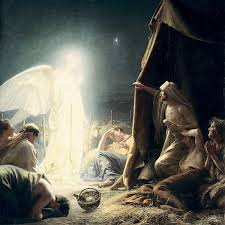
Unless Cratchet has a lot more stuff to him that I hear, he’s not going to be much attracted to this particular proclamation.  And the angel who gives the message before the heavenly hosts even appear isn’t all that full of “good will toward men” either.  “Look,” he says, “I bring you news of great joy, a joy to be shared with the whole people.”  It is, in other green 1words, good news for Jews.  It is good news for anyone who has been awaiting the arrival of the Jewish messiah, the one who will take “the throne of his father, David.”  But you have to notice that nearly all the people who have been waiting for the Jewish messiah are Jews.
This is not to say that there are not Jews in East Orange, New Jersey  Nor is it to say the Cratchet does not know these Jews and wish them the very best of the season.  Cratchet is a really good guy.  Not just in comparison to Scrooge.  He is a good guy.  But “peace on earth, good will to men” is not the message of the Season in any of the scriptures we have.
So Freberg winds up, very uncharacteristically, in the middle of the road. He offends the various advertising departments by being “anti-commercial.”  He asserts that “Christmas has a meaning,” but doesn’t go so far as to say what it is.  And Scrooge, although he is not a nice person, triumphs over Cratchet.  We know that because of the little choral war in the last few bars, in which “Joy to the World” alternates with “Deck the Halls with Advertising” and the last sound you hear is the ringing of the cash register drawer.
But here’s the beautiful thing about America.  Freberg satirizes two products in a very recognizable way: Coca Cola and Marlboro Cigarettes.  There are other references as well (“Ty-ne-Tim chestnuts roast hot, like a chestnut ought” for instance) but these two are blatant.  Within six moths, both companies asked Freberg to create an advertising campaign for them and Freberg actually did one for Coke.
So the commercial collegiality swallows up even a lampooning by one of the most astringent and certainly the funniest satirist of his time.  Ain’t it grand?

Posted in Getting Old, Theology, Words | Tagged , , , , , , | 4 Comments

Mosquitoes in Heaven

Pope Francis is having the same kind of trouble the apostle Paul had.  It’s hard to be a pastor and a theologian at the same time.  And if any remarks you make are going to be seized upon by the participants in an ongoing public controversy, it is more difficult yet.
Laura Hobgood-Oster, of Southwestern University in Georgetown, Texas, has given the matter some thought.  “The Catholic Church has never been clear on this question…Where do mosquitoes go, for God’s sake?”  You can see the whole New York Times article here.
The Pope consoled a little boy whose dog had just died.  “Paradise is open to all of God’s creatures,” said the Pope.  Presuming that by “paradise,” the Pope meant “heaven,” that gets us substantially beyimagesond Noah’s ark, in which a breeding remnant of all species was included.  It gets us to the inclusion of all animals and, depending on just what the Pope had in mind by “creatures,” all living beings whatsoever.

This suggests a different notion of ecology that we have been working with.  I know that sounds flippant and I apologize for any offense taken, but I am trying to cut a few corners here.  So let’s imagine a celestial ecology and a terrestrial ecology.  We know pretty well how things work in our terrestrial ecology.  There is a cycle of predation such that everything preys upon something, which preys upon something, etc.  Presumably, that’s what God had in mind for our earth.  Humans have had, for many hundreds of thousands of years, our own little niche in this ecology.  We are the food for animals able to kill and eat us; we kill and eat the animals we can, or scavenge from the kills of more efficient predators.  Everything works.  It is—or used to be—stable over the long term.
I’m going to skip right by some questions that might seem to be more important.  Does “paradise” mean “heaven?”  Does “heaven” mean a place where we will all be together?  Will we care?  I’m going to go to the practical questions.
If creatures go to heaven, what do they eat?  Does grass go to heaven too, or is it just the animal kingdom?  Are Flora and Fauna going to be separated for all eternity?  Do wild animals go to heaven or just domesticated ones?  Will a dog that was abused by his owner be reunited with that master in heaven?  You see the problem.
There is simply no way to map the terrestrial ecology onto the heavenly realm without starting to giggle.  Or cry.  Woody Allen quipped, using the famous passage from Isaiah as his launching pad, that in God’s rule, “the lion will lie down with the lamb.”  Currently, Allen says, only the lion gets back up.  Woody knew, I am sure, how much more productive sheep are than lions.  Possibly, he had begun to consider how the several populations could be maintained once the cycle of predation has come untied.
When you approach the matter theologically, you have to start at the other end of the images-1problem.  Things that have souls—the hypothetically eternal part of the entities we know—can go to heaven.  That means that if the question you really want to get answered is whether Rover has a soul, the answer will be “Yes” because you will not abide Rover being “just a piece of meat.”

Skeptics like me will now come by to ask just what you mean by the notion of “soul” and how you know Rover has one.  At present, we cannot say with any confidence what a “self” is.  It is a problem of instrumentation as well as philosophy.  I’d feel better about locating a soul if we had located the self.
We could approach the question linguistically instead.  What is “heaven.”  It is a “place” in the heavens.  The heavens are a name we give to what the atmosphere looks like from ground level.  The most fundamental meaning of “the heavens” is that they are not here; they are “there.”  They are higher.  Presumably, celestial beings are better than terrestrial ones—that would be us—and they live there.  Heaven as a place is “in the heavens,” i.e., in or beyond the sky and God is “there” because He is our heavenly Father, just as we have earthly fathers.  And heaven is eternal because it doesn’t seem to end, by contrast with everything earthly, which does seem to end.
I’ve got an idea.  Let’s not go there.  Let’s take a much more traditional notion of God and let that guide us.  Everything that follows is standard Christian theology.  It won’t get odd sounding until I get to the “Now what…?” section.  God intended us for relationship with Himself.  That is our ultimate good.  Rumor has it that He values freedom, justice, and mercy—not necessarily in that order and meaning what He defines them to mean.  God is trustworthy in the sense that He has a plan and will see it through to completion.  That’s good news for everyone who wants to be a part of the plan, for sure, and might be good news even for people who don’t believe there is a plan or who want to see the plan defeated.  We don’t know, really.
But since God is a loving God and since he will persist until the end He has in mind is reached, we can trust Him to do in our time what we need and to do with us, when our time is over, whatever is best.  This works really well if you are someone who believes that this plan God has is really the only game in town and if you are someone who wants it to succeed whatever the intermediate costs are to me and to my pets if any.
Here’s the “Now what…” part.  We can’t know about the future beyond that or even whether there is a future beyond that.  Trusting God’s plan is really just a practical way of trusting God.  That moves me well beyond the “heaven or no heaven” question.  Trusting God provided that he will admit me to heaven is only a way of making our trust contingent.  That moves me well beyond the “Fido or no Fido” question as well; also whether my parents will be there or my kids and grandkids, not to mention my stepkids and their kids.  All those possible questions are short-circuited by trusting that the God who bestowed upon us life and breath and time and agency, can be trusted even when all those run out.
That does leave a theological scrap or two left to deal with, but I would rather deal with those than be the Pope and have to console a little boy about when he is going to see his dead dog again.

Posted in Sustainability, Theology, ways of knowing, Words | Tagged , , , , | Leave a comment

Are there errors in the Bible? Don’t ask.

Imagine having a conversation with a man—it would be a man, I’m pretty sure—who wanted to “talk football” and whose only concern was with keeping the ball on the playing inerrancy 1field.  That might go like this.

Do you think they should kick a field goal?

Would that make the ball go out of bounds?

Yeah, unless it is blocked.

No, then.  No field goal.

Or how about this one?

It looks like they are going to be throwing crossing routes for the rest of this drive, win or lose.

That’s a good thing.

Why is it a good thing? They need to be throwing to the sidelines so the receiver can get out of bounds quickly and stop the clock.

I think they should keep the action in the center.  You know how I feel about going out of bounds.

O.K. there are two “conversations.”  They aren’t quite “about football,” but there is a game being shown while this conversation is going on.  Eventually, you will say in as polite a way as you can manage, “Why is it that the only question you care about is whether the ball is in bounds or not?”  Let’s say that he says, “Well…the game was meant to be played on the field, right?  So the first question, the one that has to be answered  before any other question are relevant is whether the ball in being kept on the field or not.”  At that point, you know that, appearances to the contrary notwithstanding,  you have not been having a conversation and until you can get him interested in another question, you will not have a conversation with him–at least not about football.

Then you will have to say, “I’ve got an idea.  Let’s ask a different question.”

A few years ago, I wrote a post called “The Gospel According to Gupta.”  You can see it here if the idea interests you.  It is about an Indian janitor in Steven Spielberg’s movie The Terminal who tells what happened when his friend Viktor Navorski faced down the manager of the airport, Frank Dixon in order to save the life of the father of a Russian man he didn’t know.  Gupta’s account is beautiful.  It is brief; it is exquisitely tailored to the audience; it raises the right question and answers it clearly.  Gupta’s answer is “true.”  It is not accurate, however, which brings us to our football friend.

inerrancy 2Many conservative Christians believe that the Bible is “inerrant.”  They believe, that is, that there are no mistakes in it.  There are hits and runs, of course, but no errors.  There are literatures of various kinds but the thing we really want to know is whether anything falsifiable is ever said and, if so, that it is shown, when investigated, to be accurate.  Not “true,” as in the Gupta story, but “accurate.”  Like our football friend, they are led by this notion to care a great deal about whether the ball ever goes out of bounds when other fans are wondering other things, such as, for instance, whether enough clock can be conserved in the last few minutes to get close enough to kick a field goal.

After a long life as a former conservative, I have to say that I am tired of the question.  No useful answer to it can be given and there are better questions to be asked.  When I argue that there are “errors” in the Bible, I am guilty of the same narrow focus as they are.  I have bought the premise—that the question of whether there are errors in the Bible is the right question—and all the shallow and pointless debates flow directly from the premise.

So here’s a question I think is better.  Let’s consider that scripture, which is “inspired,” i.e. God-breathed, has as its principal concern conveying to us the truth of the story.  You know, THE story.  Who God is; what God is like; what we are like in relationship to Him; what “the good life” looks like if it is a life meant to be in faithful relationship to a God who is like that.  That story.

So the story of creation tells us that God is the source of everything that is—not one of two sources, as was common in the creation myths of the time—and that the world is a good place.  It tells us what kind of relationship God had in mind for us, and what He did when we lusted after equality with Him and set up shop on our own.  Those cover some really important parts of the story of our own origins and none of them requires that a “day” of creation be defined as a certain number of hours or the availability of a serpent to tempt Eve or that “knowing they were naked” meant that there was something wrong with being naked.

If this story is “true,” it is true because it tells truths that we need to understand.  It doesn’t have anything to do with having “errors” in it.  If the story it tells doesn’t tell us anything we need to know then it is a bad story and being “accurate” about the order of the days of creation isn’t going to help it any.

So I don’t want to show that the notion of the error-free character of scripture is wrong.  That’s not even worth doing.  I want to reject the promise that inerrancy is a relevant virtue and get on to asking better questions.

Maybe just one example before I let this go.  How about this from Isaiah 40 and if you know the music Handel put to this you can just hum along.

Comfort ye, comfort ye my people, saith your God.

2 Speak ye comfortably to Jerusalem, and cry unto her, that her warfare is accomplished, that her iniquity is pardoned: for she hath received of the Lord’s hand double for all her sins.

3 The voice of him that crieth in the wilderness, Prepare ye the way of the Lord, make straight in the desert a highway for our God.

4 Every valley shall be exalted, and every mountain and hill shall be made low: and the crooked shall be made straight, and the rough places [a] plain:

5 And the glory of the Lord shall be revealed, and all flesh shall see it together: for the mouth of the Lord hath spoken it.

Was every valley actually exalted?  Were the mountains and hills made low?  Was the crooked made straight?  These are not the kind of statements about which we may say that they are factually true or untrue.  Isaiah absolutely froths with enthusiasm as he imagines the captive people of God in Babylon going “home” in a divinely expedited way.  And so should we all.


Posted in Biblical Studies | Tagged , , , | Leave a comment