
I’m not recommending it. I’m just thinking about how I would go about it.
The argument from self-interest is the best there is in electoral politics. And although we celebrate elected representatives who can sacrifice their own good for the good of the nation, we don’t count on it as the operative principle of the Congress. The out of focus woman at the left is the reason this picture is here. [1]

We do count on it as the operative principle in elections. People in a democratic system are supposed to know what their “interest” is and to vote in a way that reflects it. That doesn’t sound so bad for my role in this essay. I just show the Trump voter that his (the Trump deficit with women voters is more than I want to take on) true concerns are going to be addressed by a Clinton presidency.
I don’t think I can do that. This Trump voter knows that it is harder and harder to make a living and things are looking even worse for his children than for himself. The share of the economy going to middle and working classes has almost nothing at all to do with who is president. It has to do, as I understand it, with two things.
The first is the increasing reliance of manufacturers on foreign middle classes to purchase their products. The old thing—think Henry Ford—about paying your workers enough that they can afford to buy your product really isn’t necessary if you can sell your product to someone else. Businesses that rely on sales don’t really care who they are selling to if they are selling enough and if they don’t have to pay domestic workers enough to support sales, then they can save on labor costs (see point two) as well. That will go on happening under a President Clinton and also under a President Trump.
The second is that jobs are being off-loaded at a rapid and increasing pace. The products made by robots are not made by domestic workers. The products made by foreign workers are not made by domestic workers. The new jobs created by this new pattern require new skills; not the skills we needed from the old work force and many of them don’t pay well. And the new jobs are being done by the labor force least likely to be protected by unions and, needless to say, the robots don’t require any unions at all. The production jobs are on the decline and the protection of worker’s interests in at the lowest level in decades. That will go on happening under a President Clinton and also under a President Trump.
So if the self-interest of the Trump voter has to do with reversing the long-term impoverishment that the economy has been offering him, then I have nothing to say. I don’t like that, but if you are going to argue self-interest as an economic goal, that’s the way it is.
Then there is the argument from demonstrated failure. Clinton is a “status quo candidate;” Trump is not. The recent decades have shown that “the status quo” is unable to restore the jobs that once made American the envy of the world, so why should we keep on choosing it?
 This argument represents an authentic feeling. As the guy assigned to argue the Trump voter out of his madness, the intensity of this feeling is my problem. I can argue that the objection in that form is the sheerest nonsense; that “status quo” doesn’t mean anything at all if we are talking about the effects of all policies at the same time. That doesn’t help me. The anger against “the status quo” will not be mollified by more abstract considerations. Revoking Medicare and Social Security, for instance, would be a dramatic rejection of “the status quo,” but it turns out that is not what they were thinking of.
So I come to these voters prepared to make rational arguments; prepared to show them what is truly—that ordinarily means “economically”—in their interest, but I find that they are not interested in arguments and are prepared to deny the truth value of anything that has ever been studied. They don’t believe the reporting of journalists if it is inconvenient because of “the liberal media.” They don’t believe the overwhelming consensus of experts about the causes of global warming because it is not unanimous.
Besides, “experts,” i.e., people who have studied the question are “them,” they are not “us.” And we already know what we need to know because it is “common sense.”
So in making an argument based on studies and logic, I am asking them to violate the norms of their tribe (common sense) and to throw their lot in with the enemy (them) and the people who fund the studies conducted by “them.” And to believe the media, which all my friends know is deeply biased. My argument is not going to work.
Besides that, agreeing with my case will not feel good. A very common dilemma–and I have this just like everyone else– is that I follow the facts and they lead this way but I don’t like where they lead because my heart inclines me to go the other way. Please note that all you have to do to resolve this dilemma is to deny the validity or the applicability of the facts. Problem solved.
So I notice that there are lot of “Mexicans” in town and I already know that household income for working class families is going down decade by decade. Notice what wonderful efficiency there is in hating the Mexicans because they are ruining my standard of living. It may be, for instance, that you really didn’t want to do the stoop labor that agricultural work requires or to do construction work for the wages the Mexicans get or landscaping in all kinds of weather. But pairing the “taking our jobs” idea with the “reduced standard of living” idea gives you just one thing to be angry about. Just one. It simplifies your cognitive life and purifies your emotional life. What’s not to like? [4]
 The problem I am confronting in dealing with these Trump voters is that I need a solution to the grievances they have that will feel good for them to hold. I can’t think of one.
And when they do express their anger, they are shushed. That is not a pleasant experience for adults. They present their grievances and they are told that they are being insensitive. [5] You can’t tell the ethnic jokes you grew up with; or the jokes that turn on sexual stereotypes; and you can’t count on Christian rhetoric as a foundation for public policy anymore—not since “they threw God out of the schools” at any rate.
And along comes a man who is every bit as crude as we would like to be and the legion of shushers descend upon him and he refused to be shushed! He just refuses! And he ridicules the people who are saying that he should “watch his language” or “be more sensitive.”[5]
I think it is this refusal to be shushed that it as the heart of the celebration of Trump as a man who “tells it like it is.” Liberals are inclined to understand that as a truth claim. Trump knows the truth and will not be dissuaded from telling it. But I think it is a freedom of expression claim. He says crude and offensive things, the things we would say if it were not for the shushers, and he gets away with it. He’s our kind of guy!
So it turns out that I don’t have anything to say to the Trump voter. They hate Hillary and telling them that they should feel differently than they do is a hopeless task. They blame “the status quo” but that is a notion so ill-defined as to have virtually no content at all, so it is an emotional stance more than an actual critique. They can’t be shown that their assertions are incorrect because if it is in the media, it can be disregarded—the “liberal media,” don’t you know. And if it is the consensus of scholars, it can be disregarded because scholars don’t have common sense. If they did, they would get real jobs. I can’t argue that making the right political choice will turn the economy around because the economy is not going to get turned around no matter who is in the White House.
So I leave my meeting and go home and write a dauntingly large check to the Clinton campaign. It’s pathetic, I know, but I have not been able to think of anything to say to the Trump voters that will make a difference and I have stopped trying.
I’m open to suggestions.
[1] My favorite recent example is Rep. Marjorie Margolies-Mezvinsky, who provided the 218th vote in the House for President Clinton’s budget, knowing it was going to cost her her seat at the next election. It did, but as she got Chelsea Clinton as a daughter-in-law, it was not all for naught It does seem humorous to me, however, that in this picture, she (at the far left, next to her son) is the only one who is out of focus.
[2] There is always that argument from comparative advantage. It is true, this argument goes, that there will be fewer jobs that pay well, but if you get a good education and work diligently, you can have one of those jobs and then this won’t be your problem at all. Needless to say, this is not a systemic argument. It presupposes that proportion of bad jobs will always be high, but argues that you can always get someone else to pay the price for that.
[3] Former Speaker of the House John Boehner once rejected a meticulously crafted report by the Congressional Budget Office (CBO) by saying, “Well…that is the CBO’s opinion.”
[4] Which is why is was used against the Irish and the Italians and the Germans and the Poles, etc.
[5] I still prize the story of the student living in a college dorm who, just as a joke, crossed out the COLORED PAPER sign and wrote PAPER OF COLOR instead. The recycling coordinator was devastated and apologized to everyone she could find. “Oh dear. How could I have been so insensitive?”
 Vance’s second point is that as “faith” as been de-institutionalized, it has been re-politicized. But politicization, even among white working class voters, means more than Vance considers in this column. Further, the black Protestant churches are almost surely the most politicized churches in the U. S. The “values voters” that Vance laments are only a pale reflection of the “black Christian voters” that the black churches turn out year after year. [4]
 Vance sees that as the difference between a religious stance with and one without an actual community. Evangelicals who worship in community have, as Vance puts it, “camaraderie, community, and a sense of purpose.” Evangelicals who are alienated from actual communities have only a vacuum there and “into that vacuum has stepped Donald J. Trump.”
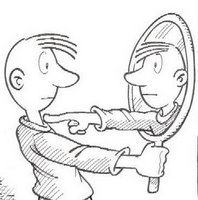
 How does that work, exactly? “Frail” is an evaluative term that requires an outside perspective. If you were to see an old man shuffling along warily, concentrating full force on not falling over, you might easily call that old man “frail.” But you would apply that term to yourself only if you imagine others would see you in that light. You imagine the way you may be viewed and apply that label to yourself.
 ondition of your bones and muscles and joints, we are talking about the conditions that will cause you to apply a word to yourself. The word is “frail.” And if you have decided that “being a frail old man” doesn’t serve you well, what can you do about it?
 ey. So I change how I act, which categorizes that kind of action as my internalized “other” will do it, which changes the meaning of what I have just done as it is applied to me. There is not an internal or “self-talk” piece in this routine anywhere. The action is external. The “meaning” is external. The application is automatic.
 The online dating setting is the same problem in a way. There are things you are expected to say. If you say only those things, they (potential dates) don’t hear you at all. But the issue in dating is not really that you want them to “hear” you. It is that you want them to “see” you; you want them to see who you are. So I learned that if you want them to see you—or, indeed, to see anything—you need to surprise them a little. Everyone on an online dating site wants to have “adventures,” for instance. So if you say you don’t like to “have adventures,” you have created an opportunity for yourself. And even if you follow that up with “…instead, I like to CHOOSE adventures,” you are likely to have revealed something about yourself. [3]
 That doesn’t happen because Ben makes common cause with her immediately and he also causes Jules to see him. In the movie, we see her do that. She says what she wants to say and then looks back down at her laptop. Then she hears what he actually said and looks back up again. Can you see that her face and her eyes are not oriented in the same way? That’s why.
 Ben jumps right on that one. “So I gather,” he says, “but I can get along with anyone.” As viewers, we remember the response of the other interns to the news. That’s how Ben knows Jules is hard to work for. He recognizes that directly and she reacts like someone just ripped a bandage off her arm. It isn’t pleasant, but when it is done, it is done and it’s all better. Besides, Ben says, “I’m here to learn about your world.”
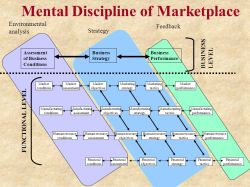
 It can be looked at in several ways. We will examine two of them. From my side of the table, it is about “subverting the discipline of the market.” I mean that ironically, as you might infer from the quotation marks, but I do mean it. Markets actually work and they don’t work by presupposing that all the participants will have good character. They work by presupposing that everyone is trying to make money.
 expression just this once—about any conversation that comes up. “You think that’s something,” he might be expected to say, “but I did this or that or the other thing, which is a lot better or more painful or more mind altering or something.” He could. But one of the things I like best about Bob is that he doesn’t do that. Ever.
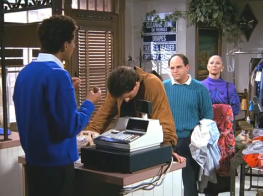 So the proprietor seems to owe Bob $100, for which he would be reimbursed by the factory. Except that the proprietor doesn’t seem eager to do that and Bob believes that pushing too hard on the factory—on which you rely for day to day business—is probably not a good idea for the proprietor.
 that becomes one of several kinds of difficulty which causes him to switch cleaners. That’s the way it ought to happen. If you don’t do good work, the people who run businesses will find someone who does.
 The truth is, about an issue like this, that the actual decision depends on which values you put in first place, which in second place, and which in third. No one in the Starbucks salon [3] argued that any of the values under discussion was wrong. All the discussion had to do with whether the personal relationship (long time customer) was so important that the proprietor shouldn’t pay for his own mistakes. Or would we all be better off just if we just waived such considerations as we are able and treat service providers mostly just as people?
 students routinely registered for the class and only 27 desks. It’s an interesting example because some students are interested only in getting one of those 27 seats for themselves; others are much more interested in making sure that there is a seat for everyone. [3]
 Let’s consider some of the costs. If marriages that were perfectly adequate before the term of service are no longer viable after a soldier’s wartime experiences, then the costs borne by all parties, particularly the children, need to be considered. I have no idea how to calculate those, but remember that it is only the monetary costs we are considering.
 I began to think of the costs of military service when I noticed the proliferation of charitable projects to support “homeless vets.” And I began to wonder how it is that soldiers can be put against their will into situations that will damage them for life and then, when they come home, be treated as the objects of charity drives? I had a brief and angry vision of myself wheeling a friend, now a vet in a wheelchair, up to an army recruiting office and saying, “Here. You broke him. Now fix him.”
 It is not right, according to this argument, to recruit men to serve a public purpose and then dump the responsibility for them onto society as if they were to be a subject of private charity. I am not opposed to private charities, but they should not be run for the purpose of compensating for the deliberate underfunding of public programs. Let us take care, as citizens and taxpayers, of the men we have sent into combat. Let us take care, as private persons whose compassion reaches out to others, of anyone whose need reaches us.
 I gave birth to the blog. It’s a question of perspective, I guess. And after six years of this, I’d have to say that I am surprised at how much it has changed me. As is often the case, I have three things in mind.
 In writing a blog, I find that many of the ideas I run across in the course of a day’s conversations are neurologically linked, like a microphone planted somewhere in my mental landscape. They catch and transmit the remarks of passersby; they remind me of stories I haven’t thought of for fifty years; they make connections between phenomena I have never seen as related before. Briefly, it changes how my mind works.
 My first blog was called “Blog 1” and it was 257 words long. Then I sat down and wrote 502 more essays. This one is #503. That works out to somewhere in the mid-70s per year. [3]

 the ingroup bias, “sticking with your friends.” I would call the ethnocentrism, “American exceptionalism.” I would call the emphasis on social norms “being a team player.” I would call a reliance on friendly sources of information, trusting people “whose hearts are in the right place.” And of course, I would provide pejorative names that they could use to describe the nonauthoritarians. Traitor and coward come readily to mind.
 I presented these contradictory responses as a “policy conflict,” but actually only the second response engages policy at all. The students who wanted to get the best of what there was to get did not have a policy orientation in mind at all. They took the system for granted and wanted to know how to work it. “What if we came to class an hour early?” they wondered. “Or maybe if we were among the first 27 students to register for the class. Or maybe we could get the professor to give upperclassmen first shot at those seats and seat underclassmen only if there were still room. Or maybe we could send one of “us” early and have him reserve the 27 seats for the rest of us.”
 At this point, I would like to introduce Marc Heatherington and Jonathan Weiler as they are represented in their book Authoritarianism and Polarization in American Politics (2009). I’m going to be relying on their recent work for most of the rest of this essay. They use several tests which look very good to academics. The tests are “valid,” i.e., they test what they are supposed to test and they are “reliable,” i.e. they come up with the same findings when a population is retested. So, in general terms, these are really good measures.
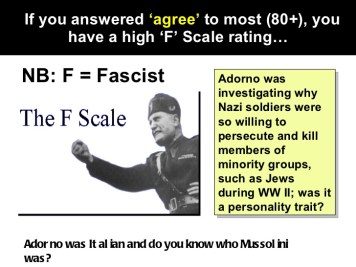 That’s what I like. “Authoritarian” is a description; it is not a condemnation. On the other hand, there are times when the policies that authoritarians disproportionately support cost all of us dearly. I can be against those policies without raising—without even considering—the question of just why they chose those policies. And that is what the authoritarianism scholarship, beginning with Theodor Adorno, has mostly done up to now. It is not what Heatherington and Weiler do, which is why I am passing their work along to you.
 seriously challenge social norms; nonauthoritarians are more likely to think that it is a good thing even when it does. Nonauthoritarians, to say it another way, are willing to put up with a good deal of disorder to protect the autonomy of persons. They don’t feel the same consideration for the “autonomy” of powerful social systems.
 My own personal views really don’t fall at either extreme. Like most people I have some of these traits and some of those. Or I honor these values in one situation and those values in another. In other words, I do not fit the “ideal type” that the tests identify. I fit somewhere further toward the middle of the scale.
 The Dilettante's Dilemma