“This isn’t told for sentiment”

Every other year, I study Luke’s account of the birth of Jesus. [1] By happenstance (see footnote 1) the Luke years are the even numbered years, which means that I study Luke in the presidential years and in the midterm election years. Luke’s notion of the ministry of Jesus emphasizes gentleness and healing, so it turns out to have been a good choice, especially this year. [2]

The first thing that happens in Luke account of the birth of Jesus has to do with the birth of John the Baptist. [3] It takes Luke a little while to get around to considering the birth of Jesus at all and this year, I am going to follow him in that.

Zechariah, the father of John, is a priest and has been chosen by lot to go into the Holy of zechariah-1Holies in the temple and burn incense. The angel Gabriel appears to him and calls him by name and gives him the wonderful news about the forthcoming pregnancy of his aged wife.

Zechariah knows several very good reasons why this event is unlikely and he shares them with Gabriel. That always seemed to me a reasonable thing to do. [4]

18 Zechariah said to the angel, ‘How can I know this? * I am an old man and my wife is getting on in years.’ 19 The angel replied, ‘I am Gabriel, who stand in God’s presence, and I have been sent to speak to you and bring you this good news. 20 Look! Since you did not believe my words, which will come true at their appointed time, you will be silenced and have no power of speech until this has happened.’ (Luke 1 in the New Jerusalem Bible).

That always seemed harsh to me. Abraham said the same thing—using the same words—and God didn’t seem ruffled. Mary will say nearly the same thing later in the chapter, and Gabriel is not offended. What is it about Zechariah?

It is at that point in his lecture that Raymond Brown, my mentor in all this, speaks the line I have taken as the title of this essay: “this isn’t being told for sentiment.” Yes, it is true, says Brown, that Gabriel’s response seems harsh, but Luke is not trying to help you analyze Zechariah’s interview with Gabriel. Luke is trying to remind his hearers of something. “Gabriel,” he wants them to say, “haven’t we heard about Gabriel before?”

zechariah-2Yes, you have. That’s the best answer. Remember back to Daniel 10:15?, the only previous appearance of Gabriel? [5] Gabriel was telling Daniel about the events that will mark the end of this era and Daniel was struck dumb. Well, here is Gabriel again and Zechariah is struck dumb. So…what does the fulfillment of God’s promise to Zechariah have to do with the end of the era?

OK, if you were looking for an answer to that question, you will have to look elsewhere. The answer I am looking at belongs to a different question. My question is, “Why is Zechariah struck dumb?” and my answer is, “Luke is trying to direct our attention to the climactic event—the birth of the forerunner of the Messiah.”

In the light of that, I would say that the question I always asked is not a very good question. I always wanted to know why Gabriel was so mean to Zechariah, especially since Abraham and Mary asked the same question without any retaliation. The question that now seems to me to be a better question is, “What does Luke mean by trying to bring to our ears echoes of Gabriel’s encounter with Daniel?”

The question I was asking was, using Fr. Brown’s word, “sentimental.” It looks for the meaning in the interaction of the two members of the conversation. The question I am now offering you might be called “referential.” Gabriel is there because of what his presence will refer to. It is that “Gabriel…Gabriel…I’ve heard of him somewhere before?” response.

This is a dilemma for modern Christians. All we really want to do, we say to ourselves, is to “read the Christmas story.” But that is disingenuous. We must ask Luke to enter into our world and use only the references we know or we must try to enter Luke’s world and the world of his hearers and to understand the references they knew.

I phrased that as if it were a choice. In pretending it is a choice we can make—we change or Luke changes—I was trying to be funny. I do seriously believe that we have a choice to make, however. One option is to insist that the passage means and should mean what a superficial reading gives us. What? Gabriel didn’t like Zechariah? It’s not good to question God when you are being offered a favor? Leave your incredulity behind when you enter the Holy of Holies?

The other choice is to learn what Gabriel’s presence means. What was Luke trying to tell us by putting Gabriel there? Matthew didn’t use any angels at all; just dreams. Gabriel is not essential to “the story;” he is essential to Luke’s story. And when we find out why Luke thought that situation would echo in the ears of his hearers, we can ask what that lesson means to us.

zechariah-3I can do that. I think the appearance is supposed to mean to Luke’s hearers what the sound of the gun at the beginning of the last lap [6] means to fans of track and field. It means that the race is almost over and if you had a move to make, this would be the right time to make it. [7] Jesus said that over and over in his ministry, but I think it is a mark of Luke’s art that he introduces it into the story of John’s birth.

Someone will surely point out that I have merely exchanged one problem for another. That’s true. Instead of fruitlessly wondering about why Gabriel was mean to that nice old man, I can wonder what it means to me that Luke thinks of Jesus’s birth as inaugurating “the bell lap” of the race we are running. I don’t know what that means to me, in fact. But I do think it is the dilemma Luke intended to offer his hearers.

I think that wrestling with the issue Luke intended for us to wrestle with is the right thing to do.

[1] Originally, it was just a matter of chance, like the division of Senate seats into three parts in the first meeting of the Senate. Obviously, if you are going to elect a third of the Senate every year, you are going to have to make some distinctions and all of the Senators who have to make that decision were elected at the same time. The choice of which Senator got to serve a two year term, which a four, and which a six was entirely random the first time. The first time I chose an infancy narrative, I chose Matthew and it happened to be an odd-numbered year.
[1] “Gentleness and healing” belong in this life only. The “life after this one” is a life of reversal and if you had a comfortable life here, Luke’s picture of what awaits you is the least comforting one I know.
[3] Verses 5—25 and 57—80 and about John and his parents, Zechariah and Elizabeth. In Luke, Elizabeth, the mother of John, and Mary, the mother of Jesus, are cousins.
[4] The young boy who is told by the suddenly changed Ebenezer Scrooge to go and buy a turkey is incredulous. “Walk-er!” he exclaims, meaning something like, “You can’t be serious.” That’s how Zechariah responded and it makes as much sense to me as it did to Charles Dickens when he wrote it.
[5] There aren’t many angels as separate beings in the Old Testament—angels with names and duties. They begin to become prominent when the Jews return from captivity in Babylon, bringing little pieces of the Babylonian cosmos with them.
[6] They use a bell at the University of Oregon, my alma mater. It works just as well and it is so…Oregon.
[7] The one I remember best was a 10K race dominated by Frank Shorter and Steve Prefontaine. Pre just sat on Shorter’s right shoulder until the bell sounded, then he moved decisively into the lead and won the race.”  I saw that race.

Posted in Advent, Biblical Studies | Tagged , , , , , | Leave a comment

Read this book

Today is the beginning of my blogging year (Blogging Year 2017) [1] and I’d like to start by recommending a book. The book is Strangers in Their Own Land: Anger and mourning on the American Right by Arlie Russell Hochschild.

It’s a good book for right now, I think, because the “American Right” has just risen up and bitten political liberals (like me) in the butt. All over America and all over the rest of the world, people are asking, “What were they thinking?” [2] Hochschild’s answer is that they weren’t thinking. They were feeling. So this is a potentially fruitful topic for “the new year.”

arh-1Hochschild is a wonderful choice to begin the new year. She is a sociologist at Berkeley and has written on some very sensitive topics. She came to my attention when I read The Managed Heart: the Commercialization or Human Feeling. [3] in 1979. It was an adptation of what “labor” means from the Marxist notion to a much richer sense that is broadened to include “emotional labor.” To study that, she studied flight attendants, who are paid to maintain a certain emotional demeanor and who suffer, as a result, from what Hochschild calls “charm depression.”

Her method of study is to go sit down with people and get to know them and the learn about their lives. Then she brings her own keen mind and her sociological training into play and devises a way to represent what she has learned. That’s what she did this time, too. She went to Lake Charles, Louisiana and got to know a lot of Tea Party voters. She got to know them across the span of all their life conditions and interests, including politics.

The politics is what particularly interested me, of course and particularly her emphasis on “feeling rules.” Every culture tells you how you ought to feel about some event or relationship. And when you don’t feel that way, you wonder what is wrong. [4] And the culture tells you also what resentments and angers and sadnesses are “appropriate.” Think about the “anger” and “mourning” in the subtitle if you are looking for examples.

I have now recommended the book and appreciated Dr. Hochschild. And now I would like to use her book to make one small point. This is the point: you can’t weigh the costs and benefits of a policy if you don’t have any policy goals. Consider this grievance: [page 69]

At a meeting of the Republican Women of Southwest Louisians, across-the-table talk of regulation focused on the promotion of fluorescent or LED light bulbs: “The government has no right to regulate the light bulbs we buy,” one woman declared. “I made my husband change all my light bulbs back to the old ones.”

If I were there to reason with this group—a fool’s errand, surely—I would begin by saying that it is hard to have to change from products and practices we are familiar with. I would use a self-deprecatory example. maybe, about how I had to get used to a different kind of cake mix. Then I would say that as uncomfortable as change can be, sometimes it helps to achieve a goal we all want to achieve and in those cases, the discomfort is worth it.

Then I would say that America (not “the United States”) has begun to work very hard to reduce the amount of energy we use. I might, in some settings, talk about the harmful effects of global warming, but with this group, I might try “energy independence.” I might, if encouraged, make a snarky remark about “oil-rich Arab states” and how dangerous it is to give them power over us.

And then I would say that their grievance—having to change to more energy-efficient light arh-4bulbs—is actually an important part of achieving the goal. I might remember to call it “our goal,” hoping that that term might cause them to think of themselves as “Americans” and not as the “victims of federal regulation.” At that point, the wheels would come off the wagon.

You cannot work in the cost/benefit frame of reference if there are no policy goals. If there is no goal, there is no benefit that comes from reaching the goal, and if there is no benefit, then any cost at all, will outweigh it. The smallest inconvenience; the least grievance. Even a new kind of light bulb.

But, of course, it isn’t really the light bulb. The light bulb is just an instance of a larger category—“the government has no right to regulate us.” And the feelings of resentment about government regulation are so intense and so near the surface that reasoning about “how to reduce energy consumption” will not survive. [5]

And the feeling rules apply because we have “every right to be angry” when the government invades our lives and tries to tell us what to do. The feelings are attached to the regulatory process. They have nothing at all to do with energy consumption or, indeed, any other policy at all.

You can’t justify the means by reference to the ends if there are no ends. “Feels good” and “feels bad” is the whole range of policy responses. Along with a little “don’t tell me what to do,” which amplifies the resistance to every policy initiative, not only from the national level, but from the state level as well.

That, Hochchild says, is what is driving our politics. You can’t reason with it, but for people like me, it might be a good idea to try to understand it.

[1] There are, of course, reasons why I start at the beginning of December, but they need not detain us here.
[2] In the U. S., “they” refers to Trump voters. Everywhere else, it refers to all of us. That embarrasses me, but I think it is largely true.
[3] Whoever writes her subtitles is worth his or her weight in gold—not saying it isn’t Hochschild herself.
[4] I have tried and—so far—failed to establish the word orthopathy to refer to “having the feelings you are supposed to have.” This word would join orthodoxy (believing what you are supposed to believe) and orthopraxy (doing what you are supposed to do). You can find those two words in any good dictionary, but you will not find my proposed word, despite both the logic of it and the need for it.
[5] Leaving aside for the moment that this is the energy dependent part of a state that has mortgaged itself to attract oil companies.


Posted in Political Psychology, Politics, Uncategorized | Tagged , , , , | 2 Comments

Thanksgiving, 2016

Whenever I begin to formulate a sentence about Thanksgiving, I think of my mother painfully contorting the sentence into “We have so much for which to be thankful.”  She was determined to avoid ending a sentence with a proposition if she could possibly avoid it.  And then I usually think of Winston Churchill who, mocking the same rule, referred to something as “an indignity up with which I shall not put.”

I really do like Churchill’s take better.  Sorry, Mother.

A more evenhanded culture would insist on a national day of lamentation, to balance off the national day of thanksgiving.  We could skim through our calendars for the past year and highlight the good things and…oh, I don’t know…lowlight, I guess, the bad things.  But “evenhanded” is no way to build a culture and we are all probably better off because of that.

My goal for quite some time now has been to find a really good retirement center and to get us there–Bette and me–before I turned 80.  Did that. I am so thankful for that that the words I really want will not likely be available to me for some years.  I won’t even be 79 until next month and our apartment here in Holladay Park Plaza in Portland, Oregon is a really good apartment in a really IMG_0424.jpg retirement center.  This picture shows a little of the living room and a little of Bette.  She is having a wonderful and warm conversation with her first mother-in-law, who lives in North Dakota.  I am in the kitchen kneading dinner rolls for our upcoming Thanksgiving feast at the home of a much-prized stepdaughter who lives here in town.
Bette is looking east, the direction our “back porch” faces. [1]  Outside, you can see what Oregon is really supposed to look like by Thanksgiving.  It is cool and wet, always with the promise of what Oregonians call “sun-breaks.”

When you get old–that’s the category I place myself in–you have lived a lot and a lot has gone wrong.  And…not to be all Sammy Sunshine about it…experiencing these things gives you a whole new register for appreciation.  Imagine a twenty-something who, on waking up in the morning, says, “Wow!  The arthritis pain in my thumb is barely noticeable today!”  This kid knows nothing at all about arthritis pain and on his behalf, we can all be happy about that.  On the other hand (no pun intended), he does not have the buoyancy I feel when some ordinary bad thing–arthritis is just one example–is not happening.  The experience of an old person enables him or her to celebrate the fact that something is not there or that it is not happening right now.  Woohoo!

It helps me a great deal when I remember that the “thanks” at the first thanksgiving IMG_0423.jpgwas about the likelihood that fewer people in Plymouth Colony would die in the coming winter than had died in the previous one.  Roughly half the population, as I recall the story, died during the first winter.  Imagine that for just a moment.  We are now into the second winter and the leaders of the colony are saying to each other, “How wonderful.  Thank God there are fewer deaths this winter than last.  The colony may survive after all.”
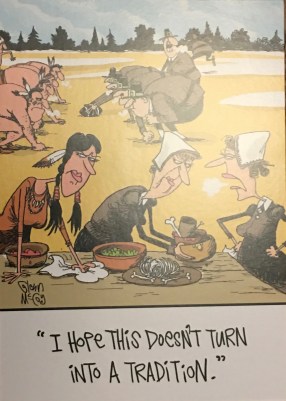
There are other way to mark the day, of course, and this cartoon suggests several of them.  If it were up to me, the Redskins (from Washington) would play the Patriots (from Foxborough) every year at Thanksgiving.  This year, the Redskins are playing the Cowboys.  Really…what kind of history is that for our children to learn?

[1]  The “front porch” is across the hall, just outside our front door.  It is my favorite place to sit and write and greet our neighbors/

Posted in Getting Old, Society | Tagged , , , , , | Leave a comment

Richard and Mildred Loving

Peter Debruge in his May 16 review for Variety explains why the film Loving just didn’t have enough pop for him. In addition to the objection I am going to cite, there were other more technical criticisms that I accepted with pleasure. But this one—this is the reason I went back to read the review.

Loving is, Debruge says, “a film of utmost sensitivity, but not nearly enough outrage.”

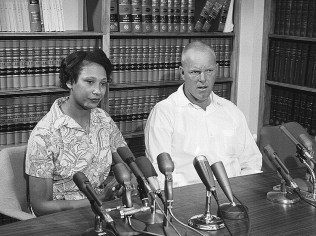
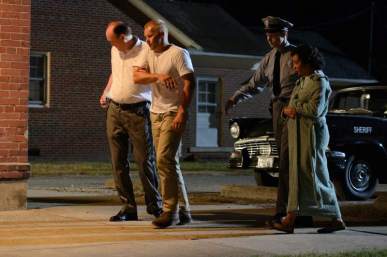
loving-2I think that is what I liked best about it. It would have been easy to turn the story of this quiet and courageous couple into a “storming of the barricades” kind of story. And doing that may have been truer to the cause, but it would not have been true at all to the Lovings. [This is the actual couple, by the way.  The actors, Ruth Nega and Joel Egerton, look remarkably like them.]

The short version of the plot is that Richard and Mildred loving ran off to Washington D. C. where it was legal for a white man and a black woman to marry, before returning to Virginia where it was not legal for them to be married. Someone—we never find out just who it was—informs the police and they come out in the middle of the night, arrest the couple and put them is prison.  A picture of that arrest is shown below.

Mildred writes to Attorney-General Bobby Kennedy many years later, after watching TV and seeing the D. C. police protecting black protesters in Martin Luther King’s march on Washington. Kennedy refers the matter to the ACLU who take it to the Supreme Court, where they win Loving v. Virginia in a case that constrains the actions of all states on interracial marriage. [1]

I have followed the politics of interracial marriage from a distance. According to our loving-5federal system, such matters are properly addressed by the states, rather than by the federal government, but states are not free to take away rights guaranteed to citizens of the United States. Just what those guaranteed “rights” are has been a matter of controversy for a long time now.
But longer than I have cared about interracial marriage, I have cared about the difference between what moves us to act and what moves us to understand. I don’t want to argue, of course, that the two are always at odds, but many times they are. I think Debruge’s point could be rephrased to say that director Jeff Nichols’ treatment, while it is admirably suited to understanding, is deficient as a call to action.
Most of the time, I would rather understand an issue than act on it. I know there are people who would rather act on an issue than understand it and I value their contribution to the general welfare, even as I lament what they take away from domestic tranquility.

With that in mind, I want to tell you about the hardest part of the movie for me. “God made robins and sparrows,” says the sheriff as I recall the quote. “Separate.” He is explaining to Richard Loving that he and his wife have violated not only the laws of the Commonwealth of Virginia, but also the “laws” of God. The sheriff is quite sure he understands what the laws of God are. The judge in the case feels the same way.

Almighty God created the races white, black, yellow, malay and red, and he placed them on separate continents. And but for the interference with his arrangement there would be no cause for such marriages. The fact that he separated the races shows that he did not intend for the races to mix.

I think the robin and sparrow analogy is a really bad analogy. I don’t like bad analogies. They lead to bad thinking which leads to bad conclusions and often to bad law. And when the sheriff made his remark about robins and sparrows—it wasn’t argumentative, he was stating a clearly observable fact and knew that everyone agreed with him—my first response would have been to object to the analogy.

loving-3Set that against the quiet certainty and the authoritarian control of Virginia. There was no question that the sheriff would throw Richard Loving in prison and might even set the bail too high for anyone to reach. The threat of imminent punishment loomed over the conversation and I knew immediately, as I sat in the theater, what a struggle it would be for me to pass by that analogy.

I would have passed it by because I would have been afraid. But that conflict—I prize careful speech but I am afraid of the consequences—would have been difficult and I am not entirely sure I would have made the prudent choice. I have not always made that choice. And sometimes I have paid the consequences. And sometimes it has been worth it.

I would recommend Loving to anyone who cares about the issue and who has the patience to let the story tell itself. It is not a movie of high drama, but I think it may affect us more deeply for that reason.

[1] And was cited in Obergefel v. Hodges, where the same logic was applied to same sex marriages.

Posted in Movies, Politics, Words | Tagged , , , , | Leave a comment

Protecting Vulnerable Communities

I’d like to share with you a few lines from political writers and a comment I heard last night from a local pollster. Then I would like to push them around on my plate for a little while, like green beans I am not yet ready to commit to eating.

If I don’t like where they wind up, I might just shove them under the mashed potatoes, the way I used to. If you don’t like where they wind up, you can shove them anywhere you like. What could be more fair than that?

I got this recently from Jeremy Bird, who runs a sort of activation network for President Obama.

If you’re anything like me, you’re still sorting through the events of the past week and a half. It’s hard — there’s no way to sugarcoat that. Vulnerable communities are feeling like this country has turned its back on them.

That sounds right to me. On the other hand, I have been reading messages just like this from Obama’s organization for so long that maybe it just sounds familiar.

But his expression “vulnerable communities” lit up for me on this reading because I had just read Frank Bruni in the New York Times. Bruni said.

From the presidential race on down, Democrats adopted a strategy of inclusiveness that excluded a hefty share of Americans and consigned many to a “basket of deplorables” who aren’t all deplorable. Some are hurt. Some are confused.

The Democratic party, according to Bruni, has ignored a lot of vulnerable communities, particularly poor white working class communities. That sounds right to me too.

Bruni points to many in these working class communities who are “hurt” and “confused.” They are also poor and, to a great extent, without hope. And sexist and racist.

vulnerable-2So if I am the Democratic party, trying to lodge Hillary Clinton in the Oval Office, these communities present a problem for me. If I say that “poor” is the part of their life I want to bring into focus, I face the difficulty that there is nothing I can do about it. The jobs that once made them solidly middle class are gone and they are not coming back.

If I say that “sexist and racist” is the part I want to focus on, I am solidifying my hold on some very important other voting blocs—feminist women and men and LGBTQs. No one says these “vulnerable communities” are hurt or confused. They are just victims.

So of these two kinds of “vulnerable communities”—vulnerable in different ways, granted—we declare one to be victims and offer our support and the other to be victimizers and offer only blame. I would think that strategy would be very popular among the victims and deeply resented among the people who are called victimizers.

There might be a short way to say this. As a Democrat, I care deeply about the welfare of my vulnerable communities, but not very much about the welfare of yours.

vulnerable-1Add to this collection of thoughts the remarks of Tim Hibbitts, a widely respected local pollster. In reflecting on all the white working class votes that Bill Clinton had won and that Barack Obama had won, but that Hillary Clinton lost, he remembered that Hillary had gone to coal country in West Virginia and told the miners and former miners that coal was gone and wasn’t coming back. She was right, said Hibbitts, about the coal jobs. But saying it there to them made her seem callous.

That caught my attention. Tim didn’t say anything else about coal, but my mind went on and imagined that Trump had visited the same setting and had promised to bring coal production and use back to full strength. And then I thought how that would make him seem to these vulnerable “coal communities.”

If he did that, it was all flim-flam, like so much else he has done. But people don’t know for sure about the future of coal. [1] Maybe they don’t care much about long term economic projections. But they know how to care that one of the candidates seemed not to care about them and the other seemed to care a great deal.

vulnerable-3I began by talking about “vulnerable communities.” These are communities of several kinds. Then I added the notion that whether a candidate seemed to care about me—about the particular way I am vulnerable. Hillary, in telling them the truth about coal, told them also that she didn’t care about them. Trump, in lying to them about coal, told them also that he did care about them. A sophisticated electorate would have chosen the teller of truth over the liar.

My father used to tell a story that seems to have stayed with me. He imagined a boy who said about his mother, “The old lady don’t bitch like she used to.” Then a boy who said, “My mother doesn’t complain as much as she once did.” [2] “Each boy, “my father would say, “is conveying the same information about the mother. He is conveying very different information about himself.”

This is a hard place for Democrats to be. No one wants to say “my vulnerable communities but not yours.” Not out loud, at least. And it is a hard thing to ask of a voter. You have to say that the problem is poverty and I have no idea how to help you. Or you can say you are terrible people, being both sexist and racist, and I am going to try to protect the people you are abusing.

It has been awhile since I have run a political campaign and as I look at this dilemma, I am glad I don’t have to design a campaign or find a candidate to solve it.

[1] If you go to cleancoaltechnologiesinc.com, you will see amazing possibilities. I have no idea whether they would work, but I am confident they will not be tried.
[2] Note: Dad had four sons and no daughters and he cared a great deal about the social setting of language.

Posted in Uncategorized | Leave a comment

“Jesus is the reason for the season.” Really?

There are so many ways for Christians to be unhappy about the way “Christmas” [1] is celebrated today. I have given it up, myself, in favor of Advent. It saves me so much grief. And why, really, should I expect anyone to celebrate my holiday when I don’t celebrate theirs? Really.

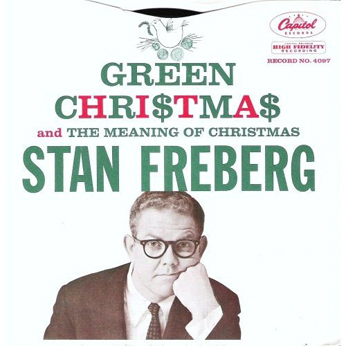
reason-2I remember when I first heard that line-Jesus is the reason for the season— and when I first saw it on a billboard. It must have been some time in the 1950s. Surely it was somewhere around the time that Stan Freberg wrote and performed Green Chri$tma$. [2] I was in my teens in the 1950s and America’s culture was in the middle of a post-WWII rebound. [3]

Obviously, I did not accept the messages my culture sent to me as characteristic of a post-war up-tick in conservative positions and sentiments. I took it as “what America is like,” or, really, “how things work” in the broadest sense of the term.

Clearly “Jesus” in the slogan is the alternative to the pervasive commercialism that Scrooge represents. So…Jesus, not shopping, is the reason we celebrate Christmas.

reason-4It is not, however, why we celebrate “the season.” Our forebears, Christian and pagan, worried that the sun, traveling further and further south in the winter, might not decide to come back this year. And when the sun “stands”—which is what the -stice part of solstice means—we could breathe a collective sigh of relief and begin to anticipate the sun’s northward journey. [4] And we would celebrate the anticipation that the present cold and dreariness will not be how the world ends, but that warmth and hope will return again.

That is “the season.” As Christians moved up into Europe, they very sensibly weighed the difficulties of cranking up a brand new festival as opposed to just hijacking a festival already in place. They decided that the celebrations of the winter solstice were a good time to celebrate the birth of Jesus, the Messiah, so they dumped Advent right on top of what Ursula LeGuin (in her Earthsea writings) calls “the festival of sun-return.”

So in Christian countries in traditional times, Christ was “the reason for the season” by virtue of the church’s mandate. No reason, after all, to turn away from figgy pudding if you don’t need to.

reason-1But then, starting early in the 20th Century, economies in Europe and North America began to rely heavily on consumer demand. The more occasions there are to sell things, the more things we can sell and the better off the economy will be. And after all, in Matthew’s account, the “Wise Men” did bring gifts to the Christ child, so why shouldn’t we give Barbies and Tonka Trucks to our own children? It may not be “the reason for the season,” but it is one of the things we do on Christmas day.

I still remember when “the season” meant “the Christmas season” and good taste required stores to hold off on the paraphernalia of Christmas until after Thanksgiving. I remember active opposition to stores who broke that taboo and “jumped the gun.” But more and more, “the season” has been defined as the time of commercial excess beginning shortly after the back-to-school sales are over.

That’s what “the season” now means. It means Halloween and Thanksgiving and Christmas. And “beginning early” now means beginning that season—roughly the days before Halloween —early. There can be no coherent “reason” for a “season” that begins in October and runs until January. It can be an extended time of appeals to customers, but there is no cultural coherence in that.

And when we have travelled that far, we are in a position to stop and notice the most outrageous word in the slogan. It is “the.” The definite article notoriously requires a single object. A polygynous husband may not introduce any of his wives as “the wife”—only as “a wife.” That’s just how English works.

reason-3And it works the same way, silently and imperiously, in “the reason.” There is, the logic demands, only one reason for this season and we are here to tell you what it is. This will be a revelation and a disappointment to the Druids who celebrated the return of the sun long before Christian missionaries arrived. It will sadden and impoverish a whole swath of merchants who see “the season” shrunk back to the days just before and just after Christmas. Both parties—the Druids and the Retailers—have a lot of reasons to reject the demand that the article “the” places on their reasons.

On the other hand, they have every reason to continue to pretend that there is such a season. A “let’s spend money” season would not be broadly appealing as a cultural meme, but “let’s celebrate THE SEASON by spending money” works just fine.

Last year, for instance, my Starbucks put a banner on the pastry case that said “Tiding so Delicious.” The only word in that banner that has a historical connection to the old celebrations of Christmas is “tidings,” as in the King James Version’s ringing, “good tidings of great joy.” This year there are red cups—they are being used now, still two weeks before Thanksgiving—that say “Share the joy.”

I would love to share the joy. How about I treat you to a grande egg nog latté?

So there is no “reason for the season.” Why would we ever have imagined there would be? There are lots of reasons why we celebrate the October to January period the way we do. And I still get my Advent to celebrate so I’m not complaining.

[1] “Xmas” in C. S. Lewis’s sarcastic account of how the winter solstice is celebrated in countries where commercial secularism is the basic assumption of society.
[2] Although he was a preacher’s kid, Freberg takes the religious argument in this parody only halfway. “But don’t you realize,” he has Bob Cratchit say to Mr. Scrooge, “Christmas has a significance, a meaning.” Freberg doesn’t go so far as to suggest what it is, but he does suggest that there is only one. Still, his little skit was banned on a lot of radio stations as impious.
[3] The role of women, the meaning of work, and the significance of “religion,” largely main stream Protestantism where I lived, were all explicit repudiations of the pre-war hedonism.
[4] When I say forebears, I am thinking of people living in the northern hemisphere. In the southern hemisphere, the solstice marking the shortest day comes in June.

Posted in Uncategorized | Leave a comment

Hacksaw Ridge

This election day was tough for a lot of Democrats—myself included—but I am proud of how I spent the afternoon of election day. I went to a theater and saw director Mel Gibson’s new movie, Hacksaw Ridge. It is a very life-and-death movie and extremely gory. On that day, the contrast between all that violence and suffering, on the one hand, and “losing an election” on the other, helped me through the day–and through the night.

hacksaw-3I’ve had a chance now to give my attention to what the movie was actually about and it turns out that I value it for more than its immediately analgesic properties.  I want to tell you a little about the story. I am confident I can do that. Then I want to tell you about the look on Desmond Doss’s face (Doss is portrayed by Andrew Garfield), his face at one special point in the film. At that job, I am pretty sure I will fail, but I’m OK with that. If I could go back and pay full price to see a five second segment of the movie—and I’m not really sure I won’t—that is the five seconds I would want to see.  It is the five seconds I would recommend to you.

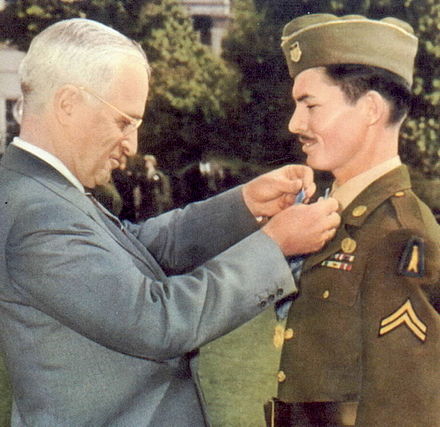
Desmond Doss was the first conscientious objector ever to receive the Congressional Medal of Honor. [1] That makes him stand out, even as we look back at his career from our present time. But, of course, he stood out even more dramatically at basic training where fusing a bunch of individuals into a team is the job to be done. Doss didn’t look like a team member. “Belonging to the team” was defined in basic training as being willing to kill to protect your buddies. Doss’s commitment that he would be willing to die to protect his buddies didn’t have much traction during basic training. It seemed abstract, somehow.

His commander tried to get rid of him in any number of ways. The Drill Instructor invited the other men to beat Doss up and they did. The psychologist tried to make a case that Doss was crazy. [2] They court-martialed him for refusing to obey a direct order and had he been convicted, he would have spent the remainder of the war in prison instead of saving the lives of the people who has beaten him.

Part of the psychological exam comes back later in the story, so I want to note it here. The psychologist, learning that Doss prays, asks whether Doss hears voices.  He doesn’t. But, pursues the psychologist, you do pray, you have conversations with God. Well, Doss says, a little ruefully I thought, they are kind of one way conversations. From the movie’s standpoint, this early in the story, we know that God hears Doss and that Doss does not hear God. [3]

hacksaw-2As part of the campaign to control Okinawa, the American troops had assaulted Hacksaw Ridge several times before  In the movie version, it was Doss’s first time in battle as a medic. The fighting was horrible and as director, Mel Gibson, makes the most of it. But it establishes the setting for the five seconds I would like to see again. The immediate landscape is a waste of blasted trees and scorched rocks. The sound of war is unbearably loud. The suffering of Doss’s company is awful and personal. We know these people who are in such agony and so does Doss.  And in that setting, Doss loses touch with God.

For the first time in the film, we see him confused. He looks wildly around, trying to see something in the smoke and flame and says, “God, I can’t hear you.” Doss has lost touch with the mission that had, up until then, sustained him.

Then, from off in the smoke somewhere, but not too far away, a soldier moans, “Can anyone help me?” We see the meanings of that call—all the meanings—register on Doss’s face.

Those are the five seconds I want to see again and invite you to see if you are able to get through the gore.

Doss knows immediately what to do and knows, at the same time, that he has heard God. You could say he has heard God “through” or “in” the voice of the wounded soldier. [4] Actually, you could say that all he actually heard was the soldier. I think that is an entirely plausible way to describe the event from the outside. But the story gives us how it seemed to Doss from the inside. We can see, as we look at the change in his face, what that voice meant to him.

So he went back into the battle.  “Lord,” he prayer over and over throughout that night, “Help me get just one more.”  He got 72.

[1] There have been two since, both from the Vietnam war.
[2] At that point, I have to say, my mind flashed back to the wonderful psychiatric exam of an actor in Montreal who was hired to play Jesus in a passion play put together by the local Catholic diocese. The psychiatrist examined “Jesus” along several lines, but it was clear that she liked him and the note she sent to the judge—and which we see the judge reading from the bench—said, “This is one of the sanest men I have ever met. He is in a lot better shape than a lot of the judges in this system.” That’s not an exact quote, but it’s close. The movie is called Jesus of Montreal.
[3] That turns out to be important because once the troops land at Okinawa, the movie turns wildly visual. “Seeing” in nearly all there is, apart from the artillery shellings, for the next hour. But the story turns on “hearing.”
[4] Doss heard that same voice, we may imagine, in the Japanese soldiers he treated.

Posted in Uncategorized | Leave a comment

Politics, Government, and the Federal System

So…President Trump?  I find it hard to type the words, but if I had had a blog in 1980, I would have found it hard to type “President Reagan.”  I don’t pretend to have begun, yet, to come to grips with last night’s disaster, but in this morning’s brief reflection–it has to be short because I have work to do today [1], I want to talk about some things that will help me.  Maybe they will help you.

Reflection 1

Whoever is having success at the national level begins to neglect the importance of politics and government at the state level.  The other side of that same coin is that the people in the states get accustomed to shifting their attention to the other side of whatever initiative is being taken at the national level.  For today, that means that the left edge of the politically possible in each state is going to start receiving more attention.

States shrug, it seems, and say, “Well then, I guess we’ll have to do it ourselves.”  A great deal of good work at the state level is just about to begin.  If it weren’t for the punniness of it, I would say we are just beginning an era of “states-manship.”

Reflection 2

broken Bridges

The expression “politics and government” is common in our language, but an appreciation of the different realities they point to is not so common.  “Politics,” as it is normally thought of is the partisan contest for the offices where power can be exercised.  “Government” is the process if identifying national needs and aspirations and collecting the will and the resources to meet them successfully.  Politics is about collecting votes.  Government is about keeping the country safe and the bridges in good repair. [2]

Reflection 3

I don’t fill my days with TV watching and hand-wringing.  There are things I have chosen to spend my time on.  Out of force of habit, I call these things “my work,” and some of them “my ministry.”  (Overlapping categories.)  They matter immediately.  The success or failure of these things is immediate; it is something I experience.  In a few hours, some dear friends and I will be leading a Bible study class, for instance.  Today, we will be considering the early failures of the Israelites after they were rescued from Egypt by a God they had only recently heard of. [3]  They had been slaves for many generations and that turned out not to be the background that led easily to becoming a covenant people, a people who honored the God who chose them and freed them.  Then, God willing, we will discuss what our own preparation to be free and responsible has been like.  It is good work to have available on such a cataclysmic day and I will very probably work it harder than I would have otherwise.

Reflection 4

And last (and briefly) I cannot imagine a better scenario leading to the victory speech of President-elect Elizabeth Warren.  I don’t think she could have followed four years or eight years of Hillary’s presidency and I don’t know if she will be willing to run, but the ball has just been teed up perfectly for her and I like her very much.

[1]  I am indebted to my brother Mark for having, many years ago, passed along a prayer he had found somewhere.  The man has a mind like a vacuum cleaner.  The prayer goes, “Thank you, God, for giving me work to do that is so important that it doesn’t matter very much whether I want to do it at the time.”

[2]  The progressives of the late 1800s used to campaign against urban political machines and their use of contracts for friends by saying that there is no Democratic way or Republican way of paving the streets.  (There are, of course, political donors who are Republicans and some who are Democrats.)  This bridge needs to be fixed.  The people who live there need for it to be fixed.  That’s government.

[3]  Pharoah said, “Who is this Yahweh that I should obey him?”  Oddly, the Hebrew slaves said the same thing.  Neither they nor the Pharoah had ever heard of this “YHWH.”  When you face the prospect of a tough sell, remember Moses with compassion.


Posted in Uncategorized | 8 Comments

“…and painful shoes”

Where would a phrase like that come from? A shoe salesman? Possible, especially if there were a more comfortable and more expensive pair of shoes available. A podiatrist? You can see that, although in my experience, podiatrists are more likely to be interested in structural anomalies than what your feet feel like to you.

And what would be paired with an expression like that? Maybe “an ugly suit” or “an ill-fitting dress?” Those would work.

Neither of those speculations is anywhere near the mark. Here is the paragraph that contains the expression.

I, myself, was everything the date of a prominent psychotherapist should be: unobtrusive in a dark blue suit, pale blue silk tie and a pair of sapphire cufflinks Susan had given me to celebrate my virility. Susan was amazing in red silk and painful shoes.

This is told in the first person, so the “I” sentences all refer to a detective named “Spenser,” whose first name is never revealed. It is set in Robert B. Parker’s mystery, Back Story (see page 106). This essay is just an appreciation. I was entirely unprepared for this juxtaposition of worlds and I laughed out loud before I remembered where I was and recovered my good manners.

Juxtaposition

As I have often said in these essays, the funniest book about humor I have ever read is Max Eastman’s The Enjoyment of Laughter and Eastman emphasizes that one of the things that makes us laugh is to have our minds guided in one direction and then suddenly see that we have been led astray. And the longer the journey in the wrong direction and the more sudden the realization that we have been duped, the funnier it is.

painful-shoesThe words I chose for the title are, as you see in the quote, the last three words. Everything before that, including the previous paragraph, which describes his buddy Hawk in terms that belong to the same genre, is about fashion. He pretends to be talking about how he blends in. That’s why he starts off with “unobtrusive.” But nothing else he describes is unobtrusive: the suit is not, the tie is not, and the cufflinks are not—particularly not when tied to his “virility”—so Parker is playing with “unobtrusive” already.

Then there is the now familiar joke about the wedding in which the groom’s attire is described in excruciating detail—as if it mattered—and the bride’s is summarized as “the bride wore white.” I think Parker wants us to have that joke in mind too.

But my favorite part of this joke is that everything is visual…until we get to the shoes. The shoes are described from the standpoint of the wearer. Everything else is described from the standpoint of the viewer. Besides, “how women feel about what they are wearing” has never been a major focus of murder mysteries. In murder mysteries, the important thing about women is how they look, not the price they have to pay to look like that.

And this description follows that standard (Susan was amazing) down to the last three words. The conjunction “and” promises that the thought will be continued. “And” isn’t like “but,” after all. Parker doesn’t say “even though the shoes must have been painful.” Nothing funny about that.

No…he promises a continuation of the theme with “and” and then violates that promise in three ways in three words. That’s why it’s funny.

Posted in Uncategorized | Leave a comment

Trump calls for sabotage

Every losing candidate for the presidency in recent years has conceded defeat in the election and wished his opponent well. I don’t think that is going to happen this time. This time, it looks like the Trump-led Republicans (that isn’t all the Republicans by any means) are preparing to continue the war.

Here is what struck me that way.

If that doesn’t work for you, try “cartoon trump ad moving to the white house” or go directly to https://www.ispot.tv/ad/AFBj/future45-the-clintons.  It’s worth 30 seconds of your time.

I was struck by the line, “When America sent Hillary back to the White House…” That is the first line in a cartoon Trump ad that I saw yesterday, on the weekend before the election. It looked like a concession speech—everything but the wishing his opponent well. Instead, it was, “You’re going to wish you hadn’t done that.” or, more briefly, “I told you so.”

“I told you so” is interesting to me in two ways. First, it presupposes that Trump will lose the election. There isn’t any other way to understand “When America sent Hillary back…” Second, it presupposes that Hillary has done something that will make “America,” or at least the Trump-leaning part of America, ashamed of her. In the dim background, I keep hearing the beginnings of a call for impeachment [1]

America, she has not yet taken the oath of office. This is like a groom accusing the bride of being unfaithful to the marriage vows before they get to the alter. Hello? She can’t have been a bad president yet.

The ad is nearly as much anti-Bill Clinton as it is anti-Hillary. There is a reference to Bill’s foreign policy speeches. I can scarcely imagine who that is aimed at. I really think it is just filler. The “report” of the Clinton moving day is given by a cartoon reporter named Robyn Lewis. At the end of the ad, Bill Clinton moves over to her and does something inappropriate—I can’t quite see what it is—and then winks at the “camera.”

That is why Bill is there. A lot of people have not forgiven “Slick Willy” for getting away with something. He was accused, but he denied. He was impeached but not convicted. The moralists who keep score so rigorously and those who are as guilty as Bill but who couldn’t evade conviction, are equally angry and that is a splash of resentment that gets on the bystanders. It cost Al Gore the 2000 election, in my judgment. It will cost Hillary every day of her presidency.

So this Trump ad, presupposing that they will lose “the main battle,” seem to be calling for years of guerrilla war as the next step. Even if the Democrats regain control of the Senate for two years—that would be the maximum, as I see it—the House will still be firmly Republican and ready to stymie anything President Hillary wants to do. More states will break out the pre-Civil War doctrine of “interposition,” interposing themselves between the federal government and “their” citizens. [2] There will be targeted budget shortages. Roads, rails, and bridges will continue to deteriorate.  The U. S. will continue to flirt with bankruptcy. “The interim is just the election carried on by other means”—that is my adaptation of the famous Clauswitz quote about war and politics. [3]

That is a very bleak picture of our future and I hope very much that it does not turn out to be true. I do think that this Trump ad is a call for exactly that future.

[1] Just a moment for a little clarification of language. “Impeachment” is something the House of Representatives does. It is a charge which is then “tried” in the Senate. By my reading, the House will still be solidly Republican after the election. Is there a downside to inaugurating impeachment proceedings at once? I can’t think what it would be.
[2] The conclusion reached by the Civil War was that they are all “our” citizens. The states have the constitutional right to control some areas of politics, but all citizens are citizens of the United States first and of…oh…Texas…second.
[3] “War is regarded as nothing but the continuation of state policy with other means.”

Posted in Uncategorized | Leave a comment