
I take it for granted that the Trump administration will be a disaster as a governing body. When you look ahead to the horrors I imagine, you might wonder why the necessary electoral majority chose him to be our president. I have an idea I would like to offer, but because it is an argument that cuts across the grain a little, I want to put some time into making a context for it.
I saw the previews of a movie in 1996 and based on those previews, decided I didn’t want to see the movie. On the other hand, I have remembered one of the scenes from the movie quite clearly.
The movie is Mr. Wrong. In it Whitman Crawford (Bill Pullman) is courting Martha Alston (Ellen DeGeneris) and trying to persuade her that his feelings for her are intense. “I’m going to show you how much I love you,” he says as he grasps and breaks his little finger. Martha tries to persuade him not to do it and fails and when he does it, she is horrified. But it was all really clear to him and that is the point I want you to remember.
The (mis-)quotation with which I began is the way I remember Sally Field’s line as she accepted an academy award. I am drawing on it as a common memory because it is the sentiment I want to use as the center of today’s argument. Here is what she actually said.
So let’s imagine now that there is a presidential contest underway. A presidential contest is like a courtship in sense. There are multiple suitors (two main ones) and the lady they are courting represents the number and distribution of voters who will exceed 270 votes in the Electoral College. They are courting us. Or, in another metaphor, they are courting Miss America.
So the courtier and his intended sit on the porch swing. He is saying the things that he thinks will win her heart. Just inside the window, her parents are listening, hoping to have a chance to talk to her afterwards.
 He says, “I know there is a guy in science class who keeps hitting on you. To show you how much I love you, I am going to kill him so he won’t do that any more.” Her heart races. “Oh,” she says to herself, “He must love me a lot to be willing to do that for me.” The parents, listening through the window are thinking, “Did he just offer to kill someone to demonstrate the intensity of his love for our daughter?” Was he joking? He didn’t sound like he was joking.”
The young man returns the next night to ask the young lady to take a ride in the car with him.
“Really?” she asks, “I didn’t know you had a car.”
“Oh, I don’t,” he says, “I stole this one because you said you really liked hot sports cars. I’ll take it back before they ever know it was gone.”
And she thinks, “What a passionate young man! How very much he must love me to do such a dangerous thing for me. And I just said I liked that kind of car.” And her parents, listening through the window, say to each other, “Did he just tell our daughter he had stolen a car? Does he have any idea that is against the law?”
Maybe just one more.
He shows up in the evening and sits on the porch swing with her. “Oh,” he says, “I heard you say that you were worried about your chemistry test tomorrow. I hate to see you worried so I set a fire in the lab. There won’t be any chemistry tests of any kind tomorrow.” And her parents think, “Murder, theft, and now arson. This guy is a screwball and needs to be kept far away from our daughter.” And the daughter thinks, “Oh my. The perfect man for me. He will take care of me at whatever cost to himself. What a pure and powerful love he has.”
I’ve been thinking about the speeches the Clinton/Kaine campaign made to coal- dependent populations as opposed to the speeches the Trump/Pence campaign made. The Democrats said that coal is dirty, that getting it out of the ground is environmentally hazardous, and that we need to move to sustainable forms of energy. The Republicans said that coal is wonderful and that people who make their living mining coal are wonderful as are the women who wait hopefully for them to return safely from the mine. We will, the Republicans said, find a way to return coal jobs to the prestige they used to have and to honor the brave men who risk their lives to bring that energy to us.”
And the voters in those areas said, “That was thrilling. He likes us; he really likes us.”
In areas where people believe (and it isn’t always untrue) that lax immigration practices are depriving them of the jobs they used to have, the Democratic courtiers said, “We take great pride in being a nation of unrestricted immigration. We love Emma Lazarus and the few lines of her poetry that everyone had to learn. People who are wary of over-immigration are xenophobes and should be ashamed of themselves. The Republican courtiers said, “We understand what it must feel like to be overrun by illegal immigrants and to be told by our government that there is nothing they can do to stop it. Maybe they can’t stop it, but we can. Choose us and we will defend you no matter what the cost.”
Please don’t stop here and try to decide just who the nut job is. If you stop, stop to think who is going to get the girl if the girl gets to make the choice.
The Democratic courtiers go in the house to have a chat with the only relevant adults in this scene. “Did you hear what that other guy was saying? He promised murder, theft, and arson to your daughter. He promised an impossible dream of a coal economy and a mammoth wall against immigrants. You aren’t going to allow that, are you?” And parents say, “We don’t seem to be able to do a thing with her. She’s in love with love and she doesn’t really care about practicalities.”
You get the idea. If “he likes me, he really likes me” is all that matters, then the substance of what is promised is beside the point entirely. The promises are only vehicles for expressing “how much I love you;” and not at all about the substance of what is being promised.
Back in the old days, it was imagined that the parties (the courtiers) would propose policies and that the people (Miss America, on the porch swing) would choose among them. And if she failed to, the parents would swing into action and bring her attention back to the life she thinks she would have with this freewheeling criminal and talk her out of it.
Madison had hopes for the quality of the courtiers. Here is a description of his hopes from the justly famous Federalist #10.
In the next place, as each representative will be chosen by a greater number of citizens in the large than in the small republic, it will be more difficult for unworthy candidates to practice with success the vicious arts by which elections are too often carried; and the suffrages of the people being more free, will be more likely to centre in men who possess the most attractive merit and the most diffusive and established characters.
This is bad news, of course, for “unworthy candidates” and good news for candidates “who possess the most attractive merit and the most diffusive and established characters.” These are absolutely the courtiers who would be chosen by the parents, but the parents aren’t calling the shots anymore.
That means that promises that illustrate affiliation with a group of voters and empathy with their plight or their hopes or their anger and going to work politically. It means that people who make promises that will just work out, they will do what they say they will do, will be unsuccessful in competition with the others.
So, to go back to Whitman Crawford and Martha Alston again, Crawford’s breaking his finger to show how much he loves her does not horrify her, as it did in the movie. In this new scenario—the porch swing scenario—she takes this perverse action not as proof that he is dangerous, but as proof that he really loves her that much.
I think that is where we are. The wacko promises that are based on the appearance of empathy will work for voters who can no longer bring themselves to care about what a policy is likely to accomplish. And sound public policy, when it is part of a campaign for office, will fail miserably with voters who want only to be courted and not to be well served.
 department players, and thought the my President had done something wrong and had entertained feelings of disdain, that would be worth doing. Costly, probably, but worthwhile. You can spare some disdain for members of your own team without doing much harm.
 That means that the Democratic opposition is wasting its time playing defense by using policy. Policy isn’t relevant yet. You beat a political machine by bringing publicity to their operations, by prosecuting them to the full extent of the law, by protecting crucial resources who are vulnerable to threats and threatening people who are vulnerable to bribes. We (Democrats) have to work harder and more consistently and with more discipline than they do and since we represent the majority of the voters so far as political outcomes is concerned, we will “win” in this limited way if we do that.
 This is, as I see it, the Democratic problem. Let’s take income as one example. “Income” is two problems. There is how to have enough of it spread broadly enough to sustain a consumer spending economy. There there is the distribution of revenue, which looks at who has a lot and who has only a little.
 This was a whole new thing for me. I was completely smitten and was rooting around for occasions that would allow me to say something that I very much wanted to say. This wasn’t being fastened upon me, as in grade school, or a matter of mutual disinterest, as with my second wife. No, this was me looking for an occasion and seizing on Valentine’s Day as an excuse. That changed my attitude toward it entirely. {The picture is from the right era, at least. In it, we are celebrating Bette’s alma mater, (North Dakota State) which is represented by the same colors as my alma mater (the University of Oregon.)
 “hugs and kisses.” First, it ought to mean “kisses and hugs” because the X is the symbol that is supposed to refer to osculation. Still, we make do with the language as we find it.
 Kobo Abe’s 1964 novel The Woman in the Dunes is the first treatment of this theme I know about. The protagonist , Niki Junpei, is an entomologist who is trapped in a sand pit because the locals won’t let him leave. All day every day he must shovel back the ever-advancing sand dunes. A young woman lives in the cave as well and they both work at this task. Eventually, working at this endless task along with the young woman comes to seem an appropriate way to spend his life.
 begins with the same weather forecast and the same music and the same pointless jokes on the radio—and turning it into a ritual of good deeds. He changes the flat tire on a car, peforms the Heimlich maneuver on a man choking to death in a local restaurant, catches a kid falling out of a tree, rescues a homeless man from starving and freezing to death. And…he honestly courts a woman he loves, knowing that she will continue to reject him and that he will continue to deserve rejection.
 narcissism.” But the case I presented is not like that. This guy—the father, employer, mayor—IS a narcissist. It is what he is like ; he overestimates his abilities and has an excessive need for admiration and affirmation. [3] And that means that he will be a narcissistic father, a narcissistic employer, and a narcissistic mayor. He brings his condition, in other words, to the statuses he occupies and as he plays out the roles those statuses demand, characteristic traits of NPD show up at home and at the workplace and at city hall.
 That brings me to Donald Trump. And for those of you who are wondering why it took me so long, the answer is that I am trying to distinguish between the effects of narcissistic behavior, on the one hand, and the causes or the signs of it on the other
 with narcissism? It seems to me that we can find three there at least.
 I need to find a way to get off this horse before I disappear over the far horizon and I have an idea. There is hardly a more innocuous movie that The Wedding Date, starring Debra Messing and Dermot Mulroney. Messing takes Mulroney to the wedding of her sister, pretending that he is her fiancé when in fact he is a professional escort. Messing is concerned that the proceedings will go well, but they start going badly as soon as she and her “wedding date “ arrive.
 And Stephen Colbert blusters, “If our Founding Fathers wanted us to care about the rest of the world, they wouldn’t have declared their independence from it.” Season 3, Episode 2
 articles called “analysis.” These are “news stories.” In a long life of reading the New York Times, I have never seen anything like it.
 often enough, there is simply no way for the media to deal with them while staying within the boundaries of “professional journalism” as previously defined. I think they have decided that the pallid responses to which they have limited themselves have made them tools of some of the worst elements of American politics and they have decided that if that is what “professional” means, it is time to give it up. (This is Sean Spicer, by the way, President Trump’s Press Secretary. For fans of The West Wing, he is standing where C. J. Craig used to stand.)
 communicate the truth in plain language. “He knows it isn’t true and he keeps on saying it is true. If that isn’t lying, what is?” And these bald confrontational questions wind up in the headlines, not buried in the text. And not countered by someone representing “the other side.
 and Pharisees accuse Jesus of blasphemy, interpreting his statement as something he, himself, was doing. It would have been easy for Jesus to have said that God had obviously forgiven this man, so it was not something Jesus was doing, but only something Jesus recognized. Then they could argue about whether God had done that or not, citing various interpretations against each other.
 requires that you forego association with violators of the law. Jesus did not dispute that the other people at the party were sinners and he did not dispute that he would become ceremonially impure by association with them. He said, as I hear it, “They may be impure, but they are also spiritually sick. It is my mission to heal as many as I can. Why would God send me to people—like you—who are not sick and who, therefore, have no need of my special gift?”
 Let’s begin with Jesus as a chooser of what issues are going to be salient. Etymologically, and issue is “salient” when it jumps out at you. [5] Each of the events I have chosen as examples brings some new aspect of Judaism front and center. In the case of the paralytic, the question of God’s forgiveness is raised. At the party, the question of holiness as separation from the needy is raised. In the “cornfield,” the question of the applicability of the Law to Jesus and his mission is raised.
 Jesus picked this fight, it seems to me, in order to establish that he dare not subordinate his mission to the ordinary constraints of Judaism. That’s why he didn’t stop with the rabbinic justification of his disciples’ actions, but went on to make a claim about himself.
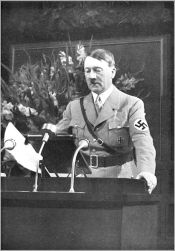 I have taught in public schools and universities nearly all my life, so I can tell you that comparing anyone to Adolf Hitler is taken as a serious insult. If you say to a politician who is five feet and nine inches tall that he is as tall as Hitler, he will take it as a mortal insult. He will say, incredulously, “Are you comparing me to Hitler?” If I say that Hitler was a marvelously gifted tactician, deploying a largely unwilling bureaucracy with great skill, I will be accused of “justifying Hitler.”
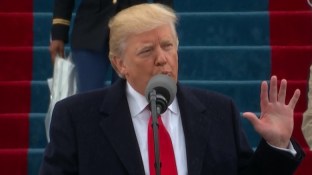 Noting these similarities is not a charge against Trump. You can go down the two speeches and just substitute a German expression for an English one and just doing that is scary.[2] It is true, however, that Trump sees many more similarities than I do between the time of his assuming power and the time of Hitler’s assuming power. And because Trump sees these similarities, he chooses words that highlight them. Any good speaker would do that. Abraham Lincoln did the same thing; he was a superb speaker as a result.
 achievement to the appropriate agencies, funding them adequately, and then holding them accountable for their work. That’s not how you build a movement. A movement needs a leader. The leader needs to focus the movement on himself and to give indications that he, personally, is bound to the success of the movement.
 United States of our time (by contrast with the Germany of Hitler’s time) there are many social and political institutions, including a robust federal system, in place. They can’t simply be set aside. They will have to be bargained with.
 OK, how are we going to have such ceremonies if people say that the ceremony is about the person who is being honored? We will not have them. If the ceremony is about the person rather than the office, then the ceremonies that are supposed to celebrate our unity as Americans and the peaceful transfer of power from one party to another, will have no power at all. Everything is politics—the pursuit of power. Nothing is government—things like providing for a common defense and protecting domestic tranquility.
 Trump will be the 45th President of the United States. But winning an election does not mean a man can show contempt for millions of Americans and then expect those very people to celebrate him.
 It takes her a little longer to get to the “but;” still, when she gets there, she wiggles the same way Rep. Castro did. I respect the office. Good. I respect the peaceful transfer of power. Good. But the man who will take the office is a jerk and the man to whom power is transferred is offensive…and therefore we cannot participate in this celebration of peaceful democracy in America.
 I think that President Trump’s actions, proposed and executed, should be opposed by everything we have. He is going to want to cozy up to Russia with predictable consequences for Germany and France. Make him pay. He is going to want to gut the health protections President Obama put in place and that the Supreme Court declared to be constitutional. Make him pay. He is going to continue to engage in business practices that are wholly out of line with the office of the President. Make him pay. He is responsible for his actions and when he does wrong, he should pay the consequences.
 The Dilettante's Dilemma