The Descent into Tribalism

David Brooks wrote a really good overview of the Trump and Comey controversy on June 9. I read it and valued it and filed it in my mind. But one small clip from that article has continued to float up to my consciousness and I’d like to give it further thought today.

Comey emerged as a superb institutionalist, a man who believes we are a nation of laws. Trump emerged as a tribalist… who simply cannot understand the way modern government works.

I like the contrast between institutionalism and tribalism. There is no way to have what has often been called “a government of laws and not of men” without people who are committed to making institutions work to the benefit of the public. Tribalism is another kind of thing entirely.

I don’t know exactly what Brooks meant by tribalism, but I know where tribalism goes if it is not contained and I don’t want to go there. Let’s consider President Trump’s pardon of Sheriff Joe Arpaio of Maricopa County, Arizona as a case in point. Why did he do it and what does it mean?

tribalism 2Sheriff Arpaio was convicted of “flagrant defiance of another judge’s orders in a long-running case over the former Maricopa County sheriff’s targeting of Latinos in Arizona,” according to Joan Biskupic, a CNN court reporter. The court said that Arpaio was violating the constitutional rights of Arizona citizens and he said he didn’t care and wasn’t going to quit. Hence the arrest and conviction.

By no coincidence at all, a big part of President Trump’s campaign was strongly anti-immigrant. He may have felt very much the way Sheriff Arpaio felt and he may have wanted to communicate his support for Arpaio to his constituents. I think a presidential tweet would have accomplished that or a “Sorry to hear about your conviction” greeting card. Trump issued a pardon.  Why did he do that?

Here’s a possibility. Trump used the resources of the office of President to rescue another member of his tribe. It is the common tribal affiliation that would matter in this way of reading it. It is not that Arpaio was tried and convicted. It is that he was tried and convicted for doing things Trump approves of or at least that he is confident his constituents approve of. Clearly, that brings a new standard to light. It is not whether you have violated the law or not, according to this new standard, it is whether you have done so “in a good cause.” If harassing U. S. citizens on the grounds that they look Hispanic is “a good cause,” then it doesn’t matter that it is against the law. You can be charged for it and tried for it and convicted for it and you really don’t care because there is always the presidential pardon to rely on.

You have to wonder whether that would cover treason “in a good cause” too. Would it cover the assassination of doctors who perform abortions? Would it cover the use of attack dogs and fire hoses against black protesters in the South? If the issue is tribal—a matter of the cause and not of the law—is there any way to tell what is permissible anymore?

I don’t see how.

The legal perspective is that it is illegal to murder people. It is illegal to murder them in a good cause and also in a bad cause and also on behalf of no cause at all. It is the means—murder—that is wrong and the defense that you did it in a good cause does not make it right. Murdering “in a good cause” might be very popular politically, but it is still wrong and it is still illegal. That is the perspective that “a government of laws and not of men” brings to the table.

If we are headed for legal immunity for the people Trump likes, how far are we from thetribalism 1 Hatfields and the McCoys. [1] On the one side of this divide would be the laws of the land and the men and women charged with seeing to it that it is obeyed. On the other would be the people who are immune from legal prosecution for anything they do on behalf of their tribe. It would mean looking at Eliot Ness and Al Capone as the heads of two tribes fighting for supremacy in Chicago. The fact that one represented the law and the other a criminal organization is not brought to light in this conflict of tribes perspective.

I don’t want to go there.

I have been careful in this essay not to try to say what tribalism is—or institutionalism either—but where this emphasis on tribe could take us. It might be, for instance, that President Trump doesn’t care as much as he seems to about Sheriff Arpaio and a great deal more than he seems to about Robert Mueller. Mark Joseph Stern wrote in Slate.com that Trump may be sending a signal to the witnesses Special Prosecutor Robert Mueller will be calling in his investigation of possible collusion between Russia and the Trump campaign.

Comey, the man Brooks referred to as “a superb institutionalist” was fired by President Trump, apparently for not being loyal enough. Trump wanted to make sure The FBI director was “on the team”—was part of the tribe—and Comey wouldn’t make that commitment. Special Counsel Mueller was appointed to look into the matter and given that he has very broad powers to collect information and to subpoena witnesses, he could very well make himself a nuisance.

And he does not appear to have a tribal affiliation. And he will be subpoenaing people who do have a tribal affiliation. Are these members of Trump’s tribe going to be required by law to tell the truth in public? Will they have to admit to having broken the law? Will they break the law by refusing to admit that they broke the law?

To all of these speculations, the tribal answer is, “Don’t worry, be happy.” You can do what you need to do and say what you need to say because the pardon that is wielded by the head of your tribe is going to be available to you no matter what. Or, as one writer put it, “The message of the Arpaio pardon to the Mueller witnesses is, “I’ve got your back.”

In these circumstances, a “crime” against the law is just a speed bump provided that it was done on behalf of the tribe. A government of men, you see, and not a government of laws after all.

tribalism 3I know that is where tribalism goes. I don’t know if we are taking large steps in that direction. It looks like it. People who stand up for the integrity of the law will be accused as being members of “the other tribe.” The Tribe of Anti-Trump. That is, after wall, what Capone said to the members of his organization who were not Anti-Ness enough. It is what members of the McCoy Clan said to family members who were not Anti-Hatfield enough. It is what President Nixon meant when he urged the people of his administration to “take one for the team” and go to jail. But he didn’t pardon them.

And Trump should not either.

[1] This famous feud involved two rural families on the West Virginia-Kentucky border in the years between 1863 and 1891. Wikipedia has a great line about it: “The feud has entered the American folklore lexicon as a metonym for any bitterly feuding rival parties.”

Posted in Politics | Tagged , , , , | Leave a comment

The Incredible Trump

“Caught in the blast of gamma radiation, brilliant scientist Bruce Banner is cursed to transform in times of stress into the living engine of destruction known as THE INCREDIBLE HULK. “

With a start like that, you have every reason to think that this essay is either a parody or a rant. It is neither. Except for the assist from Marvel Comics in establishing the basic metaphor, this is a fairly mild-mannered analysis. Let’s see how it goes.

What does “incredible” mean?

And let’s begin with “incredible.” The “incredible” in Incredible Trump means that youmechanism 4 can’t believe what he says. He is not credible. That’s the old basic meaning, but it isn’t the meaning that is reflected most in current usage.

The “incredible” in current usage means that the truth is so amazing that you will be tempted not to believe it (“credit” it) at all. And that is what it means in the Incredible Hulk; it means that the story of his prowess is so fantastic [1] that it is hard to believe. Same word. Different meanings entirely.

Why is Trump incredible?

If you imagine, as I am, for the purposes of this essay, that there is a “real Donald Trump,” then I will say that he is a Bruce Banner-like character. Eats lunch, sits and talks to people, plays golf, makes decisions. But then he “goes somewhere else” and “he”—IT, by then—is not Bruce Banner any longer

As the Hulk, he does things that are terribly destructive, but when this fit is over, he is Bruce Banner again and he is overcome with guilt and remorse. I retain the “guilt and remorse” element to keep the parallel with Banner.  I realize there has been no actual evidence that Trump has had these feelings himself.  The analogy I would like to play with is that when Trump hits the criterion condition—the blurb says “times of stress”—he “is transformed” [2] and then he “is” IT.

mechanism 3Let’s look at what that boundary condition means because as much fun as it is to have an enormous monster with great pecs and a bad disposition, it is less fun to have a Chief Executive who frequently leaves the common human condition and does “incredible things.”

What kinds of events have counted as “stress” so far? I can think of two broad categories. One is failure; the other is ridicule.

Now most of the damage so far has been done in tweets [3] so let’s add the tweeting environment to the “stress condition.” And let’s look at some examples just to see if this makes any sense. “The media” say that there weren’t many people attending Trump’s inauguration. This is a way of belittling him, one of the boundary conditions, and late at night, he read this and tweets a false crowd estimate and an attack on all the ordinary estimates. This is the act of an IT. It denies truths that can be shown to be true; it attacks people whose cooperation will be crucial to governing.

The Trump leaves a trail of destruction behind him, but at the time, there is nothing else he could have done. That one point is the principal value of the Hulk metaphor. He can’t help it. He is transformed. Note the passive form of the verb.

When and Why?

“Times of stress” says the clip from the internet on which I base my entire grasp of the Hulk. I think for Trump, the analogous conditions are failure and disapproval. Let’s explore those.

hulk 5President Trump has not had a major legislative victory yet and probably won’t ever have one because his inability to win the early battles causes him to declare war on his teammates. Trump needs to be seen as a winner. That means that high profile programs need to be passed by the Congress. But when the early votes fail, he experiences “signs of stress” and begins to attack his team members. Trump has major conflicts going on now with Paul Ryan, the Speaker of the House and with Mitch McConnell, the majority leader of the Senate.

No one—Trump included—thinks that going to war with the two most important congressional allies you could have, will make passing he program any easier. It is not a tactic for Trump. It is a fit. He changes into the Hulk and becomes “a living engine of destruction.” Analysts who try to see what sense it makes as a tactic us using a bankrupt metaphor.

I’m going to stay with this, so you might just as well settle in. The point I am trying to make with this metaphor is that this is not a choice Trump makes. Watch Bruce Banner turning into the Hulk and ask yourself at what point does Banner decide this is a good idea. He does not. The stress has the same effect on him that the failure of a high-profile commitment has on Trump. He become “IT” and starts tweeting.

The second trigger is disapproval. Trump despises the people who criticize him. He has no regard for the criticism itself. So, for instance, when he was criticized for his late and tepid “condemnation” of the white racist violence in Charlottesville, he turned on the critics. Disapproval of an action IS disapproval of him. It is personal, not programmatic. Disapproval raises the stress levels and you know what happens when the stress levels get too high. A change takes place; the intemperate violence begins, reprisals are threatened and carried out. And—again—this is not instrumental. It is not a means to an end. It is the inevitable behavior of that kind of person—not the Banner person, but the Hulk person.

What to do?

The administration has no ready solution for this radical personalization of the processes of government. It will continue to be very difficult for President Trump to fill the empty positions in his administration because people come there to administer programs. This erratic personalization of issues is not consistent with the formulation and the pursuit of administrative goals, so people will not want to serve.

The Republican party has no ready solution either. Throwing their lot in with President Trump means not only abandoning traditional Republican values, but abandoning values at all. Values are long lasting things, so they don’t adapt readily to Hulkish outbursts.

And the Constitution has no ready solution. The 25th Amendment imagines ways to cope with “presidential disability” but in no circumstances has that been imagined as erratic and recurring. Woodrow Wilson faded at the end of his presidency and other people, notably his wife Edith, stepped up to prevent constitutional crisis. Nancy Reagan played a very large role at the end of the Reagan presidency. That’s not what we are looking at here.

There are circumstances in which some body to be named by the Congress or the presently constituted Cabinet, could act to remove the President—substituting their judgment of his “fitness” for his own—but all the arrangements imagine that there will be a “condition,” not that there will be recurrent episodes of “being transformed” into an “engine of destruction.”

This is, in fact a new kind of thing. And what I like best about the Hulk metaphor is the way is discards explanations that would otherwise be futile. What did he mean? What is he trying to do? Does he have a goal in mind? What could it possibly be? All those go away. Another stress-fueled episode has occurred and he has been transformed and will do, under those conditions, whatever he chooses.

It’s a new kind of issue, I think, and this Hulk metaphor offers some clarity, even though it does not offer hope.

[1] This is another example of the escalation of adjectives so common in the English in our time. It is common to say that something was “fantastic,” meaning that it was very good. That draws our attention away from the more focused meaning, “having the characteristics of a fantasy.” Fantasies, of course, are not true, however nice they might be. You could play both sides of that, just for the fun of it, if you wanted to. The announcement is made that President Trump is going to shut down the government if he doesn’t get funding for the Wall. An excited conservative might rejoice, “That’s fantastic!” to which a liberal might reply, “Oh yes. That’s exactly what it is.”
[2] All the blurbs use the form “transforms,” as “he transforms into the monster.” But that blurs the nature of the transaction. It is important to say that he is transformed—use the passive voice—and is therefore powerless to affect it.
[3] I am considering only the damage to the presidency. Much greater damage is being done by putting in charge of federal agencies people who are opposed to the lawful pursuit of the agency mission.

Posted in Political Psychology, Politics | Tagged , , , , | Leave a comment

Holladay Park Plaza, Year 1

A year ago today, Bette and I moved into Holladay Park Plaza and I want to tell you a little about it. For me, there is always the question of what to call today. I have been celebrating the various month marks as we have gone along, so we celebrated our tetramensiversary (four) and our sesamensiversary (seven) and our decamensiversary (ten) “Anniversary” is the handy word for today, but if I wanted to stay with the monthly count, I think I would choose dodecamensiversary as the right word for today. That ought to mean “12 months.”

Bette and I did a lot of planning in anticipation of our move here. I wrote three sets of
essays about the process, so it wasn’t something we did without a good deal of thought. On the other hand, there isn’t really any way to know what it is like to live here apart from living here and we have now done a year’s worth of that.  We live in a high-rise part of HPP.  This sketch shows the East Building, which is being built right across the street from us and which we have watched since they first broke ground.  Beautiful!

I think my one line summary is that living here is easier to do than I thought and harder to Year 1describe than I thought.

Let me deal with the thinking part first. I have written a fair amount about the major aspects of HPP in preparation for some first anniversary essays. I was thinking of following one of my favorite acronyms, PERSIA, and telling you about the political, economic, religious, social, intellectual, and aesthetic aspects of our new home. Having re-read what I wrote, I realize I simply don’t understand the experience. I thought it was better than I learn that be reading my own writing than to post it and have you all tell me.  So…maybe next year.

Instead, I’d like to celebrate today by painting a picture or so and telling a story or so.

There are too many interesting people here for us to have met them all in our first year. The most common get to know you setting is dinner and the most common arrangement is to reserve a table with the new people you would like to get to know. We’ve been doing that for a year now and we haven’t gotten around and besides that, some new people have become residents since we have.

Bette and I have joined several kinds of activities and when you start an activity, you pick up a new kind of resident—a colleague. A colleague isn’t just a friend; a colleague is someone who is trying to get done the same things you are.  Every ongoing commitment, whether it is the library, in Bette’s case, or the Plaza Singers in mine, gives you a new set of people who care about what you care about.

In closing this brief reflection off, I’d like to paint two scenes for you to think about. In the lobby outside the dining room, there is a little alcove with chairs set around. There is also a very advanced one-cup-at-a-time coffee maker, so people wander in and get a cup of coffee and stay to talk. It’s like a cracker barrel at an old country store.

Early in the morning, there is a group I call Barbara’s Coffee Klatch, after Barbara Tyler, who presides there every morning. It is a women’s group both in the sense that most of the participants are women and also in the sense that the conversations have to do with relationships and extended families and medical events and proposed travels and so on. Anyone is welcome who wants to have that kind of conversation and I stop by there most mornings to catch up on things.

In the afternoon, in the same place, there is a group I call Drasko’s Seminar, after Drasko Jovanovic, who presides there every afternoon. It is a men’s group both in the sense that most of the participants are men and also in the sense that the conversations have more of a debate style to them. Some observation is made and then challenged and then supported, and so on. One recent topic was, “Is Donald Trump capable of making a decision?”  It was a serious question, carefully phrased, and backed up with decades of experience at the federal level.  IMG_0323.jpgThere are travelogues as well, because quite a few of these men have lived a lot of places, but we keep coming back to the question on the floor.

I like those two scenes because they suggest the variety of ways there are to live here. I prefer Drasko’s kind of discussion, myself, but I benefit a great deal from hearing what is said in Barbara’s and a place that has both is richer.  This truck was very important to us in August of last year.  I happened on it today and remembered just how important.

Our goal in coming to Holladay Park Plaza while we were still active was to get our chance to be a part of the robust life of the place, to help solve whatever problems we found, and to help formulate problems that had not yet been formulated, but that should have been. We have done that in this year. We have, in the words of one of the staff who is well-placed to see, “hit the ground running.”

I don’t have any goals for next year apart from continuing to do what we are doing, to make whatever contribution we can make, and to enjoy the company of a diverse and active set of friends.

I do hope to understand, better than I do now, what makes this place tick. But understanding sometimes takes longer and I’m not in a hurry. It’s only Year 1.

Posted in Getting Old, Living My Life | Tagged , , , | Leave a comment

The Solar Eclipse at Holladay Park Plaza

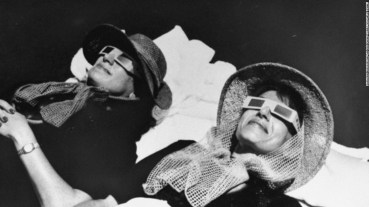
Thank goodness there is no “right way” to watch a solar eclipse. And I think a lot of people felt that way. It didn’t seem to me that up on the roof, the part of the 16th floor, which surrounds the inner rooms, there was the kindof gentle correction that goes on about most things here.  People who live here have lived a long time and most of us have some idea about how things ought to be done.  I think it is gift we share with each other that we don’t talk about it all the time.  We did that really well today.

eclipse 1

So people came up the the penthouse to watch whatever was going to happen. Some sat in the auditorium and watched the coverage on television and that was fine. Some people came up from the assisted living floor who looked like they were glad to be part of the general population for awhile.  Most of the rest of us milled about next to the east wall of the roof area and chatted about all kinds of things–sometimes including the eclipse.

eclipse 4Even if you went up to the 16th floor for the purpose of watching the solar eclipse, you found a lot of competing claims on your attention. Here are Holladay Park Plaza (a really good senior center on the east side of Portland, Oregon) we make a lot out of events. So there was a whole table full of edible puns for us to enjoy. There were the dark Oreo cookies set on top of the light Oreo cookies. There were Starburst candies. There was a large container of ice and water sitting next to a large container of ice and a dark tea of some sort. [1] There were Sun chips, cut-out cheese moons, that you could mount on dark crackers. You could eat away the whole eclipse time if you wanted.  This shows the roof from the west.  We were up there just on the other side of the brown sign.

There were groups of people sitting or standing together—all with the correct eye gear—and facing in the direction of the rapidly diminishing sun. Some looked at it as if it were interesting; others as if it has somehow been an assignment. Most engaged in a conversation that could have taken place anywhere and interrupted the flow of conversation with an occasional glance at the event. I think those are all good ways to enjoy the eclipse.

I have no idea why the first bit the shadow took out of the sun happened at the upper right “corner”—you know what I mean. Or why the last little bit of shadow exited at the lower right corner. It intrigued me.

And I hadn’t thought of how different the quality of light falling on the earth would be, but of course it would be different. My son, Dan, called during the event and said it looked to him like the sun at evening and as soon as he said it, it started to look like that to me as well.  A lingering dusk just before noon.

From the roof, we watched the traffic on the interstates thin out—but not slow down—as IMG_0431.jpgif only a few people felt that nothing was going on that needed their attention. We watched the construction of the building just east of us slow down and then stop entirely. It was still light enough to see how to cover the rafters with big sheets of plywood, but maybe a little break in the action would be appreciated.

I heard conversations from people who were still very much engaged with the previous solar eclipse, as if that one was somehow more real and more vivid in their minds than the one that was going on at the moment. That struck me as odd at first, but then I thought that we all linger over those parts of our lives that continue to engage us and we don’t necessarily privilege the insignificant things that are going on right now over the truly significant events of a decade or so ago.

I heard conversations that bore passingly on the fact that there will not be another total eclipse that can be viewed from this part of the country until 2169. “So this will be my last one,” is a line I heard, in one version or another, several times and one I said to myself several times.  Will I see the Cubs win the pennant again?  Will I see Roger Federer win another major?  I think there is a time I would have considered hearing or having these thoughts to be morbid, but now I know they are just another form of calendar.

eclipse 3I found myself interested in whether people would think of the closest approach to totality as the end of the show or the intermission. I thought it would be fun to watch when the general exodus began. It began almost as soon as the bright crescent of the sun started to increase again, but by that time, I had thought how many other variables ought to be considered. A lot of people had been sitting out in the sun for a long time by then. Quite a few had been standing for awhile by then. The restoration of the sun may not have seemed all that different from the occlusion of the sun; not that much to hang around for.

I watched it for a long time, but when I caught myself wondering how many minutes it would be until the shadow exited the sun’s surface entirely, I realized that I wasn’t fully engaged in it anymore and very shortly after that, it occurred to me that it would be fun to write a short blog about the experience.

[1] It took almost no prompting at all to get the organizer to begin referring to the dark tea as Totali-Tea and to the water, right next to it, as Near Totali-Tea.

Posted in Living My Life | Tagged , , | 2 Comments

With malice toward none

WITH MALICE TOWARD NONE WITH CHARITY FOR ALL WITH FIRMNESS IN THE RIGHT AS GOD GIVES US TO SEE THE RIGHT LET US STRIVE ON TO FINISH THE WORK WE ARE IN TO BIND UP THE NATION’S WOUNDS TO CARE FOR HIM WHO SHALL HAVE BORNE THE BATTLE AND FOR HIS WIDOW AND HIS ORPHAN TO DO ALL WHICH MAY ACHIEVE AND CHERISH A JUST AND LASTING PEACE AMONG OURSELVES AND WITH ALL NATIONS.

malice 1

And that is what it looks like on the wall of the Lincoln Memorial. It is one of the best-known paragraphs in American history. It was presented to a Republican Congress not at all ready to embrace it. The Republican majority in Congress at the time was called “Radical Republicans,” a designation no one ever gave Lincoln.

In the wake of the Charlottesville, Virginia catastrophe and particularly in the wake of President Trump’s vacillation in response to it, statues are coming down all over the country. In Helena, Montana, they are removing a fountain, of all things. These statues are called “Confederate statues,” although some are and some aren’t.

I’d like to reflect a little today about what kind of a response to all this will help us in the long run—I am aware that elections occur in the short run—and what a way forward might look like.  I am really eager to sense that there is some way forward.

Cherishing the Peace

I’d like to begin with a re-appreciation of President Lincoln’s goals. The fighting part of the Civil War (the War of Northern Aggression in many southern history texts) lasted another month after Lincoln addressed the Congress. The end of the war was imminent, but there was a lot of killing left to do and I read the first phrase of Lincoln’s admonitions to include all that killing. “Strive on,” he says, “to finish the work.”

But Lincoln wasn’t all that big on war and he wasn’t all the big on ending slavery. [1] He was big on ending the threat to the union and he didn’t mean, by that, just ending the secession. He wanted the wholeness back.

Which is why he went on to say he wanted to bind up the nation’s wounds. What wounds did the nation have? The president who offered to protect slavery in the states that currently had it—to protect it by a constitutional amendment —would not have sanctioned a crusade to remove all public notice of the Southern leaders. Nothing about that binds up the wounds of the nation. These men were patriots in their own minds and in the minds of many of their citizens, slave-holding and not. Let the wounds be bound up.

Lincoln also wanted to care for the veterans and their families. These are persons who need to be comforted and healed; not just the nation, but the people. Now it turns out that the best will in the world could not heal both the white victims of the war and the black victims of slavery. But the best will in the world also didn’t have much chance to try. Lincoln was assassinated the month after this address to the Congress and the Radical Republicans did not have the best will in the world.

malice 6So even Lincoln’s program under Lincoln’s leadership would have failed in the short run, but Lincoln wasn’t really in it for the short run. He calls, in the final clauses, not only to achieve a just and lasting peace among ourselves, but also to cherish that just and lasting peace. I don’t think Lincoln would have achieved it, but I do think he would have cherished it and I think that is where we have fallen down in our time.

I don’t think we cherish it anymore. And I think the failure to cherish it is at the heart of the festering cultural wound the South clings to and reveres.

Irish Nationalism

I spent some time in Ireland this year and one of things that surprised me was the fervor with which many Irish clung to their traditional culture, especially the music. Then I discovered that the English, in their centuries-long failure to subdue the Irish people, had tried to eradicate their culture. They already had complete dominion in political and economic spheres, but that apparently wasn’t getting the job done. Playing the Irish harp, for instance, or teaching the playing of the Irish harp were capital crimes.

malice 3I saw the result of that during my visit. Every way of embracing and cherishing Irish culture was at the same time a rejection of the Anglicization project. If it didn’t take all ten fingers to play the harp, I think one of those fingers, a finger with its own significance, would have been raised meaningfully against the English. That is the present day expression of all those years of denial and derogation.

So it didn’t work there either.

Mauthausen

Now what narrative will rescue the heroes of the Southern story from the quagmire of treason and treachery? I don’t know. I have some ideas, which I will share in due time, but what I really care about is who is going to participate in the crafting of that story. If it is only the recalcitrant bitter-end whites, it will not be a tolerable story. If you add the moderate industrial and post-industrial leaders, it will be better, but still not robust enough to survive Klan violence. What is needed is the participation in the story by the victims. “The South” needs to be able to say, “This is our story and we will protect it.” That means it can’t ignore slavery, but it also means it can’t be about slavery.

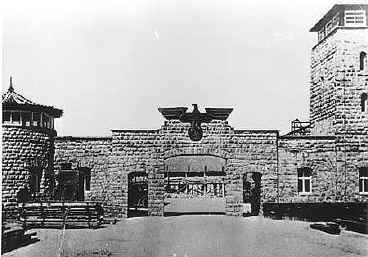
Let me add two footnotes to this consideration. I have seen only one official German/Nazi malice 4(you see the problem) death camp. It was in Mauthausen, Austria [2] But I saw it twice because I took the Elderhostel bicycle tour twice and it was the historical site featured on that day. Before we went out to see the camp, we saw a film about the era and the camp itself. It wasn’t a preachy film, but the condemnation was consistent and powerful. The first time I sat through the film, these processes were attributed to “the Germans.” The second time, some years later, they were attributed to “the Nazis.”

What a good idea, I thought. They are building a narrative that makes sense in a modern Western pro-democratic Germany. It didn’t sound to me like any attempt to evade responsibility, just to be clearer, now that the time allowed it, about whose ideology and whose initiative accomplished this. [3]

I know that not all of you are going to like that shift. It depends entirely, I am sure, on what you want to put in the foreground and what in the background. And a few other things, like why are you making that choice and what do you imagine the results of that choice to be. Things like that.

Common Southern Narrative

That is one of the ways of moving toward a Common Southern Narrative—a narrative that not only has an honorable place for most of the people of that period, but also a narrative devised by and supported by most of the people of our period. That means that some southerners will be singled out for “the Nazi treatment.” They would be people more than usually cruel or insensitive to the plight of the slaves; people who didn’t really care about the state sovereignty question except as a tool to keep the slaves; or people who violated some trust they had as members of the United States government.

That would free other Southerners, who would have done anything to avoid rebellion malice 5against their country, except, of course, being unfaithful to their state. They would be the Southern Statesmen in a Losing Cause. They would be “the Germans.” Their statues could be revered because of their place in the Common Southern Narrative. These statues would be protected in every relevant way, both verbal and physical, by the whole coalition who put the Narrative together.

Common Slavery Narrative

The second idea is my backup plan. It is based on the absurdity that it is fine to acquire and sell slaves, but horrible to acquire and use slaves. This idea puts the slave sellers and the family fortunes they amassed side by side with the slave buyers and the fortunes they amassed.

At this point, let me introduce James De Wolf (1764—1837) of Bristol, Rhode Island. You can look him up on Google; that’s how I know what I know about him.

[He was] a United States senator and a wealthy merchant who, at the time of his death, was reported to be the second richest person in the country..

The DeWolf family’s complicity in slavery continued after 1820 in other ways, too, as the family maintained slave plantations in Cuba and James DeWolf invested his slave trade profits in textile mills which used slave-produced cotton. Today, there are as many as half a million living descendants of the people traded as chattel by the DeWolfs.

So my second strategy would be to focus on the slave trade—the very part that is relegated to he background by the Common Southern Narrative—and extend it to the North as well. Not many people would want to do that, I am sure, but it is a perfectly valid alternative to the Common Southern Narrative. It is the Common American Narrative, with the Nazis of the North deprecated along with the Nazis of the South.

Conclusion

I’m not proposing either of these two solutions. They seem daunting to me, particularly with the White House-inspired resurgence of the White Power movement. But I do want to say this. What we are doing isn’t working. If the Civil War was about slavery and nothing else and if all the Southerners who participated in it were pro-slavery and nothing else, then there is no redemption for the culture and history of the South. Southerners will not live without heroes and a history they can be proud of. They don’t need to be proud of all of it. The rest of us, after all, manage to be proud of “the Westward Movement” without considering only how many Native Americans had to be sacrificed to it.

So it can be done. It just can’t be done by Southerners. And it won’t end. And I want it to end. And vilifying the few and valorizing the many will help. Even in the South.

[1] Read his justly famous letter to Horace Greeley if there is any doubt in your mind about that.
[2] Mauthausen isn’t the name of the camp. It is the name of the town. That means that there is, I have seen it myself, a Mauthausen McDonalds. And that is what is says on the sign. Ich liebe es.
[3] Nothing about that focus on the Nazis denies that many Germans thought it was a wonderful idea, but it wasn’t pitched to the Germans as a wonderful idea. It was hidden in the shadows wherever possible and the change in emphasis takes some account of that.

Posted in Political Psychology, Society, Sustainability | Tagged , , , , | Leave a comment

Really bad political arguments

In his column of August 12, which is an important contribution to today’s debates, Frank Bruni introduces Professor Mark Lilla, of Columbia University. Lilla comments that “classroom conversations that once might have begun, I think A, and here is my argument, now take the form, Speaking as an X, I am offended that you claim B.

It was that phrasing, I think, that caught my imagination.  I felt like I had just seen a horror movie.

Lilla has liberals in mind, because liberals are the ones that have been boxing his ears lately and Bruni cites him because these same liberals have been boxing Bruni’s ears, too. Today, I would like to reflect on the reasons that arguments can be set aside because they aren’t being made by the right people.

Status distortion

Like so many other “truths” of our time, this one is true as far as it goes, but it has gone too far. Later in his column, Bruni says that “race, gender, sexual orientation [and] class” inform…how we see the world. That is true, of course. It is true of every person; it is true all the time. It is true of the person making the argument and the person refusing to hear it. It is true.

bruni 6Bruni also agrees that the “check your privilege” exhortation rightly asks us to recognize that. I know that when I make an argument, the argument is affected by who I am and the experiences I have had and the same is true for you. That is as far, I think, as that truth should go.

But it doesn’t stop there and in this column, Bruni looks at some of the places it should have stopped, but did not. [1] He tells about a scuffle just up the road from me at the Evergreen State College, where “a white biology professor, Bret Weinstein, disparaged the particular tack of a day of racial healing. He raised valid points, only to be branded a bigot and threatened with violence.”

Bruni wrote about that incident and then he, in turn, got this: “I don’t need one more white male criticizing young people of color.” But I think maybe she does. If Weinstein was treated unfairly, then this reader—I am imagining her as a young woman of color—urgently needs people like and unlike herself to call attention to the unfairness. The idea that Bruni has no right to his views because he is of the wrong sexbruni 7 and color don’t sound right to me. Didn’t we write some things in the Civil Rights Act of 1965 about disparaging people because of their sex or color? Is that why it sounds familiar?  Clearly the dueling tee shirts point the direction of our future.

And I think this small, but important truth, should also have stopped before it came to this event, too.

Mark Lilla…got a big, bitter taste of this last year, too. He was scheduled to give a talk at Wellesley College on “Identity Is Not Politics” and someone scrawled on a poster advertising the talk: “White men: stop telling me about my experiences!”

But what if Lilla did not want to talk about her experiences? What if he wanted to talk about whether the commitment to identity politics has been good of bad for the Democratic party? There would need to be at least two positions, with at least one proponent for each. And who should these proponents be? They should be people with no sexual orientation, no country of origin, no race, no partisan affiliation, etc. Does that leave anyone? Because using this identity politics filter, who you are—that’s the race and sex and all that—makes what you have to say worthless. “Oh, you’re just a..[fill in the blank].  Or for upperclassmen, “just another [fill in the blank.]  Upperclassmen have heard it all before, you see.

Later in the article, Bruni cites with approval the work of Phoebe Malz
Bovy, author of The Perils of Privilege. You need to be careful to “check your privilege at the door,” says Bovy and Bruni agrees. I agree too, but privilege is not uniquely distorting. It is just especially obnoxious. Ignorance and hatred and apathy are all distorting, too, and I would dearly love to see them checked at the door.

bruni 2I think these instances are ugly and that is why I have cited them. But even more ugly to me, and I say this as a former professor [2], are the “classroom conversations” Lilla points to that take the form of “Speaking as an X, I am offended that you claim B.” Lilla says that the form of assertion precludes much more useful forms, such as “I think A and here is my argument.”

That second form, which was once taken for granted in universities, leads to a comparison of assertions and the facts and logic that sustain them. There is, of course, room to do all that badly and I have seen it done badly, but even when I see it being done badly, I know that it could have been done well. Of the first form (Speaking as an X…), I have nothing good to say. Not only is “what I say” set aside without any consideration of its merits, but even “the way I know things”—therefore potentially anything I could know—is set aside as well.  Here again, it is the parallels in this set of pictures that attracted me.

You could argue that I could just do the same thing in return. I could just set asidebruni 3 whatever you say both on the grounds of “how you know things” and also “what you know.” Those are just aspects of “who you are.” And I could. Now the two of us, completely heedless of the worth of anything the other might say, stand there and waste each other’s time. [3]

And then there is the flaw—the really hideous flaw—contained in the first part of the formula: “Speaking as an X…” The racism or classism or sexism (take your pick) embedded in that formula is truly awful. It begins with “we are all alike.” All of us white Ivy League professors are alike and all of us Hispanic agricultural workers are alike and all of us stay-at-home Moms are alike. That’s just how it begins. Everyone in any of those categories would reject that, to be sure, but it is firmly implicit in “Speaking as an X…”

Of course, you are not just an X. You are also a Y and a Z. Will you claim the right to speak for all the members of all those categories, or just for the people who, like you, are X and Y and Z? And then, of course, you are not all the X’s, you are just one particular X and you are unique. So maybe speaking for yourself would be a good idea.

And as bad as it is to claim that your personal identity is dissolved without residue into the category X, it is even worse that you have invited me to claim that I am a Y, just a Y and nothing more. And that is a separate and additional offense.

So…clearly, I need to bail out of this argument before it achieves escape velocity.  The short and simple point is that identity politics presupposes identity rhetoric–not personal identity, which would be bad enough, but group identity–and destroys the basis for any dialogue we might have had.

[1] It is striking that in writing this article, Bruni feels compelled to stop and identify himself as gay. I understand why he would do that, as a rhetorical matter. He is going to be lecturing “victims” and he wants to establish his own credentials as a victim before he dos that. Still, his need to make that claim for himself seems odd in the setting of this particular column.
[2] So…you know…my experience is distorting my judgment.

[3] Unless, of course, I am the teacher in this setting. In that case, it would be my job to teach about the erosive character of that whole orientation toward dialogue.


Posted in Education, Politics, Society | Tagged , , , , | Leave a comment

A staff you can lean on

Nobody ever accused President Jed Bartlet of being too candid as President over his seven years of presiding over The West Wing. On the contrary, the hits he took in public were about being too distant, too intellectual, too removed from ordinary life. That is not an entirely unfair characterization of him, but it passes over the other part—the passionate, angry, vengeful president.

But for that, he had a staff. [1] I am going to come, shortly, to President Trump’s dispro 1belligerency about North Korea, including both “fire and fury like the world has never seen” and “not tough enough.”  And now, since I wrote those, to “locked and loaded.”  But let’s start with President Bartlet and work back.

In Season 1, Episode 3, “A Proportional Response,” the Syrians shot down an American aircraft. Bartlet was furious about the attack and even more furious about the routines that his military had developed for dealing with such things. These routines did not express the depth of his anger, nor did they assuage his desire for revenge. Here is Round 1 with his military and diplomatic staff in the situation room. Admiral Fitzwallace is the Chairman of the Joint Chiefs of Staff.

BARTLET: Then I ask again, what is the virtue of a proportional response?

FITZWALLACE: It isn’t virtuous Mr. President. It’s all there is sir.

BARTLET: It is not all there is.

FITZWALLACE : …pardon me Mr. President, just what else is there?

BARTLET; A dis-proportional response. Let the word ring forth from this time and this place, gentlemen; you kill an American, any American, we don’t come back with a proportional response, we come back [bangs fist on table] with total disaster!

GENERAL: Are you suggesting we carpet-bomb Damascus?

BARTLET; General, I am suggesting that you and Admiral Fitzwallace and Secretary Hutchinson and the rest of the national security team take the next sixty minutes and put together a U.S. response scenario that doesn’t make me think we are just docking somebody’s damn allowance!

You couldn’t ask for more fury than that. He is angry and he has the power to punish and he wants to use it. But then an amazing thing happens. In Scene 3, President Bartlet returns to the Situation Room to hear about the new plan. He gets the new plan—and also an assessment of what this plan will look like to others.

Bartlet: You called me?

FITZWALLACE: Yes, sir. Mr. President we put together a scenario by which we attack Hassan airport…. I think Mr. Cashman and Secretary Hutchinson would each tell you what I’m sure you already know sir. That this strike would be seen at home and abroad as a staggering overreaction by a first time Commander in Chief. That without the support of our allies, without a Western Coalition, without Great Britain and Japan and without Congress, you’ll have doled out a five thousand dollar punishment for a fifty buck crime, sir.

Bartlet’s Chairman of the Joint Chief’s of Staff just responded to the Commander in Chief’s anger as “a staggering overreaction by a first time Commander in Chief.” It is, concisely, “a rookie mistake.”

And there are reasons why it is a mistake. There would need to be a “Western Coalition” dispro 2to support the kind of response the President is talking about. Bartlet just wants to hit back. There has been no engagement with Congress, not even the famous “Gang of Eight.” [1]. Nothing with Great Britain or Japan. There has been no foreign policy preparation at all and only a rookie President would act militarily in such circumstances and this rookie President if very fortunate t have someone who will tell him that.  The caption is from a Fitzwallace fan.  He didn’t have a nameplate that said that.

Bartlet is stopped by his staff. He is still angry and more will have to be done before he addresses the American people that eventing. That additional work is done by Leo McGarry in the Oval Office and when he is done, Bartlet is able to give a public voice that sounds like this.

BARTLET: My fellow Americans, good evening. A short while ago I ordered our Armed Forces to attack and destroy four military targets in Northern Syria, this in response to the unwarranted, unprovoked, and cold-blooded downing three days ago of an unarmed Air Force jet carrying 58 passengers and the flag of the United States.

It took some doing, but he got there.

The Trump Presidency

It is widely thought that no one in the Trump administration would be able to stand up to President Trump the way Admiral Fitzwallace stood up to President Bartlet. This places the contrast between these two residents of the Oval Office in an odd relationship to each other.

dispro 3For example, it is not a difference of public and private person. Bartlet was as angry in this narrative as Trump is today about the threat of North Korea. It is not that Bartlet successfully muffles his anger, determined to act like a president, rather than like an avenger. Taking this scene as a fair instance of his early presidency, he “muffles his anger” no better than President Trump is reported to.

But President Trump has not yet appointed anyone to play either role. John Kelly’s role–that’s Kelly in the picture above– appears to be to keep everyone else in line. It appears to include General John Dunford, the current Chair of the Joint Chiefs of Staff—the role Admiral Fitzwallace played in the TV narrative. And there is no setting where this could occur. President Bartlet convened the members of “national security team” to give him a report in the Situation Room. No one is convened at the site of President Trump’s 3:00 a.m. tweets.

So it appears that the setting is not there. It may be, as they say, that no one wrote the “fire and fury” line for him, but he has been rehearsing it for awhile now in angry outbursts with his associates. None of the associates seem to have found a way to say what these experts, see below, are saying, according to CNN.

Trump’s comment, which came shortly before North Korean officials threatened the United States territory of Guam with missiles, was criticized as too bellicose and direct by national security and defense experts who argued any conflict involving nuclear weapons called for calm and reserve.

So the setting is not there and as nearly as we can tell, the people who can utilize their expertise to move toward “calm and reserve” are not there either. Every president I have seen so far, and that list begins with FDR, has found a way to adapt himself to the Presidency. “It sobers you,” said recent President Barack Obama.

But it may have inebriated President Trump. If he has developed, as many think, a habit of saying what people tell him he shouldn’t say, that means one thing in a radio interview. It means not much more in a TV show that features him firing people. It means somewhat more when it comes to ethnic slurs and predatory comments about women.

But if it really is a habit—as it seems—and if he really is unwilling to set it aside for the dispro 4purpose of dealing with other heads of state, some friendly, some hostile, then he needs a strong staff in the very worst way. And he shows very little inclination—General Kelly is a possible exception—to appoint any. The recent televised cabinet meeting at which each secretary was given a chance to say what an honor it was to serve in the Trump administration, does not bode well for anyone giving the President good advice.

Let’s hope that Kim Jong Un is being better served by his staff.

[1] There is debate about the origin of the term “staff,” to refer to the people who serve you in some way. Everyone agrees the staff = “stick” in some sense, but one group believes it is a stick something like the baton that officers carry, while others think it is a stick more like a shepherd’s staff and that the joke is that the staff are the people you can lean on. I don’t know which is correct but, obviously, I prefer the one with the joke in it.

[2] Specifically, the Gang of Eight includes the leaders of each of the two parties from both the Senate and House of Representatives, and the chairs and ranking minority members of both the Senate Committee and House Committee for intelligence as set forth by 50 U.S.C. § 3093(c)(2).A

Posted in Politics | Tagged , , , , | Leave a comment

Enjoy your meal

That seems straightforward enough. It’s the kind of thing many waiters and waitresses say as they leave your table, having just served your meal. And if the alternative is not enjoying your meal, I think it is the best of the options.

But enjoying and not enjoying your meal are not the only options. There is, for instance, paying no attention to your meal at all.

meal 2I ask you to imagine that sitting down at a table with friends to eat a meal is really just a palette; it is an occasion that you will use to paint a picture of yourself. In this scenario, the meal itself is just a color, just a tool. In such a setting, it makes no more sense to say “Enjoy your meal” than it would to say to an artist, “Enjoy your yellow.”

Thought of in that way, the meal is a just a way of presenting yourself and “enjoying it” is something you would do if it advances that program. So to properly appreciate “Enjoy your meal,” we need to start back a little farther with “Pay attention to your meal.”

If you do pay attention to your meal, judging it for what it is, rather than for what is says about you, you might not enjoy it at all. I have had meals, and so have you, that are best endured, rather than enjoyed. The meat is overdone, the potatoes are lumpy, and the asparagus, having been served twice now, has developed a texture you really don’t want to encounter at the table.

If I were a positive person who was paying attention to all the possibilities for pleasure available to me at the time, I would concentrate on the people who were there, if there were a really good wine to go with this really awful meal, I would hope to enjoy it fully. There is no reason, in short, why I could not “enjoy the mealtime,” even if I couldn’t find a way to enjoy the meal. [1]

If I were a needy person, a person for whom a dinner with friends was really just an opportunity for self-enhancement, there are several paths I could take. I could say of the mediocre T-bone steak that it isn’t bad, but you should see the way they prepare steak like this in Texas. “I remember a time when Maudie and I were there in ’57 at the ranch of a friend of ours…” I could say of the broccoli that it wasn’t bad, but when we were in Berne, we were served broccoli that was fresher than this and with the most marvelous béarnaise sauce. And I could say of the mashed potatoes that they weren’t all that bad, but in Dublin, where I grew up [2], they used to whip sour cream and just a touch of horseradish into the potatoes. Now that’s the way to do potatoes.  The broccoli with béarnaise sauce looks pretty good, I’ll have to say.

It makes you glad there weren’t more courses, doesn’t it? This person is not attending tomeal 1 the meal at all, so very probably he is not enjoying it. Each kind of food is an occasion for recounting where else he has eaten this kind of food and how much better it was then than now. It is a self-aggrandizing performance and while it doesn’t, strictly speaking, preclude his enjoying the food, it is hard to think that he does.

Note to my blogging self: One of the perfectly valid versions of attending to and enjoying the meal is to savor what is best in each kind of food and to say nothing about it to anyone. That means that I, sitting at the same table, wouldn’t know anything about that experience at all, which is why I am skipping over it with just the briefest mention. That person’s experience, as good as it is, is not available to me so I don’t see why he bothers having it at all.

Another kind of neediness can be seen in “justifying the food.” It seems just a little odd to think that the food might need to be justified, but let me tell you what I mean. It might be that the broccoli is so good because they used to prepare it differently, back in the bad old days, and then I went in and had a conversation with the executive chef and since then, he has been preparing it the way I asked for it to be prepared and isn’t it wonderful? Or, more briefly, “Am I not wonderful?”

And then there is that way of receiving the meal that fits under the “justification” heading too, and is characterized by explaining why a particular course is not good. They have had such trouble with the firm that is currently providing our produce. The available space in the kitchen is so small that they can’t prepare everything at once. The influx of new help in the kitchen means that they aren’t going to get everything right immediately, but this—the food as it is tonight—is just a temporary inconvenience.

This last person may be a very nice person and she is extremely knowledgeable. But if each food item is a tool for amplifying her own role the successes or, in this case, for justifying the food by describing the kitchen or the cooks or the suppliers, then it is likely that her attention, also, is not on the food. [3]

It wouldn’t do, I suppose for the server to leave the table with “Enjoy whatever is best in this mealtime setting.” And I’m not recommending it. But I might just think it to myself as a reminder that there is going to be something that deserves my full attention and I want to be open to enjoying it. This opportunity is going to be at that table at that time and I hope I have the discipline to seek it and enjoy it fully. [4]

[1] A more challenging case would be if one item was really superb amid the basket of deplorable items. To be free to recognize that it was good and to really experience how good it was, would be an achievement to be proud of.

[2] It may have been Dublin, Ohio, but we won’t be seeing these particular people again.
[3] The food, in this scenario, is the victim. It has been badly supplied or badly prepared or badly served, but it is not to blame.

[4] I could do it without all that discipline, I suppose, but when I do it on purpose, I like it better.

Posted in Living My Life | Tagged , , , | 2 Comments

Political Lies and Political Liars

Lord Alexander Chung-sik Finkle-McGraw is instructing John Percival Hackworth, a relatively new member of the New Victorians, on “hypocrisy.” Is hypocrisy a big deal, Finkle-McGraw wants to know, or is it the way it was back at the end of the 20th Century, “the queen of the vices.”
I want to work, today, with the idea that what Finkle-McGraw tells Hackworth about hypocrisy is just what someone needs to tell American voters about lying. If I had the wisdom Finkle-McGraw has, I would do it myself, but…alas. [1]

The occasion for this reflection is the August 7 article by Sheryl Gay-Stolberg in the New York Times. She is anti-Trump, of course. That goes without saying. The New York Times, editorial staff, reporters, and columnists are all anti-Trump. But this article by Gay-Stolberg isn’t about that at all. She is wondering, and so am I, “ whether Mr. Trump, in elevating the art of political fabrication, has forever changed what Americans are willing to tolerate from their leaders.”

Have we changed?

That’s the way she puts the question in her last paragraph and I think it is a good question, but it is not my question. What I am wondering is what kinds of changes in the American public have made lying on the Trump scale, acceptable.

liar 4Let’s take it for granted that people like President Trump do whatever they feel is in their best interest. [2] And I take it for granted that people listen to what they think is in their best interest and believe what they think it is in their best interest to believe. And I think it has always been like that. I think that characterizes the presidencies of George Washington and Abraham Lincoln and Bill Clinton. [3]

If that is true, it is just as potentially revealing to ask the question from the voter side as it is from the perpetrator side. So Gay-Stolberg’s summary might be rephrased this way. “Whether Americans, in what they are willing to tolerate from their leaders, have forever changed how Mr. Trump [politicians] are elevating the art of political fabrication.”

Have the structures of the political world changed?

This analysis points to some of the structural features of contemporary politics that would have to be taken into account in a more thorough assessment. I will just refer to them here because I am not going to deal with them myself. Here are three.

The media environment is now fragmented. There is no one to play the “respected elder” role that Walter Cronkite, Chet Huntley, and David Brinkley did. And in the multiplicity of sources, everyone seems to have a first glance claim to credibility.

The electoral environment has now changed so that in many districts the principal contest is the primary election, not the general election. That means that incumbents must guard against challenges from the extreme end of the partisan scale—conservative candidates from the extreme right, liberal candidates from the extreme left [4]. So the old days, when the general election forced candidates toward the center, are over. The rewards are mostly from the extremes and candidates use the extreme language that will attract supporters and contributors.

In such environments, it is harder to tell what a lie is. More and more political meetingsliar 6 remind me of the “pep rallies” of my high school days. Speaker after speaker praises the home team and vilifies the next team on the schedule. Coaches will say things like, “And we are going to win because we are winners” with complete impunity. It doesn’t imply anything about the actual prospects of the home team in the coming game. We may have lost every game so far and be confidently expected to lose this one as well. No one takes what appears to be a prediction as a statement with any factual content at all. It is just a way of praising ourselves and fortifying ourselves against whatever reality will bring.

Political contexts were once different. If there is a center to the media that is respected and if the crowds being addressed are moderate and mixed, then there is no “we” of the kind the coach presupposes in his pep talk. And that means that things that appear to be statements of fact need to be at least plausible. [5]

Finally, the customs governing political discourse have changed. It was once a moderately funny joke to cite Sir Henry Wotton, a 17th Century wit who said,”An Ambassador is an honest man sent to lie abroad for the good of his country.” The Ambassador is “us” and he is sent off to lie to “them.” That standard has come home and it isn’t even moderately funny anymore.

Politicians lie more now because there is more reason for them to lie—see the point above about playing to the extremes of your party—and there is less reason to fear denunciation. According to the standard of small communities, if a person told lies, then he was a liar. He was condemned for it and his claims were ignored. [6]

liar 2There is no down side, in the current environment, to being shown to be a liar. In fact, now that I think of it, I don’t see that word used. We see stories that some percent of a politician’s statements (I saw a 70% ranking for Trump during the campaign) are lies, but not that the candidate was “a liar.” In the current environment, lies are honored equally with truths as “courageous,” or as “standing up for the downtrodden” (or the downtreaders) or “saying how he really feels.”

The “gotcha!” of being caught and shamed by lying in public—unless it is to a federal investigator—is gone. That’s the point Lord Finkle-McGraw wanted to make about hypocrisy. It is now part of the practice of doing the public’s business. We don’t punish the perpetrators anymore.

How we train our candidates

When I was young, I was part of a group of guys who used to play touch football in a vacant lot next to our church. My friend, Bruce Motter, lived only a block away and was within easy earshot of his home. His mother let him play right up until the time dinner was on the table, provided that he would come home when she called. That was the deal.  So we would hear her call, “Bruce.” We would look at him and he would shrug and we would keep on playing. The next one sounded like “Bruce!!” We all responded the same way. Finally there was “Bruce Allen Motter you come home this instant!” and Bruce would say, “Gotta go, guys” and take off.

I’ve been thinking about that story as I read Sheryl Gay-Stolberg’s article. We train our liar 3public officials by treating some things as acceptable and others as not acceptable. Politicians who thought their campaigns would be seriously damaged if they could be shown to be lying about public matters would stop lying about public matters. Mrs. Motter trained my friend Bruce to understand that he was not really being called for dinner when she called his name. Bruce responded exactly as you would expect, and as any politician would, who was doing something rewarding and illicit and was not punished for it.

Does it really work that way? It did in the experiment Brendan Nyhan and some colleagues put together. Here’s how that worked.

In a controlled experiment, researchers showed a group of voters a misleading claim by Mr. Trump, while another group saw that claim accompanied by “corrective information” that directly contradicted what Mr. Trump had said. The group that viewed the corrections believed the new information, but seeing it did not change how they viewed Mr. Trump.

So the viewers in the second group saw what Trump said, saw that it was not true, and continued to feel about him—however that was—the same way they had before. I am wondering what the effect would have been had Trump’s statement been called “a lie,” on the basis that the new information, which in this world is completely reliable, shows it to be untrue and the group is also shown that Trump knew it to be untrue when he said it.  Here are three plausible steps.

That would be step one; knowingly false = lie. Step two would be backing that reality up into the character of the speaker; frequently lies = liar. Then step three would be the campaign implication; do you want a liar representing you in Congress or in the White House or in the governor’s mansion?

We’ve lost that, I think. If you call the “pep rally” setting to mind, the coach is speaking for “us” and he is saying false bad things about “them” and that shows his loyalty. It show, as we say today, that his heart is in the right place.
“Lying to us” can hardly be imagined in such a setting, which might fairly be called “tribal.”

Solution

I don’t really have one. I called it that so you would read this last paragraph. It seems to me that if lying to your constituents has an upside (voters will know you are on their side) and no downside (no one expects you to tell the truth or has any incentive to punish you for lying) then candidates and incumbents will lie.

If we can get out of tribal mode (like the pep rally setting) and demand that speakers, even though they are truly “us,” tell us the truth, then there is a good reason for them to stop lying. We—not intending to overlook the crucial role of the media—are the ones who define what behavior is rewarded. Making statements you know to be untrue could be called lies. People who routinely tell lies could be called liars. A strong presumption against electing liars to represent us, could be articulated and supported. [7]

If lying “to us” is just something public figures are doing “to them,” then I think we are all lost.

[1] Although, it is true that Finkle-McGraw is “an equity lord,” which means, he says, that he is freed to—“entitled to” in a sense— consider the welfare of the phyle as a whole, not just his own place in it. Thanks to Neal Stephenson’s The Diamond Age for this wonderful character. That is very much what Erik Erikson says about the developmental stage he calls “generativity,” and I have actually made it that far.
[2] By “best interest,” I don’t mean to imply that there is anything like a careful cost/benefit analysis going on, or even whether he is comparing the immediate gratifications of blustering with the delayed consequences of losing large sections of his principal staff.
[3] There are both internal and external reasons for refusing to deceive the public, but the question is never one of “character” v. “expediency.” Sometimes good character requires you to discern and choose the lesser evil.
[4] Despite the wishes of many commentators, there is no “extreme center.”
[5] By “plausible,” I mean only that a case can be made for the assertion. Supporting facts can be adduced. A “reasonable case,” not an irrefutable case, can be made. It is a very low standard.
[6] Not trying to imply, of course, that the behavior of public officials in small towns was like that, only that the standards that were preached and were sometimes practiced, denied credibility to people who were known to be liars.
[7] Of course, “telling the truth” is not an ultimate value. Representing your constituents well is the ultimate value. But telling the truth will allow voters to make that decision on the merits. Telling tribal lies is not at all the same thing as telling the truth.

Posted in Communication, Political Psychology, Politics, Sustainability | Tagged , , , , | Leave a comment

Boys and girls and emotionality

“Why do we limit the emotional vocabulary of boys?”

In this piece from the New York Times, Andrew Reiner collects some recent research about how infant boys and girls are treated differently. He cites quite a range of research and not all of it seems to fit together. It may well be that this opinion piece is a chopped up version of a longer essay. I have had that happen to me and I am prepared to be sympathetic. Or it may be that he has a critique in mind—the one with which I have begun this reflection on his column—and that he is just grouping around it the research that comes to hand.

I am quite sure that “we” in the question includes teachers like himself. I am reasonably sure that by “limit,” he means that without the actions he and others take, the “emotional vocabulary” of boys would be richer. I suspect that if the “emotional vocabulary” of boys were “richer,” it would be very much more like that of girls.

So then I wonder why that would be a good idea.

Grieving Styles

I come to this question by a devious and personal route. My wife, Marilyn, died in gender 12003 and I had the kinds of grieving difficulties men have when their wives die. One of the difficulties was confusion. A lot of the things that were being recommended to me didn’t seem to help. Some of them made everything seem worse. That’s why I was confused.

I heard an interview on NPR with author Kenneth Doka, co-author with Terry Martin of a book now called Grieving Beyond Gender: Understanding the Ways that Men and Women Mourn. Doka was saying in this interview that the work he and his co-author had done showed that men and women very often grieved differently. That didn’t surprise me.

Then he said something that did surprise me. He said that the style more commonly used by women—they call it the intuitive style—is also the gold standard among mental health counselors. So if a man is grieving, he has a grief problem to deal with. If he sees a counselor who tells him how he should be grieving, laying out the common elements of the intuitive style, then, Doka said, he has two problems.

Not only is he grieving, but he is doing it wrong.

They call the style men more frequently use, the “instrumental style.” Just hearing Doka describe the kinds of things that many men do with their grief and how helpful they have found it made me relax. Some very large, very intimate tension inside me just gave way at that point. I was so grateful that I went out and bought the book and read it three or four times.

And that is why when I hear lines like “expanding the emotional vocabulary of boys”—which might very well be a good thing once the “How far?” question is answered—I think of my experience with the intuitive and instrumental styles of grieving. [2]

Expressing and suppressing

There are three ways to frame this problem.

  • You can say that there is “a right way to do it.”
  • You can say that gender styles are too tight (rigid) or too loose (unclear).
  • You can say that a particular person should think about gender and emotions differently, that he or she would be benefitted by emoting, lets use that as an example, differently that he or she does now.

Just to shape of the contours of those dilemmas a little, let’s try to imagine what questions they offer us.

  • The first setting can be illustrated by saying that suppressing emotions is a bad thing to do. Note that that instance bypasses both the gender-appropriate and the person-appropriate forms of the question. Here’s an example from Reiner’s article.

“…Harvard psychologist Susan David [says]: “Research shows that people who suppress emotions have lower-level resilience and emotional health.”

That may be true. “Suppress” is hard to be sure about. “Suppress” means that an emotion is experienced and prevented from expression. Nothing here says that boys, for instance, who are judged to be “over-expressive” have better emotional health. Nothing says that Charlie, the boy himself, would benefit from suppressing his emotions more or less. Both of those question are bypassed.

  • The second way of framing the question is saying that gender roles are too narrow—or alternatively, that the boundaries are too rigid. Clearly, “limit the emotional vocabulary of boys” falls into this pattern. The implication is that the emotional expressions of boys would naturally be broader—i.e. more like those of girls—except for the “limiting” that is done. Most of the studies cited in Reiner’s piece are about how such limiting is done. He does a good job, I think, of posing that question.

gender 4But there is the matter if whether that is the best question to pose. In posing this one, he bypassed the other two question we are keeping in mind. The first is whether “broad allowances for emotional expression” are good for people. In focusing on the possibility that these limits are bad for boys, Reiner bypassed the question of whether people in general are benefitted from rich and unconstrained emotional expression. If that were true, we would expect to find that cultures that presuppose free and unfettered emotional expression would be healthier than cultures that do not. I am not aware of any research that holds that to be true, but I will keep my eyes open.

Then there is the question, also bypassed by Reiner’s choice, of whether a particular boy would be benefitted. If Reiner were a counselor, rather than a professor, his job would be to look after the well-being of his client. Some clients will need to be taught better control, some greater spontaneity, and some finer discrimination between one social setting and another. Under no circumstances should Counselor Reiner allow Professor Reiner to dictate how he handles his clients because clients have such a distressing tendency to differ from each other.

  • Finally, there is the question of whether any particular boy would benefit from “a richer emotional vocabulary.” There is no way to deal with this question abstractly and I don’t criticize Reiner for failing to deal with it. I mention it here only because asking it bypasses the other two questions. We cannot begin with a particular boy in mind and ask whether people are healthier if they are more expressive; nor can we ask whether the gender-based expectations for emotionality are too broad or too narrow for boys.

Should boys (men) be different from girls (women)?

My own answer is that they certainly should, but the question isn’t very often asked that way and you will notice that Reiner does not ask it that way either. He asks whether boys would “benefit” from an array of emotional expression that is more like that of girls.

This is a question of the second kind as I explored the three above. It does not ask what is good for “people” or for a particular person, but for the members of one sex, males in this case. That raises the question of what problem of boys the proposal addresses. If it is “limited emotional vocabulary,” as in Reiner’s case, the question we want to ask is what benefit “unlimited”—I know he doesn’t mean that, but “limited” is such a weasel word—would bring to boys. How would they be better off if they expressed themselves more emotionally?

As you would guess by now, my answer is that some boys would benefit and some wouldn’t.gender 3 Furthermore, some girls would benefit from a more limited emotional vocabulary and others would not. This is the most important kind of question for parents, but I agree with Reiner that it isn’t very good for outsiders. The research Reiner reports has to do with mothers and fathers with young infants. No one is asking what kind of treatment is going to benefit this particular infant. That is not a question that can be asked yet.

A 2014 study in Pediatrics found that mothers interacted vocally more often with their infant daughters than they did their infant sons. In a different study, a team of British researchers found that Spanish mothers were more likely to use emotional words and emotional topics when speaking with their 4-year-old daughters than with their 4-year-old sons.

That’s interesting, but it isn’t important unless it contributes to the “problem” Reiner cares about in this column, which is the “limited emotional vocabulary.” And if I care about the growth and development of little boys and girls, I can’t tell how this finding should matter to me.

Reiner also reports research about the orientation of parents to young children, which is perfectly appropriate, but the research he reports is limited entirely to narrow interactions, rather than to the effects on the person.

What’s more, a 2017 study led by Emory University researchers discovered, among other things, that fathers also sing and smile more to their daughters, and they use language that is more “analytical” and that acknowledges their sadness far more than they do with their sons. The words they use with sons are more focused on achievement — such as “win” and “proud.” Researchers believe that these discrepancies in fathers’ language may contribute to “the consistent findings that girls outperform boys in school achievement outcomes.”

It is not hard to imagine, based on this study that fathers acknowledging the sadness of their daughters validates any inclination they might have had toward emotional expression. Similarly, the fathers’ focus on the achievement of their sons might very well be related to the sons’ focus on task-oriented behavior, rather than on emotional expression.

gender 6Looking at this from my standpoint, I see the precursors of the intuitive style of grieving and the instrumental style of grieving. The lesson I took from that setting is that there is a perfectly good style of grieving that doesn’t require an expanded emotional vocabulary (as well as one that does) and I am inclined to look at Reiner’s piece from that standpoint.

Peer and mate selection

One question an adolescent boy might ask if he were to read Reiner’s piece (OK, what are the chances?) is “How is the emotional style I choose going to affect my life?” Reiner offers two little clips that bear, ominously, on that question. One comes from his own classroom, presumably at Towson University in New Jersey.

Nowhere is this truer than in English classes where, as I’ve witnessed after more than 20 years of teaching, boys and young men police each other when other guys display overt interest in literature or creative writing assignments.

His point in citing this is that the guys in these classes seem to “fear” [3] emotion-rich engagement with poetry, for instance. For whatever reason, saying these kinds of things is likely to get you in trouble with your buddies and everyone in the class knows that. Your options at that point are to endure the trouble, to fight back, or to choose different buddies. [4] None of those is easy, which is why the “policing function” exercised by same sex peers is so effective.

The other question one might ask is how a style of emotional expression might affect your marriage chances. Here’s Reiner on that question.

Indeed, a Canadian study found that college-aged female respondents considered men more attractive if they used shorter words and sentences and spoke less. This finding seems to jibe with Dr. Brown’s research, suggesting that the less men risk emoting verbally, the more appealing they appear.

Or as Brené Brown summarizes it: “Women often say they want men to be emotionally transparent with them [bur]…many grow uneasy or even recoil if men take them up on their offer.”

So as a young man of the college and marriage age—I remember a time when those were very nearly the same—I look at myself and my emotional style and seek the approval of my male friends and the prospective appreciation of my female friends and I say that succinct and task-oriented are the way to go.

Conclusion

That’s not entirely fair to Reiner. He is offering a gender-based critique and he had taken the risk of showing that the research cuts both ways. I am calling into question the research that doesn’t go the way I would like it and using nearly all of the research he reports that does go the way I like it. But those small points aside, in putting the crucial question in the mind of a young man, a particular young may, I am undoing his whole strategy that “boys”—the whole genderful of people—be considered as the subject.

When a particular young man asks this question, he may well come out further down the line than Reiner would like him and closer to what I would like.

There is a problem here that needs to be solved. Surely there is. I am not sure, based on my reading of Andrew Reiner’s piece in the New York Times just what it is.

[1]  Nobody wants to deal with the “how far” question.  “More” which is just a direction seems safe.  I think boys should have more.  But “how much more” is a destination, not just a direction, and it asks the question, how much is enough and how much is too much?  The critique is often as broad as the gender.  The the answer is going to have to come one boy at a time.

[2] I think that in practice, “narrow” and “rigid” are just two visualizations of the same problem. “Narrow” refers to the space of behavior that is allowed. Broad, many kinds of behavior are permitted (not stigmatized) and “narrow,” only a few kinds are permitted. I think that “rigid” refers to the lability of the boundaries. If the boundaries are flexible, the whole question of whether they are broad or narrow is bypassed.
[3] The choice of “fear” is advocacy language. What would be obvious to any observer, the professor included, is that the other guys are disapproving “sensitive” or “emotionally nuanced” interactions with literature. The idea that this disapproval is the product of the “fear” of the other guys is an explanation that advanced Reiner’s view of the problem, but isn’t an “experience” he has had. It is a theory he is pitching.
[4] Of course, it isn’t always gender. Michelle Obama, when she was a little girl, was reproved by one of her classmates for not sounding black enough. “Ooooh,” the friend said, “You sound like a white girl.” The First Lady-in-training responded that she liked the answer she had given and was not going to change it to make it sound blacker.


Posted in Communication, Living My Life, ways of knowing | Tagged , , , , , | Leave a comment