My first victory lap

The first day of my first victory lap is December 17, 2017. That will be the day after I turn 80. I can hardly wait.

What is a “victory lap?”

It’s an old story, well known by my family. Not very well accepted as a metaphor, but I am hoping for progress along that front any day now. Once upon a time, the family lived on “new faculty circle” in New Wilmington, Pennsylvania. This was inexpensive housing that Westminster College provided to new faculty for their first few years in town. It was roughly half a mile around the circle.

I was at a place in my running project in 1977 when I needed every extra mile or victory lap 1fraction thereof I could manage. I was supposed to run 1776 miles between the 4th of July in 1976 and the 4th of July in 1977. This was to be the kind of thing joggers did to commemorate 1776, the year the Declaration of Independence was signed. I had fallen behind during the winter and I was taking long runs several times a week and no matter how long the run was, I added that little half mile around new faculty circle—just to get the extra milage. And so I wouldn’t be thinking of them as just more running, I called them “victory laps.”  This is Brittain Lake.  The western part of the victory lap passed just uphill from the edge of this picture.  And the picture below–that’s me in 1977 finishing the 1776th mile–is on the far side of the lake.

The victory lap as a metaphor
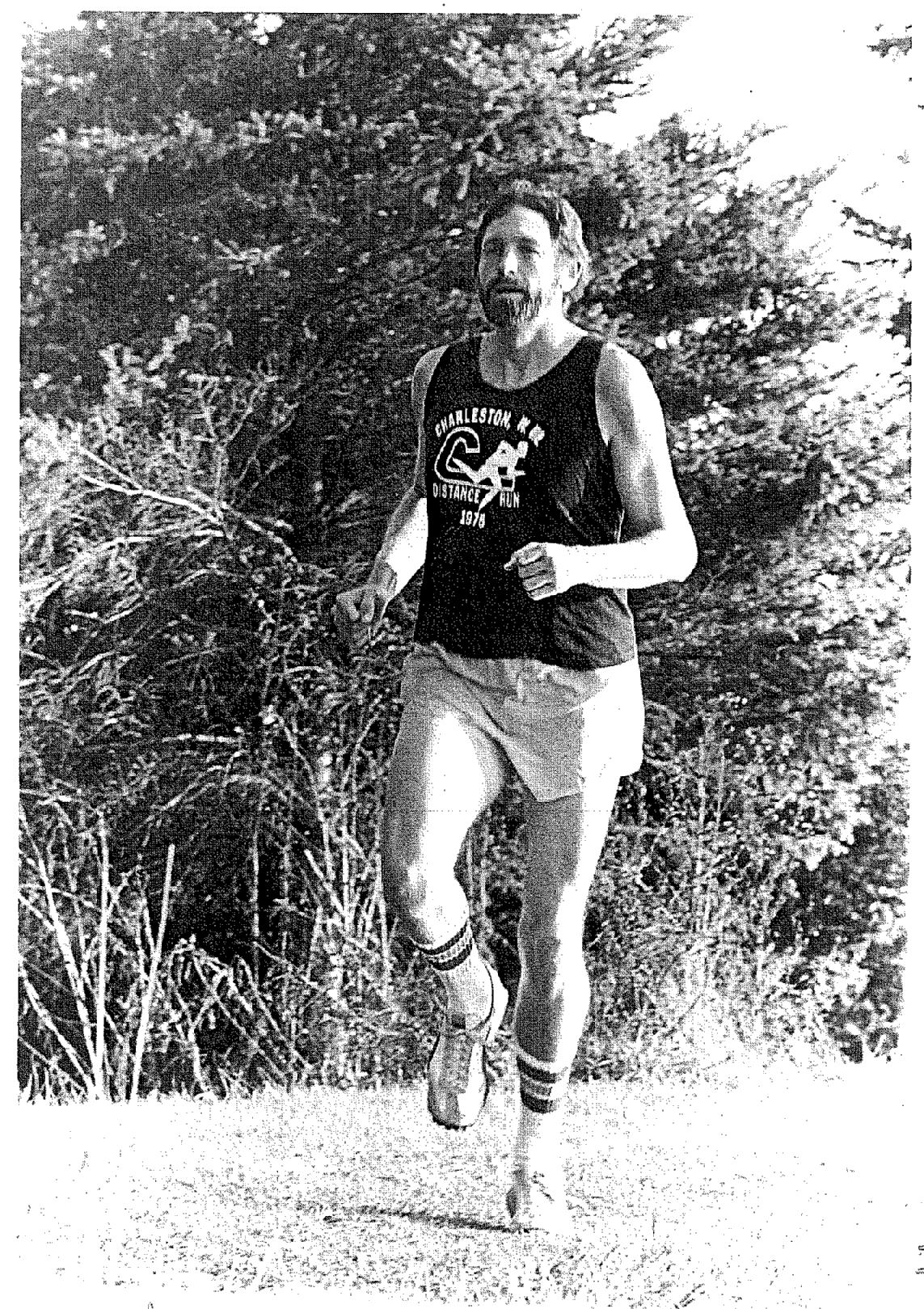
I got to thinking metaphorically about the victory lap because I noticed that the victory lap felt different, even though it really shouldn’t. I may very well have run the last five miles or so—one of my standard runs was 19 miles—in some discomfort. I had cramping problems at one time or another and blisters and dehydration and whole litany of runners’ complaints. But I noticed that when I was in the victory lap phase, those went away. Not worth paying attention to anymore? Distracted by reflections about how I had run that distance that day? Runners’ high? I never really knew, but I really did appreciate it that all those symptoms were muted once I passed the front door and started around the loop.

Then I got to thinking that with just a few liberties taken here and there, you could divide my life into four laps, like a mile race. Every lap was 20 years long. So I grew up in the first 20. In 1957, I was a sophomore in college and had no idea at all what I was doing. By the end of the second lap, in 1977, I had gained a Ph. D. and three wonderful kids and had lost my marriage to their mother. And I had remarried and gone back to teaching and acquired four stepdaughters. By the end of the third lap, in 1997, I had finished a career doing public policy for the State of Oregon. During this last lap, the one that ends next week, I have lost a wife (cancer) and remarried (again) and picked up two more stepchildren and had a post-career career as an adjunct professor and retired again and sold my house and moved with my new wife (almost 12 years now) into a very good retirement community. And that brings me to my 80th birthday on December 16 and the beginning of my first victory lap on December 17.

Now what?

I was really appreciative of the physical relief I got on the actual victory laps—the ones in the 1970s. I was intrigued by the autobiographical mapping I managed with the aid of the mile run (1500 meters if you really must). The four laps of the race could be seen as marking off the four prominent segments of my life. But now, I am actually going to BE 80 and the “race” is over and I am looking forward to the reflections on that day’s run and the easing of the physical side effects of that day’s run. All of which are perfectly clear to me—in retrospect.

But now we are talking about imagining them in prospect. On Sunday, December 17, I am going to have to start thinking experientially about my first victory lap. What will it be like? What do I want it to be like? Does it matter how many such “laps” I expect to finish?

Well…NO to the last question. I don’t care how many there are. There will be as many as there will be. It is the quality of the laps that has always mattered. What if, for instance, instead of not paying attention to my blister (until I get home and can put disinfectant and a bandage on it), I decided to not pay attention to some grievance or other that I have been carrying along with me. Not all the grievances. Maybe just one. Maybe one every lap. Would that work? By age 90—imagining for the moment that I get to age 90—I would have decommissioned ten grievances that I would otherwise have been carrying around. That sounds like a victory to me.
I remember running that last half mile and thinking over whether I had run the way I should have. It wasn’t inquisitorial. I was already done. It was just a pleasant reflection and maybe sealing in a lesson of so. Don’t push the hill going up to the Cheese Shop so hard; it costs you over the next highway mile and then you don’t cash in on the final downhill the way you could have. That kind of thing. I kind of like the idea of declaring an end to “the run” and calling the running I continue to do, “victory laps.” Maybe I could reflect on our first year here at Holladay Park Plaza, the way I reflected on that long uphill toward the Cheese House, and make some lazy speculative imaginary plans for the next year. Whatever.

Selling the Victory Laps

My kids have never been comfortable with the victory lap idea. Either they can’t believe that I really feel that way or they can’t imagine feeling that way themselves or they can’t imagine me doing anything at the finish line except dropping dead. I experienced the victory laps as wonderful in every way, which is why I have continued to pursue the metaphor. I am hoping that when they see me enjoying the victory laps, as I have every intention of doing, they will begin to relax into the concept and enjoy it along with me.

Let me begin by rejecting the sentiment in this picture.  I think this is what my kids think I really mean.  Maybe it is what they aspire to themselves and can’t imagine that I don’t.  I don’t really have a lot of fatherly responsibilities left and my life with my kids has been defined for many years now as more like dear old friendships than anything more clearly paternal. Still, this is an experience I will be having that they will be having (eventually) as well. So…there’s no point in denying that my experience of it is going to be a major factor in how they think of their own retirement. Might as well do it right.

My kids haven’t made running a part of their lives in the same way I have, so the mile race metaphor might not be the right one. But I think the discipline of using the resources you have during “the race,” whatever that is for them, so they can look back on it with satisfaction, is a really good idea. And living the years after finishing it in a celebrative and thoughtful way sounds like another good idea.

When they were little, I would teach them to do things by doing them myself, then turning it over to them to try. And I’d “coach” a little. “No, no, not so high up on the handle or take more of a backswing or ask yourself a bunch of questions you should know the answers to when you have finished the chapter.” Implicit in all the coaching was that if they would begin by doing it the way I did it, they could adapt it to their own style once they got the hang of it.

That still sounds like a good idea and I will imagine hearing the starting gun go off first thing Sunday morning, December 17, and I will try to lay down a really good victory lap for them in that first year. I won’t be doing it for them. It wouldn’t be a victory lap if I did. But if they can find value in the way I do it, it would make the victory a little sweeter.


Posted in Uncategorized | 4 Comments

Assembling a Convidium

Nope. Not a word (yet) so far as I know. I hope to have the better known “colloquium” after all the members of the convidium see the movie clips.

So, for instance, there are two reflections on forgiveness that I value particularly. Inconvidium 4 Invictus, President Mandela (Morgan Freeman) instructs his head of security, Jason Tshabalala in the need for white people in the security detail. “Forgiveness starts here,” says Mandela. In the second one, Pay It Forward, Arlene McKinney (Helen Hunt) comes to the railroad yard where the homeless gather to offer forgiveness to her mother, who lives there. There are more than 40 seconds of wordless images, showing first the mother’s face, then the daughters, as both women realize what has been done.  Here is Angie Dickinson as the mother, talking to the reporter who broke the story.

I would like to show those two clips to my convidium and host a discussion afterwards around what that means to us. I don’t have any aspirations about controlling the colloquium (more about that shortly), but I am going to begin with Christian presuppositions, myself. It is what Christianity teaches about forgiveness that will form the background of the contributions I will make to the discussion.

How that will serve as a conversational initiative will depend on who else is there. That brings me to the question of who else might be there. Well…I live in a retirement community that is full of people who have different attitudes toward Christianity. [1] There are non-Christians here, as well as anti-Christians, and post-Christians. There are atheists and agnostics. There are members of other faiths who would be welcome, but I would imagine would not come. And most challenging of all, there are members of the “spiritual, but not religious” stripe. The Pacific Northwest is the “spiritual but not religious” capital of the U. S. and very likely of the world and they are richly represented here.

So those are the pools I will be drawing from. None of those, I imagine, will react against sitting down with neighbors and watching a video clip or two (the convidium part). But as we move to the discussion (the colloquium part), everyone will appropriately claim the freedom I claimed, to place the video clip in the context of his or her own faith or unfaith or anti-faith. [2]

There are two kinds of atheists. There are those who take the position that we know there is no God—also that there are no gods; and then there are those who hold that as a personal view. It is not something to be shown to be true for this second group. It is just a personal dead spot.

Similarly, there are two kinds of agnostics. There are those who say that the existence and character of God [3] cannot be known. Then there are those who say that they, themselves, do not know; they leave aside the question of whether anyone else knows.

convidium 2I have found very few people in the category I would call “non-Christian” who are not members of some other faith. But there are some–really, there are– who have had so little contact with Christianity than they have no feelings for or against it. They are the missionaries’ dream of primitives who have no religion at all.  Blank slates waiting to be written on.

There are a few people I would call pre-Christian. These are people who imagine that they will begin to take the Christian faith seriously when they get around to it. They imagine some status as a Christian to be in their future, so they have not rejected anything, really. They have just not accepted anything yet.  I couldn’t find a picture of old people watching a movie in any groups larger than two.

The three largest groups, I am guessing, will be the anti-Christians, the post-Christians, and the “spiritual, but not religious” (S minus R, or S—R) people. People representing these choices will come to the convidium in numbers proportionate to their populations here and they will have things they want to say. And, of course, I will have things I will want to say, too. How is that going to work out?

The S—Rs will say that forgiveness is a very good idea, that it is championed by spiritually enlightened people all over the world and that there is no reason to entangle it with religious dogma. [4] Nothing in the video clips they will just have seen will conflict with that because nothing in the clips will suggest anything at all about religion. One is about politics (Mandela) and one is about the restoration of a lapsed relationship by means of an ethical imperative.

The anti-Christians will say that Christianity teaches the need for forgiveness, but… What they follow the “but…” with will point to why they are anti-Christian. Hypocrisy is the common charge. Christianity preaches forgiveness, but doesn’t practice it. There is often some Sunday School teacher in their pasts who has prominently violated this standard.

The post-Christians will say that forgiveness, as it is preached and practiced in the churches, is only a crude and specific form of some much more sophisticated position. This position, which is, not coincidentally, the position they currently hold, has some historical roots in Christianity as it is preached and practiced, but any particular guidance [5] has been dropped out. The post-Christians wind up at the same place as S—R, but they push off of some established Christian practice—something to be “post-“ from, that needs to be transcended.

That leaves the Christians. You would think that would be the largest group, and I convidium 6think it will offer the largest challenge. A bunch of Christians with different backgrounds, different traditions of scriptural interpretation, different ways of making their faith make sense, will see these simple film fragments differently. And these differences may be fanned into disagreements. There is no way of telling, really.

My hopes for this colloquium—the discussion that follows the convidium—is to keep my own view clear in my mind, to say clearly what it is, and to allow it to be sharpened and focused by the other views. That’s what I want for myself.

My hopes for this colloquium more generally are that a place will be provided where the starting point of the film can be taken seriously—these film clips are our “text”—and the meaning of the clips for each of the views represented. Naturally, I want for my own view not to be dismissed out of hand. I want it to be considered in the same way the others are. On the other hand, I don’t want to win anyone over to the view I hold…at least, not exactly.

If there are people who would like to be where I am—to hold the views I am convidium 5describing—and have thought there was no way they could get there with integrity, I’d be happy to offer my own experience to them as an encouragement. [6] I can do that because I am aware, more than most people, of how I got where I am. I like being where I am even while I know it won’t do for everyone what it has done for me.  Robin the Brave, here, with Princess Melora.

So that’s my hope. A convidium followed by a colloquium. Everyone who is willing to be respectful of the view of the others is welcome. We will watch the clips that I have chosen as “texts” and follow the logic of the discussion wherever it leads us.

I have, for instance, a really good video of the “kenosis” poem in Phillipians Chapter 2 (The Muppets’ Frog Prince) and a good one of the “red pill or the blue pill” scene from The Matrix (Nicodemus in John Chapter 3). we’ll see how those go.

[1] I have different attitudes toward it myself. I feel sometimes that what I think and convidium 1what I feel and what I know and what I do are always in some kind of tenuous balance—very much like the BOSU ball shown here.
[2] The most common response of all will be that questions like this don’t really matter to “real life.” I will not be considering that point of view because those people will not return to the group once they find out what it is about.
[3] Just to simplify things for me, let’s take every reference to “God” to mean “or the gods, of whatever type they might be.”
[4] Not everyone knows what “dogma” means, but everyone knows that it is bad. So people who want to say something against “religion” can make a very appealing case by saying they are against “religious dogma” instead.
[5] Like “seventy time seven,” Jesus’s response to Peter’s question, or “don’t go to bed angry,” Paul’s very practical counsel about anger and getting over it.
[6] The thing about “positions” is that you can’t get there from just anywhere. I got there by starting where I had to start and by being willing to thrown certain things overboard along the way. If someone else in the group is starting somewhere else and/or is unwilling to throw the obstacles overboard, then he or she just can’t get to where I got to—where I am—even if they want to.


Posted in A life of faith, Living My Life, Theology | Tagged , , , | Leave a comment

Why the CHEB is so important

CHEB is a flimsy response to an important issue. CHEB is a discipline I am going to try to follow as a way of referring to President Trump. [1] It stands for Current Head of the Executive Branch.

I called it a flimsy response, and so it is. But it is a response to what I am coming to see as the issue that needs to be addressed and nothing in my previous way of considering the presidency prepared me for this, so I am prepared to be tolerant.

Cheb 1.jpgI began my trip toward this destination while watching an episode of The Mentalist. Patrick Jane, who has done his share of onstage magic, asks why it is that magicians are accompanied on the stage by beautiful young women in skimpy outfits. The reason he gave is that the more time the audience spends looking at the assistant, the more leeway the magician has for managing his feats of illusion without being caught at it. The presence of the young woman means that the “eyeballs,” in the current phrasing, are going to be over there while the things the magician cares about are over here.

And that is the way I see the outrageous behavior of CHEB. [2] He tells demeaning jokes and directly criticizes people with handicaps and calls for an evenhanded approach to proponents of white power and black power. It is really hard to ignore those things—they are the attractive assistant—and to look instead at the illusions the magician is perpetrating. The direction of the CHEB response, flimsy as it is, is to call for consistent and critical attention to the illusionist, leaving the attractive assistant alone.

This strategy is resisted for some very good reasons as well as some bad ones. One of the good reasons is that adopting a strategy of not noticing and not responding simply allows truly egregious behavior to succeed. And not only to succeed, but to be unopposed. I have the persistent feeling that I would be complicit in allowing that to happen. In my judgment, one of the worst of these is CHEB’s remark, “You had people that were very fine people, on both sides.” I think that is outrageous. I was, in fact, outraged.

But let’s look at it using the “attractive young assistant” model. CHEB changed the Cheb 2topic from the violence against blacks to whether Robert E. Lee should be revered as a patriot (Virginia, his highest loyalty) or decried as a racist and a traitor. Similarly, CHEB changed to topic from the rising militancy of the White Supremacy movement to “a clash of forces” in which both sides—remember that is the pro and anti Robert E. Lee “sides”—have honorable people. As horrible as those statements are, they are the assistant. What is the magician doing while I am gazing spellbound at the assistant?

Doesn’t it stand to reason that if I fall for that old trick—if I rise in indignation to each new deplorable remark—that I am complicit in all the things the magician does while I am attending to the assistant? The State Department is being hollowed out and I don’t notice; the Middle East is being inflamed and I don’t notice; the needed actions to slow global warming are being delayed and denied and I don’t notice. If it is really true that you can’t pay attention to the illusionist and the assistant at the same time and if it is true that the illusionist’s tricks will not be noticed if we are watching the assistant, then I am also complicit in acts of state that I deplore.

So…the CHEB strategy is thin, as I say, but if it reminds me from time to time to pay more attention to the actual tricks and not to be distracted by superficialities, then maybe it is worth doing. I am confident in my sense of what is going on. I am reasonably well satisfied with the illusionist/assistant metaphor. I have to say honestly that if I am going to be complicit in evildoing either way—different evil deeds, but equally complicit—then I would rather allow the boorish remarks than the destructive policies.

[1] I have been referring to him as “President Trump,” trying to preserve some of the dignity attached to the office just in case the next incumbent is a person who would deserve to be respected. I think that was a pretty good idea for that stage of the issue. I think we are into a new issue now and the old solution doesn’t fit any more.
[2] Not entirely. I already knew that he did outrageous things that his base would love because they would be disapproved of my the people his bases hates. That would be people like me.

Posted in Political Psychology, Politics | Tagged , , | Leave a comment

Righteousness v. Mercy in Matthew’s account

Joseph was a righteous man. Matthew 1:18

Screen Shot 2017-11-24 at 6.12.13 AM.png
That’s what it says right there. “Her husband (it says in the previous line) being righteous AND not willing to expose her publicly.”

OK, let’s start off with the apologies. First to Professor Jerry Hawthorne, who taught me koine Greek in college so I wouldn’t have to rely on an interlinear crutch. I’m sorry, Jerry.  The fact is, I haven’t “kept up with my Greek,” as the phrase goes, and I need a crutch. This is from http://www.biblehub.com and I recommend it highly for all the reasons you can see right there on the page. [1]

Here’s how it works. The top line is a numbering system devised by James Strong in the late 19th Century. It identifies other places in the Bible where this Greek word—díkaios, in this case—appears. The second line transliterates the Greek text (line 3) into our alphabet. The fourth line translates it and the fifth line “parses” it, i.e. it gives the grammatical location of the word. We see here that díkaios is an adjective and that it is a nominative, masculine, singular (NMS) adjective, which fits Joseph perfectly.

What does “and” mean?

This text is what is “there,” so to speak. I am interested today in what itJoseph 3 means. Particularly, I am interested in what “and” means. What is the relationship between Joseph’s righteousness and his mercy—his choosing the quietest, least painful way available to treat Mary’s “infidelity.” [2]

The people who made this little poster have no interest in “and” at all.  They note that the one thing is true and also that the other thing is true.  Way too little curiosity, I say.

There are two schools of thought on this among scholars of the Birth Narratives. [3] The first is that “and” means “therefore.” Joseph was a righteous man and therefore he wanted to do everything he could to show mercy to this sinful woman. Short of consummating the marriage, of course.  The mercy proceeds from the righteousness. Righteousness, in this reading, is the kind of trait that produces merciful behavior.

Joseph 1The second is that “and” means something more like “but,” or “even though.” Joseph showed mercy to Mary “even though” he was a righteous man. Righteous in this sense means “knowing and observing the Law of Moses.” We know what the Law of Moses says could be done—the actual practices may have varied by region and certainly varied by historical period—to Mary because of her obvious infidelity. She was, in fact, pregnant, and Joseph was not the father, so we find ourselves in “the usual suspects” territory.

The text will bear either interpretation of the relationship between Joseph’s righteousness and his personal inclinations, which is why, of course, different scholars understand the same text differently. And when texts are interpreted in several ways, it is very hard not to choose the one we like best, rather than the one that is most likely. It is very hard; trust me on that. A few highly disciplined scholars might do that [4] but the church will not and individual disciples, as a rule, will not either.

An Intermediate Course

There is an intermediate course, fortunately. It is not an alternative meaning; it is an alternative way of choosing a meaning. About that course, there is good news and bad news. The good news is that it gives us an additional key for interpreting what Matthew might have had in mind. The bad news is that to use this key, we will have to go further from the text and root around a little bit in just why Matthew might have cast this story as he did.

Here’s an idea. It is Raymond Brown’s idea again. I hate to keep emphasizing that, but he is a scholar and I am not and he is the scholar of the infancy narratives I know best and trust most. It starts with Matthew’s desire to affirm both the Law and the Revelation in Jesus Christ. Matthew is clearly the most “both/and” of the evangelists. Take Matthew 13:52, for instance, in which some scholars believe Matthew is referring to himself.

And in the spirit of both/and, Matthew has nothing to lose by bearing down hard on the righteousness (dikaiosúnë) of Joseph, meaning a careful, even a rigid, adherence to the Law of Moses. Matthew can bang that drum as hard as he pleases because the next event is that Joseph receives a revelation in a dream.

In 1:20, an angel appears to Joseph—Joseph the father of Jesus has a lot of similarities to Joseph the Patriarch as dreams go—and tells him not to be afraid to bring Mary to his home because her pregnancy has nothing at all to do with infidelity. And Joseph receives this new word and gives it primacy over the old word, the Law of Moses, and does gladly what the Law of Moses would forbid.

This relationship between the “old Word,” the word God gave to Israel, and the “new Word,” the word that Jesus embodies and proclaims, will be the theme of Matthew’s gospel generally. So it makes great sense for him to tuck it into the earliest part of his gospel, the birth narrative of Jesus.

Making a choice

That is an elegant solution to the textual problem, I think, but it brings us right to the lip of the problem I posed earlier. What are we going to do?  How are we going to understand the relationship of righteousness and mercy in the story Matthew tells us. In the churches I know best, there is not much appetite for righteousness, meaning the careful observation of God’s requirements. The only thing we are really judgmental about is the fact that some churches emphasize God’s judgment, where we think the mercy of God should be favored. Judgmentalism just makes us angry.

On the other hand, we really don’t think that we should choose the interpretation we like best. We think we should favor the “best interpretation,” whatever the scholars determine that to be. That is what is behind the cherrypicking we do—not of texts, but of scholars; we just want the meaning we like best to be the best scholarly judgment.  It’s sad, really, but there it is.

So it isn’t easy. But then, it wasn’t easy for Joseph either. The dilemma he faced about Mary was not easy and the message of the angel, which replaced one dilemma with another, also wasn’t easy. So it is perfectly appropriate that we begin this Advent, one based on Matthew’s account, by celebrating the courage of the legal husband of Mary and the legal father of Jesus.

[1] The site has a lot more than an interlinear text, so the way I get to this site is to google “interlinear new testament” and choose the http://www.biblehub.com site from the list.
[2] It is a shame, really, that the meaning of the word “infidelity” has shrunk so much that it now means “having sex with someone other than your spouse.” With that shrunken meaning, we can hardly see that Joseph is being asked to be faithful to God’s plan and would be committing an act of infidelity had he refused. As it happens, both Mary and Joseph are faithful.
[3] My principal source for all this is Raymond E. Brown’s The Birth of the Messiah, the best and most thorough book I know about the birth narrative. In the Revised Edition, which I am using, having worn out my first one, this discussion appears on pp. 126—128.
[4] And very likely would be punished by vigilant peers if they did not.


Posted in A life of faith, Biblical Studies, Uncategorized | Tagged , , , , | Leave a comment

Cherished Memories-1

This is what you think it is, but it might not be where you thought it might be. It is the International Airport of Vienna, the Flughafen Wien-Schwechat. When I saw it, I laughed out loud. I was the only person in the men’s restroom at the time.

Since you are seeing this as a photograph, not in person, as I saw It's not real, but it works just as well as a target.jpgit, I should tell you that this is not a spider. It is a decal representing a spider. The decal does everything you want it to do. It affects people who know they are being affected by it and people who don’t know. And everyone it affects is affected in the same way. Their marksmanship improves whether they are attending to it or not.

There are lots of reasons why the people who run a public facility where there are wall-mounted urinals in the men’s rooms would want pee-ers to be careful [1] and there are lots of ways of approaching that goal. I have seen cutesy little signs like” “We aim to please. You aim too, please.”

With appeals to “courtesy” multiplying as they are, I expect any day to see a sign that says “Please direct the flow of your urine as a courtesy to the patron using the next urinal.”

That’s really the whole event as a memory of that time. But it turns out that I have been thinking about it off and on for all the years since and I think those thoughts are part of what makes the memory so cherished.

Why not a target?

I have thought in the years since that maybe a target would be a good urinal 1device. People like to aim at targets. But targets have two disadvantages that spiders do not have. First, you know they were put there in an attempt to manipulate you. Not everyone likes that. Second, if there is a place you are supposed to hit, there is the chance that you could miss it. You could, in other words, fail. Not everyone likes that either. And besides, what good does it do anyone for you to hit a target.



I won’t try to persuade you that I thought about all these things while I was standing there in Vienna and snickering in appreciation at what they had done. Some of these effects have just now occurred to me and some I thought of on the flight home. Still, there is an abiding sense that there should not be spiders in the urinals; therefore, there is an extra do-gooder credit that accrues to anyone who even tries to remove it.

Furthermore, because this is a good thing you are doing, you don’t have to succeed at it to reap the reward. And you don’t have the sense—not immediately, at least—that this was put there by someone so that you will act in a certain way. You have more clearly the sense that this is something you have decided to do yourself.

Peeing on a spider (decal) is something you wanted to do yourself. Indeed, it is something that is hard not to want to do. Peeing at—notice the different conjunction—a target is something someone else wanted you to do. Whoever put the target there.

And since a target represents an assessment—that is why some of the circles are small and central and others large and peripheral—it is something you need to do well in order to feel good about having tried. Aiming at a target and missing is really not a good thing. Aiming at a spider is a good thing (a good deed) whether you hit it or not.

So the whole thing has a feel-good aura about it. And maybe that’s why I have felt so good about it ever since.

[1] And if there is a journal assessing the quality of different devices for improving the marksmanship of men, I am sure it is a pee-er reviewed journal.


Posted in Living My Life | Tagged , , , | 2 Comments

Personal authenticity and robots

I had never heard of the Foundation for Responsible Robotics (FRR) until I read “Bad Day for Human Dignity” in This Week magazine, [1] but there is such a foundation and I’d like to explore today what it might propose for us.

I am sure they mean to cue up the contrast between responsible and irresponsible robotics and to say that they are against “irresponsible robotics,” whatever that is. But of course, that begs the real question: does “responsible robotics” mean anything? Can it mean anythiing?

It is typical of American culture to put sexual ethics first among our ethical concerns. And that being the case, we would expect a foundation interested in “responsibility” to pass by our responsibility to our senior citizens and to children and to pass by ethical considerations of violent behavior and focus, instead, on sex. And they have.

What happened to Samantha

Let’s start with why Greg Nichols is lamenting the “bad day for human dignity.”The incident happened at the Arts Electronica Festival in Linz, Austria. Sergi Santos, an engineer from Barcelona, Spain, was showing off a robotic doll he calls Samantha. The interactive robot is reportedly programmed to respond to “romance.” (The quotation marks are in the original article, meaning that the author isn’t quite sure what the word means in this context.)

Not much romance happened. Instead, “the men at the festival treated Samantha like, well, an object.

“The people mounted Samantha’s breasts, her legs, and arms. Two fingers were broken. She was heavily soiled,” Santos told Britain’s Metro. “People can be bad.”

Yes, we can. And I have no wish to minimize the bad behavior of the men who did this to Mr. Santos’s toy. If they had done it to his wife or his daughter, we would all know how to feel about it. The way it happened, you have to dig a little to say why it was wrong. Or whether it was wrong. Or whether it was just boorish. How do we even ask questions like that?

Fortunately, I have a good guide for questions like that. Sherry Turkle is the author of Alone Together, a study of the human-robot connection. She and a collection of her students gave robots with a limited vocabulary, a rudimentary ability to “learn,” ( and big blue eyes) to a bunch of grade school kids. And when she did that, she gave them a real dilemma. They all knew this robot was not a person. It was a machine. They knew it wasn’t alive—not, at least, in the ordinary sense of the word.

But they invested their emotions in it anyway and they attributed to it whatever traits were necessary to make sense of that investment. If they said they loved the little robot, then they said that it loved them back or that it enjoyed being loved by them. Eventually they came up with a formula. It wasn’t “alive” exactly, but it was “alive enough” for the relationship they had built up with it.

Alive enough. Really?

Very similar experiments with seniors in senior residences produced the same dilemma. The old people, mostly women, started into their time with the cute little robots knowing firmly that they were “not real.” But the robots were designed to elicit “actions of caring” and they did. Now it is the old person’s job to invent a rationale in which it is not ridiculous for them to behave the way they are behaving. So they began with ambiguous justifications, but just as you would expect, when those justifications were probed by the experimenters, they reacted in different ways. Some gave it all up and confessed that they were just pretending. Some doubled down and insisted that the little robots had really learned to love them and that they were only reciprocating.

Only reciprocating? Really?

The Foundation for Responsible Robotics

The Foundation for Responsible Robotics (FRR) wants to “promote the responsible…implementation…of robots imbedded in our society.” That’s in their mission statement.  And this is their official icon, by the way.   Is the little robot who forced the children to invent a standard like “alive enough” a responsible implementation of embedded robots? Is the display of a sex robot who responds to “romance” a responsible implementation?” Is the production of such a robot better or worse than a pack of men going rogue and abusing the robot?

These are hard questions, I think. No one I have read has any idea what to do with the genuine feelings of love (the children) or lust (the purchasers of sex robots) that are projected onto the robots. Let me say it the other way: the feelings of love or of lust that the robots “elicit.”

How is that different? We commonly say that people have “feelings” and that they “project” these feelings onto various objects. That’s how men can become completely infatuated with women they have never met and can imagine that these women would welcome romantic initiatives from them. You can imagine a mechanism in which these fantasies the men have are within them and that they are projected onto the women in the way that a movie is projected onto a screen.

This isn’t like that.

The cuddly toys and the “rapable” dolls are designed to elicit certain feelings in the children and the men, respectively. [2] The company “designs, develops, and implements” a doll that “has” a personality of a certain kind. She leads you on—by what means I don’t really know—and then starts being unresponsive. At that point you unleash on her behaviors that if she were a woman, would be called “rape.” She has just done what she was designed to do and so have you.

She is following her programming and so are you. But she has no choice. Her programming is the only operating system she has. We have a “here’s what I want to do” system, but we also have a “here’s what is right to do” system. The human programming, the part of you that “responds” to the romantic cues from the robot, is the “here’s what I want to do” part of you. Presumably the Foundation for Responsible Robotics is interested in the other part.

Are robots different?

From the standpoint of the men in question, the objects of their sexual desires don’t need to be robots. They can be real women, provided that the real women have very little choice in how to respond. Here’s an example.

I want to introduce you to a character in one of Ursula LeGuin’s novellas. Here is the story the young woman Rakam tells.

We were sent across to the men’s side most nights. When there were dinner parties, after the ladies left the dinner room we were brought in to sit on the owners’ knees and drink wine with them. Then they would use us there on the couches or take us to their rooms. The men of Zeskra were not cruel. Some liked to rape, but most preferred to think that we desired them and wanted whatever they wanted. Such men could be satisfied, the one kind if we showed fear or submission, the other kind if we showed yielding and delight. [3]

I want to pause for just a moment here to remember what we are doing. We are trying to explore whether some notion of “responsible robotics” can be formulated and we are using sex dolls, like Samantha, as our test case.

It is easy to see the differences between the sex robots and the slave women. But is there a difference in the two situations so far as the men are concerned? I don’t think so. The men desire to express their sexuality in some way or another—two modes are illustrated in Rakam’s story—and they want the object of their desires to respond “appropriately.” That means “fear and submission” in the one case and “yielding and delight” in the other case. These “responses” are performed by the sex dolls in the one setting and by the slave women in the other.

Philosopher Charles Ess says, “Since the machines are incapable of real emotions, they are simply “faking it”, no matter how persuasively.” I’m sure he is right, but the slave women are “faking it” too and so are the sex workers who make their living by faking it night after night. None of these considerations takes into account whether something really dreadful is, as I fear, being done to the men who really know better and are having the experience by pretending they don’t know better.

I’d like to close by offering you some of the questions the Foundation for Responsible Robotics thinks is worth asking.

1. Could robots help with sexual healing and therapy?

2. Could intimacy [sic] with robots lead to greater social isolation?

3. What kind of relationship could we have with a sex robot?

4. Will sex robots change societal perceptions of gender?

First, I want to say that I don’t think they are stupid questions. If “interactive” robots are coming, we need to have someone thinking about what kinds of effects they will have.

But, second, these all seem to me superficial questions. They are public policy questions, which are important in their own right, but there are also more personal, more meaningful questions. Is there going to be a hollowing out of people whose lives are more and more based on fantasies they know, at some level of consciousness, are not real. Will these relationships become the dream we can’t wake up from?

I really don’t want to find out, but I am afraid we are going to.

[1] “ Bad Day for Human Dignity,” page 6, This Week, October 13, 2017

[2] You can buy a Roxxxy TrueCompanion robot for just under $10,000 and set her “personality” to reject your “advances.” At which point, you could just go ahead and “rape” her. This “personality” you would have chosen for her is called “Frigid Farah” by the company who sells it. See Laura Bates lead paragraph in a recent New York Times Op-Ed:
[3] From “A Woman’s Liberation,” one of the stories that makes up LeGuin’s Four Ways to Forgiveness, see page 223. These “strategies” that Rakam and the other women employ are “settings” for the sex dolls.

Posted in Uncategorized | Leave a comment

The sensible pursuit of class goals

What is a “class goal?”

When I was in high school, one of the traditions was to collect money so that the graduating senior class could give a gift to the school. We did the same thing in college. The amount of money needed to give the gift we had chosen was, or could have been, identified as “the class goal.”

That’s not what I’m talking about here.

I am thinking of “class” in the Marxist sense, although not defined by the Marxist logic. [1] I am going to be working in this essay with a notion of the working class. It’s hard to say exactly who I am referring to—all the authors cited in the works I have been reading struggle as well—but this class is bounded on the down side by the “hard living “ poor and on the up side by the professional/managerial class.

I want to be specific about that because the class I am going to be thinking about calls itself “middle class.” It is the way the working class differentiates itself from those just above and those just below that identifies them. The “hard living poor” are undisciplined and waste their resources and behave shamefully. We don’t want to go there. Or, in the case of a working class family that has risen out of “hard living,” go back there. The professionals are ugly people—pretentious snobs—and we don’t want to be like them in any way. So we are who we are, the “settled living” working class. [2]

How to keep from going back to “hard living”

In this section I am going to introduce the main point—the practices of the working class are a sensible pursuit of class goals—and apply that general point to working class childrearing practices.

How should children be raised? In the view of this class, “the working class,” they should be raised so that they don’t have to sink to the level of “hard living.” Very often, the families making these calculations have been there and know they don’t want to go back so the implicit question is, “What do we have to do so that we and/or our children don’t have to go back to hard living?”

That means that people like me, who have never experienced “hard living,” but respect 1nevertheless, have views on how children should be raised, have a dilemma. I learned what the right goals of childrearing are from my parents and got a refresher course by being a parent and a step-parent. I know what is right and why it is right. I have never asked what would be the right kind of childrearing if the goal were, as in the case of the working class, to ensure that no one sinks to “hard living.” So in confronting this question, I am facing a question I have never faced before. I need to ask, of the child rearing practices of the working class, “Will they meet the goals of the parents?”

That question feels odd to me. I don’t remember having heard it asked before, with the possible exception of some anthropology texts, in which the fathers train the sons to be hunters and the mothers train the daughters to be gatherers. They inculcate in the children whatever virtues will enable the group to survive, “courage,” let’s say in the hunters and “patience” in the gatherers. But here is that same distinction, with what I hear as anthropological overtones, being made about my own fellow citizens. Here is a paragraph from Joan Williams.

As the Great Recession of 2008 showed, many less affluent families are only few paychecks away from “hard living”: losing their homes and sliding into a chaotic life. This specter dominates their approach to child rearing, where the focus is on raising a “good kid,” defined as one who finishes school and lands a stable job. Self-regulation, not self-actualization, is the underlying goal of child rearing in the Missing Middle. Workers place a high value on comfort and predictability, as opposed to innovation and openness to change.

These working class parents want their children to be “good kids” as they define good kids: finishes school and lands a stable job. That’s what good kids do. They reject “self-actualization” the default choice of parents from the professional class, and emphasize, instead, “self-regulation.”

I can feel any way I like about the childrearing practices these parents use, but if I want to criticize them, I need to say either: a) these emphases will not produce the kinds of children you are trying to produce or b) you shouldn’t want to produce that kind of child. I don’t see myself being able to say either of those. On what basis would I say them?

Here’s another one from Williams

The working- class approach is succinctly summarized by class migrant [3]and journalist Alfred Lubrano, whose father was a bricklayer: “In the working class, people perform jobs in which they are closely supervised and are required to follow orders and instructions. [So they bring their children] up in a home in which conformity, obedience, and intolerance for back talk are the norm—the same characteristics that make for a good factory worker.

Notice that. Like the father who is a hunter and who raises his sons to succeed as he has, the bricklayer raises his sons to succeed as he has. That is the point of similarity. I am not saying that there and then is the same as here and now. In an urban and industrial society with a highly individualistic interpersonal style, the choice is not being a good hunter or a bad hunter.

unruly 1But there are some differences as well. Lubrano’s father raised him to be a really good bricklayer, but Lubrano became a journalist instead. A father in our society in preparing the sons to do the same kind of work he does, is closing off a lot of other economic choices that the sons might prefer. That’s not true of the hunter.

Now, to return to Lubrano’s account, bricklayers are closely supervised and are required to follow orders and instructions. Therefore, the father brings the children up in a home where “conformity, obedience, and intolerance for back talk” are the norm. Homes like these are the places where the sons are trained in the values that will enable them to earn a living as bricklayers.

Again, I am left with my two questions. Is it really true that this kind of upbringing prepares the sons for that kind of occupation? And, again, in choosing that for your children, are you making a good choice? Are you passing by choices that would be better? Should you be making for the sons choices that they would make better themselves? I don’t see myself in a place where I can ask questions like that.
Here is one final passage from Williams:

Settled families’ insistence on self-regulation may seem heavy-handed [4] to the upper-middle class. But these families live close to the edge. In the upper-middle-class context, children are encouraged to experiment, with the secure knowledge that any “scrapes” they get into will often pass without a trace. Money can buy second chances, something professionals often take for granted. While an insistence on self-regulation may stifle creativity and spontaneity, these may seem worth sacrificing in order to maintain a foothold on the settled life.

This is the other side of the child-rearing commitment. We have seen that the families prepare the children for the kinds of lives they are going to live. Here, we see that the parents try to prevent the kinds of occurrences that will send the kids down to “hard living.”

For professionals’ kids, encouraging them to experiment is fine. If they get into a scrape, they can get through it and money buys second chances. None of that is in place for the working class kids, so a heavy handed regimen of self-regulation may seem worthwhile, even if it stifles creativity and spontaneity. If you can’t buy your way out—and these families can’t—then sterner measures intended to prevent getting into trouble make a great deal of sense.

So if you feel the way I do about authoritarian childrearing practices, then you have earn respect 1the same problem I have. We need to be able to challenge these childrearing practices on either instrumental or on normative grounds. Those are the two I introduced above. We need, in other words, to say, “I understand your adopting those practices as a way to prepare your children for working class life, but actually, they won’t have that effect.” First, I’m not really sure that is true. Besides that, I am sure I am not in a position to say it even if it were true. So the instrumental case against those childrearing practices falls apart.

The normative case against those practices is that the parents ought not to want those outcomes for their children. Presumably, we think they ought to want “a better life” for their children, by which we would mean the kind of life that professionals and managers live. So Alfred Lubrano, the journalist, would say to his father, who trained him to be a bricklayer, “Pop, I know you don’t like the lifestyle I have chosen, but I much prefer it to the one you had in mind for me and it is, after all, my choice to make.”

Of course, I couldn’t make that case, with my thoughtless presupposition that professional/managerial norms are better. Nor would my idea that being able to rise through the class system is a good thing. Lubrano’s parents don’t see it that.

I called this essay a “sensible pursuit,” meaning that the parents deliberately adopted strategies in line with their goals. And I identified the goals as “class goals” because they are determined by the parents’ distaste for the professional/managerial class and by their fear of “hard living.” These are not, on that sense, “personal goals.” I don’t think I can learn to like those practices, coming to the question with different presuppositions, but maybe I could be a little less judgmental about them.

That would be a good thing, I think.

[1] Marx’s idea was that you either controlled the means of production or you didn’t. You were one class if you did and another class if you didn’t. A version of that split was still available enough for Mitt Romney to use the expression “makers and takers” to refer to the two groups.
[2] The case I am going to be making really requires some specificity on who I am talking about. I am following the language choices of Joan Williams, in her Reshaping the Work-Family Debate: Why Men and Class Matter. Williams relies on sociologist Michele Lamont’s work on the working class/professional class boundary and on Julie Bettie for the distinction between “hard living families” and “settled living families.
[3] A term I have never heard before this book and one I think hits all the right notes. People who move from one class, one “way of life” to another, are migrants in the same sense as people are who move from one country, with its way of life, to another.
[4] Here’s an example of what she means by “heavy-handed;” “For the hard living, adherence to traditionalist religion, with its emphasis on ‘ absolute truths and a transcendent moral authority, sometimes offers a path back to settled life.”


T

Posted in Economy, Political Psychology, Society | Tagged , , , , | Leave a comment

It’s a PG sort of coffee shop

In Sam Raimi’s film, For the Love of the Game, he sets up a scene in an airport bar. An insensitive boor begins regaling the woman on the barstool next to him with his extensive knowledge of the Yankees. [1] He can name a Yankee for every uniform number. She shuts him down. “Please don’t,” she says. He is offended. “It used to be you can’t smoke in a bar. Now you can’t talk in a bar? This isn’t a church, lady.”

He’s right. Obnoxious as he is, he is right. He is in a bar watching TV and talking baseball.

I was thinking about that scene this morning when a group of us were sitting at ourp g 5 Starbucks grappling with the recent spate of sexual abuse accusations made against public figures. A small party came in to sit at the table next to us: a young couple, a small child and an infant. The mother had scarcely settled in her chair when she came over and asked us to watch our language, there being a small child within earshot.

We were flabbergasted and we didn’t handle it very well. There were six of us; all parents and most of us, grandparents.  We had not been using any words that could reasonably have offended this hypervigilant mother; it was the topic itself that made her wary. What did Judge Roy Moore really do? Is that like or unlike what Senator Al Franken is being accused of? How about President Trump? How about former President Clinton?

The clear indication that we were flabbergasted comes in two observations. The first is that although we attempted to change to another topic, we failed. I don’t ever remember this group failing to come up with one topic after another that engaged our interests.

Several of our group were seriously resentful about the request that had been put to us. The resentment distorted what would otherwise have been a more agile management of the conversation. There were recurrent proposals that we return to the old topic, but we didn’t all feel that was the right thing to do.

The second indication is that the lasting topic, the one we did turn to, was: who the hell is she to tell us not to talk about public events in our coffee shop? That’s what reminded me of the garrulous fan.

What’s at stake here?

You can begin at the public discourse end or at the protective mother end. Either way, you get to the place where the rubber meets the road. Here are the two versions.

  • Given that public discourse on public issues is crucially important, how much right to prevent that discourse does a mother have who is concerned about what words her preschool child might hear?
  • Given that a mother has every right to protect her child from experiences she feels will be detrimental to him/her, how much right does she have to ask that others in a coffee shop exercise a little restraint in the words they use in public?

A little restraint

Two questions bear on the respectability of this mother’r request. The first is, “Is it reasonable?” The second it, “Does she have other options?”

p g 2It’s hard to say that her fears were unreasonable, given that the topic—which, I remind you, was allegations of sexual abuse made about public figures—was potentially offensive. I good way to approach this would be to ask how likely it is that offensive things will be said, how harmful it would be if offensive things were said. Since she didn’t have any way to judge either question, she set the bar for her own action very low. These six old people might say something I would not want my child to hear and it might damage him or her. [2]  I am trying to imagine the six of us having the kind of impact on this mother that this picture is intended to have.
Does she have other options? Sure. She could have taken her child to some other kind of place—not a coffee shop. She could have sat at some other part of that coffee shop. She could have invented herself in distracting her child from what was being discussed at the next table. [3]

Public Discourse

This particular group has been gathering at this particular Starbucks for quite a number of years. “Politics,” broadly construed, is a common topic. Although you can’t tell by looking at the group, it’s a pretty well behaved group. We have adopted rules against offensive language in the group (we call it flame throwing) and against moral aggressiveness (we call it proselytizing). There is no way for this mother to know that, but we know it and we took it into account when she warned us to watch our language.

It is not hard to make the case that opposition to the democracy-destroying actions of the Trump administration need urgently to be discussed by the citizens and that is what coffee shops, from the time of the Revolutionary War and before, have been used for. And that’s what we were doing. Being asked not to do that because of the personal qualm of a single hypervigilant mother seems like asking a lot.

p g 3After the woman had gone back to her table and her infant and her preschooler and her husband, some members of our group recovered a little from the shock and engaged in a brisk game of Shoudasaid. We shouldasaid, “Everyone here is a parent and a grandparent. We don’t need your guidance about what kind of language to use.” We shouldasaid, “We will be careful not to say anything we wouldn’t want our own grandchildren to hear.” We shouldasaid, “Thanks for sharing your feelings, but we are going to have the conversation we had begun and if you don’t like it, there are other tables you might occupy.” We shouldsaid, “You want us to what? Really?”

There were other proposals, but those capture the flavor of the main proposals. I felt that way myself. I’m not very tolerant of being shushed, particularly by strangers and particularly when I am not doing anything I think I should be shushed about. So I was feeling pretty aggressive and was thinking of saying something back. I am sure I would have justified it by referring to “preserving the space required for effective public discourse,” but the emotional truth of the matter is that I felt I had been reprimanded and I wanted to hit back. [4]

I think that my own thinking has moved, in the time since that occasion, in the direction of “the PG coffee shop.” Not only is PG the least innocuous of the movie designations, but it also suggests that “parental guidance” is suggested. The mother came to our table to give us the guidance the thought we needed, but she was not our parent. I think I wish most that she had provided for her child the guidance that would have allowed the discussions going on all around her to continue as they were.

[1] The joke for us as viewers is that the pitcher for the Detroit Tigers who is pitching against the Yankees that day is this woman’s husband. The garrulous fan never learns that, but it is a nice touch for us.
[2] This might be the time to ask whether the case would have different if she were worried about being offended herself or her husband being offended. If she herself had been abused by a public figure or if she know that her husband gets violent when he hears such matters being discussed, then she knows things that none of us could possibly know and either of which could justify an action that, otherwise, seems very controlling.
3] This woman didn’t win any point from our group by turning immediately to her phone and ignoring her child (and her husband) completely. We would have thought that was bad behavior anyway, but since she had just slapped our collective wrist, we were inclined to hold this particular action against her.
[4] Had I been so moved, I would have cited political theorist Hannah Arendt:
However, since it is a creation of action, this space of appearance is highly fragile and exists only when actualized through the performance of deeds or the utterance of words.

Posted in Getting Old, Living My Life, Society, Theology | Tagged , , , | Leave a comment

I was “only joking”

The serious work to be done in this essay is a consideration of what the word “only” contributes to the expression, “I was only joking.” This is something that might be said by someone who has just been reproved for passing along the scandalous “Pizza-gate” allegations about Hillary Rodham Clinton. In such a context, what function is performed by the modifier “only?”

But let’s begin with a lovely and completely fictional meadow.

There is a well-worm path in a meadow I am calling up in my mind. In the future, I suppose it will become a road and then maybe a turnpike, but for now it is just a footpath. But before it was a footpath, it was just an unusually flat section in the meadow—a sort of crease leading to the nearby woods.

Did I mention that I am making all this up?

And then, over the years, ninety-nine people walked along this soon-to-be-a path part of joking 1the meadow. The first 33 were headed to the woods to cut firewood and bring it back home by the armload. The second 33 were all a man named Per [1] who was sneaking off to meet Par [2], a beautiful Persian girl whom Per’s parents would like him to avoid. The third set of 33 trips were taken by a physicist deep in thought. She found the predictable walk to the woods and back…oh…restful. It cleared her mind to work on the space-time continuum.

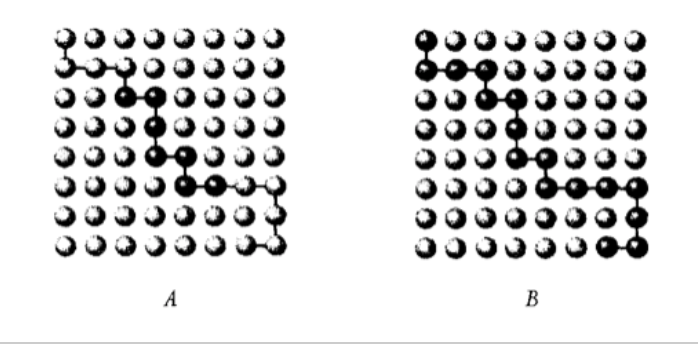

OK, that’s just a little story I made up. Now, let’s get serious and talk about neurons. This picture represents a bunch of neurons that have never recorded any experience at all. They are as unspoiled as the never-before-walked-upon meadow.

OK, that’s just a little story I made up. Now, let’s get serious and talk about neurons. This picture represents a bunch of neurons that have never recorded any experience at all. They are as unspoiled as the never-before-walked-upon meadow.

Then it—your neural system— sees a letter H. And these 64 neurons ready themselves to fire. Sixteen are actually activated and the neurological infrastructure of your experience of the letter H is encoded there—but only for an instant.

And it leaves only this. The very faintest path, which encodes the memory of once having seen an H. Look again. Make sure you can see the faint trace.

The next time you see an H only a few of the neurons notice—let’s say the first one to notice was the one in column 3 and row 3, below—and that one triggers the activity in the rest of the trail. So the pattern of activation goes from the diagram in A to the diagram in B.

This storage scheme, the brainchild of psychologist Donald Hebb, is a powerhouse. Hebb proposed the mechanism a few years after World War II. Only within the past fifteen years, however, did researchers explore its mathematical premises and build large-scale computer models of Hebbian learning. Both endeavors—the mathematical insights and their implementation in computer simulations—have illuminated quite a few of the mysteries about why people think and feel the way they do. [4]

Every presentation of an H works the same way so far as these neurons are concerned and since they are the source of what you see, what they think is what matters for what you think. A prankster holding up a sign with an H on it, along with the text, “THIS IS NOT AN H” works. A legal citation to Section H, in HR 2243, works. A sign created to tell a school child what the eighth letter of the alphabet is, works.

The point? Everything that activates that path of neurons makes it stronger and more stable and more likely to override other patterns of neurons which might, in any given instance, be more nearly correct. The twentieth time you receive a stimulus, for instance, it might actually be an A. By that time, it doesn’t matter. You are primed to see H’s and that’s what you will see.

Does anything sound political yet? The neurological trace—now nearly a rut—winds up looking like this.

Solid looking, isn’t it? It is as solid-looking as an established footpath through a meadow. These neurons are like those blades of grass. The grass doesn’t care whether the shoes were being worn by the firewood carriers or the assignation keepers or the peripatetic theorizers. Every step that abrades the grass, thereby creating the path, makes makes every other user more likely to use the same path. And that is why it might be a turnpike one day.

During the 2016 election, I heard references to bizarre allegations that Hillary Clinton was running a child sex ring from a Washington area pizza parlor. I did not know until I read Benedict Carey’s piece]that those allegations were called “Pizza-gate.”

Here’s how that works. Some Hillary-hater devises the Pizza-gate scandal and posts it on Facebook. A thousand other Hillary-haters drink it down and believe every word. Eventually, one of that thousand, who has a Democratic friend or maybe just an academic friend, passes the Pizza-gate piece to someone who is outraged by it. This Hillary-lover passes the fake news story on to her friends along with a scathing commentary. Half of the people who get it from the Hillary lover think it is a spoof and one of the best “social media outrages” of the day and pass it along in a lighthearted way to other people who also don’t take social media seriously.

So here’s the thing. Every one of those people is walking along the same path. The dots go Hillary—Pizzagate—Sex scandal. And those neurons wake up the rest of the neurons in the chain. Connecting those neurons out of malice strengthens the connection. Connecting them as a fun media outrage strengthens them. Fulminating against them and demonstrating that they are false and malicious—STRENGTHENS THEM.

What to do? I really don’t know. I am distraught.

Refuting Falsehood

I’ve always been a fan of refutation. Refutation seems the best choice for falsehood. This has been said to be true, but it has been decisively refuted. We now know that it is not true.

My friend David Rawson and I once taught an interdisciplinary introduction to the social sciences. We arranged a model experiment for them. For our purposes, it was about where “men in general” carried their pocket handkerchiefs. To help engage the students, we agreed on a sampling rule for “men in general,” on on how the sample would be drawn and how big it had to be, and what level the findings had to be before either of us would be declared the winner.

So we ran the experiment exactly as we had planned it and one of us was declared the winner (I was) and the other hypothesis, which sounded entirely reasonable in the abstract, was declared to have been refuted. That’s what I like and what I am used to.

But Pizza-gate can’t be “refuted” if every attempt to spread it and every attempt to refute it work to strengthen the neurological connection. In fact, “refute” doesn’t really mean anything under those circumstances.

Shaming the Local Gossips

Back in the old days, the spread of information was slow enough and personal enough that lies could be nailed. “Oh, you got that from Harold? Then just ignore it. Harold makes up the truths he thinks will sell best.” Only the word “that” in that formulation refers at all to what Harold said. That story is now cast away and future stories made more doubtful because they came from Harold. Harold pays a price in this story for being the origin of or the purveyor of inaccuracies. If the price is high enough and he has to pay it often enough, he will stop if he is able.

Not any more

So back then, being the source of stories that turned out not to be true could really cost you something. Even passing along stories from notoriously unreliable sources could cost you something—but not as much. Now, by contrast, it costs the source of a defamatory and completely untrue story nothing at all. Whoever invented Pizza-gate, the story that Hillary was running a child sex ring from a Washington area pizza parlor, probably had a wonderful timing inventing it and posting it. It cost him nothing to do it.

If we were able to track down the person who did it, it would still cost nothing and if here were prosecuted, he would achieve hero status in the political tribe he belongs to. Needless to say, it cost the people who passed it along nothing. They could have stopped and checked to see if it were true—and in the small town of my example, someone might have—but stopping to check if something is true really does cost something. And no one expects a user of social media to stop and check whether a story is true before forwarding it to friends. Especially if you really hope it is true.

Wouldn’t it be just wonderful, this person might say, if Hillary were running a sex scam out of a pizza joint in Washington? I’m going to pass the story along to you so you can share with me the sheer joy of baseless malevolence. It costs me something to check on the factuality—and I don’t really care—and it costs me nothing to be found to be passing long false and malicious rumors.

The accusation of “only”

And that is what the “only” means in “I was only kidding.” I thought this was funny and I am passing it along to you because you will think it is funny too—and no consequences we care about will happen as a result of this “joke.”

And that might be true. Trust in the social institutions and political leaders that make a republic possible will be reduced. A reputation will be freighted with charges that do not pertain to her at all and that no one actually believes to be true. The insularity of the social network that passes these horrific stories around for the fun of it will be increased.

And yet, the accusation of the “only” in “only joking” might really be apt. Those really might be consequences you don’t care about.

[1] Short for Peregrine, it turns out. The traveler. So, technically speaking, these trips were peregrinations.
[2] Short for Parveneh. A Persian name, I was told by a friend who has that same name.
[3] This kind of activation and storage has been called Hebbian Learning, after Donald Hebb, in the 1940s. The instruments needed to verify it did not come along for decades but when the studies were done, they confirmed Hebbs’ theories.
[4] The diagrams and nearly all the analysis have been taken from a marvelous book called A General Theory of Love, by Thomas Lewis, Fari Amini, and Richard Lannon.


Posted in Uncategorized | Leave a comment

We are running out of umpires

I first ran into what Rush Limbaugh calls “trans-partisan authorities” in the form of “trans-racial authorities.” In was in the late 1960s and a very angry black man was telling me how things really were. He said that segregation was perfectly legal. I said it was not and cited a decision by the U. S. Supreme Court. Who says?” he asked. “The Supreme Court,” I answered. “Your Supreme Court,” he replied.

Hm.. MY Supreme Court. I had never heard that before and had no idea at all how to respond to it.

Recently, David Roberts wrote a piece in Vox called “Donald Trump and the Rise of Tribal Epistemology.” [1] He says this:

In Limbaugh’s view, the core institutions and norms of American democracy have been irredeemably corrupted by an alien enemy. Their claims to transpartisan authority — authority that applies equally to all political factions and parties — are fraudulent. There are no transpartisan authorities; there is only zero-sum competition between tribes, the left and right. Two universes.

It doesn’t take much imagination to transpose the conversation I had with the alienated black man in the 1960s into charges that go like this. “How do you know.” he says. “I read it in the New York Times or the Houston Chronicle or the St. Louis Post Dispatch,” I say. “Hah!” he says, “YOUR press.”

umpire 2

It doesn’t take much imagination, either, to see what a delightful state of affairs this is for Rush Limbaugh. Limbaugh is the one of the major instigators of one of the cheering sections. He knows when an infraction has occurred on the field of play because he knows then something has happened that is an unfortunate for his team. When the good guys have the ball and the wide receiver and the safety are running stride for stride downfield and there is contact, it is obviously defensive pass interference. When the bad guys have the ball and the exact same event occurs, it is offensive pass interference.

And there are no umpires to establish what actually happened. Perfect!

That is where Limbaugh’s vision—there are no “trans-partisan” authorities—leaves us. Limbaugh will argue, certainly, that on “the other side,” there is someone doing exactly the same things he is doing, but on behalf of “the bad guys.” So it’s him, Limbaugh, against the other guy and all the decisions are zero-sum decisions; there is a winner and a loser every time. There are no “good calls,” calls that penalize a player for a foul that was actually committed; just favorable or unfavorable calls.

And what is an umpire? [2] Here, as if often the case, etymology paints a picture for us. In the middle of the 15th Century, the Old French “an oumpere”—not an equal—was divided as “a noumpere.” [3] This third person is not a peer of the other two; he is the peer of the other referees and judges. And because he is not a peer—not “on par;” not an equal—of the players, he can make unbiased and accurate judgments.

Limbaugh says that there is no such unbiased entity. Everybody is shilling for his teamumpire and there are only two teams the left and the right. The people who have been calling themselves umpires, are actually members of the left—they have been “irredeemably corrupted by an alien enemy.”
This view is, as I say, a great boon for people like Limbaugh. If nothing is really true, then my version is as good as yours and there is only the battle between one agitator and another.

Steve Bannon’s Version

Steve Bannon, whom David Roberts calls Trump’s consigliere [3] says that the mainstream press is “the opposition party.” This uses the same notion that Limbaugh uses, but in a considerably more virulent form.

If the mainstream press is “a party,” it is by definition, “partisan.” [4] That means that whatever the mainstream press says is not only partisan—watch the logic here—but “merely partisan.” That means that it has no other claim to our attention. The bulletins issued by the Democratic National Committee (or, in the Trump Era, also by the Republican National Committee) and news articles in the New York Times have the same persuasive value in Bannon’s scheme. What the mainstream parties say (Republican and Democratic) and what the mainstream press says (Seattle Times, Cincinnati Inquirer, Wall Street Journal) are equivalent. They are propaganda efforts by—remember Limbaugh’s phrase—“an alien enemy.”

What that means in practical terms is that no one can be trusted to tell you what the Trump administration is really doing. Time one: Trump embezzles money. Time two: The Times reports that Trump has embezzled money. Time three: Trump lashes out against a political attack by “the other party,” meaning, in this instance, the press.  Now we have a new story and, guess what, it isn’t about embezzlement.

This is much worse that the old default accusation that a charge was politically motivated. As I write this, lots of very ugly things are being said about Judge Roy Moore of Alabama. Moore says, in the November 12 New York Times, that the charges are politically motivated. He doesn’t say they aren’t true; he just shifts the public’s attention to the motives of the people who are reporting the stories. My own reaction to politicians who do that is that they have not only admitted the truth of the accusation, but have also revealed that they think we are stupid.

Bannon’s scenario is much worse. In Bannon’s world, we know that the reports—whatever their ultimate source—are false because they are reported by the press. So a umpire 3woman could have been raped and her account of what happened to her could be true—UNTIL IT WAS REPORTED IN THE PRESS. Then it isn’t true anymore. When it is reported, it is an act of political aggression and the truth claim is buried in politics.

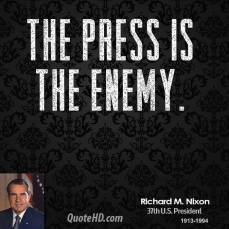
We now have a principal actor (the Trump administration) which is completely unaccountable. How completely delightful!  By the way, if all this sounds familiar, you may be remembering Watergate, but the present situation is what Nixon could only have dreamed of; he never got anywhere near it himself.

I think everything I have said about this situation is correct as far as it goes. It’s truly objectionable. It is self-serving in the extreme. On the other hand, I don’t think it’s as dire as I have made it sound. Despite Bannon’s formulations, a solid majority of the electorate—the whole electorate minus the 30% or so who are inalienable Trump fans—still believes in the truth of well-substantiated accounts published in the mainstream press. [6]

The logic of public action that supports the existence and reliability of “an umpire” is, of course, under attack and those of us who value it will need to defend it. I don’t think that is a bad thing. It is just the work we will need to do if we want candidates to compete for our votes, i.e., if we want to live in a republic.

[1] It’s a little hard to get to, but here is the step-by-step version. Go to https://www.vox.com/authors/david-roberts. That will give you a list of his recent articles. On the second page of that list, you will find an article classed “America is facing an epistemological crisis.” If you click on that article, you will find a hyper text link to “tribal epistemology.” If you click on that, you will be at the site of the article I am responding to.
[2]The umpire (U) stands behind the defensive line and linebackers… observing the blocks by the offensive line and defenders trying to ward off those blocks, looking for holding or illegal blocks. Prior to the snap, he counts all offensive players.  During passing plays, he moves forward towards the line of scrimmage as the play develops to  penalize any offensive linemen who move illegally downfield before the pass is thrown or [to] penalize the quarterback for throwing the ball when beyond the original line of scrimmage. He also assists in ruling incomplete passes when the ball is thrown short.
[3] This is a common way to get new words. I once had “a napple” but it became “an apple.” My napron became “an apron.”
[4] A consigliere is an advisor, by dictionary says, “especially to a crime boss.”
[5] In contemporary usage, the word “partisan” has taken on a host of negative connotations. That is unfortunate, in my view, because it eliminates an otherwise very usable adjective form of the noun, “party.”
[6] It is true that these allegations may have reached them through social media, but even so, there is a public account that can be referred to.

Posted in Politics | Tagged , , , , , | Leave a comment