Back to Burgundy

I know scarcely any French at all and most of what I do know, I learned from movies or jokes. [1] I was curious, of course, when I saw a movie about French siblings coming to grips with their lapsed relationships so they could deal with the vineyard their father had left them in his will. The English title is “Return to Burgundy.” Yeah, OK. Except that Jean is the only one who isn’t already living in Burgundy. The French title is Ce qui nous lie.

So what does that mean and how would a non-French speaker find out? Here are some possibilities, thanks to an online translation service.

  • ce qui nous lie means “we should seek common ground.”
  • ce qui nous lie means “how we are linked.”
  • ce qui nous lie means “what binds us together.”
  • ce qui nous lie means “what brings us together.”
  • ce qui nous lie means “what ties us all together.”

I like all those better than Back to Burgundy. Here’s a mini-overview from Rotten Tomatoes:

As four seasons and two harvests go by, Jean, Juliette, and Jérémie have to learn to reinvent their relationship and trust in each other as they work to preserve the land that ties them together.

In that clip, you see why “common ground” needs to be at least hinted at. Their father has left the domain to them collectively, to the daughter and the two sons. The domain is, in fact and in law, their “common ground.” But it is also “what brings us together” because the three were not together in any sense, even the physical sense, before their father died. And the domain is also “what binds us together.” That is the project they have in the story the film tells and it is the achievement they have made by the end.

Nice title, huh? Back to Burgundy Huhn-uh.

BACK TO BURGUNDY - Courtesy of Music Box FilmsJean, the oldest (center), has been out of touch with the family for ten years. Letters and phone calls have not worked. Juliet and Jeremie have been living in the same area, but have had no meaningful contact with each other. They are like a circuit that cannot be completed without Jean and Jean is in Australia, growing his own grapes.

There are three subplots as I see it and they are deeply and essentially interrelated. The first is being free enough of the past to show up at the table as a whole self ready to do what is best for all. Jean lives in Australia. He has a son a vineyard, and a woman he loves. Sometimes. Neither party to that relationship is willing to commit to the other and without that, Jean is not free to come to the table as fully himself.

Juliette has stayed home and continued…kind of…to grow grapes and make wine on her father’s domain. She’s keeping the lights on but she’s not making decisions. She is…you know…a girl. She may be the most talented of the three—the flashbacks suggest that—but she is…you know…a girl, and she is unsure of her own judgments. She can’t come to the table unless she gets loose from that.

Jérémie, the youngest, is in the process of marrying into another winemaking family. He and his significant other have a son and life in the shadow of a bullying father and an sweet mother who treats the two as if they were minor children. Jérémie’s future is being planned out by his lady friend’s father, who thinks Jérémie is a talentless wimp. He needs to find some backbone if he is going to be a person at all and if he doesn’t get that done, he can’t show up at the table with his siblings.

If they are not all three at the table, the current doesn’t flow and the decision doesn’t get made.

The second subplot is all about the grapes. The movie uses the estate of actor Jean-Marc Burgundy 1Roulot as the setting and we see an entire season of grapes from nearly ready to pick in Year 1 to nearly ready to pick in Year 2.   The movie is set in the Côte de Beaune section (yellow on the map).  Director Cedric Klapisch spends a good deal of time on the mechanics of caring for the vines, possibly because he spent some time in the fields working the vines himself in preparation for the movie. We see the decision about when to pick (twice) and how much of the harvest to de-stem. [2] We see every step. And when the second round begins with the instructions to the harvesters, we hear some of the same lines used and it feels familiar.

Since we see the processes so intricately, there is room for other questions to be placed. Do we want to make the same kind of wine Dad made? Did he play it too safe?  Did he make a safe and comfortable wine? Do we, now that we can choose, want to make an edgier wine; something more daring? These don’t seem like abstract questions by the time we get around he hearing them, because we have seen close up the decisions that would have to be made to make an “edgier” wine.

Burgundy 4The third subplot is about the decision itself: what shall be done with the domain, given that all three must agree? The law does not require three whole people to make this decision, but the narrative does. Juliette is going to have to find a way to claim authority for her own vision for the domain. Jérémie is going to have to resist his girlfriend’s father and move out from under the parents’ constant surveillance. Jean is going to have to settle things with his girlfriend and commit himself to several choices, none of them easy.   Burgundy, with his siblings, or Australia with his girlfriend and their son. How can the finances be worked so that the domain stays in the family, but he still has enough to service his own mortgage in Australia.

When we see them come to the decision—the idea actually came from Jean’s girlfriend—we can only applaud it. It isn’t rocket science, so far as the financial part goes, but all five of the young people—the three siblings, plus the two girlfriends—have to do some growing up to make a simple, easy, effective, and fully collegial choice.

The film begins with the adult Jean walking along on the road toward the domain. We don’t know who he is, but he looks grim. It ends, with Jean walking that same road back to town, but now he is at peace and now we know him and it is impossible not to wish him well.

[1] For instance, I will never forget that the French word for “egg” is oeuf because one of the characters in The West Wing told this joke. Why do the French eat only one egg for breakfast? Answer: Because in France, one egg is an oeuf.” That’s supposed to sound like the English, “enough.” Things like that are the sources of my French. That and well-known and probably apocryphal political sayings like, L’Etat? C’est moi.
[2] I have no idea at all what that means, but it comes up in the conversation twice.


Posted in Movies, sociability, Uncategorized | Tagged , , , | Leave a comment

The Disadvantages of Hell

However you think of Hell, it is mostly not a good place to be. Whether it is a fiery final abode, as in some cases, or a shadowy realm of the once-living, as in others, or as in C. S. Lewis’s The Great Divorce, a huge gray city, entirely illusory, but connected to heaven by a daily bus ride, it is not a good place to be. It’s not a good place to imagine that one will go.

But…on the other hand, it might not be a good place to threaten people with, either. It hell 4might not be good for the threatener, for one thing, and, speaking on behalf of the English language, it is not a good practice for people who proclaim themselves purveyors of “good news.”

We don’t see the word “good” is our word evangelism because the e- doesn’t suggest it, but in Greek, the word is euaggelion (ευαγγελιον) and the eu- prefix, which is the prefix of many English words, is plain to see. [1] I want to consider today that the availability of “Hell” as a weapon in the arsenal used by “evangelists” distorts the message and also that it distorts the bringers of the message.  As, I think, in the picture below.  Remember that one?

hell 3To set the stage for thinking about this, I’d like to pass along a story or two. [2] In 1983, Arlie Russell Hochschild wrote a book called The Managed Heart. It was originally going to be a book about people who had to seem nice no matter how they were feeling and people who had to seem menacing no matter how they were feeling. Of that second emphasis, only one chapter actually made it into the book (Chapter 7 on the emotional systems of bill collectors) but the presupposition that puts “seeming” here and “feeling” there is the same for each one.

Many years ago, I had an acquaintance who considered it to be his job to stand on the street and hand out tracts. The message of the tracts was, not to put too fine a point on it, “Accept Jesus Christ as your Lord and Savior or spend eternity in the flames of Hell.” He would hold out the pamphlet to passersby and say, “Are you interested in a little fire insurance?” [3]

How else could it be?

Well, Jesus’ disciples met him within a context of Judaism where nearly all the pieces of their first association were taken for granted and they were attracted to some unusual spins on their common heritage. Matthew puts the contrast very bleakly in his series in the Sermon on the Mount, where he has Jesus saying, “You have heard it said…but I say unto you.” Disciples are not represented as saying to their fellow Israelites—with a few minor exceptions in John—“Hey, you’ve got to come and see this guy!”[4]

But when the church gained power, it was necessary to pair the invitation with a threat. Heaven? Or would you prefer Hell? The church in this way adopts the carrot and stick approach and it may have begun as a report of the options available to sinners, but it developed into outcomes the church, itself, could provide. That being the case, the more sinners lusted after heaven or feared hell, the more power the church has over them.

I think that is the dilemma my tract-distributing acquaintance was enacting many centuries later.

But I’ve been thinking. What if all Christians agreed that there was no such thing as Hell?hell 7 How would we present our faith? I think that Heaven and Hell are a pair in the same sense that the carrot and the stick are a pair. Would we say, “Accept Jesus Christ as your personal Lord and Savior” [5] and when they said, “What if we don’t?” would we say, “Oh….nothing. It’s just Heaven.”?

That awkwardness is what I am pointing to when I say that the carrot and the stick are a pair. [6] So does taking the stick away imply taking the carrot away? I don’t think so. It does imply taking that particular carrot away. We can’t go around preaching Eternal Bliss or “something else.”

But if that is the only carrot Christians have to offer, then the faith as a community of believers died a long time ago.

I’d like to finish up with the two questions I have had in my mind from the beginning. The first is about how the doctrine of Hell distorts our faith. I’ve been playing around the edges of that one. The second is how the doctrine of Hell distorts the proclaimer of the faith.

The Disadvantages of Hell, Part I

When we offer Hell and Heaven as inducements to conversion, we instrumentalize the question. We take for granted a person’s private calculation of his or her own self-interest and we try to argue that they will be “better off” if they make the choice for Heaven and worse off if they choose Hell. Does that sound like a religious choice to you?

Me either.

hell 2That sounds like the way you would buy a car or a pair of shoes. If it is true about faith that “from the outside looking in, you can’t understand it. And from the inside looking out, you can’t explain it” [7] then instrumental logic isn’t going to get you there. Anyone who thinks he is choosing Heaven because it will be advantageous to him is not making a religious decision at all. Preaching that adopting our faith and the obligations that go naturally with it will somehow “make things better” cheapens the faith. Taking Hell away, which, as I argue above, would mean taking Heaven away, would deal with that instrumentalization.

The Disadvantages of Hell, Part II

When we offer Hell and Heaven as inducements to conversion, we instrumentalize ourselves as well. We become the people who offer “rewards” and “punishments” based on our own certain knowledge. We may have our own doubts about “the product,” but we put those aside in representing the choice to outsiders. The demands of preaching a message like that one distort the preachers of the message.

  • They distort what we think because the things we think have to be brought into line with the sales pitch and we do, in fact, hold ideas that are incompatible with the pitch.
  • They distort how we feel because we know we are supposed to feel certain ways and the ways we feel have to be in synch with the emotional benefits we say we are offering.
  • They distort what we do because the complicated and natural outworking of our own development needs to be constrained by the demands being made by the marketing department.

I know that sounds harsh. On the other hand, I know what I’m talking about.

Remember the chapter in Hochschild’s book on flight attendants (mostly) and bill collectors (one chapter)? They suffer the effects of setting aside what they think and how they feel, so that they can do what their job demands of them. They pay the price. But for them, a particular employment is instrumental anyway. They are doing what they are doing because they get paid for doing it. That is a reason they can tell to themselves and others that actually, in our society, seems to make sense.

That isn’t true of people committed to a journey of faith. The distortions they suffer by offering the carrot and the stick to their friends and neighbors cannot be explained away as the onerous demands of a job that pays well. You just have to face what it does to you. Or, alternatively, you can just not do it.

No Heaven, no Hell, no message?

Really? Is that the best we’ve got? It might be worth giving up Heaven and Hell just to find out.

[1] The rest of that word looks like “angel,” which is what it is because angelos (ἄγγελος) means “messenger.
[2] I am constantly amazed at how often placing these stories in their proper context in an essay reveals to me for the first time how important they have been to me. It is hard to continue taking them for granted when you are writing about them.
[3] He seemed to me a man utterly lacking in empathy. He would leave by his plate in a restaurant not a monetary tip, but a tract about eternal life in Jesus Christ. I asked him once whether he didn’t think that the waitress wouldn’t have preferred cash and he said that the tip he had left was infinitely more valuable. Lacking, as I say, in empathy.
[4] Jesus unquestionably believed in a Hell of the fiery sort. To the best of my recollection, that was common in the Judaism of his day. I think they brought the raw materials for it back with them from the Exile in Babylon.
[5] There are religious cultures where that whole compound title is pronounced as if it were one long word and Tom Howard recalls, in his book Christ the Tiger, the occasion when he tried to shorten it a little and was reproved by an elderly Christian, “Give him his full title, son.”
[6] Doing without one of them would be like George Carlin’s “partial scores,” one of which was Stanford 21.
[7] I know the context of that phrasing is a college bonfire, but I think it captures the dilemma of faith perfectly.


Posted in A life of faith, Theology | Tagged , , , , , | Leave a comment

Starbucks and racism

Let me put that another way. How about “Starbucks OR racism?” I suppose offering those two versions of the question is going to offend some people. I hope so because their being offended is what I want to write about.

We live in a time when people are inclined to identify themselves in terms of what offends them and of precisely how offended they are. So people who are inclined to think that Starbucks has an obligation to provide free restrooms for urban residents will focus on how they violated that obligation by refusing to allow loiterers to use the restrooms.

starbucks 1People who are inclined to think that the two men who were asked to leave were asked because they were black and further, that Starbucks followup action, which involved calling the police, was also taken because the men were black. This view imagines that if the two men had been white, they would not have been asked to leave and also that the police would not have been called.

People who are inclined to think that the police treat white people differently than black people will focus on the behavior of the police once they arrived and will find that their behavior was either inappropriate in some general way or specifically that it was racially discriminatory.

People who think that these three elements of that knotty situation cannot be realistically separated are not going to find a happy home in any of those three congregations. I am a person like that and I am speaking from experience.

Policy bias

So…if you tell me which of those three conversations you would like to have—and simultaneously, of course, which two you would like to ignore—I will tell you a good deal about your orientation toward public policy.

If you want to talk about Starbucks’ right to charge for the services they provide and to deny those services to people who don’t pay for them, then you will be called a social conservative, whether you think of yourself that way or not. You have chosen one of the three pictures to be “the one we ought to be talking about” and you have chosen to emphasize the rights of the store to make the rules that are in force there. [1]

If you want to talk about the treatment the non-customers received and especially if youstarbucks 3 want to argue that their race was a part of that treatment, you will be called a social liberal, whether you think of yourself that way or not. You, too, have chosen to bring one of the three pictures to the fore, to argue that “this is the real issue.” [2] One of the aspects of this situation is clearly based on race, you will say, and that is the important one.

If you want to talk about the reaction of the police when they arrived at Starbucks—one of the black non-customers was led away in handcuffs—you will probably be called a social conservative, although your point might have more to do with race relations than with police behavior. You are probably going to be called a social liberal too, because the conservatives are going to want to argue that the behavior of the police, whatever it was, was fully appropriate and so on.

How am I doing? You tell me what “the real issue” is and I will place you in the appropriate congregation.

If you are like most of us, most of the people you know are members of your congregation [3] and they will assure you that the face of the issue you have chosen to emphasize is exactly the right one—it is “the real issue.” At that point, you can go to war with the anyone who is a member of one of the other two congregations, if you know any, or you can declare war anonymously against all of them online.

“Simple Meliorism”

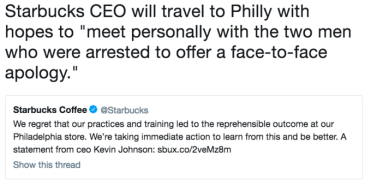
It isn’t hard to think of ways this could have been handled better. The customers could have bought a cup of coffee while they were waiting and could have used the restrooms that Starbucks maintains for customers. The staff could have dealt with the noncompliance with store rules in a way that was less likely to provoke a confrontation. That’s what Starbucks CEO Kevin Johnson (see the picture below) says they should have done. [4] The police could have handled the issue is a less confrontational way—handcuffs? for not buying a cup of coffee?—and they should have.

starbucks 2But all these responses are “make it better” responses. They are not responses that transfer each of these elements into the social war zone and declare each of them to be fundamental. The war zone has warriors like “property rights” and “black lives matter” and “police brutality.” They are all there on the field and they are all there to make war. In fact there is a disparaging name radicals use for what I am calling “make it better” responses; they call it “simple meliorism” and say that it only postpones the revolution.

Better than meliorism

A more fundamental response is envisioned by imagining a series of conversations within the groups. Black groups could get together and say, “Look. If you are there for the purpose of stirring up controversy, just go to the Starbucks and refuse to buy anything or to leave. It’s perfect. If you are trying to avoid controversy, do what everybody else does: buy something. [5] This is black leaders teaching the members of that congregation how to stay out of trouble if that is what they want to do and how to make trouble if that is what they want to do.

Simultaneously, the police get together and talk to their dispatchers and to the officers who are going to respond to the situation and train them in defusing situations of social conflict. Very few situations are “defused” by putting a nonviolent person in handcuffs. The police are always working on the border of keeping themselves safe, on the one hand, and managing the situation as pacifically as possible on the other.  Always their judgment is required.  Working with them to do it better is part of the responsibility of every police force.  So is prosecuting the ones who refuse to do it better.

And, of course, Starbucks can have its own little private talk with its employees and teach them to handle situations better than this one was handled. They are doing that. And they can also have their own really big public talk in which they apologize for their part in the event and promise to do better and apologize to the men who were arrested and to the American public in general. To the Russian public too, I assume, [6]

This is a real problem for Starbucks to deal with because, whatever their rights might bestarbucks 4 as owners of the commercial space, they have a carefully cultivated image to maintain. “The episode,” says New York Times writer Christine Hauser, “goes to the heart of how the company has modeled itself, with campaigns that address racial and social issues and promote its image as a community meeting place for customers to linger.” That’s the image Starbucks is trying to protect.

Starbucks has no more interest in the three congregations I described above than I do. I want to see the three strands that got knotted in this case, dealt with in their knotted form and when they are un-knotted, I want a “make things better” approach so long as that will work better than the alternatives. Starbucks wants to protect and if possible to enhance its image and that is why the CEO is going to Philadelphia to apologize in person to the two men who were abused by the poor decision made by one of the staff in one of their stores.

Starbucks is dealing with what they see as their real problem, which is how to appear to be the kind of place they advertise themselves to be. If that kind of conversation is also going on in the other congregations and among the ideologues of each group, a new day is about to dawn.

Don’t hold your breath.

[1] That is the way Jim Crow laws were defended as well. I know the issues are different, but the way of preferring one right over others is similar.
[2] Over many years of teaching political psychology, I have learned that the expression “this is the real issue” indicates the issue you want to talk about. It is not that other issues are somehow less real; it is that they are less preferred.
[3] This is a trait Natalie Angier referred to in her recent science article as “homophily,” the attraction to people who are like yourself.
[4] The company instructs employees to call the police in certain situations, such as those involving “threats or disturbance,” Mr. Johnson said. “In this case, none of that occurred,” he said. “It was completely inappropriate to engage the police.” This is a clip from Christine Hauser’s account in the New York Times of April 16.
[5] That’s what I do. I figure I am using the facilities and I owe them something.
[6] In 2015, Starbucks celebrated the opening of their hundredth store in Russia. Starbucks could have called the event “Grounds for Celebration,” but I’m pretty sure they didn’t.

Posted in Political Psychology, Sustainability | Tagged , , , , , | Leave a comment

“I love her shoes”

I owe the sentiment to Josh Lyman (Bradley Whitford) of The West Wing who is talking about a potential nominee for the Supreme Court, Evelyn Baker Lang (Glenn Close). [1] He means that he likes everything about her as a potential Chief Justice and besides that, he admires her as a person and feels a strong personal attachment to her. It has nothing to do with the shoes, really, but such a concrete referent and such an unexpected one carries the meaning “even her shoes,” which is what Josh actually means. “I love everything about her.”

I want to borrow Josh’s expression because I am having similar feelings for Elizabeth Bennett, of Pride and Prejudice.

At this point, you (readers) are going to group yourselves into three categories. In Group A are people who don’t know the story that well but are interested in the challenge Elizabeth overcomes. For you, I have appended the whole of Chapter XIII at the end. In Group B are people who are fully familiar with Pride and Prejudice and will simply refer in their own minds to the steps I describe. In Group C are people for whom this this whole exercise is preposterous and who have better things to do. Those are all honorable positions, it seems to me.

For the benefit of Groups A and B, I am going to take the long, slow, difficult process by which the marvelous Miss Bennett catches herself at her worst and who, through painstaking effort and despite mounting embarrassment, finds a way through. I am going to follow her process step by step.

For any of you who are fans of Jonathan Haidt’s master metaphor—the rider and the lizzie 5elephant—will notice that this is an instance to the contrary. [2] In Haidt’s metaphor, the role of the elephant—our mostly unknown desires and prejudices—is to go wherever it wants to go and the role of the rider—which we refer to by words like “my true self”—is to provide a reason why the elephant did whatever it just did. And very often, that is just how it happens.

But in this account, it doesn’t happen. In this account, the rider gives the elephant a sharp rap on the knuckles and moves the elephant back into the path the rider has chosen.

Here are the principal steps of Elizabeth Bennett’s  odyssey.

Step 1: Flustered

We know that Elizabeth is an accomplished and discerning reader.  This is not an instance of her best work.

With a strong prejudice against every thing he might say, she began his account of what had happened at Netherfield. She read, with an eagerness which hardly left her power of comprehension, and from impatience of knowing what the next sentence might bring, was incapable of attending to the sense of the one before her eyes.

The begins with a strong prejudice against anything Mr. Darcy might say. That’s not a good thing in someone who can say, “I, who prided myself on her discernment.”

She is also not reading carefully as she begins. Note that she is “incapable of attending” Lizzie 1to the sentence she is reading because of her impatience to know what the next sentence will say.  This is Jennifer Ehle as Elizabeth.  Of the many Elizabeths the movies have offered us, Ehle is my favorite.

This does not leave her in a good place.

“…her feelings were yet more acutely painful and more difficult of definition. Astonishment, apprehension, and even horror, oppressed her.

In the light of those feelings, it seems to me remarkable that she goes right back to reading the letter again, but she does.

Step 2: Commanding

In this perturbed state of mind, with thoughts that could rest on nothing, she walked on; but it would not do; in half a minute the letter was unfolded again, and collecting herself as well as she could, she again began the mortifying perusal of all that related to Wickham, and commanded herself so far as to examine the meaning of every sentence.

She tries walking as an alternative to reading and I appreciate that because that is what I would do, myself. But as you see, it doesn’t work and she takes the extraordinary step of “commanding herself…to examine the meaning of every sentence.”

lizzie 2There is a stretch of the story as it is told by Wickham and by Darcy that is the same if both accounts. But then there is a substantial divergence and Elizabeth is forced to admit that if one of the accounts is right, the other is wrong. She years for the right account to be Wickham’s because she took to Wickham instantly and for the wrong account to be Darcy’s because she rejected him from the first.  This is Colin Firth’s Mr. Darcy.  It is not his best work–he has since received an Academy Award–but he does play opposite Jennifer Ehle.

But as badly as she wanted Darcy to be in the wrong, his detailed account of Wickham’s misdeeds causes Elizabeth to hesitate. Remember that at the beginning, she was rushing heedlessly through the document; then she read with a decided bias in favor of Wickham because she liked Wickham and disliked Darcy. But in spite of all that, she laid Darcy’s and Wickham’s accounts side by side to to the extent she was able. [3]

This closer reading enables her to see the narrative differently. She doesn’t adopt the new reading, but she sees for the first time that all the facts she has could be accounted for just as well in Darcy’s account as in Wickham’s.

Step 3: Crisis

But then there is one small piece which she can confirm independently on the basis of a conversation she has had with Colonel Fitzwilliam. And then Darcy’s invitation to appeal to Fitzwilliam for the confirmation of the story as a whole. This is hard for Elizabeth both because she trusts Fitzwilliam and also because she knows Darcy would not appeal to him unless he knew that his account would be confirmed.

And now that she is able to put some of Wickham’s assertions in doubt, she moves on to reconsider the whole setting where Wickham first introduced himself and his story.  He is one handsome dude, you will have to admit.

She was now [italics in the original] struck with the impropriety of such communications to a stranger, and wondered it had escaped her before. She saw the indelicacy of putting himself forward as he had done, and the inconsistency of his professions with his conduct.

lizzie 3Note the three advances Elizabeth makes at this point. Upon reconsideration—that’s what now, in italics, is for—she sees the impropriety of Wickham’s forwardness when, at the time, she was swept away by how very unlike Darcy Wickham was. And from her new vantage point, she can see clearly that Wickham talks the talk, but he does not walk the walk. And finally, she wonders how these blatant discrepancies had escaped her before. Those are three very solid achievements.

Step 4:  Blaming herself

And finally, reaching the end of this arc of repentance [4] she draws some hard-won conclusions about herself.

Of neither Darcy nor Wickham could she think, without feeling that she had been blind, partial, prejudiced, absurd.

And then, being Elizabeth, she extends her criticism of herself into a virtual flagellation.

“How despicably have I acted!” she cried.—“I, who have prided myself on my discernment!—I, who have valued myself on my abilities! who have often disdained the generous candour of my sister, and gratified my vanity, in useless or blameable distrust.—How humiliating is this discover)-!—Yet, how just a humiliation!

And concludes, “Till this moment, I never knew myself.”

So…I haven’t fallen in love with Elizabeth—even her shoes, as Josh Lyman says— because she eventually realizes that she was mistaken about Darcy and Wickham. I have fallen for a woman who has the courage to follow this trajectory—fighting her own preferences all the way—and arrive at the conclusion that she has been culpably wrong from the very beginning until this moment.

The hardest part, I think, was the first moment when she discovered a discrepancy between Wickham’s account and Darcy’s. The most common reaction in that situation is just to deny the discrepancy and move on. But this dilemma hits Elizabeth where she is strongest; this is the most valued part of her that is at risk:—“I, who have prided myself on my discernment!” she exclaims.

And at that crucial point, she relies on herself again and her great abilities in this regard prove to her that she has erred grievously. And that is a good thing because when Darcy once more proposes marriage, she is able to accept with integrity.

[1] The whole line is, “I love her. I love her mind. I love her shoes.”
[2] See Jonathan Haidt, The Righteous Mind, which is a superb book despite Elizabeth’s knocking his argument into a cocked hat in this particular instance.
[3] Austen characterizes that particular moment in a way that is both incisive and humorous. Elizabeth “weighed every circumstance with what she meant to be impartiality.”

[4]  I wouldn’t have to call it “repentance,” surely.  It is such a religious word.  But I want to help redeem the word if I can.  The Greek is metanoia, which, in its most literal rendering means, “to change your mind.”  The -noia root is found in English words like noetic.

Appendix:  Chapter XIII of Pride and Prejudice

If Elizabeth, when Mr. Darcy gave her the letter, did not expect it to contain a renewal of his offers, she had formed no expectation at all of its contents. But such as they were, it may well be supposed how eagerly she went through them, and what a contrariety of emotion they excited. Her feelings as she read were scarcely to be defined. With amazement did she first understand that he believed any apology to be in his power; and stedfastly was she persuaded that he could have no explanation to give, which a just sense of shame would not conceal. With a strong prejudice against every thing he might say, she began his account of what had happened at Netherfield. She read, with an eagerness which hardly left her power of comprehension, and from impatience of knowing what the next sentence might bring, was incapable of attending to the sense of the one before her eyes. His belief of her sister’s insensibility, she instantly resolved to be false, and his account of the real, the worst objections to the match, made her too angry to have any wish of doing him justice. He expressed no regret for what he had done which satisfied her; his style was not penitent, but haughty. It was all pride and insolence.

But when this subject was succeeded by his account of Mr. Wickham, when she read with somewhat clearer attention, a relation of events, which, if true, must overthrow every cherished opinion of his worth, and which bore so alarming an affinity to his own history of himself, her feelings were yet more acutely painful and more difficult of definition. Astonishment, apprehension, and even horror, oppressed her. She wished to discredit it entirely, repeatedly exclaiming, “This must be false! This cannot be! This must be the grossest falsehood!”— and when she had gone through the whole letter, though scarcely knowing any thing of the last page or two, put it hastily away, protesting that she would not regard it, that she would never look in it again.

In this perturbed state of mind, with thoughts that could rest on nothing, she walked on; but it would not do; in half a minute the letter was unfolded again, and collecting herself as well as she could, she again began the mortifying perusal of all that related to Wickham, and commanded herself so far as to examine the meaning of every sentence. The account of his connection with the Pcmberley family, was exactly what he had related himself; and the kindness of the late Mr. Darcy, though she had not before known its extent, agreed equally well with his own words. So far each recital confirmed the other: but when she came to the will, the difference was great. What Wickham had said of the living was fresh in her memory, and as she recalled his very words, it was impossible not to feel that there was gross duplicity on one side or the other; and, for a few moments, she flattered herself that her wishes did not err. But when she read, and re-read with the closest attention, the particulars immediately following of Wickham’s resigning all pretensions to the living, of his receiving in lieu, so considerable a sum as three thousand pounds, again was she forced to hesitate. She put down the letter, weighed every circumstance with what she meant to be impartiality—deliberated on the probability of each statement— but with little success. On both sides it was only assertion. Again she read on. But every line proved more clearly that the affair, which she had believed it impossible that any contrivance could so represent, as to render Mr. Darcy’s conduct in it less than infamous, was capable of a turn which must make him entirely blameless throughout the whole.

The extravagance and general profligacy which he scrupled not to lay to Mr. Wickham’s charge, exceedingly shocked her; the more so, as she could bring no proof of its injustice. She had never heard of him before his entrance into the-shire Militia, in which he had engaged at the persuasion of the young man, who. on meeting him accidentally in town, had there renewed a slight acquaintance. Of his former wav of life, nothing had been known in Hertfordshire but what he told himself. As to his real character, had information been in her power, she had never felt a wish of enquiring. His countenance, voice, and manner, had established him at once in the possession of every virtue. She tried to recollect some instance of goodness, some distinguished trait of integrity or benevolence, that might rescue him from the attacks of Mr. Darcy; or at least, by the predominance of virtue, atone for those casual errors, under which she would endeavour to class, whatMr. Darcy had described as the idleness and vice of many years continuance. But no such recollection befriended her. She could see him instantly before her, in every charm of air and address; but she could remember no more substantial good than the general approbation of the neighbourhood, and the regard which his social powers had gained him in the mess. After pausing on this point a considerable while, she once more continued to read. But, alas! the story which followed of his designs on Miss Darcy, received some confirmation from what had passed between Colonel Fitzwilliam and herself only the morning before; and at last she was referred for the truth of even – particular to Colonel Fitzwilliam himself—from whom she had previously received the information of his near concern in all his cousin’s affairs, and whose character she had no reason to question. At one time she had almost resolved on applying to him, but the idea was checked by the awkwardness of the application, and at length wholly banished by the conviction that Mr. Darcy would never have hazarded such a proposal, if he had not been well assured of his cousin’s corroboration.

She perfectly remembered every thing that had passed in conversation between Wickham and herself, in their first evening at Mr. Philips’s. Many of his expressions were still fresh in her memory’. She was now struck with the impropriety of such communications to a stranger, and wondered it had escaped her before. She saw the indelicacy of putting himself forward as he had done, and the inconsistency of his professions with his conduct. She remembered that he had boasted of having no fear of seeing Mr. Darcy—that Mr. Darcy might leave the country, but that he should stand his ground; yet he had avoided the Netherfield ball the very next week. She remembered also, that till the Netherfield family had quitted the country, he had told his story to no one but herself; but that after their removal, it had been everywhere discussed; that he had then no reserves, no scruples in sinking Mr. Darcy’s character, though he had assured her that respect for the father, would always prevent his exposing the son.

How differently did every thing now appear in which he was concerned! His attentions to Miss King were now the consequence of views solely and hatefully mercenary; and the mediocrity of her fortune proved no longer the moderation of his wishes, but his eagerness to grasp at any thing. His behaviour to herself could now have had no tolerable motive; he had either been deceived with regard to her fortune, or had been gratifying his vanity by encouraging the preference which she believed she had most incautiously shewn. Every lingering struggle in his favour grew fainter and fainter; and in farther justification of Mr. Darcy, she could not but allow that Mr. Binglev, when questioned by Jane, had long ago asserted his blamelessness in the affair; that proud and repulsive as were his manners, she had never, in the whole course of their acquaintance, an acquaintance which latterly brought them much together, and given her a sort of intimacy with his wavs, seen any thing that betrayed him to be unprincipled or unjust—any thing that spoke him of irreligious or immoral habits. That among his own connections he was esteemed and valued—that even Wickham had allowed him merit as a brother, and that she had often heard him speak so affectionately of his sister as to prove him capable of some amiable feeling. That had his actions been what Wickham represented them, so gross a violation of every thing right could hardly have been concealed from the world; and that friendship between a person capable of it, and such an amiable man as Mr. Bingley, was incomprehensible.

She grew absolutely ashamed of herself.—Of neither Darcy nor Wickham could she think, without feeling that she had been blind, partial, prejudiced, absurd.

“How despicably have I acted!” she cried.—“I, who have prided myself on my discernment!—I, who have valued myself on my abilities! who have often disdained the generous candour of my sister, and gratified my vanity, in useless or blameable distrust.—How humiliating is this discover)-!—Yet, how just a humiliation!—Had I been in love, I could not have been more wretchedly blind. But vanity, not love, has been my folly.—Pleased with the preference of one, and offended by the neglect of the other, on the very beginning of our acquaintance, I have courted prepossession and ignorance, and driven reason away, where either were concerned. Till this moment, I never knew myself.”


Posted in Books, ways of knowing | Tagged , , , , | Leave a comment

Language and Rhetoric

It is hard to think clearly about a passage when the first thing you learn about it is that it is crucially important. That’s been my experience, at any rate. When you learn, later on, that a good deal of its importance is that it is hotly contested and that “we”—our people—look at it like this and “they”—you know, those other guys, look at it like that, you know  just why it is so important.

By this point, you have learned nothing at all about the meaning of the passage, but you have learned other things. You have learned that one interpretation of the passage is a marker of membership in your community and you have learned that what is at stake in the interpretation of this passage is crucially important. Doing it wrong would be something like using the name of your ex-wife in the middle of the wedding ceremony where you are making promises to the woman who is going to be your new wife. Maybe. If she can recover from your getting that one little thing wrong.

Needless to say, neither of these gut-wrenching considerations is a friend of understanding what the passage says. I have three examples I would like to cite by way of illustrating this thesis. Each of them has a language component and another component—I think I will call it “rhetorical,” but I am not sure that is really the right word.

Creation

Here is the version I grew up on and if you grew up in the church, so did you. This is the King James Version.

In the beginning God created the heaven and the earth. And the earth was without form, and void; and darkness was upon the face of the deep.

Here it is in in The Jewish Bible [1]

When God began to create heaven and earth—the earth being unformed and void with darkness over the face of the deep and a wind from God sweeping over the water—God said, “Let there be light;” and there was light.

The language differences are obvious. What is treated as the act of God in the KJV is treated as the initial condition in the JB. Creation is an act in the KJV and a process in the JB—“God created” as opposed to “When God began to create…” And God doesn’t “create” anything in the JB. God “organizes” it, starting in verse 6 where “the expanse” separates water from water. God does “create” in the KJV and in the form in which it has become a controversy, God created “ex nihilo,” that is, from nothing.

rhetoric 1If the language differences are obvious, the rhetorical differences are not. At least not to me. There is an opposition in the KJV between nothingness and somethingness. In the JB, the tension is between disorganization and organization. If you imagine the authors of these two translations as having opponents who needed to be refuted, the opponents of the KJV translators would be saying that there was something before God created anything. The opponents of the JB would be saying that there was organization before God created an order.

So my goal in dealing with this passage is to unhook myself from the atmosphere of crisis in which I first learned what this passage means, and then to see what meaning is offered by the language; and then finally to see why the language that is there was chosen. It is those steps—steps two and three—that I have been calling “language” and “rhetoric.”

The Declaration of Independence

The Declaration of Independence was a radical act, of course, but it wasn’t an interpretive puzzle. That didn’t happen until the Gettysburg Address. Jefferson is crystal clear about what he intends.

When in the Course of human events, it becomes necessary for one people to dissolve the political bands which have connected them with another, and to assume among the powers of the earth, the separate and equal station to which the Laws of Nature and of Nature’s God entitle them, a decent respect to the opinions of mankind requires that they should declare the causes which impel them to the separation.

Notice “one people” in the first line and “the powers of the earth” in the fourth. Jefferson aspires to a “separate and equal station” for this people, the people being the North American Colonists.

There is no question about what he is trying to do. So when he continues in the next line,language 2 “We hold these truths to be self-evident, that all men are created equal…” it is obvious that “all men” and “one people” refer to the same thing. He means that “all peoples are created equal.” That is the sentiment his argument requires and is, in the context, the only plausible meaning.

Fast-forward now four score and seven years and we get a new speaker, Abraham Lincoln, and a new controversy, slavery. The slaves are not “a people” as the North American Colonists were, at least they were in Jefferson’s aspiration. If slaves are to be free, it is going to have to be one by one and if Lincoln is going to rely on Jefferson, he is going to have to take “all men” and make it refer to persons, not to peoples. [2]

I remember the first time it occurred to me that there was no way Jefferson could have meant what Lincoln said he had meant. It would have been a massive and unnecessary detour in an argument that is, otherwise, quite straightforward. We are bound to the King by a social contract. He hasn’t kept his end up, (examples to follow, Jefferson says) so we are free of the contract and desire independence. One, two, three.

language 3And that same logic applies to Lincoln. There is no value at all for Lincoln in asserting the right of the North Americans to assume among “the powers of the earth” any status at all. The question Lincoln is addressing is not the equality of peoples but the equality of persons—some of them black and some of them white—so he borrows a phrase from Jefferson and twists it until it screams. The screams were covered by the sound of the cannons.

The Inspiration of Scripture

Here is the third zinger, the third of my illustrations about crisis and meaning.

This passage contains the famous words: “All/every Scripture [is] inspired by God and useful for teaching, for reproof, for correction, and for training in righteousness.”

This sentence comes from Raymond E. Brown’s Introduction to the New Testament (page 656). There are two interesting things suggested by the language. The first is that there is no way to specify the meaning of the Greek pasa as “all” or “every.” It could be either.  Both refer to the sacred scriptures of the Old Testament, one in a collective sense (all) and one in a distributive sense (every). The second language difference is that there is no “is” in the Greek text. So “all scripture is inspired by God” is a suspect translation. Another translation is “Every scripture that is inspired by God is also useful for…”refuting error, for guiding people’s lives and teaching them to be upright.” Those are the goals as they are given in the New Jerusalem Bible and they are an urgent reason for specifying the value of God-breathed scriptures.

Here again, the rhetorical intention guides our understanding of the language. Here is Brown’s assessment of it.

No matter how one translates the verse, the primary emphasis indicated by the context is less on the inspiration of all Scripture passages than on the utility of inspired Scripture for continuing what Timothy has learned from his childhood in order to teach and correct and thus to counteract evil impostors.

Paul—or some Paulinist unknown to us—is giving instructions to Timothy and is bearing language 4down on what the scriptures may be used for. These uses are absolutely central to Timothy’s duties as a pastor. Performing these tasks is as much a part of Paul’s argument as the equality of all peoples is a part of Jefferson’s.

The question of just why the scriptures are good for that—they are “God-breathed”—is interesting, but it is not on the to-do list of a harried pastor. “These are the tools I have,” the young pastor Timothy might be seen to be asking, “What are they good for, exactly?”

Much later controversies raised the questions about just what “inspired” means and in some very conservative arguments, it is said to mean “literally true.” God breathed these texts, the argument goes, so they must be true. And, the argument continues, at a much quieter level, “And furthermore, we must also be understanding them truly because they are, after all, God-breathed.”

In a similar passage in 2 Peter 1 (20-21) the metaphor is to “people who were carried along by the Holy Spirit” and who therefore “speak from God” and not from themselves only.

Conclusion

It’s hard, as I say, to pay attention to the meaning of a text or the direction of an argument when the first thing you learn about it is that it is vitally important and that there is only one clear meaning. There are some ways to do it, though. You can look carefully at the language that is used and you can locate the meaning of the language in the rhetorical goal of the author.

If there is a better way to understand the meaning of a text, I don’t know what it is.

[1] There is a lot of title here. I’ll give you what is says on the cover, starting at the top. It says “The Jewish Bible;” then “Tanakh: The Holy Scriptures;” then The new JPS Translation According to the Traditional Hebrew Text; and then, last, “Torah, Nevi’im, Kethuvim.” JPS is a reference to the Jewish Publication Society.
[2] That change didn’t go unnoticed, of course. According to Garry Wills, (Lincoln at Gettysburg: The Words that Remade America) editorial columns all over the country screamed that Lincoln had perverted one of our founding texts. But there was a war on and Lincoln was the President and, by this stage of the war, the slaves needed to be freed.

Posted in Biblical Studies, Politics, ways of knowing | Tagged , , , , | Leave a comment

“Wartime moral clarity and passion”

I had never heard of Nitsuh Abebe before he wrote this piece. In fact, I had failed to notice that the New York Times Magazine carried a feature every week called “First Words.” Since “First Words” is about language and politics—two of my favorite topics in the world—I am amazed that I have been passing it by.

nitsuh 1So with this piece, I am advertising to everyone who reads this blog that Nitsuh Abebe is a writer worth paying attention to and I am reminding myself never to miss another Sunday offering of “First Words.”

Since I started with the link to this column, I know you will read it for yourself if it catches your interest. In the remainder of this essay, I would like to pull out a few of the things that struck me particularly and comment on them.

Here is the one I think is most important.

It’s often argued that this makes our conversations increasingly polarized, dogmatic, intolerant of complexity and logically sloppy. It’s less often pointed out that this might be because they aren’t really “conversations” in the first place.

That brings us to the question, “If they aren’t conversations, what are they?”

This attitude feels like part of a culture-wide push toward a kind of wartime moral clarity and passion — a desire to cut through all the airy deliberation and sophistry and “for argument’s sake” considerations of a seminar conversation.

And how on earth did we come to such a pass. I think there are two elements involved. Abebe describes one of them as the radical expansion of the old chat rooms.

If you’d arrived on the internet in the ’90s, you’d have found many of its conversations playing out in places like Usenet groups, mailing lists and message boards — dork-friendly forums where debates had a habit of continuing, at tedious length, until they’d exhausted every possible rhetorical approach to the subject at hand, like a never-ending, dysfunctional undergraduate seminar with no professor and no purpose beyond, literally, the sake of argument.

And somehow, we got from this series of small dork-friendly forums to to “a gigantic city square teeming with protests and counter-protests.”

They turned all speech into public pronouncements, and thus all conversation into a strange form of activism, part of a zero-sum battle over which ideas will find a foothold in our collective attention. In the midst of an information war, to express any opinion, sincerely or not, is seen as giving it space and therefore material support.

And then Abebe nails it by imagining someone in the middle of a march of some sort and holding a sign that says, “What if One of Our Demands is Unwise?” I love that. I might just be that person. This sign is as good as that, but it has some of the same lightheartedness that would be scowled at in a setting of “wartime moral clarity and passion.”

So this change, which Abebe says is an issue of infrastructure, is one of the changes. Thenitsuh 4 other, which he does not deal with, is a little more complicated. I’ll pick two elements out of the mix. The first is the continued stagnation of buying power. Beginning around 1972, the economic prospects for nearly everyone in the middle of the income distribution stopped rising and started shrinking. This was followed in due time by the sense middle class Americans have, and that was duly recorded in the opinion surveys, that they expect that their children will face even worse economic times than they themselves have faced. The old idea that things are getting better, seems to have gone away.

The second is the realignment of the parties into internally consistent organizations. The Democratic party gave away the white South and became a moderate to liberal party; the Republican party took up the white South and became a moderate to conservative party. [1] That means that in predominantly red states, the incumbent will be drawn to the right by primary challengers and that in blue states the incumbent will be drawn to the left. The moderating influence of having to face each other in the general election is replaced by the radicalizing influence of facing extremists in the primaries.

So that’s how we got here. What does that mean for us? It means that “wartime moral clarity” has taken over in peacetime. We are no longer citizens debating the best way to solve our common problems. Now we man the barricades against “the mongrelization of America” or against “a rising tide of bigots and haters.”

And if we are all “manning the barricades,” what happens to the techniques we used to use to put an argument into a different perspective? These techniques are now, for all practical purposes, acts of war. Here are some I heard about first from Abebe and I will start with the two I had to look up: sea lioning and gaslighting.

“Sea-lioning” is a type of Internet trolling which consists of bad-faith requests for evidence… the purpose of which is not clarification or elucidation, but rather an attempt to derail a discussion or to wear down the patience of one’s opponent.

Under “wartime conditions,” you can image that any inconvenient request for evidence could be construed as a “bad-faith request.” So requests for evidence are, of themselves, instances of sabotage. We have the momentum of the cause to maintain, after all. [1]

“Gaslighting”—named for a 1938 play of the same name by British dramatist Patrick Hamilton—is:

“a form of manipulation that seeks to sow seeds of doubt in a targeted individual or in members of a targeted group, hoping to make them question their own memory, perception, and sanity.”

In the stage and movie versions, the goal is to make the patsy doubt his or her own memory and then the values that are associated with those memories. In internet debate, the goal would be only the undercut the argument by forcing people back to their own first principles, a level where our understanding of our commitments are apt to be weak and vulnerable.

nitsuh 6Abebe highlights two techniques in the column. The first is “playing the devil’s advocate,” which, in peacetime conditions, could be presenting contrary information the main line of the argument. [3] Under current conditions of wartime clarity and moral fervor, you might suspect “bad guys”—you know, racists and sexists and ageists—of presenting their own views under the cover of “playing the devil’s advocate.”

The other one he features he calls “hand-wringing.”

A little more than a decade ago, around the same time online sentiment began to turn against the devil’s advocate, it also seized on a close cousin: the “concern troll.” If the devil’s advocate playacts disagreement with you for the sake of strengthening your argument, the concern troll is his mirror image, a person who pretends to agree with you in order to undermine you. The concern troll airs disingenuous worries, sows doubt, saps energy, has reservations, worries that things are going too far.

That’s my kind of problem. Propositions are made so broad and proclaimed with such vigor that I see that they will become both false and pernicious in no time at all. When I say that, I am accused of all kinds of things from mixed-species parentage to evil intent.

It’s hard to imagine what would improve this deplorable state of affairs. If we could go back to the mild-mannered chat rooms of yore, that would help and I am sure many have. But that solution is a good deal narrower than the problem Abebe suggests.

If some bone fide member of a group could stand up at the point when the general discussion is just about to descend into “wartime clarity,” and re-set the discussion so that discursive arguments are protected but sea-lioning is not, that would be a great help. But who would do that? [4]

Things do go that way sometimes. The Georgian period in England did, in fact, turn into the Victorian period. Behavior does, sometimes, go from lax and riotous to strait-laced and decorous. I would really like to think that those are not our only two choices.

[1] The Tea Party revolt against moderate Republicanism was not part of the original deal but the opportunity for it to develop presupposed parties with internally consistent ideologies.
[2] I remember vividly the challenge a self-proclaimed atheist put to a church I attended in Eugene, Oregon in the 1970s. It was the practice of the pastor, Gordon Crider, to give a short sermon and then sit down in a chair at the front of the sanctuary and invite any present to enter into dialogue with what he has said. This atheist demanded to be recognized first every Sunday because the question he wanted to ask was, as he put it, “logically prior.” If it is true that there is no God, then the other questions or comments the members might make were really beside the point.
[3] This is the function that was once the focus of the adage, “the exception that proves—that is, it ‘tests’—the rule.” Alas, that adage no longer means that.
[4] Articles on the evolution of morality talk about the persistence of altruistic punishment. There are people who are so serious about seeing the rules of the game followed that they are willing to pay a price themselves to see that the game stays clean.


Posted in Paying Attention, Politics, Uncategorized | Tagged , , , , | Leave a comment

Turnips at Happy Hour

Ever since Bette and I have lived here at Holladay Park Plaza, we have attended the 4:00 Happy Hour in the Club Room. The good people in Dining Services set us up with wine and beer glasses,  a bowl of potato chips, and some napkins. We bring everything else.

turnip 1I have been watching how things are done at Happy Hour and adapting myself to what I think of as “local practice,” even though there is a modest range of different approaches to the experience that are taken by different residents.  I’ve been doing that for a year and a half now.  The illustration is “a happy hour,” not “our happy hour.”

Today, as Bette and I were coming back from a shopping trip, I found myself wondering whether I should take a turnip out of our fridge and eat some slices from it at Happy Hour along with my beer. [1]

When I caught myself in the middle of this thought, I started to chuckle because it reminded me very strongly of Abraham Maslow. Maslow is famous for his hierarchy of values in the same way that Lord Acton is famous for saying, “Power corrupts and absolute power corrupts absolutely.” [2]  And by “in the same way,” I mean that nine out of ten references to Maslow are about the hierarchy (just guessing) and nine out of ten references to Lord Acton refer to that one single quotation (I’ve actually done some checking on that one).

Maslow invented a hierarchy of values that works mostly like this. We are concerned with the rudiments of survival first. A safe place to be and food and shelter and so on. [3] Then we are interested in being part of a group. And then in distinguishing ourselves from the group. And finally in what he called “self-actualization” and what the Army’s marketing department calls “Being all you can be.”

Happy Hour is about the penultimate and antepenultimate stages. [4] When I got here I was careful to learn what I could about the local culture. What does one do? When you have been here awhile—when you have been anywhere awhile—you learn that there is a range of expected and acceptable behavior but there are still things that one does not do.

I know those things now.

And I was sure that I knew those things when I caught myself thinking about how cool it turnip 2would be to take a turnip with me down to Happy Hour and eat it along with the potato chips. And beer, of course. It’s so hard to find a merlot that goes well with turnips and potato chips. “Well,” I said, “If you are wondering about the turnip, you have definitely moved across the border from “how do I become a part of this group” to “what other things can I do and still be a part of the group.” I have moved from the stage Davies used to call “being a part” and over to the stage he called “being apart.” He liked to play with words as much as I do.  That is one of the major reasons I chose the University of Oregon for my doctoral work.

I’m done with the turnips and the Happy Hour now, but I would like to speculate just a little on why that order of stages works so well. This is a more personal speculation, but if it makes sense to me when I read it, I might begin applying it more broadly.

When I am doing all the things the group expects/allows me to do and I receive their acceptance as my reward, is it me—my self as I know myself to be—or is it just the conforming self I am offering to them? In a collective culture, that is a hard question to place and maybe even a hard one to imagine. In an individualistic culture like ours, it is almost inevitable. Does my continued acceptance by the group require continued uniformity with the group, or will I be accepted when I diverge from the group as well.

That question is right on the border between “being a part” and “being apart.” The ideal for a person in an individualistic culture is to do the things that define him—that set him apart from others—and at the same time, to be accepted as part of the group. Mostly, I think, there is a balance there to be struck. If your need for acceptance by the group is crucial, it would be better to err on the side of conformity. If your need for differentiation is crucial, maybe erring on the side of risky behavior is a good thing to do. [5]

Theoretically, every good balance is as good as every other good balance. The right balance depends entirely on the character of the culture, the nature of the group, and your own personal needs.

[1] It’s really not as weird as it sounds. I like turnips, which is why I have several in the fridge. They take to salt nicely which takes to beer nicely and it isn’t at all a bad snack to alternate with the potato chips. Really, the only reason not to do it would be that people just don’t do things like that.
[2] And Henry Wadsworth Longfellow is famous for rhyming “forehead” and “horrid.” Well, that’s not really what he is famous for, but that is his rhyme and he has every reason to be proud of it.
[3] Maslow also has a concern for “safety” which he places after that, but my grad school mentor, Jim Davies, objected (see Davies, Human Nature in Politics: The Dynamics of Political Behavior).
[4] Or, if you really must, the next to last and the next to next to last stages.
[5] In the same way, if you are indispensable to the group, you have a lot more leeway to push on that boundary than if you are marginal to it.

Posted in Living My Life | Tagged , , , | Leave a comment

“Resurrection Appearances”

Two quick things. Yes, this is Easter Sunday. [1] No, this isn’t about the resurrection appearances of Jesus, except, perhaps, analogically. This is about the movie, Michael, and John Travolta plays the reappearing angel, Michael.

I’ve written about this movie before because there is a wonderful scene in which Frank michael 6Quinlan (William Hurt) flatly denies all of the events that have made up the movie up to this point, including a very real romance between him and Dorothy Winters (Andie McDowell). Here he is denying it all to his buddy Huey Driscoll (Robert Pastorelli) who experienced it along with him.

Quinlan.: As far as I’m concerned, it never happened.[2]
Driscoll: But we were there. We saw it.
Quinlan: No. Never happened.
Driscoll: So…where’s your raincoat? (he gave it to Michael)
Quinlan: [this is my summary of his position] It never happened and you know why? Because if it happened, I’d have to believe that wonderful and unaccountable things could happen to me for no reason at all. And I don’t want to believe that. I refuse to believe that such things are possible. So I resolutely deny what you and I both saw and lived for all those days.

Maundy Thursday

But on Thursday, after our Maundy Thursday service at church, I was feeling…oh…quiet, I guess. So I got out that last section of Michael to watch it again and this time I saw much more than ever before. I saw Quinlan “seeing” Michael after Michael’s death and I saw his emotional response to that seeing and I saw the changed behavior that resulted from it and I followed it all the way to the denouement, which is “true love,” the closest Hollywood ever gets to Life Eternal.

And that’s what I want to tell you about. This is not about who is seen; this is about what happens to the see-ers.

Quinlan becomes a (temporarily) changed man under Michael’s care. He allows himself michael 3to really care about Dorothy, for instance, and “opening Quinlan’s heart” is why Michael came to earth this one last time. But, it turns out, that all that was contingent on Michael’s actual presence. We learn that because when Michael dies, Quinlan snaps back to his old cold self almost instantly.

So if Michael is here on a bet—that’s what he tells Quinlan—then either he has lost the bet or he hasn’t won—yet. Quinlan says to Driscoll that what they both saw happen couldn’t possibly have happened because if it had, he would have to believe that “things” would unaccountably and without any initiative from him, simply fall into place. The example he uses is that a car carrying the woman of his dreams would pull up to where he is walking and get a flat tire. Ridiculous, right?

This is Quinlan’s sober careful thought; his way of distancing his mind from all the conflict. And that has been “working” for him.  He has continued to live the thin flat life he has gotten used to.  If you call that “working.”  Except that as he leaves the bar, he thinks he sees Michael walking down the street in front of him. This is an instant dilemma for Quinlan and I feel very much in debt to William Hurt for making that dilemma show up fully in Quinlan’s face. “It never happened,” is a great position in a bar with a friend who knows why you are doing what you are doing, but out in the street alone at night, you see someone who looks very much like Michael wearing something that looks very much like your raincoat.

“It never happened” has no more chance of success than Thomas’s “Unless I can see…I refuse to believe” as he stands there confronting the risen Jesus. So Quinlan calls out to Michael and starts walking quickly down the sidewalk toward him. Michael picks up the pace. Quinlan begins running; Michael stays ahead of them.

Not to break the suspense or anything, but what Quinlan wants more than anything is to see Michael again. What he needs more than anything is to have his heart opened to Dorothy. [4] Quinlan doesn’t know that is a possibility; the viewers don’t know it is a possibility. But Michael does and whether he is dead or alive—or whether, with angels, it matters at all—he is still trying to win his bet. He is not willing to go home until Quinlan can go home and “home” for Quinlan requires Dorothy.

michael 5The next scene requires just a little context. My all time favorite of Jesus’ resurrection appearances is his walk to Emmaus with two of his followers. They spend a long day on the road with him and have no idea who he is until at the evening meal, he broke the bread and handed it to them. Suddenly, they knew what must have been true all day.
Back to the movie. Quinlan is now is full pursuit and he round the corner and runs into Dorothy. They are both startled. Dorothy starts, “I thought I saw…” Quinlan says, pointing back the way he had come, “He came that way.” Dorothy responds, pointing back the way she had come, “No, he came that way.”

Quinlan has been fuddled. We saw that clearly in his conversation with Huey Driscoll at the bar. And now he has been unsuccessfully chasing a ghost who is wearing his raincoat through the streets of Chicago. But even in that condition, Quinlan understands that no one could have been simultaneously leading one person east and another person west.
So we might say that Michael is “present” again. He is present to Frank, at least, for he looks longingly at Dorothy and says, “I love you, Dorothy.” On the third time he asks her, she consents to marry him. [4] He puts out his hand and she takes it and he says, “Let’s go home.” And now that he has Dorothy, he actually has a home.

So Michael wins the bet. And as Quinlan and Dorothy walk like lovers crossing the street and going home, Michael peeks out of the alley where he has been hiding. And Pansy Milbank (Jeane Stapleton) who has been Michael’s ally through all of this and who died much earlier in the film (see footnote 4), steps out with him.  And Michael holds out his hand and Patsy takes it, and he says, “Let’s go home.”

It is exactly what I wanted to watch late at night after the Maundy Thursday service. Maybe I’ll watch it next year, too.

[1] And this year, it is also April Fool’s Day. I think that is the perfect pairing. It gives everyone a choice.
[2] All the time he is saying this, he is eating sugar cubes and they show us Huey noticing that he is doing it, but he doesn’t say anything. The joke is that Michael had the world’s absolutely worst sweet tooth. He poured sugar on his Frosted Flakes at breakfast. The joke for us viewers is that we get to celebrate Quinlan’s saying it never happened as he is doing something he would absolutely never have done otherwise.
[2] So again, the distinction between what we want and what we need is illustrated. We can only think what a disaster it would have been had Quinlan been able to catch up to Michael, which means he would not have collided with Dorothy.
[3] And this is Andie McDowell’s star turn. She knows that Quinlan needs to really open himself to her and his first attempt—“Marry me.”—doesn’t do that. So she says no, while everything else about her body and her face conveys yes. And she does that twice. Two of the most enticing no’s I have ever seen.
[4] Director Nora Ephron plays on the idea of being “really here” or not from the beginning of the movie. Here, for instance, is the scene where Quinlan, Driscoll, and Dorothy meet Pansy’s friend, Michael, the angel.

Pansy: Do you see an angel?

Dorothy: I don’t think I do.

Pansy: Then how could I be with him?

Quinlan: Well, we don’t know exactly how it works with angels.

Pansy: How it works? If he’s in the room then you’re with him. If he’s somewhere else, then you’re not.

Dorothy: [very hesitantly] And that’s why we can’t see him now? He’s not here.

Pansy: Are you impaired in some way that I haven’t noticed, Miss?


Posted in A life of faith, Movies | Tagged , , , , | Leave a comment

Just a joke among Friends

In the New York Times on March 23, Ginia Bellafante wrote about a firing at Friends Seminary, a private school in Lower Manhattan. The story she tells isn’t as interesting as it would have been had it not come in a flood of similar stories. A professor commits an error in judgment and is fired.

She tells the story in a mostly straightforward manner. It’s not a hard story to tell. Ben Frisch, midway through his fourth decade of teaching at Friends Seminary made a Nazi joke in class. He was:

was seeking to demonstrate an obtuse angle in an 11th grade math class. Straightening his arm and pointing it outward, he mimicked the Nazi salute and said, “Heil Hitler.”

Ms. Bellafante continues:

No one believed he had suddenly become a Third Reich sympathizer, but at the same time not everyone found his professed effort at comedy particularly whimsical.

So the administration fired him and the students protested and Mr. Frisch is taking legal action to get his job back. It’s a tragic story [1] for the participants and it takes the wounds, both personal and institutional, a long time to heal, but the story itself is simple and increasingly common.

That isn’t what drew my attention to it. It is this paragraph in an otherwise straightforward account of a private school personnel action that caught my attention.

The danger of any educational institution rooted in progressive values but dependent on big money is the default to political correctness as a substitute for a broader liberalism — the promotion of economic equity. You cannot rail against an unfair tax system when you rely on those who benefit from it, but you can patrol offensive speech and innuendo in the name of moral compassion; you can reward unease and grievance as rectitude.

I find that sentiment unremarkable except perhaps for the grace and the economy of language it employs and I was nodding my head as I read along when suddenly it occurred to me that this is an editorial paragraph by Ms. Belafonte right in the middle of the story. So I went back and read it again.

belafonte 1Please note that she makes her case twice in this brief paragraph. The first is quite general: “The danger of any education…” It defines “a broader liberalism” as the promotion of economic equity. It contrasts the values implicit in “big money” [2] and “progressive values.”

Then, in the second part of the paragraph, she begins a more personal, more strident tone. “You cannot rail,” she says, “…but you can patrol.” “Railing” would risk offense to the economic base of the school. “Patrolling” the behavior of students and faculty within the school can look “progressive,” she says, and is much safer. That’s a pretty snarky thing to say and it gets a good deal worse in the second part of the paragraph.

Having begun, “you cannot rail…but you can patrol,” she goes on to talk about just what you can patrol and how you can justify it. “You can patrol offensive speech and innuendo…” Offensive speech and innuendo sound like pretty small potatoes compared to “an unfair tax system” and I think that is just the contrast she is looking for. Furthermore you can do your patrolling “in the name of” moral compassion—this is not at all the same as doing it as an act of moral compassion. Her use of “in the name of” signals the way the actions were spun, not the actual reasons for those actions. “In the name of” functions as a charge of hypocrisy.

“You can reward unease and grievance as rectitude” is a slur on both the parents who are complaining and on the seminary which is upgrading those common complaints to first class; they become “rectitude.” [3] The parents are feeling only unease and grievance, but they are wealthy parents, after all,  so even such feelings need to be catered to.

All in all, the political correctness of the Friends Seminary is seen as a cover for the belafonte 2political critique they don’t have the guts to make. Ms. Belafonte’s charge is that they have progressive values, but they can’t risk offending wealthy donors, so instead they go over the actions of the faculty with a fine tooth comb to see if anything has been done or said that could be prosecuted on grounds of moral rectitude.

Had this analysis appeared in an editorial column, I would have liked it. I would have nodded my head just as I did reading the news story. But coming as it does in the middle of an otherwise unremarkable account of an event at a private school in New York, it explodes like a grenade.

I don’t know any more about Friends Seminary than I learned in reading this piece so I am in no position to say anything further. I do think that the charge Ms. Belafonte makes—not the specific one about Friends Seminary, but the general one about progressive institutions dependent on wealthy donors—is a good description of a difficult dilemma. A school like that can keep its integrity or its donor pool. Not both. Compromises can be made in a lot of cases, but sometimes such a school in forced to go one way or the other.

I wish Ben Frisch good luck. I hope he is able to clamp down on his spontaneousness in class. I hope he is able to accept the friction that comes with allowing himself to be a source of division and dissent within the school. I hope he is able to continue giving the students the compassion and attention that seems to have marked his career there.

[1] I’ve had similar moments in my career in college teaching and I’ll have to say that the student protests are by far the most fun part.
[2] “Big money” is not what the development office at Friends Seminary calls its generous donors, I am quite sure, and the use of that expression by the writer plants her own ideological flag in the ground.
[3] Bellafante’s use of “as” in that sentence does the work of saying that the parents actions do not have “rectitude” (a marvelously stuffy word) but they are treated as if they do. I think left to her own devices, Bellafante would have called it self-righteousness, which is not nearly as stuffy and more in keeping with the other characterizations she makes.


Posted in Education, Living My Life, Politics | Tagged , , , , | 5 Comments

Reading a gospel like a newspaper

I’ve been trying for many years now to give up a bad habit. It’s hard. I read the gospels as if they were newspaper accounts. I’m sorry. I don’t mean to. Do you suppose there is a 12-step program for me?

Part of the difficulty I am having is that I am just trying to not do something. It is hard to not do something. As everybody knows, and as I remember from time to time, it is much more effective to do something else. I am so committed to action B that I just don’t have time for action A. [1] It follows, then, that I would be better off committing myself to reading the gospels in some other way, replacing the journalistic presuppositions with some other kind, some better kind.

The problem of journalistic assumptions

Of the many problems I have with the presuppositions of journalism, probably the worstjournalism 1 is that it directs my attention to the wrong place. Let’s take Matthew’s interest in Jesus as a player in the cosmic drama, for example.
The wise men saw the star at its rising and realized that a new king of the Jews had been born. What sort of statement is that? Is it like NASA announcing that it has discovered a new planet? Nope, it’s not like that at all. There is no value in dispatching astrophysicists to identify what that “star” might have been or what kind of cosmic event could have been mistaken for a star. You would be better off going to a local astrologer, who would begin with the presupposition that it is the meaning, not the fact, of a heavenly body that makes it interesting to us.

And at the end of that same gospel, Matthew ties a whole host of cosmic events into the death of Jesus. Here is a list from Matthew 27.

51And suddenly, the veil of the Sanctuary was torn in two from top to bottom, the earth quaked, the rocks were split, 52the tombs opened and the bodies of many holy people rose from the dead, 53 and these, after his resurrection, came out of the tombs, entered the holy city and appeared to a number of people. [2]

In the journalistic mode, we could turn first, as in the star the Wise Men saw, to what, when, where, who, and why. Was there an earthquake? Why? How does Matthew know about it? Did the tombs open? How? Could the witnesses these “holy people” appeared to testify to what they saw? How is it that Matthew know about this event when Mark, Luke, and John don’t? The presuppositions of journalism push us in that direction, certainly.

journalism 5Or we could say about Matthew, “There he goes again.” There is no way, we might say, that Matthew is going to preach about the death of Jesus without a host of cosmic phenomena. [4] There is no value at all in asking why Matthew is interested in the cosmic dimension of the Christ. We might ask where he gets the accounts he passes along. He wasn’t there. This isn’t an eyewitness account. Where does he get it?

From several places, it turns out. The earthquake comes from Joel 2:10. The rocks being split from Nahum 1:5-6. The tombs opened from Ezekiel 37: 12, 13. The holy people coming out of their tombs comes, probably, from Daniel 12:2.

How shall we understand these descriptions? Are they “events?” No, they are not events; they are kinds of events. Matthew is highlighting for us the category of events into which these particular events fall. They are eschatological events, events that signal the end of the world. Brown (see footnote 4) summarizes this way:  “this popular, poetic description is deliberately vague—its forte is atmosphere, not details.”

So if I am trying to catch the story Matthew is trying to tell me, I need to start at the right place, which is that the birth and death of Jesus of Nazareth are cosmic events. There are physical corroborations of the events in this man’s life and death, as the birth (star) and death (terrestrial phenomena) show. That is the right place for my attention to be directed and imagining that this is a journalistic account are going to put my attention elsewhere.

So what can I use as a metaphor to keep me away from (back)sliding into reading the gospels as if they were newspaper accounts. If they aren’t newspaper accounts, what are they? I have two candidates: they are sermons and/or they are narratives.

It’s a sermon

I’ve tried to think of each gospel as a sermon. Mark, Matthew, Luke, and John are guest preachers, filling the pulpit on their appointed Sundays. Each preaches a certain kind of sermon, a sermon emphasizing something about the life and ministry of Jesus.

Their accounts come from the traditions they have access to, but there are a lot more stories than they can use. That’s a problem. And there are real needs in the congregation for which there are no stories. That’s another problem

The evangelists solve the first problem by choosing the stories that say, about Jesus, what journalism 4each thinks most needs to be said. The second problem is more difficult. If I am preaching and the tools I have in my tool kit are my collection of Jesus stories and the needs of the congregation are not clearly addressed by any Jesus stories I have…then what I really need is a new Jesus story.  The picture is President M. Craig Barnes of Princeton Theological Seminary, who is probably the best preacher it has ever been my pleasure to hear.
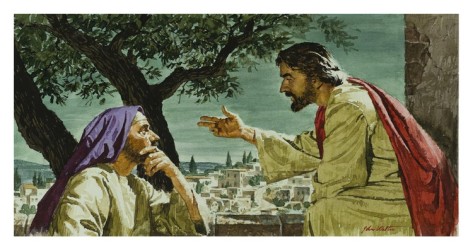
It is that problem that has forced me to get familiar with the adjective forms of the names of the evangelists. So something that has to do with Mark, is Marcan; if it relates to Matthew, it is Matthean; to Luke, it is Lukan; and to John, it is Johannine. Using those adjectives, I can say “the Johannine Jesus” instead of “the Jesus who is represented in the account John gives us,” which could be said every now and then, but which is too bulky for regular use.

So how is it that the Johannine Jesus—see how neat that is?—says this in Chapter 16?

2They will expel you from the synagogues, and indeed the time is coming when anyone who kills you will think he is doing a holy service to God.

Following the “my stock in trade is Jesus stories” metaphor, we can say that John is preaching to a church where the separation from the synagogue is actually going on. There aren’t any Jesus stories that tell the church what to do in a situation several generations removed from the public ministry of Jesus, so you make a Jesus pronouncement that applies to the situation your congregation is facing, post-date it to the time of the ministry, and put it in the future tense as if it were a prediction.

For John, considered as a guest preacher, that is a solution. He is quite sure he knows what the Jesus of his tradition would have said, so he said that Jesus said that. For me, as someone who is trying to imagine how to read the gospels outside the presuppositions of the journalistic mode, it is also a solution. Seeing the gospel as an anthology of sermons puts me on a new road entirely. [5]

This is a solution to the problem of sliding helplessly back into reading the gospels as if they were newspaper accounts. The solution is to find another metaphor, one that precludes those old journalistic bad habits, and then to work very deliberately on the new metaphor. The new metaphor is that the gospels are collections of sermons, some on the “remembered” end of the scale, and some on the “adapted” end.

It’s a narrative

I liked what Arlie Russell Hochschild, in Strangers in Their Own Land, called “a deep story.” [2] The deep story is a way to organize your perceptions of your own life or of the life of your group. The story provides the categories so that the experiences you have are not just “events,” they are instances.  This story isn’t “true” at the level of replicable events; it is “true” in that it correctly names the categories you are using to understand your life.

journalism 2Reading the gospels as narratives, I focus on the art of the narrator. I pay a lot of attention to the dialogical style of Jesus in John. When I read about Jesus’s interaction with Nicodemus in Chapter 3 as if it were taken down by a court reporter, it sounds like an inquisition. Nicodemus is a hapless tool and Jesus embarrasses him whichever way he turns. [6]  When I read that same text as an example of a format John uses—and into which he puts Jesus—in order to raise and highlight questions that would not be available for consideration otherwise, I can read it differently. John is writing both parts (the Jesus in John’s writing and the Nicodemus in John’s writing are two halves of a set dialogue) and he is writing them so that his goal as a narrator will be successfully reached.

When I see that Matthew has apparently grouped his collection of Jesus stories into five big books, each composed partly of a discourse of Jesus and partly of a narrative of the actions of Jesus, I can see a parallel to the Pentateuch, the five big books of Moses. Within each of these “books” there is a thematic grouping that makes no sense at all as a newspaper account, but that makes perfect sense as an artistic narrative.

When I read Matthew’s account of the events, described above, that accompanied Jesus’ death on the cross, I can read them in a journalistic mode—how big an earthquake, why a three hour eclipse, who saw the dead people coming into Jerusalem?—or I an focus on what Matthew is trying to tell me. He is saying that the cosmos took account of the death of Jesus, just as it did of his birth. It is a matter, as Brown says, of “atmosphere, not of details.”

Conclusion

I think either of these solutions would work for me. They give me a focus, something to work on, that is not journalism. If I am working hard enough on seeing the text as a narrative, I shouldn’t be backsliding into reading it like a newspaper. [7] So I think this is my 12 Step program and if I work on it hard enough and if I treasure the others who are trying, as I am, not to go back to the old habits, I might be successful.

[1] There are lots of ways to express that. My choice of “time” was just a convenience. You could replace action B because you are committed to the value of action A because you thought A was morally superior or more technically effective or for any other reason you might have a preference.
[2] From the New Jerusalem Bible
[3] In most settings, “deep story” would be called a myth, but myth has now taken on the primary meaning of “not true,” rather than fundamentally true.
[4] Raymond E. Brown in The Death of the Messiah, calls these “The Four Terrestrial Phenomena,” see pp. 1120—1133.
[5] It is possible that this new road doesn’t actually go anywhere, but it is NOT that other road, certainly, and it doesn’t to anywhere, I will have to turn around—that’s why they have a word like metanoia, which means “to change your mind”—and come back.

[6]  And being a nice sort of person myself, I wince on Nicodemus’s behalf and learn to resent the Jesus I have experienced in that court reporter mode.

[7] Except, of course, for all those things I learned in newspaper mode over the course of a long life of Bible study. Those aren’t all going to change, magically, now that I am driving down a different road. They are still what they were when I first leaned them and I am going to stumble on them from time to time and be embarrassed.


Posted in A life of faith, Biblical Studies, Living My Life | Tagged , , , , , , | Leave a comment