That government is best…

It’s always the dots that get you, isn’t it? What was there, you wonder? That’s where we are going. Please be patient.

You have often heard the half-maxim [1] “That government is best that governs least.” I have seen it attributed to Abraham Lincoln, Thomas Jefferson, and Henry Thoreau. Apart from considerations of what you might want the government to do, of course, it is ridiculous to say how much of it you want. In the contemporary ideological wars, it is usually enough to say “Less.” That’s how much government I want, one says: I want less.

I would like to consider this half-maxim from several beginning points today. Some are political, but most are not. I want to start our consideration of the best ways to use this word by considering the word itself and possibly a little bit about what it means to say that a word can be used in these ways but not those ways.

Let’s start off with the politics. Sometime during the time I was teaching politics ofleast 5 various kinds at Portland State University, there arose an interest in putting a limit on the number of terms a legislator could serve. [2] “Why do you want to do that?” I would ask the students who were advocating it. Well, they said, we want to reduce the power they wield in the legislature. Really, I said, and who do you want to have that power instead of them? Ordinarily, that caused a brief pause in the conversation.
Here’s what I had in mind. 100% of the available power in a legislative setting will be exercised. You don’t put it in the bank for the next session. That raises the question, who will get more power as the representatives get less? The caucus leaders, certainly. The best-funded lobbyists. The legislative staff, e.g. the Legislative Counsel’s Office. Statewide elected officials, like the Attorney General and the Secretary of State will exercise more power. Usually, it was the prospect that legislative aides and lobbyists would be empowered that caused my students’ early enthusiasm to begin to wane.

But the real issue is the confusion of governance with government. Every system is governed. Governance is a function; “government” is better thought of as a means. It would better be thought of as a synonym. “The governance (government) of the system is decentralized” for instance.

It is easy to see that “government” can be treated as a name for all the guidance functions a system uses. That fits very well with the etymology, especially when we stop to consider that government and cybernetics derive from the same root. It is the Greek (later Latin) kybernatos, meaning “pilot” in the nautical sense. The pilot (governance function) steers the ship (social unit) where it ought to go requiring no more resources than are available. What cybernetics has in common with government (considered as a function) is the feedback loop [3]This is the problem my students stumbled on. There is always going to be “government” in the legislative setting. It will always add to 100%. You can divide the sources of government so that these have more influence and those less, but you cannot simply reduce the power of one group. It’s like taking a handful of water out of a lake.

This is not to say that every kind of governance is as good or bad as every other kind. We may well have preferences for one kind. Imagine, starting at the individual units, a person who is self-governed and requires no social guidance at all. Now imagine that she has flaws in her governance system and the social system needs to step in from time to time to “guide” her actions. So far so good. But imagine now that the society has inadequate resources to deal with her behavioral aberrations, and the formal structural power—often called “government” where that word is thought of as a means of governance, not as synonymous with it—is called in to add resources.

least 3People who think of “government” as office holders and regulations and votes will say that there was no government in the first two settings and that it was introduced in the third. But if you think of government as a function, there is as much government in the first two scenarios as there is in the third. All the government is self-government in the first. All the government is self-government and where that fails, social government, in the second. All the government is self-government in the third, except where that fails and social government is brought in, and also except for where social government also fails and structures wielding formal coercive power are brought in.

Think of it this way. If self-government is represented by A, then in the first scenario A = 100%. If societal government is represented by B, then in the second scenario A + B = 100%. If political government is represented by C, then in the third scenario, then A + B + C = 100%. If we understand it this way, then asking for “less government” (governance) is just silly.

Let me illustrate with a scene from George R. Stewart’s Earth Abides. Nearly everyone in the world dies in the first few pages. “Ordinary society” doesn’t outlive the first generation in the small societies that remain. Government is by consensus. But then into one of these societies, a bad person comes. He chooses a mentally deficient girl as his prey and proposes to marry and have mentally deficient children by her. The elders come by and explain how bad that would be and forbid him to do it.

This bad person has broken the contract of self government. A is gone. The visit of the elders, explaining to him that he ought not to do what he is planning also fails. A and B are now both gone. So the village elders constitute themselves as a government. They agree—I think there might even be a vote—that they are the legitimate government of this little group. They formally accuse the bad person, they try him and find him guilty, and they pronounce his sentence and hang him. A + B + C. This is not murder. They consider murdering him, but they don’t want to introduce lawlessness, so they make laws and, according to those laws, “execute” him.

If you consider “government as a function,” the amount of governing being done or being expected is 100% at each round. It’s all self government, then it adds social government and finally adds political government.

Let’s go back now to the quotation with which we began and fill in the ellipsis. “That government is best which governs least, because its people discipline themselves.” If we can refer back to the A + B + C model, we can see this sentiment an advocacy of individual self-management and the “least government” is the kind called in least often to deal with disagreements. This raises some obvious questions. Here are two.

  • What would an advocate of this “least government” say about what to do when people do not, in fact, discipline themselves?
  • What would an advocate of this “least government” say about functions of government other than maintaining order, say, the funding of internal economic improvements, such as railroads and canal systems?

I myself would prefer a great deal of government in some ways. It will be required, certainly, if any headway is to be made in reducing global warming. Social sentiments against the activities that promote global warming have been very slow to develop and have very little effect against the corporations that produce those effects. If A + B + C is the model, this crucial achievement is going to be all C.

In the U. S., the national government commonly funds projects so long as they cost more to develop and operate than they make. When they have a hope of profit, the government turns them over to private companies. Transportation to and from the International Space Station is an example. The development and distribution of solar power is just about to become an example. In the performance of crucial tasks that only governments can do, I would prefer to have “a lot of government,” i,.e. enough to do the jobs I want to see done. It is easier, from this perspective to see why I took the trouble to point out that it was ridiculous to say the we have too much or not enough without bothering to say what we want to use it for.

So far as the use of government to settle disputes, I feel more the way Thoreau (or Lincoln, or Jefferson) did. I feel the same way about the officiating of NFL games. I want the refs to be competent and well-paid, but a game in which only a few plays were stopped by penalties would be a better game. In society, the more self-discipline each person has, the less often social and political muscle is going to have to be brought in.

least 4In societies that emphasize the power of social institutions, the power of social norms to clarify conflicts and in many cases, to resolve them, is much prized. In the U.S., we have allowed such institutions to wither. [4] In the symbolic representation I used earlier, that removes B from the A + B + C palette, so conflicts in A move rapidly to C. Individual disputes, are more and more mediated by political agencies, in other words, which are often not well-equipped to deal with them. If I saw a lot of that, I might very well argue that “that government is best that governs least,” meaning that I want less regulation of interpersonal behavior. But if I were to say that very often, it would bring me to lamenting, instead, the lack of self discipline or the atrophy of mediating institutions that requires that much government. Arguing against the constraints of government in this situation is like arguing against the constraints of a tourniquet. It brings you to wondering what the tourniquet if for.

That tourniquet is best that constrains least? No, that just doesn’t have what I was looking for.

1] Would that make it a “minim?”
[2] Peter Courtney, who was a young member of the House of Representatives in Salem when I sat on the House floor as a Legislative Assistant in 1983 is still there; as President, now, of the Oregon Senate.
[3] Wikipedia: “Cybernetics is applicable when a system being analyzed incorporates a closed signaling loop—originally referred to as a “circular causal” relationship—that is, where action by the system generates some change in its environment and that change is reflected in the system in some manner (feedback) that triggers a system change”
[4] In his Bowling Alone, Robert Putnam lamented the demise of those informal institutions that produced what he called “social capital” and on which we all drew.
 

Posted in Political Psychology, Sustainability | Tagged , , , , | 1 Comment

Turn the Other Cheek

The controversies over this text abound, very likely because following out the literal meaning is quite often inconvenient.  But there are worse things than inconvenience to say about the literal compliance with such a text.  We might say, for instance, that under some circumstances, turning the other cheek might elicit violence where otherwise none might have occurred at all. 

I too would like to say something bad about turning the other cheek [1] but I would like to say a bad thing I have not heard anyone say before.  Turning the other cheek might be a valuable opportunity lost.  This is why.

All of the cited examples continue to be defined by the same dimension as the offense.  Example 1 has to do with cheek-slapping; [2] example 2 with a successful suit at law;  example 3 with military levies of labor; example 4 with with ownership and the control that goes with what is owned.  These all have to do with more or less of the offensive behavior—slapping, suing, conscripting, borrowing.

But what is there were an opportunity to change the whole exchange into a different category?  Could that be considered “turning the other cheek” or possibly as better than turning the other cheek?  I have, as Tom Lehrer says in introducing a march he wrote called “Smut,” “a modest example here.”  

Remember the Titans

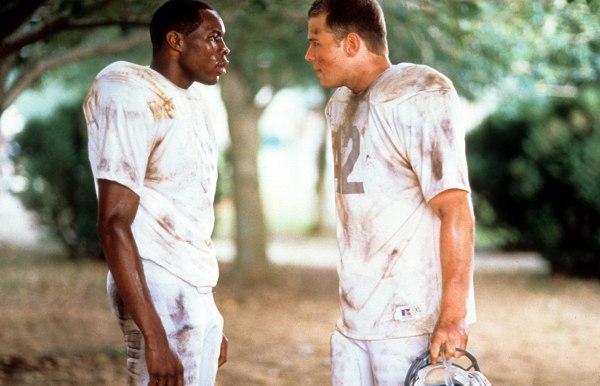
I’m thinking of a transaction in the movie Remember the Titans.  This is a subtle and powerful exchange between Julius (Wood Harris), the best black player on a recently integrated football team, and Gerry (Ryan Hurst), the captain of the team and arguably the best white player.

Coach Herman Boone (Denzel Washington) has required the black and white members of the team to get to know each other and he is holding three a day practices until they do.  In Pennsylvania.  In the summer.

The argument between Julius and Gerry goes back and forth in racial terms.  If, at that point, the norm of turning the other cheek had been introduced, no progress would have been made at all.  But Julius turns the question so that it raises to Gerry’s official role as team leader.  If he is really the team leader, why doesn’t he do something about a major flaw in the team’s performance; why doesn’t he require the white linesmen to block for the black ballcarrier?

The effect Julius gets might have been demanded as a matter of racial justice.  That case would go that people like you (white players) are cheating players like me (black players) because of your racial bigotry and you need to stop.  That wouldn’t have worked at all and that is not, in fact, what Julius did.  Julius took this damnable racist action and put it into another context.  The old context was a zero sum struggle: whatever black players gain, white players lose.  The new context is in a positive sum, a win/win, context.

The new context does not require Julius to give up his grievance.  It is a fact they both Cheek 2recognize that the white linemen are dogging it on the plays where a black man is carrying the ball.  What Julius does is to relocate that grievance so that it is part of the job of his superior, the captain of the team.  And what Gerry does is to accept the challenge not as a white player but as the captain.  As a white player, he had done everything that can be demanded of him, but as captain, he has been complicit in the behavior of his white teammates.  He has not called them for their bad football behavior (not blocking) because calling them out on that would be seen as a racial matter—and when he does it, it is seen that way.  But as captain, he really doesn’t have a choice.
Imagine that Julius hated all white players and also hated losing.  He has to be willing to call one of these white players, “Captain.”  That means he is granting a formal rank higher than his.  What he gets for that sacrifice is that the losing stops.  Julius changed the set of relevant categories from black and white, a zero sum conflict, to leader and follower.  In the new category, the leader is obligated to do something he has not been able to do, and acting as a leader rather than a “white player” opens up a positive sum (win/win) strategy of benefit to both Julius and Gerry. [3]

The options Jesus specifies have in common that the aggrieved person give up his rights.  Julius did, in fact, give up his rights as a black man and asserted, instead, his rights as a follower of the captain.  He demanded that the captain do, because of his superior rank, what he had been unwilling to do before.  Does this require sacrifice and self-discipline?  Of course it does.  But look at what you get for it.

This doesn’t just end tit for tat within the same category of behavior.  This changes the category entirely.  I say that’s a good thing.

Bargain for Frances

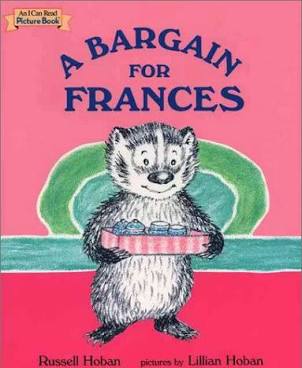
The second example comes from a children’s book called A Bargain for Frances.  Frances is a very well-mannered little badger who is being routinely abused by her playmate, Thelma.  No one, looking at this situation, would recommend that she “turn the other cheek.”  That is what she is doing already; it is all she has ever done and the results have been really bad.

In this story, Thelma cheats Frances out of a tea set and Frances finds out about it.  Following the idea that “turn the other cheek” is a mandate that locks you into the same channel that contained the offense, we could say that Frances could go out and buy another tea set and give that one to Thelma as well.  What she could not do, following that mandate, is to deceive Thelma and get her tea set back and that is what she does.

Thelma instantly recognizes that the fundamental relationship she has always enjoyed with Frances has vanished.  The old relationship was the relationship of predator (Thelma) to prey (Frances).  Clearly that was not good for Frances, but I would argue that it wasn’t really good for Thelma either.

cheek 3Perceiving the new relationship—as yet unnamed—Thelma says, “I can see that when I play with you, I will have to be careful.”  Thelma might have meant that now each can harm the other, so at least a grudging respect, is required.  Maybe Thelma meant that now that Frances has claimed the right to personhood on the same grounds as Thelma, they will have to treat each other as competitors, each taking advantage of the other when the occasion arises.  Russell Hoban, the author, doesn’t speculate.  He leaves that to me.
He does give Frances the last word, however, so we know where his heart is.  Frances picks up on the language in Thelma’s remark—“careful,” Thelma said—and says, “Would you rather be careful or would you rather be friends?”  Having earned the status of co-predator, Frances offers something better.  She offers friendship a relationship that was never an option before and one that turning the other cheek would not have generated.

I am making the argument that there is nothing in the stream of evil and nonresistance that opens the chance of a new relationship at all.  This is the end of the zero sum relationship of competitors—what I win, you lose.  This is the offer of a positive sum relationship in which both can win and in which, in fact, neither can win without the other.

Does this count as “turning the other cheek?”  I think if you read it tightly so that the response is the same kind of thing as the provocation, it does not.  Frances does not offer to be cheated again, to buy and give another tea set, to loan her tea set to Thelma and never ask for it again.  Those are all the same kind of action as the provocation.  But what if you can “turn the other cheek” by transforming the action into another kind of action entirely?

I argue that it is a “turning the other cheek,” understood more broadly.  In this way of looking at it, turning the other cheek, as well-motivated as it might be, is transcended by turning the whole relationship on its head.

That seems better to me.

[1]  And the accompanying three: the cloak as well as the tunic, the second mile as well as the first, the obligation to lend.

[2]  I understand this to be an insult rather than a beating.

[3]  They also become lifelong friends, but that is another story entirely.

Posted in Uncategorized | Leave a comment

Racial defensiveness

The topic for today is “racial defensiveness.”  I’m against it. 

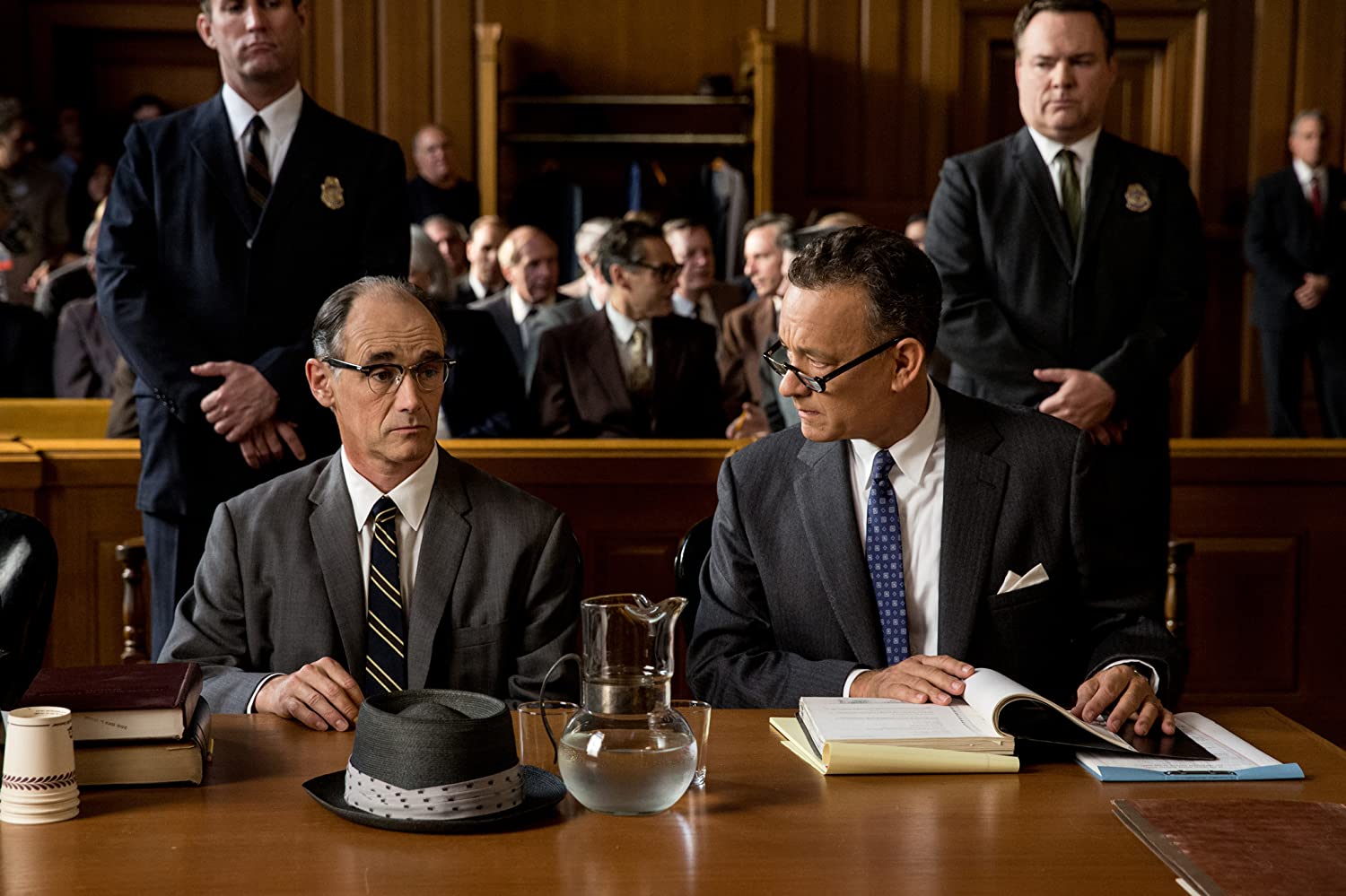
The Russian spy (Mark Rylance)  who was captured and tried in the movie “A Bridge ofdefensiveness 3 Spies” had a recurring line that made me like him immediately.  In the first use of this line, his lawyer (Tom Hanks) asked him, as they were about to enter the courtroom, .”Are you nervous?”  The spy said, “Would it help?”

That is the question for today.  I’m going to land a little hard on Peter W. Marty, editor and publisher of The Christian Century, but it isn’t because of any animosity toward him.  He just represents the last straw.

His editorial in the current issue is called “Letting go of white defensiveness.”  He is in favor of letting it go although he doesn’t give any reasons why.    I sense more and more that I am a pragmatic sort of person and I keep looking for some good outcome that will make all this wrestling worth while for us all.  I didn’t find it here.

“I’ve noticed,” he says, four paragraphs into a six paragraph editorial, “that few subjects spark defensive behaviors among white people quite like white privilege.”  “Defensive behaviors” are bad things, apparently.  Marty wishes we would get over them.

Black people have to deal with “weighty psychic burdens” every day.  White people should understand that.  They don’t and they should.  I wonder if it would help.

At the fifth paragraph, Marty turns the corner and begins to consider the effect Christian faith might make in this fraught area.  He has some good news to share with his “defensive-minded friends.”  Here is the good news.  “You have some tools in the toolbox of your faith life that are exciting to put to work in our world of racial inequity.  Start by letting go of defensiveness.”

It could be argued, I suppose, that having constantly to defend yourself is taxing, particularly if it becomes a mind set–a kind of permanent mental crouch.  I can see why anyone would want to be free of that burden.  But as a mental health matter, it seems it would be easier to stay from the people who keep accusing you of being white, but not adequately grateful.  WBNAG?  There are plenty of people available for whom that is not a high priority; there are churches for which it is not a high priority.  Racial sins—such as inadequate gratitude for instance—are no more sinful than economic or political or interpersonal sins, after all.

The question that is not addressed here or anywhere else in the editorial is, “Would it help?”  I have read that the traditional military training favored by the Prussian officers was brutal.  The idea was that soldiers who were trained in a brutal way would learn that they were able to do more than they thought; they bonded with each other under the common brutality.  They became, as a result of that kind of training, better soldiers.

I don’t really know anything about how German soldiers were trained and I have no great love of brutality even in military training, but I do understand this practice because it is aimed at an outcome that the officers value.  They will have better soldiers and will, presumably, win battles that lesser soldiers would have lost.  When I come to them with my question, “Will it help?” they have an answer.

The editorial in The Christian Century does not.

Defensiveness, Marty says, “is a constrictive survival response that only separates you from God.”  Does he think that God cannot forgive defensiveness?

“According to Jesus,” Marty says, “relinquishment is a ticket to abundant life.”  To think that “relinquishment” as such is a virtue is beyond silly.  Marty is counting on the context of racial injustice here, but nothing about tacking that value onto the teaching of Jesus helps the argument.  There are many things we ought never to relinquish, hope being prominent among them.  Setting “relinquishment” up as a virtue and tying that virtue to the teachings of Jesus hurts my ears.

“We no longer have the luxury of living racially unaware lives,” says Marty.  That’s probably true, given the near ubiquity of racist and anti-racist speech, but no one lives a more “racially aware life” than a Klansman in Alabama.  So I wonder “Would it help?”

“Where you feel uncomfortable,” Marty says, “disempower it.”  I understand that advice to be that we ought to make ourselves more comfortable about our discomfort.  That would be easy to practice, if you are interested.  Glue a tennis ball to your pajama top right between your shoulder blades.  And as you lie there, becoming more and more uncomfortable, practice getting comfortable with your discomfort.

You might remark that that is a silly thing to do and you would be right.  You might ask just how it would help anything if you learned to be comfortable with the discomfort that the tennis ball is inflicting.  My question exactly.

There are a few more, but I am ready to let this go now.  It might be true that the racial injustices and inequalities we suffer in this country would be made better in some way if liberals were less defensive; if they reached into “the toolbox of their faith life” and got hold of some tools that would make them more comfortable with their discomfort.  Or it might make everything worse.

I don’t know and Peter Marty doesn’t even wonder.

I make it a practice to ask, about proposals that are said to address the current racial crisis, “Would it help?”  Some of the answers I get provoke discussion and some don’t, but I think it is always better to ask than not.

Posted in Political Psychology, Politics, Sustainability, Uncategorized | Tagged , , , , | Leave a comment

July 4 Virus Thoughts

We are celebrating, today, the independence of the North American colonies of Great Britain from the rest of the British Empire. We had devised, here, the beginnings of a single political system and we proclaimed that it “was, and of right, ought to be, [composed of] free and independent states,” [1] To skip over the separateness of the separate states for just a moment, the Declaration says that our system really ought to be independent of your system.

It is that sense of ourselves as many, yet one, (e pluribus unum, and all that) that required the President of the United States to bring to the Congress “information of the State of the Union.” The State of the Union address was intended to be an answer to the question, “So…this union thing…how’s it going?” [2]

It isn’t going all that well, I’m afraid. Barack Obama has a vision that we were “not red states and blue states but the United States of America.” That’s not what is happening. We are, in fact, declaring independence from each other. Think of it this way: “Who are you to tell me not to….”

Notice that this transition moves away from system requirements—that’s what the Declaration of Independence was about—and  toward the question of whether we are to stop relying on each other. The pandemic puts that question to us directly.

There is the question of freedom for—what is it we demand the freedom to accomplish together—and freedom from external restraint. Those two ways of considering freedom [3] cast a sharp light on where we are today. We have solved the problem of external restraint—which is what Jefferson was concerned about—but we have lost track of what we want to do together.

4 July 1Consider this. Let’s say I want to put my shoulder to the common weal [4] and move us forward as efficiently as possible—but only provided that everyone else is pushing as hard as I think I am pushing. That’s why successful wars are so good for morale. First, the sense of external threat gets people to cooperate, even to sacrifice, more than they normally would. But also, there is a real reduction in monitoring just who is doing just how much. A great deal is excused in “There’s a war on, you know.” The focus on our freedom to accomplish what we intend is still being buffered by our attempt at keeping our independence.

And when the war is over and a nation is struggling to survive, as Germany and Japan were, or simply basking in the prosperity that victory brought, as the U. S. was, there is a time when you are just too busy to spend a lot of effort making sure that no one is getting advantages you are denied. But then the prosperity wains and people find themselves working very hard again, but this time with no external enemy.

The Tea Party voters Arlie Russell Hochschild studied in Strangers in Their Own Land imagined that they were standing in a very long line, waiting to receive the results of their hard work and sacrifice. But the line is not moving forward. This situation is not covered by “There’s a war on, you know.” It is not covered at all.

So what I want now is the best social outcome we can manage for us all, PROVIDED that no one gets more than I do or works less. And if the value of the work no longer serves to fuel my resentment, then how arduous or unpleasant the work is will have to do. If I work three jobs, I don’t want people who work two jobs to have what I have. If I work a dangerous job, I don’t want anyone who works a safe job to have what I have. And I don’t want people with no job at all to have…really…anything.

This independence from each other is what we have sunk to. And, not to give the Russian bots too much credit, it is the effect that they worked so hard to achieve in 2016. This is, in fact, what many of the Russian bots did [5] although, as former President Obama said, we were doing it to ourselves anyway.

There are solutions, of course, and our experience of the COVID-19 virus has made some of them obvious. If we had the trust in government leadership so many other nations have and the sense of ourselves as bearing a common burden and pursuing a common goal that so many other nations have, we would be having the kind of success with the pandemic that they are having and that we can only envy.

There’s no chance, I suppose, that we could begin to celebrate Interdependence Day. The 4 July 4matter of formal separation from Great Britain seems to be pretty well in hand. “Freedom from” has been accomplished. And we are not going to accomplish much more unless we find a way to affirm and value our common citizenship. It is possible that we can come to feel a sense of pride that all Americans are receiving what they need to put together a good life for themselves and a sense of shame that some Americans are sleeping in the streets and rummaging through dumpsters for food.


We could do that.

It would require the sense that we cannot become who we once thought we wanted to become just by demanding our own rights. The ceiling on who we can become together by demanding our own rights is a very low ceiling. A whole-hearted celebration of Interdependence Day would be a step in the right direction.

[1] Here is the text: “Resolved, That these United Colonies are, and of right ought to be, free and independent States, that they are absolved from all allegiance to the British Crown, and that all political connection between them and the State of Great Britain is, and ought to be, totally dissolved.” I note, for the first time that of the three verbs, one is a linking verb and the other two are in the passive voice. Not really a trumpet call, is it?
[2] The Constitution also requires that the President “recommend to their Consideration such measures as he shall judge necessary and expedient.” That is the body of the State of the Union address today. The “measures” part; not necessarily the “necessary and expedient” part.
[3] I have in mind Isaiah Berlin’s famous “negative liberty” and “positive liberty” in mind here.
[4] Just that one pun, please. It is independence day, after all.
[5] Which is why they spent freely on fluoridation campaigns and on anti-fluoridation campaigns; on pro-life campaigns and on pro-choice campaigns.

Posted in Politics, Sustainability | Tagged , , , , | Leave a comment

A Klan of “Karens”

You may have heard about the fuss kicked up by Amber Lynn Gilles at the Starbucks in San Diego. The short version is that she didn’t wear a mask, as store rules required her to do, and was not served. I don’t think her story is really unusual, but several aspects of the narrative caught my eye. For one thing, someone started a GoFundMe account in the barista’s name. For another, the New York Times wrote about the encounter which is how I heard about the rationale.

That’s the short version. I would not like to perform a brief detour to apologize to anyfriends—not “former friends” I hope—named Karen. [1] On my own behalf, I will say that I have heard “Over hill, Over Dale” all my life and have learned to think they must be referring to someone else. And finally, I allowed myself a little fun in the title “Klan of Karens” on the grounds that the first two K’s in KKK, are a reference to the Greek work kyklos, meaning “circle.” So a circle of “Karens”—emphasizing the current meaning, an emphasis on personal entitlement—would still be a KKK.

Now back to the story for the long version. There is a lot approve of in this story, like Starbucks policy and the behavior of barista Lenin Gutierrez (pictured at the right). Also, of course, a lot to disapprove of. But rather than doing either, I would like to pay attention to the several responses Ms. Gilles unleashed. I am going to take them in the order that they interested me, so don’t try to string them together as a narrative. You can do that with the hyperlink.

Masks are Stupid

Let’s start with masks.

“They are stupid,” said Ms. Gilles, “and so are the people wearing them.”

It is possible, I suppose, that saying “masks are stupid” means that they look stupid, a way of saying they make me look stupid. But more likely is the charge that they are stupid because they don’t work and/or they are unnecessary.

To poke a little at whether they work, we would need to know what they are supposed to do. They are supposed to keep the people around you free from any infection you might otherwise have shared with them. That means that it requires some such methodology as contact tracing to determine whether the people in our wake are being infected and that is not the kind of information Ms. Gilles is at all likely to have.

It is more likely that she intended to say that they were not likely to keep her from getting sick. (Her direct comment was, “I don’t need one.”) But on beyond that, there is the question of whether Starbucks should be permitted to protect their employees from people like her. I don’t think even Ms. Gilles would say that, but given the nature of her charge—they are stupid and so are the people who wear them—she doesn’t have to.

Ms. Gilles said that she was “denied and discriminated against.

This is what Starbucks is charged with. Surely there is no debate about the first part. She demanded to be served even though she was not wearing a mask and Starbucks said no. She was denied. Ordinarily “denied” connotes that one was denied something he or she had a right to. No one says, “They denied me entrance to the theater because I didn’t have a ticket.” The whole charge really ought to have the form: denied X because of Y even though Z specifies that I have the right to X. Following that form would have required Ms. Gilles to say just what she was denied or to say that Starbucks had no right to deny it.

“Discriminated against” is a little more complicated and that complexity is brought to us by the loss of meaning of “discriminated.” “Discrimination” was still mostly a good thing when I became acquainted with the word.

It is a facility that marked off people who could tell the good stuff from the bad stuff. A person was said to have “discriminating tastes.” [2] The resolutely bad meaning of the word comes from the expression “invidious discrimination.” If you are going to use “discrimination” to mean “the ability to tell the good from the bad or from the merely mediocre,” you are going to need an expression to mean “discrimination I disapprove of,” and that was the function of “invidious,” which means “malicious, hostile, or damaging.”

It is the addition of “against” that enables Ms. Gilles to say that something bad had happened. [3] But in the absence of a standard, she can only mean that she didn’t like the decision. To say more, she would have had to say that Starbucks should not have had the standard they do have.

Next comes Ms. Gilles justification of her behavior.

“I didn’t harass anyone,” she said. “I called them out because I’m frustrated.”

There are three points of interest here. The first is what “harass” means and the related question of who gets to say what it means. The second is the substitution of “called them out” for “harassed.” The third is her explanation of why she did it: she was frustrated. [4]

Lenis Gutierrez, the barista, describes it this way.

“…she started “cursing up a storm” and called people “sheep” before walking out. A few minutes later, she came back, he said, and asked for his name, took a photo of him and said she would call the corporate offices.”

My guess is that her feelings of frustration came from the barista’s request that she put on a mask. The sense that she had “called them out” more likely came from her coming back, taking his picture, and threatening to call the corporate offices. That is the part she likely identified as “calling them out” and the part also that required her to specify her motivation.

A reader of the story might wonder why her doing all that did not fall under the label harassment. I wonder that. And how is “calling them out” different?

Ms. Gilles final salvo was more institutional. This is what she posted on her Facebook page:

“Meet lenen from Starbucks who refused to serve me cause I’m not wearing a mask. Next time I will wait for cops and bring a medical exemption.”

I think Ms. Gilles understands that the two actions she threatened are empty. What will the cops do if they come? Will they say that the CDC shouldn’t have recommended masks and that San Diego County should not have required them? It doesn’t seem likely. And what kind of “medical exemption” might she have in mind? “My doctors says I am free to infect as many people as I like?” That doesn’t seem likely either.

If a “Karen,” like Ms. Gilles—Leah Asmelash of CNN says that “a Karen” is “a potent moniker for someone decidedly out of touch”—were just one unusual person using unusual rationales for her demands, I wouldn’t have bothered with this. I do think, though, that her behavior and even the kinds of justifications she provided for it, are increasingly common and I think they are deplorable.

[1] I would like to make an immediate exception on behalf of a dear stepdaughter of mine, whose name is spelled “Karyn” and who is, most emphatically, not a “queen of entitlements.” That is, apparently, the principal meaning of the current phrase, “Such a Karen.”
[2] That use comes from the 1620s. The sense of discrimination “against” and “against” for unfair or malicious reasons comes from the 1860s.
[3] Although, in all fairness, the root of the word is the Latin cernere, which means to separate; dis- only adds “apart” to the root. So separating one kind or quality of things from another. Bette once had a job watching the green beans come down the line and separating the bad ones from the good ones. She did this by being discrimination. There is always, I guess, the question of how the rejected beans felt, being discriminated against like that.
[4] Not to sound any older than I really am, but when I got acquainted with the word, “frustrated” meant the failure or an attempt to do something. It didn’t say anything at all about how you felt about the failure. In its current use, “frustrated” is the name of a feeling. So Ms. Gilles doesn’t even have to say that she was frustrated; all she has to say is that she was “feeling frustrated.”

Posted in Living My Life, Sustainability, Uncategorized, Words | Tagged , , , , | Leave a comment

And he lies scarcely at all…

Scene 1: Saint Peter and a few angels are performing the daily ritual with some dice and a chart of the cardinal sins. They throw an 11, look at the chart and see what vice is on special today.

Scene 2: George Washington, having recently died, comes before Saint Peter’s professionally stern gaze. Saint Peter checks the chart to see what today’s heinous sin is and breaks out into a lovely beatific smile. “You’re in luck,” he says to President Washington, “Today’s special sin is deceitfulness and it says here that you never told a lie. Go on in.”

There are so many silly things about that little fantasy that it is hard to know where togeorge 2 start, but it came to my mind because one of the routes I frequently ride goes past the intersection of Sandy and 57th, where this statue is normally located. I guess parts of it are still located there.

It was “desecrated” this last week as part of a protest against racism. I’d like to spend a little time on “desecrated”—such an odd word in this context—and then return to my heavenly fantasy and the reason for beginning there.

George Washington is not “sacred” to me, nor should he be. [1] He provided a substantial service to the rebellious colonies and to the fledgling republic and I think he should be honored for that. By being a successful general and a very stabilizing president, he gave us a gift without which we would not be in our present situation. There was no substitute for him.

One of the great uses to which he and his memory have been put is to serve as the exemplar of attitudes and behaviors the society needs. The legendary George Washington, by contrast with the historical George Washington, was dignified, humble, practical, and, above all, truthful. It is his legendary truthiness that I make use of in the heavenly scenario with which I began.

What is “sacred” is the use we agree to make of our great women and our great men. It is our adherence to the virtues we claim they exemplify that enables us to survive as a society. The social norms held at least partially in place by this practice allow us to live together with much less coercion than would otherwise be necessary. They allow us to cooperate more fully than otherwise, to adjust and innovate more fully than otherwise. The “great people” of our past—those who by our consent [2] evoke one or another of the crucial virtues—serve us by helping us define and support the values our society requires. I can come a lot closer to calling that function “sacred” than I can come to calling any person from our past “sacred.”

So to George Washington is attributed a wholly pure and entirely unlikely truthfulness. The well-known legend of the cherry tree can serve as an example. George is also extraordinarily lucky that on the day he came up for judgment, the virtue of the day was “truth-telling.” So he was declared “worthy of entering heaven,” [3]

Had he come on the next day, when the special virtue was “kindness,” George, as a slave-holding Virginia planter, might have had some difficulty. The current round of protests against our best-known leaders is that they were “racist.” Without question, George Washington violated that standards that are today thought to be indicative of racism.

george 1But let’s look at where this leads us. Racism is just today’s fetish. [4] What about tomorrow’s? Let’s say that sexual fidelity is the next virtue. This is sexual fidelity as it was understood in the late 18th Century, of course. Cadres of zealots, now comb through the “great men and women of our past” and locate those who offended sexual fidelity. It is time now for their statues, the erection of such statues serving as the kind of honor we pay them to remind ourselves of how important that particular virtue is, to be torn down. They are no longer worthy to represent us.
Fine.

The next virtue is, let’s say, charity.[5] We require, in this round of our purging of publicly honored persons, that they take special note of the poor among them and that they are noteworthy in caring for them as they should. Not all of our great men and not even all of our great women were unfailingly charitable. So…”off with their heads!” and where possible, their bases as well.

Fine. Next.

You see where this goes. Every round of purging will remove another category of statues until there are no more. You might think, I suppose, that new heroes will be created to mirror the newly ascendant values, but it takes only a moment of thought to understand that their time too will come when our attention as turned to a new virtue.

So the routine desecrating of our public statues, and thereby our common heroes, leads to a common celebration of no one and nothing at all. There is no common celebration. There are, of course, private celebrations. There may well be family celebrations and clan celebrations, but if the population we have in mind gets too large and/or too formal and particularly if public resources go into the construction and maintenance of such statues, we cross the boundary into George Washington territory—the racist planter who never told a lie.

In this scenario, we are without exemplars, except, of course, iconoclasts. We can still celebrate the people who pull down the statues, I guess. But we are without the common, the “public,” way of treasuring the virtues they stood for. Just what virtues they stood for is mostly, you recall, a fabrication of later generations. There are still private virtues, but there are not virtues that help us to shape our common polity, our common culture. [6]

This is a wholly needless problem. The solution is to value our forebears for what they have done, for their contributions to us. There is no need for them to be saints. We will weigh, for them as for everyone else, the good against the bad. We will not throw dice as St. Peter did in the example. We will not judge the paragons of an earlier era as if they should meet the standards of all succeeding eras.

In Portland, there are a lot of high schools named for presidents. A lot of our presidents suffered errors of judgment and flaws of character. They are, in that way, a good representation of the people who tore down their statues.

[1] He is, for one thing, “a graven image” is the most literal sense.
[2] I don’t want to overdo this. There needs to be some social reality that binds the virtue we prize to the life or the writings of the great one. You can’t just hand any virtue on the memory of just any person.
[3] A theological disaster, but the St. Peter metaphor requires it.
[4] I don’t call it a fetish because it is unimportant. I call it a fetish because of all the other virtues is displaces to become the only virtue worthy of our energies.
[5] There is really no need to focus entirely on sins of commission. Many of our leaders, faced with great opportunities, failed to achieve them through lack of imagination or failure of courage. Their statues too should be forfeit.
[6] Under normal circumstances, I would have added “our common economy,” but the common economy is an artifact, we are told, of the confluence of private greeds, so not a common economy in the same sense as the polity and the culture.

Posted in Politics, Society, Sustainability | Tagged , , , | Leave a comment

Juneteenth, 2020

I think I’d like to pay some attention to Juneteenth this year. I remember hearing about it before, but only from a distance. Since last June, I have been thinking about the increasingly wide divisions in this country and how we seem to cling to them. With that in mind, I would like to think about how Juneteenth could be celebrated by “us” this year.

Juneteenth celebrates the announcement in Texas of the end of slavery everywhere in the U. S. in 1865. Here is what Wikipedia says: [1]

Juneteenth (a portmanteau of June and nineteenth),… is an American holiday celebrated annually on June 19. It commemorates June 19, 1865, when Union general Gordon Granger read federal orders in Galveston, Texas, that all previously enslaved people in Texas were free.

The end of slavery was a very good thing for the blacks who had been enslaved. It was a very good thing for the Union soldiers who were able to mark this as the ultimate achievement of a long and bloody war. [2] Those two simple statements provide the context for my reflection today, which is: Why is this “a black holiday?”

From my seat on the sidelines, it looks to me like a wonderful opportunity to celebrateJuneteenth 6 America, emphasizing its white and black components. A lot of Union soldiers died to get the Union troops to Texas. Before that, a lot of abolitionists were punished by their communities for urging inconvenient actions regarding slavery. This would be a great time to celebrate them.
For the slaves and their children in many subsequent generations, it doesn’t represent so much an achievement [3] as the celebration of a basic right that had been long denied them. There is every reason to celebrate this new status. Is there any reason to celebrate it together? Is there any reason why the children of the Union soldiers and the northern abolitionists could not get together with the children of the freed slaves and celebrate together? When you first think about it, it seems there is not.

I think you ought to think again.

In the first place, it is not at all in keeping with the cultural and political ambience of our times. This is a time for black Americans to emphasize their common victimhood and for white Americans to bewail their “fragility” and to repent of their “privilege.” Of course, both of those things are true. There is no question that they ought to be granted. There is a reason to wonder why they ought to be allowed to crowd everything else off the stage.

So if we were to begin to consider Juneteenth as the celebration of a new level of cooperation and comity between white [4] and black Americans, the first thing we would have to do is to claim a legitimate place on the stage. It is appropriate, we would have to say, to make a place for blacks and whites to celebrate together the ending of slavery.

juneteenth 1This is no more the time for deploring the evils of slavery than it is the time to dwell on the ugliness of early adolescence when celebrating a young woman’s nineteenth birthday. We all know there were those times. One of them might have been yesterday. The bills for some of them might not yet have been paid. But they are not the matter at hand, the birthday, and they will not keep us from celebrating the end of slavery together,

I spoke casually, above, about “making a place on the stage” and in doing so, I skipped over the fact that we would have to want to make that place on the stage. This celebration of the end of slavery by the white and black participants, is not going to take place if nobody wants it. It is not going to take place if the people who do want it allow themselves to be intimidated by people who think such a celebration is a disgrace.

So we have to proclaim a celebration that violates the cultural and political ambience. And then we have to claim—maybe muscle aside a body or two—a space on the stage to have this celebration.

The case we would make is that it is too good an opportunity to be missed. This a chance for blacks and whites to celebrate an aspect of our common history—an aspect that has something to do with race. How many chances are there to do that!

For people who want it to be a celebration for black Americans only, this is going to feel bad. It is like sharing with a neighbor kid the birthday cake that was supposed to be for the family. Frankly, it is a lot easier to orchestrate a black celebration than a black and white celebration. [5] That could mean that we go to our neutral corners and wait to see what happens. On the other hand, it could mean trying to work out what kind of celebration recognizes and honors all the participants.

Blacks who want the celebration to be all for themselves will accuse the whites of coopting “our celebration.” White liberals who are even more sensitive, sometimes, to slights against a group they think of as a client group, will argue the same from editorial pages. Whites as a racial group don’t have a direct stake in the game, as I see it. There is no Sons of White Liberators from Slavery that I have ever heard of, much less a culture to sustain it. But whites do have a stake in racial comity, just as blacks do and this is a chance to exercise it. If racial comity were a muscle, it would be in danger of atrophying and the blame for that can be very widely shared.

So if there is going to be a national holiday celebrating Juneteenth, I would like it to celebrate blacks and whites making a new start, celebrating what they have done together and planning to work that racial comity muscle until it gets stronger and less likely to tear when it is stressed.

[1] It also notes that Juneteenth is a “portmanteau word” of “June” and “nineteenth.” A portmanteau is a kind of suitcase. Lewis Carroll introduced the work into English, saying that it represented the sort of words he invented for “Jabberwocky,” — “two meanings packed up into one word.”
[2] If you will permit me a small note on punctuation, please note that there is no comma after “soldiers.” If there were, the statement would be demonstrably untrue. On the other hand, there were some Union soldiers for whom it was true and this phrasing includes them. Anti-black sentiment among Union troops was notoriously high, so that is a crucially important comma that is not there.
[3] You will note that “were freed” is a passive verb. It does not represent something the slaves did, but something that was done on their behalf,.
[4] I say “white” for convenience only. I intend “all racial and ethnic groups that are not black.”
[5] It would be easier, too, to celebrate a white event in a white style, but we seem to be in no danger of that.

Posted in Political Psychology, Society, Sustainability | Tagged , , | Leave a comment

White women are vicious. Hm.

A recent column by Charles Blow, a columnist for the New York Times, is one of the worst I have seen anywhere. It stands out particularly in the Times, where the columns written by people who work for the paper are most often thoughtful and informative.

This column is neither. Not only is it racist and sexist, it is dehumanizing as well. That third charge is the one I would like to start with. If I am still angry when I am done doing that, I will provide evidence for the other two cases as well.

The subject of Blow’s diatribe is “white women.” To this category, he is going to attribute knowledge, intention, and cruelty. It is true that along the path of this accusation about white women in general, he does use particular white women as examples.

He says that ‘a white woman in New York’s Central Park”—that would be Amy CooperCentral Park although Blow does not use her name— told a black man, a bird-watcher, that she was going to call the police and tell them that he was threatening her life. Blow could plausibly say things about what Ms. Cooper knew for sure and what her motivations were. It is possible to learn those things about Amy Cooper, the person. But when she is made an instance in a more general accusation about “white women,” the meaning of the charge evaporates. It is not true about “white women” and no listing of actual instances could make it true about the whole category.

The vicious killing of Emmet Till, Blow says, came about because “a white woman said that he “grabbed her and was menacing and sexually crude toward her.” …

A few years ago, the woman admitted to an author that she had lied.” The woman’s name was Carolyn Bryant Donham. She said, in an interview with, Timothy B. Tyson, that part of her allegation—that he had grabbed her and was menacing and sexually crude toward her— “that part is not true.”

Mrs. Denham has not provided much evidence about how she saw the situation, but she did give the Tyson interview and Mr. Blow is free to explain Mrs. Denham’s actions as best he can. What Mrs. Denham has in common with Amy Cooper is that she is not “white women,” which is what Blow is so hot about. Consider the following paragraph.

Specifically, I am enraged by white women weaponizing racial anxiety, using their white femininity to activate systems of white terror against black men. This has long been a power white women realized they had and that they exerted.

There is a category here: “white women.” It is argued that this category of people “realized” something: they realized that they had a power. Let’s pause for a moment to realize just how silly this is. Either we have a category realizing something or we have all members of the category realizing something.  You’re kidding, right?

In addition, this category acts. It (they) recognize the availability of an attitude in the more general public and they “weaponize it.” Again, this is not something categories can do and it is empirically untrue that all the members of the category do this.

Mr. Blow probably has the gender status shared by all white women in mind, but when he says “femininity” he is going way beyond the constraints of “femaleness.” “Femininity” is a particular style of behavior much admired and practiced by some women and vigorously deplored and avoided by others. To attribute “femininity” to white women as a category is not a good thing to do. First, it is, as the above uses show, silly. In addition, he risks the wrath of women who think the equating of “femininity” with womanhood is a gross calumny against all women.

This category of women is, in addition, “cruel.” This is not, just to make the obvious point one more time, a charge against any particular woman, with the exception of the examples he gives. This is a charge against the category as if the category itself were sentient and/or a charge against all the women in the category.

I expressed my anger at the beginning of this essay saying that Mr. Blow’s charges are racist, sexist, and dehumanizing. The charges are “racial,” obviously and “sexual” obviously. They have to do with race and sex. I charge, in addition, that they are “racist” and “sexist” using the -ist suffix to indicate my disapproval of it.

The case for “dehumanizing” is easier. Treating human beings as if they were no more than the attributes expected of the social categories they belong to obviously “dehumanizes” them. But maybe it would be easier to see if we looked at some other categories.

What are poor midwestern farmers like?
What are Africa-born black American citizens like?
What are autistic fathers like?

You see the problem. Everyone who uses the language sees the need for discriminating within the category when using psychological notions like “intention.” What intention do autistic fathers have? Thank goodness there is only one such intention because it is so much easier to describe what “it” is than it would be to describe the many intentions that “normal people” have.

Just one question, Mr. Blow. What intention (just one, please) do columnists have?

Posted in Communication, Politics, ways of knowing | Tagged , , , , | Leave a comment

Why does President Trump lie?

My father had a drive toward being a cultured gentleman. I see, as I look back, that it was much more powerful than I thought as I was growing up, but even then, I noticed it. He was raised on a farm in eastern Pennsylvania as part of an old order community and when he chose to leave that community, he faced a bewildering array of options. I think the intensity of his focus on “being a gentleman” and on trying to make his four sons into gentlemen came from the great distance between what he left and what he chose. [1]

Part of Dad’s aspiration to gentility had to do with politics. Dad wasn’t oriented toward policy; he wanted presidential candidates who shared his concern for good manners and good language. Partly for that reason, President Truman was a difficulty for him. The trait that newscasters celebrated as “plain-spoken,” Dad saw as “vulgar.” One of the first political stories I remember from Dad was that “the dictionaries”—he may have had Webster’s 2nd Edition in mind—had been using the rule that a word will be added to the dictionary when it is used by the President. They had to stop using that rule, he said, when Truman became president.

This led in time to a joke that Washington “couldn’t tell a lie.” Roosevelt.couldn’t tell the truth. And Truman couldn’t tell the difference.”

It isn’t Dad’s conservatism I want to point to in remembering that story; it is the moral vacuity of the butt of the joke—Truman in this case. [2] And I got to remembering this when I readMichael Tomasky’s column in the New York Times this morning. Trump is the most egregious liar in the history of the presidency. Glenn Kessler of the Washington Post, who has been keeping track, has Mr. Trump at 15.6 lies a day, “roughly one every waking hour.”

Why does he do it?

Lying 4As a (nearly) life long professor of political science, I used to field questions like this in class and the first thing I wanted to know from the questioner was, “Why do you want to know?” I would ask that because some reasons for wanting to know can be satisfied, even within the context of a political science class. Other reasons have no hope at all of being adequately addressed. In the case of President Trump, I have three answers in mind and none of them can be fully addressed by the social institutions we have now.

Three plausible reasons

The first follows from Dad’s joke about not being able to tell the difference. President Trump’s overwhelming interests, it seems to me, have to do with self-aggrandizement. Some say he is besotted by the quest for power, but it isn’t power to do something; it is power to avoid restraint.

Tomasky’s column notes that previous lying presidents have lied within the structure of existing political institutions. Even Nixon and George W. Bush recognized that there were other political institutions with their own legitimate powers and they needed to be dealt with in some way. Tomasky says that Trump doesn’t recognize any other legitimate powers at all. The center of moral worth is “the Presidency,” (meaning himself); before that, it was the campaign, (meaning himself); and before that it was his several businesses (meaning himself).

There is, in the President’s mind, a massive moral equivalency between “greatest” and himself. “Greatest” naturally inheres in himself. That is why the crowd at his inauguration is larger than any other crowd ever. It is why all Americans are safer and happier than they have ever been before. These are assertions that do not need confirmation—facts that bear on these assertions are irrelevant to him. “Facts” are just tools to support a “truth” that is obvious to him, which is that he and his are the greatest. So assertions of “fact” are not, principally, true or not; they are useful or not.

The heart of President Trump’s lying, in this view, is that “truth” has no merit at all apart from utility. He asserts that it is true if it is useful. [3]

The second reason he lies is to defame his enemies. The core of President Trump’s base is angry at the way they have been treated. The Trump style of campaigning not only defames these enemies, but makes fun of them. He says they are bad, in other words, and also makes them objects of derision.  I love the idea of “leaving the sociopath,” but it will require winning a very important election to do that.

This is a separate reason for lying. It has no direct connection to the Trump fetish about Lying 1being the greatest. This is giving “talking points” to people who was to “hit back.” These people are aggrieved, remember, and whatever they do, is something “back.” They are “retaliating.” Notice the re- in retaliating; It represents the “back” in “hitting back.” And not only does it give talking points, it gives permission to say things like that. These are social slurs or ethnic slurs or class slurs. These are things that until recently, were not OK to say in public. The avalanche of Trump lies addresses these two problems: it justifies language that used to be “bad manners” and it scripts the charges against their enemies. And…of course…their truth of falsity is not an obstacle. Not for a man who tells 15.6 lies a day.

The third reason is that it puts the news media in an awful spot. The game the media have been playing has been the fact game and that game has been further inflamed by the “both sides of the story” game. President Trump’s drumbeat of outrageous lies causes the media to fail at both of the games they are accustomed to playing and that is another reason, as I see it, that he lies so much.

The match President Trump wins by lying in ways the media cannot afford to pass unchallenged is the match of the narrative against the facts. President Trump’s narrative presumes a factual basis, although it is false. The media can demolish the factual claims one by one but the revelation that the facts are fraudulent doesn’t damage the narrative. The both sides of the story game requires the media to give equal weight to the most sober investigation and the most transparent lies on the grounds that they represent two “sides.”

Lying 3The most recent response by the press is to aggressively call President Trump’s lies for what they are. This doesn’t work either. This is equivalent to the referee starting a fight with a pitcher who threw a beanball or with a defensive end who laid a late hit on the quarterback. The referee cannot become a participant and still adjudicate quarrels between players. The New York Times cannot challenge the Trump administrations claims as intentional and unconscionable lies without being “an opposing player.”  The guy in the yellow shirt, no matter how severely he was provoked, is no longer refereeing the game.

So in response to the lies of the Trump administration, the media has three options, all of which set the President up to win. And that is the third reason he lies so much.

President Trump’s lying is, in other words, overdetermined. Any of the three reasons for lying consistently is adequate to maintain the pattern.

I am very much encouraged, myself, by the fact that some lies are federal offenses. He won’t win that one.

[1] There was still a lot of distance to cover for the sons, because being the children of a father who grew up on a farm in an old order community was an identity we had to cope with.
[2] It’s really not a bad joke. It switches the meaning of the verb “tell” in the middle of the joke, from “speak to “distinguish,” so that “tell” in the last use means something different that it did in the two previous uses.
[3] Try to imagine designing a lie detector test this man could not pass.

Posted in Political Psychology, Politics | Tagged , , , , | Leave a comment

A “Permission Structure” for Republicans

Let’s start with this paragraph from Jonathan Martin in the New York Times.

Yet it would be a sharp rebuke for former Trump administration officials and well-known Republicans to buck their own standard-bearer. Individually, they may not sway many votes — particularly at a time of deep polarization. But their collective opposition, or even resounding silence, could offer something of a permission structure for Trump-skeptical Republicans to put party loyalty aside.

That is the paragraph I want to follow up on, but I do have a longstanding grievance against people who offer a quotation beginning with “Yet…” It always makes be wonder what it refers to. Here is what it refers to: “And polls today indicate that rank-and-file Republicans are squarely behind the president…” [1]

“Something of a permission structure,” Martin says. Not an expression I have ever heard before, but I know exactly what he means by it. [2] A whole world of possibilities is called into being by the action of these “well-known Republicans”.

And another piece of this same puzzle if offered by Heather Cox Richardson who, in her June 7 “letter” [3] says:

The protests, and perhaps even more, the declarations of military leaders, have given anti-Trump Republicans room to buck the president.

The military leaders are saying that President Trump has put the whole structure of military readiness in peril. Nothing about what these leaders are saying sounds partisan or political. Rather, it addresses the primary mode most Americans use it thinking about patriotism, which is using the armed forces to repel attacks by foreign enemies.

Without establishing a strict causal chain, I want to propose that declarations like that of retired Admiral William H. McRaven, who said, “President Trump has shown he doesn’t have the qualities necessary to be a good commander in chief.”

permission 1Admiral McRaven, speaking on the 76th anniversary of D-Day said “those wartime leaders inspired Americans with their words, their actions, and their humanity.” In contrast, he said,” “Mr. Trump has failed his leadership test.”
That is about as blunt as it can get. As I look at the structure of Admiral McRaven’s denunciation of Trump, I head Sen. Lloyd Bentsen’s powerful denunciation of Vice Presidential nominee Dan Quayle, “Senator, you’re no Jack Kennedy.” [4] In both cases, the contrast is carefully prepared (wartime leaders” in the case of the admiral) and then the hammer descends.

And again, without postulating a strict causal chain, I note that President Trump’s support for the Republican candidates in most of the interim elections has not helped them. This is potentially critical. As President, President Trump is head of his party, the party that nominated him as the standard bearer. But the party wants as many Republicans as possible to be elected and each candidate has a sense of what will help and what will harm his chances. A whole fleet of Republican candidates distancing themselves from the leader of their party, trying to enhance their prospects, will be catastrophic for the President.

If the party elders, the George W. Bushes snd the Mitt Romneys, are speaking out about their concerns for what is left of the Republican party and the party foot soldiers are trying to distance themselves from the top of the ticket, it is going to be very hard for the core of Trump’s support to stand firm.

This is what Martin means by “permission structure.” People make decisions and evenpermission 2 more make public announcements that they feel they are allowed to make. Broadening the boundaries of the things people are allowed to say about President Trump could be devastating and may be under way. The patriotism card is compromised by the Joint Chiefs; the national intelligence card is compromised by the complaints of recent intelligence leaders; the party elders’ card is compromised by the clear refusal of some to adhere to the leadership and the announcement by some that they are going to vote for a Democrat this time. The Republican candidates will have to find a way to navigate these difficult currents but the permission structure opens a lot of options.

I’m encouraged.

[1] There are also people who say you should never use a quote ending in an ellipsis, but you have to draw the line somewhere. Trust me, you don’t really need to know what is represented by those three dots and if you do, click the hyperlink and see for yourself.
[2] I imagine “permission structure” is a version of Peter Berger and Thomas Luckmann’s “plausibility structure,” which is the foundation of their whole sociology of knowledge. A “plausibility structure” is that set of assumptions that allows societies to agree on the shape of the social world they are living in and to decide together, how to approach it. See The Social Construction of Reality if you are interested.
[3] I feel free to call it a “letter” because her blog is called “Letters from an American,” a play, it seems to me, on J. Hector St. John Crevecoeur’s (1782) Letters from an American Farmer.
[4] With McRaven, as with Bentsen, the power is in the setup. Bentsen’s rebuke, “You’re no Jack Kennedy” was the fourth item in a series. The whole series went like this: “Senator, I served with Jack Kennedy. I knew Jack Kennedy. Jack Kennedy was a friend of mine. Senator, you’re no Jack Kennedy.”

Posted in Political Psychology, Politics | Tagged , , , | Leave a comment