
Since this is a sermon and since I come from a tradition where sermons are, nominally at least, based on texts, I have a text to offer. This comes from Neal Stephenson’s Anathem and it is said to be a saying by a very wise man named Orolo. [1]
Boredom is a mask frustration wears.
Intriguing, isn’t it? I misread it the first several times because I am more accustomed to wise sayings that would say “the mask.” Boredom is “the mask,” not “a mask.” The saying as it actually occurs is a good deal more complicated. “Frustration,” it says, may wear any number of masks, of which one is “boredom.”
Why would frustration wear a mask? Is boredom a more acceptable face that frustration? Who is to be fooled by the mask you wear? Those questions are where my mind went the first time I read the saying and where it goes still.

ULSAN, SOUTH KOREA – AUGUST 20: Holly Bleasdale of Great Britain and Northern Ireland trains at the Ulsan Sports Complex during the Aviva GB&NI Team Preparation Camp on August 20, 2011 in Ulsan, South Korea. (Photo by Mark Dadswell/Getty Images)
To get at this, I would like to push a little at the word “frustration.” Lately, it has been treated as if it were a feeling. It used to mean “failing at something,” especially being prevented from achieving something. That seems to me a more useful meaning. It is about actions taken. You tried to do something and you were prevented from doing it successfully. As in this pole vault.
It is understandable that this “being prevented, this “frustration” would come to be associated in the language with certain feelings. It is also understandable that the feelings would come to be called “frustration” and the failure would be said to “cause” the feelings.
And, in fact, that is the way the New Oxford American Dictionary (NOAD), the one that came bundled with my computer, puts it: “the feeling of being upset or annoyed, especially because of inability to change or achieve something.” Here frustration is a feeling.
But the NOAD also gives, as a second meaning, the one I like better: “an event or circumstance that causes one to have a feeling of frustration. They offer the example, “the inherent frustrations of assembly line work.” Here frustration is an event. [2]
I much prefer this second usage. “Each time I tried, I was frustrated.” But the second definition presents an additional problem in the context of today’s sermon, which is that this experience you have “causes” the feeling you have. I get really uncomfortable when I hear that experience A causes feeling B. I don’t mind hearing that it can or that it did, but that it “does” is troublesome.
You know yourself that sometimes failing at something inclines you to feel one way and sometimes another, so it is hard to agree that a given experience does, in fact, cause a certain feeling, don’t you think?
 So let’s return to Orolo’s axiom, considering frustration as an event; it is the failure to achieve something you were trying to achieve. Does that help us see why boredom would be a less harmful way to cover the effects of that frustration?
Not really. It would be easier for me to picture anger as the immediate response. And, after repeated frustrations, maybe sadness. Those are emotions that keep the link with your efforts and their failure. This is someone’s idea of what Fra Erasmus, the narrator of the story, looked like.
But “boredom” doesn’t do that. Accepting boredom destroys your link to the project that organized your efforts. You can say, if you are bored, that you are waiting for the interest to come back, but if interest is a function of intention (frustrated or not) that’t not going to do it.
Calling boredom a mask, suggests that it covers what is real. I think that is true in the sense that the story the mask tells obscures the reality, but it is not true in the sense that it does not help to hold the reality in place. If this kind of boredom is a mask, it is a mask the affects what it covers. Imagine a mask that reconfigures your face. That is the kind of mask boredom is.
What to do.
If this is a sermon—and both the reliance on a text and the exegesis of the text suggest that it is—then perhaps I ought to close with some practical suggestions. I have three.
First, be willing to catch yourself at it. Boredom is a display (hence “mask”) intended to deceive others, but if you let it have its way, you will be deceived as well. If you are willing to catch yourself putting on the mask, it will be instantly clear to you that there is a reality you are just about to cover up and it would be a good start to find out what it is.
Second, use the frustration as a chance to assess the viability of the project. When you are entirely taken up with the strategy and tactics of achieving a particular goal, it is hard to consider at the same time whether it is a viable goal. Persistent frustration of your efforts (failure to achieve the goal) is an excellent time to consider whether is a good goal for you to have. A retreat into boredom will not do that for you. A frustration that leads to reconsideration can be helpful.
Finally, boredom is passive. If you doubt that, or if you are principally a visual learner, I suggest that you google “boredom” and select [images]. All the pictures that search will call up are pictures of people not doing anything. Anything you can do to move from passive to active is going to help and what you can do right now is to be hyper-alert for the opportunity to act. I have thought of this in two ways. The first is a becalmed sailboat where the pilot is alert from moment to moment for the slightest breeze to which he can respond. The second is a car with all-wheel drive where the car chooses (senses) which wheel has the best traction and sends the power to that one.
Even in the sailboat example, there is something you can do now. You can maintain a vigilance that will alert you to even the slightest breeze. You can’t make the wind blow, but it costs a good deal to be sensitively aware that it might begin to blow. There is a reason they say that “attention” is something you can “pay.”
End of sermon.
Anathem is a rich and challenging book. In selecting one minuscule sliver of this tome, I know I have not done it justice. And it isn’t a book for everyone, but every time I re-read it, I like it more.
[1] Orolo is a monk, for all practical purposes, but philosophy serves the function in this world that religion would serve in a world of monasteries. Orolo belongs to the “mathic” world, the world of learning, not the religious world of faith or the secular world of power. Mathic as a name for that world falls easily into English because mathēmatikos, the Greek word which serves at the vehicle to bring the notion into English means “inclined to learn.”
[2] The example “frustrations of assembly line work” tilts in the direction of the things you would like to do or are trying to do and at which you fail because of the assembly line.
 Then the headline writers took over and we got this: Debunking Three Viral Falsehoods about Kamala Harris. Note that these are “viral falsehoods.” [2] The falsehoods are viral. And I thought, as I once thought about the fun party, “Wow! That happened fast.”
 have been allegorized on the spot, especially by Mark and Matthew. You hear a suggestive phrase and it blossoms almost immediately into an allegory where each part of the story represents some identifiable part of the real world.
 Hell! Or, more properly, “Retreat? Hell…” The rest of the line in “We’re just attacking in another direction.”
 Dr. Birx was criticized by Crazy Nancy Pelosi.” Speaker Pelosi is one of the least crazy people on the American political scene. She is inconvenient at times and she is quite forceful. She would be crazy not to be.
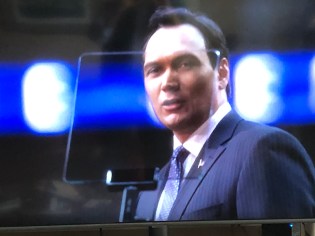 picture—you know he is not going to do what he was asked to do. How do you know that? Because there is nothing on the teleprompter. What’s a teleprompter? Well…do you see how Santos’ face is (nearly) framed by a window. It is extremely significant that there is nothing on the window. To understand how important that is, you need to know what is supposed to be on the window. Santos’ speech withdrawing from the race is supposed to be there.
 You see, Jesus adapted the parables he told based on the conventions of parable-telling. He devised these conventions by listening to parables his whole childhood and early adulthood. He liked some and didn’t like others. He saw possibilities in some that others had not seen or had not used. He didn’t start off in Mark 4 by explaining what a parable was; he began by using an established form—a popular, rather than a scholarly form—to preach to the crowds.[3]
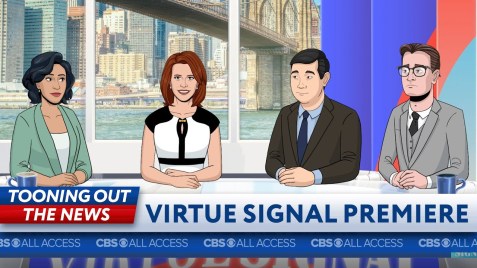 A says, in other words, “We need to do something about the callous treatment of black protesters.” B says, “Let’s talk about why you want place before the neighborhood the claim that you are a virtuous person.” A says, “Let’s talk about a public crisis.” B says, “No, let’s talk about a private motive.”
 I have lived in a society where other things were prized, however. Take purity in purchasing foods, for instance. You could be “righteous” for purchasing only virtuous goods. [3] You could be righteous by purchasing virtuous goods from virtuous stores. You could be righteous by investigating the conditions under which the food was produced and by buying only foods produced without the exploitation of workers. You could be righteous by buying food only from companies who use their profits in ways you approve.
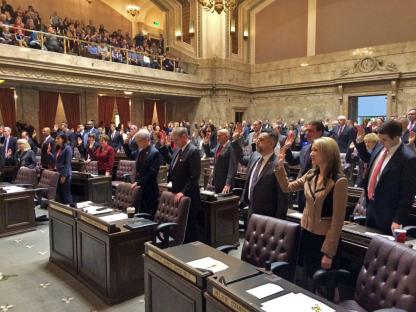 various kinds at Portland State University, there arose an interest in putting a limit on the number of terms a legislator could serve. [2] “Why do you want to do that?” I would ask the students who were advocating it. Well, they said, we want to reduce the power they wield in the legislature. Really, I said, and who do you want to have that power instead of them? Ordinarily, that caused a brief pause in the conversation.
 People who think of “government” as office holders and regulations and votes will say that there was no government in the first two settings and that it was introduced in the third. But if you think of government as a function, there is as much government in the first two scenarios as there is in the third. All the government is self-government in the first. All the government is self-government and where that fails, social government, in the second. All the government is self-government in the third, except where that fails and social government is brought in, and also except for where social government also fails and structures wielding formal coercive power are brought in.
 In societies that emphasize the power of social institutions, the power of social norms to clarify conflicts and in many cases, to resolve them, is much prized. In the U.S., we have allowed such institutions to wither. [4] In the symbolic representation I used earlier, that removes B from the A + B + C palette, so conflicts in A move rapidly to C. Individual disputes, are more and more mediated by political agencies, in other words, which are often not well-equipped to deal with them. If I saw a lot of that, I might very well argue that “that government is best that governs least,” meaning that I want less regulation of interpersonal behavior. But if I were to say that very often, it would bring me to lamenting, instead, the lack of self discipline or the atrophy of mediating institutions that requires that much government. Arguing against the constraints of government in this situation is like arguing against the constraints of a tourniquet. It brings you to wondering what the tourniquet if for.
 recognize that the white linemen are dogging it on the plays where a black man is carrying the ball. What Julius does is to relocate that grievance so that it is part of the job of his superior, the captain of the team. And what Gerry does is to accept the challenge not as a white player but as the captain. As a white player, he had done everything that can be demanded of him, but as captain, he has been complicit in the behavior of his white teammates. He has not called them for their bad football behavior (not blocking) because calling them out on that would be seen as a racial matter—and when he does it, it is seen that way. But as captain, he really doesn’t have a choice.
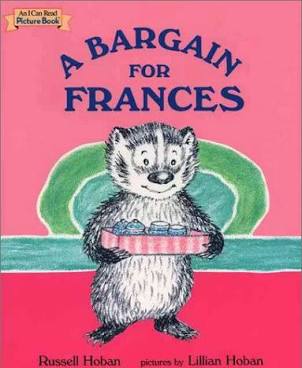 Perceiving the new relationship—as yet unnamed—Thelma says, “I can see that when I play with you, I will have to be careful.” Thelma might have meant that now each can harm the other, so at least a grudging respect, is required. Maybe Thelma meant that now that Frances has claimed the right to personhood on the same grounds as Thelma, they will have to treat each other as competitors, each taking advantage of the other when the occasion arises. Russell Hoban, the author, doesn’t speculate. He leaves that to me.
 Spies” had a recurring line that made me like him immediately.
 Consider this. Let’s say I want to put my shoulder to the common weal [4] and move us forward as efficiently as possible—but only provided that everyone else is pushing as hard as I think I am pushing. That’s why successful wars are so good for morale. First, the sense of external threat gets people to cooperate, even to sacrifice, more than they normally would. But also, there is a real reduction in monitoring just who is doing just how much. A great deal is excused in “There’s a war on, you know.” The focus on our freedom to accomplish what we intend is still being buffered by our attempt at keeping our independence.
 matter of formal separation from Great Britain seems to be pretty well in hand. “Freedom from” has been accomplished. And we are not going to accomplish much more unless we find a way to affirm and value our common citizenship. It is possible that we can come to feel a sense of pride that all Americans are receiving what they need to put together a good life for themselves and a sense of shame that some Americans are sleeping in the streets and rummaging through dumpsters for food.
