No Tickee, No Shirtee

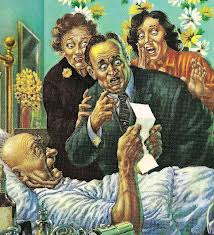
This title represents a respected—I am fighting the urge to say “hallowed”—maxim in American life.  The phrasing is taken from the stereotypical “Chinaman” who did the laundry and gave you a ticket that would allow you to identify the laundry as yours when you returned to pick it up and it is given in pidgin English so that the point can be made that however limited the laundryman’s English, he has a valid right to demand identification.  You can have the laundry you claim as yours when you present the ticket that identifies it as yours.  Otherwise, “no tickee, no shirtee.”

The New York Times this morning (see article) wrote about the indignation with which the Catholic Bishops protested the ruling of one of Germany’s highest courts that a German citizen was free to leave the church but that the church could not preventing him from attending the church services.  Here’s the description they gave.

Last week one of Germany’s highest courts rankled Catholic bishops by ruling that the state recognized the right of Catholics to leave the church — and therefore avoid paying a tax that is used to support religious institutions. The court ruled it was a matter of religious freedom, while religious leaders saw the decision as yet another threat to their influence on modern German society.

With its ruling the court also dodged the thorny issue of what happens when a parishioner formally quits the church, stops paying taxes, but then wants to attend services anyway. The court said that, too, was a matter of religious freedom, a decision that so rankled religious leaders fearful of losing a lucrative revenue stream that they made clear, right away, that taxes are the price for participation in the church’s most sacred rituals: no payments, no sacraments.

Obviously, it is that last line that tickled my Protestant funny bone.  It makes participation in the sacrament of the Eucharist something the church member purchases by his financial donation.  It commodifies the practice about which Jesus taught his disciples, “Do this in remembrance of me.” It’s disgusting.

Every organization I know of has a problem called the “freeloader” problem.  Freeloaders are people who receive the benefits of an organization without being a part of and without supporting an organization.  Labor unions are the classic case.  By demanding higher wages for their members, they raise wages for people who are not their members.  I can listen to Oregon Public Broadcasting whether I give money to the station or not.  If I listen but do not support, I am a freeloader.  Organizations do everything they can to reduce the number of freeloaders and why shouldn’t they?

But the Catholic Church of Germany does not own the sacrament of the Eucharist—not even for German Catholics.  They can’t sell it because it is not theirs.  Pretending that it is theirs, and they can price it as they please, is theologically repugnant.  Very likely, it will be impracticable as well and we may all give thanks for that.  And while we are in the thanksgiving mood, let us thank James Madison for his Memorial and Remonstrance on the subject (see document).

As is often the case, a glance at the origin of a word helps to establish a context for it.  The (barely) English Eucharist comes from the Greek eu- meaning “good,” and the verb charizesthai, “to show favor.”  The related noun charis, the source of the English charisma, means “grace, beauty, kindness.”  In all these cases, the theological setting imagines that the showing of favor is something God does.  The Eucharist is made available to us by God’s grace.  It is “grace” because it is given without reference to merit.  It is, therefore, also given without reference to means—no one is too poor to receive an undeserved favor.

The “shirtee” which the religious freeloader will have to do without includes not only receiving communion, but also making confession, serving as a godparent, holding any office in the church, and receiving Christian burial. 

Actually, I’m OK with the prohibition on office holding.  The holders of the offices of any church are the leaders and will be called on to be the exemplars of that church.  Freeloading, i.e., refusing monetary support to the congregation you are supposed to be leading, is something that ought to be prevented whenever possible, but not on theological grounds.  I think of this kind of prohibition as akin to the requirement that a candidate for office must actually live in the district he or she is supposed to represent or that citizens of a state ought to be the ones allowed to vote for their leaders.

But Christian communion?  I don’t think so.


Posted in Political Psychology, Politics | Tagged , , , | 4 Comments

Cheating

I am a teacher, so “cheating” seems like a bad idea to me, however it is justified.  On the other hand, I am a teacher of political psychology, so the way a cheater explains why he is cheating is of interest to me as well.

I don’t think I want to say that cheating is always wrong.  Here’s the way I look at it.  Cheating is a violation of trust and very often a predatory act against one’s fellow students, so I think it’s almost always wrong.  Imagine “Thou shalt not cheat” as a hurdle.  It is possible to jump over that hurdle and to justify jumping over it under some circumstances.  Not many.

We’re about to look at an entire flea market of rationalizations for cheating, thanks to Vivian Yee’s piece in the New York TimesSee the whole article here.  About each of these rationalizations, we might ask, “Is this reason so powerful that it clears the hurdle?”  If the reason is that good, we might say, we ought to allow an exception to the rule.  We keep the rule.  The hurdle is still there.  But sometimes, as this metaphor puts it, it is better to violate the norm than not to.

On the other hand, the norms aren’t random formulations.  Cheating on a test affects the cheater.  It affects those who are cheated.  It affects the school where the cheating takes place.  It affects the businesses that hire the students who have learned to cheat.  The costs of abandoning the norm, “Thou shalt not cheat,” are large beyond exact calculation, but they do not make the final decision for us.

Let’s start just by considering some of the reasons given.  These were offered by alums and current students of Peter Stuyvesant High School, “new York’s flagship public school,” according to the article.

First, let’s look at an approach that might be called “better things to do.”

A senior at Stuyvesant High School said he copied a table of chemical reactions onto a scrap of paper he would peek at in his chemistry exam. He had decided that memorizing the table was a waste of time — time he could spend completing other assignments or catching up on sleep.

Of course, assassinating the three students ahead of him for the prized scholarship might be thought of as an efficiency, too.  If there are no normative considerations to take into account, the student simply lays out his options as “things that take time” and makes his choices.  In my judgment, that one doesn’t have any promise of clearing the hurdle at all.

Here’s a second kind of exculpation.

“You could study for two hours and get an 80, or you could take a risk and get a 90.”

This notion of “taking a risk” overshadows every other notion.  “The risk” is more important than learning the material, than being fair to your fellow students, than forfeiting the self-respect that sober second thought might put in jeopardy.  Risking, apparently, is good.  Al Capone would be proud of that one.

Here’s a third kind—one that I think we need to take more seriously.

A recent alumnus said that by the time he took his French final exam one year, he, along with his classmates, had lost all respect for the teacher. He framed the decision to cheat as a choice between pursuing the computer science and politics projects he loved or studying for a class he believed was a joke.

The teacher—to combine to two grievances this rationale contains—is a joke.  “Not cheating” would appear to be a form of respect for the teacher in this way of looking at it.  You wouldn’t cheat on a good teacher because he didn’t deserve it, but a bad teacher doesn’t merit honesty from the students.  The students, of course, will be making the judgments about which courses are worth “not cheating” for.

I hear another overtone here, though.  I hear in this student a wish not to be complicit.  If good teachers are treated with respect (the students don’t cheat) and bad teachers are not (the students do cheat), then is the student making things worse by treating the bad teachers as well as the good ones?  If the students are attentive and engaged when the lecture is good and inattentive and disengaged when the lecture is bad, won’t that help the teachers to give good lectures and not bad ones?  Is pretending to be interested in a bad lecture, being complicit?

As someone who makes his living by lecturing to students, I will say that I no longer believe students can tell the difference between a good lecture and a poor one.  Without question, they can tell the difference between one that is entertaining and one that is not.  The use of the complicity standard might put more of a burden of judgment on the students than they can reliably carry.

In a fourth kind of exculpation, several framed the collaboration as banding together against a system designed to grind them down.

This is a serious charge against the system.  Stuyvesant is a very competitive school.  The students knew that when they applied.  That means that a few will achieve the top honors and the rest will not.  Failing to achieve top honors may be stressful; it may be embarrassing; it may compromise the future you had planned.  None of those are “designed to grind them down.”

“Grind them down” doesn’t have to do with merit; only with the ability to endure punishment.  When the system has no reason for its demands—and “grind us down” refers only to the experience of the system, not to the rationale for it—then subverting it is appropriate in the way that cheating on the bad teacher is appropriate.

And, fifth, if “the system” is the enemy, why should you not help your friends instead.  Refusing to cheat is, in this picture, only a way of collaborating with the enemy.

“It’s seen as helping your friend out,” Daniel Kanovich, 17, a senior, said. “If you ask people, they’d say it’s not cheating. I have your back, you have mine.”

I have to admit that I like the sound of that language.  There is in it the kind of everyday heroism that soldiers in battle speak of.  The enemy is there, but we protect each other.  We are comrades.

Before we give up, let’s turn the corner and look at one more assessment.

 “We all want to prove that Stuy is one of the top schools in the city,” said Rachel Makombo, a freshman. “We don’t want to be looked at as a cheating school.”

Ms. Makombo starts from a different place.  Everyone benefits from Stuyvesant’s reputation.  It has always meant something to be a Stuyvesant grad.  If you got through the program at Stuyvesant, you are worth taking a risk on; you are worth hiring; you are worth admitting.  If, on the other hand, what you are getting from Stuyvesant is students who know how to cheat, but not how to work, everyone suffers.  All the graduates suffer; both those who cheated and those who refused to.

In this light, the cheaters are parasites.  Cheating is effective because only a few do it.  It is like standing on tiptoe in a crowd.  It works if you are the only one who is doing it.  The cheater gets a better relative placement in his class and still gets the benefit of the Stuyvesant reputation and he gets that courtesy of all the students who refused to cheat.

That seems powerful to me.  The guy who has his buddy’s back is a parasite as well as a friend.  The student who thinks only good teachers deserve honesty in their students is a parasite, though it may be a fear of complicity that has driven him to it.  The guy who thinks of cheating as a good way to get time for a nap is a jerk.


Posted in Education, Political Psychology | Tagged , , | 3 Comments

The Battle of Favorite Aunts

David Brooks and Paul Krugman are at it again.  I’m not as surprised as I was the first time I noticed it.

This is an odd kind of disagreement.  Imagine that you and your wife are visiting the home of two elderly aunts.  Your young daughter comes into the room with a ball of yarn.

“Isn’t this yarn a beautiful color?” says the child. 

“Oh, yes,” you say, “And mauve is one of Aunt Ella’s favorite colors.”

“No, no,” says your wife, “That’s forest green.  One of Aunt Margaret’s favorite colors.”

This is a disagreement.  It is packaged so as to appear to be a disagreement about what color the yarn is.  It is, in fact, a disagreement about which aunt’s sensibilities need more to be catered to at the moment.  You and your wife are not colorblind, as an uninformed observer might think, but you do have different judgments about the feelings of the relevant parties.  Let’s look at it this way.

“Isn’t this yarn a beautiful color?” says the child.

“Oh yes,” you say, “And remember how important it is to reassure Aunt Ella about how much we care for her.  She just got some very bad news from her doctor, remember.”

“Oh no,” says your wife.  “Aunt Ella doesn’t care a lick about little preferences like that and Aunt Margaret does.  Besides, you can see, just by looking, that Aunt Margaret is in a lot of pain right now and playing the “favorite color” card is the humane thing to do.”

If we were to extend this (I’m not going to) it is easy to image the beginning of the next round going like this.

“What is with you and Aunt Margaret?  You are always soooo sensitive to her every mood and you don’t care as much about Aunt Ella.”

“I do care as much about Aunt Ella, but you simply can’t load every situation in her favor without Aunt Margaret noticing.  She isn’t as dumb as you say she is.”

You see where that’s going.  Does it sound familiar?

My observation today is that the persistently discrepant observations of David Brooks and Paul Krugman are like the first round of the argument.  They are disagreeing, certainly, but they are not disagreeing about what they seem to be disagreeing about.  This is not a fight about the merit of the two approaches to Medicare and deficit reduction.  This fight is about whether David Brooks’ favorite aunt should be catered to (Republicans—moderates, where available, but Republicans for sure) or Paul Krugman’s favorite aunt, a Democrat.

There are other differences between them, of course.  Brooks writes about political culture when he can.  Krugman writes about economics all the time.  Brooks honors personal intention whenever possible; Krugman focuses on systemic effects whenever possible.

Judge for yourselves.  Here is Brooks’s column. Here is Krugman’s.  Krugman says Paul Ryan’s plan is an illusion.[1]

What Mr. Ryan actually offers, then, are specific proposals that would sharply increase the deficit, plus an assertion that he has secret tax and spending plans that he refuses to share with us, but which will turn his overall plan into deficit reduction.

If this sounds like a joke, that’s because it is. Yet Mr. Ryan’s “plan” has been treated with great respect in Washington. He even received an award for fiscal responsibility from three of the leading deficit-scold pressure groups. What’s going on?

The answer, basically, is a triumph of style over substance.

OK.  I get that.  On the other hand, according to Brooks:

If you believe entitlement reform is essential for national solvency, then Romney-Ryan is the only train leaving the station.

And why is that?  The reason is that addressing really big problems requires passionate commitment.  Who has the passion for entitlement reform?  Not Obama:

He [Obama] had the courage to chop roughly $700 billion out of Medicare reimbursements. He had the courage to put some Medicare eligibility reforms on the table in his negotiations with Republicans. He created that (highly circumscribed) board of technocrats who might wring some efficiencies out of the system.

Still, you wouldn’t call Obama a passionate reformer. He’s trimmed on the edges of entitlements. He’s not done anything that might fundamentally alter their ruinous course.

Romney and Ryan, on the other hand.

When you look at Mitt Romney through this prism, you see surprising passion. By picking Paul Ryan as his running mate, Romney has put Medicare at the center of the national debate. Possibly for the first time, he has done something politically perilous. He has made it clear that restructuring Medicare will be a high priority.

This is impressive. If you believe entitlement reform is essential for national solvency, then Romney-Ryan is the only train leaving the station.

Here’s where we come out, imagining that Brooks and Krugman are talking about the same thing in the sense that the husband and wife are really talking about the color of the yarn.  Krugman says Ryan’s plan is an illusion and a con job.  Brooks says it is the only train leaving the station.

This isn’t about Medicare savings and entitlement momentum.  It isn’t, that is to say about the color of the yarn.  This is about whether Aunt Ella or Aunt Margaret is to be preferred, given that in this instance, you must prefer one of them.

If Brooks and Krugman ever lined up their argument so that it was about the same thing and measured by the same metric, then someone would be right and someone would be wrong.  They aren’t going to do that.  It’s going to be yarn color v. favorite aunt from here until November.


[1] Actually, it is a chimera but I don’t want to scare the children.

Posted in Political Psychology, Politics | Tagged , , , | Leave a comment

Deathbed Confessions

I’ve been thinking about deathbed confessions.  I’m feeling fine, thank you for asking, but I’ve begun to wonder what such a thing might mean.  The game, as I have heard it described in a hundred bad novels and maybe a few good ones, goes like this.  God is good-hearted and endlessly forgiving.  I live a life permeated by cruelty and greed—a life for which I deserve eternal punishment—but not to worry: at the last moment, I can confess my sins, receive absolution and gain everlasting bliss.  That’s how the game is played.

Crime show deathbed confessions are a lot easier.  I committed a crime but was never caught.  Someone else was convicted of the crime and is now in prison.  On my deathbed, I confess to the crime and give evidence that will cause the police to believe me and the court system to release the patsy who has been serving my time for me.  Except for the banality of the plot device, I’m fine with that as a practice.  The dying man provides information and the living use it to achieve a much-delayed justice.

The religious deathbed confessions are more troublesome.  I think that’s because I have a much less malleable notion of what prayer is.  Can you really pray what you want, when you want?  I don’t think so.  You can say the right words, of course, but does anyone think that the words and the prayer are the same thing?  Surely not.

A prayer is a meaning, an intention, and appeal, put into words.[1]  It’s the appeal which takes form as words that makes it a prayer.  It isn’t just the words.  So now the question for someone who has this game in mind is, “Are you really sure you can intend an appeal for mercy at just the right time?  I don’t know about you, but I have gone into a lot of situations hoping that I would have my heart in the right place—to truly hope, for instance, that a meeting I opposed would succeed—only to find that I was not able.  Inside, I still wanted the meeting to fail and for my own judgment to be vindicated.  If I was asked to give a welcoming speech, I am sure I would have said that we all hope for the success of this meeting.  But words are not intentions and whatever I said in the welcoming speech, I am NOT yearning for the success of the meeting.

So not only is it true that “You Can’t Always Get What You Want,” but you can’t even always want what you want.  And if you can’t, then you can’t slip in a deathbed confession at just the right moment.  If there are any actual, as opposed to literary, persons who are counting on working this game, they might be advised to think it through a little more.


[1] Or not put into words.  Silent prayer is not hard to understand as a concept.

Posted in Living My Life | Tagged | Leave a comment

Walter Possum’s Apprenticeship

If our fathers are around, we learn from them.  That’s pretty much how it goes.  We learn good things and bad things.  We learn character and settled habits and gestures and verbal tics the father himself doesn’t even know about.

Today is an appreciation of a Russell Hoban book I have discovered only recently.[1]  I knew his stories about Frances the little badger, but apparently he warmed up on possums and Walter is a kind of early Frances.  The same wise father and nurturing mother and obnoxious younger sister are all there, but they are all possums.[2]

Here is the line I am aiming for: Listen, Charlotte, I have something for you.”  How did we get to that line?

Charlotte is Walter’s obnoxious little sister.  On this day, she has been following Walter and his buddy Kenneth around and complaining that she is not allowed to join in the activities.  What Walter has for her is a very special stick.  It is special because Walter has decided it is special.  He decided that because he knew the trick he had in mind wouldn’t work unless Charlotte had some reason to believe it would work.

Here’s how the stick works.  It is a play-right-here stick.

 “What does it do?” says Charlotte.

 “Look,” said Walter, “you stick it in the dirt and then you look all around it and you find all kinds of things to look at so you can[3]play right here.” [Italics in the original]

Walter demonstrates.  He plants the stick in the ground, lies on the ground, and looks at the grass and dirt around the stick.  He sees an ant carrying a really huge bread crumb.  Charlotte tries it.  She sees a grasshopper.  She plays right here and Walter and Kenneth go off by themselves and play in an apple tree.

That may seem like a simple con job, but it is not.  It is a con job, certainly, but it is not simple.  That act is the first positive action Walter has taken toward anyone unless you count his tussling with Kenneth.  “Listen, Charlotte, I have something for you” is a new direction in Walter’s life.  It is proactive, imaginative, and generous.  Walter’s life is truly launched.  He is acting on the world and making it better.  And just a few pages ago, he was a bored little possum.

Today’s question is: How did Walter get to that place?  He learned from a master.  That is, after all, what apprentices do.[4]    In the story up to this point, Walter has been exactly the kind of nuisance to his father that Charlotte is to Walter.  Walter has “Nothing to Do” and believes, for reasons Hoban does not explain, but that will not be mysterious to any parent, that his father ought to do something about that.  But being a father, the father’s problem is not just to get Walter off his back for a little while, but to make Walter a master of the “Something to Do” skills.  That is what masters do for apprentices and, occasionally, fathers for sons.

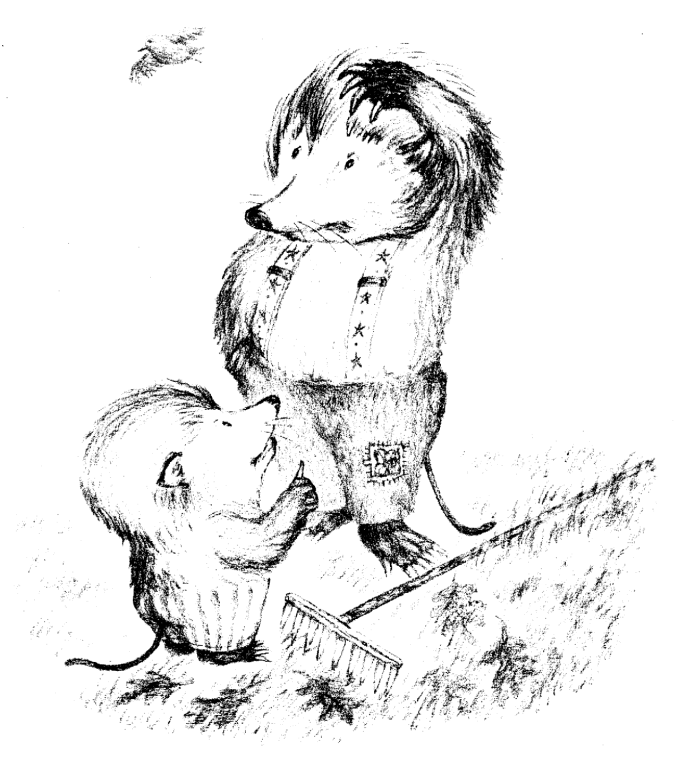
How does he do that?  There are three steps.  In the first, he refused to own Walter’s problem.  The problem is never, of course, that there is nothing to do.  The problem is always that you are not interested in what there is to do.  Father gave Walter the task of raking leaves, in response of one of Walter’s complaints, but Walter discovered that “raking leaves is not really something to do.”
In the second, he gives Walter a magic stone that he found in the river the previous night.  It is magic for precisely the same reasons that Walter’s stick is magic: it won’t work if it isn’t magic.  It’s a “something to do” stone.  It always works if you use it correctly, but the stone, unlike the “play right here” stick, requires a little training.  The crucial aspect of the training is ruling out other explanations. 

The training in the use of the stone is step three.  Here’s what I mean.  When the stone doesn’t work, the reason is not to be sought in the intentions and desires of the user.  Nor is it to be sought in the inappropriate character of the activity itself.  That means that both “You shouldn’t want to do that” and “That’s not a good thing to do” are out.

We do not want to talk about things you want to do that you should not want to do.  You can’t focus on the stone and do that at the same time.  We do not want to talk about the inappropriateness of the activity.  You can’t focus on the stone and do that at the same time.  So the “right answer” is always something to do with the use of the stone.

I confess that this section of the story is the one I loved first.  The point Hoban makes here was the point I was trying to make in my doctoral dissertation, which was a good deal longer than Nothing to Do.  Look at how this gets done.

“Listen, Walter,” he said, “I have something for you.”

“What is it?” said Walter.

“It’s a something-to-do stone” said Father.

Everybody recognize the quote?  This act of Father’s is proactive, imaginative, and generous.  Sound familiar?  Here’s the training.  “You keep it in your pocket and when you have nothing to do, you rub it.  You have to look around and think while you’re rubbing it, and then the stone give you something to do.”

Walter rubs the stone and gets an idea.  He’s going to go into the living room and play with his erector set.  He knows very well that the reason he and Father and Charlotte are outside is that Mother is cleaning the house and no one is allowed to be there.  But, following the training rules, playing in the living room cannot be a bad thing to do and Walter cannot be a bad little possum for wanting to do it.  Those are, in my line of work, “causal attributions” and if you don’t block off the bad ones, you lose access to the good ones.

“You were too close to the house when you rubbed the stone,” says Father.  “Let’s try it again, further away.”  If Walter is to become a master in using the stone[5] bad choices need to be explained by how the stone works.  They cannot be explained by how bad the idea is or how perverse the chooser is.  IT’S ABOUT THE STONE, STUPID!

On his second try, Walter tries, “I want to go to the store and get a rubber ball so I can bounce it.”  That’s not good either, as Father explains, because it is a “costs money” thing to do.[6]  Again, there is nothing wrong with Walter’s intention and there is nothing wrong with the activity.  What is wrong is an improper use of the stone.

“That’s a costs-money thing to do,” said Father.  “You were standing too close to the pocket where I keep my money when you rubbed the stone.” IT’S ABOUT THE STONE, STUPID!

On Walter’s third try, he says, “I think I know where to find an old ball that I lost. I’ll go look for it.”  The stone works, you see.  He found the ball and played with it for a while.  When he got tired of bouncing the ball, he rubbed the stone again.  When you have nothing to do, remember, you rub the stone and look around and “it gives you something to do.”  That’s what makes it such a wonderful gift.  You don’t have to find something to do yourself.  It’s not bad to have nothing to do if you have a stone that will give you something to do.  You are not a bad little boy if you have nothing to do—if you have a stone that will give you something.  And if you use it properly—not too close the wallet, not too close to the house—it always works.

Those are the three steps.  Refuse to own the problem.  Give the magic stone.  Train the apprentice in the proper use of the stone.  That is how Walter came to learn how to use the stone and to trust the stone.

There is one other event, however.  Even when he can use the stone and can benefit from that use, Walter is still only a learner.  Father wants him to be a master, but to do that, Walter woulod have to see the process whole, the way Father saw it.  He would have to refuse to own someone else’s problem.  He would have to devise a magic gift.  He would have to train someone in the proper use of that gift.  He would have to do just what we saw him do when he saw the need, invented the play-right-here stick, and taught Charlotte how to use it.  Walter is going to have to say, “What was it that caused Father to invent the something-to-do stone and to endow it with magic properties?  Oh yeah.  It was me.  I kept pestering him.  Hey, I know what….”

I do have a private fantasy, though.  I don’t know anything at all about Charlotte.  I don’t know if she can get the hang of giving the magic gift.  But somewhere in her future, I want to hear her say to one of her friends, “Helen, I have something for you.”


[1] I’m thinking about his children’s books. This one is Nothing to Do. New York: Scholastic Book Services, 1964.   When he started writing adult fiction, he wrote some very hard-edged things, especially a post-apocalyptic novel called Ridley Walker.

[2] Opossum, actually. It is an Algonquin word meaning “white beast.”

[3] Note the verb.  With the stick, Charlotte CAN do this.  It is a newly opened ability.  The verb Walter chooses shows no interest in whether Charlotte wants to do this.

[4] Or disciples, if you want to follow the “learning” route rather than the “conquest” route.  Our word apprentice came mean “learner” only by means of a metaphorical extension..  The root is prehendere, “to seize.”  It came to mean “to seize with the mind,” i.e., to apprehend.  We can still see that in comprehend.  Disciple comes directly from discere, “to learn.”

[5] I’m thinking, maybe, lithotect.

[6] Giving kids money so they can “entertain themselves” is a common—probably an increasingly common—tactic of parenthood.  It carries several problems with it however.  If you are the source of the money, you are still the solver of the problem.  The child comes to you for money rather than for ideas.  That’s not much of an improvement.  The second is that it teaches the child that he is never short of imagination and resourcefulness, only of money.  That is not a useful lesson either.  If you teach those lessons, you are not a master and do not deserve an apprentice.

Posted in Books, Political Psychology, ways of knowing | Tagged , , | Leave a comment

The Mosque in Murfreesboro

I tried to find a picture of Dan J. Qualls.  Here’s the way the New York Times described him

Only one opponent of the mosque came to voice his concerns at the opening [of the local mosque], a former auto plant worker wearing an “I Love Jesus” hat and a Ten Commandments shirt.

Then I decided it didn’t really need a picture; the words are pretty graphic.  Most of the people I talk to regularly would not wear either the shirt or the hat and most especially would not wear either in opposition to the opening of a non-Christian place of worship.  I wouldn’t either, of course.  That’s partly why I hang out with those people.

The easiest way to condemn Mr. Qualls is to call him a hypocrite, but I’m not sure that’s the best way to respond to his discontent.  The case for  comes from the hat and the shirt.  The Ten Commandments, for instance, comes from a tradition that is quite outspoken about the duty of hospitality, especially toward the stranger and the foreigner.  The closest Jesus ever came to Mr. Qualls confrontation with a mosque is probably his encounter with the Samaritan women given in the Gospel of John.  In that exchange, Jesus said, “Neither your religious traditions or ours are worth disputing over because God is in the process of moving the notion of “worship” to a level we have never even dreamed of.[1]

But a “hypocrite” is a play-actor.  It is a word from Greek theater (hypokritēs) and it means “playing a part.”  Jesus sometimes castigated the Pharisees for hypocrisy on the grounds that their religious observances were not genuine piety, but only good theater.  But what part is Mr. Qualls playing?  He said he heard about the opening of the mosque on the TV news and decided to “come out and represent the Christians.”  Is that a religious act?  Or is it more tribal or maybe ethnic.  It is a demographic group he is representing.  The teachings of his faith—either the hat or the shirt—seem beside the point.  He is there to represent the interests of his group, not the teachings of his group.

On the other hand, Mr. Qualls’s comment seems pretty small potatoes.  “My honest opinion is, I wish this wasn’t here.”  I’m OK with that.[2]

On the other hand, vandals have spray-painted “Not Welcome” on the construction signs and have set fire to some of the equipment.  At a public hearing, residents testified that Islam is “not a religion” and that Muslims are trying to overthrow the Constitution.  A local Republican candidate for Congress tied the center to Hamas, which is a terrorist organization and the freely elected government of Gaza. Robert E. Corlew III ruled that the county had not given sufficient notice of the public hearing and stopped the building permit.  The Islamic Center of Murfreesboro and the Civil Rights Division of the Justice Department filed separate lawsuits asking the Corlew’s ruling be set aside. 

That’s what else was going on in Murfreesboro and it is what makes me think that Mr. Qualls lament—the ball cap and the tee shirt aside—is not what we have most to worry about.


[1] Had Jesus been speaking Arabic, rather than Aramaic, he would have said that this is something Allah was doing.  “Allah” is a linguistic marker, not a theological one.  “Allah” is the Arabic word for the God of Abraham, Isaac, and Jacob.

[2] The Constitution guarantees freedom of religious expression.  It does not specify that others need to be happy about it.

Posted in Political Psychology, Politics | Tagged , , | Leave a comment

Conscientious Objections to Instruction in Biology

Somewhere, I read about a small political kerfuffle at the zoo in Topeka, Kansas.  Some religious conservatives took offense because the signs and displays at the zoo all took “the theory of evolution” for granted and they wanted “creationism” to be given equal time.  So they elected a majority of the board from their movement and began designing “creationist” displays.

The way I heard the story, every religious faith represented in the Topeka area showed up with its group’s creation myth.[1]  It turns out there are dozens of creation myths, even in an area where white Protestants are a substantial majority, and the zoo board had no way to accept some and reject others.  Verifiability is not the strong suite of creation myths, you see.  So the board gave up and I expect that if I visited the Topeka Zoo today, I would see evolution presupposed in the signs I read.

Two days ago, the voters of Missouri passed an amendment to their constitution.  It was not a squeaker.  Here’s a clip from Tuesday morning’s Kansas City Star: “With all but two precincts statewide counted, 779,628 voted yes on the measure and 162,404 voted no, roughly a 5-1 margin.”[2]

This was not good news for the Kansas City StarHere was their advice to Missourians about this measure:

 MISSOURI CONSTITUTIONAL AMENDMENT 2

What it does: Unnecessarily reaffirms the right to prayer in public and private settings; requires schools to post the Bill of Rights; violates the Constitution by allowing sectarian prayer to open government meetings; allows public school students to not participate in instruction if they claim it violates their religious beliefs.

Our recommendation: An emphatic “NO.” Amendment 2 is unnecessary, would lead to costly litigation and cause problems in schools.

It might help us to know that this was marketed by its supporters as the “right to pray” amendment.  Anybody here opposed to students having the right to pray?  I thought not.

Notice, however, the phrasing of the Star’s description of the effects of the amendment: “allows public school students to not participate in instruction if they claim…”  No finding is needed, no task force is convened, no curriculum adjusted.   The student claims that some kind of instruction violates their religious beliefs.  I, myself, have serious religious objections to any math beyond algebra.  Higher math is a sin for the same reason raising the Tower of Babel to the heavens was a sin.  The heavens belong to God and “higher mathematics” is part of the all too human desire to put ourselves in God’s place.  Or so I could argue if I lived in Missouri.

All fun aside, the aim of this amendment is to excuse students who believe in creationism from instruction in evolutionism, i.e., in biology, geology, astronomy, comparative anthropology, and other disciplines.  Under the current conditions of mistrust, the old idea of curriculum as something that “broadens” the mind has become a gauntlet of conscientious objections.  Courses that once had integrity—the structure of the course moved from orientation to methods to principles to applications—will now be more like libraries.  You wander in and find the books that appeal to you.

This is to be lamented as a trend, it seems to me, but there are some practical considerations as well.  Presumably, the state and federal achievement measures will continue to ask what the students know about the fragments of biology, geology, astronomy, and comparative anthropology that they covered in their classes.  Will creationist answers be accepted as well as evolutionist answers?  Will the conscientious conservatives be tested on courses they have not taken?  Will the “equal protection of the laws” clause of the 5th and 14th amendments protect equally those who have learned secular biology and those who have learned what the religious objections are to secular biology?

When you get to the assessment phase, it seems to me, all the options are bad.  “Show me” what you know is the assessment end of the curriculum and I think the “Show me” state has just painted itself into a corner.


[1] Not using the word myth in any pejorative sense.  A myth is true or false in the same way “The Hound of the Baskervilles” is true or false.  It’s not a claim; it’s a narrative framework.

[2] I wish it had been closer because my brother and his wife live in Missouri and they wasted their day seeing medical people rather than voting on this amendment.  What I really wanted was for this amendment to have won by exactly two votes

Posted in Education, Politics | Tagged , , , | 4 Comments

Chik-fil-A

So here’s an interesting question: “Do we really want our political lives and our commercial lives to be so wholly intermeshed?”  It turns out that some do and some don’t. 

Here’s an answer that is closer to what it looks like where the boots are on the ground: “I don’t want our civic lives to be in constant turmoil, but it is only right that I retaliate as best I can against a firm that opposes my interests.”  That’s an answer both ugly and common, so let’s think about it a little.

The question comes from Jonathan Merritt, son of the former Southern Baptist Convention president, James Merritt.  Here is a small collection of answers.  I will prefix the answer to the question before the quote.  Gov. Thomas Menino of Boston, “(Yes) I urge you [Chick-fil-A] to back out of your plans to locate in Boston.”  Mayor Edwin Lee of San Francisco, “(Yes) Closest Chick-fil-A to San Francisco is 40 miles away and I strongly recommend that they not try to come any closer.”  The Reverend Billy Graham, “(Yes) As the son of a dairy farmer who milked many a cow, I plan to ‘Eat Mor Chikin’ and show my support by visiting Chick-fil-A on August 1.”[1]

Not much of a collection, is it?  Everyone seems to want to preserve the right to retaliate.  I’d like to put this non-debate in context.  The answer I provided above—it is only right that I retaliate as best I can—is a common answer, but I don’t think it is a good answer.  For one thing, no one thinks the level of public incivility we are experiencing is a good idea.  People do think, however, that the other side is doing it and so we have to do it too.  The effect on the present issue is what we focus on; the effect on the way we discuss politics in this country (the growing incivility) is in the background.  It is always in the background.  That is why we do what we do with our eyes on the present issue only.[2]

So my first point is that we are choosing “constant turmoil,” as I said above, without even noticing that it is not what we want.  Second, I would like to point out, as a liberal, that conservatives are always going to win an argument about morals.  There are more conservatives and moral issues are more highly salient, and they define morality as the good, itself, rather than as “freedom to choose,” which is the liberals’ notion of “morals.”

Dan Cathy, whose family owns Chick-fil-A, says he endorses “the biblical definition of the family unit.”  We could quibble, of course, about whether there is a biblical definition of the family unit and in what part of the Bible it might be found, but that’s not where I want to go.  I want to ask what the liberal definition of the family unit is and why it is good.  The answer, I think, is that we don’t have one and we don’t argue that it is good.  What we want to protect is freedom of choice—especially, in the present context, for gays and lesbians—and we think the question of whether it is “good” is beside the point once the “right to choose” has been granted.[3]  So my point, again, is that if the argument is about morals, the conservatives will win it.  For liberals to win it, it has to be about freedom of choice.

Third, this is not a freedom of speech case. It is not about Chik-fil-A’s notoriously bad spelling, as in the famous ad.  Chik-fil-A is not preaching about conservative issues like abortion and gay marriage; they are actively funding events and organizations that have the twin goals of making abortion unavailable and gay marriage illegal.  I think it would be a lot more direct to oppose each and every use of Chik-fil-A’s money for those purposes than to retaliate against the company.  Donating money to make abortions unavailable to women who want them, or whose doctors advise them, can reasonably be characterized as a restriction of freedom of choice.  Liberals are going to win a freedom of choice argument, provided it is about morals, say, rather than pollution.  When liberals go after the conservative companies like Chik-fil-A, they are shifting the argument back to morals, where we will lose.

Finally, there is the slippery slope argument.  I want to boycott Chik-fil-A because I don’t like what they do with their profits.  Fine.  Do you know what your life insurance company does with its profits?  Your dry cleaners?  Your running shoe manufacturer.  Do any of those guys pollute?  Pay their workers too little?  Maintain bank accounts in the Caymans?

That’s the slippery slope.  It is one thing to oppose a prominently political company like Chik-fil-A, but how do you draw the line so you don’t have to know just what the carbon footprint is, for instance, of anything your buy or the political investments of any firm you patronize.  I don’t know those things myself and I don’t want to have to learn them.  If Chik-fil-A makes a really good chicken sandwich and if I really like chicken sandwiches, then I have no problem at all about going there to get one.  If you have a problem with it, there are some questions about the products you buy and the firms you patronize that we are going to have to get into.

I know you don’t want that.


[1] The Reverend Doctor Graham has allowed his publicity machine to use an ambiguous pronoun.  That happens sometimes.  Did his father, the dairy farmer, milk a lot of cows?  Did he, the son of the dairy farmer, milk a lot of cows?  Both, probably, but you can’t tell from the statement.

[2] It is impossible in politics, as much as in ecology, to swoop in and change one thing, leaving everything else the same.  You kill a noxious pest—this is not a partisan reference—and you kill whatever ordinarily eats that noxious pest.

[3] Following the same logic, gun enthusiasts think gun-related homicides are beside the point once the right to own, carry, and use guns has been established.

Posted in Politics | Tagged , , , | Leave a comment

Guns and Politics

A gunman stood up at a Batman movie in Aurora, Colorado and killed 12 people and injured 58 others–as many people as he could with the time he had and the arsenal he brought into the theater with him.  David Brooks’s response (here) comes down to this: “The crucial point is that the dynamics [of mass killings like this one and the others he cites] are internal, not external.”

Puh-leese!

Is there something we can do to better protect our citizens from the rapidly increasing chance that they will be slaughtered by someone with guns and grievances?  Brooks’s answer is yes: there are two things we can do.  First, we can have closer relationships with each other.

It’s probably a mistake to think that we can ever know what “caused” these rampages. But when you read through the assessments that have been done by the F.B.I., the Secret Service and various psychologists, you see certain common motifs.  Many of the killers had an exaggerated sense of their own significance, which, they felt, was not properly recognized by the rest of the world. Many suffered a grievous blow to their self-esteem — a lost job, a divorce or a school failure — and decided to strike back in some showy way.  Many had suffered from severe depression or had attempted suicide. Many lived solitary lives, but most shared their violent fantasies with at least one person before they committed their crimes.

I think it is a wonderful idea to be more social and inclusive, but here is what is not going to happen: we are not going to “recognize” the significance of these people in the way they think is deserved; we are not going to prevent grievous blows to their self-esteem; we are not going to prevent them from living “solitary lives;” we are not going to have everyone who hears a friend vent a violent fantasy contact the police.

We are, in short, not going to prevent people from having grievances.  But does that mean that we can do nothing to prevent these grievances from becoming the occasions for mass slaughter?  I don’t think it does mean that.  Brooks tries to show that there is nothing we can do by citing a study by the Centers for Disease Control and Prevention to the effect that gun control laws are not effective.  I don’t think that works.  I haven’t seen the study he cites, but I’m pretty sure it compares states with stricter gun control laws to states with more lenient gun control laws.  I can see why no effect is shown in that comparison; indeed, it would be remarkable if any effect at all could be discovered.

Here’s another look.

The United States has by far the highest rate of gun deaths — murders, suicides and accidents — among the world’s 36 richest nations, a government study found.  The U.S. rate for gun deaths in 1994 was 14.24 per 100,000 people. Japan had the lowest rate, at .05 per 100,000. The study, done by the Centers for Disease Control and Prevention, is the first comprehensive international look at gun-related deaths. It was published Thursday in the International Journal of Epidemiology. 

This quotation and the next one can be seen here.

Maybe comparing economically developed nations with a lot of gun violence to similar countries with only a little would be a help.  Brooks tries to head that off by mentioning mass killers from elsewhere: Ernst Wagner in Germany (1913), Robert Steinäuser (Germany), and Anders Breivik (Norway).  These have nothing to do with aggregate statistics, as Brooks knows.  The figures for gun deaths per 100,000 of population are Norway 2.22, Germany 1.16, and the U. S. 9.46.  Does Brooks really think that the gun laws of these countries are unrelated to the rate of gun deaths?  I don’t think he does think that.

He might be thinking that it is the gun culture—not the laws—that account for such high homicide rates here in the United States.

The CDC would not speculate why the death rates varied, but other researchers said easy access to guns and society’s acceptance of violence are part of the problem in the United States. “If you have a country saturated with guns — available to people when they are intoxicated, angry or depressed — it’s not unusual guns will be used more often,” said Rebecca Peters, a Johns Hopkins University fellow specializing in gun violence. “This has to be treated as a public health emergency.”

Brooks and I know that you can’t change a cultural feature by making laws about it.  On the other hand, the laws are not irrelevant to the direction the culture takes.  Our “acceptance of violence” is part of the culture, as Rebecca Peters says, but the availability of guns is part of the politics.

Brooks’s second solution is to be more aggressive in our provision of “treatment options,” especially for young men.  I think that would help, but what is he thinking people are going to be “treated” for?  Massacring without a license?  Oh…wait.  You don’t have to have a license for that.  “Treated” doesn’t sound like prevention to me.

As long as we have angry loners with guns, we will have attention-seeking killings.  Nothing the government can do will directly affect how many people are angry.  Nothing the government can do will directly affect how many people are loners.  No one is going to murder a dozen people in a theater with a switchblade.

Any ideas, David?


Posted in Politics | Tagged , , , | Leave a comment

Public Porn

The two most common responses I have heard to protests against pornography are these: a) it doesn’t hurt anybody and b) what they (the consumers of pornography) do in the privacy of their homes is nobody’s business. The New York Times this morning ran a story called, “He’s Watching That, In Public?”  You can see the whole article here.  There aren’t any pictures in the article, but I have added a few that I liked, as you see.

The best place to begin is the experience of Dawn Hawkins, executive director of a group called Morality in Media.  She was on a plane several months ago and noticed that the man in the row in front of her was engrossed in the images on his iPad.  These were images of naked women whipping each other.

He was consuming pornography “in public.”  What is public?  Let’s imagine that he was looking at these pictures on cards the size of playing cards and holding them discretely in his lap so that only he could see them.  That’s “public” in the sense that he is doing his viewing in a public place, but it is not “public” in the sense that it couldn’t be dealt with simply by not paying attention to it.  It is not different in kind, it seems to me, that his reading a pornographic novel.  On the other hand, let’s imagine that he was viewing these erotic flagellants on a 15 inch computer screen.  It’s going to take some effort “not to notice” for people in the periphery of the viewing area.  For the person in the next seat or in the several seats behind him, no effort is going to be enough.  I think that is “public” in another sense.

There are people who are going to want to treat this story as if pornography were wrong and should be prevented or punished.  I don’t know quite how I feel about pornography as a moral matter because I don’t really know (see option a, above) how directly people are affected by it.  I am going to treat it as an offense against one’s “fellows.”

One’s fellow what?  Well, in the San Francisco library people have been using the library computers to access pornography.  If this is a violation, it is a violation of their “fellow patrons.”  The library responded by putting plastic hoods over the monitors so only the person using the computer can see what is on the screen.

On the road in New Jersey, we are talking about one’s fellow travelers.[1]  State Senator Anthony Bucco has introduced a bill that would ban porno on seat-back DVD players.  These players are oriented so that other drivers could plausibly be distracted by them.  The people in what I called “the viewing area” on the plane are fellow travelers as well.

At the Café Ponte in San Francisco, where customers come to surf the web, they would be fellow diners (companion is the Latin version of that) and compotadors if they drank anything.[2]  Bruce Ponte, the owner, says “This is an internet café.  People come here to surf.  Am I supposed to do something about that?”

Let’s imagine that I have established that the public viewing of pornography—I have defined “public” as a viewing that can be avoided by one’s fellows only by heroic effort—as a bad thing.  What to do?  Dawn Hawkins complained about the fan of erotic flagellation on her place and was told by the flight attendant that he was powerless to force the man to stop.  That might be literally true—“forcing him”—but it seems reasonable that he was not powerless to ask him to stop.  The Association of Flight Attendants says that its members want to avoid offending passengers or playing the role of censors.  I’ll bet they do.  But if one of the people on the plane is doing something offensive, then people are being offended and the flight attendants are going to have to choose a course of action.

Starbucks, which always seems to find a way to manage these things, says it does not censor the use of its Wi-Fi, but it does reserve the right to ask someone not to view material that might offend patrons or employees.  That seems like a good approach to me, but let’s looks at one that is a lot better.

Lewis Goldberg, 42, a partner in an investor relations firm in New York, occasionally watches shows like “Mad Men” or “Game of Thrones” on his iPad when he works out at the gym. But he fast-forwards through sexual or particularly violent scenes.  “There’s a woman jogging behind me on the treadmill and I don’t want her to fall off,” he said. “I’m bringing my media into a public space, and it’s part of my responsibility in a civil society.”

That’s the approach the most sense to me.  It doesn’t ask why Goldberg is watching shows in public that have sexual or particularly violent scenes.[3]  It focuses on his sense that he has a responsibility to others and it gives as an instance one way he enact that responsibility.   And this is what conservatives always say.  If we have people of sensitivity and social responsibility, “fixers” will not have to be called in: not the library or the airlines and certainly not the legislator.  I’d have to say that in this case, it is the conservative stand on managing what “public” means that makes most sense to me.


[1] This is perhaps the most nearly innocuous use of “fellow traveler” I have ever seen.  When I was growing up, it was a very substantial political charge.

[2] I made than one up, but you have to admit it is plausible since potare = to drink and com- means “together.”  Companion uses the same prefix and substitutes panis = bread for the focus of the action.

[3] It is worth our while to pause to note which of those terms was thought to require the emphasis on an adverb.  Some societies, it seems likely, would have said violent or particularly sexual” instead.

Posted in Politics, sociability | Tagged , | Leave a comment